

Key Takeaways
- Brain healthcare is evolving rapidly, with AI-powered neuro health apps enabling continuous monitoring and earlier detection of neurological conditions.
- Platforms like Altoida and Rune Labs combine AI, digital biomarkers, wearable integrations, and remote monitoring to improve patient care.
- Building a successful platform requires AI analytics, digital biomarker pipelines, wearable connectivity, clinician dashboards, secure infrastructure, and compliance.
- These solutions improve early diagnosis, treatment monitoring, clinical research, and remote neurological care while creating enterprise opportunities.
- How Idea Usher can help businesses build AI-powered neuro health apps with advanced analytics, healthcare integrations, enterprise security, and scalable architecture.
Neurology is rapidly becoming one of the biggest frontiers for AI. New neuro health apps are changing how brain conditions are monitored by collecting insights from everyday devices rather than relying solely on clinic visits. This gives doctors a much clearer view of how symptoms change over time and helps patients stay connected with their care. As brain health becomes a bigger priority, more people are choosing neuro health apps because they offer an easy way to track cognitive and neurological changes without disrupting daily life.
We’ve built numerous neuro health solutions that leverage AI-powered digital biomarker analysis and remote patient monitoring technologies to help healthcare providers monitor neurological conditions and make better clinical decisions. With this expertise, we’re writing this blog to walk you through the key steps involved in building a neuro health app like Altoida and Rune Labs.
Market Size and Growth of the Neuro Health App Industry
According to Grand View Research, the global digital health in neurology market was valued at USD 32.3 billion in 2023 and is projected to reach USD 131.3 billion by 2030 at a 22.5% CAGR. This growth shows that neurological care is becoming more digital as healthcare providers look for smarter ways to detect conditions earlier, monitor patients remotely, and improve treatment outcomes. As AI becomes a routine part of clinical care, neuro health platforms are emerging as one of the fastest-growing opportunities in digital health.
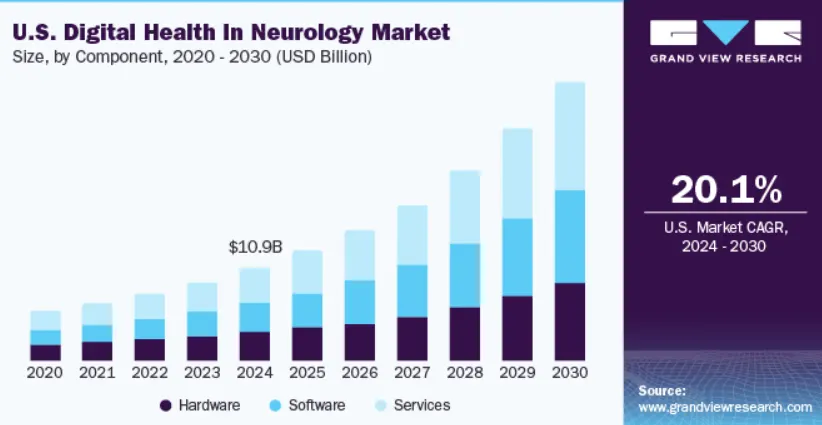
Source: Grand View Research
- Explosive Market Valuation: The digital neurology sector is moving toward a multi-billion-dollar valuation, driven by rising demand for accessible brain health management, early diagnostic tools, and scalable therapeutic interventions.
- Shift to Proactive Healthcare: Clinicians and patients are moving away from reactive treatments. The priority has shifted toward continuous monitoring, early detection, and long-term neuro-rehabilitation.
Consider the success of platform models like Calm. By turning mental resilience and baseline brain health tools into a daily consumer habit, the app scaled its business model to pull in over $200 million in annual revenue.
Building a product in this space requires more than basic mobile development. Success hinges on advanced machine learning algorithms, seamless data pipelines, and strict medical-grade compliance.
Digital Biomarkers Are Driving Innovation
Traditional neurological assessments often rely on episodic clinic visits and subjective self-reporting. Digital biomarkers change this dynamic completely by converting everyday device interactions into objective, actionable health metrics.
- Micro-Movement Tracking: Analyzing fine motor control, tap timing, and touch precision to detect early subtle indicators of motor-related neurodegenerative changes.
- Vocal Analytics: Capturing cadence, pitch variations, and micro-pauses in speech to evaluate cognitive strain, mood fluctuations, or neurological shifts.
- Eye-Tracking & Pupillometry: Using high-frame-rate mobile cameras to track saccadic movements, gaze stability, and visual focus metrics.
Capturing these continuous, passive data streams allows founders to offer genuine clinical value rather than generic surface-level advice. Building high-fidelity processing loops into consumer hardware is a complex engineering challenge. We design optimized mobile frameworks that run complex sensor processing locally, keeping latency low while ensuring sensitive patient data remains protected.
Why Investors Bet On Neuro Platforms
Investors are paying close attention to neuro health platforms because they solve a growing healthcare need while offering strong long-term business potential. Solutions that continuously collect neurological data become more valuable over time, giving healthcare providers better insights and creating a scalable business model.
MindMaze is a great example of this opportunity. Its neuro-rehabilitation platform reached over $35 million in annual revenue and achieved a billion-dollar valuation, showing how successful this market can become. Building your platform on a scalable architecture with secure data handling, HIPAA and GDPR compliance, and EHR integration helps position your product for enterprise adoption and future investment.
Overview of Altoida and Rune Labs
Precision neurology is shifting from traditional episodic care to continuous digital tracking. Companies like Altoida and Rune Labs lead this space by combining artificial intelligence with novel digital biomarkers. They replace subjective clinical evaluations with continuous objective measurements.
These platforms prove how software extracts actionable medical insights from everyday hardware. Their market success shows a clear path for digital health products to deliver high patient engagement along with strong venture returns. Developing a platform of this caliber requires deep technical capabilities:
- Signal Processing Pipelines: Converting raw smartphone and wearable inputs into clean clinical measurements
- Compliant Data Architecture: Building secure backends that comply with medical standards like HIPAA and GDPR without sacrificing processing speed
- Cross-Platform Delivery: Delivering lightweight user interfaces that maintain high performance across varied hardware
Turning complex medical requirements into scalable commercial applications requires engineering high-performance digital health backends, streamlining hardware integration, and structuring software platforms for long-term growth.
Early Cognitive Detection Via Altoida
Altoida targets early cognitive decline by turning consumer devices into sophisticated diagnostic instruments. Their platform uses augmented reality and spatial computing to evaluate micro-movements, reaction times, and spatial orientation during short interactive tests.
The technology measures fine motor control and spatial navigation to flag early cognitive impairment years before traditional symptoms surface. Altoida monetizes its platform through licensing partnerships with pharmaceutical enterprises, research institutions, and care providers. This enterprise model helped the platform secure over $21 million in total funding.
Key technical demands for spatial cognitive tools:
- AR Framework Optimization: Tracking micro-spatial variations smoothly without causing battery drain or frame drops
- On-Device Machine Learning: Running predictive models directly on smartphones to maintain instant feedback loops
- Scalable B2B Portals: Designing enterprise dashboards that aggregate population-level data for researchers
Building low-latency spatial applications for mobile platforms ensures complex algorithms process smoothly on standard consumer hardware, making early diagnostic tools accessible to global markets.
Precision Neurology At Rune Labs
Rune Labs focuses on neurodegenerative conditions like Parkinson disease by gathering continuous real-world data streams. Their StrivePD platform integrates with Apple Watch sensors and implanted deep brain stimulation devices to track tremors and medication response patterns.
This model replaces infrequent clinic visits with round-the-clock passive monitoring. Rune Labs translates continuous data streams into clear trends for clinicians and valuable real-world evidence for drug developers. This enterprise data strategy propelled the company toward an estimated $54.3 million in annual revenue. Building continuous ingestion pipelines requires robust engineering:
- Wearable OS Integration: Managing background sync efficiently on iOS and Android without draining device battery
- Scalable Data Lakes: Ingesting terabytes of raw time-series sensor data from thousands of active users simultaneously
- Clinical EHR Sync: Streaming structured patient metrics directly into hospital electronic health record systems
Software founders need high-throughput data pipelines that process continuous health streams securely. Structuring scalable cloud architectures accommodates millions of daily events, giving products the backbone required for enterprise partnerships.
Innovations Powering Next-Gen Brain Health
Both Altoida and Rune Labs prove that the future of neurology lies in passive, continuous, and objective measurement. The technological crossover between these platforms sets the blueprint for new investments in digital health:
- Multimodal Sensor Fusion: Merging movement, voice, and touch patterns into unified health scores
- Edge Computing: Running predictive AI locally on consumer hardware to maintain low latency and user privacy
- Enterprise Revenue Models: Monetizing through clinical trial integration, SaaS software licensing, and insurance reimbursements
How Is Altoida Transforming Early Cognitive Assessment?
Altoida modernizes cognitive assessment by using AI and everyday mobile devices to detect early changes in brain health. Instead of depending only on traditional clinical tests, it captures subtle behavioral patterns that help clinicians make earlier and more objective decisions. The platform also demonstrates how neuro health software can scale across healthcare systems while creating sustainable enterprise revenue.
1. Digital NeuroMarker Platform
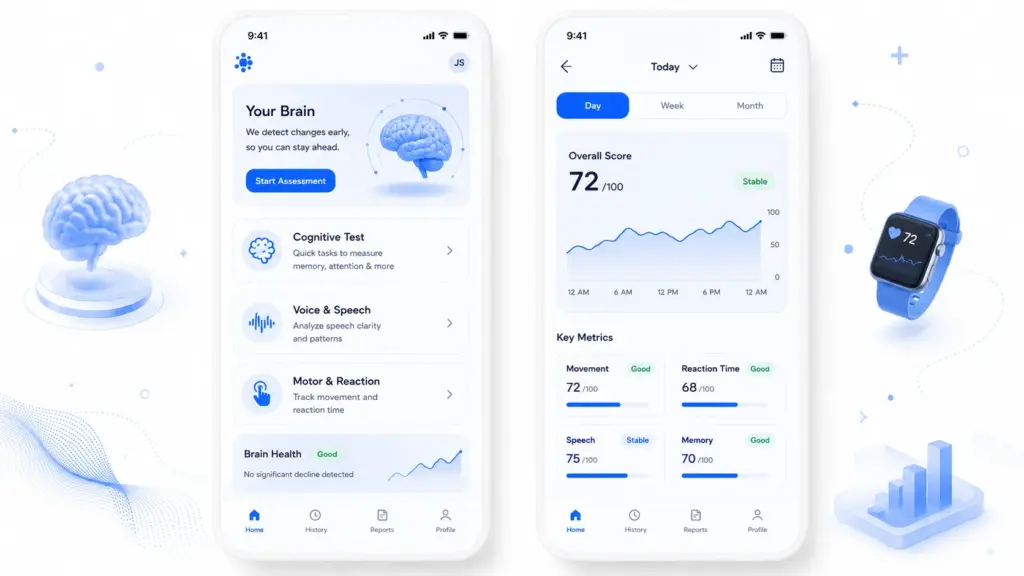
The Digital NeuroMarker Platform acts as a bridge between passive data collection and active clinical evaluation. It collects millions of raw data points across motor, speech, and spatial domains during brief user interactions. Key features powering the platform:
- Multimodal Data Capture: Ingesting touch pressure, tremor patterns, reaction timing, and voice metrics simultaneously
- On-Device Data Processing: Processing sensitive behavioral metrics locally to maintain patient privacy and data security
- Clinical EHR Connectivity: Exporting structured diagnostic reports straight into hospital health record systems
2. AI, AR, And Digital Biomarkers
Augmented reality plays a central role in Altoida’s testing strategy. The app guides users through immersive activities like hiding and finding virtual objects in a physical room, simulating complex everyday activities. These interactive tasks reveal cognitive strain through distinct biomarker signals:
- Micro-Spatial Mapping: Measuring precise orientation and movement fluidity as users navigate physical spaces
- Fine Motor Control: Tracking subtle tremors, hesitation pauses, and hand-eye coordination variations
- Gaze and Reaction Analytics: Evaluating visual search speed and focus adjustments during dynamic tasks
3. Detecting MCI Early
Mild Cognitive Impairment often goes unnoticed until significant damage occurs. Altoida addresses this challenge by identifying micro-level functional declines years before traditional paper tests can flag an issue. Early identification opens up high-value clinical and commercial opportunities:
- Timely Interventions: Enabling early lifestyle changes or pharmacological therapies when they remain most effective
- Optimized Clinical Trials: Helping pharmaceutical sponsors filter candidates more accurately for targeted clinical studies
- Lower Healthcare Costs: Reducing long-term care expenses by delaying the progression toward severe dementia.
How Rune Labs Is Building Precision Neurology for Parkinson’s Disease?
Traditional Parkinson’s care relies on brief clinical visits every few months. Rune Labs transforms this approach by capturing real-time neurological data directly from consumer devices. Their platform streams continuous sensor information into actionable insights, helping clinicians evaluate disease progression and adjust therapies.
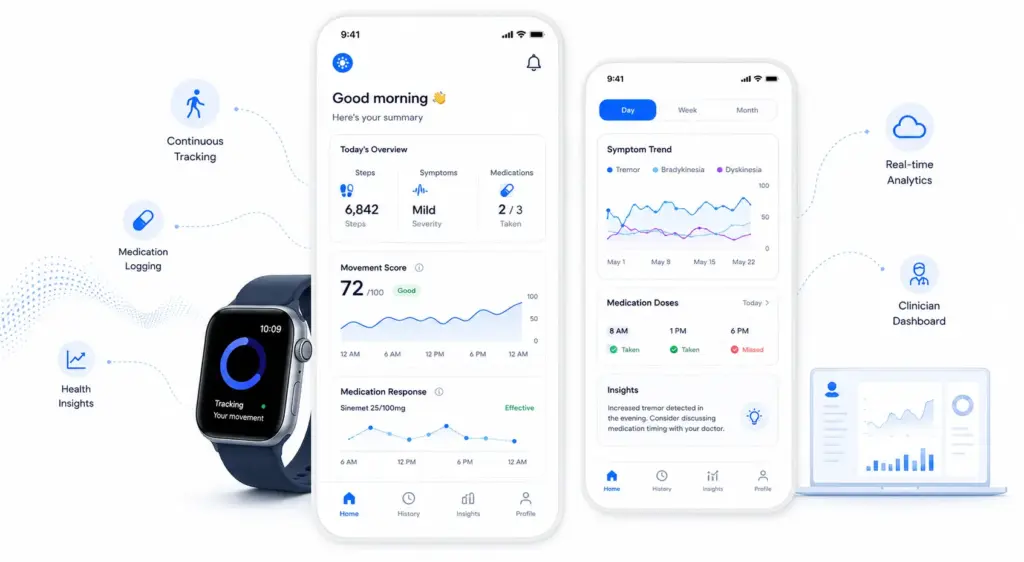
1. Continuous Parkinson’s Tracking
The StrivePD application acts as the primary patient interface within the Rune Labs platform. Running on Apple Watch and iOS hardware, it tracks symptoms without disrupting daily routines. Core capabilities driving the application:
- Passive Data Ingestion: Capturing involuntary movements and motor patterns automatically through the Apple Movement Disorder API.
- Medication Response Tracking: Logging dose times to show how specific drugs influence symptom severity over hours or weeks.
- Patient Empowerment: Giving individuals clear visual graphs of their daily health trends to share during appointments.
2. Real-Time Wearable Analytics
Raw sensor data becomes truly valuable when context is added. Rune Labs applies machine learning models to sensor streams, turning noisy movement data into structured clinical metrics. Key technical elements powering these real-time insights:
- Edge Processing: Filtering motion artifacts on the device to keep data payloads light and battery consumption low.
- Invasive Device Sync: Integrating data from implanted Deep Brain Stimulation devices alongside wearable metrics for deeper neurological context.
- AI Care Companions: Analyzing long-term trends to answer patient questions and generate visit summaries through specialized conversational models.
3. Dashboards For Personal Care
Neurologists need clear summaries rather than endless streams of raw sensor figures. Rune Labs delivers a dashboard that organizes patient data into clear trends, highlighting symptom spikes and medication gaps. Strategic benefits for healthcare providers:
- Efficient Consultations: Focusing clinic visits on objective data trends rather than relying solely on patient recall.
- Dosing Optimization: Adjusting medication schedules precisely based on measured side effects like dyskinesia.
- Remote Care Models: Supporting ongoing remote patient monitoring programs that generate new reimbursement channels for health networks.
Key Features of Neuro Health Apps Like Altoida and Rune Labs
Modern neuro health apps use consumer hardware and intelligent backends to reshape brain healthcare. By replacing periodic clinic visits with continuous tracking, apps like Altoida and Rune Labs collect rich real-world telemetry. Users interact with these platforms daily through brief interactive tasks, wearable integrations, and personalized AI assistants.
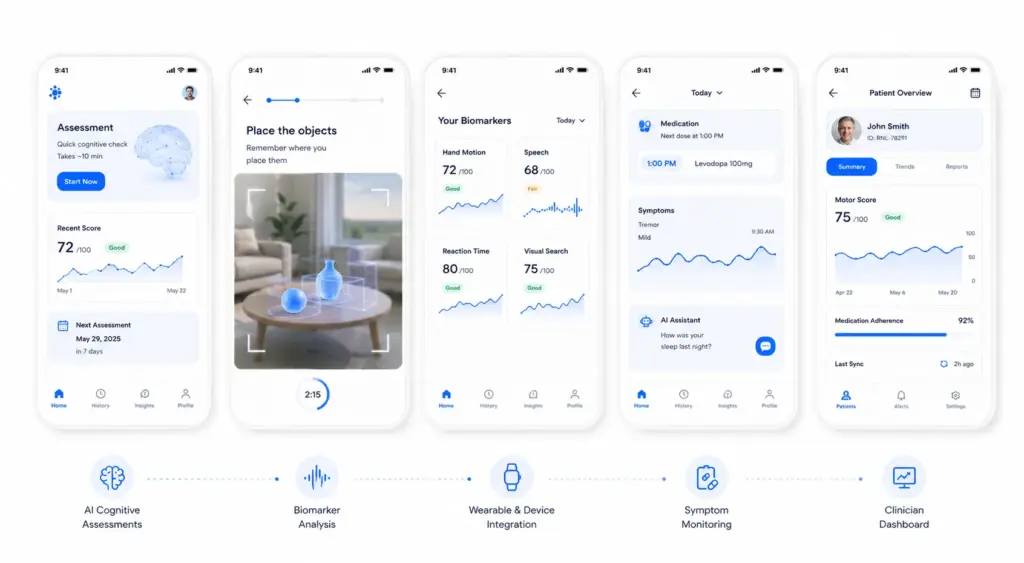
Here is how core features inside Altoida and Rune Labs operate across the patient and clinician journey.
1. AI Digital Cognitive Assessments
Patients complete interactive, game-like evaluations on standard tablets or smartphones in under 10 minutes. Inside Altoida, users place virtual objects around a room using augmented reality and relocate them later, simulating everyday tasks. AI algorithms process this interactive behavior immediately to flag subtle cognitive declines.
- Gamified Tasks: Guided AR activities replace long paper memory tests with quick spatial challenges.
- On-Demand Access: Users perform evaluations at home or during primary care checkups without needing specialist setups.
2. Digital Biomarker Collection And Analysis
Every tap, swipe, and movement during app interaction feeds into a behavioral dataset. Altoida tracks micro-tremors, visual search paths, and speech pauses while users perform digital tasks. The platform converts these subtle physical behaviors into objective neurological scores.
Key signals captured during app usage:
- Kinematic Metrics: Measuring hand micro-movements, hesitations, and touch pressure variations.
- Speech Patterns: Evaluating voice acoustics and cadence changes during conversational tasks.
3. Wearable And Medical Device Integration
Passive sensing allows platforms to monitor physical health continuously throughout the day. Users pair the Rune Labs StrivePD app with an Apple Watch or implanted deep brain stimulation devices. The app runs in the background, syncing health metrics automatically without manual logging.
- Background Movement Sync: Apple Watch sensors stream continuous motor data straight into Rune Labs.
- Neuro-Device Telemetry: Direct integrations with deep brain stimulators track electrical pulse adjustments.
4. Symptom And Disease Monitoring
Patients manage their condition using daily interactive logs and automated tracking. Inside Rune Labs StrivePD, users log medication times, track tremor fluctuations, and record side effects like dyskinesia. The app overlays medication schedules on physical motion graphs to show drug effectiveness.
Core tracking features for patients:
- Medication Reminders: Interactive notifications prompt users to log doses and record off-time symptoms.
- AI Conversational Chat: Subscribing to StrivePD Guardian gives users an AI companion to ask daily health questions.
5. Clinician Dashboards
Physicians access web portals that summarize months of continuous patient data into clear trends. Neurologists log into Rune Labs or Altoida provider portals before appointments to review objective symptom reports. This eliminates reliance on subjective patient memory.
- Longitudinal Trend Graphs: Visualizing symptom spikes against exact medication dose times.
- Automated Summaries: AI algorithms compile weeks of telemetry into concise visit notes.
6. Treatment And Care Management
Longitudinal data helps care teams adjust treatments based on real-world patient responses. Clinicians viewing Rune Labs dashboards adjust Parkinson’s medication timings or alter neuro-stimulator settings based on measured side effects. Altoida provider reports help doctors personalize cognitive interventions early.
Value driven by personalized models:
- Dose Optimization: Fine-tuning drug schedules to minimize motor fluctuations and dyskinesia.
- Proactive Interventions: Catching early functional changes before severe complications arise.
7. Clinical Trial And Research Support
Pharmaceutical sponsors use these platforms to streamline clinical research and trial management. Trial participants use Altoida or Rune Labs at home to complete study protocols and submit continuous data. Researchers track real-world evidence remotely to evaluate drug efficacy faster.
- Targeted Screening: Altoida identifies qualified candidates for Alzheimer’s trials using digital biomarkers.
- Continuous Endpoint Data: Rune Labs feeds precise daily motor measurements directly into pharma drug development pipelines.
How to Build a Neuro Health App Like Altoida and Rune Labs?
Building a successful precision neurology platform requires balancing clinical accuracy with an intuitive digital experience. We help founders transform complex neurological workflows into scalable applications that capture meaningful clinical data while delivering an engaging experience for both patients and healthcare providers.
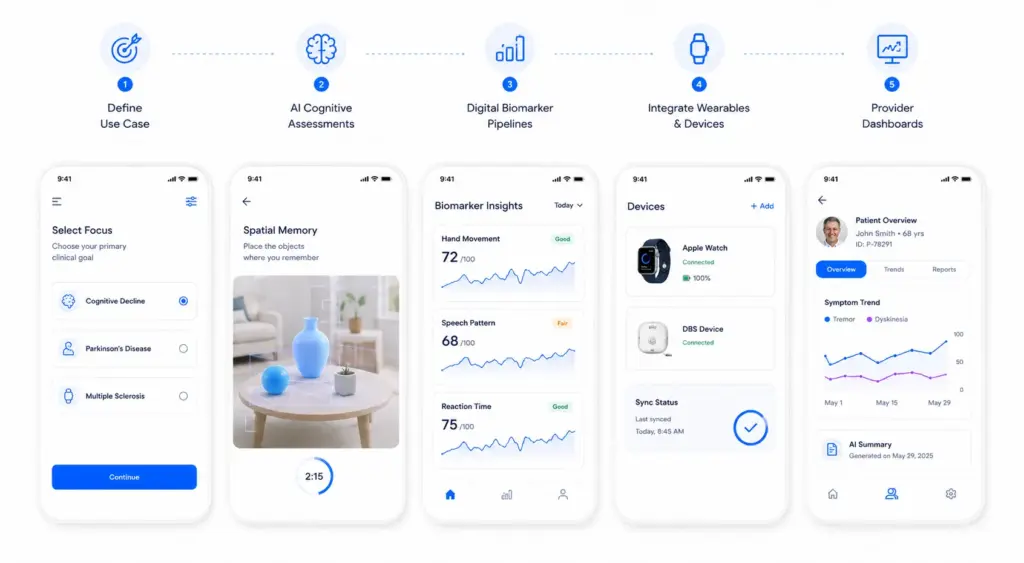
1. Define Your Care Use Case First
Every successful brain health app begins with a focused clinical goal rather than trying to address every neurological disorder from the start. We work with founders to define the right use case and build workflows that match real clinical needs. This creates a stronger product foundation, speeds up validation, and makes it easier to scale the platform as adoption grows.
2. Design AI Cognitive Assessments
Standard questionnaires fail to capture micro-level changes in brain health. AI-driven testing uses interactive tasks to measure real-time behavioral responses on standard mobile hardware. Interactive elements that drive higher diagnostic accuracy:
- Augmented Reality Tasks: Guiding users through spatial exercises to evaluate memory and orientation.
- Voice Analytics: Capturing speech cadence and micro-pauses during brief reading exercises.
- Kinematic Tracking: Measuring finger tap timing and touch pressure during screen interactions.
We design low-latency assessment engines that process machine learning models locally on smartphones, keeping evaluation sessions smooth and secure.
3. Build Digital Biomarker Pipelines
Reliable digital biomarkers come from clean and accurate sensor data rather than raw smartphone readings alone. We develop intelligent data pipelines that remove unnecessary noise, capture meaningful neurological signals, and process large volumes of data efficiently. This helps deliver more dependable clinical insights while keeping the platform scalable as patient usage grows.
4. Integrate Wearables And Devices
Continuous patient monitoring is only effective when wearable devices and medical hardware work seamlessly with the app. We create secure integrations that connect smartwatches and clinical devices while optimizing battery life and data synchronization. This helps deliver reliable health insights without affecting the everyday user experience.
5. Develop Provider Dashboards
Physicians do not have time to comb through thousands of raw data points. Web dashboards must translate continuous telemetry into clear visual trends that fit naturally into clinical workflows. Critical dashboard features for medical providers:
- Visual Trend Lines: Plotting symptom spikes against exact medication dose times.
- Automated Clinical Summaries: Compiling weeks of patient metrics into brief PDF export summaries.
- EHR Interoperability: Connecting provider dashboards straight to hospital electronic health record systems via FHIR standards.
We engineer intuitive provider portals that present complex health datasets clearly, helping clinicians make faster care decisions.
6. Ensure Compliance And Security
Handling sensitive neurological data requires strict adherence to global healthcare privacy regulations. Compliance cannot be an afterthought when pitching enterprise buyers or institutional investors.
- End-To-End Encryption: Securing patient data both in transit and at rest using advanced encryption standards.
- Access Control: Implementing strict role-based permissions and audit logs across all platform services.
- Regulatory Alignment: Structuring software architecture to meet Software as a Medical Device standards for FDA clearance.
We embed enterprise-grade security protocols into your platform backend from day one, giving buyers total confidence in your data governance.
7. Validate And Scale Platform
A neuro health app gains real traction when it is tested in clinical environments before expanding to a wider audience. We support this journey by helping validate the platform, improve it with real user feedback, and prepare it for enterprise adoption across hospitals, healthcare providers, and research organizations.
Cost of Developing a Neuro Health App Like Altoida and Rune Labs
Building a neuro health app requires a clear understanding of specialized engineering investments. The overall budget depends on whether your platform targets cognitive evaluation through spatial computing or continuous motor tracking using wearable sensors.
Estimated Cost of An Altoida-Like Platform
Creating an AI-driven cognitive assessment tool involves integrating augmented reality, spatial tracking, and machine learning. Here is a breakdown of the typical investment required across development phases.
| Development Scope | Estimated Cost (USD) |
| MVP with cognitive assessments | $80,000–$150,000 |
| AI + Digital Biomarker Platform | $150,000–$280,000 |
| AR-based assessments | $40,000–$90,000 |
| Clinician Dashboard | $35,000–$70,000 |
| Healthcare Integrations | $30,000–$80,000 |
| Enterprise Platform | $300,000–$600,000+ |
Key technical cost drivers for cognitive platforms:
- AR Cognitive Testing: Calibrating smartphone cameras and spatial frameworks to measure physical orientation without lag.
- AI Model Engineering: Training computer vision and behavioral models to spot micro-level motor delays accurately.
- Biomarker Analytics: Structuring pipelines to isolate genuine cognitive indicators from background handling noise.
- Sensor Fusion: Merging touch pressure, eye movement, and motion metrics into unified patient profiles.
- Compliance Frameworks: Structuring cloud architectures to meet HIPAA and Software as a Medical Device standards.
Our engineering team builds low-latency spatial assessment tools, ensuring your algorithms run smoothly across standard mobile devices while managing cloud backend costs.
Estimated Cost of a Rune Labs-Like Platform
Continuous remote monitoring platforms rely heavily on background data sync, wearable device APIs, and high-throughput ingestion pipelines.
| Development Scope | Estimated Cost (USD) |
| MVP for Parkinson’s monitoring | $90,000–$170,000 |
| Wearable integrations | $50,000–$120,000 |
| Remote patient monitoring | $40,000–$90,000 |
| AI analytics platform | $80,000–$180,000 |
| Clinician dashboards | $40,000–$80,000 |
| Enterprise Precision Neurology Platform | $350,000–$700,000+ |
Key technical cost drivers for motor tracking platforms:
- Wearable OS Integration: Optimizing background sensor sync on Apple Watch and Android Wear without causing battery drain.
- Longitudinal Data Lakes: Engineering scalable cloud storage to hold millions of continuous time-series data points.
- Pattern Recognition AI: Running machine learning algorithms that identify tremor spikes and medication side effects.
- Monitoring Dashboards: Building web portals that organize weeks of raw telemetry into intuitive graphs for neurologists.
- Interoperability Standards: Connecting platform backends directly with hospital Electronic Health Records via FHIR APIs.
We design high-throughput data backends that handle continuous wearable streams securely, helping you maintain fast processing speeds as your active user base grows.
Factors Influencing Development Costs
Final development budgets vary based on architectural choices, integration depth, and regulatory scope.
- AI Model Complexity: Training proprietary neural networks on large datasets costs significantly more than integrating existing third-party APIs.
- Biomarker Engine Scope: Converting raw accelerometer and voice inputs into clinical metrics requires specialized signal processing expertise.
- Hardware Interoperability: Custom Bluetooth protocols for implanted deep brain stimulators increase QA testing hours compared to standard smartwatch APIs.
- EHR Integration: Building custom FHIR and HL7 data bridges for hospital systems adds engineering overhead but unlocks enterprise B2B sales.
- Security Standards: Implementing end-to-end encryption, role-based access controls, and audit trails ensures compliance across global health networks.
- Clinical Testing Support: Running structured pilot studies with academic partners requires continuous platform iterations based on physician feedback.
Revenue Streams for Neuro Health Apps Beyond Patient Subscriptions
Relying solely on consumer subscriptions often limits growth in digital health. High-net-worth investors and platform founders favor B2B models that generate recurring, enterprise-scale contracts. Diversifying revenue channels creates stronger data moats while building stable enterprise valuation over time. Here is how modern neuro health platforms monetize beyond direct-to-consumer app fees.
1. Licensing For Health Systems
Health networks buy digital brain platforms to improve patient care and optimize clinical operations. Enterprise licensing models charge medical networks annual enterprise fees based on patient volume, active clinician seats, or hospital department deployments. Plagued by fragmented patient tracking, health systems use platforms like MindMotion by MindMaze to guide neuro-rehabilitation remotely.
By selling enterprise software suites straight to clinics, MindMaze generated $35 million in annual revenue while securing multi-year hospital contracts.
Strategic enterprise value drivers:
- Remote Patient Monitoring Billing: Enabling hospitals to bill insurance via dedicated CPT codes for continuous telemetry tracking.
- Reduced Readmission Rates: Helping clinics spot early functional declines before patients require costly emergency readmissions.
- Integrated Care Dashboards: Streamlining patient monitoring directly inside hospital electronic health record systems.
2. Clinical Research Partnerships
Pharmaceutical developers spend billions identifying qualified candidates for clinical trials and proving drug efficacy. Neuro health platforms monetize their user base by offering digital biomarker screening and real-world evidence collection for clinical studies. Cogstate built a lucrative business around this model, providing computerized cognitive assessments directly to clinical trial sponsors.
Their specialized research software and data endpoint services helped the company cross $44 million in annual revenue, driven primarily by multi-year pharmaceutical contracts.
High-margin pharma partnership opportunities:
- Trial Recruitment Portals: Filtering qualified patients for Alzheimer’s or Parkinson’s trials using objective digital biomarkers.
- Digital Endpoint Licensing: Selling validated cognitive testing software to measure therapeutic impact during clinical drug trials.
- Real-World Evidence Datasets: Aggregating anonymized longitudinal symptom data to accelerate drug development pipelines.
3. API Licensing And Ecosystems
Proprietary algorithms that measure micro-tremors, speech cadence, or spatial orientation carry significant commercial value beyond a single mobile application. Licensing these analytical models via developer APIs creates a scalable B2B revenue pipeline. Kinsa demonstrated the power of aggregation by processing continuous symptom data from connected consumer devices.
By licensing real-time disease prevalence APIs and predictive analytics to enterprise partners and regional care networks, the company generated millions in annual business data licensing revenue. Key commercial benefits of API licensing:
- Hardware Integrations: Licensing motor analytics tools to wearable device manufacturers looking to add brain health tracking.
- Third-Party Health Apps: Supplying predictive cognitive algorithms to broader wellness software platforms via cloud APIs.
- Zero-Marginal-Cost Distribution: Monetizing proprietary software IP globally without incurring direct patient acquisition costs.
Build a Neuro Health App with IdeaUsher
Building a successful neuro health platform takes more than strong technology because it also requires a deep understanding of clinical workflows and healthcare regulations. We work with founders to build secure, scalable applications that deliver real clinical value while creating a smooth experience for patients and healthcare providers.
Build AI Platforms With Expertise
Building AI engines capable of extracting digital biomarkers requires deep technical execution. We engineer custom machine learning models that analyze kinetic, visual, and vocal data streams on standard consumer devices. Our core engineering capabilities include:
- Signal Processing Engines: Cleaning real-time sensor streams to isolate micro-tremors, reaction lag, and speech hesitation.
- Spatial Computing Integrations: Designing low-latency augmented reality tasks for spatial orientation testing.
- Smart On-Device Analytics: Running machine learning algorithms directly on mobile hardware to maintain low latency and data privacy.
Working with us gives you direct access to experienced product strategists and software engineers who know how to turn raw sensor data into validated clinical value.
Develop Secure And Compliant Solutions
Protecting patient data and meeting healthcare regulations are critical for building trust in a neuro health platform. We design secure, compliant systems with HIPAA and GDPR standards, seamless EHR connectivity, and enterprise-ready infrastructure so your platform is prepared for healthcare organizations and future growth.
Scale From MVP To Enterprise Platforms
Launching a digital health product is a step-by-step journey that balances speed-to-market with long-term platform stability. We guide you from early functional prototypes all the way through full-scale commercial deployments.
- Rapid MVP Deployment: Building lean, feature-focused MVPs designed to validate digital biomarkers in early clinical trials quickly.
- Scalable Microservices Backend: Structuring high-throughput cloud architectures capable of processing continuous data streams from millions of active users.
- Dedicated Engineering Teams: Providing continuous platform updates, performance monitoring, and technical scaling as your enterprise customer base expands.
Conclusion
Building a neuro health app like Altoida or Rune Labs starts with understanding a real clinical need and creating a platform that healthcare providers can rely on. The right mix of AI, secure infrastructure, and intuitive design helps deliver meaningful patient insights while supporting long-term growth. As digital neurology continues to evolve, businesses that build with scalability and clinical value in mind will be better positioned for success.
Things to Know About Neuro Health Apps
A1: A neuro health app helps people monitor and manage neurological conditions through their smartphone or connected devices. Instead of waiting for occasional doctor visits, these apps allow patients to track symptoms, complete cognitive assessments, and share health data with their care team. Many modern platforms also use AI to identify changes over time, helping clinicians make more informed treatment decisions and intervene earlier when needed.
A2: AI-powered neuro health apps collect information from sources such as cognitive tests, wearable devices, and patient-reported symptoms. The AI looks for patterns that may indicate changes in a person’s neurological health and presents those insights in an easy-to-understand format for both patients and clinicians. This allows healthcare providers to monitor progress between appointments and make treatment decisions based on continuous, real-world data instead of a single clinical visit.
A3: Digital biomarkers are health measurements collected through everyday digital devices instead of traditional laboratory tests. They can include information about movement, balance, speech, sleep, memory, or reaction time. Because these measurements are gathered regularly, doctors gain a clearer picture of how a neurological condition changes over time and whether a treatment is having the desired effect.
A4: Neuro health apps are commonly used for conditions such as Alzheimer’s disease, Parkinson’s disease, Mild Cognitive Impairment (MCI), epilepsy, multiple sclerosis, and stroke recovery. The exact features depend on the condition, but most platforms help patients monitor symptoms, stay on top of medications, complete assessments from home, and remain connected with their healthcare providers throughout their treatment journey.