


Key Takeaways
- Healthcare billing relies on manual processes, but AI-powered solutions automate tasks and improve accuracy.
- AI in revenue cycle management is projected to grow from USD 25.15 billion in 2025 to USD 219.48 billion by 2035.
- Platforms like Tennr and AKASA target different billing problems; Tennr focuses on intake while AKASA optimizes coding and claims management.
- Building a successful Healthcare Billing App requires automation, compliance, and deep integration with existing systems.
- Investors show strong interest in AI healthcare billing startups due to their potential for high ROI and demand for automation.
For years, healthcare billing has depended on manual work and outdated workflows. As the volume of claims continues to grow, managing reimbursements has become more challenging for healthcare providers. AI-powered billing platforms are changing this by automating routine tasks, improving claim accuracy, and helping organizations get paid faster. They also reduce the workload on billing teams so they can spend more time resolving complex cases instead of handling repetitive work.
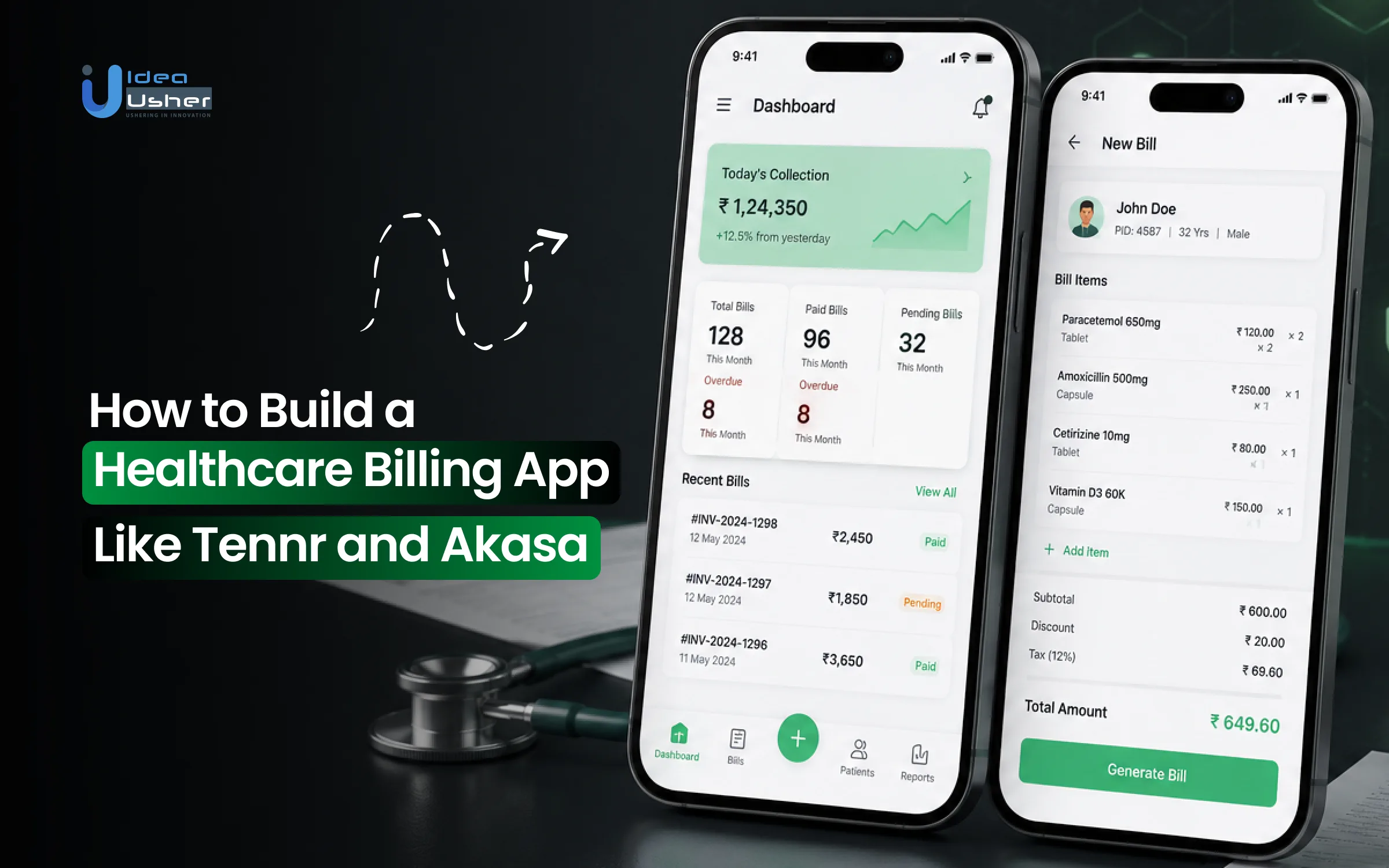
Healthcare billing is becoming increasingly AI-driven, and building a reliable platform requires a deep understanding of clinical workflows, medical coding, and payer requirements. Having worked on AI-powered healthcare solutions, we’ve seen what makes these platforms successful. In this blog, we’ll break down what goes into making a healthcare billing app like Tennr and AKASA.
Market Potential of AI-Powered Revenue Cycle Management
According to Novaone Advisor, the AI in revenue cycle management market was valued at USD 25.15 billion in 2025 and is projected to reach USD 219.48 billion by 2035, growing at a 24.19% CAGR. As healthcare providers look for faster and more accurate billing, AI is becoming the preferred way to automate claims, reduce errors, and improve revenue collection.

Source: Novaone Advisor
Why Hospitals Invest in AI Billing
Hospitals operate on razor-thin margins. Revenue leaks directly threaten their survival, and intelligent billing software addresses these financial risks head-on.
- Rising Claim Denials
Insurers use automated checks to flag minor coding errors. Manual teams struggle to keep pace with these frequent rejections. - Severe Staffing Shortages
Turnover among billing personnel remains high. Hospitals struggle to hire and retain enough skilled workers to manage workloads. - Increasing Regulations
Payer rules change constantly. Machine learning models adapt to updated guidelines instantly to prevent costly mistakes. - Operational Bottlenecks
Manual verification slows cash flow. Modern software checks eligibility instantly and catches errors before filing.
Automating these workflows helps health systems secure cash flow faster while cutting back-office costs.
Strong Startups Opportunity
Building an intelligent billing platform offers a clear path to high-margin recurring software revenue. Healthcare leaders are actively searching for automation partners, creating a strong window for new market entrants.
| Strategic Advantage | Investor Impact |
| High Enterprise Demand | Health systems pay top dollar for tools that cut claim denials. |
| Sticky SaaS Revenue | Once integrated into financial workflows, platforms keep clients for years. |
| Proven Precedents | Companies like Tennr and AKASA demonstrate clear market validation. |
| Clear ROI for Clients | Providers see immediate financial returns as claims clear faster. |
Startups in this sector gain immediate market leverage. Health networks buy these platforms to protect their bottom line, allowing well-designed software to scale rapidly and lock in long-term enterprise contracts.

Different Problems Tennr and AKASA Solve in Healthcare Operations
Before diving into specific product architectures, founders and investors must understand where healthcare operations break down. While companies like Tennr and AKASA both use artificial intelligence to solve operational gridlock, they target entirely different stages of the patient journey. Selecting the right focus area determines your platform architecture, target buyer, and initial go-to-market strategy.
Tennr Automates Intake
Tennr builds AI software for front-end medical operations. The platform uses machine learning and computer vision to process unstructured referral documents and speed up intake. Traditional intake creates serious administrative bottlenecks. When referral paperwork arrives via fax or email, staff must manually transcribe patient details. This manual workload leads to long scheduling delays and lost revenue.
Key Problems Tennr Solves:
- Unstructured Data Extraction
Reads messy medical records and extracts required insurance details instantly. - Prior Authorization Delays
Identifies payer requirements early to secure approvals before appointment dates. - High Referral Drop-Off
Faster intake prevents patients from seeking care at competing medical networks. - Staff Overload
Eliminates manual data entry so patient access teams focus on patient care.
Fixing these front-end hurdles keeps clinical calendars full and speeds up care delivery.
AKASA Optimizes Billing
AKASA focuses on post-visit revenue operations. The platform uses generative AI and machine learning to automate complex coding, claim submissions, and denial management for health systems. Medical billing breaks down easily after a patient leaves the facility. Uncollected bills and claim rejections directly impact provider margins. AKASA sits on top of existing electronic health record systems to manage these post-care financial workflows.
Key Problems AKASA Solves:
- Coding Inaccuracies
Translates complex physician charts into billing codes automatically. - Claim Denial Patterns
Analyzes historical payer trends to catch errors before submitting claims. - Revenue Leakage
Identifies underpayments and recovers missing revenue without extra staff. - Complex Payer Rules
Adapts to frequent changes in insurance billing policies automatically.
Automating these back end tasks helps hospitals collect full payment faster.
Patient Access vs. Billing
Deciding between patient access and revenue cycle depends on your technical capability and go to market strategy. Both models offer strong returns for investors. Building a patient access platform gives you a faster path to initial revenue. Medical practices adopt intake tools quickly because they drive immediate patient volume.
| Strategic Dimension | Patient Access (Tennr Model) | Revenue Cycle (AKASA Model) |
| Core Focus | Intake, referrals, prior authorization | Coding, claims, denial management |
| Primary Value | Increases patient volume and retention | Protects profit margins and cash flow |
| Sales Cycle | Faster adoption with practice managers | Longer sales cycles with health system CFOs |
| Data Requirements | Document parsing and OCR models | Deep integrations with EHR systems |
Building a revenue cycle platform requires deeper integrations and higher security compliance. However, back-end platforms command larger enterprise contracts and deliver high long-term retention.
How Tennr Uses AI to Eliminate Referral Bottlenecks?
Tennr provides an AI automation platform designed for front-office medical operations. By converting chaotic fax feeds and patient charts into structured data, the platform eliminates scheduling delays. Armed with $162 million in total capital and rapid revenue growth across large provider networks, Tennr validates the massive commercial opportunity in automating intake workflows.

1. Automated Document Intake
Healthcare practices collect incoming referrals from faxes, web portals, EHRs, and emails. Processing these records manually ties up staff and slows down care delivery. Tennr uses proprietary computer vision and language models trained on millions of medical records to read unstructured documents. The system categorizes document types, extracts demographic information, and indexes chart notes without human data entry.
By turning messy PDFs and faxes into clean records automatically, intake teams avoid hours of typing and copy-pasting.
2. Payer Requirements Mapping
Extracting patient text is only half the battle. Insurance companies enforce strict rules for prior authorizations and coverage eligibility. Tennr evaluates patient records against complex insurance policies to confirm coverage instantly.
How Tennr Streamlines Approvals:
- Payer Criteria Matching
Cross-references patient chart notes directly against policy guidelines to verify coverage. - Gap Detection
Flags missing lab reports or signed doctor orders before insurance submission. - Eligibility Checks
Runs live coverage checks with payer databases to prevent claim rejections. - Volume-Based SaaS Pricing
Tennr charges customized subscription fees based on monthly document throughput and active provider counts.
Catching missing records early protects practice revenue and prevents billing denials downstream.
3. Intelligent Patient Routing
After verifying insurance details, Tennr manages the rest of the patient journey automatically. The system triages incoming referrals based on clinical urgency and policy needs rather than simple arrival time. The system sends automated updates to notify patients and request missing information. It forwards completed care packages straight to schedulers, eliminating phone tag between medical offices.
Automating this care pipeline helps health systems increase appointment throughput, eliminate intake backlogs, and drive immediate bottom-line growth.
How AKASA Applies Healthcare-Specific LLMs to Revenue Cycle Automation?
AKASA builds specialized generative AI tools trained specifically on clinical records and healthcare revenue cycle workflows. The platform uses custom machine learning models to automate complex coding, prior authorization checks, and denial management across major health systems.
Market momentum in this space is substantial. To put investor interest into perspective, adjacent health tech platforms like Tennr have reached $162M in venture funding and a $605M valuation, demonstrating strong demand for systems that automate medical operations.
AI Referral & Document Processing
Healthcare practices process referrals from faxes, patient portals, emails, and electronic health record systems. Handling these files manually creates administrative backlogs and delays essential patient care. Intelligent systems use machine learning models trained on millions of medical pages to process unstructured documents. The software extracts key patient data, indexes clinical notes, and categorizes files automatically, saving administrative teams from hours of manual entry.
Payer Requirements Mapping
Extracting text is only the first step. Insurance companies enforce strict rules for coverage eligibility and prior authorizations. AI platforms match patient records directly against insurance guidelines to confirm coverage before service delivery.
Streamlining Prior Approvals:
- Policy Matching: Cross-references physician chart notes against specific insurer policies to verify coverage.
- Gap Detection: Flags missing lab reports or signed physician orders before submitting paperwork to insurers.
- Eligibility Checks: Runs real-time coverage checks with insurance clearinghouses to prevent rejections.
- Flexible SaaS Models: Platforms like Tennr typically charge recurring software fees scaled by provider count or document volume.
Catching missing information early protects health system cash flow and prevents costly claim rejections downstream.
Intelligent Patient Routing
Once coverage details are clear, automated systems manage the remaining workflow steps. The software prioritizes incoming cases based on clinical urgency and policy needs rather than simple arrival time. The system sends automated updates to notify patients and request missing information. It routes completed care packages directly to schedulers, eliminating phone tag between medical offices.
Automating this care pipeline helps health systems eliminate intake backlogs, improve scheduling speeds, and capture revenue faster.
Key Features of Healthcare Billing App Like Tennr and Akasa
Healthcare teams use Tennr to automate referral intake, verify insurance, and route patients to the right care. At the same time, AKASA helps billing and revenue cycle teams streamline medical coding, monitor claims, and resolve denials more efficiently through AI healthcare billing apps.

1. AI Intake & Document Processing
Tennr ingests incoming referrals from faxes, emails, EHRs, and web portals using proprietary vision and language models. The system extracts patient demographics, clinical histories, and insurance details automatically without manual typing. When required records are missing, Tennr flags the gaps immediately so staff can request paperwork before care begins.
2. Intelligent Patient Routing
Tennr matches patient records against specific payer rules to confirm eligibility and manage prior authorizations before scheduling.
- Priority Triage: Orders incoming cases based on clinical urgency and insurer guidelines instead of arrival time.
- Eligibility Checks: Runs live insurance verification directly with clearinghouses to prevent coverage issues.
- Automated Outreach: Sends automated notifications to patients to collect missing insurance forms and confirm appointments.
- Care Path Routing: Directs verified referral packages straight to specialty schedulers to remove booking delays.
3. AI Medical Coding & Documentation
AKASA reviews physician notes and clinical charts using generative AI trained on healthcare data. The system identifies missed coding opportunities and assists Clinical Documentation Improvement teams. Fixing documentation errors early ensures claims reflect the full scope of care provided.
4. Claims & RCM Optimization
AKASA automates post-visit financial operations to protect provider margins and accelerate collections.
| Feature | Operational Benefit |
| Claim Status Tracking | Monitors payer portals continuously to identify payment delays. |
| Denial Prevention | Flags potential coding or billing errors before claims are submitted. |
| Authorization Audit | Cross-references active claims with prior authorization numbers automatically. |
| Revenue Integrity | Detects underpayments and recovers missing revenue without extra administrative work. |
5. AI Analytics & Decision Support
AKASA equips revenue cycle executives with AI-powered analytics and operational dashboards. The platform tracks key performance indicators like accounts receivable days, claim rejection rates, and staff productivity metrics. Integrated clinical search features allow billing teams to review historical documentation instantly during audit checks.
6. Enterprise Integrations & Compliance
Both Tennr and AKASA connect directly with leading electronic health record systems, practice management software, and payer networks.
- HIPAA Compliance: Applies strict data protection protocols for processing protected health information (PHI).
- Role-Based Access Control: Limits data visibility to authorized medical, billing, and administrative personnel.
- Audit Logging: Tracks every data extraction, document modification, and system decision for security compliance.
- Secure Data Exchange: Ensures safe transmission of patient files across provider networks and insurance clearinghouses.
How to Build a Healthcare Billing App Like Tennr and Akasa?
Building an AI-powered healthcare billing app requires the right mix of automation, scalability, and healthcare compliance. At Idea Usher, we design and develop production-ready AI billing platforms that help healthcare organizations streamline operations and grow with confidence.
1. Define Workflow Goals
Before writing code, product leaders must pinpoint where their software sits in the operational stack. Attempting to automate the entire revenue cycle from day one often leads to bloat and delayed launches. Our product engineering team works directly with founders to analyze target provider pain points, define core functional scopes, and design high-impact minimum viable products that deliver immediate ROI.
2. Design AI Workflows
Modern healthcare platforms rely on AI models designed to parse messy medical files, extract clinical entities, and match records against insurer guidelines. We engineer customized document processing pipelines that integrate computer vision, natural language processing, and generative AI directly into your platform’s operational workflows.
3. Build Secure Data Infrastructure
Handling Protected Health Information demands institutional-grade data security. A single compliance violation can ruin a growing health tech business. We build HIPAA-compliant cloud architectures from line one, implementing end-to-end data encryption, granular user access, and automated audit trails so your platform passes security reviews with enterprise health systems.
4. Integrate Core Systems
A billing app is only as strong as its integrations. Healthcare software must connect seamlessly with existing systems to pull patient charts and send claim files.
- EHR Systems
Bi-directional data exchange via FHIR and HL7 standards with Epic, Cerner, and Athenahealth. - Insurance Clearinghouses
Direct connections to electronic data interchange (EDI) rails like 270/271 for eligibility checks and 837/835 for claims and remittances. - Payer Portals
Automated scraping and API integrations to monitor claim status and verify prior authorization policies.
Our engineers handle complex health tech interoperability, enabling your software to exchange data without breaking client operations.
5. Train Medical AI Models
Generic AI models fall short when parsing complex clinical jargon and changing payer rules. Systems must be trained on actual medical charts, billing codes, and policy documents. We help clients train, fine-tune, and validate specialized models on domain-specific datasets to maximize processing accuracy.
| Model Focus | Capability | Operational Goal |
| Document NLP | Parses doctor notes and faxes | Extracts patient data and chart notes |
| Medical Coding LLM | Maps charts to ICD-10 and CPT codes | Reduces coding errors before submission |
| Rule Validation Engine | Evaluates records against insurer rules | Prevents authorization and billing denials |
6. Validate with Human Review
Healthcare AI requires a safety net. Human-in-the-Loop workflows ensure billing specialists and coders can review AI suggestions before final claim submissions. We design intuitive review interfaces that highlight flagged fields and missing documents, enabling human reviewers to process records faster while continuously feeding corrections back into the AI engine.
7. Deploy, Track, and Scale
Deploying a healthcare billing platform requires phased implementations, real-time performance tracking, and model updates as payer guidelines evolve. At Idea Usher, we partner with founders beyond product launches, providing ongoing maintenance, real-time analytics dashboards, and system optimizations. Whether you are looking to hire a dedicated development team or build an enterprise-grade AI billing app from the ground up, we provide the technical expertise to turn your vision into a market-ready platform.
Cost to Build a Healthcare Billing App Like Tennr and Akasa
Evaluating the cost to build an AI-powered healthcare billing app requires looking at your target scope, technology stack, and compliance requirements. Developing software focused on front-office referral intake like Tennr carries a lower entry point than building an enterprise back-office coding and denial engine like AKASA.
Cost to Build an App Like Tennr
Building a production-ready referral automation platform takes 8 to 12 months. Early-stage healthcare apps require investments in computer vision, OCR document processing, and HIPAA compliance layers to process patient records securely.
| Development Stage | Estimated Cost (USD) |
| Product Discovery & Planning | $10,000–$20,000 |
| UI/UX Design | $15,000–$30,000 |
| AI Referral Intake & OCR | $35,000–$70,000 |
| Document Intelligence & NLP | $40,000–$80,000 |
| Referral Workflow Engine | $30,000–$60,000 |
| Patient Scheduling & Routing | $20,000–$40,000 |
| EHR & FHIR Integrations | $30,000–$70,000 |
| Insurance & Prior Authorization | $25,000–$50,000 |
| Admin Dashboard & Analytics | $20,000–$40,000 |
| HIPAA Security & Compliance | $20,000–$45,000 |
| QA, Testing & Deployment | $20,000–$40,000 |
| Estimated Total | $265,000–$545,000 |
Cost to Build an App Like AKASA
Building an enterprise revenue cycle system requires 12 to 18 months. Development budgets run higher because solutions like AKASA require domain-specific LLMs, clinical NLP pipelines, deep EHR integrations, and Human-in-the-Loop validation tools.
| Development Stage | Estimated Cost (USD) |
| Product Discovery & Architecture | $15,000–$30,000 |
| UI/UX Design | $20,000–$40,000 |
| AI Medical Coding Engine | $60,000–$120,000 |
| Clinical NLP & LLM Development | $70,000–$150,000 |
| Claims Processing Automation | $40,000–$80,000 |
| CDI & Revenue Optimization | $50,000–$100,000 |
| Denial Prediction Engine | $35,000–$70,000 |
| EHR, FHIR & Clearinghouse APIs | $40,000–$80,000 |
| Analytics & Revenue Dashboard | $25,000–$50,000 |
| HIPAA, SOC 2 & Security | $30,000–$60,000 |
| AI Model Training & Validation | $40,000–$90,000 |
| QA, Compliance & Deployment | $25,000–$50,000 |
| Estimated Total | $450,000–$920,000 |
Key Factors Influencing Cost
Understanding cost drivers helps founders allocate capital efficiently without overbuilding early on.
- AI & Document Intelligence Sophistication
Basic OCR extracts plain text cheaply, but handling messy doctor handwriting, fax artifacts, and unstructured clinical notes requires custom NLP and LLM fine-tuning. - Interoperability & Integrations
Connecting to EHR systems like Epic or Cerner and clearinghouses via FHIR and EDI rails increases engineering effort and testing timelines. - Security & Compliance Protocols
Enterprise healthcare products need end-to-end encryption, role-based access control, HIPAA compliance, and SOC 2 Type II certifications. - Multi-Stakeholder Dashboards
Supporting billing teams, coders, physicians, and health system executives adds user management, permission layers, and reporting complexity.
What Makes AI Healthcare Billing Startups Attractive to Investors?
Investors pour hundreds of millions into AI revenue cycle management because healthcare administrative costs consume hundreds of billions of dollars annually. Health systems desperately need automation to survive shrinking margins, severe staffing shortages, and rising claim denials.
For venture capital and private equity firms, billing platforms offer an ideal mix of high enterprise contract values, sticky recurring software revenue, and clear client ROI. Software that directly recovers lost revenue or speeds up cash flow becomes indispensable to hospital CFOs instantly.
Candid Health: $52.5M Series C
Candid Health secured tens of millions in venture backing after demonstrating rapid revenue growth across high-volume medical practices. The platform uses AI automation to reduce claim denials, streamline billing workflows, and simplify complex insurance reimbursements. Investors backed Candid Health because of its ability to fix claim errors before submission. Traditional platforms try to resolve rejected claims after the fact, but Candid Health prevents rejections upfront, driving predictable, high-margin software revenue.
Commure: $70M at $7B Valuation
Commure raised $70M at a multi-billion dollar valuation to expand its enterprise healthcare platform. Its agentic AI automates over 85% of billing and payment workflows, handling end-to-end operational tasks across large hospital networks. Venture backers invested heavily in Commure because healthcare executives demand tools that cut administrative overhead immediately. The platform converts complex hospital operations into sticky, long-term software revenue.
| Strategic Asset | Market Value |
| High Automation Rate | Automates over 85% of routine billing tasks without human intervention. |
| Enterprise Scalability | Integrates deeply across hundreds of healthcare organizations. |
| Massive Market Reach | Valued at $7B due to steady expansion and enterprise contract growth. |
AKASA: $125M Series C
AKASA raised major funding rounds totaling over $200M in venture capital to scale its generative AI billing platform. The software learns complex medical coding rules and clinical documentation structures directly from hospital data. This allows healthcare providers to reduce manual work, improve coding accuracy, and maximize reimbursement.
Why Investors Backed AKASA:
- Unmatched Data Scale: Processes billing workflows representing over $100 billion in net patient revenue.
- Domain-Specific AI Models: Trains custom machine learning engines specifically on clinical notes, coding manuals, and payer rules.
- Measurable ROI: Improves coding accuracy and speeds up reimbursement rates for leading health systems like Stanford and Johns Hopkins.
- Proven Category Leadership: Demonstrates that specialized generative AI can replace manual back-office tasks in enterprise hospitals.
Build a Healthcare Billing App with IdeaUsher
Building a custom AI healthcare billing platform gives founders and health system leaders a direct path to high-margin recurring software revenue. Partnering with IdeaUsher ensures your product is engineered for deep clinical utility, strict compliance, and fast market adoption.
AI Healthcare Experts
With over 500,000 hours of coding experience, our team of ex-MAANG/FAANG developers brings deep technical knowledge to every build. We construct AI billing platforms with intelligent document processing, secure cloud setups, and large-scale capabilities. Our engineers design custom software that fits into existing hospital workflows while meeting strict regulatory standards.
Secure & Scalable RCM Platforms
We engineer tailored billing systems designed around your specific business goals, whether you target front-end intake or back-end medical coding. Every product we launch handles high transaction volumes, exchanges data safely across networks, and supports long-term platform growth.
| Platform Capability | Engineering Focus |
| AI Medical Coding | Automated chart parsing and ICD-10 code extraction. |
| Referral Management | Optical character recognition (OCR) for incoming faxes and forms. |
| Interoperability | Native FHIR and HL7 protocols for electronic health record syncing. |
| Data Protection | Full HIPAA-compliant cloud architecture with audit logging. |
Strategy to Enterprise Rollout
We guide healthcare founders through the full software development lifecycle. Our team handles product discovery, interface design, model training, and cloud rollout. Partnering with Idea Usher cuts technical risks, speeds up time to market, and equips your business with a competitive, enterprise-grade revenue cycle platform.
Conclusion
Creating a healthcare billing app like Tennr or AKASA is about more than automating claims. Success comes from creating a platform that fits real clinical workflows, reduces administrative effort, and improves financial outcomes. With the right AI strategy and healthcare expertise, you can build a solution that delivers lasting value for providers and scales with the industry’s growing demand.
Things to Know About Healthcare Billing Apps
A1: Yes. If your app handles patient health information, HIPAA compliance is essential. Security should be built into the product from the beginning rather than added later. Features like encryption, role-based access, audit logs, and secure authentication protect sensitive data and help healthcare organizations meet regulatory requirements. A strong compliance foundation also builds trust with hospitals and enterprise customers.
A2: The timeline depends on the size and complexity of the platform. An MVP with core billing features can usually be built in 4–6 months. A full-scale platform with AI-powered coding, document processing, EHR integrations, and enterprise security generally takes 9–18 months. The more integrations and AI capabilities you add, the longer the development process becomes.
A3: Most AI billing platforms combine OCR, natural language processing, and large language models to understand clinical documents and automate billing tasks. These technologies can suggest billing codes, detect missing information, flag high-risk claims, and help reduce denials before submission. The result is a faster billing process with better accuracy and fewer manual reviews.
A4: Absolutely. Enterprise billing platforms are designed to work alongside EHRs, practice management software, clearinghouses, and insurance systems. Standards like FHIR, HL7, and X12 make it possible to exchange patient and billing data securely. These integrations eliminate duplicate data entry, keep records up to date, and create a smoother workflow for both clinical and billing teams.


