

Key Takeaways
Structured courses like Duolingo teach you vocabulary. They don’t teach you to hold a conversation. That’s the whole appeal of a language exchange app, and here are five things worth knowing before you pick one.
- HelloTalk leads on scale. 70 million-plus users, 260-plus languages, 200-plus countries. It’s the easiest app to find a partner in almost any language pair, especially if what you’re learning isn’t Spanish or French.
- The global language exchange app market is worth roughly $6.3 billion in 2026, and it’s projected to hit $21.2 billion by 2035, a 14.4% CAGR, as AI matching and video calling get genuinely good.
- Moderation quality is all over the map. Tandem manually reviews new signups. Free web tools like Speaky and InterPals mostly rely on users reporting each other. Check how an app screens people before you hand over personal details.
- Pricing runs from free to $150-plus lifetime plans. Most of the serious apps use a freemium model: core exchange features stay free, and AI tools or unlimited translation sit behind a paywall.
- There’s no single “best” app for everyone. Text-first learners do well on HelloTalk or Speaky, voice-first learners do better on Lingbe or the Mixxer, and if you want a guaranteed native speaker on a schedule, pair an exchange app with a tutor marketplace like italki or Preply.
If you’ve tried to get fluent using only a gamified app, you already know the gap: you can ace every lesson and still freeze up the first time a real person asks you a question. That’s the problem language exchange apps actually solve. HelloTalk, Tandem, and Busuu are the three best language exchange apps in 2026, and each wins for a different reason. HelloTalk has sheer reach, 70 million-plus users across 260-plus languages. Tandem’s correction quality is a notch above the rest. Busuu splits the difference, pairing structured lessons with a real exchange partner so you’re not left guessing what to say. Below is a feature-by-feature look at the 13 apps and platforms worth your time in 2026, how to pick between them, and why this category is growing so fast right now.
Quick Comparison: 13 Best Language Exchange Apps at a Glance
| App | Best For | Price | Rating |
|---|---|---|---|
| HelloTalk | Overall best, largest community | Free; VIP from ~$12.99/mo | 4.8/5 |
| Tandem | AI-corrected messaging | Free; Pro from ~$13.99/mo | 4.6/5 |
| Busuu | Structured lessons + exchange | Free tier; premium subscription | 4.6/5 |
| Speaky | Free, no-frills text chat | Free | 2.8/5 |
| Lingbe | On-demand voice calls | Free; from $4.99/week | 4.5/5 |
| Idyoma | Finding a partner nearby | From $3.49/month | 4.1/5 |
| Polyglot Club | Group practice and meetups | Free | Community-rated |
| InterPals | Pen-pal style writing | Free | Community-rated |
| The Mixxer | Free video exchange (university-run) | Free | Niche/community |
| MyLanguageExchange | Long-term structured pen pals | Free tier; from $5.99/mo | Community-rated |
| italki | Exchange plus paid tutoring | Free community; tutoring paid | 4.7/5 |
| Preply | Guaranteed native tutor | $4 to $40-plus/hour | 4.8/5 |
| Reddit/Facebook groups | Free community fallback | Free | N/A |
Why Language Exchange Apps Are Booming in 2026
Here’s what a lot of language apps get wrong: they optimize for lesson completion, not for the moment you actually open your mouth in front of a stranger. That gap is exactly what’s fueling this category’s growth. The global language learning market overall is valued at roughly $101.5 billion in 2026 and is projected to reach $649 billion by 2035, a 22.9% CAGR, according to Global Market Insights. Carve out just the exchange segment, apps built around pairing two humans rather than one learner and a chatbot, and it’s valued at approximately $6.3 billion in 2026, headed toward $21.2 billion by 2035 at a 14.4% CAGR, per Business Research Insights.
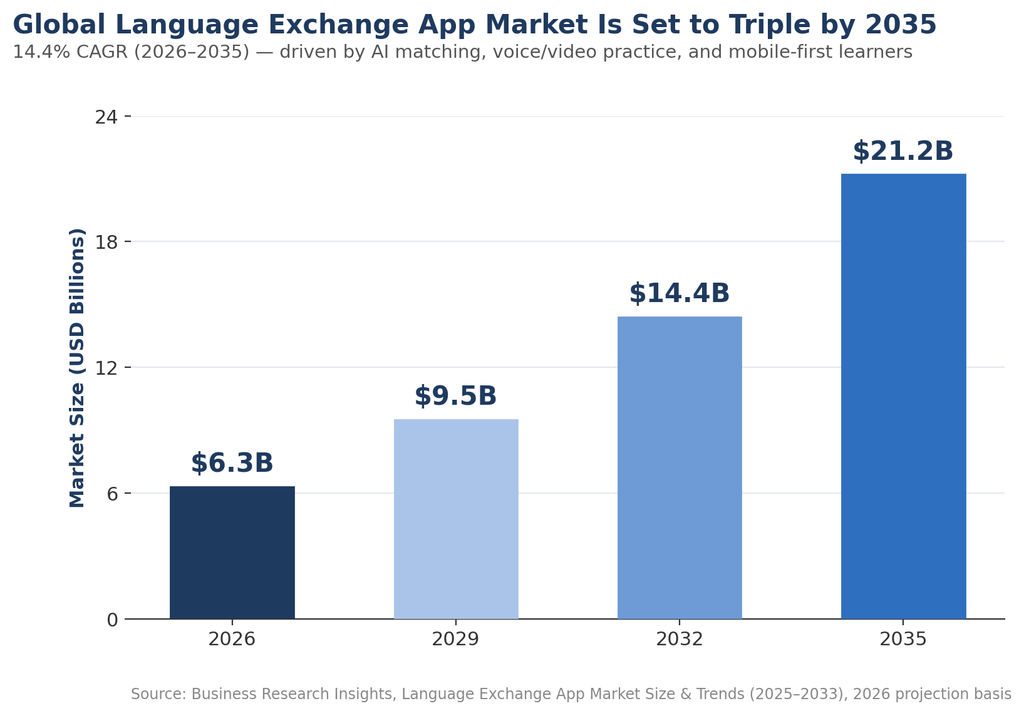
Global Language Exchange App Market Is Set to Triple by 2035
Three things are pushing that number up:
- Remote work and global hiring. Conversational fluency has become an actual career requirement rather than a resume line, and the professional-learner segment is growing around 24.4% a year within the broader market, faster than purely educational use.
- AI-powered matching and real-time translation. These have quietly fixed the two things that used to kill exchange apps: bad partner matches and conversations that stalled the moment vocabulary ran out.
- Asia-Pacific’s dominance. Already the largest regional market at roughly 32.9% share, it also happens to be the fastest-growing one, as English fluency becomes table stakes for cross-border business across the region.
The growth isn’t confined to Asia, either. North America is smaller by comparison, roughly $23.9 billion within the broader language learning market in 2025, but it’s growing faster on a percentage basis, around 20.8% CAGR, as U.S. and Canadian employers start treating a second language as a real hiring differentiator. Europe’s on a similar curve at a projected 22.1%, driven by labor mobility across the EU and workplaces that simply run in more than one language now. None of this growth is bunched up in one region or one age group. It’s broad, which is probably why the exchange-app segment has held up even as spending on consumer apps generally has gotten tighter.
For founders and product teams, that’s the interesting part. Most of today’s category leaders, HelloTalk, Tandem, Busuu, were built between 2011 and 2015, before on-device translation, AI pronunciation feedback, and language model-based correction were anything close to viable at consumer scale. That’s a real timing gap, and it’s exactly why newer, narrower entrants keep chipping away at specific slices of the market instead of trying to out-build the incumbents outright: on-demand voice (Lingbe), nearby matching (Idyoma), and so on. None of these newer apps have cracked HelloTalk’s scale yet, but that was never really the point. Carving out one use case and doing it noticeably better than a decade-old incumbent is usually enough to build a real business around. Idea Usher’s language learning app development like HelloTalk guide walks through what it actually costs to build something in that HelloTalk mold today.
Which Language Exchange App Has the Most Users?
Busuu and HelloTalk are the two biggest platforms by registered users, but bigger isn’t automatically better for your specific language pair. Busuu claims 120 million-plus registered users across its combined course-and-exchange model. HelloTalk claims 70 million-plus, spread across 260-plus languages and 200-plus countries, with over a billion messages exchanged daily. Mid-sized platforms like Tandem (an estimated 15 million-plus users), Idyoma, and Speaky trade some of that scale for tighter, more curated communities. That trade-off usually means faster matches if you’re learning something common, and slower ones if you’re not.
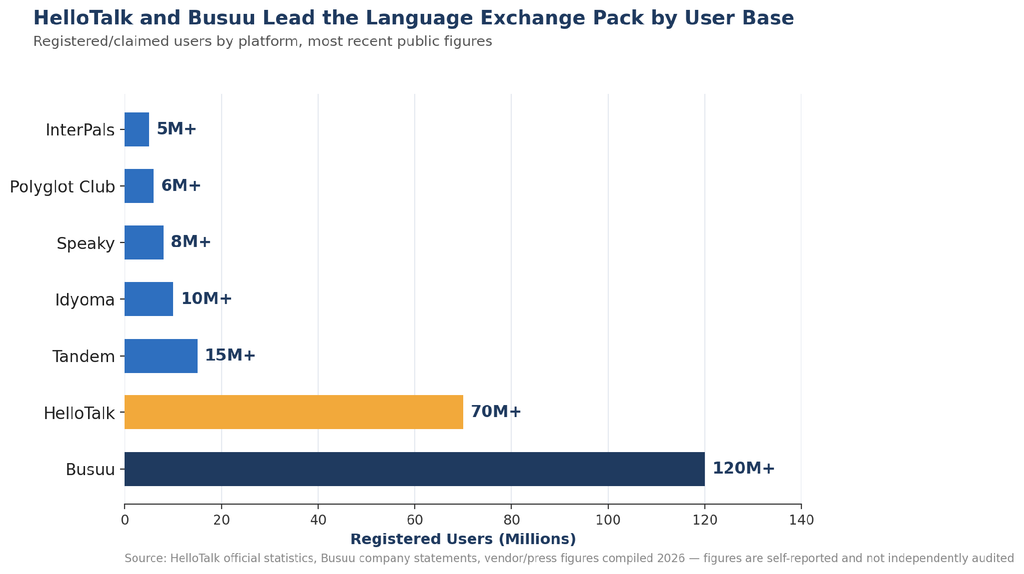
HelloTalk and Busuu Lead the Language Exchange Pack by User Base
The practical version of all this: if you’re learning Spanish, English, Mandarin, or French, any of the top five apps will connect you with a partner in minutes. If you’re learning something less common, go with HelloTalk or Busuu first. A bigger user base just means a deeper pool of native speakers for whatever you’re actually trying to learn. And if your target language is genuinely rare, say, a regional dialect or a language with a smaller diaspora online, don’t be surprised if even the biggest apps take a day or two to surface a good match. That’s when the community forums near the bottom of this list actually earn their spot.
How to Choose the Right Language Exchange App
The right app comes down to how you actually want to practice, not which one has the most downloads. Four things matter most here.
- Matching quality. This matters more than people expect. Tandem and HelloTalk use algorithmic matching based on your stated interests, proficiency, and goals, which produces noticeably better first conversations than apps like Speaky or InterPals, where you’re mostly browsing and filtering manually. If your time is limited, an app that matches you algorithmically gets you into a real conversation faster.
- Communication mode. Some learners want text first, it’s lower pressure and easier to correct, and HelloTalk and Speaky are built around exactly that. Others want to skip straight to speaking; Lingbe’s on-demand voice calls or the Mixxer’s video setup do that without any text-chat warmup. Most serious learners end up wanting both eventually, which is why HelloTalk and Tandem, which support text, voice notes, and video all in one app, tend to hold onto users the longest.
- Safety and moderation. This one gets overlooked constantly. Tandem screens new applicants by hand, which can mean waiting up to seven days for approval, but it produces a noticeably cleaner, more serious community as a result. Free web tools like InterPals and MyLanguageExchange lean on users reporting each other rather than vetting anyone upfront, worth knowing before you hand a stranger your contact details. That doesn’t make the free tools unsafe exactly, just that the burden of screening a new partner falls more on you than on the app.
- Cost. If budget’s tight, Speaky, Polyglot Club, and the Mixxer stay entirely free with no real paywall anywhere. If you’re planning to stick with an app long-term, HelloTalk VIP or Tandem Pro (roughly $13 to $14 a month) tends to be worth it, since it removes translation caps and unlocks AI grammar tools that make daily practice noticeably smoother.
Idea Usher’s guide on how to build a language learning app breaks down how these freemium models actually get structured on the development side.
Language Exchange Apps vs. Hiring a Tutor: Which Should You Use First?
Exchange apps and paid tutors aren’t really competing with each other, they solve different problems, and most fluent learners end up using both.
- A free exchange partner is available across time zones and gives you unscripted, real conversation, but there’s no guarantee they’ll show up, no lesson plan, and correction quality depends entirely on how good a teacher your partner happens to be, which varies a lot.
- A paid tutor through italki or Preply costs real money, anywhere from $4 an hour for a community tutor to $40-plus for a certified professional, but you get a scheduled session, a curriculum if you want one, and consistent, expert-level correction every time.
The pattern that tends to work: start on a free exchange app to build basic conversational comfort and get used to being corrected in real time. Then bring in a paid tutor once you hit a plateau a random partner can’t fix, exam prep, industry-specific vocabulary, a pronunciation habit nobody’s caught yet. Running both at once, a free partner for daily volume and a paid tutor for weekly structured feedback, is what most language coaches actually recommend. It’s also exactly the gap italki and Preply are built to fill once a pure exchange app stops cutting it on its own.
The 13 Best Language Exchange Apps in 2026
Here’s the full ranked list, 1 to 13, starting with the biggest all-around pick and ending with the free fallback option.
- HelloTalk: Best Overall Language Exchange App
- HelloTalk earns the top spot mostly because it does everything: text chat with inline correction, voice messages, video calls, a public “Moments” feed where partners correct posts you write in your target language, and live Voicerooms for group practice. That’s a lot of formats packed into one app, and with 70 million-plus users across 260-plus languages and 200-plus countries, it’s the safest default for almost any language pair you can think of. The free tier covers 90% of what you’ll actually use; VIP (roughly $12.99/month, $79.99/year, or a $149.99 lifetime option) removes translation limits and adds AI pronunciation scoring. Honestly, the Moments feed is underrated, it turns idle scrolling into extra correction practice without you even trying.
- Tandem: Best for AI-Powered Corrections
- Tandem’s edge is message-level correction paired with a manual human-review signup process, which sounds like friction but actually keeps the community noticeably more serious than most competitors. Matching runs on stated interests and goals, and a built-in rating system lets you flag low-effort partners after a session, so the community self-polices over time. Core messaging is free; Tandem Pro runs about $13.99/month, $31.99 per three months, or $79.99/year for unlimited translation and video. Founded in Germany back in 2014, it holds a 4.6/5 rating. The seven-day wait for approval annoys some people, but it’s a big part of why Tandem’s community holds up better than open-signup apps.
- Busuu: Best Hybrid of Structured Courses and Exchange
- If you want a curriculum and not just a chat partner, Busuu’s the pick. You work through structured lessons with defined grammar targets, then submit writing exercises that real native speakers correct as peer feedback, so you get guided progression and authentic human input in the same app. With 120 million-plus registered users, it has the biggest raw community here, though the free tier is thinner than HelloTalk’s and most course content sits behind a premium subscription. It works especially well for anyone coming from a classroom setting who wants exchange to reinforce a syllabus rather than replace it.
- Speaky: Best Free, No-Frills Text Chat
- Speaky is about as simple as this category gets: a chat interface with language and gender filters, entirely free, no premium tier trying to upsell you. That simplicity is also the weak point. Its 2.8/5 rating reflects looser moderation and a smaller active community than the algorithm-driven apps above it, so set your expectations accordingly. It’s a fine free backup for basic text practice, just not something to build a serious study habit around.
- Lingbe: Best for On-Demand Voice Practice
- Lingbe skips text entirely and goes straight to instant voice calls, which is the fastest route to real speaking practice if you’re comfortable with that. Its reward system, “lingos,” which you earn by helping others practice your native language, gamifies reciprocity in a way most exchange apps don’t even attempt. Pricing runs $4.99/week, $9.99/month, or $99.99/year, and it holds a solid 4.5/5 rating. If speaking anxiety is your actual problem, this is the app that forces you past it, there’s no hiding behind text.
- Idyoma: Best for Finding a Language Partner Nearby
- Idyoma’s differentiator is location-based matching, connecting you with partners physically nearby so you can eventually take the practice offline. It layers verified profiles and safety filters on top of that, starts at $3.49/month, and holds a 4.1/5 rating. Good fit for expats or students in a new city who want in-person practice eventually. The catch: outside major metro areas, the nearby-match pool thins out fast.
- Polyglot Club: Best for Group Practice and Real-World Meetups
- Polyglot Club swaps one-on-one chat for group discussions and organized real-world events, which suits people who find one-on-one pressure harder than a group setting. It bundles a text correction service and a video library covering 100-plus languages, all free, with over 100,000 members. Because it’s web-first rather than app-first, it works best as a supplement to a mobile exchange app rather than a replacement for one, and its meetup listings are genuinely useful if you live somewhere with an active language-learner scene.
- InterPals: Best for Pen-Pal Style Writing Practice
- InterPals is built for long-form, asynchronous writing rather than real-time chat, closer to a pen-pal relationship than a messaging app. Around 5 million users, a strong cultural-exchange focus, and lighter moderation than most app-based alternatives, so know that going in. It hasn’t aged as gracefully as newer apps on mobile, and most people still use it primarily on desktop. If you actually enjoy writing, composing a proper message instead of firing off a quick voice note, this is one of the few platforms still built around that.
- The Mixxer: Best Free University-Backed Video Exchange
- Run out of Dickinson College, the Mixxer routes exchange partners into live video calls through WhatsApp, Skype, or Zoom rather than building its own chat system, and it includes ready-made conversation starters for every session. Small, web-only, entirely free, and more academic in feel than the commercial apps on this list. Matching can take longer simply because the member count is smaller, but for video-first practice without a huge anonymous user base, it’s a solid pick.
- MyLanguageExchange: Best for Long-Term Structured Pen Pals
- MyLanguageExchange runs on a searchable member database rather than swipe-style matching, built for long-term pen-pal relationships over email, Skype, or its own messaging tools. Free tier is functional but limited; paid plans run $5.99/month, $11.99 for three months, or $23.99/year for expanded search and messaging. The interface feels dated next to newer apps, no question, but it’s a reliable fallback for rarer language pairs that other apps barely cover.
- italki: Best for Combining Exchange with Paid Tutoring
- italki pairs a free community layer with a large paid-tutor marketplace, so you can start informal and upgrade to structured, paid sessions, including JLPT or IELTS prep, once your goals get more serious. All formal tutoring is paid at rates each tutor sets individually. The underlying community and video infrastructure make it a natural next step once free exchange partners aren’t cutting it anymore, especially if you’re working toward a certification deadline rather than open-ended conversation.
- Preply: Best When You Want a Guaranteed Native Tutor
- Preply isn’t a peer-to-peer exchange app, it’s a tutor marketplace, but it earns a spot here because it solves the one thing exchange apps can’t: guaranteed availability. 100,000-plus tutors across 90-plus languages, rates from $4 to $40-plus an hour, 4.8/5 rating. It’s often the first paid step people take once relying on a free exchange partner starts feeling too inconsistent to build real progress on.
- Reddit and Facebook Language Communities: Best Free Fallback
- When app-based matching runs dry for a rare language pair, dedicated Reddit subreddits and Facebook language-exchange groups are a legitimate, completely free fallback. No built-in matching, no correction tools, no safety net, so it takes more manual effort to use well. But for niche languages with thin coverage on dedicated apps, these communities often have more active native speakers than any single purpose-built app, and there’s zero cost to just try.
How Language Exchange Apps Actually Work Behind the Scenes
Strip away the branding and every language exchange app runs on roughly the same five-stage flow: profile setup, matching, communication, correction, and retention. Worth understanding whether you’re evaluating apps as a user or scoping a build as a founder.
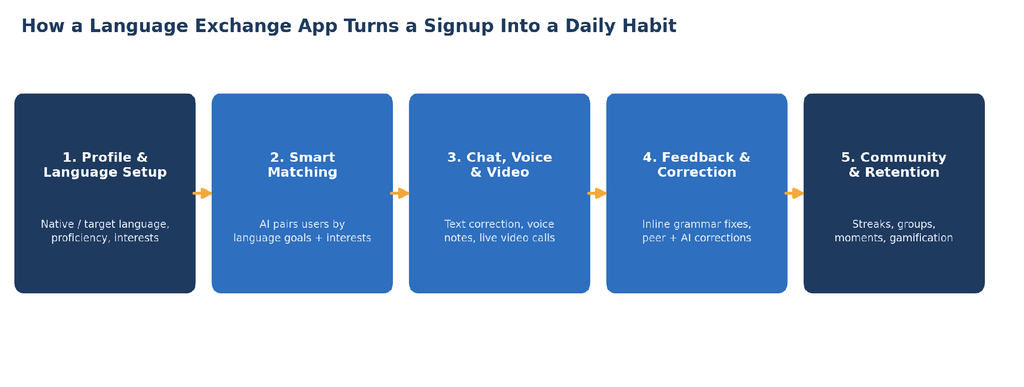
How a Language Exchange App Turns a Signup Into a Daily Habit
- Profile setup. A new user sets a native language, a target language, a proficiency level, and interest tags, all of which later feed the matching engine.
- Matching. The app pairs the user with someone compatible, either algorithmically based on shared interests and complementary goals (Tandem, HelloTalk), or manually through browsing and filters (Speaky, InterPals).
- Communication. Once matched, the app routes the pair into whatever channel it’s built around: text with inline translation, asynchronous voice notes, or live voice and video.
- Correction. A correction layer, peer-driven like Busuu’s writing feedback, AI-assisted like HelloTalk’s and Tandem’s grammar tools, or both, turns raw conversation into something you’re actually learning from rather than just chatting.
- Retention. Streaks, community feeds, group rooms, and gamified rewards like Lingbe’s lingos are all designed to get you back the next day instead of letting the novelty wear off after week one.
It’s worth noting that the apps dominating this list all pour their engineering effort into matching and correction, not the flashier features. That’s where users actually feel the value, and it’s where thinner competitors tend to fall apart. Idea Usher’s breakdown of how to build a language learning app like Babbel covers the structured-course side of that stack, the Duolingo-style app development guide covers gamified retention, and the Memrise-style app development breakdown gets into spaced-repetition retention specifically.
Why Partner With Idea Usher to Build a Language Exchange App
If the gap between these incumbents and what AI-native matching, moderation, and real-time translation can now do looks like an opening, Idea Usher has already built most of the core pieces a language exchange platform needs. The team’s been shipping e-learning and language-tech products for over a decade, and it understands both the matching-and-correction stack these apps run on and the safety tooling a serious exchange platform needs from day one, not bolted on after something goes wrong.
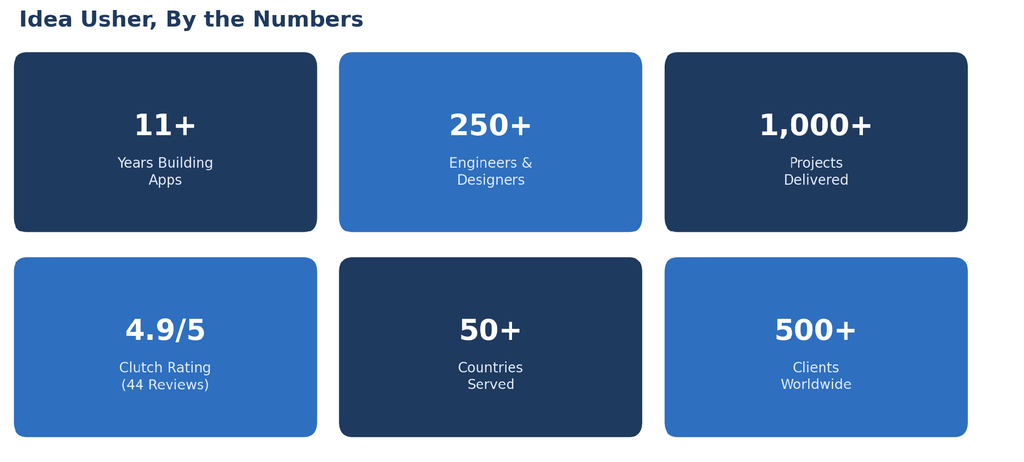
Idea Usher, By the Numbers
11-Plus Years of EdTech and Language-Tech App Development
Idea Usher has been building mobile and web applications since 2014, including hands-on experience architecting language-learning and exchange-style products. That work is covered in the top eLearning app development companies roundup, which places Idea Usher among the category’s established builders.
AI Matching, Moderation, and Real-Time Communication Built In
A language exchange app lives or dies on its matching algorithm, its moderation tooling, and how well it handles voice and video at scale. Idea Usher’s team treats AI-driven interest and proficiency matching, human-plus-AI moderation pipelines, and real-time chat, voice, and video infrastructure as core modules from day one, not features bolted on after launch. That includes the parts newer entrants tend to skimp on early: report-and-review flows, abuse detection on open chat, and translation quality that actually holds up on low-resource language pairs, not just the handful of major languages everyone already covers well.
Phased Delivery From MVP to Scale
Rather than one massive build, Idea Usher typically scopes language and exchange apps across a phased 800 to 1,200-hour cycle: a lean, testable MVP first, core matching, chat, correction, then voice rooms, gamification, and monetization layered in once real user data backs up the decisions.
A Track Record Clients Vouch For
Idea Usher holds a 4.9/5 average rating across 44 reviews on Clutch, has delivered 1,000-plus projects for 500-plus clients in 50-plus countries, and runs a 250-plus person team across engineering, design, and product. The language learning app development cost guide breaks down project and pricing detail specific to this category if you want the numbers.
If you’re scoping a build in this space, book a free consultation on Nitish Garg’s calendar, or take a look at the full mobile app development service page.
Conclusion
For most learners, HelloTalk is the safest place to start in 2026, with Tandem and Busuu as strong alternatives depending on whether you’d rather have tighter moderation or a structured-course hybrid. Speaky, Lingbe, Idyoma, and everything else on this list solve a narrower problem, free-only budgets, voice-first practice, nearby in-person matching, so the right pick really comes down to how you want to practice, not which app has the most downloads. For founders eyeing the category itself, a $6.3 billion market growing 14.4% a year against a handful of aging incumbents is real headroom, and that gap is worth building into. The Idea Usher homepage has the broader portfolio if you want to see what else the team’s shipped beyond language tech.
Frequently Asked Questions
What is the best free language exchange app in 2026?
HelloTalk, for most people. 90% of what you’d actually use, matching, text chat, voice messages, the Moments feed, stays free, with only advanced AI tools and unlimited translation locked behind VIP. Speaky and Polyglot Club are fully free with no premium tier at all, but both have smaller, less actively moderated communities than HelloTalk.
Is Tandem or HelloTalk better for language exchange?
Depends what you’re optimizing for. HelloTalk wins on reach and format variety, its larger user base (70 million-plus versus Tandem’s roughly 15 million-plus) means faster matches, especially for less common languages. Tandem wins on community quality: manual signup review and a rating system tend to produce more serious, higher-effort partners.
Are language exchange apps actually effective for learning a language?
Yes, particularly for speaking confidence and listening comprehension, the two things structured courses struggle to teach. Language learning research consistently shows real conversational output with correction accelerates fluency faster than passive study alone, which is part of why hybrid apps like Busuu, course plus peer correction, tend to outperform pure gamified apps on speaking outcomes.
How much do language exchange apps typically cost?
Core exchange functionality is usually free; premium tiers for translation, AI tools, or video calling typically run $10 to $15 a month. HelloTalk VIP is roughly $12.99/month or $79.99/year, Tandem Pro is about $13.99/month, and smaller apps like Lingbe and Idyoma price lower, $3.49 to $9.99 a month, reflecting a smaller feature set.
Are language exchange apps safe to use?
It depends heavily on how the app moderates, so check before sharing contact details with anyone. Apps with human-reviewed signups, like Tandem, or built-in verification and safety filters, like Idyoma, tend to have cleaner communities than fully open, self-reported platforms like InterPals or MyLanguageExchange, where reporting after the fact is basically the only moderation mechanism.
What’s the difference between a language exchange app and a language learning app like Duolingo?
An exchange app connects you with a real human conversation partner. Duolingo teaches you through gamified, solo exercises with no human partner involved at all. They’re complementary, not competing: plenty of learners use Duolingo or Babbel to build vocabulary and grammar first, then move to HelloTalk or Tandem to actually use it. That’s also why several of the fastest-growing platforms in 2026 are experimenting with hybrid models that fold both approaches into one app.
Can you build a language exchange app like HelloTalk or Tandem from scratch?
Yes, and the core feature set isn’t a mystery: profile and language-pair setup, algorithmic matching, real-time chat with translation, voice and video calling, and a correction or moderation layer are the five components every successful app in this category ships. The hard part isn’t any single feature, it’s getting matching quality and moderation right at launch, since a thin partner pool or a poorly moderated early community is what kills most new entrants before they reach any real scale. Idea Usher’s language learning app development cost guide walks through realistic budget and timeline ranges for a build like this.