

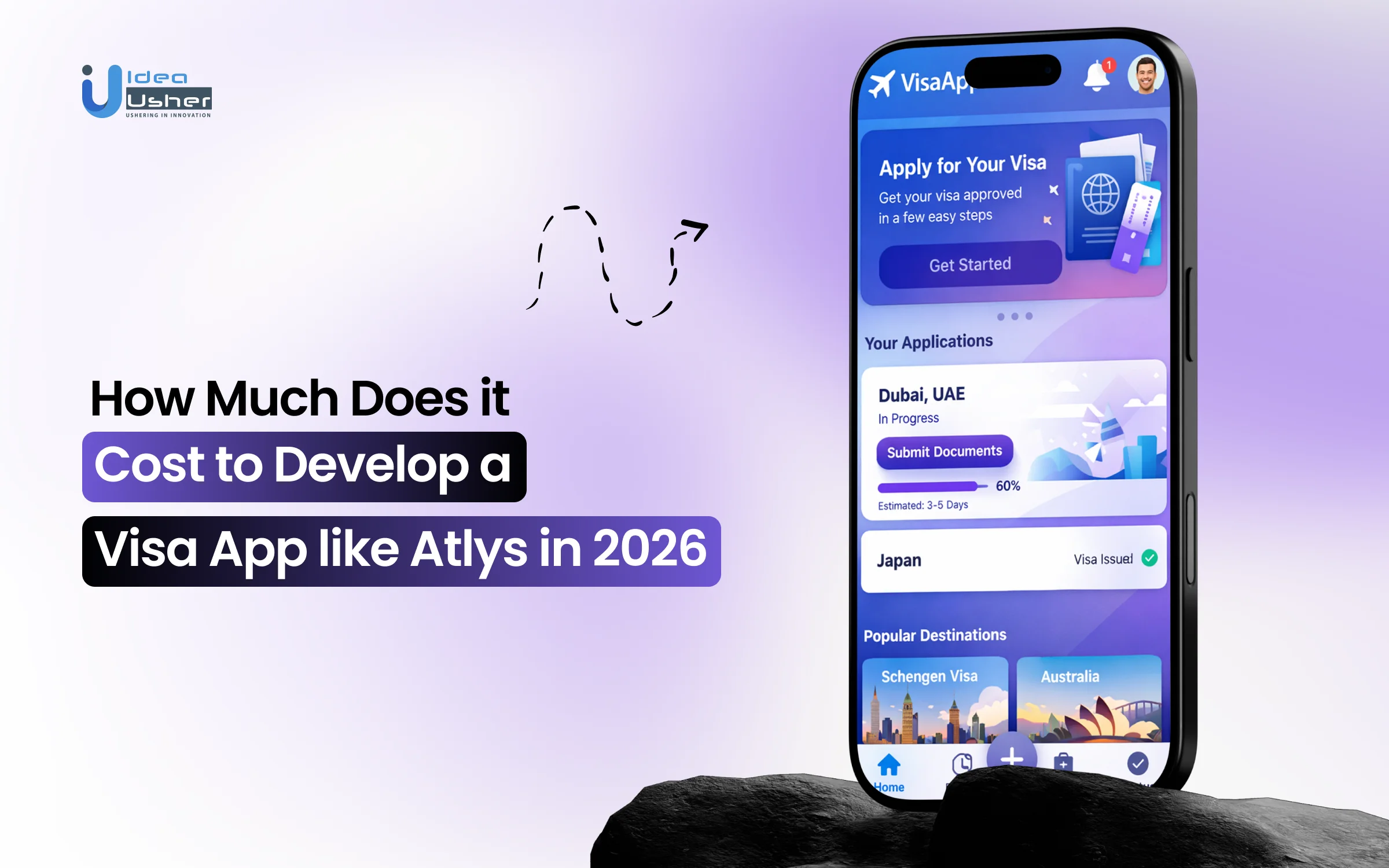
Visa application platforms combine document handling, compliance workflows, and real-time status tracking into a single user experience, making cost estimation more complex than typical mobile or web apps. From managing user inputs and document uploads to integrating with embassy processes and verification systems, shaping Atlys like visa app development cost, where pricing depends on how deeply the platform handles automation, validation, and external integrations.
The cost drivers become more defined as functionality expands like document processing systems, workflow engines, third-party integrations, security measures, and scalability requirements all contribute to overall investment. The final cost depends on how these components are structured, the number of regions supported, and the level of automation built into the application process.
In this blog, we break down how much it costs to develop a visa app like Atlys in 2026 by examining key cost drivers, development components, and the practical factors that influence total platform investment.
Why Visa Apps Like Atlys Are Growing in 2026
The travel technology landscape in 2026 has moved beyond simple booking engines and itinerary aggregators. We are currently witnessing a massive consolidation of the bureaucratic layer of travel. For investors and entrepreneurs, the surge in platforms like Atlys represents a fundamental shift in how global mobility is managed.
As borders become more digitally integrated, the friction of traditional visa processing has become an intolerable bottleneck. This creates a high-value vacuum that agile, tech-first platforms are now filling.
The growth is driven by infrastructure readiness and changing consumer psychology. Governments worldwide are retiring legacy paper-based systems in favor of e-Visas. However, these government portals are often plagued by poor user experience and regional payment failures. Modern visa apps act as the sophisticated middleware that abstracts this complexity.
For an investor, the appeal lies in the high-intent nature of the user. A visa is a non-negotiable requirement. This makes these platforms essential utilities rather than discretionary lifestyle apps.
Shift From Agents to Digital Visa Platforms
The traditional visa agency model is systematically being dismantled. High-net-worth individuals and frequent business travelers are no longer willing to wait days for a manual review that an algorithm can validate in milliseconds. Digital platforms offer a level of transparency and real-time tracking that legacy agencies cannot replicate.
- Data Security and Privacy: Travelers are increasingly hesitant to hand over sensitive passports to third-party fixers. Digital platforms provide encrypted, end-to-end environments that ensure data is only shared with relevant sovereign authorities.
- Cost Efficiency at Scale: Unlike traditional agencies that scale linearly by needing more staff, digital platforms scale exponentially. The cost of processing the 10,000th application is fractionally lower than the first.
- Standardization of Experience: Whether a traveler is applying for a Schengen visa or a Southeast Asian e-Visa, digital platforms provide a unified interface. This reduces the cognitive load on the user.
Rising Demand for Fast Global Travel Processing
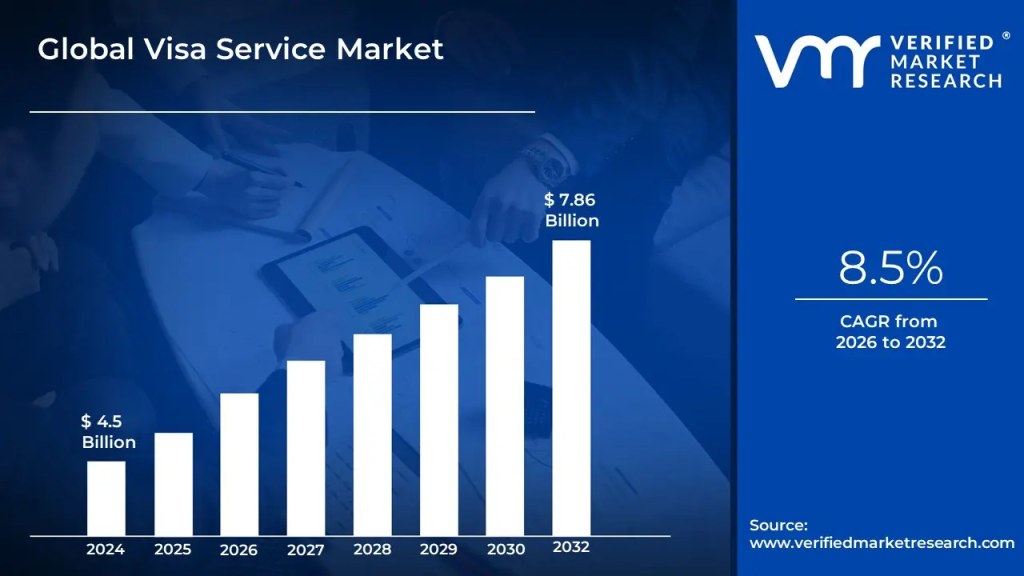
The global visa service market size was valued at USD 4.5 billion in 2024 and is projected to reach USD 7.86 billion by 2032, growing at a CAGR of 8.5% during the forecast period 2026 to 2032. This steady growth is driving increased investment in digital visa platforms like Atlys.
International travel has rebounded strongly, reaching nearly pre-pandemic levels with 1.4 billion travelers, creating a massive and growing user base for digital visa solutions. At the same time, the Asia-Pacific region is emerging as the fastest-growing market, expected to expand at a 14.8% CAGR through 2035, driven by rapid digital infrastructure development.
Non-immigrant visas, including tourist and business categories, are expected to account for 57% of the market by 2035, making them the most lucrative segment for new visa apps. At the same time, governments worldwide are accelerating the shift toward paperless immigration, with initiatives like the Schengen region’s plan to launch a unified digital visa platform by 2028.
Practical examples of this demand can be seen in the rise of digital nomadism and work-from-anywhere corporate policies. These demographics do not just want a visa. They want an assurance that their travel plans will not be derailed by a clerical error.
Strategic investment in this space is currently focused on guaranteed processing windows. By utilizing deep integrations with consular databases, platforms are able to offer premium expedited tiers that legacy players cannot support. This demand is further bolstered by the expansion of visa-on-arrival schemes that still require pre-travel digital authorization.
How AI is Transforming Visa Applications
The integration of Artificial Intelligence is the primary differentiator between a basic form-filling site and a market-leading platform. In 2026, AI is the core engine for risk assessment and document verification. For an entrepreneur, the competitive advantage is the proprietary datasets used to train these models.
- OCR and Automated Validation: Advanced Optical Character Recognition now validates the authenticity of documents. It can instantly detect if a passport photo meets specific biometric requirements, preventing rejection cycles.
- Predictive Error Correction: AI models can cross-reference application data against thousands of successful historical filings. If a user enters a detail that statistically leads to a rejection, the system flags it for correction immediately.
- Dynamic Translation and Localization: AI-driven linguistic models handle the nuances of translating local employment records or bank statements. This ensures that the context of the applicant’s financial stability is not lost in translation.
What Is an Atlys-Like Visa App and How It Works
An Atlys-like platform is essentially a digital bridge between a traveler and a sovereign immigration system. It functions as a sophisticated middleware that simplifies the bureaucratic requirements of international travel. For an entrepreneur, the value proposition is clear. The app replaces the anxiety of government portals with a streamlined, predictable user journey.
The technical architecture is built to handle high-stakes data. It must manage everything from biometric photo capture to secure document storage while ensuring compliance with varying international standards. This is not just a form-filling tool. It is an end-to-end logistics and data management engine.
Core Workflow of a Digital Visa Platform
The user journey on a platform like Atlys is designed to minimize drop-off rates and maximize speed. It typically begins with a high-level eligibility check where the user selects their destination and citizenship. The system then dynamically generates a checklist tailored to that specific bilateral agreement.
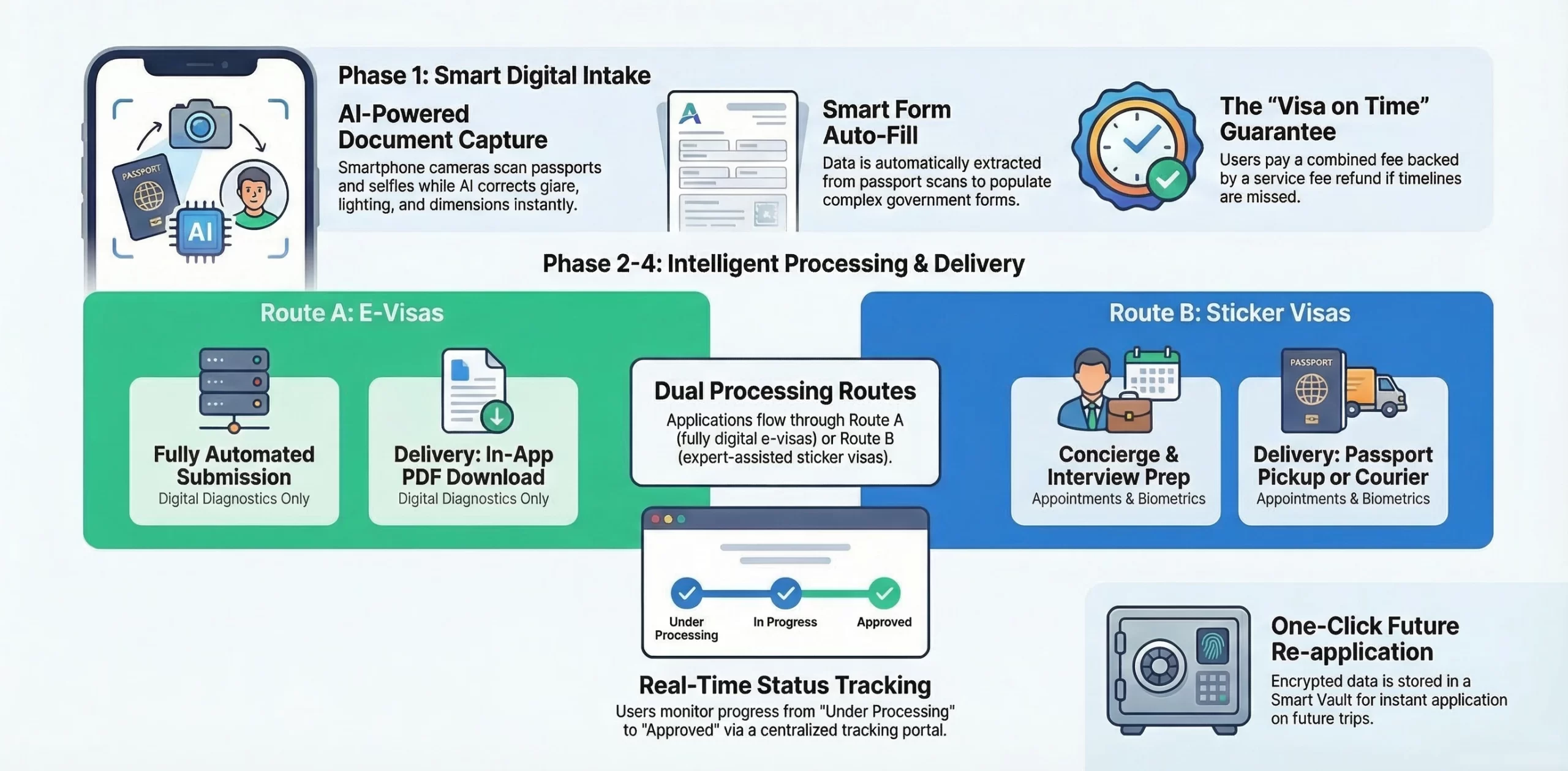
- Profile Creation: Users scan their passport bio-page. The app uses Optical Character Recognition to extract name, date of birth, and passport numbers instantly.
- Smart Documentation: Instead of physical copies, the app prompts for digital uploads or in-app photo captures of required evidence like bank statements or hotel bookings.
- Submission and Tracking: Once the application is finalized, the platform submits the data directly to government gateways via API or secure portals. The user receives real-time status updates, eliminating the need to check government sites manually.
Role of AI in Form Filling and Eligibility Checks
AI is the primary driver of efficiency in modern visa platforms. In 2026, these systems do far more than just transfer text from one field to another. They act as a preliminary layer of adjudication.
The AI engine performs real-time diagnostics on every entry. For example, if a user’s travel dates do not align with their visa type’s maximum stay, the system flags the error before payment. This proactive intervention significantly reduces rejection rates.
Additionally, AI models are trained on thousands of successful applications to identify patterns that consulates prefer. This include validating that a passport photo meets exact biometric specifications for lighting and background, which are common causes for manual rejection.
How Document Reusability Improves UX
One of the most powerful features for user retention is the digital document vault. Traditionally, every new visa application felt like starting from scratch. Digital platforms change this by creating a reusable identity profile.
Once a user has successfully applied for one visa, their core documents are encrypted and stored. For the next trip, the platform can auto-populate up to 90% of the required information. This turns a multi-hour chore into a three-click process.
For investors, this reusability creates a massive “moat.” Once a traveler has their sensitive data safely stored and verified in one ecosystem, the friction of switching to a competitor becomes much higher. This builds long-term customer lifetime value and positions the app as a permanent digital travel companion.

Key Features That Define Atlys like Visa App Development Cost
A visa app is defined by intelligent automation, seamless document handling, and user-friendly workflows that simplify complex application processes. These features influence Atlys like visa app development cost to enhance accuracy, reduce manual effort, and deliver a fast, reliable, and convenient experience for global travelers.

1. User Panel With Guided Visa Application Flow
This feature provides a step-by-step, intuitive interface that breaks down complex legal requirements into manageable tasks, ensuring users provide accurate data through a personalized, high-conversion “wizard” style application journey.
Technical Systems:
- State-managed multi-step form architecture (Redux or React Context).
- Dynamic conditional logic engine for country-specific fields.
- Real-time field validation and progress persistence (Web Storage/IndexedDB).
Estimated Cost: $8,000 – $12,000
Architecting dynamic multi-step journeys across diverse visa types necessitates complex UI/UX design and seamless state management for multi-session user inputs.
2. AI Visa Recommendation Engine
Leveraging historical data and current diplomatic trends, this engine suggests the most viable visa type and calculates the statistical likelihood of approval, significantly building user trust and informed decision-making.
Technical Systems:
- Machine Learning models (Random Forest or Gradient Boosting) for probability scoring.
- Data pipeline for ingesting real-time embassy success/rejection metrics.
- Python-based Flask/FastAPI microservice for inference.
Estimated Cost: $15,000 – $25,000
High-accuracy prediction engines require extensive data sourcing, specialized model training, and real-time ingestion from volatile, external government data sources.
3. Smart Document Upload and Reuse System
This system utilizes Optical Character Recognition to instantly pull data from passports and IDs, auto-populating forms and storing encrypted profiles to allow one-click applications for future international travel.
Technical Systems:
- Computer Vision APIs (AWS Textract, Google Vision, or Tesseract).
- Regex-based data cleaning and standardization layers.
- Secure, encrypted vault for storing reusable biometric and personal data.
Estimated Cost: $10,000 – $18,000
Integrating high-precision OCR tools and encrypted storage for sensitive PII adds critical technical rigor and robust security protocols.
4. Real-Time Visa Status Tracking
This core module manages the disparate requirements of multiple nations while providing users with a centralized dashboard to track their application status via real-time notifications and automated government portal pings.
Technical Systems:
- Microservices architecture for country-specific API adapters.
- Webhooks and Cron jobs for automated status polling.
- Push notification system (Firebase Cloud Messaging) and email/SMS triggers.
Estimated Cost: $12,000 – $20,000
Building scalable microservices to handle external API integrations and real-time synchronization with fragmented government databases increases development infrastructure requirements.
5. Secure Payment Gateway Integration
A multi-currency, PCI-compliant payment system that supports global credit cards, digital wallets, and local payment methods, ensuring a frictionless checkout experience while handling complex refund and service fee logic.
Technical Systems:
- Stripe, Adyen, or PayPal Braintree global API integration.
- Multi-currency conversion and real-time exchange rate layers.
- Ledger system for tracking service fees, government fees, and reversals.
Estimated Cost: $5,000 – $9,000
Global financial operations demand rigorous PCI-DSS compliance, secure API implementation, and a bulletproof reconciliation backend for multi-currency exchange rates.
6. Admin Dashboard for Application Management
The operational nerve center where staff can monitor submissions, manage exceptions, update visa rules, and view high-level analytics on platform performance, user churn, and successful visa issuance rates.
Technical Systems:
- Role-Based Access Control (RBAC) for varying staff permission levels.
- Data visualization suite (D3.js or Chart.js) for business intelligence.
- Audit logs for tracking every manual change made to sensitive applications.
Estimated Cost: $7,000 – $13,000
Developing granular access controls, comprehensive audit logs, and visual reporting dashboards for operational decision-making elevates the overall development investment.
Advanced Features That Increase Development Cost
For investors, evaluating a visa platform requires distinguishing a basic form tool from a high-performance ecosystem. The highest ROI features often demand the greatest investment, requiring specialized engineering, advanced data modeling, and ongoing compliance maintenance.
Investing in these advanced modules creates a significant barrier to entry for competitors. While they increase the initial “burn rate,” they also establish the technical moat necessary to capture and retain the global travel market at scale.
1. AI-Powered Approval Prediction System
The complexity of building a reliable prediction engine lies in the data science required to train the model. Developers must aggregate and clean millions of historical application records to identify hidden patterns in consulate decision-making.
The cost is driven by:
- Data Acquisition: Licensing or scraping vast datasets of visa outcomes.
- Model Training: Employing machine learning engineers to build neural networks that adapt to changing geopolitical climates.
- Continuous Tuning: Ensuring the AI remains accurate as travel policies shift overnight.
2. Multi-Country Visa Support Architecture
A platform that supports only one destination is easy to build; a platform that supports 150 is a massive engineering challenge. The backend must be modular enough to handle the unique logic of every nation.
Building this architecture involves:
- Dynamic Form Engines: Creating a system that renders different questions and document requirements based on the destination.
- Rule Engines: Hard-coding thousands of “if-then” scenarios (e.g., “If applicant is Indian and destination is France, require bank statements”).
- Scalable Infrastructure: Ensuring the database can handle high-concurrency across different time zones.
3. OCR for Document Scanning and Data Extraction
High-accuracy Optical Character Recognition (OCR) is far more expensive than standard text scanning. To be useful, the system must extract data with 99%+ accuracy from wrinkled, low-light, or non-English documents.
The primary cost factors include:
- Custom Model Development: Training models to recognize diverse passport formats and fonts globally.
- Image Processing Pipelines: Building specialized software to “clean” user-uploaded photos before extraction.
- Compute Costs: The high server overhead required to process complex image data in real-time for thousands of users simultaneously.
3. Multi-Language and Localization Support
To capture a global audience, a platform cannot exist in English alone. True localization goes beyond simple translation; it requires adapting the entire user experience to local cultural and legal norms.
Strategic investment is required for:
- Native Translation: Hiring professional linguists rather than relying on generic AI translations that can miss legal nuances.
- Regional UX Adaptation: Adjusting date formats, currency displays, and even “Right-to-Left” (RTL) interface layouts for Middle Eastern markets.
- Legal Compliance: Ensuring the platform adheres to regional data privacy laws like GDPR (Europe) or CCPA (California).
4. API Integration With Embassies and Databases
The most difficult and expensive technical hurdle is establishing direct communication with government systems. Many consulates do not have modern APIs, requiring developers to build custom “bridges.”
This phase involves:
- Secure Handshaking: Building highly encrypted tunnels to transmit sensitive personal data to government servers.
- Maintenance of Legacy Bridges: Constantly updating “scrapers” or connectors when government portals change their internal layouts without warning.
- Database Licensing: Paying for access to third-party verification databases to cross-reference user identities and criminal records in real-time.
Atlys like Visa App Development Cost in 2026
The Atlys like visa app development cost in 2026 involves significant investment across technology, compliance, AI capabilities, and user experience design. The breakdown below outlines key cost components and factors influencing the overall development budget.

1. UI UX Design
Premium design in 2026 focuses on “Progressive Disclosure” to prevent user fatigue during complex data entry. High-fidelity prototypes must include custom biometric photo-guides and real-time validation feedback to ensure document accuracy.
| Component | MVP – Mid-Scale | Enterprise | What to Build |
| User Research & Journey Mapping | $3,000 – $6,000 | $8,000 – $15,000 | Defines seamless paths for travelers, including document collection, application tracking, and automated status notifications. |
| Wireframing & UX Architecture | $3,500 – $7,500 | $10,000 – $20,000 | Structural layouts for the application dashboard, document upload portals, and interactive visa requirement guides. |
| Visual UI Design System | $4,000 – $9,000 | $15,000 – $30,000 | Clean typography, high-contrast components, and intuitive icons for a trustworthy, professional legal-tech brand identity. |
| Biometric & Form Interfaces | $4,000 – $9,000 | $12,000 – $25,000 | Specialized interfaces for biometric photo capture, OCR scanning results, and secure multi-step application forms. |
| TOTAL (Approx.) | $14,500 – $31,500 | $45,000 – $90,000 | Comprehensive design system covering the end-to-end traveler journey from discovery to final visa approval. |
2. Frontend and Backend Development
The backend must act as a “Legal Engine” capable of managing thousands of concurrent, encrypted document repositories. Frontend development focuses on cross-platform responsiveness to allow users to upload passport scans from any mobile device.
| Component | MVP – Mid-Scale | Enterprise | What to Build |
| Cross-Platform Mobile App | $15,000 – $25,000 | $60,000 – $120,000 | Responsive mobile application allowing users to manage applications, scan documents, and receive push notifications. |
| Centralized API & Microservices | $12,000 – $20,000 | $50,000 – $90,000 | Scalable logic handling user authentication, application processing workflows, and real-time data synchronization across services. |
| Secure Document Storage | $5,000 – $10,000 | $20,000 – $40,000 | Encrypted repository for sensitive PII data with automated backup and high-availability retrieval systems. |
| Admin Control Panel | $5,000 – $10,000 | $15,000 – $35,000 | Internal interface for managing applications, monitoring server health, and updating global visa requirement data. |
| TOTAL (Approx.) | $37,000 – $65,000 | $145,000 – $285,000 | Full-stack architecture ensuring reliable, secure, and fast application processing for high-volume global travel users. |
3. AI and Automation Development
AI Automation is the core differentiator for apps like Atlys, reducing manual review times by up to 90%. Implementing AI for photo compliance and passport data extraction ensures that applications are “embassy-ready” upon submission.
| Component | MVP – Mid-Scale | Enterprise Cost | What to Build |
| OCR & Passport Extraction | $8,000 – $15,000 | $35,000 – $70,000 | Automated extraction of passport data and personal details to eliminate manual entry and errors. |
| Biometric Photo Validation | $7,000 – $12,000 | $30,000 – $60,000 | Real-time AI checks ensuring user photos meet strict government requirements for background and lighting. |
| Smart Document Verification | $6,000 – $10,000 | $25,000 – $55,000 | Logic to automatically verify supporting documents, ensuring all necessary files are present and valid. |
| Approval Odds Predictor | $5,000 – $9,000 | $25,000 – $50,000 | Machine learning models analyzing historical data to provide users with estimated visa approval probabilities. |
| TOTAL (Approx.) | $26,000 – $46,000 | $115,000 – $235,000 | AI-driven automation layer designed to maximize application accuracy and minimize government rejection rates globally. |
4. Third-Party API Integration
Integrations provide the “live” pulse of the app, connecting it to global flight databases and government gateways. These connections ensure that users receive real-time updates on visa requirements and their current application status.
| Component | MVP – Mid-Scale | Enterprise | What to Build |
| Government Portal Bridges | $10,000 – $18,000 | $40,000 – $90,000 | Direct connections to official embassy systems for automated submission and real-time status tracking updates. |
| Global Payment Gateways | $2,000 – $4,000 | $8,000 – $15,000 | Secure multi-currency processing for visa fees and service charges across various international markets. |
| IATA & Travel Data Feeds | $3,000 – $6,000 | $12,000 – $25,000 | Live feeds for flight schedules, hotel bookings, and constantly changing entry requirements per country. |
| Identity Verification APIs | $4,000 – $8,000 | $15,000 – $30,000 | Third-party integrations for background checks and identity validation to ensure high-trust application submissions. |
| TOTAL (Approx.) | $19,000 – $36,000 | $75,000 – $160,000 | Interconnected ecosystem providing real-time data sync and seamless financial transactions for travelers and governments. |
5. Testing, Security, and Compliance
Security is non-negotiable when handling national identity documents and biometric data. Continuous penetration testing and compliance audits ensure the platform meets international standards for data protection and legal liability.
| Component | MVP – Mid-Scale | Enterprise | What to Build |
| Legal Compliance Audits | $6,000 – $12,000 | $30,000 – $70,000 | Regular checks to ensure data handling meets global standards like GDPR, SOC2, and regional laws. |
| Security & Encryption | $5,000 – $10,000 | $25,000 – $55,000 | Robust end-to-end encryption protocols protecting sensitive biometric and personal information from unauthorized access. |
| QA & Edge Case Testing | $4,000 – $8,000 | $20,000 – $45,000 | Intensive testing scenarios covering non-standard passports, rare scripts, and high-load traffic surges. |
| Biometric Fail-Safe Testing | $3,000 – $6,000 | $15,000 – $30,000 | Validation of AI photo-checking accuracy across diverse ethnicities, lighting conditions, and device cameras. |
| TOTAL (Approx.) | $18,000 – $36,000 | $90,000 – $200,000 | Fortified security framework guaranteeing user privacy and absolute accuracy across millions of global applications. |
6. Deployment and Infrastructure Cost
Scaling globally requires a serverless architecture that can handle seasonal travel surges without downtime. Infrastructure costs include the specialized hosting of sensitive documents and the maintenance of high-availability cloud servers.
| Component | MVP – Mid-Scale | Enterprise | What to Build |
| Scalable Cloud Hosting | $2,000 – $5,000 | $15,000 – $40,000 | Elastic server clusters and load balancers ensuring uptime during peak summer or holiday travel seasons. |
| CI/CD & DevOps Automation | $3,000 – $6,000 | $12,000 – $25,000 | Automated deployment pipelines for rapid bug fixes and feature rollouts without disrupting user sessions. |
| Global CDN Media Delivery | $2,000 – $4,000 | $10,000 – $25,000 | Content delivery networks for lightning-fast loading of high-resolution document scans and asset-heavy interfaces globally. |
| Infrastructure Monitoring | $2,000 – $4,000 | $8,000 – $20,000 | 24/7 observability tools tracking system performance, error rates, and potential security threats in real-time. |
| TOTAL (Approx.) | $9,000 – $19,000 | $45,000 – $110,000 | High-performance infrastructure built to scale globally while maintaining low latency and zero data loss. |
Total Estimated Visa App Development Cost in 2026
The following table reflects the investment required for a production-ready platform. In 2026, the cost of AI has shifted; while model access is cheaper, the “Data Engineering” and “Compliance” (GDPR/SOC2) required for legal-tech products have become the primary cost drivers.
| Platform Stage | Estimated Cost | What Includes in this Stage |
| MVP Stage | $75,000 – $120,000 | Core “Happy Path” automation: AI-powered passport OCR, biometric photo compliance checks, integration with 5-8 major E-Visa portals, and essential PII encryption. |
| Mid-Scale Platform | $140,000 – $280,000 | Advanced “Edge Case” handling: Forgery detection, 24/7 automated status polling for 40+ countries, multi-currency wallets, and full regional data compliance (GDPR/CCPA). |
| Enterprise Level | $550,000 – $800,000+ | Total “Sovereign” infrastructure: Predictive approval algorithms, direct government G2B API bridges, white-label corporate portals, and multi-region data residency. |
The Reason behind the MVP Cost
To deliver a truly professional visa product in 2026, these “hidden” essentials push the budget beyond a standard simple app:
- Document Accuracy Guardrails: An MVP cannot afford a 10% error rate. Investing in “Double-Check” AI logic (where two models verify the same document) adds roughly $15k – $20k to the initial build but prevents costly legal rejections.
- Biometric Liveness Detection: To prevent fraud, you need “Liveness” checks (ensuring the user is a real person, not a photo of a photo). Integrating these specialized 2026 security modules adds a premium to the frontend development.
- The “Token Tax” & Data Pipelines: While running the AI is cheaper, building the pipeline that “cleans” and “anonymizes” sensitive passport data before it hits the AI model is a specialized engineering task that requires senior oversight.
- API-First Approach: Utilizing third-party OCR and biometric verification APIs (like Onfido or Jumio) instead of building custom ML models from scratch can reduce initial R&D costs by up to 30%.
Key Factors That Influence Visa App Development Cost
Building a visa application platform like Atlys involves navigating a high-stakes environment where accuracy and security are paramount. The following factors are the primary drivers of the total investment, shifting the budget based on the scale of automation and geographical reach.
1. Number of Countries and Visa Types
Expanding your footprint from a single region to a global scale significantly increases the mapping of unique government workflows. Each country presents a distinct set of document requirements, validation rules, and submission protocols that must be digitally mirrored.
Estimated Cost: $25,000 – $55,000
- Maintenance of Entry Rules: Constant monitoring of shifting diplomatic policies requires dedicated backend logic updates to ensure users always see accurate requirements.
- Custom Form Mapping: Every embassy has unique data fields; building a dynamic form engine that adapts to these requirements prevents application rejections.
- Localized Document Handling: Supporting specific local requirements, such as notarized translations or regional insurance uploads, increases the complexity of the document management system.
2. Complexity of AI Features and Automation
High-level automation enables modern visa apps to process applications 10x faster than traditional agencies. Using advanced computer vision for passport extraction and biometric validation ensures “embassy-ready” submissions without manual oversight.
Estimated Cost: $35,000 – $80,000
- OCR and Data Parsing: Implementing high-accuracy Optical Character Recognition (OCR) to instantly pull data from diverse passport formats reduces user friction and manual errors.
- Biometric Compliance Checks: AI-driven photo validation ensures that user uploads meet strict governmental standards for lighting, background, and head positioning.
- Fraud Detection Layers: Advanced systems include liveness detection and document forgery checks, which are essential for maintaining platform trust and high approval rates.
3. Platform Choices
Choosing between a single-platform launch or a dual-platform rollout dictates the initial development time and the size of your engineering team. In 2026, a cross-platform approach is standard for reaching the widest possible traveler demographic simultaneously.
Estimated Cost: $30,000 – $55,000
- Native Feature Access: Leveraging device-specific cameras for high-resolution document scanning requires optimized integration for both iOS and Android hardware.
- Consistent User Experience: Maintaining a unified UX across different screen sizes and operating systems ensures that travelers have a seamless experience regardless of their device.
- Maintenance Overhead: Supporting two platforms doubles the testing requirements for OS updates, ensuring that biometric features and push notifications remain functional year-round.
4. Compliance and Data Security
Handling sensitive personal identifiable information (PII) like passports and biometric data necessitates the highest level of digital fortification. Meeting global standards is not just a legal requirement but a fundamental pillar of user trust.
Estimated Cost: $20,000 – $45,000
- Regulatory Audits (GDPR/SOC2): Achieving and maintaining international data protection certifications requires specialized architecture and third-party security audits.
- End-to-End Encryption: Protecting data at rest and in transit prevents breaches, which is critical when dealing with national identity documents and financial details.
- Data Residency Logic: Some jurisdictions require that citizen data be stored on local servers, necessitating a complex, multi-region cloud infrastructure setup.
5. Third-Party Integration Dependencies
Modern visa apps function as an orchestrator for various external services, from government portals to global payment gateways. These integrations provide the real-time data flow necessary for a “live” application tracking experience.
Estimated Cost: $15,000 – $35,000
- Government API Bridges: Building and maintaining stable connections to official embassy systems requires custom engineering to handle non-standard government legacy code.
- Payment and Financial Rails: Integrating global gateways like Stripe or Adyen allows for secure, multi-currency transactions while managing complex international tax compliance.
- Travel Intelligence Feeds: Connecting to IATA or flight databases provides users with up-to-the-minute info on entry bans, health requirements, and transit rules.
Visa App Cost Comparison Based on Development Approach
Selecting the right development model is a critical capital allocation decision that dictates not only your initial burn rate but also the long-term scalability and technical debt of your visa platform.
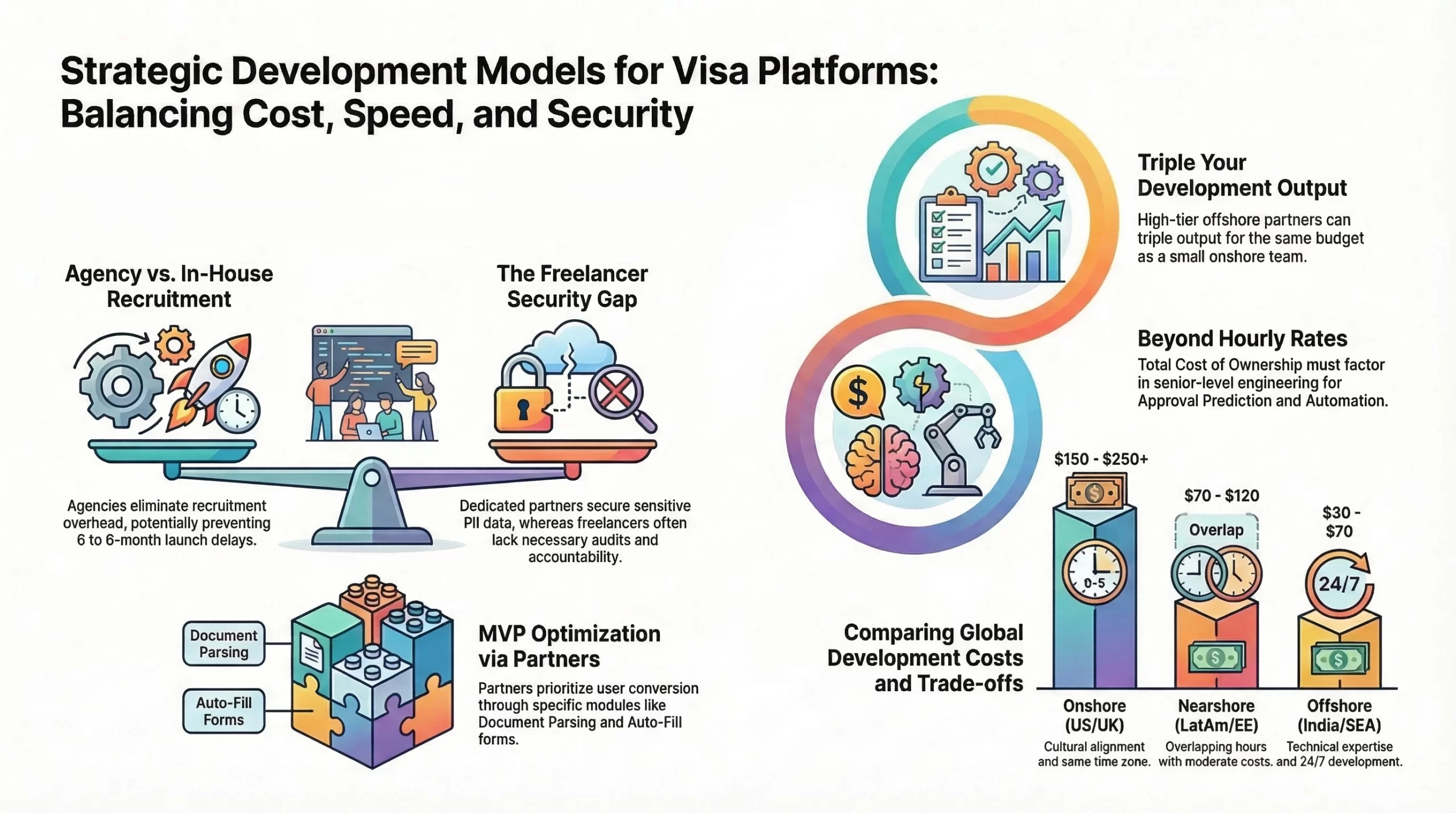
A. In-House Team vs Development Agency
The choice between building an internal team and hiring an agency is a trade-off between long-term control and immediate speed-to-market.
- In-House Team: This approach requires significant upfront investment in recruitment, office infrastructure, and benefits. While it ensures full dedication to the company’s vision, hidden costs such as payroll taxes, software licenses, and hiring delays can postpone launch by 6 to 9 months.
- Development Agency: An agency provides a “ready-to-code” team including Product Managers, QA Engineers, and DevOps specialists. This eliminates recruitment overhead and allows for quick pivots. For a Visa app, an agency’s experience with OCR and secure API integrations can save hundreds of development hours.
Strategic Insight: Investors often choose a development agency like Idea Usher to build the MVP (Minimum Viable Product). Our ex-FAANG/MAANG developers with AI experience deliver enterprise solutions, cut time-to-market in half, and maintain high quality compared to building an internal team.
B. Freelancer vs Dedicated Tech Partner
While freelancers offer the lowest hourly rates, they often represent the highest risk for complex, security-heavy projects like a travel-tech platform.
- The Freelance Gap: Visa applications involve sensitive PII, which freelancers rarely secure rigorously. They often lack audits, documentation, or accountability. If a freelancer leaves mid-project, rescuing the code usually costs more than the original budget.
- Dedicated Tech Partner: A partner functions as an extension of the business. They bring a structured methodology, including Sprint planning, automated testing, and CI/CD pipelines.
Business Depth: A dedicated partner like Idea Usher focuses on business ROI. For instance, they might suggest specific Document Parsing or Auto-Fill Forms modules that prioritize user conversion over just “finishing a task.” This proactive consultation is rarely found in the freelance market.
C. Offshore vs Onshore Development Cost
The geographical location of the development team is the key lever for managing “runway” and maximizing output per dollar spent.
| Region | Avg. Hourly Rate | Pros | Cons |
| Onshore (US/UK/Europe) | $150 – $250+ | Same time zone, cultural alignment. | Prohibitively expensive for startups; high burn rate. |
| Offshore (India/SE Asia) | $30 – $70 | High technical expertise, 24/7 dev cycles. | Requires strong communication protocols and PM oversight. |
| Nearshore (LatAm/Eastern Europe) | $70 – $120 | Overlapping work hours, moderate cost. | Smaller talent pools compared to major offshore hubs. |
- The Cost-Quality Equilibrium: Modern collaboration tools have neutralized the “distance” penalty of offshore development. By choosing a high-tier offshore partner (Idea Usher), you can effectively triple your development output for the same budget required for a small onshore team.
- Actionable Guidance: When evaluating offshore costs, consider more than just the hourly rate. Factor in the “Total Cost of Ownership,” including the partner’s ability to handle Approval Prediction and Automation, which require senior-level engineering rarely found at “bargain” prices.
How Visa App Like Atlys Makes Money?
Visa platforms like Atlys earn through service fees, convenience charges, and value-added offerings across the application journey. These models focus on monetizing efficiency, expert assistance, and premium user experiences while simplifying complex visa processes for travelers.

1. Commission Per Visa Application
The primary revenue driver is a direct service fee added to the base government visa cost. These platforms often utilize a “success-based” or “guaranteed” pricing model to build high levels of user trust and justify premium convenience markups.
Strategic Insight:
- Tiered pricing based on destination complexity (e.g., E-visa vs. Sticker).
- “No-risk” guarantees where service fees are only collected upon successful issuance.
- Instant document processing surcharges for high-precision automated auditing.
Revenue Impact: High-frequency, transactional income that scales linearly with the growing volume of international outbound travelers.
2. Premium Processing and Subscription Models
To cater to high-net-worth individuals and frequent business travelers, platforms offer expedited handling and “concierge” style subscriptions. These models provide predictable, recurring revenue while solving the pain point of volatile visa appointment availability.
Strategic Insight:
- Priority monitoring for rare appointment slots (e.g., US or Schengen visas).
- Subscription tiers for “Global Citizens” offering unlimited document storage and reduced fees.
- Add-on services like “Mock Interview” prep and professional cover letter generation.
Revenue Impact: High-margin revenue that increases customer lifetime value (CLV) and reduces the platform’s reliance on one-off seasonal users.
3. Partnerships With Travel Ecosystem Players
Visa apps can cross-sell essential high-margin products by acting as a “gatekeeper” to international travel. Strategic integrations with airlines, OTAs (Online Travel Agencies), and fintech providers create a seamless, one-stop-shop for the modern traveler.
Strategic Insight:
- Commission from integrated travel insurance and eSIM data plans.
- Referral rewards programs, such as converting visa applications into digital gold or loyalty points.
- Deep-link integrations with major OTAs (e.g., Expedia) to bundle visas with flight bookings.
Revenue Impact: Diversifies the income portfolio and offsets the high cost of customer acquisition through profitable affiliate commissions.
4. White Label Solutions for B2B
Enterprise-grade growth is achieved by providing the platform’s underlying technology to travel agencies and corporate HR departments. These B2B solutions allow smaller players to offer high-tech visa services without building the infrastructure themselves.
Strategic Insight:
- B2B Portals for travel agents to manage hundreds of client applications simultaneously.
- Enterprise API access for corporate travel teams to automate employee mobility workflows.
- White-label branding options that allow partners to maintain their own customer identity.
Revenue Impact: Creates scalable, low-overhead revenue through volume-based licensing and platform usage fees from the professional travel trade.
Conclusion
The Atlys like visa app development cost in 2026 depends on multiple factors including features, integrations, platform choice, and development complexity. From basic apps to advanced, AI-driven solutions, costs can vary significantly based on your business goals and scalability needs. Careful planning, choosing the right tech stack, and partnering with an experienced development team can help optimize your budget. As demand for digital visa solutions grows, investing wisely in Atlys like visa app development cost ensures long-term value, improved user experience, and a competitive edge in the evolving travel tech industry.
Why Choose IdeaUsher for Visa App Development?
Understanding the cost to build a visa application platform like Atlys in 2026 requires more than estimating feature lists; it demands insight into government integration complexity, compliance overhead, and long-term maintenance strategies.
We build AI-driven products across industries, specializing in performance systems, model integration, and scalable infrastructure. Our expertise helps us develop visa automation apps that balance development investment, operational efficiency, and revenue potential.
Our ex-FAANG and MAANG engineers bring over 500,000+ hours of hands-on AI development experience, allowing us to architect cost-efficient travel platforms aligned with growth trajectories, feature prioritization, and sustainable monetization models.
Why Hire Us:
- Cost-Optimized Architecture: We build high-compliance ecosystems with smart infrastructure that minimize initial costs and ensure scalability. We deploy strong document processing systems without over-engineering for unproven markets.
- Custom Feature Planning: We help prioritize development by country rollout strategy, building proprietary verification tools and user flows that maximize market impact per dollar.
- Full-Cycle Ownership: We handle infrastructure, data compliance, payment gateway integration, and scalable architectures to grow with your users. We ensure your visa app is advanced, cost-efficient, and ready from launch.


FAQs
A.1. The MVP level Atlys like visa app development cost typically ranges from $40,000 to $70,000 in 2026. This budget covers core features like document uploading, basic OCR, and integrated payment processing, allowing you to test the market with essential functionality.
A.2. Integrations with global travel databases and government APIs can add $15,000 to $25,000 to your Atlys like visa app development cost. These fees cover custom development and recurring subscription costs for premium data services, which are necessary for providing real time visa status updates.
A.3. Annual maintenance generally costs 15% to 20% of the initial development price. This includes server hosting, security patches, and regular updates to stay compliant with changing international travel laws and evolving mobile operating system requirements for iOS and Android.
A.4. Hiring developers in North America or Europe can cost $150 per hour, while teams in Asia or Eastern Europe charge $30 to $60. Choosing a remote, high quality development partner can reduce your total expenditure by nearly 50% without sacrificing quality.