 (+971) 8007 4267
 (+91) 946 340 7140
 (+1) 628 432 4305


Tax platforms manage highly rule-driven, risk-sensitive workflows such as filing logic, validations, audit trails, and jurisdiction rules that must operate consistently as data moves through the system. As AI integrates with these workflows, architectural decisions start to matter as much as tax logic itself, shaping how an AI tax SaaS architecture supports accuracy, traceability, and controlled automation at scale.
Architectural choices directly impact AI reliability and risk in production. Coordinated data pipelines, rule engines, model inference, explainability, and secure storage must each have clear boundaries and fallback paths. This structure supports regulatory updates, human review, and audits without disrupting operations.
In this blog, we break down the architecture of an AI tax SaaS platform by examining core system layers, integration patterns, and design considerations required to build compliant, scalable, and production-ready tax software.

Overview of AI Tax SaaS Platform Architecture
An AI Tax SaaS Platform is a cloud-based software-as-a-service (SaaS) solution that integrates artificial intelligence (AI), machine learning (ML), and natural language processing (NLP) to automate and optimize tax-related workflows.
These platforms shift tax management from a reactive, manual process to a proactive, data-driven one by handling complex calculations, compliance monitoring, and data extraction with minimal human intervention.
Core Capabilities
These core capabilities use AI and automation to simplify complex tax processes. They improve accuracy, ensure compliance, and enable smarter, faster financial decisions.
- Intelligent Data Extraction: Uses Optical Character Recognition (OCR) and AI to automatically scan and categorize data from financial documents like receipts, invoices, and tax forms (e.g., W-2s, 1099s, and K-1s).
- Automated Compliance & Reporting: Monitors ever-changing global and local tax regulations in real time, automatically updating rules within the system to ensure filings remain accurate and compliant.
- Predictive Analytics: Analyzes historical financial data to forecast future tax liabilities, identify potential savings, and model various tax scenarios for strategic planning.
- Anomaly & Fraud Detection: Employs ML algorithms to scan massive datasets for inconsistencies or irregular patterns that might trigger audits or indicate fraudulent activity.
- Conversational AI Assistants: Provide 24/7 support through chatbots that can interpret complex tax codes and answer specific user queries in plain language.
Why AI Tax SaaS Architecture Is Different From Regular FinTech?
AI tax SaaS architectures differ from traditional FinTech due to regulatory depth, jurisdictional complexity, and audit requirements. They combine probabilistic AI intelligence with deterministic tax engines to ensure legally defensible, explainable outcomes.
1. Non-Linear Logic Orchestration
Unlike standard FinTech that follows linear transaction flows, tax SaaS requires non-linear orchestration. AI must simultaneously reconcile accounting rules, local statutes, and global treaties to determine a single data point’s validity.
2. Temporal Data Sensitivity
FinTech tracks “now,” but tax AI must manage temporal complexity. The architecture must handle retroactive law changes, ensuring that reprocessing 2023 data today applies the correct historical rules without breaking current records.
3. Deterministic vs. Probabilistic Balancing
Regular FinTech is purely deterministic (1+1=2). Tax AI must balance absolute math with probabilistic reasoning to interpret vague legal “grey areas,” assigning confidence scores to various tax positions or potential audit outcomes.
4. Hyper-Granular Audit Lineage
Tax platforms require “source-to-form” traceability that far exceeds standard ledgering. The architecture maintains animmutable chain for every transformed data point, allowing auditors to drill from a final return back to raw metadata.
5. Multijurisdictional Rule Injection
While FinTech focuses on currency or payment rails, Tax SaaS must inject live, jurisdictional code updates into active workflows. This requires a modular engine that swaps complex tax logic without disrupting core operations.
Global Market Growth of AI Tax SaaS Platforms
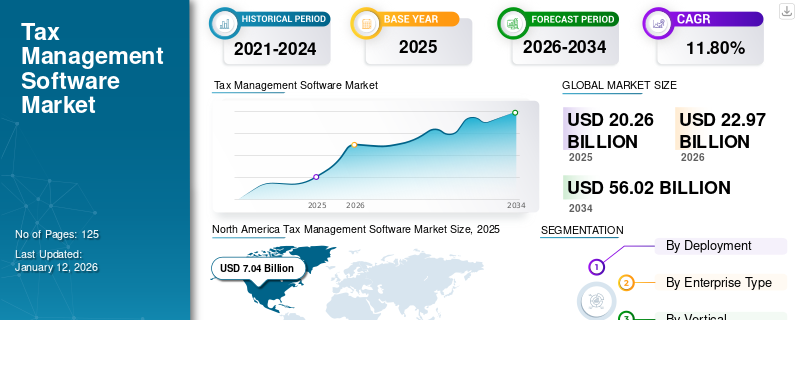
The global tax management software market is projected to reach about USD 56.02 billion by 2034, up from USD 20.26 billion in 2025, registering a CAGR of 11.80% during the forecast period. A well-designed AI tax SaaS architecture emphasizes scalable cloud infrastructure, secure data pipelines, and modular AI components to support accuracy, compliance, and future growth.
Modern AI-driven tax automation significantly speeds up workflows, reducing overall preparation time by up to 75%, cutting document processing time by 40%, and shortening audit cycles by 30%. Tasks like data entry and reconciliation can be done up to 70% faster.
AI-driven tax automation delivers significant efficiency gains, with implementations achieving a 30–60% reduction in overall compliance time. ML-powered solutions have also accelerated workflows by cutting 5-hour manual tasks to just 6 minutes, delivering nearly a 50× speed improvement.
In addition, AI systems can process 15,000 transactions in 5 seconds, compared to 30 hours for manual teams. UK firms using robotic tax assistants save up to 3 hours per return, collectively reclaiming 45,000+ hours annually for higher-value advisory work.
High-Level Architecture Overview of an AI Tax SaaS Platform
An AI-powered tax SaaS platform integrates data ingestion, compliance engines, and analytics to automate filings, ensure accuracy, scale securely, and deliver real-time insights across jurisdictions for enterprises and advisors globally.

1. Presentation Layer
This is the user-facing entry point. Its primary goal is to collect user inputs (both structured and unstructured) and present results in a human-readable, auditable format.
Components:
- Web Application: A responsive dashboard for detailed tax filing, analytics, and document management (Built with React, Angular, or Vue).
- Mobile Application: On-the-go access for capturing receipts (OCR), checking tax estimates, and receiving notifications.
- Chatbot/Conversational UI: A natural language interface allowing users to ask questions like, “What is my estimated tax liability for Q3?” or “Upload my W-2.”
- API Gateway: The single point of entry for all clients. It handles authentication (OAuth2/JWT), rate limiting, and request routing.
Key Functionality:
- Multi-modal Input: Accepts text, voice commands, and document uploads (PDFs, images).
- Visualization: Renders complex tax data into graphs, charts, and step-by-step explanations.
2. AI Orchestration Layer
This is the “brain” of the platform. It does not perform tax calculations itself; instead, it acts as a smart router and context manager. It determines what the user needs and how to get it.
Components:
- Orchestration Engine: The central workflow manager. It receives a user request (e.g., “I have a 1099 form”) and breaks it down into sub-tasks: “1. Parse the document,” “2. Extract income data,” & “3. Classify income type.”
- Context Builder & Session Memory: Maintains the state of the user’s session and historical data. This ensures the AI remembers that the user owns an LLC from a previous conversation, providing continuity.
- LLM Proxy / Router: Manages connections to various Large Language Models (e.g., GPT-4, Claude, or specialized local models). It selects the best model for the task (e.g., a cheaper, faster model for summarization; a more powerful model for complex deduction analysis).
- Guardrails & Validation: A critical security layer. It sanitizes user prompts to prevent “prompt injection” and validates that the output from the LLM stays within safe, tax-relevant boundaries before passing it to the downstream engines.
Key Functionality:
- Intent Classification: “Is the user asking a question, uploading a document, or requesting a calculation?”
- Prompt Engineering: Dynamically constructs prompts using data from the user’s profile and tax context.
3. Tax Intelligence Engine
This is the “heart” of the platform, containing the deterministic logic. Unlike the probabilistic nature of the AI layer, this engine is rules-based and mathematically precise. It is the source of truth for tax numbers.
Components:
- Rules Engine: Encodes the tax code (Federal, State, Local) into machine-readable logic (e.g., Drools, or a custom DSL). This defines if-then scenarios regarding deductions, credits, and filing statuses.
- Calculation Engine: A high-precision math engine that performs the actual tax computations. It handles complex depreciation schedules, amortization, and marginal tax rate calculations without rounding errors.
- Compliance Checker: Cross-references the user’s calculated return against current tax authority regulations to flag potential audit triggers or missing forms.
- Scenario Planner: Allows users to run “what-if” scenarios (e.g., “What if I make a $5,000 IRA contribution before April 15th?”). It interfaces with the Calculation Engine to provide instant projections.
Key Functionality:
- Deterministic Output: For any given input, the output (tax liability) is always the same.
- Version Control: Tracks changes in tax law to ensure calculations are based on the correct tax year.
4. Data & Evidence Layer
This layer handles the ingestion, storage, and retrieval of all data that fuels the platform. It is designed to handle both structured and unstructured data.
Components:
- User Input Data Store: A secure, encrypted database (SQL/NoSQL) storing user profiles, historical returns, and manually entered data.
- Financial Aggregators (Plaid/Yodlee): APIs that connect to the user’s bank accounts, credit cards, and investment platforms to automatically import transaction data and identify tax-relevant items (e.g., mortgage interest, business expenses).
- Document Parsing Pipeline: Utilizes OCR (Optical Character Recognition) and specialized LLMs to read uploaded documents (PDF W-2s, 1099s, JPEG receipts). It extracts key-value pairs (Employer Name, Amount, Date) and passes this structured data to the AI Orchestration Layer.
- Tax Authority DB (External): Integration points with external government APIs (e.g., IRS, State Revenue departments) to validate filing status, download forms, or check for existing tax records (like IRS Income Verification Express Service).
Key Functionality:
- Data Lineage (Provenance): Every piece of data used in a calculation must be traceable back to its source (e.g., “This income value came from page 2 of this PDF uploaded on Tuesday”). This is critical for audit trails.
- Unified Data Lake: Aggregates data from all sources into a single, structured format that the AI Orchestration Layer can easily query.
How Does the Architecture of an AI Tax SaaS Platform Function?
The AI Tax SaaS platform operates through layered architecture components working in sequence. Data flows from ingestion to AI engines, compliance logic, and reporting layers to deliver automated, accurate, and scalable tax outcomes.
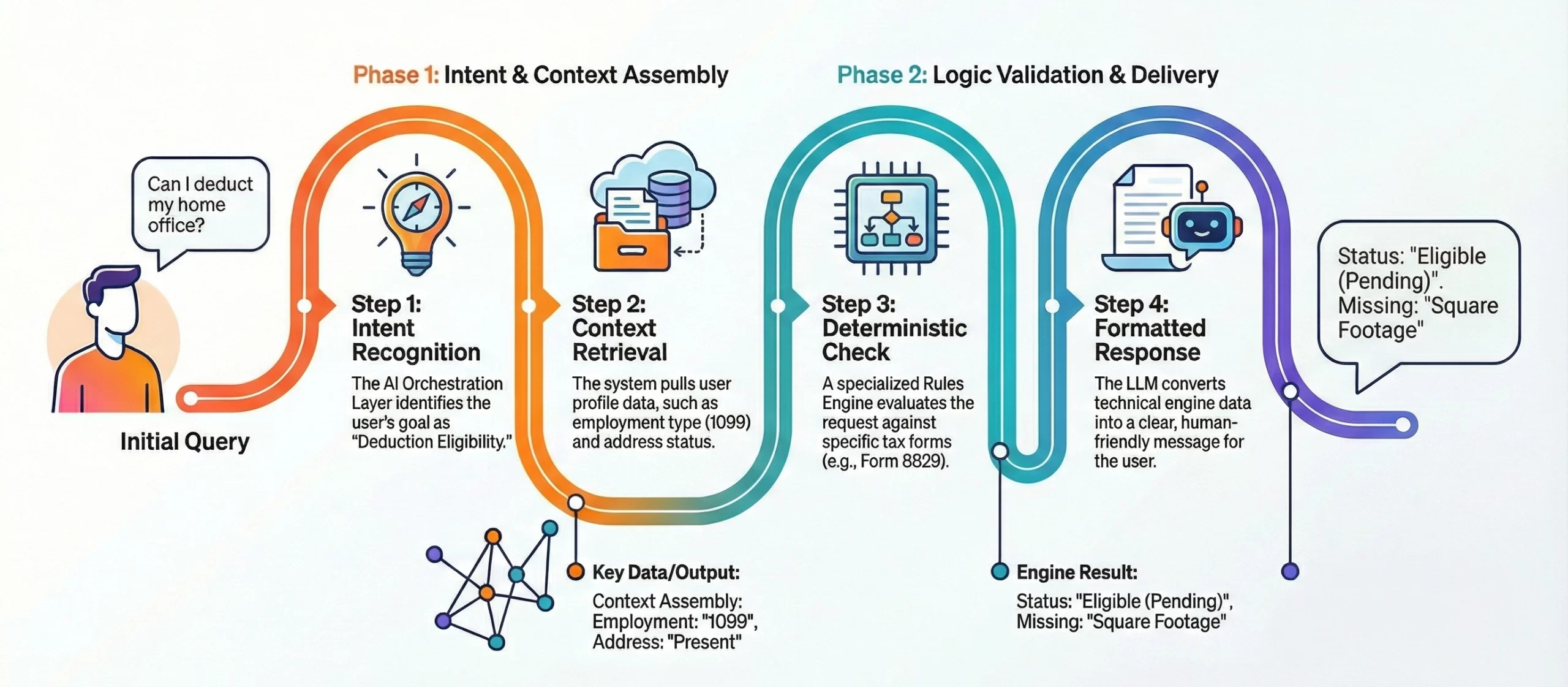
To illustrate how these four layers interact, let’s walk through a practical example: a user asking about a Home Office Deduction.
1. User Action
It captures user input, enforces access controls, and securely forwards requests into the backend architecture
Involved Layer: Presentation Layer (Web App / Chatbot)
A user types a question into the chatbot interface: “Can I deduct my home office?”
Action: The Presentation Layer captures this natural language query and sends it securely via the API Gateway to the backend for processing.
2. Orchestration & Context Building
Involved Layer: AI Orchestration Layer
The Orchestration Engine receives the raw text. It doesn’t know the answer yet, but it knows how to find out.
Intent Recognition: It identifies that the user is asking about “Deduction Eligibility.”
Data Gathering: To answer this accurately, the engine needs context. It sends a request down to the Data & Evidence Layer asking:
- “What is this user’s employment type? (W-2 or 1099?).”
- “Does the user have a home address on file?”
Context Assembly: The Data Layer returns: Employment Type: 1099 and Address: Present. The Orchestrator now has the necessary context to formulate a precise question for the tax logic engine.
3. Intelligence Request
Involved Layer: AI Orchestration Layer → Tax Intelligence Engine
The Orchestrator packages the user’s intent and the gathered data into a structured, machine-readable request. It sends this to the Tax Intelligence Engine:
Request Payload: “User is classified as 1099. A physical address exists. Please check eligibility rules for the Home Office Deduction (referencing tax Form 8829).”
4. Deterministic Calculation
Involved Layer: Tax Intelligence Engine
The Tax Intelligence Engine takes over. This layer is deterministic, meaning it follows the tax code precisely without guesswork.
Rules Check: The Rules Engine evaluates the criteria: “Is the user self-employed? (Yes). Does the user have a qualifying space? (Address exists, but we need more details).”
Logic Preparation: The Calculation Engine prepares the necessary math (calculating the percentage of home used for business) but flags that it is missing a key variable: the square footage of the office.
Response: The Tax Engine returns a structured result to the Orchestrator: “Eligibility: Eligible (Pending). Required Input: Square footage of office space. Calculation Parameters: [Formula for deduction ready].”
5. Human-Friendly Response
Involved Layer: Tax Intelligence Engine → AI Orchestration Layer → Presentation Layer
The dry, technical result from the Tax Engine needs to be translated back into a friendly conversation.
AI Formatting: The AI Orchestration Layer takes the data (Eligible + Missing: Square Footage) and uses its LLM capabilities to generate natural language.
Final Output: The Presentation Layer receives this text and displays it to the user in the chat interface:
“Yes, as a self-employed individual, you can deduct your home office. Based on your address on file, we’ll need the square footage of your office space to calculate the exact amount. Shall we calculate this now?”
This flow ensures that the user gets a friendly, conversational experience (driven by the AI Layer), backed by mathematically accurate tax code (enforced by the Tax Engine), using verified user data (stored in the Data Layer).
How to Develop the Architecture of an AI Tax SaaS Platform?
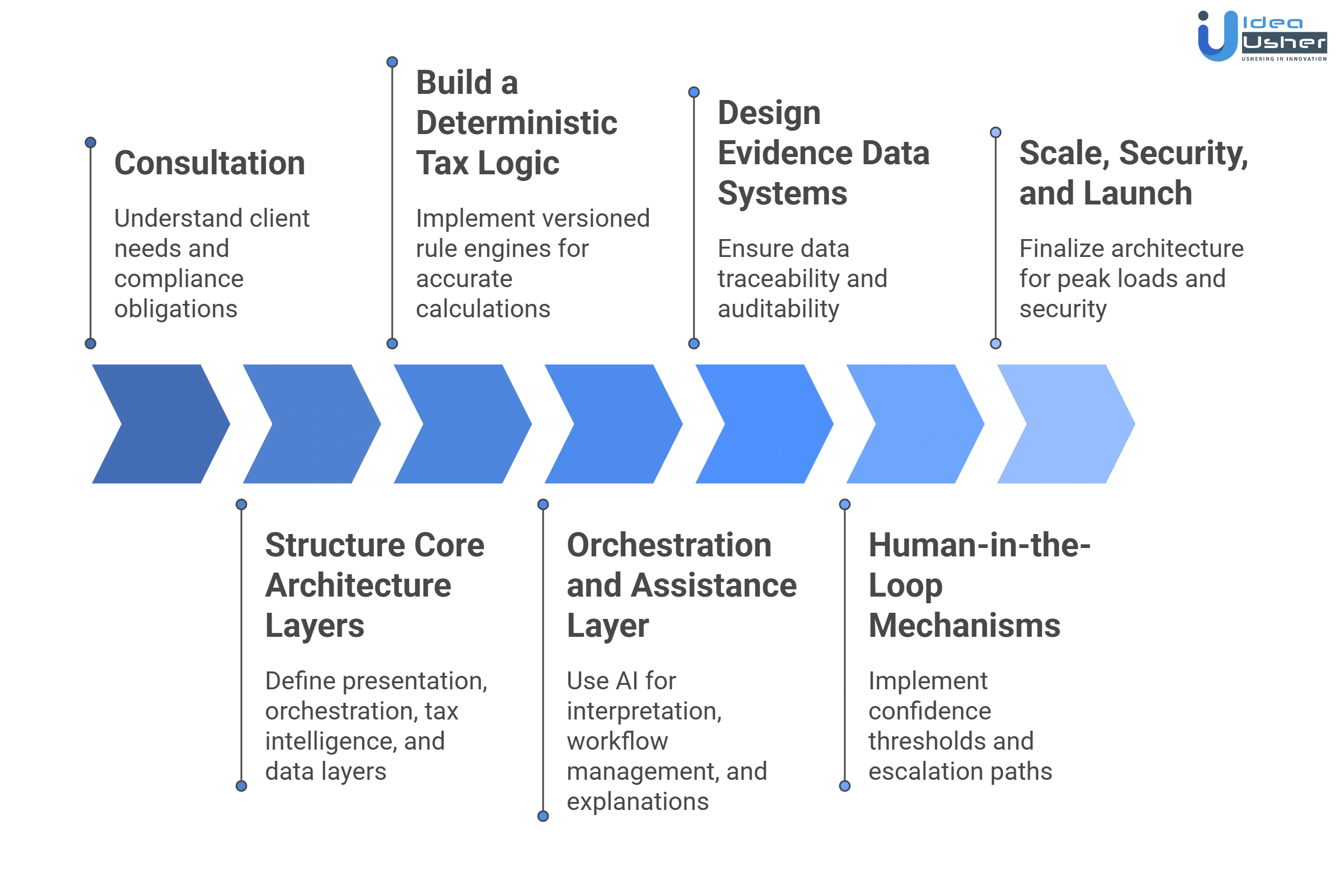
Building an AI Tax SaaS platform requires balancing intelligence, accuracy, and compliance through thoughtful system design. Our developers follow a compliance-first approach to build scalable, auditable architectures where AI supports workflows without affecting statutory tax correctness.
1. Consultation
We consult with clients to understand their business model, target jurisdictions, and compliance obligations. Based on this, we define clear boundaries where AI assists interpretation and workflows, while deterministic engines enforce legally binding tax calculations, preserving statutory accuracy, auditability, and regulatory trust from day one.
2. Structure Core Architecture Layers
Our developers structure the platform into presentation, orchestration, tax intelligence, and data layers. Each layer owns a specific responsibility, preventing cross-coupling and ensuring scalability, explainability, and controlled system evolution.
3. Build a Deterministic Tax Logic
We implement tax computation as deterministic, versioned rule engines aligned with jurisdictional tax laws. This core guarantees reproducible results, supports retroactive compliance, and acts as the authoritative source for all tax outcomes.
4. Orchestration and Assistance Layer
Instead of embedding AI into calculations, we use it to interpret intent, manage workflows, and explain outcomes. AI enhances usability while remaining subordinate to rule-based enforcement and human accountability.
5. Design Evidence-Centric Data Systems
Our architecture treats data as evidentiary assets. We design ingestion, normalization, and lineage tracking so every tax result is traceable back to original documents, transactions, and applied statutory rules.
6. Human-in-the-Loop Mechanisms
We design confidence thresholds and escalation paths where AI uncertainty or compliance risk exists. This allows tax professionals to review, override, and validate decisions while maintaining a complete audit trail.
7. Scale, Security, and Market Launch
Before launch, we help finalize the architecture to handle peak filing loads, enforce tenant isolation, and meet security standards. Scalable services, hardened access controls, and versioned tax logic ensure the platform is production-ready and compliant at market entry.
Where AI Models Should and Should Not Be Applied in Tax SaaS?
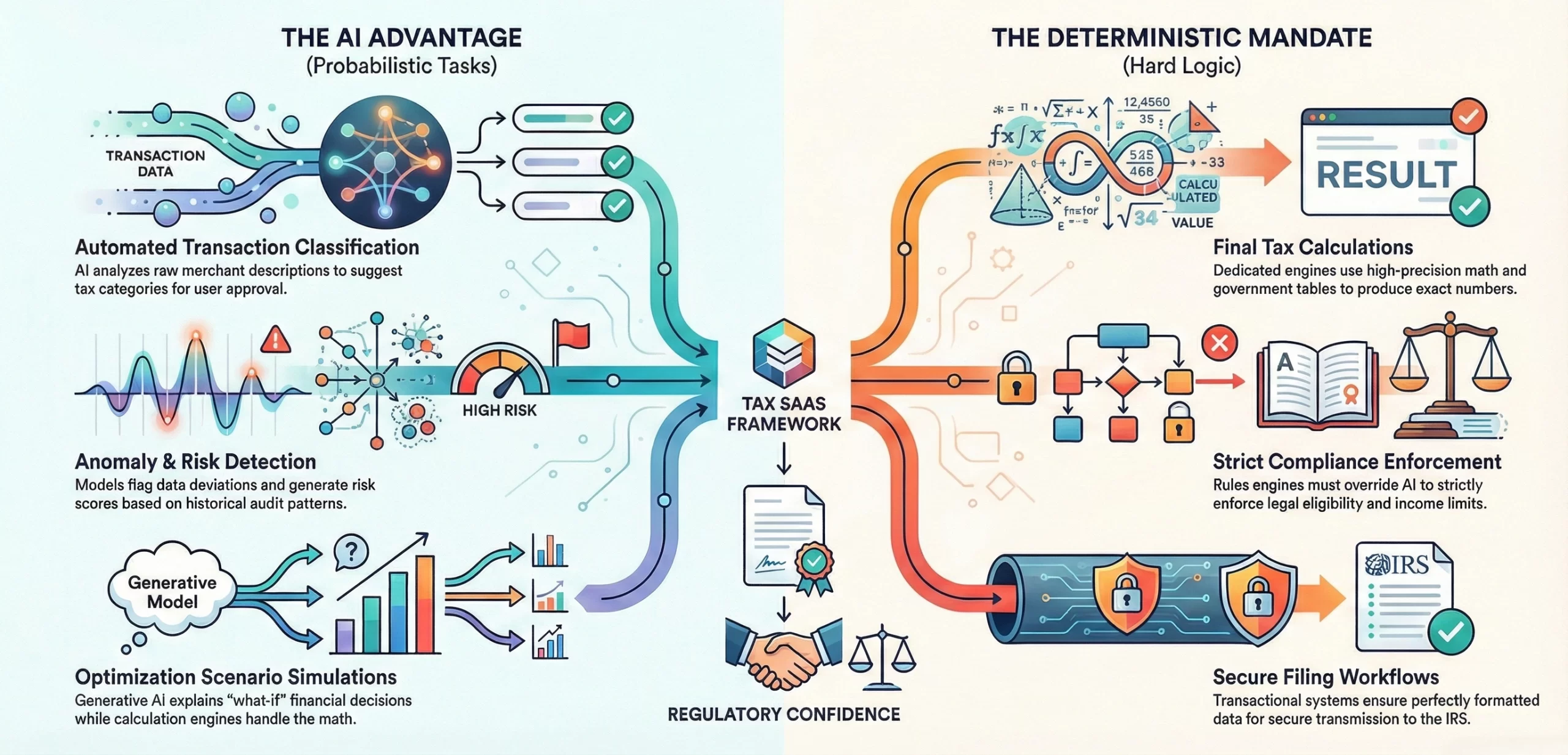
AI models enhance efficiency and intelligence in a tax SaaS platform, but cannot replace deterministic compliance logic. The golden rule is: AI suggests; the Tax Engine confirms, preserving accuracy, auditability, and regulatory confidence.
A. Where AI Adds Real Value
AI is deployed in areas where the data is unstructured, probabilistic, or requires pattern matching. These are tasks where a human accountant would normally spend time reading, categorizing, and making educated guesses.
1. Transaction Classification
The Problem: Users upload bank statements or credit card feeds containing raw merchant descriptions (e.g., “STARBUCKS #78921”).
The AI Solution: AI models (specifically Natural Language Processing and Classification algorithms) analyze the merchant name, amount, and frequency to suggest a tax category (e.g., “Meals & Entertainment” or “Office Supplies”).
The Workflow: The AI suggests a category, but the user (or the rules engine) must approve it before it impacts the tax return.
2. Anomaly Detection
The Problem: Identifying potential errors in a large dataset (e.g., a user accidentally entering $10,000 instead of $1,000 for a charitable donation).
The AI Solution: Unsupervised learning models establish a baseline of the user’s spending and historical deductions. Any data point that falls significantly outside the standard deviation (a statistical measure indicating how much a value differs from the average) is flagged for review.
The Workflow: The system alerts the user: “We noticed your charitable donations are 300% higher than last year. Please verify this amount.”
3. Tax Optimization Scenario Simulation
The Problem: Users want to know the future impact of financial decisions (“Should I contribute to a Roth or Traditional IRA?”).
The AI Solution: Generative AI and predictive models create plain-language summaries of complex “what-if” scenarios. The AI explains the trade-offs in human terms, while the actual math is handled downstream by the calculation engine.
The Workflow: The user asks a hypothetical question; the AI structures the parameters; the Tax Engine runs the numbers; the AI translates the results back into advice.
4. Risk Scoring and Audit Likelihood Prediction
The Problem: Users want to know if their return looks “normal” to the IRS to avoid being audited.
The AI Solution: Machine Learning models are trained on anonymized aggregated data (or public IRS audit rate data) to identify patterns that statistically correlate with audits (e.g., claiming the home office deduction with a certain income level).
The Workflow: The AI generates a “Risk Score” and highlights specific line items that may increase audit risk, allowing the user to add additional documentation or reconsider the deduction.
B. Where Deterministic Systems Must Override AI
These are the “no-fly zones” for AI. In these areas, the consequences of an AI “hallucination” (making up a fact) or statistical error are too high. The system must rely on hard-coded logic, known as deterministic systems, which produce the same output every time for a given input.
1. Final Tax Calculation
The Mandate: The actual number on Line 37 of Form 1040 cannot be guessed or approximated.
The Logic: This must be performed by a dedicated calculation engine using integer math (or high-precision decimals) based on the tax tables published by the government. If AI is used here, it is only to read the number from the screen, not to generate the number.
2. Compliance Rule Enforcement
The Mandate: Eligibility for certain deductions (like the Earned Income Tax Credit) has strict legal requirements (age, income limits, dependent status).
The Logic: A rules engine (e.g., Drools) evaluates these conditions deterministically. If the user’s income is $1 over the limit, the system must deny the credit. An AI model might “feel” the user should get it, but the rules engine must override that instinct.
3. Filing and Submission Workflows
The Mandate: When the user clicks “Submit to IRS,” the data package must be perfectly formatted (ASCII characters only, specific field lengths) and transmitted via secure, audited channels.
The Logic: This is a transactional workflow system. AI has no role in formatting the XML/JSON file or handling the handshake with the IRS servers. Introducing AI here risks file corruption or submission rejection.
What does “AI suggests, Tax Engine confirms” mean in practice?
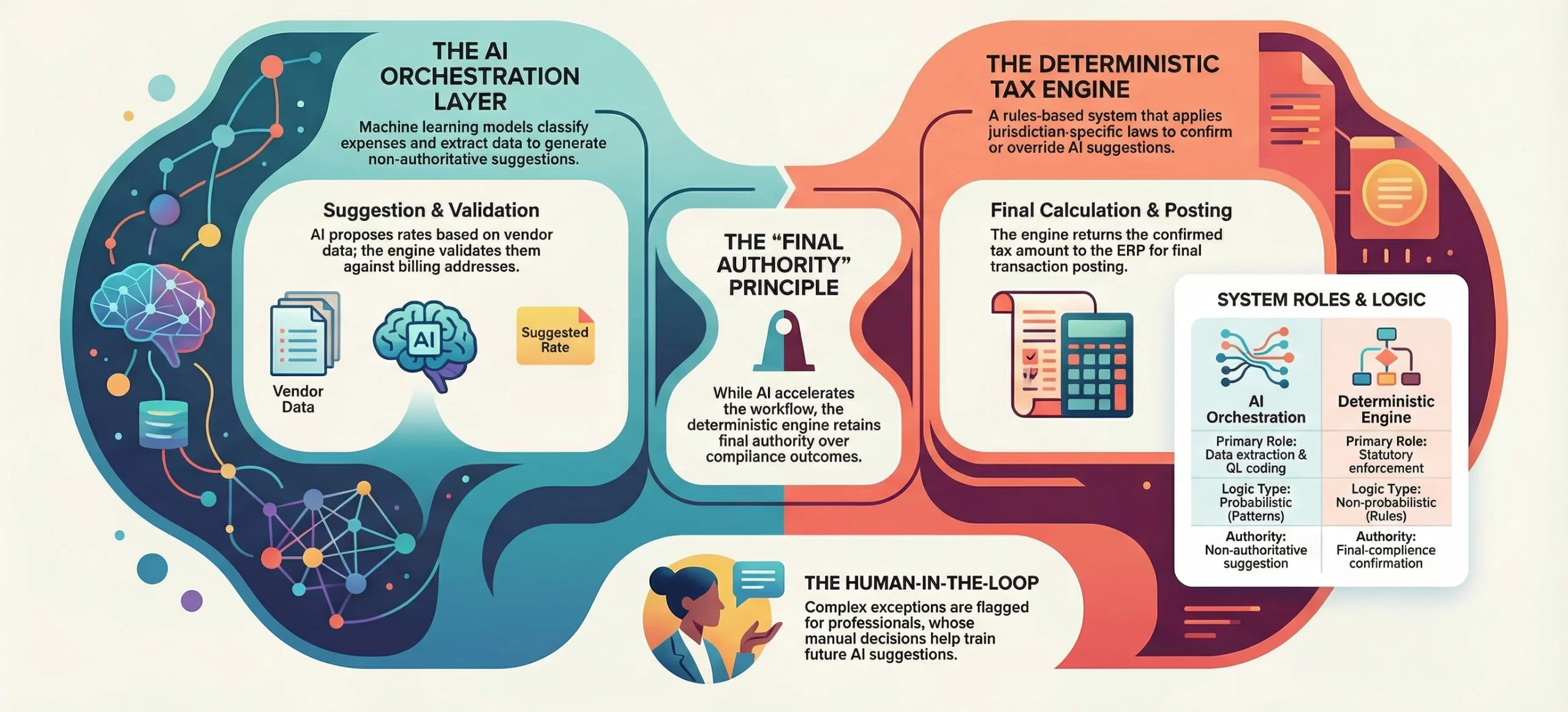
This principle defines how intelligence and statutory enforcement coexist in a tax platform. It ensures AI accelerates interpretation and workflow efficiency while deterministic tax engines retain final authority over compliance-critical outcomes.
A. Breaking Down the “AI Suggests” Phase
This phase operates within the AI orchestration layer, where machine learning models assist with early-stage tasks such as expense classification and data extraction from invoices or receipts. The models generate structured suggestions based on learned patterns, accelerating processing while remaining non-authoritative.
B. The “Tax Engine Confirms” Mechanism
The confirmation step occurs within the deterministic tax intelligence layer. This rules-based engine applies jurisdiction-specific tax laws to AI-generated suggestions, enforcing eligibility criteria, taxability rules, and rates using versioned, non-probabilistic logic.
C. The Interaction in a Workflow
In a typical workflow, the AI orchestration layer and tax intelligence engine work sequentially, each fulfilling specific roles to ensure efficient, accurate, and compliant tax processing.
- Data Ingestion: A vendor invoice is scanned or received digitally.
- AI Suggestion: The AI reads the line items, suggests a general ledger code (e.g., “Computer Hardware”), and proposes the applicable VAT or sales tax rate based on the vendor’s information.
- Engine Confirmation: The tax engine checks the suggested classification against local tax laws for shipping and billing addresses. It may override the AI’s rate if, for example, hardware is exempt, software is taxed, or a new surtax applies.
- Final Calculation: The tax engine returns the final, confirmed tax amount to the ERP or finance system, which then posts the transaction.
D. The Human-in-the-Loop Exception
Although the process is automated, exceptions still require human review. If the tax engine can’t validate the AI’s suggestion due to missing data or complex scenarios, it flags the item for a tax professional. The manual decision is then fed back to the AI to improve future suggestions.
Conclusion
Designing a scalable and resilient AI tax SaaS architecture requires more than layering AI onto legacy systems. It demands a cloud-native foundation, real-time data integration, strong governance, and explainable AI models built for regulatory scrutiny. When architecture aligns with security, compliance, and extensibility from the start, enterprises can move from reactive tax filing to continuous, intelligence-driven tax operations. The result is not just automation, but a future-ready platform that adapts to global tax change, supports strategic decision-making, and delivers measurable business value.
Build an AI-Powered Tax SaaS Platform with IdeaUsher!
We’ve built and launched multiple enterprise-grade AI SaaS platforms, helping organizations design robust architectures that scale seamlessly while meeting strict compliance and security standards.
With ex-MAANG/FAANG engineers and 500,000+ hours of engineering experience, we build AI-powered tax platforms aligned with modern SaaS and regulatory requirements.
Why Partner with Us?
- AI-First SaaS Architecture Design: We architect modular, cloud-native AI tax platforms that support automation, real-time processing, and future scalability.
- Compliance-Driven System Design: Our solutions are built with tax regulations, data privacy laws, and audit-readiness embedded at the architectural level.
- Seamless Enterprise Integrations: We ensure smooth integration with ERPs, accounting systems, payment gateways, and third-party tax data sources.
- Secure & Scalable Deployment: From multi-tenant SaaS models to enterprise-grade security controls, our platforms are designed to scale without compromising data integrity.
Explore our portfolio to see how we’ve designed and delivered enterprise AI SaaS products across industries.
Get in touch with us to discuss your AI tax SaaS architecture requirements and learn how we can build a scalable, compliant platform tailored to your business objectives.


FAQs
A.1. A robust architecture includes cloud-native infrastructure, secure data ingestion layers, AI/ML engines, rule-based tax logic, audit logging, and compliance governance frameworks. Together, these components ensure reliability, regulatory alignment, and enterprise-grade performance.
A.2. Scalability is achieved through microservices, containerization, elastic cloud resources, and asynchronous data processing to handle peak filing periods. This approach allows the platform to grow seamlessly across entities, regions, and data volumes.
A.3. Encryption at rest and in transit, role-based access controls, tenant isolation, and compliance with standards like SOC 2 and ISO 27001 are critical. Strong security safeguards sensitive financial data and builds trust with enterprise customers.
A.4. Explainable AI ensures transparency in tax calculations, enabling audit defense, regulatory trust, and clear validation of AI-driven decisions. It also helps tax professionals confidently rely on AI-generated outputs.