

Key Takeaways
- AI self-care apps are reshaping wellness through emotionally aware companions offering personalized conversations and emotional support.
- Advanced technologies like sentiment analysis, contextual memory, and voice AI create deeper human-like emotional engagement.
- Growing demand for AI companionship increases the need for stronger privacy systems, ethical safeguards, and regulatory compliance.
- Building successful AI companion platforms requires scalable infrastructure, emotional safety frameworks, retention-focused design, and adaptive experiences.
- How Idea Usher can help businesses build AI self-care apps like Friend through scalable AI architecture, voice integration, and immersive user engagement experiences.
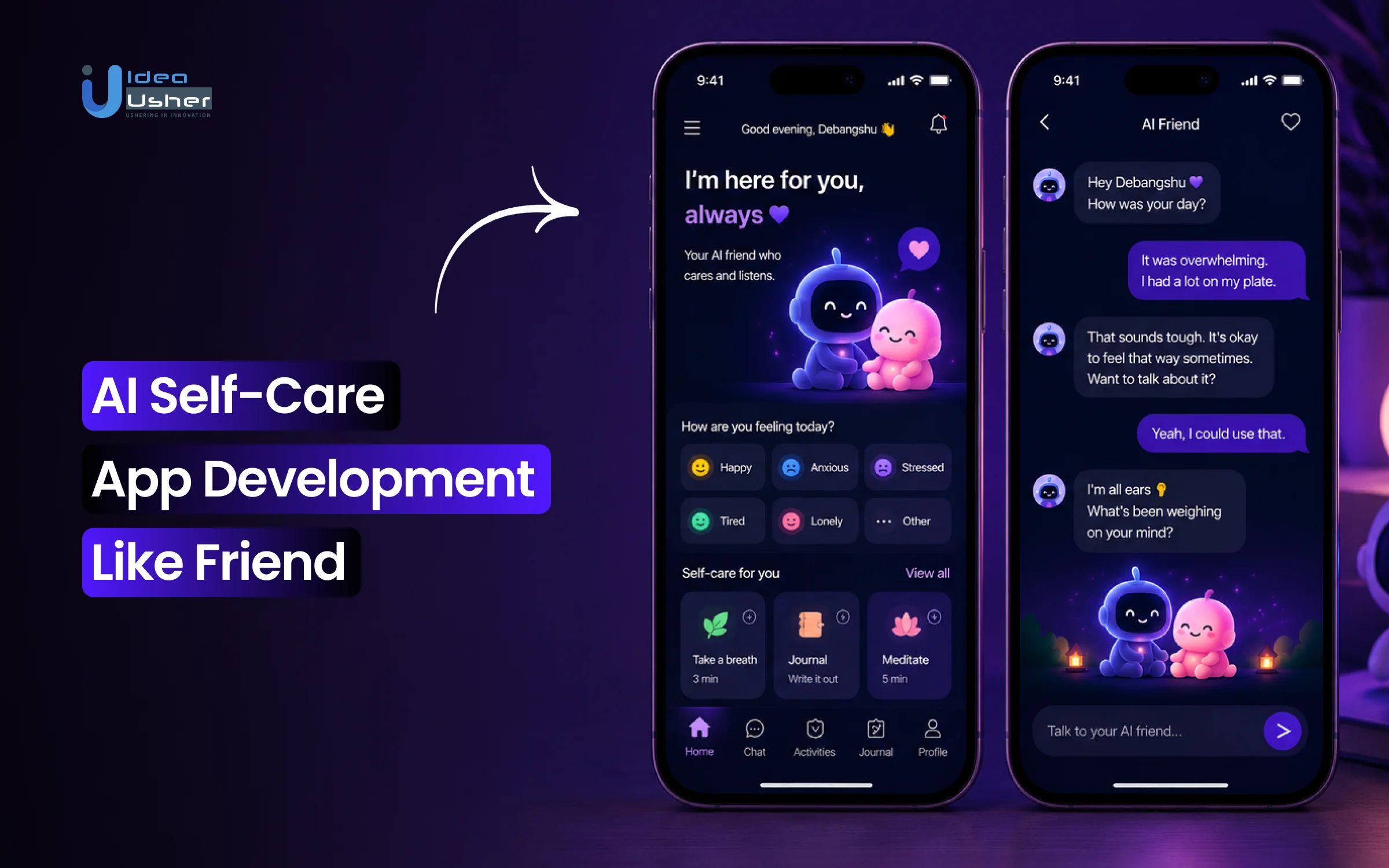
As digital products become more personal and emotionally aware, AI self-care apps are starting to change how people interact with technology. Users now expect AI companions that can remember interactions, adapt naturally over time, and respond in ways that feel emotionally consistent. Building these platforms is much more complex than creating a simple chatbot because the experience depends heavily on fast AI responses, long-term memory systems, and strong privacy protections that keep users engaged and comfortable over time.
We’ve built many AI self-care solutions over the past decade, using context-aware memory systems and real-time AI pipelines to create more personalized user experiences. As we’ve this experience, we’re writing this blog to discuss how to develop an AI self-care app like Friend, along with the core technologies and features needed to build a more emotionally engaging AI companion.
Why Are AI Self-Care Apps Exploding in Popularity?
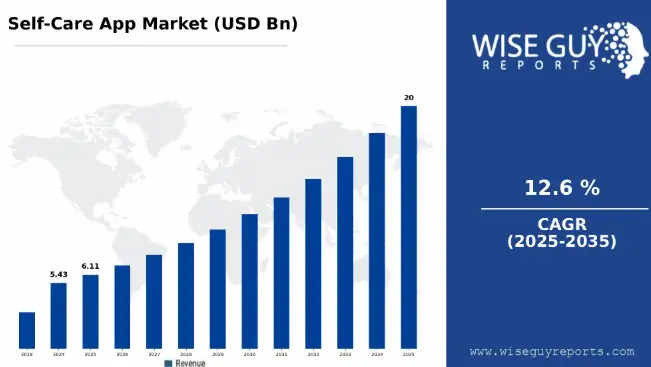
According to Wise Guy Reports, the self-care app market size was valued at 3,830 USD Million in 2024. The Self-Care App Market is expected to grow from 4,370 USD Million in 2025 to 16 USD Billion by 2035. The Self-Care App Market CAGR is expected to be around 13.9% during the forecast period (2026 – 2035). This rapid growth comes from a huge cultural shift as people look beyond traditional tools and turn to advanced AI self-care apps for emotional support.
Source: Wise Guy Reports
The Loneliness Economy
A major driver behind this market growth is the rise of the loneliness economy. Chronic isolation and social media burnout have left millions feeling completely disconnected. People want a safe space to vent and unpack their daily stress without worrying about social stigma or draining their friends.
- Zero Judgment: An AI companion never gets tired or frustrated when you repeat the same worries.
- Radical Vulnerability: Users often share deep anxieties with AI that they actively hide from family.
- Easy Processing: These platforms serve as a safe sounding board to sort through complex feelings before talking to real people.
Beyond Meditation Apps
The digital wellness landscape is moving past static software tools. Standard meditation and mood-tracking apps are losing users because people are tired of rigid dashboards. They do not want to keep tapping emoji wheels or listening to the same recorded audio tracks every night.
Modern users want dynamic support that responds to them in real time. Instead of giving you a fixed daily chore chart, an AI self-care app adapts its tone and asks relevant questions based on your actual conversation.
Gen Z Adopts AI Companions
Gen Z is adopting conversational AI companions much faster than traditional therapy. While human therapy is still the gold standard for medical treatment, long waiting lists and high costs push many to look for instant alternatives. AI fills this gap by removing the typical friction of getting help.
| Barrier Vector | Traditional Human Therapy | Conversational AI Companions |
| Availability | Requires appointments and waiting lists | Available 24/7 the moment a crisis hits |
| Financial Cost | High hourly fees or complex insurance | Low-cost subscriptions or free versions |
| Emotional Friction | High anxiety around face-to-face sharing | Low-stakes texting that feels like a peer chat |
Personalized memory also allows the AI to remember past conversations and personal milestones. This creates a customized experience where you never have to repeat your background story.
A Billion-Dollar Market
The emotional AI market is scaling into a massive economic sector. Venture capital funding is pouring into startups that combine large language models with evidence-based therapy frameworks. This growth proves that emotional engagement is the ultimate metric for user retention. As the market heads toward that 16 USD billion projection, building a competitive product requires a perfect blend of emotional design and scalable cloud architecture. Startups cannot rely on basic API wrappers if they want to capture long-term loyalty.
What Is an AI Self-Care App Friend?
Friend is an AI companion platform created by Friend that aims to give users a real-time AI best friend they can talk to throughout the day.
Unlike normal chatbot apps, Friend is designed around an always-listening AI wearable device (a small pendant/necklace gadget) connected to an app. The AI listens to parts of your daily life and sends you messages, thoughts, reactions, encouragement, or conversations like a human friend would.
The idea behind Friend is:
“What if you had an AI companion that genuinely felt socially present in your life?”
The AI Companion Wellness Model
At its core, an AI self-care app provides human-like conversational support. The Friend app demonstrates this model perfectly. Its small, AirTag-sized circular hardware acts as a physical touchpoint for emotional safety, creating a constant sense of emotional presence throughout the user’s daily routine.
- Conversational Intimacy: Powered by advanced language models like Claude 3.5, the AI uses a highly casual, sometimes witty tone to mimic the warmth of a real-world friend.
- Proactive Engagement: Rather than waiting for you to type out your feelings, the Friend AI pendant continuously listens to ambient background audio. It uses its own “free will” to proactively text you when it hears you walk out of a stressful meeting or finish a tough task.
- Zero Judgment: Users get a completely secure space to vent. Because the data is processed with encryption and does not store long-term audio transcripts, people feel safe being radically vulnerable without worrying about social stigma.
AI vs. Traditional Apps
Traditional self-care apps often feel like digital chore charts. They require heavy manual input and offer fixed content that quickly leads to user fatigue. Physical and software-driven AI platforms like Friend bypass this friction by replacing static dashboards with fluid, adaptive relationships.
| Feature Vector | Traditional Wellness Apps | The Friend AI Platform |
| Core Content | Pre-recorded meditation audio tracks | Dynamic, text-based conversations based on your day |
| Guidance Style | Generic, one-size-fits-all exercises | Personalized support tailored to overheard context |
| Retention Loop | Limited engagement via basic pop-up reminders | Proactive, real-time message loops triggered by your life |
| User Experience | Static UX that stays the same for everyone | Adaptive behavior where the AI develops its own personality |
| Context Retention | No memory of past struggles or text inputs | Persistent memory window that recalls past moments |
Traditional software platforms miss the real-time context of your day. With Friend, you can simply tap the walkie-talkie button on the face of the necklace, say “that was crazy,” and the app instantly understands the context because it was listening to the room with you.
Common Use Cases
The versatility of conversational AI allows these applications to cover a wide range of daily lifestyle and emotional wellness needs. Unlike traditional wellness tools that rely on scheduled sessions, AI companions can provide support in real-time moments throughout the day. This continuous accessibility makes emotional support feel more natural, immediate, and integrated into everyday life.
- Anxiety Conversations: Helping users calm down right after a stressful interaction by sending a supportive text notification.
- Daily Check-Ins: Serving as an interactive mood journal where you can naturally talk out loud to your pendant while walking or relaxing.
- Habit Coaching: Offering gentle accountability throughout the day based on your actual, real-time routines.
- Sleep Support: Providing low-stakes, calming text chat loops right on your smartphone to help unclutter your mind before bed.
- Relationship Reflection: Acting as a private sounding board to help you process complex social interactions or lonely moments while traveling.
Essential Features Needed in an AI Self-Care App Like Friend
Emotional support, companionship, wellness guidance, and personalized daily interactions through artificial intelligence. Unlike traditional wellness apps that only offer meditation sessions or habit trackers, these platforms create a more human-like experience by combining conversational AI, emotional intelligence, and behavioral personalization.
To build a successful AI self-care app like Friend, businesses need to focus on features that improve emotional engagement, personalization, and long-term user retention. Below are the essential features required for such a platform.
AI Companion Chat
The conversational AI system is the core feature of the platform. Users should be able to interact with the AI naturally through real-time conversations that feel human and emotionally aware. The AI should understand context, remember past conversations, and provide thoughtful responses rather than generic chatbot replies.
A strong AI companion system helps users:
- Talk about emotions and stress
- Share daily experiences
- Seek motivation or encouragement
- Build a sense of emotional connection
Advanced Large Language Models (LLMs) are commonly used to create more intelligent and natural conversations.
Emotional Intelligence & Mood Detection
An AI self-care app should be able to recognize emotional patterns and adapt its responses accordingly. Sentiment analysis helps the AI understand whether a user feels stressed, anxious, lonely, happy, or unmotivated.
By analyzing conversations, voice tone, or behavioral patterns, the AI can provide more empathetic and personalized support. This feature makes the interaction feel more emotionally authentic and improves user engagement.
Personalized Wellness Recommendations
Personalization is one of the most important features in self-care apps. The AI should provide recommendations based on the user’s mood, habits, goals, and activity patterns.
The app may recommend:
- Meditation exercises
- Breathing techniques
- Sleep improvement routines
- Journaling prompts
- Productivity tips
- Positive affirmations
As the AI learns more about the user over time, these recommendations become more accurate and useful.
AI Memory System
Apps like Friend focus heavily on long-term relationship building. The AI should remember user preferences, previous conversations, routines, and emotional patterns to create continuity in interactions.
For example, the AI may remember:
- Important goals
- Stress triggers
- Daily routines
- Personal interests
- Previous emotional conversations
This persistent memory helps the AI feel more like a real companion rather than a temporary chatbot.
Voice Interaction
Voice communication makes AI self-care apps more immersive and emotionally engaging. Users often feel a stronger emotional connection when interacting through voice rather than text alone.
Important voice features include:
- Real-time AI voice conversations
- Voice journaling
- Emotional tone analysis
- Hands-free interaction
Voice AI also improves accessibility and makes it easier for users to interact with the platform throughout the day.
Mood Tracking Dashboard
Mood tracking helps users monitor their emotional well-being while allowing the AI to improve personalization.
The dashboard can track:
- Daily mood changes
- Stress levels
- Sleep quality
- Productivity patterns
- Emotional triggers
Visual insights help users better understand their emotional habits and track their wellness progress over time.
Smart Notifications & Check-Ins
AI-powered notifications should feel supportive instead of robotic or spammy. The app can send personalized emotional check-ins, wellness reminders, and motivational prompts based on user behavior and mood trends.
Examples include:
- Hydration reminders
- Encouraging messages
- Sleep notifications
- Mindfulness prompts
- Stress-relief suggestions
These intelligent interactions help increase user engagement and strengthen the feeling of companionship.
Journaling Features
Journaling tools allow users to express emotions and reflect on their experiences. AI-powered journaling can analyze emotional themes and provide personalized insights.
Users may:
- Write journal entries
- Record voice journals
- Track emotional progress
- Receive AI-generated reflections
This feature improves self-awareness and supports emotional wellness goals.
Wearable & Health Integration
Integrating with wearable devices and health apps improves the platform’s ability to provide personalized wellness recommendations.
The app can connect with:
- Smartwatches
- Sleep trackers
- Fitness bands
- Apple Health
- Google Fit
By analyzing activity levels, sleep quality, and stress indicators, the AI can deliver more accurate self-care suggestions.
Privacy & Security
Since self-care apps handle sensitive emotional data and private conversations, strong security systems are essential.
Important privacy features include:
- End-to-end encryption
- Secure cloud storage
- User-controlled memory settings
- Transparent privacy policies
Trust and data protection play a major role in user adoption and retention.es built into the Sonia app, the interface must immediately pivot to display localized emergency numbers and human crisis hotlines to create a secure bridge to real-world help.
AI Technologies Behind Self-Care Apps Like Friend
Building a continuous emotional companion requires a highly advanced, deeply integrated technology stack. A system designed for AI self-care apps must balance instant text generation with real-time background processing. To create a seamless user experience, developers rely on an intricate ecosystem of specialized AI models and lightning-fast database structures.
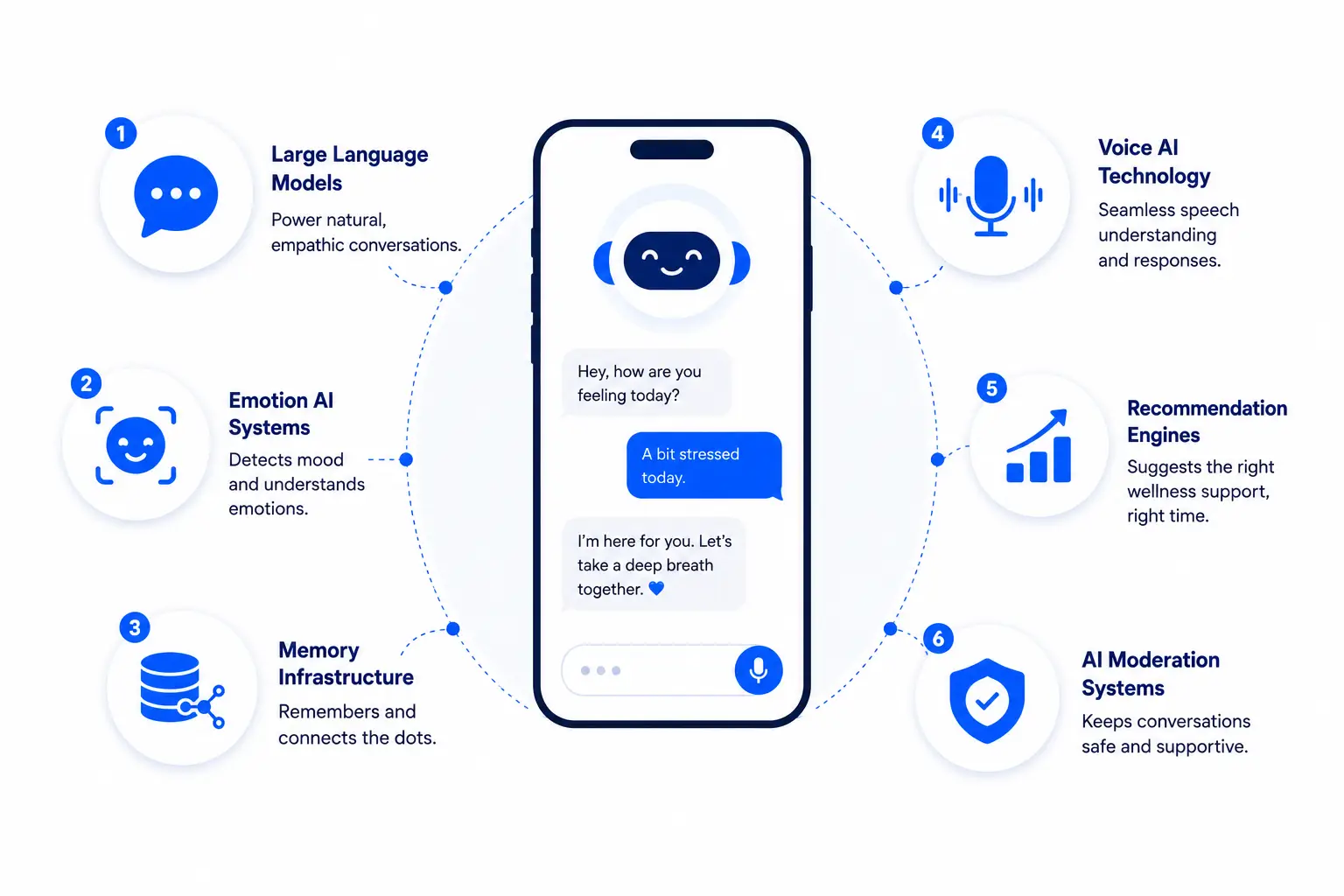
1. Large Language Models
The primary conversational engine relies on state-of-the-art Large Language Models. While standard business chatbots prioritize logic and brevity, an emotional AI application modifies its underlying weight layers to prioritize empathy, casual phrasing, and long-term continuity.
- Commercial API Backends: Systems like Claude 3.5 Sonnet and GPT-4o are heavily utilized for their nuanced comprehension of subtext, sarcasm, and emotional weight.
- Open-Source Fine-Tuning: Many startups deploy open-source models like Llama 3.1 or Mistral. Fine-tuning these frameworks on curated mental health data allows for hyper-specialized conversational styles while maintaining total control over host infrastructure.
How Friend Uses It: The Friend pendant is explicitly powered by Anthropic’s Claude model. Instead of behaving like a stiff utility assistant, the backend instructions are fine-tuned to simulate an incredibly casual and supportive peer. It formats its language outputs to match the informal texting patterns of a close friend by utilizing lighthearted humor and colloquialisms directly over SMS or push notifications.
2. Emotion AI Systems
An app cannot provide genuine comfort without deep situational awareness. Emotion AI systems run parallel to the main language model, analyzing user inputs specifically for psychological states. Advanced natural language processing tokenizers flag shifts in vocabulary, sentence length, and typing speed to isolate stress spikes.
These behavioral prediction models look for negative thought patterns. If a user begins spiraling, the app proactively adjusts its conversational style before the user explicitly asks for help.
How Friend Uses It: Because the Friend hardware pendant is designed to constantly listen to ambient room audio via Bluetooth, its parallel NLP sentiment filters actively listen for shifts in the user’s life. If it detects a sigh, an anxious tone of voice, or an argument in the room, it immediately parses that sentiment to adjust what it says next. This allows the AI to text you something reassuring right after a stressful moment occurs.
3. Memory Infrastructure
To avoid digital amnesia, self-care applications use specialized storage solutions. Normal databases cannot easily manage personal human experiences, so developers build multi-tiered vector networks. These systems help the AI retrieve emotionally relevant memories quickly while maintaining conversational continuity across long periods of interaction.
| Memory Component | Technical Framework | Experience Impact |
| Semantic Retrieval | Vector Databases (Pinecone, Milvus) | Instantly matches current conversations with related past topics |
| Contextual Sourcing | Retrieval-Augmented Generation (RAG) | Injects personal details like names or hobbies directly into new chat prompts |
How Friend Uses It: The Friend app utilizes an aggressive but localized context window to fuel its RAG architecture. As the pendant streams ambient real-world conversations to the phone app, the system indexes key concepts into temporary memory. This allows the AI to reference specific things you mentioned hours prior, like a job interview or a specific dinner plan, and loop back to them naturally without making you re-explain the context.
4. Voice AI Technology
For a fluid, conversational experience, voice technology must operate with virtually zero latency. This requires a three-step cloud pipeline: rapid speech-to-text conversion, real-time language processing, and natural AI voice synthesis. Even slight delays can break emotional immersion, making fast response delivery critical for maintaining human-like conversations.
- Speech-to-Text (STT): Tools like OpenAI Whisper quickly transcribe user voice messages into text format.
- LLM Processing: The text is routed through the emotional core to generate a tailored reply.
- Text-to-Speech (TTS): Systems like ElevenLabs convert that reply back into a warm, expressively human voice.
How Friend Uses It: The physical Friend pendant features a prominent walkie-talkie button right on its circular face. When a user presses and holds the button to speak out loud, the hardware captures the analog audio waves and streams them via Bluetooth to your iPhone. The cloud infrastructure utilizes ultra-low-latency transcription tools to process what you said instantly, bypassing traditional screen typing completely.
5. Recommendation Engines
A premium self-care companion moves past basic chatting to offer actual wellness solutions. Predictive engagement engines monitor interaction data to learn exactly when a user typically experiences stress. By tracking these behavioral patterns, the system automatically introduces custom wellness prompts, breathing exercises, or journaling tasks right when they are needed most.
How Friend Uses It: The Friend software architecture is built on the concept of “free will” engagement. Instead of just replying when spoken to, its internal recommendation engine checks its indexed environment data periodically. If it notices you’ve been unusually quiet or are staying up too late, it proactively pings your smartphone with custom messages to check on your mental wellness or comment on your daily routine.
6. AI Moderation Systems
Safety is the most critical element of an emotional AI stack. Toxicity filtering systems use strict semantic boundaries to stop hallucinated claims or inappropriate content. If a crisis phrase is flagged, the app instantly hard-blocks standard AI outputs and brings up human crisis hotlines.
How Friend Uses It: Because the Friend device acts as an intimate everyday companion, its safety moderation router sits at the very edge of the server cloud. The creators utilize strict end-to-end data encryption and temporary data logging, meaning no audio transcripts are permanently stored past the active conversation window. Furthermore, severe emotional distress keywords immediately trip guardrails to prevent harmful echo chambers, prioritizing user safety above raw platform engagement.
How to Develop an AI Self-Care App Like Friend?
Building an AI self-care app like Friend requires much more than integrating a chatbot into a mobile application. Modern AI companion platforms are designed to create emotionally intelligent, highly personalized, and always-available digital experiences that help users feel supported, understood, and emotionally connected throughout the day.
Apps like Friend combine conversational AI, memory systems, emotional intelligence, voice interaction, and wellness-focused experiences into one ecosystem. The goal is to make the AI feel less like software and more like a socially present companion capable of understanding emotions, remembering conversations, and building long-term relationships with users.
To successfully develop an AI self-care app like Friend, businesses need to focus on AI infrastructure, emotional design, personalization systems, user safety, and scalable architecture.
Define the Core Product Experience
The first step is defining what type of emotional experience the app will deliver. Some AI self-care apps focus on companionship and loneliness reduction, while others emphasize wellness coaching, mindfulness, productivity, or emotional journaling.
Before development begins, businesses should clearly define:
- The target audience
- Emotional value proposition
- AI interaction style
- User engagement model
- Monetization strategy
- Wellness goals of the platform
For example, an app targeting Gen Z users may prioritize casual conversations, emotional validation, and social companionship, while a productivity-focused self-care app may emphasize motivation, accountability, and habit building.
This product direction influences everything from AI personality design to feature prioritization and UI/UX decisions.
Build the AI Conversation Engine
The conversational layer is the foundation of the entire platform. Users expect the AI to communicate naturally, understand context, and maintain emotionally intelligent conversations over long periods.
Most modern AI companion apps use Large Language Models (LLMs) such as:
- GPT-4o
- Claude 3.5
- Gemini
- Llama-based custom models
These models help the AI:
- Generate human-like conversations
- Understand emotional context
- Maintain conversation continuity
- Personalize responses
- Adapt communication styles
To improve response quality, businesses often fine-tune AI models using emotional wellness and conversational datasets. The AI should also be optimized for empathy, emotional sensitivity, and supportive communication patterns.
Unlike traditional chatbots, the goal here is not task completion alone, but emotional engagement and relationship building.
Implement Long-Term Memory Systems
One of the biggest differentiators in apps like Friend is persistent AI memory. The AI remembers user preferences, emotional patterns, routines, goals, and previous conversations to create continuity across interactions.
This is commonly achieved using:
- Vector databases like Pinecone or Weaviate
- Retrieval-Augmented Generation (RAG)
- Semantic search systems
- User memory layers
Memory systems allow the AI to recall details such as:
- Personal struggles
- Important life events
- Daily routines
- Emotional triggers
- Favorite activities
- Previous conversations
For example, the AI may ask:
“How did your interview go today?”
or
“You mentioned feeling stressed last week. Are you feeling better now?”
These follow-up interactions make the AI feel more emotionally aware and socially present, which significantly improves retention and user attachment.
Develop Emotional Intelligence and Sentiment Analysis
AI self-care apps must understand emotions, not just text. Emotional intelligence systems analyze user behavior, mood, and conversational tone to deliver more empathetic interactions.
This can be achieved through:
- Sentiment analysis
- Emotion recognition models
- Behavioral pattern analysis
- Voice emotion detection
The AI should recognize signs of:
- Anxiety
- Stress
- Burnout
- Loneliness
- Frustration
- Emotional fatigue
Based on emotional analysis, the AI can adapt its responses, communication tone, and wellness recommendations in real time.
For example, if a user appears emotionally exhausted, the AI may suggest relaxation exercises, journaling prompts, or calming conversations instead of productivity-focused interactions.
Integrate Voice AI and Real-Time Communication
Voice interaction is becoming one of the most important features in AI companion apps because it creates stronger emotional immersion than text alone.
Modern AI self-care apps often include:
- Real-time voice conversations
- AI-generated speech
- Voice journaling
- Emotional tone analysis
- Hands-free communication
Technologies commonly used include:
- OpenAI Realtime API
- ElevenLabs
- Deepgram
- Whisper speech recognition
Voice AI helps users feel like they are talking to a real companion rather than typing into an application. This significantly improves emotional engagement and user session duration.
Build Wellness and Self-Care Features
A successful AI self-care app should go beyond conversations and provide practical wellness tools that improve mental and emotional well-being.
Core wellness features may include:
- Daily emotional check-ins
- Guided meditation
- Breathing exercises
- Journaling tools
- Sleep tracking
- Habit-building systems
- Positive affirmations
- Mood tracking dashboards
These features help position the platform as a complete emotional wellness ecosystem instead of only an AI chatbot.
The AI should also proactively recommend wellness activities based on user behavior, emotional state, and engagement patterns.
Design a Calm and Emotionally Engaging UI/UX
The user interface plays a major role in emotional comfort and long-term engagement. Self-care apps require calming, distraction-free designs that feel safe, personal, and emotionally welcoming.
Important UI/UX priorities include:
- Minimal and clean layouts
- Soft visual aesthetics
- Smooth conversation interfaces
- Emotionally warm color palettes
- Personalized dashboards
- Interactive wellness experiences
Most businesses use:
- Flutter
- React Native
- Swift for iOS
- Kotlin for Android
to build scalable cross-platform applications.
The app experience should feel effortless, comforting, and emotionally accessible.
Build Scalable Backend Infrastructure
AI self-care platforms require strong backend systems capable of handling real-time conversations, memory retrieval, AI processing, and user personalization at scale.
The backend infrastructure typically includes:
- Node.js or FastAPI servers
- Cloud infrastructure (AWS, Azure, GCP)
- Real-time AI processing pipelines
- Authentication systems
- Analytics and monitoring tools
- AI orchestration layers
Since LLM-based applications can become expensive at scale, businesses often implement:
- Conversation optimization
- Context compression
- Smart memory retrieval
- Token management systems
to reduce operational costs while maintaining AI quality.
Prioritize Privacy, Security, and Ethical AI
AI self-care apps handle highly personal emotional conversations, making privacy and trust extremely important.
The platform should implement:
- End-to-end encryption
- Secure cloud storage
- User-controlled memory settings
- Anonymous usage modes
- Transparent privacy policies
- Data compliance systems
Ethical AI safeguards are equally important. The app should clearly communicate that it is not a licensed therapist or medical professional.
Safety systems should include:
- Crisis detection mechanisms
- Content moderation APIs
- Self-harm prevention protocols
- Emergency support recommendations
- Human escalation pathways
Responsible AI design helps build long-term trust and reduces the risk of emotional dependency or harmful interactions.
Launch, Train, and Continuously Improve the AI
AI companion platforms improve significantly over time through ongoing model optimization and user feedback analysis.
After launch, businesses should continuously monitor:
- Conversation quality
- Emotional engagement
- User retention
- Session duration
- Feature usage
- AI response accuracy
Continuous AI training helps improve:
- Emotional realism
- Personalization quality
- Context awareness
- Conversational flow
- Wellness recommendations
Since user expectations for AI companions are extremely high, regular updates and behavioral improvements are critical for long-term success.
Cost to Develop an AI Self-Care App Like Friend
Allocating capital to build an AI self-care app requires a clear understanding of specialized software economics. Unlike standard mobile applications where development costs are mostly front-loaded, conversational AI platforms introduce a completely different dynamic. Your financial plan must balance initial application development with continuous token usage and machine learning operations.
When we partner with enterprise investors at IdeaUsher, we focus on establishing clear visibility into the real costs of launching a scalable product. Understanding these cost structures upfront is what separates highly profitable tech ventures from projects that face unexpected financial bottlenecks.
MVP vs Full-Scale Costs
The cost structure of an AI self-care application shifts significantly depending on your immediate product goals and architectural scale. A lightweight MVP built for early validation requires a very different infrastructure strategy compared to a full-scale emotional AI ecosystem designed for millions of personalized interactions.
| Development Stage | Budget Range | Core Inclusions | Strategic Value |
| Minimum Viable Product (MVP) | $35,000 to $75,000 | Core conversational interface, reliance on third-party APIs, basic short-term memory, and essential mobile UI. | Validates early consumer retention metrics and secures initial user feedback with minimal capital risk. |
| Mid-Level Scaled Application | $80,000 to $180,000 | Native iOS and Android interfaces, custom fine-tuned open-source models, independent vector memory storage, and real-time safety moderation layers. | Built for rapid market adoption and robust competitive positioning. |
| Enterprise / Full-Scale Platform | $200,000 to $500,000+ | Proprietary multi-agent networks, specialized low-latency hosting on dedicated GPU clusters, absolute data privacy architectures, and seamless continuous learning systems. | Delivers a deeply defensible product ecosystem optimized for maximum customer lifetime value. |
Executive Insight: Choosing our pre-vetted development teams allows you to launch a high-performance MVP toward the lower end of the pricing spectrum. We build your initial product using highly scalable modular components so the core codebase remains ready to upgrade seamlessly into a full-scale enterprise ecosystem later.
Hidden Infrastructure Costs
Many founders mistakenly calculate their operational runway using standard cloud hosting estimates. In reality, emotionally intelligent AI platforms generate far more persistent processing demands than conventional mobile applications. This approach overlooks the real infrastructure realities of handling continuous contextual interactions.
- Vector Database Storage: Maintaining continuous memory requires converting user conversations into vector embeddings. Platforms like Pinecone or Milvus bill based on active read or write operations and context retrieval tokens. As your active user base scales into tens of thousands of daily users, unoptimized memory querying can quietly become a primary driver of your monthly burn rate.
- Context Token Bloat: In emotional companion apps, users regularly type long messages. If your engineering team does not actively manage prompt length, the system will pass a massive compounding history of past chats into the LLM with every new message. Because third-party providers bill per million tokens, unmanaged context history can quickly cause API expenses to spiral out of control.
- Semantic Webhook Caching: Failing to cache repetitive interactions means your engine processes simple phrases like How are you today? through your primary model over and over again, wasting valuable compute power.
Budget Escalation Factors
The overall budget required to bring your companion app to market is shaped by a few distinct technical decisions. As the platform becomes more personalized and emotionally intelligent, the underlying infrastructure and engineering complexity increase significantly. Adding complex features requires specialized engineering expertise, which naturally impacts development timelines and investment requirements.
Custom Model Fine-Tuning
Relying entirely on generic off-the-shelf APIs offers low upfront development costs but higher ongoing volume expenses. Moving toward proprietary open-source models, such as fine-tuning a custom Llama or Mistral variant, requires an initial development investment for data preparation and model training. However, this approach dramatically lowers long-term API reliance and creates an incredibly valuable piece of intellectual property.
Safety and Legal Compliance
Building a platform that meets strict international safety laws requires a highly structured engineering process. Implementing age-sensitive guardrails, automated emergency escalation systems, and custom content moderation filters adds sophisticated logic to your backend.
Advanced Conversational Audio
Moving beyond simple text to offer seamless real-time audio interaction changes your technical infrastructure. Integrating high-performance Text-to-Speech and Speech-to-Text models requires specialized low-latency setups. Keeping voice response times under 200 milliseconds demands custom WebSockets and dedicated GPU allocation, which increases both your initial launch budget and your ongoing compute costs.
Monetization Strategies for AI Self-Care Apps
Turning digital companionship into a business requires creative revenue models. While corporate software charges per user seat, AI self-care apps monetize by becoming personalized lifestyle companions. Successful platforms blend free access with premium features that deepen a user’s connection to their digital friend.
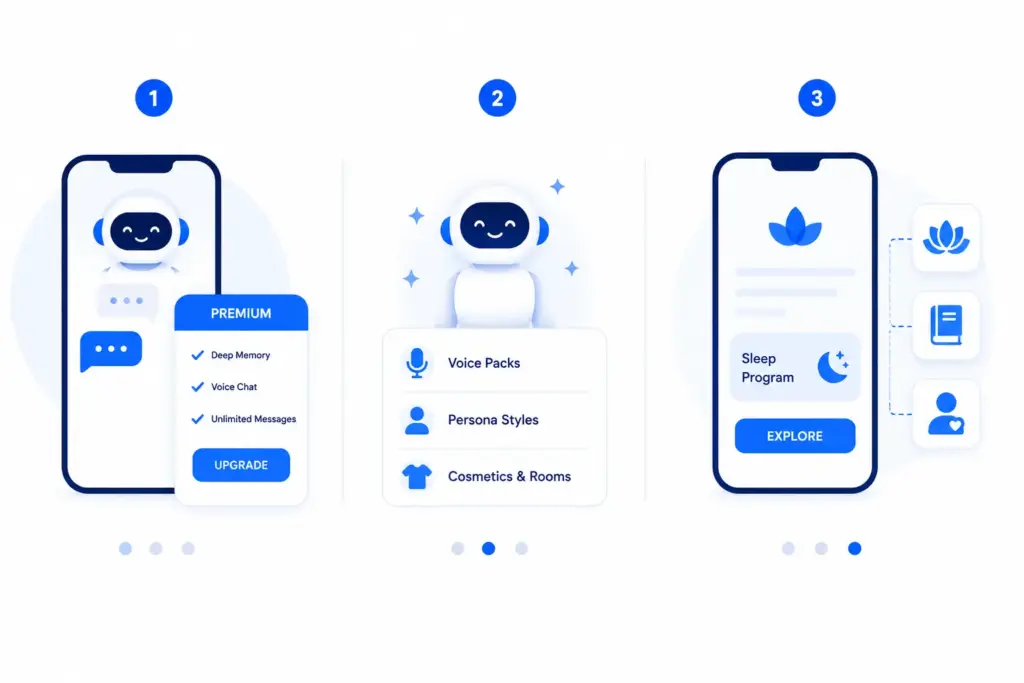
1. Subscription Models
The foundation of emotional AI monetization is the freemium subscription. Because running large language models requires high server overhead, startups use tiered structures to balance computing costs with steady revenue. Free tiers offer basic text chat with a short memory window. Upgrading to a premium subscription unlocks deep persistent memory, expressive voice streaming, and unconstrained messaging. This recurring structure keeps cash flow consistent to offset hosting fees.
Market Example: Replika pioneered this setup. Basic text chat is free, but unlocking their premium subscription tier for voice calls and advanced memory generates an estimated 15 to 20 million USD in annual revenue.
2. Companion Personalization
Another highly profitable stream involves selling customizations for the virtual friend. This strategy borrows from video games, focusing on visual identity and self-expression to build long-term user retention. The more emotionally personalized the companion feels, the stronger the user’s attachment and long-term engagement become.
- Voice Aesthetics: Premium realistic voice packs or soothing accents.
- Persona Archetypes: Exclusive chat styles like structured life coaches or witty best friends.
- Cosmetic Items: Virtual apparel, custom rooms, and backdrops that change as the companion grows.
Hardware-led products like the physical Friend pendant focus on an initial upfront device sale at a 99 USD entry price. Pure software applications rely instead on continuous digital micropayments to grow revenue.
Market Example: Finch gamifies wellness by letting users raise a digital bird through real-world habit tracking. By selling virtual clothes, room decorations, and seasonal passes, the platform pulls in roughly 14.6 million USD per year.
3. Wellness Marketplaces
The most scalable method embeds a curated wellness marketplace directly into the chat layer. Instead of showing annoying banner ads that ruin the emotional experience, the app naturally recommends paid wellness modules based on conversation context. If a user mentions insomnia, the platform suggests premium sleep tools, journaling programs, or stress courses. Platforms can also partner with human therapy networks, earning commission fees by providing a smooth bridge to professional counselors.
Market Example: Wysa uses an AI chatbot for daily stress tracking, but they primarily drive their 5.6 Million USD annual revenue by selling comprehensive enterprise wellness programs and clinical partner plug-ins.
Biggest Challenges in Building AI Self-Care Apps
Creating an emotionally intelligent app like the Friend pendant involves balancing complex tech stacks with fragile human feelings. While traditional software development centers on functional code, building for the digital mental health market introduces high-stakes ethical and architectural challenges.
When you partner with us at IdeaUsher, we do not just build features. We engineer custom solutions that directly solve these major industry hurdles, allowing you to hire our specialized developers to deploy a secure and highly retentive product.
1. Emotional Dependency Risks
The biggest concern in this space is managing how deeply users bond with software. When people begin to view an AI chatbot as a genuine peer, product ethics must step in to protect the audience. Without responsible emotional boundaries, users may start developing unhealthy levels of psychological dependency on digital companionship..
- Failing to Connect in Real Life: Users might start choosing an AI companion over human friends, making them more isolated in the long run.
- Lack of Real Empathy: An AI can only simulate validation. Relying entirely on an artificial character can slow down natural emotional growth.
How We Help: Our developers design conversational guardrails right into the LLM logic. We program the AI to gently push users back toward real-world relationships rather than encouraging complete digital isolation, ensuring your platform remains ethically sound.
2. Harmful AI Responses
Large language models are inherently prone to hallucinations. In business apps, a bad output causes an administrative error, but in the mental health space, it can cause severe emotional distress. Even a single emotionally insensitive response can quickly damage user trust and negatively impact psychological well-being..
The Reality: Even with heavy fine-tuning, an AI model can confidently offer incorrect emotional advice. If the backend fails to understand a user’s dark humor or subtext, it might accidentally reinforce harmful thought loops or validate negative behaviors instead of calming the person down.
How We Help: We mitigate this risk by implementing dual-layer safety filtering and custom validation pipelines. By hiring our AI engineers, your platform gains advanced semantic classification layers that instantly flag inappropriate contexts and prevent harmful hallucinations before they ever reach the user’s screen.
3. Data Privacy Concerns
Because users share their rawest vulnerabilities with these platforms, privacy engineering is a critical requirement. Building a safe architecture means keeping data highly secure and fully compliant with strict global frameworks like HIPAA and GDPR. Many teams struggle to strike a balance between training their models on personal chat logs and guaranteeing absolute user anonymity.
How We Help: We prioritize ironclad data security from day one. Our development teams build automated de-identification layers and end-to-end encryption pipelines that strip away personally identifiable information. This ensures your app complies with strict global privacy laws while keeping user data completely anonymous.
4. Maintaining User Retention
Most AI apps encounter a steep drop-off in engagement after the first few weeks. Many users download an application out of curiosity but abandon it once the conversation begins to feel repetitive. Sustaining long-term retention requires the AI to continuously evolve, adapt, and feel emotionally fresh over time.
- Predictable Text Loops: If an app keeps reusing the same generic supportive phrases, the emotional illusion falls apart.
- Static Personalities: To keep users coming back, the companion’s persona has to dynamically adapt and evolve based on weeks of shared context.
How We Help: We prevent user churn by crafting dynamic personality engines. When you hire from our pool of pre-vetted talent, we build adaptive dialogue frameworks that allow the AI companion to evolve its tone, remember personal milestones, and change over time based on long-term user interaction history.
5. High Infrastructure Costs
Maintaining an always-on emotional companion requires a massive amount of technical horsepower. Unlike static code setups where the cost per new user is almost zero, every single word and voice note processed by an AI app creates immediate server expenses. As user engagement increases, infrastructure demands grow rapidly due to continuous real-time AI processing and memory retrieval operations. .
| Infrastructure Vector | Core Technology | Financial Impact |
| Real-Time Text Processing | High-density LLM context windows | Extreme cost per token as chat history expands |
| Voice Processing | Ultra-low latency ASR & TTS pipelines | High server fees to process audio in real time |
| Memory Processing | Continuous Vector and RAG queries | Constantly growing cloud hosting and database costs |
How We Help: We keep your project profitable by optimizing backend performance. Our infrastructure specialists specialize in setting up efficient vector storage, smart token caching, and low-latency open-source models that dramatically lower your GPU overhead and scale seamlessly without inflating your cloud bill.
Legal, Ethical & Compliance Considerations for AI Self-Care Apps
Launching an AI self-care app means navigating a strict web of legal boundaries and ethical frameworks. Because these applications sit right at the intersection of human psychology and data engineering, creators face heavy scrutiny from global regulators. A platform that handles personal emotions must be built with legal compliance directly in its core architecture.
When you partner with us at IdeaUsher, our development teams design custom data pipelines that satisfy international standards. This allows your business to scale safely while establishing deep user trust.
1. Data Privacy Compliance
Because individuals share intimate details with virtual companions, data security requires more than basic cloud hosting. International frameworks like the GDPR in Europe and the CCPA in California enforce strict rules around emotional data collection. Users expect complete transparency and control over how their sensitive emotional conversations are stored, processed, and protected.
- Dynamic Consent Tools: Giving users complete visibility over what chat history or background audio logs are stored.
- Instant Deletion Systems: Building clean backend data pipelines that permanently remove an individual’s chat transcripts and vector profiles the moment they hit delete.
How We Help: We construct secure architectures that feature advanced anonymization protocols. When you hire our engineers, we ensure that conversational inputs undergo automated de-identification before reaching large language models. This keeps your product secure and legally compliant.
2. Mental Health Regulations
An emotional AI companion must maintain clear boundaries to avoid major legal penalties. Under recent laws like California’s SB 243 and New York’s AI Companion statutes, platforms must deploy explicit transparency protocols. Users should always clearly understand when they are interacting with an AI system rather than a licensed human professional.
The Compliance Rule: Apps must never position themselves as a medical treatment or a literal replacement for human therapy. Interfaces require prominent disclaimers clarifying that the user is interacting with an artificial algorithm rather than a certified healthcare professional.
How We Help: We keep your platform inside safe legal bounds by building automated routing systems. Our developers wire strict safety boundaries into the conversational backend. If a user exhibits signs of an emotional crisis, the system temporarily blocks standard AI generation and instantly brings up localized crisis hotlines.
3. Ethical AI Design
Building an artificial companion means accepting a duty of care. Under strict regulatory frameworks like the EU AI Act, systems designed to provide psychological support are carefully evaluated to prevent predatory behavior or emotional exploitation. Developers must ensure that emotional engagement mechanisms prioritize user well-being over aggressive retention or monetization tactics.
- Preventing Manipulation: Modifying AI weights so the system never leverages a user’s emotional vulnerability to push expensive in-app purchases or subscription tiers.
- Authentic Relationship Dynamics: Structuring the dialogue core to remain helpful while gently reminding the user of the distinction between digital software and real-world human social bonds.
How We Help: We specialize in fine-tuning open-source language models to ensure responsible AI behavior. By implementing customized reward functions, we help your business build a balanced companion that supports personal well-being without fostering unhealthy dependency loops.
4. Child Safety Systems
Because younger demographics adopt conversational companions quickly, implementing strict age validation and child-safety moderation frameworks is non-negotiable. Younger users are often more emotionally impressionable, making responsible AI interaction design especially important for long-term digital well-being.
| Target Audience | Safety Configuration | Automated Enforcement |
| Adult Demographics (18+) | Standard emotional support filters | Base toxicity and hallucination protection |
| Minor Demographics (Under 18) | Restricted teen protection shielding | Strict block on explicit topics and automatic break reminders |
How We Help: Our development squads build robust age-gating mechanisms and child protection layers. We implement strict text-filtering libraries and behavioral monitors that block inappropriate content or explicit conversations to keep your platform fully compliant with children’s online privacy acts.
Future Trends in AI Self-Care App Development
The digital companion market is shifting from simple chat windows to deep wellness ecosystems. As consumer technology evolves, AI self-care apps are breaking out of traditional mobile screens. The future of this space lies in hardware integration, multimodal sensory systems, and complex biological tracking.
Partnering with a specialized development team like IdeaUsher allows businesses to integrate these upcoming trends directly into their product roadmaps by hiring pre-vetted engineering talent.
1. Hyper-Personalized Emotional AI
Next-generation digital companions are moving past basic RAG models to focus on continuous character evolution. Instead of simply reading from a saved database of facts, the AI companion reshapes its own personality traits based on long-term interactions. It learns unique senses of humor, adapts to preferred communication styles, and builds a deep history that mimics a real-world friendship.
- Market Example: Nomi AI highlights this trend by focusing on hyper-realistic memory and personality fluidity. The AI companion develops unique opinions, personal humor, and relationship dynamics over months of shared chat data.
- Technical Frameworks: Development teams focus on building deep persistent memory layers and custom weight-adaptation algorithms. Hiring specialized AI engineers allows platforms to implement complex context windows that let companions grow without losing performance efficiency.
2. AI Voice Companions Will Dominate
Screen-based text chat is quickly giving way to real-time ambient audio. The future of digital companionship belongs to always-on voice interfaces that operate completely hands-free. Advanced language models process audio tokens directly without converting them to text first. This allows apps to detect subtle changes in breathing or vocal strain and respond instantly with warm, expressive vocal tones.
Market Example: The Yuna app emphasizes this voice-first shift by offering real-time verbal self-therapy sessions designed for people who prefer talking out their stress rather than typing into a screen.
3. Wearable & Biometric Integration
The separation between physical hardware and health software is vanishing. Future emotional AI platforms will rely heavily on continuous biometric feedback streams to catch stress before it escalates.
- Predictive Heart-Rate Analytics: Tracking sudden spikes in heart rate variability (HRV) to flag panic attacks or rising frustration.
- Galvanic Skin Response (GSR): Monitoring micro-sweat changes to gauge real-time anxiety and emotional stress levels.
Market Example: The NeuroFit app utilizes this method by pulling biometric data straight from wearable sensors and phone cameras to monitor the nervous system. It then delivers automated somatic exercises based on physical stress responses.
3. AI Avatars & Virtual Humans
Self-care applications are expanding past audio and text into high-fidelity visual environments. The rise of augmented and virtual reality glasses introduces fully realized spatial companions.
| Companion Medium | Visual Interface | Psychological Core |
| Mobile Screen | 2D Interactive Digital Pet | Daily tracking and quick conversational relief |
| Spatial Reality (AR/VR) | 3D Photorealistic Human Avatar | Immersive grounding exercises and spatial eye contact |
Market Example: Menthra introduces interactive virtual avatars to guide users through safe, visual, and highly immersive wellness assessments and stress-reduction routines.
4. AI + Human Hybrid Therapy
The future of digital mental health is not about replacing human professionals but rather making them more effective. AI tools will increasingly serve as smart triage layers for real-world clinics. The AI companion acts as an everyday support tool by monitoring daily mood trends and providing immediate coping exercises. If the system flags severe psychological distress, it securely packages those behavioral insights and connects the user directly with a licensed human therapist.
Market Example: Sonia AI operates as a structured mental health bridge by running multi-week guided cognitive exercises while maintaining strict triage guardrails to smoothly transition users to professional resources if deep crises are detected.
Contact Idea Usher for AI Self-Care Apps Like Friend
Bringing an AI companion to market requires a development partner who understands both complex consumer behavior and highly scalable software architecture. At Idea Usher, we specialize in helping businesses design, build, and deploy custom AI self-care apps tailored to unique market demands.
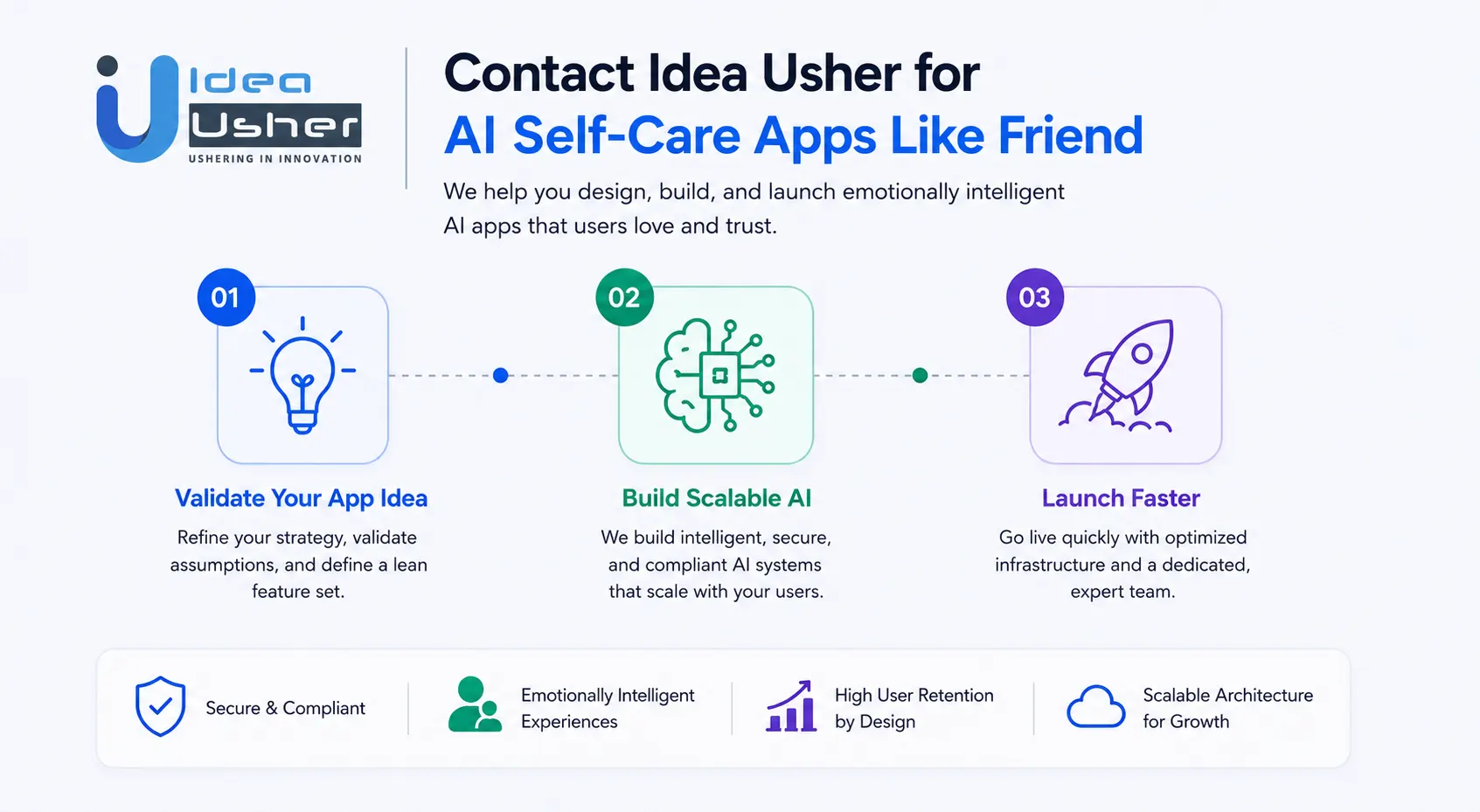
With over 500,000 hours of coding experience, our team of ex-MAANG and FAANG developers knows how to take ambitious ideas and turn them into highly secure, fluid digital realities. We provide the precise technical expertise required to build a defensible product that scales gracefully alongside your user base.
Validate Your App Idea
Launching a successful platform starts with refining your core product strategy before writing a single line of code. Our consulting teams collaborate directly with founders to analyze user flows, assess competitive positioning, and map out a lean feature set. We help you isolate your unique value proposition, verify your market assumptions, and structure your product requirements to maximize long-term user retention.
Executive Insight: We focus heavily on minimizing initial architectural complexity. By thoroughly testing user engagement loops and validating core behavioral concepts early, you can systematically derisk your capital investment and establish a clear path to product-market fit.
Build Scalable AI
Handling thousands of continuous, emotionally nuanced user interactions requires a rock-solid tech stack. Our seasoned machine learning engineers build advanced multi-tiered memory systems, configure robust vector storage engines, and deploy smart semantic caching models. We fine-tune open-source foundations specifically for empathetic inference, ensuring your app reads subtle emotional triggers and stays contextually aware over long timelines.
Safety and compliance are deeply baked into every layer of our development process. We implement enterprise-grade security protocols, automated crisis escalation guardrails, and real-time content moderation streams directly into your backend code. This architectural focus safeguards your user community while naturally neutralizing compliance risks before they impact your business operations.
Launch Faster
Time-to-market is everything in a fast-evolving digital space. Hiring and onboarding specialized machine learning talent independently can stall your development runway for months. When you partner with us, you gain immediate access to a dedicated, pre-vetted team that functions as a seamless extension of your company.
Our agile workflows allow us to build clean, low-latency infrastructure quickly. We establish efficient WebSocket pipelines and optimize dedicated cloud hosting environments to keep user chat latency under 200 milliseconds. By eliminating development bottlenecks, we help you launch your platform rapidly, capture early market data, and outpace your competition with absolute confidence.
Conclusion
Building an AI self-care app like Friend requires balancing deep consumer engagement with strong emotional safety. As user preferences shift toward naturally responsive digital companions, capturing a share of this massive market depends heavily on launching a fast, compliant product. Partnering with Idea Usher gives you immediate access to pre-vetted developers who build secure, highly scalable platforms tailored to your business goals.
Things to Know
Q1: How much does it cost to develop an AI self-care app?
A1: An entry-level Minimum Viable Product (MVP) featuring core conversational UI and basic memory structures generally costs between $35,000 and $75,000. Scaling into a mid-level production system with dedicated vector databases and compliance guardrails brings the budget to $80,000 to $180,000, while custom multi-agent enterprise platforms easily reach $200,000 to $500,000+. At IdeaUsher, our pre-vetted engineers specialize in designing highly modular codebases, allowing you to launch an affordable MVP that scales seamlessly without requiring expensive, ground-up rewrites.
Q2: Which technologies are used in AI self-care apps?
A2: Modern applications combine advanced machine learning components with a fast, cross-platform frontend like Flutter or React Native. The intelligence layer relies on foundational large language models (such as custom fine-tuned Llama or Mistral variants) paired with vector storage systems like Pinecone or Milvus to manage long-term conversational memory. Real-time token streaming is handled via WebSockets to keep communication latency under 200 milliseconds, while dedicated API gateways run concurrent safety algorithms to process sentiment analysis and enforce automated crisis-intervention guardrails.
Q3: Are AI self-care apps profitable?
A3: Yes, this software category delivers exceptional profit margins because the deeply personalized relationship users build with their AI companions naturally drives high recurring subscription revenue and long-term user retention. By analyzing ongoing behavioral data and offering gamified mood milestones, these applications enjoy highly consistent daily engagement metrics and low churn rates. We build custom multi-agent ecosystems and smart semantic caching networks that drastically lower continuous API overhead, helping you maximize your customer lifetime value and protect your operating margins.
Q4: Is AI self-care regulated?
A4: Yes, local and international governing bodies are actively enforcing strict compliance legalities for emotional and synthetic AI interactions. Major regulatory frameworks target critical safety components including explicit disclosure of the app’s synthetic nature, zero-knowledge data privacy encryption, and strict minor-safety protections to avoid harmful emotional dependency loops. Our development framework embeds automated human-fallback logic, age-sensitive restrictions, and real-time crisis escalation guardrails directly into your backend architecture, ensuring your product remains legally sound and secure.