


Key Takeaways
- Lenders are adopting AI income verification platforms to replace manual checks with faster, more accurate, and secure verification workflows.
- Modern platforms combine AI-powered document analysis, payroll integrations, open banking, fraud detection, and automated verification.
- Building a successful solution requires multi-source data connectivity, secure APIs, compliance, AI orchestration, and scalable cloud infrastructure.
- These platforms improve loan approvals, fraud prevention, operational efficiency, and customer experience, creating strong fintech business opportunities.
Identity verification has become much easier over the years, but verifying a person’s income is still a challenge for many businesses. Lenders and financial institutions often spend valuable time reviewing documents before they can approve an application. AI income verification platforms are changing that by making the entire process faster and more reliable. Instead of relying on paperwork, businesses can instantly access verified income data and make confident decisions in less time. This not only speeds up approvals but also improves the overall experience for customers.
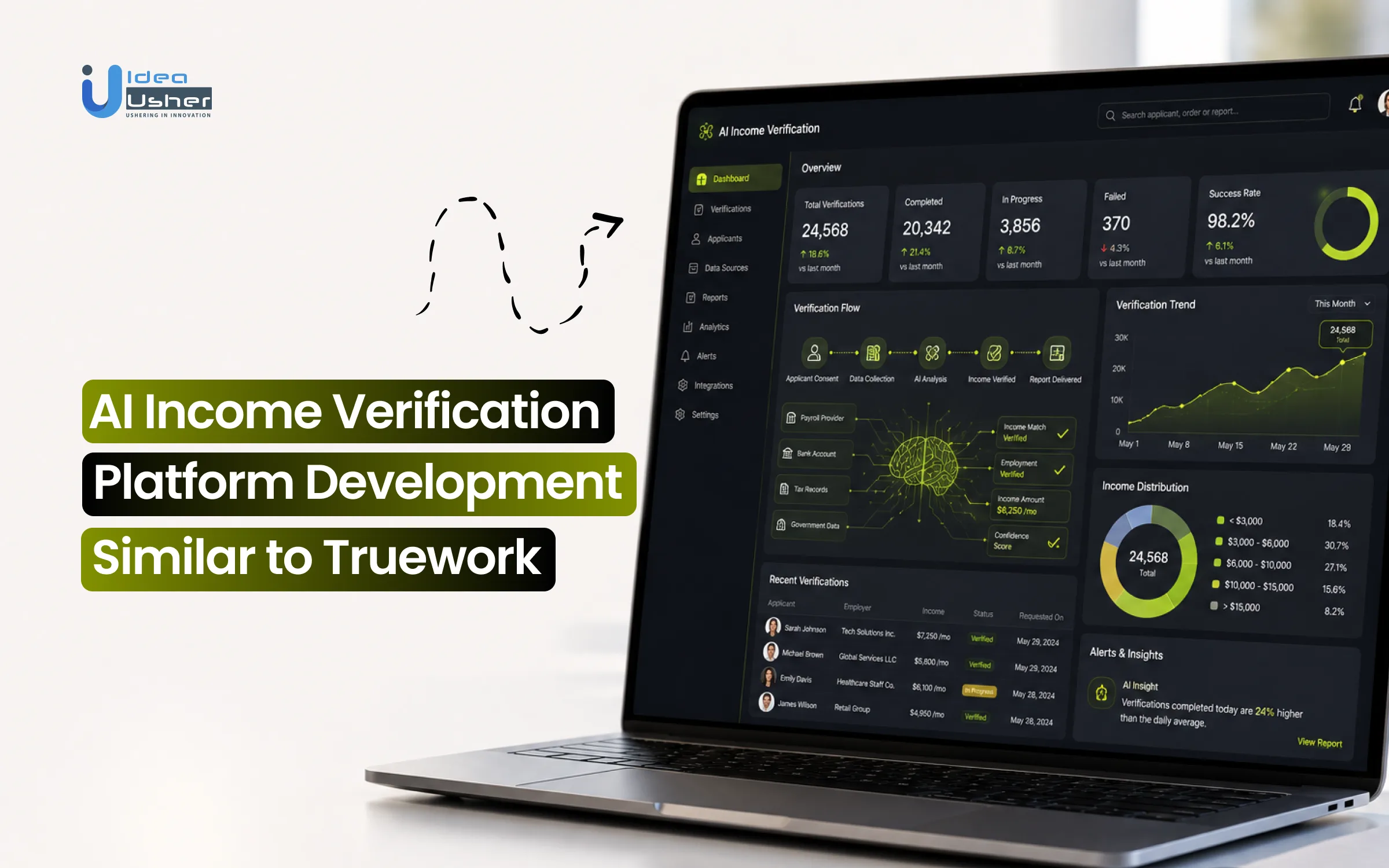
AI income verification has evolved far beyond manually reviewing pay stubs and employment records. Having worked on platforms that automate income verification using AI, OCR, and financial data integrations, we’ve put together this guide to explain how a AI income verification platform like Truework is designed, built, and scaled.
Market Demand for AI Income Verification Platforms

Source: Growth Market Reports
As lenders look for faster and more reliable ways to verify applicant income, platforms that automate this process are well positioned to generate recurring enterprise revenue and become an essential part of lending infrastructure.
Why Lenders Abandon Manual Checks
Manual income verification is expensive and slow. A typical loan application takes days to clear because underwriters must manually review PDFs, cross-check tax forms, and call employers. This delay kills conversion rates. Borrowers drop off when forced to hunt down paperwork, while operational expenses climb with every manual touchpoint.
- Speed as a competitive edge: Borrowers choose the platform that approves them first. Instant verification turns shoppers into funded loans.
- Margin expansion: Automating document processing reduces operational overhead by up to 70 percent per file.
- Scalability: Automated systems handle sudden spikes in loan volume without requiring extra staff.
Consider Ocrolus, an AI platform focused on financial document analysis. By turning unformatted paystubs and bank statements into verified data, Ocrolus built a recurring revenue model generating over $50 million in annual revenue. Lenders rely on it because it turns days of paper-pushing into a quick automated check.
Infrastructure Driving Adoption
Income verification has changed a lot over the past few years. Instead of asking applicants to upload pay stubs, modern platforms connect directly to payroll systems, tax records, and bank accounts after receiving user permission. This gives lenders verified income information in real time, makes fraud much harder, and speeds up loan approvals with data they can trust.
A great example is Plaid. Although it first became popular for bank account connectivity, the company expanded into payroll and income verification APIs as demand for faster financial verification grew. That move helped Plaid become a key part of the fintech ecosystem, and today the company generates more than $300 million in annual revenue, showing how valuable this infrastructure has become.
Rising Fraud Drives Platform Demand
Fraud has become a major concern for digital lenders as fake pay stubs can be purchased for as little as $20 and altered bank statements are easy to create. To reduce this risk, modern income verification platforms use AI and direct data connections to verify information from trusted sources instead of relying only on uploaded documents. This helps lenders detect fraud more accurately, make safer lending decisions, and build greater confidence in every application.

What Is Truework and How Does It Work?
Truework is a platform built to automate identity, income, and employment checks. It acts as an invisible bridge connecting lenders, background check providers, and screeners directly with payroll databases. Instead of chasing down HR reps or waiting days for paystub uploads, Truework handles requests through direct data connections.
For investors evaluating this market, Truework proves how valuable clear execution can be. The platform generates over $25 million in annual revenue by turning a painful compliance requirement into an instant API call.
What Makes Truework Different?
Traditional verification relies on fragmented vendors, manual phone calls to employers, and PDF uploads that applicants easily manipulate. This manual approach breaks down when loan volumes spike. Truework solves this by unifying data streams into a single platform.
- Multi-Source Access: Pulls data across payroll APIs, bank accounts, tax filings, and employer records.
- Unified API: Lenders query one system rather than managing multiple legacy vendor contracts.
- Automated Waterfall Routing: If one verification channel fails, the platform automatically routes to the next best source without human intervention.
This single-integration model keeps applicants inside the lender’s loan portal without redirecting them to external sites.
How the Verification Process Works
The core workflow balances user privacy with instant data delivery.
- Applicant Consent: The borrower authorizes data access during their application flow.
- Instant API Lookup: The engine first searches direct connections like payroll portals and bank feeds for an immediate match.
- Smart Outreach: If instant data is missing, the system automatically triggers targeted outreach to HR departments to complete the check.
- Report Delivery: Data is normalized and sent directly into the lender’s underwriting software.
Lenders receive a clean, standardized report with zero manual data entry needed from their underwriting teams.
Why Financial Institutions Choose Truework
Lenders care about two main things: closing loans faster and keeping overhead low. Truework hits both targets directly. Integrating directly into existing lending software makes the tool indispensable. Once a bank or mortgage company adopts a system like this, switching costs are high, creating a defensible moat and predictable recurring revenues for platform investors.
| Metric Impact | Value Delivered |
| Turnaround Time | Drops from days to under two minutes for instant checks |
| Operational Overhead | Reduces manual verification work by up to 80% |
| Completion Rates | Multi-source cascading ensures fewer abandoned applications |
| Data Integrity | Eliminates manual entry errors and forged paystub risks |
The Evolution of Income and Employment Verification with Truework
Income verification was once a slow and manual process that depended on paperwork and repeated follow-ups with employers. Platforms like Truework changed that by automating verification and connecting directly to trusted data sources. This allows lenders to verify income much faster, reduce operational costs, and deliver a smoother experience for both teams and applicants.

From Paperwork to Automation
Verification once required loan officers to call employers, wait for HR callbacks, and process emailed paystubs. This manual workflow meant lenders paid high labor costs while applicants waited days for approval decisions. Modern platforms replace these friction points with smart orchestration engines.
- Legacy Model: Manual phone calls, paper paystubs, slow turnaround times, and high human error rates.
- Modern Automated Model: Direct API queries, instant data retrieval, automated routing, and audit-ready digital reports.
By turning verification into a digital API call, lenders process applications faster and reduce drop-off rates across their loan pipelines.
Unifying Multiple Data Sources
Relying on a single data source limits coverage. If a borrower works for a small business or receives freelance income, standard payroll integrations often fail. Truework solves this coverage gap by unifying multiple verification channels into a single cascading framework.
- Direct Payroll Connections: Instant lookups across major enterprise payroll databases.
- User-Permissioned Banking: Open banking feeds to confirm recurring income deposits for gig workers.
- Tax Transcripts: Direct IRS integrations for self-employed borrower verification.
- Smart Outreach: Automated fallbacks to contact employer HR teams directly when instant data is not available.
To keep costs predictable for lenders, Truework uses flat transaction pricing rather than expensive monthly retainers.
| Verification Service | Standard Cost Per Report |
| Verification of Employment (VOE) | $39.95 to $59.95 |
| Verification of Income & Employment (VOI) | $42.95 to $64.95 |
| Reverification Check | $19.95 |
Lenders pay per completed report, making software costs scale directly with loan volume.
AI Drives Speed and Accuracy
Machine learning elevates income verification beyond simple data pulling. AI models continuously evaluate request parameters to select the fastest, most cost-effective path to verify an applicant’s financial profile.
- Intelligent Routing: Algorithms predict which data source will return an instant match, avoiding unnecessary API charges.
- Employer Name Normalization: Machine learning maps thousands of employer name variations to single corporate entities.
- Automated Fraud Screening: Vision models and pattern analysis detect altered PDF paystubs and inconsistent financial numbers.
Key Features of an AI Income Verification Platform Iike Truework
Truework helps financial institutions verify applicant income quickly without adding delays to the lending process. It combines automated data connections with backup verification methods, allowing teams to manage requests through a single dashboard or integrate the service directly into their existing lending systems using APIs.
1. AI Orchestration Engine
When a lender submits a verification request, Truework does not just query a single database. Its smart engine analyzes applicant details like employer size and job title to pick the fastest and cheapest verification path. Users set target parameters inside their account settings. If an instant payroll lookup fails, Truework automatically shifts to bank feeds or document analysis without breaking the application flow.
2. Unified Income, Employment, and Asset Checks
Lenders usually have to manage three separate vendors for income, job status, and bank balances. Truework combines all three checks into one platform flow.
- Employment Verification: Confirms start dates, job titles, and active status.
- Income Verification: Pulls pay frequency, gross income, and year-to-date earnings.
- Asset Verification: Measures liquid assets, bank balances, and cash flow stability.
Loan officers view this consolidated financial profile directly in their underwriting dashboard, eliminating switching between different software portals.
3. Multi-Source Data Connectivity
Truework connects with payroll providers, employer systems, banking networks, and tax data sources to verify income from trusted records instead of relying only on uploaded documents. This broad coverage helps lenders verify both traditional employees and gig workers more easily, reducing verification delays and improving approval rates even for applicants with non-traditional income sources.
4. AI Fraud Detection and Document Analysis
When applicants upload paystubs or W-2s, Truework uses vision models to inspect every file before accepting it. Underwriters receive immediate flags on suspicious uploads, protecting lenders from forged financial records.
| Inspection Area | How Truework Checks It |
| Font Consistency | Detects mismatched typefaces or edited numbers |
| Pixel Anomalies | Identifies digital alteration marks across uploaded PDFs |
| Cross-Data Logic | Compares claimed earnings with geographic averages |
5. Smart Outreach for Complex Cases
Not every applicant works for a company with direct digital payroll connections. For hard-to-verify cases, Truework activates Smart Outreach. The system sends secure requests directly to HR teams. Automated reminders follow up until the check clears. Loan officers track every outreach step inside Truework without picking up the phone.
6. Unified Reports and Tracking
Truework presents verified income data in a clear, standardized format that is easy for lenders to review and audit. Teams can track verification requests in real time, view expected completion timelines, and access detailed audit logs that record user consent, data sources, and every step of the verification process. This improves transparency while helping organizations meet compliance requirements.
7. Flexible APIs and System Integration
Truework integrates directly into existing loan software like Encompass or custom fintech builds. Users trigger checks, receive status updates, and view completed reports without leaving their primary software interface. This setup cuts integration timelines for engineering teams, letting lenders launch automated verification quickly.
How to Develop an AI Income Verification Platform like Truework?
Building a modern income verification platform requires much more than document uploads. It needs secure connections to payroll providers, banks, and other trusted data sources so financial information can be verified in real time. At the same time, the platform must protect sensitive user data and comply with regulations such as FCRA, ensuring every verification is accurate, secure, and legally compliant.

1. Define Workflows and Target Users
The core platform architecture depends heavily on who you serve first. A mortgage lender needs deep tax transcript analysis and strict compliance trails. A property manager just wants rapid proof that a tenant earns three times the monthly rent.
- Mortgage Lenders: Require Fannie Mae and Freddie Mac compliance, historical earnings, and full asset verification.
- Fintech & Personal Lenders: Prioritize instant API checks and low-friction mobile consent flows.
- Property Management: Need fast income-to-rent ratio calculations and basic employment checks.
2. Build Multi-Source Data Integration Layer
No single data provider covers the entire workforce. Your data layer must aggregate multiple sources to ensure high coverage rates across W-2 employees, 1099 contractors, and self-employed individuals.
- Payroll Connections: Partner with aggregator APIs or build direct connectors to major HR systems.
- Open Banking Aggregators: Use banking APIs to verify recurring payroll deposits for gig workers.
- Tax & Government Records: Integrate IRS transcript services for verifying tax returns.
- Document Fallbacks: Allow PDF paystub and tax form uploads when digital connections are unavailable.
3. Develop AI Verification and Fraud Detection
The AI layer processes raw data, checks for document tampering, and converts unformatted records into structured financial metrics. Combining machine learning with human oversight for edge cases keeps fraud detection accurate without slowing down legitimate applications.
| Inspection Area | Engineering Approach |
| Document Forensics: | Computer vision models scan PDF metadata, layout grids, and fonts to flag edited paystubs. |
| Data Extraction: | OCR models extract line items like gross pay, net pay, and deductions from paystubs. |
| Data Standardization: | Machine learning models normalize employer names and job titles across different sources. |
4. Create Intelligent Orchestration System
An orchestration engine acts as the brain of the platform. It determines the most efficient data path for every request to keep operating costs low and speed high. This dynamic routing prevents overspending on expensive API calls when a cheaper or faster source can fulfill the request.
5. Integrate Secure APIs and Consent Flows
Handling sensitive financial records requires strict security measures and transparent consent management.
- Consent Interfaces: Build embedded widget flows where applicants explicitly authorize data access.
- Encrypted Data Transit: Secure all API endpoints with modern encryption and tokenized credentials.
- Compliance Auditing: Log every data request, consent timestamp, and report view to maintain full regulatory compliance.
6. Build Analytics and Admin Dashboards
Lenders and internal ops teams need visibility into active verification pipelines. The portal should display real-time statuses, pending employer outreach, system completion rates, and clear fraud flags. Providing clean visual reports makes it easy for underwriters to approve loans quickly.
7. Test, Deploy, and Improve with AI
Before launching, benchmark your models against thousands of real-world paystubs and financial documents to measure extraction accuracy. Once live, track match rates across different data providers and monitor false-positive rates on fraud detection. Machine learning models continuously improve as transaction volumes grow, leading to faster processing times and lower operational costs over time.
Cost to Develop an AI Income Verification Platform like Truework
Development costs increase as the platform becomes more advanced. A basic solution may only verify uploaded documents, while an enterprise-grade platform supports automated workflows, real-time API integrations, and intelligent verification across multiple data sources. More advanced features improve speed, accuracy, and scalability but also require greater investment.
Estimated Cost by Complexity
Development costs scale alongside functional depth, automation capability, and system security levels. A basic system focuses on single-point document processing, while enterprise builds deliver end-to-end orchestration and instant API matching.
| Scope | Core Capabilities | Timeline | Estimated Cost |
| Minimum Viable Product (MVP) | Basic OCR paystub extraction, manual fallback queues, single payroll API integration, standard dashboard | 3 to 5 months | $40,000 – $75,000 |
| Mid-Market Solution | Multi-source routing, basic fraud detection, open banking APIs, loan origination system plugins, automated reporting | 5 to 8 months | $85,000 – $160,000 |
| Enterprise Platform | AI vision forensics, real-time cascading orchestration, custom HRIS integrations, SOC 2 compliance, predictive analytics | 8 to 12+ months | $175,000 – $350,000+ |
Key Factors That Influence Development Costs
Several technical and regulatory components drive the primary budget allocations for a verification engine.
- Data API Licensing: Connecting to payroll networks, open banking aggregators, and tax databases involves direct setup fees and per-query costs. Expect $15,000 to $40,000 annually for enterprise data licensing.
- AI Model Engineering: Custom document intelligence models and computer vision algorithms require significant training and fine-tuning. Building custom fraud screening tools adds $25,000 to $60,000 to standard development.
- Security and Regulatory Compliance: Adhering to FCRA, SOC 2 Type II, and GDPR requirements demands secure data storage, tokenization, and audit logs. Compliance setup and third-party penetration testing cost between $15,000 and $35,000.
- Infrastructure and Cloud Hosting: Scalable cloud setups on AWS or Azure using auto-scaling serverless architectures average $2,000 to $8,000 monthly depending on request volume.
How to Reduce Costs
Controlling costs starts with smart product planning. Launching an MVP with high-value verification workflows lets engineering teams validate core assumptions before building complex custom features.
- Leverage Pre-Built Frameworks: Use proven open-source AI models for standard text OCR, reserving custom model development specifically for proprietary fraud detection logic.
- Prioritize Modular Architecture: Design microservices so new payroll or banking connectors can be added without rewriting core system logic.
- Use Cloud-Native Services: Managed serverless databases and identity management tools reduce initial setup overhead and ongoing maintenance costs.
Revenue Models for an AI Income Verification Platform
Income verification platforms convert essential risk checks into high-margin recurring revenue. Successful platforms balance usage-based transaction fees with predictable recurring enterprise contracts. As adoption grows across lending, hiring, and financial services, this recurring revenue model creates long-term business stability and strong opportunities for expansion.
1. Pay-Per-Verification Pricing Model
The transactional model charges customers a flat fee for every completed verification report. Lenders love this approach because software costs scale directly with their loan pipeline volume. This pricing model creates immediate alignment between the platform and the lender. When loan volume surges, platform revenue scales automatically without requiring new sales cycles.
- Basic Employment Checks: Charges range from $15 to $35 per completed match.
- Full Income and Asset Reports: In-depth reports pulling multiple years of tax and payroll history run from $40 to $70 per query.
- Reverification Checks: Short pre-closing confirmation checks cost around $10 to $20.
A strong example of this model in action is Argyle. By offering direct-source payroll and income checks on a transactional basis for mortgage and personal lenders, Argyle scaled its business to over $30 million in annual revenue.
2. SaaS Subscriptions for Enterprise Clients
Large banks, credit unions, and digital lenders often prefer predictable monthly operational expenses over fluctuating per-report invoices. Subscription models package fixed report volumes, premium integrations, and dedicated support into monthly or annual contracts.
| Tier Level | Target Client | Key Inclusions | Price Range |
| Growth Tier | Regional Credit Unions | 500 monthly checks, basic LOS plugins, email support | $2,500 – $5,000 / month |
| Scale Tier | Mid-Market Lenders | 2,500 monthly checks, custom routing, dedicated account manager | $8,000 – $15,000 / month |
| Enterprise Tier | National Banks & Fintechs | Unlimited queries, custom SLAs, white-label options | $25,000+ / month |
A leader using recurring enterprise arrangements is Pinwheel. The platform provides payroll and income verification APIs across major fintech applications, driving over $25 million in annual recurring revenue while securing a $500 million company valuation.
3. API Licensing and White-Label Solutions
Many enterprise software platforms, tenant screening applications, and HR management portals want to offer income verification directly inside their own software without building the underlying data network themselves. Licensing raw verification APIs or offering a white-label version lets third-party software companies rebrand your platform as their own embedded feature.
- Embedded API Licensing: Platforms charge annual licensing fees to let third-party developers embed verification endpoints directly into their software.
- White-Label Partner Portals: Screening agencies pay recurring platform fees to run their verification operations under their own logo and custom domain.
- Data Usage Surcharges: Platforms earn volume margins on top of raw API call costs as secondary partners scale their end-user accounts.
An example of enterprise API licensing is Incode Technologies. By delivering automated verification and identity APIs deeply embedded into major enterprise applications, Incode generated $170 million in annual recurring revenue.
Build an AI Income Verification Platform with IdeaUsher
Launching an automated income verification platform requires high-precision AI, secure data feeds, and flawless compliance. Building a solution from scratch presents complex technical and regulatory hurdles. Partnering with a specialized software engineering firm accelerates execution while mitigating foundational build risks.

Develop a Secure Platform from Day One
Creating a competitive verification system means connecting direct data pipelines with advanced document analysis and automated risk detection. IdeaUsher designs architectures that balance real-time processing speed with enterprise-grade data security.
- Smart Data Ingestion: Connects directly into payroll networks, banking feeds, and tax databases.
- Document Intelligence: Vision models detect paystub alterations, layout edits, and font irregularities.
- Compliance Standards: Built to meet strict FCRA guidelines, SOC 2 protocols, and modern data protection rules.
Leverage Our Fintech and AI Expertise
With over 500,000 hours of coding experience, our team of ex-MAANG/FAANG developers brings deep technical knowledge to complex fintech products. We eliminate trial and error, executing custom architectures designed to process millions of requests smoothly.
| Engineering Focus | What We Deliver |
| Custom AI & ML | Fine-tuned OCR models, employer normalization, and fraud detection algorithms |
| Fintech Integrations | Pre-built wrappers for major open banking, payroll, and LOS platforms |
| Scalable Infrastructure | High-throughput, low-latency microservices built on cloud-native networks |
Having developed data engines, identity solutions, and automated underwriting tools, our engineers know how to build software that scales effortlessly alongside growing transaction volumes.
Partner with IdeaUsher
At IdeaUsher, we help businesses turn AI income verification ideas into secure and scalable products. From planning the platform architecture to building AI-powered verification workflows and integrating with payroll, banking, and lending systems, our team supports every stage of development. Even after launch, we continue to optimize performance, add new features, and help your platform scale as your business grows.
Conclusion
AI-powered income verification is becoming an essential part of modern financial services. Platforms like Truework demonstrate how AI and direct data connections can simplify verification while improving speed, accuracy, and security. As more lenders and financial institutions adopt digital workflows, businesses that invest in reliable and compliant verification platforms will be well positioned to meet growing market demand and build a scalable fintech solution.
Things to Know About AI Income Verification Platforms
A1: An AI income verification platform helps businesses verify a person’s income and employment without relying on paper documents or lengthy manual checks. Instead, it securely connects to trusted sources like payroll systems, bank accounts, tax records, and employer databases to retrieve verified information. This makes the process much faster, improves accuracy, and gives lenders or employers greater confidence when making important financial decisions.
A2: Any industry that needs to confirm a person’s financial or employment information can benefit from these platforms. Mortgage lenders use them to speed up home loan approvals, banks and fintech companies rely on them for underwriting, while property managers use them during tenant screening. Employers and background screening companies also use automated verification to simplify hiring and reduce paperwork.
A3: AI makes verification more reliable by comparing information from multiple trusted data sources instead of depending on a single document. It can quickly identify inconsistencies, detect suspicious documents, and choose the best verification method for each applicant. This reduces manual effort, speeds up approvals, and helps businesses make decisions using verified, high-quality data.
A4: Yes. Modern verification platforms are built with security and compliance in mind. They encrypt sensitive information, require user consent before accessing financial data, and maintain detailed audit logs for every verification request. Many platforms also follow standards such as FCRA, SOC 2, and GDPR, helping businesses protect customer data while meeting regulatory requirements.


