

Key Takeaways
- AI-powered websites use automation and personalization to improve engagement and real-time user experiences.
- Modern AI web development uses LLMs, AI coding tools and predictive analytics across the full stack.
- Businesses use AI for chatbots, smart search, automated testing and adaptive frontend experiences.
- AI-driven web platforms help companies achieve faster development cycles and higher conversion optimization.
- How IdeaUsher help you build AI-native web platforms with scalable engineering and enterprise-grade AI integrations.
Websites are evolving from digital brochures into intelligent systems that can predict user behavior, automate workflows, personalize experiences and generate content in real time. AI is no longer a futuristic add-on in web development. It is becoming a core layer powering how modern digital products engage users, optimize conversions and operate at scale.
Businesses are rapidly shifting from static interfaces toward AI-powered websites, AI website builders and AI-assisted frontend development that deliver personalized experiences, predictive automation and intelligent content delivery. This is creating a new generation of AI-native digital platforms where automation and conversational interfaces are embedded directly into user experiences.
In this guide, we will explore how AI is transforming web development, the technologies driving this shift and how businesses can build scalable AI-powered digital experiences where IdeaUsher positions itself as a full-stack plus AI-native development company that combines scalable engineering with production-grade AI integration for modern web platforms.
What Is AI in Web Development?
Artificial Intelligence in web development refers to the integration of machine learning algorithms, natural language processing (NLP), generative AI, and automation pipelines into the lifecycle of building, deploying, maintaining, and optimizing web applications.
Rather than relying purely on hardcoded, static instructions written by a developer, AI-enforced architectures use data-driven models to dynamically generate code, adapt user interfaces in real time, automate routine maintenance, and predict user behavior.
A. Traditional Websites vs. AI-Powered Websites
The distinction between legacy development and modern, AI-integrated digital systems centers on adaptability and logic execution:
| Feature | Traditional Websites | AI-Powered Websites |
| Logic & Structure | Rule-based, static, and hardcoded via explicit code. | Dynamic, adaptive, and modified via machine learning models. |
| Content Delivery | Identical content served to all users based on fixed categories. | Programmatic, hyper-personalized content served based on live intent. |
| User Interaction | Forms, static menus, and structured, explicit navigation paths. | Conversational interfaces, voice search, and predictive UI layouts. |
| Maintenance | Manual debugging, performance tuning, and schedule-based code updates. | Autonomous regression testing, self-healing code, and automated security patches. |
B. How AI Works Across the Web Stack
AI operates across every layer of modern software engineering, from the local code editor to the production server.
- Frontend Development: Models instantly convert Figma wireframes into responsive React/Tailwind code, leveraging tools like Vercel’s v0 and the native React Compiler to auto-tune performance.
- Backend Engineering: Codebase-aware IDEs like Cursor, Windsurf, and GitHub Copilot function as co-architects, writing database queries and mapping edge data flows.
- UX Personalization: Real-time vector models replace static A/B tests, allowing the interface to instantly restructure navigation menus based on live in-session clickstreams.
- Predictive Analytics: Intelligently tracks micro-interactions to map user intent, pinpoint checkout friction, and feed predictive customer metrics directly into pipelines.
- CI/CD Automation: Intelligent deployment networks run autonomous regression testing, write test suites on demand, and execute self-healing code rollouts with minimal intervention.
- Cybersecurity: Defends against automated botnets and zero-day exploits by monitoring low-level user behavior telemetry and triggering autonomous server isolation protocols.
C. Why Businesses Are Investing in AI Web Development in 2026
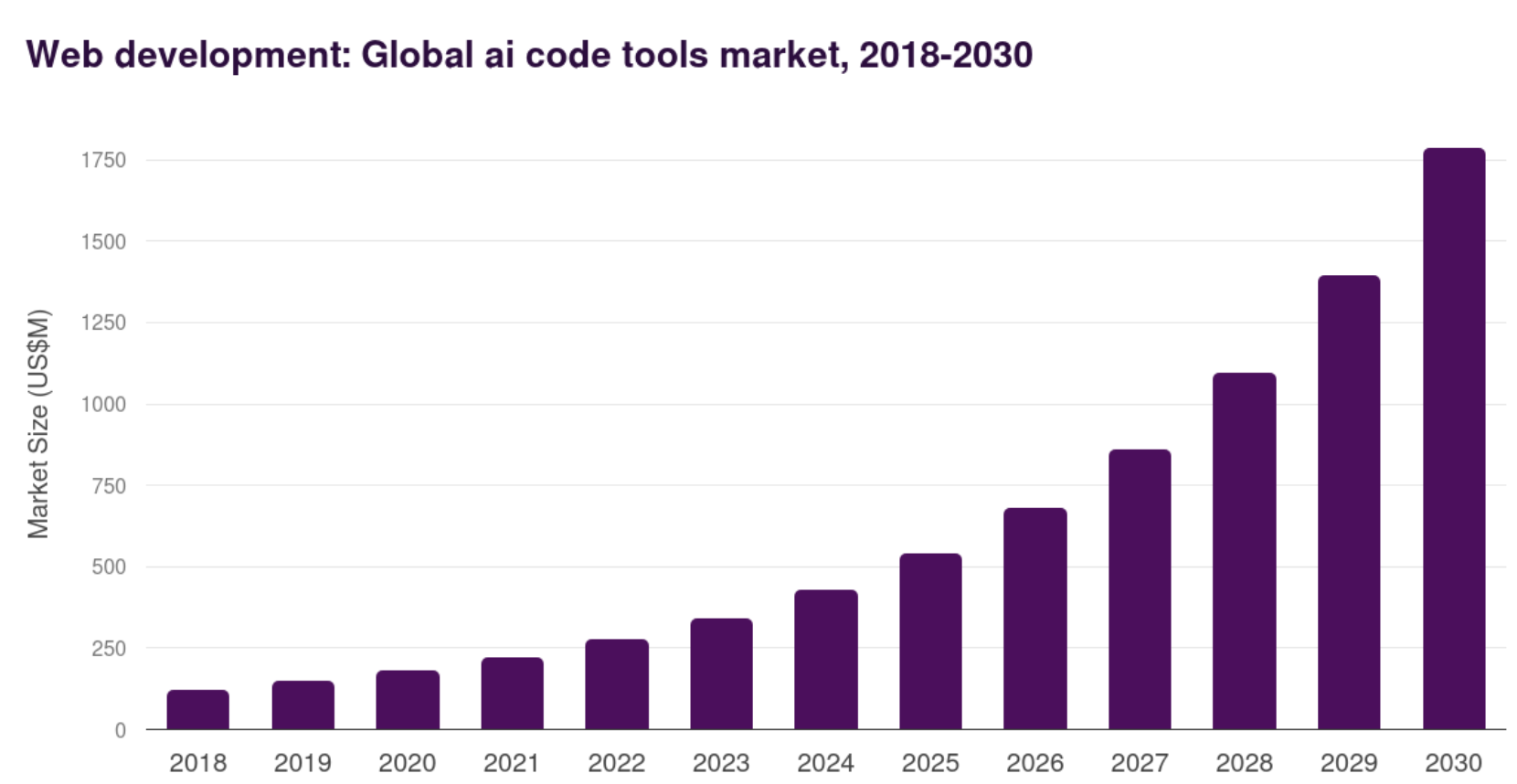
The global web development ai code tools market size was valued at US$ 340.2 million in 2023 and is estimated to grow at a compound annual growth rate (CAGR) of 26.7% from 2023 to 2030. As AI transforms web experiences, businesses are adopting AI-powered automation and smart coding tools to build faster, personalized, and scalable websites in 2026.
The commercial landscape has passed the point of treating AI as an optional feature. Companies are integrating AI directly into their core tech stacks to capture five primary business advantages:
- Higher Engagement: Real-time layout adjustments, intent-driven copy shifts, and semantic search match user motivation instantly, keeping visitors on-site longer and lowering bounce rates.
- Lower Operational Costs: Delegating repetitive workflows like metadata tagging, QA test suites, and Tier-1 support to autonomous LLMs frees internal teams for high-value product design.
- Faster Development Cycles: AI assistants compress time-to-market by scaffolding MVPs, building complex API routing, and executing deep codebase documentation in hours rather than days.
- Smarter Customer Experiences: Apps remove interface friction through context-aware conversational search, real-time voice accessibility features, and proactive, agentic customer support loops.
- Better Conversion Optimization (CRO): Predictive models eliminate static A/B guesswork by testing and displaying hyper-personalized CTAs and layout configurations based on active session behavior.
D. Key Technologies Powering AI Web Development
Modern intelligent applications rely on a foundational ecosystem of specific machine learning subfields and cloud integrations:
- Machine Learning (ML): Foundational logic processing user datasets and executing reinforcement loops to auto-optimize full-stack execution.
- Natural Language Processing (NLP): Technology powering semantic web search, voice navigation, and real-time sentiment tracking to parse exact user intent.
- Generative AI: Modern models integrated via engineering pipelines to dynamically render custom UI components and build content on demand.
- Computer Vision: Vision models processing visual media instantly for real-time moderation, automated alt-text compliance, and visual product searches.
- Recommendation Engines: Deep learning networks leveraging vector embeddings and collaborative filtering to serve highly contextual product streams mid-session.
- Predictive Analytics: Statistical models running traffic forecasts to prevent server degradation and enable serverless infrastructure to auto-scale on edge runtimes.
- AI APIs & LLM Integrations: The connecting layer leveraging uniform standards like the Model Context Protocol (MCP) to connect secure backends to frontier LLMs for mult-step workflow automation.
Why AI Is Reshaping Modern Websites
The rapid convergence of real-time machine learning and edge computing is shifting web development away from rigid, static templates toward autonomous digital environments that learn, adapt, and self-optimize.
A. From Static Interfaces to Adaptive Digital Experiences
Web design is shifting away from fixed, rigid layouts designed for a generic audience. By leveraging continuous data streams, websites have evolved from passive, flat files into fluid, intelligent environments that adapt to individual users in real time.
- Dynamic UI Adaptation: Interfaces programmatically restructure based on behavior, such as streamlining checkout by suppressing banners and increasing CTA contrast to reduce friction.
- Real-Time Personalization: Systems process live signals like scroll speed to instantly modify copy and imagery, matching the visitor’s exact mindset.
- Smart Recommendations: Using vector embeddings, modern engines analyze immediate context and global trends to serve relevant products and content on the fly.
B. The Rise of AI-Native User Expectations
As users interact daily with sophisticated, highly responsive software, their expectations for standard web applications have fundamentally changed. Static menus and rigid search boxes are increasingly viewed as outdated friction points.
- AI Chat Support: Static, rule-based bots are obsolete. Modern conversational agents use LLMs to understand nuance, access knowledge bases, and resolve complex issues autonomously in real time.
- Personalized Dashboards: Static portals are evolving into intelligent workspaces. Platforms now use historical workflow patterns to dynamically prioritize data feeds and tools for each user.
- Conversational Search: NLP-driven semantic search is replacing keyword bars. It interprets intent and natural phrasing to provide accurate results, even when exact keywords or tags are missing.
- Predictive UX: Interfaces now anticipate actions by mapping user flows. Websites create frictionless experiences by pre-rendering pages, offering proactive guidance, and auto-filling recurrent data.
C. How AI Changes the Web Development Lifecycle
AI isn’t just transforming how an end user experiences a website; it is fundamentally rewriting how software engineers build, test, and maintain digital products.
- AI-Assisted Coding: IDE extensions and agentic companions act as force multipliers, generating boilerplate, complex queries, and framework translations. This allows developers to focus on high-level architecture and system review rather than manual syntax.
- Automated Testing: AI-driven tools replace brittle manual scripts by autonomously exploring user paths, generating robust end-to-end test cases, detecting visual regressions across viewports, and self-healing when UI elements change.
- Faster Debugging: AI diagnostic tools parse logs and stack traces in seconds to pinpoint failures and explain logic errors. They generate production-ready patches, significantly reducing mean time to resolution (MTTR).
- Smart Deployment Optimization: CI/CD pipelines use predictive models to optimize infrastructure. AI automates asset bundling, resource allocation at the edge, anomaly detection during rollouts, and executes rollbacks if performance metrics drop.
10 Game-Changing Uses of AI in Web Development
Artificial intelligence embedded directly into full stack architectures allows modern web applications to move beyond passive interfaces. This technical integration turns websites into active platforms that optimize development velocity, cybersecurity, and consumer conversions.
1. AI-Powered Personalized User Experiences
The traditional model of treating every website visitor identically is obsolete. Modern web platforms use real-time data to alter what a user sees, creating an individualized version of the site for every single session.
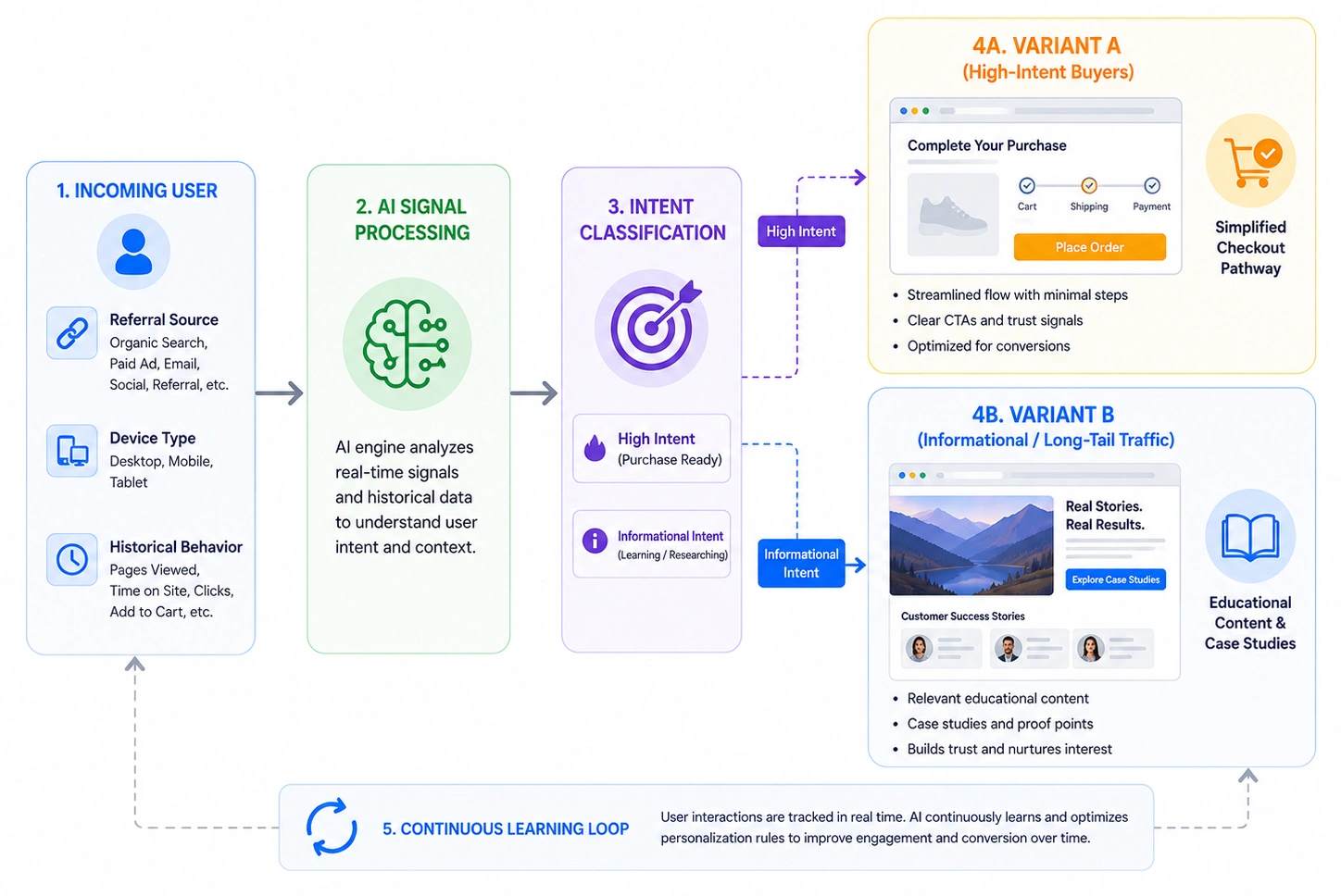
- Dynamic Content Personalization: Web applications evaluate micro-interactions such as mouse hovering speed, scrolling patterns, and referral sources to restructure copy and swap imagery on the fly.
- Predictive Product Recommendations: Modern recommendation engines map a user’s current session path against millions of anonymous user journeys to display highly relevant up-sell modules instantly.
- Behavioral Funnel Targeting: Algorithms pinpoint a user’s stage in the buying journey. High purchase intent suppresses promotional pop-ups, while exit intent triggers specialized retention hooks.
Real-World Implementations: Global digital leaders use adaptive web architectures to eliminate user friction. These production deployments demonstrate how intelligent frontends reshape layout structures to optimize engagement and conversion metrics.
- eCommerce (Like Amazon): Product grids reorder categories dynamically, placing lightweight fashion items at the top for a casual window-shopper, while prioritizing bulk items for a repeat B2B buyer.
- Streaming Platforms (Like Netflix & Spotify): Interfaces completely alter thumbnail artwork, banner carousels, and categorization rows to match a user’s immediate mood and viewing history.
- SaaS Dashboards: Enterprise applications automatically highlight a user’s most-frequented metric widgets, pinning high-priority tasks and burying unused features to optimize focus.
Conversion Metrics That Matter: Shifting from static layouts to individualized web experiences drives clear financial returns. At IdeaUsher, when we implement real-time personalization architectures for client platforms, we consistently target a 20-30% lift in average session duration and a direct reduction in checkout abandonment.
2. AI Chatbots & Conversational Interfaces
Customer communication has evolved past rigid, decision-tree chat loops. Implementing modern AI in web development means deploying system-aware conversational models that understand human nuance, access backend databases, and resolve client inquiries natively.
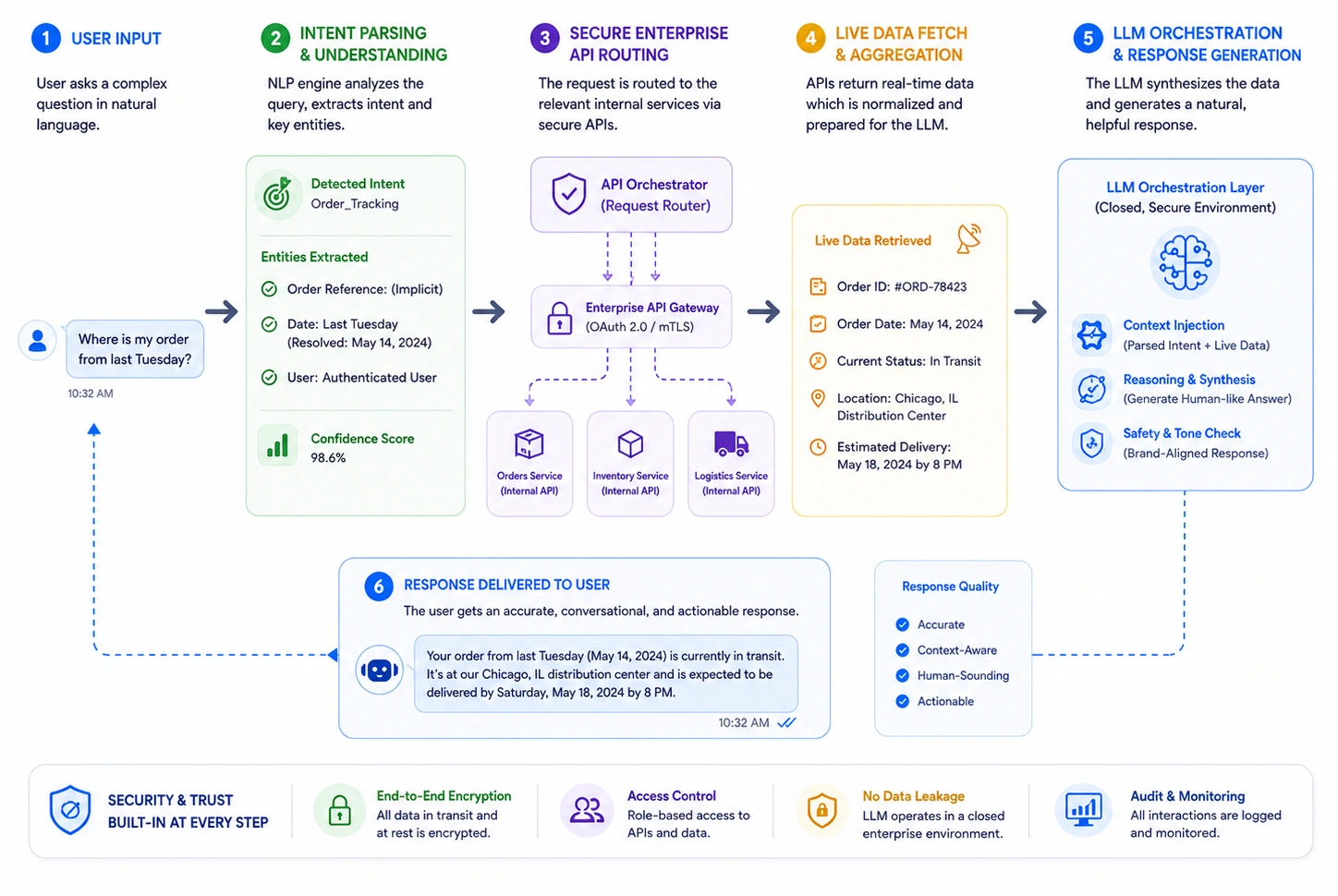
- GPT-Powered Assistants: Built using customized large language models (LLMs), these assistants read complex human phrasing and maintain context across long conversations, providing accurate answers instead of generic links.
- Autonomous Customer Support: Connected directly to secure internal APIs, these advanced agents look up live shipping statuses, process refunds, and update user configurations completely within the chat window.
- AI Onboarding Systems: Context-aware interactive guides monitor a new user’s initial interaction pattern. If the user encounters an error or pauses on a technical setup screen, the assistant steps in with a targeted, real-time walkthrough.
Operational Benefits: Automated conversational infrastructures drive measurable bottom-line value. These targeted AI in web development eliminate repetitive clerical tasks to increase system availability, optimize resource allocation, and accelerate customer conversion pipelines.
- 24/7 Availability with Zero Overhead: Automated systems maintain continuous availability across global time zones, resolving up to 70% of Tier-1 support queries instantly without increasing staff headcount.
- Frictionless Lead Generation: Conversational interfaces pre-qualify inbound traffic by asking contextual business questions, gathering contact records, and routing high-value prospects directly to sales pipelines.
- Drastic Support Cost Reduction: Offloading routine troubleshooting, account verification steps, and password resets to automated agents allows human customer success teams to focus exclusively on high-value client relationships.
3. AI Website Builders Accelerating Development
The rise of the autonomous AI website builder has transformed the foundational steps of creating web properties, moving the process from manual coding to natural language description.
- Prompt-to-Website Workflows: Teams can type descriptive instructions (e.g., “Build a dark-mode real estate listing page with a sticky map view and responsive filter cards”) to render functional, styled web layouts within seconds.
- AI Layout Generation: Design systems evaluate spacing, typography hierarchies, and visual weight to balance layout grids automatically, ensuring clean alignment across multiple browser layouts.
- Automated Branding Suggestions: Software matches corporate logos with balanced color palettes, typography pairs, and UI icon kits, generating an entire digital brand guidelines package from a single asset input.
Architectural Boundaries: While an AI website builder is exceptionally fast for spinning up MVPs, launching marketing landing pages, and wireframing early product concepts, it faces stark limitations at the enterprise level.
The Enterprise Scaling Gap: Sandbox site builders generate isolated codebases that lack structural flexibility. They cannot support complex microservices, custom database architectures, proprietary authentication loops, or granular role-based security controls.
Why Custom Development Wins: Custom AI web development is vital for growing brands. At IdeaUsher, our engineers use specialized AI tools to accelerate full-stack development rather than replacing the custom codebase, providing automated speed alongside the infinite scalability of clean, custom code.
4. AI-Assisted Frontend Development
Leveraging AI for frontend engineering shifts the developer’s focus from writing repetitive style classes to reviewing application architecture and polishing user interaction.
- AI-Generated UI Components: Code assistants produce well-structured, modular frontend elements using modern utility frameworks like Tailwind CSS, ensuring clean structural encapsulation out of the box.
- Smart Layout & Styling Generation: Systems eliminate manual styling bugs by calculating exact layouts, responsive alignments, and complex transition animations based on simple structural descriptions.
- Accessibility Optimization (WCAG Compliance): AI scanning utilities analyze the website’s structural code in real time to enforce semantic HTML, inject correct screen-reader tags, evaluate visual contrast compliance, and suggest immediate updates to guarantee global web accessibility compliance.
Core Developer Tooling: Our engineering teams at IdeaUsher integrate a highly specialized suite of AI utilities directly into our daily workflows to maximize output:
- GitHub Copilot & Cursor: Next-generation, codebase-aware developer environments that read entire project directories to refactor code, write multi-file features, and manage deep system dependencies via conversational commands.
- v0 (by Vercel): A prompt-to-UI engine that generates clean, production-ready React components styled with Tailwind CSS, which can be deployed directly into an enterprise repository.
- Figma AI: Design tools featuring capabilities that generate UI structures from text prompts, automatically establish functional layout spacing, and export accurate design tokens directly to engineering pipelines.
The ROI Impact: Automated design-to-code ecosystems generate clear financial returns for modern digital enterprises. These technical integrations compress traditional deployment timelines and lower engineering overhead to maximize product profit margins.
- Compressed Time-to-Market: Speeds up the frontend coding phase by 40%, allowing businesses to launch new product features ahead of competitors.
- Drastically Lower QA Costs: Automated accessibility and layout checking catch design regressions early in the development lifecycle, preventing costly post-launch hotfixes.
5. AI-Powered Search & Recommendation Engines
Traditional, rigid database indexing cannot parse user intent. Modern web search uses AI pattern matching to understand the meaning behind a user’s query, ensuring accurate results even without exact keyword matches.
| Feature Layer | Legacy Search Systems | AI-Powered Semantic Engines |
| Matching Logic | Exact string matching, literal keywords. | Numerical pattern mapping that reads contextual intent. |
| Error Handling | Fails on typos, syntax errors, or synonyms. | Understands context, intent, and colloquial terms smoothly. |
| Result Order | Sorted by static creation dates or simple tags. | Personalized based on active user history and behavior. |
- Semantic Search Optimization: The engine uses conceptual mapping rather than string matching. It calculates contextual relationships from queries to deliver highly relevant results.
- Natural Language Queries: Users interact with search fields using conversational, everyday phrasing (e.g., “Show me that waterproof jacket I looked at last week that was on sale”). The engine extracts dates, attributes, and user history to isolate the correct product.
- AI Product Discovery Systems (Like Airbnb): AI-powered e-commerce and booking platforms function as digital concierges, interpreting nuanced requests like “cozy beachside workspace with Wi-Fi” to find relevant matches across massive, varied datasets.
Growth Outcomes: Upgrading to semantic search directly fixes the “Zero Results Found” loop, a major drop-off point in the user journey. Implementing advanced product discovery tools drives a direct lift in average order value (AOV) and conversion rates.
6. Predictive Analytics for Smarter Business Decisions
Web platforms are changing from simple data-collection interfaces into active, predictive hubs that analyze usage patterns to guide business strategy.
- User Behavior Prediction: ML models process clickstream sequences to anticipate actions, pre-rendering subsequent pages before a user clicks for an instantaneous loading experience.
- Proactive Churn Analysis: Analytics tools track declining interaction signals to flag at-risk accounts, automatically triggering targeted customer retention flows.
- AI-Powered Dashboards: Data portals replace static charts with natural language summaries that identify conversion drop-offs and propose actionable layout fixes instantly.
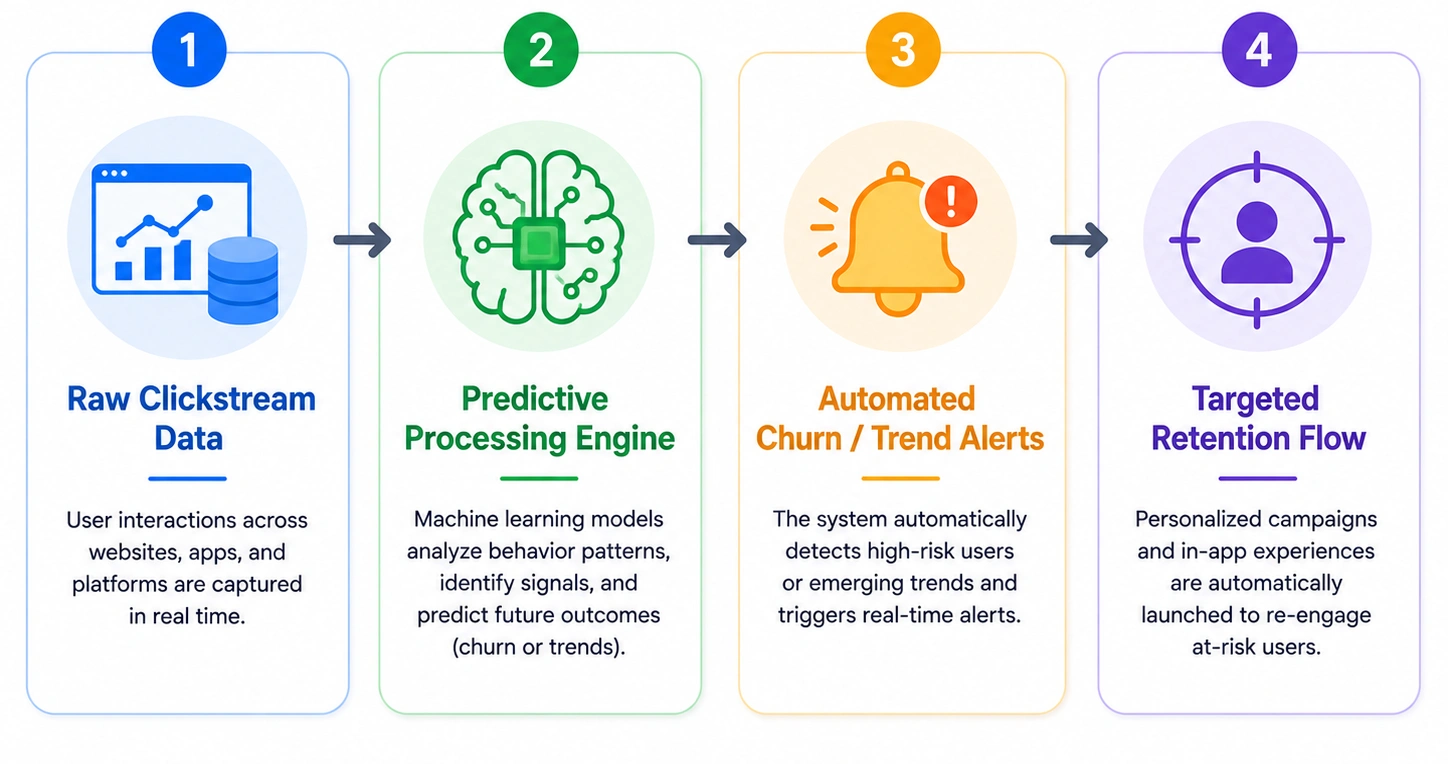
The Enterprise Advantage: Through this transition, websites function as active decision-making platforms. Businesses can optimize their marketing spend allocation in real time, minimize user churn, and significantly increase customer lifetime value (LTV) based on data-backed forecasts rather than historical guesswork.
7. AI-Driven Cybersecurity & Fraud Detection
As web threats scale in complexity, static firewall rules are no longer sufficient. Modern web infrastructure uses behavioral machine learning models to detect and block malicious traffic in real time.
For example, a high-traffic sneaker marketplace launching a limited-edition drop and within milliseconds, tens of thousands of automated checkout bots flood the network to buy out inventory. Legacy firewalls fail because the bots mimic human IPs.
AI security mitigates threats by analyzing granular behavioral data, including keypress rhythms and navigation patterns. The system identifies and terminates sessions exhibiting superhuman interaction speeds to prevent automated exploitation.
- Advanced Bot Detection: Isolates advanced, distributed scraping bots and automated hacking networks from genuine human traffic without forcing real users to complete frustrating CAPTCHAs.
- Real-Time Fraud Prevention: Transaction engines block fraudulent checkouts by analyzing payment patterns against historical baselines, identifying suspicious proxies, impossible travel speeds, and anomalous cart sizes in real time.
- Real-Time Anomaly Detection: Systems monitor backend server behavior, database read/write ratios, and API consumption to detect out-of-bounds metrics, instantly isolating compromised sub-systems.
High-Risk Industry Verticals: High-risk digital sectors deploy intelligent security layers to safeguard transactions. These targeted models continuously mitigate advanced operational threats across complex compliance environments.
- Fintech: Banking portals leverage behavioral models to halt suspicious money transfers and intercept account-takeover attempts without adding friction for legitimate users.
- Healthcare: Patient portals use automated data-access tracking to ensure compliance with privacy regulations, verifying that medical record requests align with standard clinical staff behavior.
- Marketplaces (Like eBay): Multi-vendor platforms deploy automated moderation networks to intercept fake reviews, isolate fraudulent listings, and detect collusive pricing schemes across thousands of accounts simultaneously.
8. Automated Testing & QA With AI
AI has streamlined the quality assurance (QA) pipeline, replacing fragile, time-consuming manual scripts with resilient, self-healing test architectures.
- Self-Healing Test Scripts: AI tools automatically identify structural frontend updates and rewrite test selectors, preventing false build failures and broken deployment pipelines.
- Automated Bug Detection: Testing agents autonomously explore apps to uncover hidden race conditions, broken redirect paths, and unhandled exceptions before hitting production.
- Visual Regression Testing: Vision models scan renders across hundreds of simulated screen resolutions to instantly spot layout shifts, overlapping text, and broken CSS styling.
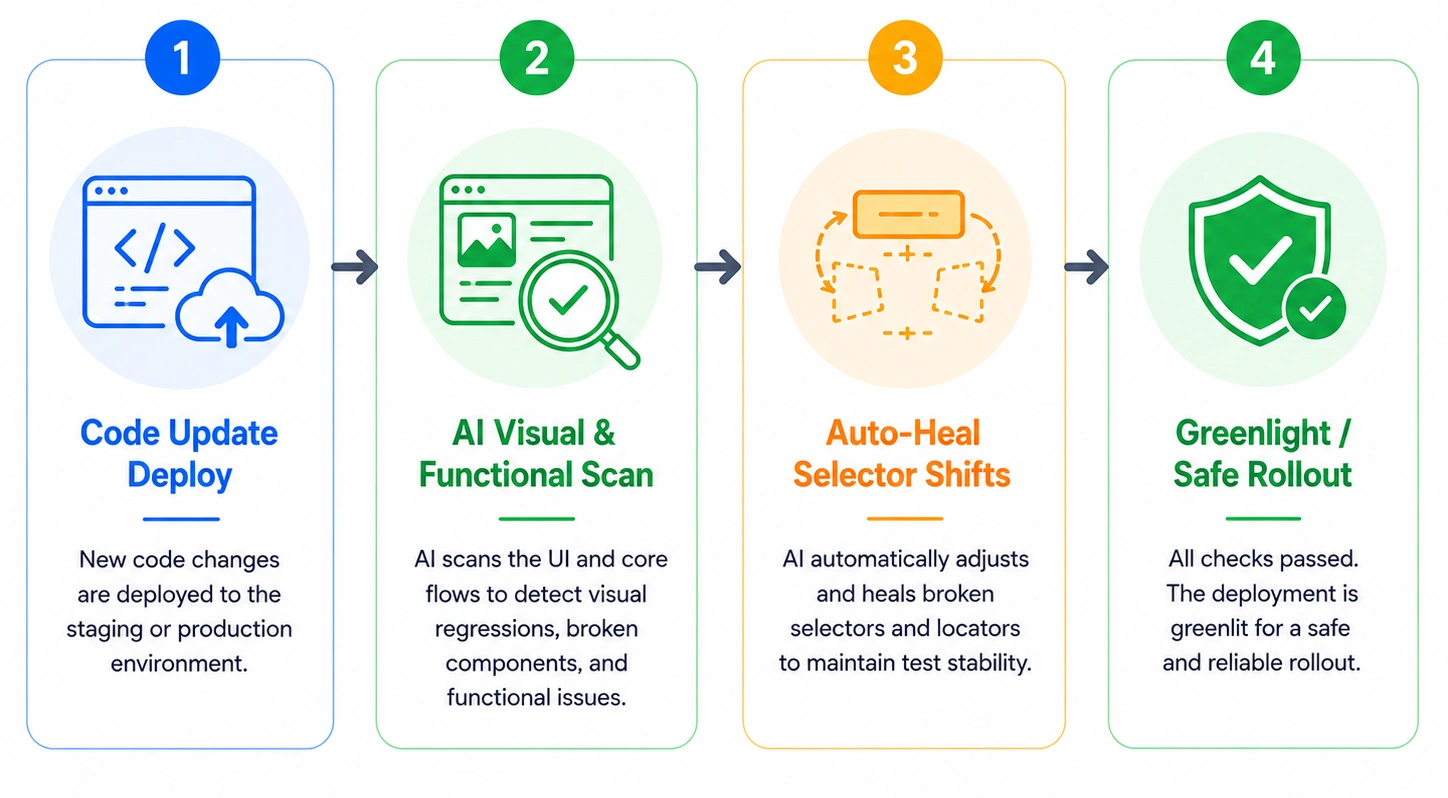
Why It Matters: For enterprise client platforms built by IdeaUsher, automated QA pipelines translate to faster release cycles, vastly reduced manual QA costs, and bulletproof software reliability that protects your brand’s reputation from Day 1.
9. AI Content Generation for Dynamic Websites
Maintaining modern web applications requires a continuous volume of precise, contextually relevant copy. Integrating automated generation systems directly into the content management pipeline accelerates production at scale.
- Automated Product Descriptions: E-commerce platforms leverage structured inventory data (such as materials, dimensions, and specifications) to automatically write unique, brand-aligned product copy across thousands of SKUs instantly.
- Localized Multilingual Content (Like Duolingo): Localized web engines replace literal translation tools by using cultural and industry context to accurately adapt copy for global audiences.
- Dynamic Landing Page Generation: Content management systems (CMS) assemble bespoke landing page variants on demand, combining targeted copywriting with tailored layout templates to match specific inbound marketing campaigns.
The Quality Control Mandate: While generation pipelines dramatically reduce content bottlenecks, automated output must include human editorial oversight. At IdeaUsher, we always advocate for a “human-in-the-loop” framework to ensure absolute factual accuracy, preserve distinct brand tone, and maintain compliance with search engine quality guidelines.
10. AI Voice Interfaces & Multimodal Experiences
Web interaction is expanding past touchscreens and keyboards. Modern web applications utilize sight, sound, and text to create highly natural user experiences.
- Voice Search Optimization: As users shift toward conversational search terms via mobile devices and smart home equipment, websites structure content schema and index API responses to resolve semantic, spoken questions easily.
- Embedded AI Voice Assistants: Web platforms embed natural-sounding audio agents directly into the interface. Users can talk through account configurations, book travel arrangements, or run software commands via real-time audio conversations.
- Multimodal UX Interaction: Modern apps handle diverse, simultaneous inputs. For example, a user can upload a photo of a broken part, highlight a section, and verbally request a specific replacement.
Future Trajectories: Conversational Commerce: The checkout process is rapidly consolidating into unified conversational flows. Powered by custom integrations, users can select products, ask clarifying size questions, authorize payments, and arrange delivery addresses entirely within a single audio or chat sequence, completely eliminating the multi-page checkout form.
Top AI Tools for Web Developers
The web development stack has shifted significantly. Engineering teams now use context-aware AI for coding, UI design, quality assurance, and conversion optimization, moving beyond basic auto-completers and static dashboards.
For businesses looking to capture a competitive edge, integrating the right AI tools for web developers into internal engineering workflows is no longer optional, it is the foundation of modern product delivery.
1. AI Coding Assistants
Modern AI coding assistants act as intelligent co-architects within the integrated development environment (IDE) rather than operating as basic text expander. They read entire multi-file project directories, trace complex backend dependencies, and handle repetitive boilerplate logic so developers can focus on high-level system architecture.
- GitHub Copilot: Integrates inside VS Code to provide inline code generation. It excels at translating natural language comments into functional scripts and instantly writing comprehensive unit tests for backend logic.
- Cursor: Built as an AI-first fork of VS Code, allowing teams to highlight repository blocks for natural language refactoring. Its chat interface scans entire codebases to trace bugs and scaffold full-stack features.
- Codeium: A secure, enterprise-ready assistant providing fast code autocomplete and local directory search. It offers robust self-hosted and on-premise deployment options for teams with strict data privacy mandates.
2. AI Design & Frontend Tools
The handoff process between design teams and frontend engineers has historically been a primary friction point in software delivery. Next-generation AI layout engines compress this timeline by converting visual concepts and text prompts into clean, responsive frontend components.
- Figma AI: Generates layout structures from text prompts, automatically renames messy asset layers, maps design tokens, and instantly populates realistic placeholder text and visual assets.
- Framer: Generates fully adaptive, interactive websites from simple conversational descriptions, matching layout grids and styling parameters automatically to close the gap between wireframes and production.
- v0 (by Vercel): A prompt-to-UI engine that instantly outputs production-ready, modular React components styled with Tailwind CSS from a simple description of a design concept.
3. AI Testing & Automation Platforms
Traditional quality assurance (QA) is notoriously brittle; a minor update to a button class or a DOM element can break hundreds of manual test scripts. AI automation tools eliminate this friction by implementing self-healing test pipelines that adjust to code updates in real time.
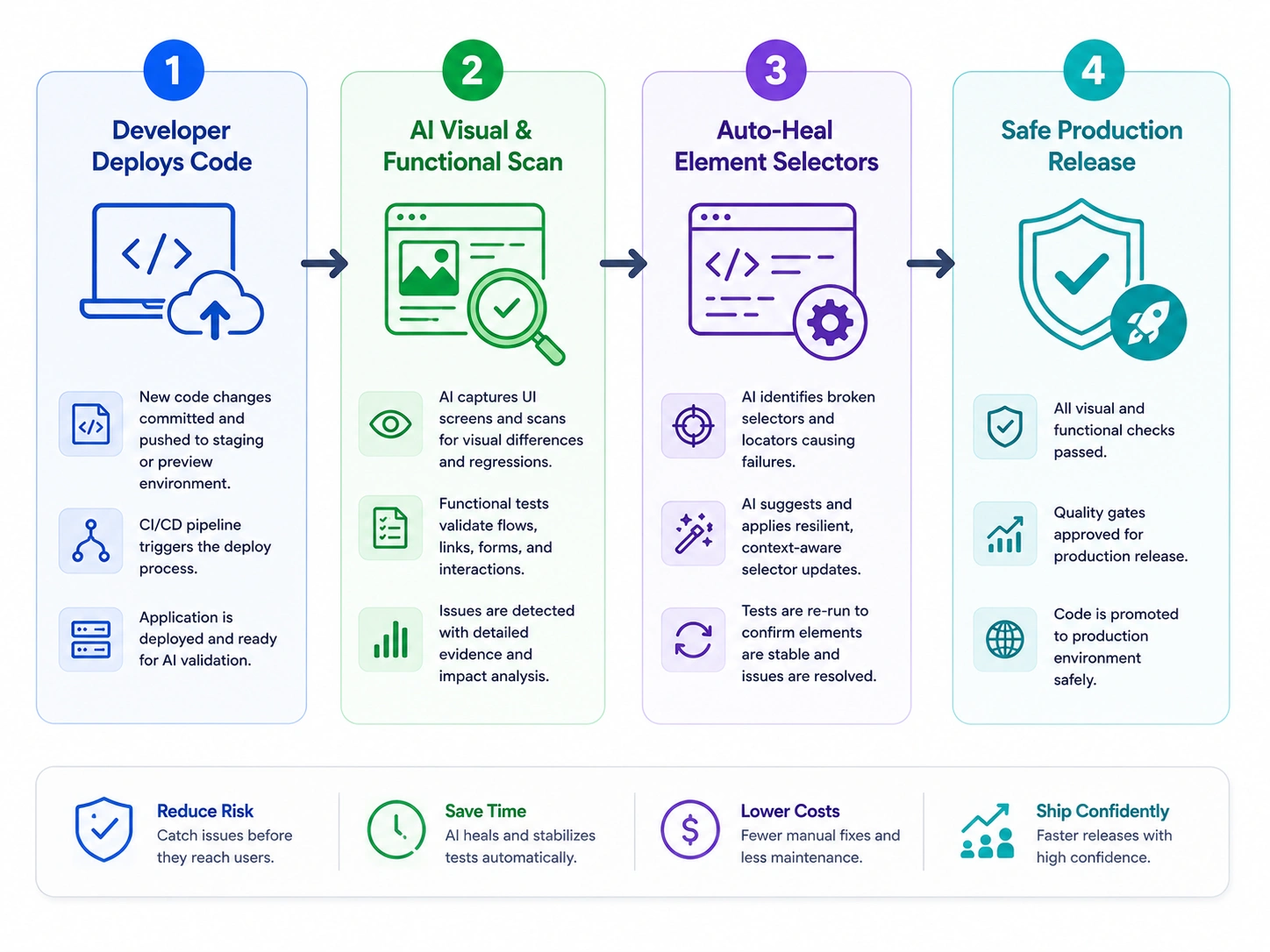
- Testim: Uses machine learning to analyze the structural characteristics of web applications. Its smart locators automatically adapt to layout changes, preventing false build failures and drastically reducing manual test maintenance costs.
- Applitools: Powered by visual AI to execute automated visual regression testing. It scans interfaces across hundreds of simulated devices, instantly detecting broken layout spacing, overlapping text, and styling defects.
4. AI Analytics & Personalization Tools
Once a web application is live in production, the engineering challenge shifts from deployment to conversion optimization. Modern analytics and optimization platforms move past passive data logging to proactively predict user behavior and adapt user experiences on the fly.
- Mixpanel AI: Integrates natural language processing directly into product analytics. Teams can ask conversational questions (e.g., “Why did user drop-offs spike on the checkout page last Tuesday) to instantly trace user journeys and pinpoint the exact root causes behind conversion drop-offs.
- Dynamic Yield (Experience OS): Leverages advanced machine learning to customize web experiences in real time. It evaluates live user context and behavioral signals to dynamically reorder product grids and deliver predictive recommendations.
How IdeaUsher Integrates AI Into Web Projects
IdeaUsher combines enterprise-grade web engineering with production-ready machine learning architectures. Our development team builds secure, data-compliant full-stack systems that smoothly connect custom large language models directly into core business operations.
A. Building AI-Native Web Platforms for Startups & Enterprises
A premium web experience requires more than simply connecting public, third-party APIs to a legacy frontend. To achieve true operational efficiency and competitive differentiation, modern applications must be engineered with artificial intelligence at their core.
IdeaUsher combines enterprise-grade web engineering with production-ready AI integration under one roof.
Bridging the gap between standalone data science and structural software. We manage the entire lifecycle, converting complex machine learning algorithms into responsive, scalable, and consumer-ready web platforms.
- Full-Stack Engineering: We construct modular, lightning-fast frontend interfaces using frameworks like React, Next.js, and Tailwind CSS, tightly coupled with robust backend environments written in Node.js, Python, and Go.
- Custom AI Model Integration: Our developers integrate algorithms with web logic by deploying custom LLMs and RAG frameworks to index corporate knowledge. We utilize vector databases like Pinecone and Milvus for efficient semantic retrieval.
- Secure Cloud Infrastructure: Financial and healthcare web architectures require strict data compliance. We build isolated, zero-egress cloud topologies on AWS, Google Cloud, and Azure to ensure data pipelines meet SOC2, HIPAA, and GDPR standards.
- Scalable Edge Architecture: To handle sudden, high-volume traffic spikes without latency or exponential cost inflation, we implement serverless execution pools and host real-time model inference protocols directly at the cloud edge.
B. AI Features IdeaUsher Integrates Into Modern Websites
We don’t build generic web pages; we engineer active, decision-making environments. Our development teams smoothly weave specialized AI functionality directly into enterprise full-stack structures:
- Context-Aware Chatbots: LLM-driven interfaces that securely authenticate users, access database records via APIs, and natively resolve complex, tiered customer support tickets.
- Predictive Recommendations: Real-time collaborative filtering networks that process in-session user behavior to instantly reorder product grids, content cards, and CTAs.
- Predictive Analytics: Data intelligence layers processing historical event tracking to forecast churn variables, anticipate supply spikes, and optimize resource allocation.
- Intent-Driven Search: Vector-based semantic search engines that interpret conversational phrasing, eliminating “Zero Results Found” errors caused by typos or missing tags.
- Dynamic Personalization: Systems that modify layouts, hero assets, and marketing copy on the fly based on active user intent, scroll velocity, and referral metrics.
- Workflow Automation: Agentic backend automation that handles cross-platform data syncing, matches invoices via visual processing, and executes multi-step operations.
- Natural Language Dashboards: Portals that replace static graphs with plain-English summaries, explaining metric shifts and proposing immediate tactical fixes.
C. Real-World Success Stories
Rather than discussing artificial intelligence conceptually, we prove its viability through production-ready software architectures deployed for our global clients.
1. Scribion — AI-Powered Clinical Documentation Platform
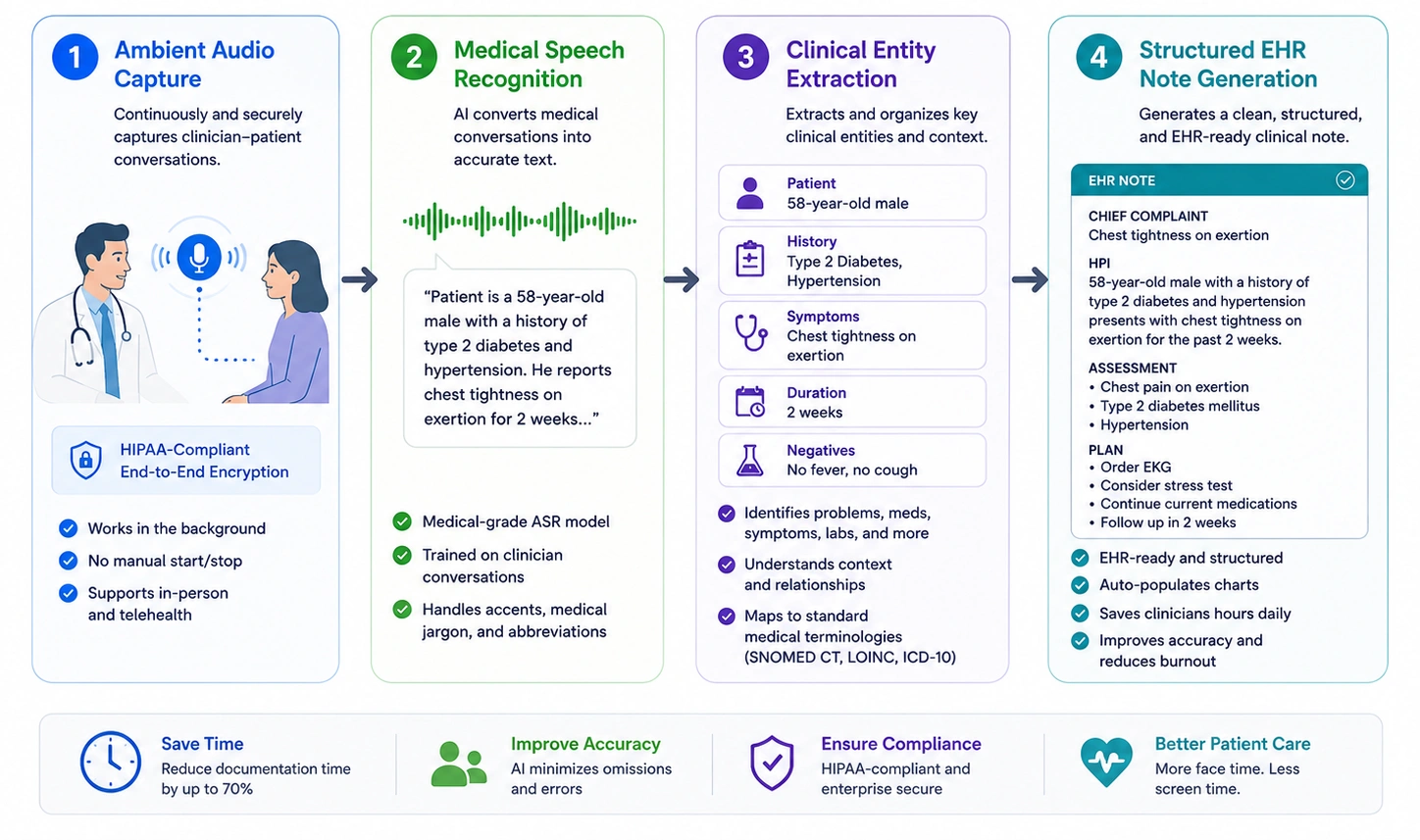
IdeaUsher engineered an AI-native healthcare platform that captures ambient clinical dialogue, filtering out background noise to instantly structure raw consultation audio into secure, HIPAA-compliant electronic medical notes.
A. Client Problem
The administrative burden placed on modern healthcare providers directly limits patient throughput and accelerates clinical burnout. To eliminate this workflow friction, IdeaUsher engineers secure, real-time ambient documentation systems that seamlessly bridge the gap between clinical speech and structured electronic health records.
- The Documentation Bottleneck: Medical professionals spend up to a third of their operational workdays executing manual clinical charting, transcribing patient conversations, and manually updating Electronic Health Records (EHR).
- The Burnout Catalyst: This compounding administrative load reduces the time doctors can dedicate to direct patient care and increases operational overhead across healthcare facilities.
- The Technical Mandate: The client needed a secure, real-time web app to capture clinical dialogue and instantly generate compliant medical notes without interrupting patient care.
B. AI Solution Implemented
To address the client’s operational bottleneck, IdeaUsher built a tailored, production-ready solution that transforms unstructured consultation audio into structured, secure clinical documentation in real time.
- Bespoke Platform Engineering: IdeaUsher designed and engineered Scribion, an AI-native medical scribe application optimized to deliver high-precision clinical documentation instantly.
- Intelligent Audio Processing: The platform captures ambient room dialogue between physicians and patients, utilizing advanced acoustic filtering algorithms to strip away non-clinical background noise.
- Clinical Entity Extraction: Leveraging specialized Natural Language Processing (NLP) models, the backend automatically extracts vital clinical entities, diagnoses, symptom variations, and intended treatment plans from the raw audio stream.
- Standardized Document Assembly: The platform converts conversations into SOAP (Subjective, Objective, Assessment, and Plan) notes, enabling staff to review and sync summaries to their EHR database.
C. Technologies Used
Scribion integrates a highly secure, modern healthcare tech stack engineered for real-time compliance and low-latency clinical data processing.
- Frontend: React.js, Tailwind CSS, Web Audio API for lossless client-side audio capturing.
- Backend & Orchestration: Python (FastAPI) and Node.js managing asynchronous audio processing queues.
- AI & Machine Learning: Advanced medical speech-to-text transformation models, custom-tuned clinical entity extraction LLMs, and semantic text segmentation layers.
- Infrastructure & Security: AWS Cloud architecture featuring end-to-end HIPAA-compliant database encryption, isolated data transmission tunnels, and zero-retention data logging protocols to protect patient privacy.
D. Enterprise Growth Outcome
Scribion completely transformed the clinical documentation lifecycle for its users, compressing note-generation times by over 60%. By reducing administrative friction, healthcare providers using the platform recorded a substantial increase in daily patient intake capacity and a drastic reduction in clerical errors.
2. Spend-Easy — AI-Driven Corporate Spend Optimization Platform
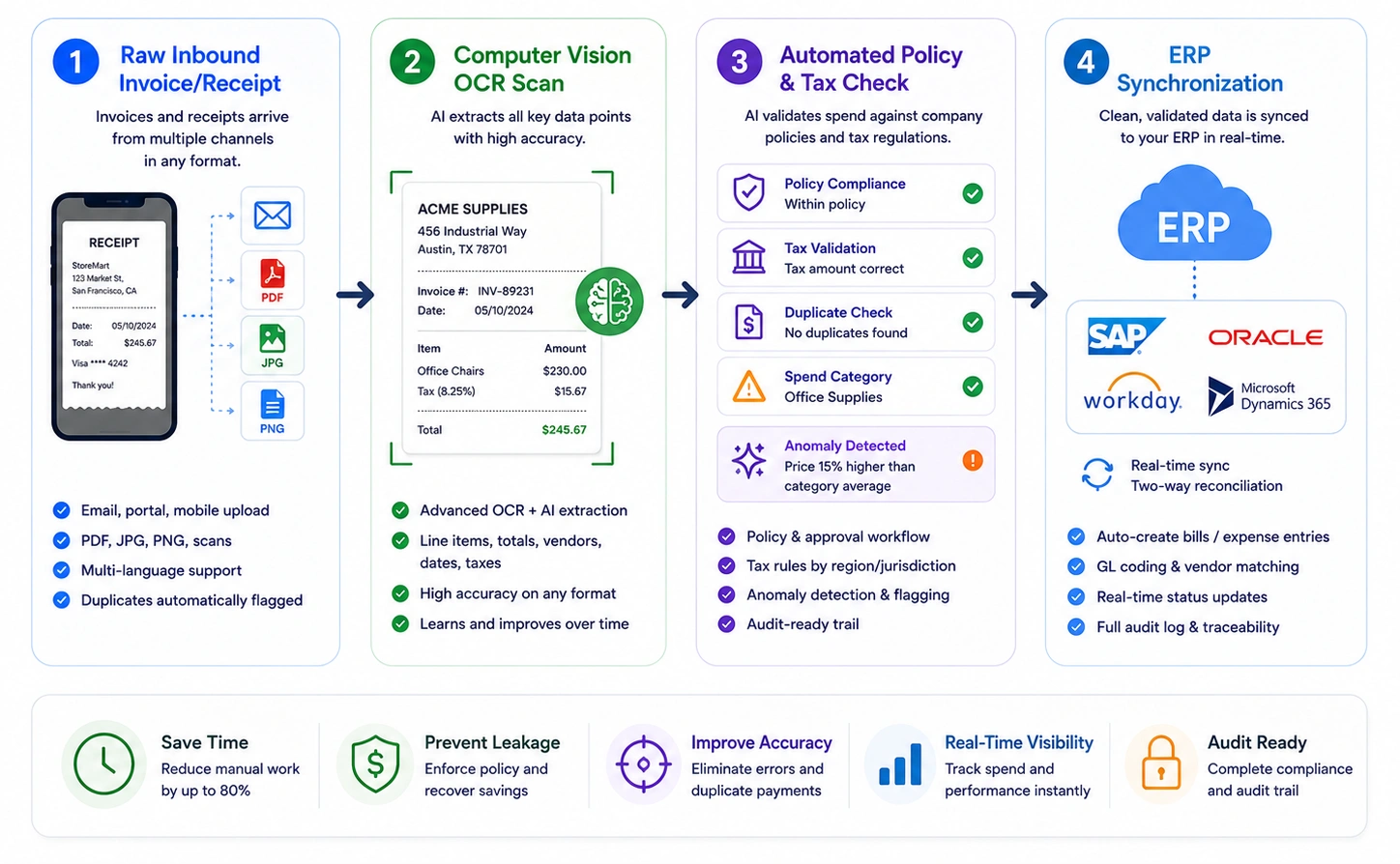
IdeaUsher built an automated financial intelligence SaaS that leverages computer vision to scan invoices, extract real-time transaction data, and deploy predictive models to eliminate enterprise budget leaks.
A. Client Problem
Manual, reactive bookkeeping frameworks severely limit an enterprise’s ability to maintain real-time fiscal control. To eliminate these workflow bottlenecks, modern platforms require autonomous data processing systems that turn unstructured financial intake into instantaneous, forward-looking cash flow intelligence.
- Fragmented Tracking and Inefficiency: Modern procurement pipelines frequently stall due to manual expense tracking, hidden shadow IT expenses, and severely delayed invoice processing workflows.
- Stale Cash Flow Data: Legacy spend management systems capture transaction data hours or days after an event occurs, leaving finance executives with outdated metrics that limit accurate cash flow forecasting.
- The Intelligence Mandate: The client needed an intelligent platform to replace manual asset and intake workflows. They required a system to process physical invoices instantly and provide forward-looking expense visibility to safeguard profitability.
B. AI Solution Implemented
To replace the client’s manual bookkeeping infrastructure, IdeaUsher engineered an automated data pipeline that transforms raw transactional assets into actionable, real-time corporate expense intelligence.
- SaaS Architecture Deployment: IdeaUsher designed and deployed Spend-Easy, an automated financial intelligence platform that replaces manual bookkeeping spreadsheets with real-time, multi-tenant data pipelines.
- Computer Vision Ingestion: The platform leverages advanced computer vision models to scan incoming physical receipts, paper invoices, and digital billing files, instantly extracting line-item details, currency indicators, and localized tax structures.
- Predictive Budget Guardrails: An integrated machine learning engine continuously analyzes historical corporate spending patterns to automatically flag anomalous transaction vectors, duplicate bills, or sudden budget leaks before they scale.
- Live Ledger Synchronization: The platform unifies transaction streams into real-time analytics, giving treasury teams instant expense oversight and seamless integration with core ERP systems.
C. Technologies Used
Spend-Easy leverages a resilient, high-throughput financial tech stack optimized for real-time asset ingestion and enterprise-grade data isolation.
- Frontend: Next.js with responsive, real-time data visualizer matrices.
- Backend & APIs: Python, Go, and secure financial webhook integrations for live bank ledger synchronization.
- AI Core Engine: Custom Computer Vision models for advanced Optical Character Recognition (OCR), semantic categorization transformers, and anomaly detection algorithms.
- Data Architecture: PostgreSQL alongside highly secure, multi-tenant cloud storage structures optimized for high-frequency transactional data.
D. Operational Benefits
Spend-Easy’s launch removed manual data entry hurdles, cutting invoice approvals by 70%. Its automated compliance flagged thousands of unauthorized transactions, giving treasury teams full visibility while securing profitability.
Future Trends of AI in Web Development
The rapid convergence of frontier language models and edge computing is driving web architecture into an autonomous era. Websites are transitioning from static, pre-compiled files into fluid, self-directed ecosystems that actively think, adapt, and build themselves in real time.
1. Autonomous Websites That Self-Optimize
Web applications are discarding scheduled development updates in favor of continuous, self-learning UX loops. By evaluating live clickstreams, these systems execute real-time conversion rate optimization (CRO) and adjust layout friction parameters programmatically without developer intervention.
Real-World Example: Enterprise platforms like Optimizely use multi-armed bandit AI algorithms to replace manual testing. Their optimization layers continuously shift traffic between hundreds of design variations, automatically sunsetting low-performing layouts and scaling winning UI patterns in real time.
2. AI Agents Embedded Into Websites
Modern web platforms are embedding task-driven AI agents directly into backend architectures. Rather than just answering simple support queries, these autonomous assistants orchestrate multi-step software workflows and interact securely with underlying APIs to solve user problems.
Real-World Example: Financial institutions like Wells Fargo deploy virtual assistants built on Google’s Gemini enterprise framework. Embedded inside the banking portal, these agents let users execute complex workflows like analyzing historical spending and initiating secure fund transfers within a single conversational interface.
3. Hyper-Personalized Web Experiences
The next generation of context-aware software relies on deep behavioral adaptation to project hyper-personalized spaces. Web layers analyze current situational inputs, environmental data, and interaction velocities to craft custom dashboards tailored to individual intent.
Real-World Example: Klarna integrates financial streaming data with real-time browsing vectors. Upon login, the site architecture adapts to environmental variables, dynamically adjusting currency models and visual layouts based on whether the user is conducting industrial or personal shopping.
4. Generative UI & Real-Time Interface Creation
Generative UI marks a massive departure from standard design systems by engineering interfaces purely on demand. Using modular component libraries, the backend dynamically pieces together tailored layouts, rendering custom application states perfectly tuned to active user queries.
Real-World Example: Production rollouts of CopilotKit’s Open-JSON-UI integration exemplify this shift. By standardizing application-LLM interfaces, enterprise platforms can stream dynamic simulations and data matrices into sandboxed containers, entirely bypassing static template structures.
Why Businesses Choose IdeaUsher for AI Web Development
Choosing an engineering partner for AI requires moving beyond superficial API wrappers. True enterprise value is realized when AI is treated as the foundational core of software architecture rather than an afterthought.
With over 11 years of structural engineering experience, more than 1,000 successfully delivered projects globally, and an elite team of 250+ niche developers, IdeaUsher has established a reputation as a trusted technology collaborator for fast-growing startups and Fortune 500 enterprises alike.
- Full-Stack + AI-Native Expertise: We integrate Machine Learning, NLP, and Agentic AI directly into robust React, Next.js, Python, and Go workflows, ensuring your intelligence layer executes smoothly in production.
- Enterprise-Grade Scalability: Architected for global performance with a 99.9% uptime SLA across 120+ countries. We utilize Kubernetes and serverless pipelines to auto-scale during traffic spikes without cost inflation.
- Human-Centered UX Design: We turn dense predictive data and multi-step conversational flows into clean, scannable, and highly intuitive interfaces that strip away friction and drive user retention.
- Accelerated Deployment Cycles: By combining agile methodologies with pre-tested AI infrastructure blueprints, we compress the development lifecycle to fast-track MVP and enterprise rollouts.
- Custom Autonomous Workflows: We build bespoke, self-learning AI agents tailored to your operational parameters and backend ERP systems, avoiding one-size-fits-all templates.
- Rigid Security & Continuous MLOps: Every platform features hardened security built to satisfy SOC 2, ISO 27001, GDPR, and HIPAA compliance, backed by continuous model monitoring and proactive patches.
Conclusion
AI is no longer an experimental layer in web development. It is becoming the foundation of how modern digital platforms are built, optimized, and experienced. From personalized user journeys and conversational interfaces to predictive analytics and AI-powered automation, intelligent systems are reshaping every stage of the web ecosystem. Businesses that adopt AI-powered web development early will gain a major competitive advantage through faster innovation, higher engagement, and smarter operational efficiency. The future belongs to adaptive, AI-native web experiences that continuously learn, evolve, and deliver value in real time
Things to Know About AI in Web Development
Q.1. What Is the Role of AI in Web Development?
A.1. Artificial intelligence functions as an execution accelerator across both frontend and backend architectures. It automates structural boilerplate syntax, handles complex database queries, manages edge routing configurations, and continuously optimizes client side rendering performance to shorten the path from initial wireframes to production code.
Q.2. How Do AI Personalization Impact Website Conversion Rates?
A.2. By eliminating static testing loops, real time machine learning models analyze behavioral clickstreams, scroll depth, and active context instantly. This data processing allows the user interface to programmatically restructure layouts, navigation menus, and call to action positioning on the fly to maximize user retention.
Q.3. What are The Challenges in AI in web Development?
A.3. Enterprise applications face significant constraints around data privacy compliance under regulations like GDPR, alongside high infrastructure computation costs. Engineering teams must navigate complex integration requirements, secure internal data isolation protocols, and implement continuous performance monitoring to prevent technical decay within live deployment pipelines.
Q.4. How AI Testing Frameworks Reduce Software Quality Assurance Costs?
A.4. Autonomous quality assurance platforms deploy self healing test scripts that adapt to frontend structural changes automatically. By simulating comprehensive human interaction paths and executing rapid visual regression testing across variable browser viewports, these tools detect runtime exceptions early to eliminate brittle, manual maintenance.