


Key Takeaways
- A TRC20 crypto wallet is evolving into a stablecoin-focused financial platform for USDT transfers, cross-border payments, merchant settlements, DeFi, and multi-chain assets.
- Core features include TRC20 token management, USDT transfers, Energy/Bandwidth management, staking, cross-chain support, hardware wallets, and secure signing.
- AI capabilities add transaction risk scoring, suspicious-address detection, smart-contract analysis, resource optimization, and predictive monitoring.
- Scalable wallets need TRON infrastructure, blockchain indexers, automated Energy management, HD addresses, transaction monitoring, and treasury sweeping.
- Security and compliance increasingly require MPC, hardware wallets, encrypted key management, KYC/AML, KYT, Travel Rule support and audit trails.
- Development costs range from $50,000 to $500,000+, depending on custody, security, integrations, compliance, AI, and scalability.
TRON’s growing role in stablecoin payments is reshaping crypto wallet expectations. Beyond storing and transferring USDT-TRC20, users increasingly need cross-chain access, faster settlement, stronger security, and seamless payments. This creates opportunities for TRC20 crypto wallets designed around digital-dollar payments, cross-border transactions, and broader everyday crypto utility.
Modern TRC20 wallets are evolving beyond basic token storage, combining multi-token management, fast USDT transfers, QR payments, dApp connectivity, cross-chain transfers, portfolio tracking, biometric security, hardware-wallet support and intelligent transaction monitoring. For builders, the opportunity lies in creating wallets that can serve retail users, merchants and institutions across increasingly connected stablecoin ecosystems.
In this blog, we will talk about the top TRC20 crypto wallet development trends in 2026, emerging features, security innovations, cross-chain interoperability, institutional use cases, compliance requirements and how IdeaUsher can help you build a scalable TRC20 crypto wallet.
Why TRC20 Wallets Are Becoming Stablecoin Infrastructure
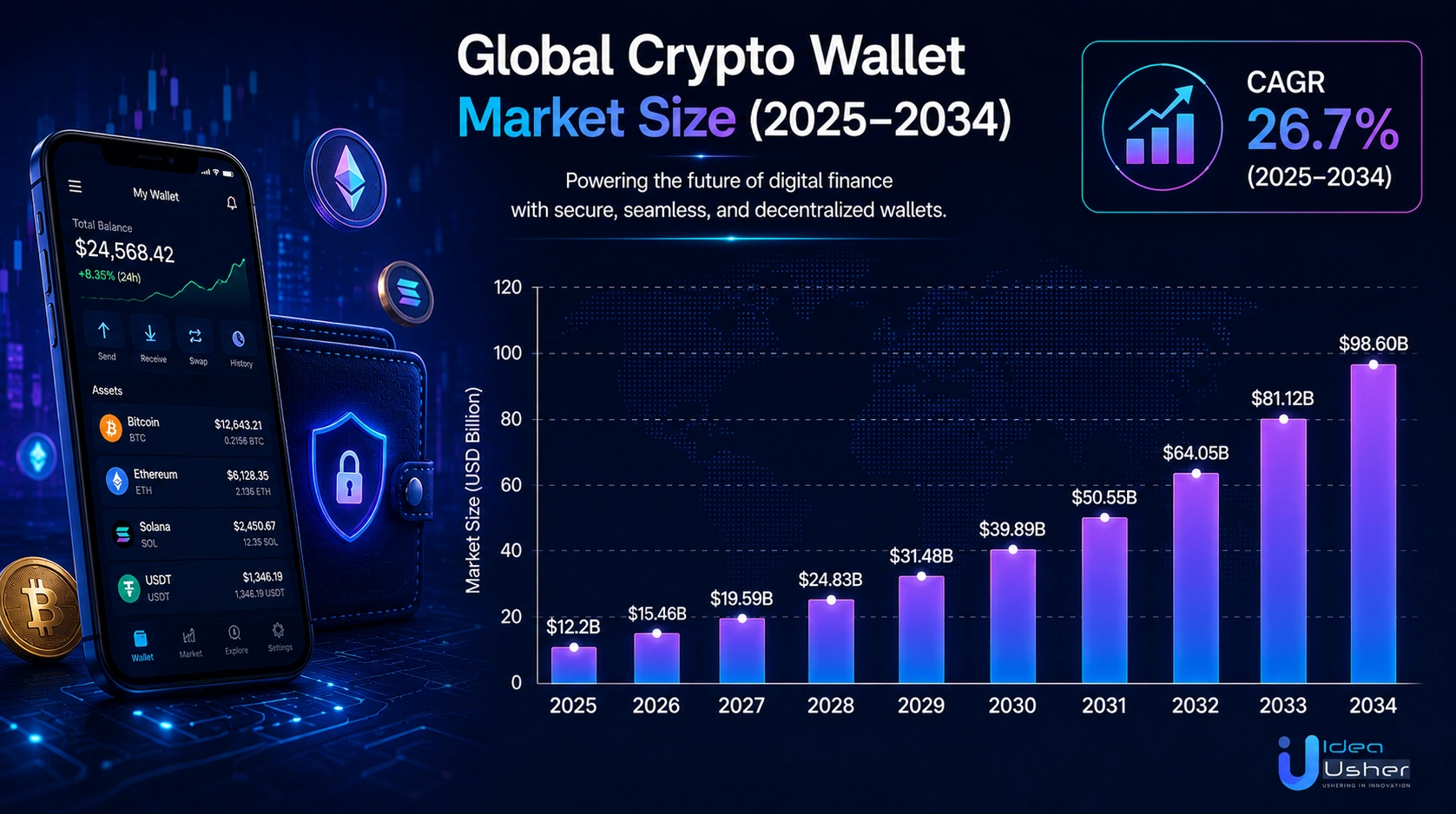
The global crypto wallet market is projected to grow from around $12.2 billion in 2025 to nearly $98.6 billion by 2034, expanding at a CAGR of about 26.7%, highlighting rapidly increasing demand for secure wallet solutions like USDT TRC20 wallet apps are well positioned to capture this demand through fast, low-cost stablecoin transfers and scalable payment experiences for users and businesses.
The global stablecoin market has expanded into a critical pillar of digital payments, with total stablecoin supply surpassing from approx. $300 billion and annual settlement volume exceeding $1.45 trillion in 2035. Within this ecosystem, the TRON network (TRC20) commands a dominant footprint, hosting over $90 billion in circulating USDT, which represents more than 50% of the entire global Tether supply.
A. TRC20 Wallets Are Moving Beyond Basic Token Storage
First-generation Web3 wallets functioned primarily as static, passive vaults designed to hold speculative assets like Bitcoin or Ethereum.
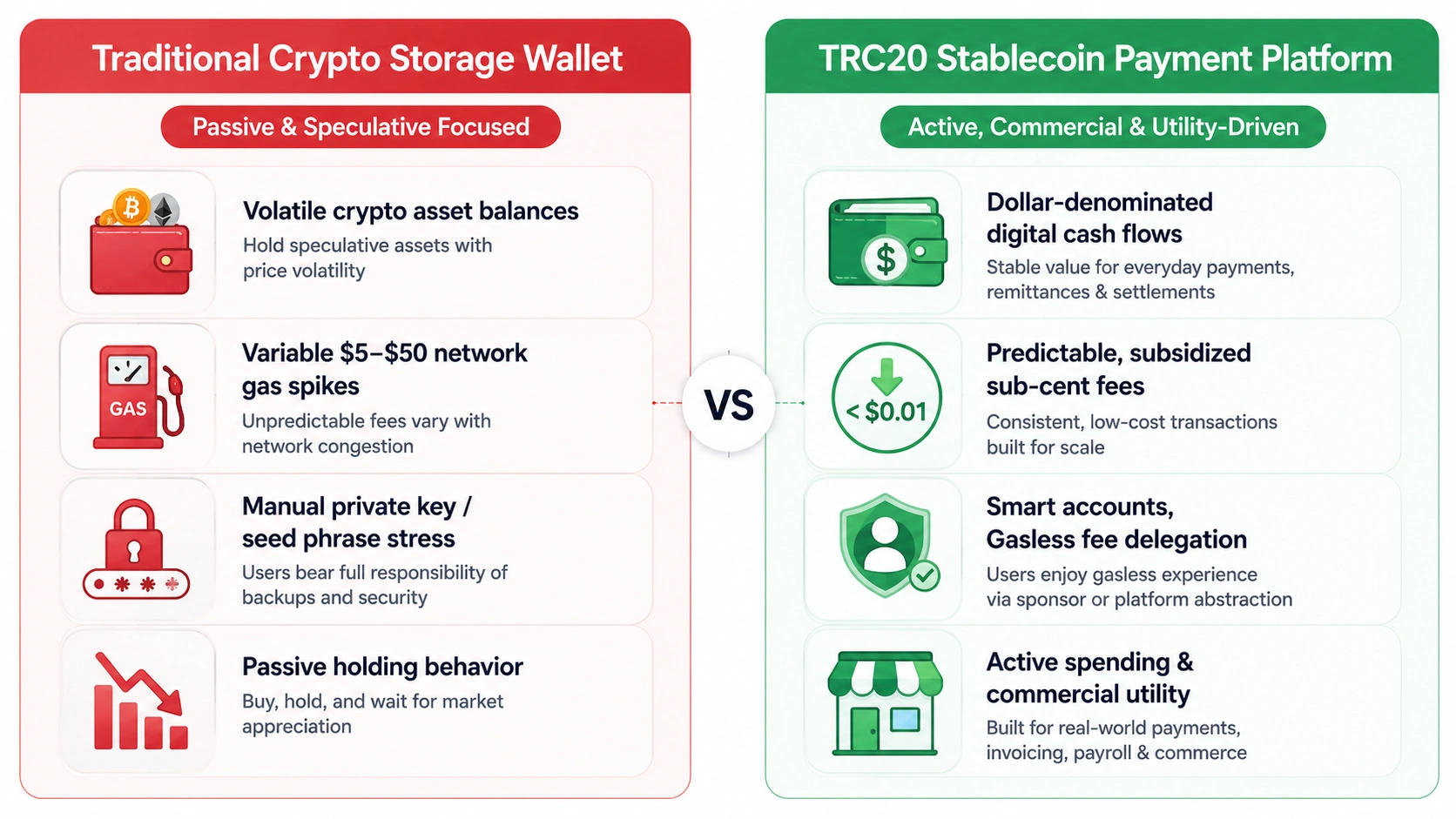
This shift is redefining the wallet’s role, as TRC20-centric platforms increasingly function as active financial operating systems rather than simple token storage tools:
- From Asset Custody to Cash Flow Orchestration: Users no longer rely on TRC20 wallets simply to hold digital tokens. Increasingly, they use them for payroll disbursements, peer-to-peer (P2P) transfers, international supplier invoicing, and retail point-of-sale checkout, turning wallets into active payment infrastructure.
- Gasless Fee Delegation (Energy/Bandwidth Rental): TRON enables wallet providers and payment gateways to sponsor transaction fees By leveraging Bandwidth and Energy instead of native gas. Consequently, users can transfer USDT without needing to acquire or hold TRX balances.
- Enterprise Multi-Sig & Smart Treasury Automation: Enterprise TRC20 wallets adopt multi-signature governance, RBAC, automated sweep rules, and mass-payout APIs to secure treasury tasks and connect with corporate accounting systems.
B. Why USDT-TRC20 Is Driving Wallet Adoption
The mass adoption of TRC20 wallets is directly tied to the network effects of USDT on TRON, which processed over $4.2 trillion in transfer volume in 2026.
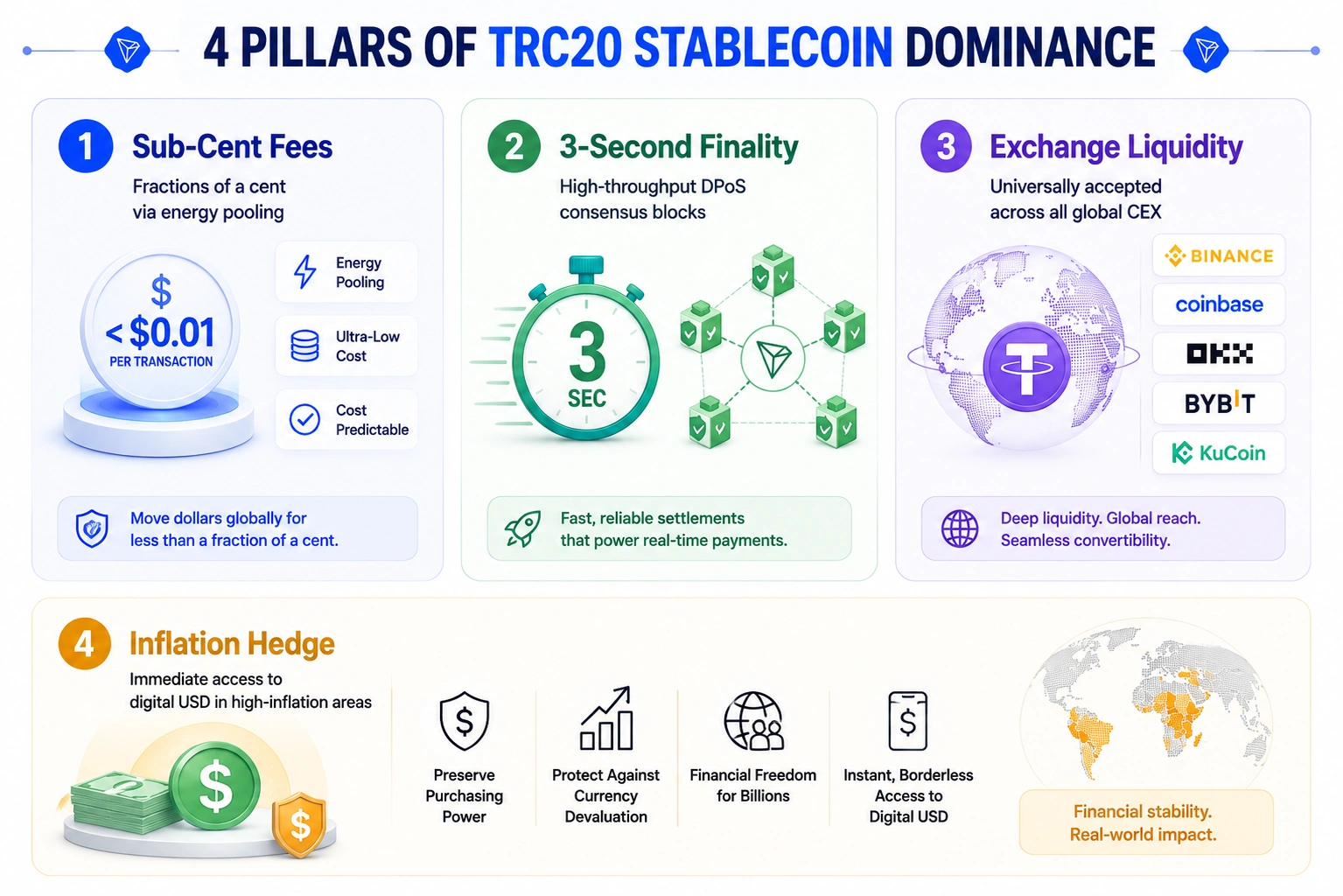
Multiple structural factors make USDT-TRC20 the preferred payment rail across Latin America, Southeast Asia, Eastern Europe, and Africa:
- Predictable, Low Transaction Costs: Ethereum mainnet transfers can reach tens of dollars during congestion, while TRON transfers typically cost a fraction of a cent when powered by pooled network Energy. This makes micro-transactions, everyday payments, and retail commerce more economically viable.
- High Throughput & Rapid Settlement: TRON’s Delegated Proof of Stake (DPoS) architecture, supported by 27 Super Representatives, enables 3-second block generation and 2,000+ TPS capacity, providing rapid confirmation suitable for commercial checkout flows.
- Universal Liquidity Across Centralized Exchanges (CEX): Major exchanges including Binance, OKX, Bybit, and Coinbase support TRC20-USDT deposit and withdrawal corridors. This broad liquidity helps users move between local fiat currencies and digital dollars with minimal friction and slippage.
- Protection Against Local Currency Depreciation: In high-inflation economies, TRC20 wallets offer a frictionless, censorship-resistant way to store and transact in digital dollars outside traditional banks.
C. From Crypto Wallets to Stablecoin Payment Platforms
The maturation of the TRC20 standard is driving a shift from decentralized apps (dApps) toward integrated fintech rails:
| Feature Dimension | Traditional Non-Custodial Wallet | TRC20 Stablecoin Payment Platform |
| Primary Unit of Account | Native cryptocurrency (e.g., BTC, ETH, SOL). | Fiat-pegged stablecoins (USDT, USDD). |
| Fee Experience | User must hold and calculate volatile gas. | Subsidized fees or fee deduction directly from USDT. |
| B2B Integration | Disconnected from enterprise ERPs. | REST/Webhook APIs for invoicing, auto-settlement, & webhooks. |
| Fiat Off-Ramping | Multi-step transfers through external CEXs. | Embedded On/Off-ramps, local P2P networks, & crypto debit cards. |
This transition creates opportunities for wallet providers to move beyond asset storage and build payment infrastructure, connecting stablecoin transactions with commerce, business operations, cross-border transfers, and everyday spending.
- Embedded On/Off Ramping & Card Issuance: Modern TRC20 platforms integrate virtual and physical Visa/Mastercard cards, allowing users to fund cards directly with USDT-TRC20 and spend digital dollars across millions of global point-of-sale terminals.
- Automated Invoicing & Webhook Infrastructure: Payment processors such as BitPay, NOWPayments, and custom enterprise gateways use TRC20 wallets to automate B2B supply-chain payments, with sub-minute payment-verification webhooks connected directly to merchant ecommerce platforms.
- Decentralized Cross-Border Remittance: TRC20 payment rails can reduce international transfer costs compared with traditional 6%–8% wire fees, enabling immigrant workers and multinational contractors to send and receive funds quickly with minimal network transfer costs.
The Enterprise Takeaway: TRC20 crypto wallets are evolving from crypto tools into digital payment infrastructure. Leveraging USDT-TRC20 liquidity, fast block finality, and fee-delegation architecture, enterprises can build global payment platforms with lower friction than traditional banking rails.
What Is a TRC20 Crypto Wallet?
A TRC20 crypto wallet is a blockchain wallet for storing, sending, receiving, and managing TRC20 tokens on the TRON network, with USDT-TRC20 among its most widely used assets. TRC20 is TRON’s fungible-token standard, comparable to Ethereum’s ERC20, providing a common framework for tokens to interact with compatible wallets, exchanges, and dApps.
TRC20 wallets function as custodial or self-custodial asset platforms. Key capabilities include storage, transfers, address management, swaps, QR payments, dApp access, tracking, biometric security, and hardware support. They also manage TRON’s Energy and Bandwidth resource system for transaction fees.
- TRC20 Standard: The technical specifications (including smart contract functions like totalSupply, balanceOf, and transfer) required for fungible tokens to run on the TRON network.
- TRC20 Address Format: A public address always starts with the letter “T” and consists of 34 Base58Check-encoded characters (e.g., TR7NHqje…). A single TRON address handles TRX, TRC10, and TRC20 tokens simultaneously.
- USDT-TRC20: Tether issued on the TRON blockchain. It is one of the world’s most widely used stablecoin transfer channels due to low costs and fast block times (~3 seconds).
- Energy & Bandwidth: TRON’s two-tier resource model used to pay for network transactions instead of relying strictly on flat gas fees:
- Bandwidth: Used to pay for simple byte size data transfers (e.g., sending basic TRX).
- Energy: Required to execute smart contracts (e.g., sending TRC20 tokens like USDT).
- TRX (TRONix): The native utility coin of the TRON network, used to freeze for Energy/Bandwidth or burn directly to cover gas fees when transferring TRC20 tokens.
Types of TRC20 Wallets
TRC20 crypto wallets come in several forms, each balancing security, accessibility, custody, transaction convenience, and user control differently across self-custody, hardware, and custodial models.
- Self-Custody App Wallets: Hot wallets like TronLink, Trust Wallet, and Atomic Wallet where the user retains exclusive ownership of private keys and seed phrases.
- Hardware Wallets: Cold storage solutions like Ledger or OneKey that sign TRON transactions offline for maximum security.
- Exchange / Custodial Wallets: Account addresses provided by centralized exchanges (e.g., Binance, Coinbase) that manage TRC20 deposits and withdrawals on the user’s behalf.
TRC20 Wallet Overview
TRC20 crypto wallets provide access to USDT transfers, TRON-based applications, and stablecoin transactions, with their architecture influencing fees, speed, security, and overall user experience.
| Category | Platform Information |
| Primary Use Case | Moving stablecoins (USDT), interacting with TRON dApps, peer-to-peer transfers, and fast exchange deposits/withdrawals. |
| Address Prefix | Always begins with “T” (34 characters). |
| Transaction Speed | ~3-second block times (confirmation speeds depend on exchange policies). |
| Average Cost | Free (if TRX is staked for Energy) or ~1–2 in burned TRX (substantially lower than ERC20 Ethereum gas fees). |
| Gas Fee Asset | Native TRX token. |
Top 10 TRC20 Wallet Development Trends Shaping 2026
The TRON network anchors the world’s most active dollar-settlement layer, hosting over $90+ billion in circulating USDT-TRC20 and handling trillions in annual transfer volume. In 2026, TRC20 wallet development has evolved far beyond basic token storage into institutional-grade, cross-border payment and financial infrastructure.
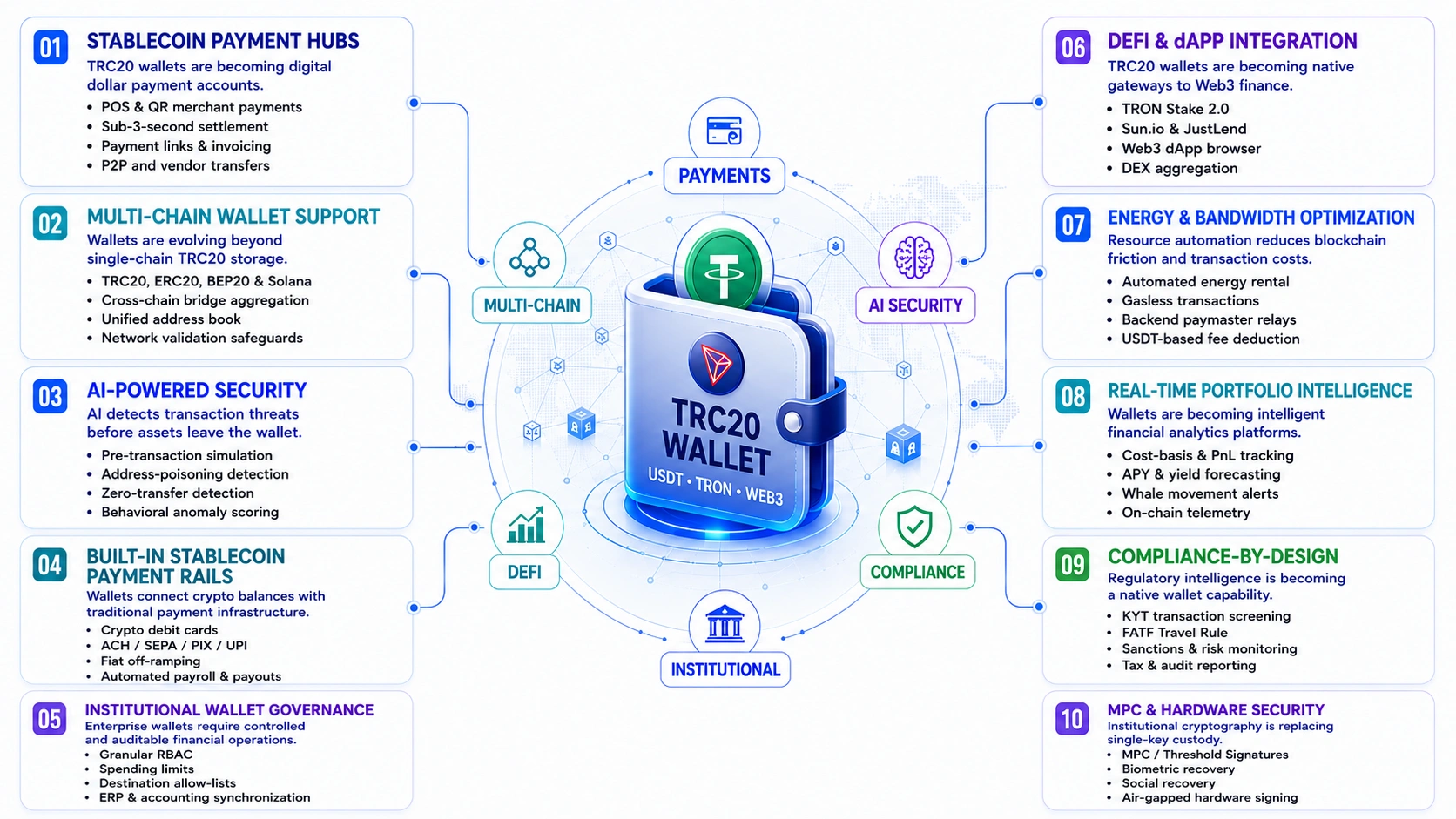
1. USDT-TRC20 Wallets Are Becoming Stablecoin Payment Hubs
Rather than serving as passive speculative crypto wallets, TRC20 apps are engineered as dedicated digital dollar accounts:
- Point-of-Sale (POS) & QR Merchant Rails: Direct scan-to-pay functionality optimized for instant retail transactions, vendor disbursements, and P2P remittances.
- Sub-3-Second Settlement: Leveraging TRON’s delegated Proof-of-Stake (DPoS) consensus to settle transactions in 3 seconds with deterministic finality.
- Micro-Merchant Tooling: Automated multi-currency invoicing, payment link generators, and zero-fee internal ledger transfers between platform users.
2. Multi-Chain Support Is Reshaping Wallet Development
While USDT-TRC20 dominates settlement volume, isolated single-chain apps struggle with user retention:
- Cross-Chain Bridge Aggregators: Native bridge protocols integrated directly into the wallet UI, enabling frictionless swaps between TRC20, ERC20, BEP20, Solana (SPL), and Arbitrum/Base Layer-2 stablecoins.
- Unified Multi-Chain Address Books: Intelligent UI safeguards that automatically validate destination networks, preventing costly errors where users attempt to send TRC20 tokens (starting with T) to EVM hex addresses (0x…).
3. AI-Powered Security Is Transforming Risk Detection
Machine learning models now provide pre-execution transaction defense against malicious smart contracts and phishing drainers:
- Pre-Transaction Simulation: AI models simulate transaction outcomes before signing, flagging unauthorized token approval allowances or malicious contract state changes.
- Address Poisoning & Zero-Transfer Detection: Algorithms detect zero-value spoofed transfers and look-alike vanity addresses designed to trick users into copying fraudulent history hashes.
- Anomaly Detection: On-device behavioral biometrics and risk scoring that trigger step-up multi-factor authentication (MFA) during abnormal withdrawal spikes.
4. Stablecoin Payment Rails Are Becoming Built-In
Wallets are closing the gap with traditional banking infrastructure through integrated on- and off-ramps:
- Virtual & Physical Crypto Debit Cards: Direct integration with card networks (Visa/Mastercard) allowing users to spend TRC20-USDT balances at millions of physical terminals worldwide.
- Local Currency Payout Gateways: Direct ACH, SEPA, PIX (Brazil), and UPI (India) settlement pipes embedded within the wallet for instant fiat off-ramping without centralized exchange accounts.
- Automated Payroll & Batch Disbursements: Enterprise mass-payout modules enabling businesses to execute hundreds of global contractor payments in a single transaction payload.
5. Institutional Adoption Is Driving New Wallet Capabilities
High-volume institutional market makers, OTC desks, and corporate treasuries demand enterprise governance features:
- Granular Role-Based Access Control (RBAC): Multi-tier organizational permissions separating payment initiators, financial compliance reviewers, and executive signers.
- Automated Spending Limits & Allow-Lists: Configurable smart-contract rules enforcing daily transaction caps, mandatory cooling-off periods, and allowlisted destination addresses.
- Enterprise Accounting & ERP Sync: Direct API webhooks that export real-time transaction data into enterprise accounting systems (QuickBooks, NetSuite, SAP).
6. DeFi and dApp Integration Are Becoming Core Features
TRC20 crypto wallets act as native portals to TRON’s decentralized finance and yield ecosystem:
- In-App Staking & Yield Farming: Native interfaces for TRON Stake 2.0, Sun.io liquidity pools, and JustLend DAO lending markets.
- Web3 dApp Browsers & WalletConnect v2: Secure, sandboxed Web3 browsers enabling seamless authentication with decentralized exchanges (DEXs), NFT platforms, and launchpads.
- Gas-Optimized DEX Aggregators: In-app routing protocols that automatically split token swap orders across JustSwap, SunSwap, and cross-chain AMMs to minimize slippage.
7. Energy and Bandwidth Optimization Is Improving UX
TRON’s dual-resource model requires Bandwidth and Energy to execute smart contract calls, making resource management a critical wallet differentiator:
| Resource Strategy | How It Works in 2026 Wallets | User Impact |
| Automated Energy Rental | Dynamically leases energy via protocols (e.g., Tronsave) at transaction broadcast. | Reduces USDT transfer fees from 13.4 TRX burn down to $0.50–$1.20. |
| Gasless Paymaster Relay | Wallet operator pays Energy/Bandwidth fees via backend gas tanks. | Users can transfer USDT with zero TRX balance in their wallet. |
| Fee Deduction in USDT | Backend relays execute the transaction and deduct network costs directly from the transferred USDT balance. | Eliminates the requirement for non-crypto users to purchase native TRX. |
8. Real-Time Portfolio Intelligence Is Becoming Standard
Modern TRC20 wallets incorporate dynamic financial analytics engines:
- Cost-Basis & PnL Tracking: Automated tracking of realized/unrealized profit-and-loss, historical purchase prices, and portfolio performance graphs.
- Historical APY & Yield Forecasting: Real-time analytics estimating passive yield returns across staked TRX, energy delegation pools, and stablecoin deposits.
- Push Telemetry & Whale Alerts: Instant notifications tracking major on-chain movements, protocol balance updates, and gas resource fee fluctuations.
9. Compliance Is Becoming Core to Wallet Architecture
As regulatory frameworks (such as the EU’s MiCA and global FATF Travel Rule guidelines) mature, compliance is built directly into wallet software:
- KYT (Know Your Transaction) Screening: Integrated real-time risk scoring (via Chainalysis, Elliptic, or TRM Labs) that flags transactions associated with sanctioned entities or illicit mixers.
- FATF Travel Rule Compliance: Protocols (such as TRISA or Notabene) embedded into institutional wallet builds to exchange verified originator and beneficiary data during cross-VASP transfers.
- Exportable Tax Auditing Logs: One-click generation of transaction histories, capital gains reports, and proof-of-reserves statements formatted for regional tax authorities.
10. MPC and Hardware Wallets Are Raising Security Standards
The industry is moving away from fragile 12-to-24-word seed phrases toward institutional cryptography:
- Multi-Party Computation (MPC): Utilizes Threshold Signature Schemes (TSS) to split the private key into distributed shares across the user’s device, cloud backup, and institutional server. The complete private key never exists in a single location.
- Social & Biometric Key Recovery: Passwordless onboarding and recovery leveraging FaceID, TouchID, and distributed social guardians without seed phrase vulnerability.
- Air-Gapped Hardware Bridge: QR-code and Bluetooth integration with hardware security modules (Ledger, Trezor, Keystone) for cold-storage transaction signing.
Why USDT-TRC20 Is Central to Wallet Development
The global stablecoin settlement market moves trillions in annual volume, with TRON hosting over $90 billion in circulating USDT, representing approximately 47% of total global USDT supply. TRON processes over 12 million transactions daily, and USDT transfers on the network consistently exceed $20 billion in daily transfer volume.
As USDT-TRC20 crypto wallets dominates peer-to-peer and commercial settlements, supporting TRON is essential for wallet adoption, enterprise liquidity, and fast global transactions.
A. TRON’s Stablecoin Activity Is Changing Wallet Requirements
TRON’s growing stablecoin usage is pushing wallet developers to prioritize payment efficiency, scalable infrastructure, seamless fee handling and high-frequency transaction support rather than focusing solely on basic asset storage.
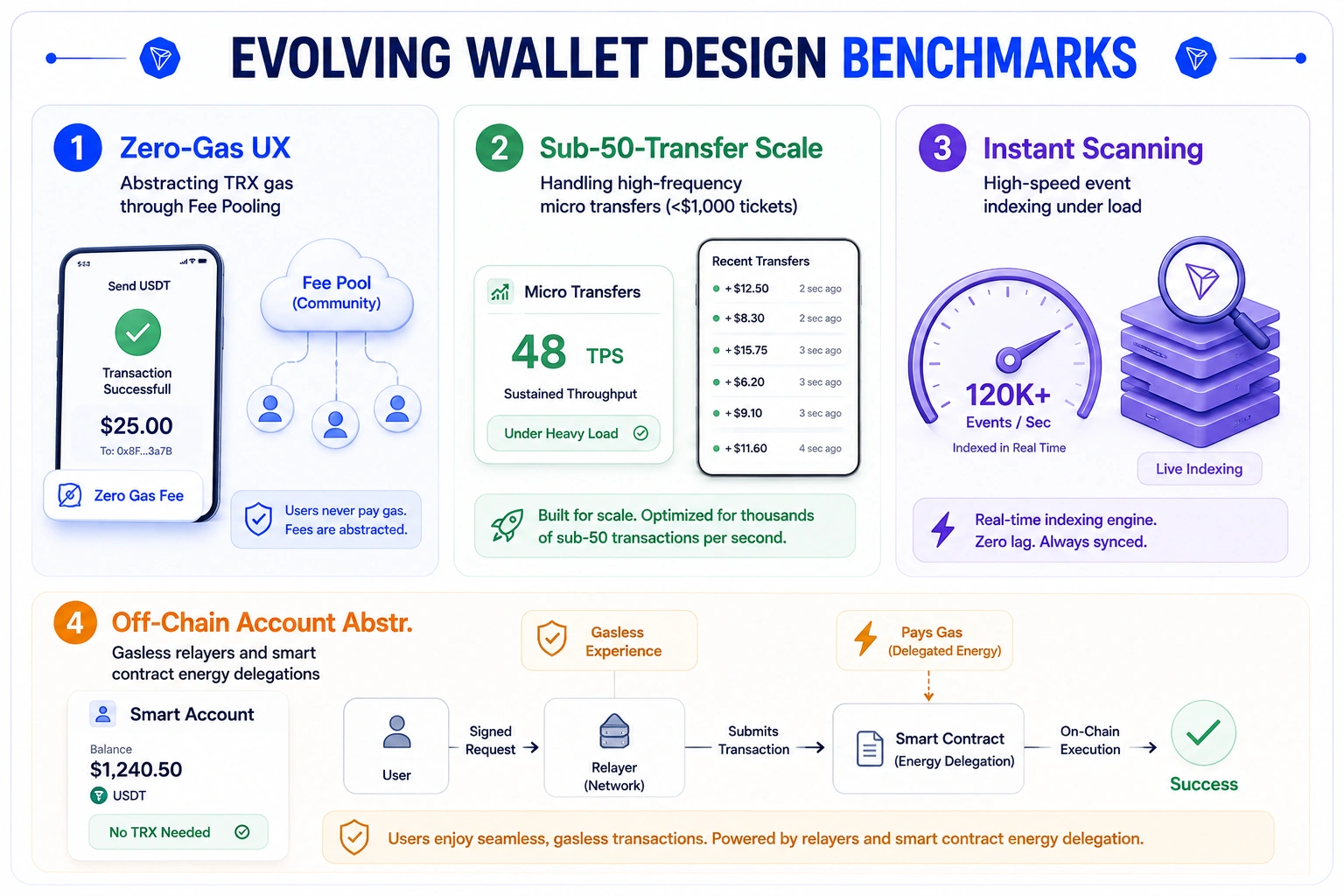
The overwhelming concentration of real-world retail and B2B activity on TRON has fundamentally altered the technical and operational benchmarks for wallet applications:
- Eliminating Native Gas Dependency: Traditional wallets require users to hold TRX for network fees. TRON’s Energy model enables Gas-Free Fee Delegation Relayers, allowing users to send USDT while paying fees from their USDT balance or having the platform sponsor required Energy.
- Micro-Transaction Throughput: More than 52% of native sub-$1,000 USDT transfers occur on TRON, making wallets well-suited for small-ticket payments, merchant checkout, and gig-economy payouts rather than infrequent, high-value DeFi transactions.
- High-Concurrency State Tracking: With roughly 3.5 million daily active addresses, TRC20 wallets require high-performance RPC nodes and dedicated indexers to prevent UI lag, missed block synchronization, and inaccurate balances during traffic peaks.
B. Why Businesses Prefer TRC20 for Stablecoin Transfers
Enterprises, payment service providers (PSPs), and cross-border merchants overwhelmingly favor TRC20 over alternative blockchain standards when building commercial settlement flows:
| Operational Metric | USDT on TRON (TRC20) | USDT on Ethereum (ERC20) | Legacy Banking (SWIFT/Wire) |
| Typical Transfer Cost | $0.01 – $1.50 (with Energy rental) | $3.00 – $25.00+ (Gas volatile) | $25.00 – $50.00+ flat fee |
| Settlement Finality | ~3 seconds (DPoS consensus) | 12 – 15 minutes (Multi-block) | 2 to 5 business days |
| P2P Liquidity Scale | Deepest global CEX/OTC liquidity | High institutional DeFi volume | Strict banking hours & FX spread |
| Developer Tooling | TronWeb, TronGrid, HTTP/gRPC APIs | Web3.js, Ethers.js, Alchemy | Disconnected ISO 20022 portals |
These operational advantages TRC20 crypto wallets particularly attractive for high-volume, cross-border payment flows, where transaction costs, settlement speed, liquidity, and integration simplicity directly influence margins and customer experience.
- Predictable Unit Economics: Ethereum gas volatility can create unpredictable margins for high-volume payouts. TRC20 enables more deterministic transaction costs through TRX staking or bulk Energy purchases.
- Global Off-Ramp Interoperability: Most major centralized exchanges (CEXs) and P2P desks in emerging markets support USDT-TRC20, enabling faster conversion to local fiat without costly cross-chain bridging.
- Frictionless B2B Supply Chain Invoicing: Multinational vendors can use TRC20 wallets for cross-border settlements while reducing reliance on FX conversions, weekend banking restrictions, and correspondent banking fees.
C. What High-Volume USDT Usage Means for Wallet Architecture
Supporting millions of USDT-TRC20 transactions at scale requires a decoupled, enterprise-grade backend infrastructure rather than a generic lightweight wallet client:
- Automated Energy Station Integration: High-volume wallets use Energy Rental Pools instead of costly raw TRX consumption, programmatically leasing required resources for outbound transfers. Systems can allocate roughly 32,000–65,000 Energy per transfer to minimize contract execution costs.
- Hierarchical Deterministic (HD) Address Sweeping: Enterprise wallets generate unique TRC20 deposit addresses per user or invoice. Event-listening bots provision Bandwidth/Energy and atomically sweep deposits into cold storage or treasury pools, preventing residual balances.
- Dedicated RPC Node Infrastructure: Public TronGrid endpoints may face rate limits and downtime during network spikes. Scalable wallets use distributed TRON Full Nodes with Redis caching for reliable, sub-second block queries.
The Enterprise Takeaway: USDT on TRON drives global stablecoin liquidity and peer-to-peer velocity. Building a modern wallet requires treating TRC20 as a high-throughput payment rail powered by automated energy delegation, dedicated node infrastructure, and automated treasury sweeping.
Which TRC20 Wallet Features Matter Most in 2026?
A successful TRC20 crypto wallets needs more than token storage. Its core features should support secure USDT transfers, TRON-native resources, Web3 connectivity, staking, multi-chain access, hardware security and reliable private-key management for everyday and institutional users.
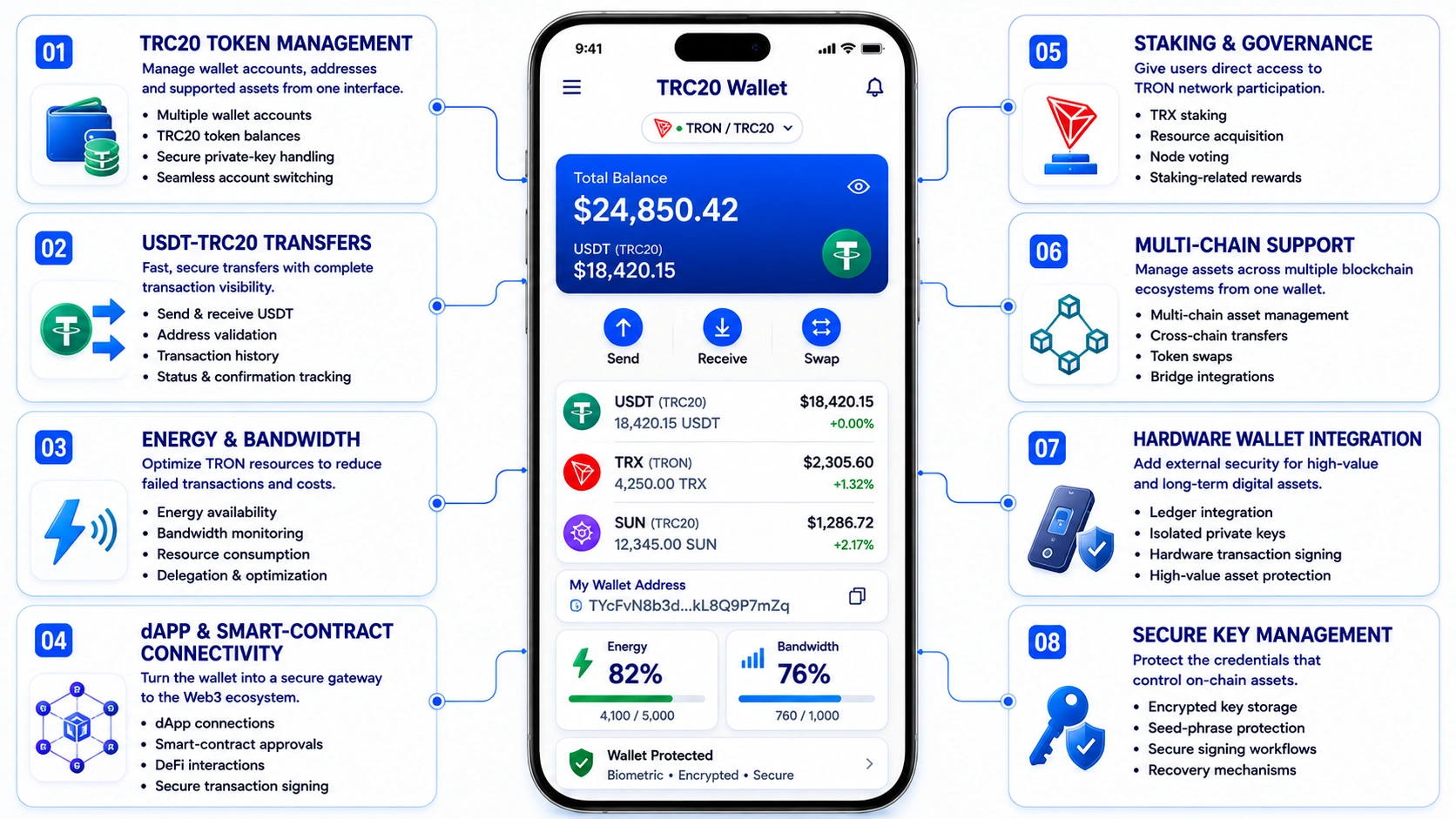
1. TRC20 Token Management and Wallet Accounts
TRC20 token management lets users create and manage wallet accounts, addresses and supported assets from one interface. The platform should support TRC20 tokens, multiple accounts, secure private-key handling, token balances and seamless account switching for efficient asset management.
2. USDT-TRC20 Transfers and Transaction Tracking
USDT-TRC20 transfers are a core wallet use case, requiring fast send and receive flows, address validation and transaction monitoring. The platform should provide transaction history, status tracking, confirmations, wallet addresses and reliable transfer visibility for every USDT movement.
3. Energy and Bandwidth Management
Energy and Bandwidth determine how users pay for and execute transactions across the network. A wallet should display resource availability, consumption and requirements while helping users obtain, delegate or optimize resources to reduce failed transactions and unnecessary costs.
4. dApp and Smart-Contract Connectivity
dApp and smart-contract connectivity turns the wallet into a Web3 access layer rather than a simple asset manager. Users should be able to connect with decentralized applications, approve smart-contract transactions, interact with DeFi protocols and sign transactions securely.
5. Staking and Governance Support
Staking and governance features allow users to participate in network operations while earning staking-related benefits. A wallet can support TRX staking, resource acquisition and node voting, giving users direct access to network participation without leaving the platform.
6. Multi-Chain Asset and Cross-Chain Support
Multi-chain support allows users to manage assets across different blockchain networks from one wallet. Cross-chain transfers, token swaps, bridge integrations and unified USDT management can expand the platform beyond TRON while creating a more flexible Web3 asset experience.
7. Ledger and Hardware Wallet Integration
Hardware wallet integration adds an external security layer for users managing valuable digital assets. Supporting devices such as Ledger allows private keys to remain isolated while transactions are securely signed, making the wallet more suitable for high-value and long-term asset management.
8. Secure Transaction Signing and Key Management
Secure transaction signing and key management protect the credentials that control on-chain assets. The wallet should use encrypted key storage, seed-phrase protection, secure signing workflows and recovery mechanisms while giving users clear control over every transaction before authorization.
How AI Is Changing TRC20 Wallet Development
AI can make TRC20 crypto wallets more proactive by analyzing transaction behavior, wallet activity and network resources. Instead of adding generic AI assistants, developers can use AI to improve risk detection, transaction decisions, resource optimization and financial intelligence.
| AI Capability | What It Does in a TRC20 Wallet | Why It Matters |
| AI Transaction Risk Scoring | Analyzes transaction patterns, recipient behavior, wallet history, and context to score transfer risk before approval. | Helps users identify potentially risky transactions before funds leave the wallet. |
| Suspicious Address & Fraud Detection | Uses behavioral signals and address intelligence to detect suspicious wallets, unusual transfers, phishing attempts, and fraud indicators. | Adds proactive protection beyond basic transaction confirmation and address validation. |
| Smart Contract Risk Analysis | Evaluates contract interactions and transaction parameters to flag dangerous approvals, unusal behavior, and unexpected asset movements. | Provides added protection when connecting to DeFi protocols and dApps. |
| AI-Powered Energy & Bandwidth Optimization | Analyzes transaction requirements and resource usage to recommend Energy/Bandwidth strategies and estimate required resources. | Simplifies TRON’s resource model while reducing unnecessary costs and failed transactions. |
| Intelligent Portfolio & USDT Flow Insights | Analyzes balances, transaction history, USDT inflows/outflows, and asset activity to identify spending patterns and unusual movements. | Converts raw blockchain activity into actionable financial insights for users and businesses. |
| Predictive Transaction Monitoring | Learns normal wallet behavior and flags deviations in transaction frequency, destinations, or transfer amounts. | Enables earlier detection of account compromise, operational errors, and suspicious activity. |
Note: These AI capabilities help TRC20 wallets become safer, smarter and more efficient but AI should complement, not replace, deterministic wallet controls. Production TRC20 wallets should combine AI-driven insights with transaction simulation, user confirmation, access controls, monitoring, and secure key management to maintain reliable protection and user trust.
How Much Does TRC20 Wallet Development Cost?
TRC20 crypto wallets development costs vary based on wallet architecture, platform scope, security requirements, blockchain integrations, compliance needs and advanced functionality. A phased cost view helps businesses estimate budgets before selecting features and development priorities.
A. Development Phase-Wise Cost Table
Each TRC20 crypto wallets development phase contributes differently to the overall budget. The following breakdown shows typical cost ranges across planning, design, development, testing and deployment for a TRC20 wallet.
| Development Phase | Estimated Range (MVP → Enterprise) | What the Phase Covers |
| Business Analysis & Technical Planning | $5,000 – $15,000 | Defines wallet requirements, roles, architecture, blockchain strategy, security, integrations, compliance, and workflows. |
| UI/UX Design | $7,000 – $20,000 | Designs onboarding, dashboards, transaction flows, token tools, security UI, notifications, and UX. |
| Frontend Development | $17,000 – $45,000 | Builds wallet interfaces, portfolio screens, transactions, auth flows, token displays, and app components. |
| Backend & API Development | $20,000 – $50,000 | Develops wallet services, APIs, transaction processing, databases, auth, notifications, and backend logic. |
| TRON & TRC20 Integration | $15,000 – $40,000 | Integrates TRON nodes, TRC20 contracts, USDT transfers, signing, balances, Energy/Bandwidth, and monitoring. |
| Security & Key Management | $20,000 – $60,000 | Implements key protection, encryption, recovery, transaction authorization, access controls, and threat monitoring. |
| Advanced Features & Integrations | $25,000 – $100,000 | Adds dApp connectivity, swaps, staking, multi-chain/hardware wallet support, third-party APIs, and AI features. |
| Testing & Quality Assurance | $10,000 – $30,000 | Tests transactions, blockchain interactions, security, APIs, performance, failure modes, and wallet workflows. |
| Deployment & Infrastructure Setup | $8,000 – $25,000 | Configures cloud infra, nodes, CI/CD, monitoring, backups, logging, production environments, and scaling. |
| Compliance, Audit & Launch Readiness | $15,000 – $55,000 | Handles KYC/AML workflows, compliance, security audits, penetration testing, docs, and launch prep. |
| Estimated Total | $50,000 – $600,000+ | Total investment depends on complexity, security architecture, integrations, compliance, AI, and scope. |
Note: These are indicative planning ranges rather than fixed quotes. Actual costs can vary based on development location, custody architecture, security requirements, integrations, compliance scope, supported platforms and post-launch infrastructure needs.
B. Development Cost Table By Platform Complexity
Wallet complexity directly affects development effort and infrastructure requirements. The following estimates show how costs can change based on the functionality, integrations, security model and scalability expected from the platform.
| Wallet Complexity | Estimated Development Cost | Typical Scope |
| Basic TRC20 Wallet | $50,000 – $70,000 | TRC20/USDT support, send and receive, wallet creation, transaction history, basic authentication, secure key management and backup/recovery |
| Standard TRC20 Wallet | $70,000 – $120,000 | Core wallet features, dApp connectivity, Energy/Bandwidth management, enhanced security, transaction monitoring and address management |
| Advanced TRC20 Wallet | $120,000 – $200,000 | Multi-chain support, token swaps, staking, DeFi/dApp integrations, hardware-wallet connectivity, AI security and advanced portfolio analytics |
| Enterprise TRC20 Platform | $200,000 – $500,000+ | Institutional custody, MPC/multisig, KYC/AML, compliance tooling, APIs, advanced security, multi-chain infrastructure and administration systems |
Note: Platform-level costs represent broader product packages rather than simple feature additions. Enterprise wallets typically require significantly greater investment because institutional custody, compliance, security, scalability, and multi-chain infrastructure increase development complexity.
How Businesses Can Use TRC20 Wallet Infrastructure
TRC20 crypto wallets infrastructure provides enterprise software and financial rails that allow modern businesses to store, accept, and transfer digital dollar stablecoins (USDT-TRC20) with sub-three-second settlement times, microscopic network fees, and full programmatic smart contract automation.
| Business Use Case | How Wallet Infrastructure Is Used | Key Capabilities | Real-World Example |
| Cross-Border Stablecoin Payments | Enables fast, global enterprise USDT-TRC20 transfers outside legacy banking. | ~3-second settlement, 1–2 fees, 24/7 transfers, USD-pegged payments | Bitfinex & Tether ecosystem operators use TRC20 infrastructure for global USDT liquidity transfers. |
| Merchant Payment & Crypto Checkout | Integrates USDT-TRC20 payments into e-commerce checkout systems. | Immutable payments, dynamic QR codes, low transfer costs | Travala.com accepts USDT-TRC20 for hotel and flight bookings with instant confirmations. |
| Business Treasury & Stablecoin Management | Helps businesses hold, transfer, and manage corporate USDT reserves. | Multisig governance, treasury sweeps, yield integrations, audit trails | Binance Corporate Treasury uses multi-signature wallet architectures for USDT management. |
| Payroll & International Settlements | Powers international payroll, bonuses, and contractor payments. | Batch payouts, off-ramping, exact transfers, receipts | Deel supports stablecoin-based payroll withdrawals, including USDT-TRC20. |
| Crypto Payment Gateways & APIs | Automates invoicing, address generation, deposits, and settlements via APIs. | HD addresses, automated sweeping, blockchain webhooks | NOWPayments and CoinGate provide gateway APIs supporting USDT-TRC20 payments. |
| Institutional Digital Asset Custody | Offers secure custody and control for institutional USDT-TRC20 assets. | MPC, multisig, policy controls, KYT, allowlisting | BitGo provides institutional custody infrastructure supporting TRC20 assets. |
Top 7 TRC20 Crypto Wallets in 2026
As TRC20 adoption continues expanding, users have more options for managing USDT, TRX, dApps, and cross-chain assets. This list compares leading wallets based on security, TRON support, usability, custody, and key features.
1. Trust Wallet
Trust Wallet is a mobile-centric, multi-currency crypto wallet that prioritizes access to decentralized applications. This makes it a valuable tool for users who want to explore DeFi platforms and interact with blockchain-based services directly from their phones.
- User-friendly interface: Easy to navigate for beginners, making it a good starting point.
- Built-in exchange: Conveniently swap between cryptocurrencies directly within the wallet.
- DeFi platform integrations: Connect to various DeFi platforms to access services like lending, borrowing, and yield farming.
2. Binance Chain Wallet
This is the official wallet designed for use with the Binance Chain. It provides secure storage for Binance Coin and other BEP-2 tokens. It integrates seamlessly with the Binance ecosystem for easy crypto management.
- Secure storage: Leverage Binance’s security infrastructure for the safekeeping of your TRC20 tokens.
- Convenient management: It is easy to manage your TRC20 tokens directly from the Binance ecosystem.
- Binance ecosystem integration: Seamless interaction with Binance exchange features like trading and staking.
3. TronLink
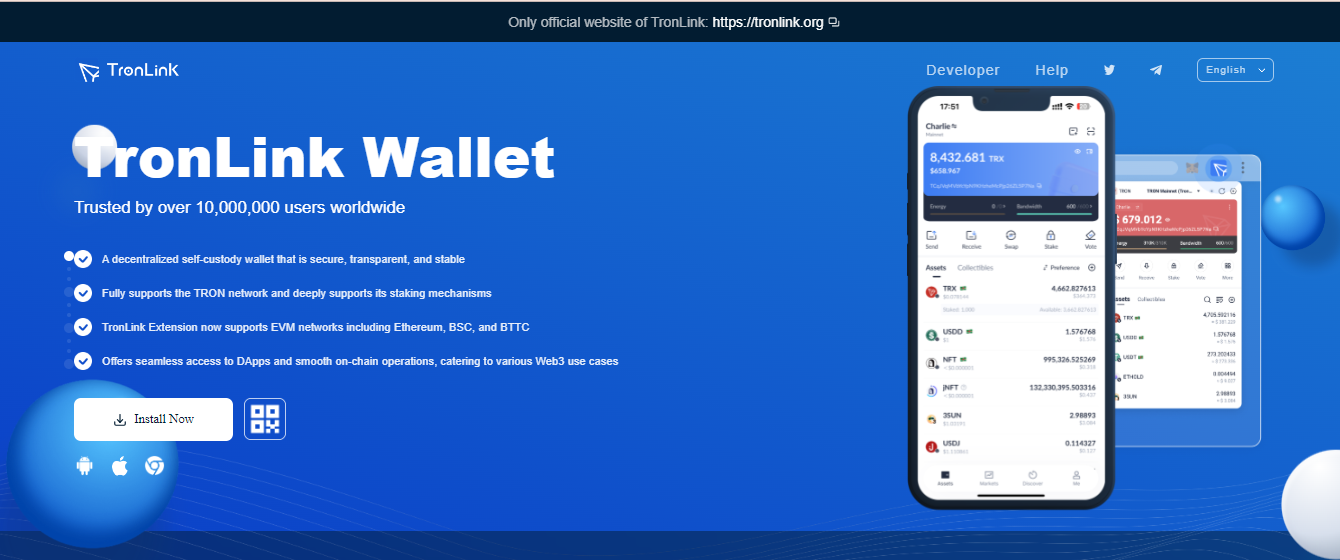
TronLink is a dedicated wallet for the Tron blockchain, allowing users to store, send, and trade Tron tokens and other tokens built on the Tron network. It’s ideal for users who are deeply involved in the Tron ecosystem.
- TRON network interaction: Designed specifically for the Tron blockchain, allowing smooth interaction with Tron-based applications.
- DeFi app access: Directly connect to decentralized finance applications built on the Tron network.
- NFT marketplace access: Explore and participate in NFT marketplaces running on the Tron blockchain.
4. MathWallet
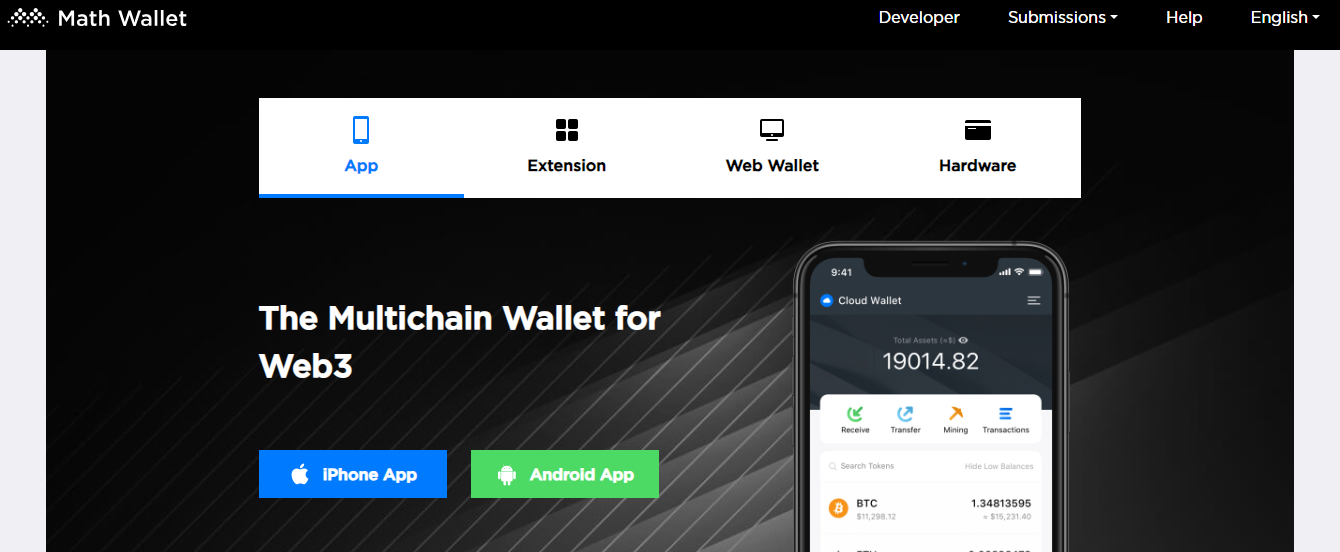
MathWallet is a multi-chain crypto wallet that allows users to manage assets across various blockchains. This makes it a strong choice for users who invest in tokens built on different blockchain protocols.
- Multi-chain support: Store and manage not just TRC20 tokens but also cryptocurrencies from other blockchains within a single wallet.
- Built-in exchange: Swap between different cryptocurrencies directly through the MathWallet interface.
- NFT and DeFi access: Access features like NFT storage and DeFi applications without needing separate wallets.
5. Atomic Wallet:
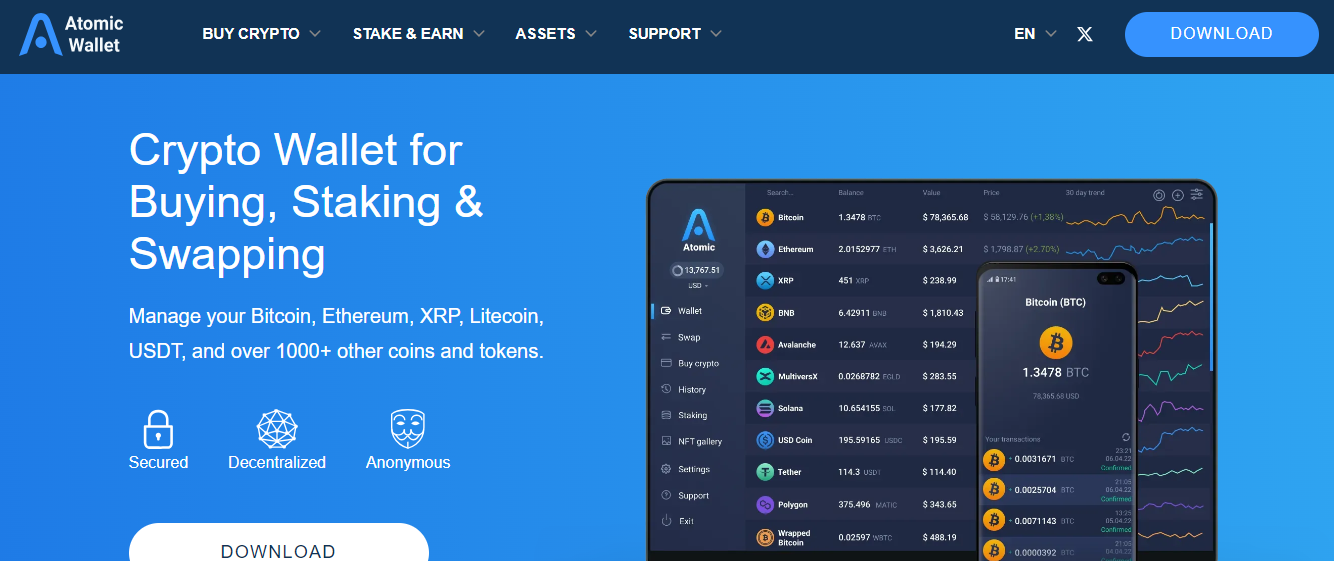
Atomic Wallet is a non-custodial, all-in-one crypto wallet that caters to experienced users. It offers built-in atomic swaps for decentralized exchange, staking capabilities, and a focus on user privacy and control over your crypto assets.
- Secure desktop storage: Provides a robust security layer for your TRC20 tokens on your desktop computer.
- Built-in exchange: Trade cryptocurrencies directly within the wallet for added convenience.
- Atomic swaps: Enables peer-to-peer trading of cryptocurrencies without relying on a centralized exchange.
- Staking capabilities: Earn rewards by staking your TRC20 tokens to support blockchain operations.
6. Exodus Wallet
Exodus Wallet prioritizes a user-friendly experience, making it easy for beginners to navigate the world of cryptocurrency. With its intuitive interface and built-in exchange features, Exodus streamlines crypto management for those new to the space.
- User-friendly interface (desktop & mobile): Easy to use on both desktops and smartphones, catering to a broad user base.
- Built-in exchange: Conveniently exchange cryptocurrencies without leaving the Exodus Wallet app.
- Staking capabilities: Earn passive income by staking your TRC20 tokens to validate transactions on the blockchain.
7. Coinomi Wallet:
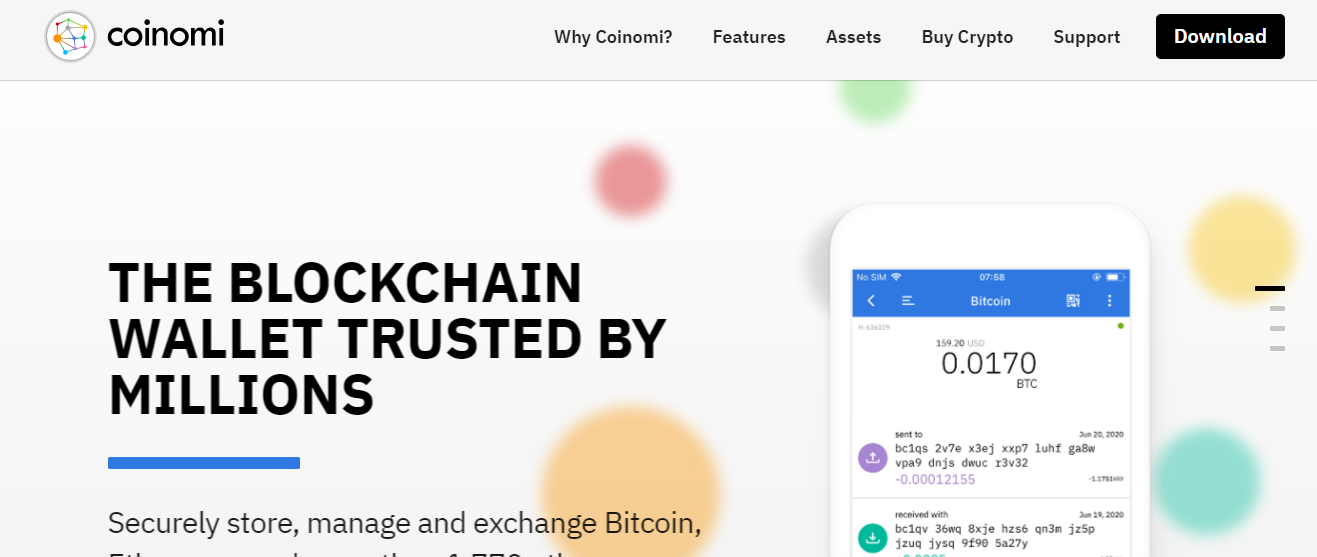
Coinomi is a popular, multi-asset cryptocurrency wallet known for its strong security features. It offers secure storage for a wide variety of digital currencies, making it a great option for users who value both security and versatility.
- Multi-chain support: Similar to MathWallet, it allows you to manage various cryptocurrencies, including TRC20 tokens, within a single wallet.
- Built-in exchange: Trade your cryptocurrencies directly through the Coinomi Wallet interface.
- Staking capabilities: Participate in staking to earn rewards on your TRC20 token holdings.
Our Latest Projects at Idea Usher
At Idea Usher, we don’t just develop apps; we bring visionary ideas to life. Take a look at how we tackled the unique challenges of some of our recent projects:
1. EQL Trading
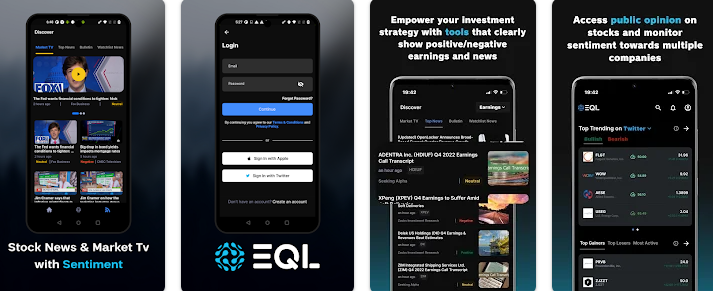
EQL was designed as a blockchain-based, commission-free stock trading platform combining real-time market data with social sentiment and trending-stock insights. Idea Usher focused on turning complex market signals into practical tools for faster, informed investment research.
- Real-Time Social Sentiment Analysis: Integrated Twitter and Reddit sentiment analysis with Python, NLP and machine learning models to process social data and surface stock popularity, sentiment and momentum insights.
- Investment Scanner: Developed a market scanner using Python, APIs and data-processing frameworks to identify investment opportunities based on market capitalization, P/E ratio, dividend yield and risk preferences.
- IPO Calendar & Alerts: Added an IPO calendar with real-time financial APIs and notification infrastructure to track upcoming offerings and alert users about relevant investment opportunities.
- Blockchain-Based Trading: Built EQL around blockchain infrastructure, Web3 APIs and digital asset technology to support commission-free trading and blockchain-based financial transactions.
- Market Intelligence Interface: Combined real-time market APIs, social sentiment data and Web3 integrations to create a unified interface for stock research, market intelligence and blockchain-enabled trading.
- Secure Trading Experience: Integrated blockchain transaction architecture, cryptographic security and API-based financial data services to provide a reliable environment for managing investment activities.
2. SALVACoin

SALVACoin was envisioned as a utility-focused cryptocurrency ecosystem designed to make blockchain participation more accessible through affordable transactions, token utility and user rewards. Idea Usher translated this vision into a Polygon-based platform with a streamlined ICO and intuitive user experience.
- Polygon-Based Token Infrastructure: Developed SALVACoin on Polygon after evaluating transaction costs, speed, scalability, and ecosystem adoption for a cost-efficient blockchain foundation.
- ICO Research & Strategy: Conducted extensive ICO research and structured the launch around pre-sale, public sale, token economics, pricing, distribution, and post-sale activities.
- SALVA Store Integration: Enabled users to purchase and spend SALVACoin within the SALVA Store, giving the token practical utility beyond holding and trading.
- Token-Based Rewards System: Designed a custom token rewards mechanism that incentivizes users to hold SALVACoin and earn additional tokens, encouraging long-term ecosystem participation.
- MetaMask Wallet Integration: Created a simplified MetaMask onboarding flow for connecting wallets, purchasing SALVACoin, and confirming blockchain transactions without complex crypto interactions.
- Low-Cost Transaction Experience: Leveraged Polygon’s lower gas fees and fast processing to make SALVACoin purchases and ecosystem transactions more affordable.
Build Your TRC20 Crypto Wallet With IdeaUsher
IdeaUsher is a leading Web3 product engineering firm with 11+ years of expertise across 50+ countries. Supported by 250+ specialists, 1,000+ delivered projects, and a 4.9/5 Clutch rating, we build custom, high-performance TRC20 crypto wallets from scratch.
Instead of templates, we craft custom, scalable custodial and non-custodial Web3 wallets with high-throughput TRON node sync, automated Bandwidth and Energy optimization, multi-sig vaults, and fiat on/off-ramps to position your platform for market leadership.
Why Enterprises Partner With Us
Fintech institutions, crypto exchanges, and Web3 enterprises partner with us because we transform complex TRON blockchain protocols and cryptographic key management into secure, ultra-low-fee, and frictionless digital asset wallets.
- High-Throughput TRC20 & TRC10 Asset Management: We engineer wallet logic for USDT-TRC20, TRX, and TRON tokens, enabling instant validation, dynamic fee estimation, and automated balance synchronization.
- Bandwidth & Energy Resource Optimization: Our blockchain engineers build TRON resource delegation algorithms that dynamically freeze TRX to lease Energy and Bandwidth, reducing user transaction fees toward zero.
- Institutional-Grade Key Management & MPC Security: We deploy MPC, HD wallet structures, and multisignature security to eliminate single points of failure while maintaining controlled user access.
- Integrated Bi-Directional Fiat On/Off-Ramp Gateways: We build payment API bridges with MoonPay, Transak, and Simplex for seamless TRC20 conversions through cards, Apple Pay, and bank transfers.
- Hardware-Agnostic & Cross-Platform Web3 SDKs: We build optimized iOS, Android, browser extension, and dApp-connect integrations using WalletConnect and TronLink APIs for cross-platform Web3 access.
- Zero Vendor Lock-In Asset Delivery: We deliver clean, documented, open-source code, giving your organization complete ownership of the platform and private-key infrastructure.
Ready to launch an institutional-grade, high-performance TRC20 crypto wallet platform? Partner with Idea Usher’s principal blockchain and Web3 software architects to map out your custom product build today.
Conclusion
TRC20 wallets are moving beyond basic token storage toward stablecoin-focused financial infrastructure. USDT payments, cross-chain connectivity, AI-powered security, Energy and Bandwidth management, DeFi access and institutional custody are shaping what users now expect from these platforms. The right feature mix ultimately depends on your target users, custody model, compliance requirements and business objectives. For businesses entering this space, a clear product strategy and scalable blockchain architecture can turn a TRC20 wallet into a reliable Web3 financial platform built for long-term adoption.
FAQs
A.1. TRC20 wallet development typically includes token management, USDT transfers, Energy and Bandwidth handling, dApp connectivity, staking, multi-chain support, secure transaction signing and hardware wallet integration.
A.2. TRC20 wallet development costs range from $50,000–$70,000 for basic wallets to $200,000–$500,000+ for enterprise platforms, with standard solutions costing $70,000–$120,000 and advanced wallets $120,000–$200,000, depending on features, security, integrations, and complexity.
A.3. Core features include TRC20 token management, USDT transfers, transaction tracking, resource management, dApp connectivity, staking, cross-chain support, hardware wallet integration and secure key management.
A.4. A TRC20 wallet can generate revenue through transaction fees, token swap fees, premium services, staking commissions, merchant payment services, institutional accounts, custody services and API-based offerings.