

Key Takeaways
- Buying is cheaper. A white-label prediction market platform costs around $25,000 to $50,000 for a basic setup, against $150,000 to $500,000+ to build from scratch.
- It also gets you to market much faster, usually in 4 to 8 weeks, while a custom build can take 6 to 18 months.
- Building only pays off over the long run, when you need full control, deep customization, or proprietary technology.
- For most startups and businesses testing the market, buying is the smarter and lower-risk choice.
- See how Idea Usher can help businesses develop a prediction market platform that fits their budget, timeline, and growth goals.
Buying a white-label platform gets you to launch for less money and in far less time. Basic setups run about $25,000 to $50,000 and go live within 4 to 8 weeks. A custom build starts at $150,000 and can pass $500,000 while the wait before the first trade stretches from 6 to 18 months. On those numbers alone, the decision looks easy. Price leaves out a lot, though. Cheaper platforms often limit how much you can customize. A custom build gives you full control, but it ties up your money and your engineers for a long time before anything ships.
The better option depends on your budget and your team, and on how soon you need to launch. In this blog, we’ll break down what each path really costs, where each one pays off, and how to decide which fits your business.
Is the Prediction Market Business Model Sustainable?
Yes, a prediction market business can last, but only if the platform earns steady money from trading and keeps its markets busy after the first wave of users is gone. Interest in forecasting tools is clearly growing. According to Markets And Markets, the global Predictive Analytics Market was valued at $10.5 billion in 2021 and is projected to reach $28.1 billion by the end of the forecast period, growing at a CAGR of 21.7%. Factors like the increasing use of AI and ML, along with acquisitions and product launches, are expected to drive adoption of predictive analytics software and services. That demand is a good sign, but a platform still needs smart fees, deep liquidity, and a safe legal path to stay alive.
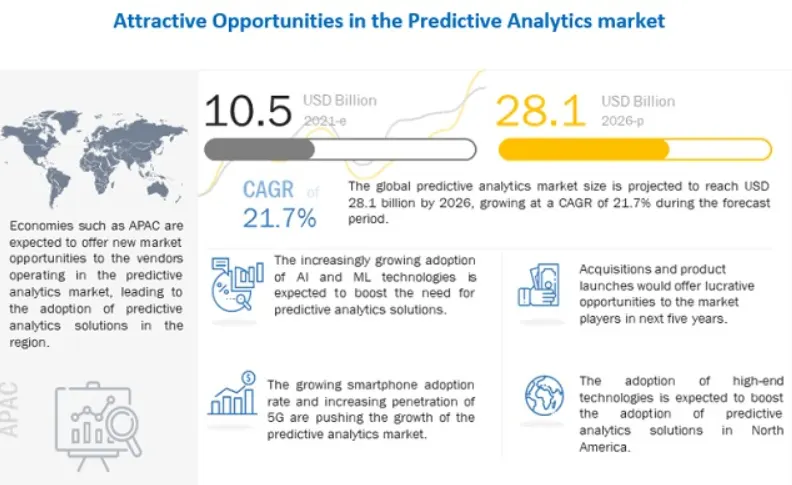
Source: Markets And Markets
Revenue Streams and Platform Margins
Most prediction markets do not make money in one way only. They mix a few small sources together and hope the volume makes up for the small size of each one. The tricky part is that the market has no standard fee style yet, so every platform picks its own way and margins can look very different from one to the next. Polymarket re-entered the US market with fees designed to undercut Kalshi. That kind of price fight can squeeze everyone’s margins, even the platform that started it.
- Trading fees: Kalshi and Polymarket both use probability-based formulas, so fees are highest when a share trades near 50 cents.
- Profit share: Polymarket’s global platform charges no trading fees but takes 2% of net profits.
- Interest on idle cash: Kalshi pays interest tracking Treasury rates on uninvested cash balances.
- Maker and taker fees: Taker fees on Polymarket are paid back daily to liquidity providers through its Maker Rebates Program.
One research note warned that if Polymarket keeps fees near zero, it could push the whole sector toward exchange-style economics and compress take rates, making scale and order flow matter more than headline fees. So the business is only healthy when volume stays high.
Liquidity Costs and User Acquisition
Liquidity is the part nobody sees, but everybody pays for. If a market is thin, traders get wide gaps between the buy and sell price, and they leave. A “0% fee” market with a 5-cent spread can cost more than a “2% fee” market with penny-wide quotes. So platforms spend real money on rewards and on market makers just to keep prices tight. Here is how the two biggest names do it:
Polymarket also bought a regulated exchange. It paid $112M for QCEX to get regulated US access. That shows how much a platform may need to spend just to reach more users.
Robinhood took a different road and chose to own the plumbing. In its first step, it brought in market maker Susquehanna International Group as a day-one liquidity provider. Then the joint venture bought a 90% stake in the derivatives exchange MIAXdx. MIAXdx was renamed Rothera Exchange and Clearing LLC in January. The payoff was fast because Rothera processed 3.5 billion contracts in Q2. Robinhood already had the customers, so it only needed the exchange and the liquidity to keep them trading.
Getting users also depends on what they want to trade. Sports make up 75% of Kalshi’s daily volume and 45% of Polymarket’s. That means a platform with no popular events has a hard time keeping people around.
Long-Term Profitability and Market Risks
Long-term profit depends a lot on whether the platform is allowed to keep running. Even a good fee model and strong liquidity can be hurt by one court decision. This is the biggest open question for the whole industry right now, and it is why many founders look at the legal side first.
Legal Fights With States
States say sports contracts are just betting. The federal regulator says they belong to it. The CFTC has sued eight states since April 2, starting with Illinois, Arizona and Connecticut, and New Mexico was the eighth. Things got messier when Minnesota became the first state to ban prediction markets outright in May. After that, a federal judge in Michigan ruled that sports prediction markets are not regulated by the CFTC. A platform that depends on one big category can lose it fast.
Novig’s Legal Fight
Novig shows how young platforms feel this pressure. It went live nationwide on Aug. 4. Ten days later, it sued Wisconsin, its fifth state-level legal challenge, and called state enforcement an “existential business threat.” Spending on lawyers this early eats into any profit a new platform hopes to make.
Tighter Rules Ahead
New rules may bring more clarity but also more limits. On June 10 the CFTC proposed rules that would allow most sports event contracts but ban contracts on war and ones easy to manipulate, such as player injuries or referee decisions. Later, the agency told platforms to stop showing prices as traditional betting odds. So the business can last, but only for platforms that plan for rules to keep changing.

Custom Build vs. White-Label Pricing for Prediction Market Platforms
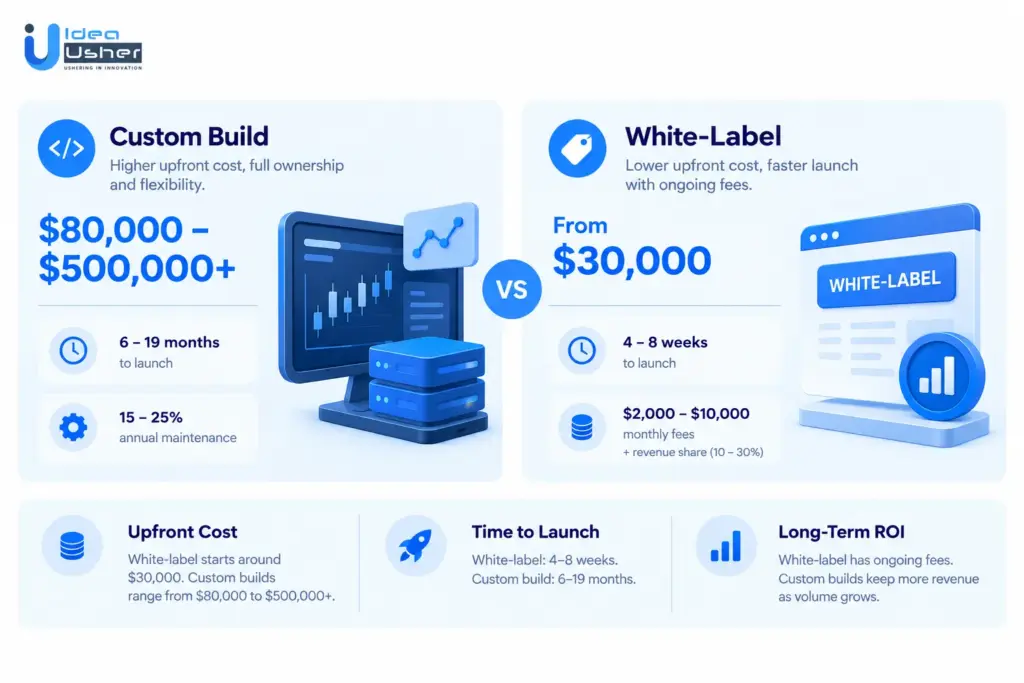
White-label is usually cheaper at the start. We estimate it can begin around $30,000 and then add $2,000 to $10,000 a month. A custom build costs more. We estimate it at $80,000 to $500,000+ over 6 to 19 months. These are our estimates so real quotes will differ. The gap gets smaller each year because white-label fees never stop, and a custom platform has its own upkeep.
White-Label Prediction Market Costs
White-label means you rent a finished platform and set it up with your brand. We estimate the monthly plan at $2,000 to $10,000, and the first year at $40,000 to $150,000 once setup is added. The matching engine, oracle, and back-office tools come included, so you do not build them. Liquidity support is often included too, which helps a new platform feel alive on day one.
| Model | Our cost estimate |
| SaaS plan | $2,000 to $10,000 per month |
| Self-hosted license | $15,000 to $40,000 upfront plus $300 to $800 per month |
| Setup and configuration | $15,000 to $60,000 one time |
| Year-one total | $40,000 to $150,000 |
| Time to first trade | 4 to 8 weeks |
FanDuel Rents an Exchange
FanDuel Predicts launched with CME Group in Alabama, Alaska, South Carolina, North Dakota, and South Dakota and then rolled out to more states. Users can trade event contracts on the S&P 500 and Nasdaq-100 and on oil and gas prices. Sports contracts appear only in states where online sports betting is not legal and FanDuel stops offering them once a state legalizes betting. CME helps structure and run the contracts so FanDuel can focus on its own users and app.
Custom Prediction Market Development Costs
A custom build means you pay for every part yourself. We estimate the core build at $150,000 to $360,000 or more, and it takes 6 to 18 months before the first trade. You need a team of 5 to 14 engineers. Enterprise builds with full CFTC compliance and institutional data feeds run $500,000 or more. Liquidity does not come with the code, so a new platform starts with no users and no order flow. That is why the first year often lands between $300,000 and $600,000 or more.
| Part | Our cost estimate |
| Matching engine or AMM | $40,000 to $80,000 |
| Oracle and data layer | $15,000 to $40,000 |
| Settlement and disputes | $20,000 to $40,000 |
| Custody and wallets | $15,000 to $30,000 |
| Fee and revenue tools | $10,000 to $20,000 |
| Live data and interfaces | $20,000 to $40,000 |
| Security audits | $10,000 to $30,000 |
| Compliance review | $20,000 to $80,000 |
| Core total | $150,000 to $360,000+ |
Feature Ownership and Customization Costs
Ownership is the real price difference. In white-label you set event categories and contract rules and position limits and fees and branding. You do not change the engine underneath. Some providers also cap how many markets can run at once or block API access and a few hand over the source code only on a custom deal. Big custom extras like AI tools and institutional data feeds push a build toward the $500,000 mark.
- White-label gives you: your brand and your contract rules and fee settings and fast changes.
- Custom gives you: full control of the engine and your own market types and anything you can pay to build.
Interactive Brokers Owns Its Exchange
Interactive Brokers runs ForecastEx through a wholly owned subsidiary that holds CFTC designations to operate a contract market and a clearinghouse. Its founder Thomas Peterffy said the company had worked on and tested the idea for nearly 10 years. Interactive Brokers then built a single interface that lets clients trade contracts from Kalshi and CME Group and ForecastEx in one place. It charges no commission on ForecastEx trades and 10 cents on CME event contracts. Owning the exchange let it list its own contracts and still sell others.
Long-Term Maintenance and Operating Costs
A platform keeps costing money after launch. We estimate custom upkeep at 15 to 25 percent of the build cost every year, so a $200,000 build needs $30,000 to $50,000 a year before any new features. White-label upkeep is the plan fee you already pay, and the provider handles security updates. The gap shrinks over time because the plan fee never stops. Each re-audit after a fix on a custom build adds $5,000 to $15,000.
| White-label | Custom | |
| Year-one total | $40,000 to $150,000 | $300,000 to $600,000+ |
| Yearly upkeep | $24,000 to $120,000 in plan fees | 15 to 25 percent of build cost |
| Re-audit after a fix | Covered by provider | $5,000 to $15,000 each |
Where White-Label Prediction Market Platforms Fall Short?
White-label prediction platforms fall short on control. The vendor owns the code and sets the limits, so you wait on them for new features. The fees also keep coming after launch. And if you ever want to leave, moving costs a lot of time and money. These restrictions can also make it harder to adapt your platform as market demand, trading requirements, or business goals change.
1. Customization Limits and Vendor Dependencies
A white-label platform is a shared product with your logo on it. It constrains how much you can change the matching engine, the way markets resolve, and the trader experience. The limits show up as you grow. These systems often cap how many markets run at once, restrict custom market types, and block API access for outside tools. One vendor puts it plainly for teams with a new idea. If your edge is a new market structure or your own way of resolving markets, then a shared platform cannot get you there.
PrizePicks shows what depending on one provider looks like. Its prediction product, PrizePicks Predict, runs on a multi-year deal with Kalshi. Every contract inside the app comes straight from Kalshi, and the app inherits Kalshi’s fee structure. That helps on liquidity because it taps into deep order books. It also means PrizePicks cannot list a market Kalshi does not offer. A white-label buyer faces the same kind of limit with a vendor.
2. Revenue Sharing and Recurring Fees
The launch price looks small and the bills keep going. Here is what vendors say these cost.
Vendors disagree on how bad this gets. One that sells custom builds says hidden costs like revenue share and lock-in can double total ownership expense within 24 months. Another that sells white-label puts year one at $40,000 to $150,000. Both have a reason to say what they say. So ask for the revenue share in writing and check what it becomes when volume goes up.
3. Source-code Ownership and Exit Costs
In most white-label deals, the vendor keeps the code. You can brand it with your logo and colors, but the code underneath stays owned and managed by the vendor. Some vendors sell a way out. Source code licensing is available for operators who want full ownership. That usually costs extra, so it is worth pricing before you sign.
What leaving costs
Moving to another platform is slow. Player data migration, payment setup and new legal approvals can take 3 to 6 months and cost $50,000 to $100,000 in consulting and legal fees. Underdog is a useful case. It first entered prediction markets as an intermediary offering markets through Kalshi and Crypto.com, and later launched an exchange of its own. Few companies can do that. A small team usually cannot, so it helps to know the exit price before the first day.
When Does Custom Prediction Market Development Pay Off?
Custom prediction market development pays off when the product itself is your edge, and you expect enough volume to cover the bigger first bill. If your idea needs its own pricing rules and its own tool connections, then building is worth it. You also want to decide yourself when and how the product changes. If you only want to test an idea, then white-label is usually the better start.
1. Proprietary Trading and Pricing Logic
A custom build lets you write the rules that decide how trades match and how prices move. One vendor describes this as a bespoke matching engine with its own pricing and risk logic. That matters when liquidity is thin. An automated market maker can make markets feel active even when few people are trading. A shared white-label product cannot always do this for you. One vendor says an operator whose edge is a new market structure or its own way of resolving markets cannot get there on a shared platform.
ForecastEx shows what a custom pricing idea looks like. It is the exchange behind Interactive Brokers’ forecast contracts. It pays holders an interest-like incentive coupon based on the closing value of their positions, and trading is commission-free. The rate was listed at 3.83% APY and moves with benchmark rates. One review calls this a hybrid between a prediction market and a derivative that earns interest. A pricing twist like that is the kind of thing a team would build on its own.
2. Custom Workflows and Platform Integrations
Many white-label vendors limit what you can plug in. These systems often restrict custom market types and block API access for outside tools. A custom build has no such limit, so you can wire the platform into the tools your users already have. One vendor of custom builds says you get full control over liquidity models, market types, and compliance workflows.
Some workflows that usually call for custom work:
- Connecting the platform to a brokerage app people already use
- Your own sign-up and compliance steps for each region
- A partner and referral layer. Paid ads for trading are restricted on major networks, so partner channels carry a big share of new users.
ForecastEx also shows the integration side. Forecast contracts can be traded from IBKR Desktop through ForecastTrader, and also with the ScaleTrader and Accumulate/Distribute tools. A beta also added ForecastEx contracts on select CME futures. Those links work because the exchange and the broker belong to the same company. A team renting a platform would need the vendor to build each one.
3. Long-term Control Over Product Changes
Control costs money. A custom build is a bigger bet at the start, and it needs steady upkeep. The numbers below come from vendors, so they vary.
Gemini shows both sides. Its affiliate Gemini Titan received a CFTC license after a five-year process. That is a long wait. Once it had the license, it launched Gemini Predictions inside its own app and let US customers trade with USD from their Gemini account, with fee-free trading for a limited time. It also said it will explore adding crypto futures, options and perpetual contracts. Nobody else had to approve those moves. So building makes sense for a team that plans to keep changing the product for years and can wait for it.
Features of a Custom Prediction Market Platform and Their Cost Impact
A custom platform should have seven features that a basic white-label one often lacks. They are custom market creation, a live pricing engine, automatic liquidity tools, a multi-asset wallet, AI tools, fraud controls and compliance automation. The features that touch money and trust cost the most because mistakes there are the most expensive. Features that only change how the product looks cost far less. Pick the ones that fit your idea first and add the rest later.
| Feature | Our cost estimate |
| Custom market creation and resolution | $35,000 to $80,000 |
| Real-time odds and pricing engine | $60,000 to $120,000 |
| Automated liquidity management | $10,000 to $20,000 plus market maker costs |
| Multi-asset wallet integration | $15,000 to $30,000 |
| AI-powered market predictions | Part of builds that run $500,000 or more |
| Fraud detection and risk controls | $10,000 to $30,000 plus $5,000 to $15,000 per re-audit |
| Compliance automation and geofencing | $28,000 to $105,000 |
1. Custom Market Creation and Resolution
Custom market creation lets you write your own contracts and rules instead of picking from a menu. Resolution is how the platform decides who won. We estimate the oracle part at $15,000 to $40,000 and the settlement and dispute part at $20,000 to $40,000. Polymarket uses the UMA Optimistic Oracle together with Chainlink data streams so markets resolve faster with less human work. The risk is real though. A governance attack on the UMA oracle once caused wrong settlement of a $7 million prediction pool. That is why this part is worth building with care.
2. Real-Time Odds and Pricing Engine
The pricing engine decides how fast and how fairly odds move. There are two main ways to do it:
- Order book: buyers and sellers post their own offers and trades happen when they match.
- Automated market maker (AMM): a formula sets the price so markets feel active even when there are few natural traders.
- Hybrid: an AMM and an order book run side by side.
We estimate the matching engine or AMM at $40,000 to $80,000 and the real-time data layer with interfaces at $20,000 to $40,000. Polymarket used an AMM to price its binary contracts when the CFTC fined it. Good odds also travel far. Kalshi’s real-time probabilities show up on CNN in a live on-screen ticker.
3. Automated Liquidity Management
A market with nobody to trade against is a dead market. Liquidity tools keep prices tight so people can buy and sell any time. A custom build starts with no users and no order flow so this feature matters a lot on day one. Real platforms also hire help. Kalshi uses Susquehanna as a large liquidity provider. We estimate the fee and reward tools at $10,000 to $20,000. Paying market makers is a separate cost and it depends on your deals.
4. Multi-Asset Wallet Integration
The wallet handles deposits and withdrawals and holds the user’s shares safely. We estimate it at $15,000 to $30,000. More payment types mean more work but they also bring in more users. Polymarket added bitcoin deposits to widen its funding options.
Coinbase Takes Cash or USDC
Coinbase launched prediction markets in all 50 US states through its Kalshi partnership. Users manage positions next to their crypto and cash balances and the minimum trade starts at $1 in USD or USDC. They can fund trades with cash or the USDC stablecoin from their existing accounts. Coinbase also bought The Clearing Company to grow the product. A simple wallet choice like this makes it easy for new users to start.
5. AI-Powered Market Predictions
AI can help find new topics and clean up data so you can open markets faster. Kalshi teamed up with the intelligence company AppliedXL on a program that allows trading on clinical trial outcomes and FDA decisions. That is a market type most platforms do not have. We could not find a clear price for AI features alone. Enterprise builds with AI market monitoring and institutional data feeds run $500,000 or more. Start with one AI tool that fixes one problem and grow from there.
7. Fraud Detection and Risk Controls
Insider trading and manipulation are the biggest trust risks. Platforms overseen by the CFTC must have surveillance systems that can detect manipulation and insider trading. We estimate independent audits at $10,000 to $30,000 and each re-audit after a fix at $5,000 to $15,000.
| Platform | Tools |
| Kalshi | Poirot (its own system), Solidus Labs HALO and IC360 for sports |
| Polymarket | Palantir and TWG AI sports integrity platform on the Vergence AI engine |
Kalshi said its systems flagged two insider trading cases and its team froze the accounts before reporting them to the CFTC. Polymarket’s new platform adds monitoring before and after trades and screening of banned traders.
8. Compliance Automation and Geofencing
This feature verifies users’ identities and locations before allowing them to trade. KYC and geofencing implementation can cost between $8,000 and $25,000, while legal review may add $20,000 to $80,000. Ongoing geofencing is equally important, as platform access rules can change across jurisdictions. Polymarket has reported blocking access in 36 regions, while France can impose fines of up to €100,000 for advertising unauthorized gambling websites.
Truth Predict Borrows a License
Trump Media’s Truth Social added prediction markets by plugging into Crypto.com. Truth Social routes event contracts through Crypto.com Derivatives North America which is a CFTC-registered exchange and clearinghouse. Users can convert in-platform rewards called Truth gems into Cronos tokens to use in prediction contracts. A US beta comes first and a global rollout follows once regulatory requirements are met. The partner carries the compliance load so the social app can focus on its own users.
Centralized vs Decentralized vs Hybrid: How Architecture Changes Your Budget
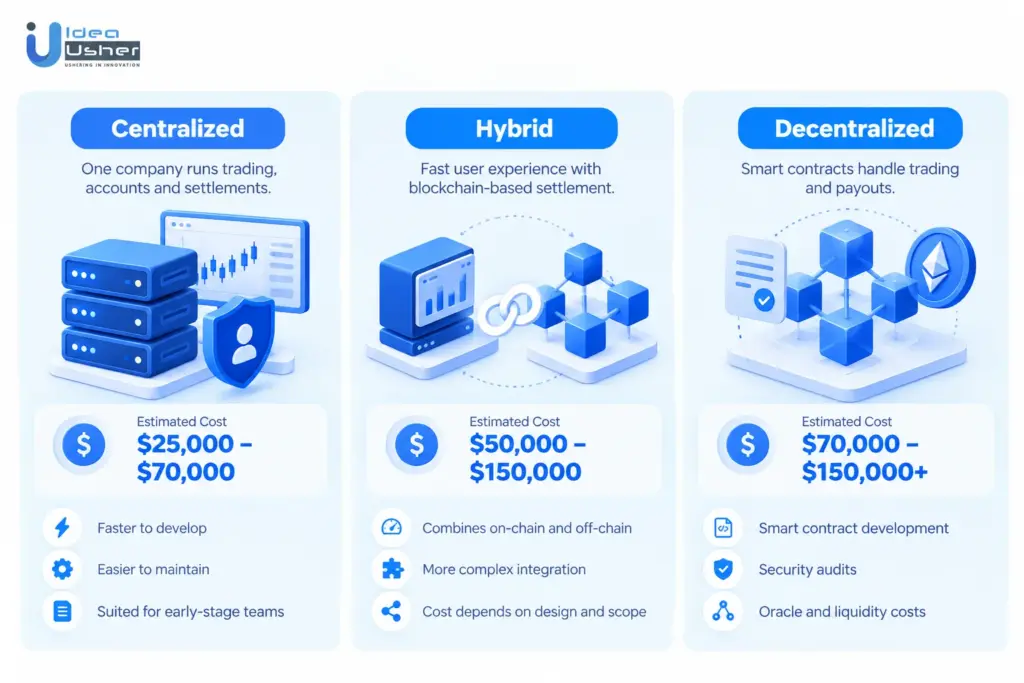
Architecture changes your budget more than most other choices. A centralized prediction market is the cheapest to start because one company runs everything. A decentralized platform costs more because of smart contract work and security audits. A hybrid sits in the middle, and its price depends on how well the two sides are joined. If you are close to a scoping call, this is the first thing to decide.
Centralized Builds and Lower Initial Costs
In a centralized platform, one authority manages the accounts, the trades and the settlements. That makes it faster to develop and easier to maintain, so it suits a team testing a new idea. Most of the money goes to servers and rules. Centralized builds lean on backend infrastructure and compliance tooling. Prices differ between vendors but one guide gives this rough picture:
| Architecture | Estimated development cost |
| Centralized | $25,000 to $70,000 |
| Hybrid | $50,000 to $150,000 |
| Decentralized | $70,000 to $150,000+ |
Kalshi is a well-known centralized platform. It runs a centralized order book. It looks like a brokerage, relies on institutional market makers and pays interest on cash that is not being traded. The tradeoff is rules. Every contract is reviewed by the CFTC before it lists, so new markets arrive slowly. So a centralized platform saves money on engineering and spends more on approvals.
Decentralized Builds and Smart Contract Costs
Decentralized platforms let smart contracts run the trading and the payouts. That means a lot more blockchain work. Smart contract development is estimated at $8,000 to $20,000 and audits at $5,000 to $25,000. The bills do not stop after the first audit. Each re-audit after a fix costs $5,000 to $20,000, and squeezing a four-week audit into one week adds 20% to 40%. One vendor says a basic decentralized app can cost $200,000 or more. Vendors disagree here, so ask for a line-by-line quote.
Oracles and liquidity
Two more costs sit outside the contracts. Oracle costs can go from a small line item to a monthly expense that outlasts the build. And decentralized platforms need large pools of funds locked in a smart contract so users can trade.
Limitless Exchange shows the design choices. It runs on Base, Coinbase’s Ethereum layer 2 network, and uses a central limit order book instead of the automated market makers many others use. It takes oracle and market data from Pyth and offers hourly and daily markets for crypto prices. It also closed a $10M seed round and passed $500M in total trading volume, which shows how much money a team may need behind a decentralized launch.
Hybrid Builds and Integration Trade-offs
Hybrid platforms try to give users a fast app while still using a blockchain for settlement. They need a more sophisticated technical design than the other two. One guide says most production platforms end up as hybrid. Another warns that the balance itself has a price tag. The extra cost comes from joining two systems that were not made together.
Things that raise a hybrid budget:
- Keeping the fast off-chain part and the on-chain settlement in step
- Oracle integration, estimated at $5,000 to $8,000
- Audits for the on-chain part
- Support for every network you want to use
That last point is easy to miss. The blockchain you pick affects complexity, wallet support, scalability, and future maintenance costs. Myriad is a case where this shows. It is an on-chain prediction market that uses an AMM model and runs on Ethereum, Arbitrum and Base, with no-KYC trading and up to 2.5x leverage. Each extra chain is more work to build and test. So a team should pick one network first and add others later.
Order Book (CLOB) vs AMM: Impact on Development Cost
An order book (CLOB) and an automated market maker (AMM cost money in different places. A CLOB asks for more engineering and then needs real traders or market makers to fill the book. An AMM asks for less waiting but it needs capital or a subsidy so prices stay fair. A platform that runs both costs the most to build. The right pick depends on how much trading you expect on day one.
CLOB Development and Matching Engine Costs
A CLOB lets users post and match orders against each other. That sounds simple but the code underneath is heavy. The platform needs order entry and cancellation, matching logic, market depth handling, websocket streaming, concurrency control, latency management, order tracking and audit trails. Matching usually follows price-time rules. One vendor breakdown puts these pieces in dollars:
That vendor lists one figure for the matching engine or AMM so the split between the two is not published. A new CLOB also starts with an empty book until the first quote arrives. So the money does not stop at the code. Polymarket runs a CLOB because its flagship markets attract professional market makers. The same analysis says its liquidity rewards are expensive. Polymarket’s Maker Rebates Program pays back taker fees to people who post orders, and it offers 3x rewards for limit orders within ±4¢ of the midpoint.
AMM Logic and Liquidity Requirements
An AMM prices trades with a formula so people can trade even when nobody else is there. It is useful when you want markets to feel active with little natural liquidity. It is not a small add-on. It needs work on pricing curves, liquidity logic, exposure management, slippage, market seeding rules, and risk controls.
Who pays for liquidity?
With the classic LMSR design, the operator pays. The operator subsidizes the market and loses a bounded amount. One research paper treats the collateral needed as growing with the log of the number of outcomes. There is also a setting to get right. The liquidity parameter is a guess, and at high volume, LMSR markets are priced worse than CLOB markets. A newer version called LS-LMSR fixes liquidity inflexibility and chronic market-maker losses at the price of more complex math and more compute per trade. Paradigm also introduced the pm-AMM, built for prediction markets.
Manifold Markets
Manifold Markets shows why a team might pick an AMM. Its target is thousands of user-created questions, most of them thin, and its founders wrote that order books are especially bad for that. The platform is play-money with no USD, so losing some subsidy is cheap. A real-money platform would feel that loss in dollars.
Choosing a Model for Your Budget
Most small teams do not need to choose forever. One vendor suggests starting with the AMM to guarantee liquidity from day one and moving to the CLOB as real trading grows. That costs more to build. The cost is running two matching engines and routing orders between them. A few questions help decide:
- Will you have market makers or a user base on launch day?
- Can you afford to subsidize an AMM until volume arrives?
- Do you need to be on-chain? A smart contract cannot always run an order book.
- Can the budget cover a build of $150,000 to $360,000+ plus 15 to 25 percent a year in upkeep?
Augur shows the on-chain case. Its first version used LMSR because it could run as a smart contract without off-chain order matching. The tradeoff was price quality at high volume. A team building on a blockchain may end up making the same choice for cost reasons.
Time to Market For Prediction Market Platforms: 4-6 Weeks vs 12-18 Months
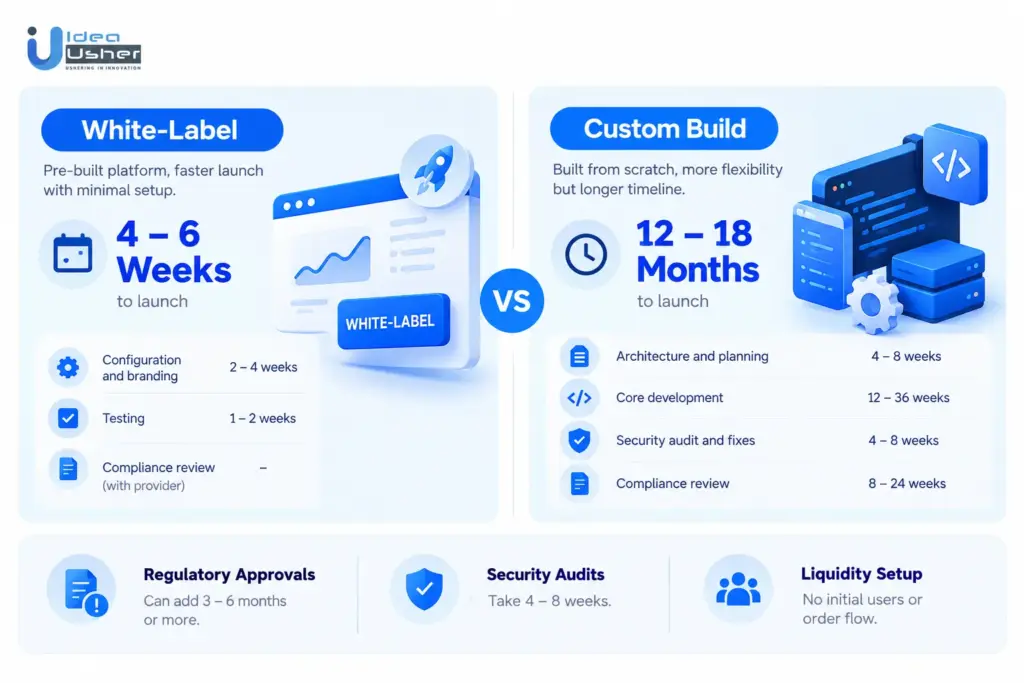
A white-label platform gets you live in weeks. A custom build takes more than a year. If speed decides the project, then white-label wins by a wide margin. A custom build only makes sense when you can wait and when the product itself is the point. However, the faster launch should be weighed against licensing costs, customization limits, and long-term ownership before making the final decision.
White-label Launches in 4–6 Weeks
Most white-label vendors quote a few weeks because the hard parts already exist. One says a white-label solution gets you to market in 4 to 6 weeks. Another gives a slightly wider range of 4 to 8 weeks to first trade. The matching engine, settlement and back office are already built, so the time goes to setup and testing.
- Configuration and branding: 2 to 4 weeks
- Testing: 1 to 2 weeks
- Compliance review: shared with the provider
Heavier changes stretch the calendar. One cost guide puts a white-label project with real customization at 12 to 16 weeks. So the 4- to 6-week number is for a light-touch launch.
Coinbase is a good example of moving fast by partnering. Reports in mid-November said it planned an in-house prediction market powered by Kalshi, and it showed the product at its System Update event in December. It started with a limited rollout and later went live in all 50 US states. Coinbase did not build an exchange first. It used one that already worked.
Custom Builds Take 12–18 Months
Building from scratch is a much longer road. One vendor says it requires 12 to 18 months of development and a specialized engineering team. Another gives a wider spread. It puts the timeline at 6 months for a focused crypto-native MVP and 18 months or more for a full build with compliance and a back office. A team of 5 to 14 engineers is usually needed. Here is how one vendor splits the time:
Not every vendor agrees. One cost guide says a custom platform takes 16 to 24 weeks and another says 6 to 19 months. The gap comes down to scope. A simple build with few markets is quick and an exchange-grade build is slow.
What Can Delay Your Launch?
Approvals are the biggest wildcard. Regulatory delays can push a custom build’s go-live by three to six months. For a US exchange, the wait can be much longer. Exchange registrations (DCM) can take more than two years and sit outside most build timelines. One guide puts the full CFTC path at an 18- to 24-month timeline.
Gemini lived this. Its affiliate, Gemini Titan, first applied for its DCM license on March 10, 2020. The approval came in December of 2025. Its CEO called it a 5-year licensing process. After approval, things moved fast. Gemini Predictions launched a week after the license came in. The code was not the slow part.
Audits and rework
Security checks can add weeks. An independent audit and fixes take 4 to 8 weeks, and each re-audit after a patch costs $5,000 to $15,000. Rushing hurts too. Squeezing a four-week audit into one week adds 20% to 40% to the cost. Liquidity is another delay because a custom build produces a platform with no users and no order flow.
Commodity vs Differentiating: Which Components Should You Build or Buy?
Buy the parts that work the same on every platform and build the parts that make your market feel different. That is the short answer. Wallets and identity checks do not win you any users, so there is no reason to write them again. Your market rules and pricing logic are what people remember, so those are worth owning. This mix is the hybrid path, and it is where our platform sits. You start with the standard parts already working, and your team spends its time on features that only you have.
Buy Commodity Infrastructure
Commodity parts are the ones where nobody can tell the difference from the outside. Identity checks, wallets, payments, and reporting all fit here. A user will never pick a market because its identity check looks nicer. Even licenses can be bought. Polymarket paid $112 million for QCEX, a US-licensed derivatives exchange and clearinghouse, to get ready for its return to the US market. That shortcut makes sense because licensed exchanges are expensive and slow to create.
Security audits are another thing you hire out. Outside auditors like CertiK and OpenZeppelin are named as top choices for this work. i
| Component | Buy or build | Why |
| Identity checks (KYC) | Buy | Same rules for every platform |
| Wallets and custody | Buy | Hard to get right and easy to copy |
| Payments and deposits | Buy | Users expect them to just work |
| Licenses and clearing | Buy or acquire | Slow to get from scratch |
| Reporting and admin tools | Buy | Nobody picks you for these |
| Contract audits | Hire out | You want a second pair of eyes |
Build Proprietary Trading and Market Logic
This is the part users actually feel. It covers which markets you list and how prices move and how fast a new market goes live. People who write about building these platforms say the work is more about market design, liquidity and trust than about code. If you buy this layer you end up looking like every other platform.
What Kalshi Keeps In-House
Why Robinhood Took Over Its Exchange
Robinhood first used Kalshi as the exchange behind its app. Then it teamed up with Susquehanna and bought a 90% stake in MIAXdx while MIAX kept 10%. Susquehanna is the day-one liquidity provider. Robinhood said more than one million customers had traded nine billion contracts and expects more product variety and faster rollouts from owning the venue. The exchange now goes by Rothera Exchange and Clearing.
Combine Third-Party APIs With Custom Features
The middle path is to plug in outside services and put your own features on top. You get speed from the outside part and a different product from your own part. These are the usual pieces:
- Oracles: Polymarket uses the UMA Optimistic Oracle together with Chainlink data streams so markets resolve faster with less human work.
- Data and media: ICE will send Polymarket data to its institutional customers. Google Finance also added data from Polymarket and Kalshi.
- Brokers: Kalshi already works with Robinhood and Webull.
- Liquidity: market makers like Susquehanna fill the order book from day one.
DraftKings Borrowed First and Built Later
DraftKings Predictions launched in December using contracts listed by outside exchanges Crypto.com and CME Group. At the same time DraftKings bought Railbird, and Railbird got its CFTC license in June before the deal was announced on October 21. DraftKings now plans to run its own Railbird exchange and add parlay-style “combos.” It also said moving the product into its main app cut customer acquisition cost by more than 80% in April.
Regulatory Costs for a Prediction Market: Do You Need a CFTC DCM License?
Yes, if you run your own exchange for US users. A prediction market that lists event contracts to people in the US needs a CFTC DCM license or it has to plug into a partner that already holds one. Regulation takes a big share of the budget because the license is slow and the lawyers and compliance staff never stop. It is also the first thing serious users and partners check before they trust a platform. Skipping it ends up being the most expensive choice of all.
When a DCM License Is Required?
The CFTC classifies prediction markets as designated contract markets. A DCM has to show it follows 23 core principles and file a long application called Form DCM. Two of those principles matter most for event contracts. One says you may only list contracts that are hard to manipulate, and the other makes you responsible for stopping manipulation and settlement problems. If your platform lists its own contracts and matches trades, you are the exchange so these duties land on you.
What Happened to Polymarket
PredictIt Used a Smaller Door
PredictIt ran for years under a CFTC no-action letter instead of a DCM license. The price was subject to strict limits. Each question had a cap of 5,000 traders, and each person could only put in $850. Later, the cap per contract went up to $3,500, and the trader limit was removed. Its operator, Aristotle, also won exchange and clearinghouse licenses after applications that had been pending since late 2021. Underdog then bought Aristotle Exchange and its DCM and DCO entities. Approvals like these can take years so existing ones are worth a lot.
Licensing, Legal and Compliance Costs
The CFTC does not publish one price for becoming a DCM. The high costs are time and people. Applicants must show financial statements and enough capital to cover more than 12 months of operating expenses. After approval, you still pay for compliance staff, market surveillance, and legal work every year. The CFTC is also asking the public how core principles and margin and insider trading rules should apply to prediction markets, so the rules can change after you launch.
| Route | Dollar cost | Time |
| Apply for your own DCM | Capital worth 12+ months of expenses plus legal and staff costs | Years |
| Buy a licensed exchange | $112M for QCEX (Polymarket) | Faster than applying |
| Partner with an existing DCM | You pay the partner instead of paying for a license | Fastest |
| Run without a license | $1.4M penalty and markets shut down (Polymarket) | Risk never ends |
Gemini Waited Five Years
Gemini first applied for a DCM license in March 2020, and its affiliate Gemini Titan got it in December. The CEO called it a 5-year licensing process. It was the first crypto-native exchange to get a DCM license to run a prediction market for US users. Gemini then launched Gemini Predictions in all 50 states. Customers trade with USD in their Gemini account, and fees were waived for a limited time at launch.
Regulatory Requirements Across Jurisdictions
A federal license does not end the fight inside the US. The CFTC has sued Illinois, Arizona, Connecticut, New York, and Wisconsin and says those states overstepped by regulating markets that fall under federal law. Kentucky sued five platforms, including Kalshi and Polymarket, for running unlicensed sports betting. Minnesota passed a bill that bans prediction markets from operating in the state. Outside the US, most countries treat these markets as gambling:
- France: the gambling regulator ordered internet providers to block Polymarket. Advertising an unauthorized site can bring fines up to 100,000 euros ($114,000).
- Brazil: moved to shut down 27 platforms, including Kalshi and Polymarket.
- Spain: ordered a block on Polymarket and Kalshi while it checks their gambling licenses.
- Singapore, Poland and Belgium: added restrictions in early 2025 as more than 30 countries and regions put controls on Polymarket.
This means geoblocking and local legal advice are real budget lines. Polymarket itself said it was geoblocked in 36 regions. Plan the budget country by country and do not assume one license covers every market.
Build a Custom Prediction Market Platform with Idea Usher
Idea Usher helps businesses build custom prediction market platforms tailored to their trading models, target audiences, and growth plans. With 500,000+ hours of coding experience and a team that includes ex-MAANG and FAANG developers, we bring deep engineering expertise to complex platform development. From trading infrastructure to market resolution and third-party integrations, we help turn your platform concept into a scalable product.
Custom Trading Logic
We develop prediction market platforms with custom trading engines, market creation workflows, order books, and automated market maker (AMM) mechanisms based on your business requirements. Our team helps you choose an architecture that balances performance, liquidity needs, and development costs.
Secure, Scalable Infrastructure
Our developers build infrastructure designed to support growing transaction volumes, real-time market updates, secure user accounts, and reliable settlement workflows. We can also integrate payment systems, data oracles, analytics tools, and external APIs to support your platform’s operational needs.
End-to-End Development
Idea Usher supports the development process from initial discovery and architecture planning to deployment, testing, and post-launch improvements. We help businesses evaluate build-versus-buy decisions, prioritize essential features, and plan future upgrades without committing to unnecessary complexity at launch.
Conclusion
Buying a ready-made platform is usually cheaper to start, while building only makes sense if you already have users and capital. The software is rarely the biggest cost. Polymarket paid $112M for QCEX to get regulated US access, and Robinhood bought 90% of MIAXdx after it had already signed Susquehanna as a liquidity provider. Those costs stay whichever route you take. A small team should buy, then put the savings into market makers and legal compliance.
FAQs
A1: A custom build usually costs $150,000 to $500,000 or more. The first year often lands between $300,000 and $600,000 or more once you add security, liquidity, and compliance. A white-label plan costs about $2,000 to $10,000 a month. A license is a separate bill, and Polymarket paid $112 million for the licensed exchange QCEX.
A2: Yes, at the start. A white-label plan works out to $24,000 to $120,000 a year while some estimates put a custom build as low as $80,000 and as high as $500,000 or more. The gap can shrink later because the monthly fee never stops. Revenue share can also become the highest cost after about 18 months.
A3: A white-label platform can go live in 4 to 8 weeks. A custom build takes 6 to 19 months before the first trade. The license adds more time since a US DCM registration can take over two years. Gemini waited five years for its own.
A4: Yes, but it depends on the provider. Some let you change your brand, domain and business model, and a few hand over the full source code. Others only let you change colors and a logo. Some also limit the number of markets and block API access. Ask about these before you sign.
A5: The biggest factor is what you build yourself. Wallets, oracles, data, and market integrity drive the cost, and the matching engine and oracle take the most engineering time. A centralized platform needs KYC and AML checks, while a blockchain one requires smart contract audits. Liquidity is another cost since a new platform has no users on day one. The license can cost more than the software.