


Key Takeaways
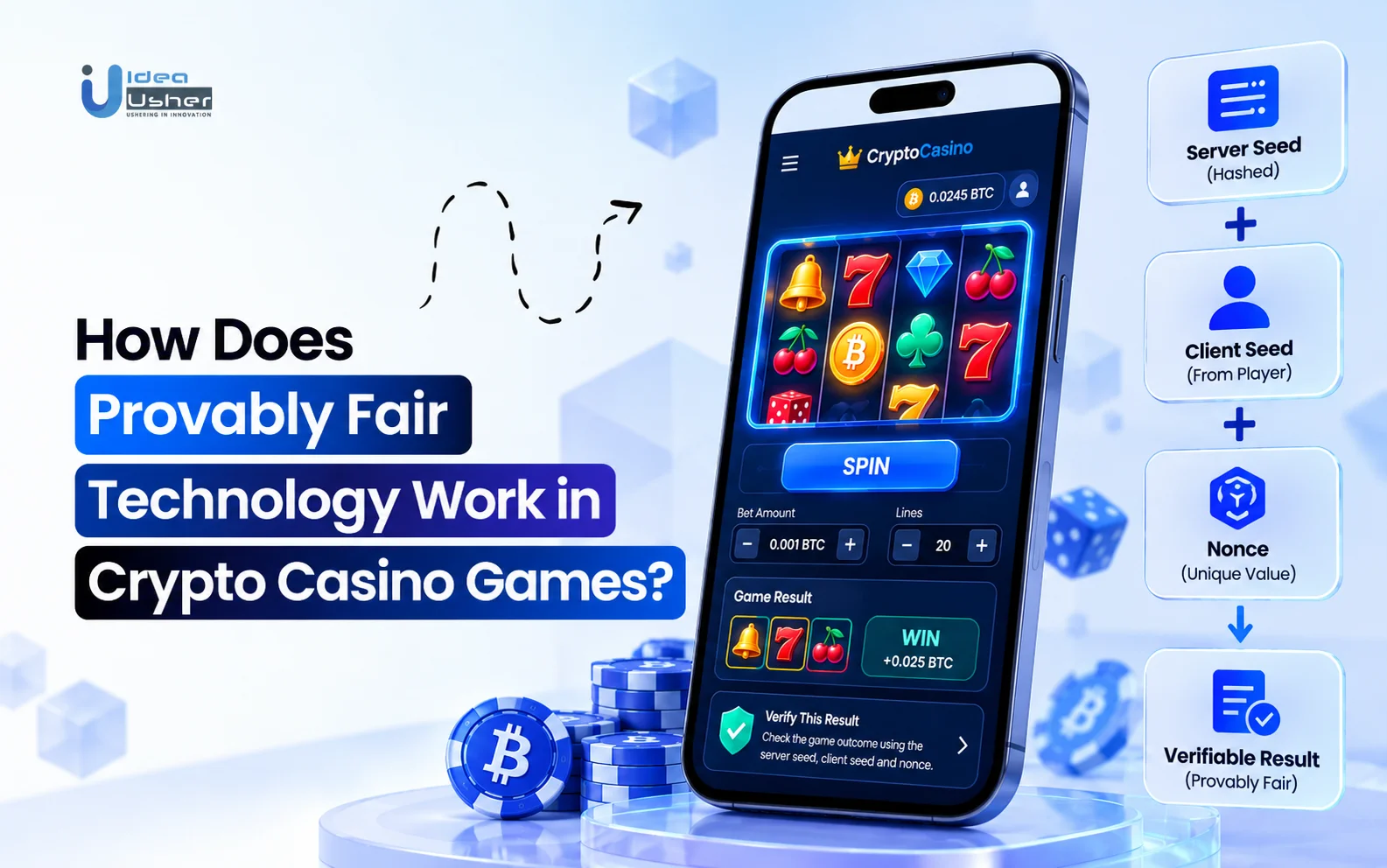
- Provably Fair technology allows players to verify game outcomes using a server seed, client seed and nonce. This means players can check the results for themselves.
- Before a bet, the casino publishes a hash of its secret server seed. Once the seed is revealed, players can recalculate the result and check if it matches.
- Different games like Dice, Crash and Mines each use their own rules to turn cryptographic data into outcomes. That’s why each game requires its own way of checking the results and different verification logic.
- Creating a provably fair casino means making sure the seed data stays secure. It also means tracking every bet and keeping a full game history.
- The cost to build a provably fair casino platform can start around $30,000 per game. For a platform with many games and more integrations, the cost can go well over $300,000.
- Even though provably fair technology helps with transparency, it doesn’t guarantee fair payouts or secure withdrawals. Players still need wallet security, clear policies and proper licensing.
Provably fair technology in crypto casino games uses cryptographic algorithms, server seeds, client seeds and nonces to generate verifiable outcomes that can be checked by clients. Before gameplay, the casino publishes a hash of its secret server seed. Once the seed is revealed, players can recalculate completed rounds using the published algorithm. This helps verify committed inputs but does not guarantee fair payouts or overall platform integrity.
The challenge is implementing verification without compromising seed security or disrupting gameplay. Provably fair casino games require reliable random number generation, secure seed handling, transparent verification tools and accurate round records. Players must also understand how each input affects the outcome and what verification can actually prove about a completed game round.
In this blog, we will explain how provably fair technology works in crypto casino games, including server seeds, client seeds, nonces, hash verification, outcome recalculation and the technical safeguards needed to build a transparent and reliable casino gaming platform while enabling independent verification of completed game outcomes.
How Is the Global Online Casino Market Growing?
The global online casino market was valued at $19.1 billion in 2024 and is projected to grow from $23.9 billion in 2026 to $38.0 billion by 2030, at a CAGR of 12.2% from 2025 to 2030. This growth creates opportunities for operators to differentiate their platforms through transparency, security and verifiable gameplay.

Market growth also brings a trust challenge. In a 2025–2026 UK Gambling Commission study, 70% of people who had gambled in the past year disagreed that gambling games and machines were fair and free from errors, highlighting a clear trust challenge for online operators.
- Transparent Game Rules: Clear explanations of odds, payouts and game mechanics help players understand how games operate.
- Verifiable Outcomes: Cryptographic verification lets players independently check whether completed rounds match the published algorithm.
- Independent Oversight: External testing, appropriate licensing and security assessments provide safeguards beyond outcome verification.
The UK Gambling Commission’s 2025 research gave perceived fairness of gambling games and machines a score of just 40.1 out of 100. As competition grows, operators need ways to demonstrate how game outcomes are generated rather than asking players to rely on promises alone.
Provably fair technology addresses this need by letting players independently verify rounds using published algorithms and cryptographic inputs.

What Is Provably Fair Technology in Crypto Casinos?
Provably Fair technology is an algorithmic framework that uses cryptography, specifically SHA-256 or HMAC hashing to let players independently verify that a game’s outcome was generated randomly and not altered after a bet was placed.
The system combines three core parameters to calculate game results:
- Server Seed: A secret string of random characters generated by the casino operator.
- Client Seed: A random string generated by the player’s browser or inputted directly by the user.
- Nonce: A sequential counter that increments with every wager placed under that seed pair (0, 1, 2…).
Before gameplay begins, the casino publishes a cryptographic hash of its Server Seed. Because hashing functions are one-way, the player cannot decode the secret seed to predict the result.

Once the round finishes or the seed is rotated, the unhashed Server Seed is revealed, allowing the player to run the mathematical parameters back through the algorithm to confirm the exact result.
A. How Provably Fair Differs From Traditional Game Audits
In standard online casinos, fairness relies on third-party Independent Testing Laboratories (ITLs) such as GLI, BMM Testlabs, or eCOGRA which periodically evaluate a provider’s Random Number Generator (RNG) code in a closed lab environment.
| Feature / Aspect | Traditional Game Audits | Provably Fair Cryptography |
| Trust Model | Institutional Trust: Players trust external lab testing agencies and state regulator oversight. | Trustless Cryptography: Players rely on mathematical certainty without trusting a third party. |
| Verification Timing | Retrospective / Periodic: Audits occur quarterly or annually on sample code batches. | Real-Time / Per-Round: Players can verify every single spin, card hand, or dice roll instantly. |
| Data Accessibility | Opaque Backend: Source code, seeds, and internal database logs remain hidden from end users. | Transparent Input Feeds: Seeds, hashes, and mathematical formulas are exposed via client widgets. |
| Scope of Proof | Verifies overall RNG statistical compliance across millions of simulated hands. | Proves that a specific individual round was pre-committed and non-manipulated. |
B. What Players Can and Cannot Verify
While Provably Fair algorithms offer cryptographic proof for game outcomes, they do not guarantee total platform integrity.
What Players CAN Verify
Players can check whether the casino used the committed server seed correctly, reproduce game outcomes with public verifier tools and confirm that results were not changed after their bets.
- Server Seed Commitment: Confirm the revealed Server Seed produces the same SHA-256 hash published before the wager.
- Outcome Reproducibility: Use an open-source verifier with the Server Seed, Client Seed and Nonce to reproduce the round’s reel stop, crash point or card value.
- Post-Bet Manipulation Checks: Verify that the outcome matches the committed inputs and published algorithm, preventing undetected changes after the wager.
What Players CANNOT Verify
Provably Fair does not confirm the casino’s advertised RTP, available funds, withdrawal reliability, platform security or licensing status. These require separate checks, audits and regulatory oversight.
- Return-to-Player (RTP) & House Edge Verification: Provably Fair verifies individual round outcomes but does not independently confirm that the paytable or house edge matches the advertised long-term RTP.
- Financial Solvency & Withdrawals: The algorithm cannot prove that the platform has sufficient liquid funds or will process withdrawal requests.
- Platform Security & Licensing: Cryptography does not guarantee wallet database security, protection against insider fraud or compliance with US multi-state online casino licensing requirements.
C. How Does Provably Fair Technology Relate to Crypto Casino?
Crypto casinos combine cryptocurrency wallet payments with cryptographic game verification, but these serve different purposes. While blockchain networks can process transactions, provably fair algorithms let players independently verify how individual game outcomes were generated.
- Cryptocurrency Payments: Players can use Bitcoin, Ethereum or stablecoins to fund wagers and receive payouts, depending on the platform’s supported assets.
- Off-Chain Game Verification: A casino can generate and verify game outcomes on its own servers without recording every round on a blockchain.
- Blockchain Transactions: Blockchain networks may handle deposits, withdrawals or smart-contract interactions, depending on the platform’s architecture.
- Independent Outcome Verification: Server seeds, client seeds, nonces and published algorithms allow players to reproduce completed game outcomes.
- Separate Security Controls: Provably fair verification does not guarantee secure wallets, successful withdrawals or blockchain transaction safety. These require separate safeguards.
How Does the Provably Fair Technology Verification Process Work?
The verification workflow allows players to audit completed game rounds in real time without trusting the operator’s internal database. By using public cryptographic functions, players can independently verify two essential factors:
- No Retrospective Tampering: The operator locked in the hidden server seed before the player placed their wager.
- Deterministic Calculation: The game outcome was computed strictly from the committed seeds, nonce, and published mathematical formula.

Step 1: Publish the Server Seed Hash Before Play
Before a player places a bet, the casino platform creates a secret value called the Server Seed. It then uses SHA-256 to turn that value into a fixed-length code called the Server Seed Hash.
Server Seed Hash = SHA-256 (Server Seed)
The casino displays this hash before the round begins. Players cannot derive the seed from the hash, but can log it to later verify that the operator did not alter its committed seed post-bet.
For casino operators, this means the backend must generate seeds securely, publish hashes before betting and preserve the data needed to verify completed rounds.
Step 2: Generate and Record the Game Outcome
When a player places a bet, the casino platform uses a cryptographic algorithm, usually HMAC-SHA256, to generate the game result. It combines three inputs:
- Server Seed: The secret value created by the casino before play.
- Client Seed: A random value provided by the player or generated by the browser.
- Nonce: A counter that increases with each bet to help distinguish one round from another.
The system combines these values to create a unique output:
HMAC Digest = HMAC-SHA256 (Server Seed, Client Seed + “:” + Nonce)
The platform then converts this output into a game result. Depending on the game, it could determine a dice roll, a crash multiplier or the order of cards. The system must also record the inputs and result so players can check the outcome later when the server seed is revealed.
Step 3: Reveal the Server Seed After Rotation
To preserve game randomness, the original Server Seed must remain secret while active. Once the player finishes a betting session, rotates their Client Seed, or closes a round cycle, the operator reveals the unhashed Server Seed.
The player can now take the newly revealed Server Seed and pass it through a standard SHA-256 hash calculator:
Commitment Match: If SHA-256 (Revealed Server Seed) = Pre-Game Server Seed Hash, the player has mathematical confirmation that the casino did not alter the server seed after seeing the bet.
Commitment Mismatch: If the recalculated hash does not match the published pre-game hash, the operator changed the seed mid-session, signaling outcome manipulation.
Step 4: Recalculate the Result Independently
With all three inputs explicitly disclosed (Revealed Server Seed, Client Seed, and Nonce), the player inputs these variables into an open-source verifier or a local script (such as Node.js or Python):
- Re-run the HMAC-SHA256 function using the revealed inputs.
- Apply the published parsing formula (e.g., converting the first 4 bytes into an integer or float).
- Compare the recalculated numerical output against the game result recorded in the account history.
If the recalculated result matches the displayed game outcome, the result can be independently reproduced using the published algorithm and recorded inputs.
How Does Provably Fair Technology Work Across Casino Games?
Provably Fair uses the same basic cryptographic process (Server Seed + Client Seed + Nonce → HMAC-SHA256) across casino games, but each game uses the result differently. The platform converts the generated output into a game-specific outcome, such as slot reel positions, dice rolls, card sequences or crash multipliers. Understanding these differences helps developers build games that players can verify.
A. Dice and Plinko: Mapping Random Values to Outcomes
For linear outcome games like Dice and Plinko, the translation logic maps raw cryptographic bytes into a single integer range or a sequence of directional binary choices.
Dice Roll Mapping: The engine takes the first 4 bytes of the HMAC digest, converts them into a 32-bit unsigned integer and uses the modulus operator to map the value to the required range:
Roll Outcome = (32-bit Integer mod 10000) ÷ 100
This produces a result between 0.00 and 99.99, which the game compares with the player’s selected target to determine the outcome.
Plinko Pin Routing: A Plinko board has multiple rows of pins, typically 8 to 16. The mapping algorithm reads bits from the digest to decide whether the ball moves Left (0) or Right (1) at each pin. The total number of rightward moves determines the ball’s landing position and the multiplier assigned to that slot at the bottom of the board.
B. Crash Games: Generating the Crash Multiplier
In Crash games, the multiplier rises until the round ends. Lower multipliers such as 1.50x or 2.00x, occur more often, while very high multipliers such as 100x are much less common. The platform uses a formula to turn the cryptographic result into the point where the round crashes.
For example, if a round crashes at 2.00x, a player who has not cashed out by then loses the wager. If the player cashes out at 1.50x, the payout is based on that multiplier. The exact result depends on the game’s predefined rules and cryptographic inputs.
Built-In House Edge & Instant Busts: The house edge, often set at a small percentage, is built into the game’s probability rules. It gives the casino a mathematical advantage over many rounds rather than changing a result after a bet is placed.
- The Modulo Instant Bust Branch: Some Crash algorithms include a rule that can make a round end immediately at 1.00x. A modulo check is one way to decide when this happens.
- The 1.00x Crash Event: When an instant bust occurs, the multiplier stops at 1.00x, leaving no time for players to cash out above that value. Developers must document this rule so independent verification tools can reproduce the same outcome.
C. Mines: Verifying Board Positions and Mine Placement
Games like Mines (typically played on a 5 x 5 grid of 25 tiles) requires generating a non-repeating array of mine positions without bias.
- Grid Representation: The 25 tiles are assigned index positions 0 through 24.
- Fisher-Yates Cryptographic Shuffle: The algorithm uses sequential bytes from the HMAC digest as the random indices for a modified Fisher-Yates shuffle algorithm.
- Mine Extraction: If the player selects a game with 3 mines, the first 3 indices in the shuffled array are designated as hidden mine tiles.
- Post-Game Layout Audit: Once the round ends or the player cashes out, the unhashed Server Seed is disclosed, allowing the verifier to re-run the Fisher-Yates shuffle and confirm the exact hidden mine locations across all 25 tiles.
D. Why Each Game Needs Its Own Verification Logic
A common error among developers building crypto casino platforms is assuming a “universal verifier” can validate all titles. While the cryptographic seed exchange is universal, the verification engine must implement game-specific mapping scripts for every title:
| Game Category | Unique Mapping Requirements | Verification Edge-Case Risks |
| Dice & Limbo | Slices 4-byte chunks; applies modulo 10000. | Mismatch in floating-point rounding precision or byte order (Big-Endian vs. Little-Endian). |
| Crash Games | Heavy-tailed exponential curve calculation with maximum multiplier caps. | Omission of the instant 1.00x house-edge modulo branch. |
| Mines & Keno | Multi-step Fisher-Yates array shuffling across 25–80 grid tiles. | Duplicate index selection if array elements are not properly removed during shuffling. |
| Slots & Cards | Multi-reel symbol array mapping or 52-card deck state generation. | Incorrect handling of wild symbols, bonus round triggers, or mid-hand deck reshuffles. |
Without clear, open-source verification documentation explaining the exact parsing logic, byte-slicing order, and house-edge math for every individual game, players cannot independently re-calculate results.
What Does It Take to Build a Provably Fair Crypto Casino?
Building a provably fair casino platform requires integrating cryptographic verification into the game engine, backend systems and database. Developers cannot simply add a verification feature to the interface after launch.

The platform must be designed to generate consistent game outcomes, protect sensitive seed data and allow players to verify completed rounds independently.
1. Secure Seed Generation and Management
The integrity of a provably fair system depends on the unpredictability of the server seed and keeping it secret until it is ready to be revealed.
- Generate Seeds Securely: Use cryptographically secure random number generators such as crypto.randomBytes() in Node.js or Python’s secrets module, instead of Math.random().
- Store Active Seeds Securely: Encrypt server seeds in protected databases or key management systems like AWS KMS or HashiCorp Vault. Restrict access to prevent exposure through logs, dashboards or public APIs.
- Prevent Premature Seed Disclosure: Keep active server seeds secret until rotation or retirement. Early exposure may allow future outcomes to be predicted when the client seed, nonce and algorithm are known.
2. Deterministic Game Logic and Nonce Handling
The game engine must produce the same result whenever the same server seed, client seed and nonce are processed using the same algorithm. This allows players to independently reproduce completed game outcomes.
- Track Each Game Round Correctly: The nonce must increase according to the platform’s defined rules for successive rounds. Database transactions or atomic counters help prevent duplicate nonce values when multiple bets are placed concurrently.
- Keep Outcome Calculations Consistent: Game results must depend on the documented algorithm and its specified inputs, not unrelated factors such as server timestamps, database record IDs or network delays.
- Use the Same Calculation Rules Everywhere: Developers must standardize how cryptographic output is converted into game results including byte order and rounding rules. Both the backend and verification tool must follow identical calculations to prevent discrepancies.
3. Seed Rotation and Verifiable Game Histories
Seed lifecycle management governs how active seed pairs transition into historical, publicly verifiable data logs.
Define When Seeds Should Rotate: Players should be able to change their client seed and request a new seed pair according to the platform’s rules. Automatic rotation can also be triggered after a defined number of rounds or period of inactivity (e.g., after 1,000 nonces or 24 hours of inactivity), depending on the protocol.
Keep Complete Records of Every Bet: Each bet record should retain:
- The active Public Server Seed Hash at the time of the bet.
- The player’s Client Seed.
- The exact Nonce increment.
- The final revealed Server Seed (populated immediately upon seed rotation).
Make Previous Rounds Easy to Verify: Each completed round in the player’s account history should include a direct Verify button. Selecting it should automatically load the relevant seed values, nonce and game result into the verification tool.
4. Crypto Wallet and Payment Integration
Crypto wallet and payment integration allows players to deposit funds, place wagers and receive payouts using supported digital assets. Developers must connect the payment layer with the casino’s game engine and transaction ledger to keep balances accurate and prevent duplicate or unauthorized transactions.
- Wallet Connectivity: Support suitable wallets and blockchain networks based on the platform’s target users and supported assets.
- Deposits and Withdrawals: Build transaction monitoring, confirmation handling and clear status updates for incoming and outgoing payments.
- Bet and Payout Reconciliation: Ensure wagers, winnings and refunds are recorded accurately in the player ledger, including when transactions fail or are interrupted.
- Wallet Security: Apply appropriate key management, access controls and transaction monitoring to protect funds and reduce unauthorized activity.
- Provably Fair Separation: Keep game-outcome verification distinct from payment processing. Verifying a game result does not prove that a deposit, withdrawal or wallet transaction is secure or successful.
5. A Player-Facing Provably Fair Verification Interface
A cryptographically sound backend is useless if players cannot easily run and interpret verification checks within the UI.
| Interface component | What it should do | Why it matters |
| Active Seed Display | Shows the current server seed hash, client seed and nonce counter. | Helps players inspect the inputs used by the game. |
| Built-In Verification Tool | Automatically loads the revealed server seed, client seed, nonce and completed round details. | Lets players check results without manually entering every value. |
| Independent Verification Options | Offers downloadable game data and links to independently hosted verification tools. | Allows players to check results outside the casino’s own interface. |
| Clear Verification Error Messages | Explains failures such as when a revealed server seed does not match its original hash. | Helps players understand what went wrong and identify potential inconsistencies. |
6. Consistency Between Game Logic and Verification Results
One of the most frequent causes of failure during independent platform audits is a discrepancy between the code running on the live production game server and the mathematical logic published in the public verification documentation.
- Use Consistent Calculation Code: Shared libraries or matching logic (e.g., JavaScript, WebAssembly) ensure identical outcomes in the game engine and verifier.
- Document Special Game Rules: The verifier must reflect all outcome factors, including Crash multipliers, instant busts, reshuffles, and house-edge math.
- Test Results Before Release: Pre-deployment automated tests comparing engine outputs with an independent verifier catch errors and prevent regressions.
How Much Does Provably Fair Crypto Casino Development Cost?
Developing a provably fair crypto casino platform requires balancing custom software engineering with third-party ecosystem integrations. Rather than relying on a single artificial figure, real-world development budgets range from $30,000 for a lean, single-game launch up to $300,000+ for a full-featured, multi-provider enterprise platform.
A. The Features That Drive Development Costs
The cost of building a provably fair crypto casino depends on the platform’s scope, technical complexity and operational requirements. Understanding these cost drivers helps operators allocate budgets, compare development approaches and prioritize essential capabilities.
1. Custom Game Development vs. Aggregator Integrations
The choice between proprietary games and third-party content affects online casino game development timelines, customization options and long-term control. Operators must evaluate how each approach supports their intended gaming experience and business model.
- Custom Proprietary Games ($15,000 – $40,000+ per title): Engineering custom HTML5/Canvas/WebGL titles (e.g., Crash, Plinko, Mines, Dice) with native, exposed provably fair logic requires bespoke mathematical modeling, UI animation, and byte-slicing code.
- Third-Party Aggregator Integration ($10,000 – $30,000 setup fee): Connecting aggregators such as SoftSwiss and other alternatives gives instant access to thousands of traditional slots, but limits direct provably fair verification to providers that natively expose cryptographic seed APIs.
2. Seed Management & Cryptographic Verification Engine ($15,000 – $35,000)
A reliable verification system requires careful engineering to make game outcomes reproducible and historical results independently checkable. Its complexity depends on the protocol design, integration requirements and expected verification workload.
- High-entropy Server Seed CSPRNG generation, secure KMS key-enclave vault isolation, automatic seed rotation logic, and real-time SHA-256 commitment hashing.
- Building embeddable client-side verification widgets and open-source JSON verification tools.
3. Crypto Wallet & Payment Rail Integrations ($10,000 – $30,000)
Payment infrastructure influences transaction reliability, user convenience and the platform’s ability to support different digital assets. The implementation scope varies with the supported networks, custody model and transaction processing requirements.
- Web3 wallet connections (MetaMask, Phantom, WalletConnect) alongside automated non-custodial or custodial crypto deposit address generators (BTC, ETH, USDT, SOL).
- Real-time blockchain event listeners, gas optimization, cold/hot wallet threshold routing, and automated withdrawal velocity checks.
4. Game History, Administration & Monitoring ($15,000 – $35,000)
Operational visibility becomes increasingly important as the casino RGS (Remote Game Server) handles more players, transactions and concurrent game rounds. These capabilities help operators investigate disputes, monitor business performance and maintain consistent records across the platform.
- High-concurrency database logging (Redis + PostgreSQL/MongoDB) tracking every bet, Client Seed, Nonce, and outcome hash.
- Admin back-office dashboards for real-time GGR metrics, player risk scoring, bonus engine management, and seed history auditing.
5. Security Hardening, Lab Auditing & Deployment ($15,000 – $40,000+)
A provably fair casino games app must be prepared to withstand security threats and meet applicable technical and regulatory expectations before launch. The required effort depends on its architecture, target jurisdictions and external assessment requirements.
Penetration testing, smart contract/KMS security audits, DDoS mitigation (Cloudflare Enterprise), and GLI-11/GLI-19 software certification preparation.
B. Build a Custom Algorithm or Integrate Existing Games?
Choosing between developing custom provably fair games or integrating turnkey casino solutions determines your product’s speed to market and technical differentiation.
| Strategic Metric | Custom Proprietary Games | Integrated Third-Party Games |
| Development Cost | $15,000 – $40,000+ per game title | $10,000 – $30,000 initial integration fee |
| Speed to Market | 3 to 6 months (requires full design, math & QA cycle) | 2 to 6 weeks (pre-certified, plug-and-play lobbies) |
| Provably Fair Autonomy | 100% Full Cryptographic Control (exposes seeds & math) | Limited to specific crypto-native providers (e.g., Spribe, BGaming) |
| Ongoing Vendor Royalties | 0% Revenue Share (100% margin retention) | 10% – 20% Gross Gaming Revenue (GGR) Royalty |
| Custom UX & Gamification | Total freedom over multipliers, themes, and social features | Fixed UI templates and vendor-restricted player flows |
C. What is Provably Fair Crypto Casino Development Estimate Include?
A comprehensive, production-ready provably fair casino games app development estimate from an engineering partner must cover both one-time implementation costs and year-one operational infrastructure:
| Workstream / Phase | Estimated Cost Range | Core Scope & Deliverables |
| Discovery & Architecture Design | $10,000 – $25,000 | Detailed technical specifications, cryptographic flow charts, database schema design, and regulatory compliance mapping. |
| Core Platform & Wallet Engineering | $45,000 – $95,000 | Proprietary PAM ledger, high-concurrency Nonce handling, CSPRNG seed vault, and multi-currency crypto cashier pipelines. |
| Game Portfolio Integration | $20,000 – $60,000 | Custom HTML5 game builds (e.g., Crash, Plinko, Mines) or universal third-party aggregator API wrappers. |
| Quality Assurance & Security Auditing | $15,000 – $35,000 | End-to-end regression testing, byte-slicing mathematical verification, load testing (high-TPS), and third-party penetration audits. |
| Infrastructure & DevOps Deployment | $10,000 – $25,000 | Production cloud deployment (AWS/GCP), auto-scaling Kubernetes cluster setup, database replication, and Cloudflare Enterprise DDoS mitigation. |
| Post-Launch Maintenance & Support | $36,000 – $156,000 / year | 24/7 SLA maintenance ($2,000 – $8,000/mo), continuous seed vault monitoring, framework updates, and cloud server hosting ($1,000–$5,000/mo). |
Market Planning Note: Total provably fair casino games app development expenditure depends heavily on the size of your initial game portfolio, target concurrency, and multi-currency blockchain requirements.
How Do You Test a Provably Fair Casino Games Before Launch?
Testing a provably fair casino before launch helps confirm that game results are verifiable, betting records remain consistent and payouts follow the intended rules. Testing should cover cryptographic verification, seed management, game logic and financial transactions separately.
A. Test Seed Commitments and Recalculated Outcomes
These tests confirm that the casino uses the same server seed it committed to before a bet and produces repeatable results from recorded inputs. This helps identify mismatches between the verification system, production database and player interface.
- Commitment Audit: Run automated tests across millions of generated rounds to confirm that the SHA-256 hash of each revealed server seed matches the public hash displayed before the bet.
- Outcome Determinism: Use recorded server seeds, client seeds and nonces in a separate verification script. Confirm that its results match those stored in the production database and displayed in the game interface.
B. Test Nonce Gaps, Seed Rotation and Edge Cases
Seed management tests help ensure that every bet uses the correct nonce and seed combination, even during simultaneous requests, interrupted sessions or seed changes. These checks prevent duplicate round identifiers, missing records and verification errors.
- Atomic Nonce Integrity: Simulate concurrent API requests to confirm the nonce counter increases sequentially without skipped values, duplicates or race conditions.
- Mid-Session Interruption Recovery: Disconnect clients during a game round and verify that the backend records the outcome under the correct nonce, preserves the active seed pair and supports later verification.
- Seed Rotation Lifecycle Locks: Trigger manual and automatic seed rotations to confirm revealed seeds remain in read-only historical records and each new server seed receives a fresh SHA-256 commitment hash.
C. Audit Game Rules Separately From Cryptographic Fairness
Cryptographic verification confirms that a result matches the committed inputs, but it does not guarantee that the game applies the correct rules. Separate testing must validate payout calculations, probability settings, wallet balances and transaction handling.
Payout & Math Engine Audits: Test paytable multipliers, house-edge rules and instant-bust conditions to confirm outcomes and payouts follow published game logic. Run statistical simulations to verify that long-term Return to Player (RTP) results align with intended targets.
Ledger & Wallet Verification: Test player balances across deposits, wagers, wins, losses and withdrawals. Confirm wagers are deducted correctly, payouts are credited only once and wallet balances remain consistent during concurrent transactions.
Is Provably Fair Technology Enough to Trust a Crypto Casino?
No, provably fair technology helps players verify game outcomes, but it cannot guarantee that a casino operates honestly. Trust also depends on fair payout rules, secure wallets, reliable withdrawals, independent audits and proper regulatory oversight.
A. Cryptographic Verification Is Not a Guarantee of Fair Operations
Provably fair technology confirms that a game result matches the recorded cryptographic inputs and was not changed after the wager.
However, cryptographic fairness alone does not guarantee:
- Honest Withdrawals & Solvency: A casino can run mathematically uncheatable games but still refuse cashouts, impose hidden withdrawal limits, or run off with player deposits.
- Fair Payout Odds & RTP: The algorithm proves the outcome matched the digest, but it does not prove the underlying paytable or house edge offers favorable or declared Return to Player (RTP) rates.
- Wallet Security: Cryptography on game seeds does not protect hot/cold wallet keys from backend hacks or insider fraud.
B. Combine Verification With Independent Testing and Controls
A trustworthy casino needs safeguards beyond cryptographic verification. Independent testing, recognized licensing, strong cybersecurity and clear player policies help assess whether the platform handles:
- Independent Math & RTP Audits: Third-party labs such as GLI and BMM assess game mathematics, RNG and RTP calculations. Independent verification tools help players check whether individual outcomes follow the published algorithm.
- Jurisdictional Licensing: Recognized gaming regulators may require operators to meet standards for player protection, financial controls, dispute resolution and responsible gaming.
- Cybersecurity Assessments: Secure wallet-key management, smart contract audits where applicable and regular penetration testing help identify vulnerabilities that threaten player funds or sensitive data.
- Responsible Gaming & Transparent Terms: Self-exclusion tools, clear wagering requirements and understandable withdrawal policies help players make informed decisions about their funds.
Build a Provably Fair Crypto Casino With IdeaUsher
Developing a provably fair crypto casino requires more than integrating blockchain payments. The platform must generate verifiable game outcomes, protect seed data, maintain accurate betting records and let players independently check results.
IdeaUsher brings 11+ years of software expertise, 250+ technical specialists, a 4.9/5 Clutch rating and 1,000+ builds to help businesses develop secure, scalable crypto casino platforms with transparent game logic and reliable verification systems.
A. Define Your Game Portfolio and Verification Requirements
We consult and work with you to define the casino’s game portfolio, mathematical rules and fairness requirements before implementation. We align cryptographic verification, payment integrations and security safeguards with your platform’s operational needs.
- Game Scope & Mathematical Modeling: Scope custom crash, dice, plinko, roulette, and slot mechanics with fixed RTP configurations.
- Cryptographic Seed Architecture: Implement dual-seed hashing (SHA-256/HMAC) combining server seeds, client seeds, and incrementing nonces to guarantee unmanipulated round outcomes.
- Integrations & Security Safeguards: Integrate multi-chain crypto payment gateways, automated cold-to-hot wallet management, and precision geo-fencing (GeoComply).
B. Turn the Fairness Protocol Into a Production-Ready Platform
Our developers turn the defined fairness architecture into a production-ready provably fair casino games app through deterministic game engines, transparent verification tools and rigorous testing. We validate payout integrity and deliver maintainable source code before launch.
- Full-Stack Game Logic & Verification UI: Engineer deterministic server-side game engines paired with interactive, in-browser verification widgets that allow players to recalculate every outcome independently.
- Auditing, Simulation & Clean Codebase: Run automated multi-million-round Monte Carlo simulations to validate payout integrity prior to launch, delivered with 100% clean source code and zero vendor lock-in.
Planning to launch a provably fair crypto casino? Connect with Idea Usher’s Web3 architects to evaluate your game catalog, seed mechanics, and security architecture to receive a project-specific development estimate.
Conclusion
Trust in crypto casinos starts with transparency and verifiable results. Provably fair casino games allow players to check how outcomes are generated, but cryptographic verification alone cannot guarantee fair payouts, secure wallets or reliable withdrawals. A robust platform combines transparent game logic with independent testing, strong security controls and responsible gaming measures. With the right technical architecture and verification tools, IdeaUsher can help you turn your provably fair crypto casino concept into a secure, scalable platform.
FAQs
A.1. Yes, existing crypto casinos can add provably fair functionality if their game engines support deterministic outcomes, secure seed management, documented algorithms and independent result verification.
A.2. Essential features of provably fair casino games app include secure seed generation, client seed management, nonce tracking, cryptographic verification, seed rotation, verifiable game histories, secure crypto payments and independent testing.
A.3. Development costs of provably fair casino games depend on game complexity, wallet integrations, verification systems, security requirements and platform scale. A basic launch may cost less than a full-featured multi-provider casino.
A.4. No, provably fair technology verifies game outcomes against committed inputs and published algorithms. Independent audits, accurate payout rules, secure wallets and regulatory compliance remain essential.


