

Key Takeaways
- White label is most likely the simplest way if your aim is simply to get going quickly and try out various ideas.
- With Turnkey, you gain greater control, but at the same time you are taking over more of the business duties yourself.
- Once you start encountering the ready-made options, custom becomes more reasonable.
- The actual issue is what you are willing to rely on a provider for and what you would prefer to look after yourself.
- Idea Usher can assist you in making that call and in setting up the custom casino if that is the more suitable option.
Choose white label to validate a casino idea, turnkey to operate independently, and custom to differentiate your product. The decision between turnkey and white label comes down to what you want to own. If you make the wrong choice, then your license, your payments, and your players’ data will end up within someone else’s contract.
At the moment, the stakes are greater since Curaçao has got rid of sublicensing and all the existing sublicenses expired in January 2025. It therefore follows that anyone who is still offering a ‘sublicense’ should be subject to serious questioning before you agree to anything.
At Idea Usher, we begin every discussion about casinos by asking the question concerning ownership, before ever touching on features, games, or budget. This blog follows the same principle. It first compares the three models in terms of license control, payment relationships, player data, revenue economics, and exit rights, and then explains when each model is appropriate, what it costs, and how it is possible to leave a provider later on without losing your players.
White Label, Turnkey, and Custom Serve Different Goals
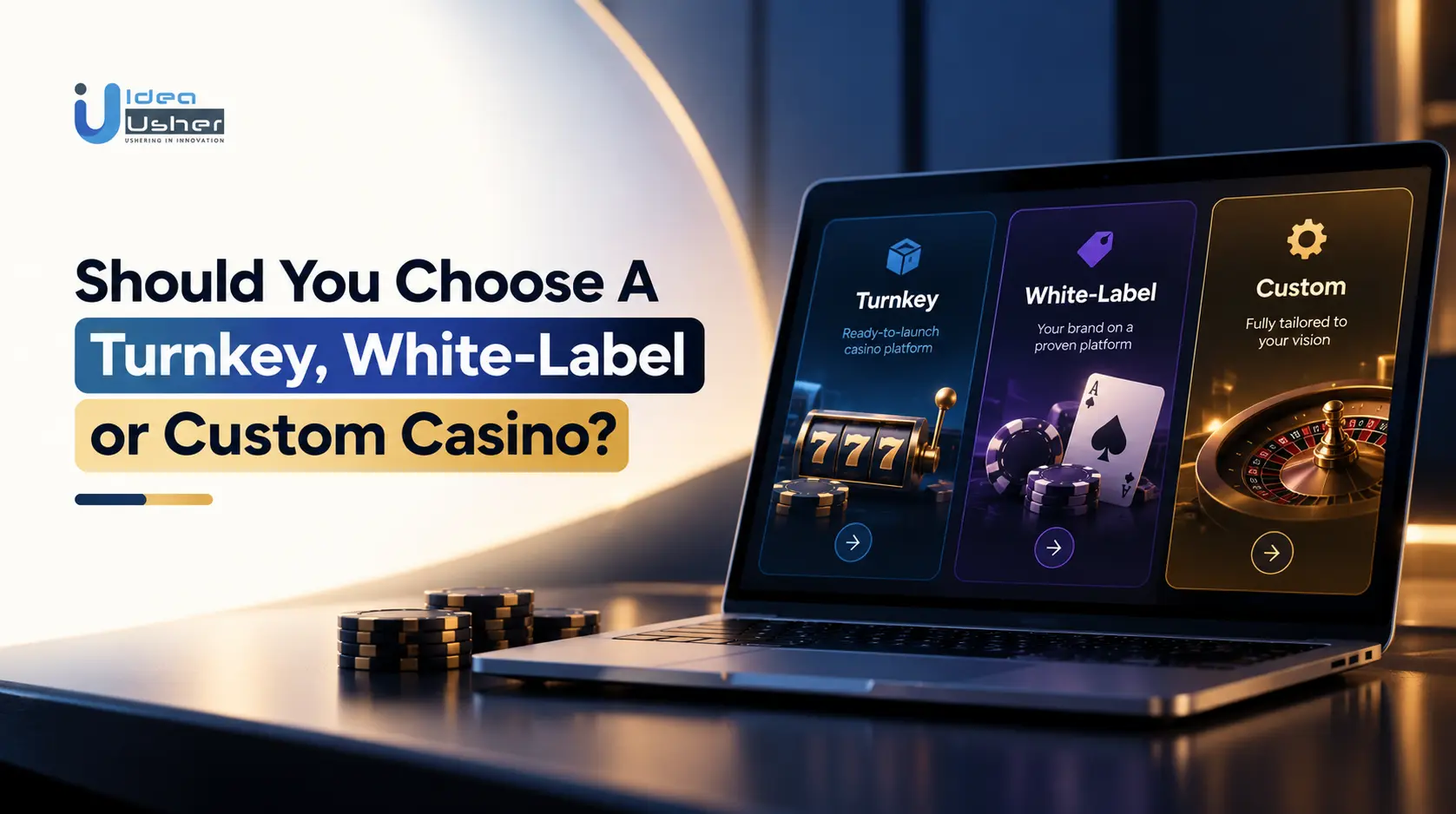
White label rents you a provider’s complete platform and license, while turnkey gives you a ready platform to run independently under your own license. In contrast, custom builds only the technology you choose to own, so your product can stand apart from every ready-made template on the market today.
Therefore, white label serves validation, turnkey serves operating independence, and custom serves product differentiation, so decide first by what you truly need to own.
1. What You Actually Get With Each Casino Model
First, every casino needs the same building blocks, and each bullet shows who supplies them in white label, turnkey, and custom. However, each model changes who supplies, owns, and maintains them.
- Hosting, security, and maintenance: provider-run, operator-chosen, fully owned.
- PAM/PMS and wallet: shared system, configurable platform, built to your rules.
- Games and payments: bundled, then chosen by you in turnkey and custom.
- KYC and support: provider-managed, contracted by you, designed around your market.
- CRM, bonus engine, and analytics: standard templates, configurable modules, proprietary logic.
- Mobile: branded template, customized front end, owned product.
2. White Label Lets You Rent Most of the Casino Stack
In practice, a white label casino runs on the provider’s platform, so you only add branding. Also, it is worthy of note that white label is not a license type.
- Provider-run infrastructure, hosting, and maintenance.
- A license held by the provider or its partner.
- Ready-made integrations, with payments and support varying by provider.
- Branding instead of deep platform ownership.
- Revenue share: up to 15% of GGR or 10% to 30% of NGR.
Best suited to founders prioritizing validation and launch speed.
3. Turnkey Gives the Operator More Independence
Turnkey gives you an existing platform that you operate yourself, though vendors define the term differently. For instance, minimal customization, operator-held licensing, and payment relationships are all included here.
- An existing platform configured for your brand.
- Your own operating setup and, commonly, your own license.
- Direct relationships with payment providers.
- Greater control over player data, depending on contract.
- More responsibility for compliance and daily operations.
4. Custom Makes the Technology Part of the Business
Put simply, custom is selective ownership, and not a rewrite of every casino component. Therefore, you build what differentiates your product and integrate the rest.
- Owned architecture, wallet, and PAM.
- Custom workflows, bonus logic, and back office.
- Proprietary player experience and analytics.
- Source code and IP rights, set by contract.
- Integrations and infrastructure shaped by your roadmap.
5. Hybrid and Modular Models Sit Between These Options
Alternatively, hybrid models mix owned and third-party components, so you choose what to build and what to integrate. Moreover, that choice shapes cost, speed, and control later.
- Custom front end with a third-party PAM.
- Custom wallet with aggregated games.
- External KYC and payment providers.
- Managed sportsbook feeds.
- Swappable modular infrastructure.
In short, white label rents most of the stack for fast validation. By contrast, turnkey gives you a platform and the responsibility to operate it independently. Finally, custom and hybrid models turn selected technology into assets you own.
Why Platform Choice Matters Beyond Launch Speed
Platform choice matters beyond launch speed because it decides who carries compliance, who controls payments, and how easily you can add products. However, launch happens once, but operating happens every single day afterward, with regulators, payment partners, and players all depending on how the platform behaves.
Therefore, the model you pick on day one quietly sets your compliance exposure, payment access costs, and expansion options for years to come.
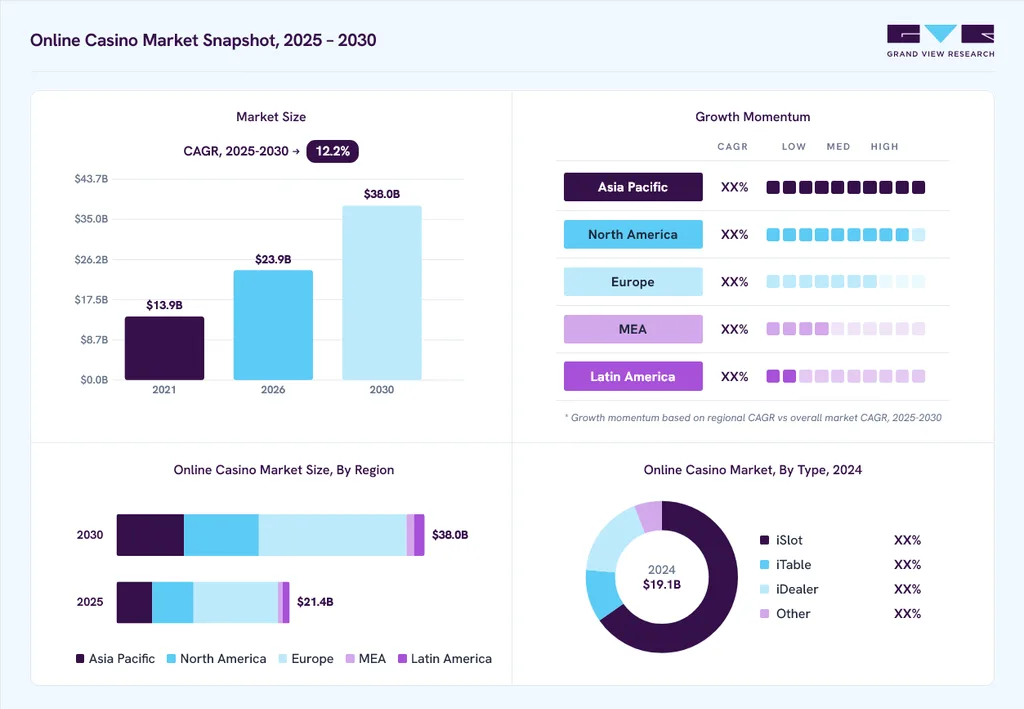
Moreover, the market rewards operators who can adapt quickly. Grand View Research projects the global online casino market will grow from $23.9 billion in 2026 to $38.0 billion by 2030, a 12.2% CAGR.
As a result, competition for players will likely intensify, so platform flexibility matters even more every year.
1. License Responsibility Changes With the Operating Model
First, the UK Gambling Commission states that compliance responsibility, even on white label sites, stays with the license holder and cannot be transferred. As a result, white label leaves that duty with your provider, while the turnkey makes you the holder.
- White label: your provider’s compliance record, good or bad, becomes your business risk.
- Turnkey: you answer for AML, responsible gambling, player protection, and vendor oversight.
- Vendors: the Commission expects oversight of contracted third parties, and weak controls can mean suspension or license loss.
- US states: online operators typically partner with a land-based license holder, so paths differ by state.
- Ask early: who holds the license, where, and what happens if it is suspended.
2. Payment Access Depends on Approvals and Relationship
In practice, platform support for a payment method does not mean you can use it. Consequently, several separate approvals and relationships, not API support alone, decide what actually works for your casino.
- Platform support: the software connects to a payment method through an API.
- PSP approval: the processor reviews your business, license, and target markets first.
- Merchant relationship: the account taking deposits belongs to you or your provider.
- Settlement: when funds reach you, some white-label contracts hold a 15% to 25% reserve.
- Chargebacks: disputed deposits count against the account holder’s ratios.
- Gambling restrictions: gambling is high risk, and lower-tier licenses can see 20% to 40% declines.
- Market availability: a processor may cover one country but not the next.
3. Successful Casinos Often Expand Beyond One Product
For instance, Fanatics, DraftKings, and FanDuel each launched combined apps in 2026, merging products under one account. Therefore, your first platform decides how easily each addition connects to your wallet, player data, and payments.
- Sportsbook: needs a shared wallet and managed odds feeds.
- Live casino: adds studio content, dedicated tables, and separate commercial terms.
- Crypto: needs wallet screening, blockchain monitoring, and Travel Rule controls.
- Loyalty: needs one balance across every product, as FanCash does at Fanatics.
- Prediction products: can face different rules than casino games.
- Proprietary games: need math models, RTP settings, and independent testing.
- New regions: bring local licenses, payments, and certification.
Overall, white label leaves compliance and payments largely with your provider, while turnkey moves both to you. Moreover, every extra product tests how well your platform connects wallet, data, and payments.
Ultimately, the best model is the one you can still operate after launch.
Compare the Three Models Before Looking at Price
At a glance, white label is fastest and most constrained, turnkey balances independence with responsibility, and custom offers the most control with the heaviest build. Moreover, the three models differ most on who holds the license, who controls payment relationships, and who owns the player data.
The two tables below compare them across business decisions and platform components before any pricing, so the shape of the choice is clear first.
1. Business and Ownership Decisions Across the Three Models
| Decision | White Label | Turnkey | Custom |
| Launch speed | Fastest, often weeks | Moderate, often months | Slowest, often a year or more |
| Upfront capital | Lowest | Moderate | Highest |
| License control | Provider’s license | Usually your own license | Your own license and compliance design |
| Player relationship | Your brand, but contract defines ownership | Operator-owned | Fully yours |
| Payment relationships | Mostly provider’s processors and accounts | Your own PSPs and merchant accounts | Your own, with custom cashier logic |
| Data access | Often limited; ownership varies by contract | Broader; varies by contract | Full access to your data stack |
| Product customization | Branding and templates | Configurable modules and front end | Full control by design |
| Revenue share | Highest ongoing share | Lower share or fixed fees | No platform share, but partners still charge |
| Technical ownership | Provider owns | Licensed platform; code rights vary by contract | You own, per contract |
| Internal team required | Lean: marketing and customer operations | Mid-size: compliance, payments, operations, support | Largest: product, engineering, compliance, operations |
| Expansion flexibility | Limited by provider’s license, roadmap, and markets | Broader, with your license and integrations | Highest; shaped by your roadmap |
| Exit complexity | High; data, payments, and license sit with provider | Moderate; depends on contract and integrations | Lowest vendor dependence, highest upkeep |
| Best fit | Validation and launch speed | Operating independence | Product differentiation |
2. Platform Components Across the Three Models
| Component | White Label | Turnkey | Custom |
| Hosting | Provider-hosted | Your servers or cloud; varies by vendor | Your cloud, your architecture |
| PAM/PMS | Shared provider system | Vendor platform you configure | Built or selected to your rules |
| KYC/AML | Provider tooling under provider’s license | You contract tools and run the process | You design workflows and vendor mix |
| Responsible gaming | Provider-managed tools | Configured tools you must enforce | Designed for your markets |
| Game providers | Provider’s bundled catalog | Aggregators or direct deals you choose | Direct, aggregated, or proprietary |
| RNG and certification | Provider’s certified platform and content | You manage testing per market | You arrange lab testing for platform and games |
| CRM | Standard or limited | Configurable or integrated | Built around your data |
| Bonus engine | Provider’s standard promotions | Configurable rules | Proprietary logic |
| Mobile | Branded template | Customizable front ends | Custom, mobile-first apps |
| Crypto | Depends on provider | Add cashier and compliance tools | Build wallet and chain logic, as a crypto casino platform needs |
| Customer support | Often provider-supplied; varies | Your team or outsourced | Your design and tooling |
| Maintenance | Provider handles | Shared between vendor and you | Your engineers or partner |
| Infrastructure scaling | Bound by provider capacity | You scale with vendor support | You design for scale |
In short, white label trades control for speed, turnkey trades some speed for independence, and custom trades time and capital for ownership.
For example, many white label contracts keep player data and payment accounts with the license holder, and leaving brings cost and a new compliance process. Consequently, choose by what you must own, not by the feature list.
Who Actually Runs the Casino Under Each Model?
In practice, your provider runs most of the casino under white label, including license, hosting, compliance, and payments, while you run brand and marketing. By contrast, turnkey has you run operations and compliance day-to-day on vendor technology, while custom also adds the technology itself and its upkeep.
Therefore, the real question is not what the software includes, but which responsibilities you will carry yourself and which ones you rent.
Who Runs Casino Under Each Model
| Responsibility | White Label | Turnkey | Custom |
| License | Provider holds it | You hold it | You hold it |
| Hosting | Provider | Your servers or cloud; varies by vendor | You |
| KYC/AML | Provider, as license holder | You, with vendor tools | You, with tools you select or build |
| Responsible gaming | Provider’s tools and policies | You enforce configured tools | You design and enforce |
| Payments | Provider’s processors | Your PSPs, vendor-assisted | Your PSPs and cashier logic |
| Payouts | Typically paid from provider-held accounts | You approve and release | You design approval rules |
| Fraud | Provider’s tooling | You, with vendor tools | You design rules and monitoring |
| Customer support | Often provider-supplied | You or an outsourced team | You or an outsourced team, on your tooling |
| Games | Provider’s catalog | Aggregators or direct deals you choose | Direct, aggregated, or proprietary |
| CRM | Provider templates | You configure | You build |
| Bonuses | Provider’s standard promotions | You configure rules | You design logic |
| Data | Provider holds it; contract sets access | Contract sets access; usually broader | You hold it |
| Maintenance | Provider | Shared with vendor | You or your partner |
| Scaling | Provider’s capacity | You, with vendor support | You design for scale |
Importantly, “you” means you carry the duty, even when a vendor supplies the tool.
For example, the UK Gambling Commission expects licensees to keep oversight of the third parties they contract. Consequently, turnkey and custom need in-house compliance, payments, and operations skills.
What You Really Own Under Each Casino Model
First, paying for a platform does not mean you own it, since payment alone does not transfer software rights. Therefore, check each asset separately, using the table below.
Assets Owned Under Each Casino Model
| Asset | White Label | Turnkey | Custom |
| Brand and domain | You own (migration needs planning) | You own | You own |
| License | Provider owns | You own | You own |
| Player data | Provider often holds it | Contract decides | You own |
| Payment accounts | Provider-owned accounts | Your accounts | Your accounts |
| Source code and IP | Provider owns | Contract decides | You own, if the contract assigns it |
| Wallet and PAM | Provider owns | Contract decides | You own |
| Game contracts | Provider bundles them | You or your aggregator | You or your aggregator |
| Back-office settings | Stay in the provider’s platform | Contract decides; confirm export | You own |
Finally, get these in writing before you sign, and use Idea Usher’s vendor question table to cover data, code, and termination terms.
- IP assignment and repository access for your code.
- Data export terms, including format and timing.
- Every account, including payments and hosting, registered in your name.
- For EU players, GDPR Article 20 covers data they provided, so your platform must export it in a machine-readable format.
In short, white label rents the license, payments, and data custody; turnkey hands you operations and accounts, and custom gives you the stack. Moreover, ownership depends on contract wording, not the model’s name. Therefore, treat the contract as the real ownership document.
Your License Can Eliminate Options Before Development
Licensing affects the platform decision because white label usually runs under a provider’s license, while turnkey and custom usually need your own license. Therefore, choose your jurisdiction and license path first, before choosing software, because a regulator can rule out a model, provider, or market entirely.
As a result, the right question is not which platform to buy, but whose license it will run under and in which markets.
1. How Licensing Usually Works With White Label
First, a licensed operator offers the gambling facilities, and you supply the brand and marketing. For example, the UK Gambling Commission says the operator, not the white label partner, holds the license.
- Liability: breaches on a white label site are the licensee’s liability, not the partner’s.
- Due diligence: the operator must vet its white label partners.
- Market limits: the provider’s license defines where you can operate.
- Do you need your own license? Usually not to launch, but your reach depends on theirs.
2. Turnkey Usually Moves Licensing to the Operator
In the common turnkey model, you hold the license, so you answer to the regulator directly. Therefore, operational independence means owning the duties a white label provider would otherwise carry.
- Apply for and keep the license, including fees and reporting.
- Set up your own company, bank, and merchant accounts, which SoftGamings lists alongside licensing in its turnkey path.
- Run or contract your compliance, support, and fraud teams.
- Oversee your vendors, because responsibility stays with you.
3. Custom Software Does Not Replace a Gambling License
Custom software is technology, not permission to accept bets. Therefore, even a fully owned platform needs a license before it takes real-money players.
- Owning the code does not transfer regulatory permission.
- The MGA requires a B2C license to offer a gaming service from Malta.
- Your license can shape the build, since the MGA publishes system documentation, audit, and review checklists for applicants.
- Plan the license path alongside the build, as Idea Usher’s secure and scalable casino app guide outlines.
4. Jurisdiction Changes the Economics of Every Model
Jurisdiction sets fees, taxes, and timelines, so it changes which model makes financial sense. For example, MGA currently lists a €5,000 B2C application fee and a €25,000 fixed annual license fee, before other applicable contributions and taxes.
| Jurisdiction | Published figures | What it means for you |
| Malta (MGA) | €5,000 application; €25,000 fixed annual fee; 5% gaming tax; compliance contribution extra | Your own license. Several game types under one license |
| United Kingdom (UKGC) | Remote Gaming Duty 40% from April 1, 2026 (was 21%); Commission fees up about 25% from October 1, 2026 | Tax weighs heavily on margins |
| Curaçao (CGA) | €4,592 application; €47,450 annual B2C fee | Direct license only, and sublicensing has ended |
| United States (New Jersey example) | $100,000 non-refundable deposit, credited to an issuance fee of at least $400,000; renewal of at least $250,000; plus $250,000 yearly to a state fund | Operators work through licensed casinos, and ach state differs |
5. KYC, AML, and Responsible Gaming Still Need Clear Owners
Whichever model you choose, someone must verify players, monitor money laundering risk, and enforce safer gambling. Therefore, name an owner for each duty in writing, because the UK Gambling Commission says licensees must know their customers and show oversight.
- White label: the provider runs the tooling as license holder, and you follow its policies.
- Turnkey: you run KYC, AML, and responsible gaming with vendor tools.
- Custom: you design the workflows and choose the vendors.
- Curaçao: licensees face mandatory AML/KYC, dispute resolution, and responsible gambling policies.
6. Game Certification and RNG Depend on What You Build
Certification follows what you build or change, not the model’s name. For example, GLI-19 sets the technical standards for interactive gaming systems, including platform, RNG, and game requirements.
- White label: the provider’s certified platform and content usually carry you, so confirm your markets are covered.
- Turnkey: you manage testing per market, so confirm the vendor’s certificates fit your license.
- Custom: you submit platform and games to an approved lab, and platform certification does not automatically cover the games on top.
- Labs: GLI, BMM, eCOGRA, and iTech Labs, which GLI acquired in 2023.
- RNG audits: Idea Usher’s casino game development guide notes that laws require authorized labs to audit your RNG.
7. US Casino Launches Depend on State-Level Regulation
In the United States, there is no federal online casino license, so each state sets its own rules. Therefore, platform choice must follow the state, not the other way around.
- Market access: operators typically partner with a land-based license holder, and in Michigan, each license supports one online skin.
- Geolocation and KYC: New Jersey uses geolocation to confirm players are inside the state and requires them to be 21.
- Vendor approvals: New Jersey lists ancillary vendors that must file applications before contracting with casino licensees.
- Platform and payments: one consultancy says payment processors and platform providers need separate authorization, so pick vendors already approved in your target state.
In short, white label borrows a license, turnkey makes you the holder, and custom adds technology but not permission. Moreover, jurisdiction, KYC and AML duties, certification, and US state rules all narrow which models are feasible. Therefore, settle the license path before you commit to a platform.
Payment Access Can Rule Out a Platform Fast
Payments can change the casino-model decision because your platform may support a payment method that no processor will approve for your business.
However, white label usually runs on the provider’s merchant accounts, while turnkey and custom need your own approvals with fiat PSPs, crypto gateways, or both.
Therefore, check who holds the merchant relationship, and who bears chargeback risk, before you choose a platform, because a rejected application can delay launch.
1. White Label Can Bundle Payment Infrastructure
First, a white label provider often brings pre-integrated processors, so you can accept deposits without negotiating with banks. However, that convenience also hands the provider’s merchant accounts, fees, and approvals control over your cash flow.
- Convenience: processors, cashier, and sometimes crypto gateways arrive pre-integrated.
- Dependency: deposits typically settle into the provider’s accounts, so reserves and payout timing follow its contracts.
- Limited choice: adding your own PSP or crypto gateway usually needs provider approval.
- Switching cost: leaving means rebuilding every payment relationship.
2. Turnkey Gives More Control but More Responsibility
By contrast, turnkey has you apply for your own merchant accounts and choose your PSPs, so you control fees, routing, and settlement. Consequently, you also carry onboarding, reserve, and chargeback risk.
- Merchant onboarding: each PSP or acquirer reviews your company, owners, license, and target markets before approval.
- PSP relationships: you negotiate rates, settlement timing, and reserves yourself.
- Chargebacks: card disputes count against your merchant ID, and Mastercard flags merchants at 100 monthly chargebacks and a 1.5% ratio.
- Crypto gateways: they avoid card chargebacks, but you still handle wallet screening and blockchain monitoring, and settled withdrawals cannot be reversed.
- Team: budget for payments, risk, and reconciliation skills, in-house or contracted.
3. Custom Lets You Design the Payment Layer
Finally, custom lets you design the payment layer, from gateway integration to cashier and reconciliation, instead of accepting a vendor’s defaults. Therefore, you decide how money moves, how it is checked, and how it is matched to the ledger.
- Routing: send each transaction to the best PSP by market, currency, or approval rate.
- Cashier: one deposit and withdrawal experience across fiat and crypto.
- Deposit workflows: limits, source-of-funds checks, and geo rules before funds move.
- Withdrawal workflows: approval rules, KYC gates, and payout speed by method.
- Reconciliation: match player balances against PSP settlements and crypto wallets.
- Fiat and crypto: run both rails through one wallet and ledger.
- Fraud controls: score deposits and withdrawals before release.
4. Test Payment Eligibility Before Signing the Platform
First, ask one question in writing: can your intended entity, license, market, currency, and gambling product actually use the proposed PSP? Moreover, ask at least two payment providers for a soft indication before you apply, because approval depends on your exact profile.
- Entity: will the PSP onboard your company, owners, and jurisdiction?
- License: does it accept your license tier, or push you toward a high-risk processor?
- Market: is it live in every country you plan to launch in?
- Currency: can it settle in your players’ currencies and your payout currency?
- Gambling product: does it accept casino, sportsbook, or both?
- Crypto: will a gateway and a banking partner support your license, assets, and monitoring needs?
- Contract: are reserves, settlement timing, chargeback duties, and exit terms in writing?
White label bundles payments but keeps the merchant relationship with the provider, while turnkey gives you control and the approvals that come with it. Moreover, custom lets you design routing, cashier, and reconciliation across fiat and crypto. Therefore, confirm payment access in writing before you sign the platform.
Compare Total Cost And The Platform Quote
White label setup runs $50,000 to $200,000 plus 15% to 30% of GGR, while turnkey runs $100,000 to $300,000 plus about 7%. By contrast, a scoped custom development engagement runs $70,000 to $300,000 with no platform revenue share, though it excludes licensing, staff, and marketing.
Therefore, the model that costs more over time depends on your revenue, because revenue share grows with GGR while ownership costs stay mostly fixed.
1. What White Label Costs After Revenue Share
At first glance, white label looks cheapest, but revenue share keeps charging for as long as you stay. Therefore, price it with this formula: setup + monthly platform fee + revenue share + payments + games + operations.
- Setup: $5,000 to $50,000 for a basic setup, with fuller packages costing more.
- Monthly platform fee: $2,000 to $15,000.
- Revenue share: 15% to 30% of GGR in the cost guide
- Payments and games: often billed separately, with aggregated slots taking 10% to 20% of slot GGR and cards costing 1.5% to 3.5% per transaction.
2. What Turnkey Costs Once You Run the Operation
Turnkey costs more to launch, but a lower revenue share changes the math as volume grows. Therefore, price it with this formula: platform + license + compliance + payments + integrations + operations.
- Platform: $100,000 to $300,000 upfront and about 7% revenue share, with a 3- to 6-month launch.
- License and compliance: paid separately, for example, Malta at €5,000 plus €25,000 a year.
- Integrations: $2,000 to $15,000 each for extra payment or game providers.
- Payments and operations: paid separately, including staff, so ask exactly what the revenue share covers.
3. What a Custom Casino Actually Costs to Own
First, a scoped custom development engagement runs $70,000 to $300,000, and that covers building, not running the casino.
Therefore, treat development cost and launch cost as two different budgets, because development cost is not the entire casino business cost.
4. Custom Casino Build Cost Phase-By-Phase
| Phase | What it covers | Estimated range |
| 1. Discovery and architecture | Scope, jurisdiction needs, build-versus-integrate decisions | $5,000 to $20,000 |
| 2. Core platform build | Wallet, PAM, back office, admin tools | $25,000 to $110,000 |
| 3. Third-party integrations | Game aggregator, PSPs, crypto gateways, KYC | $15,000 to $70,000 |
| 4. Player experience | Web and mobile front end, bonus and CRM hooks | $15,000 to $60,000 |
| 5. Testing and launch support | QA, security testing, certification preparation, deployment | $10,000 to $40,000 |
| Total development | $70,000 to $300,000 | |
| Annual maintenance after launch | 15% to 20% of build cost | About $10,500 to $60,000 a year |
Want this scoped to your market? Request a phased platform estimate from Idea Usher.
- Not included in the range: licensing, lab certification, payment reserves, game revenue share, staff, and marketing.
- Full launch budget: $100,000 to $4 million or more in the first year, depending on market and scale.
5. When Higher Ownership Can Improve Long-Term Economics
Generally, higher ownership pays off only when volume is high enough to spread fixed costs across growing GGR.
For example, at $500,000 monthly GGR, a 15% share costs $75,000 a month, while a 5% share costs $25,000.
- ROI: returns come from avoided revenue share, minus added build, license, and staffing costs.
- Revenue share: SoftGamings lists up to 15% of GGR for white label and 2% to 5% for turnkey, so the gap widens with scale.
- Retained margin: NGR is commonly 55% to 75% of GGR after platform, game, tax, bonus, and chargeback costs, so a few points of share matter.
- Scale: custom helps most when your product itself differentiates, not only your fees.
6. Use a 12-, 24-, and 36 Month TCO Comparison
First, compare models on total cost at 12, 24, and 36 months, not on setup price alone.
TCO Comparison Table
| Monthly GGR | Horizon | White label (15% share) | Turnkey (7% share) | Custom (no platform share) |
| $100,000 | 12 months | $180,000 | $84,000 | $0 |
| $100,000 | 24 months | $360,000 | $168,000 | $0 |
| $100,000 | 36 months | $540,000 | $252,000 | $0 |
| $300,000 | 12 months | $540,000 | $252,000 | $0 |
| $300,000 | 24 months | $1,080,000 | $504,000 | $0 |
| $300,000 | 36 months | $1,620,000 | $756,000 | $0 |
Importantly, this table shows revenue share only, and custom still pays engineering, hosting, and maintenance. For example, subtract the extra setup, license, staff, and maintenance you take on from the share you avoid.
Consequently, the month where avoided share exceeds ownership cost is your break-even, and it moves with your GGR.
What Should Be Custom and What Should Stay Third Party
Founders do not need to build the whole casino, because strong platforms usually own only the layers that actually differentiate them. Moreover, specialist infrastructure such as games, identity checks, geolocation, PSPs, and certification is mature, regulated, and rarely worth rebuilding yourself from scratch.
Therefore, custom casino software development should include the player, wallet, bonus, and data layers that shape your product, and integrate the rest through proven APIs.
1. Build the Layers That Create Real Differentiation
First, build the layers where your product, data, or economics can beat a vendor’s template. Therefore, each layer below is worth owning only if it changes how players experience your casino or how you earn.
| Custom layer | Why it can be worth owning |
| Player account management | Holds onboarding, limits, segments, and compliance flags in one record |
| Wallet and ledger | Gives one balance across casino, sportsbook, and new products |
| Bonus engine | Lets you design offers and wagering rules a template cannot |
| Loyalty | Ties rewards to behavior across every product |
| Proprietary UI | Shapes the player experience and your brand |
| Back office | Matches your risk, support, and finance workflows |
| Player analytics | Keeps your data and models in your own stack |
| Payment orchestration | Routes by market, currency, and approval rate |
| Risk workflows | Encodes your own fraud, bonus abuse, and withdrawal rules |
| Sportsbook-casino experience | Delivers one account, wallet, and journey across products |
| AI personalization | Uses your player data for offers and game suggestions |
For example, a sportsbook client of Idea Usher added casino content through a unified wallet, single sign-on, and CRM sync. As a result, that guide reports 28% longer sessions and 15% higher ARPU for the client.
2. Integrate Mature Infrastructure Where It Makes Sense
Meanwhile, integrate categories where specialists already carry the approvals, data, and scale. Therefore, rebuilding them adds cost and risk without adding a player-facing advantage.
| Third-party category | Why integrate it |
| Game studios | You license content, and building studios is a separate business |
| Aggregators | One API and contract replace many studio integrations |
| Identity verification | Specialists already maintain document and AML checks |
| Geolocation | Regulated markets require approved, tested location tools |
| PSPs | Merchant approvals and bank relationships cannot be coded |
| Certification | Only independent labs can certify your RNG and platform |
| Live data | Licensed suppliers provide real-time results and statistics |
| Odds feeds | Trading specialists provide odds and markets |
Above all, ownership should follow differentiation, not ambition. As a result, the strongest custom platforms follow one rule.
“The strongest custom platforms usually own the technology that creates differentiation while integrating specialist infrastructure where rebuilding would create cost without strategic value.”
3. Mobile and Crypto Requirements Can Change the Architecture
Finally, mobile and crypto requirements can change which components you build or integrate. Therefore, decide them early, before you design the account and wallet layer.
| Requirement | What it changes | Custom or integrate? |
| Responsive web | One build reaches every browser, with wider device reach but fewer device features than native | Custom front end on shared APIs |
| Native app | Better device experience, but store rules apply, and apps can be removed without a valid license | Custom front end; cross-platform frameworks such as React Native or Flutter reduce duplicate work |
| Shared account and wallet | Web, app, and sportsbook must call one service, so balances never diverge | Build and own |
| Crypto cashier | On-chain payments are irreversible, and custody and AML duties are heavy | Usually integrate; Track360 advises buying and integrating the cashier unless it differentiates you |
| Blockchain functionality | Provably fair proofs or tokenized loyalty add smart contract and audit work, and they are not yet standard in regulated markets | Custom only if it is part of your product; otherwise skip or integrate |
In short, build the layers that differentiate your casino, and integrate the specialist infrastructure that regulators and players already trust.
Moreover, mobile and crypto choices should be made early, because they shape the account and wallet layer. Therefore, custom means selective ownership, not rebuilding every component.
Which Casino Model Fits Your Business Stage
Choose white label to test a market quickly, turnkey to operate independently, and custom when the platform itself is your competitive edge.
Moreover, modular architectures sit between turnkey and custom, so sportsbook operators and multi-product casinos often mix owned and third-party components to balance speed and control.
Therefore, find your scenario below, then confirm the license, payment relationships, and data ownership in writing before you sign any platform agreement.
1. First-Time Founder Testing One Market
Choose white label when you are a first-time founder testing one market and need to validate demand before committing capital. Moreover, it launches in 4 to 8 weeks, though revenue share and limited control apply.
- Upgrade when GGR is steady or the provider restricts your markets.
- Avoid it if you need your own license or payment accounts.
2. Experienced Operator Launching a New Casino Brand
Choose white label when the new brand is a test or portfolio extension, and choose turnkey when you want your own license, payments, and data. Therefore, license and control decide this case, not experience alone.
- Ask first: which markets will the provider’s license allow?
3. Operator With Its Own License and Operations Team
Choose turnkey when you already hold a license and have compliance, payments, and support teams ready to run the casino. Alternatively, choose a modular stack when you want to swap PAM, games, or payments without rebuilding.
- Fit: you already carry the duties turnkey assumes.
4. Sportsbook Adding Casino to an Existing Product
Choose custom integration when your sportsbook already has accounts, a wallet, and a CRM that the casino must share. Otherwise, choose a modular architecture when you want specialist casino content without building a second wallet.
- Test: one wallet, one login, and one CRM across products.
5. Casino Expanding Into Multiple Betting Products
Choose custom or a heavily modular architecture when you plan to add sportsbook, live casino, crypto, or prediction products to one account.
For example, Fanatics, DraftKings, and FanDuel each launched combined apps in 2026.
- Idea Usher’s guide to a casino app like Fanatics treats the sportsbook module as part of one app.
6. Large Operator With Proprietary Product Strategy
Choose custom when your product strategy, data, and economics are the business, and you can fund engineering for years. However, you still integrate licensed content, KYC, and certification, because custom means selective ownership.
- Trade-off: upkeep of about 15% to 20% of build cost a year.
In short, choose white label to test, turnkey to operate, modular to mix, and custom to differentiate. Moreover, move up a model only when volume, licensing, or product strategy justifies the cost. Revisit your choice as your stage changes.
How Idea Usher Builds a Custom Casino Platform
If custom is right, Idea Usher builds the platform layers that make your casino distinct and integrates specialist infrastructure everywhere else. Moreover, the layers span player accounts, wallet, cashier, bonus engine, back office, KYC and AML, integrations, analytics, fraud workflows, mobile apps, and infrastructure.
Therefore, the first deliverable is an ownership map, so every layer is either built, integrated, or deliberately left to a vendor with a clear contract.
1. Product and Ownership Architecture
First, the engagement starts with an ownership map, because every later cost, contract, and compliance decision follows from it.
Our team defines what you own, what stays external, and where intellectual property boundaries sit.
- Operator-owned: wallet, PAM, bonus logic, and player data where they create differentiation.
- External: game content, KYC vendors, PSPs, geolocation, and certification labs.
- IP boundaries: code assignment, repository access, and contract terms set before the build.
- Data architecture: one player record shared across products, with export rights.
- Provider dependencies: a register of each vendor, its contract, and its exit path.
2. Player Account and Identity Infrastructure
Next, the player account is the system of record for identity, limits, and permissions. Therefore, KYC, responsible gaming, and region rules attach to one account, not to each product.
- Registration and onboarding flows
- Account management and role-based permissions
- KYC and identity verification integrations
- Responsible gaming limits, self-exclusion, and cool-off tools
- Multi-region controls, such as geo-blocking and per-market limits
3. Wallet, Ledger, Deposit, and Withdrawal Systems
Meanwhile, the wallet and ledger protect financial integrity, while the cashier shapes how fast and clear payments feel. Therefore, we design both together, so every credit and debit is recorded and reconciled.
- Ledger: real-time tracking, so every credit and debit is accounted for.
- Deposits: fiat and crypto methods through integrated payment gateways, with limits and checks first.
- Withdrawals: approval rules, KYC gates, and payout speed by method.
- Reconciliation: player balances matched against PSP and wallet settlements.
- Player experience: clear status, fast confirmation, and one balance across products.
4. Casino Game and Aggregator Integrations
In practice, game content arrives through aggregator and studio APIs, so the platform works as an orchestration layer. Therefore, you can add or remove providers without rebuilding the casino.
- Aggregator and direct studio APIs
- Game launch, session, and balance callbacks
- Catalog, search, and merchandising controls
- Certified RNG from approved labs, not an in-house build
5. Sportsbook and Cross-Product Integrations
Moreover, the platform treats sportsbook and casino as one product on one account. For example, Idea Usher’s published sportsbook case used a unified wallet, single sign-on, and CRM synchronization.
- Unified wallet: instant transfers between products.
- Single sign-on: one login across sportsbook and casino.
- CRM synchronization: sports bets can trigger casino offers.
- Reported outcome: 28% longer sessions and 15% higher ARPU.
6. Custom Back Office and Operator Tools
Meanwhile, the back office is where your team runs the casino every day. Therefore, it follows your workflows, not a vendor’s default screens.
- Players and support: profiles, limits, notes, and ticket history.
- Bonuses and content: offer rules, wagering terms, banners, and promotions.
- Payments and risk: withdrawal approvals, fraud flags, and limits.
- Reporting and compliance: revenue, regulator reports, and audit logs.
7. Analytics and Player Intelligence
Next, analytics should show which players, games, and offers drive retention and margin. Therefore, owned data pipelines make sense where player data is a competitive asset.
- One event pipeline from wallet, games, sportsbook, and CRM
- Dashboards for revenue, retention, and bonus cost
- Segments and churn signals for CRM
- AI personalization, only where data volume justifies it
8. Security, KYC, AML, and Regional Controls
Furthermore, security and compliance controls are designed in from the start, not added after launch.
Indeed, Idea Usher’s casino material positions KYC and AML workflows, transaction monitoring, fraud detection, and security as platform layers.
- KYC and AML workflows with identity verification vendors
- Transaction monitoring and fraud detection
- Secure data handling and access controls
- Geo-blocking and regional rules per market
- Responsible gaming tools tied to the account
9. Infrastructure Designed for Future Product Expansion
Finally, infrastructure should let casino, sportsbook, payments, player data, and future betting products work as one system. Therefore, the architecture uses shared services and APIs, so a new product plugs in without a rebuild.
- Shared account, wallet, and data services across every product
- Mobile architecture with responsive web and mobile-first apps on the same APIs
- Scalable, secure architecture with monitoring and load testing before launch
- Room for sportsbook, live casino, crypto, loyalty, or prediction products
Custom works when each layer is deliberately owned, integrated, or left to a vendor, and the whole platform behaves as one system.
Therefore, to scope which layers fit your market, talk to Idea Usher’s iGaming team before you commit to a platform.
Conclusion
The turnkey vs white label casino decision comes down to what you need to own: license, payments, player data, and exit rights. Therefore, choose white label to validate, turnkey to operate independently, and custom only where the platform creates your edge. Finally, confirm each asset and payment account in writing before you sign.
FAQs
Q1. Who handles KYC and AML in a white-label casino?
A1. In a white-label casino, the license holder, usually your provider, carries KYC and AML responsibility and runs the tooling. However, you still follow its policies, collect documents, and support players through verification. Therefore, confirm in writing who reviews flagged accounts, files suspicious activity reports, and answers regulators before launch.
Q2. What is included in a turnkey casino platform?
A2. A turnkey platform usually includes player account management, wallet, back office, game aggregation, and basic payment integrations. However, licensing, payment contracts, staff, and extras such as sportsbook, live casino, CRM, or bonus tools are often separate. Therefore, ask each vendor for a written scope list and price every add-on.
Q3. Can a casino platform support crypto and mobile apps?
A3. Yes, a casino platform can support crypto and mobile apps, but support varies by model. Moreover, crypto usually arrives through an integrated gateway, while mobile runs on responsive web or native apps over shared account and wallet services. Therefore, confirm your license allows crypto and that one wallet serves every channel.
Q4. What should I ask a casino software provider before signing?
A4. Ask who holds the license, who owns player data and code, and what the revenue share covers, including GGR or NGR. Moreover, request payment account ownership, lab certifications, add-on prices, integration fees, and exit terms. Therefore, treat any vague or unwritten answer as a risk before you sign.
Q5. Is turnkey better than a white-label casino?
A5. Turnkey is better when you want your own license, payment relationships, and data, while white label is better for fast, low-capital validation. Moreover, turnkey often costs $100,000 to $300,000 upfront, against $50,000 to $200,000 for white label. Therefore, choose based on the control you need.
Q6. Do I need my own gambling license for turnkey software?
A6. Usually yes, because in the common turnkey model you hold the license, though rules vary by jurisdiction. For example, Malta licenses operators directly, Curaçao now issues direct licenses only, and US states typically require a land-based partner. Therefore, confirm your target market’s license path before you sign any platform agreement.
Q7. Can I move from white label to a custom casino later?
A7. Yes, but plan the move early. First, secure data portability, domain control, and player export rights. Next, open your own payment accounts and game contracts. Finally, run a phased migration with regulator and player notice, because leaving white label brings cost, technical complexity, and a new compliance process.
Q8. Can one platform support casino and sportsbook products?
A8. Yes, if player accounts, wallet, CRM, data, payments, and product integrations are designed to work together. For example, a unified wallet, single sign-on, and synchronized CRM let players move between casino and sportsbook without friction. Therefore, plan the shared account and wallet layer before you add the second product.