

Key Features
- To develop an AI obituary platform, you need to combine AI-powered obituary generation, family collaboration, memorial pages, and secure data management.
- The development cost typically ranges from $35,000 to $250,000+, depending on features, integrations, and platform complexity.
- Core features can include AI writing assistance, personalized templates, photo and video sharing, family editing, and obituary publishing.
- Advanced platforms can add voice input, multilingual generation, AI personalization, funeral home integrations, and digital memorials.
- See how IdeaUsher can help businesses develop custom AI obituary platforms with scalable features and tailored funeral-tech workflows.
Developing a specialized AI obituary and memorial platform requires a thoughtful combination of empathetic user experiences, conversational AI, and secure data management. Within the funeral technology space, these platforms aim to ease the burden on grieving families and funeral professionals by simplifying the process of creating meaningful tributes without having to start from a blank page. When someone is grieving, finding the right words can feel especially difficult, and an AI-powered platform can help turn memories, stories, and important life details into a thoughtful first draft that families can review and personalize.
The cost of building an AI obituary platform can range from around $35,000 for a focused MVP to $250,000 or more for a feature-rich platform with advanced AI, memorial pages, family collaboration, integrations, and enterprise-grade security. In this blog, we’ll explore the key features, development costs, technology stack, and process involved in building an AI obituary platform.
Why Funeral Homes Are Adopting AI Obituary Writers?
Funeral homes are adopting AI obituary writers because they turn a time-consuming drafting task into a faster review process, giving directors more time to support grieving families. Funeral directors are increasingly offering families AI-assisted obituary creation, showing growing interest in the technology. According to 360 Research Reports, the global funeral home software market is estimated at $2.6 billion and is projected to reach $6.74 billion by 2035, growing at a 11.17% CAGR. For businesses building an AI obituary platform, this signals an established B2B market with growing demand.
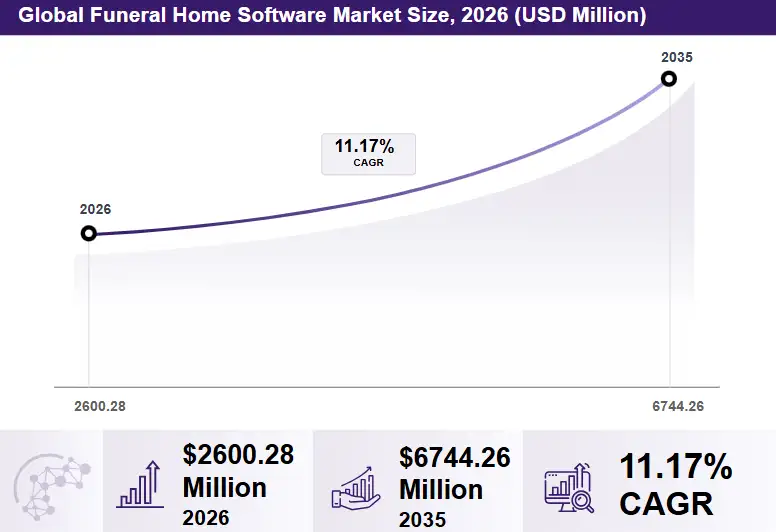
Source: 360 Research Reports
Reducing the Burden on Funeral Directors
Writing an obituary can take hours while directors are also managing arrangements, paperwork, and family communication. Passare’s VP of Product and Marketing, Josh McQueen, said funeral directors reported spending hours on a single obituary. AI helps by creating a first draft that staff can review and personalize.
Passare’s AI Obituary Writer, launched in August 2023, uses existing case information to create drafts in different tones. The company says its AI tools have produced tens of thousands of obituaries nationwide.
AI Features From Passare
- AI Obituary Writer: Eight tone options, including formal, poetic, and compassionate.
- AI Scanner: Extracts case information from first-call or vitals sheets.
- AI Assistant: Works with case information inside the platform.
- Built-in Review: Warns users that AI-generated details should be checked.
This shows why human review remains essential when building an AI obituary platform.
Helping Families Create Tributes Faster
Families often need to create an obituary without having a finished life story ready. AI tools can collect details through prompts and turn them into a draft within minutes. Tribute Technology’s Tribute Obituary Writer asks about careers, achievements, interests, and hobbies before generating the obituary.
AI Obituary Tools
| Tool | Notable update | Family controls |
| Tribute Obituary Writer | Released March 20 | Creativity level and memorable quotes |
| PlotBox AI Obituary Assistant | Unveiled June 17, 2024 | Prompts, quotes, and personal details |
| PlotBox EverAfter | Planned cross-functionality | Obituaries, memorial cards, and photographs |
AI can quickly adjust tone and length. An NFDA survey found 55.3% of funeral professionals were interested in AI, while a SurveyMonkey Audience survey for Choice Mutual found 65% of Americans were wary of AI for their own or a loved one’s funeral. Family editing and approval can help address this concern.
Streamlining Obituary Workflows
AI can connect the fragmented obituary process into one workflow:
- Capture: Collect family details and stories.
- Draft: Generate the obituary based on tone and length.
- Review: Verify names, dates, and facts.
- Publish: Send approved content to websites, memorial pages, and newspapers.
- Sync: Save the final information to the case record.
Legacy.com’s Publishing Model
Legacy.com’s ObitWriter allows families and funeral directors to create obituaries and publish them to more than 2,600 newspapers or Legacy.com. In 2023, McClatchy selected Legacy to manage obituary intake, death verification, content screening, and print-ready delivery, supported by more than 30 specialists.
The key takeaway is that AI writing is only one part of the platform. Verification, publishing, automation, and record synchronization can turn an AI obituary writer into a complete funeral technology solution.
The AI Obituary Workflow From Input to Publication
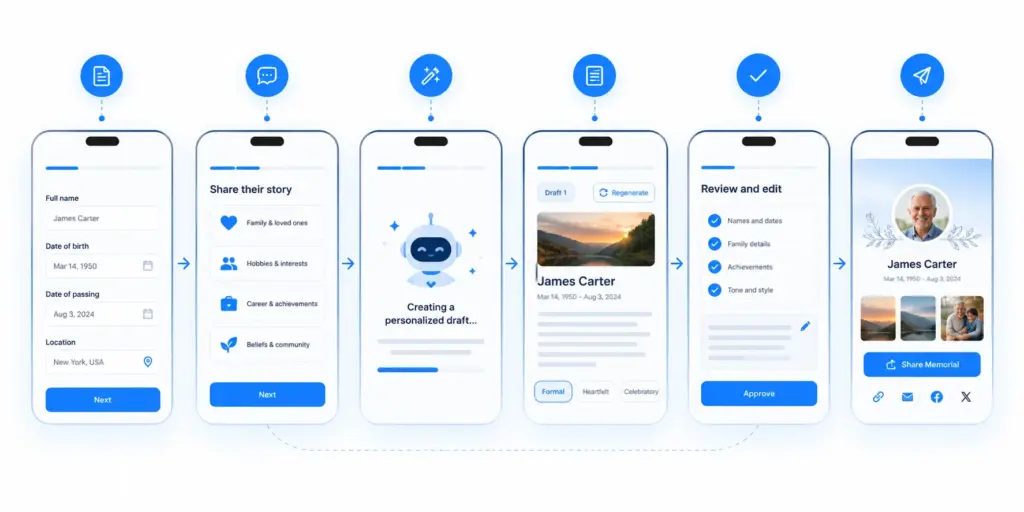
The AI obituary workflow typically moves from collecting biographical details and family memories to AI-generated drafting, human review, approval, and final publication. The platform uses the information provided by families or funeral homes to create a personalized obituary, allows users to adjust the tone and details, and then publishes the approved version across funeral home websites, memorial pages, or newspapers.
1. Collect Biographical Information
The process begins with verified details such as the person’s name, dates, education, career, service information, and media. Ever Loved keeps this step simple by asking for basic information and generating an obituary draft from it.
| Data point | What the platform collects | Why it matters |
| Identity | Full name, nickname, age | Anchors the obituary |
| Dates and places | Birth, death, residence | Reduces factual errors |
| Education and career | Schools, employers, military service | Adds life achievements |
| Service details | Date, time, venue, donations | Completes the notice |
| Media | Photo and optional video | Supports memorial content |
Ever Loved’s AI obituary service is free, while traditional newspaper obituaries can cost hundreds or thousands of dollars. This makes a quick, low-friction intake experience important for adoption.
2. Ask Relationship-Based Questions
Basic facts create a notice, but personal relationships make it a tribute. The platform can ask about family, friendships, traditions, and the person’s role in their community. Passare’s guidance also shows how AI can turn long survivor lists into more readable and personal sections.
Example Questions
- Who were the closest people in their life?
- What traditions or habits will people remember?
- What role did they play in the family or community?
- Who should be listed as survivors?
- Which causes or communities mattered to them?
Even a short answer such as “mom enjoyed gardening” can give the AI enough context to develop a more personal passage.
3. Build the Life Story Context
The platform then organizes the family’s answers into context the AI can use. This helps the obituary sound personal instead of like a generic template. Keeper Memorials launched a ChatGPT-powered biography and obituary assistant on March 2, 2023 as an optional feature. Keeper says families from over 200 countries use its platform each month, alongside its digital memorial tools for families, cemeteries, and funeral homes.
4. Generate the First Draft
The AI combines the collected facts and stories into an initial obituary. Strong platforms let families regenerate and adjust the output rather than treating the first result as final. Tribute Technology’s Obituary Writer provides five preset tones: formal, heartfelt, celebratory, religious, and playful. Passare similarly allows users to adjust prompts and generate new versions.
Ever Loved follows a simpler model where users receive a draft and then add their own anecdotes and stories. The key is to make the draft easy to edit and regenerate.
5. Review Facts and Tone
Review protects the family from factual or tonal mistakes. Passare warns that AI may alter certain facts and recommends carefully reviewing the generated obituary.
| Check | What to verify | Typical risk |
| Names | Family names and spellings | Incorrect names |
| Dates | Birth, death, service dates | Wrong dates |
| Relationships | Survivors and predeceased relatives | Incorrect relationships |
| Achievements | Career, awards, military service | Invented details |
| Tone | Formal, warm, religious, etc. | Wrong emotional style |
| Sensitive content | Personal or private details | Unwanted information |
A built-in review checklist and side-by-side versions can make this step easier for families.
6. Approve and Publish
The final stage turns the reviewed draft into a published obituary. The family and, when applicable, funeral-home staff should explicitly approve the content before publication.
Final Publishing Flow
- Approve: Confirm the obituary and photos.
- Verify: Check service and publication details.
- Publish: Send the obituary to selected channels.
- Create: Generate or update the memorial page.
- Save: Store the final version in the case record.
Ever Loved can create a custom website for the loved one that families can share through email, social media, or text. For newspaper publishing, Legacy.com’s ObitWriter provides access to more than 2,600 newspapers.
Core Features to Build Into the AI Obituary Platform
The core features of an AI obituary platform should cover the complete journey from family information collection to final publication. These can include conversational obituary intake, AI-powered writing, tone and style controls, family collaboration, real-time editing, version history, multilingual generation, and newspaper-ready formatting.
1. Conversational Obituary Intake
A conversational intake replaces lengthy forms with simple questions that families can answer in their own words. This reduces the effort required during a difficult time while giving the AI richer personal details. Funeralwise demonstrates this approach with its free AI Obituary Writer, which asks questions and generates an editable draft. It supports both families writing an obituary and people preparing their own obituary in advance, making pre-need planning another potential use case.
2. AI Obituary Generation
The AI writing engine turns collected information into a structured obituary covering the person’s life, survivors, and service details. It should reuse existing information rather than asking users to enter it again.
| Capability | What it does | Real-world reference |
| Case-data drafting | Uses existing case information | Passare |
| Prompt-based drafting | Uses family-provided details | Tribute Obituary Writer |
| Guided drafting | Turns short answers into a draft | Funeralwise |
| Fact protection | Helps preserve key details | Review workflows |
The AI should work primarily with information supplied by the family or funeral home. Any added claims should be flagged for review since AI can introduce incorrect details.
3. Tone and Style Controls
Families may want a formal notice or a more personal and celebratory tribute. The platform should provide clear tone presets, length controls, religious references, and quote options.
Key Style Controls
- Preset tones: Tribute offers five presets: formal, heartfelt, celebratory, religious, and playful.
- Combinable styles: Passare offers eight tone options, including Celebratory and Informal.
- Length instructions: Passare allows users to specify obituary length.
- Personality words: Tribute asks families for three words describing their loved one.
- Quote option: Families can include or exclude a memorable quote.
Users should be able to switch styles and regenerate versions without starting over.
4. Family Collaboration
Obituaries often involve multiple relatives, so the platform should provide a shared workspace for adding stories, comments, and corrections. Roles and permissions can prevent contributors from overwriting each other’s work while allowing one person to provide final approval.
FuneralFolio offers a browser-based obituary writer with guided questions and editable drafts. It also provides funeral programs, announcement cards, thank-you notes, memorial stationery, and AI-assisted eulogy and speech writing. Passare similarly emphasizes family approval before publication.
5. Real-Time Editing
Real-time editing allows users to modify the draft immediately with commands such as “make this shorter” or “add the grandchildren.” The interface can also highlight AI-added information so users can focus on verification.
Editing Checklist
- Confirm names and relationships.
- Check dates, ages, and places.
- Remove repetitive AI-generated phrases.
- Add personal memories.
- Read the obituary aloud before approval.
Passare’s editing guidance follows a similar sequence, starting with factual details before moving to flow and personalization.
6. Obituary Version History
Version history stores drafts, edits, comments, approvals, and published copies. This gives families a way to restore earlier versions and gives funeral homes an audit trail.
| Version event | What to store | Why it matters |
| AI draft | Prompt, tone, generated text | Compare or regenerate |
| Human edit | Changed text and editor | Track modifications |
| Family comment | Correction or request | Keep feedback connected |
| Approval | Approver, time, final text | Record final approval |
| Published copy | Final text by channel | Support corrections |
Passare notes that manual drafting and revisions can take hours, while AI can generate alternatives and additions much faster. Tribute’s multiple styles also show why version comparison is useful.
7. Multilingual Generation
Multilingual support allows families to create and review obituaries in the language they use at home. The U.S. Census Bureau reported that 67.8 million people spoke a language other than English at home in 2019.
| Language spoken at home | Share who spoke English “less than very well” |
| Vietnamese | 57% |
| Chinese | 52% |
| Spanish | 39% |
| Arabic | 35% |
| Tagalog | 30% |
Multilingual support should go beyond direct translation by handling names, honorifics, cultural phrasing, and religious expressions appropriately. Human review remains important, particularly for sensitive language.
8. Newspaper-Ready Formatting
The platform should prepare approved content for newspapers, funeral programs, memorial cards, and online pages without requiring re-entry. Word counts, previews, photo requirements, and channel-specific formatting can also prevent publishing issues. Legacy.com’s ObitWriter allows users to choose from over 2,600 newspapers or publish online only. Its February 2023 McClatchy partnership added print-ready delivery, death verification, and content screening, supported by more than 30 specialists.
Advanced AI Features Worth Adding in an AI Obituary Platform
Advanced AI features can make an obituary platform more helpful by supporting voice input, biography summaries, personalized questions, multilingual drafting, memorial timelines, and smart recommendations. These features can also turn a one-time obituary into a lasting memorial experience.
1. Voice-to-Obituary Creation
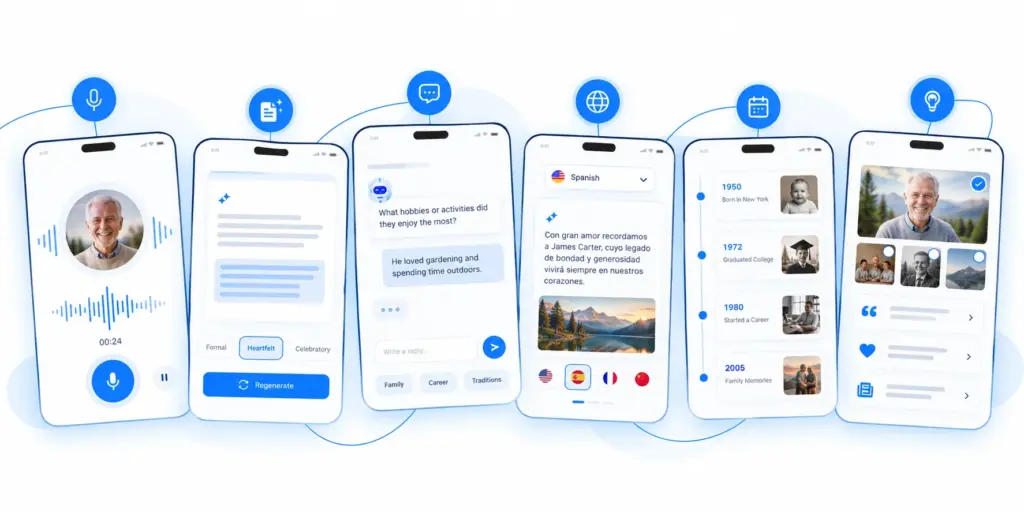
Voice input lets relatives speak their memories while AI transcribes, organizes, and turns them into an obituary draft. This can be easier than typing, especially for older relatives or users who prefer speaking. Remento announced Remento Book on November 8, 2023, using Speech-to-Story technology to turn recorded stories into written memories. Its hardcover book costs $99, and the company says more than 500,000 stories have been recorded. A similar approach could combine written obituaries with original family recordings.
2. AI Biography Summarization
AI can turn transcripts, family notes, letters, or speeches into shorter life summaries while preserving important details and the person’s voice.
| Mode | Purpose |
| Cleaned transcript | Removes filler while preserving wording |
| Narrative rewrite | Creates a polished life story |
| Short obituary | Fits newspaper limits |
| Extended memorial | Adds detail for online pages |
Remento offers similar approaches, including cleaned transcripts and rewritten stories. Since AI can change tone or meaning, platforms should allow families to compare the original and edited versions.
3. Personalized Follow-Up Questions
AI can ask questions based on previous answers instead of following a fixed questionnaire. For example, if someone mentions that their father coached baseball, the platform can ask about how long he coached and what people remembered about him. HereAfter AI uses hundreds of prompts covering childhood, family, relationships, career, and personality. Users can also add photos and allow family members to ask questions later.
Useful prompts could include:
- Which achievements mattered most?
- What did friends remember about them?
- Which traditions will the family keep?
- What causes mattered to them?
- What details should remain private?
4. Multilingual Obituary Generation
Multilingual AI allows families to draft, translate, and review obituaries in multiple languages. The U.S. Census Bureau reported that people speaking a language other than English at home increased from 23.1 million in 1980 to 67.8 million in 2019. Spanish represented about 61% of these speakers and Chinese about 5%.
| Language | Share speaking English “less than very well” |
| Vietnamese | 57% |
| Chinese | 52% |
| Spanish | 39% |
| Arabic | 35% |
| Tagalog | 30% |
The platform should account for cultural phrasing, names, honorifics, and religious language rather than simply translating word for word.
5. AI Memorial Timeline Creation
AI can extract dates and milestones from family information and organize them into a visual life timeline. This gives families another way to preserve memories and can also help identify inconsistent dates.
| Timeline element | Source | Memorial value |
| Life events | Intake and transcripts | Shows key milestones |
| Photos and clips | Family uploads | Adds visual context |
| Story categories | AI tagging | Organizes memories |
| Voice or video | Recorded stories | Adds personality |
HereAfter AI organizes memories into categories, while Remento collects stories over time and compiles them into a book. A platform could combine both approaches by organizing memories by date and theme.
6. Smart Content Recommendations
AI can recommend useful additions based on the information already provided, such as quotes, photos, charities, publication options, or memorial content.
- Quote prompts: Tribute offers an option to add a memorable quote.
- Service ideas: Passare’s AI Assistant, released July 31, 2025, recommends service options based on case details.
- Publication choices: Legacy.com offers access to over 2,600 newspapers.
- Photo selection: AI can suggest photos matching important life events.
- Next steps: Reminders can cover thank-you notes, memorial pages, and donation links.
Recommendations should remain optional, explain why they were suggested, and avoid turning a sensitive experience into an advertising channel.
How to Build an AI Obituary Platform?
To build an AI obituary platform, combine guided information collection, AI-powered obituary generation, family collaboration, publishing integrations, and secure data management. The platform should collect verified life details, use AI to create personalized drafts, let families review and approve the content, and support publishing to newspapers, memorial pages, and funeral home websites.
1. Platform Goal and User Needs
The goal is to turn a stressful blank page into an accurate, personal obituary in minutes. Families may feel overwhelmed, while funeral homes manage multiple cases and need reliable drafts. Legacy.com notes that publishing an obituary can cost under $100 to $800 or more, while Trustworthy estimates $100 to $1,000, depending on where it runs. Offering low-cost drafting with transparent publishing prices can reduce this barrier.
| User type | Main need | Platform offering |
| Grieving family | Help telling a difficult story | Guided prompts, tone options, easy edits |
| Funeral director | Fast, accurate drafts | Case-data import, templates, bulk drafting |
| Newspaper partner | Correct formatting | Standard export and order integration |
| Pre-planning user | Record wishes early | Saved drafts and updates |
2. User Journey and Experience
The journey should feel like a patient conversation rather than a software form. Use plain language, auto-save progress, show users where they are, and keep each step focused.
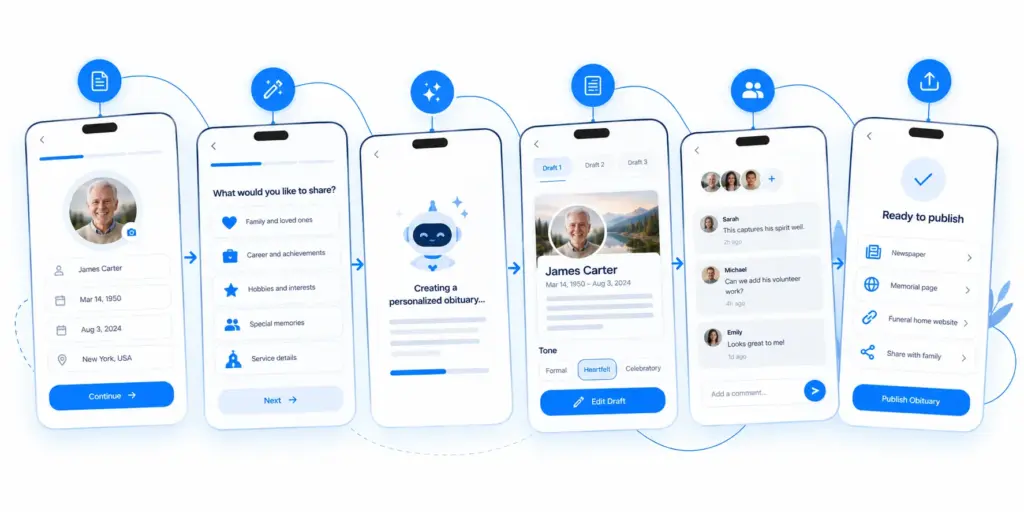
Simple User Journey
- Start: Enter the loved one’s name and start from scratch or an existing draft.
- Share details: Add life facts, memories, and service information.
- Review: Compare AI versions, adjust tone and length, and edit.
- Invite family: Relatives add details or comments.
- Choose publishing: Select newspapers, a memorial page, or both.
- Publish: Confirm placement and receive a shareable link.
3. AI-Powered Information Collection
Good obituaries depend on good inputs. Use structured fields for names, dates, family members, and service times, while open prompts collect stories, hobbies, and career highlights. Existing funeral-home case data can also be imported to reduce re-entry and errors.
4. Tribute Technology Example
Tribute Obituary Writer collects career details, achievements, interests, and hobbies, then lets families regenerate content with different tones. Its newer AI tools also include guest book moderation, event detail capture, and spam filtering. Tribute’s event capture can pull visitation times directly into the obituary editor. Its AI Tribute Obituary Writer is available to website clients at no additional cost across more than 9,000 providers worldwide.
5. Personalized Obituary Generation
The generation layer should combine an LLM with strict accuracy rules. Names, dates, and places should come from verified input rather than being generated. The AI should use family stories and preferred tone to create a personalized draft.
| Component | What to build | Why it matters |
| Structured prompt | Fixed fields, tone, and length | Consistent output |
| Fact lock | Verified names and dates | Prevents errors |
| Tone and length | Solemn, warm, or celebratory | Supports different formats |
| Regeneration | New details or styles | Gives families options |
| Safety filter | Screen harmful or copied text | Protects trust |
6. Family Review and Collaboration
The AI draft should remain a starting point. A shared editor can let relatives contribute while keeping the main contact in control. Track every change and require final approval before publishing.
Core Collaboration Features
- Roles and permissions: Owners, contributors, and viewers.
- Comments and suggestions: Flag corrections without changing text.
- Version history: Track edits and restore previous versions.
- Approval lock: Freeze the final draft before publishing.
- Funeral home access: Let staff review or finalize when requested.
7. Publishing and Distribution
Publishing turns an obituary generator into a complete platform. Support newspapers, memorial pages, funeral home websites, and sharing channels, with formatting rules for each outlet. Legacy.com’s ObitWriter was developed through an exclusive partnership with Narrative Science. Its AI-powered version is free for families and funeral directors and supports newspapers across the U.S.
Users can choose from more than 2,600 newspapers, or publish online only. Legacy.com says it serves 40 million users each month. Funeral homes can also embed the tool and track usage through analytics.
| Channel | Integration approach | Notes |
| Newspapers | Partner API or order submission | Varying length, photo, and price rules |
| Memorial page | Permanent page with photos and guest book | Lower-cost option |
| Funeral home website | Widget or API | Usage analytics |
| Social and email | Share links and print-ready export | Extends reach |
8. Security and Data Management
Obituary platforms handle personal information about both deceased individuals and living family members. Security should therefore be built into the platform from the start. IBM’s Cost of a Data Breach Report found that the average breach cost U.S. organizations $10.22 million, compared with $4.44 million globally. Organizations took an average of 241 days to identify and contain a breach, highlighting the need for monitoring and early detection.
Essential Security Controls
- Encryption in transit and at rest
- Role-based access and MFA for staff
- Audit logs for viewing, editing, and publishing
- Clear consent, retention, and deletion rules
- Guest book and public-form moderation
- Regular security testing and incident response
What is the Cost to Build an AI Obituary Platform?
The cost to build an AI obituary platform typically ranges from $25,000 to $300,000+, depending on its complexity. An MVP with AI obituary writing, guided intake, editing, and basic publishing can cost 25,000–50,000, while a mid-level platform with family collaboration, integrations, analytics, and publishing tools may cost 60,000–130,000. Enterprise platforms with multi-tenant architecture, white-label features, advanced security, and APIs can reach 150,000–300,000+.
MVP Development Cost
An MVP should let a family move from a blank page to a reviewed and publishable obituary in one sitting. It typically includes guided intake, AI drafting, tone and length controls, an editor, sharing, a memorial page, and a basic admin panel. We estimate an MVP at $25,000 to $50,000 over three to four months, using a small team of a designer, two engineers, QA tester, and part-time project manager.
Clutch data shows development companies listed on its platform charge an average of $25 to $49 per hour. Around 1,000 hours can therefore fall within this range. Higher-end agencies charging $100 to $250 per hour can price the same scope considerably higher.
Build vs. Buy
Before building custom software, compare it with existing tools. Afterword offers funeral home case management with an AI obituary writer. One published comparison reports its Personalized Case Management plan starts at $325/month, based on 200 cases per year, while its Essential plan costs $79/month without the obituary writer. That equals about $3,900 per year for one funeral home.
A custom MVP makes more sense when you plan to launch a product, serve multiple funeral homes or newspapers, or need a branded experience that existing software cannot provide.
MVP Feature Scope
- Guided intake for names, dates, family, and life stories
- AI drafting with tone and length controls
- Editor with sharing and basic approval
- Hosted memorial page with photos
- Basic admin panel and accounts
- Encryption, access control, and backups
Mid-Level Platform Cost
A mid-level platform costs roughly $60,000 to $130,000 and takes five to eight months. The added cost mainly comes from integrations and features used by funeral homes and families. Passare shows what this level can include. Its AI Obituary Writer drafts from existing case details, while its Planning Center lets families create another version that syncs back to the case. Passare reports tens of thousands of obituaries written nationwide.
The platform offers eight tone options, real-time editing, final-version locking, funeral home website publishing, and print-service delivery. It has also added an AI Scanner for converting photos of vitals sheets into case data and an AI Assistant for staff support.
The key budget drivers are case-data integration and family collaboration, which move the product beyond a basic AI writer.
| Added capability | Estimated cost |
| Case-management and website integrations | $10,000 – $22,000 |
| Family collaboration | $8,000 – $15,000 |
| Newspaper submission and print export | $7,000 – $18,000 |
| Payments and order management | $4,000 – $8,000 |
| Analytics dashboard | $4,000 – $10,000 |
| Moderation and admin tools | $3,000 – $7,000 |
Enterprise Platform Cost
An enterprise platform typically costs $150,000 to $300,000 or more and takes nine to fourteen months. At this level, the platform supports multiple funeral homes, newspapers, or memorial brands with separate data, branding, and permissions. Clutch pricing data reports that the average custom software project costs $132,480 and takes around 13 months. An enterprise obituary platform can exceed this because of its security, integrations, and multi-tenant requirements.
Enterprise Feature Scope
- Multi-tenant architecture with separate data and branding
- White-label portals and custom domains
- Single sign-on and advanced permissions
- Public API and webhooks
- Audit logs and advanced security controls
- Multilingual drafting and regional publishing rules
- AI model evaluation and quality tracking
- Monitoring, SLAs, and dedicated DevOps
AI Integration Costs
AI is relatively inexpensive to run but requires careful engineering. Anthropic’s published Claude rates show $3 per million input tokens and $15 per million output tokens for its Sonnet tier, while Haiku costs $1 and $5. Batch processing can reduce rates by 50%. For example, a draft using about 1,500 input tokens and 600 output tokens costs approximately $0.0135 on the mid-tier model and $0.0045 on the lighter model.
Most AI spending therefore goes toward prompt design, fact-locking, safety filters, and quality testing rather than model usage.
| AI cost item | Estimated cost |
| Prompt design, fact-lock logic, and testing | $5,000 – $15,000 |
| Safety filters and moderation | $3,000 – $8,000 |
| Case-data retrieval and integration | $8,000 – $20,000 |
| Lighter model, 10,000 drafts/month | About $45/month |
| Mid-tier model, 10,000 drafts/month | About $135/month |
| Monitoring and prompt updates | $500 – $2,000/month |
Feature-Based Cost Breakdown
Feature-level pricing helps determine what belongs in the MVP and what can be added later. Integrations generally increase costs because each external system requires additional testing and maintenance.
| Feature | Estimated cost |
| Guided intake form | $3,000 – $6,000 |
| AI drafting engine | $6,000 – $15,000 |
| Tone, length, and regeneration controls | $2,000 – $4,000 |
| Editor and family collaboration | $8,000 – $15,000 |
| Memorial page with guest book | $5,000 – $12,000 |
| Publishing integrations | $8,000 – $22,000 |
| Payments and order management | $4,000 – $8,000 |
| Admin dashboard and analytics | $6,000 – $12,000 |
| Security and compliance | $5,000 – $15,000 |
| Moderation tools | $2,000 – $5,000 |
| UI/UX design | $4,000 – $10,000 |
| QA, DevOps, and project management | $6,000 – $15,000 |
| Full feature set | About $59,000 – $139,000 |
A platform with the full feature set falls within the mid-level range, which is why many teams start with an MVP and add features in phases. A discovery workshop can help narrow the estimate before development begins.
Funding and Investor Interest in Grief-Tech
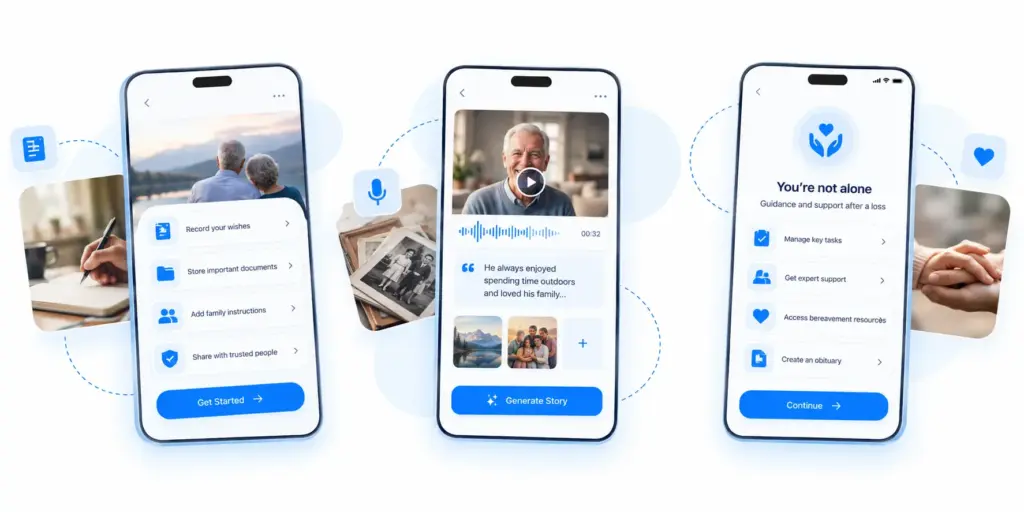
Investors are backing grief-tech across end-of-life planning, memory preservation, and bereavement support. Funding is increasingly moving toward AI-native platforms that support families before and after a death. For AI obituary platforms, this shows that obituary writing can be an entry point into broader family, legacy, and insurance workflows.
1. AI-Powered End-of-Life Platforms
End-of-life platforms help people record wishes, store documents, and leave instructions before death, then guide families through the administrative work afterward. Investors are attracted to models that can work with insurers, pension providers, and employers, creating wider distribution.
Example: Solace Care
Solace Care, a Stockholm-based platform, recently raised a €2.1 million pre-seed round led by Spintop Ventures, with Plug and Play and Nordic insurance executives also participating. The platform lets policyholders record wishes, collect documents, and leave instructions in a shared vault. After death, it guides families through tasks involving banks, insurers, pension providers, and tax authorities.
The company says it covers more than 25,000 lives across Sweden, Finland, and Norway and plans to use the funding to expand carrier and broker partnerships and enter the Netherlands and UK.
What investors value:
- Distribution through insurers, brokers, and employers
- White-label partnership opportunities
- Support before and after death
- Help with complex administrative tasks
- Expansion through local partners
2. AI Memory Preservation Platforms
Memory preservation platforms turn spoken family stories into written keepsakes. Their AI typically handles transcription, editing, and first-draft creation, making this category closely related to AI obituary generation.
Example: Remento
The service sends weekly prompts, supports photos, and starts at $99 for a one-year subscription. Its AI can transcribe recordings, lightly edit them, and create a first draft. The company later celebrated recording its 500,000th story.
| Remento milestone | Detail |
| Seed round | $3 million, led by Upfront Ventures |
| Remento Book | AI service turning recorded stories into physical books |
| Celebrity investment | $300,000 from Mark Cuban for 10% |
| Entry price | $99 for one year |
| Usage milestone | 500,000th story recorded |
3. AI Bereavement Support Platforms
Bereavement platforms address the practical and emotional work that follows a death. Empathy’s Cost of Dying Report found families can spend up to 500 hours over as many as 13 months handling administrative tasks. This creates opportunities for platforms serving families, insurers, and employers.
Example: Empathy
Empathy announced a $72 million Series C led by Adams Street Partners, with General Catalyst, Index Ventures, and others participating. This brought its total funding to $162 million. The company says it supports more than 50 million covered lives through partnerships with insurers including New York Life, Voya, and Aflac. It also launched the Empathy Alliance, bringing together ten financial institutions, banks, and insurers.
AI supports the platform by improving the speed, accuracy, and reach of its Care Team, while human support remains central. Empathy has also launched an AI obituary tool, showing how bereavement platforms can expand beyond support into obituary creation.
Build an AI Obituary Platform with Idea Usher
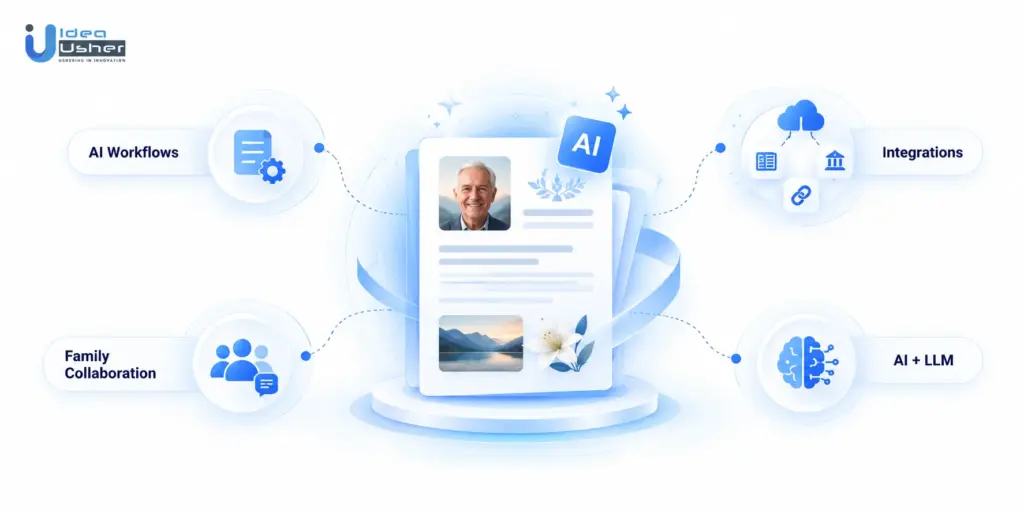
Building an AI obituary platform requires more than integrating an LLM. It needs secure data handling, personalized AI workflows, family collaboration, and funeral software integrations. IdeaUsher brings 500,000+ hours of coding experience and a team of ex-MAANG and FAANG developers to build scalable AI-powered funeral technology solutions.
Custom AI Obituary Workflows
We develop tailored workflows that collect life stories, family details, service information, and preferences before generating personalized obituary drafts. Workflows can include AI intake, fact verification, tone controls, review stages, and publishing. This creates a structured process that reduces manual work while keeping families in control of the final tribute.
Funeral Software Integrations
Connect your platform with existing funeral home case management systems, memorial websites, newspaper platforms, payment systems, and APIs. These integrations reduce manual data entry and help funeral professionals manage obituary workflows from one platform.
Family Collaboration Portals
Create secure family portals where relatives can add memories, suggest edits, upload photos, comment on drafts, and approve final obituaries. Role-based permissions and version history help keep collaboration organized. Families can work together remotely while funeral professionals retain the appropriate level of access and control.
AI and LLM Integration
Integrate LLMs, prompt engineering, RAG, AI summarization, multilingual generation, and safety controls to create personalized obituary content while keeping verified facts protected. Our AI development approach focuses on reliable outputs, human review, and scalable architecture.
Conclusion
Building an AI obituary platform combines AI-powered writing, family collaboration, secure data management, and publishing workflows to simplify a difficult process for families and funeral professionals. With development costs ranging from $25,000 for an MVP to $300,000+ for an enterprise platform, the right approach is to start with core features and scale gradually.
A well-designed platform can go beyond obituary generation to support digital memorials, funeral software integrations, multilingual content, and personalized family experiences.
FAQs
A1: Building an AI obituary platform typically costs $25,000 to $300,000+, depending on the features and complexity. An MVP may cost 25,000–50,000, while mid-level and enterprise platforms can cost 60,000–130,000 and 150,000–300,000+ respectively. Integrations, advanced AI features, security, and multi-tenant architecture can increase the overall cost.
A2: Development can take around 3–4 months for an MVP, 5–8 months for a mid-level platform, and 9–14 months for an enterprise solution. The timeline depends on AI features, integrations, collaboration tools, security requirements, and publishing workflows. A clear product scope can help reduce delays during development and testing.
A3: Yes, AI can turn recorded family interviews, voice inputs, transcripts, and personal memories into a structured obituary draft. The platform can summarize the information, preserve important details, and let families review and personalize the final version. Voice-to-text and AI summarization can make the process easier for families who prefer speaking over writing.
A4: Yes, AI obituary software can integrate with funeral home case management systems, websites, memorial platforms, newspaper services, and other APIs. This allows existing case information to flow into the obituary workflow and reduces manual data entry. Secure integrations can also help funeral professionals manage drafts without entering the same information multiple times.
A5: Yes, families can edit AI-generated drafts before publication. A collaboration portal can support real-time editing, comments, suggestions, version history, tone adjustments, and final approval while allowing funeral professionals to assist when needed. Human review also helps verify names, dates, relationships, and other important details before publishing.
A6: Yes, an AI obituary platform can generate personalized memorial websites containing the obituary, photos, videos, guest books, service details, and sharing links. These pages can also connect with funeral home websites and publishing workflows. This allows the platform to extend beyond obituary writing and support a complete digital memorial experience.