

Key Takeaways
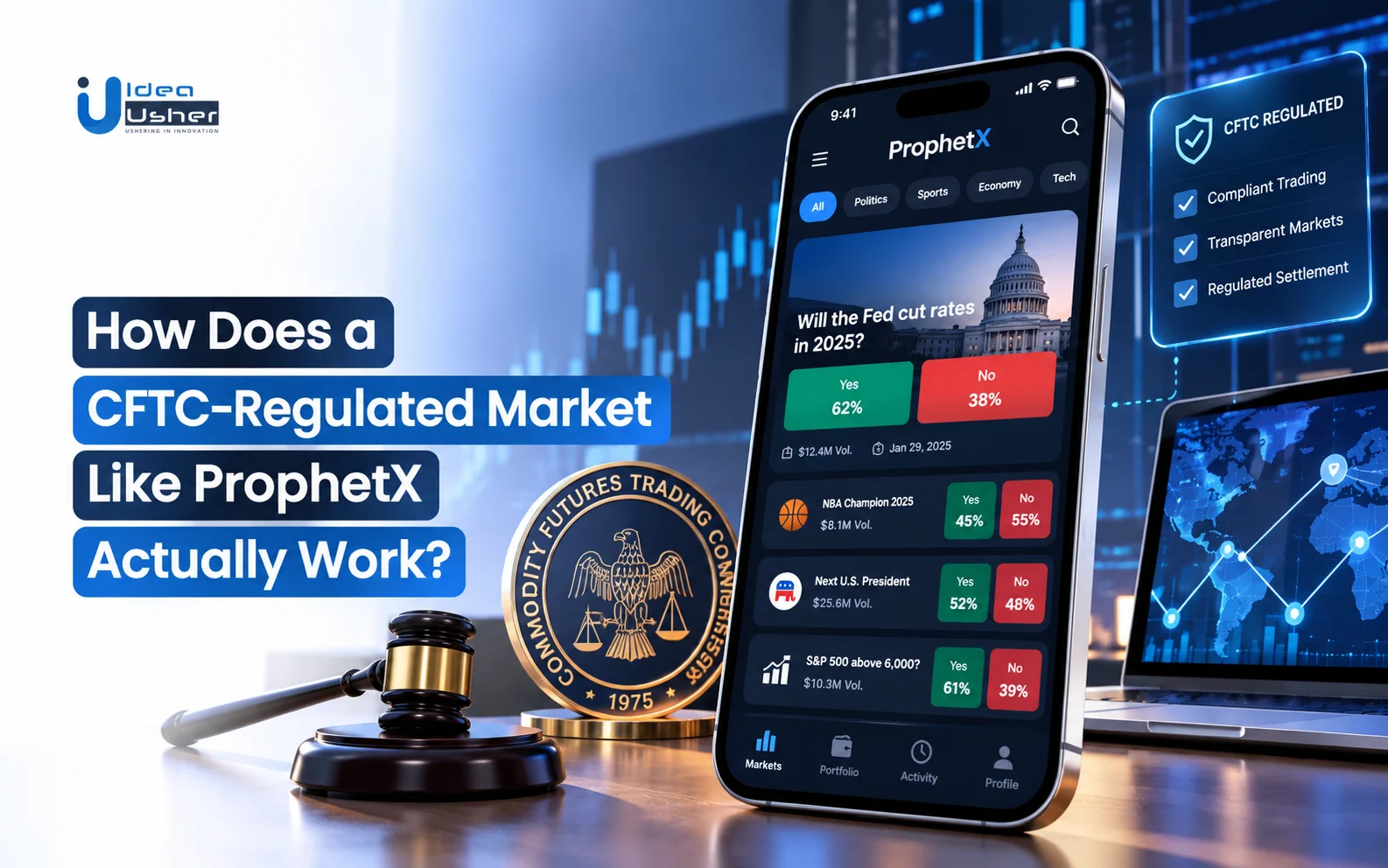
- A CFTC-regulated market like ProphetX works by letting users trade standardized event contracts through a regulated exchange.
- Each contract represents a defined outcome, with prices driven by supply, demand, and trader expectations.
- Buyers and sellers are matched through the market’s trading infrastructure rather than betting directly against a sportsbook.
- Once the underlying event is resolved, contracts are settled according to predetermined rules and authoritative data.
- Learn how IdeaUsher can help businesses build a CFTC-regulated market like ProphetX with secure, scalable trading infrastructure.
ProphetX functions as a CFTC-regulated peer-to-peer prediction market where users trade event contracts with one another instead of placing bets against a sportsbook. Contract prices fluctuate based on market supply and demand, while the platform facilitates order matching, manages positions, and settles contracts based on the final outcome of the underlying event.
But how does this model actually work, from listing an event and matching trades to managing positions and settling contracts? This guide explains how a CFTC-regulated market like ProphetX works and the technology and processes behind it.
Is a CFTC-Regulated Market a Viable Business Model in 2026?
Yes, a CFTC-regulated market can be viable, and current market growth explains why founders are paying attention. According to Future Market Insights, the global sports betting market is expected to grow from USD 111.9 billion in 2025 to USD 298.1 billion by 2035, at a 10.3% CAGR. Offline platforms are projected to hold 58.3% of the market in 2025, while fixed-odds wagering is expected to account for 34.6% of revenue.
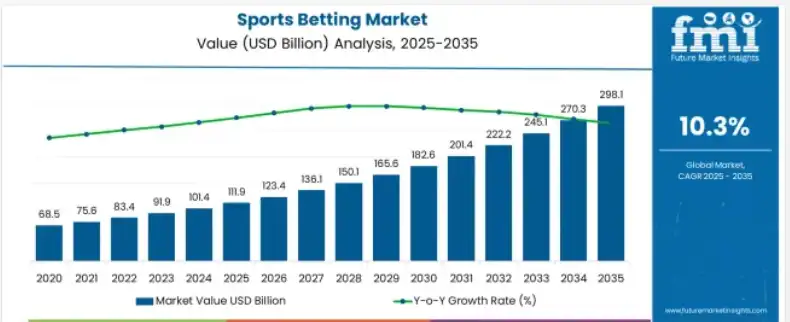
Source: Future Market Insights
This leaves room for online, exchange-style products. A CFTC-regulated model can also provide a federal regulatory framework, although success still depends on liquidity, funding, compliance, and distribution.
Growing Demand for Prediction Markets
ProphetX shows how quickly the category is developing. The company moved from a regulated peer-to-peer betting exchange to a sweepstakes model before launching its sports-focused, peer-to-peer prediction market on June 18. It also raised $35 million, led by Parlay Capital and Data Point Capital, highlighting investor interest in regulated sports prediction markets.
Novig offers another example. It began as a sweepstakes exchange before raising a $75 million Series B led by Pantera Capital at a valuation of about $500 million. Its federally regulated launch operated through Ludlow Exchange, with the path from application to launch taking 195 days. Its partnership with the New York Mets also demonstrates how regulated exchanges can expand through sports partnerships.
Other market signals include:
- The CFTC has 17 pending DCM applications, many involving prediction markets and sports-event contracts.
- Major sportsbooks are entering the space. DraftKings launched DraftKings Predictions in December 2025, while FanDuel partnered with CME Group to launch FanDuel Predicts.
- The CFTC has proposed rules that would generally allow sports event contracts while restricting certain sensitive categories.
Revenue Opportunities Across Markets
A regulated exchange can diversify revenue beyond direct trading.
| Revenue Stream | How It Works | Real Example |
| Direct exchange trading | Users trade event contracts against each other | ProphetX’s two-sided exchange |
| Access partner integrations | Third-party apps connect their users to the exchange | ProphetX with Pikkit, Boom Sports, and Players’ Lounge |
| White-label and B2B distribution | Exchange infrastructure is provided to other brands | ProphetX’s access provider and white-label programs |
| Sports and brand partnerships | Teams or media brands bring users and visibility | Novig’s Mets partnership |
| Clearing services | The platform clears its own trades or supports other exchanges | ProphetX’s DCM and DCO structure |
Why Distribution Partnerships Matter
Access partnerships can help exchanges reach engaged audiences without bearing the full cost of acquiring every user. For new platforms, this makes B2B integrations and distribution partnerships an important growth channel.
Regulatory, Technology, and Operations
Regulatory approval requires significant planning. Sporttrade submitted its DCM and DCO applications on February 4, while reports indicate that a typical DCM approval process can take 12 to 18 months. The company eventually shut down sportsbook operations in five states to rebuild around prediction markets. Its exchange uses an order book that allows customers to trade against each other rather than against a house.
Key Areas to Budget For
- Compliance planning: Build the regulatory roadmap early as rules continue to evolve.
- Order matching engine: Develop reliable order-book, pricing, and settlement infrastructure.
- Identity verification: Implement secure KYC and onboarding workflows.
- Fund handling and clearing: Decide whether to operate as a DCO or work with a clearing partner.
- Market integrity: Account for proposed restrictions around affiliated market makers and potential conflicts of interest.
- Contract selection: Carefully evaluate markets that regulators may restrict, including injuries or officiating decisions.
What Makes ProphetX a CFTC-Regulated Market?
ProphetX is a CFTC-regulated market because the Commodity Futures Trading Commission approved it to operate as both an exchange and clearinghouse. Its sports contracts therefore operate under federal derivatives rules, rather than state sportsbook licensing. In simple terms, users trade contracts with each other on a regulated exchange instead of betting against the platform.
What Does the CFTC Regulate?
The CFTC oversees U.S. derivatives markets, including futures, options, and swaps. It supervises the exchanges and clearing organizations where regulated contracts trade.
Key Areas Under CFTC Oversight
- Exchanges: Contract venues must register as Designated Contract Markets or DCMs.
- Clearinghouses: Organizations handling trade clearing and settlement must register as Derivatives Clearing Organizations or DCOs.
- Event contracts: Proposed rules would generally allow sports event contracts while restricting areas involving injuries, officiating, high school sports, fights, war, terrorism, and other sensitive events.
- Market integrity: Proposed rules also address affiliated market makers and potential conflicts of interest.
Why Are ProphetX Contracts Different?
An event contract derives its value from whether a real-world event occurs. ProphetX focuses on sports event contracts, where users take opposing positions on outcomes and the market price reflects perceived probability. Unlike a traditional sportsbook, buyers and sellers determine prices, while the exchange matches participants. ProphetX also offers a proprietary Request for Quote Parlay Mechanism, allowing users to create combined positions and price them with counterparties.
What Makes a DCM Different?
The key differences are who sets the price, who takes the risk, and who regulates the platform.
| Feature | Typical Betting App | DCM Like ProphetX |
| Regulator | State gaming authorities | CFTC |
| Price setting | Sportsbook sets odds | Buyers and sellers set prices |
| Platform role | Takes the other side | Matches participants |
| Product | Wagers | Derivative event contracts |
| Clearing | Operator-managed | Registered clearinghouse |
| Geographic reach | State by state | Nationwide federal framework |
Before approval, ProphetX operated a sweepstakes-style model in more than 40 states. After receiving federal approval, it moved to a single regulated model and launched nationwide one week later. Novig followed a similar path, receiving CFTC approval for its DCM application a week after ProphetX. The CFTC also continues to have numerous pending applicants, reflecting growing interest in the federal model.
Where Do DCM and DCO Fit?
ProphetX holds both registrations, with each serving a different function:
- DCM: The exchange where contracts are listed and orders are matched.
- DCO: The clearinghouse that guarantees and settles trades.
Together, they support ProphetX’s direct-clearing model, allowing trades to be executed, cleared, and settled under CFTC oversight.
How a ProphetX Trade Moves
- Account and verification: Users register through ProphetX or a partner app.
- Order placement: Users select a sports event contract.
- DCM matching: The exchange matches the order with an opposing participant.
- DCO clearing: The clearinghouse processes and guarantees the trade.
- Settlement: Once the event ends, the contract settles and the winning side is paid.
ProphetX completed its approval process in roughly six months, with DCO registration approved one day before the DCM. The company also raised $35 million, led by Parlay Capital and Data Point Capital, and operates white-label and access-provider programs.
ProphetX’s Distribution Partners
- Pikkit: Connects its tracking and analytics users to the ProphetX exchange.
- Boom Sports: Integrates ProphetX’s exchange with its user base.
- Players’ Lounge: Offers access to ProphetX’s regulated exchange.
- Swivel Gaming: Expands access to CFTC-regulated prediction markets through B2B technology.
What Happens When You Trade a ProphetX Event Contract?
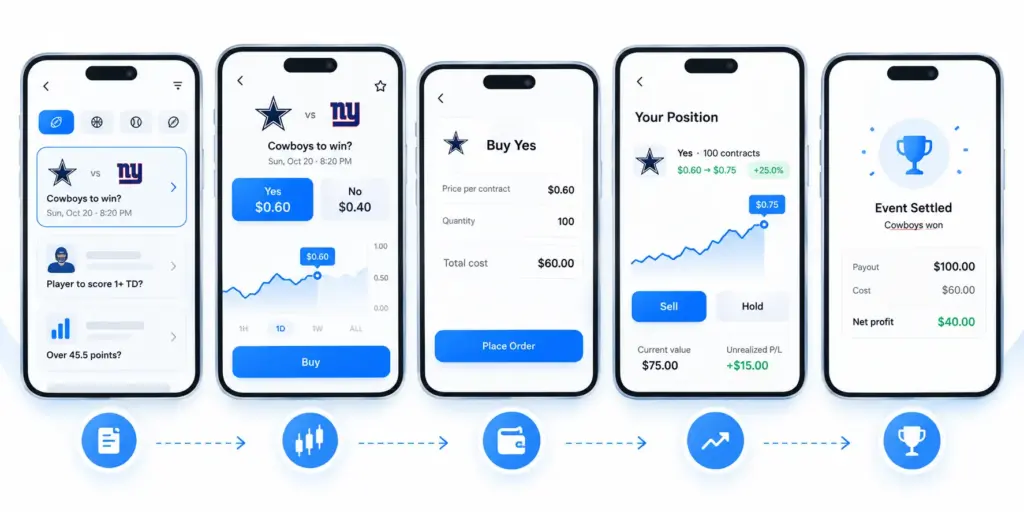
When you trade a ProphetX event contract, you take a Yes or No position on a sports outcome at a price set by other traders. Your order is matched with the opposite side, and the contract pays a fixed amount when the result is official. You can also sell your position before the game ends. The process runs from contract creation to matching, trading, and final settlement.
1. Turning Sports Outcomes Into Contracts
An event contract turns a real-world question into a yes-or-no financial instrument. The CFTC describes these contracts as usually having a fixed $1 payout and an expiration tied to a set time or the event’s natural end. ProphetX focuses exclusively on sports contracts, including NFL game lines, player props, futures, and parlays.
Each contract defines:
| Contract Part | What It Defines | Example |
| Underlying question | The exact event being priced | Will Team A beat Team B? |
| Binary payout | $1 if Yes, $0 otherwise | Yes holders receive $1 on a win |
| Price | What a trader pays | Set by buyers and sellers |
| Resolution source | Authority deciding the result | Official game results |
| Expiry | When trading ends | When the event resolves |
| Settlement | How winners are paid | Cash, with no physical delivery |
The CFTC has also emphasized the importance of clear, objective resolution criteria for settlement integrity.
2. Understanding the $0.60 Contract Price
The $1 is the maximum payout, while the market price reflects what traders believe the outcome is worth. A $0.60 contract implies roughly a 60% probability of the outcome. Prices range from one cent to 99 cents. Suppose you believe the Cowboys will beat the Giants and buy 100 Yes contracts at $0.60:
- Cost: 100 × $0.60 = $60
- If Cowboys win: You receive $100, earning $40
- If they lose: Your maximum loss is $60
- Fee: ProphetX charges a 2% fee on net gains for straight trades, so a $40 gain would incur about $0.80
No fee is charged on losing trades.
3. Setting Market Prices
ProphetX uses a back-and-lay order book, where traders post prices and others respond. Because users trade against each other, the platform does not build a house margin into the price. This means prices move based on real-time trader demand, rather than being determined by a fixed sportsbook margin.
Two Ways to Place Orders
- Take a price: Accept the best available price for faster execution.
- Make a price: Post your own limit price and wait for a match.
ProphetX also offers an RFQ Parlay Mechanism, allowing users to build parlays and receive prices from counterparties. Parlays carry no commission, while straight trades carry the 2% fee on net gains.
4. Order Matching and Trade Clearing
A match turns your order into a live position. Once another trader accepts the price and quantity, the trade is cleared through ProphetX’s registered clearinghouse. Both sides are committed to the agreed contract terms once the order is matched. The clearing process records the trade and ensures it can be properly settled when the event concludes.
The Matching Process
- Place an order: Use a market-style or limit order.
- Order rests or fills: Limit orders wait for an opposing order.
- Exchange matches: Another trader takes the opposite side.
- Funds are held: Stakes remain secured until settlement.
- Trade is cleared: ProphetX’s DCO processes and guarantees the trade.
Unmatched orders never become positions, and ProphetX charges no fee on losing or unmatched trades.
5. Exiting Before Contract Settlement
Unlike a traditional sportsbook, users can trade in and out before settlement. The CFTC notes that customers can use the current market price to lock in gains or limit losses. ProphetX supports this during live games, subject to available liquidity. This gives traders more flexibility to manage positions as market conditions change in real time, rather than waiting for the final outcome.
Example: Exiting a $0.60 Position
- Price rises to $0.75: Sell to lock in $0.15 per contract.
- Price falls to $0.40: Sell to limit the loss to $0.20 per contract.
Liquidity is generally strongest around major sporting events and thinner in smaller markets.
6. Contract Settlement and Payouts
Once the outcome is official, ProphetX settles the market using official results. Each contract ends at $1 or $0, with the clearing structure supporting the payout.
| Your Position | Event Outcome | Settlement Value |
| Yes contract | Event happens | $1.00 |
| Yes contract | Event does not happen | $0.00 |
| No contract | Event does not happen | $1.00 |
| No contract | Event happens | $0.00 |
The 2% fee on net winnings is taken when a trade closes. There is no separate withdrawal fee, although payment providers may charge their own fees. Because payouts are fixed, your maximum loss is the price paid for the contract. The CFTC similarly describes a trader’s profit as the difference between the initial investment and the eventual payout.
Who Takes the Other Side of a ProphetX Trade?
The other side of a ProphetX trade is another market participant, such as a fellow trader or market maker, not ProphetX itself. Buyers and sellers interact through the exchange’s order book, where their orders are matched at agreed prices. ProphetX operates the trading venue and clearing infrastructure rather than taking a house position, creating a peer-to-peer market structure similar to a financial exchange.
1. ProphetX vs Traditional Sportsbooks
A sportsbook sets odds and takes the opposite side of a bet. An exchange instead provides the venue where participants trade with each other. The CFTC describes regulated platforms as trading venues rather than counterparties competing against customers. ProphetX has no affiliated trading desk taking the other side of customer positions.
| Question | Typical Sportsbook | ProphetX Exchange |
| Who takes the other side? | The sportsbook | Another trader |
| Who sets the price? | The sportsbook | Buyers and sellers |
| How does the platform earn? | House margin | 2% fee on net gains for straight trades |
| Who supervises it? | State gaming regulators | CFTC as DCM and DCO |
The ProphetX and Boom Sports partnership demonstrates this model. Boom integrates ProphetX’s exchange into its sports product, allowing users to trade event contracts against other participants rather than against Boom.
2. Two-Sided Market Mechanics
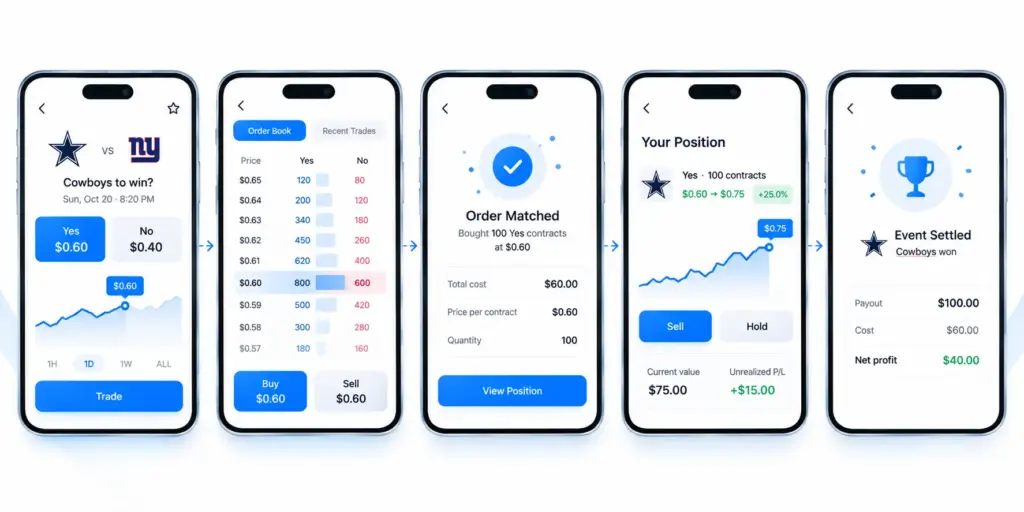
Every position needs an opposite side. If Trader A buys a Yes contract because they expect a team to win, another participant can sell Yes or take the No side. ProphetX uses back-and-lay trading, with both sides held until the event is resolved. This creates a peer-to-peer market, where traders provide liquidity to one another instead of trading directly against the platform.
$0.60 Contract Example
- Trader A: Buys Yes at $0.60.
- Trader B: Takes the opposite view through No at $0.40.
- Exchange: Matches the two positions.
- Settlement: Stakes remain committed until the event resolves.
- Payout: The winning side receives $1.
The Pikkit partnership expands this participant pool by connecting its tracking and analytics users to ProphetX. More participants can mean more potential counterparties on the same order book.
3. Order Book Mechanics
The order book is the core mechanism behind a two-sided market. It displays live bids and offers, allowing buyers and sellers to meet at specific prices. When compatible orders match, the trade executes. ProphetX supports several order-book features:
- Liquidity at each price: Shows available trading depth.
- Quick Trade: Takes the currently available market price.
- Limit Orders: Lets users specify their preferred price.
- Partial Fills: Executes the available portion while the remainder waits.
Market orders prioritize speed, while limit orders provide more price control but may remain unmatched.
4. Event Contract Liquidity
Liquidity determines how easily traders can enter or exit positions at a reasonable price. Deep markets generally offer tighter spreads and faster fills, while thin markets can create wider gaps and slower execution. Higher liquidity also makes it easier to execute larger orders without significantly moving the market price.
| Market Condition | What It Looks Like | Effect on Traders |
| Deep liquidity | Many orders near each other | Faster fills, tighter spreads |
| Thin liquidity | Few orders, wider gaps | Slower fills, worse exits |
Major events can attract substantial trading activity. Kalshi and Polymarket reported close to $3 billion in trades on the World Cup winner market, illustrating the demand major tournaments can generate. ProphetX has similarly seen stronger liquidity around major sporting events, while activity outside major sports remains more limited.
5. Market Maker Liquidity
New markets can begin with an empty order book, making them difficult to trade. Market makers help solve this by posting both buy and sell prices, giving participants available counterparties. ProphetX’s CFTC filing recognizes that affiliated liquidity can help bootstrap markets but argues that it should supplement independent price formation rather than replace it.
The CFTC has also proposed distinguishing bona fide market making from directional proprietary trading. Genuine market makers are expected to maintain two-sided quotes rather than simply take directional positions.
ProphetX Liquidity Incentives
ProphetX also uses fee structures to encourage liquidity:
- Parlay makers: Pay no trade fee when resting orders are filled.
- Parlay takers: Pay a fee when executing against resting liquidity, with a minimum of $0.01 per order.
- RFQ Parlay Mechanism: Lets users create multi-event combinations and receive prices from counterparties, supporting competitive price discovery.
What Happens Behind the Scenes After a ProphetX Order Is Matched?
After a ProphetX order is matched, multiple systems turn the agreed price into a recorded, settled trade. The matching engine confirms execution, risk systems update positions, funds remain locked, and market data is published. The trade waits for event resolution before the clearinghouse settles it.
Every step is recorded so regulators can reconstruct what happened. This technical layer separates a regulated exchange from a simple betting app.
1. Order Matching and Execution
ProphetX uses an anonymous central limit order book that matches orders by price and then time. Its CFTC application also describes a confidential Request for Quote (RFQ) protocol behind its RFQ Parlay Mechanism. Participants receive equal access to real-time prices, bids, and offers, while published matching rules, order types, and market states make execution predictable.
Automated Order Checks
Before reaching the order book, orders pass through automated controls:
- Price collars: Block prices far from the current market.
- Maximum order size: Reject oversized orders.
- Throttles: Limit message frequency from one participant.
- Buying-power checks: Confirm sufficient funds.
- Self-trade prevention: Prevent participants from matching themselves.
ProphetX also defines error-trade and no-cancellation standards. Market Operations staff monitor matching-engine performance and session health.
2. Position and Exposure Tracking
After execution, the exchange tracks each participant’s positions throughout the trading day and again the next day. Threshold alerts flag positions before limits are reached. ProphetX states that it does not exceed applicable federal position limits and uses exchange-specific limits or accountability levels where appropriate. These are calibrated to product risk and liquidity.
| Trigger | What Happens |
| 75% of a position limit | Alert flags the position for review |
| 90% of a position limit | Higher-priority alert is raised |
| Accountability level exceeded | Exchange may request rationale, related positions, and a reduction plan |
| Hard or federal limit breached | Order blocking, cancel-on-breach, liquidation-only status, or directed reductions |
Alerts and outcomes are logged, while material or willful breaches can trigger disciplinary measures. Position tracking therefore functions as a live compliance system, not simply a holdings database.
3. Collateral and Financial Integrity
ProphetX uses a fully collateralized model, meaning trades are backed by sufficient funds to cover the maximum possible loss. The clearinghouse guarantees performance through final settlement. Buying-power checks run in real time, rejecting orders that exceed available funds and preventing unfunded exposure.
$1 Contract Collateral Flow
- Buyer funds locked: A Yes buyer at $0.60 has $0.60 reserved.
- Seller funds locked: The opposing side has $0.40 reserved, covering the full $1.
- Funds segregated: Customer funds remain separate from company capital in qualified institutions.
- Withdrawals controlled: Dual authorization and individual sub-ledgers manage fund movements.
- Compliance runs: AML includes sanctions screening and transaction monitoring.
ProphetX also targets resources at or above 12 months of projected operating costs, reviewed on a rolling basis.
4. Market Data and Price Updates
Real-time prices, bids, and offers are available equally to participants. The platform also displays liquidity at each price, helping traders assess market depth. This is especially important for sports contracts, where prices can move sharply as games unfold. ProphetX’s application states that it publishes a Daily Bulletin before the next trading session containing prior-day settlement prices, total volume, and end-of-day open interest.
The machine-readable bulletin follows:
Generate → Validate → Publish → Archive
Files are created at market close, reconciled by compliance and market operations against audit-trail data, and corrected before publication when discrepancies appear.
5. Event Resolution and Settlement
When an event ends, the contract resolves to $1 or $0 based on official results. Matched orders remain in escrow until settlement, with the clearinghouse standing behind the payout. Before listing a contract, ProphetX submits a product filing covering the reference event, liquidity, data sources, settlement methodology, and governance. Compliance reviews it, followed by approval from the Chief Regulatory Officer.
Settlement Controls
After listing, the exchange monitors:
- Settlement-input quality: Tracks data sources determining outcomes.
- Settlement influence: Detects attempts to affect results.
- Emergency powers: CRO can halt trading, adjust parameters, or cancel trades.
- Regulator notification: Significant disruptions are reported to the CFTC before action where practicable and within 24 hours otherwise.
This creates a documented settlement process for disputed or unusual outcomes.
6. Trade Records and Audit Trails
Regulated exchanges must maintain records capable of reconstructing trading activity. ProphetX records the full order and execution lifecycle with high-precision timestamps, including modifications and cancellations. Records are encrypted and stored on write-once or append-only systems for at least five years, with two years readily accessible.
| Audit Trail Field | Why It Matters |
| Participant and user IDs | Identifies who acted |
| Account designation | Identifies the relevant account |
| Instrument | Names the contract |
| Side and price | Records buy/sell and price |
| Quantity | Records order or trade size |
| Order type and time-in-force | Shows intended order behavior |
| Self-trade prevention IDs | Supports self-matching detection |
7. Real-Time Trade Surveillance
This data feeds ProphetX’s surveillance system, which operates in real time and again the next day using Nasdaq SMARTS. It looks for spoofing, layering, wash trading, and momentum ignition. When regulators request records, each production is logged with a chain of custody. For anyone building a regulated market, audit trails are core infrastructure because they support surveillance, disputes, and regulatory reviews.
Why Does ProphetX Need Market Makers?
ProphetX needs market makers because an exchange only works when someone is ready to take the other side of a trade. On a peer-to-peer platform, buyers need sellers and sellers need buyers. Market makers post prices on both sides, helping orders match quickly and keeping prices competitive. Without them, new or less popular markets can remain empty, hurting both traders and the exchange.
1. Market Maker Liquidity Problem
Peer-to-peer exchanges face a basic chicken-and-egg problem: traders need liquidity to trade easily, but liquidity depends on having traders. Market makers break this cycle by continuously posting prices. They are typically sophisticated trading firms that provide liquidity, making them the counterparty for many retail trades. ProphetX has said it does not operate an affiliated trading arm and works with outside institutional funds for liquidity.
Without liquidity providers, markets can experience:
- No counterparty: Orders remain unmatched.
- Wide spreads: Traders pay more to enter and lose more when exiting.
- Slow or partial fills: Orders may only partially execute.
- Unstable prices: Large orders can move prices sharply.
Liquidity varies by market, with major leagues such as the NFL and NBA typically seeing stronger activity than smaller or niche markets.
2. Two-Sided Quotes and Spreads
A two-sided quote includes a bid to buy and an ask to sell. The difference is the spread. Competition among market makers can narrow spreads and bring prices closer to the market’s estimated probability. The CFTC’s proposal describes a genuine market maker as maintaining two-sided quotations without taking directional positions beyond that obligation.
| Market Condition | Bid | Ask | Spread | What It Means for Traders |
| Thin market | $0.55 | $0.65 | $0.10 | 10-cent round-trip cost per contract |
| Active market makers | $0.59 | $0.61 | $0.02 | 2-cent round-trip cost per contract |
ProphetX makes this depth visible. Each odds button shows available liquidity and market volume, while its order book displays prices and the amount available at each level.
3. Market Maker Price Discovery
Price discovery is how buyers and sellers determine an outcome’s market value. Competing quotes and trader responses push prices toward the market’s best estimate. A liquid, two-sided market generally provides a stronger signal than a thin, one-sided book. ProphetX’s RFQ Parlay Mechanism lets users create multi-event combinations and receive prices from counterparties, supporting dynamic price discovery and competitive liquidity.
CEO Dean Sisun similarly told the CFTC that two-sided exchanges form prices through competition among participants rather than through the venue taking the opposite side.
4. Nascent Market Liquidity
New contracts often face the biggest liquidity challenge. ProphetX’s Nascent Markets Program is designed to support newly listed or newly active markets by:
- Deepening order books: Adds resting orders to new markets.
- Supporting price discovery: Gives early traders meaningful prices to evaluate.
- Promoting orderly trading: Helps reduce sharp movements in new contracts.
This also raises questions around liquidity-provider independence. Kalshi Trading, for example, operates as an affiliated trading arm and can seek profits in markets on its sibling exchange. ProphetX has taken a different approach. Its team has argued that affiliated trading can affect fairness and pricing quality. Sisun has said affiliated liquidity can help bootstrap markets but should supplement independent price formation, not replace it.
5. Liquidity Controls and Market Integrity
Liquidity incentives must be paired with controls against artificial activity. Fake trading can make a market appear deeper than it really is and distort prices. ProphetX’s filing describes protections against wash trading, self-matching, and other non-bona-fide activity within its Nascent Markets Program.
| Control | What It Does |
| Wash trading rules | Prevent activity designed only to create artificial volume |
| Self-trade prevention | Stops a participant’s orders from matching each other |
| Manipulative-practice rules | Prohibit fraudulent and disruptive conduct |
| Real-time and next-day surveillance | Uses Nasdaq SMARTS to detect spoofing, layering, wash trading, and momentum ignition |
| Employee proprietary-trading ban | Prohibits employees from proprietary trading |
| Maker-taker fee design | On parlays, takers pay while resting makers do not |
ProphetX leadership describes maker-taker pricing as a way to distribute economics among liquidity providers, recreational takers, and the exchange. Together, these controls aim to reward genuine two-sided liquidity rather than artificial volume.
DCM vs DCO vs FCM: Who Does What in a CFTC Market?
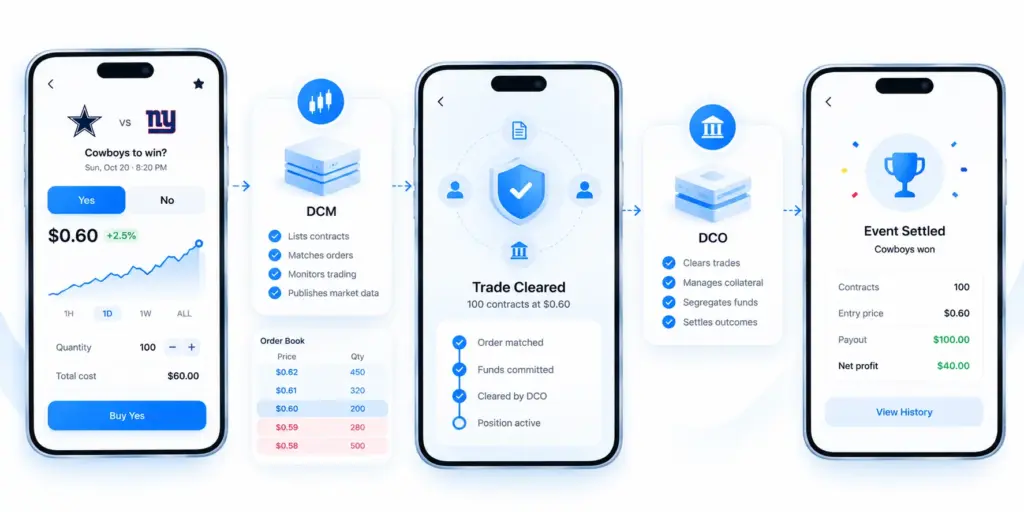
In a CFTC-regulated market, a Designated Contract Market lists contracts and matches orders, a Derivatives Clearing Organization clears and settles trades, and a Futures Commission Merchant acts as the customer-facing broker. Each has separate registration and responsibilities. ProphetX is unusual because it holds both DCM and DCO registrations, allowing it to operate the exchange and clearing functions within one structure.
1. DCM Core Functions
A DCM is the marketplace. It lists contracts, operates the order book, monitors trading, and publishes market data. DCMs must comply with 23 CFTC Core Principles covering areas including trading, records, and financial integrity. ProphetX’s application describes an anonymous central limit order book, a confidential RFQ protocol, and equal access to real-time prices, bids, and offers.
Key DCM Responsibilities
- Contract listing: ProphetX submits product filings covering the reference, liquidity, data sources, and settlement method.
- Order matching: Runs the matching engine and checks such as price collars and self-trade prevention.
- Surveillance: Uses real-time and next-day monitoring, including Nasdaq SMARTS, for spoofing, layering, and wash trading.
- Market data: Daily Bulletin publishes settlement prices, volume, and open interest.
- Emergency authority: The Chief Regulatory Officer can halt trading or cancel trades.
- Recordkeeping: Audit-trail records are retained for at least five years.
2. DCO Clearing Functions
A DCO is the clearinghouse. After a trade is matched, it helps guarantee performance through settlement. CFTC rules also require applicable customer funds held by FCMs and DCOs to be segregated from their own funds. ProphetX uses a fully collateralized model, meaning sufficient funds cover the maximum possible loss on each contract.
ProphetX Direct Clearing Flow
- DCM matches the order: Buyer and seller are paired.
- Funds are committed: Buying-power checks reject orders exceeding available funds.
- DCO clears the trade: ProphetX’s registered clearinghouse guarantees the transaction.
- Funds stay segregated: Customer money remains separate from proprietary capital.
- Settlement pays winners: The DCO settles after the event resolves.
ProphetX therefore combines trading and clearing within a vertically integrated structure under CFTC oversight.
3. FCM Brokerage Functions
An FCM is a customer-facing broker that accepts orders and holds customer funds in segregated accounts. CFTC rules require FCM customer funds to remain separate from the FCM’s own funds. Not every platform needs to become an FCM. An Introducing Broker (IB) can solicit or accept orders without holding customer funds, routing them through an FCM.
| Role | What It Does | Holds Customer Funds? | Example |
| DCM | Lists contracts and matches orders | Not as a broker | ProphetX |
| DCO | Clears and settles trades | Holds collateral in segregated accounts | ProphetX |
| FCM | Accepts orders and holds customer money | Yes | Robinhood Derivatives; Coinbase Financial Markets |
| IB | Solicits or refers orders to an FCM | No | DraftKings through Gus III LLC |
4. Partner Access Models
ProphetX also supports direct access through partner apps. Pikkit connects users to ProphetX, while Boom Sports and Swivel Gaming provide similar access routes. ProphetX also operates white-label and access-provider programs. Its CEO has asked the CFTC for a Section 4(c) framework covering qualifying technology service providers, showing that partner-app structures continue to evolve.
5. Separate Trading and Clearing Controls
Trading and clearing manage different risks. The exchange focuses on fair and orderly markets, while the clearing function focuses on financial safety and settlement. ProphetX separates these responsibilities through governance and financial controls. Its application describes a Regulatory Oversight Committee, employee restrictions on proprietary trading, and a conflicts-of-interest program. Customer funds are segregated from proprietary capital and moved through dual-control authorization.
Role-Specific Controls
- DCM controls: Surveillance, discipline, position limits, and emergency powers.
- DCO controls: Collateral requirements, segregated funds, and settlement guarantees.
- FCM controls: Segregation calculations, capital requirements, and customer disclosures.
For founders, combining roles can provide greater control, as ProphetX’s DCM + DCO structure demonstrates, but it also requires meeting multiple regulatory and operational obligations simultaneously.
What Does the CFTC Require a Market Like ProphetX to Control?
The CFTC requires markets like ProphetX to control who trades, which contracts are listed, how contracts settle, and how trading is monitored. They must also manage exposure, protect customer funds, maintain records, and demonstrate sufficient resources. These requirements come from the core principles for DCMs, with event contracts receiving additional regulatory attention.
1. Market Manipulation Controls
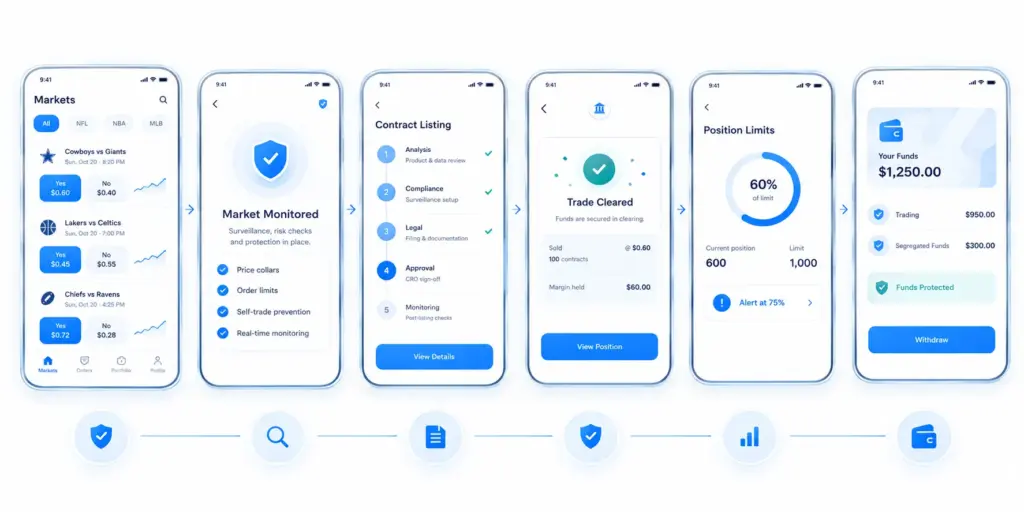
The CFTC treats manipulation as both a design and monitoring issue. Norton Rose Fulbright highlights Core Principles 3, 4, and 12 as particularly relevant to event contracts, covering manipulation resistance, prevention, and market protection. ProphetX addresses this through:
- Surveillance: Nasdaq SMARTS detects spoofing, layering, wash trading, and momentum ignition.
- Investigations: Targets completion within 12 months, absent documented good cause.
- Sanctions: Ranges from warnings to fines, suspension, and expulsion.
- Independence: A Regulatory Oversight Committee supervises enforcement.
2. Contract Manipulation Testing
Before listing, an exchange must show that a contract is not readily susceptible to manipulation. CFTC guidance calls for supporting documentation and data sources. For sports, exchanges are encouraged to consider league integrity standards and restricted-participant lists. Proposed rules also generally allow sports event contracts while restricting categories involving injuries, officiating, and high school sports.
ProphetX Listing Workflow
- Product analysis: Product team prepares methodology, data validation, and Appendix C documentation.
- Compliance review: Configures surveillance and recommends mitigations.
- Legal filing: Prepares self-certification or approval request.
- CRO approval: Chief Regulatory Officer submits it to the CFTC.
- Post-listing monitoring: Tracks settlement inputs, methodology, and liquidity.
If risks emerge, the CRO can adjust parameters, temporarily suspend trading, or amend rules.
3. Market Disruption Controls
ProphetX monitors disruptions from bad data, runaway orders, and technical failures through real-time supervision, automated controls, and emergency powers. Alerts are calibrated by contract and periodically tested.
| Control | What It Does |
| Price collars | Block prices far from the market |
| Maximum order size | Reject oversized orders |
| Throttles | Limit message frequency |
| Buying-power checks | Reject orders exceeding available funds |
| Self-trade prevention | Prevent orders from matching themselves |
| Error-trade standards | Define when trades can be cancelled |
| Emergency authority | CRO can halt, adjust, or cancel trades |
For significant disruptions, ProphetX says it notifies the CFTC before acting where practicable, or within 24 hours otherwise. It also maintains after-action reports and technical logs. Its technology safeguards follow the NIST framework, including penetration tests, tabletop exercises, and business continuity planning.
4. Contract Resolution Rules
Resolution rules determine who gets paid, making clear wording critical. Norton Rose Fulbright identifies resolution and dispute procedures as key regulatory areas, while CFTC guidance warns against overly broad or undefined settlement criteria.
- Weak: “Settles based on whichever sources the exchange chooses after the game.”
- Strong: “Settles based on the official result published by a named authority.”
ProphetX includes settlement methodology in each product filing and documents calculation steps, time windows, outlier filters, and fallbacks. Disputes follow a binding arbitration framework referencing NFA rules, with neutral administration and final, enforceable awards.
5. Position Limits and Accountability
Position limits prevent traders from building stakes large enough to distort markets. CFTC principles require limits or accountability levels where necessary, while event contracts raise questions around aggregating related positions, such as a game winner and spread. ProphetX follows federal limits where applicable and sets exchange-specific limits based on product risk and liquidity.
| Trigger | What Happens |
| 75% of a limit | Position alert is triggered |
| 90% of a limit | Higher-priority alert follows |
| Accountability level | Exchange may request rationale and reduction plan |
| Hard/federal limit | Blocking, cancel-on-breach, liquidation-only, or reductions |
Aggregation follows CFTC rules, supported by KYC checks, controller designations, and periodic certifications. The CRO can also grant bona fide hedge and spread exemptions under objective standards.
6. Recordkeeping and Financial Resources
Records allow regulators to reconstruct activity, while financial resources help the exchange remain operational during disruptions. ProphetX keeps records for at least five years, with two years readily accessible, using encrypted write-once or append-only storage. ProphetX also targets resources covering at least 12 months of projected operating costs.
Its finance team conducts sufficiency analyses, the CFO certifies filings, and quarterly submissions cover resources, haircuts, and runway. ProphetX raised $35 million to support liquidity, development, and partnerships.
User Protection Controls
- Customer funds: Fully collateralized trading rejects orders exceeding available funds; customer money remains segregated.
- Anti-money laundering: Includes sanctions screening and transaction monitoring.
- Accountability: Complete audit trails support investigations and disputes.
- Continuity: Dedicated financial resources support operations through disruptions.
Why Is CFTC Regulation Important for a Prediction Market?
CFTC regulation places prediction markets under federal rules for fairness, transparency, customer protection, and accountability. On a regulated exchange like ProphetX, prices come from participants rather than the platform taking the other side, while oversight monitors manipulation and misconduct.
The exchange must follow published rules, maintain detailed records, and answer to a federal regulator. This makes regulation central to both market safety and credibility.
1. Federal Oversight and Integrity
Federal oversight begins before a market opens. The CFTC requires exchanges and intermediaries to complete a stringent application process and undergo periodic examinations. They must also follow core principles addressing manipulation, insider trading, and market integrity.
ProphetX’s approval process took roughly six months, with its filing mapping operations to the applicable core principles. A Regulatory Oversight Committee oversees enforcement to maintain independence from commercial interests.
Prediction Market Milestones
| Milestone | What Happened |
| 1988 | Iowa Presidential Stock Market launches as an academic program |
| 1992 | CFTC issues a no-action letter allowing expansion to up to 20 universities |
| 2004 | CFTC approves Hedge Street Inc. as the first DCM offering binary options |
| 2010 | Dodd-Frank gives the CFTC authority to prohibit certain event contracts |
The CFTC notes that event contracts have existed in regulated U.S. markets for more than two decades, placing ProphetX within an established regulatory framework.
2. Transparency in Regulated Markets
Transparency lets traders understand how prices form and how contracts work. The CFTC says contract prices reflect traders’ perceived probability, while order books generally display real-time bids and asks. For example, if a Yes position on a $1 contract costs $0.70 and the event occurs, the trader earns a $0.30 profit at settlement.
ProphetX Transparency Measures
- Live market depth: Displays available liquidity and traded volume.
- Published rules: Includes rulebooks, specifications, fees, calendars, and notices.
- Daily data: Daily Bulletin reports settlement prices, volume, and open interest.
- Clear costs: Straight trades carry a 2% fee on net gains.
- Explained mechanics: Disclosures cover matching, order types, risk controls, errors, and settlement.
The CFTC also expects timely information about contract terms, payouts, prices, settlement, and decision-making.
3. Customer and Trading Protections
Protection operates across several layers. Customer-facing intermediaries must follow rules protecting customer funds, while regulated exchanges and intermediaries do not take the opposite side of customer trades. The CFTC also states that prediction markets can operate across all 50 states under federal law, subject to the applicable federal framework.
ProphetX adds several safeguards:
- Pre-funded trades: Buying-power checks reject orders exceeding available funds.
- Segregated funds: Customer money remains separate from company capital.
- Dual approvals: Fund transfers require dual-control authorization and member sub-ledgers.
- Clearing guarantee: ProphetX’s DCO stands behind performance through settlement.
- No house position: The platform does not take the other side of trades.
- Financial crime controls: AML includes sanctions screening and transaction monitoring.
ProphetX also offers Deposit Limits, Trading Breaks, Self-exclusion, and Account Closure.
4. CFTC Market Surveillance
Surveillance operates across multiple levels. Exchanges establish and enforce trading rules and monitor their markets, the NFA oversees brokers and intermediaries, and the CFTC supervises the broader market and enforces federal law. CFTC guidance on sports contracts also encourages cooperation with league investigations involving manipulation or insider trading.
| Layer | Responsibility | ProphetX Example |
| Exchange | Trading rules and market monitoring | Nasdaq SMARTS surveillance for spoofing, layering, wash trading, and momentum ignition |
| Compliance team | Investigations and discipline | Investigations target completion within 12 months, with sanctions up to expulsion |
| NFA | Rules and enforcement for intermediaries | Applies to intermediaries providing market access |
| CFTC | Federal oversight and enforcement | Reviews ProphetX filings and receives significant-disruption reports |
ProphetX says its surveillance captures the information needed to reconstruct the full audit trail of actionable platform messages.
5. Participant Rights and Remedies
The CFTC gives prediction-market customers rights to clear risk, fee, commission, and obligation disclosures, accurate account statements, access to funds, and protection from high-pressure or manipulative sales practices.
Common Participant Remedies
- Complaints: Customers can contact their broker, exchange, NFA, or CFTC.
- Disputes: ProphetX provides binding arbitration referencing NFA rules, with neutral administration and enforceable awards.
- Whistleblowing: Eligible reports can receive incentives, confidentiality, and anti-retaliation protections.
- Administrative complaints: The CFTC’s Office of Proceedings handles certain regulated-entity complaints.
- Safer access: The CFTC recommends using registered entities because unregistered offshore platforms may provide little protection.
The CFTC also advises users to verify that websites and apps belong to registered entities, since counterfeit apps can appear in app stores.
Are CFTC-Regulated Prediction Markets Legal in Every State?
CFTC-regulated prediction markets are not clearly legal in every state. The CFTC says federally regulated markets can operate in all 50 states under federal law, while several states dispute this for sports contracts. Federal appeals courts have also reached different conclusions.
As of late September, platforms may still face state enforcement, operating restrictions, or litigation. This is a changing legal landscape, not legal advice.
1. Federal Preemption and State Laws
The federal position is that CFTC oversight can preempt conflicting state gambling laws. The CFTC says federally regulated prediction markets can operate nationwide and has reaffirmed its exclusive jurisdiction in a federal circuit-court filing. The argument is that sports event contracts qualify as “swaps” under the Commodity Exchange Act, placing them under federal authority.
ProphetX’s CEO has made a similar argument, asking the CFTC to enforce the Act’s express federal preemption provisions. Courts remain divided:
| Date | Court | What It Held |
| April | Third Circuit | Sided with Kalshi in New Jersey, finding a reasonable likelihood that sports contracts are swaps and federal law preempts the state |
| Earlier ruling | Eighth Circuit | Ruled sports-related contracts are not swaps |
| August 28 | Ninth Circuit | Ruled unanimously for Nevada, treating the contracts as sports gambling regardless of their label |
| September 25 | Sixth Circuit | Ruled unanimously that Ohio and Tennessee may apply gambling laws to Kalshi’s sports contracts |
This creates a circuit split, and the U.S. Supreme Court could eventually consider the issue, although it is unclear whether or when it will take a case.
These rulings concern sports event contracts and specific state laws; they are not a nationwide ban on every prediction market.
2. Why States Challenge Sports Markets
The central dispute is what a sports contract legally represents. States argue that a $1 contract paying on a team win is a wager and therefore unlicensed gambling. The Sixth Circuit applied a narrower test, finding that sports outcomes are not tied to a potential financial, economic, or commercial consequence required by the statutory swap definition. This has made sports contracts a major regulatory flashpoint.
Current State Challenges
- Civil suits: Washington, Massachusetts, Michigan, and Nevada have sued operators over alleged unlicensed gaming.
- Criminal action: Arizona has pursued criminal charges, while Minnesota has sought to prohibit prediction markets.
- Tribal lawsuits: Tribes in California, Wisconsin, and New Mexico have sued Kalshi and Robinhood over sports contracts available on tribal land.
- Cease-and-desist orders: On September 10, Connecticut ordered nine platforms to stop offering sports contracts, including ProphetX and Novig, and announced 29 investigative subpoenas.
ProphetX’s history illustrates the difficulty of state-by-state operations. Leadership said it abandoned a New Jersey exchange license after about two years, citing the challenges of operating nationally under state rules. This helped motivate its pursuit of CFTC registration.
3. Operator Compliance Watchlist
Operators need a continuously updated legal watch list because court rulings, state enforcement, and federal rulemaking are evolving simultaneously.
| Watch Item | Why It Matters | Current Example |
| Circuit split and Supreme Court | Final ruling could settle the swap question | Third Circuit for Kalshi; Ninth and Sixth against |
| State enforcement orders | Can restrict where platforms operate | Connecticut orders covering nine platforms, including ProphetX |
| State and tribal lawsuits | Can create new legal challenges | Washington, Massachusetts, Michigan, Nevada, and tribal plaintiffs |
| Geolocation rules | Users must be located in permitted states | ProphetX uses geolocation verification |
| Contract scope | Sports, college, and age rules face scrutiny | Connecticut concerns include under-21 users and college sports |
| CFTC rulemaking | Federal sports-contract rules remain under development | Proposed limits involving injuries, officiating, and high school sports |
4. State Availability Monitoring
Third-party reviews of ProphetX currently disagree about its state footprint. One lists 11 excluded states, including Arizona, Connecticut, Nevada, and New York, while others say only Nevada is excluded. That discrepancy shows why operators should verify availability directly rather than rely on third-party summaries.
A practical approach is to review legal guidance regularly, track every state notice, and build location-based access controls that can quickly restrict users when requirements change.
Build a Custom CFTC-Regulated Market With IdeaUsher
Building a CFTC-regulated market requires more than a trading interface. You need event contract infrastructure, real-time matching, liquidity systems, market surveillance, data integrations, and scalable financial architecture working together. With 500,000+ hours of coding experience and a team that includes ex-MAANG and FAANG developers, IdeaUsher can help businesses engineer the technology behind a custom prediction market like ProphetX.

Custom Event Contract Infrastructure
Build flexible infrastructure for creating, configuring, and managing event contracts with defined outcomes, pricing, settlement rules, contract specifications, and resolution data. We can design the system to support sports markets, futures, props, parlays, and other event-based products.
Trading and Matching Engine Development
Develop a real-time central limit order book and matching engine that supports bids, asks, limit orders, market-style execution, partial fills, price-time priority, and self-trade prevention. The architecture can also incorporate pre-trade risk checks and scalable order processing.
Sports Data and Market Integrations
Connect your platform with real-time sports data providers to power live scores, player statistics, game states, event outcomes, and settlement inputs. We can build resilient APIs and data pipelines that keep contracts synchronized with authoritative event information.
Liquidity and Market-Maker Infrastructure
Create infrastructure for market makers, liquidity providers, and RFQ-based trading, including two-sided quoting, liquidity visibility, market depth, and automated liquidity management. The system can also support maker-taker mechanics and tools designed to improve price discovery across new and active markets.
Conclusion
A CFTC-regulated market like ProphetX gives traders a way to trade event contracts without betting directly against a sportsbook. For businesses planning to build a similar platform, the main challenge is creating a system that can handle real-time trading while keeping every trade secure and properly settled. It also needs strong liquidity so users can trade without waiting too long for a match. With the right setup, businesses can create a market that feels simple for traders while handling the complex work in the background.
FAQs
A1: Yes. ProphetX is a CFTC-designated contract market and a registered Derivatives Clearing Organization. Its DCM designation became effective on June 11, 2026, while its DCO registration became effective on June 10, 2026. This means its trading and clearing operations fall under federal CFTC oversight.
A2: No. ProphetX operates as an exchange rather than a traditional sportsbook. Users trade event contracts with other market participants through an anonymous electronic order book, while ProphetX operates the trading and clearing infrastructure. This means the platform does not simply set odds and take the other side of each trade.
A3: ProphetX generates revenue through trading-related fees and its exchange infrastructure rather than relying on a sportsbook-style house edge. For straight trades, its published fee structure includes a 2% fee on net gains, while its platform also supports partnerships and access models that bring additional users and liquidity to the exchange.
A4: A Designated Contract Market (DCM) is a trading venue designated by the CFTC to list and trade derivatives contracts. It operates under CFTC requirements covering areas such as market integrity, surveillance, recordkeeping, contract listing, and fair trading. ProphetX received its DCM designation in June 2026.
A5: A DCM runs the marketplace, where contracts are listed and orders are matched, while a DCO handles clearing and settlement. ProphetX holds both registrations, allowing its structure to combine the exchange and clearing functions under CFTC oversight. This gives ProphetX control over both the trading and post-trade process.
A6: CFTC event contracts let traders take positions on defined real-world outcomes, usually through contracts with predetermined settlement terms. Traders buy and sell through the exchange, and the contract is settled according to its published rules and an authoritative outcome. ProphetX currently offers certified event contracts, including sports-related binary contracts.