

Picture two bettors who disagree about tonight’s Yankees game. One thinks New York wins, the other thinks they lose. On a normal sportsbook app, both of them are quietly betting against the house, and the house has built a small edge into both sides of that bet so it wins over time no matter who’s right. Novig cuts the house out entirely. It just matches the two bettors against each other and steps out of the way.
That’s a nice pitch. It’s also a strange business, because “we don’t take a cut the way everyone else does” isn’t usually the first sentence of a pitch deck. Yet Novig has raised 108 million dollars, hit a 500 million dollar valuation in its Series B, and is now processing over 4 billion dollars a year in trading volume. So the money has to be coming from somewhere. This article walks through exactly where, using Novig as the test case for how any sports betting exchange, or prediction market platform, can actually turn a profit without the vig that traditional sportsbooks lean on.
We build these platforms at IdeaUsher, so we get some version of this question from founders every few weeks: “if we skip the house edge, what’s left to charge for?” Novig’s answer is a genuinely useful case study, partly because it’s public about the parts that are still unsolved.
The Short Version
If you just want the gist before the detail, here’s what’s actually happening under the hood:
- No vig, but not free. Traders who fill an existing order pay a small fee, capped near three-quarters of a cent per dollar traded. Traders who post an order and wait get a rebate instead of a charge.
- The real money is meant to come from institutions. Novig’s founder has said plainly that the long-term plan is charging professional market makers and liquidity firms, not casual bettors, for access.
- Right now, it runs on virtual currency. Novig Coins fund the platform today, ahead of the exchange-fee model scaling up.
- Federal registration is the unlock. A CFTC exchange license, not a state gambling license, is what lets Novig operate in 47 states without applying state by state.
- Volume is the whole game. Founder Jacob Fortinsky has said profitability isn’t the goal until monthly volume clears 1 billion dollars. It’s currently around 300 million.
Now for how each piece actually works.
Why This Isn’t a Sportsbook Wearing a Different Coat
Novig covers eight sports: NFL, MLB, MLS, WNBA, UFC, PGA Tour, and men’s and women’s tennis. Nothing outside sports, at least so far. Instead of the usual American odds (-110, +150, and so on), everything trades as a probability between 0 and 1. A contract sitting at 0.60 is the market saying “60 percent chance this happens.” Get it right and it settles at a dollar. Get it wrong and it settles at zero.
What actually makes that tradeable is a plain order book, the same idea behind any stock exchange. You can post your own price and wait for someone to take it (that’s “making” the market), or you can grab whatever’s already sitting there for an instant fill (that’s “taking”). A bid to buy Yes at 0.60 and an offer to sell No at 0.40 are the same trade seen from opposite sides, so the two always add up to 1.
Here’s the part that actually matters for the business model: a traditional book has to take the other side of your bet. It’s your opponent, which means it’s carrying risk, watching for sharp bettors, and adjusting lines to protect itself. Novig never takes a side. It just introduces two people who already disagree and lets them trade. Take away the house’s exposure and you take away its need for a built-in edge, which is exactly why Novig had to go find revenue somewhere else.
Why Federal Registration Isn’t Just a Legal Footnote
Here’s a detail that’s easy to skim past but is actually doing a lot of work: in 2026, Novig registered with the Commodity Futures Trading Commission as a Designated Contract Market. That’s derivatives regulation, the same category that governs commodities and futures exchanges, not gambling regulation.
Practically, that one registration replaces what would otherwise be a slow crawl through individual state gaming boards. Novig can operate across 47 states plus D.C. today, with only Arizona, Michigan, and Nevada currently off-limits. A traditional sportsbook has to win that access one license at a time, which costs money and years. Kalshi and Polymarket took the same federal route for the same reason, and it’s a big part of why all three companies scaled distribution faster than a licensed sportsbook could.
For a business whose margin per trade is razor thin, reaching more states faster isn’t a nice-to-have. It’s the difference between the volume math working and not working.
Where the Fees Actually Come From
| Revenue source | How it works | Status today |
|---|---|---|
| Taker fees | Up to $0.0075 per contract, formula: 0.03 × P × (1−P) | Live |
| Maker rebates | Credits (not charges) to traders who post liquidity | Live |
| Institutional / liquidity provider fees | Market makers pay for access, data, faster execution | Planned |
| Virtual currency sales | Novig Coins converted to redeemable Novig Cash | Live, bridge model |
Taker fees, capped near a rounding error. Instead of a spread baked into every line, Novig charges the person who accepts an existing order a fee that tops out around three-quarters of a cent per dollar contract, using the formula 0.03 × P × (1−P). Notice what that formula does: the fee peaks when a contract sits near 50/50, where the outcome is genuinely uncertain and trading is busiest, and shrinks toward the edges where the result is nearly decided. It’s a fee sized to match how much genuine price discovery is happening, not a flat tax on every wager.
Maker rebates, which flip the incentive. Post an order instead of taking one and you earn a small credit rather than paying anything. That’s deliberate: an order book is only useful if people are willing to sit there offering prices, and Novig is paying for that liquidity rather than assuming it’ll show up on its own.
Institutional fees, which is where the founder says the real business lives. Fortinsky has been direct about this: retail taker fees were never going to carry the company. The actual plan is charging professional market-making firms and liquidity providers for the deep, always-on liquidity that lets casual users get instant fills. That’s standard practice on financial exchanges, and it’s the piece Novig is still building out.
Novig Coins, the bridge that funds things today. Ahead of the institutional-fee model maturing, Novig runs a sweepstakes-style structure: users buy virtual currency (Novig Coins), convert it into redeemable Novig Cash through play, and cash out. It’s not the end-state business, but it’s a legitimate way to monetize a growing user base and stay compliant in more states while the exchange side scales.
“The biggest gap between us and our competitors is brand recognition,” founder Jacob Fortinsky has said of rivals Kalshi and Polymarket. His counter is that Novig has “a higher slope,” betting that faster relative growth eventually closes a valuation gap that currently reads 11 billion, 9 billion, and 500 million dollars.
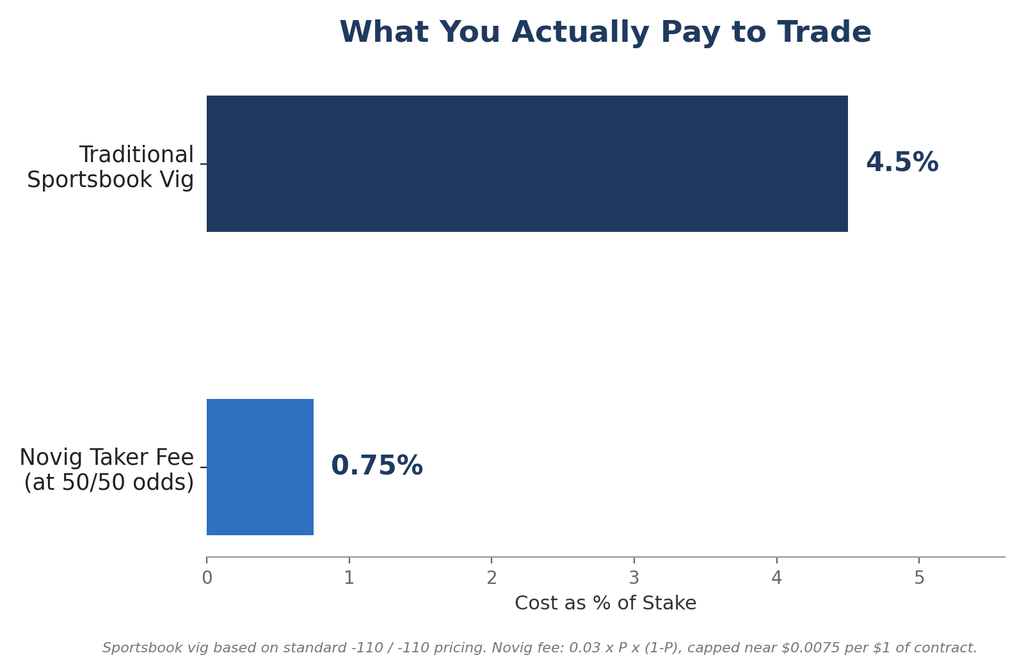
Novig taker fee versus a traditional sportsbook’s vig
And underneath all of it: volume, volume, volume. Trading grew tenfold across 2025, and annualized volume now sits above 4 billion dollars, with roughly 300 million dollars moving through the platform monthly as of the Series B raise. Fortinsky has said flatly that profitability isn’t the priority until monthly volume crosses 1 billion dollars, the point where thin per-trade fees start adding up to something real. It’s the same math every exchange runs on: keep the take rate low enough to steal share from the incumbents, then let scale do what margin used to do.
How Big Is the Pond Novig Is Fishing In
Two numbers are worth holding in your head at once. The traditional sports betting market was worth roughly 111.2 billion dollars in 2025, is on track for 123.4 billion in 2026, and is projected to reach 236 billion by 2033, a 9.7 percent annual growth rate. Layered on top of that, the newer prediction-market category Novig sits inside has grown even faster: industry-wide monthly trading volume went from about 1.2 billion dollars in early 2025 to more than 20 billion dollars by January 2026, and unique active wallets nearly tripled over that same stretch.
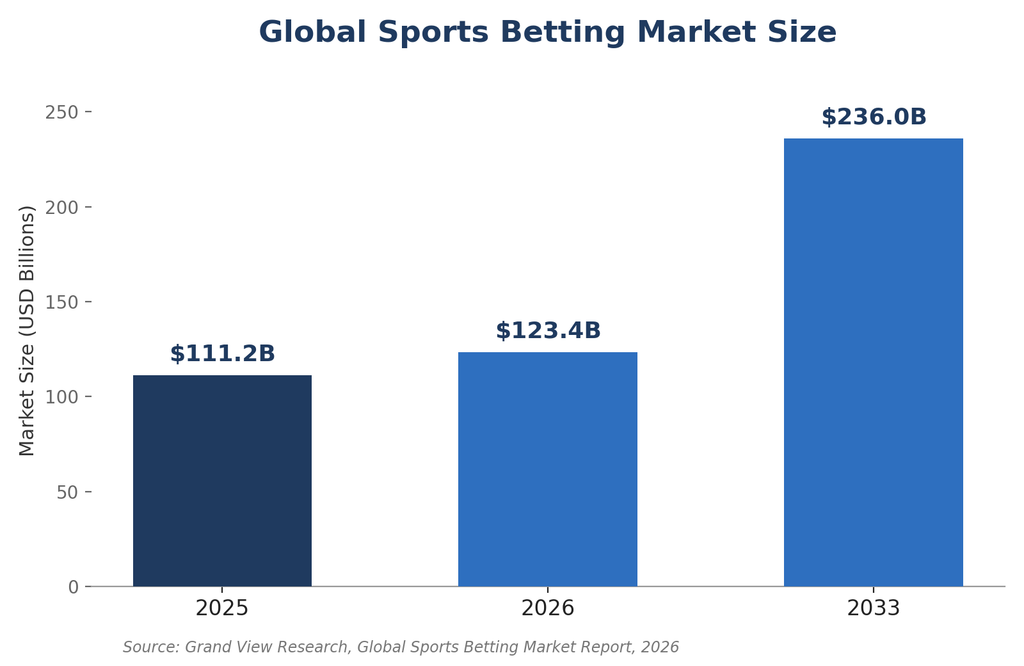
Global sports betting market size 2025 to 2033
That’s the tailwind. The headwind is who else noticed it. Kalshi is valued around 11 billion dollars with roughly 2 billion dollars trading weekly. Polymarket sits near 9 billion, after ICE (the parent company of the New York Stock Exchange) put up to 2 billion dollars into it. Next to those two, Novig’s 500 million dollar valuation looks small, and it is small. What it has instead is focus: it’s the only one of the three built sports-first rather than treating sports as one category among many.
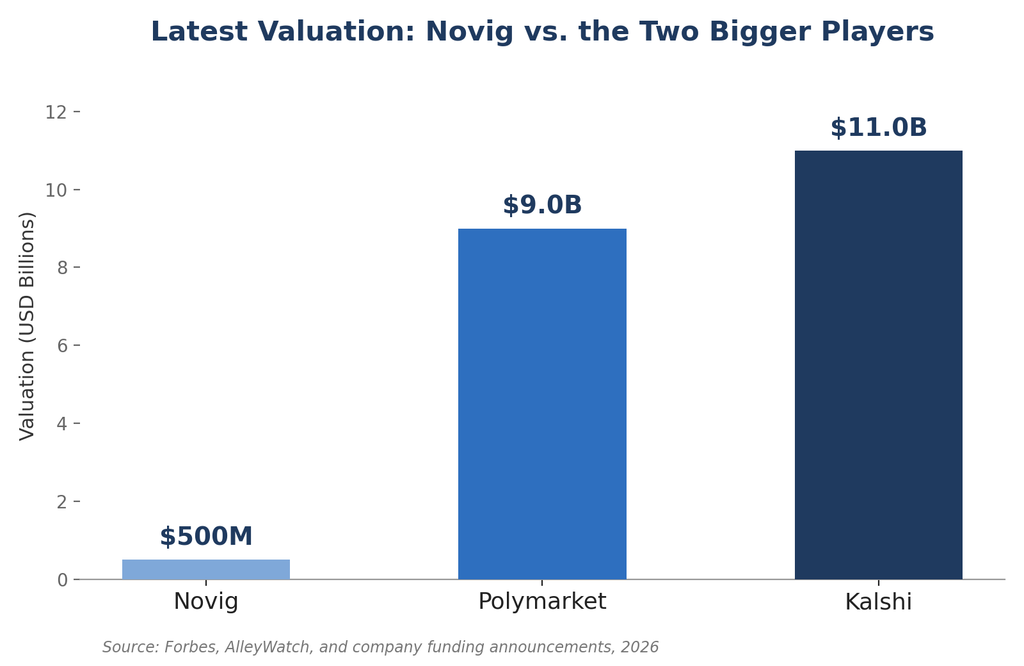
Valuation comparison: Novig, Polymarket, and Kalshi
Where the Model Could Break
None of this is guaranteed to work, and it’s worth being honest about where it could go wrong.
A thin order book is the most obvious risk. If not enough people are trading a given market, spreads widen and fills slow down, and a bettor comparing that to an instant, guaranteed line at a normal sportsbook might just go back to the sportsbook, worse price and all. Novig has to keep growing volume just to stay usable, not only to hit its own revenue targets.
Then there’s the size gap. Fortinsky has openly admitted brand recognition is Novig’s biggest disadvantage against Kalshi and Polymarket, and a 500 million dollar company has a lot less runway to outspend competitors that are twenty times its size.
And the regulatory ground isn’t fully settled either. The same CFTC registration that gives Novig national reach without state licensing is currently being scrutinized by the CFTC itself: in 2026 the agency proposed new rules aimed at limiting how sports-adjacent prediction markets operate. A business built on one interpretation of the rules is exposed if that interpretation shifts.
None of that makes the model broken. Exchanges in other asset classes have survived worse growing pains. But it does mean the whole thing only works if liquidity, capital, and regulatory footing all hold up at the same time, which is a harder trick than the pitch makes it sound.
What This Actually Means If You’re Building Something Similar
A few things stand out if you’re a founder looking at Novig as a template rather than just a curiosity.
The matching engine is the product, not a feature. Everything about pricing fairness and user trust rests on a fast, reliable order-matching system that can handle live sports data without lag that lets someone pick off a stale price. This isn’t something you bolt onto a betting app template after the fact; it has to be architected as an exchange from the start, which is the same discipline we apply whenever a team comes to us wanting to build a platform like Polymarket or develop something closer to Kalshi.
Regulatory strategy has to be picked before the tech stack, not bolted on after. Whether you go the state-licensing route, the CFTC exchange route, or the sweepstakes route changes your compliance architecture, your payment rails, and your entire rollout order. Founders who treat this as paperwork to sort out later usually end up rebuilding core infrastructure at real cost.
The fee model needs a bridge to survive its own early years. Copying Novig’s near-zero take rate without also copying its patience is a fast way to run out of runway. Whether that bridge is a virtual currency model, institutional API access, or a subscription tier for serious traders, something has to fund the platform while volume builds toward the level where thin fees actually add up.
Liquidity is the real moat, not the branding. A gorgeous interface over an empty order book is unusable, because nobody can get filled at a fair price. Most early-stage exchanges need seeded liquidity, either from a market-making partner or the platform’s own capital, until organic volume is enough to sustain itself.
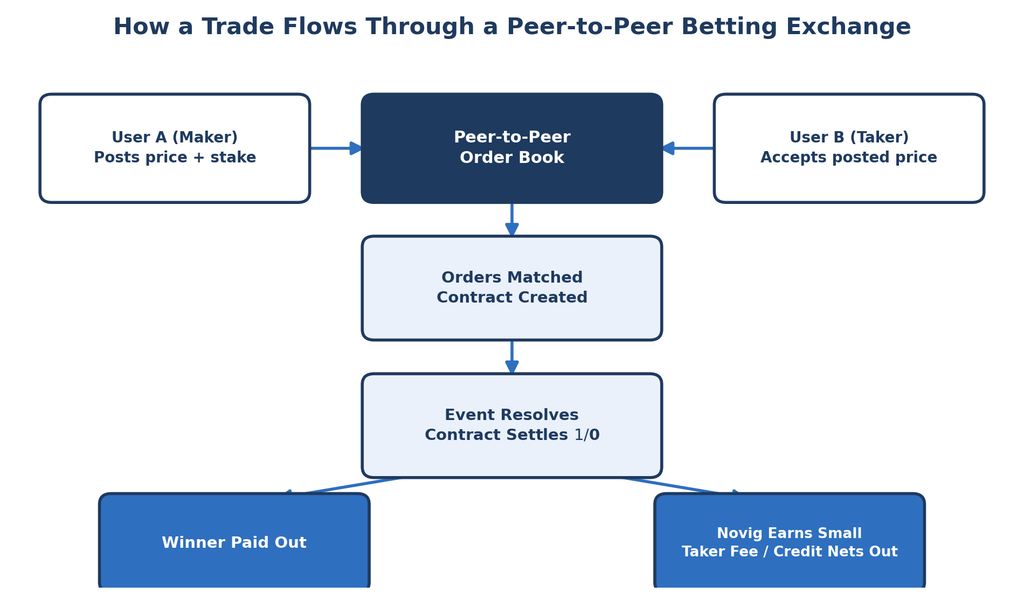
How a trade moves through a peer-to-peer betting exchange
Why Founders Building This Kind of Platform Work With IdeaUsher
An exchange-style betting platform is a different build than a standard sportsbook app, and most agencies have only ever shipped the latter. We’ve spent over a decade specifically in fintech and sports betting app development, which is usually why founders building Novig-style exchanges end up talking to us instead of a generalist shop.
The experience is specific, not general. Eleven-plus years, a 250-plus person team, engineers who’ve actually shipped order-matching engines, real-time odds feeds, and AI-driven sports betting products. Over 1,000 projects delivered across 50-plus countries means we’ve already hit most of the edge cases a first-time exchange builder is about to discover the hard way.
Compliance gets built in, not bolted on. A betting exchange sits at the intersection of gaming law and derivatives regulation, so our fintech development work treats KYC, AML, and audit trails as architecture decisions from day one, not a checklist for later.
We ship in phases, on a real timeline. Rather than a year-long monolithic build, a compliant MVP, core order book, matching engine, and payments, typically ships in 12 to 16 weeks. Secondary markets, mobile apps, and institutional features layer on after that’s validated. It’s roughly how Novig itself scaled: narrow and sports-only first, broader later.
The track record is checkable. A 4.9 out of 5 average on Clutch matters more here than in most verticals, because a mispriced contract or a broken payment flow in fintech isn’t a minor bug. It’s real money and real regulatory exposure on day one.
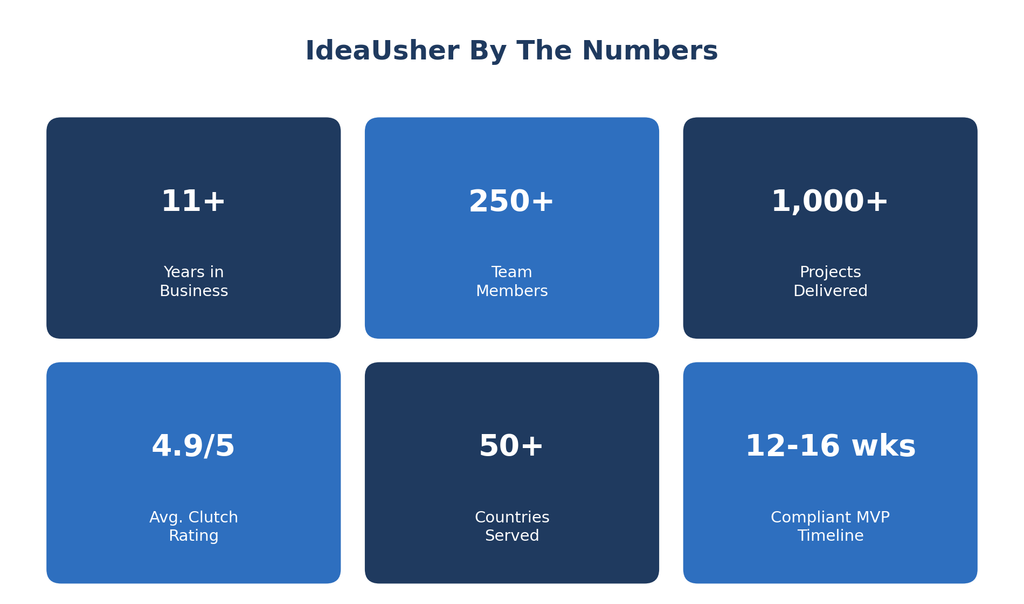
IdeaUsher by the numbers
If you’re scoping something in this space, IdeaUsher’s prediction marketplace team is a reasonable place to start, especially if you haven’t yet decided between a sweepstakes model, a CFTC-registered exchange, or a traditional state-licensed sportsbook.
The Short Answer
Novig makes money by being a different kind of business than a sportsbook, not a cheaper version of the same one. It takes a sliver of a cent on filled trades, plans to charge institutions once volume justifies it, sells virtual currency to keep the lights on in the meantime, and treats trading volume, not margin per bet, as the number that actually matters. The CFTC registration isn’t a side detail either. It’s the regulatory foundation the entire low-fee model depends on to work at national scale.
If you’re eyeing the same opportunity, the lesson isn’t “remove the vig and users show up.” It’s that removing the vig only works if you replace it with an actual exchange: a deep order book, a regulatory structure built to scale, and a way to fund the years before the fee model pays for itself.
Frequently Asked Questions
Does Novig charge any fees at all?
Yes, just structured differently from a sportsbook’s vig. Traders who post liquidity (“makers”) earn a small credit instead of paying anything, while traders who accept an existing order (“takers”) pay a fee capped around three-quarters of a cent per dollar contract.
How is Novig regulated compared to DraftKings or FanDuel?
Novig is registered with the CFTC as a Designated Contract Market, federal derivatives oversight, rather than relying on state-by-state gaming licenses the way traditional sportsbooks do. That’s what lets it run in 47 states plus D.C. with only a handful currently excluded.
Is Novig actually profitable?
Not yet, and not by accident. The founder has said profitability isn’t the priority until monthly trading volume crosses 1 billion dollars. As of the 2026 Series B, monthly volume was closer to 300 million, with annualized volume above 4 billion.
What’s the real difference between Novig and Kalshi or Polymarket?
Scope and focus. Novig is sports-only. Kalshi and Polymarket cover politics, economics, and current events on top of sports, and they’re dramatically bigger: roughly 11 billion and 9 billion dollar valuations against Novig’s 500 million. Novig’s bet is that narrower focus means faster relative growth.
Can you build something like Novig without CFTC registration?
Yes. State-by-state sportsbook licensing or a sweepstakes model using virtual currency, closer to what Novig itself ran in its early days, are both workable paths. Each one changes your cost, timeline, and which states you can reach first, which is why this decision needs to happen before development starts, not after.
What does it cost to build a betting exchange like this?
It depends heavily on scope, but a compliant MVP covering the matching engine, real-time data feeds, payments, and core compliance typically takes a specialized team 12 to 16 weeks. There’s more detail on what drives that cost in IdeaUsher’s guide to sports betting app development costs.