

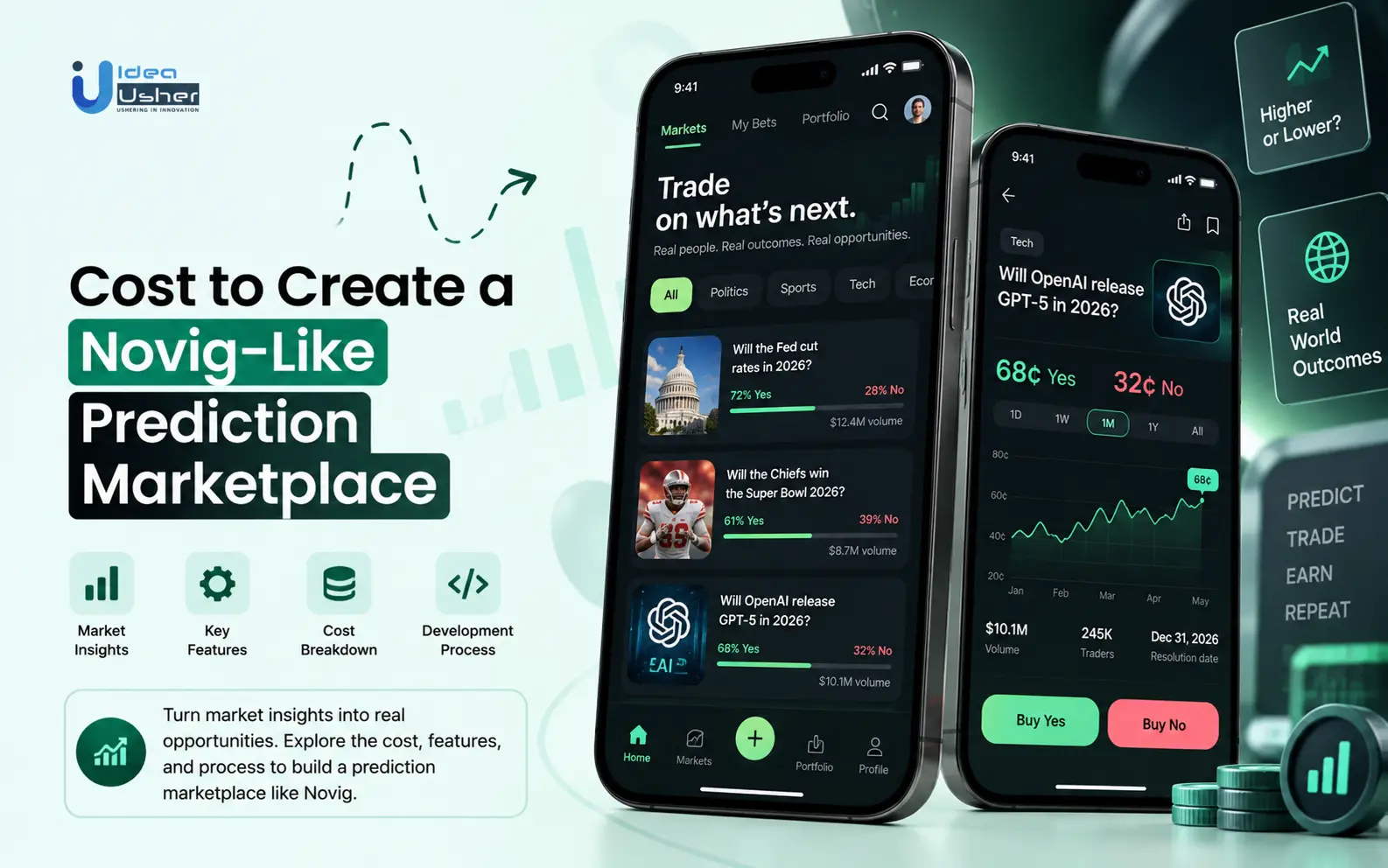
One Sydney Sweeney ad later, prediction markets aren’t a niche anymore. Novig went from “that betting app” to something your coworkers bring up at lunch, and somewhere, a founder watched that commercial and didn’t think about placing a bet. They thought about owning the platform.
If that founder is you, this blog answers the question you’re probably already asking: how much does it cost to build a prediction marketplace like Novig? The short version is $50,000 to $400,000+, depending on whether you launch a lean MVP, a full production exchange, or a CFTC-grade platform. You’ll also find clone scripts going for $10,000 to $30,000. They look like a steal right up until real liquidity and real regulators show up.
Below, we break down where that money actually goes: features, tech stack, compliance, liquidity, and the hidden costs most estimates skip. Still deciding which model to follow? Our guides on building a prediction market platform like Kalshi and developing a prediction marketplace like Polymarket cover the adjacent categories.
What Is Novig and Why Are Founders Copying It?
Novig is a sports-only, peer-to-peer prediction market where users trade against each other on an order book instead of betting against a house. Prices are shown as probabilities between 0 and 1, both sides of a contract sum to $1, and there is no vig baked into the quote. Contracts settle at $1 if the outcome happens and $0 if it does not. For a plain-language walkthrough, see OddsShopper’s explainer on how Novig works.
The model gained serious credibility in 2026. Novig’s operator, Ludlow Exchange LLC, received CFTC Designated Contract Market (DCM) status on June 16, 2026, which opens a path to a federally regulated exchange across the United States. Until that exchange fully launches, Novig still runs a dual-currency sweepstakes product for users aged 21 and above. Its coverage is deliberately narrow: tennis, MLB, MLS, NFL, PGA Tour, UFC, and WNBA, with no political, crypto, or weather markets.
That focus is exactly why founders want a Novig-like build. A niche, sports-first exchange with an order book, zero house edge, and a clear regulatory path is easier to market and defend than a generic “bet on anything” platform. The catch is that the cost is driven less by the app screens and more by the matching engine, liquidity, and compliance stack underneath.
How Much Does a Novig-Like Prediction Marketplace Cost?
A custom Novig-like exchange costs $50,000 to $100,000 for an MVP, $100,000 to $250,000 for a full production platform, and $250,000 to $400,000+ for an enterprise-grade, regulation-ready build. These ranges follow published 2026 benchmarks from Clarisco and vary by team location, scope, and compliance depth.
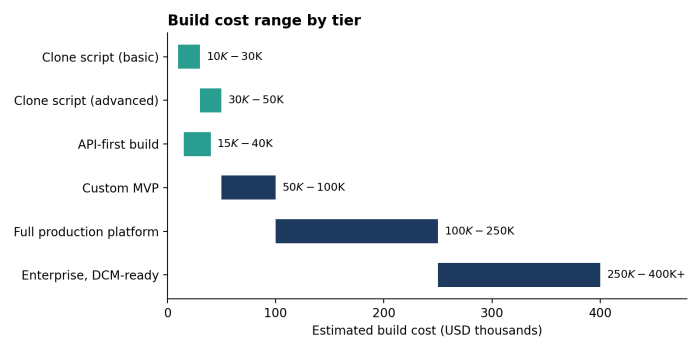
Figure 1: Build cost range by tier (USD thousands)
| Build Tier | Estimated Cost (USD) | Timeline | Best For |
| Clone script (basic) | $10,000 – $30,000 | 4 – 6 weeks | Fast demo, sweepstakes-style pilot |
| Clone script (advanced) | $30,000 – $50,000 | 6 – 10 weeks | Early validation, limited customization |
| API-first build (third-party liquidity) | $15,000 – $40,000 | 4 – 10 weeks | Front-end brand on existing markets |
| Custom MVP | $50,000 – $100,000 | 3 – 6 months | Single-sport order book, limited users |
| Full production platform | $100,000 – $250,000 | 6 – 12 months | Multi-sport exchange with wallets and KYC |
| Enterprise, DCM-ready | $250,000 – $400,000+ | 12 – 18 months | Regulated exchange with surveillance and clearing |
Software cost is only one line item. Legal counsel, licensing, market makers, and 15 to 20 percent yearly maintenance sit on top, and for a regulated exchange they can rival the build budget itself. For a broader benchmark, compare this with our breakdown of the event prediction marketplace development cost and the cost of developing a sports betting app.
Feature-Wise Cost Breakdown
The order book and matching engine are the most expensive modules, because they must be fast, fair, and auditable. A Novig-like product needs several moving parts beyond a normal betting app, and each one carries its own price tag.
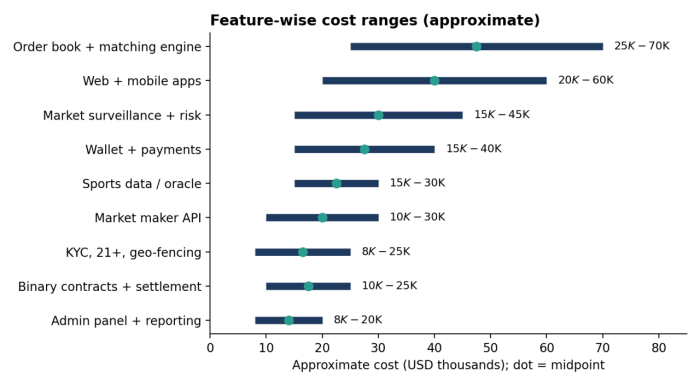
Figure 2: Feature-wise cost ranges (approximate)
| Feature / Module | What It Does | Approx. Cost (USD) |
| Order book and matching engine | Matches buy and sell orders at prices between 0 and 1 | $25,000 – $70,000 |
| Binary contract and settlement logic | Pays $1 or $0 on result, handles voids and cancellations | $10,000 – $25,000 |
| Sports data and oracle integration | Feeds odds, scores, and final results for settlement | $15,000 – $30,000 |
| Wallet, deposits, and withdrawals | Payment gateways, ledger, balances, payout rules | $15,000 – $40,000 |
| KYC, age (21+), and geo-fencing | Identity checks, state-level access control | $8,000 – $25,000 |
| Market surveillance and risk tools | Detects manipulation, insider activity, wash trading | $15,000 – $45,000 |
| Web and mobile apps (iOS, Android) | Trading screens, charts, positions, notifications | $20,000 – $60,000 |
| Admin panel and reporting | Market creation, disputes, user management, audits | $8,000 – $20,000 |
| Market maker API and liquidity tools | Lets professional liquidity providers quote tight spreads | $10,000 – $30,000 |
Only the oracle range comes from a published benchmark; the other ranges are approximate planning estimates and shift with scope and team location.
Why the Matching Engine Costs So Much
A peer-to-peer order book has to process orders in microseconds without ever double-filling or losing state. Engineering that reliably means low-latency services, event sourcing, and heavy load testing, which is why this single module can take up to a quarter of the build budget. Our guide to decentralized prediction marketplace development explains the on-chain alternative and its trade-offs.
Why Sports Data Is a Hidden Cost
Live sports feeds are usually licensed per league and billed monthly, so the oracle budget is both a one-time integration cost and a recurring one. Tennis, MLB, NFL, and UFC each come from different providers with different latency and pricing.
Cost by Development Phase and Team
Discovery, architecture, and compliance planning should take 10 to 15 percent of the budget, and skipping them is the most common reason exchange builds overrun. The phases below show where the money typically goes on a $150,000 production build (approximate split).
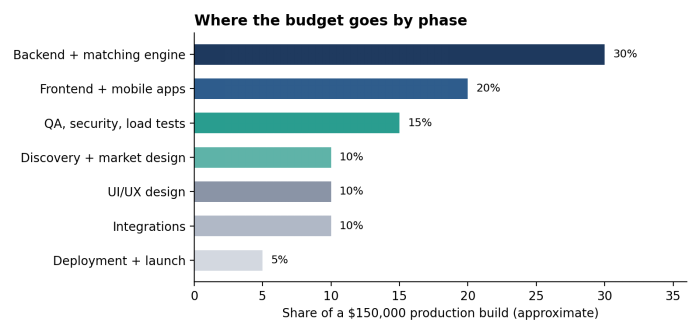
Figure 3: Budget share by development phase
| Phase | Share of Budget | What Happens |
| Discovery and market design | 10% | Sport coverage, contract rules, fee model, regulatory scoping |
| UI/UX design | 10% | Trading flows, order tickets, mobile-first screens |
| Backend and matching engine | 30% | Order book, ledger, settlement, APIs |
| Frontend and mobile apps | 20% | Web app, iOS, Android |
| Integrations | 10% | Sports data, payments, KYC, geo-location |
| QA, security, load testing | 15% | Penetration tests, concurrency and failover tests |
| Deployment and launch support | 5% | Cloud setup, monitoring, go-live |
Team You Will Need
A realistic core team is 8 to 12 people working 4 to 9 months. That usually means a product manager, a solution architect, two or three backend engineers with trading-systems experience, two frontend or mobile developers, a UI/UX designer, a QA engineer, and a DevOps engineer. Add a compliance lead and legal counsel from day one if you plan to pursue a regulated route.
Hourly rates decide the final number more than any feature does. North American agencies often charge $100 to $200 per hour, Eastern European teams $50 to $90, and South Asian teams $25 to $50, so the same scope can vary by two to four times.
Compliance, Licensing, and Ongoing Costs
Regulation is the biggest swing factor in the whole budget. Novig’s operator needed a CFTC Designated Contract Market designation, and Gaming Today reports its approval came about five months after the application appeared in the CFTC portal, while earlier DCMs such as Railbird and QCEX took roughly three years. With 17 DCM applications reportedly pending, timelines and legal fees are unpredictable. You can also review the regulator’s own material at the CFTC website.
Three Realistic Launch Routes
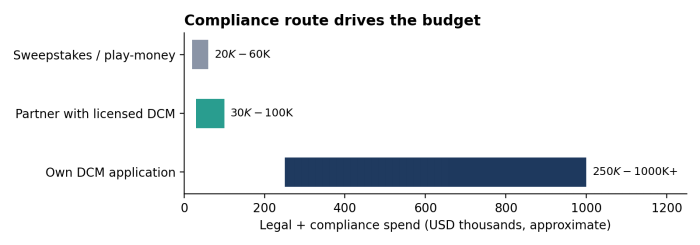
Figure 4: Legal and compliance spend by launch route
| Route | Legal Exposure | Typical Legal and Compliance Spend |
| Sweepstakes or play-money model | State-by-state sweepstakes law | $20,000 – $60,000 |
| Partner with a licensed DCM or broker | Depends on partner agreement | $30,000 – $100,000 |
| Own DCM application | Full CFTC oversight, surveillance, clearing rules | $250,000 – $1,000,000+ |
Legal ranges are approximate and depend heavily on counsel and jurisdiction. Get advice from a CFTC-experienced attorney before choosing a route.
Recurring Costs After Launch
Plan for 15 to 20 percent of the initial build cost per year for infrastructure, monitoring, and upgrades, according to Clarisco. On top of that, budget for these items:
- Sports data licenses: monthly fees per league or provider.
- Cloud infrastructure: low-latency hosting, redundancy, and DDoS protection.
- Liquidity incentives: market maker rebates or seed capital so spreads stay tight.
- Customer support and dispute handling: especially for settlement disputes.
- Compliance tooling: surveillance software, audits, and reporting.
Factors That Affect Cost and How to Reduce It
Scope, regulation route, and team location move the budget more than design or branding. The main cost drivers are the number of sports and markets at launch, whether you build your own liquidity layer, the depth of surveillance tooling, native mobile apps versus web only, and the compliance path you choose.
Ways to Lower the Budget Without Killing the Product
- Launch one sport first. A tennis or MLB-only order book cuts data, QA, and market-ops cost, and proves demand before you expand.
- Start with an API-first or partner model. Plugging into licensed liquidity can bring the entry cost down to the $15,000 to $40,000 band.
- Ship web and PWA before native apps. Native iOS and Android can follow once retention is proven.
- Buy, do not build, commodity modules. KYC, payments, and geo-location vendors are cheaper than in-house builds.
- Phase compliance. Begin with a sweepstakes or partnered model and pursue your own DCM only when volume justifies it.
How a Novig-Like Marketplace Makes Money
Novig markets itself as commission-free with no vig, so revenue has to come from somewhere else. Common models include small per-contract or settlement fees, taker fees only, market maker spread capture, premium data or API access, and sponsorships. Users still pay a practical cost through the bid-ask spread, as OddsShopper notes, which is where liquidity design directly affects margin. See how the biggest player monetizes in our breakdown of how Polymarket makes money.
Build Your Novig-Like Prediction Marketplace With Idea Usher
Idea Usher is a custom software and AI engineering company that builds prediction market platforms, order-book exchanges, and trading systems for startups and enterprises. The team scopes the MVP around one sport, designs the matching engine and settlement logic for scale, and plans the compliance route with your legal counsel so the budget holds up after launch. Explore our prediction marketplace development services or book a free 30-minute scoping call to get a tailored estimate.
FAQs
How much does it cost to build a platform like Novig?
A Novig-like platform costs $50,000 to $100,000 for an MVP, $100,000 to $250,000 for a production build, and $250,000 to $400,000+ for an enterprise, DCM-ready exchange. Legal, data licensing, and liquidity costs are additional.
How long does it take to build a Novig-like exchange?
An MVP takes 3 to 6 months, a full platform 6 to 12 months, and an enterprise build 12 to 18 months. Clone scripts can launch in 4 to 10 weeks with limited customization.
Do I need a CFTC license to launch?
Not always, but a U.S. exchange offering event contracts generally needs a regulated route, such as your own DCM or a licensed partner. Novig itself operated a sweepstakes model before its exchange, Ludlow Exchange LLC, was designated a DCM on June 16, 2026. Consult a CFTC-experienced attorney before choosing your model.
What is the cheapest way to start?
An API-first or clone-script build for one sport is the cheapest entry, roughly $15,000 to $50,000. Expect to rebuild core modules if the product gains traction.
What are the yearly maintenance costs?
Budget 15 to 20 percent of the initial build cost per year, plus sports data licenses, cloud hosting, and market maker incentives.
Is a Novig-like model different from Polymarket or Kalshi?
Yes. Novig is sports-only and order-book based with no house line, while Polymarket and Kalshi cover many event categories. A sports-only focus narrows the data and compliance scope, which can lower cost. Read our guides on Polymarket-style development and Kalshi-style development.