

Key Takeaways
- The cost to build a platform like ProphetX can cost around $150,000 to $1.5M+, depending on the platform scope, trading setup, compliance and target market.
- The main sports exchange app like ProphetX development cost comes from the exchange infrastructure, including order books, matching, live sports data, wallets, payments, liquidity and security.
- A basic MVP sports exchange app like ProphetX starts around 150,000–300,000. The production and regulated versions can go much higher to $600,000 to $1.5M or more when trading and compliance features are added.
- Liquidity is also a major part of the sports exchange app development cost. The platform needs market makers, monitoring tools, incentives and enough capital to keep markets active.
- For a real-money US exchange, CFTC requirements, KYC/AML and fund controls need to be built into the sports exchange platform. Market surveillance and audit systems must be included from the start in the platform.
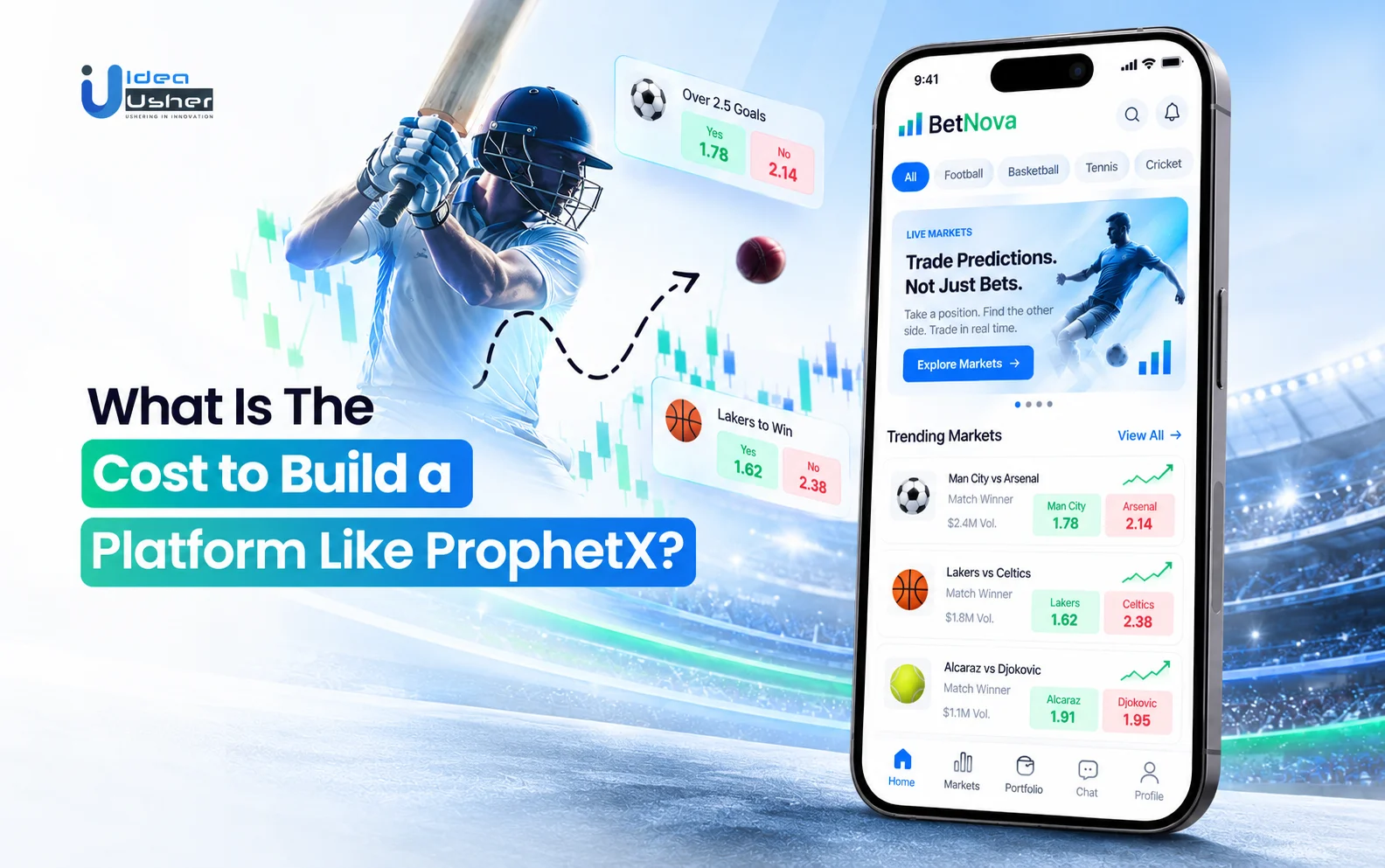
The cost to build a platform like ProphetX ranges from $150,000 to $1.5 million or more. This development cost depends on the exchange model, trading infrastructure, sports data integrations, liquidity requirements, compliance controls and target jurisdiction. A basic MVP needs significantly less investment than a production-ready or regulated exchange that includes matching, market making, strong security and solid financial infrastructure.
A sports exchange prediction platform involves far more than a betting interface, which is why development costs can vary widely. Real-time sports data, order matching, wallets, payments, liquidity, risk controls and compliance can increase both development and operational expenses, while the technology stack, feature scope, integrations and team structure further influence the overall investment.
In this blog, we will break down the major cost components, development stages, technology requirements, ongoing expenses and factors that influence the cost to build a platform like ProphetX, and how IdeaUsher will help you plan a realistic budget for sports prediction exchange app launch and future scaling.
What Is a Sports Prediction Exchange Like ProphetX?
A sports prediction exchange like ProphetX is a financial marketplace for sports trading, where users buy and sell event contracts directly against one another rather than betting against a centralized house or sportsbook.
Operating under a peer-to-peer (P2P) model, exchange platforms function like financial order books similar to stock exchanges or platforms like Kalshi. Users take either side of a proposition (“Backing” an outcome or “Laying” it) or set their own prices, while the exchange acts as a neutral venue holding funds in escrow and settling outcomes.
- Order Book Dynamics: Instead of picking odds from a fixed board, traders view a live order book showing available bid and ask prices along with market depth (liquidity volume at each price level).
- Backing vs. Laying: Backing means taking a position that an outcome will occur, while laying means offering a position that it will not.
- Backing: Buying a contract that an event will happen.
- Laying: Selling/offering a contract that an event will not happen (acting as the “house” for another trader).
- Zero House Edge / Lower Fees: Platforms eliminate the 4% to 10% profit margin (“vig” or “juice”) built into traditional sportsbook lines. Instead, exchanges monetize by taking a small commission (typically 2% to 3%) strictly on net winning payouts.
- No Winning Limits: Traditional sportsbooks frequently limit or ban profitable bettors. Because prediction exchanges do not take market risk on the outcomes, they encourage volume and do not restrict winning traders.
A. Core Business Overview
ProphetX is a sports-native peer-to-peer prediction exchange. Rather than acting as a traditional sportsbook that sets line odds and bets against players, ProphetX operates an order-book marketplace where users trade event outcomes directly against each other.
| Metric | Details |
| Monetization Model | Charges a 2% trading fee on net winnings per market for straight trades (0% fee on losing trades or original stakes). |
| Monetization Mechanics | Eliminates the standard house “vig” or margin (typically 4.5%–10% at traditional books), driving higher payout values for traders. |
| Key Features | Live order-book depth, custom limit order pricing, high-frequency API access for institutional market makers, and “Parlay Mode”. |
| Company Structure | Privately held fintech startup. Founded in 2018 (originally operating state-level exchanges like Prophet Exchange in NJ before rearchitecting under CFTC regulations). |
B. How Is ProphetX Different From a Sportsbook?
A sports prediction exchange like ProphetX differs from a traditional sportsbook in its counterparty model, pricing, fees, regulation and trading mechanics, giving users greater control over how contracts are priced and traded.
| Dimension | Traditional Sportsbook (e.g., DraftKings) | Sports Prediction Exchange (e.g., ProphetX) |
| Counterparty | The House (Bookmaker) | Other Individual Traders (P2P) |
| Pricing Engine | Oddsmakers establish fixed lines + vig margin | Open order book driven by supply and demand |
| Monetization | Embedded “Juice” / Overround on lines (~5–10%) | Net payout commission (typically 2–3% on wins) |
| Regulatory Model | State-by-state sports betting licenses | Federal regulatory frameworks (e.g., CFTC DCM compliance) |
| Custom Odds | Unavailable (Must accept quoted line) | Permitted (Users post custom bid/ask orders) |
C. How Large Is the Sports Prediction Exchange Market?
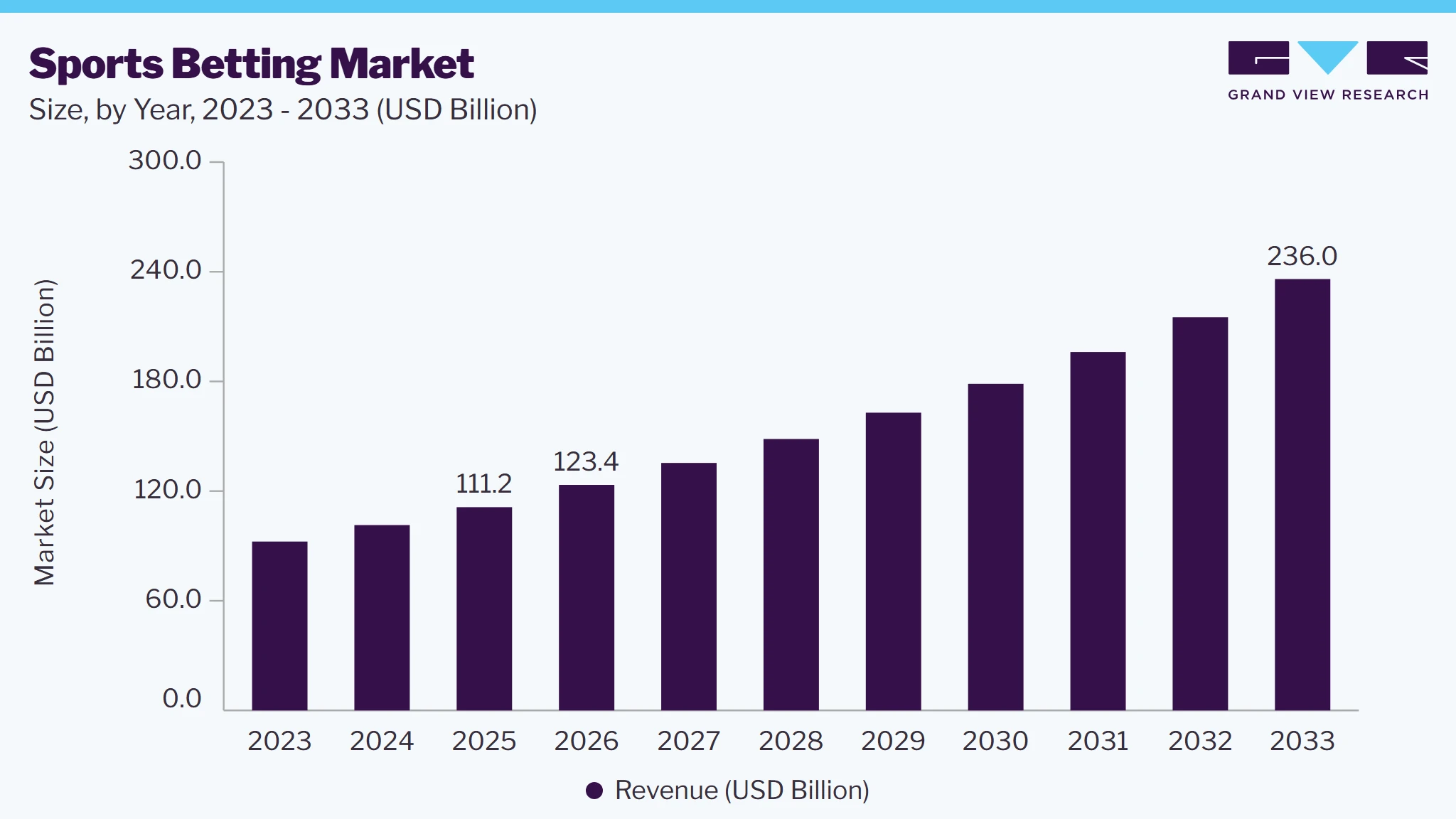
The sports gaming industry is expanding beyond traditional sportsbooks toward peer-to-peer (P2P) prediction exchanges. The global sports betting market has reached $123.4 billion in 2026, while prediction markets have recorded $11.6 trillion in annualized trading volume.
Meanwhile, Pew Research Center found that combined monthly trading volume across major US prediction platforms surged from under $5 billion in September 2025 to approximately $24 billion by April 2026, nearly twice the $14 billion average monthly handle reported across legal US sportsbooks.
This growing activity around P2P trading, event-based contracts and exchange-style sports markets is creating opportunities for platforms such as ProphetX, which has raised $31.1 million across its funding rounds. Its exchange model combines price discovery, liquidity, order matching and real-time execution, bringing sports outcome trading closer to the infrastructure used by financial markets.
- Peer-to-Peer Trading: Users trade directly with other participants instead of betting against an operator that sets prices and takes the opposing side.
- User-Driven Price Discovery: Participants submit prices and orders, allowing market activity and liquidity to influence contract prices.
- Real-Time Markets: Live sports data and changing game conditions enable platforms to update prices, contracts and trading opportunities within seconds.
- Flexible Trading Mechanics: Users can buy, sell, place orders and manage positions, offering more flexibility than fixed-odds betting.
- Growing Event Contracts: Rising interest in event-based contracts is creating new opportunities for sports platforms to offer tradable outcome markets.
Key Takeaway: The growth of P2P trading, user-driven pricing, real-time markets and flexible event contracts is expanding the opportunity for sports prediction exchanges. However, building one requires exchange-grade infrastructure for liquidity, matching, data and execution, rather than a conventional sportsbook app.

How Much Does It Cost to Build a Platform Like ProphetX?
Building a platform like ProphetX can cost approximately $150,000 to $1.5 million+, depending on scope. A basic MVP may require less investment, while a production-ready exchange needs matching engine, live sports data, payments, compliance, security and scalable infrastructure. Advanced exchange-grade features can increase development costs significantly across regulated multi-state deployments.
A. ProphetX-Like Platform Development Cost by Scope
Development costs for a ProphetX-like platform vary by scope, from a focused MVP to a production-ready trading platform or regulated exchange. Each stage adds capabilities across trading, compliance, liquidity, security and infrastructure, increasing both cost and development complexity.
| Platform Scope | Estimated Development Cost | Features to Include |
| MVP | $150,000 $300,000 | User accounts, KYC, live market data, order book, buy/sell orders, matching engine, wallet, selected sports, basic settlement |
| Production Platform | $300,000 $600,000 | Real-money trading, multi-sport markets, advanced matching, live APIs, payments, automated settlement, portfolio tracking, analytics |
| Regulated Exchange | $700,000–$1.5M+ | Full KYC/AML, compliance controls, financial ledger, liquidity management, market-maker integrations, advanced security, high availability, audit infrastructure |
These ranges are software-development estimates, not regulatory approval costs or total platform expenses. Custom prediction-market software may cost $150,000–$300,000, while real-money sports betting can reach $300,000–$600,000 for single-state builds and $700,000+ for multi-state platforms.
The final budget can also change significantly based on sports-data licensing, payment processing, liquidity arrangements, regulatory requirements, jurisdiction, infrastructure scale and whether components are built from scratch or integrated through third-party providers.
B. What Determines the Cost of ProphetX-Like App Development?
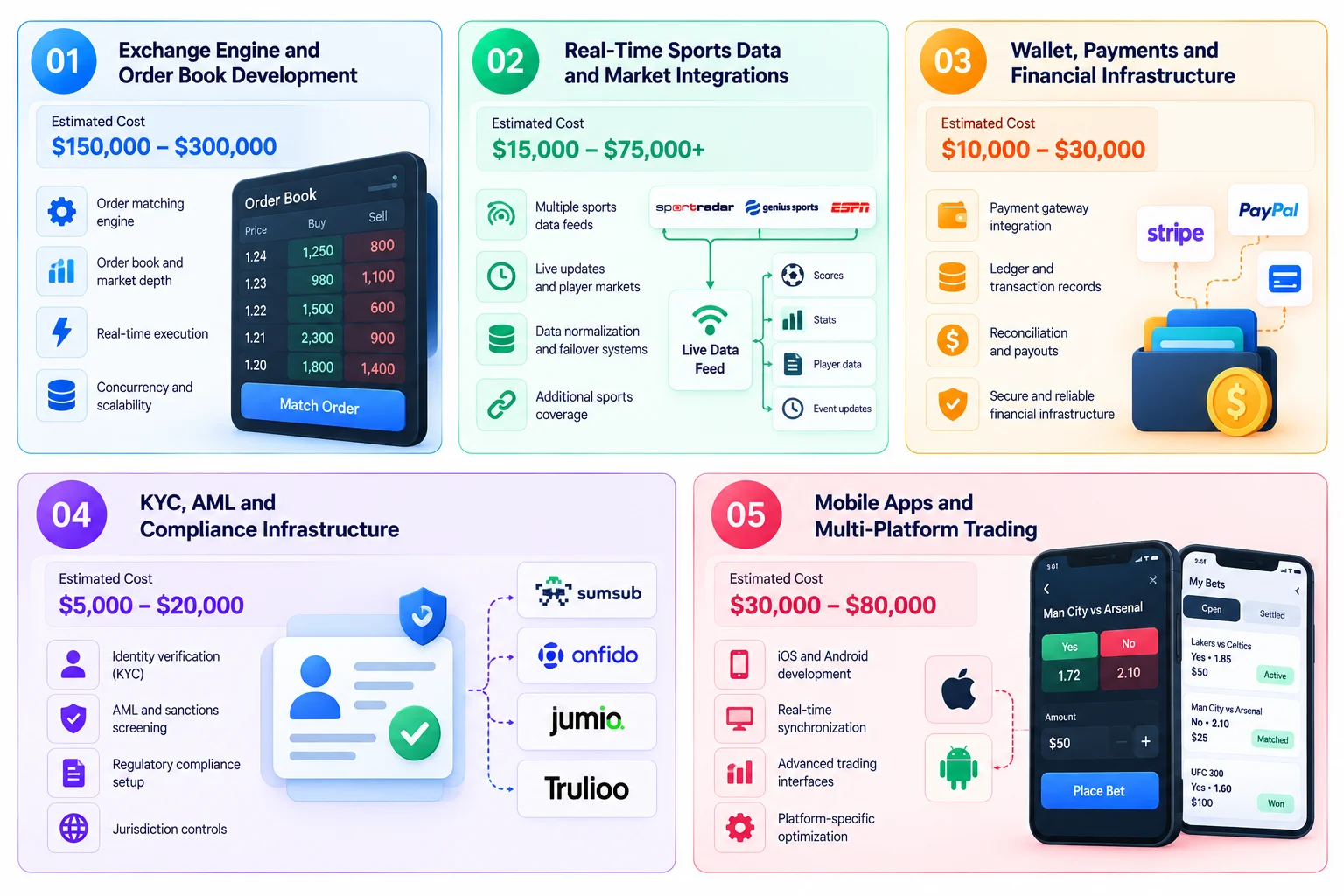
The cost of a ProphetX-like platform depends less on the number of screens and more on the exchange infrastructure behind every trade. Matching logic, real-time data, financial systems, compliance and scalability can each materially change the development budget.
1. Exchange Engine and Order Book Development
A custom prediction-market engine can account for $150,000–$300,000 of core software work, with order matching, market depth, concurrency and real-time execution driving complexity.
2. Real-Time Sports Data and Market Integrations
Sports-data costs are typically provider-specific, but development increases with multiple feeds, live updates, player markets, data normalization, failover systems and additional sports coverage, with integration costs typically ranging from $15,000 to $75,000+.
3. Wallet, Payments and Financial Infrastructure
Prediction-market payment infrastructure can add roughly $10,000–$30,000 for integration, while more sophisticated ledger, reconciliation and payout requirements increase the overall financial-system budget.
4. KYC, AML and Compliance Infrastructure
KYC/AML integration can add approximately $5,000–$20,000 in initial development, before recurring verification costs and the substantially larger legal and regulatory expenses of operating a regulated product.
5. Mobile Apps and Multi-Platform Trading
Native or cross-platform mobile development can add approximately $30,000–$80,000 for iOS and Android, before advanced trading interfaces, real-time synchronization and platform-specific optimization.
Which Exchange Components Drive ProphetX-like App Development Cost?
ProphetX-like development costs are shaped by the complexity of core exchange components including sports data, matching, liquidity, financial infrastructure and security. Each component adds different engineering requirements, while integrations, licensing, compliance and scalability can further influence the overall development budget.
| Exchange Component | What It Includes | Estimated Cost Impact |
| Real-Time Sports Data & Market Management | Live sports feeds, event data, player statistics, market creation, contract lifecycle, market suspension and data normalization | $20,000 – $100,000 |
| Order Book & Matching Engine | Buy/sell orders, order matching, price-time priority, partial fills, cancellations, concurrency and low-latency execution | $80,000 – $150,000 |
| Pricing, Liquidity & Trading Infrastructure | Price discovery, liquidity depth, market makers, liquidity providers, maker incentives, REST APIs and WebSockets | $40,000 – $120,000 |
| Wallet, Settlement & Financial Infrastructure | User balances, fund locking, wallets, payments, transaction ledger, automated settlement, payouts and reconciliation | $30,000 – $80,000 |
| Security, Compliance & High Availability | KYC/AML, authentication, fraud controls, audit logs, encryption, monitoring, load balancing, failover and disaster recovery | $30,000 – $150,000 |
These figures should be presented as development estimates for the respective software components, not five costs that must simply be added together. Several capabilities overlap across architecture, while third-party sports-data licensing, payment fees, liquidity programs, regulatory/legal costs and cloud operations can sit outside the development budget.
How Much Does Liquidity Infrastructure Add to the Cost?
Liquidity infrastructure can add substantial cost to build a platform like ProphetX because the platform must continuously support two-sided markets, matching, market-making and execution.
Unlike sportsbooks, exchanges depend on sufficient liquidity to maintain active order books, reduce slippage and support reliable trading, making liquidity infrastructure a major technical and capital requirement.
A. Market Maker Integrations
Bootstrapping peer-to-peer liquidity requires connecting institutional high-frequency trading (HFT) and quantitative market-making firms to quote both sides of active markets:
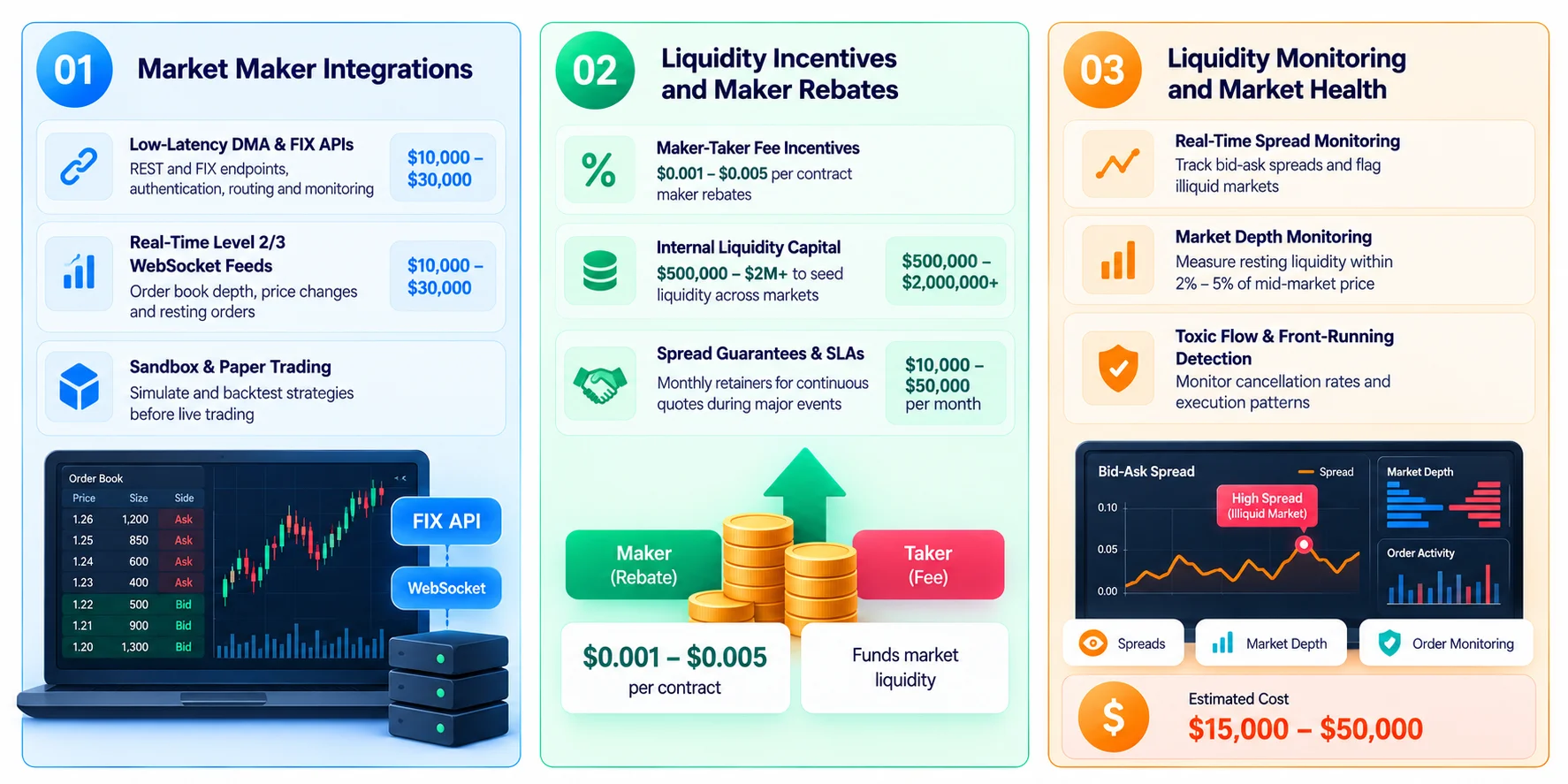
- Low-Latency DMA & FIX APIs: Provide institutional market makers with REST and FIX endpoints for frequent quote updates, dynamic pricing and fast execution. FIX connectivity, authentication, routing and monitoring can add $10,000–$30,000.
- Real-Time Level 2/3 WebSocket Feeds: Stream order book depth, price changes and resting orders through optimized pipelines. Real-time market-data infrastructure can add approximately $10,000–$30,000 to the cost to build a platform like ProphetX.
- Level 2: Shows the price and total quantity available at each bid and ask level. It tells traders how much liquidity exists at different prices.
- Level 3: Provides individual order-level details, such as each resting order’s price, quantity and position in the queue, where the exchange supports that visibility.
- Sandbox & Paper Trading: Offer simulation environments where liquidity providers can backtest strategies, test order behavior and validate failover controls before deploying real capital.
B. Liquidity Incentives and Maker Rebates
Retail market makers rarely populate an exchange organically at scale. Exchanges deploy economic incentives and capital structures that carry direct operational costs:
- Maker-Taker Fee Incentives: Waive fees or offer $0.001–$0.005 per contract maker rebates to encourage passive liquidity, funded through taker fees.
- Internal Liquidity Capital: Allocate $500,000–$2M+ in risk capital to internal market-making desks or external liquidity partners to seed $0.01–$0.99 contract prices across less-liquid sports markets.
- Spread Guarantees & SLAs: Offer market makers $10,000–$50,000 monthly retainers for maintaining continuous quotes and defined bid-ask spreads during major sporting events.
C. Liquidity Monitoring and Market Health
Operating an orderly market requires continuous surveillance of order book depth, execution velocity and market-integrity parameters.
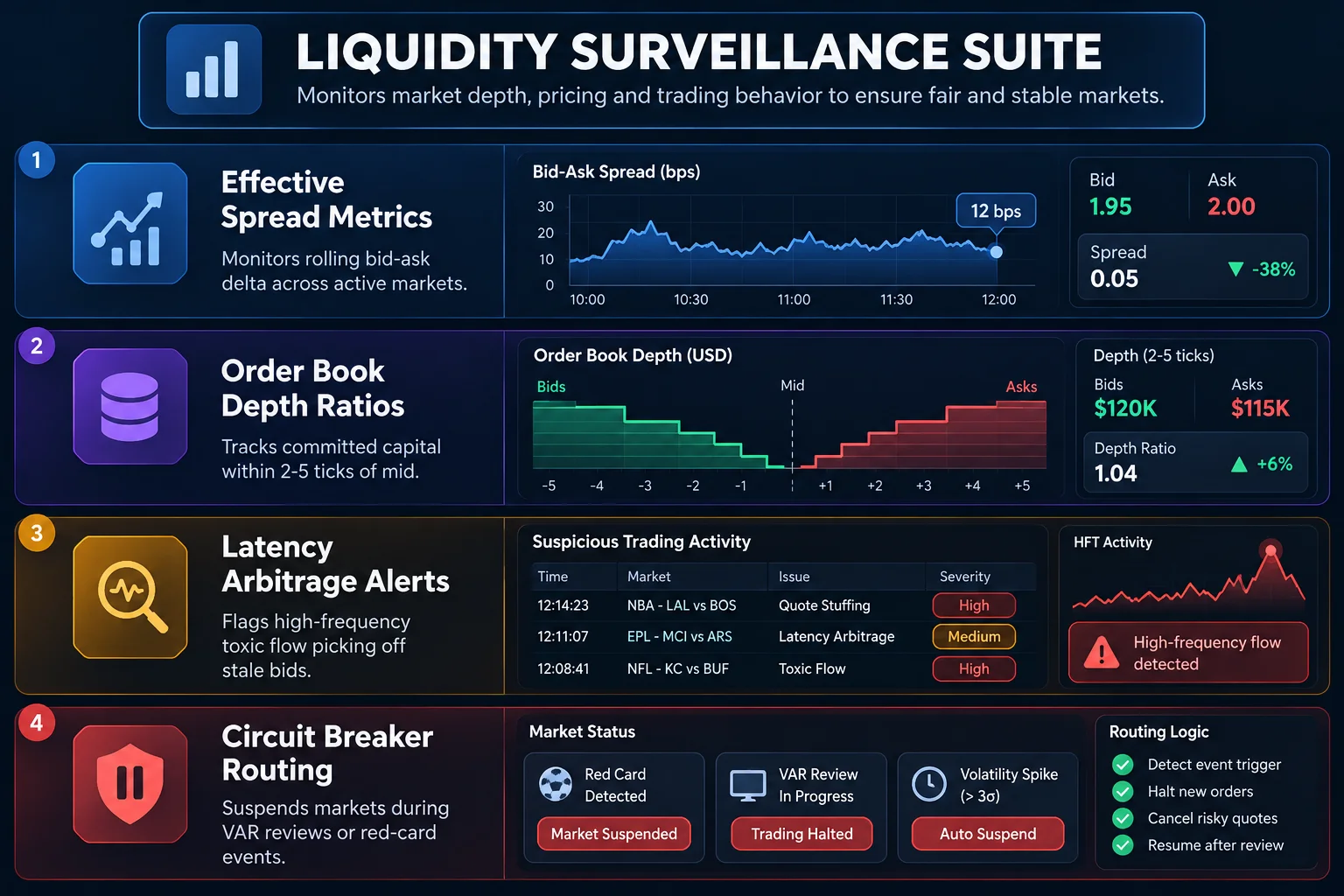
Dedicated monitoring and market-health tools can add approximately $15,000–$50,000 depending on market count and monitoring rules.
- Real-Time Spread Monitoring: Track effective bid-ask spreads across active markets, flagging high-slippage or illiquid markets for additional market-maker liquidity.
- Market Depth Monitoring: Measure resting liquidity within 2%–5% of the mid-market price to ensure larger retail orders can execute without excessive price impact.
- Toxic Flow & Front-Running Detection: Monitor cancellation rates and millisecond-level execution patterns to identify predatory trading and protect passive market-maker quotes during breaking news.
D. What Happens When a Market Has Low Liquidity?
Low liquidity can make a sports exchange harder to trade by widening spreads, leaving orders unmatched, weakening price discovery, reducing activity and eventually pushing both traders and market makers away.
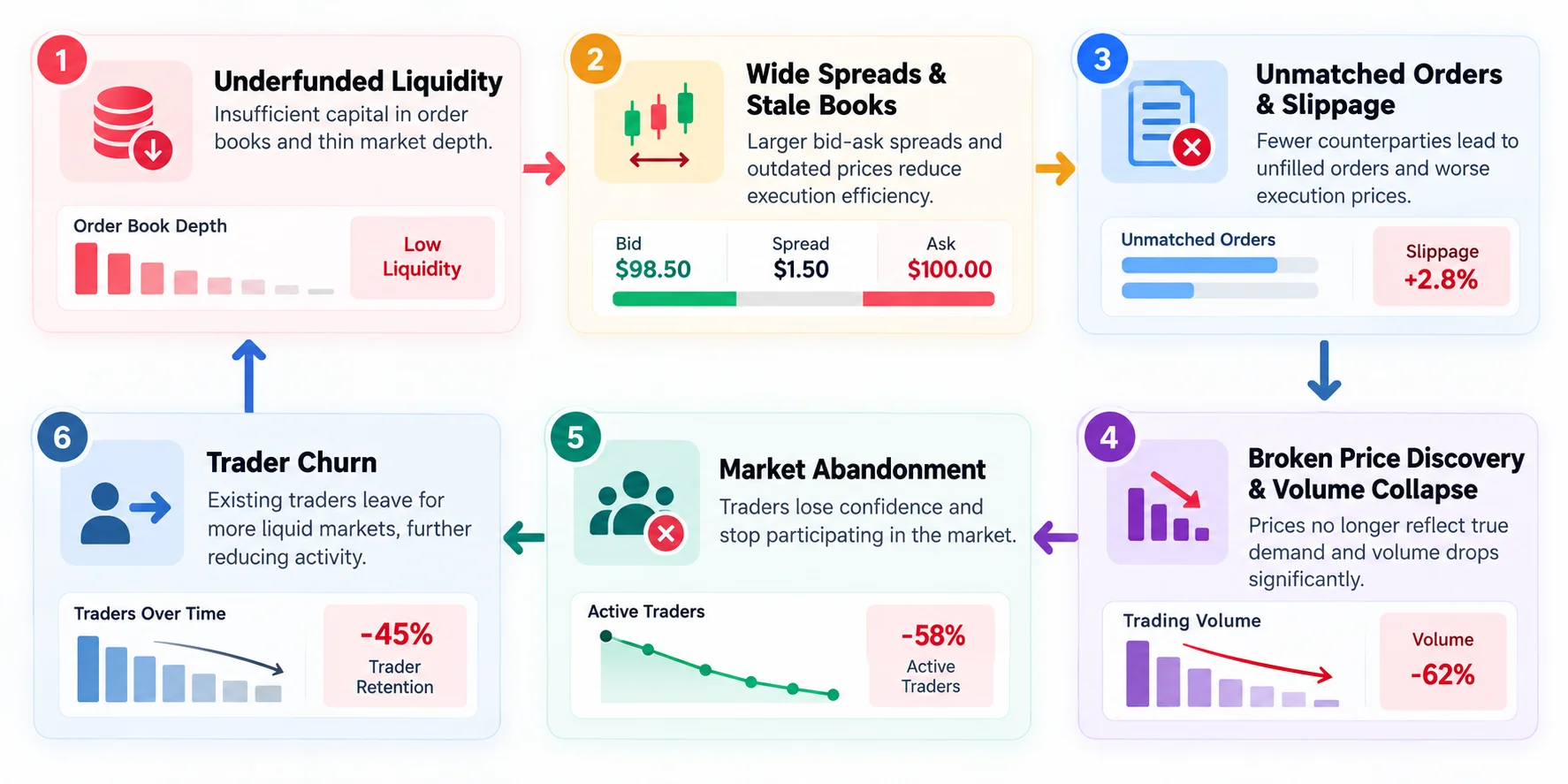
When liquidity infrastructure is underfunded, an exchange suffers a cascading failure cycle that degrades the product experience and drives platform abandonment:
- Wide Spreads: Limited market-maker participation can widen the gap between the best Yes and No prices, such as $0.40 bid versus $0.65 ask, reducing the exchange’s pricing advantage.
- Unmatched Orders: Limit orders may remain unfilled for hours when counterparties are unavailable. Long waits can frustrate recreational traders who expect immediate execution and lead to cancellations.
- Poor Price Discovery: Thin order books may produce inaccurate market pricing. A single $200 market order can move contract prices by 20%–30%, creating excessive volatility.
- Low Trading Activity: Flat volume and shallow order books can signal weak market activity. Institutional market makers may reduce capital allocation when retail taker flow is insufficient to support quoting risk.
- Market Abandonment: Low liquidity can discourage retail participation, while weak order flow can drive market makers away, creating a negative liquidity cycle that leaves markets inactive.
Key Takeaway: Liquidity is not simply a feature of a sports exchange app. Businesses must budget for market-maker integrations, liquidity technology, monitoring, incentives and potentially hundreds of thousands or millions of dollars in liquidity capital, making it both a development and ongoing operational cost.
What Regulatory Requirements Affect ProphetX-Like Platform Development Cost?
Regulatory requirements can significantly increase the cost of a ProphetX-like prediction exchange because the platform may need to support CFTC registration, event-contract compliance, KYC/AML controls, customer-fund protections, market surveillance and auditability.
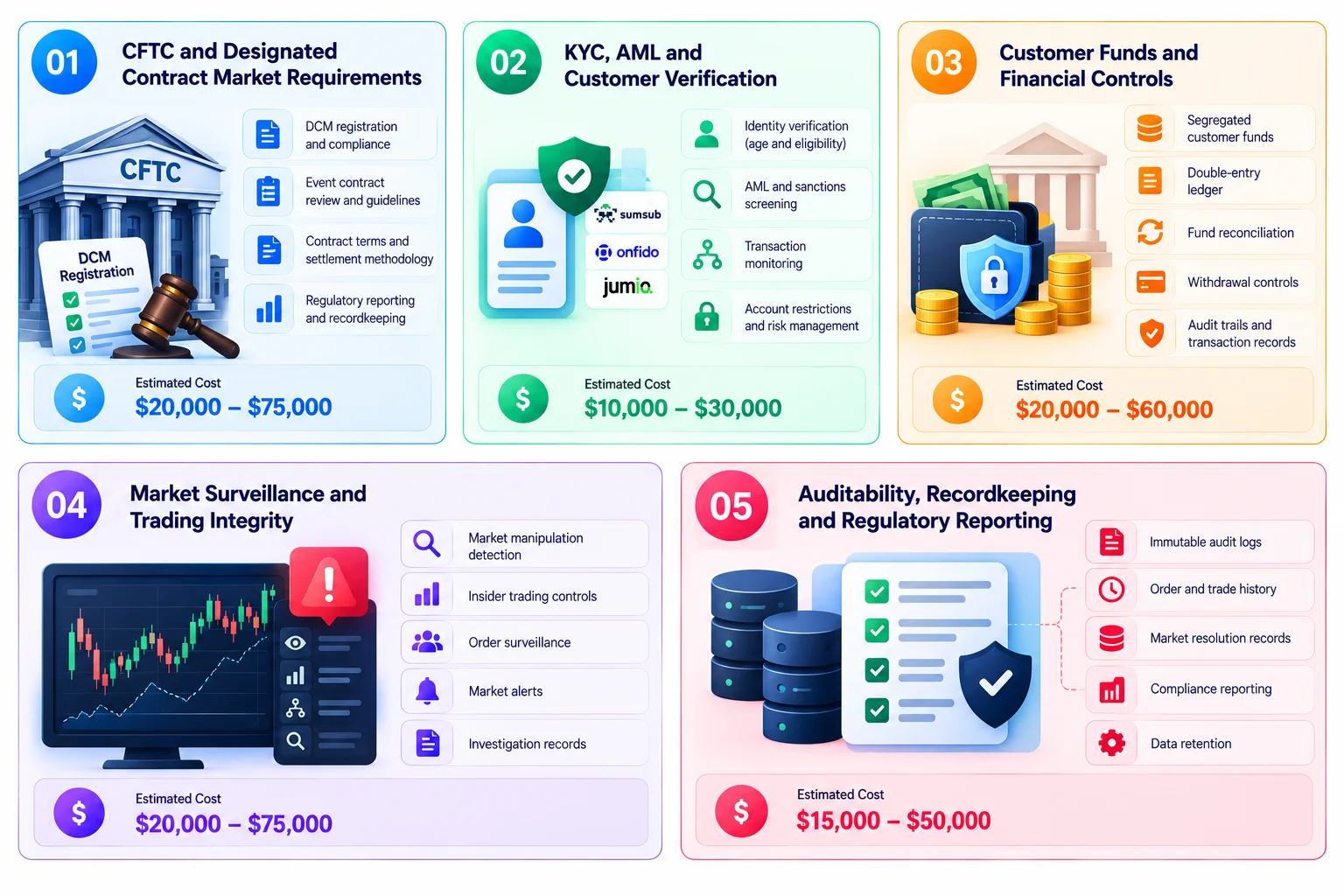
For a US launch, these requirements can add $50,000–$200,000+ in specialized compliance engineering, excluding licensing, legal counsel, regulatory capital and other operating expenses.
A. CFTC and Designated Contract Market Requirements
In the US, prediction-market contracts can fall under the Commodity Exchange Act (CEA) and CFTC oversight. The CFTC states that event contracts are financial contracts whose value is based on the outcome of an event, while a prediction market offering swaps or futures to the general public may need to operate as a Designated Contract Market (DCM) unless an applicable exemption or exclusion applies.
A sports exchange prediction app therefore needs regulatory requirements reflected directly in its platform architecture:
- DCM Compliance: A US exchange serving retail participants may need DCM registration and systems supporting CFTC regulatory obligations. The CFTC’s current DCM records list ProphetX LLC as a designated contract market as of June 11, 2026.
- Event Contract Review: Sports contracts cannot simply be treated as ordinary app features. In 2026, the CFTC issued guidance and proposed rulemaking addressing event contracts, including contracts involving sporting events and activities covered by statutory restrictions.
- Contract Documentation: Each market needs clearly defined contract terms, payout conditions, settlement methodology and procedures for determining the official outcome.
- Regulatory Reporting: The platform may require systems for maintaining records, producing reports and supporting regulatory examinations.
Estimated compliance engineering cost: $20,000–$75,000, excluding legal fees, registration costs and regulatory capital.
B. KYC, AML and Customer Verification
A real-money prediction exchange needs stronger identity and financial controls than a simulated-market application. KYC and AML requirements can affect onboarding, deposits, withdrawals, transaction monitoring and account-risk management.
- Identity Verification: Integrate third-party KYC services to verify customer identity, age and eligibility before enabling real-money trading.
- AML Screening: Screen customers and transactions against applicable sanctions and risk databases, with escalation workflows for suspicious activity.
- Transaction Monitoring: Monitor deposits, withdrawals, trading behavior and unusual account activity for potential fraud or financial crime.
- Account Restrictions: Automatically restrict, suspend or review accounts when risk thresholds or compliance rules are triggered.
A production-grade KYC/AML layer can add approximately $10,000–$30,000 in initial engineering and integration cost to build a platform like ProphetX, followed by per-verification and ongoing monitoring fees.
C. Customer Funds and Financial Controls
Financial infrastructure becomes a major compliance consideration when users deposit real money into an exchange. CFTC-regulated derivatives markets have specific customer-fund protections, including requirements around segregation and treatment of customer assets.
- Segregated Customer Funds: Customer money must be appropriately separated from proprietary funds where applicable under the regulatory structure.
- Double-Entry Ledger: Maintain an auditable record of deposits, withdrawals, locked funds, executed trades, fees and settlements.
- Fund Reconciliation: Reconcile internal balances against banking, payment and clearing records.
- Withdrawal Controls: Apply identity, risk and transaction checks before releasing funds.
- Audit Trails: Preserve transaction records so financial activity can be reconstructed during investigations or audits.
Building these controls can add approximately $20,000–$60,000 beyond a basic wallet and payment system.
D. Market Surveillance and Trading Integrity
An exchange must also protect the integrity of its markets. The CFTC’s prediction-market materials emphasize protections against fraud, manipulation and unfair trading practices, while a 2026 enforcement advisory highlighted cases involving misuse of nonpublic information and fraud in prediction markets. This requires technology for:
- Market Manipulation Detection: Identify unusual price movements, coordinated trading and abnormal order patterns.
- Insider Trading Controls: Monitor trading involving participants who may have a direct or indirect influence over an event outcome.
- Order Surveillance: Track cancellation rates, order timing, account relationships and suspicious trading patterns.
- Market Alerts: Automatically flag contracts requiring compliance or risk-team review.
- Investigation Records: Preserve sufficient order, trade and account history to investigate suspicious activity.
A dedicated market-surveillance layer can add approximately $20,000–$75,000 depending on the number of markets, trading volume and sophistication of detection rules.
E. Auditability, Recordkeeping and Regulatory Reporting
Compliance cannot rely solely on policies and manual review. The platform needs an auditable technical record of how markets, orders, trades, balances and settlements were handled.
- Immutable Audit Logs: Record user actions, order changes, trade execution and administrative activity.
- Order and Trade History: Preserve timestamps, prices, quantities, order IDs and execution details.
- Market Resolution Records: Store the source and decision used to determine each contract’s settlement outcome.
- Compliance Reporting: Generate structured reports for internal compliance teams and applicable regulators.
- Data Retention: Maintain required records according to the applicable regulatory framework.
This audit and reporting layer can add approximately $15,000–$50,000 in cost to build a platform like ProphetX depending on retention, reporting and regulatory requirements.
Key Takeaway: Regulatory compliance can become one of the largest cost drivers for a US ProphetX-like exchange. CFTC requirements, KYC/AML, customer-fund controls, market surveillance and audit infrastructure must be designed into the platform from the beginning, rather than added after the trading engine is complete.
What Are the Ongoing Costs After Launch?
Launching a ProphetX-like prediction exchange does not end the financial commitment at development. Once the platform goes live, operators need to budget for cloud infrastructure, sports data, compliance, security and liquidity operations. Recurring costs can vary significantly based on trading volume, sports coverage, target jurisdictions and platform scale.
| Ongoing Cost | Indicative Cost | What It Covers | Main Cost Drivers |
| Cloud & Infrastructure | $5,000–$25,000+/month | Compute, databases, WebSockets, load balancing, backups, monitoring, storage and high-availability infrastructure | Trading volume, concurrent users, market count, real-time connections and redundancy |
| Sports Data Licensing | $5,000–$50,000+/month | Live scores, player statistics, event schedules, historical data and real-time sports feeds | Number of sports, leagues covered, data latency, API volume and licensing agreements |
| Compliance & Legal Operations | $5,000–$30,000+/month | KYC/AML monitoring, regulatory reporting, audits, licensing support and compliance operations | User volume, transaction volume, jurisdictions and regulatory requirements |
| Security & Monitoring | $3,000–$15,000+/month | Security monitoring, penetration testing, fraud detection, market surveillance and incident response | Platform scale, transaction volume, threat exposure and security requirements |
| Liquidity & Market-Maker Incentives | $10,000–$100,000+/month + liquidity capital | Maker rebates, liquidity incentives, market-maker retainers and spread/depth guarantees | Number of active markets, target spreads, trading volume and required market depth |
Key Takeaway: While initial development funds the core exchange infrastructure, ongoing operating expenses grow significantly alongside volume, coverage, and regulatory requirements. Consequently, cloud systems, sports feeds, compliance, security, and separate liquidity capital must be budgeted from day one.
Build Your ProphetX-Like Platform With IdeaUsher
Developing a high-frequency sports prediction exchange requires complex infrastructure beyond a typical betting interface. It demands deterministic order books, sub-millisecond matching, live sports feeds, robust liquidity mechanisms, automated escrow settlement, and scalable cloud architecture to handle peak traffic.
IdeaUsher operates as an enterprise product engineering partner, backed by 11+ years of software expertise, 250+ specialized technologists and a 4.9/5 Clutch rating across 1,000+ delivered builds. We bridge complex financial market microstructure with sports wagering mechanics to build fully custom exchange platforms from the ground up:
- Custom Sports Prediction Exchange Architecture: Design P2P exchange workflows, order types, tick-size rules and commission models tailored to secondary market trading.
- Deterministic Matching Engine: Build continuous double auction (CDA) engines for low-latency order matching, cancellations and real-time position netting.
- Wallet, Escrow & Settlement: Engineer double-entry ledgers, PCI-DSS payment rails, escrow holds and automated payouts for auditable settlement.
- Liquidity & Market-Maker Integrations: Develop FIX/REST API connectivity for institutional liquidity providers and algorithmic market makers to maintain active order books.
- Security & Scalable Cloud Infrastructure: Deploy auto-scaling Kubernetes infrastructure, geolocation controls, KYC/AML verification and anti-collusion monitoring, with 100% clean source code delivery and zero vendor lock-in.
Planning to launch a peer-to-peer sports prediction exchange? Connect with Idea Usher’s principal fintech and exchange software architects to discuss your intended sports coverage, exchange model, target jurisdictions, MVP scope, and third-party integration requirements to receive a tailored technical roadmap and development estimate.
Conclusion
A clear view of the financial requirements helps put a ProphetX-like exchange into practical perspective. The cost to build a platform like ProphetX can range from a focused MVP to a full-scale regulated exchange, depending on trading infrastructure, sports data, liquidity, compliance and security requirements. Beyond development, ongoing expenses for infrastructure, market data and liquidity also shape the overall investment. A carefully scoped architecture, regulatory strategy and cost plan can help align technical decisions with long-term platform requirements and operating goals.
FAQs
A.1. The cost to build a platform like ProphetX typically ranges from $150,000 to $1.5 million or more, depending on platform scope, trading infrastructure, liquidity, compliance and jurisdictional requirements.
A.2. A ProphetX-like platform can take several months to build, with timelines depending on market complexity, sports coverage, matching engine requirements, payment integrations, regulatory controls and overall development scope.
A.3. Core features include live sports markets, order books, matching engines, real-time pricing, user accounts, wallets, settlement, payments, portfolio tracking, market data integrations, liquidity management and compliance controls.
A.4. A regulated platform may require CFTC compliance, KYC and AML controls, customer-fund protections, market surveillance, audit trails and regulatory reporting, depending on its operating model and target jurisdictions.