

Key Takeaways
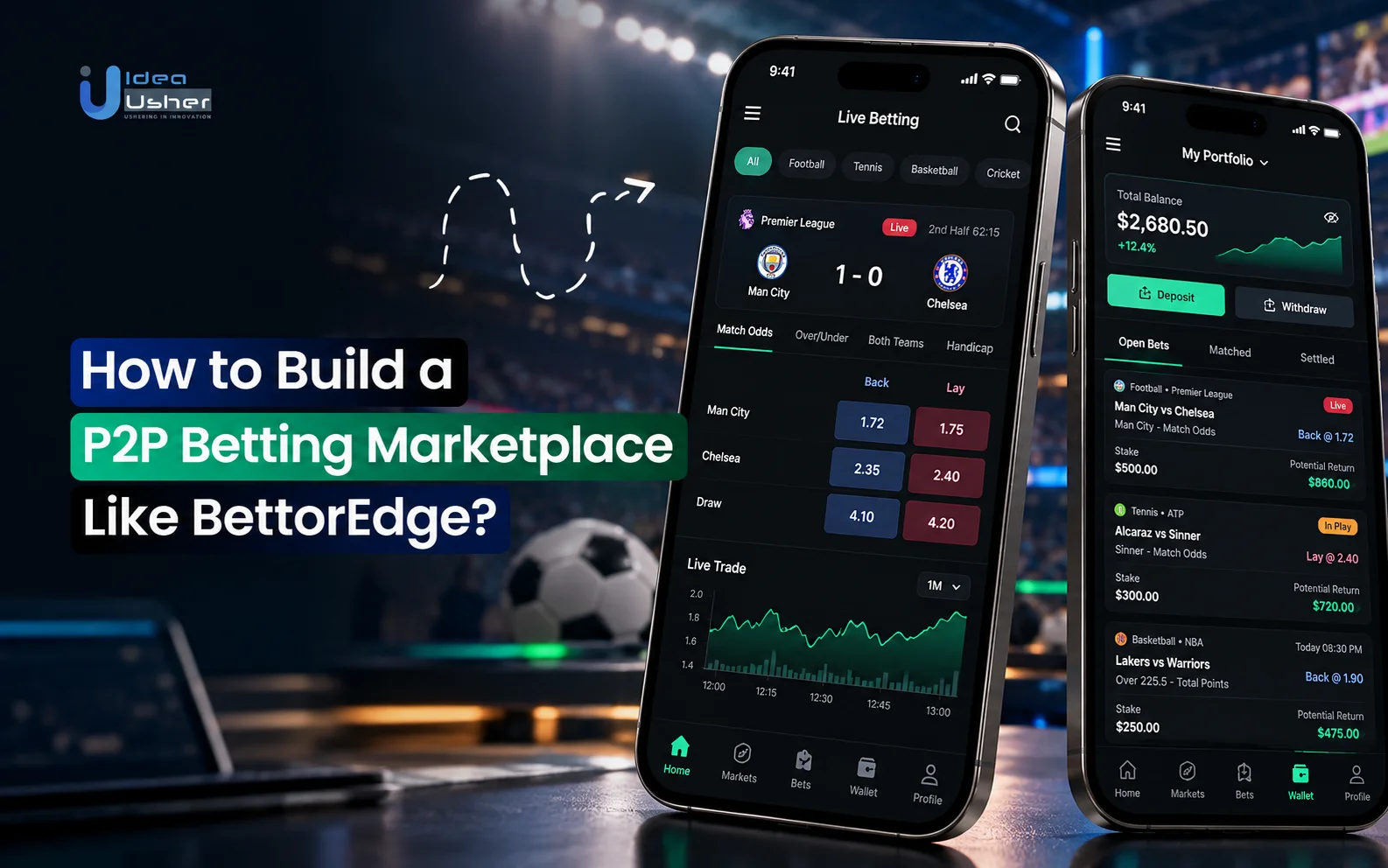
- A P2P betting marketplace like BettorEdge lets users take opposite sides of sports bets while the platform handles matching, liquidity, wallets and settlement.
- The MVP P2P betting marketplace features include real-time markets, order matching, liquidity, wallets, settlement, KYC and notifications. Social and advanced features can come later for scaling.
- P2P betting marketplace development can cost around $130,000 to $550,000+. The cost depends on platform tier, sports and league coverage, compliance integrations, social features and platform complexity.
- The marketplace can make money through transaction fees, premium subscriptions, payment-related charges and other services instead of mainly relying on users’ losses.
To build a P2P betting marketplace like BettorEdge, you need to develop a peer-to-peer wagering platform where users can create, accept, and trade bets directly with other users instead of relying entirely on a traditional sportsbook. The development focuses on a P2P betting engine, user-created markets, odds management, wallet infrastructure, matching system, and automated settlement.
Traditional sportsbooks control pricing and manage wagers centrally, while a P2P marketplace depends on users supplying both sides of the market. This makes liquidity, matching logic, risk controls and transparent settlement critical to the product experience.
In this blog, we will talk about the core features, technology architecture, development process, integrations, security requirements and costs involved in building a P2P sports betting marketplace like BettorEdge, along with the key factors that influence its liquidity, scalability and user experience.
What Is a P2P Betting Marketplace?
A peer-to-peer (P2P) betting marketplace is an exchange-based platform where users trade sports wagers directly with one another rather than betting against a centralized bookmaker. Traditional sportsbooks operate as the “house,” setting lines with an embedded fee, known as the “vig” or “juice,” and taking directional risk against their customers.
The marketplace enables users to propose their own prices (odds) or accept offers posted by other participants, removing the traditional sportsbook margin and allowing market prices to be determined by supply and demand.
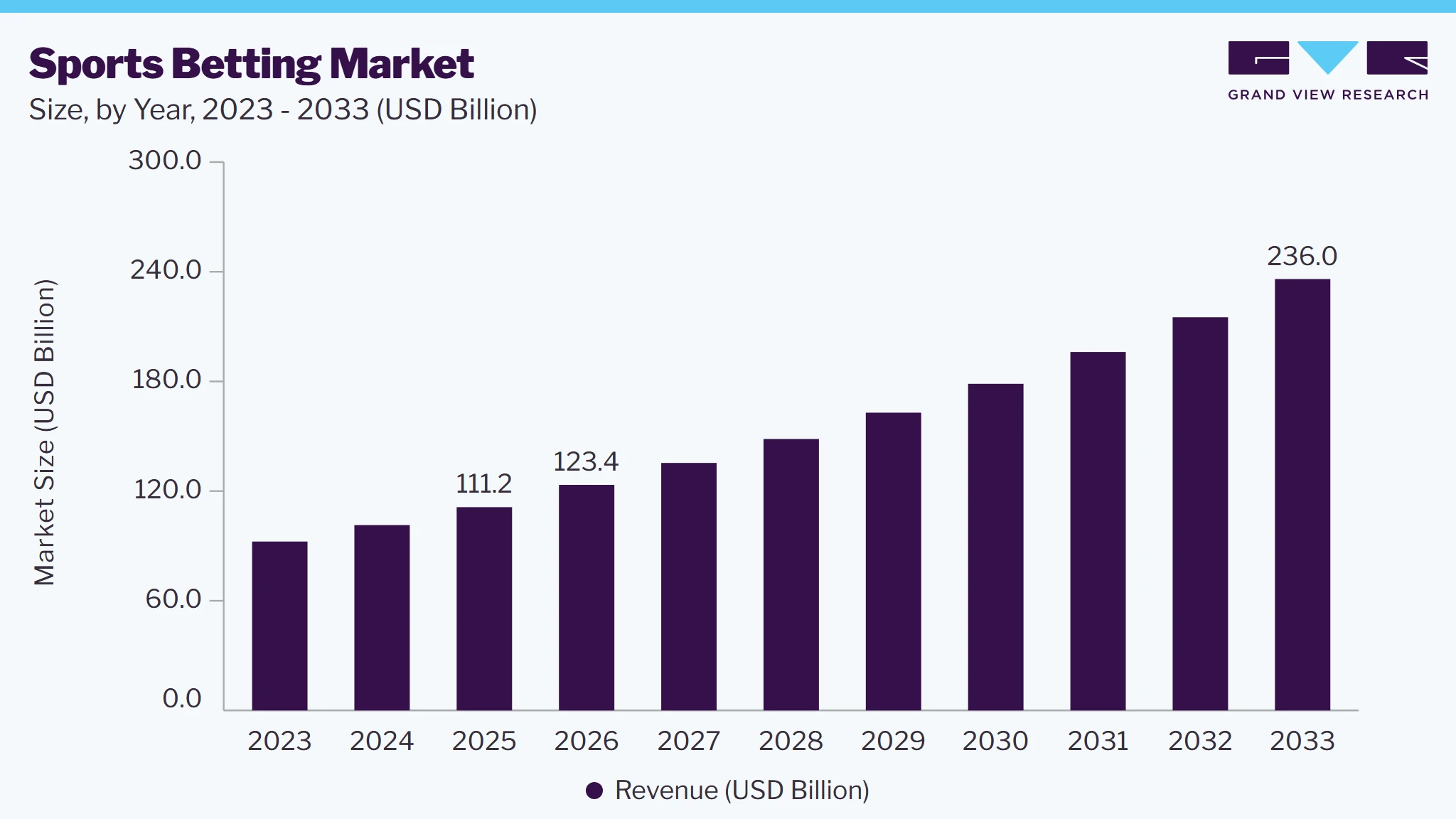
The global sports betting market, valued at $111.2 billion in 2025 and is projected to grow from $123.4 billion in 2026 to $236.0 billion by 2033, at a CAGR of 9.7% from 2026 to 2033, according to Grand View Research, with P2P betting marketplace emerging as one of its fastest-growing segments.
BettorEdge is an example of this P2P model in practice, connecting bettors who want to take opposite sides of sports markets. Its marketplace supports user-to-user trading across markets while adding social features that extend the betting experience beyond traditional sportsbooks.
It reports 35,000+ bettors, $100M+ matched between users, and 1M+ orders placed, while stating that the marketplace operates across 45+ states.
A. How Bettors Are Matched on a Betting Exchange
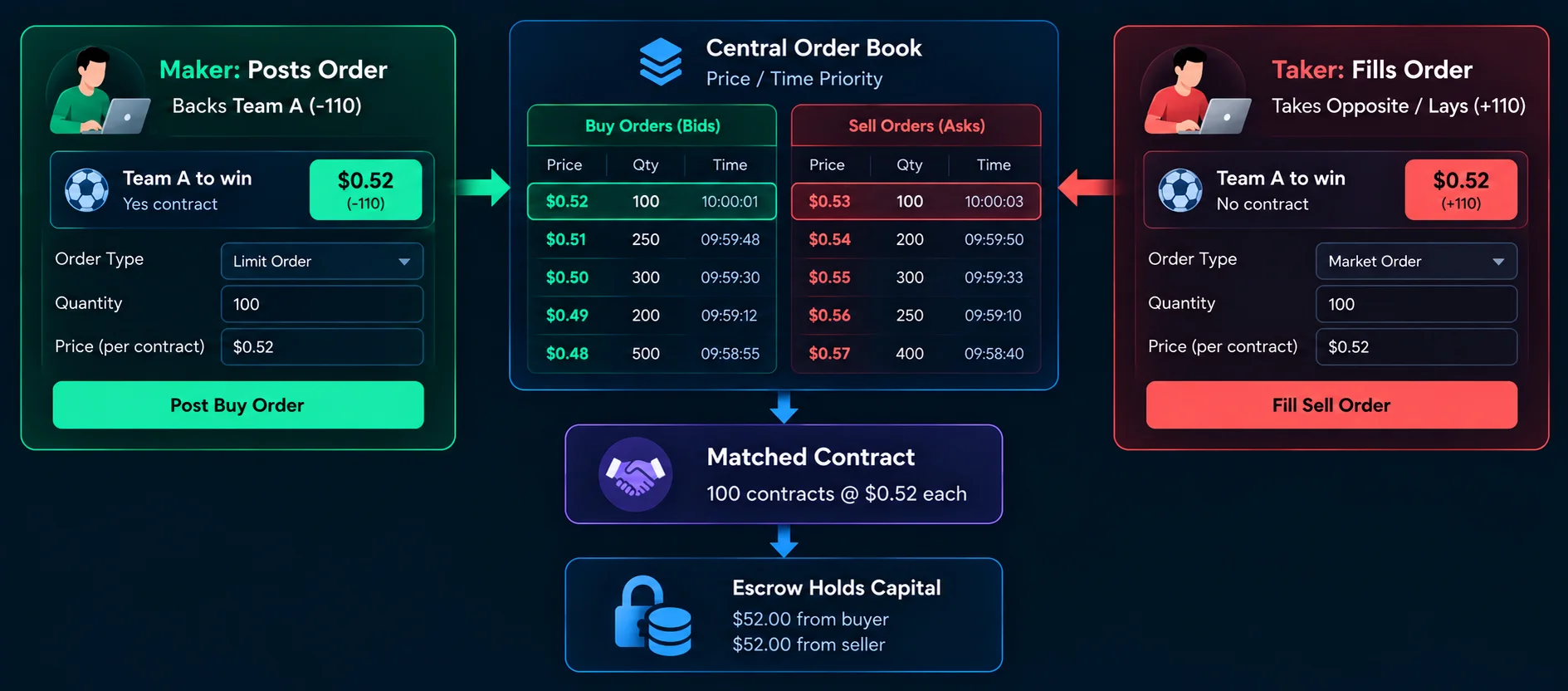
A P2P betting exchange connects users taking opposite positions, allowing each wager to be matched against available market interest. This structure makes efficient order matching central to the platform. At the core of a P2P betting marketplace is an automated matching engine modeled after financial exchanges.
1. Order Submission (Makers vs. Takers)
A maker posts an open order with custom odds such as backing an underdog at +150 for $50. The order remains in the marketplace order book until a taker funds the opposing side. Users can also place market orders to instantly fill available liquidity.
2. Backing and Laying Dynamics
Every sports wager requires complementary positions. When one bettor backs an outcome, such as Team A to win or the Over, the system matches them with a counterparty laying that outcome, meaning Team A will not win or the Under, at reciprocal odds.
3. Escrow Settlement
Once matched, the platform locks both participants’ funds in escrow. Neither party can cancel the wager mid-game. After the event ends and official statistics are confirmed, the platform releases the collateral to the winning party.
B. How BettorEdge Betting Marketplace Makes Money
A P2P betting marketplace like BettorEdge avoids traditional sportsbook “vig” (~10%) and losing-bet profits. Operating like a financial exchange, it earns revenue through winning transaction fees, subscription plans, partner referrals, and payment processing surcharges.
| Monetization Stream | How It Works | Rates & Numbers |
| Order Processing / Transaction Charges | Charges a small fee only on net winnings. Losing bets and unfilled orders incur no fee. | 0% to 3.0% of gross winnings per order. (Standard marketplace baseline is typically ~1.5%). |
| Premium Subscriptions | BettorEdge Premium offers tools such as Instant Order Grading, higher fee rebates and increased deposit limits. | $19.99 / month (or annual option including 2 free months). |
| Excess Withdrawal Fees | Basic ACH/bank withdrawals are free up to a weekly limit. Additional or frequent withdrawals may incur processing fees. | 3 free withdrawals per rolling 7-day period; processing fees applied on additional requests. |
Freemium Fee Rebates ($11.75 on $750)
On BettorEdge, the 1.5% winning transaction charge is standard. To incentivize high-volume betting and encourage users to upgrade to BettorEdge Premium ($19.99/mo), they give users a monthly allowance that waives (rebates) those transaction fees up to a certain earnings limit:
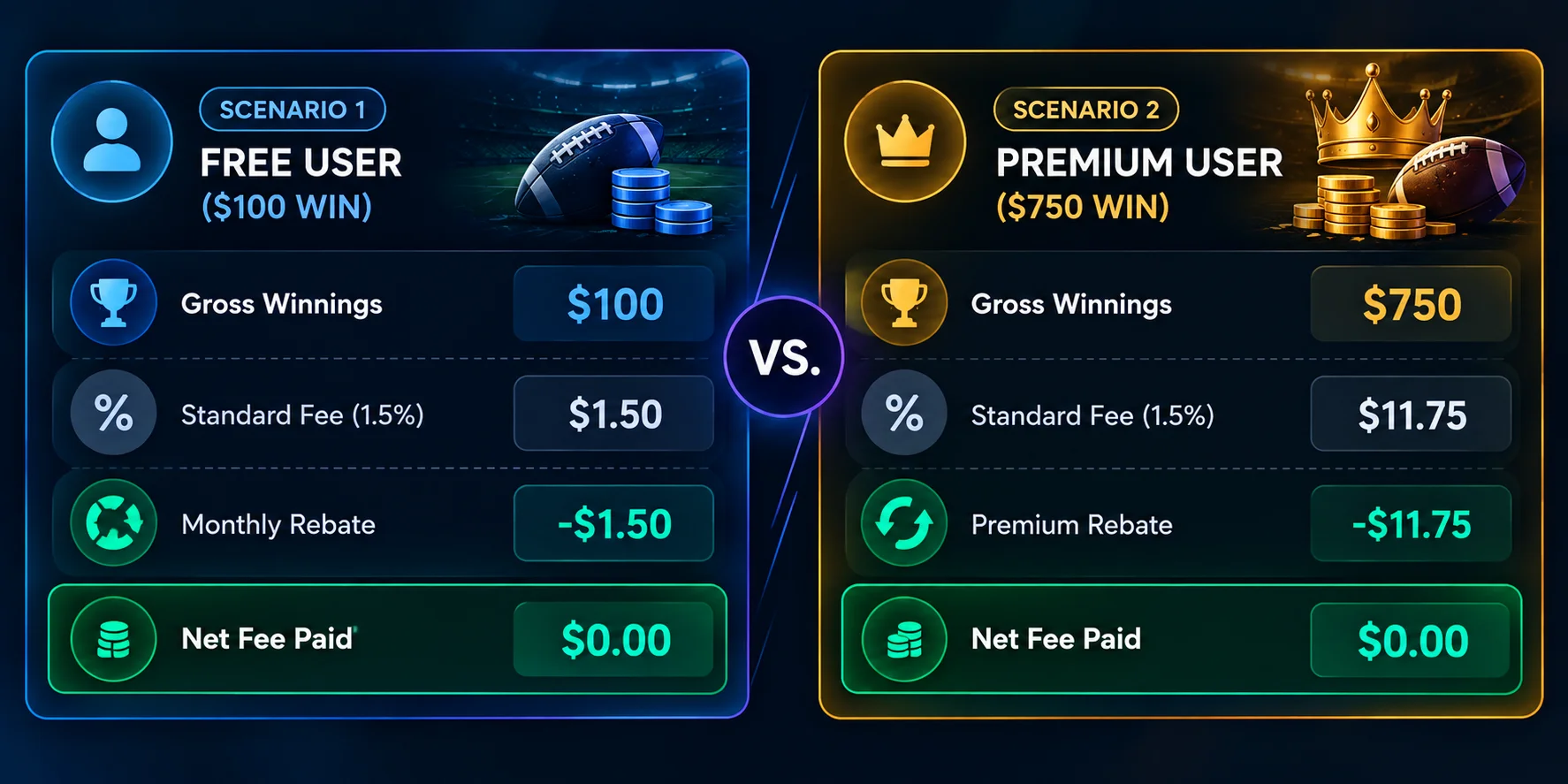
The fee rebate structure differs by membership level, giving free users a smaller allowance while Premium members receive a higher monthly rebate.
- Free Account: BettorEdge waives your transaction fees on your first $100 in winnings each month (a max discount/rebate of $1.50).
- Premium Account ($19.99/mo): BettorEdge waives your transaction fees on your first $750 in winnings each month (a max discount/rebate of $11.75).
How Processing Fees Work in Practice
Because the platform acts as an exchange matching buyers and sellers, fees are calculated strictly against net winnings. This means the processing charge applies only when a bettor generates a profit, rather than being deducted from the original stake.
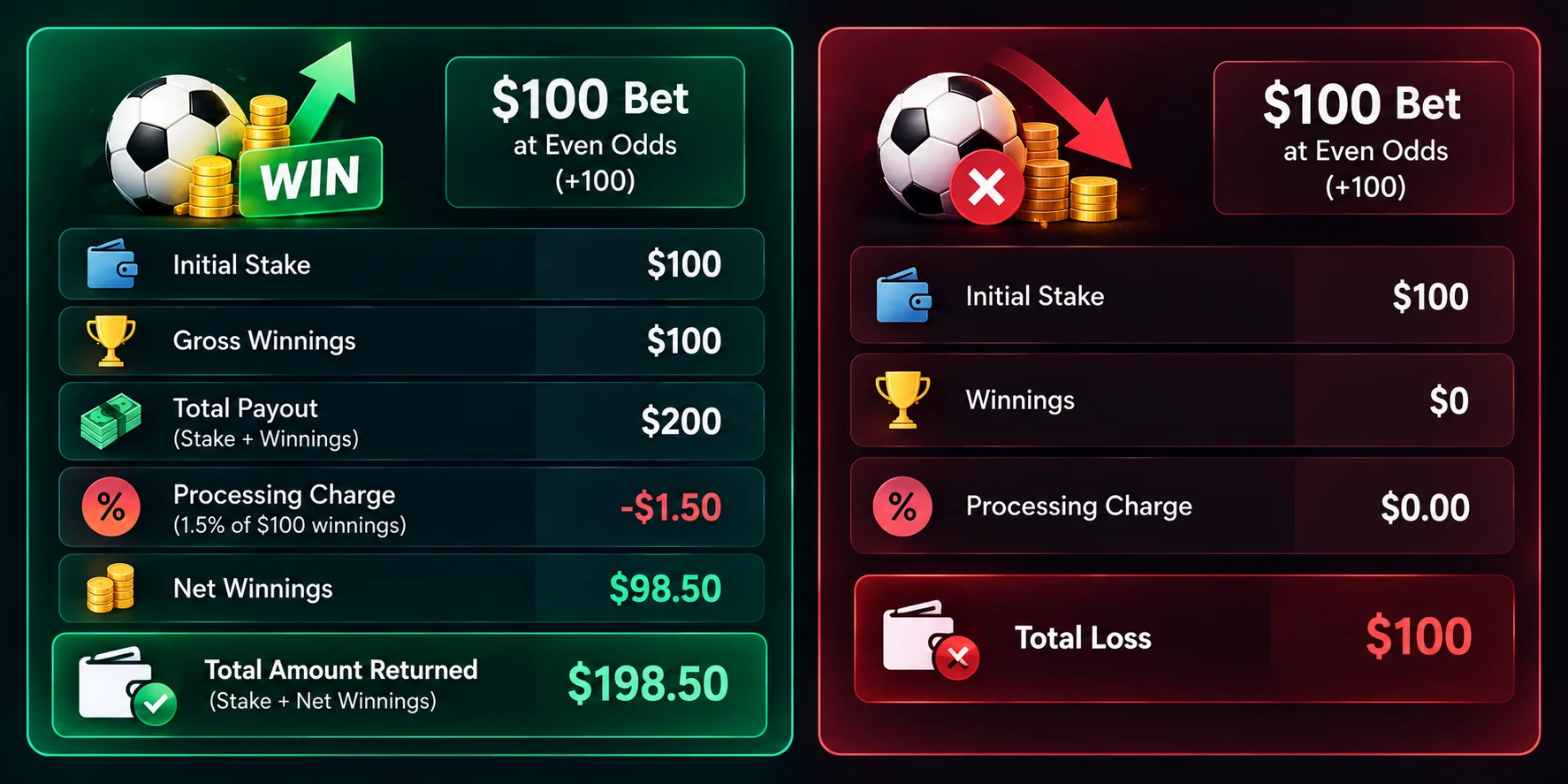
The following example shows how a 1.5% processing charge affects the final amount credited to a bettor after a winning wager.
For a winning wager, the processing fee applies only to the gross profit, not the original stake. For a $100 bet at even odds (+100), the calculation works as follows:
- Initial Stake: $100
- Gross Winnings: $100
- Total Payout: $200 ($100 stake + $100 winnings)
- Processing Charge: $1.50 (1.5% of the $100 winnings)
- Net Winnings: $98.50
- Total Amount Returned: $198.50 ($100 stake + $98.50 net winnings)
If the Bettor Loses: When the wager loses, there are no winnings against which to apply the processing fee. The bettor simply loses the amount originally staked:
- Initial Stake: $100
- Winnings: $0
- Processing Charge: $0.00
- Total Loss: $100
This fee model keeps charges tied to actual winnings rather than total wagers. Understanding this structure helps explain how a BettorEdge-like marketplace handles users, bets, matching, funds and settlement.

How Does a BettorEdge-Like Betting Marketplace Work?
A peer-to-peer (P2P) sports betting marketplace replaces the traditional bookmaker with an automated exchange workflow modeled after financial trading venues.
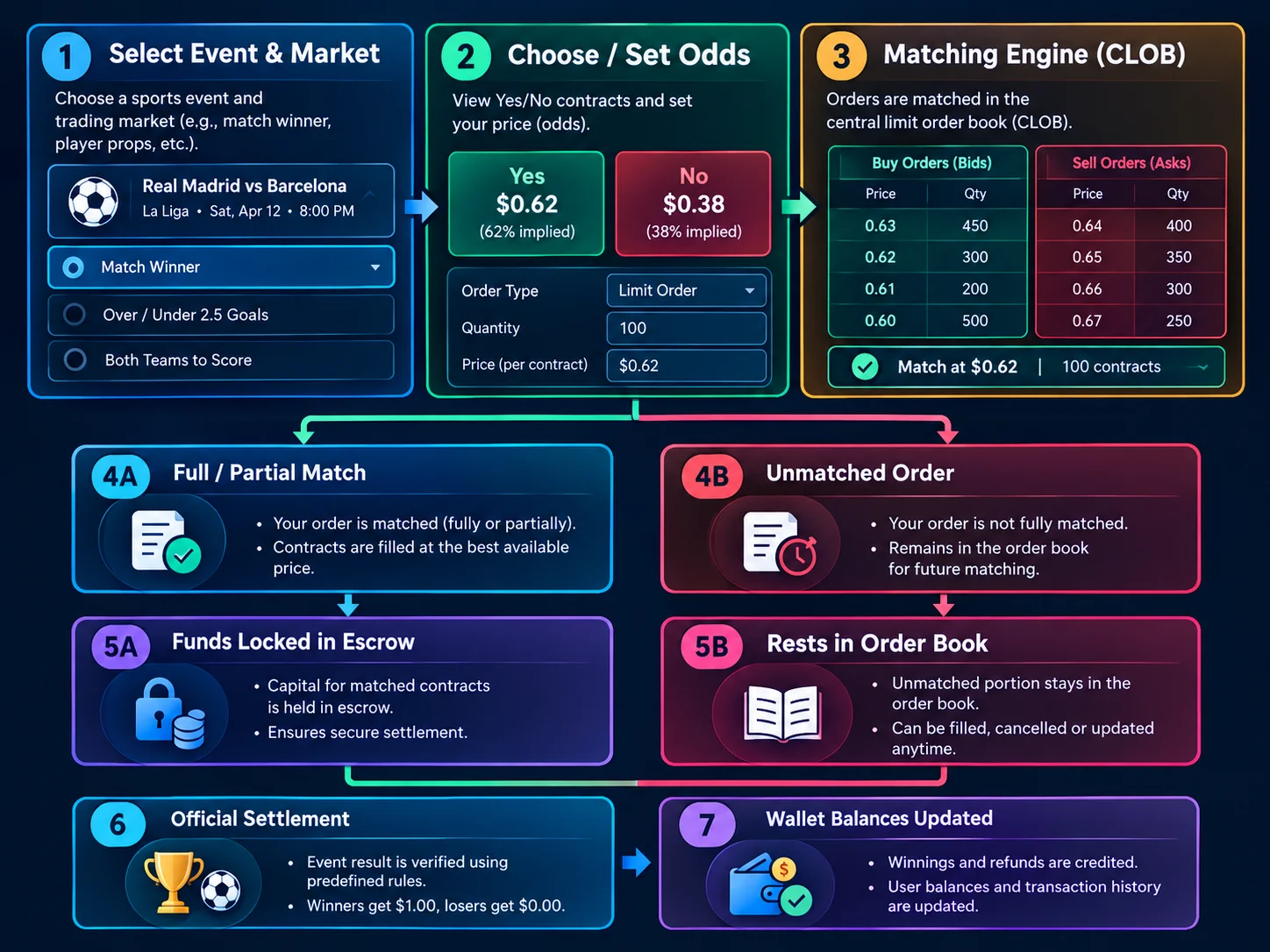
Instead of wagering against the “house,” participants trade complementary sports contracts directly with one another. The end-to-end lifecycle follows a six-stage mechanical process:
1. User Selects a Sports Event and Market
The lifecycle begins with event discovery. The user navigates a catalog of sporting competitions (e.g., NFL, NBA, Premier League) and chooses a specific market:
- Standard Markets: Moneyline (outright winner), Point Spread (margin-based betting) or Totals (Over/Under).
- Derivatives & Props: Individual player performances (e.g., passing yards, points scored) or in-game quarter/half intervals.
- Order Book Visibility: Instead of viewing a single static betting line, the interface displays the current market depth, showing the best available prices and total matched volume currently sitting on either side of the proposition.
2. Users Choose or Create Available Odds
Unlike a sportsbook where the bettor must accept the house line, a P2P marketplace offers two execution pathways:
- Taker (Accepting Market Odds): The user accepts an existing open price displayed in the order book for immediate execution (similar to a financial market order).
- Maker (Setting Custom Odds): If the available price is unfavorable, the user sets custom odds and a stake amount (similar to a limit order). For example, if the best available market price for an underdog is +130, a user can post an offer requesting +150.
- Pre-Trade Balance Verification: Before the order enters the system, the platform validates that the user’s wallet has sufficient liquid funds to cover the total liability of the wager.
3. Matching Engine Finds the Opposite Side
Once an order is submitted, it routes directly to the platform’s Central Limit Order Book (CLOB) and matching engine:
- Price-Time Priority (FIFO): The matching engine prioritizes incoming orders based on the best available price. When multiple orders exist at identical odds, the order submitted earliest executes first.
- Pairing Complementary Sides: The engine pairs buyers and sellers with mutually compatible positions. Backing Team A at -110 is matched with a counterparty willing to lay Team A (or back Team B) at the corresponding complementary price.
- Partial Fills: If a user submits a $100 order at -110 but opposing market interest only covers $60 at that price, the engine fills the $60 immediately and leaves the remaining $40 active in the queue.
4. Unmatched Orders Remain in the Order Book
Orders that cannot be filled immediately do not fail or cancel:
- Resting Orders: The unfilled order (or remaining portion of a partial fill) rests in the public order book as displayed liquidity, visible to all other marketplace users.
- Market Discovery: Other participants can view this open order and choose to take the opposite side as market sentiment shifts or game time approaches.
- Order Modification and Cancellation: As long as an order remains unmatched, the maker retains full control to adjust the odds, modify the stake, or cancel the order entirely, instantly unlocking their committed wallet balance.
5. Matched Bets Move Into Settlement
The instant two compatible sides are matched, the order transitions from an active quote into an executed contract:
- Irrevocable Escrow Lock: The matching engine removes the funds from both participants’ available balances and locks the total collateral pool in escrow. Neither participant can cancel or alter the wager once matched.
- Risk-Collateralized Balancing: The total escrow balance exactly equals the sum of both parties’ maximum risk, ensuring zero counterparty default risk.
- Live In-Play Trading: Depending on platform features, a matched bettor can hedge or exit their position prior to the final whistle by submitting an offsetting order to the marketplace at current in-play odds.
6. Wallet Balances Update After Settlement
When the sporting event concludes, final execution transitions to clearing and account balance reconciliation:
- Authoritative Feed Verification: The platform ingests verified game outcomes from official sports data providers (such as Sportradar or Genius Sports).
- Automated Collateral Distribution: The clearing engine evaluates the official result and instantly disburses the locked escrow pool:
- The winning participant receives the gross payout (their original risk plus the counterparty’s matched stake).
- The losing participant’s escrowed stake is forfeited.
- Platform Fee Assessment: If the marketplace operates on a commission model, the software automatically deducts the platform’s fee (e.g., 1% to 2.5% of net profit) before crediting the winner’s liquid cash balance, completing the transaction cycle.
What Features Should a P2P Betting Marketplace Include?
A P2P betting marketplace like BettorEdge should include features for market discovery, bet matching, liquidity, wallets, odds, position tracking and settlement. It should also support KYC, fraud monitoring, dispute handling and real-time notifications to enable secure peer-to-peer transactions. These features create the foundation for a scalable marketplace.
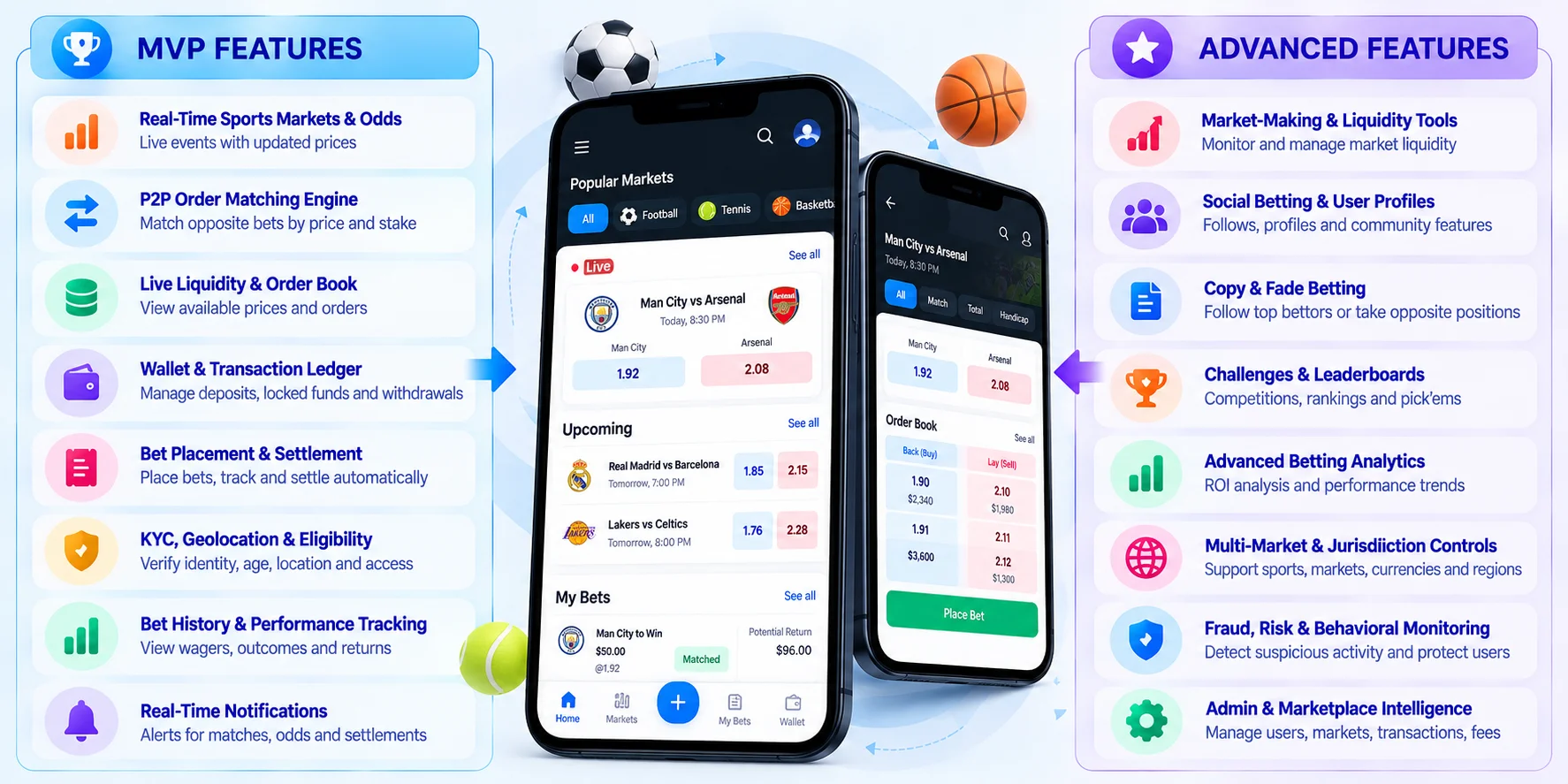
A. MVP Features That Establish the Core Marketplace
A successful P2P betting marketplace combines intuitive user experiences with reliable trading infrastructure. The right features help users discover markets, place and match bets, manage funds, track positions and participate securely as the platform scales.
| Feature | What It Does | Why It Matters |
| Real-Time Sports Markets & Odds | Displays upcoming and live events with continuously updated market prices. | Creates the real-time betting experience and attracts marketplace activity. |
| P2P Order Matching Engine | Matches users taking opposite sides based on price, stake and market conditions. | Enables the core transaction between marketplace participants. |
| Live Liquidity & Order Book | Shows available prices, amounts and unmatched orders. | Makes liquidity and matchability transparent to users. |
| Wallet & Transaction Ledger | Manages deposits, locked funds, winnings, fees and withdrawals. | Keeps financial transactions accurate and auditable. |
| Bet Placement & Settlement | Handles wager placement, cancellation, tracking and automated settlement. | Completes the core betting transaction lifecycle. |
| KYC, Geolocation & Eligibility | Verifies identity, age, location and participation eligibility. | Establishes compliance controls from the beginning. |
| Bet History & Performance Tracking | Records wagers, outcomes, returns, fees and activity. | Provides users with visibility while creating data for future analytics. |
| Real-Time Notifications | Alerts users about matches, market changes, settlements and account activity. | Keeps users informed during time-sensitive transactions. |
The MVP should be the smallest version capable of proving the marketplace itself, rather than a stripped-down version of the final product. The priority is a reliable cycle covering market discovery, liquidity, bet placement, matching, fund locking and settlement.
Once this cycle generates repeat activity, transaction data, user behavior and liquidity patterns can guide investment in advanced capabilities without overbuilding the initial product.
B. Advanced Features for Enterprise-Scale Betting
As your P2P betting marketplace grows, advanced features can improve liquidity, engagement, analytics, risk management and operational control. These capabilities help transform a functional MVP into a scalable, competitive platform built for sustained user activity.
| Feature | What It Does | Why It Matters |
| Market-Making & Liquidity Tools | Provides liquidity monitoring and tools for managing thin or high-demand markets. | Supports healthier markets as trading activity grows. |
| Social Betting & User Profiles | Enables follows, profiles, shared picks and community interactions. | Creates additional engagement and retention loops. |
| Copy & Fade Betting | Lets users follow or take the opposite side of selected bettors where supported. | Adds a social-trading layer to the marketplace. |
| Challenges & Leaderboards | Supports competitions, rankings, pick’ems and betting challenges. | Encourages recurring participation and community activity. |
| Advanced Betting Analytics | Provides ROI analysis, performance trends and deeper market insights. | Turns marketplace data into a premium analytics layer. |
| Multi-Market & Jurisdiction Controls | Supports different sports, markets, currencies, rules and jurisdiction configurations. | Enables expansion without rebuilding core marketplace logic. |
| Fraud, Risk & Behavioral Monitoring | Detects suspicious transactions, collusion signals and abnormal activity. | Protects users, funds and overall market integrity. |
| Admin & Marketplace Intelligence | Provides controls for markets, users, liquidity, transactions, fees and risk. | Gives operators the visibility required to manage scale. |
Advanced capabilities should be introduced after the core marketplace demonstrates sustained activity. MVP transaction data can inform analytics, user activity can power social features and liquidity patterns can guide market-management tools.
The goal is not to launch with the most features. It is to launch with the features that make P2P betting work exceptionally well, prove that users will transact on the marketplace and then use that foundation to build the advanced ecosystem around it.
How to Build a P2P Betting Marketplace Like BettorEdge?
Building a P2P betting marketplace like BettorEdge requires an architecture that allows users to take opposing positions rather than relying on a traditional sportsbook model. The system must coordinate market creation, order matching, liquidity, wallets, sports data, payments and settlement while maintaining accurate transaction records.
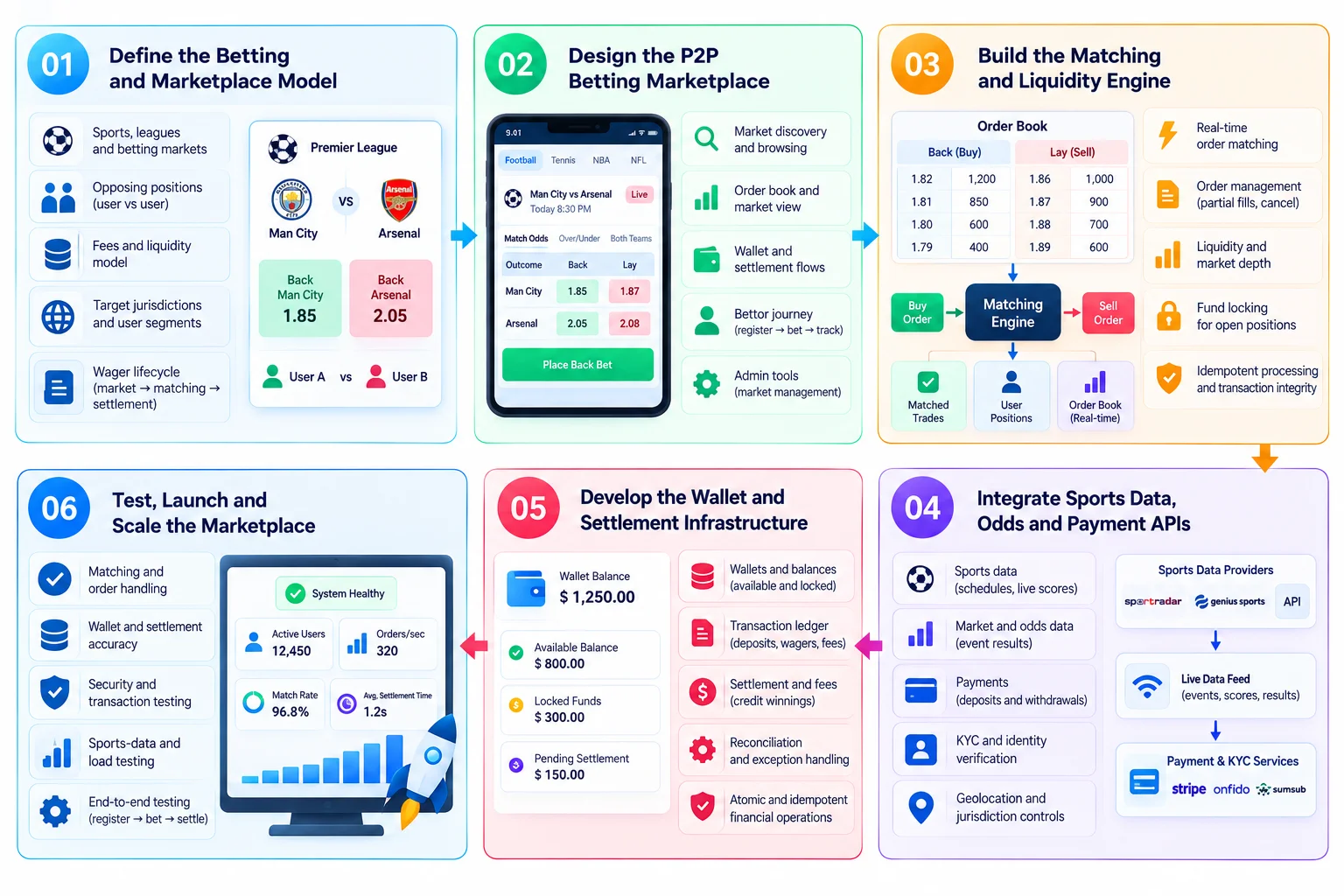
A practical development process starts with the marketplace model and user journey, followed by the matching engine, external integrations, financial infrastructure and end-to-end testing before scaling the platform.
1. Define the Betting and Marketplace Model
Start by defining what users can bet on and how opposing positions interact within the marketplace. These rules determine how the platform handles markets, orders, liquidity, fees and settlement.
- Sports and markets: Select supported sports, leagues, events, betting markets and wager types.
- Opposing positions: Define how one user’s position is matched with an opposing position and how matched wagers are recorded.
- Fees and liquidity: Establish marketplace fees, liquidity requirements and the approach to user-provided or additional market-making liquidity.
- Jurisdictions and users: Identify target jurisdictions, applicable requirements, user eligibility and primary bettor segments.
- Wager lifecycle: Define the flow from market creation and order placement through matching, event resolution and settlement.
The platform should also establish the lifecycle of a wager, from market creation and order placement through matching, event resolution, and settlement.
2. Design the P2P Betting Marketplace
Once the marketplace model is defined, design the user and operational flows around the core marketplace loop. The interface should clearly show how users discover markets, take positions, provide or accept liquidity and receive settlement proceeds. The product design should cover:
- Bettor journey: Registration, verification, deposits, market discovery, order placement, matching, position tracking and withdrawals.
- Market and order-book experience: Display sports, events, prices, available liquidity, market status and opposing positions.
- Wallet and settlement flows: Show available funds, locked funds, transaction history, fees, winnings and settled positions.
- Administration: Provide tools for market management, user controls, transaction monitoring and dispute handling.
For the MVP, prioritize account creation, market discovery, order placement, matching, wallet management, settlement and essential administration instead of launching every possible feature.
3. Build the Matching and Liquidity Engine
The matching engine is the core of a P2P betting marketplace. It continuously compares available positions and executes compatible orders while preventing duplicate or conflicting transactions. The engine should support:
- Real-time order matching: Match compatible opposing positions according to configured price and execution rules.
- Order management: Handle matched, unmatched, partially matched and cancelled orders while maintaining available quantities.
- Liquidity and order book: Display available liquidity and market depth while keeping the order book synchronized with executed trades.
- Fund locking: Reserve required funds for committed positions according to the platform’s financial model.
- Transaction integrity: Use idempotent processing and transactional controls to prevent duplicate execution, inconsistent balances or conflicting positions.
The system should maintain a consistent relationship between the order book, matched bets, user positions and wallet ledger. Failed executions should be recoverable without creating duplicate financial movements.
4. Integrate Sports Data, Odds and Payment APIs
External integrations connect the marketplace with sports information, financial services and user verification systems. They should provide reliable event data while supporting secure payments and jurisdiction checks. Key integrations include:
- Sports data: Import schedules, teams, fixtures, event IDs, live scores and relevant event updates.
- Market and results data: Connect required odds or market-data feeds and retrieve authoritative results for settlement.
- Payments and identity: Integrate payment gateways, KYC services and geolocation tools for deposits, withdrawals, identity verification and jurisdiction controls.
- Integration safeguards: Implement API authentication, request validation, retries, timestamps, failure handling and data reconciliation.
Sports-data failures require specific controls. Delayed, missing or conflicting results should not trigger settlement unless they satisfy the platform’s predefined resolution criteria.
5. Develop the Wallet and Settlement Infrastructure
The financial layer must track more than a displayed wallet balance. Users can have available funds, locked funds, active positions and pending settlements, so every movement needs a reliable financial record. The infrastructure should include:
- Wallets and balances: Maintain available and locked funds for each user based on open orders and matched bets.
- Transaction ledger: Record deposits, withdrawals, wagers, fees, adjustments and settlement transactions while linking them to individual bets and positions.
- Settlement and fees: Apply configured fees, credit eligible winning proceeds and close losing positions according to defined rules.
- Reconciliation and exceptions: Compare marketplace records with payment-provider data and route failed payments, disputed transactions and settlement inconsistencies for review.
The ledger should remain the authoritative financial record, with critical operations designed to be atomic and idempotent so retries do not create duplicate credits, debits or settlements.
6. Test, Launch and Scale the Marketplace
Before launch, test the complete marketplace lifecycle rather than validating individual features in isolation. Testing should confirm that matching, financial records, sports-data processing and settlement remain consistent under normal and high-volume conditions. Testing should include:
- Matching and order handling: Verify matching accuracy, partial fills, cancellations and remaining quantities.
- Wallet and settlement accuracy: Validate available and locked balances, winning and losing positions and final settlement.
- Security and transaction testing: Test authentication, authorization, API security, payment failures, duplicate requests, retries and reconciliation.
- Sports-data and load testing: Simulate delayed or conflicting results, high order volumes, concurrent users and increased data throughput.
- End-to-end testing: Run complete scenarios from registration and deposit through market participation, matching, resolution, settlement and withdrawal.
The initial launch can focus on a controlled set of sports, markets and jurisdictions. Once live, monitor liquidity, match rates, order activity, settlement performance, system health and user activity.
As usage grows, infrastructure can be scaled to support additional markets, higher concurrent order volumes, more sports-data streams, and expanded operational requirements.
How Much P2P Betting Marketplace Like BettorEdge Development Cost?
A P2P betting marketplace like BettorEdge can cost approximately $130,000 to $550,000+ to develop, depending on its trading infrastructure, sports coverage, social features, integrations, compliance requirements and overall platform complexity. Development time can range from 5 to 15 months based on the selected scope.
BettorEdge-Style P2P Betting App Cost by Tier
The P2P betting marketplace like BettorEdge development costs vary by platform tier, with a core exchange requiring fewer markets and integrations than a full community-driven platform. The table below compares estimated costs, timelines and key features across three development tiers for a BettorEdge-style P2P betting marketplace.
| Tier | Estimated Cost | Timeline | What’s Included |
| Core exchange MVP | $130,000 – $190,000 | 5 – 7 months | Bet matching engine, back/lay pricing, escrow settlement, basic KYC, single-sport markets |
| Social betting marketplace | $190,000 – $320,000 | 7 – 10 months | Multi-sport markets, freemium tiers with usage caps, leaderboards, head-to-head challenges, live sports data feeds |
| Full community exchange platform | $320,000 – $550,000+ | 10 – 15 months | Discord/chat bot integration, tipping system, virtual practice currency, advanced analytics dashboard, multi-state compliance |
These figures are directional estimates, not fixed quotes. Final costs depend on the launch states, selected sports data and payment vendors, and how much compliance infrastructure is already in place.
The MVP costs more than a typical app because even a basic betting exchange must hold funds in escrow, verify users and settle outcomes accurately. KYC, escrow and core compliance are required from day one, not added later.
IdeaUsher’s role is to keep the MVP tightly scoped around a single-sport, single-state compliant exchange, adding freemium tiers, leaderboards and chat after user data validates them. Once the state and vendor stack are finalized, the estimate can be narrowed to a project-specific quote.
Cost Affecting Factors During Development
Several factors can increase P2P betting marketplace development costs, including licensing, identity verification, live data, billing, social features and regulated payment infrastructure. These requirements also add recurring operational expenses.
- State-by-State Legal Licensing: P2P betting legality is determined individually across US states, and mapping geofencing plus compliance logic across 45+ jurisdictions adds $20,000 to $50,000 in ongoing legal and engineering work.
- KYC and Identity Verification: Verifying government-issued ID and age before allowing real-money wagers requires a dedicated verification pipeline, typically adding $10,000 to $25,000 depending on the provider and jurisdiction count.
- Live Sports Data Feed Licensing: Real-time scores and odds context from licensed data providers carry ongoing subscription costs of $2,000 to $10,000+ monthly, on top of $15,000 to $30,000 in integration work.
- Freemium Billing and Usage-Cap Logic: Enforcing different no-fee wager limits for free versus premium tiers, similar to BettorEdge’s $100 and $750 monthly caps, requires tiered billing infrastructure adding $10,000 to $20,000.
- Social Engagement Infrastructure: Leaderboards, activity feeds and head-to-head challenge mechanics that drive retention between matched bets typically add $25,000 to $60,000 combined across backend and UI work.
- Payment Processing for Regulated Wagering: Standard processors like Stripe don’t support gambling transactions, so integrating a gambling-approved processor commonly used across the US market adds $5,000 to $15,000 in annual licensing plus integration cost.
How Can Social Features Differentiate a P2P Betting App?
Social features can differentiate a P2P betting app like BettorEdge by turning individual wagers into shared experiences. Features such as bettor profiles, following, social feeds, challenges, leaderboards, shared picks and performance tracking can encourage interaction while helping the marketplace generate recurring activity beyond individual betting transactions.
A. Turn Betting Activity Into a Social Experience
In a legacy betting app, placing a bet is a private financial decision. In a social P2P marketplace, every order can become a piece of interactable content:
- Public & Segmented Feeds: Users can publish trades, position changes and custom limit orders to social feeds, where others can comment, react and discuss betting lines.
- User Following & Group Networks: Bettors can follow friends, domain experts and community analysts, with feeds highlighting activity across groups such as alumni circles, regional sports communities and high-volume traders.
- Contextual Trash Talk & Chat Channels: Real-time chat alongside live order books lets opposing position holders interact during matches, connecting social engagement directly with active positions.
B. Build Competition Around the Betting Marketplace
Competitive mechanics sit on top of the central limit order book to generate engagement that feeds back into core marketplace liquidity:
- Direct Head-to-Head Challenges: Users can challenge specific friends or rivals at agreed-upon odds, bringing casual social betting into an automated, escrow-backed system that guarantees settlement.
- Transparent Leaderboards: Public rankings track net profit, ROI and winning streaks across weekly, monthly and seasonal periods, encouraging continued participation and trading activity.
- Low-Stakes Contests as Top-of-Funnel: Free-to-play pick’ems, auction squares and survivor pools engage casual users, sustain activity during quieter sports periods and direct participants toward active exchange markets.
C. Use Bettor Activity to Power Social Discovery
The core data produced by a P2P exchange every matched order, fill price, and settled contract serves as the foundational content engine for the app:
- Verifiable Track Records: Traditional social media includes unverified sports touts claiming inflated win rates. A P2P marketplace can use ledger-backed profiles to display historical ROI, closing line value (CLV), win/loss records and sport-specific hit rates.
- Algorithmic Pick Discovery: Trending sections can highlight where active or experienced traders are deploying capital. Users can filter picks by sport, market type or risk tier to monitor changing market activity.
- One-Click “Copy” or “Fade” Mechanics: When users discover a position in their feed, they can avoid manually rebuilding the ticket. A single tap lets them:
- Copy the Pick: Automatically post an identical order or fill existing opposing liquidity to back the same outcome.
- Fade the Pick: Automatically take the opposite side of that user’s position, instantly acting as the counterparty and supplying liquidity to the market.
D. Design Social Features Around Retention
Adding chat rooms or follower counts does not improve retention on its own. For social mechanics to meaningfully reduce user churn, they must form a self-reinforcing behavioral loop that channels social interaction directly back into capital commitment:
- Bet: A user creates or accepts an order in the marketplace.
- Share: The executed contract automatically publishes to their profile, group chats, or community feed as an interactable card.
- Follow & React: Friends and community members see the position, reply, or follow the user’s ongoing performance.
- Compete & Match: Peers either copy the trade (adding demand on that side) or take the opposite side via a direct challenge or fade (instantly creating counterparty liquidity).
- Return: Automated push notifications alert participants to in-game line movements, peer replies, or closing outcomes.
- Re-Bet: Settlement credits winnings or triggers competitive rematches, prompting the user to place their next trade.
Designing around this circular loop ensures social interaction serves as an engine for marketplace liquidity, transforming casual users into recurring market participants.
Practical Challenges in Building a P2P Betting Marketplace Like BettorEdge
A P2P betting marketplace introduces development challenges that extend beyond conventional sportsbook functionality. Developers must maintain accurate matching, synchronized financial records and reliable event data while handling real-time transactions and failures without disrupting active wagers.
1. Maintaining Matching Accuracy Under Concurrent Orders
Challenge: High volumes of simultaneous orders can create race conditions, duplicate matches, stale liquidity and inconsistent order-book states during peak betting periods.
Solution: Our developers use transactional controls, idempotent processing and synchronized order handling to maintain matching accuracy while ensuring partial fills, cancellations and concurrent orders remain consistent.
2. Keeping Wallet and Settlement Records Consistent
Challenge: Deposits, locked funds, matched bets, fees and settlements can create reconciliation problems when payment failures, retries or duplicate requests occur.
Solution: Our developers implement an authoritative transaction ledger with atomic financial operations, idempotency controls and reconciliation workflows to prevent duplicate credits, incorrect balances and settlement inconsistencies.
3. Handling Unreliable Sports Data and Settlement Events
Challenge: Delayed, missing or conflicting sports-data updates can cause incorrect market states or premature settlement of active betting positions.
Solution: Our developers implement validated data pipelines, provider redundancy, event-state checks and predefined settlement rules so uncertain results remain unresolved until authoritative information becomes available.
Why Choose IdeaUsher for P2P Betting App Development?
IdeaUsher operates as an enterprise product engineering partner and fintech innovator, backed by 11+ years of software expertise, 250+ specialized technologists and a 4.9/5 Clutch rating across 1,000+ delivered builds.
We replace generic gambling templates with custom, high-concurrency peer-to-peer (P2P) betting and prediction exchange platforms that eliminate the traditional bookmaker model in favor of transparent, user-driven liquidity pools
- High-Throughput Matching Engines: We build deterministic, in-memory matching engines using continuous double auction (CDA) or automated market maker (AMM) algorithms for sub-millisecond bet matching, instant netting and real-time order cancellation.
- Low-Latency Sports Feeds & Oracle Settlement: Direct integrations with official data providers such as Sportradar, Opta and Genius Sports, plus decentralized oracles for real-time match events, odds streaming and automated settlement.
- Escrow Architecture & Multi-Currency Rails: Secure escrow mechanisms supporting PCI-DSS compliant fiat gateways and Web3 crypto rails to lock stakes and execute automated payouts after outcome verification.
- Regulatory Compliance & Risk Guardrails: Compliance modules supporting multi-jurisdictional KYC/AML, IP/GPS geofencing, anti-collusion monitoring and responsible gaming controls.
- Zero Vendor Lock-In & Full IP Ownership: Full platform sovereignty with modular source code delivery and auto-scaling Kubernetes infrastructure designed to handle major championship-level traffic spikes.
Planning to launch a peer-to-peer betting exchange? Connect with Idea Usher’s principal fintech and gaming software architects today to evaluate your market model, order-matching logic, liquidity infrastructure, and technical development roadmap.
Conclusion
A strong P2P betting marketplace depends on more than familiar sportsbook features. The foundation lies in reliable matching, visible liquidity, secure transactions, real-time sports data and scalable infrastructure. A well-planned P2P betting marketplace like BettorEdge can combine these capabilities with social betting and advanced analytics to create a differentiated user experience. The right technology partner can help turn the concept into a scalable platform while addressing integrations, compliance, security and evolving marketplace requirements from MVP through enterprise expansion.
FAQs
A.1. A P2P betting marketplace like BettorEdge can cost approximately $130,000 to $550,000+, depending on sports coverage, matching infrastructure, integrations, compliance requirements, social features and platform complexity.
A.2. A P2P betting marketplace like BettorEdge needs real-time markets, order matching, liquidity tracking, wallets, settlement, KYC, geolocation, notifications and transaction tracking, with advanced social and analytics features added as the platform scales.
A.3. A P2P betting matching engine compares opposing orders based on price, stake and execution rules, then matches compatible positions while managing partial fills, unmatched orders and available liquidity.
A.4. A P2P betting marketplace can generate revenue through transaction fees, premium subscriptions, payment-related charges, partner referrals and other marketplace services, rather than relying primarily on users’ betting losses.