


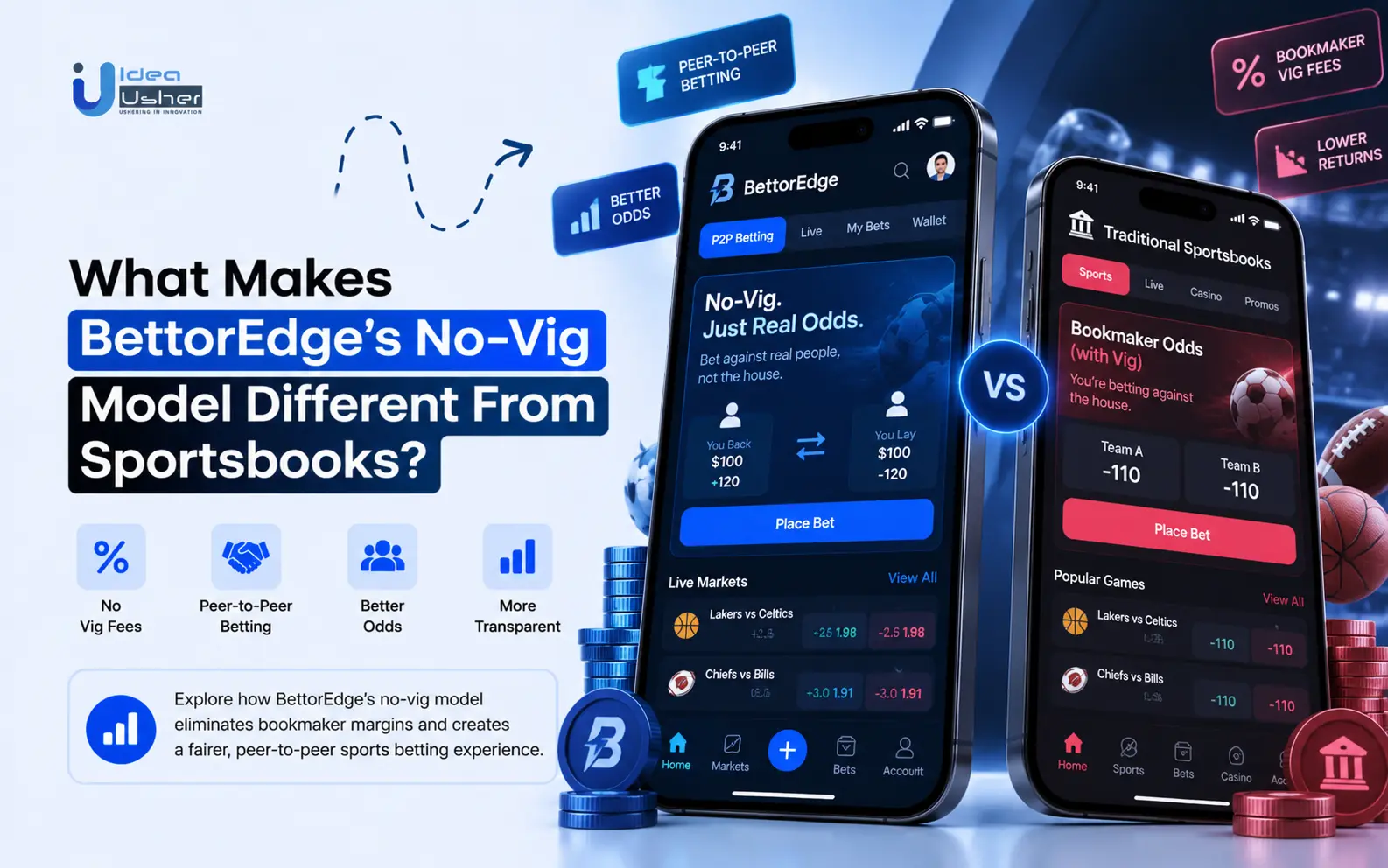
Key Takeaways
- BettorEdge is a peer-to-peer betting exchange, not a sportsbook, so users bet against each other instead of against a house that prices in a profit margin.
- Traditional sportsbook odds carry a built-in vig, commonly 4.76% to 10%, which pushes the break-even win rate to roughly 52.4% or higher.
- Removing the vig drops the break-even win rate to a flat 50%, and BettorEdge reports over 40% of its users are profitable, compared to roughly 2% at traditional sportsbooks.
- Users can set their own odds, match existing offers, and buy or sell a position before an event ends, none of which a fixed-odds sportsbook allows.
- A comparable no-vig betting exchange typically costs $50,000 to $250,000 to build, with a compliant production platform achievable in 6 to 12 months.
BettorEdge removes the single biggest cost every sports bettor pays without realizing it: the vig, and it does that by replacing the sportsbook itself with a peer-to-peer exchange where users bet directly against each other. A traditional sportsbook prices every line so that both sides combined imply more than 100% probability, and that gap is pure margin the house collects regardless of outcome. BettorEdge’s exchange model, covered in depth in its own posts on vig-free betting and how no-vig odds reveal true probability, eliminates that structural edge entirely. This guide breaks down exactly how the model works, what makes it fundamentally different from a sportsbook, and what it takes to build a comparable exchange at Idea Usher.
What Does “Vig” Mean in Sports Betting?
The vig, short for vigorish, is the built-in commission a sportsbook charges on every bet, and it is baked directly into the odds rather than charged as a visible fee. At standard -110 odds, a bettor risks $110 to win $100. That extra $10 is the sportsbook’s margin. Run the math across both sides of a two-way market priced at -110/-110, and the implied probabilities add up to 104.8% instead of 100%, using BettorEdge’s own fee calculator as a reference point. That extra 4.8% is the vig, and it forces a bettor to win roughly 52.4% of their wagers just to break even, before they can turn any actual profit.
Vig percentages vary by sport and market type, running anywhere from about 4.76% on mainstream point spreads up to 10% or more on player props and exotic bets. It is a quiet tax that compounds over a season of betting, and most bettors never see the number, only the odds.

Traditional sportsbook odds at -110/-110 sum to 104.8% implied probability, with the excess above 100% being the sportsbook’s vig
BettorEdge’s no-vig exchange prices both sides at a true 100% implied probability with no house margin baked in
How BettorEdge’s No-Vig Model Actually Works
BettorEdge functions as a peer-to-peer betting exchange, meaning the platform matches bettors against each other instead of taking the other side of every wager itself. This single structural choice is what removes the vig, and three mechanics make it work in practice.
Peer-to-Peer Exchange Instead of a Sportsbook Counterparty
Every wager on BettorEdge is matched against another user’s opposite position rather than absorbed by the house. As the platform puts it, users “bet against other people, not a sportsbook,” with no juice baked into the price and no limits placed on winning accounts, a common complaint against traditional books that restrict or void winning bettors.
Setting Your Own Odds or Matching Existing Offers
Users can post a wager at whatever price they believe is fair and wait for another bettor to match it, or they can browse the marketplace and accept an offer someone else already posted. This is fundamentally different from a sportsbook bet slip, where the price is fixed by the house and non-negotiable.
Buying and Selling Positions Before an Event Ends
BettorEdge lets users exit a position early by selling it to another bettor before the event concludes, functioning more like a trading exchange than a bet slip. Every open wager also appears on a social feed, adding a transparency layer no sportsbook offers.
The Math: How No-Vig Odds Reveal True Probability
Converting odds into a true, vig-free probability takes three steps:
- Convert each side’s odds into an implied probability. For negative odds: implied probability = (−odds) / ((−odds) + 100). For positive odds: implied probability = 100 / (odds + 100).
- Add the implied probabilities for every outcome in the market together.
- Divide each individual outcome’s probability by that total, then multiply by 100 to normalize back to a true, no-vig percentage.
Applied to two teams both priced at -110: each side implies 52.4% probability, for a combined 104.8%. Dividing 52.4% by 104.8% and multiplying by 100 gives a true probability of 50% per side, exactly what a coin-flip market should show with no house margin distorting it.
What Makes This Different From Traditional Sportsbooks
| Factor | Traditional Sportsbook | BettorEdge No-Vig Exchange |
|---|---|---|
| Who sets the counterparty | The house takes the other side | Another bettor takes the other side |
| Odds source | Fixed by the sportsbook | Set by users or matched peer-to-peer |
| Break-even win rate | About 52.4% (with 8% vig) | Exactly 50% |
| Exiting a position early | Not possible | Buy or sell before the event ends |
| Winning accounts | Often limited or restricted | No limits on winning |
| Bettor profitability | Roughly 2% of bettors profitable | Over 40% of users reportedly profitable |
How BettorEdge Compares to Other No-Vig and P2P Platforms
BettorEdge is not the only platform chasing the no-vig model, and its positioning only makes sense against the alternatives:
- Versus Novig: Both are peer-to-peer exchanges eliminating the sportsbook’s built-in margin, though Idea Usher’s breakdown of how a platform like Novig actually makes money shows Novig leaning on per-contract fees and market-maker spread capture rather than a traditional commission, a revenue model BettorEdge’s exchange structure could adopt just as easily.
- Versus traditional sportsbook apps: A conventional sportsbook build, the kind covered in Idea Usher’s sports betting app development guide, centers on a fixed-odds pricing engine and house risk management. A no-vig exchange replaces that entirely with an order book, which is a different engineering problem, not a variation of the same one.
- Versus peer-to-peer sportsbooks with house-set odds: Some platforms let users challenge each other directly but still price the underlying line themselves, an approach detailed in Idea Usher’s peer-to-peer sports betting app development work. BettorEdge goes further by letting users set the price itself, not just the matchup.
Why This Matters: The Financial Impact for Bettors
A 2.4 percentage point drop in break-even win rate sounds small until it is run across a real betting volume, at which point it becomes the difference between a losing hobby and a profitable one. BettorEdge’s own modeling shows a bettor placing 1,040 wagers a year at a 53% win rate would save approximately $7,560 annually in vig alone compared to betting the same volume at a traditional sportsbook. That is not a bonus or a promotion. It is money a bettor never has to give up in the first place, because the structural cost was never built into the price.

Sportsbook bettors profit at roughly 2%, while BettorEdge reports over 40% of its users are profitable, alongside the break-even win rate dropping from 52.4% to 50%

How a wager moves through BettorEdge’s peer-to-peer exchange: set or match odds, place the peer-to-peer wager, buy or sell before the event ends, settle at the true no-vig price
How to Build a No-Vig Betting Exchange Like BettorEdge
Building a no-vig betting exchange means replacing a sportsbook’s fixed-odds pricing engine with an order book and matching system, plus the wallet, compliance, and settlement infrastructure to support it.
Core Features Checklist
- Order book and matching engine that pairs opposing positions in real time
- User-set pricing alongside a browsable marketplace of open offers
- Buy and sell functionality for exiting a position before settlement
- Social feed showing open and matched wagers for transparency
- Multi-currency or fiat wallet with fast deposits and withdrawals
- KYC and geo-fencing tied to each state’s specific betting regulations
- Admin dashboard for market oversight, risk flags, and dispute resolution
- Market surveillance tooling to detect manipulation or collusion between accounts
Order Book and Matching Engine
This is the single most technically demanding piece of the build. The engine has to match opposing positions with price-time priority, support partial fills when order sizes do not match exactly, and update the displayed odds in real time as new orders enter the book. Idea Usher’s breakdown of what it costs to build a Novig-like prediction marketplace flags the matching engine as the costliest single component of a build like this, precisely because of the microsecond-level processing it requires during high-volume windows like game day.
Tech Stack for a No-Vig Betting Exchange
- Frontend: React or Next.js for web, React Native or Flutter for mobile
- Backend: Node.js, Python, or Go for the API and matching services
- Database: PostgreSQL for transactional data, Redis for real-time order book state
- Real-time infrastructure: WebSockets or Kafka for live odds updates and the social feed
- Sports data and oracle: A licensed data provider for event results and settlement triggers
- Payments: A payment processor for fiat rails, with optional crypto wallet support
Platforms that want to go further can layer AI on top of this stack for personalized market recommendations and fraud detection, an approach Idea Usher covers in its guide to AI sports betting app development, though most teams are better served getting the core matching engine right before adding a recommendation layer on top of it.
Development Cost and Timeline
| Tier | Core Features Included | Cost Range | Timeline | Best For |
|---|---|---|---|---|
| MVP | Basic order book, single sport, simple wallet | $50,000 to $100,000 | 3 to 6 months | Testing demand before a full compliance build |
| Production Platform | Full matching engine, KYC, multi-sport, buy and sell before settlement | $100,000 to $250,000 | 6 to 12 months | Most operators launching a compliant no-vig exchange |
| Enterprise/DCM-Ready | Regulatory-grade matching engine, market surveillance, exchange-license-ready architecture | $250,000 to $400,000 or more | 12 to 18 months | Operators pursuing full exchange or DCM licensing |
Feature-level costs break down further, since each system component is scoped and built separately:
| Component | Estimated Cost |
|---|---|
| Order book and matching engine | $25,000 to $70,000 |
| Binary contract and settlement logic | $10,000 to $25,000 |
| Sports data or oracle integration | $15,000 to $30,000 |
| Wallet and payment processing | $15,000 to $40,000 |
| KYC and geo-fencing | $8,000 to $25,000 |
| Market surveillance tools | $15,000 to $45,000 |
| Web and mobile apps | $20,000 to $60,000 |
Legal review, sports data licensing, and liquidity incentives for early market makers are typically scoped as separate line items outside these ranges.
Common Mistakes to Avoid
- Underbuilding the matching engine, then hitting performance walls the first time a marquee game drives order volume
- Treating KYC and geo-fencing as an afterthought instead of a core requirement tied to every state’s specific rules
- Launching without market surveillance tools, which makes collusion and manipulation between accounts nearly impossible to catch
- Ignoring the sell-before-settlement feature, which is one of the core differentiators bettors expect from an exchange rather than a sportsbook
Why Partner With IdeaUsher to Build Your Betting Exchange
A no-vig betting exchange lives or dies on its matching engine and compliance architecture, and Idea Usher has spent over a decade building exactly these kinds of money-moving platforms.
Over 10 Years Building Money-Moving Software
Idea Usher has operated for more than 10 years with a team of 250-plus specialists across AI, blockchain, and fintech development, with direct experience building order books, wallets, and settlement systems rather than standard consumer apps.
Real-Time Matching Engines and Exchange Architecture
Idea Usher’s prediction marketplace development practice is built around central limit order book trading engines, real-time infrastructure for peak-event load, and resolution systems that settle against verified data sources, the same core architecture a BettorEdge-style exchange depends on.
Phased Delivery With Compliance Mapped First
Builds run through a staged process, requirements and architecture, UX design, trading infrastructure development, data integration, testing, and deployment, with legal and regulatory mapping happening before the majority of the engineering budget is spent.
A Track Record Backed by Real Numbers
Idea Usher has delivered more than 1,000 projects across 50-plus countries, holds a 95 percent client retention rate, and carries Clutch recognition as a top app development and top blockchain company for 2026.

Idea Usher by the numbers: 10+ years in business, 250+ niche experts, 1,000+ projects delivered, 50+ countries reached, 95% client retention, Top 2026 Clutch App and Blockchain Company
If you are scoping a no-vig betting exchange, talk to Idea Usher’s team about your prediction marketplace development options, or book time directly with Nitish Garg to walk through your matching engine and compliance requirements.
Conclusion
BettorEdge’s no-vig model is different from a sportsbook at the structural level, not just the pricing level, because it replaces the house as counterparty with a peer-to-peer marketplace where users set and match their own odds. That single change drops the break-even win rate from roughly 52.4% to a flat 50%, and it is why a meaningfully higher share of BettorEdge users report being profitable compared to traditional sportsbook bettors. For founders building in this space, the lesson is the same one that applies across every no-vig and prediction-market product: the order book and settlement architecture is the product, and it has to be built right from the first line of code.
FAQs
What does “no-vig” mean?
No-vig means the odds carry no built-in sportsbook commission, so both sides of a market sum to exactly 100% implied probability instead of the 104% or more typical of a traditional sportsbook line.
How does BettorEdge make money without charging vig?
BettorEdge operates as a peer-to-peer marketplace connecting bettors directly rather than taking the other side of wagers itself, so it does not need to price a margin into every line the way a sportsbook does.
Is BettorEdge’s no-vig model the same as a betting exchange?
Yes. A peer-to-peer exchange where users set or match odds and can buy or sell a position before settlement is functionally a betting exchange, a structure shared by platforms like Novig in the same category.
How much does it cost to build a no-vig betting exchange like BettorEdge?
A comparable build typically costs $50,000 to $400,000 depending on scope, with a compliant production platform achievable for $100,000 to $250,000 in 6 to 12 months.
What is the hardest part of building a betting exchange?
The order book and matching engine, since it has to pair opposing positions in real time, handle partial fills, and scale to handle order volume spikes during major sporting events without latency.
Can a no-vig exchange still charge fees?
Yes. Common alternatives to vig include a flat per-contract settlement fee, a taker-only fee, capturing the bid-ask spread as a market maker, or charging for premium market data access.
What tech stack does a no-vig exchange need?
Most builds run on React or Next.js for web, React Native or Flutter for mobile, Node.js, Python, or Go on the backend, PostgreSQL and Redis for data, and WebSockets or Kafka for real-time order book updates.


