

Key Takeaways
- Telehealth companies can use multi-state licensing software to keep all licenses, renewals, state rules and provider authorizations in one place.
- The software links patient location with the provider’s license so it can warn or stop a visit if the provider is not authorized to practice in that state.
- The main features of multi-state licensing software are state-rule management, license tracking and verification, renewal alerts, compliance dashboards and scheduling integrations.
- Multi-state licensing software development can range from about $50,000 to $350,000+, depending on state coverage, automation, integrations and security needs.
- AI in multi-state licensing software helps with document extraction, renewal forecasting and rule-change detection. Compliance teams still have to review and approve key licensing decisions for providers.
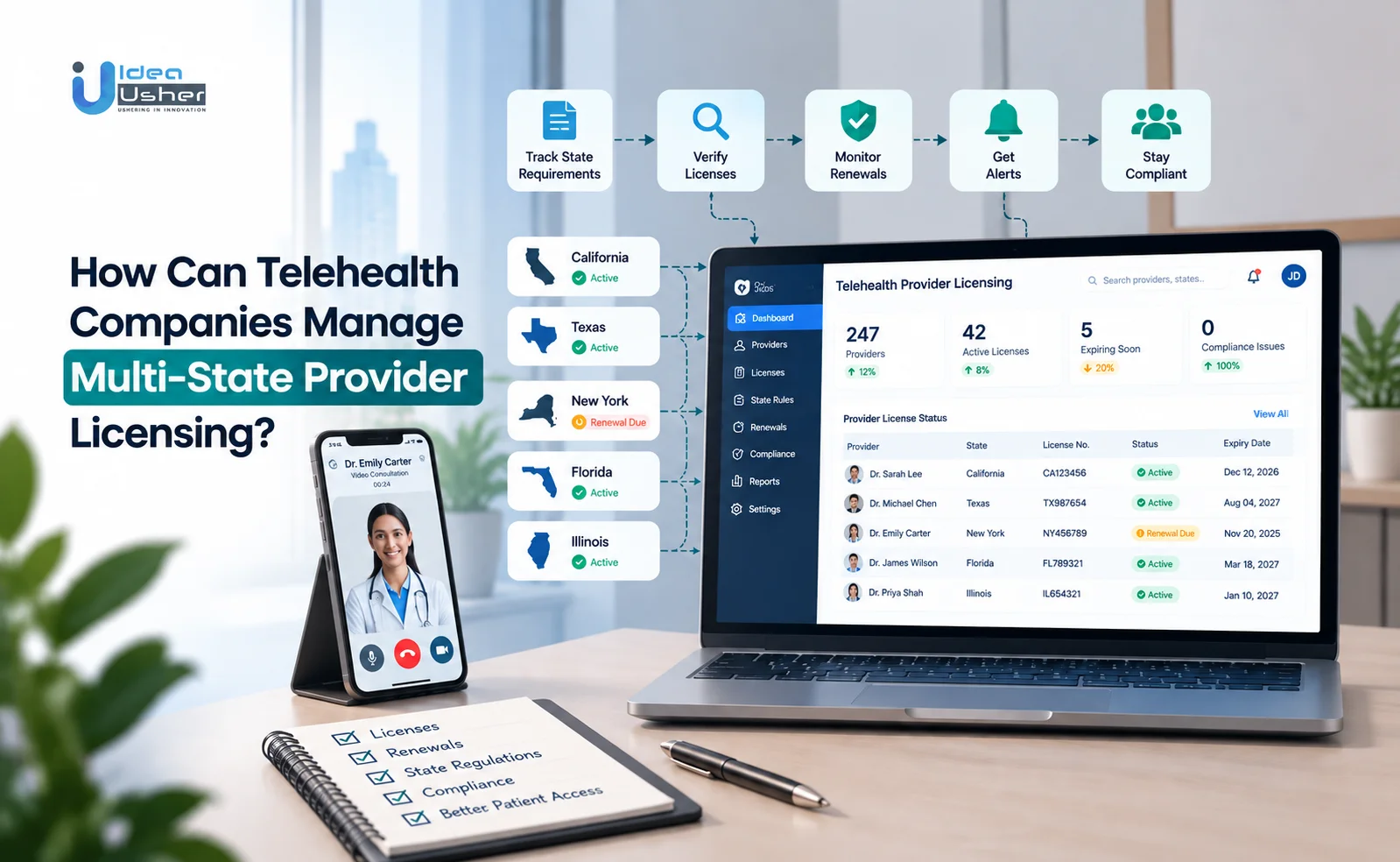
Telehealth multi-state licensing software helps telehealth companies manage provider licenses across different states from one place. The software keeps state license records, state-specific requirements and renewal dates organized. It also checks where each provider is allowed to practice and flags missing credentials or upcoming expirations. This gives telehealth teams an accurate view of provider licensing status across their network and helps them manage renewals in one place.
Manual tracking through spreadsheets and disconnected systems becomes difficult as provider networks grow. Different state requirements, changing regulations and recurring renewals can create gaps that affect provider availability. Centralized workflows and automated alerts help teams manage these requirements more consistently.
In this blog, we will talk about how telehealth companies can manage multi-state healthcare provider licensing including key software features, workflows, integrations, security requirements, costs and development considerations, along with the key factors that influence scalability, compliance and market readiness.
Why Multi-State Licensing Is a Telehealth Bottleneck
Telehealth offers the promise of borderless clinical access, but virtual care delivery operates under a state-by-state regulatory paradigm. While nationwide demand for digital care has grown rapidly, healthcare practice acts remain decentralized across 50 distinct state medical boards, the District of Columbia and U.S. territories.
The global telehealth services market size was valued at $46.0 billion in 2023 and is projected to grow from $103.5 billion in 2026 to $291.4 billion by 2030, at a CAGR of 30.2% from 2024 to 2030.
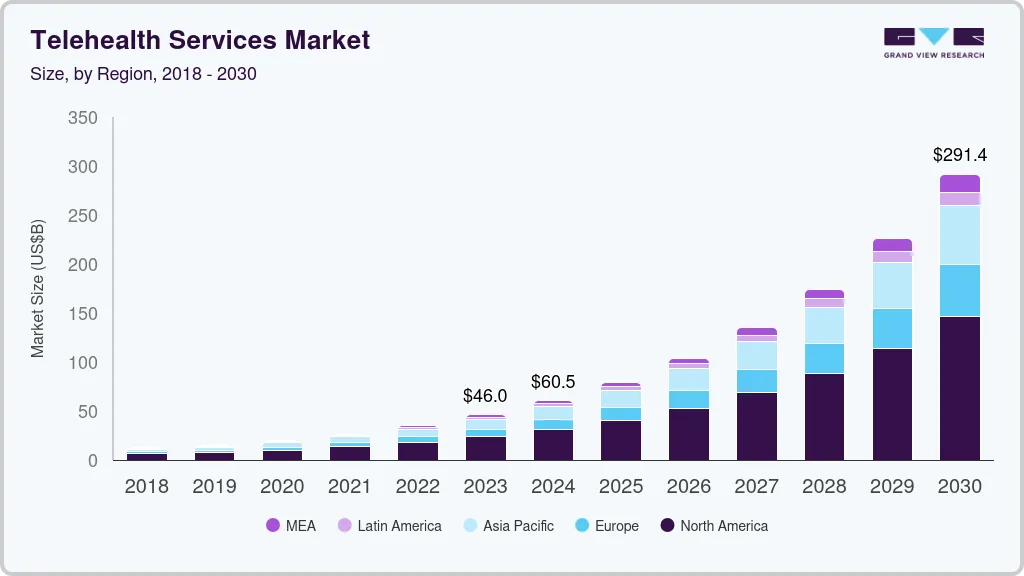
The U.S. market highlights the need for scalable licensing infrastructure. The CDC reported that 80.0% of office-based physicians used telemedicine in 2024, including 86.2% of primary care physicians and 83.2% of medical specialists, increasing the importance of reliable multi-state authorization tracking.
According to data from the Federation of State Medical Boards (FSMB) shows that 24% of U.S. physicians hold multiple active state licenses, including 15% with two and 9% with three or more. Telemedicine clinicians may require 10 to 30+ licenses for cross-state coverage, making manual tracking costly, complex and operationally restrictive.
A. Why Patient Location Determines Licensing Requirements
The foundational principle of U.S. medical jurisprudence is that the clinical encounter legally takes place at the physical location of the patient, not the practitioner.
- Strict Geographic Jurisdiction: A physician treating a patient across the state line, such as from California to Nevada, generally needs an active, unencumbered Nevada medical license or compact privilege, regardless of where the physician is physically located.
- Compacts Do Not Remove State Control: The Interstate Medical Licensure Compact (IMLC) spans over 40 participating states, plus Washington D.C. and Guam, but does not create a national license. Physicians still obtain individual state licenses, averaging 4 licenses per applicant.
- Severe Non-Compliance Penalties: Treating patients across state lines without proper authorization can constitute practicing medicine without a license, potentially resulting in criminal charges, board enforcement, NPDB-reportable actions and malpractice coverage issues for the encounter.
B. Where State Licensing Rules Create Operational Gaps
Navigating 50 independent state medical, osteopathic, and nursing boards introduces significant variance in turnaround times, continuing education mandates, and fee structures.
- Turnaround Time Variance: State licensing boards differ widely in processing speed. Compact-assisted applications can take roughly 19 days, while traditional multi-state applications may take 60 to 180+ days, creating onboarding delays.
- Asynchronous Renewal Deadlines: Renewal schedules vary by state. Some licenses renew annually, others biennially based on the clinician’s birth month, while others follow fixed statutory dates, such as December 31 of odd-numbered years.
- Bespoke State Mandates: These differences extend beyond timing and fees. State board fees range from $300 to $1,200+, while renewal may also require state-specific Continuing Medical Education (CME) courses, opioid training, implicit bias education or jurisprudence exams.
C. How Licensing Gaps Can Affect Telehealth Scheduling
The real-world consequence of fragmented licensing operations is an unpredictable, brittle patient scheduling queue.
- Appointment Cancellations and Churn: If a provider’s license has lapsed in the encounter state, the appointment must be canceled or reassigned. With telehealth platform churn near 6.9% monthly, these disruptions can increase patient drop-off.
- Real-Time Cross-State Routing Failures: Virtual care depends on real-time matching. Without an accurate API-fed matrix of active, verified state licenses, scheduling systems cannot safely route cross-state patient volume during demand spikes.
- Underutilized Clinical Supply: Clinical capacity remains idle when doctors have open calendars but lack the verified multi-state licensing credentials needed to handle overflow patient visits from neighboring states.
What Is Multi-State Provider Licensing Software?
Multi-state provider licensing software is a specialized regulatory compliance and operations platform designed to track, manage, verify and renew professional healthcare licenses across multiple state jurisdictions. Rather than treating a medical license as a static document, the software continuously synchronizes active state authority with provider registries, credentialing pipelines, scheduling engines and payer networks.
For virtual care networks, nationwide digital health platforms, locum tenens agencies and multi-state health systems, this software serves as an operational engine that helps prevent unauthorized cross-border care, reduce clinician downtime and support regulatory compliance across all 50 states, the District of Columbia and U.S. territories.
A. What the Software Tracks for Each Provider
Operating across state lines requires tracking far more than an individual license number and expiration date. Multi-state licensing software manages a multi-dimensional matrix of state-level clinical authority:
| Tracking Area | What the Software Tracks |
| State Medical, Osteopathic, and Nursing Licenses | Tracks license status, application sub-stages, renewal dates and disciplinary histories across every state where the provider is licensed or applying. |
| Compact Privileges vs. Traditional Licenses | Differentiates between standalone state licenses and multi-state privileges through frameworks such as IMLC, NLC and PSYPACT. |
| Controlled Substance Authority | Tracks federal DEA certificates alongside state-specific Controlled Dangerous Substance (CDS) or Controlled Substance Registrations (CSR) where separate authorization is required. |
| Continuing Medical Education (CME) Compliance | Monitors state-specific CME requirements, including opioid stewardship, implicit bias and infection control coursework, while tracking credits against each state’s renewal deadline. |
| Supervisory & Collaborative Practice Agreements | Manages collaborative agreements, physician supervision ratios and chart-review protocols for APRNs and PAs practicing in restricted or reduced-practice states. |
B. How State Authorization Is Linked to Provider Profiles
State authorization is linked to provider profiles by mapping each state license, status, practice location and renewal deadline to a centralized clinician record, creating a complete view of clinical authority.
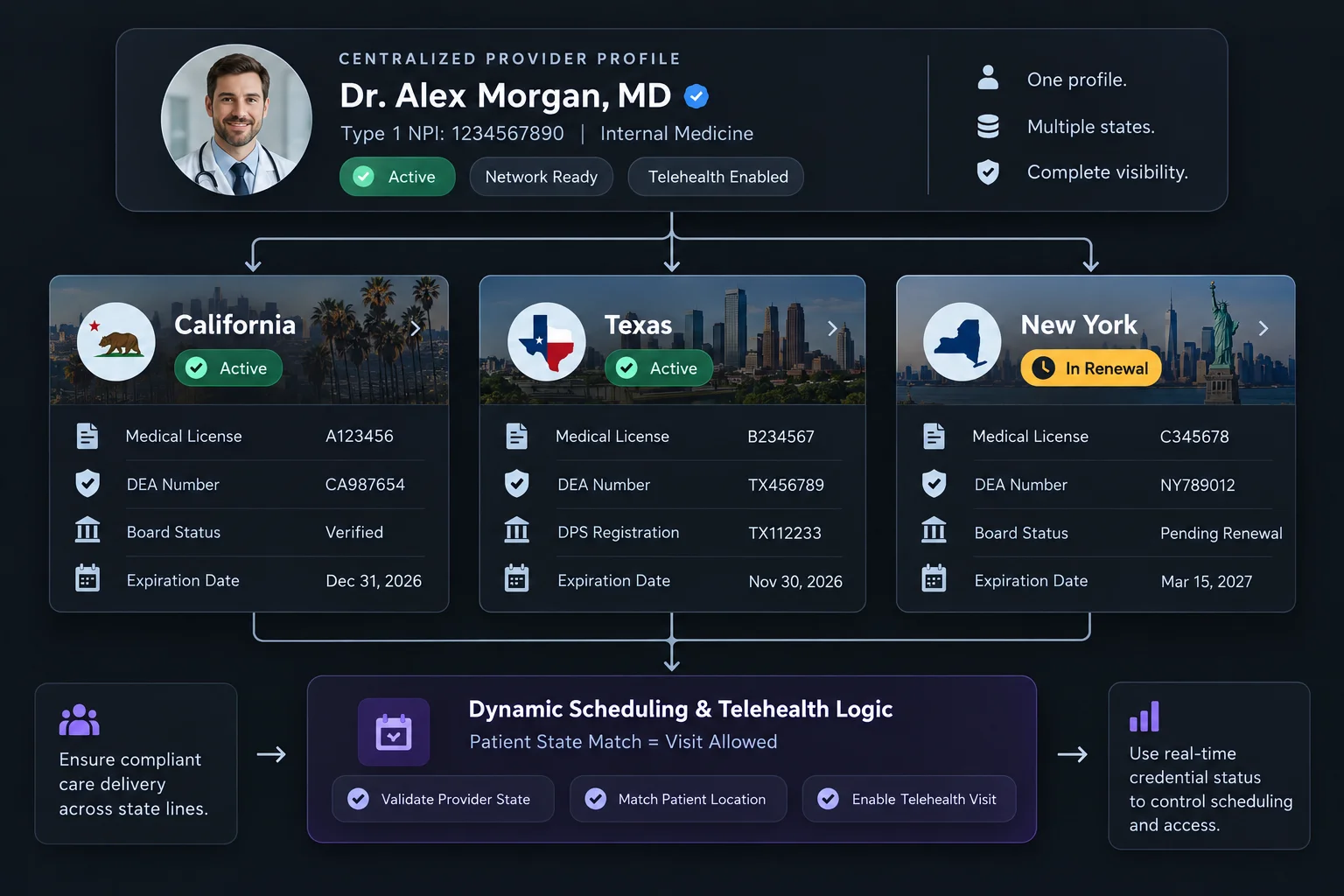
In modern healthcare platforms, state licensing is mapped to a canonical, centralized provider record:
- Relational Multi-State Hierarchy: The one-to-many architecture links one clinician identity (anchored by NPI and SSN hash) to multiple state licenses, practice addresses and DEA schedules.
- Dynamic Status Flags: Each state maintains live state-level statuses such as Active, Pending Verification, Renewal in Progress, Lapsed, Encumbered, automatically enabling or disabling clinical authority by jurisdiction.
- Automated Expirable Engine: Calculates state-specific renewal timelines, including annual, birth-month and biennial deadlines, then triggers reminders and task workflows 120, 90, 60 and 30 days before expiration.
C. How Licensing Data Connects With Credentialing
Licensing is the foundational prerequisite for all clinical vetting and hospital appointment workflows. Multi-state licensing software feeds verified data directly into broader credentialing pipelines:
- Primary Source Verification (PSV) Integration: Connects to state medical board databases through APIs or webhooks, pulling live license status, issuance dates and board actions to support NCQA, URAC and Joint Commission requirements.
- CAQH ProView & DataSpring Synchronization: Pushes new multi-state licenses and expiration dates into provider profiles, keeping CAQH records current for quarterly attestations and commercial payer reviews.
- Institutional Privileging: Provides Medical Executive Committees (MECs) and credentialing-by-proxy workflows with current state license status, supporting clinical privilege decisions without manual board verification delays.
D. Why Licensing Should Not Be a Standalone Database
Treating multi-state licensing as an isolated database or static spreadsheet creates severe operational risks and data silos across healthcare organizations:
- The Clinical Scheduling Risk: Without real-time licensing status, patient-provider matching can book visits with providers whose state licenses have lapsed, causing cancellations, patient churn or unauthorized care.
- The Billing & Claims Disconnect: Submitting claims before confirming state-specific licensing and payer enrollment can trigger out-of-network denials, billing write-offs and compliance audits.
- The Single Source of Truth: Integrating licensing with HRIS, credentialing, EHR and billing ensures state board updates immediately flow across systems, keeping clinical and financial authorization accurate.
How Can Telehealth Companies Automate License Management?
Telehealth companies automate license management by continuously monitoring state licenses, syncing status changes with clinician profiles and scheduling systems, and triggering alerts or booking restrictions when authorization changes.
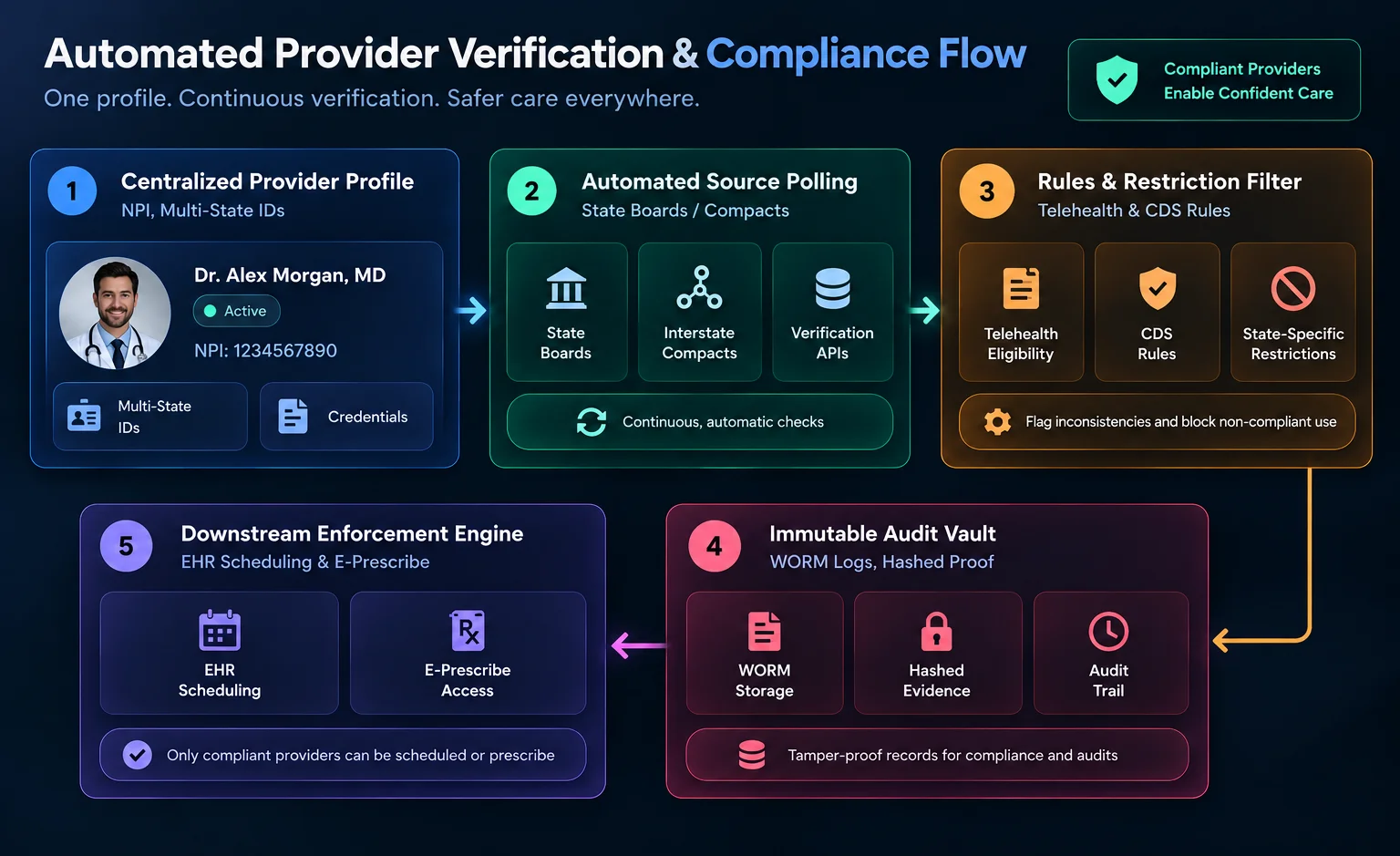
For nationwide providers, this replaces manual tracking with an event-driven compliance workflow. If a license lapses or enters a state board inquiry, the system can block affected bookings, reduce unauthorized cross-border care, limit billing write-offs and reduce administrative downtime.
A. Centralize Provider Licenses and State Authorizations
The workflow begins by establishing a canonical data model for each clinician that maps multi-jurisdictional clinical permissions to a single source of truth:
- Profile Ingestion: The platform ingests clinician records through self-service onboarding or HRIS feeds, capturing Type 1 NPIs, state license numbers, DEA registrations and compact identifiers such as IMLC, NLC and PSYPACT.
- Authority Hierarchy Modeling: Software builds a relational clinician profile linking the home state (State of Principal License) with secondary standalone licenses, multi-state compact privileges and state-specific Controlled Dangerous Substance (CDS) certificates.
- Practice Location Association: Links each active license to the organization’s local virtual practice entity, corporate TIN and registered business addresses required by applicable state boards.
B. Track License Expiration and Renewal Requirements
Because state medical and nursing boards do not follow unified expiration cadences, the software executes rolling, jurisdiction-specific renewal workflows:
- Dynamic Expiration Clocks: Parses board rules to calculate renewal triggers based on fixed calendar dates, birth-month deadlines or biennial cycles.
- Automated Notification Cadences: Sends email, in-app and SMS alerts at 120, 90, 60 and 30 days before license expiration.
- CME Tracking & Validation: Matches completed Continuing Medical Education (CME) units against state-specific mandates, including opioid management, suicide prevention and implicit bias training, and blocks renewal closure until requirements are met.
- Renewal Packet Auto-Assembly: Generates pre-filled board renewal forms using stored provider credentials and routes them for digital signatures, reducing late renewal filings.
C. Automate License Verification and Status Checks
Rather than relying on clinicians to self-report their license statuses or staff manually visiting 50 state medical board portals, the software programmatically conducts Primary Source Verification (PSV):
- Automated Source Inquiries: Scheduled worker microservices query official state licensing portals and compact registries through direct REST APIs or secure browser automation.
- Evidence Packaging: Captures live status data such as Active, Suspended, Lapsed and Probation, along with renewal dates, while generating a timestamped, cryptographically signed PDF snapshot of the source page.
- Continuous Status Sweeps: Runs periodic background polls, such as weekly sweeps, to detect mid-cycle disciplinary actions, license suspensions and administrative holds outside standard renewal windows.
D. Flag State-Specific Licensing Restrictions
A valid state medical license does not grant unrestricted virtual care authority. The software applies business-logic rules engines to identify jurisdiction-specific delivery constraints:
- Telehealth Prescribing Limits: Checks whether state law permits virtual prescribing for specific drug tiers. If a state restricts Schedule II prescribing without a prior in-person exam, the platform flags the provider’s authority for patients in that state.
- Mid-Level Collaboration Ratios: For NPs and PAs, tracks state-specific Full, Reduced or Restricted Practice rules, including physician-to-APRN ratios and current collaborative practice agreements.
- Modal Constraints: Identifies state requirements for synchronous audio-video or asynchronous store-and-forward care, then applies these service-line constraints to clinician profiles.
- Real-Time Scheduling Enforcement: Sends active state status flags to the patient-provider matching engine via API. If a Texas license lapses or lacks CDS authority, the clinician is immediately excluded from Texas bookings.
E. Maintain a Complete Compliance Audit Trail
To survive payer delegation audits and state regulatory investigations, the system anchors all licensing interactions into an immutable compliance ledger:
- Immutable Transaction Logs: Logs every automated query, manual override, status change and document upload in Write-Once-Read-Many (WORM) storage, capturing UTC timestamps, actor IDs and IP addresses.
- Cryptographic Proof of History: Signs verification receipts with SHA-256 hashes, preventing historical records from being retroactively altered to pass audits.
- Instant Audit Export: Generates self-contained compliance packages on demand, linking primary source snapshots, historical board standing and active dates for randomized samples during NCQA, URAC or payer surveys.
How Should Patient Location and Licensing Work Together?
Patient location and licensing should work together through real-time jurisdiction matching, where the platform identifies the patient’s location at the time of care and verifies the clinician’s active license or compact privilege for that state before allowing the encounter.
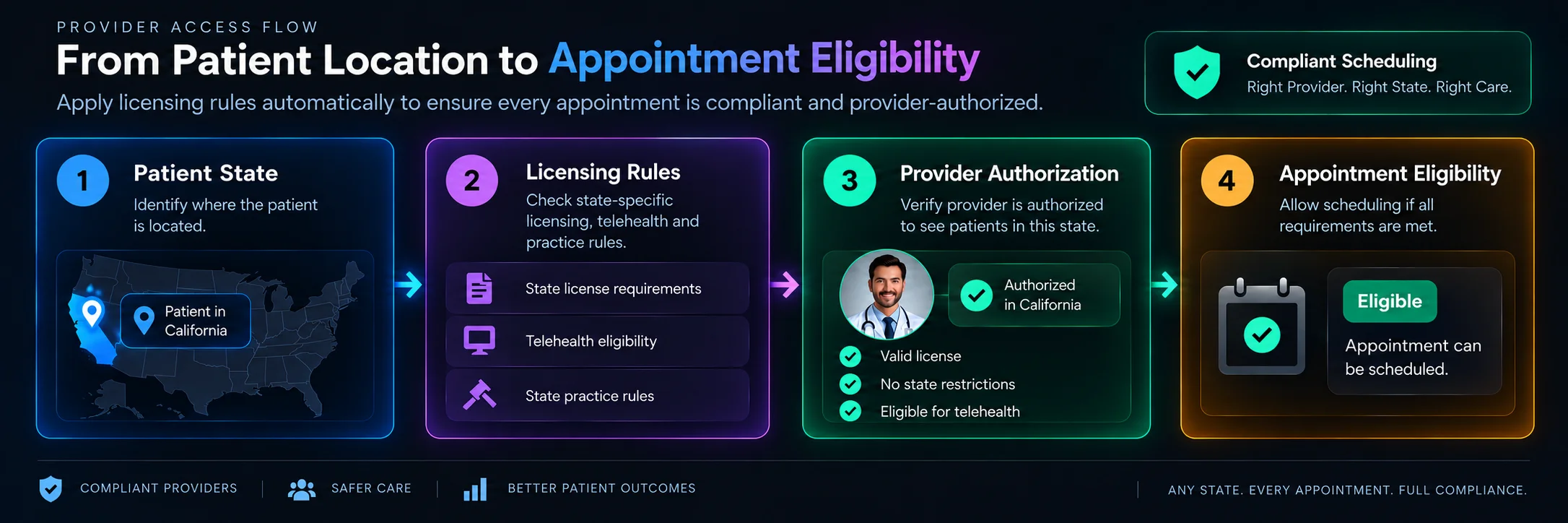
This creates a compliance control that helps telehealth organizations prevent unauthorized cross-state practice, enforce state-specific prescribing and modality rules, and maintain an audit trail showing why a clinician was authorized to treat a patient in a particular jurisdiction.
A. Verify Patient Location Before the Telehealth Visit
Telehealth software should verify the patient’s physical location before each visit because state practice laws generally depend on where care is received, making jurisdiction confirmation essential for compliant encounters.
- Multi-Point Ingestion: Capture current jurisdiction via browser geolocation, device IP lookup, and mandatory pre-visit check-in attestations.
- Jurisdictional Locking: Enforce location confirmation before launching the video room, binding the encounter to that specific state’s practice act.
B. Match Patient State With Provider Authorization
Once the patient’s state is confirmed, the platform should compare that jurisdiction with the provider’s active authorization, ensuring the clinician has legal authority to deliver the planned service there.
- Authorization Evaluation: Verify the clinician holds an active, unencumbered license or compact privilege (e.g., IMLC, NLC) in the patient’s state.
- Service-Level Rules: Check state-specific modalities (synchronous vs. asynchronous) and verify required Controlled Dangerous Substance (CDS) certificates or supervisory agreements before confirming the match.
C. Block or Flag Non-Compliant Appointments
The scheduling system should block or flag appointments that fail licensing checks, preventing unauthorized clinicians from treating patients in jurisdictions where they lack required authorization or credentials.
- Hard Scheduling Stops: Programmatically block unauthorized bookings, removing out-of-jurisdiction clinicians from the patient’s available booking slots.
- Automated Triage Routing: If an assigned provider loses state clearance mid-cycle, automatically reassign the visit to an authorized alternate clinician with matching availability.
D. Recheck Authorization When Patient Location Changes
Because patient location can change before or during care, telehealth software should revalidate jurisdiction and provider authorization whenever location data indicates a state change, preventing unauthorized encounters.
- Dynamic Re-Validation: If a patient logs in from a different state on visit day, the system re-runs the authorization algorithm immediately.
- Pre-Encounter Deflection: Sidelined or rerouted visits trigger instant, transparent notifications to patients before clinical charting begins, protecting the organization from non-compliant practice.
What Features Should Multi-State Licensing Software Include?
Telehealth multi-state licensing software should combine state-specific rule management, provider license tracking, renewal automation, location-based authorization, compliance monitoring, audit controls and system integrations.
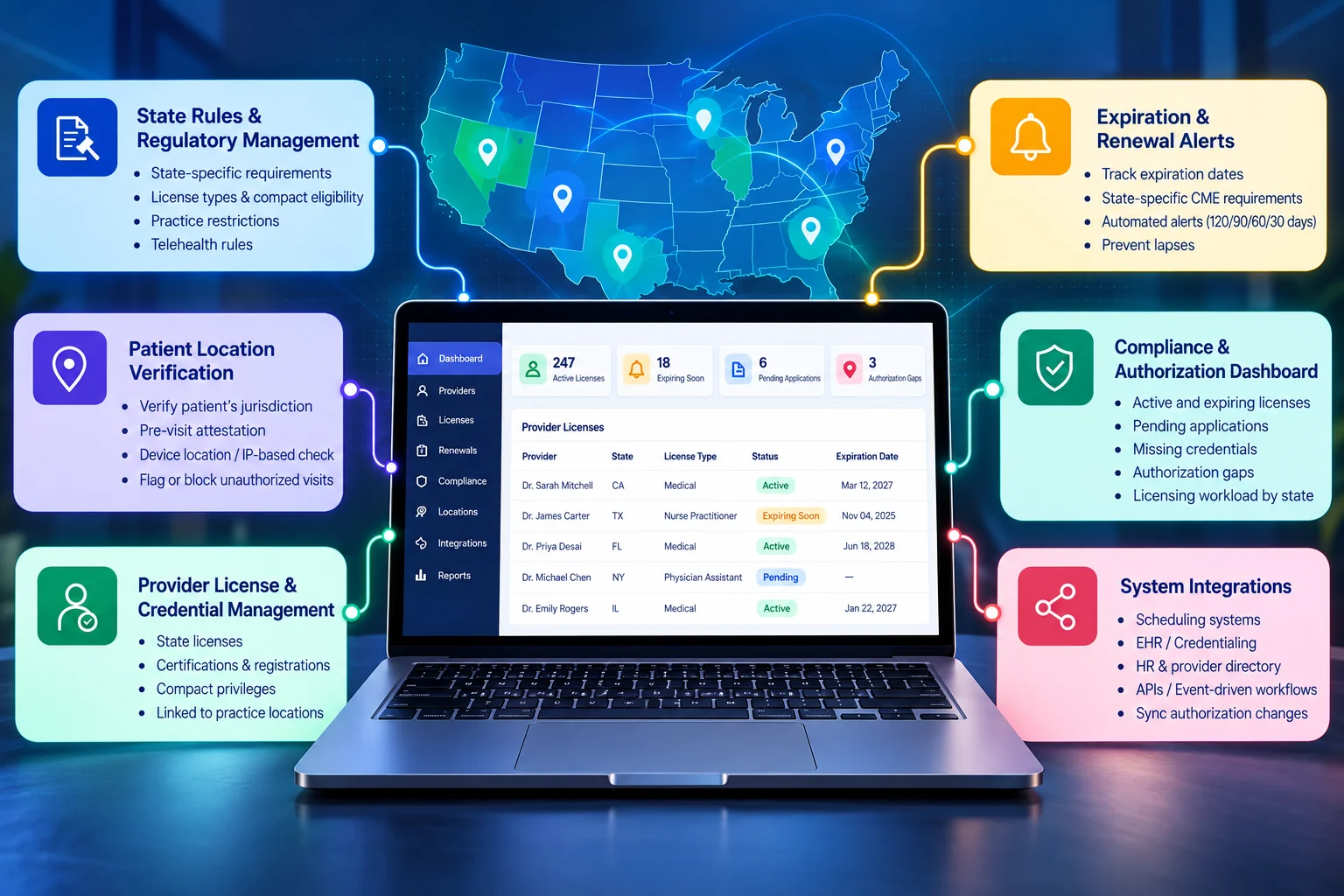
These healthcare provider features help organizations manage licensing requirements across jurisdictions while reducing manual work and preventing authorization gaps.
1. State Rule and Regulatory Requirements Engine
A state rules engine centralizes jurisdiction-specific licensing requirements and converts them into configurable workflows. It can manage license types, compact eligibility, renewal requirements, practice restrictions, telehealth rules and controlled-substance requirements without embedding every state rule directly into the application code.
2. Provider License and Credential Management
A centralized provider profile should connect each clinician with their state licenses, compact privileges, certifications, registrations and supporting credentials. Linking these records to practice locations and organizational entities gives teams a consistent view of provider authorization across states.
3. Automated Expiration and Renewal Alerts
The platform should monitor license expiration dates, renewal periods and state-specific CME requirements while triggering alerts before deadlines. Configurable notifications at 120, 90, 60 and 30 days can help licensing teams identify upcoming renewals and prevent avoidable lapses.
4. Patient Location Verification
For telehealth organizations, the platform should verify the patient’s physical jurisdiction before an encounter and compare it with the provider’s authorization. Location checks can use pre-visit attestations, device location or IP-based signals to flag or block appointments when required authorization is missing.
5. Compliance and Authorization Dashboard
A centralized dashboard should show active and expiring licenses, pending applications, missing credentials, authorization gaps and licensing workload by state. This gives operations teams visibility into provider coverage and helps them identify licensing issues before they affect scheduling or service delivery.
6. Scheduling and Credentialing Integrations
Licensing data should connect with scheduling, EHR, credentialing, HR and provider directory systems through APIs or event-driven workflows. These integrations allow authorization changes to reach operational systems quickly, helping prevent appointments from being assigned to providers without the required state authorization.
How To Build Multi-State Provider Licensing Software
The telehealth multi-state provider licensing software development combines a centralized healthcare provider database, configurable state rules, license tracking, authorization checks, location intelligence, system integrations and compliance monitoring.
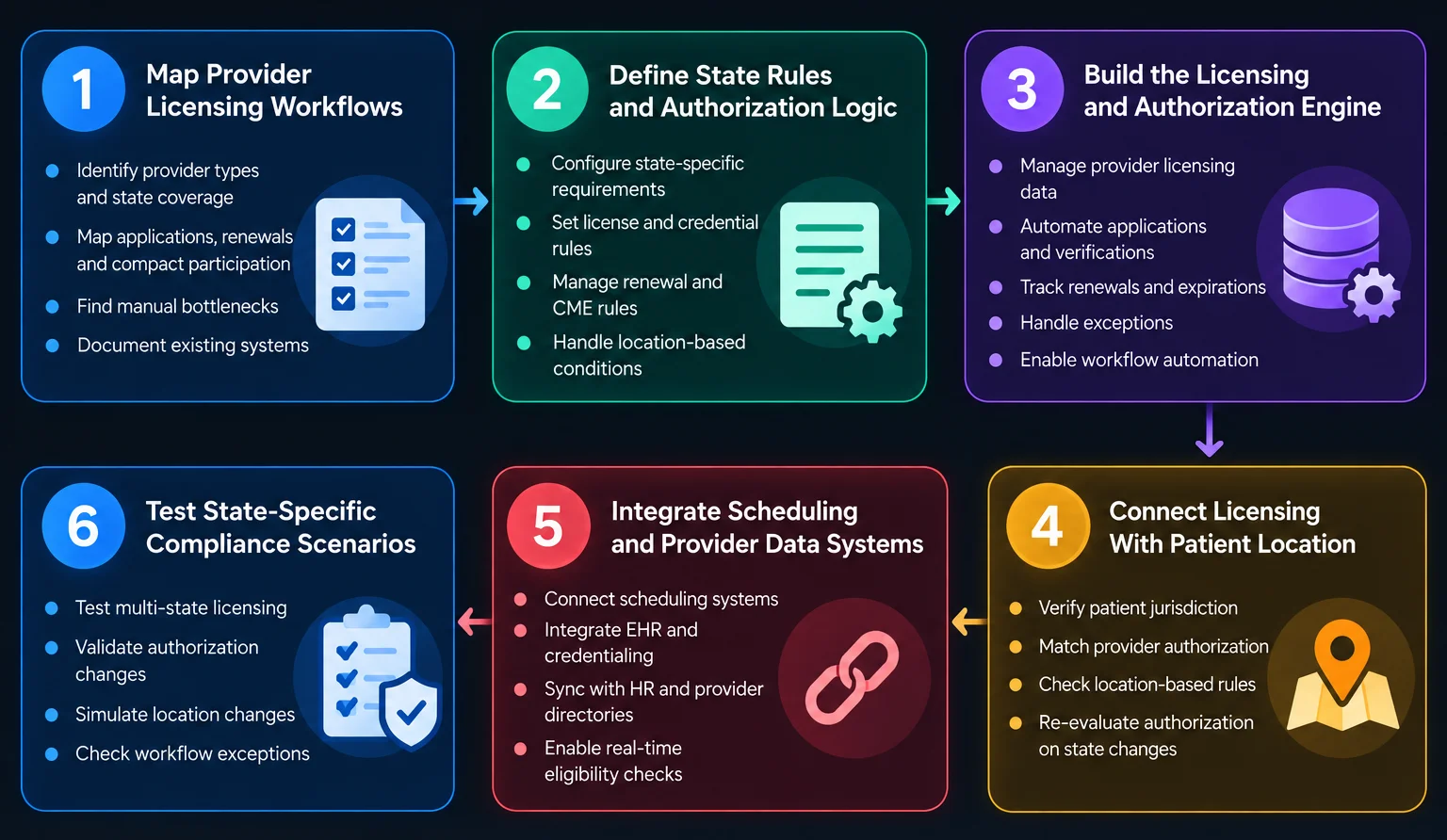
The multi-state licensing healthcare provider software development process should begin by mapping state requirements and provider workflows, then translating them into a scalable licensing platform.
1. Map Provider Licensing Workflows
Start by documenting how providers obtain, maintain, renew and verify licenses across states. This establishes the operational requirements the software must support and identifies where automation can reduce manual work. The workflow assessment should focus on:
- Provider and state coverage: Identify provider types, states currently supported and planned expansion markets.
- Licensing processes: Map applications, renewals, reinstatements, compact participation and temporary authorizations.
- Manual bottlenecks: Identify repetitive data entry, document collection, portal submissions, status checks and renewal follow-ups.
- Existing systems: Document credentialing, HR, scheduling, EHR and provider data systems that need to exchange licensing information.
The output should be a complete licensing workflow map showing where information originates, how it moves through the process and which activities can be automated.
2. Define State Rules and Authorization Logic
Telehealth multi-state licensing software needs a configurable rules layer to handle differences between jurisdictions. State requirements should remain separate from core application logic so they can be updated without rebuilding the platform. The rules engine should account for:
- License and credential requirements: License types, provider specialties, certifications and supporting documents.
- Authorization conditions: License status, expiration, compact privileges, temporary authorization and practice restrictions.
- Renewal requirements: Renewal periods, CME requirements, documentation and renewal triggers.
- Location-based rules: Patient location, provider location and state-specific service or supervision requirements.
The system can then evaluate provider type + patient state + license status + authorization type + expiration date to determine whether a specific care or workflow scenario is permitted.
The output should be a configurable state rules framework that makes regulatory updates easier to manage.
3. Build the Licensing and Authorization Engine
The licensing engine transforms provider and state data into actionable workflows for applications, verification, renewals, exceptions and approvals. Core services should include:
- Provider licensing data: Provider identity, NPI, specialty, state, license number, status, issue date, expiration date and authorization type.
- Application and credential workflows: Provider onboarding, license applications, document validation and verification.
- Renewal and expiration management: Automated expiration tracking, renewal tasks and requirement matching.
- Exception handling: Missing documents, failed verification, rejected applications and unresolved licensing issues.
- Workflow automation: Task assignment, escalation, approval states and audit logging.
Workflow states can include draft, documentation pending, ready for submission, submitted, under review, approved, rejected, renewal due and expired.
Where licensing boards lack APIs, the platform should distinguish between automated internal workflows and external submission processes rather than assuming every transaction can be fully automated.
4. Connect Licensing With Patient Location
For telehealth organizations, provider licensing must be evaluated alongside patient location. The platform should connect licensing data with location information to verify authorization before care is delivered. The location layer should capture:
- Patient jurisdiction: State or other applicable location at the time of care.
- Provider authorization: Active license, compact privilege, service restrictions and expiration status.
- Location-based conditions: Provider location, service location and applicable authorization requirements.
When a patient changes states, the system can automatically re-evaluate provider authorization before the encounter proceeds.
The output should be a location-aware authorization layer connecting provider licensing with the jurisdiction where care is delivered.
5. Integrate Scheduling and Provider Data Systems
Licensing information becomes operationally useful when connected to systems that assign providers and manage patient care. Key integrations include:
- Scheduling systems: Provider availability, appointment assignments and patient location.
- EHR and credentialing systems: Provider identity, credentials, verification results and clinical workflows.
- HR and provider directories: Employment status, specialties, locations and organizational relationships.
API-based integrations and event-driven workflows can trigger licensing eligibility checks when provider or patient information changes.
The output should be an integrated provider licensing ecosystem where licensing status can directly influence scheduling and care workflows.
6. Test State-Specific Compliance Scenarios
Before production deployment, the platform should be tested against realistic multi-state NCQA licensing scenarios where provider, credential and location rules interact. Testing should prioritize:
- Multi-state licensing: Providers applying for or maintaining licenses across multiple jurisdictions.
- Authorization changes: Expired, suspended, revoked or inactive licenses.
- Location changes: Providers treating patients in different states or changing practice locations.
- Workflow exceptions: Missing documents, renewal delays, temporary authorization and compact scenarios.
Automated tests should validate rule calculations and workflow transitions, while integration and user acceptance testing should confirm accurate data exchange across licensing, scheduling and credentialing systems.
The output should be a validated multi-state licensing platform with documented test results, corrected workflow gaps and a production rollout plan.
How Much Does Telehealth Multi-State Provider Licensing Software Cost?
Building software to manage multi-state provider licensing typically costs $50,000 to $350,000, depending on how many jurisdictions and provider types it needs to support. The core challenge isn’t the software itself, it’s that telehealth licensing is governed by 51 separate jurisdictions, each with its own rules, and a provider must be licensed in the state where the patient is physically located, not where the provider is.
A. Phase-Wise Development of Multi-State Licensing Software
The telehealth multi-state licensing software development cost varies across phases because each stage handles a different part of the licensing workflow. Mapping requirements may cost less, while state-rule logic, integrations and authorization checks require deeper technical work.
| Phase | Estimated Cost | What Happens Here |
| 1. Map Provider Licensing Workflows | $8,000 – $25,000 | Documenting how licenses are obtained, renewed, and tracked across compact and non-compact states |
| 2. Define State Rules & Authorization Logic | $15,000 – $45,000 | Translating each jurisdiction’s distinct rules into system logic; the most jurisdiction-heavy phase, given 51 different frameworks |
| 3. Build the Licensing & Authorization Engine | $25,000 – $90,000 | The core system that checks a provider’s active licenses in real time before authorizing a visit |
| 4. Connect Licensing With Patient Location | $15,000 – $50,000 | Building geolocation or patient-attestation capture and matching it against the authorization engine |
| 5. Integrate Scheduling & Provider Data Systems | $15,000 – $60,000 | Connecting the licensing engine to scheduling so unlicensed visits are blocked before they’re ever booked |
| 6. Test State-Specific Compliance Scenarios | $10,000 – $40,000 | QA across compact and non-compact states, edge cases like patient travel, and license lapses |
| Total | $50,000 – $350,000 | A standalone licensing and authorization engine, not a full telehealth platform |
If this engine is being built as one module inside a larger telemedicine platform rather than standalone, budget it as an addition to that platform’s base cost, typically $40,000 to $450,000+ depending on tier, not as a separate full build.
B. Multi-State Provider Software Development Cost by Tier
The multi-state licensing software development cost also changes based on the product tier and the level of licensing automation required. A basic platform can handle core tracking, while enterprise systems require broader integrations, advanced rules and compliance controls.
| Product Tier | Estimated Cost | Key Features | Typical Scope |
| Core Licensing Management | $50,000 – $90,000 | Provider profiles, license tracking, expiration alerts, document management, basic state rules, dashboards and assisted verification. | MVP supporting a limited number of states and provider types |
| Multi-State Licensing Platform | $90,000 – $180,000 | State-rule engine, license verification, renewals, patient-location checks, authorization logic, compliance dashboards and scheduling/data integrations. | Production platform supporting multiple states and growing provider volume |
| Enterprise Licensing & Authorization Platform | $180,000 – $350,000+ | Advanced rule engine, automated authorization, compact tracking, real-time scheduling checks, audit controls, enterprise security and regulatory updates. | Large telehealth organizations operating across many states and provider types |
Note: The tier-based estimates help define a suitable starting point based on operational needs. Costs can increase with more jurisdictions, complex authorization rules, real-time integrations, security requirements and higher provider volumes.
C. Adjacent Regulatory Costs to Budget For (Not Software)
These aren’t development costs, but they directly affect what the software needs to track, and skipping them in your budget planning is a common mistake.
| Cost Item | Amount | Notes |
| IMLC application fee | $700 one-time | Covers expedited licensing across all member states for eligible physicians |
| Traditional state-by-state verification (non-compact) | ~$25,000 across ~42 states | The cost the IMLC pathway is specifically designed to avoid |
| DEA registration per state | $731 per 3-year period, per state | Required separately in every state where a provider prescribes controlled substances via telehealth |
| Ongoing compliance and legal review | $10,000 – $50,000+ | Recurring cost as state rules change; not a one-time software expense |
These regulatory costs apply to the provider organization regardless of which software vendor builds the platform. They’re included here because they’re exactly what the software in the table above is designed to track and reduce, not because IdeaUsher bills for licensing fees or legal compliance work.
D. Why This Category Is Inherently Complex
Multi-state telehealth licensing is complex because requirements vary by patient location, provider type, state rules and compact participation. Processing times and verification requirements can also differ significantly, making centralized software valuable for managing these variables.
- Telehealth is legally considered to occur at the patient’s physical location, not the provider’s, meaning the software has to verify where the patient actually is at the moment of the visit, not just where they registered from.
- Interstate compacts like the Interstate Medical Licensure Compact (IMLC), only covers physicians (MDs and DOs) in member states, not nurses, therapists, or other license types.
- The IMLC dramatically changes the economics of multi-state licensing: a traditional, non-compact approach to reaching 42 states requires roughly 903 separate verification requests and costs approximately $25,000 in verification fees alone, versus a single $700 IMLC application covering all member states.
- License processing ranged from 24 to 251 days, averaging 120 days, a tenfold variation that makes manual tracking genuinely unreliable at scale.
Which Integrations Does Licensing Software Need?
Multi-state licensing software needs integrations with credentialing systems, provider databases, state licensing sources, NPI verification services, scheduling platforms, telehealth systems and patient location services.
These connections keep provider authorization data synchronized and allow licensing checks to influence scheduling, telehealth delivery and compliance workflows.
| Integration | What It Connects | Why It Matters | Key Data / Workflow |
| Credentialing & Provider Systems | Profiles, credentials, specialties and employment data | Syncs licensing records with provider profiles and reduces duplicate entry. | Identity, credentials, specialty, license status, verification results |
| Scheduling & Telehealth | Availability, appointments, patient location and virtual care workflows | Checks licensing eligibility before provider assignment or telehealth visits. | Patient state → provider authorization → appointment eligibility |
| NPI & Verification Systems | Provider identifiers and verification data | Confirms provider identity and links credentials to the correct record. | NPI, provider type, specialty, identity, verification status |
| State Licensing & Regulatory Sources | Licenses, state requirements and jurisdictional rules | Supports license verification and changing state-specific authorization logic. | Status, expiration, requirements, restrictions, regulatory updates |
| Identity & Patient Location | Patient identity, location and jurisdiction data | Determines which state requirements apply before care is delivered. | Identity, jurisdiction, location changes, authorization checks |
The integration layer should support event-driven workflows where appropriate. A license status change can update provider authorization, while a patient location change can trigger a new licensing check before an appointment proceeds.
Enterprise platform architecture must balance API availability, authentication, sync frequency, error handling, and data ownership, tailoring automated, assisted, and manual workflows to each external system’s capabilities.
How Can AI Improve Multi-State Licensing Management?
Artificial intelligence enhances multi-state licensing by functioning as an intelligent assistant that streamlines document intake, detects regulatory risks, and models processing timelines. While AI cannot legally determine authorization to practice, it reduces operational drag across 50-state compliance pipelines.
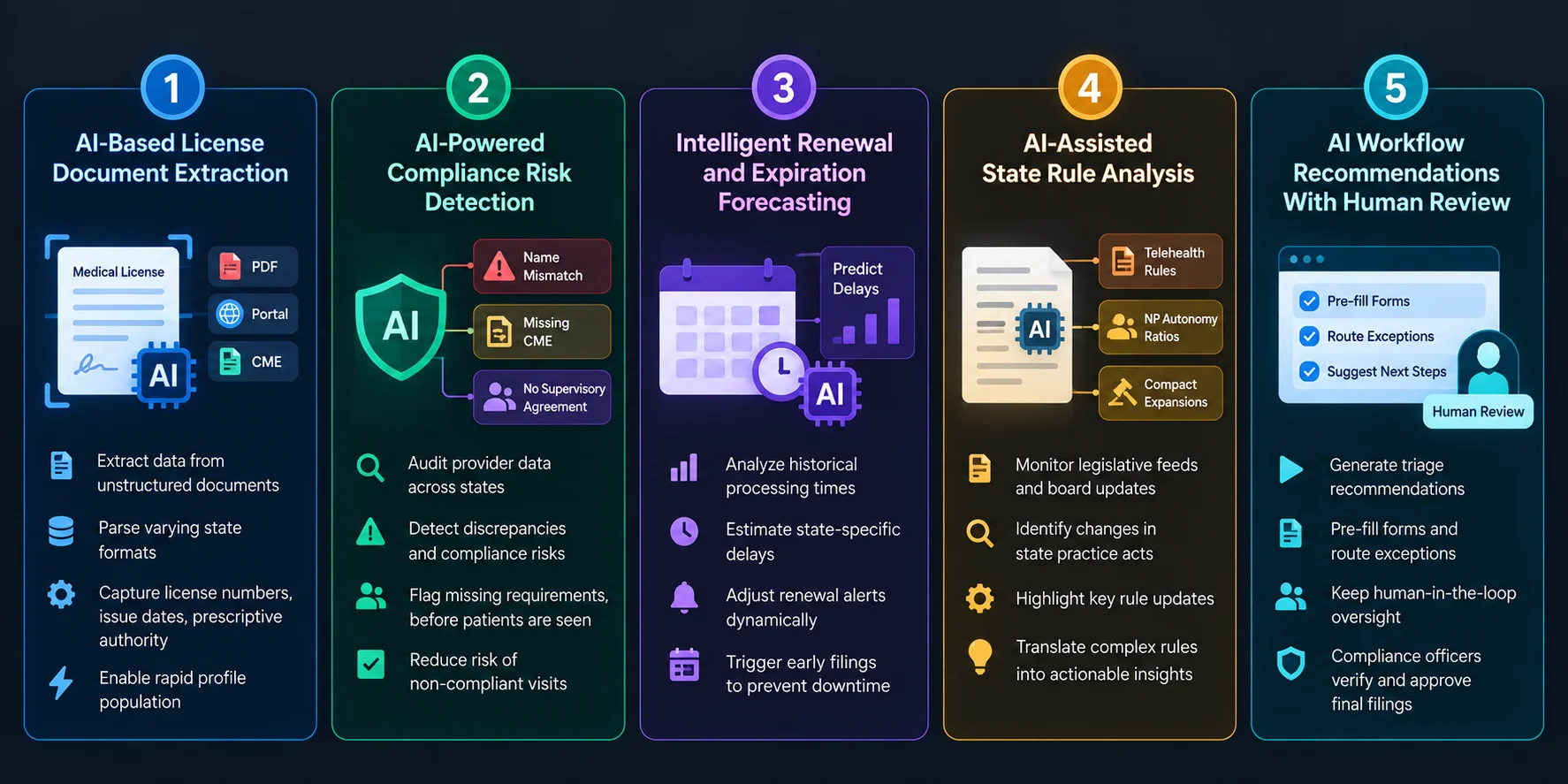
1. AI-Based License Document Extraction
Intelligent document processing (IDP) extracts unstructured text from PDF certificates, medical board portals, and CME receipts. By parsing varying state layouts without brittle zonal templates, it structures license numbers, issue dates, and prescriptive authority tiers for rapid profile population.
2. AI-Powered Compliance Risk Detection
Machine learning models continuously audit active provider rosters against state-level discrepancies. The system flags subtle issues such as mismatched names across jurisdictions, unfulfilled state-specific CME prerequisites, or missing supervisory agreements before non-compliant visits can occur.
3. Intelligent Renewal and Expiration Forecasting
Predictive analytics models historical board turnaround times against varying seasonal backlogs. By estimating state-specific processing delays, the software dynamically adjusts renewal initiation alerts, prompting filings months earlier in slower jurisdictions to prevent clinical downtime.
4. AI-Assisted State Rule Analysis
Natural language processing (NLP) monitors legislative feeds and medical board bulletins to track changes in state practice acts. The engine highlights updates to telehealth prescribing limits, nurse practitioner autonomy ratios, or compact expansions, translating complex statutes into clear configuration proposals for compliance teams.
5. AI Workflow Recommendations With Human Review
AI generates actionable triage recommendations such as pre-filling renewal forms or routing cross-border exceptions while strictly enforcing human-in-the-loop oversight. Authorized compliance officers retain sole authority to verify primary sources, confirm legal standing, and approve final filings.
How Can Companies Keep State Licensing Rules Updated?
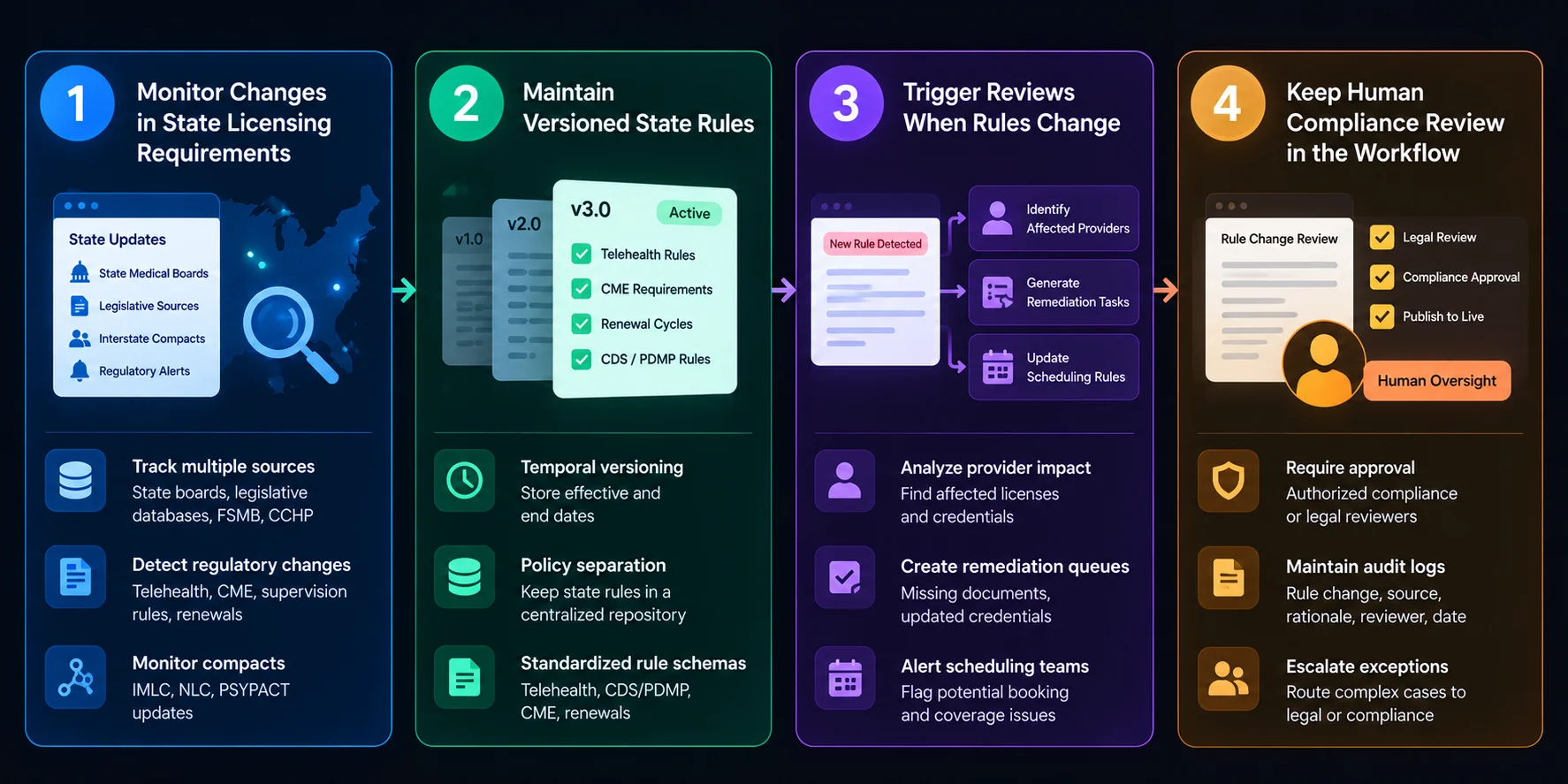
Companies can keep state licensing rules updated by combining regulatory monitoring, versioned rules engines, automated impact analysis and human compliance review. This approach helps licensing software reflect changing state requirements while preserving historical rules, identifying affected providers and controlling changes to live workflows.
A. Monitor Changes in State Licensing Requirements
Companies should continuously monitor state boards, legislative sources and interstate compact registries to identify licensing changes before they affect provider authorization, renewal workflows or clinical operations.
- Multi-Source Monitoring: Track state medical boards, legislative databases and regulatory updates from sources such as FSMB and CCHP.
- Regulatory Change Detection: Use automated feeds or targeted scrapers to flag changes involving telehealth prescribing, CME, supervision requirements and renewal rules.
- Compact Monitoring: Track IMLC, NLC and PSYPACT updates to identify new state adoptions, expansions or changes.
B. Maintain Versioned State Rules
State requirements should be maintained in a versioned, declarative rules engine rather than hard-coded into application workflows. This allows regulatory logic to change without rebuilding the core platform.
- Temporal Versioning: Store rules with effective and end dates so historical encounters can be evaluated against the requirements applicable at that time.
- Policy Separation: Keep state-specific requirements in a centralized policy repository that can be updated independently of application code.
- Standardized Rule Schemas: Structure rules for telehealth modalities, CDS and PDMP requirements, CME obligations and renewal cycles.
C. Trigger Reviews When Rules Change
When licensing requirements change, the platform should automatically identify affected providers, workflows and scheduling rules, then route required actions through a controlled review process.
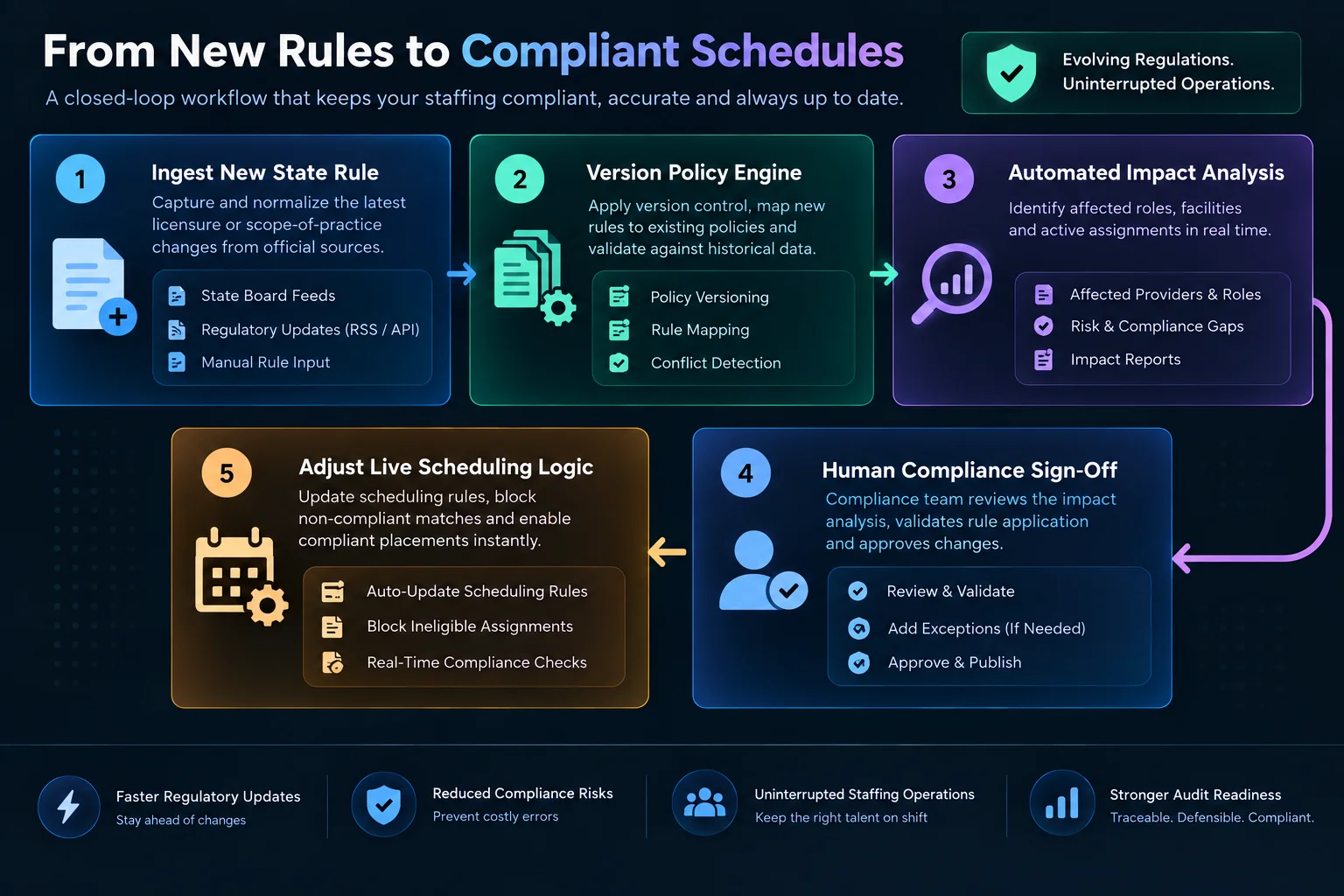
When requirements change, the platform should turn regulatory updates into clear actions, helping teams assess provider impact, resolve compliance gaps and adjust scheduling decisions.
- Provider Impact Analysis: Evaluate provider records against new rules to identify affected licenses, credentials or compliance requirements.
- Remediation Queues: Generate targeted tasks for missing documentation, updated credentials or required training before enforcement dates.
- Scheduling Warnings: Alert operations teams when upcoming rule changes could affect provider booking eligibility or patient coverage.
D. Keep Human Compliance Review in the Workflow
Automation can detect and assess regulatory changes, but qualified compliance professionals should approve changes before new rules affect clinical workflows or provider authorization.
- Controlled Rule Publishing: Require authorized compliance or legal reviewers to approve regulatory changes before they reach live workflows.
- Regulatory Audit Logs: Record the rule change, regulatory source, rationale, reviewer and approval date for traceability.
- Exception Escalation: Route ambiguous requirements to legal or compliance teams while retaining the existing rule until approved guidance is available.
Why Build Multi-State Provider Licensing Software With IdeaUsher?
IdeaUsher operates as an enterprise product engineering partner, backed by 11+ years of software expertise, 250+ technical specialists and a 4.9/5 Clutch rating across 1,000+ delivered builds. We engineer custom, cloud-native licensing platforms that streamline cross-state telehealth operations.
A. Build Licensing Around Your Existing Telehealth Workflow
We map your exact clinical operations into software, configuring custom data models that track Interstate Medical Licensure Compact (IMLC) statuses, state-specific telehealth registrations, and continuing education credits without disrupting daily administrative processes.
B. Connect Provider Authorization With Scheduling
Our engineers integrate licensing tracking directly with your patient booking software and EHR. Automated logic checks state-level active credentials in real time, preventing patients from booking appointments with unverified clinicians.
- Real-Time Booking Logic: Restrict patient scheduling by automatically verifying active, state-matched licenses before appointments confirm.
- EHR & Roster Sync: Instantly update practice management systems when a provider is approved in a new jurisdiction.
C. Automate Compliance Without Removing Human Review
We build primary-source verification integrations alongside human-in-the-loop audit queues. Automated scrapers monitor medical boards for license changes, while your compliance officers retain final sign-off authority.
D. Scale Licensing Workflows Across New States
We deploy modular, cloud-native microservices on AWS/GCP featuring end-to-end AES-256 encryption, HIPAA compliance, and zero vendor lock-in, allowing your network to enter new state markets effortlessly.
- Modular Microservices: Add new regional health rules and state application templates without refactoring core platform architecture.
- Full IP & Code Ownership: Deploy HIPAA-compliant infrastructure on AWS/GCP with 100% clean source code and zero vendor lock-in.
Planning cross-state telehealth expansion? Connect with Idea Usher to design your multi-state provider licensing software roadmap.
Conclusion
Multi-state telehealth operations demand more than tracking licenses and renewal dates. A connected platform can link provider authorization, state rules, patient location and scheduling workflows to reduce compliance gaps and support expansion across jurisdictions. The right telehealth multi-state provider licensing software can centralize licensing data, automate critical checks and give teams clearer visibility into provider eligibility. With scalable integrations, configurable rules and continuous compliance monitoring, telehealth companies can manage licensing complexity while supporting reliable, compliant care delivery.
FAQs
A.1. Telehealth multi-state licensing software typically costs $50,000 to $350,000+, depending on state coverage, provider types, automation, integrations, patient-location verification, compliance workflows and enterprise security requirements.
A.2. Essential features include state-rule management, provider license tracking, renewal alerts, patient-location verification, authorization checks, compliance dashboards and scheduling integrations to support scalable multi-state telehealth operations.
A.3. Patient location determines which jurisdiction’s licensing requirements may apply to a telehealth encounter. Licensing software can connect patient location with provider authorization rules to identify potential compliance issues before care begins.
A.4. Yes. Licensing software can evaluate provider credentials, license status, expiration dates, patient location and state-specific rules to determine whether a provider is authorized for a particular telehealth encounter.