


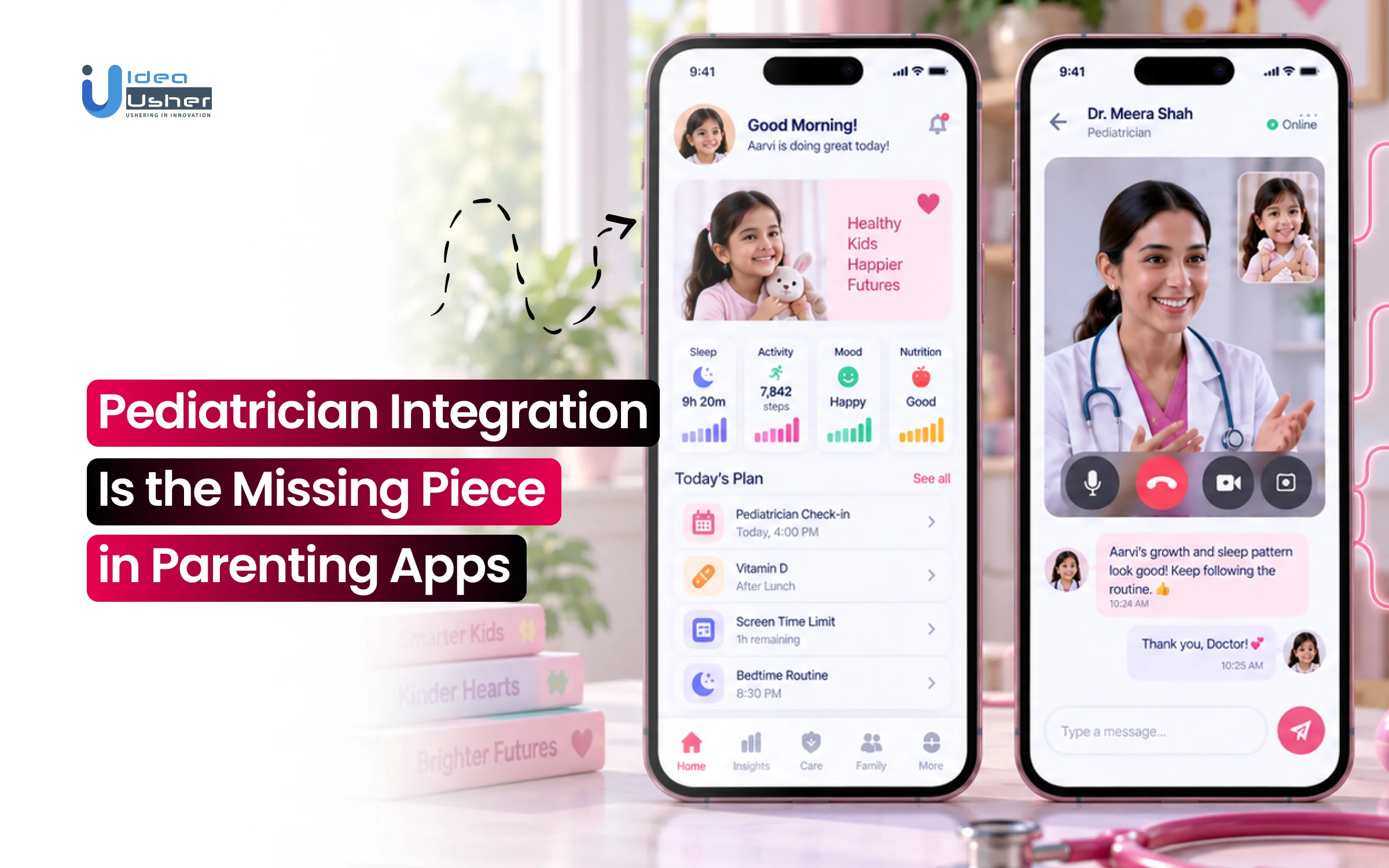
Key Takeaways
- The pediatrician integration links AI parenting help with medical support, giving parents a clearer route from everyday questions to professional care.
- AI can manage routine parenting needs, but medical worries need safety limits, clear escalation rules and the judgment of a human pediatrician.
- A pediatrician-integrated AI parenting app’s core features include child health records, video consultations, pediatrician messaging, symptom summaries, referrals and care-plan tracking.
- A pediatrician-integrated parenting app workflow connects parent concerns, child context, red-flag detection, clinician summaries and post-visit follow-up.
- COPPA, HIPAA, parental consent, child-data security, telehealth licensing and clinical documentation should be considered when adding pediatrician services.
- Pediatrician integration can cost $101,000–$320,000+, depending on scope. IdeaUsher can help with AI, EHR and telehealth integration, escalation workflows and secure infrastructure.
An AI-powered parenting app can answer thousands of questions asked by parents, but what happens when a parent needs medical guidance instead of another AI-generated response? That gap is making pediatrician integration in AI parenting app increasingly important as parents expect personalized guidance without losing access to qualified medical expertise. The next generation of parenting platforms must know not only how to respond, but when a professional should enter the conversation.
Traditional parenting apps separate digital guidance from pediatric care, leaving parents to move between platforms when concerns become more specific or medically relevant. A connected model can bring AI personalization, trusted pediatric knowledge, professional consultations and follow-up care into one experience while maintaining clear boundaries around diagnosis and treatment.
In this blog, we will talk about pediatrician integration, its role in AI parenting apps, key features, workflows, safety considerations, privacy requirements and how businesses can build a pediatric-connected parenting app that bridges AI-powered guidance with professional pediatric care.
The Growing Market for AI-Powered Parenting Apps
The global parenting apps market was valued at $2.9 billion in 2024 and is projected to reach $5.5 billion by 2033, expanding at a CAGR of 12.2%, with AI-driven personalization cited as the primary force behind that acceleration.

The demand base is already established. A Menlo Ventures survey of US adults found 79 percent of parents identify as AI users compared with 54 percent of non-parents, and 29 percent of parents use AI daily versus 15 percent of non-parents, making parents one of the fastest-adopting consumer segments in the US.
A. Rising Demand for Personalized Parenting Support
Lurie Children’s Hospital’s April 2026 survey of 1,004 US parents found 81 percent have used AI for parenting tasks, with 43 percent using it weekly, confirming that routine AI reliance is already normalized among American parents.
- Contextual over generic: Parents expect advice tied to their child’s specific age, temperament, and logged history, which static content libraries and rule-based apps structurally cannot deliver.
- Conversation memory: Persistent memory across sessions lets the AI build on prior questions instead of restarting context each time, requiring vector storage alongside structured profile data.
- Shrinking advice networks: Nuclear family structures and dispersed extended families have reduced informal support, shifting first-line parenting questions onto digital platforms by default.
- Multi-caregiver context: Personalization now extends across parents, grandparents, and nannies, requiring shared family profiles rather than single-user accounts.
B. Why Child Health Is Moving Into Digital Platforms
Health tracking is shifting from manual logging to passive capture. Industry data shows around 49 percent of parenting apps now integrate wearable devices for real-time baby health monitoring, changing both the data volume and the architecture these apps require.
- Continuous over periodic: Wearables and smart monitors generate ongoing sleep, feeding, and vitals data, surfacing patterns that periodic pediatric checkups cannot detect.
- Predictive milestone tracking: Algorithms using multiple developmental indicators shift the product from passive record-keeping toward early flagging of potential developmental concerns.
- Clinical benchmarking: Logged growth and milestone data is measured against CDC and WHO standards, giving parents a reference point rather than raw numbers.
- Encryption as baseline: Child health data requires AES-256 at rest and TLS 1.3 in transit, plus audit logging, before an app can credibly claim compliance.
C. The Shift Toward Connected Pediatric Care
The gap between consumer parenting apps and clinical care is closing. Roughly 53 percent of parenting apps now offer telehealth consultation booking, positioning the app as an entry point into care rather than a standalone tracking tool.
- RAG-grounded clinical accuracy: Responses anchored to AAP and CDC guidelines separate credible platforms from general-purpose chatbots, which matters given documented parent distrust of AI health advice.
- Longitudinal data for clinicians: In-app sleep, feeding, and growth records give pediatricians context a short appointment cannot surface independently.
- Medical escalation logic: Defined rules must stop AI-generated advice and route parents to a pediatrician or emergency service when symptoms exceed general guidance.
- Expanded compliance scope: Once an app touches health data or connects providers, obligations extend past COPPA into health-data handling, raising both cost and timeline.

Why AI Parenting Apps Need Pediatrician Integration
An AI model can instantly synthesize developmental guidelines, adjust bedtime routines, or suggest language-building games. However, when an infant spikes a high fever, develops a persistent cough, or shows subtle signs of lethargy, probabilistic text generation ceases to be an asset, it becomes a dangerous liability.
Parenting applications cannot function purely as autonomous algorithmic copilots. To be safe, medically defensible and clinically credible, an AI parenting platform requires an integrated pediatrician layer: clinical governance, deterministic medical boundaries, expert-reviewed protocols, and direct escalation paths to human clinicians.
A. Where AI Parenting Guidance Reaches Its Limits
Large Language Models (LLMs) operate on pattern completion and statistical probability, not clinical diagnostic reasoning. In consumer parenting tech, these inherent computational boundaries present significant risks:
- Inability to Perform Physical Assessment: Parents may describe a baby as “breathing funny” or “fussy,” but an LLM cannot auscultate lungs, assess skin turgor, or palpate the abdomen, making text-based assessment vulnerable to narrative bias and observational errors.
- The “Confidently Wrong” Hallucination: General foundation models can generate plausible but clinically incorrect guidance, such as confusing harmless reflux with intestinal blockage or recommending home remedies when an ear infection needs prompt treatment.
- Atypical and Edge-Case Failures: AI performs best on common patterns, while pediatric care often involves prematurity, congenital conditions, and rare metabolic disorders where standard developmental algorithms may not apply.
B. The Gap Between Education and Clinical Care
A fundamental failure mode in digital parenting tools is confusing developmental education with clinical triage and care:

Educational Content Explains the “Norm”: AI easily answers informational questions such as “When do babies typically transition to one nap?” or “How much iron does an 8-month-old need daily?”
Clinical Care Interprets the “Deviation”: Medicine requires contextual judgment: evaluating family history, weighing subtle physical markers, and recognizing when a cluster of non-specific symptoms indicates an acute crisis. An AI engine should never attempt to cross this threshold.
C. Why Parents Need Escalation, Not Just Answers
When parents face an ambiguous health event, open-ended conversational text often compounds anxiety rather than relieving it. An exhausted parent scrolling through five paragraphs of AI-generated nuances at 2:00 AM does not need a conversational partner; they need clear decision architecture and escalation:
- Eliminating Cognitive Overload: Anxious parents may over-prompt chatbots with leading questions seeking reassurance, such as “Are you sure his labored breathing isn’t just common congestion?” An unconstrained AI may placate users, potentially delaying emergency care.
- Deterministic Escalation Triggers: When inputs cross predefined safety thresholds, such as fever ≥100.4°F (38°C) in infants under 3 months, breathing difficulty, or sudden extreme lethargy, the app must exit the chat loop and present clear escalation actions, including emergency numbers, Poison Control, or local urgent-care options.
- Objective Clinical Summaries: Instead of speculative answers, the system should shift to clinical triage support, structuring feeding logs, temperature trends, and symptom timelines into concise summaries parents can share with triage nurses or emergency physicians.
D. AI Should Support Pediatricians, Not Replace Them
The objective of an AI parenting platform is not to displace the child’s primary care provider, but to serve as a high-fidelity bridge between home life and the clinic.

The right AI layer turns everyday family data into structured clinical context, helping pediatricians review relevant patterns faster while keeping clinical decisions firmly in human hands.
- Augmenting the 15-Minute Well-Child Visit: Pediatricians often struggle to gather reliable developmental histories during brief visits. AI apps can track milestones, sleep, and nutrition and generate structured reports, such as ASQ-3 summaries, for rapid physician review.
- Reinforcing Doctor-Approved Guidance: Configure the AI to reinforce, not contradict, pediatrician guidance. When a physician sets a reflux or iron supplementation plan, the app tracks adherence and related behavioral trends.
- Strengthening the Care Continuum: Positioning AI as a preparation and tracking tool, not a diagnostic authority, reduces misinformation and acute malpractice exposure while building long-term trust with parents and healthcare professionals.
What Pediatrician Integration Means for AI Parenting Apps
Pediatrician integration in AI parenting apps is an architectural and clinical framework that connects AI with human pediatric oversight. It bridges everyday parenting support with professional medical care.
Rather than relying on isolated AI chatbots, the model combines generative AI for routine developmental queries with clinical triage engines that identify health risks and connect parents with healthcare professionals.
This transforms the app from a conversational tool into a clinically governed digital health platform. It provides low-latency guidance while maintaining clear safety boundaries that protect children from unmonitored medical advice.
A. AI Assistance for Low-Risk Parenting Questions
The majority of daily parenting challenges do not require clinical intervention. In an integrated architecture, AI operates as the first line of engagement, managing low-risk operational and pedagogical queries:
For these operational touchpoints, AI reduces cognitive load by synthesizing family history and child context in seconds. The parent receives immediate, empathetic, and actionable guidance without scheduling a doctor’s appointment or sifting through conflicting forum threads.
B. Pediatric Escalation for Clinically Relevant Concerns
The core technical differentiator of an integrated system is its ability to identify the boundary where developmental guidance ends and clinical evaluation begins.
Using pre-inference semantic classifiers, keyword interceptors, and sentiment analyzers, the platform continuously monitors user inputs for clinical red lines:
- Symptom Flags: Mentions of respiratory distress (stridor, retractions), persistent high fevers, uncharacteristic lethargy, repeated projectile vomiting, or suspected allergic reactions.
- Medication Requests: Questions asking for prescription drug dosing calculations (e.g., amoxicillin or steroid suspensions), which require weight-based pediatric prescriptions.
- Developmental Regression: Prolonged failure to meet milestone ranges or sudden loss of acquired motor or speech capabilities.
When these patterns trigger, generative conversation halts. The system does not guess or offer speculative diagnostic commentary. Instead, it activates an escalation ladder:
This escalation framework keeps AI guidance within safe boundaries by recognizing clinically relevant concerns early. Instead of extending uncertain conversations, the platform shifts toward appropriate pediatric care, helping protect children while maintaining caregiver trust.
C. Consultations, Messaging, Referrals, and Follow-Ups
Once an escalation is triggered, pediatrician integration provides the technical rails to connect parents with certified medical professionals directly inside the platform:
- Asynchronous Pediatric Messaging: Parents can route flagged non-emergency questions to a certified pediatric nurse or clinician queue for review such as a mild localized diaper rash.
- On-Demand Telehealth Consultations: Uses WebRTC video for real-time pediatric visits without leaving the app or re-entering the child’s medical history.
- Specialist Referral Routing: Maps developmental concerns, such as speech plateaus or gross-motor asymmetry, to early-intervention services, pediatric PTs, and SLPs.
- Post-Visit Care Plan Follow-Ups: Ingests pediatrician care plans and shifts AI into adherence tracking, monitoring recovery, fluid intake, medication schedules, and timelines.
D. One Workflow from Parent Question to Professional Care
Without integration, the parent journey is fragmented: a parent searches for an AI tool, panics, calls a busy clinic, sits in an urgent care waiting room, and struggles to remember symptom timelines when the doctor walks in. This unified workflow delivers safety and peace of mind for families while saving clinical teams valuable diagnostic time.
Pediatrician integration unifies this experience into a continuous, data-driven workflow:
| Stage | What the Parent Experiences | System Architecture |
| 1. The Question | Parent logs: “My 10-month-old refused his last two bottles and has had a 101.5°F fever since yesterday.” | RAG engine checks the input against clinical triage guidelines and flags fever with reduced fluid intake. |
| 2. The Safe Boundary | App responds: “A sudden drop in fluid intake alongside an active fever needs clinical evaluation to monitor hydration.” | Suppresses speculative advice, prepares the case file, and activates escalation options. |
| 3. The Handoff | Parent taps: “Speak to a Pediatric Nurse” or “Export Doctor Summary.” | Aggregates 48-hour diaper, bottle, and temperature logs into an HL7/FHIR-compatible clinical brief. |
| 4. The Clinical Encounter | Pediatrician reviews the summary and conducts an in-app video or message consultation. | Telehealth provider accesses the child’s rolling baseline, documents the diagnosis, and adds the care plan. |
| 5. Post-Care Tracking | Receives an in-app care plan: “Offer 2 oz electrolyte solution every 30 min; monitor wet diapers.” | AI copilot schedules fluid reminders, tracks diaper status, and alerts parents when intake falls below target thresholds. |
How AI-to-Pediatrician Escalation Works
Escalation is not a feature to bolt on later. It is a product architecture decision that determines what data structures, safety rules, and integrations need to exist from day one. The six steps below describe the actual workflow a founder needs to build, not a simplified version of it.

Step 1: Parent describes the child’s concern
The workflow starts with unstructured input, not a form. How that input is captured shapes everything downstream.
- The AI should accept natural-language, free-text input instead of rigid symptom dropdowns, since real parental concerns rarely fit predefined categories cleanly.
- The system should capture and preserve the parent’s raw, verbatim description without paraphrasing, preventing clinically relevant details from being lost before human review.
- Initial intake should avoid leading or closed-ended questions that could bias the parent before enough context is gathered for meaningful follow-up.
- The system should immediately log a timestamp and basic metadata such as child profile ID and parent account, since escalation timing may become clinically relevant as symptoms progress.
Step 2: AI gathers relevant context
A single description is rarely enough to act on. The AI needs a structured follow-up process that pulls in both new information and existing history.
- The AI should ask dynamic, symptom-specific follow-up questions, adapting to the parent’s initial description based on duration, severity, associated symptoms, and recent changes.
- Relevant child-profile data, including age, allergies, medications, and recent milestone or health logs, should be retrieved automatically instead of being requested again.
- This stage should screen for red-flag indicators such as breathing difficulty, high fever in young infants, or unresponsiveness early. Any red flag should bypass routine questioning and trigger escalation.
- The AI must avoid diagnostic language entirely at this stage. Its role is context gathering, not diagnosis, which is important for clinical safety and liability.
Step 3: Safety rules determine escalation
This is the step where the product’s actual safety architecture lives. It should not be left entirely to the language model’s judgment.
- Deterministic Escalation Layer: Run escalation through a clinically reviewed rules layer above the AI, rather than letting the LLM make case-by-case escalation decisions.
- Age-Specific Red Flags: Maintain defined red-flag symptoms by age group that automatically trigger the highest escalation tier, regardless of the AI conversation.
- Tiered Escalation: Route cases through defined levels: self-care, routine visit, urgent care today, or emergency care immediately, each with clear triggering criteria.
- Fail-Safe Escalation: Bias the system toward escalation under uncertainty. An unnecessary urgent-care referral is less harmful than a false negative that delays emergency treatment.
Step 4: Pediatrician receives a structured summary
A pediatrician should never have to read a raw chat transcript to understand why they’re being consulted. This step is where the product needs to do real translation work.
- The handoff should be a structured clinical summary, not a conversation log, using a format similar to SBAR (Situation, Background, Assessment, Recommendation) for clinical handoffs.
- The summary should clearly identify what triggered escalation, whether a red-flag rule, parent-reported severity, or AI-identified pattern, so the pediatrician can immediately understand the urgency.
- Relevant child history, including age, allergies, medications, and recent related logs, should be automatically pulled from the profile data collected in Step 2.
- Transmission must use a HIPAA-compliant secure channel, not standard email or SMS, with direct FHIR/EHR integration where the provider supports it.
Step 5: Consultation and clinical documentation
This is the step where actual clinical judgment happens, and the product’s role shifts from active participant to supporting infrastructure.
- Pediatrician makes the clinical determination: The AI’s role is to escalate and summarize relevant information, not render a medical opinion or diagnosis.
- Consultation data flows back into the record: Notes and outcomes should return to the child’s in-app record, creating a continuous clinical history rather than an isolated encounter.
- Clear liability boundary: The AI escalates and summarizes, but does not diagnose. This distinction must be reflected in both UI language and system architecture.
- Medical record retention: Consultation documentation follows medical record-keeping requirements, not just COPPA, often requiring longer retention than the app’s general data policy.
Step 6: AI supports post-consultation follow-up
The workflow doesn’t end when the consultation does. Follow-up is where the AI’s ongoing role in the child’s care actually adds value.
- The AI can reinforce the pediatrician’s care plan through reminders and adherence tracking, such as medication schedules and follow-up appointment nudges, without providing clinical advice.
- Symptom monitoring should continue for a defined post-consultation window, with check-ins on resolution and alerts when symptoms persist or worsen.
- Recurrence or worsening should feed back into Step 3’s escalation logic as new information, rather than being treated as a routine follow-up.
- Resolved-case outcomes, whether minor or serious, should inform ongoing refinement of escalation rules, with clinical oversight for any rule changes.
Why a “Talk to a Doctor” Button Is Not Enough
Many digital health platforms reduce pediatric integration to an isolated UI gimmick: embedding an unintegrated “Talk to a Doctor” button that redirects parents to a generic, third-party telehealth queue.
This disconnected approach creates friction when parents need clarity. Placing an anxious caregiver in a queue with an on-call physician who lacks the child’s history forces them to start over, leading to rushed consultations, diagnostic gaps and fragmented care.
American Academy of Pediatrics (AAP) telehealth guidance emphasizes privacy, guardian verification, care coordination and structured follow-up. Pediatric integration should connect AI context, child tracking, secure messaging and post-visit actions within one care workflow rather than treating telehealth as a standalone service.
A. Connecting AI Context With Pediatric Consultations
When a parent initiates a consultation through a well-architected parenting app, the pediatrician shouldn’t begin with a blank slate.
The platform’s underlying data pipeline should package the ambient and logged data into an objective, clinically relevant pre-visit brief:
- Automated Clinical Summarization: Converts multi-day parent logs into an HL7/FHIR-compatible clinical intake sheet. For a 6-month-old with fever and reduced wet diapers, clinicians can instantly review a 48-hour timeline of fluid intake, fever spikes, and antipyretic use.
- Objective Data Over Recall Bias: Timestamped, verified logs reduce parental recall bias, giving physicians clearer symptom timelines, improving triage, and supporting faster clinical decisions.
- Technical & Privacy Safeguards: Pediatric virtual encounters require encryption and strict access controls. Telemetry and media should use HIPAA-compliant storage and appropriate third-party inference controls, including zero-retention agreements where required.
B. Reducing Repetitive Information Collection
One of the greatest drivers of parent dissatisfaction in pediatric telehealth is repetitive administrative questioning. Under a basic button implementation, parents must repeatedly re-enter:
- Birth weight, gestational age and delivery complications.
- Current medications, vitamin supplements, and active allergies.
- Feeding modalities (formula brand, breastfeeding exclusivity, or solid food stages).
- Detailed symptom timelines previously explained to the AI copilot.
A shared clinical context can carry relevant child information from earlier interactions into the consultation, reducing repeated questions and giving pediatricians a clearer starting point for each visit with families.
Integrating the AI context layer directly with the telehealth electronic health record (EHR) removes this administrative bottleneck. Clinicians can review verified child demographics, developmental baselines and current problem summaries ahead of time, allowing visits to focus on physical evaluation, diagnostic reasoning and caregiver reassurance.
C. Making Follow-Up Part of the Product Experience
The AAP notes that pediatric virtual care cannot operate as a detached, transactional encounter; it must tie back to the child’s ongoing care plan and primary pediatrician. In a standalone video call, once the browser tab closes, care coordination ends. The parent is left to interpret complex discharge instructions alone.
True platform integration turns the consultation’s clinical outcome into a structured, app-driven routine:
- In-App Care Plan Ingestion: Post-consultation discharge summaries (e.g., oral rehydration protocols, scheduled fever medication schedules, or topical ointment frequencies) map directly into the app’s notification engine.
- Proactive Recovery Check-Ins: The AI copilot shifts from passive tracking to active protocol monitoring:
- “It’s been 4 hours since Maya’s last dose of acetaminophen. Her temperature was 101.2°F at 2 PM — would you like to log an update?”
- “Dr. Chen recommended offering 1 oz of electrolyte solution every 20 minutes. Tap here to log completed intake.”
- Closing the Loop with the Medical Home: The platform automatically dispatches an encounter summary back to the child’s primary care pediatrician (via secure direct messaging or FHIR export), ensuring continuity across all care settings.
D. Creating a Continuous Parent-Caregiver Workflow
Rather than treating pediatric expertise as an external service to summon in emergencies, modern digital health platforms make clinical governance the backbone of everyday product engagement:
| Workflow Phase | What the Caregiver Experiences | System & Clinical Architecture |
| 1. Daily Observation | Logs sleep, solid foods, and mood through voice or quick taps. | ML models build rolling child baselines and flag developmental outliers. |
| 2. Triage & Detection | Reports sudden lethargy and barking cough; the app flags the symptom cluster. | Deterministic clinical guardrails trigger, conversational AI halts, and the parent is directed to immediate pediatric escalation. |
| 3. Seamless Consultation | One tap launches a secure telehealth session with a pediatric provider. | Secure WebRTC connects while the provider dashboard displays a unified FHIR intake, video stream, and symptom timeline. |
| 4. Care Plan Tracking | Provider enters recovery guidance, which the app converts into automated schedules. | Dynamic scheduling adjusts sleep and feeding targets around prescribed medication windows. |
| 5. Longitudinal Follow-Up | Tracks recovery and alerts the pediatrician if symptoms do not improve within 48 hours. | Automated re-evaluation prompts symptom updates and prepares re-escalation if red flags persist. |
Tying together everyday tracking, clinical intervention, and post-visit execution elevates a parenting app from a disposable utility to a trusted, clinically backed health partner.
What Pediatrician Integration Adds to the Product
Pediatrician integration in AI parenting app from a self-contained tracking tool into a product connected to actual clinical care. Each capability below adds a specific data structure or workflow requirement, not just a UI screen.
1. Child Health Records and History
This is the data layer that makes every other pediatrician-facing feature actually useful, rather than isolated tools with no shared context.
- A unified record combines parent-tracked data (feeding, sleep, milestones) with provider-entered clinical data (diagnoses, visit notes, lab results) in one place.
- Growth charts should track against standard CDC or WHO percentile curves, not a generic line graph, since percentile position is the clinically meaningful metric.
- Immunization records need structured tracking against the standard pediatric vaccination schedule, not a free-text log a parent has to interpret themselves.
- Allergy and medication lists must stay current from both directions. A provider updating a prescription and a parent logging a new reaction both need to update the same record.
2. Secure Video Consultations
Video consultation cannot run on a standard consumer video call tool. It requires healthcare-specific infrastructure from the start.
- Video infrastructure must be built on a HIPAA-compliant, BAA-covered platform, not a general-purpose video SDK not designed for protected health information.
- State telehealth licensure rules apply here directly. A pediatrician can typically only consult with patients located in states where they are licensed, which the product needs to account for.
- Provider-side tools during the call, such as quick access to the child’s record or the ability to add visit notes in real time, make the consultation clinically useful, not just a video window.
- Consent and any recording policy must be handled explicitly and disclosed to the parent before a session starts, not assumed as a default setting.
3. Asynchronous Pediatric Messaging
Not every concern needs a live appointment. Secure messaging handles the space between “nothing to worry about” and “book a visit.”
- In-app secure messaging replaces insecure channels like personal text or email, keeping protected health information inside a compliant system.
- A triage layer should filter messages before they reach the pediatrician directly, similar to the escalation logic used for urgent concerns, so providers aren’t fielding routine questions manually.
- A defined response time SLA, set by the practice rather than assumed by the parent, manages expectations for how quickly a message gets answered.
- Every message thread should stay tied to the child’s profile and record, keeping the conversation part of their continuous care history rather than a disconnected chat log.
4. Symptom and Routine Summaries
Structured summaries save clinical time and reduce the chance that something important gets left out of a rushed office visit conversation.
- An auto-generated symptom timeline ahead of an appointment gives the pediatrician objective, dated data instead of relying on a parent’s memory of when something started.
- A routine and milestone digest summarizes recent tracking activity, giving the provider useful context without them having to scroll through raw logs.
- These summaries directly reduce time spent on history-taking during a visit, freeing more of the appointment for actual clinical assessment.
- The same structured format used for urgent escalation summaries should extend to routine visits, keeping the data format consistent across the whole product.
5. Care-Plan and Follow-Up Tracking
A care plan means nothing if it disappears the moment the visit ends. This feature keeps it active in the product between appointments.
- The provider enters a structured care plan after a visit or consultation, rather than the parent relying on verbal instructions or handwritten notes.
- Medication and dosage reminders tied directly to the care plan reduce missed doses and dosing errors during a treatment course.
- The app can prompt automatic follow-up scheduling when a care plan specifies a recheck timeline, rather than leaving that to the parent to remember.
- Adherence tracking, visible to both the parent and the provider, closes the loop on whether the care plan is actually being followed.
Compliance Considerations for Pediatric AI Platforms
Pediatric AI parenting platforms handle sensitive child and family information, making privacy, consent, security and clinical compliance important from the start. Enterprises should understand how COPPA, HIPAA, healthcare licensing and data governance requirements apply based on the platform’s users, services and data flows.
| Compliance Area | What It Means for a Pediatric AI Platform | What Founders Should Consider |
| COPPA & Children’s Personal Information | COPPA can apply to child-directed services or services knowingly collecting covered information from children under 13. | Assess COPPA scope and implement parental notice, consent, access and deletion mechanisms. |
| Consent & Parental Rights | Parents may need control over how a child’s information is collected, accessed, used or shared. | Build consent management, parent access, data requests, deletion workflows and privacy disclosures into the architecture. |
| HIPAA for Covered Entities | HIPAA does not automatically apply to every parenting app. It depends on whether the platform involves a covered entity or business associate. | Assess the business model, healthcare partners, data flows and platform role before determining HIPAA obligations. |
| Pediatric Telehealth & State Licensing | Platforms supporting clinical care may involve licensing, telehealth, prescribing and practice requirements across jurisdictions. | Define clinician service areas, verify credentials and establish jurisdiction-specific workflows. |
| Clinical Documentation & Responsibility | Clinical consultations may require documentation, care plans, follow-up and clear responsibility for clinical actions. | Establish clinician documentation workflows and define pediatrician vs. AI responsibilities. |
| Product Model & Compliance Scope | Requirements vary between education apps, health-data platforms and clinical care services. | Map users, data, architecture, clinical services, partners and jurisdictions before finalizing compliance requirements. |
Note: Compliance requirements in pediatrician integration in AI parenting app vary by product design, business relationships, data practices and jurisdiction. Founders should obtain qualified legal and healthcare compliance advice before launching clinical functionality.
How Much Does Pediatrician Integration in AI Parenting App Cost?
Pediatrician integration in AI parenting app typically costs $101,000 to $320,000+, depending on the clinical capabilities, EHR connectivity, consultation workflows and compliance requirements involved. The final budget also varies based on integration depth, security infrastructure and third-party healthcare services.
A. Pediatrician Integration Cost by Capability
pediatrician integration in AI parenting app comprises eight distinct capabilities, each with specific build costs and clinical compliance requirements. The table below outlines costs by capability rather than providing a single aggregated figure.
| Capability | Estimated Cost | What Drives the Cost |
| Pediatrician profiles and specialty information | $8,000 – $25,000 | NPI verification integration, specialty tagging, credential display |
| Appointment scheduling and availability | $15,000 – $40,000 | Real-time calendar sync, booking flow, automated waitlist logic |
| Secure video consultations | $25,000 – $70,000 | HIPAA-compliant video infrastructure, state licensure logic, in-call provider tools |
| Asynchronous pediatric messaging | $10,000 – $25,000 | Secure messaging infrastructure, triage-layer routing before provider inbox |
| Child health records and history | $15,000 – $80,000 | EHR/FHIR integration, growth chart and immunization data structuring |
| Symptom and routine summaries | $8,000 – $20,000 | Structured summary generation, reuses existing AI/data architecture |
| Care-plan and follow-up tracking | $10,000 – $30,000 | Structured care-plan data model, medication reminder logic |
| Clinical referrals and specialist connections | $10,000 – $30,000 | Referral data structure, specialist directory, status tracking |
| Total for full pediatrician integration suite | $101,000 – $320,000+ | Varies heavily based on which capabilities are built and EHR integration depth |
Note: These estimates of pediatrician integration in AI parenting app are indicative. Actual costs vary based on integration depth, third-party services, compliance requirements, platform complexity and development approach.
B. HIPAA Compliance Overlay
Adding real clinical workflows, not just wellness tracking, typically adds a separate compliance cost on top of the feature costs above, particularly if the base app wasn’t already built to handle protected health information.
- HIPAA compliance work specifically, covering end-to-end PHI encryption, audit logging, role-based access and compliance documentation, commonly adds $40,000 to $95,000 to a healthcare app build.
- Using a HIPAA-eligible video API (such as Twilio) instead of building video infrastructure from scratch typically saves 3 to 6 weeks of engineering time, a meaningful reduction when video consultation is the most expensive single capability in the table above.
- If the base AI parenting app was already built with HIPAA-aligned architecture, much of this overlay cost is already absorbed. If pediatrician integration is the app’s first real clinical data feature, budget for this as new, additional cost.
C. What Determines Where You Land in the Range
The final cost depends less on the number of features than on their technical and clinical complexity. These factors can significantly change development effort, integration requirements and the resources needed for a production-ready platform.
- EHR integration depth is the single biggest cost swing factor. A basic, read-only connection to pull records costs far less than a bidirectional integration with Epic or Cerner via HL7/FHIR.
- Video consultation build approach matters directly: a pre-built HIPAA-eligible SDK costs meaningfully less than custom-built video infrastructure, both in dollars and timeline.
- Number of specialties and referral network size affects the profiles and referrals capabilities, since a single-practice deployment costs far less than a multi-specialty network integration.
- Existing compliance posture determines whether the HIPAA overlay is a new cost or work that’s already mostly done.
How IdeaUsher Can Build Pediatrician-Integrated AI Parenting App
IdeaUsher is a product engineering partner expert in the healthtech industry with 11+ years of expertise across 50+ countries. Supported by 250+ experts, 1,000+ completed projects and a 4.9/5 Clutch rating, we build custom, clinically integrated AI platforms.
Going beyond basic chatbots, we construct connected platforms bridging parental tracking with clinical care, combining pediatric RAG models, dynamic triage rules, bi-directional EHR integration, and COPPA/HIPAA-compliant backends to provide reliable, scalable digital health solutions.
1. Design the AI Parenting and Clinical Workflow
Bridging home observations with outpatient clinical care requires aligning daily parent inputs with structured medical pathways:
- Adaptive Caregiver Intake: We build conversational, age-adjusted intake flows capturing developmental milestones, sleep telemetry, nutrition metrics, and symptom timelines.
- Clinical Triage Protocols: Our AI cross-references parental inputs with established pediatric guidelines, including AAP protocols, to route inquiries to developmental coaching, nurse review, or urgent clinic visits.
- Automated Pre-Visit Chart Summaries: We aggregate longitudinal logs and symptom histories into concise, structured SOAP notes before pediatrician appointments.
2. Build Secure Parent and Pediatrician Interfaces
We design dedicated, role-specific applications optimized for empathy on the consumer side and workflow efficiency on the clinical side:
- Intuitive Parent Mobile Apps (iOS & Android): We build frictionless apps with one-handed milestone logging, voice journaling, growth curves, and an AI advisory copilot for low cognitive friction.
- Provider Clinical Dashboards: Our developers build high-density web consoles for pediatricians to review AI-generated symptom timelines, audit parent-reported data, and approve or adjust AI care recommendations.
- Granular Role-Based Access (RBAC): We implement permission controls that let primary guardians securely grant read/write access to caregivers, nannies, or specialists while retaining centralized administration.
3. Integrate AI with Health Data and Consultations
We construct low-latency data bridges that embed clinical context directly into the AI interaction model:
- Bi-Directional EHR/EMR Connectors: We integrate hospital and clinic systems such as Epic, Cerner/Oracle Health, and Athenahealth using HL7 FHIR and SMART on FHIR to securely ingest immunizations, allergies, and growth history.
- Embedded Telehealth & Messaging: We integrate HIPAA-compliant WebRTC for audio/video consultations, secure asynchronous messaging, and automated appointment scheduling.
- Domain-Grounded Pediatric RAG: We build RAG architectures grounded in verified pediatric literature and the patient’s medical history to reduce hallucinations while preserving personalized conversational context.
4. Implement Escalation and Human-in-the-Loop Workflows
Clinical safety requires strict boundaries between automated guidance and licensed medical oversight:
- Real-Time Red-Flag Interceptors: Semantic classification layers immediately flag pediatric warning signs such as neonatal fever, respiratory distress, and lethargy, bypassing conversational AI when detected.
- Smart Emergency Routing: Automated prompts direct parents to pediatric ERs, 911, or Poison Control, with pre-populated situational summaries for faster assistance.
- Human-in-the-Loop (HITL) Adjudication: Routes non-emergent borderline queries to clinical workqueues, where pediatric nurses or physicians can approve, edit, or reject AI-drafted responses before delivery.
5. Build Scalable Healthcare-Ready Infrastructure
We architect secure cloud infrastructure engineered to handle sensitive minor data under strict regulatory mandates:
- HIPAA, COPPA & GDPR-K Compliance: We implement zero-trust architecture, multi-tenant database isolation, AES-256 encryption at rest, and TLS 1.3 in transit.
- Tamper-Evident Audit Logging: We use cryptographically hashed logs to record AI suggestions, parent inputs, and clinician sign-offs for medico-legal compliance.
- Elastic Microservices & Zero Vendor Lock-In: Our developers deploy containerized, auto-scaling Kubernetes clusters on AWS or GCP with documented source code, ensuring full IP and data ownership.
Planning to deploy a clinical-grade pediatric platform? Connect with Idea Usher’s principal healthcare software architects to review your AI architecture, clinical pediatric workflows, secure EHR integration requirements, and end-to-end product development roadmap.
Conclusion
The next generation of parenting apps will need more than convenient AI answers. Pediatrician integration in parenting apps can connect everyday child health tracking with qualified professional support, creating a clearer path from questions to consultation and follow-up. The real value lies in combining AI context, clinical escalation, secure communication, and ongoing care within one experience. With thoughtful safety boundaries, privacy controls, and clinician workflows, this model can make AI parenting platforms more useful, responsible, and ready for real-world family needs.
FAQs
A.1. Core features of pediatrician integration in AI parenting app include child health records, secure video consultations, asynchronous messaging, symptom summaries and care-plan tracking, connecting everyday parenting support with professional pediatric care.
A.2. AI gathers relevant child context, while clinically reviewed rules identify warning signs and trigger appropriate escalation. Pediatricians receive structured summaries to support professional evaluation and follow-up.
A.3. Compliance requirements in pediatrician integration in AI parenting apps depend on the product, data practices, healthcare partnerships and jurisdictions. Key considerations include COPPA, applicable HIPAA obligations, parental consent, clinician licensing, secure data handling and clinical documentation.
A.4. Pediatrician integration in AI parenting app development typically costs $101,000 to $320,000+ for the full feature suite. Final costs depend on EHR integration depth, consultation infrastructure, compliance requirements and existing architecture.


