

Key Takeaways
- RPA helps hospitals automate boring and repetitive work without changing the systems they already use.
- Hospitals can start with simple tasks like claims and billing that often take a lot of staff time and can be done faster with automation.
- A good RPA project starts by finding the right workflow. The hospital can then map the process, connect the needed systems, test the bot, and run a small pilot.
- AI, OCR, and NLP can make RPA even more useful. They can help bots work with documents and handle tasks that are harder to automate.
Hospitals already use many digital systems. Yet staff still spend hours handling repetitive tasks and moving information between them. A lot of healthcare institutions have started implementing RPA because it can take over routine work and reduce the burden on hospital teams. RPA in healthcare can do many tasks without changing the hospital’s existing systems. The main thing is to pick the right tasks to automate. Hospitals should start with manual work that takes a lot of time but still needs people to make important decisions.
Hospital operations involve many repetitive processes that can slow teams down and create unnecessary manual work. We’ve worked on RPA solutions for healthcare that use intelligent document processing and AI workflow automation to simplify these processes. With this experience, we’re sharing a practical roadmap for implementing RPA in hospitals and taking an automation project from the first workflow to a scalable system.
Understanding The Business Value of Healthcare RPA
According to Precedent Research, the global robotic process automation in healthcare market size is estimated at $2.80 billion and is expected to reach around $27.23 billion, growing at a CAGR of 26.10%. This growth shows that healthcare organizations are moving beyond small automation experiments and looking at RPA as a way to improve how their operations run.
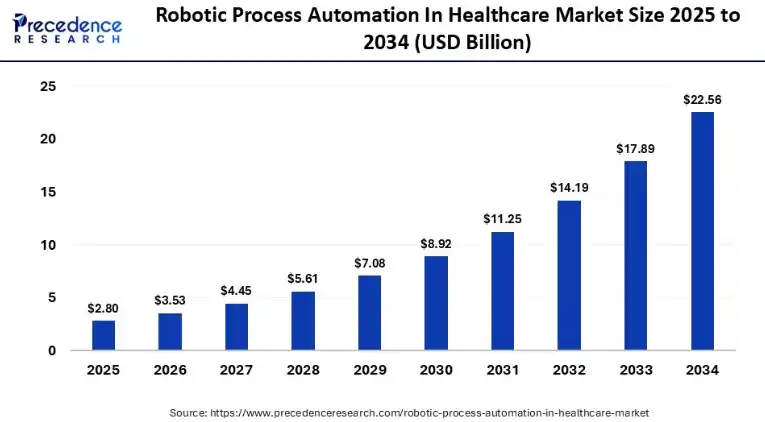
Source: Precedent Research
The value is not simply about replacing manual work with bots. For hospitals, the bigger opportunity comes from reducing delays, improving revenue cycle operations, and giving staff more time for work that actually needs their expertise.
Cutting Repetitive Work
A large part of hospital operations involves simple tasks that have to be done again and again. RPA can handle these tasks in the background so employees do not have to spend their day switching between systems or entering the same information.
| Manual Work | RPA Value |
| Repeated data entry | Faster processing |
| Eligibility checks | Quicker verification |
| Claim updates | Fewer manual follow-ups |
| Record reconciliation | More consistent results |
Cleveland Clinic is a good example. Its RPA program automated revenue cycle workflows such as claim edits and eligibility verification. The organization reported $700,000 in ROI over three years, while one automated process became 80% faster. This shows where the business value starts to become measurable. The hospital is not simply saving clicks. It is processing work faster and freeing employees to focus on tasks that require judgment.
Improving Financial Operations
For hospitals, automation can also have a direct connection to revenue. A delayed claim or an incorrect eligibility record can create more work later and may slow down reimbursement. RPA can help keep these processes moving by handling repetitive checks and updates at the right stage. This can reduce the amount of manual follow-up required by revenue cycle teams.
Kaiser Permanente provides another useful example. Its organization reported that RPA in claims processing delivered more than $50 million in efficiencies over three years. It also used around 1,900 bots to automate software testing and reduce testing time from 14 weeks to eight weeks.
The important lesson is that healthcare RPA can create value beyond administrative savings. When automation improves the speed and consistency of revenue-related processes, it can influence the financial performance of the entire organization.
Creating More Staff Capacity
RPA does not have to mean reducing the workforce. A stronger business case is to use automation to give existing teams more capacity. When bots handle repetitive steps, employees can spend more time on patient-facing work, complex cases, and decisions that cannot be safely automated.
Cleveland Clinic found this in its nursing operations as well. Its automation team used bots to handle routine work inside the EHR and other systems, allowing nurses and support staff to spend more time on responsibilities that require their expertise.

Which Hospital Processes Should You Automate First?
Hospitals generate huge amounts of repetitive administrative work every day. The best starting point for RPA is not necessarily the most complex process. High-volume workflows with clear rules and frequent manual data entry usually offer the fastest return. Healthcare organizations have already seen measurable results from this approach.
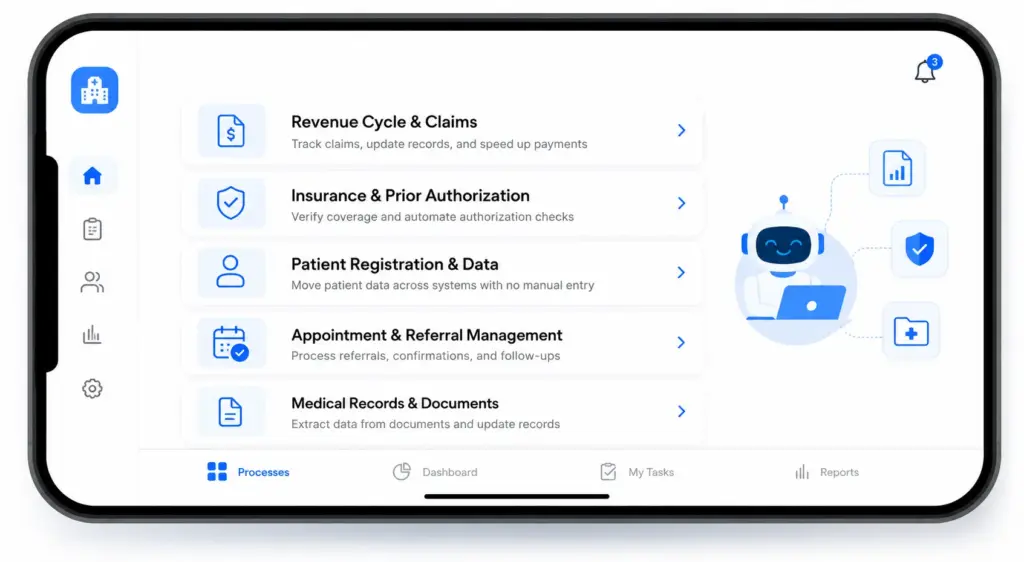
1. Revenue Cycle and Claims
Revenue cycle workflows are often a strong starting point because small delays can directly affect hospital cash flow. RPA bots can check claim status, move information between systems, update billing records, and flag cases that need human review. This allows revenue teams to spend more time resolving complex issues instead of repeatedly checking portals.
Max Healthcare provides a practical example. Its RPA implementation automated claims processing and reconciliation for government healthcare schemes. The hospital reported a 50% reduction in claims turnaround time and recovered around $120,000+ in pending payments over 12 months.
2. Insurance and Prior Authorization
Insurance verification can become a bottleneck when staff have to check eligibility across multiple payer systems. RPA can collect patient details, verify coverage, update records, and route exceptions to the right team. This can help hospitals reduce delays before treatment begins.
A typical automated workflow can look like this:
Patient details → Eligibility check → Coverage validation → Authorization status → EHR update
3. Patient Registration and Data
Registration teams often enter the same patient information into several systems. RPA can reduce this duplication by transferring structured information between registration software, EHRs, billing systems, and other hospital applications. Helse Vest in Norway used RPA to reduce repetitive clinical data registration.
One cancer-related workflow that previously required information to be entered across three systems was automated. The program eventually covered more than 50 processes and gave doctors and nurses more than 14,000 hours back each year.
The lesson is important: automating data movement can create value even when the underlying hospital systems remain unchanged.
4. Appointment and Referral Management
Appointment and referral workflows are another practical area for automation. Bots can move referral information into EHRs, check appointment details, send confirmations, and identify incomplete records. This is especially useful when hospitals receive large numbers of referrals through different channels.
At Princess Alexandra Hospital NHS Trust, RPA was combined with electronic forms to automate referral processing. The hospital was handling around 2,323 referral documents each month, with manual data entry taking several minutes per document. The automation removed repetitive rekeying and improved data quality across the referral pathway.
5. Medical Records and Documents
Hospitals still handle large volumes of PDFs, forms, reports, and other documents. RPA can help extract structured information and move it into the appropriate systems. When combined with OCR or intelligent document processing, it can handle documents that are not already stored in a clean digital format.
The bot can recognize the document, extract relevant fields, validate them against existing records, and send uncertain cases to staff for review. That keeps humans involved where judgment is needed while removing much of the repetitive work.
6. Billing and Payment Reconciliation
Payment reconciliation is another area where small manual tasks can add up quickly. RPA can compare payment records and flag mismatches before they create bigger issues. TPMG used RPA to automate 98% of its penny-adjustment process. The solution also cleared a backlog of more than 100,000 outstanding write-offs and is expected to save over $200,000 within five years.
The real value goes beyond reducing manual work. Faster reconciliation helps hospitals keep their financial records accurate and maintain a healthier cash flow. It also allows billing teams to focus on payment issues that actually need human attention.
7. Compliance Reporting and Data
Compliance teams often spend significant time collecting information from different systems and preparing recurring reports. RPA can gather predefined data, check required fields, generate reports, and maintain an audit trail of completed tasks. Oxford University Hospitals NHS Foundation Trust has deployed more than 80 robots across its operations. Its automation program has saved more than 450,000 processing hours, while individual workflows have produced measurable financial savings.
How Should Hospitals Prioritize RPA Opportunities?
Not every hospital process is a good candidate for RPA. The strongest opportunities usually have high transaction volumes, repetitive manual work, stable rules, and measurable financial impact. A simple scoring method can help teams avoid automating a process just because it looks inefficient. The better approach is to compare each workflow against the effort required to automate it and the value it can create.
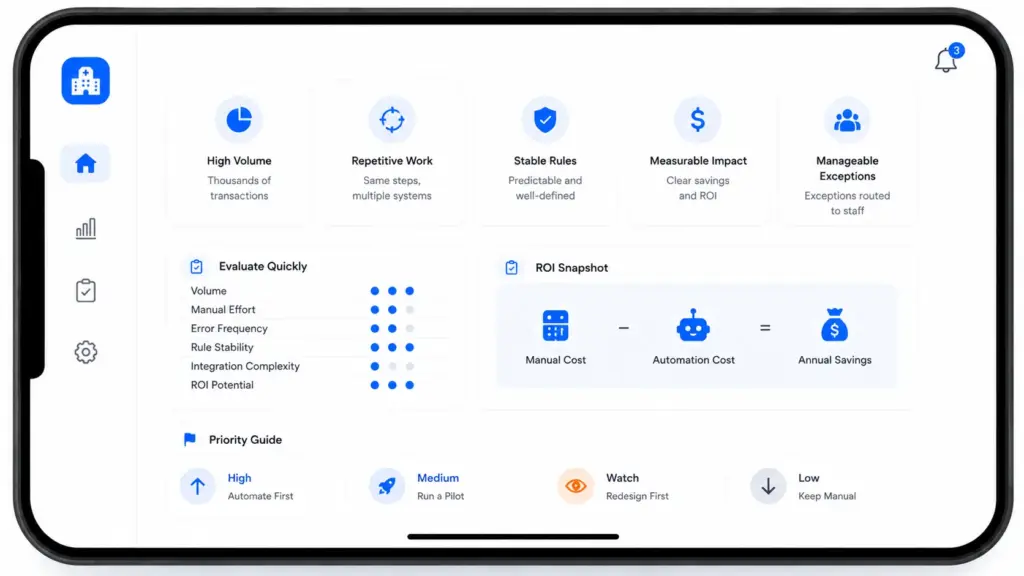
1. Score Automation by Volume
Transaction volume is one of the easiest ways to identify a strong RPA opportunity. A process that runs thousands of times each month can generate significant savings even when each individual task takes only a few minutes. Hospitals should also look at how often employees repeat the same steps across different systems.
2. Compare Cost and Errors
Time savings alone do not tell the whole story. Hospitals should also compare how much a process costs to run manually and how often errors lead to rework. A workflow with moderate volume can still be a strong candidate if mistakes create expensive delays or compliance problems.
| Factor | Low | Medium | High |
| Transaction volume | Few cases | Regular cases | Thousands of cases |
| Manual effort | <5 min | 5–15 min | >15 min |
| Error frequency | Rare | Occasional | Frequent |
| Rule stability | Changing | Mostly stable | Highly stable |
| Integration complexity | Simple | Moderate | Complex |
| Expected ROI | Low | Moderate | High |
Shinshu University Hospital shows how automation can create value beyond direct labor savings. Its RPA program saved 4,559 work hours per year by automating administrative processes.
3. Estimate the Expected ROI
Before approving an automation project, hospitals should estimate how much money and staff capacity the workflow can save. The calculation should include current labor costs, transaction volumes, error-related rework, software expenses, and the expected cost of developing and maintaining the bot.
A simple assessment can compare:
Annual manual cost − Annual automation cost = Potential annual savings
The NHS Shared Business Services program across seven NHS trusts offers a strong benchmark. Its automation work released 21 full-time-equivalent capacity and produced approximately £450,000 in annual savings.
4. Identify Manageable Exceptions
A process does not need to be completely predictable to benefit from RPA. What matters is whether the exceptions can be identified and sent to employees for review. This allows the bot to handle routine cases while staff deal with situations that require judgment. For example, Bedfordshire and Luton used an RPA solution called Ada to automate parts of its referral workflow.
The average processing time fell from 40 minutes to less than five minutes, while the system reduced the risk of errors by 90%. The automation also saved more than 116 hours each month and was projected to deliver around £16,000 in annual savings.
5. Separate Quick Wins From Strategy
Hospitals can start with simple workflows and expand into more complex automation as they see results. Newcastle Hospitals took this approach across several operational areas and its RPA program has saved thousands of hours while supporting around 1.5 million patient engagements. This shows how starting small can create a foundation for wider automation.
A practical roadmap could look like this:
| Priority | Process Profile | Recommended Action |
| High | High volume + low complexity | Automate first |
| Medium | High value + moderate complexity | Run a pilot |
| Watch | High complexity + unstable rules | Redesign first |
| Low | Low volume + low savings | Keep manual |
The goal is not to find the process that looks most impressive to automate. It is to find the workflow where automation can produce measurable value with manageable implementation risk.
The Hospital RPA Implementation Roadmap
Implementing RPA in a hospital should follow a clear and controlled path. Start by finding the right process to automate and then move through design, integration, testing, and deployment. A structured roadmap helps reduce implementation risks while making it easier to measure results and scale automation across departments.
Phase 1: Assess Hospital Readiness
Before building anything, the hospital needs a clear view of its current systems and workflows. This means identifying where staff spend the most time and where information moves between applications. It also helps reveal security, compliance, and integration limitations early.
A simple readiness review can cover:
| Area | What to Check |
| Systems | EHR, EMR, billing, payer portals |
| Workflows | Manual steps and handoffs |
| Data | Sensitive information and access rules |
| Security | Credentials and permissions |
| Compliance | Applicable healthcare requirements |
Phase 2: Select the First Workflow
The first automation should be useful without being unnecessarily complicated. High-volume processes with stable rules are usually better pilot candidates than workflows that require frequent judgment. Hospitals can score potential workflows based on:
- Transaction volume
- Manual processing time
- Error frequency
- Rule stability
- Integration effort
- Expected financial return
This approach helped Cleveland Clinic identify claim edits and eligibility verification as strong starting points. Its automation reduced processing time by 80% while producing the $700,000 ROI mentioned above.
Phase 3: Map Rules and Exceptions
Once a workflow is selected, document how it actually works. Do not rely only on written procedures because employees often handle exceptions differently from the official process. This becomes the blueprint for the bot and makes it easier to identify where human judgment must remain in the workflow.
The process map should show:
Input → Validation → Business Rule → System Action → Exception → Human Review → Completion
Phase 4: Design the RPA Architecture
The architecture should fit the hospital’s existing technology environment rather than forcing every department onto a new system. The team needs to decide where bots will run and how they will access applications. Key design decisions include:
| Architecture Area | Main Consideration |
| RPA platform | Bot development and orchestration |
| Infrastructure | Cloud, on-premise, or hybrid |
| Credentials | Secure bot identities |
| Integrations | APIs, UI automation, OCR |
| Monitoring | Logs, alerts, and performance |
A strong architecture also makes future automation easier. Helse Vest spent around six months establishing its operating model, governance, process models, and testing approach before scaling its program. It eventually automated more than 50 processes and saved over 14,000 hours annually.
Phase 5: Connect Hospital Systems
RPA becomes more valuable when it can move information across the systems staff already use. A bot may need to retrieve information from an EHR, check an insurance portal, process a document, and then update another hospital application.
Common integration points include:
- EHR and EMR platforms
- Insurance and payer portals
- Hospital management systems
- Legacy applications
- Document repositories
- APIs and databases
Cleveland Clinic’s RPA workflows operated across EHR-based revenue cycle processes. Its bots automated claim edits and registration eligibility activities without requiring the hospital to replace its existing systems.
Phase 6: Build and Validate Bots
Development should begin only after the workflow and exception paths are clearly understood. The bot can then be configured around the approved business rules and tested against realistic scenarios. Testing should cover:
| Test Scenario | What to Validate |
| Normal Cases | Bot completes the workflow correctly |
| Missing Information | Bot identifies incomplete data |
| Incorrect Data | Bot flags invalid information |
| System Downtime | Bot handles unavailable systems safely |
| Unexpected Responses | Bot detects unusual system behavior |
| Human Escalation | Bot routes complex cases to staff |
For healthcare workflows, testing with representative data is especially important because a small automation error can affect billing, records, or patient administration.
Phase 7: Run a Controlled Pilot
A pilot gives the hospital a chance to prove that the automation works before it reaches a wider operational environment. Start with a limited workflow and define measurable targets for time savings, accuracy, exceptions, and human intervention.
For example:
| Pilot KPI | Baseline | Target |
| Processing time | 15 min | 5 min |
| Manual errors | 8% | <2% |
| Exception rate | 12% | <5% |
| Human intervention | 100% | <20% |
| Cost per transaction | $X | $X |
Oxford University Hospitals NHS Foundation Trust provides a useful benchmark. One automation program achieved a 153% return on investment in its first year and generated £53,000 in savings, with savings projected to reach £500,000 over five years.
Phase 8: Move Bots Into Production
Production deployment needs stronger controls than a pilot. The hospital should establish who can change the bot, who receives alerts, and what happens when an automated workflow fails. A production checklist can include:
- Deployment approval
- Version control
- Credential management
- Monitoring dashboards
- Failure alerts
- Incident procedures
- Rollback procedures
- Process-owner sign-off
This reduces the risk of a bot continuing to process incorrect information after a system change or unexpected exception.
Phase 9: Scale Across Operations
Once the first automation proves its value, the hospital can build a pipeline of additional opportunities. Reusable components and centralized governance make this expansion faster and easier. NHS Shared Business Services demonstrated the value of scaling automation across multiple trusts. Its program released capacity equivalent to 21 full-time employees and generated approximately £450,000 in annual savings.
Processing costs were around 50% lower than manual work in the program. At this stage, hospitals should treat RPA as an ongoing capability rather than a collection of isolated bots. Each successful workflow can provide the framework for the next one.
Where Does AI Fit Into Hospital RPA?
RPA works well when hospital processes follow clear and repeatable rules. The challenge starts when the workflow involves documents, language, or decisions that are harder to structure. AI can add the missing layer of understanding. Instead of replacing RPA, it can help bots interpret information and decide what action should happen next.
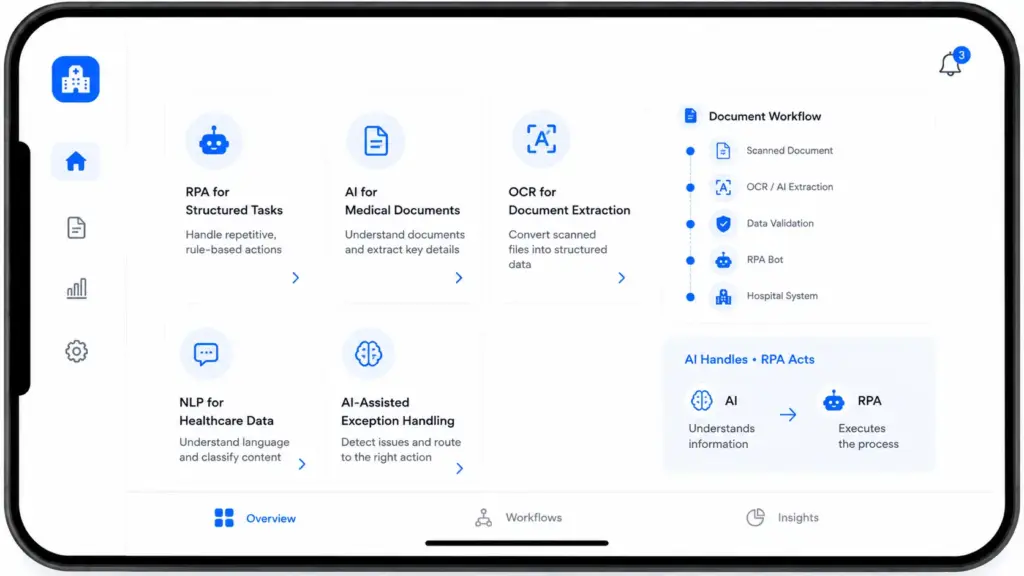
1. RPA for Structured Tasks
RPA is most effective when the inputs and outputs are predictable. A bot can move patient details between systems, check eligibility, update records, or process billing information without changing the underlying workflow. The benefit comes from making these workflows faster and more consistent. RPA handles the action while the hospital keeps control over the business rules.
| RPA Strength | Hospital Example |
| Repetitive actions | Updating patient records |
| Rule-based checks | Insurance verification |
| Data transfer | Moving billing information |
| Scheduled tasks | Generating routine reports |
2. AI for Medical Documents
Medical documents rarely follow one perfect format. Discharge summaries, referral letters, insurance documents, and clinical reports can contain information in different layouts and writing styles. AI can interpret this content before RPA takes over the next step. For example, an AI model can identify a diagnosis or appointment detail from a document.
RPA can then transfer the extracted information into the appropriate hospital system. This creates a workflow where AI understands the information and RPA moves it through the process.
3. OCR for Document Extraction
OCR is useful when information exists in scanned forms or image-based documents. It converts that content into machine-readable text so downstream systems can process it. OCR becomes even more useful when combined with AI. Instead of simply reading characters, intelligent document processing can identify fields and understand where each piece of information belongs.
A typical workflow could look like:
Scanned document → OCR → Data validation → RPA bot → Hospital system
4. NLP for Healthcare Data
Natural language processing can help hospitals work with information written in everyday clinical or administrative language. This can include referral notes, patient messages, insurance correspondence, and other text-heavy workflows. NLP can identify relevant information and classify the document before passing it to an RPA workflow.
Example: Referral received → NLP identifies specialty → RPA checks availability → Appointment workflow begins
This reduces the need for staff to manually read and categorize every document before the administrative process can continue.
5. AI-Assisted Exception Handling
Not every automated workflow will follow the expected path. A patient record may be incomplete or an insurance response may contain information that does not match the hospital’s rules. Instead of stopping the entire process, AI can help classify the exception and determine whether it can be resolved automatically.
| Exception | AI Role | RPA Action |
| Missing field | Identify what is missing | Request information |
| Mismatched data | Compare records | Flag for review |
| Unclear document | Classify confidence | Send to staff |
| Unusual response | Detect anomaly | Pause workflow |
This creates a more flexible system where human staff focus on cases that genuinely require judgment.
6. Combining RPA With AI
The strongest approach is not choosing between AI and RPA. It is using each technology where it performs best. AI can interpret complex information while RPA handles the repetitive actions that follow. A hospital could build a workflow such as:
| Step | What Happens |
| 1. AI Reads the Document | Identifies the type and context of the document |
| 2. AI Extracts Information | Pulls out relevant healthcare data |
| 3. RPA Validates the Data | Checks the information against defined rules |
| 4. RPA Updates Systems | Transfers approved data into hospital systems |
| 5. AI Finds Exceptions | Detects unclear or unusual cases |
| 6. Staff Review Cases | Humans handle cases that need judgment |
This combination turns basic task automation into intelligent automation. It can help hospitals move beyond simple data entry and automate workflows that previously required continuous manual interpretation.
How Much Does RPA Implementation Cost for a Hospital?
Hospital RPA implementation can range from $15,000 for a small pilot to $500,000+ for an enterprise automation program. The final cost depends on how many workflows are automated and how deeply the bots need to connect with hospital systems. A simple claims workflow will usually cost far less than an automation program spanning billing, EHRs, insurance portals, and document processing. These figures are practical estimates for planning rather than fixed vendor quotes.
What Drives RPA Costs?
The biggest cost difference usually comes from workflow complexity rather than the number of bots alone. A bot that copies information between two stable systems is relatively straightforward. A workflow that handles sensitive healthcare data and interacts with several legacy applications requires more engineering and testing.
| Cost Factor | Lower Complexity | Higher Complexity |
| Workflow design | $2,000–$5,000 | $10,000–$25,000+ |
| RPA development | $5,000–$15,000 | $30,000–$75,000+ |
| System integrations | $2,000–$10,000 | $25,000–$100,000+ |
| Testing & validation | $2,000–$5,000 | $15,000–$40,000+ |
| Security & compliance | $2,000–$7,500 | $20,000–$50,000+ |
The final budget can also increase when a hospital needs OCR, AI-based document processing, complex exception handling, or real-time integrations.
Single-Workflow Pilot Cost
A single-workflow pilot is often the most practical way for a hospital to test RPA before committing to a larger program. A realistic budget is around $15,000–$40,000 for a focused workflow such as eligibility verification, claims processing, appointment management, or invoice reconciliation.
A typical pilot budget could look like:
- Process discovery: $2,000–$5,000
- Bot development: $5,000–$15,000
- Integration: $3,000–$8,000
- Testing: $2,000–$5,000
- Deployment: $3,000–$7,000
This approach lets the hospital measure actual time savings and error reduction before expanding the automation program.
Multi-Workflow Automation Cost
When several departments need automation, the project becomes more complex. Multiple workflows may share systems and data but still require separate business rules and exception paths. A multi-workflow program can typically cost around $50,000–$200,000+ depending on scope.
| Scope | Estimated Cost |
| 2–3 workflows | $50,000–$80,000 |
| 4–7 workflows | $80,000–$150,000 |
| 8–15 workflows | $150,000–$200,000+ |
At this stage, hospitals may also need centralized bot management, reusable components, stronger monitoring, and dedicated automation governance.
Enterprise RPA Costs
Large hospitals and healthcare networks can require a much broader automation environment. Enterprise implementation can range from $200,000 to $500,000+ when it involves multiple departments, complex integrations, AI capabilities, security controls, and centralized orchestration.
The investment may cover:
Discovery → Architecture → Multiple bots → Integrations → Security → Testing → Deployment → Monitoring
Enterprise projects also need to account for infrastructure and licensing. The technology cost can therefore continue after the initial development phase.
Maintenance and Support Costs
RPA does not become maintenance-free after deployment. Hospital applications change, payer portals get redesigned, credentials expire, and business rules evolve. Bots need regular monitoring to make sure these changes do not interrupt automated workflows. A reasonable planning estimate is around 15%–25% of the initial development cost per year for maintenance and support.
For example, an RPA implementation costing $100,000 could require roughly $15,000–$25,000 annually for ongoing support.
| Support Area | Typical Annual Cost |
| Bot monitoring | $3,000–$8,000 |
| Bug fixes | $3,000–$10,000 |
| System changes | $5,000–$15,000 |
| Security updates | $2,000–$7,000 |
| Workflow improvements | $5,000–$15,000+ |
How Can Hospitals Prove RPA ROI?
Hospitals should treat RPA ROI as an ongoing measurement exercise rather than a one-time calculation. The baseline should be recorded before automation begins and compared with results after deployment. This makes it easier to show whether a bot is actually saving money or simply moving work from one team to another.
1. Measure Administrative Hours
The easiest place to start is the time employees spend completing a process manually. Record the average handling time and monthly transaction volume before introducing the bot. After deployment, compare those numbers with the time required for exceptions and human review.
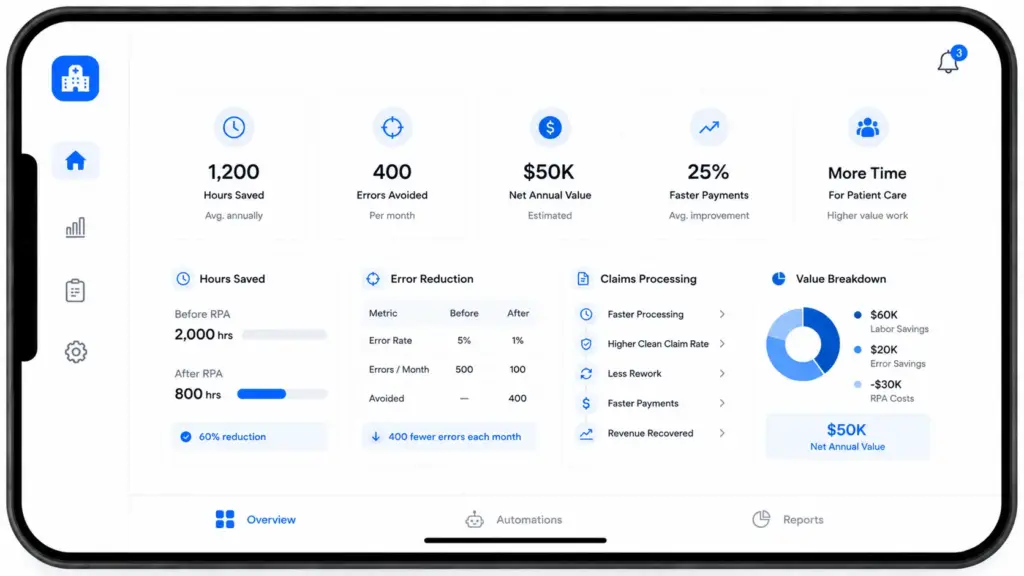
For example, if a team spends 2,000 hours a year on a workflow and automation reduces that effort by 60%, the hospital has potentially released 1,200 working hours. At an estimated loaded labor cost of $30 per hour, that represents around $36,000 in annual capacity.
2. Track Processing Errors
Automation can create financial value by reducing mistakes that lead to rework. Hospitals should track errors before and after implementation rather than simply reporting that the bot completed more transactions.
| Metric | Before RPA | After RPA |
| Monthly transactions | 10,000 | 10,000 |
| Error rate | 5% | 1% |
| Errors per month | 500 | 100 |
| Manual corrections | 500 | 100 |
| Avoided corrections | — | 400 |
This becomes especially valuable when each correction has a measurable cost. A reduction of 400 errors is much more meaningful when the hospital can show that those corrections previously consumed $20,000 or $30,000 in staff time each year.
3. Speed Up Claims Payments
Faster claims processing can connect automation directly to hospital revenue performance. RPA can help staff check claim information, update payer portals, identify missing details, and move approved claims through the workflow. This can reduce delays and help hospitals collect payments sooner while reducing the amount of manual work required from billing teams.
The key metrics should include:
Claim processing time → Clean claim rate → Rework volume → Payment turnaround → Revenue recovered
4. Calculate Operational Savings
Labor savings are only one part of the business case. Hospitals should also measure reductions in overtime, manual processing costs, paper-based work, outsourced services, and other expenses linked to the workflow. These savings can add up over time and give hospitals a clearer picture of the real financial impact of automation beyond labor costs.
A simple calculation can help:
Annual RPA Value = Labor Savings + Error Savings + Revenue Recovery − RPA Costs
For example, if an automation creates $60,000 in labor capacity and prevents $20,000 in annual rework while costing $30,000 to operate, the estimated net value would be $50,000 per year.
5. Measure Staff Productivity
RPA does not always mean reducing headcount. In many hospitals, the stronger business case is giving employees more time for work that requires judgment and patient interaction. It can take repetitive tasks off their daily workload and reduce time spent switching between systems. This allows teams to focus more on patients and tasks that need human attention.
Hospitals can track:
- Hours released from repetitive tasks
- Transactions handled per employee
- Overtime reduction
- Time spent on exception cases
- Staff time redirected to higher-value work
6. Compare Cost With Value
The final ROI calculation should bring the entire picture together. Hospitals need to compare the initial development cost, software and infrastructure expenses, maintenance, and human oversight against the value created by the automation. This approach helps decision-makers identify which automations deserve further investment.
| ROI Measure | Example |
| Initial RPA investment | $50,000 |
| Annual operating cost | $15,000 |
| Labor capacity released | $45,000 |
| Error-related savings | $15,000 |
| Revenue recovered | $25,000 |
| Annual value created | $85,000 |
| Net annual benefit | $70,000 |
The strongest RPA business case is not simply “the bot saves time.” It shows exactly how that saved time translates into lower costs, faster revenue collection, fewer errors, or greater staff capacity.
How Should Hospitals Secure RPA Workflows?
RPA can access sensitive healthcare information and interact with systems that support critical hospital operations. This makes security part of the automation architecture rather than something added after deployment. Hospitals should treat every bot as a controlled system identity with defined permissions, monitored activity, and clear accountability.
1. Protect PHI During Execution
Bots may handle protected health information while moving data between EHRs, billing systems, and other applications. Access should therefore be limited to the information required for a specific workflow. Sensitive data should also avoid unnecessary exposure in bot logs or temporary files.
A safer workflow looks like:
Limited data access → Secure processing → Controlled transfer → Verified update → Secure log
This reduces the chance of exposing PHI during routine automated tasks.
2. Control Bot System Access
Every bot should have only the permissions it actually needs. A claims bot does not need unrestricted access to the entire hospital network. Applying least-privilege access can limit the damage if credentials are compromised or the automation behaves unexpectedly.
| Access Area | Recommended Control |
| EHR | Workflow-specific permissions |
| Billing | Role-based access |
| Payer portals | Dedicated bot accounts |
| Admin systems | Restricted or prohibited |
| Sensitive records | Minimum necessary access |
Johns Hopkins Medicine has used RPA to automate administrative workflows while maintaining controls around its healthcare environment. Its automation program has included processes such as employee onboarding and clinical trial administration. (uipath.com)
3. Encrypt Data During Transfers
Data moving between hospital applications should be protected while it is being transferred. Sensitive information should also remain encrypted when stored in databases, files, queues, or other temporary locations. The security architecture should account for:
- Data exchanged between bots and applications
- Temporary files created during processing
- API communication
- Database connections
- Backup and recovery copies
Encryption helps ensure that intercepted or improperly accessed data cannot be easily read.
4. Maintain Complete Audit Trails
Hospitals need to know what a bot did, when it did it, and which system it accessed. Detailed logs make it easier to investigate failures and demonstrate that automated workflows are operating within approved rules. They also provide a clear record of each automated action, which can help spot unauthorized changes and trace issues back to their source.
A useful audit trail can capture:
Bot identity → Timestamp → Action performed → System accessed → Result → Exception
Logs should be protected from unauthorized changes and retained according to the hospital’s applicable policies and regulatory requirements.
5. Secure Credentials and Secrets
Bots often need credentials to access EHRs, payer portals, databases, and internal applications. Storing passwords directly inside automation scripts creates unnecessary risk. Instead, credentials should be managed through a secure secrets or privileged-access system.
The bot should receive access only when it needs it. Credentials should also be rotated regularly and removed immediately when an automation is retired or its permissions change.
6. Monitor Automation Activity
Security monitoring should continue after a bot goes live. Unusual login attempts, unexpected data access, repeated failures, or activity outside normal operating patterns can indicate a security issue. Mayo Clinic has also explored RPA for healthcare operations. Its automation initiatives have included administrative workflows and demonstrated how automation can be introduced within a large and highly controlled healthcare environment.
A monitoring layer can track:
| Signal | Possible Concern |
| Unusual login | Credential misuse |
| Sudden activity spike | Bot malfunction |
| Repeated failures | Workflow or system change |
| Unexpected data access | Permission issue |
| Activity outside schedule | Unauthorized execution |
Contact IdeaUsher to Implement RPA in Healthcare
Hospitals need automation that fits into their existing operations rather than creating another layer of complexity. IdeaUsher helps healthcare businesses plan and build RPA solutions around their actual workflows. Our team focuses on creating secure automation that can start with one process and expand as the hospital sees results.
Build Hospital RPA Workflows
We can help identify repetitive workflows that are suitable for automation and turn them into reliable RPA processes. This can include claims processing, patient registration, billing, referrals, and other administrative tasks. The goal is to reduce manual work without disrupting the way hospital teams already operate.
Our development approach can cover:
Workflow assessment → Process mapping → Bot development → Testing → Deployment
Integrate RPA With EHRs
RPA becomes more useful when it can work with the systems hospitals already depend on. We can build automation that connects with EHRs, EMRs, payer portals, billing platforms, and legacy applications through suitable integration methods. The workflows can also incorporate OCR or AI when documents and unstructured information are involved. This helps hospitals automate data movement while keeping security, access controls, and auditability in focus.
Scale Healthcare Automation Securely
A successful pilot should create a path toward wider automation. IdeaUsher can help hospitals expand from individual bots to a broader automation environment with centralized monitoring and stronger governance. Our team has 500,000+ hours of coding experience and includes ex-MAANG and FAANG developers who bring experience in building complex and scalable software systems.
Conclusion
RPA can help hospitals reduce repetitive administrative work without disrupting the systems their teams already rely on. The key is to start with workflows that have clear rules and measurable value. A well-planned implementation can improve processing speed, reduce errors, free up staff time, and create a foundation for wider automation. As hospitals gain experience, they can gradually connect RPA with AI and other technologies to handle more complex workflows while keeping human oversight where it matters most.
FAQs
A1: RPA implementation usually starts by finding repetitive hospital tasks that follow clear rules. The team then maps the workflow and identifies the systems involved. After that, the bot is developed and tested with different scenarios before it goes live. Starting with one controlled workflow can help the hospital prove its value before expanding automation further.
A2: The first step is to find a workflow that is suitable for automation. Hospitals can start by looking at tasks that take up a lot of staff time or often lead to errors. Processes with predictable steps are usually easier to automate. Choosing the right first workflow can make the rest of the implementation much smoother.
A3: RPA works best for repetitive tasks that do not require constant human judgment. Claims processing and insurance verification are common examples. Patient registration and billing reconciliation can also be good candidates. These processes often involve the same actions being repeated across hospital systems.
A4: Yes. RPA can work with EHR and EMR systems through their interfaces or available APIs. A bot can retrieve information and enter approved data without requiring staff to repeat the same steps manually. The integration should be designed carefully when sensitive patient information is involved. Strong access controls and audit trails help keep these automated workflows secure.