

Key Takeaways
- Asset managers face key challenges when deciding between building custom and buying fund administration software, including hidden operational costs of legacy systems.
- Commercial off-the-shelf software often fails to cater to complex fund workflows, forcing firms to work around limitations.
- Modern fund operations require scalable automation for efficiency, data transparency, and timely reporting, impacting investor confidence.
- Building custom fund administration software becomes essential when workflows are unique, regulatory needs are complex, or data ownership is critical.
- Understanding hidden costs, such as compliance and integration complexity, is vital for making informed decisions about fund administration software.
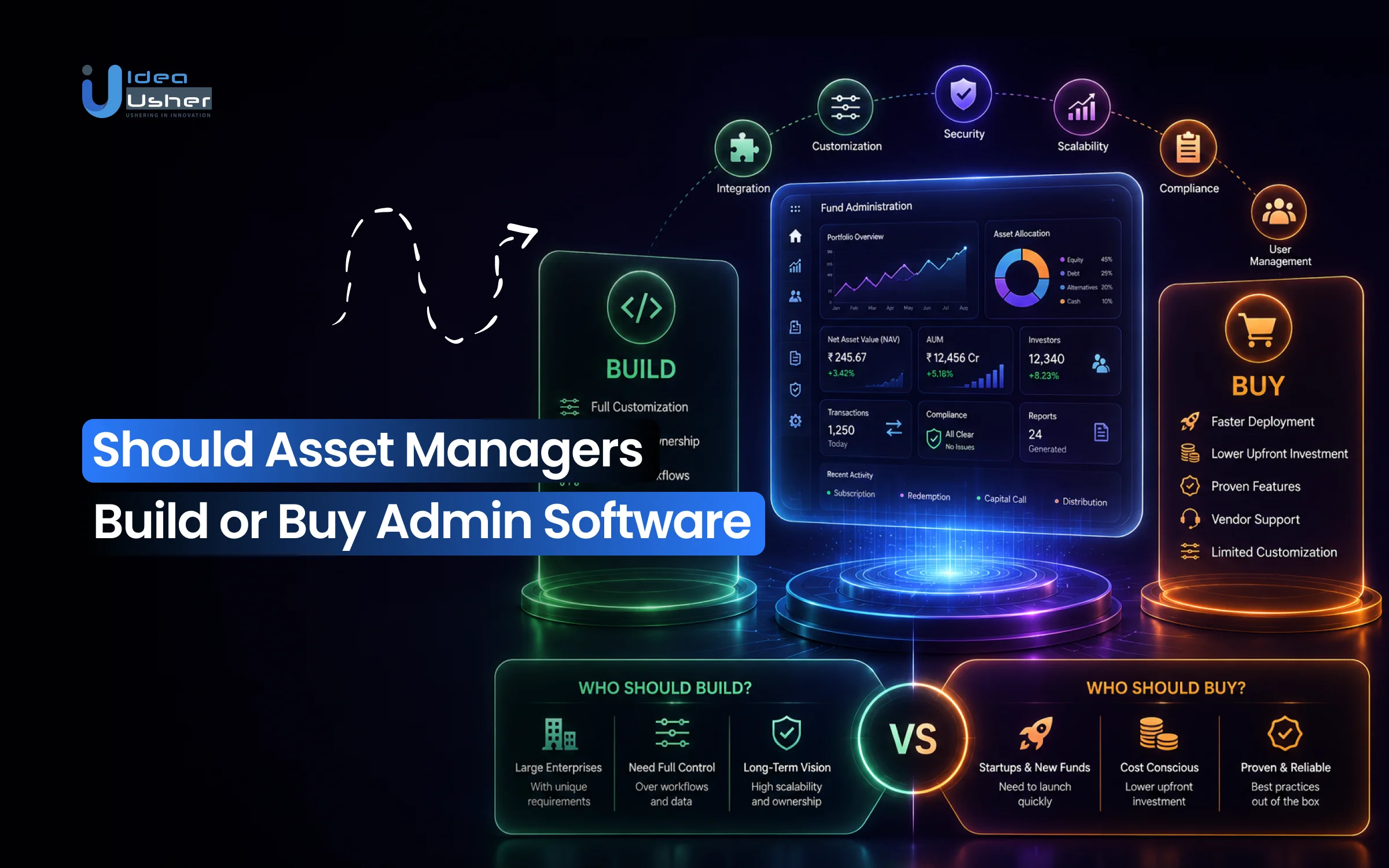
The biggest mistake asset managers make is treating administration software as an operational purchase instead of a long-term competitive asset. This shift is reshaping fund administration software development, as firms outgrow generic platforms that struggle with evolving regulations, complex fund structures and institution-specific workflows and the real question is whether the software can scale with the business.
Off-the-shelf solutions offer speed, but they often introduce workflow compromises, integration limitations and vendor dependency that become costly at scale. Custom-built platforms, on the other hand, enable firms to automate fund accounting, investor reporting, compliance, capital calls, NAV calculations, document management and portfolio oversight while integrating seamlessly with existing financial ecosystems. Choosing whether to build or buy is now a strategic technology decision that directly influences operational efficiency, scalability and long-term control.
In this blog, we will talk about the build vs buy decision for fund administration software, the key factors asset managers should evaluate, cost implications, essential platform capabilities and how Idea Usher can help you to determine the right approach to build scalable fund administration software while balancing scalability, operational efficiency, and regulatory compliance.
Why Asset Managers Are Replacing Legacy Admin Systems
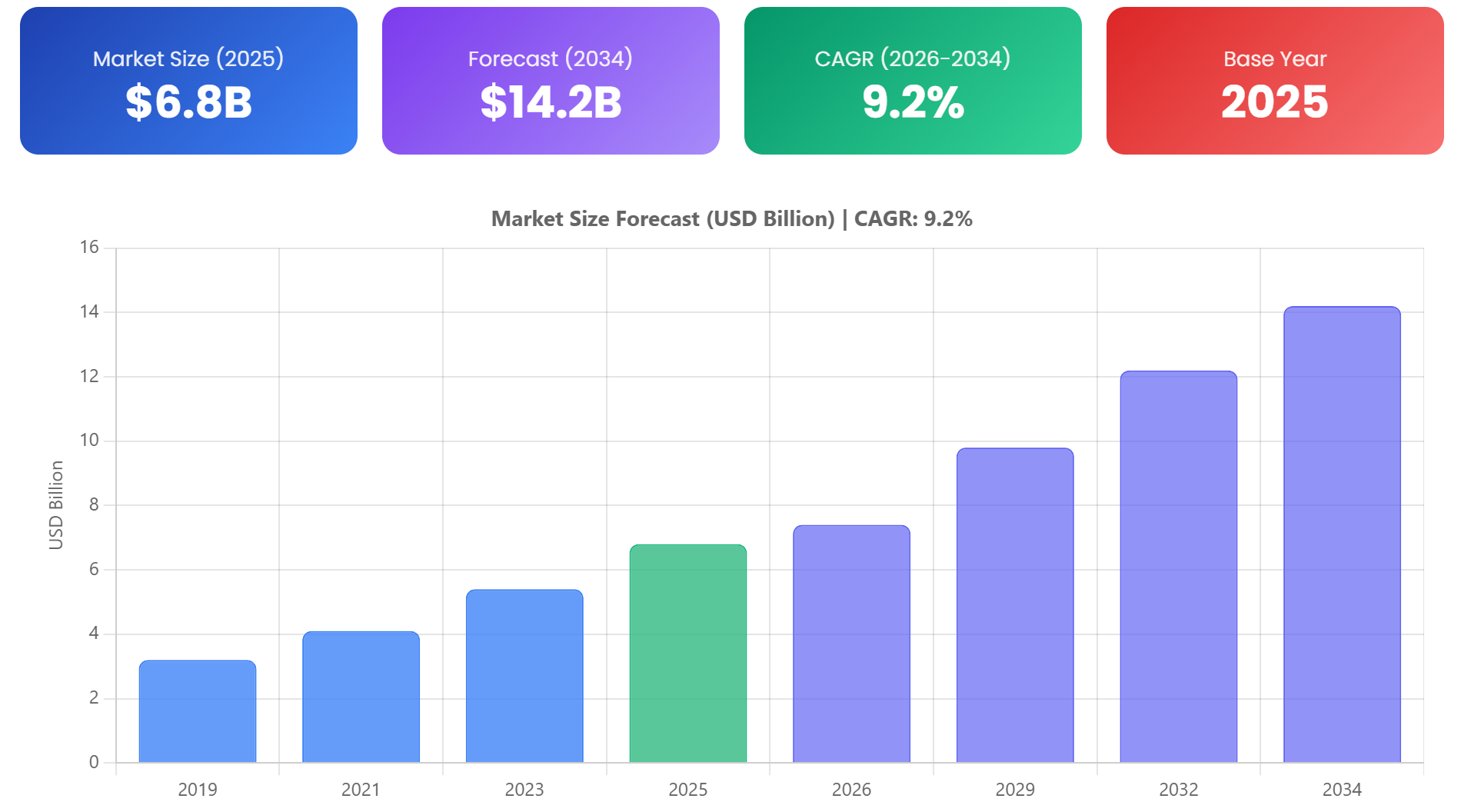
Global asset managers are facing mounting pressure as pre-tax operating margins have declined by 3–5 percentage points, driving greater focus on operational efficiency. At the same time, the fund administration software market is projected to grow from $6.8 billion in 2025 to $14.2 billion by 2034 at a 9.2% CAGR, reflecting rising demand for scalable, compliance-driven solutions.
While institutional asset managers allocate 1.3 to 2.7 basis points of AUM to technology, a staggering 60% to 80% of those IT budgets are consumed just maintaining legacy infrastructure.
This leaves little capital for innovation. According to industry surveys, 46% of asset management executives identify reliance on legacy platforms as their primary barrier to modernizing fund operations, while 61% report that adapting outdated architecture to market and regulatory changes requires an unsustainable drain of time and capital.
A. How Manual Operations Reduce Fund Efficiency
Relying on legacy back-office software forces fund administrators to rely heavily on manual spreadsheets, disconnected accounting engines, and physical reconciliations. This creates compounding operational friction:
- Higher Costs for Smaller Funds: Driven by manual processes, smaller fund managers spend a median of 3.4% of committed capital on operating expenses, whereas mega-funds ($100M+ AUM) using digital platforms spend only 1%.
- Data Fragmentation Strain: Disconnected data flows cause significant operational friction for 56% of asset managers, while 43% struggle to handle the volume and frequency of manual updates.
- Distribution Cycle Delays: Operations teams spend 8 to 10 hours per distribution cycle manually calculating, verifying, and double-checking waterfall allocations and investor payouts.
- Compliance Documentation Drain: Teams waste 15 to 20 hours per week gathering and verifying compliance documentation across disconnected databases.
- Reconciliation & Valuation Bottlenecks: Re-keying transactions across order management systems, general ledgers, and custodian reports causes high NAV and capital statement error rates. Automation cuts these manual tasks by up to 50%.
B. Why Modern Investors Expect Real-Time Transparency
Institutional Limited Partners (LPs), family offices, and high-net-worth investors no longer accept delayed, end-of-month PDF statements. They demand on-demand access to real-time Net Asset Value (NAV), intraday portfolio exposures, performance attribution, and transparent fee breakdowns.
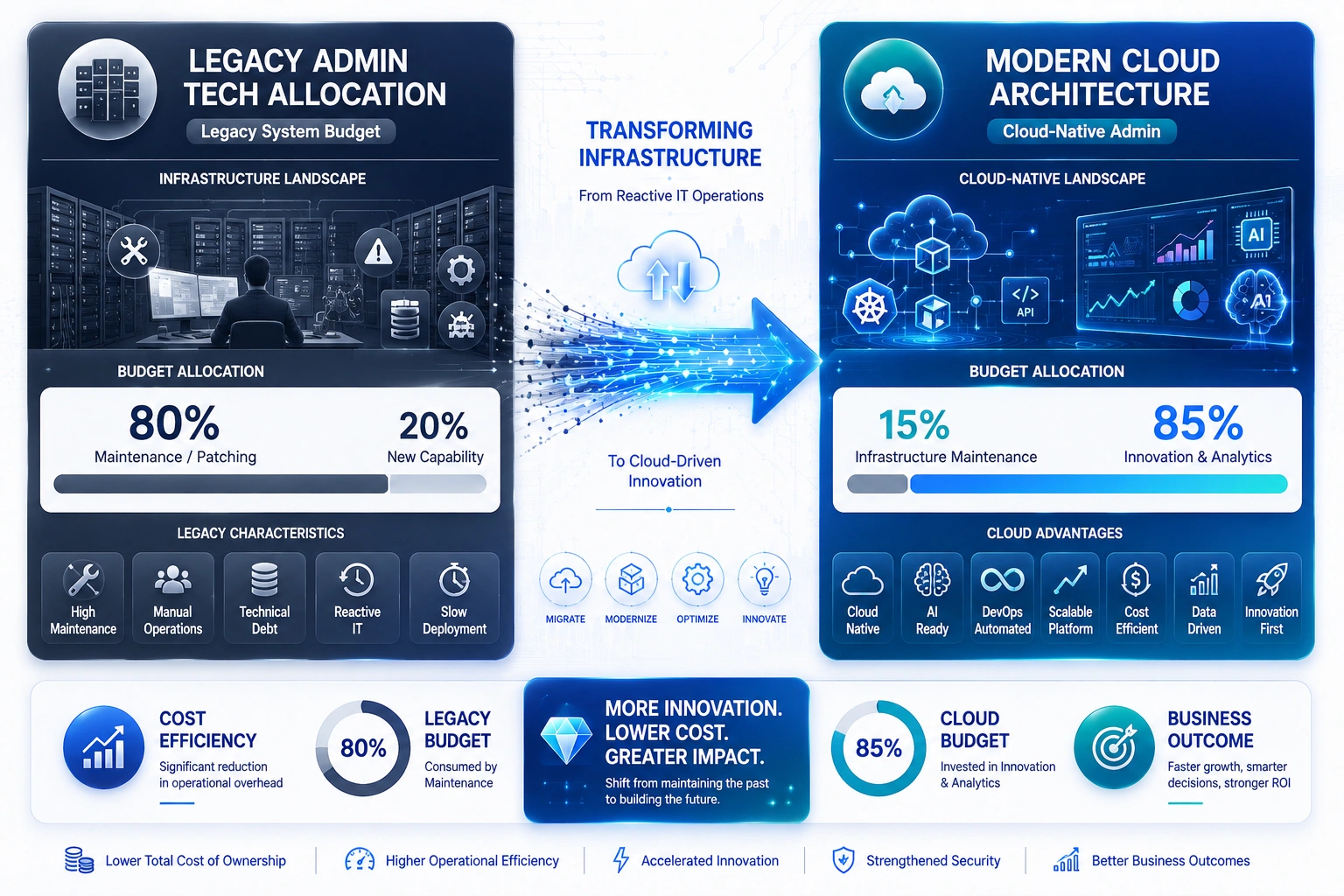
As investor expectations evolve, fund administrators must shift from delayed, static reporting to real-time, cloud-enabled platforms offering greater transparency, accessibility, and efficiency. The comparison below highlights these differences.
| Operational Feature | Legacy Fund Administration | Modern Cloud-Native Platform |
| NAV Generation | End-of-month / T+3 to T+5 delay | Real-time / T+0 intraday shadow NAV |
| Investor Portal Access | Static monthly PDF uploads | Interactive dashboard with API access |
| Deployment Model | On-premise / Hosted legacy (34.4% market) | Cloud-native (65.6% global market share) |
| AUM Growth Impact | High client churn due to reporting friction | Up to 32% increase in AUM within 18 months |
Driven by this demand, the cloud wealth and fund management platform market is growing at a 15.2% CAGR to $20.84 billion, with cloud deployments capturing 65.6% of adoption. Asset managers offering self-service, real-time reporting portals achieve up to 32% AUM growth over 18 months due to faster investor onboarding and enhanced LP trust.
C. How Regulatory Demands Outgrow Legacy Platforms
The global regulatory environment has shifted from periodic reporting to continuous, granular oversight.
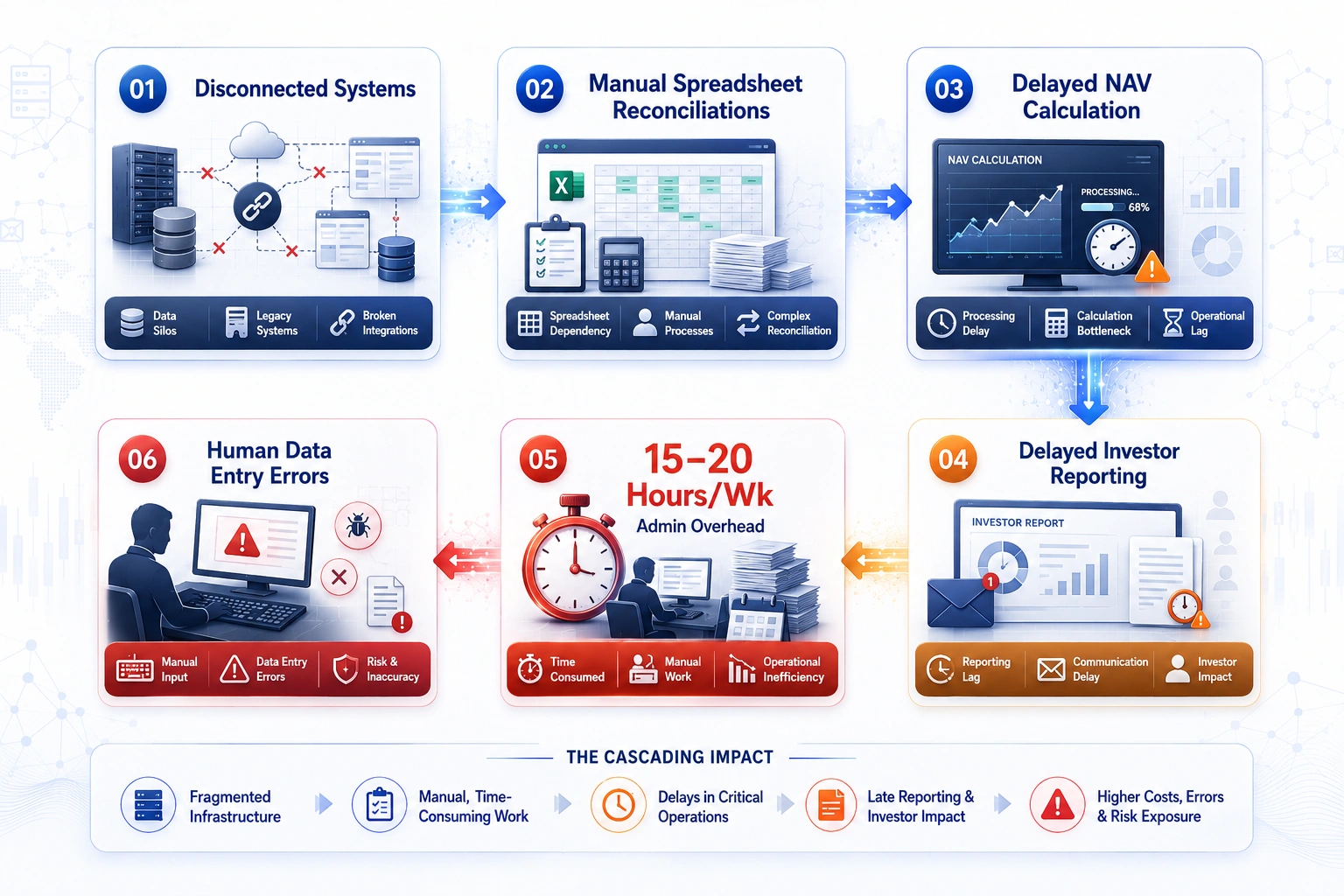
Outdated software architectures struggle to keep pace with compressed settlement cycles and strict operational resilience laws:
- Resource-Intensive Reporting: Over 37% of asset management leaders name regulatory document production (e.g., Form PF, Annex IV, Solvency II) as their most resource-intensive administrative task due to fragmented data silos.
- Transition to Accelerated Settlement (T+1): The global shift from T+2 to T+1 settlement demands instant trade matching and automated reconciliation. Legacy platforms using batch processing fail within these compressed windows, increasing trade failure rates.
- The Digital Operational Resilience Act (DORA): Under Europe’s DORA framework, financial entities face strict scrutiny over ICT risks. Legacy systems are lacking automated audit trails, sub-second data lineage, and real-time cyber resilience testing pose unsustainable compliance risks.

What Fund Administration Software Actually Covers
Fund administration software serves as the operational backbone for alternative asset managers, spanning private equity, venture capital, hedge funds, real estate, and private credit. Rather than a simple general ledger, it orchestrates the entire fund lifecycle: ingesting multi-asset transaction data, executing complex accounting models, enforcing regulatory compliance, and managing investor relationships.
Understanding its scope requires evaluating its core functional engines, operational deployment models, and the specific firms that derive the highest strategic value from deploying a platform.
A. Core Workflows Managed by the Platform
Modern fund administration platforms unify front-, mid-, and back-office operations into a single source of truth, eliminating disconnected spreadsheets and manual reconciliations.
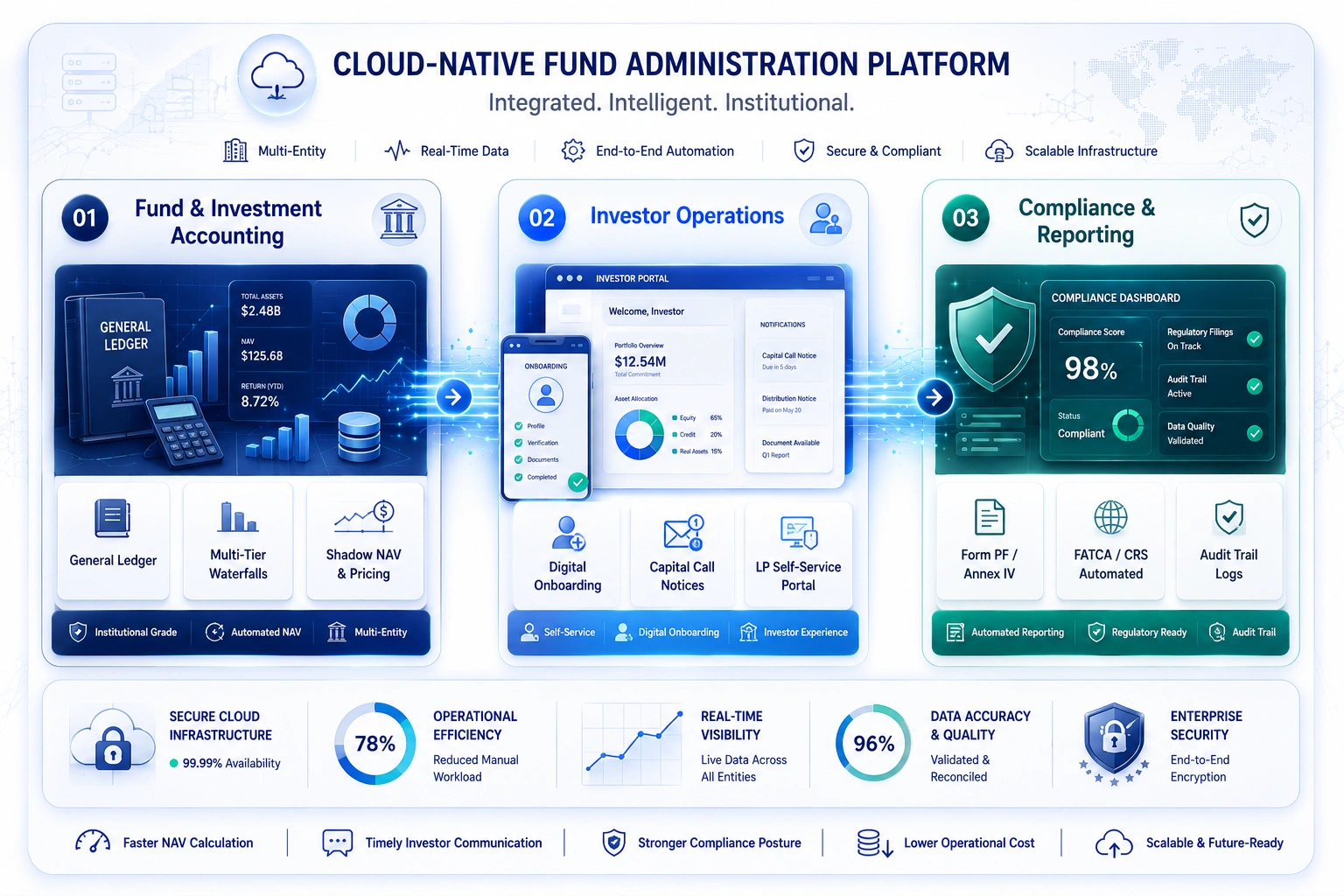
1. Fund & Investment Accounting Engine
Accurate accounting forms the foundation of efficient fund administration. A robust accounting engine automates complex calculations, improves financial accuracy, reduces manual effort, and delivers reliable reporting across diverse investment structures.
- Multi-Tier Chart of Accounts: Manages complex fund structures, including master-feeder networks, parallel vehicles, blocker corporations, and Special Purpose Vehicles (SPVs).
- Waterfall & Carry Allocations: Automates European and American waterfall models, tracking preferred return hurdles, catch-up provisions, clawbacks, and Carried Interest calculations down to individual LP partners.
- NAV Production & Shadow Accounting: Calculates official Net Asset Values (NAV) for in-house administrators or maintains a parallel “Shadow NAV” to independently cross-check third-party administrator (TPA) statements.
2. Investor Relations & Capital Operations
Investor satisfaction depends on seamless communication and operational efficiency. Modern fund administration software streamlines onboarding, capital transactions, and investor reporting while enhancing transparency throughout the investment lifecycle.
- Digital Onboarding & eKYC/AML: Automates investor subscription document processing, running automated identity verification, Politically Exposed Persons (PEP) checks, and Sanctions screening.
- Capital Call & Distribution Management: Calculates investor drawdowns based on unfunded commitments, generates branded capital call notices, and manages automated payout distributions.
- Self-Service LP Portals: Provides limited partners (LPs) with real-time, secure access to account statements, K-1 tax documents, capital call notices, and interactive performance attribution dashboards.
3. Regulatory Compliance & Data Governance
Regulatory obligations continue to grow across global investment markets. Built-in compliance and governance capabilities help firms automate reporting, maintain audit readiness, protect sensitive investor data, and reduce regulatory risk.
- Automated Regulatory Filings: Pre-populates data templates for regulatory submissions including SEC Form PF, AIFMD Annex IV, FATCA, and Common Reporting Standard (CRS) filings.
- Immutable Audit Trails: Maintains complete data lineage, logging every parameter change, journal entry override, and document approval for regulatory auditors.
B. Internal Operations vs. Outsourced Administration
Selecting the right fund administration operating model directly impacts cost, efficiency, data ownership, and investor transparency. Each model offers distinct trade-offs in technology ownership, control, scalability, and administrative responsibility.
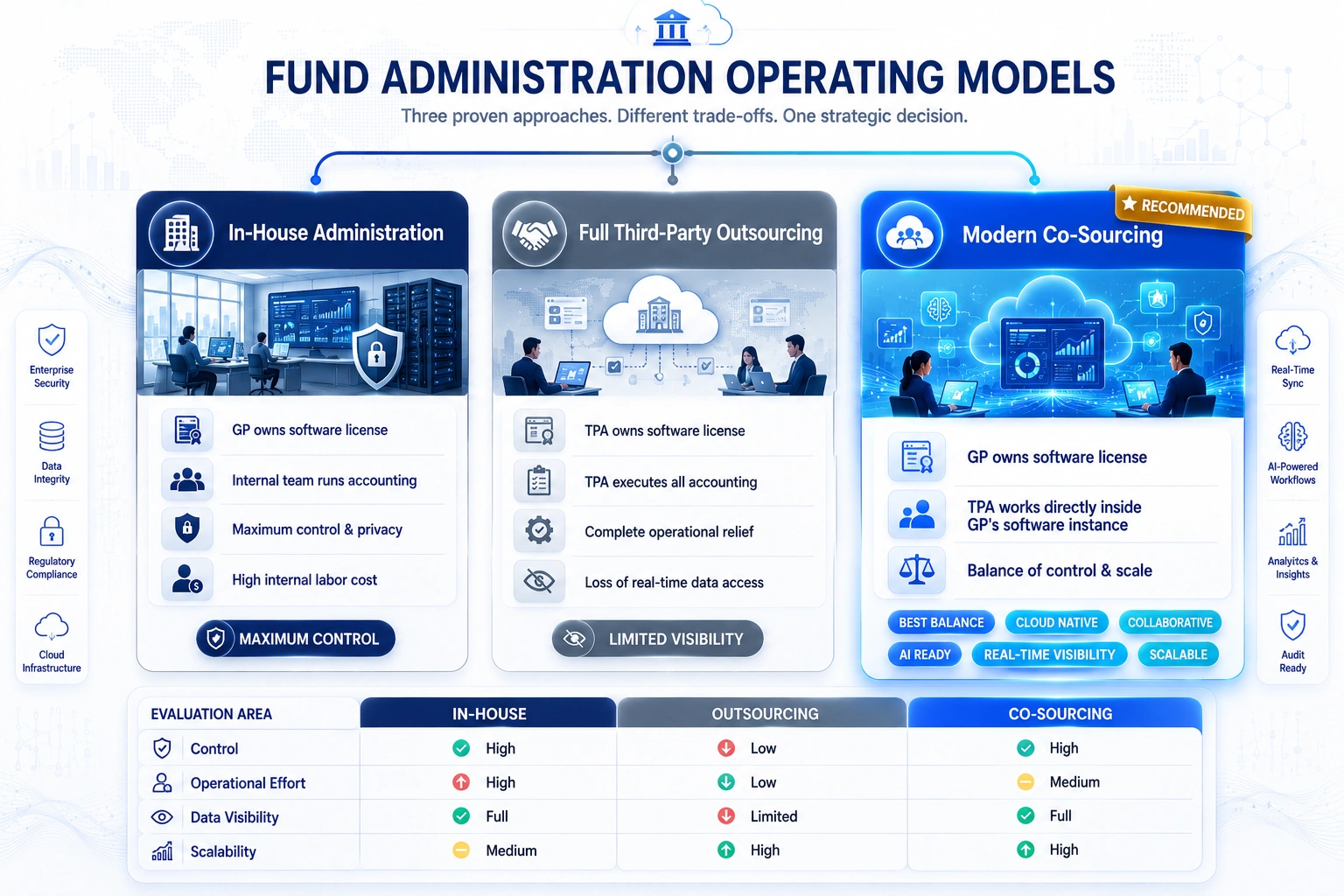
When determining operational strategy, asset managers choose between three primary models using fund administration technology:
| Operational Dimension | In-House Administration | Full Third-Party Outsourcing | Co-Sourcing (Hybrid) |
| Software Ownership | General Partner (GP) licenses software directly. | Third-Party Administrator (TPA) owns technology. | GP owns software license; TPA gets direct access. |
| Data Control & Visibility | Full, continuous access to real-time data. | Data is siloed within TPA; access via delayed reports. | Real-time single source of truth for both GP & TPA. |
| Cost Center & Fee Allocation | Operating expense typically borne by Management Co. | Administration fees usually charged directly to the Fund. | Software fee split or allocated based on fund agreement structure. |
| Key Advantage | Complete operational control and custom workflows. | Offloads operational burden to external specialists. | Eliminates data handoff friction while maintaining LP visibility. |
C. Who Benefits From Custom Admin Platforms?
Deploying a modern, dedicated fund administration platform delivers distinct strategic advantages depending on firm size, strategy, and business structure:
- Emerging Managers (Under $250M AUM): Gain institutional credibility during LP Operational Due Diligence (ODD) checks by demonstrating automated, auditable workflows rather than unmonitored Excel sheets.
- Mid-Market & Scaling GPs ($250M – $2B AUM): Benefit from automated capital call workflows, complex multi-currency waterfall calculations, and co-sourcing capabilities that prevent headcount expansion as fund vehicle counts grow.
- Institutional Fund Administrators (TPAs): Drive client margin expansion by servicing 3x to 5x more GP clients per administrator using automated batch reconciliations, client white-labeled LP portals and direct LIS/EHR-style accounting pipelines.
- Family Offices & Multi-Asset Allocators: Achieve unified, cross-portfolio transparency by running shadow accounting across dozens of external underlying fund managers on a single consolidated platform.
What to Know Before Building or Buying Fund Administration Software
Before committing to either building a bespoke platform or licensing a commercial product, asset managers and fund operators must navigate three foundational challenges that frequently undermine tech initiatives.
A. Legacy Systems Create Hidden Operational Costs
Many fund managers rely on aging, fragmented software stacks, often held together by complex Excel models, legacy on-premise databases, and manual data entries. While these systems may seem “free” because their initial development or licensing cost was amortized long ago, they introduce massive hidden operational liabilities:
- Fragile API Bridges: Connecting a modern front-end or new compliance tool to an aging legacy core requires complex custom middleware and point-to-point API workarounds that break easily during routine updates.
- Reconciliation Overhead: Operations teams spend hundreds of hours manually cross-checking data across isolated spreadsheets and static reports, driving up payroll costs and increasing human error risks.
- Keyman Risk: Legacy codebases or specialized operational macros often rely on a single developer or analyst who knows how the system operates, creating severe operational bottlenecks if that individual leaves.
B. Off-the-Shelf Software Rarely Fits Complex Fund Workflows
Commercial off-the-shelf (COTS) fund accounting and management platforms are designed for the broad “average” user, offering standardized features built for mass commercial adoption. However, modern fund structures rarely fit standard molds:
- Non-Standard Waterfalls & Carry Calculations: Multi-tier waterfall structures, complex clawback provisions, and custom co-investment terms across private equity, real estate, or venture debt funds rarely fit into pre-built SaaS settings.
- Compulsory Operational Workarounds: Because off-the-shelf software cannot adapt to unique operational rules, employees are forced to bend their operational workflows around the software’s limitations, undermining the efficiency gains the software was bought to deliver.
- Rigid Data Schemas: Commercial platforms limit your ability to capture specialized custom LP reporting attributes, bespoke ESG metrics, or specialized asset-level telemetry without paying for expensive custom vendor extensions.
C. Modern Fund Operations Demand Scalable Automation
Limited partners (LPs) and institutional investors increasingly judge fund managers on operational efficiency, data transparency, and reporting speed. Scalable automation is no longer optional, it directly impacts capital raising and investor confidence:
- Real-Time LP Self-Service Portals: Modern investors expect dynamic, self-service dashboards providing real-time capital call statuses, distribution histories, and tax document access rather than waiting days for manual PDF email attachments.
- Automated Capital Call & Distribution Execution: Systems must seamlessly calculate, verify, and execute capital calls and NAV adjustments automatically, minimizing administrative downtime between investment decisions and capital deployment.
- Continuous Regulatory Compliance: Evolving regulatory standards (such as EU AMLR, SFDR ESG disclosures, and AIFMD II) demand automated audit trails and real-time data extraction that static or unautomated setups cannot reliably maintain.
Should You Build or Buy Fund Administration Software?
Deciding whether to build a custom solution from the ground up or buy an off-the-shelf platform is one of the most critical technology decisions a firm can make. Choosing the wrong path can lead to bloated budgets, delayed market entry, or operational lock-in that limits long-term growth.
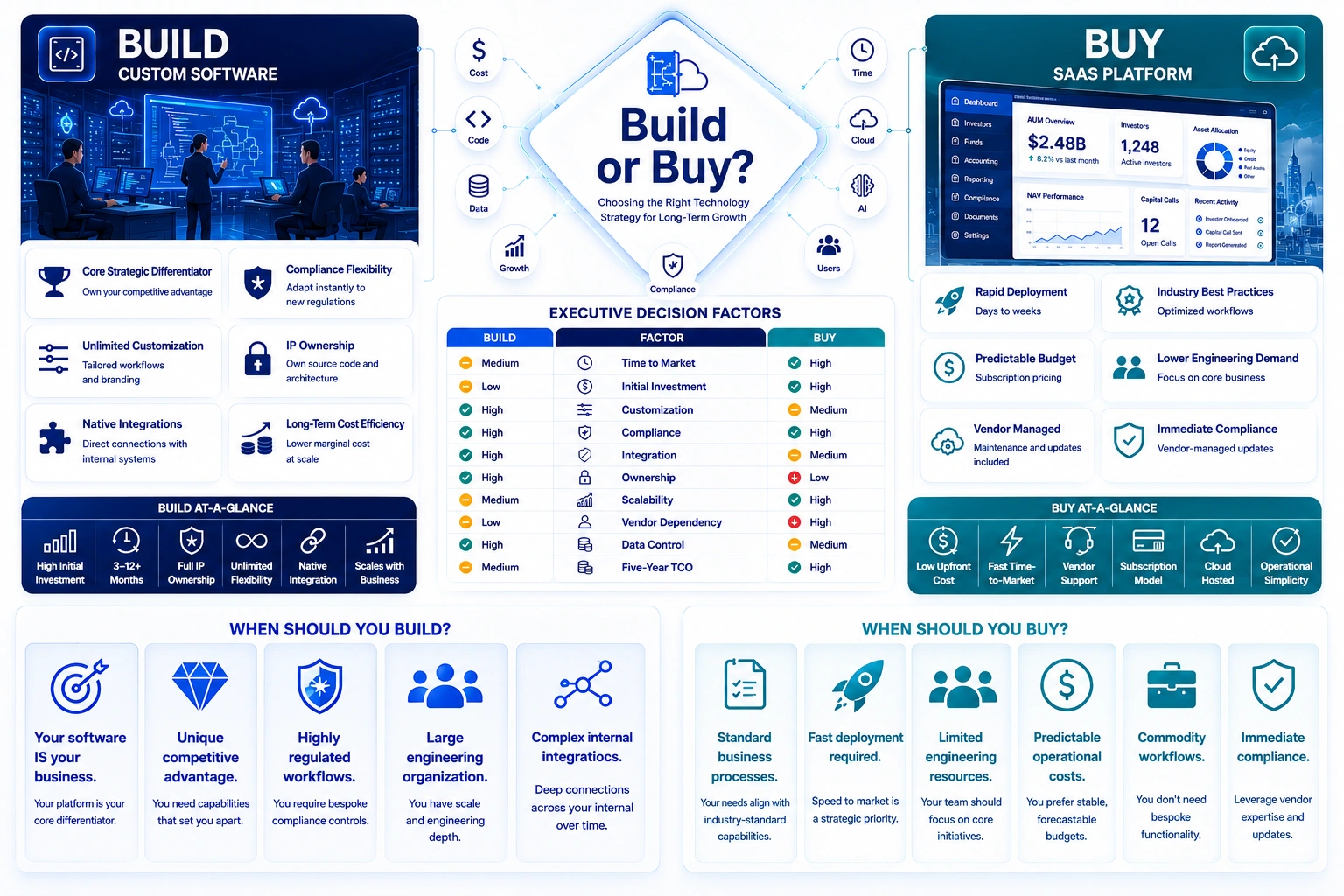
To make the right choice, leadership teams must evaluate whether the fund adiministration software development serves as a core competitive differentiator or a standardized operating requirement.
A. When buying software makes more sense
Purchasing a commercial off-the-shelf (COTS) or Software-as-a-Service (SaaS) platform is generally the optimal path when speed, predictability, and standard utility take priority over custom IP creation.
- Standardized Industry Workflows: If your operational requirements align 80% or more with existing market solutions (e.g., standard CRM, core accounting, basic HR, or turnkey KYC verification), off-the-shelf platforms leverage years of vendor optimization.
- Urgent Time-to-Market Constraints: When compliance deadlines or product launch dates require deployment within days or weeks rather than quarters, buying delivers immediate functionality.
- Predictable Upfront Budgeting: Off-the-shelf software eliminates initial engineering capital expenditure (CapEx) in favor of predictable, recurring operational expenditures (OpEx).
- Limited Internal Engineering Capacity: If maintaining custom software diverts your engineering team away from core product innovation, leveraging vendor-managed maintenance and security updates is vastly more efficient.
B. When building becomes the better investment
Developing proprietary software in-house or with a dedicated engineering partner becomes necessary when custom workflows directly form your business’s competitive moat.
- Core Strategic Differentiator: If the software drives the exact reason clients choose your platform over competitors (e.g., a unique proprietary risk-scoring algorithm or specialized automated underwriting system), you should own the underlying intellectual property (IP).
- Niche or Highly Complex Regulatory Mandates: When operating across multiple jurisdictions with complex compliance rules that off-the-shelf vendors cannot natively support without painful, costly workarounds.
- Deep Legacy System Integrations: If connecting off-the-shelf software to internal core databases requires building massive custom middleware, building a tailored solution natively into your stack is often cleaner and cheaper in the long run.
- High Seat or Volume Scale: For rapidly growing firms, SaaS per-seat licensing or per-transaction licensing models can scale exponentially, making a custom-built solution significantly cheaper over a 3-to-5-year horizon.
C. Build vs Buy Comparison Across Key Decision Factors
Choosing between building custom software and buying off-the-shelf solutions is a critical business decision that impacts cost scalability control and long-term operational efficiency across organizations of all sizes in today’s businesses.
The table below provides a comprehensive comparison of building vs. buying across key operational, technical, and financial criteria:
| Comparison Factor | Building Custom Software | Buying Off-the-Shelf / SaaS |
| Initial Investment | High: Upfront investment for architecture, development, and testing (€50,000–€300,000+). | Low–Moderate: Subscription or license-based pricing with minimal setup costs. |
| Time to Deployment | 3–12+ Months: Full software development lifecycle from discovery to launch. | Days–Weeks: Rapid onboarding with configurable setup. |
| Customization | Unlimited: Built around your workflows, branding, and business rules. | Limited: Restricted by vendor features and configuration options. |
| Compliance Flexibility | Complete: Adapt compliance rules, audit trails, and reporting as regulations evolve. | Vendor-Dependent: Compliance updates rely on the vendor’s release cycle. |
| Integration Capability | Native: Direct integration with internal systems, databases, and APIs. | API-Dependent: Relies on vendor APIs, webhooks, or middleware. |
| Long-Term Ownership | Full IP Ownership: Complete ownership of source code and architecture. | No IP Ownership: License-based access to vendor-owned software. |
| Vendor Dependency | None: Full control over hosting, code, and future development. | High: Migration and vendor switching can be costly and disruptive. |
| Data Control | Full Data Sovereignty: Self-hosted or private cloud deployment options. | Vendor-Managed: Data resides within the vendor’s cloud infrastructure. |
| Five-Year Total Cost | High Year-1 CapEx ($117,000–$351,000), followed by 15–20% annual maintenance ($18,000–$70,000/year); 5-year TCO is approximately $187,000–$632,000. | Low setup ($6,000–$23,000), but annual subscriptions ($29,000–$94,000+/year) grow 2×–4× as seats, transaction volumes, and add-ons scale; 5-year TCO is approximately $176,000–$585,000+. |
Note: While off-the-shelf software offers faster deployment and lower upfront costs, custom fund administration software development provides greater flexibility, ownership and long-term value. The right choice ultimately depends on your firm’s growth strategy, operational complexity, compliance requirements and total cost of ownership.
How Much Does It Cost to Build Fund Administration Software
Building custom fund administration software requires balancing complex ledger logic, multi-entity accounting rules, strict security, and regulatory compliance. Depending on whether you need a proof-of-concept for a single fund strategy or an enterprise-grade platform managing complex multi-currency umbrella structures, development costs generally range from $50,000 to $450,000+.
The table below breaks down typical fund administration software development cost ranges, development timelines, and feature scopes across three primary software tiers:
| Software Tier | Estimated Cost Range | Timeline | Core Scope & Features Included |
| MVP Development | $50,000 – $85,000 | 3 – 4 Months | Basic capital calls & distribution tracking, static LP portal, manual NAV inputs, basic PDF reporting, single-currency support. |
| Mid-Scale Platform | $90,000 – $220,000 | 5 – 8 Months | Automated NAV calculation, multi-entity waterfall engine, interactive LP self-service portal, CRM & deal pipeline, standard bank API integrations. |
| Enterprise Platform | $250,000 – $450,000+ | 9 – 14+ Months | Multi-currency & multi-jurisdictional support, real-time transaction monitoring, AI audit logs, advanced reporting engines (SFDR, AIFMD II), core banking API connectors. |
A. Major Factors Affecting Development Budget
Several core architectural and operational variables dictate where your custom fund administration software development build will fall within the price spectrum:
- Waterfall Complexity & Calculations: Simple fee distribution is easy to program, but multi-tiered waterfall models (e.g., American vs. European style, dual-tired hurdles, clawbacks, co-investments) need intensive math architecture and testing, adding $20,000 – $50,000 in backend engineering.
- Investor Portal & Interactive Reporting: Upgrading from static file sharing to dynamic, real-time interactive LP dashboards (offering custom tax documents, capital statements, and live performance metrics) significantly expands UI/UX design and frontend development scope.
- Accounting Architecture (Single vs. Multi-Entity): Basic single-fund accounting is straightforward, whereas multi-tenant, multi-currency structures require complex cross-fund consolidation, automated inter-company eliminations, and FX recalculations.
- Security & Regulatory Audit Trails: Adding SOC 2 Type II controls, field-level database encryption, immutable audit logs for transactions, and granular Role-Based Access Control (RBAC) increases infrastructure costs by 15% to 25%.
B. Third-Party Infrastructure and Licensing Costs
Beyond direct software engineering hours, fund administration software development rely on ongoing third-party services and cloud infrastructure that contribute to the annual operational fund administration software development budget:
| Infrastructure / Service | Purpose | Typical Cost |
| Cloud Infrastructure & Managed Databases | Provides high-availability servers, database clusters, backups, and environments via AWS or Azure. | $800–$3,500/month |
| Financial & Market Data APIs | Delivers FX rates, valuations, and pricing via Bloomberg, Refinitiv, or Fixer.io. | $300–$5,000+/month |
| Banking & Open Banking Connectors | Enables bank reconciliation and synchronization via Plaid, Yodlee, or SWIFT/SEPA. | $0.10–$0.50 per connected account/transaction |
| Identity & Compliance SDKs | Automates KYC/AML, screening, and e-signatures via Sumsub, ComplyAdvantage, and DocuSign. | $1.50–$3.50 per verification |
| Security, Monitoring & Observability (SIEM/APM) | Offers monitoring, tracking, logging, and threat detection via Datadog, New Relic, Splunk, and CloudWatch. | $200–$2,000+/month |
Hidden Costs of Building vs Buying Fund Admin Software
Standard “Build vs. Buy” guides often simplify the decision into a basic calculation: comparing Year 1 engineering salaries against annual SaaS license costs. This shallow framing overlooks major operational pitfalls that disrupt budgets and tech roadmaps 12 to 36 months post-launch.
A thorough total cost of ownership (TCO) model must account for these five hidden challenges.
Hidden Cost Comparison at a Glance
The table below compares the most significant hidden cost factors associated with building proprietary software versus purchasing commercial fund administration software.
| Hidden Factor | Built Proprietary Software | Purchased Commercial Software |
| Workflow Alignment | Built around internal workflows, eliminating manual workarounds and $15,000–$40,000/year in productivity loss. | Teams adapt to vendor processes, creating manual work and $20,000–$50,000+/year in hidden labor costs. |
| Integration Complexity | Connects directly with your databases and technology stack, minimizing long-term maintenance. | Requires APIs, ETL scripts, and migration tooling, adding $10,000–$40,000 per integration plus $5,000–$15,000 for migration. |
| Pricing Predictability | Cloud infrastructure typically costs $500–$3,000/month with no per-user or transaction fees. | Subject to 8–15%+ annual renewals, $50–$250+/user/month licensing and API overage charges. |
| Compliance Control | Manage audit logs, data residency, and compliance updates internally, typically costing $10,000–$30,000/year. | Compliance updates depend on the vendor’s release cycle. Custom requirements can add $15,000–$35,000 in development costs. |
| Maintenance & Technical Debt | Bug fixes, dependency upgrades, and refactoring typically require 15–20% of the initial development budget ($20,000–$60,000/year). | Core platform maintenance is handled by the vendor, while custom integrations and APIs typically require $5,000–$15,000/year. |
Note: Hidden costs rarely appear in initial project estimates or vendor pricing, yet they often have the greatest impact on long-term ROI. Evaluating workflow flexibility, integration complexity, compliance requirements, and scalability is essential for informed technology decisions.
The comparison above highlights how hidden costs accumulate differently across build and buy models. The following sections break down each factor in detail to clarify real-world financial and operational impact.
1. Custom Workflow Limitations
Off-the-shelf software is designed for standardized operations, often forcing firms to rely on spreadsheets, manual workarounds, and disconnected processes. These inefficiencies reduce productivity, increase human error, and limit the ability to build operational differentiation.
2. Integration & Migration Costs
Integration with legacy systems often requires custom APIs, middleware, data migration, and ETL pipelines. These efforts increase implementation complexity, extend deployment timelines, and introduce costs that are rarely reflected in vendor pricing.
3. Vendor Lock-In Risks
Heavy reliance on a vendor can lead to recurring price increases, limited roadmap influence, and costly migration barriers. As firms scale, switching platforms or extracting data may become expensive, slow, and operationally disruptive.
4. Compliance Maintenance Costs
Compliance requires continuous investment in regulatory updates, reporting standards, data residency rules, and security certifications. These ongoing changes are essential to maintain audit readiness and reduce multi-jurisdictional regulatory risk.
5. Technical Debt & Long-Term Maintenance
All software accumulates technical debt through evolving requirements, system upgrades, and infrastructure changes. Without ongoing refactoring and modernization, organizations face rising maintenance costs, integration failures, and reduced engineering capacity for innovation.
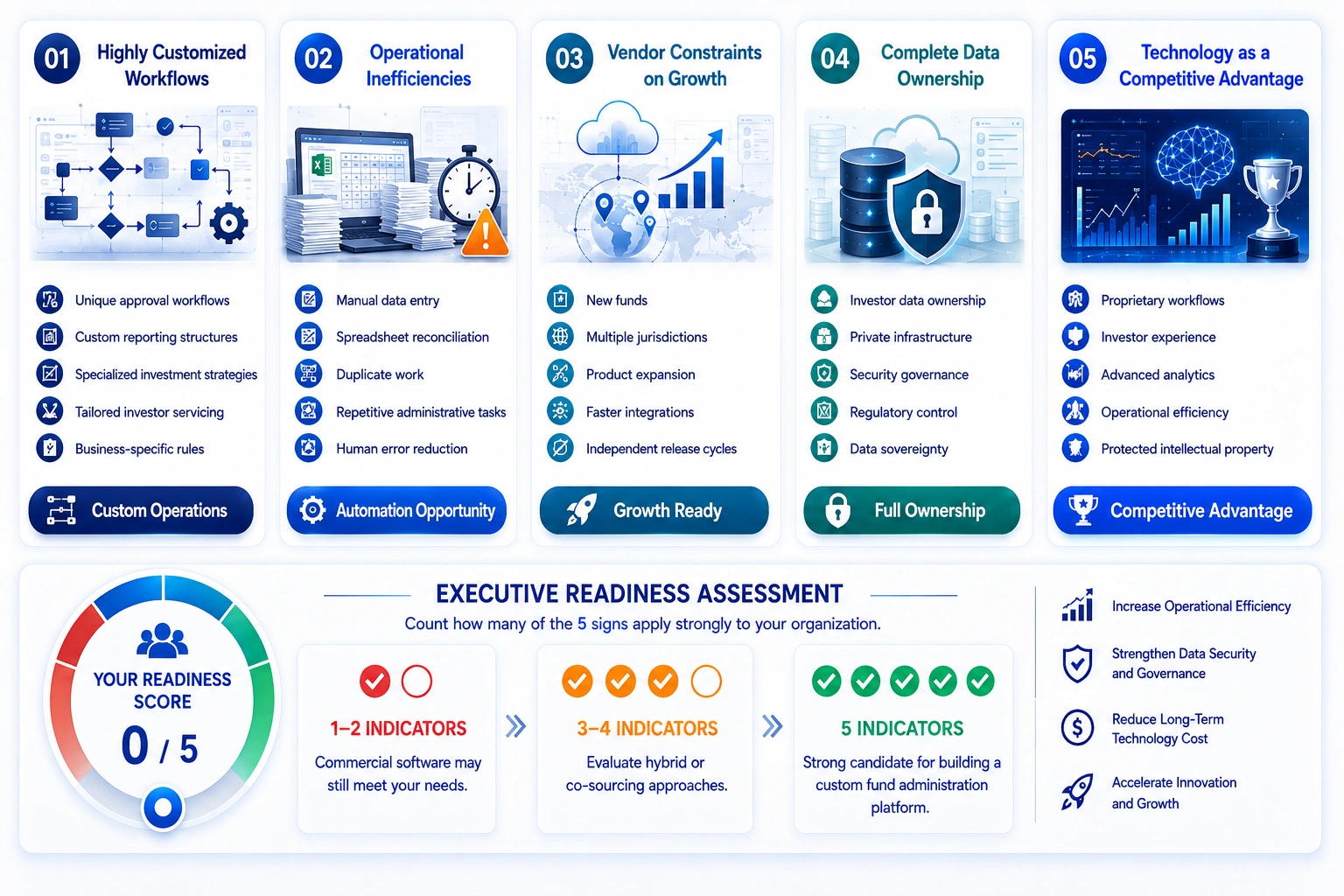
Signs Your Firm Should Build Fund Admin Software Instead of Buy
Commercial fund administration platforms are ideal for standardized operations but often fall short for firms with complex workflows or ambitious growth plans. In such cases, custom fund administration software offers greater flexibility, scalability, and long-term value.
1. Highly Customized Workflows
If your fund operations depend on unique approval workflows, reporting structures, investment strategies, or investor servicing processes, custom software aligns with your operations instead of forcing teams to adapt to vendor-defined workflows.
2. Operational Inefficiencies in Existing Tools
Frequent manual data entry, disconnected spreadsheets, duplicate work, and repetitive administrative tasks reduce productivity. Custom software automates fund workflows, improves operational efficiency, and minimizes costly human errors across the investment lifecycle.
3. Vendor Constraints on Growth
Expanding into new funds, jurisdictions, or investment products often exposes commercial software limitations. A custom platform enables faster feature expansion, integrations, and compliance updates without relying on vendor release cycles.
4. Complete Data Ownership Requirements
Managing sensitive investor data, financial records, and compliance information requires stronger control over infrastructure, security, and governance. Custom software provides complete data ownership while supporting evolving regulatory requirements.
5. Technology as a Competitive Advantage
If proprietary workflows, investor experiences, analytics, or operational efficiency differentiate your firm in the market, relying on the same software as competitors limits innovation. Building custom fund administration software protects your intellectual property and creates capabilities that competitors cannot easily replicate.
How IdeaUsher Helps Build Enterprise-Grade Fund Admin Software
IdeaUsher operates as an elite product engineering partner and fintech innovator, leveraging 11+ years of mastery across 50+ countries. Driven by a global team of 250+ niche experts, over 1,000+ completed projects, and a top-tier 4.9/5 Clutch rating, we build high-capacity fund administration platforms from scratch.
We build enterprise fund accounting architectures complete with automated NAV microservices, real-time capital call engines, LP/GP reporting portals, and multi-currency reconciliation gates to ensure your absolute market dominance.
A. Deep Expertise in Fintech & Fund Administration
We combine deep financial engineering with modern software architecture to automate complex accounting workflows and investor communications across private equity, venture capital, and hedge funds.
- Automated NAV & Multi-Asset Accounting: We build high-precision engines that automate NAV processing, multi-asset accounting, waterfall distributions, and fee calculations across complex fund structures.
- LP/GP Reporting Portals: We develop secure web and mobile investor portals with real-time capital calls, distribution statements, and portfolio performance dashboards for LPs and GPs.
- Automated Reconciliation & Bank Integrations: We connect custodian banks, prime brokers, and payment systems via secure APIs to automate cash, transaction, and position reconciliations across fund operations.
B. Compliance-First & Secure Development
We protect high-value assets and sensitive investor data by embedding strict regulatory compliance and security safeguards into every layer of your platform.
- SOC 1, SOC 2 & ISO 27001 Security Infrastructure: We build cloud architectures aligned with SOC 1, SOC 2, and ISO 27001, implementing AES-256 encryption for data at rest and in transit.
- Automated KYC/AML & Investor Verification: We integrate automated KYC/AML screening, accredited investor verification, and global sanctions checks to streamline compliant investor onboarding.
- Immutable Audit Trails & RBAC: We implement Role-Based Access Control (RBAC) and immutable audit logs to securely track every transaction, ledger update, and approval for regulatory audits.
C. End-to-End Product Development & Long-Term Support
We provide full lifecycle technical partnership, guiding your fund administration software from initial architecture blueprinting to commercial deployment and continuous scaling.
- Discovery & Software Blueprinting: We define your platform architecture, including database schemas, reporting logic, and third-party API integrations before development starts.
- Agile Engineering & QA: We use pre-audited software accelerators and run continuous load, security, and financial stress testing throughout development.
- Zero Vendor Lock-In Delivery: We provide clean, fully documented, auditable source code after fund administration software development, ensuring full ownership and long-term flexibility.
Ready to modernize your fund operations with a custom, enterprise-grade fund administration platform? Partner with Idea Usher’s principal fintech and software architects to map out your custom product build today.
Conclusion
Every asset management firm has unique operational priorities, growth plans, and compliance requirements. As a result, the build-versus-buy decision extends beyond technology alone. Evaluating long-term fund administration software development costs, workflow complexity, scalability, and ownership helps determine the right approach. When custom fund administration software development aligns with your business goals, partnering with an experienced development team ensures a secure, scalable, and adaptable platform that supports future growth and evolving regulatory requirements.
FAQs
A.1. Fund administration software development typically costs between $50,000 and $450,000+, depending on platform complexity, compliance requirements, integrations, user roles, automation features, and deployment infrastructure.
A.2. Core features of fund administration software development include fund accounting, NAV calculation, investor onboarding, capital call management, investor reporting, compliance automation, document management, audit trails, and secure integrations with banking and financial data providers.
A.3. The decision depends on operational complexity, growth plans, compliance needs, and customization requirements. Standard software suits generic workflows, while custom development offers greater flexibility, ownership, scalability, and long-term control.
A.4. Custom fund administration software development supports growing fund portfolios, increasing investor volumes, new asset classes, and evolving regulatory requirements without depending on vendor release cycles or licensing limitations.