

Key Takeaways
- AI chart review platforms automate clinical abstraction by analyzing structured and unstructured EHR data with evidence-backed AI.
- Core capabilities include registry automation, longitudinal record analysis, clinical data extraction, evidence validation and EHR integration.
- Healthcare AI improves abstraction accuracy, accelerates quality reporting and reduces manual chart review workloads across health systems.
- Medical LLMs, secure interoperability and explainable AI are essential for building scalable enterprise chart review platforms.
- How Idea Usher can help you build AI chart review platform like Layer Health with clinical intelligence, evidence-grounded AI and healthcare-compliant infrastructure.
Clinical value is no longer created by capturing more patient data but by intelligently reasoning across the data already available. This shift is accelerating adoption of the AI chart review tool like Layer Health as healthcare organizations build platforms that validate evidence, automate registry abstraction and surface clinically meaningful insights at scale.
Traditional chart review relied on manual EHR navigation and time-intensive clinical abstraction. Modern health systems increasingly require AI-powered chart review, automated registry abstraction, longitudinal patient analysis, quality measurement automation, evidence-backed AI, clinical pathway identification, EHR/FHIR integration, real-time insights, specialty-specific workflows, and enterprise-grade AI to improve quality reporting, operational efficiency, and clinical decision-making.
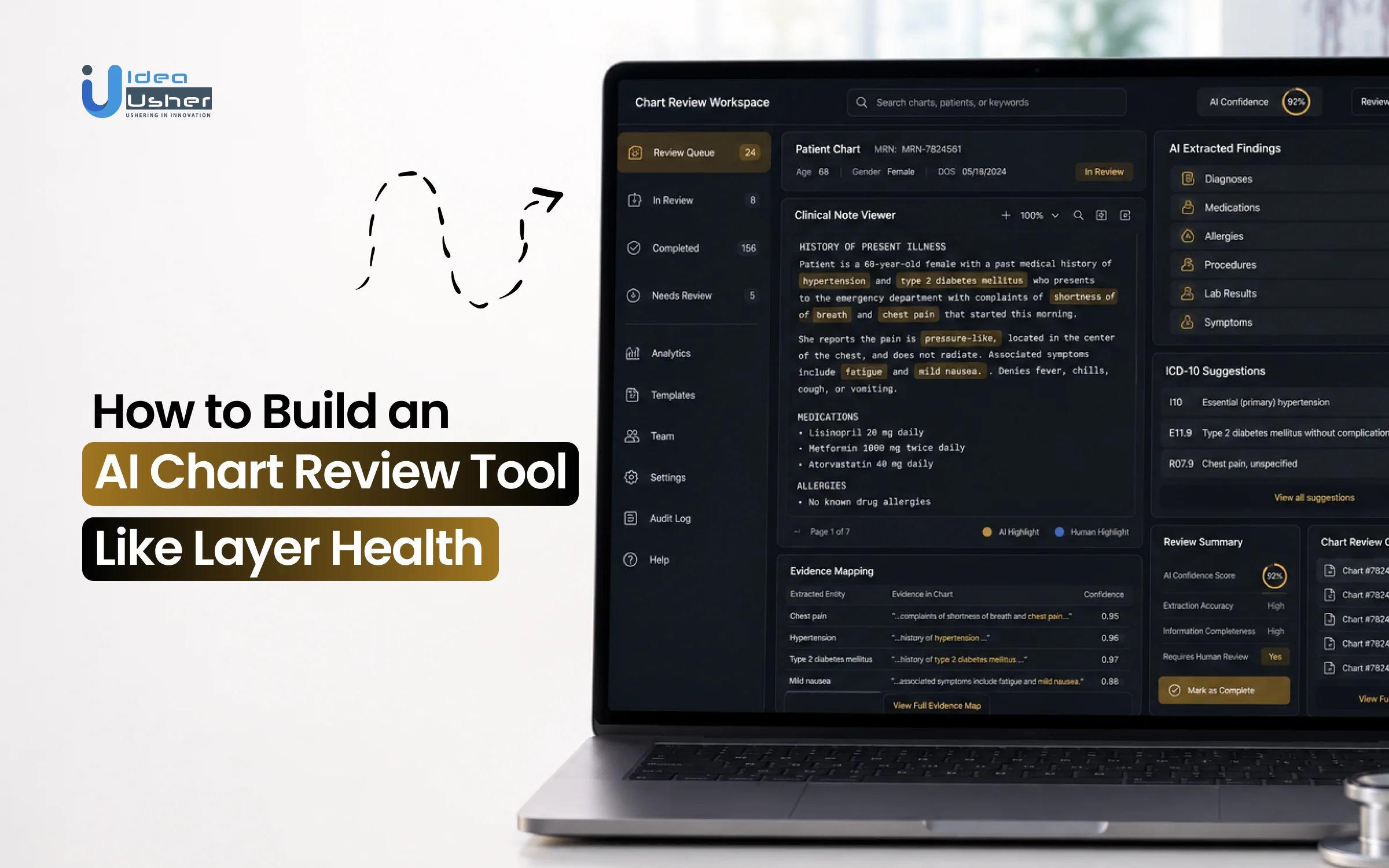
In this blog, we explore how to build an AI chart review tool like Layer Health, covering its core features, AI architecture, technology stack, and clinical workflows, and how IdeaUsher can help build enterprise-grade medical chart review AI platforms that deliver evidence-aware clinical intelligence across structured and unstructured health records.
Why AI Chart Review Is Replacing Manual Clinical Abstraction
Healthcare organizations are replacing manual chart review with AI-powered clinical abstraction as data complexity and compliance demands grow. The clinical data analytics market is projected to reach $10.42 billion by 2035, making AI essential for scalable, efficient clinical data management.
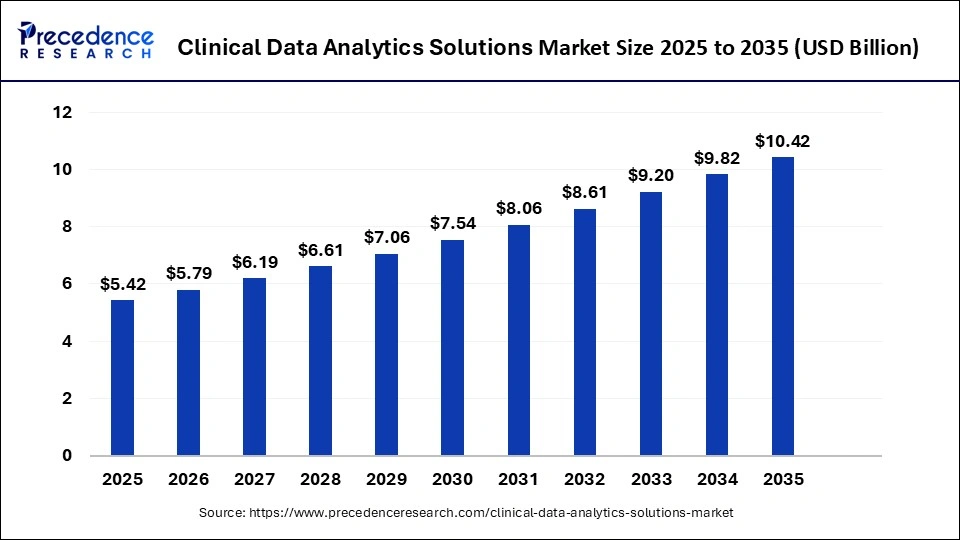
This transition represents an industry-wide push to manage clinical risk and secure accurate revenue processing. Nationwide, U.S. physician practices spend over $15.4 billion annually on quality reporting alone, with individual clinicians sacrificing an average of 785 hours per year to manual administrative tasks. By replacing slow human workflows with automated, context-aware large language models, enterprise networks are transforming a labor-heavy compliance barrier into a streamlined data pipeline.
A. Why Manual Chart Review No Longer Scales
The operational breakdown in traditional clinical abstraction stems directly from a widening gap between data volume and processing capacity. Attempting to parse modern Electronic Health Records (EHR) using human review squads creates severe vertical limits on health system capacity:
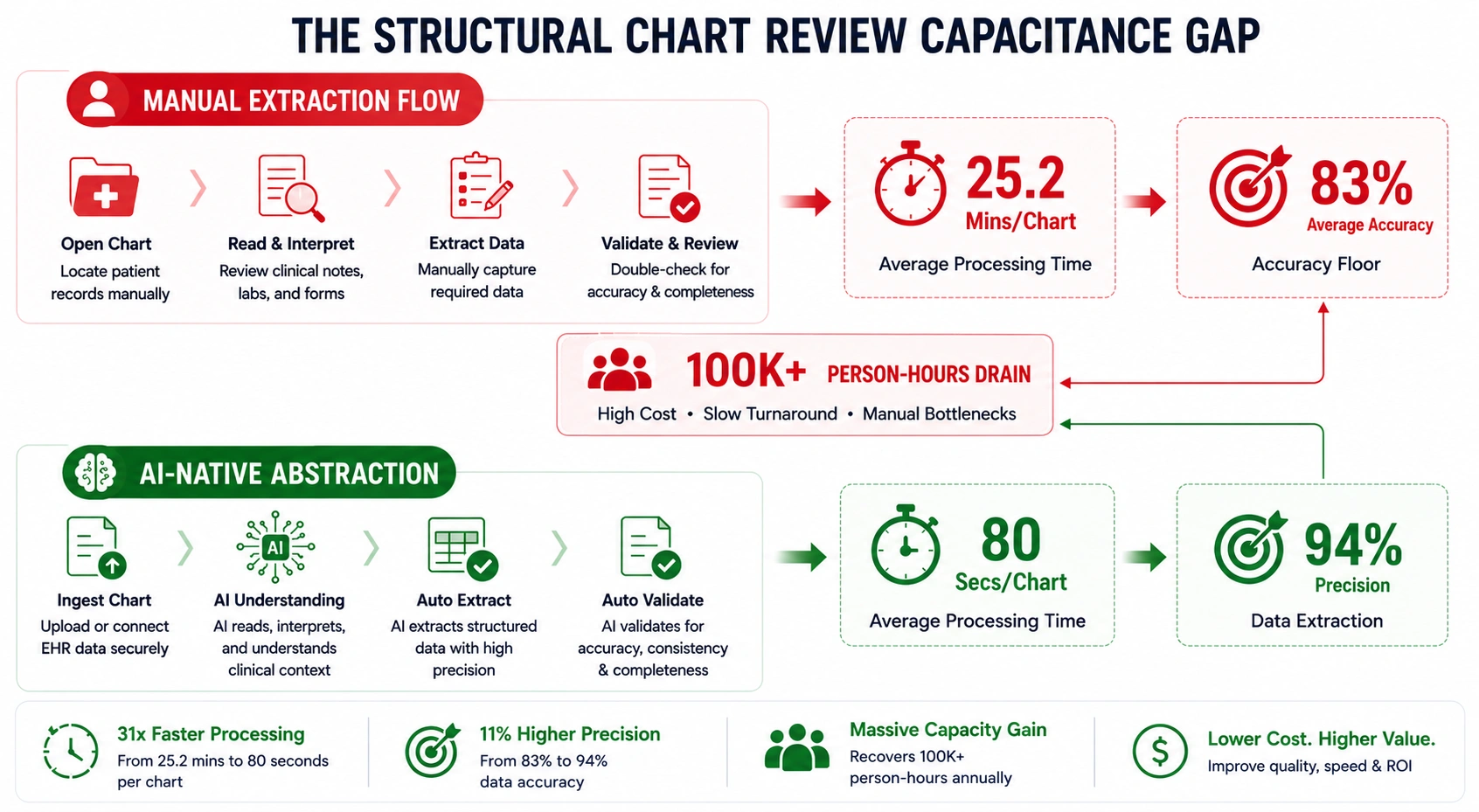
The exponential growth of unstructured clinical data has outpaced human review capacity, making manual abstraction increasingly expensive, inconsistent, and difficult to scale.
- The Unstructured Data Challenge: Healthcare data is growing by 47% annually, with nearly 80% of clinical data trapped in unstructured physician notes, discharge summaries, and pathology reports.
- Unsustainable Time & Labor Costs: Manual chart review takes an average of 25.2 minutes per patient record. For a single acute care hospital, quality reporting can exceed 100,000 person-hours and $5 million annually in labor costs.
- Human Error & Inconsistent Extraction: Manual abstraction is prone to variability, with average extraction accuracy of around 83%. This results in missed clinical insights, delayed value-based reimbursements, and costly reporting errors.
B. Why Healthcare Is Shifting Toward AI-Powered Clinical Abstraction
To resolve these massive vertical backlogs, the clinical ecosystem is adopting specialized, agentic AI platforms. Rather than relying on rigid, first-generation keyword scrapers that fail when text structures shift, modern clinical abstraction platforms employ semantic reasoning models capable of fully understanding clinical intent.
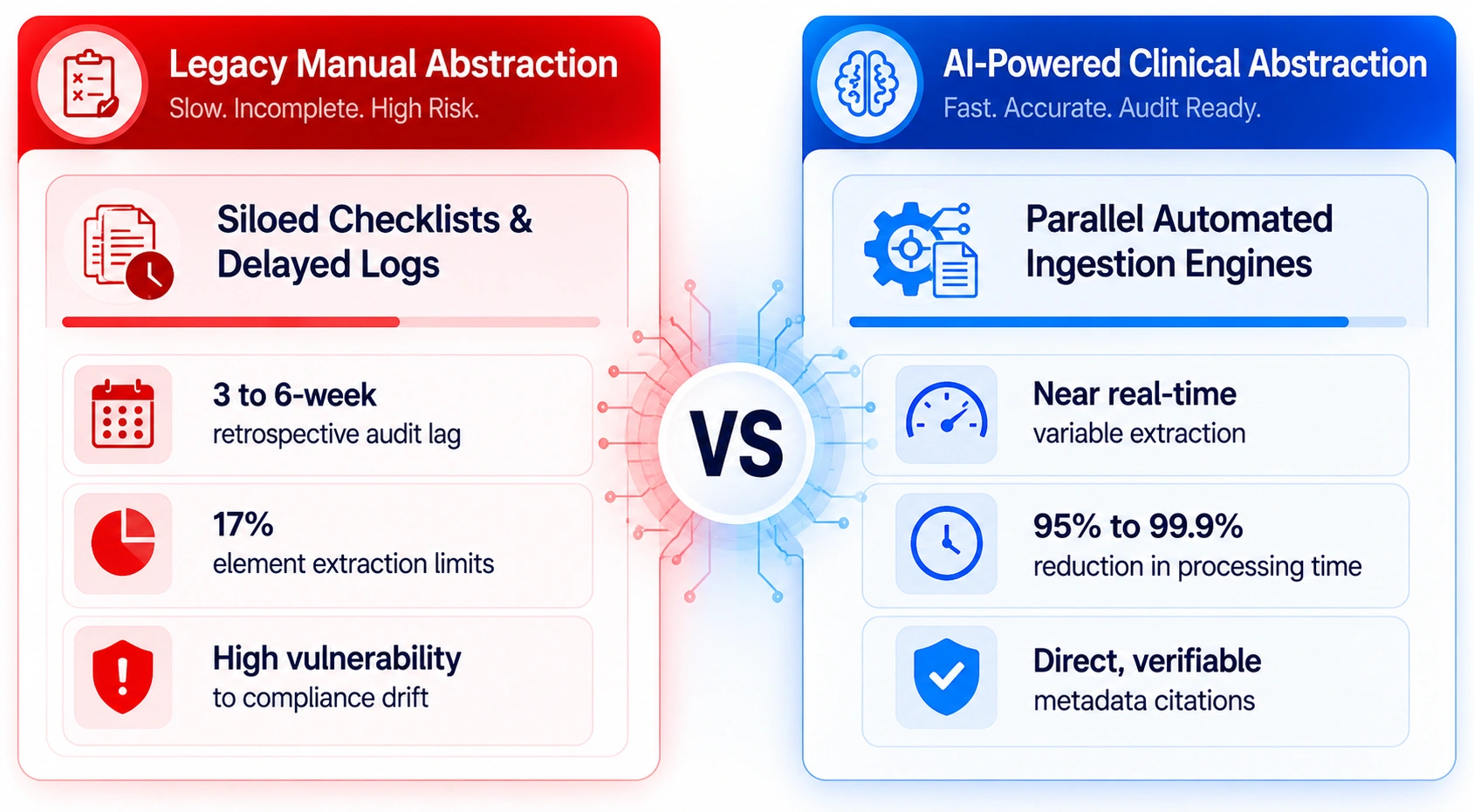
These platforms connect as a secure read-only layer via FHIR-native APIs, mapping directly across thousands of interconnected sub-systems. The processing shift delivers massive operational scale:
- 95% Case Compression Velocity: Advanced AI tools compress the chart processing window from 25.2 minutes down to just 80 seconds per patient record. When scaled across a large cohort, parallel cloud processing achieves a 99.9% time reduction compared to manual labor.
- Semantic Understanding: Modern architectures easily scan unstructured clinical logs to capture precise variables for registries such as NSQIP surgical data or oncology metrics. The systems extract these points with a 94% variable extraction accuracy, outperforming human benchmarks while providing embedded source citations to eliminate algorithmic hallucination risk.
C. Why Healthcare Organizations Are Investing in AI Chart Review
For hospital executive boards, Chief Medical Officers, and financial directors, investing in AI chart review software is a highly strategic move to protect clinical margins and capture value-based care incentives. In recent cluster-randomized clinical trials published in JAMA Network Open, deploying an AI-driven clinical abstraction agent drove an 13% absolute improvement in complex core compliance metrics (like sepsis SEP-1 bundles), pushing scores from 70.1% up to 82.9% compliance.
The enterprise performance advantages driving this capital reallocation are clear:
| Enterprise Value Vector | Legacy Manual Abstraction | AI-Powered Clinical Abstraction | Direct Operational & Balance Sheet Impact |
| Data Processing Velocity | Consumes 100,000+ staff hours annually per hospital for manual chart review. | Processes patient records in parallel in under 80 seconds per chart. | Reduces labor costs, saving hospitals up to $5M annually. |
| Audit Resolution Window | Retrospective audits take 3–6 weeks, delaying insights. | Continuously analyzes records in near real time. | Enables proactive quality management and faster interventions. |
| Extraction Precision | Human fatigue limits accuracy to roughly 83%. | Delivers 94% extraction precision with 92% human agreement. | Minimizes data errors and protects value-based care revenue. |
| Registry Reporting | Manual metric extraction slows specialty reporting. | AI extracts up to 60% more data elements for clinical registries. | Accelerates registry submissions without increasing staffi |
The Enterprise Takeaway: Manual clinical abstraction can no longer keep pace with today’s data-intensive healthcare environment. AI chart review software transforms chart abstraction into a scalable, secure, and transparent workflow. With deep EHR integration and semantic text processing, healthcare organizations improve quality reporting, reduce staff burnout, streamline operations, and strengthen long-term financial performance.
What is an AI Chart Review Platform Like Layer Health
An AI chart review platform like Layer Health functions as an advanced infrastructure layer that extracts clinical meaning from unstructured medical records. Rather than operating as a simple search toolbar or a generic transcription plugin, this technology serves as a specialized machine learning workspace. It uses clinical-grade large language models (LLMs) to automatically read, interpret, and organize massive clinical files into audit-ready datasets.
By analyzing thousands of independent electronic health record (EHR) data elements simultaneously, these platforms solve the core administrative backlogs that slow down modern health systems. They automatically isolate vital medical insights while maintaining strict compliance frameworks.
A. What Makes a Layer Health-Style Platform Different
Traditional clinical search systems and first-generation medical AI models function primarily as basic text aggregators. They can isolate single keywords or generate superficial chart summaries, but they cannot handle complex clinical data workflows. A specialized chart review platform operates differently across multiple key performance vectors:
- Longitudinal History Synthesis: Automatically consolidates years of clinical records including progress notes, lab results, imaging, and external documents into a unified patient timeline.
- Structured Data Abstraction: Converts unstructured clinical text into standardized, machine-readable data mapped to ICD-10, CPT, SNOMED CT, and LOINC codes.
- Bidirectional Evidence Grounding: Links every extracted data point to its original chart source, enabling instant verification and reducing AI hallucination risks.
- Unified Quality & Registry Management: Connects clinical data with reporting requirements to automate quality measurement and scale registry reporting with minimal manual effort.
B. How an AI Chart Review Platform Works
An AI chart review platform transforms fragmented clinical records into structured, evidence-backed insights through an intelligent automation pipeline. Each stage combines clinical AI, medical reasoning, and healthcare interoperability to deliver accurate abstraction at scale.
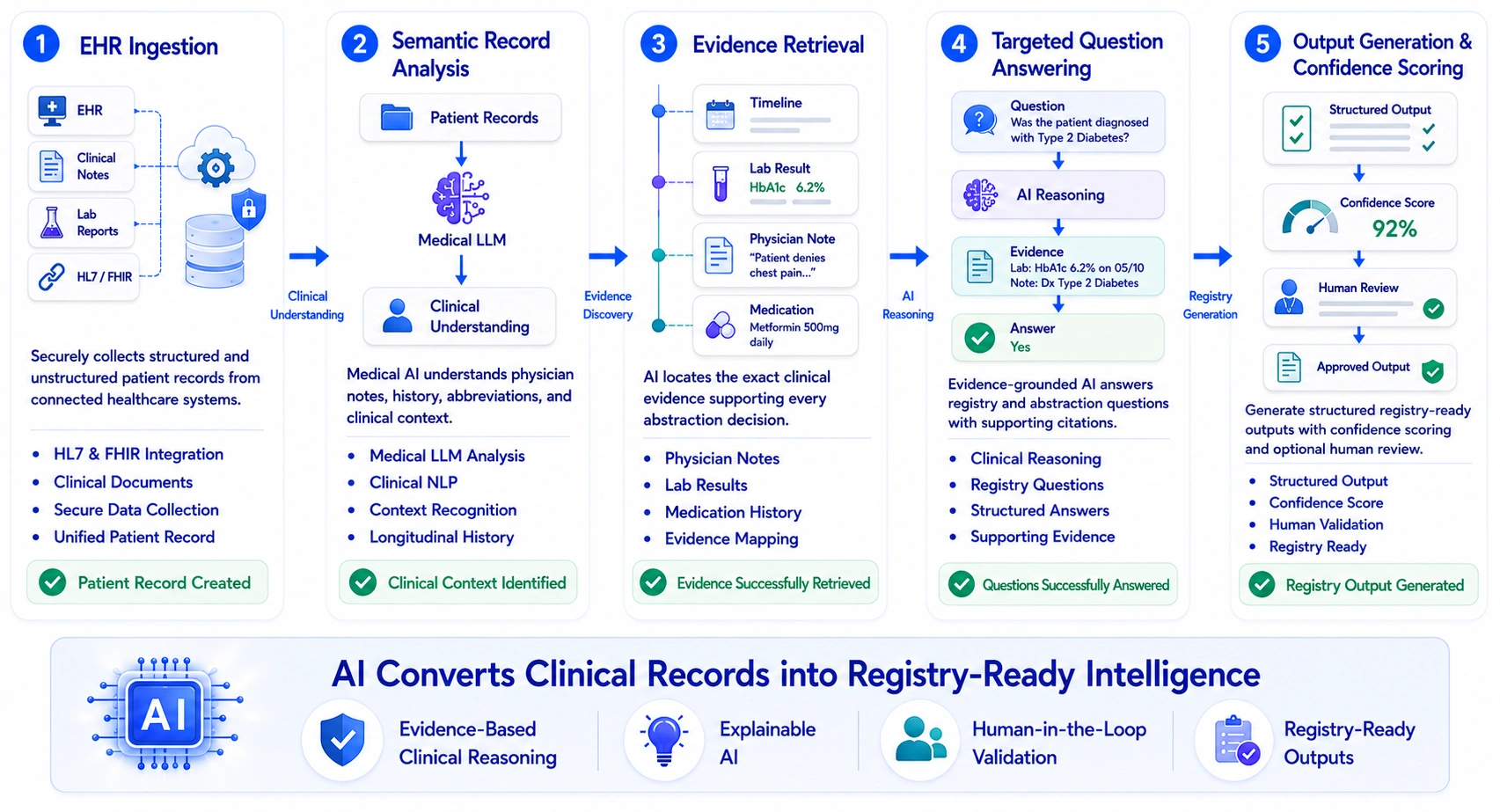
1. EHR Ingestion
The platform securely ingests structured EHR data and unstructured clinical documents through HL7, FHIR APIs, and healthcare connectors, creating a unified patient record foundation for accurate AI-powered chart review and clinical abstraction.
2. Semantic Record Analysis
Medical LLMs and clinical NLP analyze longitudinal patient records, understanding clinical context, negations, abbreviations, contradictions, and physician narratives to accurately interpret complex healthcare documentation across multiple encounters.
3. Evidence Retrieval
The platform retrieves relevant evidence from patient charts by linking clinical findings, physician notes, laboratory results, and historical records to every abstraction variable, ensuring transparent, evidence-backed clinical reasoning.
4. Targeted Question Answering
An evidence-grounded AI engine answers complex clinical abstraction queries by reasoning across multiple patient records, identifying supporting documentation, and extracting structured insights for registries, quality reporting, and clinical workflows.
5. Output Generation & Confidence Scoring
The platform generates structured clinical outputs with supporting evidence and confidence scores, automatically routing low-confidence cases for human validation to improve abstraction accuracy, regulatory compliance, and clinician trust.
C. Where Healthcare Organizations Use AI Chart Review Platforms
Consolidating administrative, financial, and clinical data layers into a single processing platform helps healthcare enterprises eliminate backlogs across multiple departments:
| Systemic Use Case Environment | Core Focus of AI Variable Extraction | Direct Institutional & Financial Value |
| National Clinical Registries | Extracts highly technical variables for specialty registries like NSQIP, GWTG, and STS. | Compresses data collection workloads by 95%, maximizing reporting accuracy. |
| Quality Measurement & HEDIS | Automatically tracks care gap fulfillment metrics across extensive patient groups. | Optimizes quality scoring performance, securing maximum CMS Star Ratings bonus yields. |
| Risk Adjustment (HCC Coding) | Captures hidden Hierarchical Condition Categories (HCC logs) in free text. | Eliminates documentation gaps, preventing severe revenue leakage. |
| Clinical Research & Trials | Scans large chart repositories to instantly identify target candidates for clinical trials. | Cuts study recruitment runways from months down to a few hours. |
| Utilization Management | Cross-references active charts against specific InterQual medical necessity guidelines. | Streamlines care validation, reducing hospital length of stay (LOS) issues. |
The Enterprise Takeaway: Traditional keyword searches and manual chart reviews can no longer support modern healthcare demands. AI-powered chart review platforms transform clinical data extraction into a scalable, secure process, improving registry workflows, revenue cycle accuracy, and the value of enterprise-wide clinical data.
Core Features of an AI Chart Review Tool Like Layer Health
An AI chart review platform delivers value through features that automate clinical abstraction, improve data accuracy, and integrate seamlessly with existing healthcare workflows. Below are the core capabilities that enable faster chart review, evidence-based clinical decisions, and scalable quality measurement across health systems.
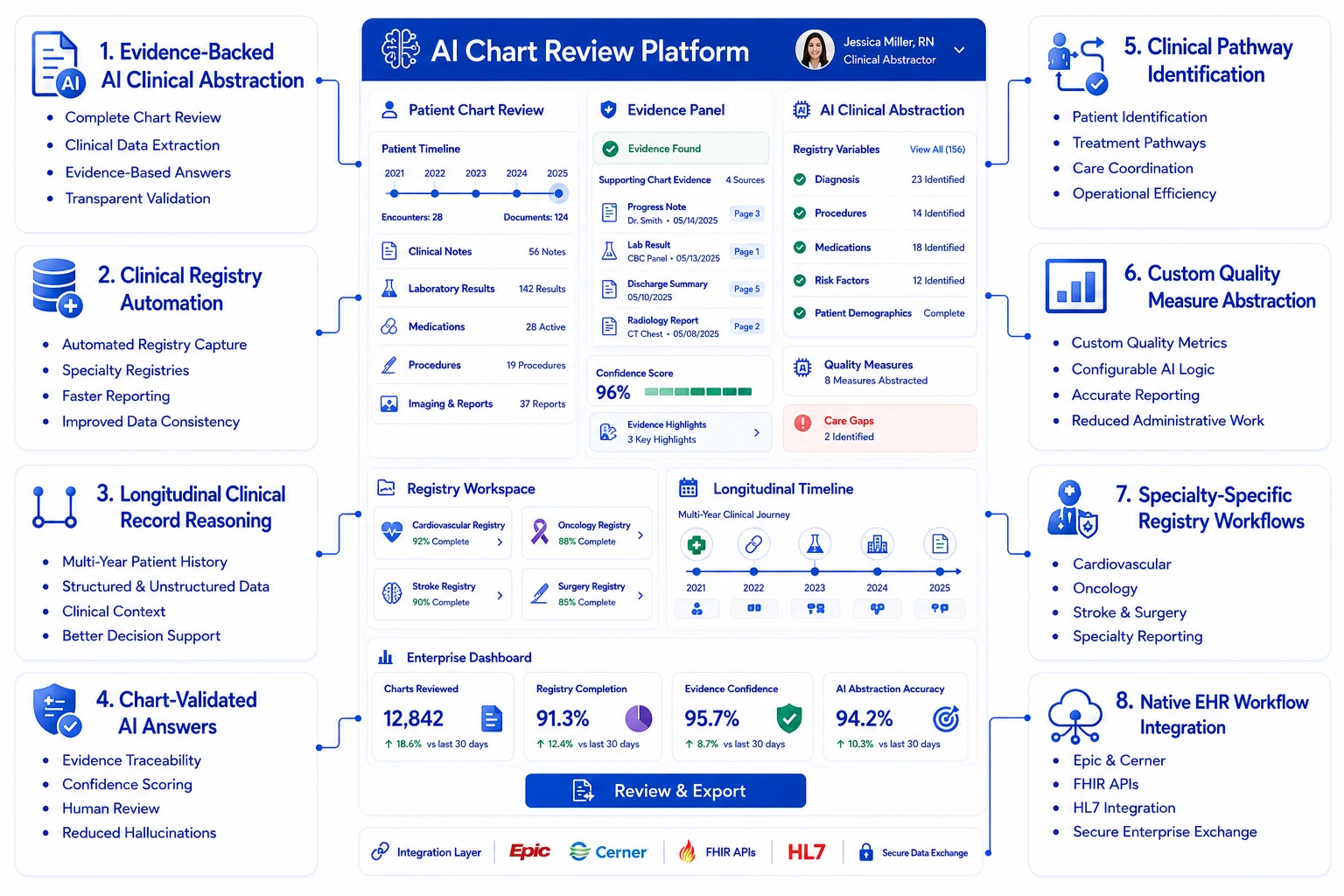
1. Evidence-Backed AI Clinical Abstraction
Evidence-backed AI clinical abstraction enables the platform to review complete patient records, extract clinically relevant information, and answer abstraction questions with supporting chart evidence. This feature improves abstraction accuracy, reduces manual effort, builds clinician confidence, and ensures every clinical insight remains transparent and verifiable.
2. Clinical Registry Automation
Clinical registry automation allows healthcare organizations to capture required registry data without manual chart review. It accelerates abstraction for cardiovascular, oncology, stroke, surgery, and other specialty registries while improving data consistency, reducing reporting delays, and supporting regulatory and quality improvement initiatives.
3. Longitudinal Clinical Record Reasoning
Longitudinal clinical record reasoning enables AI to understand the complete patient journey by analyzing years of structured and unstructured EHR data. This capability uncovers clinically meaningful relationships, improves decision accuracy, and provides comprehensive patient context beyond individual encounters or documents.
4. Chart-Validated AI Answers
Chart-validated AI answers ensure every response is supported by evidence from the patient’s medical record before reaching clinicians. By providing evidence traceability, confidence scoring, and human review capabilities, the platform minimizes hallucinations, improves trust, and supports safe clinical decision-making.
5. Clinical Pathway Identification
Clinical pathway identification helps healthcare organizations automatically identify eligible patients for treatment pathways, quality initiatives, and care management programs. By analyzing diagnoses, medications, laboratory results, procedures, and outcomes, the platform improves care coordination while increasing pathway adherence and operational efficiency.
6. Custom Quality Measure Abstraction
Custom quality measure abstraction enables organizations to automate unique clinical quality metrics beyond standard registry requirements. Configurable AI workflows allow teams to create custom abstraction logic, improve reporting accuracy, reduce administrative workload, and quickly adapt to evolving quality measurement standards.
7. Specialty-Specific Registry Workflows
Specialty-specific registry workflows tailor AI abstraction to the unique clinical requirements of cardiovascular, oncology, stroke, surgery, and other specialties. Customized workflows improve abstraction precision, simplify specialty reporting, and ensure healthcare organizations capture the most relevant clinical information for each registry.
8. Native EHR Workflow Integration
Native EHR workflow integration connects the platform with Epic, Cerner, FHIR, HL7, and other healthcare systems without disrupting existing clinical processes. Seamless interoperability enables clinicians and abstractors to access AI-powered insights directly within familiar workflows while maintaining secure enterprise data exchange.
How to Build an AI Chart Review Tool Like Layer Health
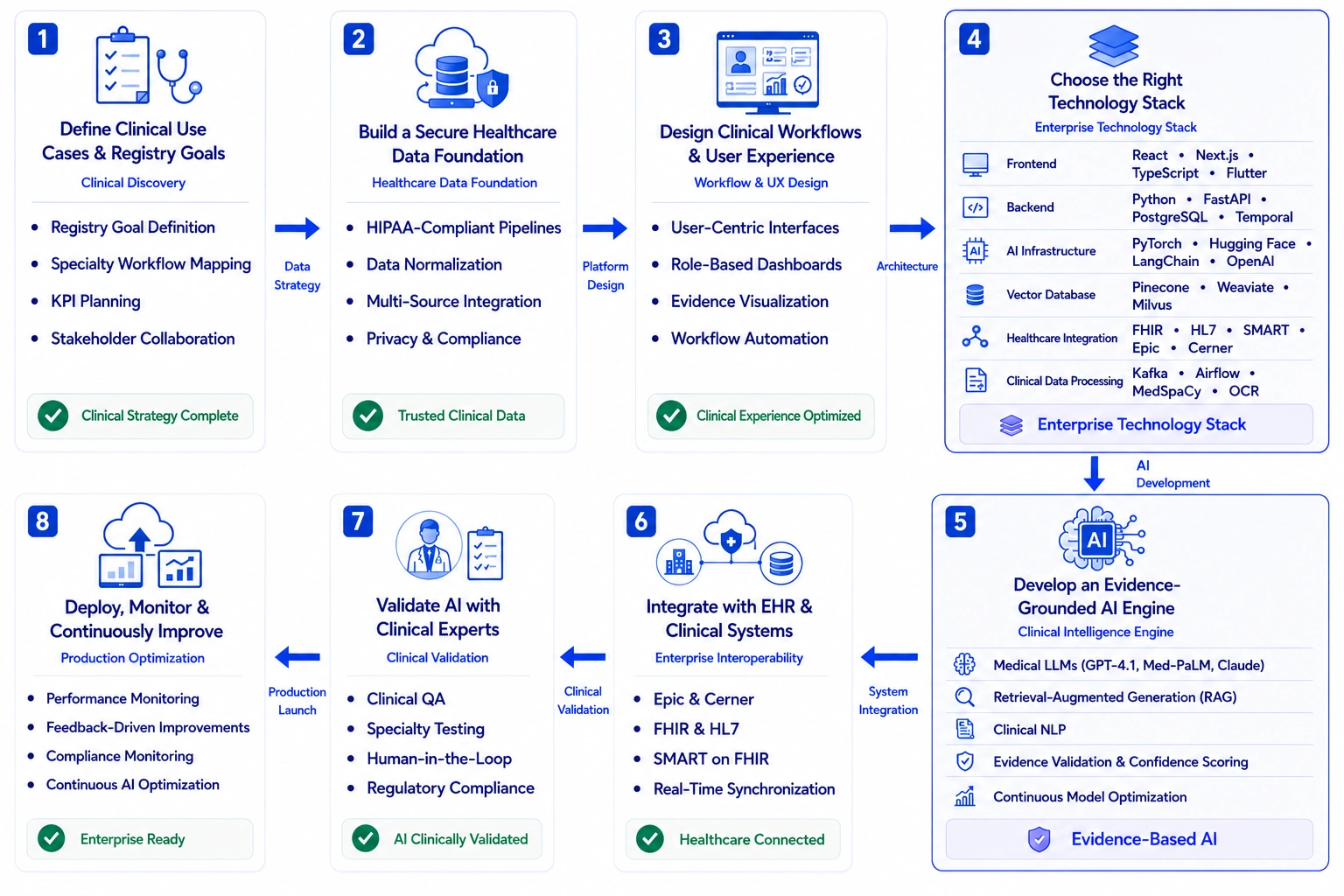
Building an AI chart review platform requires more than integrating a medical LLM. It involves designing secure healthcare infrastructure, developing evidence-grounded AI, ensuring clinical interoperability, and validating every workflow with domain experts to deliver a scalable, enterprise-ready clinical intelligence solution.
1. Define Clinical Use Cases and Registry Goals
We begin by understanding the healthcare organization’s objectives, target specialties, registry requirements, quality measures, and abstraction workflows. This discovery phase ensures the platform solves real clinical challenges while aligning development with measurable business and patient care outcomes.
- Strategic Requirement Alignment: Identifies clinical priorities, registry objectives, and measurable outcomes to guide focused and value-driven platform development.
- Specialty-Specific Use Case Mapping: Defines tailored workflows for different medical specialties to ensure relevance and precision in clinical abstraction.
- Outcome-Driven KPI Definition: Establishes measurable success metrics such as accuracy, efficiency, and compliance to track platform performance.
- Stakeholder Collaboration Framework: Engages clinicians, administrators, and IT teams to ensure alignment across all operational and clinical goals.
2. Build a Secure Healthcare Data Foundation
Our developers create HIPAA-compliant data pipelines that securely ingest, normalize, and organize structured and unstructured healthcare data from EHRs, clinical notes, reports, and external systems, providing the reliable data foundation required for accurate AI-powered clinical reasoning.
- Secure Data Infrastructure Setup: Establishes compliant pipelines to collect, standardize, and manage healthcare data securely across multiple clinical sources.
- Data Normalization and Standardization: Ensures consistency across diverse healthcare data formats for accurate AI processing and interoperability.
- Multi-Source Data Integration: Aggregates data from EHRs, labs, imaging systems, and external databases into a unified platform.
- Privacy and Compliance Enforcement: Implements encryption, access controls, and audit mechanisms to maintain HIPAA and regulatory compliance.
3. Design Clinical Workflows and User Experience
Next, we design intuitive workflows for clinicians, abstractors, and quality teams. Every dashboard, abstraction screen, approval process, and evidence review interface is optimized to improve productivity while fitting naturally into existing clinical operations.
- User-Centric Workflow Design: Focuses on simplifying clinical tasks through intuitive interfaces that enhance productivity and align with existing healthcare operations.
- Role-Based Interface Customization: Tailors dashboards and tools for clinicians, abstractors, and administrators to improve usability and efficiency.
- Evidence Visualization and Navigation: Enables quick access to supporting clinical evidence for faster and more accurate decision-making.
- Workflow Automation and Task Management: Streamlines repetitive processes and ensures seamless task tracking across teams.
4. Choose the Right Technology Stack
Our team selects enterprise-grade technologies based on scalability, interoperability, security, AI performance, and long-term maintenance. Choosing the right architecture from the beginning reduces technical debt while supporting future product growth and regulatory compliance.
The following table outlines the core technology stack components required to build a scalable and secure AI chart review platform.
| Platform Layer | Recommended Technologies | Purpose |
| Frontend & Clinical Workspace | React, Next.js, TypeScript, Tailwind CSS, Flutter (for mobile app) | Build intuitive clinician dashboards, abstraction interfaces, and responsive user experiences across web and mobile platforms. |
| Backend & Workflow Orchestration | Python, FastAPI, Node.js, Temporal, PostgreSQL, Redis | Manage business logic, APIs, workflow automation, authentication, task orchestration, and high-performance backend services securely. |
| AI Infrastructure & Model Serving | PyTorch, Hugging Face Transformers, vLLM, LangChain, OpenAI, Azure OpenAI | Deploy medical LLMs, RAG pipelines, inference services, prompt orchestration, and scalable AI model serving efficiently. |
| Vector Database & Knowledge Retrieval | Pinecone, Weaviate, Milvus, ChromaDB, Azure AI Search | Store clinical embeddings and retrieve relevant patient evidence for accurate, context-aware AI reasoning and responses. |
| Healthcare Data & EHR Integration | FHIR APIs, HL7, SMART on FHIR, Epic, Cerner, MEDITECH | Connect securely with EHR systems, exchange clinical data, and enable seamless healthcare interoperability across platforms. |
| Clinical Data Processing | Apache Kafka, Apache Airflow, OCR, MedSpaCy, Amazon Comprehend Medical | Process structured and unstructured healthcare data, normalize records, and prepare datasets for reliable AI analysis. |
5. Develop an Evidence-Grounded AI Engine
We build an AI engine that combines Medical LLMs, Retrieval-Augmented Generation, clinical NLP, and evidence validation to generate clinically reliable answers. Every AI response is designed to remain explainable, traceable, and supported by patient-chart evidence.
The following table highlights the key AI technologies that power accurate, evidence-driven clinical abstraction and decision-making.
| AI Technology | Role in the Platform | AI Recommendation |
| Medical LLMs | Understand clinical terminology, medical context, and answer abstraction questions across patient records. | GPT-4.1, Med-PaLM 2, Llama 3.3, Qwen 3, Claude 4 |
| Retrieval-Augmented Generation (RAG) | Retrieves relevant evidence directly from patient charts before generating responses. | LangChain, LlamaIndex, Pinecone, Weaviate, Azure AI Search |
| Clinical NLP Engine | Processes structured and unstructured EHR data, including physician notes, lab reports, discharge summaries, and scanned documents. | Amazon Comprehend Medical, Google Cloud Healthcare NLP, spaCy, MedSpaCy |
| Evidence Validation & Confidence Scoring | Verifies AI-generated outputs against supporting chart evidence while assigning confidence scores for each response. | RAGAS, DeepEval, Guardrails AI, TruLens, LangSmith |
| Continuous Model Optimization | Continuously retrains and validates AI models using health system data, clinician feedback, and abstraction outcomes. | MLflow, Weights & Biases, Azure ML, Vertex AI, Amazon SageMaker |
6. Integrate with EHR and Clinical Systems
The platform is integrated with leading healthcare systems such as Epic, Cerner, MEDITECH, FHIR APIs, and HL7 interfaces, enabling secure real-time data exchange while preserving existing hospital workflows and minimizing implementation complexity.
- Seamless System Integration Strategy: Enables secure connectivity with healthcare platforms to ensure real-time data exchange without disrupting existing workflows.
- Standards-Based Interoperability: Utilizes FHIR, HL7, and SMART protocols for consistent and scalable integrations.
- Real-Time Data Synchronization: Ensures up-to-date patient data is available for accurate AI analysis and decision-making.
- Minimal Workflow Disruption: Maintains existing clinical processes while enhancing them with AI capabilities.
7. Validate AI with Clinical Experts
Before deployment, our healthcare AI specialists and clinical reviewers validate abstraction accuracy, evidence quality, confidence levels, and specialty-specific performance. This process helps reduce hallucinations while ensuring the platform meets enterprise healthcare quality standards.
- Clinical Validation and Quality Assurance: Ensures AI outputs meet healthcare standards through expert review, accuracy checks, and continuous performance evaluation.
- Specialty-Specific Accuracy Testing: Evaluates AI performance across different medical domains to ensure reliability.
- Human-in-the-Loop Review Systems: Incorporates clinician feedback to refine AI outputs and improve trust.
- Regulatory Compliance Verification: Confirms adherence to healthcare standards and guidelines before deployment.
8. Deploy, Monitor, and Continuously Improve
After deployment, we continuously monitor platform performance, AI accuracy, infrastructure health, and user feedback. Ongoing model optimization, compliance monitoring, and performance improvements ensure the platform evolves alongside changing clinical workflows and healthcare regulations.
- Continuous Performance Optimization: Focuses on monitoring system health, improving AI accuracy, and adapting to evolving clinical and regulatory requirements.
- Real-Time Monitoring and Alerts: Tracks system performance and detects issues proactively to ensure reliability.
- Feedback-Driven Iteration: Uses user insights and clinical feedback to refine workflows and AI models.
- Compliance and Update Management: Keeps the platform aligned with evolving healthcare regulations and standards.
Cost to Build an AI Chart Review Tool Like Layer Health
The cost of developing an AI chart review platform depends on clinical complexity, AI capabilities, healthcare integrations, compliance requirements, and deployment scale. A well-planned investment ensures the platform delivers reliable clinical intelligence while remaining secure, scalable, and ready for enterprise healthcare adoption.
A. Development Cost Breakdown by Phase
Every development phase contributes differently to the overall budget. The table below provides estimated costs for both MVP and enterprise-level implementations, ensuring alignment with the platform-level cost ranges.
| Development Phase | Estimated Cost (MVP → Enterprise) | What the Phase Covers |
| Discovery & Clinical Planning | $5,000 – $20,000 | Define clinical workflows, registry requirements, product roadmap, stakeholders, compliance scope, and business objectives. |
| UI/UX Design | $8,000 – $30,000 | Design clinician dashboards, abstraction interfaces, workflow screens, role-based experiences, prototypes, and usability validation. |
| Healthcare Data Infrastructure | $10,000 – $50,000 | Build secure data pipelines, normalization, storage, indexing, and HIPAA-compliant healthcare data architecture. |
| Frontend & Backend Development | $20,000 – $90,000 | Develop responsive applications, APIs, authentication, workflow automation, notifications, and core platform functionality. |
| AI Engine Development | $20,000 – $120,000 | Build Medical LLM workflows, RAG pipelines, NLP models, evidence validation, and clinical reasoning capabilities. |
| EHR & Healthcare Integrations | $10,000 – $70,000 | Integrate Epic, Cerner, MEDITECH, FHIR APIs, HL7, registries, laboratory systems, and healthcare interoperability standards. |
| Testing & Clinical Validation | $5,000 – $40,000 | Perform QA, security testing, AI accuracy validation, clinician review, compliance verification, and performance optimization. |
| Deployment & Ongoing Support | $2,000 – $40,000 | Deploy cloud infrastructure, monitor platform health, optimize AI models, maintain compliance, and provide continuous updates. |
| Total Estimated Cost | $80,000 – $600,000+ | Total combined expenses covering all development phases, resources, tools, and implementation efforts. |
Note: These estimates vary depending on the number of healthcare integrations, AI sophistication, supported specialties, compliance requirements, deployment model, and custom workflow complexity required for your platform.
B. Development Cost by Platform Level
The overall investment largely depends on the platform’s feature set, scalability requirements, AI maturity, and enterprise readiness. While the ranges below are directionally accurate for planning purposes, actual costs can vary significantly based on scope, geography, and regulatory depth.
| Platform Level | Estimated Cost | What Features Include |
| MVP | $80,000 – $165,000 | Basic chart review, Medical LLM integration, RAG, clinician dashboard, authentication, limited EHR integration, and core abstraction workflows. |
| Mid-Level Platform | $170,000 – $370,000 | Advanced clinical reasoning, multiple registries, workflow automation, FHIR integration, analytics dashboard, quality measurement, audit logs, and enhanced security. |
| Enterprise Platform | $400,000 – $600,000+ | Multi-specialty support, extensive EHR integrations, custom AI models, evidence validation, enterprise security, and advanced analytics. |
Important Clarification: These platform-level estimates are not fixed or universally accurate. They represent industry-informed ranges based on typical healthcare AI projects. In reality, costs can increase substantially if you require:
- Deep integrations with multiple EHR systems (especially Epic or Cerner at scale)
- Custom-trained medical AI models instead of API-based LLMs
- Extensive clinical validation and regulatory readiness
- Multi-region deployment with strict compliance requirements
- Highly customized workflows across multiple specialties
Because of these variables, enterprise-grade platforms often exceed initial estimates, especially when transitioning from MVP to production-scale healthcare environments.
C. Factors That Influence Development Budget
Several technical, regulatory, and business decisions directly affect the total development budget. Understanding these cost drivers helps organizations prioritize features, allocate resources effectively, and avoid expensive architectural changes later.
- Volume & Quality of Training Data: The process of collecting, cleaning, annotating, and validating clinical datasets typically costs $15,000–$80,000+, especially when clinician-led labeling is required.
- EHR Integration Complexity: The integration of multiple EHR systems and support for real-time or unstructured data exchange can add $20,000–$70,000, depending on the scope.
- Regulatory Compliance & Certifications: FDA clearance and certifications beyond HIPAA can increase costs by $25,000–$100,000+ due to extensive documentation, validation, and compliance requirements.
- Custom AI vs Pre-trained Models: Proprietary AI models generally cost $50,000–$150,000+, while fine-tuning pre-trained LLMs typically ranges from $20,000–$60,000.
- Real-time Processing Requirements: Real-time chart analysis and clinical decision support require additional cloud infrastructure, adding $10,000–$40,000 compared to batch-processing systems.
- Ongoing AI Maintenance: Continuous retraining, model monitoring, clinical updates, and performance optimization typically cost $5,000–$20,000 per month, depending on platform scale.
Compliance Requirements When Building an AI Chart Review Platform
AI chart review platforms process sensitive patient information and integrate with clinical systems, making regulatory compliance a core development requirement. While several regulatory considerations exist, the following areas form the foundation of most AI chart review platforms and should be prioritized during development.
| Compliance Area | Why It Matters | Development Best Practices |
| HIPAA-Compliant Data Security | Protects Protected Health Information (PHI) and ensures secure patient data handling. | End-to-end encryption, RBAC, audit logs, secure cloud infrastructure, and continuous security monitoring. |
| Healthcare Interoperability Standards | Enables secure data exchange across EHRs and healthcare systems. | HL7, FHIR, SMART on FHIR, secure APIs, standardized data mapping, and bidirectional integration. |
| AI Governance & Clinical Validation | Ensures accurate, explainable, and clinically reliable AI decisions. | RAG, confidence scoring, evidence traceability, human-in-the-loop validation, and continuous model monitoring. |
| Data Privacy & Regional Regulations | Ensures compliance with GDPR and other regional privacy laws. | Data anonymization, pseudonymization, consent management, data residency controls, and privacy-by-design architecture. |
| Auditability & Reporting Compliance | Maintains transparent audit records for regulatory reviews. | Audit trails, activity logging, model versioning, and automated compliance reporting dashboards. |
Note: While these areas are the most critical, additional compliance requirements such as HITECH, FDA guidance for AI-enabled software, and other regional healthcare regulations may also apply depending on the deployment geography and use case.
Practical Challenges in Building an AI Chart Review Platform
Building an AI chart review tool like Layer Health may seem straightforward from a technical standpoint, developers often encounter more nuanced, real-world challenges that go beyond standard data integration or model deployment. These challenges are less about complexity in theory and more about handling inconsistencies, edge cases, and workflow alignment in practice.
1. Inconsistent and Messy Clinical Data
Challenge: Clinical data often contains incomplete records, inconsistent terminology, duplicate entries, and unstructured notes varying significantly across different healthcare providers.
Solution: Our developers build advanced preprocessing pipelines, apply data normalization techniques, and use domain-specific NLP models to clean, standardize, and accurately interpret diverse clinical data inputs efficiently.
2. Alignment of AI Outputs with Clinical Workflows
Challenge: AI-generated outputs may not align with existing clinical workflows, making them difficult to use, disruptive, or less valuable for healthcare professionals.
Solution: Our developers collaborate with clinicians to design intuitive interfaces, generate concise outputs, and ensure AI insights integrate seamlessly into existing workflows, improving usability and clinical adoption.
3. Edge Cases and Exceptions Management
Challenge: Patient data often includes rare conditions, ambiguous documentation, or conflicting information that AI models struggle to interpret accurately and consistently.
Solution: Our developers implement fallback logic, rule-based validation, and human-in-the-loop review systems to manage uncertainties, ensuring reliable outputs while maintaining system efficiency and clinical trust.
Why Choose Idea Usher for an AI Chart Review Platform
IdeaUsher is an elite digital product engineering powerhouse and healthcare technology catalyst. Leveraging 11+ years of industry mastery to launch disruptive, compliant software ecosystems across 50+ countries, we are backed by 250+ niche experts, a portfolio of 1,000+ deployed assets, and a 4.9/5 Clutch credential to construct high-performing healthtech platforms entirely from scratch.
We skip generic templates to handcraft premium, LLM-powered clinical intelligence software optimized with unstructured data extraction, automated registry abstraction, and concurrent clinical documentation improvement (CDI) pipelines to eliminate administrative bottlenecks and capture undisputed market dominance.
Why Enterprises Partner With Us
Healthcare systems, life science groups, and revenue cycle leaders choose us to build advanced clinical reasoning platforms because we transform complex medical charts into highly structured, audit-ready data models instantly.
- Large-Scale Unstructured Data Parsing: Our developers build high-throughput LLM architectures that analyze physician notes, discharge summaries, and pathology reports, converting unstructured EHR data into structured clinical insights.
- Automated Registry Abstraction & Validation: We design machine learning pipelines that extract complex clinical variables with manual-level accuracy across specialties such as cardiology, oncology, and surgery.
- Pre-Bill Chart Reasoning & CDI Assistance: Our systems use real-time AI inference to review patient charts, medications, labs, and vitals, helping identify documentation gaps and support accurate coding before claims submission.
- Bi-Directional HL7 & FHIR Interoperability: We implement secure integration layers during AI chart review tool like Layer Health that connect with major EHR systems, synchronizing patient registries and provider records without disrupting clinical workflows.
- Isolated Multi-Tenant Security Containers: Our developers create independent cloud environments that ensure HIPAA and HITECH compliance by isolating tenant data and preventing cross-contamination.
Ready to eliminate manual clinical review times and uncover deep patient insights with a custom AI chart abstraction engine? Partner with Idea Usher’s principal healthcare tech and AI architects to map out your infrastructure build today.
Conclusion
Healthcare organizations are rapidly moving toward AI-powered clinical intelligence to reduce manual chart review, improve abstraction accuracy, and deliver better patient outcomes. An AI chart review tool like Layer Health combines advanced AI reasoning, secure healthcare integrations, and evidence-backed decision support into a single enterprise solution. With the right development strategy, technology stack, and healthcare expertise, businesses can build a scalable platform that streamlines clinical operations while meeting regulatory standards and creating long-term value for providers, payers, and healthcare organizations.
FAQs
A.1. The AI chart review tool like Layer Health development cost typically ranges from $80,000 to over $600,000+, depending on factors such as AI capabilities, EHR integrations, compliance requirements, clinical workflows, validation processes, and the overall complexity of the platform.
A.2. EHR integration enables secure access to patient records, supports real-time clinical data exchange, improves abstraction accuracy, reduces manual effort, and ensures seamless interoperability across healthcare systems.
A.3. The core features of AI chart review tool like Layer Health include automated data extraction, clinical abstraction, configurable workflows, specialty logic, real-time analytics, EHR integration, quality assurance, and scalable architecture supporting multiple registries and healthcare programs.
A.4. Specialties managing large clinical datasets including cardiology, oncology, orthopedics, neurology, and population health, benefit through faster abstraction, improved documentation quality, and more efficient quality reporting.