

Key Takeaways
- AI supplier sourcing software automates vendor discovery, supplier evaluation, RFQ workflows, and procurement operations.
- Machine learning, NLP, predictive analytics, and agentic AI improve sourcing accuracy and supply chain resilience.
- Modern AI sourcing platforms include supplier discovery engines, procurement copilots, contract intelligence systems, and analytics dashboards.
- Enterprise AI adoption is accelerating through procurement automation, autonomous sourcing workflows, and supplier risk management.
- How Idea Usher can help businesses develop enterprise AI supplier sourcing software with pre-vetted developers and ERP integrations.
Many enterprises today are struggling to manage supplier sourcing in a world where supply chains change constantly due to rising costs, geopolitical disruptions, and stricter sustainability requirements. Yet, many procurement teams still rely on outdated spreadsheets, manual vendor research, and slow approval processes that simply can’t keep up with the speed and complexity of modern global trade.
An AI-powered supplier sourcing platform helps businesses modernize this entire process by turning sourcing into a faster, smarter, and more strategic operation. Instead of spending weeks manually evaluating suppliers, AI can analyze large volumes of supplier, logistics, compliance, and risk data in real time to identify vendors that match specific business needs, pricing goals, and risk requirements. This helps procurement teams make faster sourcing decisions and build stronger supply chains.
We’ve helped enterprises build several AI-powered sourcing solutions using NLP-based supplier analysis, intelligent data extraction, and real-time procurement APIs. In this guide, we’ll explore how to create AI supplier sourcing software for enterprises in 2026, including its features, development process, and business value.
Market Demand for AI Supplier Sourcing Softwares
According to Grand View Research, the global sourcing software market is projected to more than double from USD 5.03 billion in 2025 to USD 10.73 billion by 2033, expanding at a 10.2% CAGR. Driven by intensifying supply chain complexities and a critical need for cost optimization, this growth represents a massive opportunity for enterprise investors. Legacy procurement frameworks can no longer handle modern market volatility, shifting enterprise demand toward intelligent, risk-mitigating software assets.
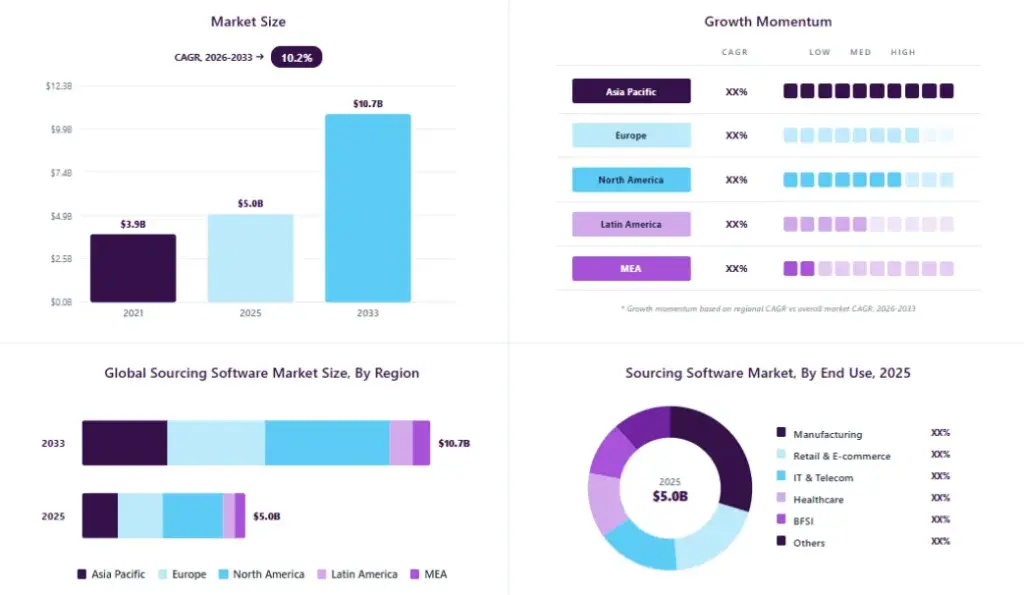
Source: Grand View Research
For entrepreneurs, this market evolution signals a lucrative opening to build next-generation, AI-native platforms. Modern enterprises are actively reallocating capital to replace rigid legacy systems that fail under macroeconomic stress. Capturing this high-value market requires building a platform that directly resolves these architectural gaps, positioning your venture at the center of corporate digital transformation.
Replacing Legacy Sourcing Tools
Traditional strategic sourcing software built on rigid ERP architectures was designed for an era of predictable logistics and static supplier relationships. These legacy platforms function primarily as digitized filing cabinets that rely on manual data entry, siloed spreadsheets, and linear workflows. Enterprise procurement teams routinely spend hundreds of hours manually executing RFPs, verifying supplier compliance certifications, and normalizing pricing bids across disparate regions.
The modern enterprise cannot tolerate the operational friction inherent in these legacy systems. Decision-makers are actively replacing traditional tools due to specific, systemic points of failure:
- Data Fragmentation: Legacy systems cannot synthesize unstructured data from external market indexes, financial health databases, or real-time shipping logs.
- Inability to Scale: When an enterprise needs to source a new component across multiple continents simultaneously, manual supplier discovery creates an operational bottleneck.
- Reactive Risk Management: Traditional tools only flag supplier vulnerabilities after a disruption has occurred, such as a bankruptcy or regulatory violation, rather than predicting it beforehand.
By building a platform that eliminates these inefficiencies, you deliver a direct mechanism for operational cost reduction. Forward-thinking investors recognize that software capable of automating the vendor vetting process compresses enterprise procurement cycles from months to days, unlocking massive capital efficiency for the buyer.
Demand for Procurement Automation
The real market opportunity is the shift from basic digitization to intelligent automation. Modern enterprise buyers demand software that leverages machine learning and natural language processing to analyze data and execute complex sourcing workflows. Industry leaders like Tropic use deep historical spend data to offer predictive cost optimization, while platforms like Zip utilize dedicated AI agents to automate entire intake-to-pay processes.
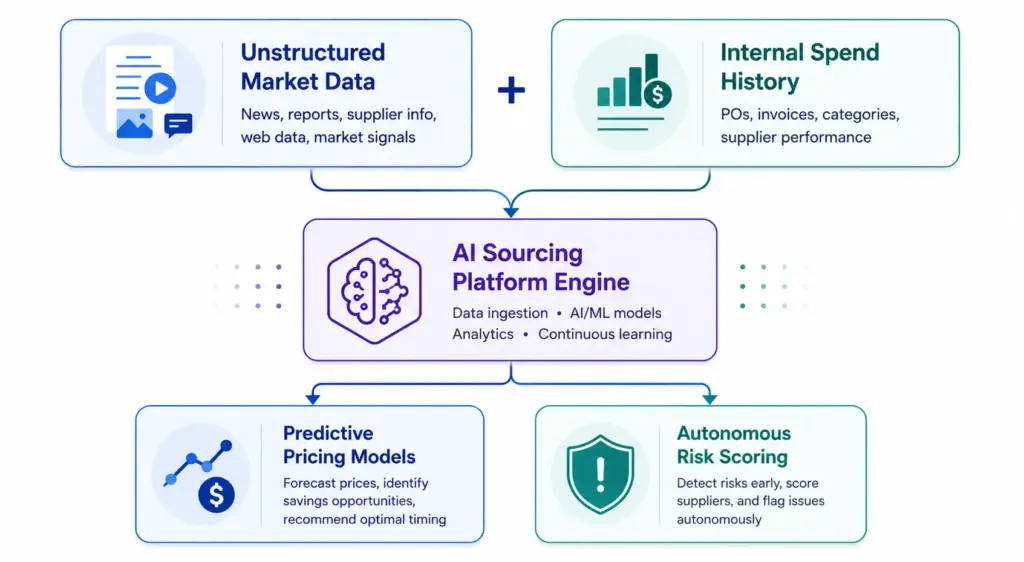
This technology gives enterprises a massive strategic advantage during high-stakes contract negotiations. Instead of human teams manually auditing contract clauses, an AI engine instantly scans historical spending, commodity pricing, and supplier performance. For an investor, backing this level of technical intelligence creates a highly sticky B2B product with steep switching costs and strong recurring revenue.
This structural capability allows the platform to autonomously recommend optimal target pricing, identify hidden volume discount opportunities, and flag unfavorable legal terms before negotiation begins. For an entrepreneur, investing in this level of technical depth creates a sticky B2B product with high switching costs, driving long-term enterprise value and predictable recurring revenue.
Supply Chain Risks Driving AI Adoption
Compounding volatility from trade disputes and logistics disruptions has forced enterprise executives to abandon fragile, just-in-time supply chains. Corporate boards now mandate a shift toward multi-sourcing and vendor diversification, accelerating the adoption of predictive AI tools. In this unstable climate, resilience has become the primary metric for ROI, and organizations are paying a premium for software that offers real-time risk modeling over static historical tracking.
An AI-powered sourcing platform serves as an early-warning system by continuously scanning news, regulatory shifts, and financial markets. When a critical supplier faces insolvency or compliance risks, the software goes beyond a basic alert by autonomously scanning the marketplace, identifying pre-vetted alternatives, and drafting RFPs. For institutional buyers, a platform engineered for this level of real-time data synthesis offers an unparalleled value proposition.
What Is AI Supplier Sourcing Software?
AI supplier sourcing software is an enterprise procurement platform that uses artificial intelligence to automate supplier discovery, supplier evaluation, sourcing workflows, vendor management, RFQ processing, and procurement decision-making. Unlike traditional sourcing systems that rely heavily on manual procurement teams, AI-driven sourcing platforms continuously analyze supplier data, procurement history, compliance records, pricing trends, ESG signals, and operational risks.
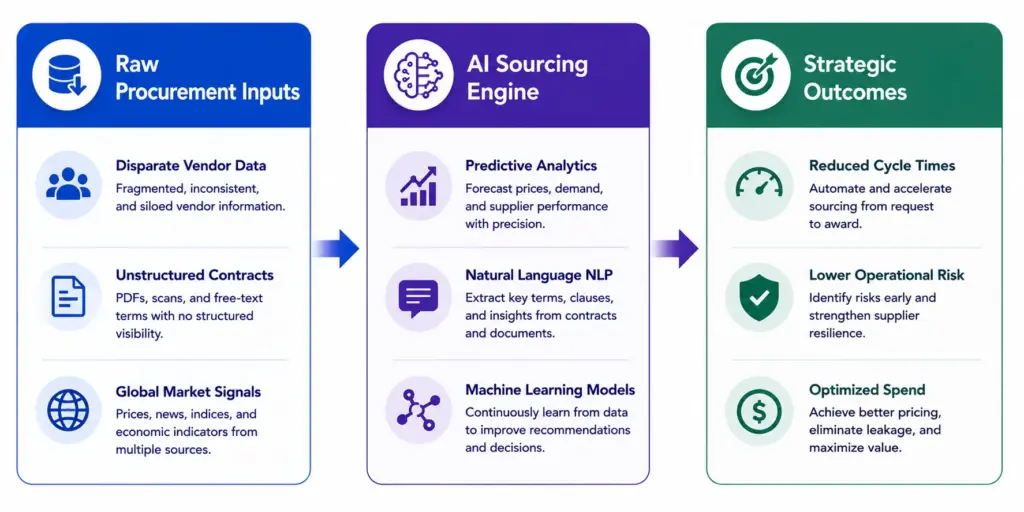
For an entrepreneur or investor looking to build a high-yield enterprise software asset, this category is highly attractive. The platform replaces fragmented, human-dependent workflows with a centralized, data-driven engine that directly protects corporate balance sheets. By leveraging this technology, modern enterprises achieve a step-change improvement across their entire procurement lifecycle:
- Identify qualified suppliers faster by eliminating manual internet research and database scraping.
- Reduce procurement cycle times from months to days through automated document workflow routing.
- Automate supplier onboarding using intelligent verification pipelines that vet certifications autonomously.
- Detect supplier risks proactively via continuous monitoring of external financial and legal data streams.
- Improve sourcing transparency by auditing pricing and vendor choices through algorithmic logic.
- Optimize spend management by uncovering hidden volume discounts and anomalous supplier charges.
- Enhance supplier collaboration through centralized portals that streamline communication and performance tracking.
Your Vendor Selection Process Is Probably Broken
Most enterprise procurement teams are running on a dangerous illusion. They believe their vendor selection process is thorough because it involves hundred-row spreadsheets, weeks of back-and-forth emails, and multi-stage committee reviews. In reality, modern procurement requires organizations to shift toward next-generation AI supplier sourcing software to fix these broken, fragmented workflows.
Traditional sourcing remains slow, reactive, and highly susceptible to human bias, leaking capital while your team manually copies data from flat PDFs into internal tracking logs. While your team is busy with manual data entry, market dynamics are shifting, material costs are fluctuating, and your competitors are locking down the best suppliers using automation.
Broken Lifecycle Anatomy
The standard approach to enterprise vendor selection follows a predictable, fragmented timeline that leaks capital and squanders time at every phase. Procurement teams often spend months evaluating suppliers without gaining complete visibility into operational risks, pricing inconsistencies, or long-term vendor reliability.
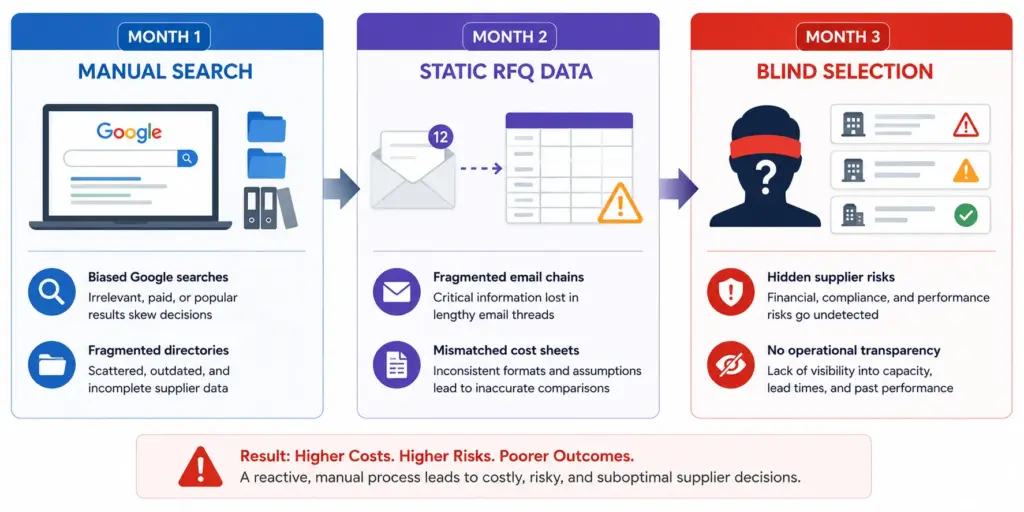
The Keyword Trap
When your team needs a new manufacturing or logistics partner, where do they start? Usually, it begins with basic search engine queries or a glance through an internal vendor directory that hasn’t been updated in years. This keyword-reliant approach limits your options to suppliers with the best public marketing teams, completely missing niche fabricators who possess the exact technical capabilities you require but use different terminology on their websites.
Unstructured Proposal Deluge
Evaluating dozens of incoming bids should be an apples-to-apples comparison. Instead, procurement managers are forced to sort through wildly different document layouts, unaligned pricing grids, and vague compliance assertions. This fragmented proposal structure makes it extremely difficult to identify the true operational and financial value of each supplier quickly and accurately.
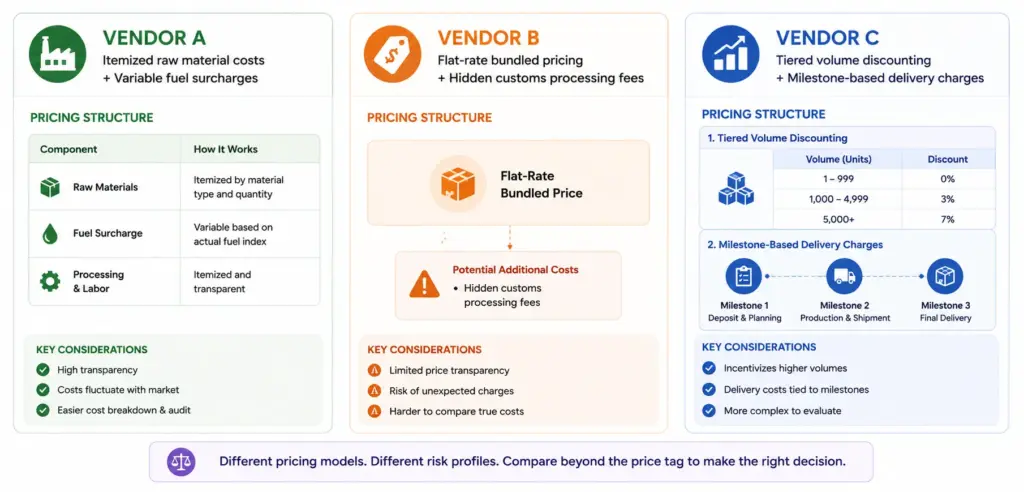
Without automated data ingestion, normalizing these proposals requires manual data reentry, which is a slow process prone to calculation errors that obscure the true cost of a contract.
Disruption Blindness
A vendor selection process shouldn’t stop once a contract is signed. Traditional systems treat risk management as a static checkbox cleared during initial onboarding. A supplier that looks financially stable on paper during Q1 can easily slide into operational distress by Q3. If your sourcing platform cannot actively monitor real-time shipping bottlenecks, international port closures, or macro commodity fluctuations, you are choosing to manage your supply chain completely blind.
Communication Silos
When procurement, corporate legal, IT security, and finance teams all use different software to evaluate a single supplier, critical information slips through the cracks. Weeks are wasted as contract drafts stall in email outboxes, legal teams overlook critical liability variances, and IT security reviews are treated as an afterthought rather than a core requirement.
Next-Gen Fixes
Fixing a broken vendor selection workflow requires a fundamental shift away from manual administrative work toward an integrated, intelligent software layer. Modern platforms solve these deep structural leaks through automated, data-driven execution. By centralizing supplier intelligence, procurement workflows, and risk monitoring into one system, businesses can make sourcing decisions faster with far greater accuracy and visibility.
- Semantic Discovery Engine: Replaces basic keyword matching with advanced concept-based search, allowing your team to find highly capable suppliers based on actual engineering intent rather than exact phrasing.
- Intelligent Document Processing: Instantly reads unstructured PDFs, text files, and spreadsheets, automatically mapping varied supplier bids into a standardized, transparent pricing matrix for clear comparison.
- Continuous Risk Orchestration: Connects your sourcing pipeline directly to live global trade records, financial health indices, and geographic hazard feeds to flag supply vulnerabilities before they cause assembly line shutdowns.
- Unified Workspace Governance: Ties all internal stakeholders together into a single, automated approval loop, ensuring legal, finance, and security reviews happen in parallel rather than isolated chronological steps.
Key Business Benefits of AI Supplier Sourcing Platforms
For an investor or founder looking at this space, the core equation is simple: how much hard business value do these platforms deliver to companies buying them? The market is shifting because AI supplier sourcing software transforms procurement from a slow, paper-pushing chore into a real strategic advantage.
By taking over routine paperwork and tracking market trends, these platforms protect corporate profit margins. They act as a major efficiency booster, helping businesses shield their bottom line from inflation, erratic market swings, and unexpected supply gaps.
1. Faster Supplier Discovery
Most purchasing teams still find new vendors the old-fashioned way: manual web searches, messy spreadsheets, and outdated directories. It is a slow grind that takes weeks. AI sourcing engines erase this headache by instantly scanning massive datasets to match businesses with the right partners.
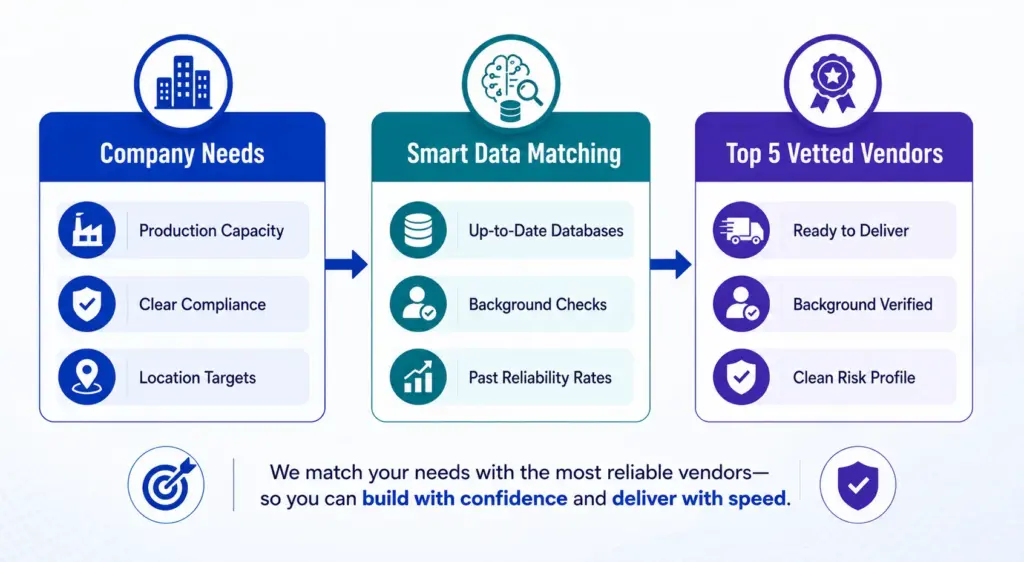
By connecting internal company data with global market records, the software cuts search times from weeks to minutes. This speed allows companies to pivot fast when market opportunities open up or critical materials run short.
2. Better Procurement Decisions
Picking a supplier based purely on the lowest price tag is a major gamble. AI platforms reduce this risk by giving managers a full, honest view of a vendor’s history, financial health, and overall reliability. Well-known systems like SAP Ariba use this data to spot market price trends and budget fluctuations before a company commits its capital.
- Real-World Alerts: The software monitors outside factors like new trade tariffs, port congestion, and shifting raw material costs.
- Smart Warning Flags: The system automatically spots struggling vendors whose delivery timelines are slipping or whose financials look weak.
This proactive approach stops expensive supply chain failures before they hurt a company’s profits, taking the guesswork out of multi-million dollar deals.
3. Reduced Procurement Costs
Running a traditional purchasing department involves high manual overhead. Teams spend endless hours writing up quote requests and trying to make sense of completely different vendor pricing setups. Artificial intelligence removes this administrative burden by using automated software tools to handle repetitive document reviews.
Platforms like Keelvar use dedicated sourcing assistants to handle the back-and-forth of everyday price quotes and negotiations, proving how much manual labor can be optimized. When you remove tedious data entry, procurement teams can finally focus on what matters most: negotiating better deals and building stronger bonds with key suppliers.
The math works out beautifully for corporate buyers. By speeding up the sourcing process and automating daily vendor check-ins, companies can lower their operational overhead while managing a larger volume of business.
4. Enhanced Compliance Management
Tracking legal and environmental compliance across thousands of global suppliers is a massive headache for corporate legal teams. Advanced sourcing software builds these safety checks right into the system, creating continuous, automated guardrails. Enterprise tools like Zycus Merlin AI automate contract reviews and compliance checks, using machine learning to catch risks and verify invoices without human error.
| Compliance Focus | The Old Manual Way | The Automated AI Way |
| Certifications | Trawling through spreadsheets to find expiration dates. | Automated renewals and early alerts sent to vendors. |
| Green Standards | Processing self-reported paperwork by hand. | Real-time cross-checks against global eco-databases. |
| Contract Rules | Reading every page to spot hidden liabilities. | Smart text scanners instantly flag non-standard clauses. |
The software instantly highlights any supplier that drops below company standards, protecting the corporation from regulatory fines and reputational damage.
5. Stronger Supplier Relationships
The relationship between corporate buyers and suppliers has historically been purely transactional and siloed. AI-native sourcing platforms fix this by offering clear, shared portals that make working together much easier. Modern options like Cognilix integrate central hubs that handle everything from live bidding auctions to transparent price benchmarking.
The platform coordinates onboarding steps, tracks major project milestones, and updates performance scores that both sides can see. By centralizing communication and linking payments directly to verified milestones, the software cuts down on financial arguments. For anyone building this software, creating this shared workspace keeps clients deeply attached to the platform, making the product highly resistant to customer churn.
Core Features of an Enterprise AI Supplier Sourcing Software
Modern enterprise procurement systems require much more than simple supplier databases. The most competitive sourcing platforms combine AI intelligence, workflow automation, data analytics, and cross-company collaboration tools into a single, cohesive operating system. To achieve this level of performance, organizations are moving away from outdated tools and adopting next-generation AI supplier sourcing software.
These core features define the actual product roadmap. To win over corporate buyers, a platform must deliver on all six of these structural modules, combining deep technical capability with clean, enterprise-ready usability.
1. Discovery Engine
This module acts as the absolute intelligence layer of the sourcing platform. Instead of forcing procurement teams to manually browse outdated directories, this engine actively surfaces hidden manufacturing and service partners globally based on complex, multi-variable project requirements. Platforms like Scoutbee validate this capability by using graph-based AI models to map deep, multi-tier supply chains.
- Platform Features: Includes an automated supplier recommendation engine, AI-powered vendor matching algorithms, automatic supplier categorization, industry-specific filtering, global supplier search indexing, and multi-language sourcing support.
- AI Technologies Used: Built using Natural Language Processing (NLP) models, semantic search capabilities, vector databases for fast data retrieval, modern recommendation systems, and structured knowledge graphs that map global corporate ownership networks.
2. Risk Intelligence
Risk management has become one of the most important procurement priorities for corporate boards. This module continuously evaluates the reliability of a company’s supply base, shifting risk management from a reactive cleanup job to a proactive corporate defense strategy. Market leaders like Coupa use this approach by running predictive risk models across massive global supplier ecosystems to flag potential failures early.
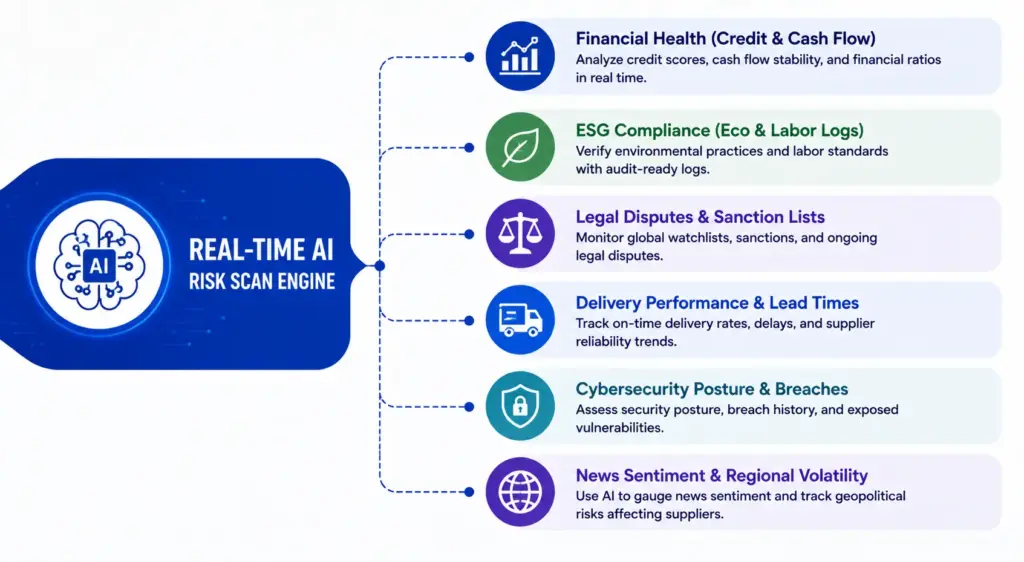
To turn this raw data into clear business choices, the platform relies on predictive analytics, classification models, proprietary risk scoring algorithms, and real-time sentiment analysis models.
3. RFQ/RFP Workflows
AI simplifies procurement document management significantly by taking over the massive administrative burden of running a corporate tender. For instance, platforms like Keelvar deploy autonomous sourcing bots that manage the end-to-end RFQ process and handle multi-round negotiations.
Enterprise Value: This reduces total sourcing cycle times from months to days, eliminates costly data entry errors, and ensures corporate procurement policies are enforced consistently across every single contract. The system handles the entire lifecycle through dedicated capabilities:
- RFQ Generation: Instantly creates technical documentation using historical templates.
- Proposal Comparison: Automatically extracts line-item pricing from hundreds of different vendor formats.
- Vendor Scoring: Ranks incoming bids against predetermined quality and delivery benchmarks.
- Automated Bid Analysis: Spots hidden fees, erratic price outliers, and unbundled delivery costs.
- Pricing Intelligence: Cross-references bids against live global commodity indexes.
- Negotiation Support: Suggests optimal counter-offers based on past transactional data.
4. Procurement Copilot
Enterprise procurement teams increasingly prefer conversational sourcing workflows over complex, multi-button software dashboards. A natural language interface drastically lowers user training time and drives high software adoption rates across corporate divisions. Solutions like Tonkean feature specialized ProcurementGPT copilots that orchestrate complex, multi-department approval processes through simple conversational interfaces.
| Copilot Capability | Business Use Case Example |
| Natural Language Queries | Finding complex vendor answers without building custom database filters. |
| Spend Analysis Summaries | Instantly identifying which corporate departments are overspending on software. |
| Contract Clause Extraction | Locating hidden liability and termination rules across thousands of active PDFs. |
A typical procurement officer using the platform can type a direct, natural query: Find ISO-certified semiconductor suppliers in Southeast Asia with low geopolitical risk and delivery scores above 90%. The copilot immediately processes the request, reviews the global dataset, and presents a pre-vetted list of vendors in seconds.
5. Contract Intelligence
AI contract analysis is a major differentiator for modern procurement tools. It converts static, unsearchable legal documents into active data points that corporate legal and finance teams can track in real time. Enterprise-grade tools like Sirion automate contract reviews and compliance checks, using machine learning to catch risks and verify obligations post-signature.
- Key Features: Includes optical character recognition (OCR) based contract ingestion, automatic clause extraction, liability risk detection, automated renewal alerts, compliance validation, and multi-year project obligation tracking.
- Technologies Used: Powered by advanced OCR pipelines, NLP clause extraction models, Large Language Model (LLM) summarization engines, and Retrieval-Augmented Generation (RAG) setups that keep sensitive enterprise data entirely private and secure.
6. Performance Analytics
Procurement leaders require real-time supplier visibility to manage annual budgets and defend operational margins. This final piece of the platform architecture visualizes the health of the entire supply chain through a highly interactive executive command center. Industry standard-setters like Suplari employ advanced AI agents to continuously crawl enterprise data pipelines and deliver prebuilt analytics dashboards.
- Metrics Tracked: Real-time delivery performance, cost efficiency margins, Service Level Agreement (SLA) compliance rates, verified ESG metrics, product quality benchmarks, and total procurement savings.
- Dashboard Components: Built with live KPI tracking modules, interactive spend visualization graphs, automated supplier benchmarking charts, and machine-learning-driven procurement forecasting engines that predict price shifts before they hit the corporate balance sheet.
How to Create AI Supplier Sourcing Software for Enterprises?
Building an enterprise-grade AI supplier software means shifting away from basic apps toward systems focused on tight data security, high reliability, and complex business rules. For investors and founders, the goal is simple: build a platform that fits perfectly into a company’s existing tech setup while proving its value from day one.
At IdeaUsher, we connect you with dedicated teams of pre-vetted developers who know exactly how to turn raw market data into useful business insights. Our approach ensures your platform fixes real procurement headaches while getting your product ready for market quickly.
1. Identifying Sourcing Pain Points
Before writing any code, we work closely with you to map out the exact business bottlenecks your platform will clear away. Enterprise software succeeds when it solves specific, expensive problems rather than trying to fix everything at once. We focus our development strategy on three main corporate pain points:
- Siloed Supplier Data: Important info trapped across completely separate legacy software setups and offline files.
- Slow RFP Lifecycles: Weeks wasted on drafting quote requests by hand, sending emails, and waiting for replies.
- Blindspot Risk Profiles: A complete lack of live tracking for a vendor’s financial stability or legal status.
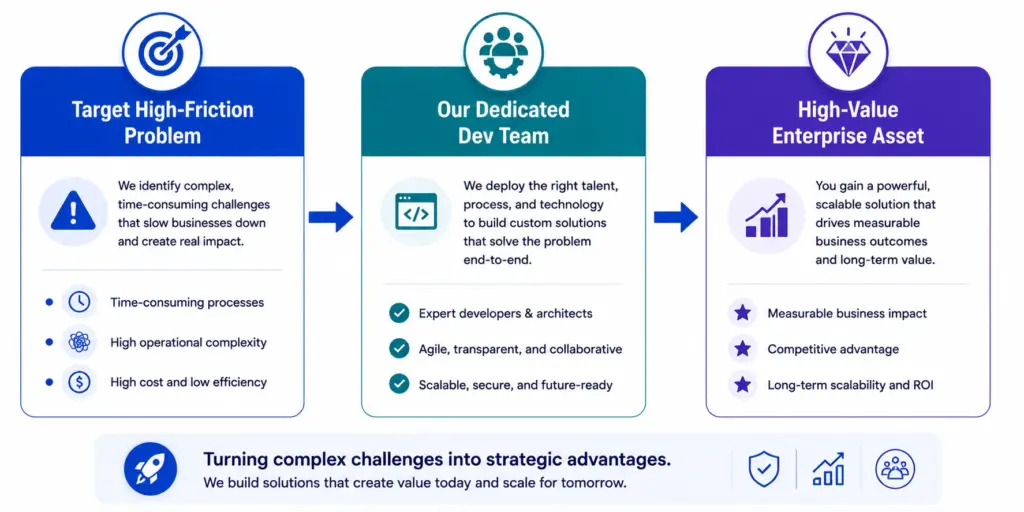
By targeting these specific issues, our engineering teams avoid wasting time on unnecessary features. This ensures your initial software matches up perfectly with what corporate procurement departments are actively budgeting for.
2. Creating the Discovery Engine
The core value of an AI sourcing tool is how well it matches companies with the right vendors. Old-school search tools rely on static business directories that go out of date fast. We build smart, active search systems that analyze multiple variables at the same time. To build an enterprise-ready discovery tool, our developers set up a multi-layered data pipeline:
- Smart Data Gathering: We build custom collectors to pull live info from global shipping logs, business registries, and trade networks.
- Contextual Search: We set up language models so the software understands what a user actually means. If someone searches for automotive plastics, the system automatically looks for suppliers handling advanced polymers too.
- Relationship Mapping: We link suppliers to their parent companies and factories to help businesses spot hidden vulnerabilities in their supply chains.
This structural depth ensures your software uncovers high-quality, reliable vendors that other companies miss using basic manual searches.
3. Developing RFQ Automation
The Request for Quote process is notoriously slow. Teams spend hours formatting documents, answering the same questions from different vendors, and trying to compare quotes sent in different currencies or units. We fix this by building automated features directly into your platform:
- Instant Document Drafting: We use conversational AI to automatically generate clear, detailed quote requests based on past successful projects.
- Smart Bid Reading: Our engineers use machine learning to instantly pull key pricing data from incoming vendor PDFs and spreadsheets.
- Automatic Comparison: We build a calculation layer that normalizes every quote against live currency rates, shipping fees, and bulk discounts.
This gives purchasing managers a clean, ranked dashboard of their best options, cutting project finalization times from weeks to hours.
4. Integrating Risk Metrics
Large companies pay a premium for software that protects them from supply chain shutdowns and legal liabilities. We equip your platform with live risk engines that track a business’s entire vendor base around the clock. Instead of running slow manual checks every few months, our technical teams build live tracking pipelines:
| Monitoring Focus | Where the Data Comes From | How the AI Evaluates It |
| Financial Health | Credit bureaus, public market records, court filings. | Flags sudden bankruptcy or cash-flow risks early. |
| Operational Risk | Port congestion data, live weather monitors, news feeds. | Forecasts shipping delays and supply bottlenecks. |
| Legal Compliance | Government trade blacklists, sanction watchlists. | Instantly pauses workflows if a vendor violates a rule. |
By building this continuous tracking system, we ensure your platform becomes an indispensable safety tool that corporate leaders rely on to protect their operations.
5. Training the Sourcing Models
An AI platform is only as smart as the data it learns from. To build software that offers accurate contract advice and vendor recommendations, we design your system to safely process highly specific enterprise data. This helps businesses generate more precise sourcing insights while reducing procurement errors over time.
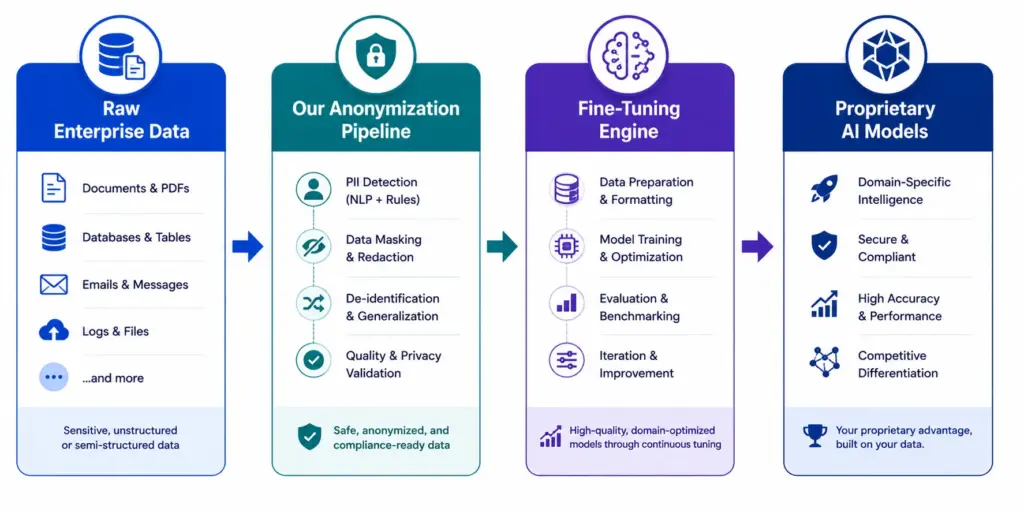
Our development teams follow a highly structured training process: The true value of a B2B platform is its private data loop. We train your models on real-world transaction histories and contract patterns to create a specialized tool that generic, free AI models can never copy.
We start by building ultra-secure pipelines that clean and anonymize old purchase logs and supplier scorecards. We use this data to tune your models so they understand industry-specific jargon, shipping rules, and pricing tricks. Crucially, we build solid digital walls between clients so that one company’s sensitive data is never exposed to another’s models.
6. Designing Corporate Architecture
To sell into the corporate market, your software infrastructure must meet strict IT standards for security, compliance, and uptime. Corporate buyers will walk away from any platform that leaves them vulnerable to data leaks or frequent software crashes. Our development roadmap prioritizes three foundational security pillars:
- Granular Access Controls: We build internal permission structures so employees, outside vendors, and executives only see the data allowed for their specific jobs.
- Easy ERP Integration: We ensure your platform connects smoothly with leading business software like SAP, Oracle, and Microsoft Dynamics through secure, stable connections.
- Enterprise Security Standards: We build data encryption frameworks for data both in transit and at rest from day one, preparing your product to clear official enterprise security audits easily.
AI Technologies Powering Supplier Sourcing Software
The most resilient enterprise procurement platforms move away from a single-model approach, avoiding reliance on just one Large Language Model or basic script. To handle the strict demands of global supply chains, modern systems combine multiple specialized artificial intelligence technologies into a unified engine.
When you partner with us at IdeaUsher, we bring the deep technical expertise needed to assemble these complex systems. Our pre-vetted developers handle the backend complexity from day one, allowing you to hire a dedicated team that turns advanced machine learning into an intuitive, market-ready procurement asset.
Machine Learning Stack Architecture
An enterprise-grade sourcing platform operates through a carefully layered technology ecosystem, where different AI models pass structured context to one another. Each layer is designed to handle a specific procurement function, from supplier discovery to predictive risk analysis. This structured architecture improves processing accuracy while allowing the platform to scale efficiently across large enterprise operations.
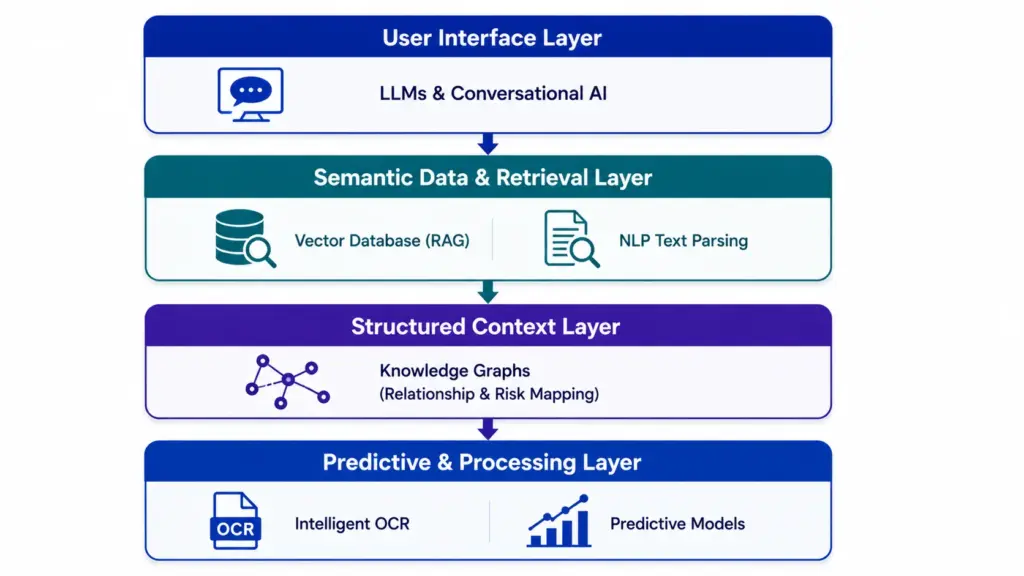
Large Language Models
Instead of managing the underlying procurement logic, Large Language Models function as the adaptive user interface and text generation layer of modern platforms. We program these models to break down messy human requests into specific, executable database actions. This allows procurement teams to interact with complex sourcing systems using simple conversational commands.
- Core Applications: Powering conversational procurement copilots, summarizing complex supplier communications, auto-generating Request for Quotes, and creating first drafts of contract adjustments based on explicit instructions from corporate legal teams.
- Operational Impact: Lowers the technical barrier to entry for team members, allowing any purchasing manager to retrieve deep supply chain answers without waiting for a dedicated database analyst.
Natural Language Processing
Standard Large Language Models often struggle with precision, which is why our developers build dedicated Natural Language Processing engines into the platform core. They parse massive amounts of unstructured enterprise text with high accuracy, pulling out specific business entities, numbers, and deadlines.
- Document Analysis: Continuously monitors supplier emails, corporate compliance forms, and legal documentation.
- Workflow Automation: Instantly extracts payment rules, liability limits, and renewal dates, converting plain paragraphs into structured, reportable data points.
Intelligent Document Processing
Enterprise supply chains still run on mountains of paperwork, usually locked away in flat PDFs or image files. Our technical teams build Intelligent Document Processing systems that combine advanced Optical Character Recognition with deep learning to turn these documents into organized data arrays.
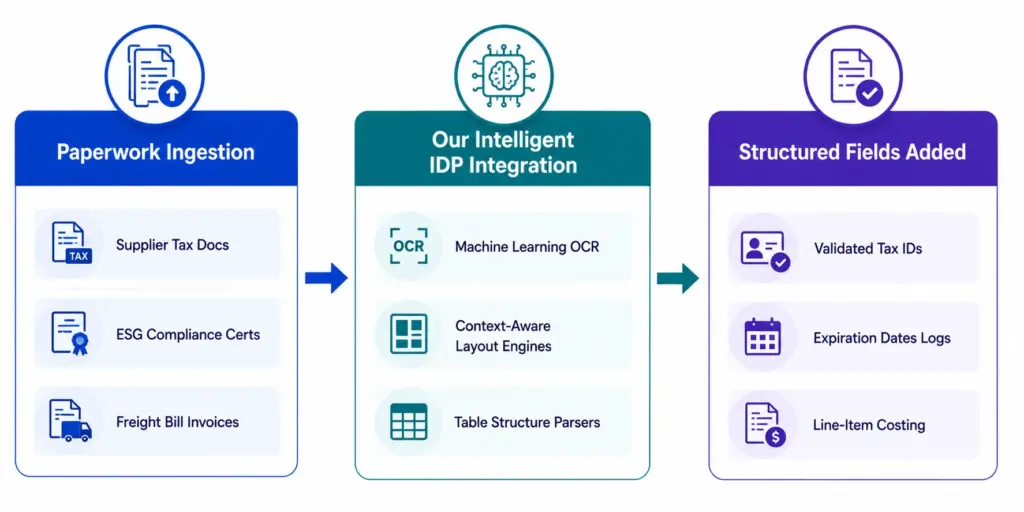
By setting up these visual data pipelines, we ensure the platform extracts line-item data seamlessly without requiring human teams to waste hundreds of hours on manual data entry.
Predictive Analytics
While language models handle text, our engineers build predictive analytics engines to process numerical data and timeline patterns. These machine learning systems look at years of transactional history and macro market shifts to forecast risks before they disrupt operations.
- Supplier Failures: Spots early indicators of financial distress, such as shifting payment requests or dropping delivery accuracy.
- Delivery Delays: Calculates the exact probability of port delays based on weather patterns and current customs logjams.
- Cost Fluctuations: Analyzes raw commodity prices to alert managers about upcoming spikes in packaging or transport fees.
Knowledge Graphs
We implement a knowledge graph to serve as the central data fabric of your application. Unlike a standard relational database that keeps information in isolated tables, a knowledge graph treats the relationships between data points as primary, searchable assets. A standard database tells you what a supplier is. We build knowledge graphs to map exactly who that supplier connects to, including their sister companies, sub-component providers, international factories, and active legal obligations.
This interconnected layout allows the system to instantly run deep risk assessments. For example, if a port closes in Southeast Asia, the graph traces every single vendor, sub-assembly component, and active customer order tied to that specific region in seconds.
Vector Databases
Vector search tools make semantic supplier discovery and context-aware retrieval possible. By converting complex supplier profiles, past project reviews, and capabilities text into multidimensional coordinates, our developers ensure the database searches by concept rather than exact keyword matches.
| Database Search Pattern | Old Keyword Database | Our Vector Search Setup |
| Search Query Example | Precision CNC Milling Specialist | Advanced high-tolerance aerospace parts fabricator |
| Search Logic | Looks only for exact letter strings. Drops useful suppliers who use different titles. | Understands engineering intent. Safely surfaces relevant machining partners. |
| System Precision | Highly restrictive, frequently misses niche manufacturing vendors. | Highly contextual, matches suppliers based on raw industrial capability. |
We design this vector layer to act as the foundation for modern Retrieval-Augmented Generation pipelines. This provides Large Language Models with pinpoint corporate context and eliminates the risk of AI hallucinations during critical contract reviews. By hiring our pre-vetted developers, you can confidently deploy this entire advanced architecture smoothly and efficiently.
Cost to Build AI Supplier Sourcing Software
Development costs vary significantly based on AI complexity, integrations, and enterprise scalability requirements. When estimating budgets for a custom AI supplier sourcing software, it is essential to balance raw software feature development with the specialized infrastructure needed to run machine learning models safely inside a corporate network.
At IdeaUsher, we map out these costs transparently so you know exactly how capital is allocated. By choosing to hire from our pool of pre-vetted developers, you optimize your development budget while ensuring that high-level technical frameworks are built by seasoned professionals.
Cost Breakdown by Project Scale
The total investment required depends directly on the depth of the automation and the size of the target enterprise market. Platforms with advanced AI capabilities, global infrastructure, and deep ERP integrations naturally require higher development resources. Businesses must also account for long-term scalability, security, and ongoing AI optimization when planning their budgets.
| Project Scale | Estimated Cost | Key Features Included |
| MVP AI Spend Analytics Platform | $40K – $80K | Basic semantic search, core invoice and RFQ uploads, spend dashboards, standard UI frontend, basic reporting automation |
| Mid-Scale Enterprise Platform | $120K – $250K | Deep ERP integrations, live risk scoring, advanced document parsing, workflow automation, predictive spend analytics |
| Large Enterprise AI Ecosystem | $300K – $1M+ | Autonomous procurement bots, multi-region cloud infrastructure, continuous compliance monitoring, advanced AI forecasting, enterprise-grade scalability |
The financial spectrum for building these platforms divides into three clear tiers:
- MVP Sourcing Platform ($40,000–$80,000): Focuses on core capabilities like a basic semantic supplier discovery engine, standard RFQ creation fields, and a clean user dashboard. Ideal for validating your software concept in the market.
- Mid-Scale Enterprise Platform ($120,000–$250,000): Introduces deeper automated layers, such as live risk tracking pipelines, automated invoice parsing, full contract text analysis, and smooth connections with mainstream business databases.
- Large Enterprise AI Sourcing Ecosystem ($300,000–$1,000,000+): A complete, top-tier infrastructure. Features include multi-department autonomous negotiation bots, globally distributed server networks, predictive commodity pricing systems, and custom-trained foundational language models.
Major Cost Drivers
Understanding where the development capital goes helps in prioritizing the software roadmap effectively. It also allows businesses to identify which features deliver the highest operational value during the early development stages. This approach helps optimize budgets while ensuring critical enterprise functionalities are developed first.
AI Model Infrastructure
Training and tuning specialized models require heavy computational power. Integrating tools like Retrieval-Augmented Generation pipelines to prevent AI hallucinations, setting up custom embedding vectors, and managing ongoing API token expenses for heavy text analysis represent a major portion of the core technical budget.
ERP Integrations
Enterprise clients will not use a platform that stands completely alone. Connecting your platform seamlessly with legacy systems requires complex, custom middleware development. These integrations ensure procurement data flows smoothly between departments without disrupting existing enterprise operations. They also help businesses maintain real-time visibility across inventory, supplier management, and financial systems.
- SAP & Oracle Environments: Building bidirectional data synchronizations that pull past spend histories and push newly approved purchase orders automatically.
- Microsoft Dynamics: Designing real-time inventory triggers that tell the sourcing engine to look for components the moment warehouse stock drops below a specific line.
Security and Compliance
Corporate procurement teams handle highly sensitive financial data and trade secrets. Ensuring your system passes institutional check-ups adds significant structural development hours. Enterprise readiness is not a feature you can bolt on later. Building role-based access controls, complete data encryption, and logging detailed audit trails from day one is mandatory to clear corporate IT reviews.
Our technical teams build these data protection layers natively, preparing your application to comfortably clear formal security audits like SOC 2 Type II and GDPR without costly architectural reworks.
Supplier Intelligence Datasets
An AI discovery engine is useless without data to feed it. Sourcing budgets must account for purchasing premium data licenses or engineering highly scalable, continuous web collection scrapers to pull and normalize fresh trade registries, global shipping records, and financial health scores.
Cloud Infrastructure & Multi-Region Deployment
Running complex machine learning systems requires high-performance cloud server setups. Enterprise contracts usually require isolated database environments for different corporate users and localized multi-region server setups to maintain fast data speeds and comply with international data residency laws.
By utilizing our pre-vetted engineering teams at IdeaUsher, you can manage these complex cost variables efficiently, ensuring every dollar spent goes directly toward building a highly valuable, secure, and commercially competitive software asset.
Why Agentic AI Will Transform Supplier Sourcing?
Enterprise procurement is moving rapidly beyond simple automation. While the previous generation of software relied on humans to click buttons, trigger rules, and move files manually, the next wave of corporate sourcing shifts execution directly to the software itself. Organizations are aggressively adopting next-generation AI supplier sourcing software that treats independent, goal-oriented digital assistants as the core architecture.
The Evolution of Procurement Software
The structural leap from basic data storage to autonomous execution shows how drastically corporate workflows are changing. Enterprises are now prioritizing systems that can independently analyze data, make decisions, and trigger procurement actions in real time. This shift is helping businesses reduce operational delays while improving sourcing efficiency across large-scale supply chains.
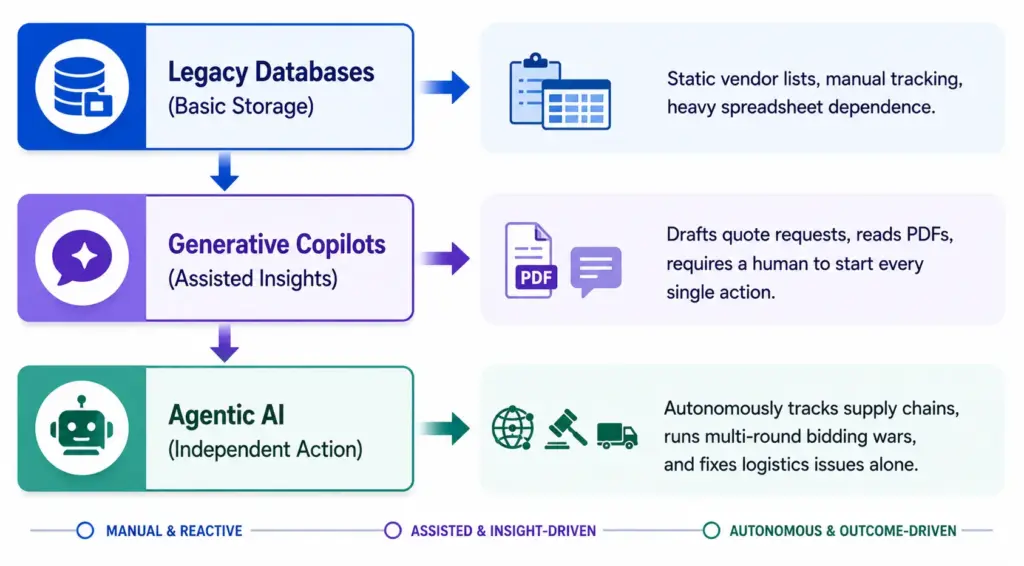
1. Autonomous Supplier Discovery
Instead of waiting for a human manager to type out a query, an AI agent continuously monitors your inventory levels and market conditions. If the system spots a potential supply gap, it independently scans global shipping logs, verifies vendor backgrounds, and initiates initial outreach to pre-vetted manufacturing partners without needing a manual command to get started.
2. AI-Led Negotiations
Negotiating boilerplate contracts and minor purchasing agreements wastes hundreds of hours of a legal team’s time. Sourcing agents can step into the middle of live bidding cycles, using historical purchase logs and real-time commodity data to handle multi-round pricing negotiations directly with a supplier’s automated sales bot.
3. Predictive Sourcing Optimization
Rather than sticking blindly to static templates, agentic systems optimize for real-world outcomes based on fluid corporate targets. If corporate leadership prioritizes carbon reduction over short-term savings, the agent automatically shifts its vendor evaluation rankings, dynamically balancing compliance, cost metrics, and delivery speed across changing scenarios.
4. Self-Healing Procurement Workflows
When a traditional system encounters an error, like a missing tax ID or an incorrect invoice format, the workflow grinds to a halt until a human fixes it. Platforms like ORO Labs showcase the power of agentic orchestration here, using autonomous data handling to seamlessly sync information across multi-ERP environments and fix system disconnects instantly.
5. Real-Time Risk Mitigation
An AI agent treats global disruption data as an immediate trigger for action. If a sudden storm shuts down an international shipping port, the system does not just send an alert to your dashboard. It actively recalculates delivery delays, checks alternative route availability, and shifts ordering volumes to backup suppliers in seconds to prevent a total line stoppage.
What Enterprises Should Know?
Deploying autonomous systems requires a highly strategic approach. Not every AI project succeeds, and corporate teams must learn to ignore the general industry hype to focus entirely on verifiable operational outcomes. The most resilient enterprise sourcing platforms avoid letting software run completely unchecked, building success around four core pillars instead:
- Human-Agent Teaming: Shifting the role of human procurement professionals from tedious data entry to strategic oversight. Humans act as managers who review alternative choices, handle critical exceptions, and sign off on major financial commitments.
- Transparent AI Governance: Building clear digital guardrails. Every decision an agent makes must be captured in clean audit logs, ensuring compliance teams can trace exactly why a specific vendor was picked or why a counteroffer was made.
- Reliable Procurement Datasets: Ensuring your internal data is flawless. An autonomous agent is only as reliable as the information it processes, making the creation of an organized, single source of truth across spend and contracts absolutely vital.
- Modular Software Architecture: Assembling systems out of specialized, single-task agents rather than relying on one giant, generic model. This modular setup allows companies to swap out individual language tools easily as technology evolves, keeping the enterprise infrastructure agile and secure over the long term.
Top 5 AI Supplier Sourcing Software for Enterprises
Through extensive market research and evaluation of leading enterprise procurement platforms, we found several AI-powered supplier sourcing software solutions that stand out for their advanced capabilities and enterprise-grade performance. These platforms are helping enterprises simplify supplier discovery, improve procurement decisions, and build more resilient supply chains.
1. Coupa
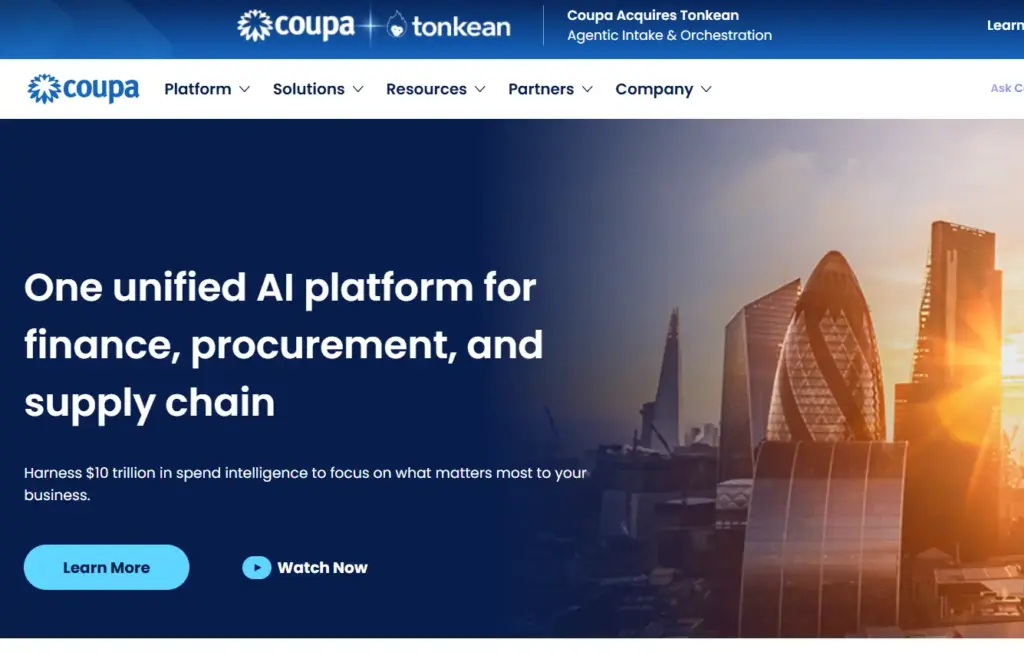
Headquartered in San Mateo, California, Coupa remains a dominant titan in global spend management. The platform uses a massive pool of cross-company transaction data to track real-time supplier performance, compliance, and financial health. It actively flags potential vendor bankruptcies, delivery bottlenecks, or pricing variations before an enterprise ever initiates an RFQ.
- Community Intelligence: Uses anonymized transaction data from millions of global suppliers to benchmark performance and calculate real-time supplier health scores.
- Coupa Navi Engine: An autonomous assistant that models complex supply chain disruptions and recommends immediate sourcing adjustments.
- Automated Fraud Auditing: Continuously monitors multi-region purchase orders in the background, instantly flagging billing variances before payment happens.
2. GEP Worldwide
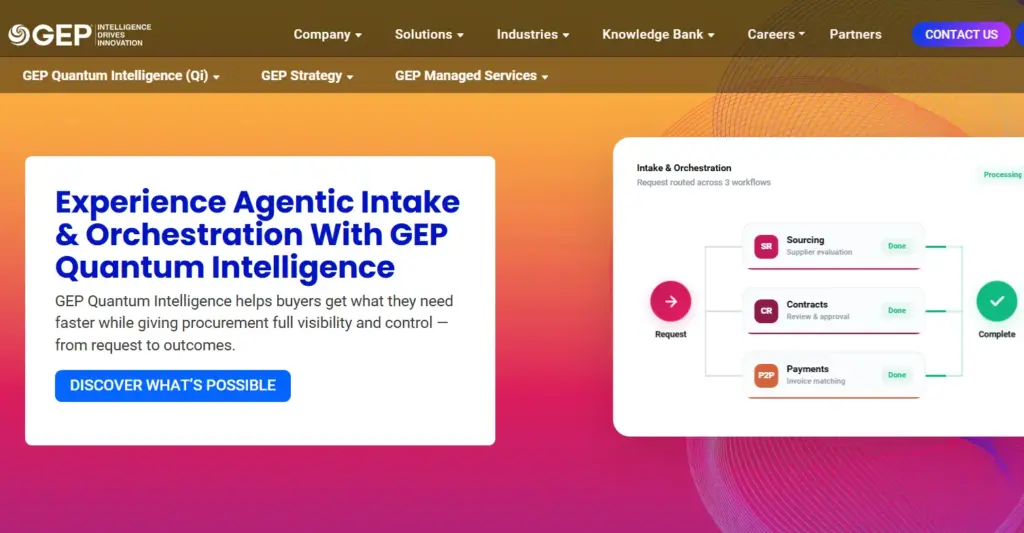
Operating out of Clark, New Jersey, GEP provides an advanced source-to-pay suite through its GEP Quantum Intelligence framework. The platform introduces agentic AI orchestration into the core purchasing process, using autonomous digital agents to build vendor recommendations, handle multi-language translations during bidding wars, and match incoming technical proposals against corporate sustainability goals.
- Autonomous Market Tracking: Monitors shifting global commodity indexes and material availability, automatically drafting sourcing events when price drops occur.
- AI Spend Classification: Employs proprietary neural networks to aggregate, scrub, and report highly fragmented multi-currency corporate spend data.
- Contract Drift Monitoring: Tracks post-signature supplier deliverables and schedules, instantly alerting both parties the moment vendor performance slips.
3. Levelpath
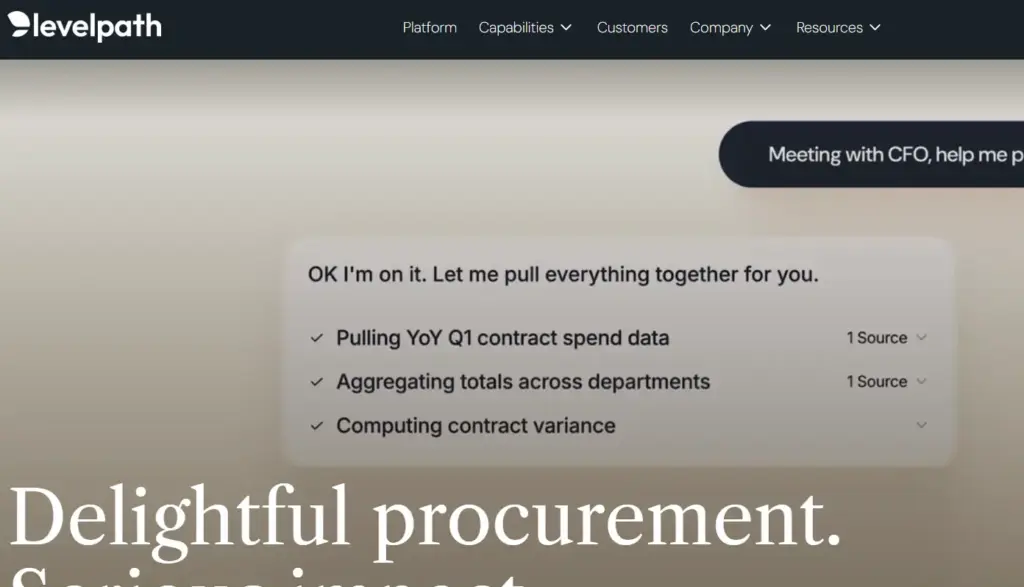
Representing the new wave of AI-native software architectures, San Francisco-based Levelpath avoids the trap of layering basic AI components on top of old databases. It is engineered from scratch as an integrated mobile-ready intelligence layer. Procurement teams can bypass dense, confusing dashboards entirely by interacting with a conversational copilot that handles sourcing tasks.
- Hyperbridge Reasoning: A data engine that extracts, correlates, and summarizes siloed enterprise data to deliver immediate contextual sourcing insights.
- Side-by-Side Comparison: Uses natural language parsing to extract unstructured lines from vendor proposals and lay them out in a matching pricing grid.
- Supplier Enrichment: Uploads legacy vendor records and uses automated web pipelines to instantly pull in missing certifications and corporate hierarchies.
4. Zip HQ
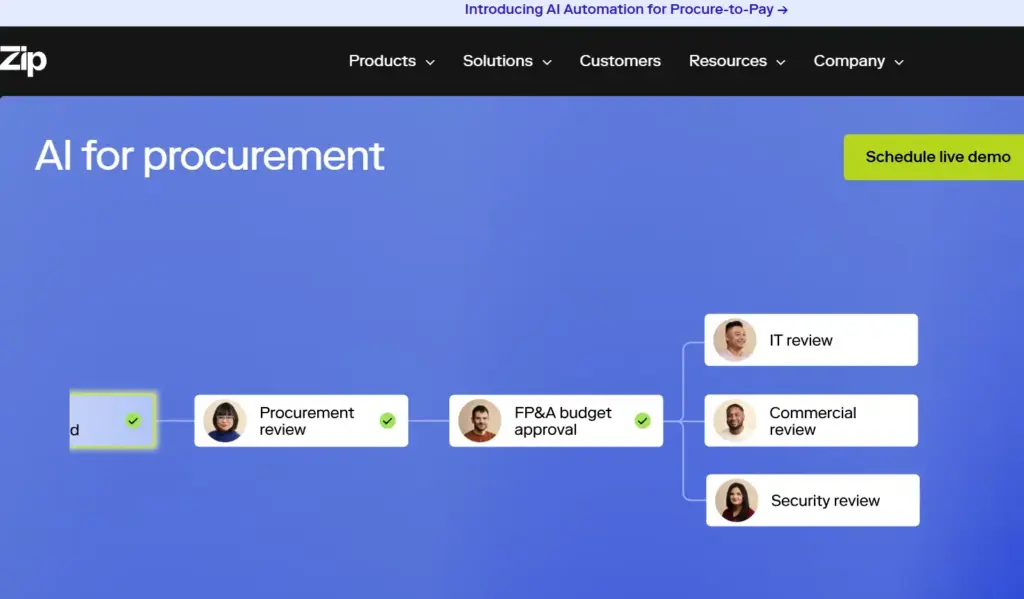
Another foundational player in the Silicon Valley ecosystem, Zip HQ focuses on intake-to-procure orchestration. Its primary mission is to unify messy, multi-department workflows into a single, cohesive software environment. Zip utilizes smart intake forms and routing algorithms to cross-reference incoming requests against existing software portfolios to stop redundant corporate spending.
- Intelligent Intake Guidance: Steers employees toward preferred corporate vendors during the initial request phase and predicts form fields based on historical patterns.
- Dynamic No-Code Workflows: Builds automated parallel approval chains across legal, IT security, and finance teams simultaneously to eliminate cross-department delays.
- Predictive Renewal Analytics: Scans active contract dates and software usage patterns to alert procurement leaders months ahead of a renewal.
5. ORO Labs
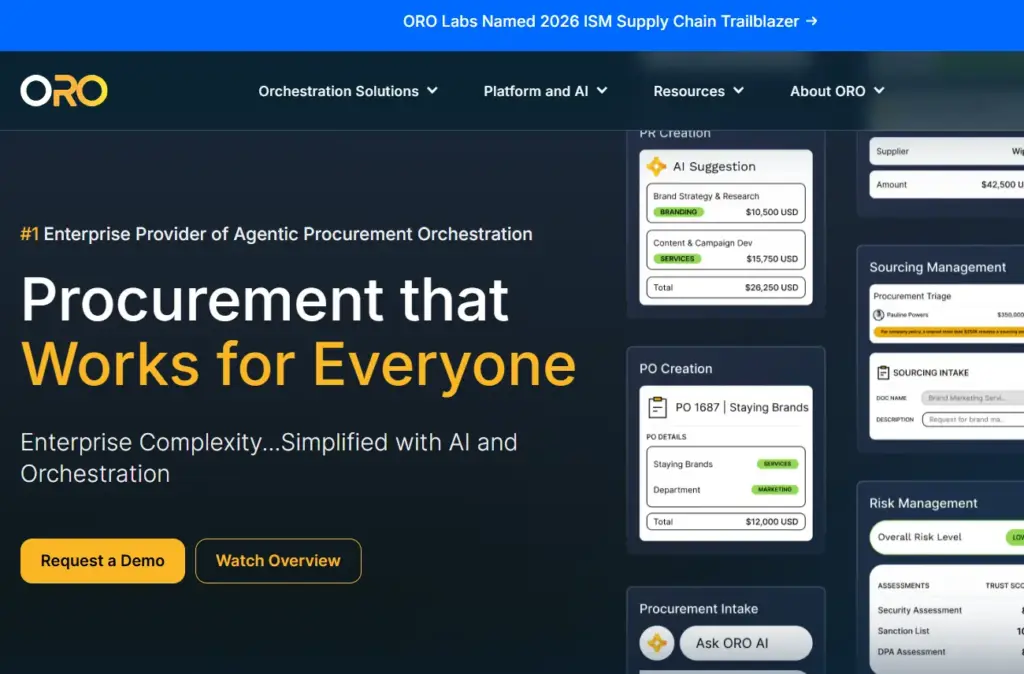
Based in Jersey City, New Jersey, ORO Labs excels at managing complex orchestration workflows across highly decentralized corporate structures. Its autonomous workflow engine clears the administrative roadblocks out of global sourcing by identifying system anomalies, independently reaching out to suppliers for paperwork, and auto-routing tasks to the correct division heads without manual human dispatching.
- Multi-ERP Synchronization: Uses autonomous middleware workflows to cleanly bridge data tracking gaps between disconnected SAP, Oracle, and legacy accounting tools.
- Self-Healing Onboarding: Automatically communicates with external vendors to collect missing compliance papers or correct invalid tax IDs without human intervention.
- Context-Driven Task Routing: Instantly breaks down large procurement requests and dispatches compliance sub-tasks to the correct regional leads based on corporate policy.
Develop an AI Supplier Sourcing Software with Idea Usher
Building complex enterprise procurement software requires far more than generic coding; it demands highly specialized engineering and foolproof data security to clear strict corporate IT reviews. At IdeaUsher, we solve this engineering bottleneck by giving you direct access to our premier team of ex-MAANG/FAANG developers. Backed by over 500,000 hours of coding experience, we turn advanced machine learning models into secure, high-performance sourcing platforms that protect your infrastructure and deliver immediate operational value.
Custom AI Solutions
Every corporate supply network operates under its own distinct constraints, compliance frameworks, and internal workflows. Off-the-shelf software packages often fail because they try to force rigid, generic templates onto specialized corporate logistics patterns. We completely avoid this limitation by building tailor-made systems designed around your precise business needs.
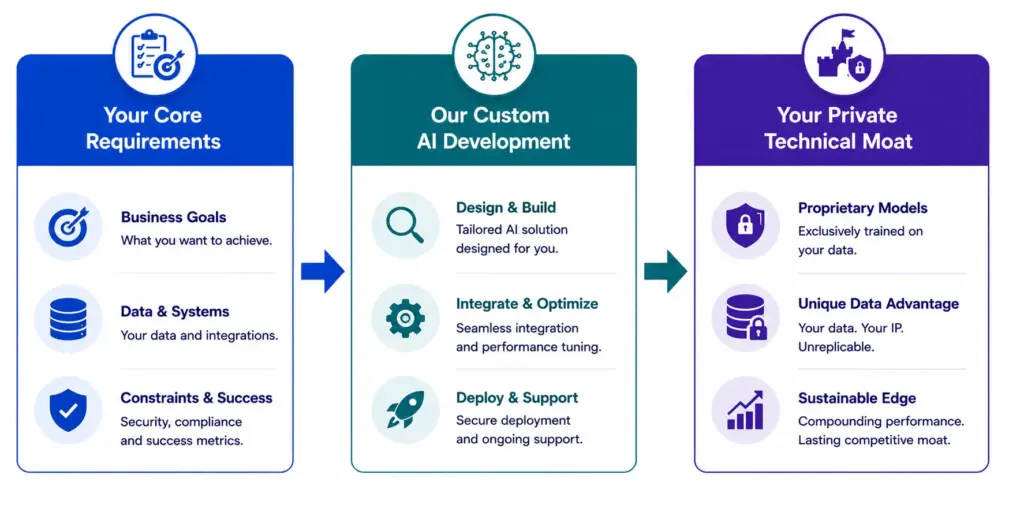
Our engineering teams focus on creating custom modules:
- Tailored Recommendation Frameworks: We build custom algorithms that rank vendors based on your specific operational priorities, whether you choose to optimize for fast delivery speed, low carbon footprints, or regional tax advantages.
- Smart Data Scrapers: We build dedicated data collection networks that pull real-time trade records, regulatory logs, and financial risk indicators directly from your target global markets.
- Proprietary Knowledge Networks: Our developers construct private data graphs that map hidden links between your vendors, sub-component manufacturers, and international parent corporations.
End-to-End Development
We guide your enterprise software project through a structured roadmap, taking care of every phase from initial technical architecture to final live server configuration. Our comprehensive development methodology ensures your system launches smoothly without unexpected budget overruns or engineering delays.
Our structural development stages keep your software rollout moving predictably: The difference between basic code and a scalable business platform lies in the execution of the rollout. Our end-to-end development methodology ensures that advanced data models are deeply integrated into your existing workflows without ever risking ongoing operations.
- System Planning and Architecture: We map out the data pipelines, select the right specialized AI models, and design isolated database structures to ensure your system can process complex queries fast.
- Data Pipelines and Fine-Tuning: Our engineers build ultra-secure text processing frameworks to clean and anonymize your historical purchase histories, scorecards, and legal files to safely train your models.
- Rigorous Testing and System Checks: We put the software through intensive, automated security and load testing, checking for system stability and stress-testing the database under heavy user traffic.
Scalable and Secure Platforms
To win over corporate buyers, your application must meet strict international data protection standards and remain completely reliable during sudden traffic spikes. We build your platform from day one on a foundation of absolute stability, advanced data protection, and structural flexibility. Our development teams design and deploy highly secure software infrastructures:
- Granular Identity Management: We build strict role-based access frameworks so that your internal employees, external suppliers, and corporate executives can only view data specifically permitted for their exact jobs.
- Bidirectional ERP Connectors: We develop stable, high-performance API endpoints that integrate your custom sourcing engine smoothly into existing enterprise environments like SAP, Oracle, and Microsoft Dynamics.
- Enterprise Security Frameworks: We configure end-to-end data encryption for information both in transit and at rest, structuring your code carefully so your platform can easily clear formal SOC 2 Type II and GDPR institutional compliance audits.
Conclusion
Creating AI supplier sourcing software for enterprises means pairing smart automation features with a secure, highly protective data backend. Success depends on deploying robust discovery, risk monitoring, and automated document engines that comfortably clear strict corporate IT security compliance checks. Partnering with a specialized team of pre-vetted engineers, like our developers at IdeaUsher, allows you to bypass complex infrastructure headaches and roll out a scalable, market-ready procurement platform quickly.
Things to Know About AI Supplier Sourcing Softwares
Q1: What is AI supplier sourcing software?
A1: AI supplier sourcing software is a next-generation corporate procurement platform designed to replace manual vendor management with automated intelligence. Instead of relying on static spreadsheets or outdated directories, these platforms use machine learning to handle supplier discovery, verify vendor backgrounds, automate quote requests, and track real-time supply chain performance. By serving as a central digital command center, the software connects directly with internal business databases to make enterprise purchasing faster, cheaper, and far more accurate.
Q2: How does AI improve supplier sourcing?
A2: AI transforms supplier sourcing by shifting procurement from a reactive, slow process into an active, data-driven workflow. It scans global trade records in seconds to find hidden manufacturing partners, tracks live risk indicators like port delays or financial shifts, and instantly extracts line-item pricing from hundreds of mismatched vendor proposals. By automating these repetitive administrative tasks and streamlining negotiations, the software compresses corporate purchasing timelines from several weeks to just a few hours.
Q3: Which AI technologies are used in procurement software?
A3: Modern procurement systems achieve high reliability by combining multiple specialized artificial intelligence layers rather than relying on a single model. Large Language Models power the conversational procurement copilots, while dedicated Natural Language Processing engines parse complex contracts and supplier documents with high precision. These text-based tools work alongside machine learning OCR pipelines that digitize paper invoices, predictive analytics that forecast supply chain shortages, and vector databases that match suppliers based on raw industrial capabilities.
Q4: What industries use AI sourcing platforms?
A4: AI sourcing systems are heavily used across industries that manage complex global supply chains or navigate strict regulatory environments. Manufacturing, automotive, and aerospace companies use these platforms to prevent factory line stoppages, while healthcare and pharmaceutical organizations rely on them to track strict vendor compliance and safety certifications. Additionally, high-volume retail, logistics, energy, and enterprise SaaS companies deploy these automated sourcing tools to manage volatile commodity shifts and keep overhead costs low.