


Key Takeaways
- Procurement platforms unify purchasing, approvals and vendor management into one financial operations system.
- Platforms like Ramp use AI automation, virtual cards and ERP integrations to improve spend control.
- Core features include AP automation, approval workflows and real-time spend analytics for finance teams.
- Enterprises adopt procurement platforms for faster approvals, lower maverick spend and stronger compliance.
- How IdeaUsher help you build scalable procurement platforms with AI automation and enterprise-grade fintech integrations.
Procurement is shifting from a slow approval-driven process into a real-time financial control system that directly influences spending efficiency and operational agility. That shift is increasing demand for a modern procurement platform capable of connecting purchasing, expense management, approvals and vendor workflows inside a single ecosystem.
Traditional procurement systems relied on fragmented tools, delayed approvals and disconnected financial visibility that created operational bottlenecks as businesses scaled. Modern companies now expect automated purchasing workflows, intelligent spend controls, virtual cards, real-time expense tracking and ERP-connected procurement operations that reduce manual coordination and improve financial decision-making.
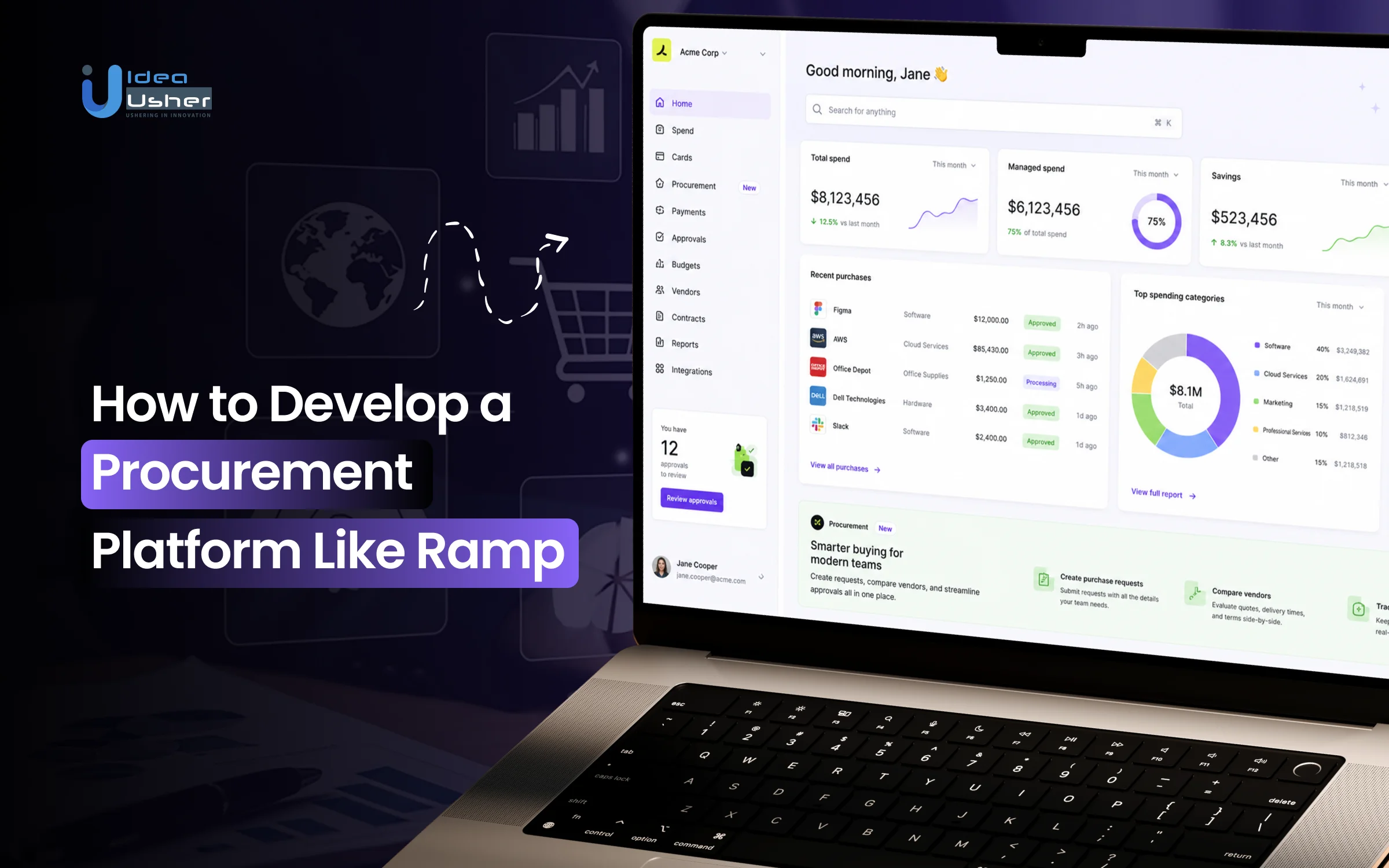
In this blog, we will talk about core features, architecture, development costs and how IdeaUsher can help build a procurement platform like Ramp by combining procurement, expense management and financial automation into one operational layer instead of treating them as separate systems.
Why Traditional Procurement Systems Fail Modern Businesses
The global procurement software market has grown from $11.14 billion to $17.6 billion at a CAGR of 12.1%, driven by the increasing need for operational agility and digital procurement transformation. Despite this growth, many enterprises still rely on outdated procurement systems built for slower, centralized supply chain environments.

Outdated manual procurement infrastructure fails to meet modern demands. Organizations lose nearly 11% of contract value due to low visibility, while only 15% of businesses share contracting systems across teams. Furthermore, only 27% of companies using manual methods have complete spend visibility.
Manual financial operations cause major inefficiencies, with 95% of finance teams still using spreadsheets. This leads to 3%–5% annual overspending and error rates up to 4%. While manual processing costs $13–$16 per invoice, automation reduces this to $1.42–$6, saving teams nearly 520 hours annually.
A. Manual Procurement Workflows Create Financial Blind Spots
The reliance on manual procurement workflows such as tracking purchase orders (POs) via disparate spreadsheets, chasing physical signatures and routing invoice approvals through endless email threads is a ticking financial time bomb.
- The Sourcing Void: Manual entry creates data silos, forcing finance teams to react to spend only after invoices arrive.
- The Approval Bottleneck: Slow manual routing causes procedural bypasses and unauthorized maverick spending.
- The Error Rate: Manual entry leads to duplicate payments and missed discounts, complicating audits and reconciliations.
B. Legacy ERP Systems Lack Real-Time Spend Intelligence
Enterprise Resource Planning (ERP) systems are the operational backbone of many organizations, legacy iterations were never built to handle the dynamic nature of modern business spend. They excel at recording historical data, but they fail miserably at providing forward-looking, actionable insights.
The Reality of Legacy Tech: Most traditional ERPs act as digital filing cabinets. They capture data after the transaction is finalized, leaving decision-makers blind to real-time financial health.
Without real-time spend intelligence organizations struggle to maintain financial agility. Relying on outdated data reporting structures leads to several operational deficiencies:
- Reactive Cash Flow Management: Finance teams make liquidity decisions using outdated financial data instead of real-time cash visibility.
- Weak Supplier Negotiations: Limited vendor visibility reduces procurement leverage and contract optimization opportunities.
- Lack of Predictive Analytics: Traditional systems fail to detect duplicate subscriptions or unusual spending patterns proactively.
- Missed Bulk Purchasing Opportunities: Data silos prevent departments from identifying enterprise-wide volume discounts.
- Delayed Financial Risk Response: Late ERP reporting slows budget corrections, vendor renegotiations and financial issue resolution.
C. Finance Teams Need Unified Procurement and Expense Automation
To eliminate blind spots and reclaim control over corporate capital, modern finance teams must transition away from fragmented tools and adopt unified procurement and expense automation platforms.

Bridging the gap between procurement (POs, vendor management) and expense management (reimbursements, corporate cards) into a single, automated ecosystem offers distinct strategic advantages:
- Centralized Spending: A unified platform tracks all corporate card purchases and vendor contracts on one dashboard.
- Advanced Compliance: Finance teams use automated virtual cards and pre-approved POs to enforce budget limits before transactions occur.
- Efficient Workflows: Intuitive interfaces and AI-driven approvals allow employees to submit requests instantly, reducing maverick spend.

What Is a Procurement Platform Like Ramp?
The Ramp Procurement Platform is an AI-driven, intake-to-pay software solution that consolidates purchasing requests, vendor management, purchase orders (POs) and accounts payable (AP) into a single system. Instead of forcing employees to jump between multiple disjointed tools, it acts as a centralized “procurement orchestration” layer sitting directly on top of a company’s existing financial tech stack.
This platform connects purchasing intent with final payment by uniting corporate cards, expenses, AP and vendor management. Unlike isolated traditional tools, this integrated interface eliminates friction, speeds up procurement and provides finance leaders with immediate, comprehensive spend visibility.
A. Core Procurement Management Capabilities Explained
A modern procurement platform must handle the entire intake-to-pay lifecycle to effectively replace fragmented legacy systems. Platforms built on Ramp’s philosophy offer several core capabilities:
- Smart Intake Forms: Instead of making employees navigate complex compliance manuals, the platform utilizes dynamic procurement intake questionnaires. It collects the necessary vendor security details, contracts and budget justifications upfront based on the request type.
- Automated, Multi-Department Approval Workflows: Requests are automatically routed to the correct stakeholders (IT for security, legal for contracts, finance for budget) simultaneously or sequentially, eliminating email tracking and manual handoffs.
- Purchase Order (PO) Management: Teams can instantly generate POs upon approval. The platform tracks fulfillment, monitors contract limits and flags deviations automatically.
- Vendor Management & SaaS Optimization: Centralized dashboards track all active vendors, contract renewal dates and software utilization metrics, alerting finance teams to duplicate subscriptions or upcoming price hikes.
B. How Ramp Combines Spend Management, AP Automation and Procurement
Ramp integrates spend management, AP automation and procurement into a unified financial operations platform. By linking the purchase-to-pay lifecycle through AI and real-time ERP synchronization, it replaces fragmented tools for cards, invoicing and intake with one centralized system.

The platform connects these three traditionally disconnected financial workflows through a streamlined process:
1. The Procurement Phase: Intelligent Intake
The lifecycle begins when an employee needs to buy something such as a new software subscription or office equipment.
- Conversational Intake: Employees do not have to fill out complex purchase request forms. They can log a request using natural language directly within Slack or Microsoft Teams.
- AI Due Diligence: Ramp’s autonomous AI Procurement Agents instantly analyze contract terms, perform vendor risk assessments and check background compliance before any human reviews it.
- Price Benchmarking: Before the request is approved, Ramp’s Price Intelligence engine compares the vendor’s quoted price against thousands of anonymized market transactions to flag if you are overpaying.
- PO Generation: Once approved through conditional routing rules, Ramp automatically cuts a Purchase Order (PO) to log the committed spend.
2. The AP Automation Phase: Touchless Bill Pay
When the invoice finally arrives from the vendor, Ramp transitions the workflow into its accounts payable engine, known as Ramp Bill Pay.
- Autonomous Ingestion: Invoices are pulled directly out of dedicated email inboxes or uploaded via drag-and-drop.
- Agents for AP: Utilizing advanced OCR and machine learning, Ramp’s specialized AI Agents for AP read the invoice and accurately extract line items, quantities and totals.
- 3-Way Matching: The system automatically cross-references the incoming invoice against the original PO created during the procurement phase and the receiving receipt. If everything aligns perfectly, the bill is cleared for payment without human data entry.
3. The Spend Management Phase: Card Issuance & ERP Sync
Once a bill or purchase is validated, Ramp controls how the money actually exits the business, leveraging physical and virtual corporate cards.
- Targeted Virtual Cards: For ongoing services or SaaS subscriptions, Ramp can issue a dedicated virtual card tied to that specific vendor. If a vendor attempts to overbill or charge an unapproved renewal, the card automatically blocks the transaction.
- Zero-Touch Expense Matching: If an employee utilizes a physical or virtual card for an approved procurement request, Ramp text-prompts them for a receipt image and uses AI to instantly match it to the expense line.
- Real-Time ERP Reconciliation: Since procurement (POs), AP (invoices) and spend (transactions) share one architecture, the entire lifecycle maps immediately to the general ledger. Bidirectional syncing with ERPs like NetSuite, QuickBooks and Sage further accelerates month-end closing.
C. Why AI-Driven Procurement Platforms Are Growing Rapidly
The rapid adoption of AI-driven procurement platforms is being propelled by the urgent need for operational efficiency and real-time cost containment. Finance teams can no longer afford to wait for month-end reports to discover wasteful spend.
- Autonomous Data Extraction and Matching: AI eliminates the bottleneck of manual invoice processing. It reads complex, multi-page global invoices, codes them to the correct general ledger (GL) accounts and matches them to POs with high accuracy, reducing AP cycle times from weeks to minutes.
- Proactive Waste Detection: Machine learning algorithms continuously analyze organizational spend patterns. AI can detect if two different departments are paying for the same software, flag contract price anomalies against historical averages and alert managers when a vendor increases a recurring fee without notice.
- AI-Assisted Vendor Negotiations: Advanced platforms leverage macro-level, anonymized benchmarking data to give procurement teams an edge. If a business is overpaying for a popular SaaS tool compared to market averages, the platform flags the premium, giving finance leaders actionable intelligence to renegotiate better terms.
Essential Integrations for Enterprise Procurement Platforms
For a modern procurement platform to deliver true value, it cannot operate as a siloed application. It must serve as a central connectivity hub, Idea Usher’s enterprise engineers have experience building complex ERP-connected ecosystems with secure API orchestration and finance workflow automation.

A. ERP Integrations for Procurement Automation
Enterprise Resource Planning (ERP) integrations act as the foundational bridge between upstream procurement workflows and downstream corporate accounting, eliminating manual data entry across disparate core business systems.
- SAP: Connects high-volume procurement pipelines and multi-location inventory records with core SAP environments for global corporate alignment.
- Oracle: Synchronizes complex cross-border procurement actions and vendor balances with Oracle’s financial suite for deep compliance.
- Microsoft Dynamics 365: Aligns procurement intake and contract management smoothly with Microsoft’s modular operational ecosystem.
- NetSuite: Drives continuous data synchronization for automated journal entries, PO mapping and real-time ledger updates.
- Procurement data synchronization: Ensures that purchase requests, purchase orders and vendor details mirror perfectly between systems without manual file transfers.
- Budget reconciliation: Automatically cross-references procurement requests against active ERP budgets to prevent accidental department overspending.
- Real-time accounting updates: Triggers instant general ledger updates the moment a purchase is authorized or an invoice is cleared.
B. Accounting and Payment Infrastructure Integrations
These integrations connect the procurement platform directly to mid-market bookkeeping tools and global payment rails, streamlining payment execution and day-to-day cash reconciliation.
- QuickBooks: Simplifies mid-market bookkeeping by pushing categorized procurement expenses and cleared invoices instantly into QuickBooks environments.
- Stripe: Powers the digital payment rails needed for instant virtual card issuing, processing and programmatic spend controls.
- ACH processing: Enables automated, secure bank-to-bank transfers to settle high-value vendor invoices directly through local clearing houses.
- Invoice automation: Ingests vendor invoices automatically, executing a continuous digital pipeline from optical character recognition (OCR) parsing to final payment.
- Tax compliance systems: Integrates with engines like Avalara or localized tax databases to automatically calculate VAT, GST and corporate sales tax.
C. AI and Analytics for Procurement Intelligence
This layer connects raw transactional pipelines to advanced data models, transforming historical spending records into forward-looking strategies and proactive fraud defense systems.
- Spend anomaly detection: Scans corporate transactions continuously to instantly flag sudden spikes in SaaS fees, duplicate software subscriptions or unusual employee spending.
- AI-powered procurement recommendations: Analyzes historical vendor contract data to recommend volume discounts, consolidation opportunities or better contract terms.
- Forecasting procurement budgets: Leverages machine learning models to analyze historical cash outflows, helping finance teams predict future budget requirements accurately.
- Supplier performance analytics: Tracks vendor fulfillment timelines, delivery accuracy and invoice discrepancies to generate objective reliability scores for suppliers.
Core Features of Procurement Platform Like Ramp
Building a modern, Ramp-like procurement platform requires a robust, interconnected architecture that unifies corporate spending with intelligent automation. The platform must transition finance teams from reactive bookkeeping to proactive, real-time control across several core technical modules.

1. Intelligent Procurement Request and Approval Workflows
This module digitizes the intake-to-procure pipeline, routing employee purchase requests through automated compliance checks (“Zero-Touch”) to ensure all expenditures are authorized before any corporate capital is committed.
- Multi-level approvals: Routes high-value purchase requests sequentially through managers, department heads and finance executives based on custom cost thresholds.
- Budget-aware routing: Automatically checks active department budgets and flags or reroutes requests that threaten to exceed allocated quarterly limits.
- Department-wise approval chains: Directs software requests to IT, hardware to operations and marketing tools to CMOs via dedicated, isolated workflows.
- Role-based permissions: Restricts procurement request, modification and approval privileges based on an employee’s organizational tier and job function.
- Conditional approval logic: Triggers specialized approval loops if specific parameters are met, such as onboarding an entirely new vendor.
2. Corporate Cards and Spend Control Infrastructure
This feature provides businesses with programmable payment instruments, allowing finance teams to issue cards with hardcoded restrictions that eliminate maverick spend at the point of sale.
- Virtual cards: Generates instant, disposable or recurring digital cards for specific vendors or subscriptions to secure online transactions.
- Physical corporate cards: Issues secure, branded hardware cards to employees for field expenses, travel and physical business purchases.
- Spend limits: Enforces strict daily, monthly or per-transaction caps directly on the card level to prevent budget overruns.
- Merchant restrictions: Restricts card usage to specific Merchant Category Codes (MCCs), blocking unapproved spend like entertainment or retail.
- Real-time transaction monitoring: Authorizes payments instantly while simultaneously pushing live transaction data directly to the central finance dashboard.
3. Real-Time Expense Tracking and Reconciliation
This capability automates the tedious task of gathering transaction evidence, instantly pairing receipts with card swipes to compress the month-end closing process from weeks to minutes.
- Automated expense syncing: Imports transaction data from cards and bank feeds instantly, removing the need for manual end-of-month logging.
- Receipt matching: Uses SMS and email parsing to automatically match digital receipt images with their corresponding card transactions.
- Expense categorization: Leverages machine learning to automatically assign standard accounting codes to transactions based on merchant profiles.
- Duplicate expense detection: Scans the ledger continuously to flag identical transaction amounts or double-submitted invoices for review.
- Finance reconciliation automation: Matches card statements with general ledger entries, streamlining the final accounting push for finance teams.
4. AI-Powered Invoice and Accounts Payable Automation
This system handles non-card business spend by using artificial intelligence to ingest vendor invoices, verify billing accuracy and execute high-volume B2B payments without manual data entry.
- OCR invoice extraction: Employs optical character recognition to pull line-item details, tax numbers and payment terms from unstructured PDFs.
- Invoice approvals: Routes extracted invoice data to the original purchaser for quick verification and sign-off before payment execution.
- Vendor payment scheduling: Optimizes working capital by scheduling automated ACH, check or wire transfers exactly on invoice due dates.
- AP workflow automation: Drives invoices seamlessly from receipt to three-way matching and final ledger posting using hands-free digital pipelines.
- Fraud detection systems: Cross-references invoices against historical data to flag billing anomalies, phishing attempts or altered bank account details.
5. Vendor Management and Supplier Intelligence Systems
This control center manages vendor relationships, tracking supplier credentials, performance metrics and contract compliance to safeguard the company’s supply chain and software ecosystem.
- Supplier onboarding: Deploys self-service portals where new vendors securely input their payment structures, tax forms and contact data.
- Vendor verification: Screens suppliers against global watchlists, bankruptcy records and fraud databases to ensure corporate compliance.
- Risk scoring: Evaluates vendor reliability, security postures and financial stability to flag high-risk accounts before signing contracts.
- Supplier performance monitoring: Tracks delivery timelines, invoice accuracy and contract fulfillment rates to evaluate vendor utility over time.
- Compliance tracking: Monitors vendor insurance certifications, NDA renewals and SOC 2 data policies, alerting procurement when documents expire.
6. Procurement and Spend Intelligence Dashboards
This intelligence hub processes raw transactional data into visual analytics, giving CFOs the clear visibility needed to optimize vendor contracts and identify waste across departments.
- Department-wise spend visibility: Generates real-time charts breaking down corporate expenditure by team, project or individual cost center.
- Procurement forecasting: Utilizes historical spending patterns to project future cash outflows and assist finance teams with quarterly budgeting.
- Budget utilization tracking: Compares actual real-time spending against forecasted budgets, providing visual alerts as caps are approached.
- Spend anomaly detection: Flags sudden spikes in recurring vendor fees, duplicate software subscriptions or unusual employee spending behaviors.
- Executive finance dashboards: Consolidates high-level financial health metrics, savings data and operational KPIs into clean presentations for stakeholders.
7. Multi-Entity and Multi-Currency Procurement Management
This framework supports international business scaling, enabling corporations to manage global purchasing pipelines, cross-border tax compliance and multi-currency transactions from one unified portal.
- Global procurement operations: Configures isolated spend controls and distinct workflows across multiple international offices, teams or subsidiaries.
- Currency conversion: Handles real-time foreign exchange pricing for cross-border purchases while tracking localized exchange rate impacts.
- Tax management: Automates localization for regional tax regulations, capturing VAT, GST and sales tax details for accurate reporting.
- Regional compliance: Adapts procurement workflows to match local financial laws, data storage mandates and employment rules.
- Subsidiary-level budgeting: Allocates individual capital limits and balance sheets to distinct entities while maintaining global visibility.
8. Mobile Procurement and Approval Experience
This native mobile extension keeps the procurement process moving on the go, allowing remote managers to approve requests and employees to upload expense receipts instantly.
- Mobile approvals: Empowers managers to review, reject or authorize purchase requests instantly through clear smartphone interfaces.
- Real-time procurement alerts: Pushes immediate notifications regarding budget flags, urgent payment requests or contract deadlines to stakeholders.
- Expense uploads: Allows employees to snap smartphone photos of physical receipts for instant AI parsing and transaction matching.
- Procurement notifications: Keeps teams updated on request statuses, vendor approvals and card changes through timely mobile alerts.
- Executive dashboard access: Delivers high-level spend charts and cash flow metrics to leadership directly on their mobile screens.
How to Develop a Procurement Platform Like Ramp
Building an enterprise-ready procurement platform requires a systematic development lifecycle that balances complex workflow automation with bulletproof financial accuracy. Transitioning from initial concept to a scalable SaaS ecosystem requires execution across several key strategic phases.

1. Define Procurement Workflows and Use Cases
Before writing code, product teams must map out the end-to-end purchasing journey to ensure the platform accommodates diverse enterprise operational structures.
- Procurement lifecycle mapping: Outlines the exact progression of a purchase request, from initial employee intake and sourcing to invoice matching and final ledger reconciliation.
- Stakeholder approval structures: Configures parallel and sequential approval hierarchies involving team managers, department heads, finance analysts and legal executives.
- Department-level procurement requirements: Adjusts workflows to handle unique departmental mandates, such as requiring security questionnaires for IT software or logistics tracking for operations hardware.
- Spend control objectives: Defines the proactive parameters of the system, including hardcoded budget limits, vendor-specific virtual card constraints and automated policy enforcement rules.
- Vendor management workflows: Establishes how suppliers are requested, vetted, onboarded and evaluated throughout their operational lifecycle with the enterprise.
2. Conduct Market and Competitor Research
Designing a competitive solution requires analyzing market leaders and identifying unaddressed friction points within corporate finance operations.
- Analysis of Ramp: Studies Ramp’s specific architecture, tracking how it successfully unified corporate cards with upstream purchasing pipelines and automated accounts payable.
- Procurement automation trends: Evaluates the market’s shift toward zero-touch invoice processing, real-time visibility and mobile-first approval experiences.
- Enterprise procurement pain points: Examines common legacy frustrations, including slow multi-week approval loops, fragmented data silos and excessive maverick spend.
- Competitive differentiation opportunities: Identifies gaps in existing tools, such as building deeper localized tax management engines or more flexible conditional approval routing.
- Target industry selection: Pins down the initial vertical for rollout such as fast-growing tech startups, multi-entity mid-market firms or highly regulated healthcare enterprises.
3. Design the Procurement Platform Architecture
A modern financial ecosystem requires a highly scalable, resilient and secure technical foundation capable of executing high-volume, real-time data processing.
- Multi-tenant SaaS architecture: Builds a secure software model that safely isolates customer data, configurations and user logs within dedicated virtual boundaries.
- Microservices infrastructure: Decouples core platform capabilities such as card issuing, invoice OCR and reporting dashboards into independent, highly available services.
- Workflow orchestration systems: Implements robust state machines (e.g., Temporal or AWS Step Functions) to manage complex, long-running approval loops without data loss.
- API-first architecture: Designs clean, developer-friendly RESTful or GraphQL APIs to facilitate seamless third-party connections and internal modular communication.
- Cloud-native deployment planning: Outlines a containerized infrastructure strategy leveraging Kubernetes and managed cloud databases to guarantee high uptime and horizontal scalability.
4. Build the MVP Procurement and Spend Management Modules
The Minimum Viable Product (MVP) focus should center on delivering the core intake-to-pay loops that provide immediate operational value to finance teams.
- Procurement requests: Develops intuitive, smart intake forms that collect necessary purchase justifications and vendor details without overwhelming employees.
- Approval workflows: Codes the foundational routing engine, enabling the system to pass requests to the correct manager based on total cost or department tags.
- Vendor onboarding: Introduces a basic self-service portal where suppliers can securely upload their banking routing numbers and corporate tax documents.
- Expense management: Implements standard card transaction tracking, allowing users to submit receipts and match them to specific corporate card swipes.
- Procurement dashboards: Builds centralized data interfaces that give CFOs live visibility into pending approvals, total monthly spend and active vendor lists.
5. Integrate ERP, Accounting and Payment Systems
To eliminate manual bookkeeping friction, the platform must connect directly to existing enterprise ledgers and global payment rails.
- SAP integration: Links enterprise purchasing pipelines and inventory data directly with SAP setups for large-scale corporate data alignment.
- Oracle integration: Harmonizes cross-border transactions and complex vendor balances with Oracle’s financial application suite.
- NetSuite integration: Engineers bidirectional data synchronization to handle automated journal entries, PO mapping and instant ledger updates.
- Payment gateway integration: Connects to specialized banking APIs and card networks (like Stripe or Marqeta) to facilitate instant virtual card generation and ACH processing.
- Real-time financial synchronization: Ensures that any action taken on the platform whether a card swipe or an approved invoice is reflected instantly across connected financial systems.
6. AI Automation and Procurement Intelligence
Integrating artificial intelligence transforms the platform from a passive recording tool into an active driver of corporate efficiency and fraud prevention.
- AI-driven spend categorization: Uses machine learning models to instantly analyze transaction data and map it to the correct general ledger accounting codes.
- Predictive procurement analytics: Evaluates historical cash outflows to project upcoming spending trends and help teams optimize quarterly budgets.
- Invoice OCR automation: Employs advanced computer vision and text parsing to extract line items, amounts and payment terms from unstructured PDFs with high precision.
- Fraud detection systems: Continuously checks invoices and transaction behaviors against historical data patterns to flag anomalies, duplicates or phishing risks.
- Smart approval recommendations: Highlights unusual parameters in purchase requests (e.g., higher-than-average software pricing) to assist managers during the review process.
7. Enterprise-Grade Security and Compliance Layers
Financial systems demand rigorous defensive controls, immutable record-keeping and strict adherence to global compliance standards.
- Role-based access controls: Restricts platform interaction by enforcing precise user permissions, ensuring only authorized personnel handle capital or security settings.
- SOC 2 compliance: Designs the platform architecture and data handling procedures to satisfy rigid criteria for security, availability and processing integrity.
- PCI DSS readiness: Implements strict data encryption, tokenization and storage architectures required to securely handle and issue corporate payment cards.
- Audit logging systems: Deploys unalterable, time-stamped logs that capture every user sign-in, configuration modification and system approval for transparent reporting.
- Data encryption infrastructure: Protects sensitive financial records, corporate banking credentials and user data using top-tier encryption algorithms both at rest and in transit.
8. Test Procurement Workflows and Financial Accuracy
Thorough validation ensures the software can handle edge cases smoothly without encountering data mismatches or calculation errors.
- Workflow testing: Validates that complex conditional approval loops route requests to the correct stakeholders and handle rejections or modifications seamlessly.
- Integration testing: Checks data transmission pipelines between the platform and external ERP systems to ensure error-free sync loops.
- Security testing: Conducts rigorous penetration testing and vulnerability scans to discover and patch potential application loopholes or data leaks.
- Financial reconciliation validation: Performs detailed stress-tests on the ledger engine to ensure every single currency unit matches across systems during multi-currency conversions.
- Performance testing for enterprise scale: Simulates high volumes of concurrent user sessions, heavy invoice uploads and rapid card swipes to verify platform stability under load.
9. Deploy and Scale the Procurement Platform
Rolling out the application demands a structured DevOps framework alongside comprehensive observability tools to maintain reliable system uptime.
- Cloud deployment: Hosts the containerized application infrastructure across secure, multi-availability zone cloud environments (such as AWS, GCP or Azure).
- DevOps automation: Sets up continuous integration and continuous deployment (CI/CD) pipelines to safely automate code testing, building and deployment.
- Monitoring infrastructure: Implements real-time application performance monitoring (APM) tools to instantly track system health, database latency and API error rates.
- Procurement analytics optimization: Tunes database indexing and caching strategies to ensure complex analytics dashboards load instantly, even with massive datasets.
- Multi-region scaling strategies: Configures localized data storage architectures to comply with geographic residency regulations (like GDPR) as the platform expands globally.
10. Optimize Based on Procurement Data Insights
Post-launch success relies on interpreting transactional data trends to refine system performance, user adoption and automation efficiency.
- Spend pattern analysis: Analyzes corporate-wide transaction aggregates to spot hidden cost trends, redundant software tools or vendor consolidation opportunities.
- User behavior optimization: Reviews user interaction maps to identify and remove points of friction in the intake and receipt-upload processes.
- Procurement workflow refinement: Optimizes approval routing sequences, adjusting thresholds or automated paths to shorten overall purchase lifecycle times.
- Vendor performance intelligence: Aggregates delivery data, invoicing accuracy and contract renewals to provide enterprises with clear metrics on their suppliers.
- AI model improvement: Feeds edge-case invoices and exception logs back into machine learning pipelines to steadily increase OCR accuracy and classification precision over time.
Cost to Develop a Procurement Platform Like Ramp
Estimating the financial investment required to build a modern procurement platform involves analyzing engineering complexity, regulatory compliance and backend financial infrastructure. The total cost varies significantly depending on whether you are launching an early-stage Minimum Viable Product (MVP) or deploying a fully scaled, enterprise-grade automated ecosystem.
A. MVP Procurement Platform Development Cost Breakdown
An MVP focuses on delivering the essential intake-to-pay loop, establishing baseline budget controls and tracking expenses before introducing complex enterprise automation.
Below is the structured breakdown of the development phases required to launch a functional procurement MVP:
| Development Phase | What this Phase Covers | Estimated Cost Range |
| Requirements & Workflow Mapping | Map intake-to-pay cycles, user roles (employee/finance), approval levels and spend policies. | $5,000 – $8,000 |
| UI/UX Design & Prototyping | Design wireframes and high-fidelity screens for intake forms, manager views and admin dashboards. | $7,000 – $12,000 |
| Core Intake & Approval Modules | Develop backend logic for requests, automated routing and notification triggers. | $18,000 – $30,000 |
| Basic Vendor & Expense Tracking | Create supplier databases, receipt uploads, transaction logging and basic reporting. | $14,000 – $22,000 |
| Accounting & Payment Integration | Integrate accounting APIs (QuickBooks) and payment rails (Stripe) for processing. | $15,000 – $27,000 |
| Testing, QA & Deployment | Perform workflow validation, security checks and ledger testing on secure cloud staging. | $6,000 – $10,000 |
| Total Estimated MVP Cost | Complete end-to-end launch of a functional, market-ready baseline procurement platform. | $70,000 – $110,000 |
B. Enterprise-Scale Procurement Software Development Costs
An enterprise-ready procurement ecosystem demands deep automation, high-end security architecture and bidirectional data sync loops. Building a platform capable of competing directly with Ramp’s premium tiers scales the engineering investment to $200,000 to $500,000+ and a timeline of 8 to 14+ months.
| Development Modules | Phase Coverage Summary | Estimated Cost Range |
| Architecture & Multi-Tenant Setup | Architecting microservices, multi-tenant security and Temporal-based orchestration. | $25,000 – $40,000 |
| Advanced Engine & Complex Workflows | Developing multi-subsidiary approvals, RBAC, multi-currency tools and tax engines. | $45,000 – $75,000 |
| Deep ERP & Banking Core Integration | Building bidirectional API connectors for SAP, Oracle, NetSuite and virtual card issuance. | $50,000 – $95,000 |
| AI Intelligence & OCR Automation | Creating LLM/OCR models for invoice extraction, GL coding, fraud detection and forecasting. | $40,000 – $80,000 |
| Enterprise Security & Compliance | Applying encryption, audit logs and achieving SOC 2 Type II and PCI DSS compliance. | $20,000 – $45,000 |
| QA & Stress Testing | Executing penetration tests, ledger audits, stress tests and multi-region CI/CD setup. | $20,000 – $40,000 |
| Total Estimated Enterprise Cost | A fully automated, globally compliant, AI-driven financial operations ecosystem. | $200,000 – $425,000+ |
Technical Imperatives for Enterprise Scale
To truly deliver value at this tier, engineering cannot focus solely on features. Enterprise buyers evaluate platforms on three strict, hidden technical dimensions that dictate long-term ROI:
- Real-Time Ledger Syncing: Replace slow batch processing with event-driven webhooks for instant updates to ERPs like NetSuite, providing CFOs constant financial clarity.
- Compliant Infrastructure: High-end security for data sovereignty (GDPR compliance) and real-time card tokenization requires specialized cloud-native engineering.
- Custom AI Models: Advanced, fine-tuned models are necessary to parse complex, multi-page global invoices and automatically map varied line items to specific cost centers.
C. Factors That Affect Procurement Platform Development Cost
The final project budget is highly fluid, shaped by specific choices regarding feature depth, payment rail connectivity and targeted user volume.
- Integrations (25-35% of budget): Standard accounting connections take 80-120 hours. Bidirectional enterprise ERP connectors (SAP/Oracle) add $30,000-$65,000 each due to custom middleware and complex mapping.
- Compliance (15-20% of budget): Handling corporate capital requires PCI DSS and SOC 2 Type II readiness, adding 150+ QA hours for secure data flow validation.
- AI Complexity (20-30% of budget): Basic matching is cheap, but autonomous features like real-time 3-way matching and tax extraction increase AI costs 2-3x due to specialized talent and GPU infrastructure.
- User Permissions (10-15% of budget): Global corporate matrices with 10+ permission tiers require complex backend logic and exhaustive matrix testing.
- Scalability (15-25% of budget): Supporting millions of transactions with 99.99% uptime via multi-region replication and microservices significantly raises DevOps and recurring cloud costs.
Common Challenges in Procurement Platform Development
Building an enterprise-ready procurement platform introduces complex engineering hurdles across data synchronization, strict regulatory compliance and distributed systems. Overcoming these obstacles requires a deep understanding of financial infrastructure, robust security protocols and scalable real-time processing architectures.

1. ERP and Accounting Integration Challenges
Challenge: Legacy ERP platforms often lack modern APIs, creating severe data inconsistencies, synchronization lag and breaking bidirectional financial workflows during high-volume updates.
Solution: Our engineers implement custom middleware layers with robust event-driven webhooks and message queues to ensure reliable, zero-lag data synchronization and automated error reconciliation.
2. Enterprise Security and Compliance Challenges
Challenge: Safeguarding sensitive corporate financial data, preventing sophisticated payment fraud and adhering to strict international regulations like PCI DSS and SOC 2.
Solution: We embed end-to-end data encryption, multi-factor authentication and tokenized payment architectures into a secure cloud setup, backed by unalterable, time-stamped system audit logs.
3. Scaling Real-Time Procurement Analytics
Challenge: Processing millions of concurrent transactions and extracting live spend intelligence across multiple global subsidiaries causes database latency and delayed reporting.
Solution: Our developers optimize database indexing, deploy multi-region active replication and utilize decoupled microservices architectures to ensure instant, real-time analytics dashboard rendering.
4. Building Scalable Procurement Approval Workflows
Challenge: Managing complex, deeply nested conditional approval paths involving multiple corporate stakeholders often leads to system performance bottlenecks and stuck requests.
Solution: We design resilient workflow orchestration using advanced state machines like Temporal, allowing the system to execute thousands of parallel multi-tier approval paths without data loss.
Why Choose Idea Usher for Procurement Platform Development
Partnering with Idea Usher means gaining access to a highly specialized team of 250+ enterprise software architects, fintech engineers and AI developers. We bridge the gap between complex financial workflows and scalable technology, delivering robust procurement platforms that eliminate operational friction and drive long-term business value.
A. 500K+ Hours in Enterprise SaaS Development
With 500,000+ engineering hours in fintech, Idea Usher specializes in high-volume transactions, multi-tenant SaaS and scalable backend infrastructure for modern spend management.
- 11+ Years of Domain Excellence: Leveraging over a decade of hands-on software engineering experience to deliver robust, deployment-ready financial architectures.
- Global Product Footprint: Successfully launched engineered platforms utilized across 50+ countries, adapting smoothly to regional operational frameworks.
- Over 1,000 Projects Delivered: A proven engineering track record spanning small-scale MVPs to highly sophisticated, multi-tier enterprise systems.
- 250+ Dedicated Niche Experts: Immediate access to specialized cloud architects, senior backend engineers and advanced data security professionals.
B. Expertise in ERP and Procurement Integrations
Our engineers specialize in resolving financial data silos by designing secure API architectures and custom middleware. We provide seamless, real-time bidirectional synchronization between procurement workflows and accounting tools or enterprise ERPs, ensuring data accuracy across all systems.
- Advanced AIS Integration: Deep technical proficiency combining complex Accounting Information Systems (AIS) directly into standard enterprise frameworks.
- Multi-Platform ERP Masters: Experienced in constructing direct data-sync pipelines for premium networks including SAP, NetSuite, Sage and QuickBooks.
- Plaid API Implementations: Seamless utilization of secure banking APIs like Plaid to authorize real-time, bank-verified transaction streaming.
- Unified Communication Hubs: Eradicating cross-platform bottlenecks by replacing legacy batch processing with real-time event-driven data webhooks.
C. End-to-End Development for AI Procurement Platforms
Idea Usher builds intelligent systems, not just standard software. By training custom machine learning models for precise invoice parsing, engineering real-time fraud detection and creating predictive forecasting tools, we provide the AI-driven automation businesses need to turn data into strategic savings.
- Agentic AI & LLM Customization: Designing advanced, autonomous AI agents capable of contextual decision-making and automated vendor policy matching.
- Natural Language Processing Solutions: Implementing complex NLP models to interpret text variations across unstructured, multi-page international supplier invoices.
- 35% Reduction in Manual Processes: Deploying tailored automation models that eliminate repetitive administrative hurdles and speed up financial closing cycles.
- Continuous ML Data Learning: Engineering prediction engines that continuously train on historical corporate spend data to yield highly accurate quarterly budget forecasting.
Book a Procurement Platform Strategy Consultation With Idea Usher
Ready to turn your procurement platform vision into a secure, enterprise-grade reality? Talk with Idea Usher’s enterprise software architects to validate your procurement platform idea, design scalable finance automation workflows and build a secure procurement ecosystem tailored for enterprise growth.
During our strategic session, we will cover:
- Procurement platform feasibility analysis to validate your platform concepts and feature scope.
- ERP integration consultation to map out secure data synchronization with systems like SAP, Oracle or NetSuite.
- AI procurement workflow planning to incorporate autonomous invoice processing and fraud detection.
- Enterprise SaaS architecture assessment ensuring data isolation and multi-tenant security.
- Development roadmap planning to outline clear milestones for a successful MVP and market launch.
- Compliance and scalability evaluation to prepare your platform for PCI DSS, SOC 2 and high-volume operations.
Talk with Idea Usher’s enterprise software architects to validate your procurement platform idea, design scalable finance automation workflows and build a secure procurement ecosystem tailored for enterprise growth.
Conclusion
Procurement platforms are rapidly evolving into intelligent finance ecosystems that combine spend management, procurement automation and real-time financial visibility within a single platform. Modern businesses now prioritize AI-driven approvals, procurement intelligence and seamless ERP integrations to improve operational efficiency and control enterprise spending. For founders entering this market, building scalable architecture with enterprise-grade security and automation capabilities is critical. Idea Usher helps businesses develop robust procurement platforms with deep expertise in fintech infrastructure, enterprise integrations and AI-powered SaaS development.
Things to Know About AI Procurement Platforms
Q.1. Why procurement platforms Need Bidirectional ERP Synchronization?
A.1. Market-ready financial software must maintain continuous data exchange. Building bidirectional synchronization ensures that transaction metrics, general ledger updates and purchase order adjustments mirror across all systems simultaneously, eliminating mid-month data blindness.
Q.2. How machine learning reduces procurement processing costs?
A.2. Transitioning from brittle template layouts to adaptive natural language networks lowers manual bookkeeping expenses. The algorithms read document fields contextually, predict coding paths and learn continuously from human validation patterns.
Q.3. What are the compliance standards of AI procurement platforms?
A.3. Commercial viability relies heavily on protecting transactional integrity. Software development architectures must include unalterable audit trail generation, zero-trust role configurations, multi-factor authentication systems and encryption setups adhering to global data regulations.
Q.4. What are the features of AI procurement software?
A.4. Market-ready procurement software must prioritize cognitive document ingestion, multi-level logic routing and real-time vendor portals. Seamlessly combining artificial intelligence with automated matching rules allows the system to process unstructured billing records touchlessly.


