

Key Takeaways
- Kubernetes security is becoming a requirement as businesses rely on fast-moving CI/CD pipelines and cloud-native infrastructure.
- Weak container validation, insecure secrets management, poor RBAC policies, and missing runtime monitoring can expose Kubernetes environments to risks.
- Companies are hiring Kubernetes DevSecOps engineers to automate security, enforce compliance, and secure deployment workflows without slowing releases.
- Modern DevSecOps strategies focus on shift-left security, Policy as Code, runtime threat detection, and automated compliance management across environments.
- How IdeaUsher provides businesses with pre-vetted Kubernetes DevSecOps engineers to secure CI/CD pipelines and strengthen cloud-native infrastructure.
Why are companies still treating Kubernetes security like a post-deployment problem when CI/CD pipelines now ship code continuously? The way teams build and release software has changed faster than most hiring strategies. Modern Kubernetes environments depend on automated deployments, distributed infrastructure, and rapid iteration cycles where a single security gap can scale instantly across production systems. In this environment, hiring a generic DevOps engineer is no longer enough.
Businesses are now prioritizing Kubernetes DevSecOps engineers who can secure CI/CD pipelines without slowing delivery velocity. The demand is shifting toward specialists who understand container hardening, policy automation, runtime security, and cloud-native compliance as part of the deployment lifecycle itself. Traditional staffing models often optimize for operational support, while modern engineering teams need talent capable of building secure-by-default infrastructure systems from the start.
In this blog, we’ll explore where to hire skilled Kubernetes DevSecOps engineers for secure CI/CD pipelines, the key skills to look for, hiring models, associated costs, and how IdeaUsher helps businesses build secure, scalable cloud-native infrastructure with pre-vetted DevSecOps talent.
Why Secure CI/CD Pipelines Are Failing in Kubernetes Environments?
According to Mordor Intelligence, the Kubernetes market size is expected to grow from USD 2.57 billion in 2025 to USD 3.13 billion in 2026 and is forecast to reach USD 8.41 billion by 2031 at a 21.85% CAGR over 2026-2031. This explosive capital allocation toward container orchestration signals a fundamental shift in how global enterprises manage digital infrastructure. However, for the investor and the entrepreneur, this rapid adoption creates a precarious security debt where the speed of deployment frequently outpaces the robustness of the underlying security architecture.
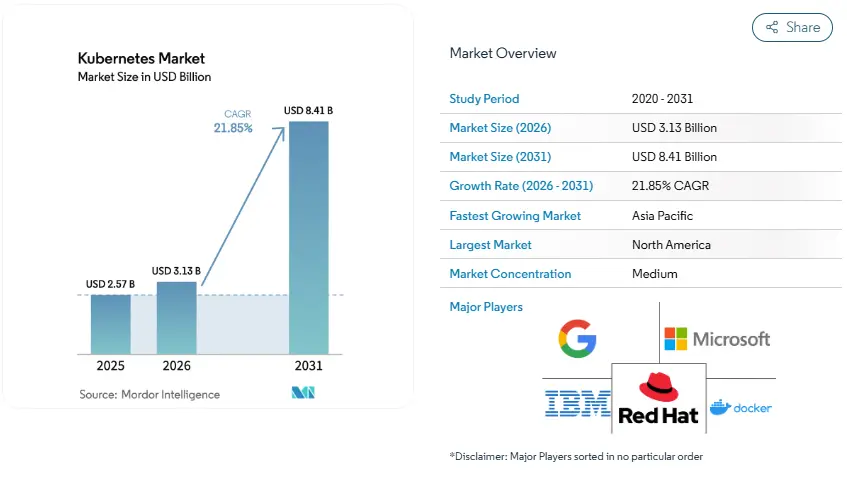
Source: Mordor Intelligence
Modern Continuous Integration and Continuous Deployment pipelines were originally designed for speed, not for the complex, ephemeral nature of Kubernetes. In a legacy environment, security was a perimeter concern. In a Kubernetes-native world, the pipeline itself becomes the primary vector for systemic risk. When organizations rush to capture market share by accelerating release cycles, they often inadvertently bake vulnerabilities directly into their clusters.
The failure of these pipelines is not usually due to a lack of individual security tools, but rather a failure to integrate security into the automated orchestration logic that defines the Kubernetes ecosystem.
Security Gaps in Rapid Releases
The move fast and break things philosophy is a liability when applied to Kubernetes-integrated CI/CD. In the drive for daily or hourly deployments, traditional security gates such as manual code reviews or asynchronous vulnerability scanning become bottlenecks that developers eventually bypass. This tension leads to shadow security, where teams prioritize uptime and feature velocity over the integrity of the container image.
Strategic gaps often emerge in the following areas:
- Image Provenance and Integrity: Without automated cryptographic signing, pipelines can pull compromised images from public registries, injecting malicious code directly into the production environment.
- Secret Sprawl: Rapid deployment cycles often lead to hardcoded credentials or poorly managed environment variables. In a Kubernetes context, a single leaked secret can grant an attacker lateral movement across the entire cluster.
- Inadequate Scanning Depth: Many automated tools scan only the application layer, ignoring the underlying base image vulnerabilities or the configuration files that dictate how the container interacts with the kernel.
For an entrepreneur building in this space, the opportunity lies in creating frictionless security tools that provide deep inspection without degrading the velocity of the development team.
Kubernetes and the Expanded Attack Surface
Kubernetes is not just a platform. It is a complex web of interconnected components, each representing a potential entry point for an adversary. Unlike traditional virtual machines, Kubernetes environments are highly dynamic, with pods scaling up and down in seconds. This fluidity makes traditional IP-based security monitoring obsolete.
The attack surface expands significantly due to several factors:
- Over-privileged Service Accounts: By default, many CI/CD tools require high-level permissions to modify the cluster. If the pipeline is compromised, the attacker inherits those administrative rights.
- Network Policy Complexity: Kubernetes allows any pod to talk to any other pod by default. Without sophisticated micro-segmentation, a vulnerability in a non-critical web front-end can lead to the exfiltration of a backend database.
- API Server Exposure: The Kubernetes API is the brain of the operation. If the CI/CD pipeline interacts with an insecurely exposed API, the entire business logic of the enterprise is at risk.
Investors must recognize that a secure Kubernetes platform is one that assumes a zero-trust posture, where every internal communication is verified, and every automated action is logged and audited.
The Business Cost of Insecure Automation
From a business perspective, the cost of a security failure in the CI/CD pipeline extends far beyond the immediate technical remediation. For an enterprise, the Real Cost is measured in brand equity, legal liabilities, and the massive operational overhead required to fix the damage after a cluster-wide compromise. When a pipeline is used to distribute malware or ransomware across a global Kubernetes footprint, the recovery time objective can stretch into weeks. The financial implications include:
- Direct Revenue Loss: Downtime in a high-transaction environment can cost millions per hour.
- Remediation Burn Rate: Diverting high-cost engineering talent away from product development to focus on forensic audits and infrastructure rebuilding.
- Insurance Premium Spikes: As cyber-insurers become more sophisticated regarding cloud-native risks, companies with leaky pipelines face significantly higher premiums or denial of coverage.
Misconfiguration and Compliance Risk
For any venture-backed platform, regulatory compliance like GDPR, SOC2, HIPAA, or PCI-DSS is a prerequisite for moving up-market into enterprise sales. Kubernetes introduces a unique challenge here because compliance is not a static state but a continuous requirement. A single misconfigured CI/CD pipeline can render a company non-compliant in seconds by deploying an unencrypted database or exposing sensitive PII through an insecure ingress controller.
The risk is often found in the Infrastructure as Code layer. If the CI/CD pipeline does not include automated policy enforcement, often referred to as Policy as Code, there is no guarantee that the deployed environment matches the documented security standards. For decision-makers, this means that passing an audit today does not guarantee compliance tomorrow. Building a platform that automates this verification is no longer an optional feature. It is a core business requirement for any scalable Kubernetes-based service.
What Kubernetes DevSecOps Engineers Actually Solve?
The shift from traditional DevOps to DevSecOps within Kubernetes environments is a strategic response to the realization that security cannot be an afterthought in a containerized world. For an entrepreneur or an investor, understanding this role is vital because Kubernetes DevSecOps engineers are the architects of Technical Trust, ensuring that the speed of the developer does not compromise the stability of the enterprise.
1. Lifecycle Security
The objective here is to move security as far left as possible. In a professional CI/CD environment, this means integrating checks at the very moment a developer commits code. By embedding security into the lifecycle, engineers prevent expensive late-stage rollbacks and keep the production environment clean.
Strategic Implementation Points:
- Pre-Commit Hooks: Automated scripts that prevent developers from pushing secrets, such as API keys or passwords, into a git repository.
- Static Analysis (SAST): Scanning the source code for logical vulnerabilities and insecure coding patterns before the container is even built.
- Software Composition Analysis (SCA): Identifying known vulnerabilities in third-party libraries and dependencies, which often make up 80% of a modern application’s codebase.
Investor Insight: Companies that successfully embed security early reduce their remediation tax. It is significantly cheaper to fix a vulnerability in the IDE than to patch a running cluster during an active breach.
2. Pre-Production Container Security
In Kubernetes, the container image is the unit of delivery. If the image is compromised, every instance spawned from it is a liability. DevSecOps engineers implement a rigorous Image Trust workflow to ensure only verified, sanitized workloads reach the cluster. This proactive verification eliminates the risk of deploying corrupted code that could compromise the entire production ecosystem.
| Security Layer | Technical Action | Business Value |
| Base Image Hardening | Stripping unnecessary tools from the image. | Reduces the attack surface and minimizes image size for faster scaling. |
| Image Scanning | Cross-referencing image layers against CVE databases. | Prevents the deployment of known exploits into production. |
| Binary Authorization | Requiring digital signatures to be verified by the Kubernetes admission controller. | Ensures that only images built by the internal CI/CD pipeline can be executed. |
3. Cluster Policy Enforcement
Manual oversight is impossible when managing hundreds or thousands of pods. DevSecOps engineers solve this by using Policy as Code. This allows leadership to define business rules, such as no container can run as root or all traffic must be encrypted, and have the system enforce them automatically.
- Admission Controllers: These act as the cluster bouncers. They intercept requests to the Kubernetes API and reject any deployment that does not meet the organization’s security profile.
- Resource Quotas: Preventing a single compromised or runaway container from consuming all cluster resources, which protects against internal Denial of Service.
- Namespace Isolation: Ensuring that different departments or clients on the same platform are logically separated, preventing lateral movement.
4. Preventing Runtime Threats
Security does not end once the code is running. Because Kubernetes is dynamic, new threats can emerge in the runtime environment, which is the period when the application is live and interacting with the internet. DevSecOps engineers deploy sophisticated monitoring to detect and stop these threats in real-time.
- Behavioral Monitoring: Establishing a baseline of what normal looks like for a pod. If a web server suddenly starts scanning the internal network, the system automatically kills the pod.
- Egress Filtering: Limiting where a container can send data. A secure system ensures that a compromised application cannot call home to an attacker’s server to exfiltrate data.
- Drift Detection: Identifying when a container configuration has changed from its original state. In a healthy environment, containers should be immutable; any change suggests a potential intrusion.
Why Traditional DevOps Teams Struggle With DevSecOps?
Traditional DevOps teams prioritize speed and automation. Their success depends on how fast they can move features to production. However, Kubernetes complexity often turns security into a secondary thought. The knowledge required to secure a containerized architecture is different from securing standard virtual machines. This is why specialized Kubernetes DevSecOps engineers are becoming essential to the modern stack.
1. Kubernetes Expertise Gaps
Kubernetes is not a set it and forget it technology. It requires understanding etcd encryption, Mutual TLS for communication, and role-based access control.
The Expertise Gap:
- Networking: Traditional engineers understand firewalls, but Kubernetes requires knowledge of network policies and CNI plugins.
- Abstraction: Security must be applied at the container, pod, node, and cluster levels simultaneously.
- Immutability: Shifting from patching servers to rebuilding images requires a total workflow overhaul.
2. Runtime Security Challenges
Most teams are experts at build-time logic. They know how to get the code to run. However, once a container is live, it can become a black box. Runtime security involves monitoring active behavior to catch zero-day exploits or anomalies that static scanning missed.
The Reality Check: A container that passed every scan can still be hijacked through process injection.
Without experience in eBPF-based monitoring, teams miss early warning signs. For a business owner, this lack of visibility is a critical risk. If a team cannot identify what a pod is doing in real-time, the platform relies on luck rather than design.
3. Friction in Shift-Left Security
The push to shift left moves security checks to early development stages. While sound in theory, a clumsy implementation by a traditional team often creates developer friction.
- False Positives: Tools flagging non-critical issues overwhelm developers, leading them to ignore alerts.
- Broken Pipelines: Strict gates that stop builds for minor issues can bring a high-velocity team to a halt.
- Context Switching: Forcing developers to act as security researchers reduces time spent on innovation.
Security must be automated and silent. If the early stages are too intrusive, the final delivery to the customer will suffer.
4. Tool Sprawl and Complexity
The security market is flooded with point solutions. These tools solve specific problems but rarely communicate. A traditional team may end up managing dozens of dashboards, leading to alert fatigue.
| Problem Area | Tool Examples | Operational Impact |
| Vulnerability Scanning | Trivy, Clair | Overlapping data and fragmented reporting. |
| Policy Management | OPA, Kyverno | Conflicting rules causing deployment failures. |
| Secrets Management | Vault, Cloud Secrets | High integration overhead and complex rotation. |
This sprawl creates a management tax. High-cost engineers spend time maintaining tools instead of building features. Scaling platforms requires integrated solutions that consolidate these functions to reduce complexity.
Where Secure CI/CD Pipelines Usually Break Down?
Securing a Kubernetes environment is a game of managing dependencies where any flaw in the initial stages, such as a misconfigured YAML file or a vulnerable base image, is amplified as it moves toward production. Building a resilient system requires identifying the specific failure points where automation bypasses human oversight, as pipelines without natively integrated orchestration logic become liabilities rather than assets.
1. Weak Container Image Validation
The container image is the fundamental building block of the cluster. If validation is weak, the entire supply chain is compromised from the start. This vulnerability allows undetected threats to move downstream, turning every deployment into a potential security breach. Without rigorous verification of image origin and content, the speed of your pipeline becomes its greatest liability.
- Vulnerability Blind Spots: Using static scanners that only check for known OS-level bugs while ignoring application-layer vulnerabilities.
- Lack of Signing: Deploying images that have not been cryptographically signed allows for man-in-the-middle attacks where malicious code is swapped for legitimate containers.
- Bloated Base Images: Using full-service OS images like Ubuntu instead of minimal distros like Alpine or Distroless increases the attack surface by including unnecessary tools.
2. Insecure Infrastructure as Code
Infrastructure as Code allows for rapid cluster scaling, but it also allows for the rapid scaling of mistakes. A single line of misconfigured code in a Terraform or Helm chart can leave an entire environment exposed. When flaws are codified into templates, they replicate across every region and cluster automatically, turning a minor oversight into a systemic failure.
Technical Debt Warning: If your IaC templates do not undergo automated security linting, you are essentially automating the deployment of vulnerabilities.
Common IaC failures include:
- Hardcoded Configurations: Static settings that prevent the dynamic rotation of security parameters.
- Over-Permissive Security Groups: Opening unnecessary ports like SSH or insecure API endpoints by default.
- Privileged Mode: Allowing containers to run with host-level permissions because the template was copied from an insecure public source.
3. Misconfigured RBAC and Policies
Role-Based Access Control is the primary gatekeeper in Kubernetes. However, it is often one of the most neglected components due to its complexity. When permissions are granted too broadly to simplify workflows, it creates a massive internal attack surface that hackers can easily exploit to move laterally across your infrastructure
| Configuration Error | Immediate Risk | Long-term Impact |
| Cluster-Admin Overuse | Total cluster takeover if a single account is compromised. | Irreparable data loss and system wipe. |
| Default Service Accounts | Pods can query the API server for sensitive cluster data. | Lateral movement across namespaces. |
| Missing Network Policies | Unrestricted lateral traffic between sensitive pods. | Exfiltration of backend databases via web pods. |
4. Secrets Exposure in Pipelines
Automated pipelines require credentials to function, but these secrets often end up in the wrong places. This exposure is one of the most common ways high-value targets are breached. When sensitive keys are stored in insecure locations or leaked into build logs, they provide a direct map for attackers to bypass even the most advanced perimeter defenses.
- Environment Variable Leaks: Passing passwords or API keys as plain text in YAML files.
- Log Poisoning: Failing to mask sensitive data, resulting in credentials appearing in build logs that are accessible to the whole team.
- Insecure Storage: Storing long-lived secrets in Git repositories rather than using a dedicated vault or a dynamic secret provider.
5. Missing Runtime Monitoring
The greatest fallacy in modern DevSecOps is the belief that a clean scan at build-time ensures safety at runtime. Security must be continuous, extending into the live environment where the most sophisticated attacks occur. Relying solely on static checks ignores the dynamic nature of containerized workloads, leaving the platform blind to threats that only manifest after the application is live.
- Visibility Gaps: If you cannot see process-level activity inside a pod, you cannot detect a shell being opened by an attacker.
- Log Integration Failures: Collecting logs is useless if they are not being analyzed for anomalous behavior in real-time.
- No Automated Response: A system that detects a threat but waits for a human to intervene is already too late. Modern systems must isolate or kill compromised pods automatically.
Core Skills to Look for in DevSecOps Engineers
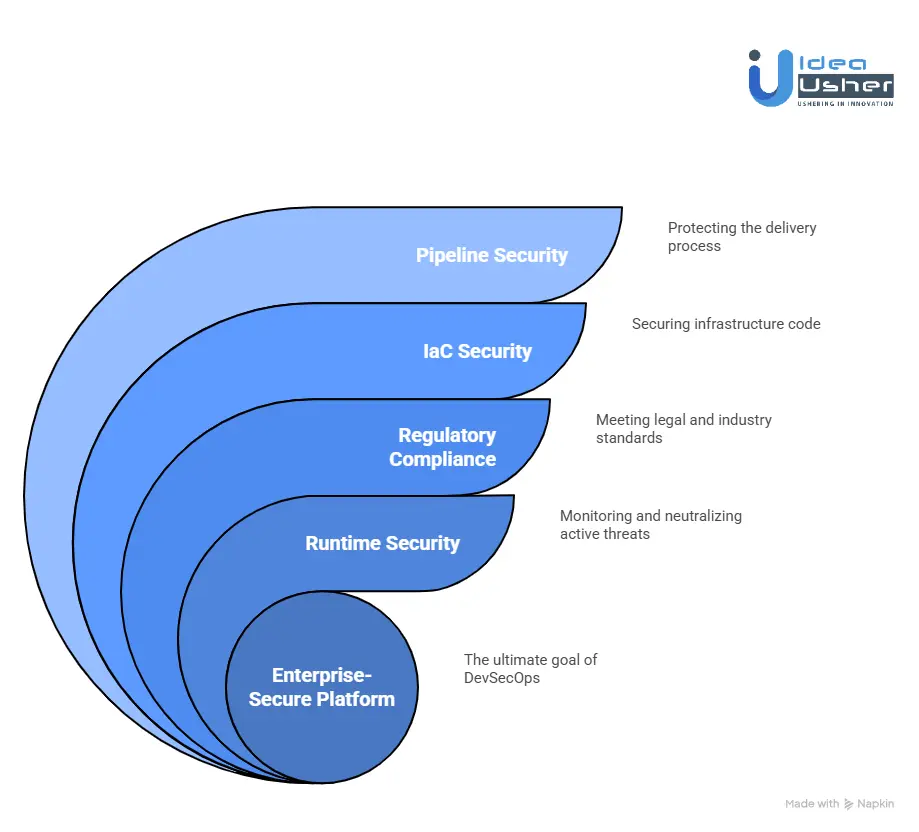
Identifying the right talent is the most significant hurdle when scaling a secure containerized platform because Kubernetes DevSecOps engineers are specialized architects who understand the intersection of distributed systems and adversarial psychology. At IdeaUsher, we help businesses build secure, scalable cloud-native infrastructure by providing access to pre-vetted talent who possess a blend of offensive and defensive skills.
1. Cluster Hardening
Hardening a cluster goes far beyond default settings. We ensure our engineers understand the deep internals of the Kubernetes control plane and the underlying node architecture. This expertise ensures your platform foundation is resistant to initial access attempts. By identifying and closing hidden backdoors within the default configuration, we create a defensive perimeter that protects your most sensitive internal processes.
Key Verification Areas:
- CIS Benchmarking: Ability to implement and audit the cluster against the Center for Internet Security standards.
- mTLS Implementation: Experience with service meshes like Istio or Linkerd to ensure all internal traffic is encrypted.
- Control Plane Security: Knowledge of securing the etcd database and restricting access to the Kubernetes API server.
2. Secure GitOps
GitOps transforms your git repository into the single source of truth for your infrastructure. When you hire through us, we provide experts who use this model to ensure that no manual, unrecorded changes ever occur in production. This approach creates a transparent audit trail where every modification is documented, reviewed, and automatically reconciled with the live state of your cluster.
Operational Insight: By using tools like ArgoCD or Flux, our DevSecOps engineers implement drift detection. This ensures the cluster automatically reverts to its secure, documented state if an unauthorized change is detected.
3. Pipeline Security
The pipeline itself is a high-value target. We vet our talent on their ability to harden the orchestration tools that have the keys to your kingdom. Protecting the delivery mechanism is just as critical as protecting the code it carries. By securing the automated links between development and deployment, we prevent attackers from using your own tools to inject malicious code into production.
- Jenkins Hardening: Securing controller-agent communication and limiting plugin usage to minimize the attack surface.
- GitHub Actions Security: Using OpenID Connect to allow actions to access cloud resources without needing long-lived, static secrets.
- Workflow Integrity: Implementing mandatory status checks and protected branches to ensure no code enters the pipeline without proper vetting.
4. IaC Security
Infrastructure as Code must be treated with the same level of scrutiny as application code. We look for proficiency in automated linting and security scanning for infrastructure templates to prevent misconfigurations from reaching production. By embedding security tests directly into the provisioning process, we ensure that every resource is compliant with your organizational policies before a single cloud asset is created.
| Tooling | Practical Application | Security Goal |
| Checkov / Tfsec | Automated scanning of Terraform files. | Detect misconfigured buckets or open ports before deployment. |
| Helm Chart Auditing | Verifying template logic and dependency versions. | Prevent the injection of malicious sidecars or insecure defaults. |
| State File Protection | Encrypting and restricting access to Terraform state. | Prevent the exposure of sensitive infrastructure metadata. |
5. Regulatory Compliance
For businesses dealing with financial or medical data, compliance is a non-negotiable requirement for market entry. We provide engineers who can translate abstract legal requirements into concrete technical controls. They are comfortable mapping Kubernetes network policies to PCI DSS requirements or using audit logs to satisfy SOC 2 availability markers.
6. Runtime Security
Runtime security is the final line of defense. Proficiency in these tools ensures that your platform can defend itself even after a successful initial breach by monitoring active container behavior. By analyzing system calls and network patterns in real time, our engineers can instantly flag and neutralize unauthorized activity before it escalates into full-scale data exfiltration.
- Falco Mastery: Writing custom rules to detect suspicious syscalls, such as a process spawning a shell inside a production container.
- Open Policy Agent: Using the Rego language to define fine-grained authorization policies that govern what users and machines can do within the cluster.
- Real-time Alerting: Integrating these tools with communication platforms to ensure the security team is notified of threats within seconds.
Finding an engineer with this specific combination of skills is the difference between a platform that is cloud-ready and one that is truly enterprise-secure. By partnering with IdeaUsher, you gain immediate access to this elite tier of technical talent.
Why Hiring Kubernetes DevSecOps Talent Is Difficult?
Hiring Kubernetes DevSecOps engineers is a challenge because they must balance rapid software delivery with rigorous risk management. This talent scarcity often forces businesses to choose between delayed launches and insecure platforms. At IdeaUsher, we solve this by providing immediate access to pre-vetted specialists who ensure your infrastructure is secure, compliant, and scalable from day one.
1. Rising Expert Demand
The rapid adoption of cloud-native technologies has outpaced the growth of the talent pool. As businesses migrate core services to Kubernetes, security-first engineering has shifted from a luxury to a baseline requirement. This imbalance forces organizations to compete for a shrinking number of specialists capable of defending complex, distributed environments.
The Market Reality:
- Explosive Growth: Every major industry, from fintech to healthcare, is now competing for the same specialized security architects.
- Specialization Gap: Many general DevOps engineers can manage a cluster, but few can defend it against sophisticated, modern attack vectors.
- Retention Challenges: High demand means top-tier talent is frequently headhunted, making it difficult to maintain long-term architectural stability.
2. Lack of Production Experience
There is a significant difference between passing a certification exam and managing a live, high-traffic Kubernetes cluster during a security incident. Many candidates possess theoretical knowledge but falter when faced with the messy reality of production. This gap often results in a “security theater” where clusters look safe on paper but remain vulnerable to sophisticated, real-world exploitation.
Expert Insight: Real-world security experience involves handling leaky abstractions, complex legacy integrations, and the high-pressure environment of a live breach. This level of intuition cannot be taught in a boot camp.
Without a track record of securing live workloads, an engineer might overlook subtle misconfigurations that lead to lateral movement or privilege escalation. This experience gap is why simple DevOps hires often fail to meet the rigorous demands of a true DevSecOps mandate.
3. Project Delays
The time it takes to find, vet, and onboard a qualified security engineer can span several months. In the tech world, a three-month delay in hiring is not just a human resources issue; it is a direct threat to your market competitiveness. As your infrastructure continues to evolve without a dedicated guardian, the window of opportunity for attackers widens, potentially turning a staffing gap into a catastrophic security breach.
- Stalled Roadmaps: Critical security features are often pushed to later sprints, leaving the current infrastructure vulnerable.
- Overburdened Staff: Existing engineers are forced to pull double duty, leading to burnout and an increase in human error.
- Technical Debt: Temporary “band-aid” solutions are implemented to meet deadlines, creating security debt that must be paid back later at a higher cost.
4. No Room for Experimentation
In a production environment, there is no room for learning on the job when it comes to security. A single failed experiment with a network policy or a mismanaged secrets provider can result in catastrophic data loss or an extended service outage. This high-stakes environment demands seasoned expertise because a single misstep in configuration can inadvertently tear down the very barriers designed to protect your most critical assets.
| Risk Factor | Impact of Inexperience | Strategic Consequence |
| Data Integrity | Improperly configured volumes leading to leaks. | Permanent loss of customer trust and legal liability. |
| System Availability | Security tools that inadvertently crash pods. | Immediate revenue loss and damaged brand reputation. |
| Compliance | Failure to meet SOC2 or HIPAA standards. | Inability to close enterprise-level deals or pass audits. |
Organizations require a day-one impact from security hires. The cost of a bad hire in this space is not just their salary, but the potential exposure of the entire business. By partnering with IdeaUsher, you bypass this experimental phase and gain access to pre-vetted experts who have already proven their ability to secure large-scale Kubernetes ecosystems.
In-House Hiring vs External DevSecOps Experts
Deciding between building an internal team or leveraging external expertise is a critical choice for your cloud-native security. While internal teams offer institutional knowledge, they often struggle with the high costs of retention and the rapid evolution of Kubernetes tools. External experts provide an immediate infusion of field-tested strategies that would otherwise take years to develop in-house.
At IdeaUsher, we bridge this gap by helping businesses build secure, scalable cloud-native infrastructure with pre-vetted DevSecOps talent, so you can hire from us and achieve total peace of mind.
1. Model Cost Comparison
Building an internal DevSecOps unit involves high hidden costs beyond base salaries. We offer external models that provide a more predictable expenditure profile by eliminating the overhead associated with specialized recruitment and continuous training. By shifting these complexities to our pre-vetted team, you convert volatile hiring risks into a stable, managed investment that scales precisely with your technical requirements.
| Expense Category | Internal Hiring | External Experts (IdeaUsher) |
| Recruitment Fees | High (20 to 30 percent of salary) | Zero (Immediate access) |
| Training and Certs | Ongoing (CKA, CKS, Cloud certs) | Included (Pre-vetted expertise) |
| Tooling Costs | Separate licenses and setup | Often bundled with expert workflows |
| Employee Benefits | Full burden (Insurance, 401k, etc.) | None (Project-based or flat rate) |
2. Deployment Speed Gaps
The speed at which you can secure your pipeline directly impacts your time-to-market. When you partner with us, our external experts significantly compress the onboarding and implementation phases. By deploying pre-configured security frameworks and proven automation scripts from the very first day, we eliminate the traditional learning curve that typically stalls new infrastructure projects.
- Internal Model: Finding a qualified candidate usually takes 3 to 6 months, followed by a 2-month ramp-up period to understand the existing architecture.
- External Model: We provide experts who typically begin high-impact hardening within the first week by utilizing pre-built security templates and established best practices.
- Deployment Velocity: Because our specialists have handled dozens of similar environments, they avoid the pioneers’ tax, which is the time wasted solving problems that have already been solved elsewhere.
3. Internal Knowledge Gaps
Even the most talented internal DevOps engineers often face knowledge gaps when transitioning to a full DevSecOps mandate. Security is a specialized discipline that requires constant exposure to new threat vectors that a single-company environment might not provide.
Technical Bottleneck: Internal teams often rely on default-secure settings which are rarely sufficient for enterprise scale. We provide external experts who bring a broader perspective because they have seen how these defaults fail across multiple industries and diverse attack scenarios.
These gaps often manifest as a lack of familiarity with advanced tools like Kube-bench, Kyverno, or complex eBPF-based monitoring. Without this specialized knowledge, internal teams may inadvertently create a false sense of security while leaving critical API vulnerabilities exposed.
4. Rapid Risk Reduction
Our external experts operate with a day-zero mentality by applying lessons learned from hundreds of production incidents to your specific cluster. We do not just implement tools. We implement a security culture that is designed to survive a breach. This proactive philosophy ensures that your systems are not just compliant on paper but are fundamentally resilient against the actual techniques used by modern adversaries.
- Immediate Remediation: We identify and patch common misconfigurations, like privileged containers or missing resource limits, on day one.
- Adversarial Thinking: We approach your cluster from the perspective of an attacker by conducting internal audits that internal teams might be too close to see.
- Scalable Policy as Code: Instead of manual checks, we deploy automated Policy-as-Code frameworks that grow with your infrastructure.
Why Staff Augmentation Works for Kubernetes Security?
Cloud-native protection requires more than a simple checklist. As Kubernetes environments become more complex, businesses need security strategies that evolve alongside rapid deployment cycles and distributed infrastructure. Idea Usher supports organizations by strengthening cloud-native security frameworks, streamlining DevSecOps adoption, and helping teams reduce operational risk without compromising development speed.
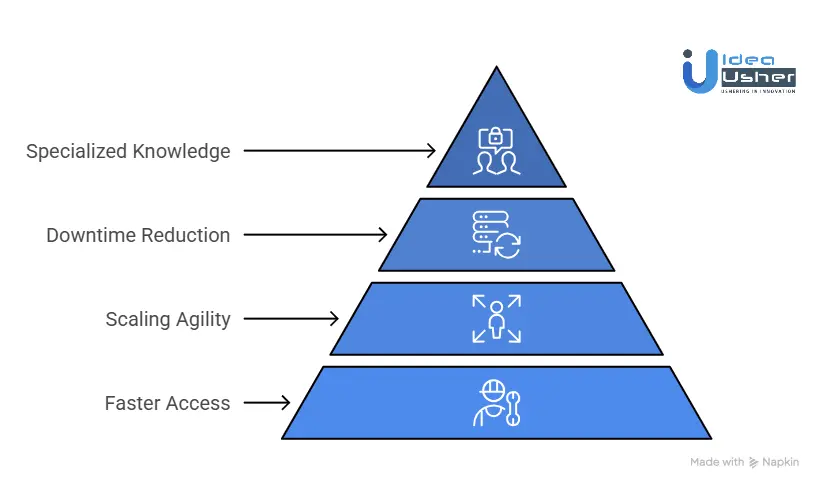
1. Faster Access to Engineers
The traditional hiring cycle for a specialized engineer can take months, leaving your infrastructure exposed in the interim. Staff augmentation bypasses this delay by connecting you with professionals who are already vetted and ready to deploy. This immediate access allows you to patch critical security holes in real time rather than waiting for a lengthy HR process to conclude.
- Pre-Vetted Proficiency: We handle the technical rigors of testing for CKS-level knowledge so you don’t have to.
- Instant Integration: Our engineers are trained to adapt to various project management styles, ensuring they hit the ground running on day one.
- Verified Track Records: You gain access to talent that has successfully navigated real-world cluster compromises and audits.
2. Scaling Without Delays
When your project scope increases, your security requirements expand in tandem. Traditional recruitment cannot move at the speed of a modern cloud-native roadmap, but staff augmentation can. This flexibility allows you to inject specialized talent exactly when your architecture reaches a new level of complexity, ensuring that growth never outpaces your ability to defend it.
Operational Agility: We enable you to expand or contract your security team based on current sprint demands. This flexibility prevents your core development team from being overwhelmed by security backlog items during critical growth phases.
By removing the bottleneck of recruitment, we ensure that security remains a continuous part of your development lifecycle rather than a periodic afterthought. This on-demand scaling allows you to meet aggressive deadlines without cutting corners on your defensive architecture.
3. Reducing Infrastructure Downtime
Insecure deployments often lead to unexpected outages or emergency rollbacks. Our experts focus on stability as much as security, ensuring that hardening measures do not disrupt your service availability. We implement a rigorous validation process that tests security policies against your specific traffic patterns before they ever reach production.
| Deployment Phase | How We Minimize Risk | Reliability Outcome |
| Cluster Updates | Staged patching and rolling updates with pre-checks. | Zero-downtime maintenance and version parity. |
| Network Policy | Dry-run testing before applying restrictive ingress rules. | No accidental blocking of critical internal traffic. |
| Secrets Management | Automated rotation without manual service restarts. | Continuous uptime even during credential changes. |
4. Accessing Specialized Knowledge
Kubernetes security is a niche field within a niche field. Most organizations do not need a full-time expert on every single payroll, but they do need that specialized knowledge during the architecture and scaling phases. This requirement makes staff augmentation the ideal solution for accessing high-level architectural oversight without the long-term overhead of a permanent senior hire.
- Deep-Dive Audits: We provide talent that can perform deep-packet inspection and eBPF-based monitoring at the kernel level.
- Advanced Policy Enforcement: Access expertise in Rego for Open Policy Agent (OPA) to create fine-grained authorization rules that simple RBAC cannot handle.
- Threat Modeling: Our engineers don’t just fix bugs. They anticipate how an attacker might chain multiple low-level vulnerabilities to gain cluster-admin privileges.
How Idea Usher Helps Companies Secure CI/CD Pipelines?
A fast pipeline is a liability if it is not secure. At IdeaUsher, we help businesses build secure, scalable cloud-native infrastructure with pre-vetted DevSecOps talent who ensure security is an enabler, not a roadblock. By integrating our specialists, you can hire from us to transition from a reactive scan and fix model to a proactive, secure-by-design architecture. This ensures every line of code and container is hardened before reaching production, allowing you to scale rapidly without introducing systemic vulnerabilities.
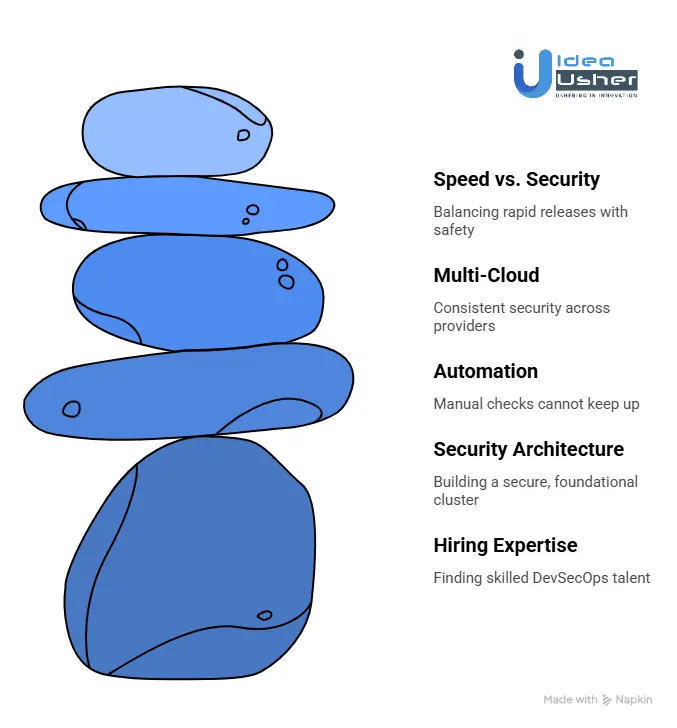
1. Vetted DevSecOps Talent
We eliminate the guesswork of hiring by providing engineers who have already mastered the steep learning curve of the Kubernetes ecosystem. Our experts bring a depth of experience that goes beyond basic automation to include sophisticated defensive strategies. By utilizing our pre-existing talent pool, you avoid the high costs and risks associated with traditional technical recruitment.
- Rigorous Vetting: We test for hands-on proficiency in Kubernetes API security, service mesh configurations, and container runtime protection.
- Day-One Impact: Our specialists arrive ready to audit your current pipelines and identify low-hanging vulnerabilities immediately.
- Mentorship Culture: While securing your systems, our engineers share best practices with your internal team to elevate your overall security maturity.
2. Security-First Architectures
Building a cluster is easy, but building a fortress requires a foundational commitment to security-first principles. We design environments where the principle of least privilege is the default, not an afterthought. This ensures that every component in your stack has exactly the permissions it needs and nothing more.
Architectural Guardrails: We implement immutable infrastructure and rootless containers to ensure that even if a component is compromised, the blast radius is strictly contained. By establishing these boundaries early, we prevent the lateral movement that attackers rely on to escalate privileges within a cluster.
3. Automated CI/CD Workflows
Manual security checks cannot keep up with modern release cycles. We help you automate your defenses so that security testing happens at the speed of code. This automation creates a continuous feedback loop that catches errors before they become expensive production problems.
- Static Analysis (SAST): We integrate tools that scan your source code for hardcoded secrets and insecure patterns during the commit phase.
- Container Scanning: Every image is checked against the latest CVE databases before being pushed to your private registry.
- Policy Enforcement: We use admission controllers to automatically reject any deployment that does not meet your specific security standards.
4. Multi-Cloud Support
Modern enterprises rarely stay within the walls of a single provider. We specialize in securing Kubernetes across AWS, Azure, and Google Cloud, ensuring a consistent security posture regardless of where your workloads reside. Our expertise ensures that your security policies remain portable and effective even as you scale across different vendors.
| Cloud Provider | Our Security Focus | Unified Result |
| AWS (EKS) | IAM Roles for Service Accounts (IRSA) | Granular AWS resource access. |
| Azure (AKS) | Azure Active Directory Integration | Centralized identity management. |
| Google (GKE) | Binary Authorization and Workload Identity | Cryptographically verified deployments. |
5. Speed Without Compromise
The ultimate goal of DevSecOps is to ensure that secure and fast are no longer mutually exclusive. We help you reach a state where your developers can push updates with confidence, knowing the platform itself will catch and block potential risks. By shifting security to the left, we reduce the friction that usually occurs when security teams attempt to audit code at the very end of a sprint.
By embedding our pre-vetted experts into your workflow, you gain the ability to ship features at a market-leading pace without exposing your business to unnecessary danger. This accelerated release cycle is powered by automated feedback loops that inform developers of security issues in real-time, allowing for immediate remediation during the development phase.
What Idea Usher’s DevSecOps Engineers Actually Do?
Modern Kubernetes security demands deeper expertise than traditional infrastructure management alone. Idea Usher enables businesses to strengthen their cloud-native ecosystems by embedding experienced DevSecOps professionals into development workflows, ensuring security remains integrated across every deployment stage.
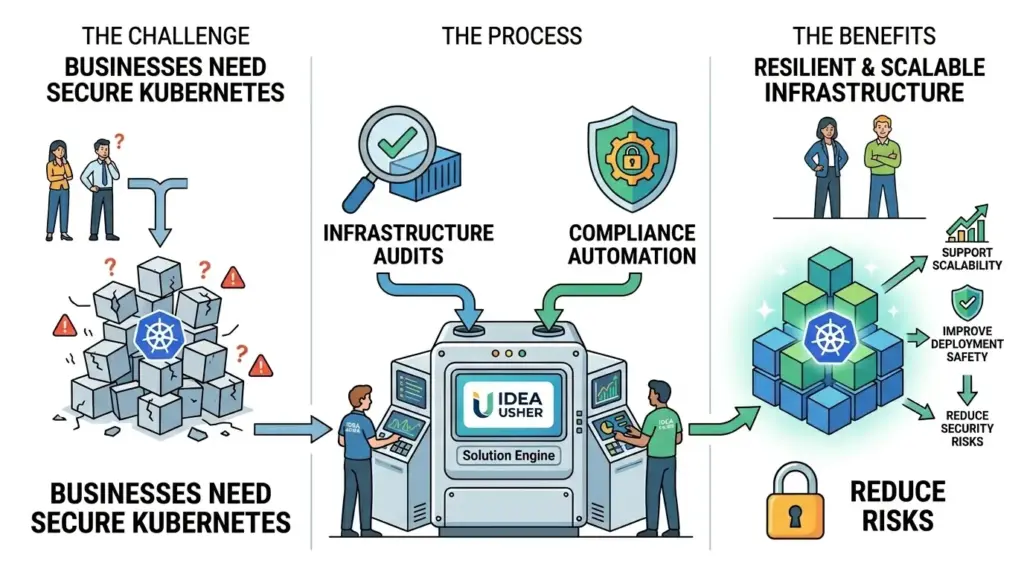
Our engineers work alongside internal teams to harden systems, automate security practices, and build resilient Kubernetes environments that can adapt to evolving operational and threat challenges.
1. Audit Infrastructure Risks
Before writing defensive code, our engineers perform a deep-dive analysis of your environment. We identify the invisible holes that automated scanners often miss. This manual inspection uncovers logic flaws and complex architectural weaknesses that standard tools overlook.
- API Server Hardening: We block public exposure and ensure unauthorized requests are rejected.
- RBAC Review: We audit permissions to ensure no user has more access than necessary.
- Network Mapping: We identify shadow services and unencrypted traffic within your clusters.
- Secret Management: We locate sensitive keys hidden in config maps or environment variables.
2. Secure CI/CD Configuration
We transform your delivery pipeline into a secure gateway. By injecting checkpoints at every stage, we ensure only verified code reaches production. This systematic approach filters out vulnerabilities during the build process to prevent security flaws from ever reaching your end users. By hardening the pipeline itself, we turn your deployment process into a consistent and reliable first line of defense.
The Zero-Trust Pipeline: Our engineers configure CI/CD tools to require cryptographic signatures for every image. This means the cluster rejects any unsigned artifacts, preventing attackers from injecting malicious code even if they access your registry.
3. Container and Dependency Scanning
A secure cluster is only as safe as the code inside it. We implement automated scanning layers that act as a filter for your software supply chain. This continuous oversight ensures that every third-party library and base image is verified against known threats before it can compromise your internal network.
- Vulnerability Management: We set up real-time scanning of images against global CVE databases.
- SCA Integration: Software Composition Analysis identifies poisoned open-source libraries before import.
- Base Image Hardening: We use minimal distroless images to reduce the potential attack surface.
4. Runtime Monitoring and Detection
Security continues after a pod is running. Our engineers implement active defense strategies to monitor behavior and catch anomalies as they happen. This real-time visibility allows us to detect and neutralize suspicious activity before it can escalate into a full-scale system breach. By maintaining a constant watch over your live environment, we ensure that your defenses remain effective long after the initial deployment is complete.
| Detection Type | Engineering Action | Benefit |
| Drift Detection | Blocks manual changes to running containers. | Prevents hot-patching by attackers. |
| Behavioral Analysis | Monitors for unusual system calls or file access. | Identifies zero-day exploits in progress. |
| Log Aggregation | Centralizes audit trails from the API and nodes. | Provides a map for forensic analysis. |
5. Automate Compliance Checks
Regulatory requirements should not be a manual headache. We turn compliance into an automated reality by using Policy as Code frameworks. Instead of spreadsheets, we deploy tools like Kyverno or OPA Gatekeeper. These tools automatically enforce rules across every deployment, such as requiring resource limits to prevent Denial of Service or blocking containers from running as root. This ensures your infrastructure remains audit-ready without manual intervention.
6. Optimize Incident Response
When a security event occurs, every second counts. Our engineers build the playbooks and automated responses necessary to contain threats instantly. This involves setting up isolation protocols where suspicious pods are quarantined without taking down the entire service.
By partnering with us, you ensure your incident response is proactive. We help you build self-healing architectures that can rotate compromised credentials and restart affected services in a safe state. This level of preparedness is why businesses hire from IdeaUsher to build long-term resilience.
Technologies Used in Secure Kubernetes CI/CD
Selecting the right stack is only half the battle. We focus on a layered technology approach where every tool serves a specific purpose in your security posture. You can hire us to ensure these complex technologies are configured correctly from the start, preventing the common gaps that lead to cluster exploitation. Our engineers bring a unified defense strategy that aligns your technical choices with your business goals.
1. Core Orchestration
The foundation of your stack must be hardened at the engine level. We move beyond default configurations to ensure the container runtime and orchestration layers are strictly isolated. This deep-level hardening ensures that a compromise in one container cannot easily spread to the host or other workloads.
- Runtime Sandboxing: We configure Containerd to use gVisor or Kata Containers for workloads requiring high isolation.
- Node Hardening: Our engineers apply CIS Benchmarks to the host OS to prevent container escape attempts.
- Resource Quotas: We implement limits at the namespace level to ensure no single container can crash your entire node.
2. Deployment Automation
Modern CI/CD requires a declarative approach where the state of your security is always version-controlled. By using ArgoCD, we ensure your cluster state matches your Git repository exactly to eliminate manual configuration drift. This synchronization provides a reliable source of truth for both your developers and your security auditors.
Automated Guardrails: Whether you use GitLab or GitHub, we inject security scanning directly into the runner. This ensures a pipeline fails immediately if a high-severity vulnerability is detected, keeping insecure code away from your users.
3. Infrastructure as Code
We treat infrastructure as code to ensure repeatability and security. By using Terraform and Helm, we deploy entire environments pre-configured with your organizational security policies. This automation ensures that every environment, from staging to production, adheres to the same rigorous defensive standards.
| Tool | Role | Security Benefit |
| Terraform | Cloud Provisioning | Eliminates manual errors in IAM and VPC setup. |
| Helm | App Packaging | Ensures consistent deployment templates across teams. |
| Checkov | IaC Scanning | Catches misconfigured resources before deployment. |
4. Scanning and Detection
Detection and prevention must happen at every stage. We use these specialized tools to create a deep defense-in-depth strategy that protects the full lifecycle of your applications. This multi-layered visibility allows us to catch threats whether they originate in your source code or emerge during live operations.
- Trivy: We use this for lightning-fast vulnerability scanning of container images and file systems.
- Falco: Our engineers deploy Falco to monitor kernel-level activity and alert on suspicious behavior like unexpected shell executions.
- Aqua Security: We integrate enterprise-grade protection for organizations that require advanced supply chain security and forensic data.
5. Policy and Identity
The final layer is identity and policy management. We ensure secrets are never stored in plain text, and every action in the cluster is governed by a strict policy. By centralizing control over access and credentials, we significantly reduce the risk of identity-based attacks. We use HashiCorp Vault to inject secrets into pods at runtime so sensitive data never touches persistent storage.
Simultaneously, we deploy OPA Gatekeeper to act as a programmable guard. This tool allows us to write custom rules that block non-compliant deployments, such as those missing mandatory labels or using prohibited image registries. This combination ensures your internal security remains airtight even as your team grows.
Common Mistakes Companies Make During DevSecOps Adoption
Transitioning to a cloud-native model often introduces complexity that outpaces traditional security. Many organizations treat security as a hurdle at the end of the sprint rather than an integral part of the architecture. This reactive approach creates bottlenecks and leaves critical gaps in your defense. When you hire from Idea Usher, we help you avoid these mistakes by embedding security into every layer of your lifecycle from the first line of code.
1. Late-Stage Security
The most frequent error is treating security as a final gate. By the time a vulnerability is found in production, the cost to fix it has multiplied significantly compared to finding it during the design phase. This delay creates a dangerous friction between development speed and system integrity, often forcing teams to choose between a timely launch and a secure one.
- Cost of Delay: Fixing flaws in production often requires emergency rollbacks and unplanned downtime.
- Release Friction: Security teams become roadblocks when they stop releases at the last minute.
- The Solution: We implement shift-left security where automated testing happens as soon as a developer pushes code to a branch.
2. Generalists vs. Specialists
Many companies assume DevOps engineers can naturally handle deep Kubernetes security. While these engineers excel at automation, security is a specialized discipline that requires an adversarial mindset. Expecting a generalist to defend against sophisticated exploits is a high-risk gamble that often leaves subtle but critical configuration gaps exposed.
Technical Reality: A standard DevOps engineer configures a cluster to run, but a specialized DevSecOps engineer ensures it can survive a targeted attack. Relying on generalists often leads to misconfigured RBAC or overly permissive network policies that look functional but are fundamentally insecure.
3. Ignoring Runtime Threats
Static scanning of images is necessary but insufficient. An application safe at build time can still be exploited at runtime through zero-day vulnerabilities or compromised credentials. This reality makes continuous runtime monitoring essential, as it allows you to detect malicious behavior that only manifests when the code is actually executing.
| Mistake | Consequence | Our Corrective Action |
| No Visibility | Attacks go unnoticed for months. | Deploying eBPF-based monitoring for real-time alerts. |
| Static Policies | New threats bypass old rules. | Implementing dynamic behavioral analysis. |
| Manual Audits | Gaps appear between audit cycles. | Continuous automated logging and anomaly detection. |
4. Scaling Without Governance
As clusters grow, manual security management becomes impossible. Companies that scale infrastructure without automated governance quickly lose track of which services run with elevated privileges. This loss of visibility turns your internal network into a playground for lateral movement, as attackers can easily exploit forgotten or over-privileged pods.
- Configuration Drift: Without strict governance, different teams apply varying security standards to their namespaces.
- Resource Exhaustion: A lack of global policy can allow a single runaway process to consume all cluster resources.
- Policy as Code: We solve this by deploying global admission controllers that enforce your security standards automatically as you scale.
5. Tool Proliferation
Buying every security tool on the market does not guarantee safety. Using too many unintegrated tools leads to alert fatigue and data silos where critical information is lost in the noise. Our engineers focus on tool consolidation and integration. Instead of managing ten different dashboards, we create a unified security pipeline where data flows seamlessly between your scanner, orchestrator, and monitoring stack.
This streamlined approach ensures your team spends less time managing tools and more time responding to actual risks. By choosing to hire from us, you gain a partner who understands how to build a lean, effective, and fully integrated security ecosystem.
Example Use Cases for Kubernetes DevSecOps Teams
Implementing high-level security is not a one-size-fits-all task. Different industries face unique threat profiles and regulatory pressures that require specific architectural decisions. We provide the expertise to adapt your Kubernetes environment to these diverse needs. At Idea Usher, you get a team that understands how to translate complex business requirements into hardened, automated technical controls.
1. FinTech and Compliance
Financial institutions operate under intense scrutiny, where a single misconfiguration can lead to massive fines or loss of trust. We help FinTech companies build environments that are audit-ready by default. This proactive stance ensures that every infrastructure change is documented and verified against regulatory requirements before it can impact your ledger.
- Data Encryption: We implement mTLS via service meshes like Istio to ensure all data in transit between microservices is encrypted.
- Immutable Audit Logs: We configure centralized logging that cannot be altered or deleted, providing a clear trail for compliance officers.
- Segregation of Duties: Our engineers use RBAC to ensure the developers who write code cannot also approve its deployment to production.
2. Healthcare Data Protection
In healthcare, protecting Personal Health Information is a legal mandate. We design Kubernetes architectures that prioritize data isolation and strict access control to meet HIPAA-level standards. This architectural rigor ensures that sensitive records are protected by multiple layers of encryption and identity verification throughout their entire lifecycle.
Privacy by Design: We utilize encrypted persistent volumes to ensure that sensitive patient data is never accessible in plain text. By isolating these workloads into dedicated, hardened namespaces, we create a secure enclave within your larger cluster. This layered approach ensures that patient records remain confidential even if other parts of the system are compromised.
3. SaaS Runtime Hardening
SaaS providers are prime targets for attackers looking to exploit one customer to reach another. We focus on multi-tenancy security to prevent lateral movement and unauthorized data access across your platform. This strategy involves the use of granular network policies and pod-level isolation to ensure that a breach in one tenant cannot spill over into another.
| Security Layer | Technical Implementation | SaaS Benefit |
| Tenant Isolation | Network Policies | Prevents a compromised pod from accessing another customer’s data. |
| Runtime Defense | Real-time Falco alerts | Catches malicious shell executions or unexpected network calls instantly. |
| Automated Patching | Blue-Green deployments | Ensures the platform stays updated without interrupting service for users. |
4. Multi-Cluster Scaling
Scaling across regions or cloud providers introduces massive management overhead. We help organizations maintain a unified security posture across dozens of clusters, ensuring a policy update in one location is reflected globally. This centralized control eliminates the risk of regional configuration gaps that often emerge during rapid expansion.
- Centralized Policy: We use OPA Gatekeeper to push security policies from a single repository to every cluster in your fleet.
- Secure Connectivity: We protect inter-cluster communication using encrypted tunnels and verified identity certificates.
- Unified Observability: Our engineers build dashboards that aggregate security alerts from every region, providing your team with a single pane of glass view.
Signs Your Business Needs DevSecOps Engineers Now
Waiting for a breach before hiring specialized talent is a high-stakes gamble. Most organizations experience subtle warning signs, such as systemic frictions and small failures, that indicate infrastructure has outpaced the ability to secure it. When these red flags appear, it is time to hire Kubernetes DevSecOps engineers from us to bring in specialists who can bridge the gap between development speed and system safety.
1. Excessive Security Alerts
If your teams are drowning in a sea of critical alerts from your CI/CD pipelines, you likely have a noise-to-signal problem. This often leads to alert fatigue, where genuine threats are ignored because they are buried under thousands of false positives. This constant bombardment of data creates a dangerous environment where security teams become desensitized to the very warnings designed to protect them.
- The Symptom: Developers begin to bypass security checks just to meet deadlines.
- The Risk: A major vulnerability is dismissed as a glitch, leading to a production compromise.
- The Solution: Our engineers fine-tune your scanning tools to focus on reachable vulnerabilities, ensuring that your team only acts on the risks that actually matter. This precision reduces developer frustration and ensures that critical security resources are directed toward genuine threats.
2. Frequent Release Bottlenecks
Security should be a highway, not a roadblock. If your feature releases are consistently delayed by late-stage security reviews or manual audits, your current process is broken. This friction often results in an adversarial relationship between your DevOps and Security teams. When security feels like a final hurdle rather than a built-in feature, developers are tempted to cut corners just to keep the project on schedule.
The Bottleneck Effect: When security is treated as an external audit rather than an internal process, it inevitably slows down the business. Our DevSecOps specialists integrate into your existing pods to resolve security issues during the coding phase, ensuring that by the time you reach the release gate, approval is a mere formality.
This integration transforms security from a final hurdle into a continuous, supportive part of the development journey.
3. Growth Outpacing Governance
Rapid scaling is a sign of success, but it is also a security liability. If you are adding clusters, namespaces, and services faster than you can manually apply security policies, you are creating a fragmented and indefensible network. This lack of centralized oversight often results in hidden backdoors and inconsistent permissions that attackers can easily exploit as they move through your environment.
| Scaling Sign | Potential Danger | Our Engineering Fix |
| Cluster Proliferation | Inconsistent security settings across regions. | Centralized Policy as Code (Kyverno/OPA). |
| Increased Cloud Spend | Over-provisioned resources and open ports. | Automated IAM and Network Policy auditing. |
| Team Expansion | New hires are lacking a local security context. | Immutable guardrails that prevent non-compliant code. |
4. Difficult Compliance Maintenance
Maintaining compliance for standards like SOC2, HIPAA, or PCI-DSS should not feel like a fire drill every quarter. If your team is spending weeks manually gathering logs and evidence for auditors, your infrastructure lacks the necessary native automation. This manual scramble not only drains your engineering resources but also increases the likelihood of human error or overlooked gaps that can fail an audit.
- Manual Evidence Collection: Relying on screenshots and spreadsheets is prone to error and incredibly time-consuming.
- Lack of Continuous Monitoring: If you only know you are compliant during an audit, you are likely non-compliant the rest of the year.
- The DevSecOps Standard: We implement automated compliance checking that provides a real-time dashboard of your security posture. This ensures that you are always audit-ready, allowing your engineers to focus on building features instead of filling out compliance paperwork. By turning compliance into a background process, we eliminate the stress and overhead of seasonal audits.
How to Choose the Right Kubernetes DevSecOps Partner?
The difference between a secure cluster and a vulnerable one often comes down to the expertise behind its configuration. IdeaUsher helps businesses strengthen cloud-native security by integrating skilled DevSecOps engineers who embed security directly into Kubernetes workflows. When you hire from us, you gain experts who balance strong protection with the fast pace of modern development.
1. Verify Production Experience
Theoretical knowledge falls short in the complex world of live orchestration. You need a partner that has managed high-traffic, production-grade clusters where downtime is not an option. This level of hands-on expertise ensures that we can anticipate and mitigate infrastructure failures before they impact your end users.
- Practical Problem Solving: We can demonstrate exactly how we have mitigated past outages or security incidents in real-world environments.
- Proven Scale: Our engineers have experience managing massive node counts, ensuring your infrastructure won’t outgrow its security.
- Adversarial Mindset: We describe how we would attempt to breach our own configurations to ensure no blind spots remain.
2. Security Automation Prowess
Manual security is a liability in a containerized world. We are obsessed with automating every check, scan, and policy enforcement to keep pace with your deployment frequency. This rigorous automation ensures that your security posture evolves in lockstep with your code, preventing human error from becoming a backdoor into your production environment.
The Automation Standard: We replace manual spreadsheets with Policy as Code. If a security check can be automated, we automate it. This ensures that your defenses are active 24/7, catching misconfigurations long before they reach your production environment. This persistent automation allows your developers to focus on features while we handle the guardrails.
3. Compliance and Audit Expertise
For many businesses, security is not just about safety; it is about legal necessity. We are well-versed in the specific requirements of your industry, whether that involves SOC2, HIPAA, or PCI-DSS. This deep understanding of regulatory frameworks allows us to translate complex legal mandates into concrete technical configurations within your Kubernetes clusters.
| Expertise Area | Our Implementation | Value Added |
| Audit Trails | Automated, immutable logging setups. | Reduces audit preparation time from weeks to hours. |
| Data Privacy | Advanced encryption and secret management. | Ensures sensitive data is never exposed in plain text. |
| Access Control | Zero Trust and Least Privilege RBAC. | Minimizes the blast radius of a potential credential leak. |
4. Multi-Cloud Security Knowledge
Very few modern enterprises stay locked into a single cloud provider. We understand the nuanced security differences between EKS, GKE, and AKS to ensure a consistent posture across your entire footprint. This cross-platform fluency prevents regional security gaps and ensures that your global infrastructure is governed by a single, unified set of rules. By hiring from us, you ensure that your security strategy remains cohesive even as you expand across different cloud ecosystems.
5. Proven CI/CD Implementations
Security must be woven into the fabric of your delivery pipeline. We specialize in integrating vulnerability scanning, image signing, and secret injection into existing GitLab, GitHub, or Jenkins workflows. This seamless integration ensures that every container is verified and hardened before it ever reaches a production node.
- Shift-Left Integration: We show you exactly how we catch flaws at the pull-request stage before they ever touch a server.
- Supply Chain Security: We implement strict verification for the integrity of all third-party images and dependencies.
- Feedback Loops: We ensure that security results are delivered directly to developers in the tools they already use, making fixes fast and intuitive.
Why Companies Choose Idea Usher for DevSecOps Execution?
Selecting a security partner is a high-stakes decision that impacts your long-term scalability and brand reputation. At IdeaUsher, we move beyond basic consulting by providing pre-vetted talent that integrates directly into your engineering culture. We don’t just point out vulnerabilities; we write the code to fix them. When you hire from us, you gain a partner dedicated to building a resilient infrastructure that remains secure under the pressure of rapid growth.
1. Fast Access to Enterprise-Ready Talent
The global shortage of security experts can stall your roadmap for months. We eliminate this friction by maintaining a bench of specialized engineers ready to hit the ground running. This immediate availability allows you to bypass the traditional hiring cycle and start hardening your infrastructure the moment your project kicks off.
- Vetted Skills: Every engineer we provide has been tested on real-world Kubernetes failure scenarios.
- Rapid Onboarding: We match you with experts who understand your specific cloud provider and compliance needs.
- Cost Efficiency: Avoid the overhead of traditional recruitment while gaining high-level architectural expertise.
2. Flexible Staff Augmentation
Business needs shift rapidly, and your security team should be able to scale accordingly. We provide the flexibility to expand or contract your security capacity without the complexity of long-term hiring commitments. Whether you need a single specialist to lead a migration or a full squad to manage a multi-cluster rollout, we adapt our delivery model to your current project velocity. This on-demand access to specialized knowledge ensures that your security initiatives never become a bottleneck for your product team.
3. Kubernetes and Cloud Security
We specialize in the intersection of container orchestration and defensive architecture. Our engineers don’t just manage servers; they secure the entire cloud-native ecosystem. This comprehensive approach covers everything from the low-level container runtime to the high-level application traffic, ensuring no layer of your stack is left exposed.
| Security Domain | Our Technical Focus | Business Outcome |
| Cluster Hardening | CIS Benchmarking and Pod Security Standards | A foundation that is resilient to automated exploits. |
| Network Defense | Zero Trust and Service Mesh (Istio/Linkerd) | Prevent lateral movement even if a service is compromised. |
| Secret Management | HashiCorp Vault and Cloud KMS Integration | Eliminate hardcoded credentials and prevent data leaks. |
4. Securing Complex CI/CD Pipelines
A fast pipeline is only an asset if it is secure. We specialize in building automated delivery cycles where security checks are performed at every stage of the lifecycle. This “shift-left” approach ensures that vulnerabilities are caught in the development environment, preventing expensive and dangerous flaws from ever reaching your production clusters. By automating image signing and dependency scanning, we give your stakeholders the confidence to release code multiple times a day without fear of a security regression.
5. End-to-End Support
We stay with you through the entire journey, ensuring that the security policies we design are the same ones protecting your live traffic. This continuous engagement means we don’t just hand over a configuration and leave; we refine your defenses as your application evolves and new threats emerge.
- Initial Security Audit: We identify existing gaps in your Kubernetes configuration and networking.
- Strategy and Tooling: We select the best-of-breed open source and enterprise tools for your specific stack.
- Implementation: Our engineers deploy the security layers and automate the governance policies.
- Continuous Monitoring: We set up real-time observability to catch and remediate threats as they appear.
Conclusion
To hire Kubernetes DevSecOps engineers who can truly secure your CI/CD, you need a partner that treats security as code rather than a checklist. At IdeaUsher, we provide pre-vetted specialists who automate vulnerability scanning and policy enforcement directly within your pipelines. By hiring from us, you ensure your deployments stay fast and your infrastructure remains impenetrable, allowing you to scale with confidence.
FAQs
A1: Kubernetes has unique security layers, such as container runtimes and cluster networking, that standard security roles often miss. Our engineers implement container-native defenses like Pod Security Standards and Network Policies specifically for orchestration. Hiring our specialists ensures these complex layers are hardened, preventing common backdoors that generalists might overlook.
A2: We provide talent that integrates automated scanning and policy gates directly into your build process. This shift-left approach catches vulnerabilities in the development phase, stopping flawed code before it ever reaches production. Our engineers transform your pipeline into a security filter that automatically verifies every image and dependency.
A3: Yes, our engineers translate legal mandates into technical guardrails within your clusters. We set up automated monitoring and immutable audit logs so your infrastructure is always audit-ready. This proactive setup replaces the manual scramble for evidence with real-time dashboards, making compliance a background process rather than a quarterly crisis.
A4: Finding niche security talent can take months; we give you instant access to pre-vetted experts. This model allows you to scale your security capacity up or down based on your roadmap without the risk of long-term overhead. It is the fastest way to secure your infrastructure while maintaining the flexibility to adapt to shifting business needs.