


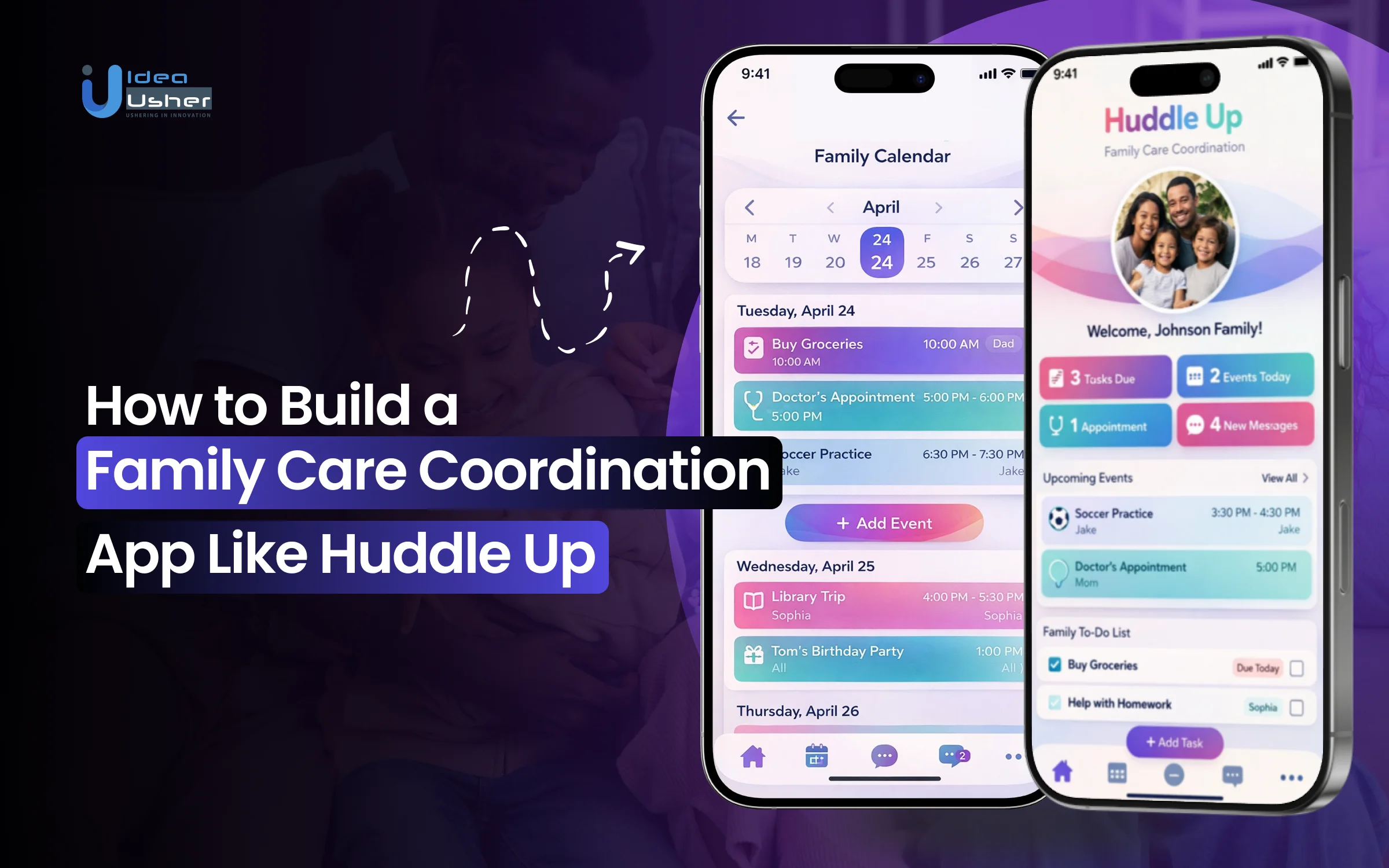
Coordinating care within families often involves managing schedules, medications, appointments, and communication across multiple people and providers. Without a shared system, important updates can be missed, responsibilities become unclear, and coordination breaks down over time. These challenges are driving interest in Huddle Up like family care coordination app development, where families can organize care activities, share updates, and stay aligned through a single platform.
The platform must go beyond basic task management by ensuring shared calendars, medication tracking, real-time updates, role-based access, and communication tools work together to reflect real caregiving routines. Its effectiveness depends on supporting collaboration while maintaining privacy, clarity, and ease of use.
In this blog, we explain how to build a family care coordination app like Huddle Up by examining core features, architectural considerations, and practical steps involved in creating a reliable and user-friendly caregiving platform.
Why Family Care Apps Are Gaining Rapid Demand
The Childcare Software Market was valued at USD 193.8 million in 2023 and is expected to reach USD 315.3 million by 2030, growing at a CAGR of 7.2% during 2024–2030. This growth highlights the rising demand for Huddle Up like family care coordination app, making it a timely opportunity to build platforms similar to Huddle Up.

Over 90 million children worldwide require special education services, with more than 7 million students in the U.S. receiving IEP support, fueling a30% surge in the adoption of assistive classroom technologies over the past five years.
Families using virtual care platforms see about 17% lower healthcare costs, while Psychiatry and Behavioral Health lead pediatric telehealth with a 21.3%revenue share, reflecting strong demand for virtual mental health support among K-12 students.
A. Shift From Solo to Collaborative Care Models
The educational and therapeutic landscape has shifted from isolated interventions to a ‘care circle’ model, requiring a platform as a single source of truth. This moves away from fragmented email threads or verbal updates between teachers and parents, which often cause gaps in a student’s IEP.
- Shared Responsibility: Distributing essential tasks such as behavioral tracking, speech therapy exercises, or medication administration across a team of educators, therapists, and family members.
- Transparency: School psychologists, primary guardians, and other involved parties can access the same real-time data, reducing the communication burden often placed on a single parent.
- Scalability: As a student’s academic and developmental needs grow more complex, the digital ecosystem seamlessly incorporates new specialists and service providers without losing years of vital historical context.
B. Rising Need for Real-Time Care Coordination
In special education and pediatric behavioral health, a lack of immediate information sharing can result in missed therapeutic windows or inconsistent behavioral interventions between the classroom and home. Real-time synchronization in Huddle Up like family care coordination app ensures that when a school therapist logs a breakthrough in speech or a specific behavioral trigger, the evening care circle is instantly informed to maintain a consistent developmental environment.
| Coordination Feature | Strategic Value | Business Impact |
| Instant Notifications | Alerts the care circle to medication administration or urgent behavioral incidents. | Builds deep user trust and enhances student safety protocols. |
| Live Activity Logs | Provides a chronological feed of therapy sessions and classroom progress. | Eliminates fragmented “backpack notes” and redundant status calls. |
| Dynamic Scheduling | Updates IEP meetings and therapy sessions for the entire circle instantly. | Reduces missed interventions and simplifies complex school-year logistics. |
C. Gaps in Traditional Caregiving Systems
Traditional methods like physical IEP binders and fragmented emails lack the specialized security and educational specificity for student management. These systems fail to provide role-based access, creating privacy risks and compliance vulnerabilities.
Using WhatsApp or spreadsheets is no longer viable for high-stakes special education. Legacy systems lack structured data entry to track student trends, which are vital for data-driven adjustments to a student’s learning plan.
D. Market Trends Driving Care App Adoption
The rise of neurodivergence and personalized education is driving strong growth in this sector. The functional needs education technology market, valued at $4.2 billion in 2024 and projected to reach $12.7 billion by 2033 at a 12.8% CAGR, reflects increasing demand for tech-driven remote care solutions that maintain high clinical and educational standards.
- Interoperability: The push for apps to sync with both Electronic Health Records (EHR) and School Information Systems (SIS) via FHIR standards for a holistic view of the student.
- Student Progress Monitoring: Increasing integration with digital learning tools and behavioral tracking devices to feed real-time developmental data directly into the care app.
- Mobile-First Coordination: The expectation of parents and educators to have full IEP goals, therapy logs, and communication channels accessible via smartphone 24/7.

What Is a Family Care App Like Huddle Up?
A family care app like Huddle Up is a digital platform designed to coordinate the various logistics of caring for family members, ranging from youth sports and daily scheduling to managing medical records for aging parents.

A. Core Concept of Shared Care Coordination
Shared care coordination creates an interconnected environment where every action is visible to the support team. This eliminates the silo effect in special education, ensuring critical behavioral breakthroughs and progress updates are no longer trapped in private, fragmented messages.
- Collaborative Infrastructure: Designing a framework that supports multiple contributors, including parents, special education teachers, speech-language pathologists, and school psychologists.
- Synchronous Updates: Ensuring that any change such as a shift in a behavioral intervention strategy or an updated IEP goal is reflected across all devices instantly for the entire “Huddle.”
- Unified Progress Feed: Providing a chronological history of therapy sessions and classroom observations that allows any member of the care circle to understand the student’s current developmental status immediately.
B. How It Becomes a Single Source of Truth
The app’s value lies in consolidating fragmented data into a single authoritative record. By integrating document storage, medication logs, and calendars, the platform ensures all caregivers remain aligned on a unified, real-time care plan.
| Data Type | Integration Method | Strategic Outcome |
| IEP & Evaluations | Centralized PDF/Image vault for Individualized Education Programs and clinical reports. | Prevents loss of critical developmental history and ensures compliance. |
| Medication & Behavioral Logs | Real-time tracking of dosage and behavioral incidents with timestamps. | Eliminates communication gaps and ensures consistency across school/home environments. |
| Provider Directory | Shared contact list for all school specialists, private therapists, and pediatricians. | Streamlines emergency outreach and professional coordination for the student. |
C. Key Users in the Caregiving Ecosystem
Building a successful platform requires understanding that the “user” is a hierarchy of stakeholders with varying needs. Role-based access control is essential to maintain student privacy while ensuring everyone has the specific information required to perform their role.
- Primary Guardians: Usually parents or legal guardians who manage the overall Individualized Education Program (IEP), approve therapy plans, and make high-level medical or educational decisions.
- Educational & Clinical Teams: Special education teachers, school psychologists, and speech or occupational therapists who need access to daily progress logs, behavioral data, and academic milestones.
- Support Network: Extended family or community helpers who assist with logistics, such as school pick-ups or extracurricular transportation, without needing access to sensitive clinical evaluations.
- The Student: Often the central focus of the data being managed, but who may also use the app as an “active” user to check their own therapy schedule, track personal goals, or communicate with their support circle.
D. Real-Life Use Cases Across Care Scenarios
The platform manages everything from academic support to high-intensity medical needs. By automating “memory work,” it reduces cognitive load for families and ensures educational consistency throughout a student’s developmental journey.
| Scenario | Coordination Challenge | Platform Solution |
| IEP Goal Tracking | Lack of shared platforms to log real-time progress toward academic and social milestones. | Live Activity Feed: Teachers log “Goal Met” in real-time, instantly updating the parent’s dashboard with notes and photo evidence. |
| Medication at School | Communication gaps between home and school nurses causing dosage errors or missed units. | Synced Medication Logs: School nurse logs trigger immediate parent notifications, ensuring home doses are accurately adjusted. |
| Behavioral Incident Management | Delayed “backpack notes” prevent immediate home support or timely intervention from private therapists. | Instant Crisis Alerts: Real-time behavioral logging lets parents prepare the home environment or notify therapists instantly. |
| Transition Planning | High school students transitioning to vocational programs often lose years of historical therapy data. | Consolidated Document Vault: A lifelong record of IEPs and evaluations ensures seamless transitions to adult services. |
| Multi-Provider Alignment | A student may see a school SLP, private OT, and pediatrician who typically do not communicate. | Unified Care Circle: All external providers can access shared session notes, enabling aligned therapeutic strategies. |
How a Care App Like Huddle Up Works?
A care coordination platform functions as a sophisticated data engine that synchronizes high-stakes medical logistics and interpersonal communication into a streamlined, automated workflow for every stakeholder involved.

1. User Onboarding and Care Circle Setup
The onboarding process is the most critical friction point; it must be intuitive enough for busy teachers and non-technical guardians yet robust enough to capture essential developmental baselines.
- Invitation Logic: Primary guardians invite members such as speech therapists or school psychologists via secure links, ensuring no unauthorized access to the student’s profile.
- Privacy Onboarding: Users are guided through consent screens that clearly explain how student data is shared and stored in compliance with FERPA and HIPAA.
- Initial Baseline Setup: The app prompts for core information such as IEP goals, allergies, and emergency contacts to provide immediate value to the school-to-home circle.
2. Adding Students and Caregiver Roles
Efficiency in coordination depends on a clear hierarchy of responsibilities, managed through sophisticated Role-Based Access Control (RBAC) to ensure data privacy across various tiers.
- Guardian/Owner Controls: Full access to the student’s medical records, IEP documents, and member management, typically reserved for parents or legal guardians.
- Professional Partner Permissions: Ability to view and edit progress logs or behavioral charts, typically assigned to lead teachers or clinical therapists.
- Support Member Access: Restricted access to calendars and basic logistics only, ideal for extended family members or transportation volunteers.
3. Managing Student Records in One Place
The platform acts as a digital vault for fragmented developmental history, consolidating everything from evaluation reports to insurance cards into a searchable database.
- Document Categorization: Metadata-driven filing that sorts records by school year, provider, and document type (e.g., IEPs, 504 Plans) for instant retrieval.
- Shareable Student Profiles: The ability to export or display a summary of behavioral strategies and medical needs instantly for emergency responders or new specialists.
- Historical Progress Tracking: Longitudinal views of developmental milestones that allow the team to spot trends and academic growth over months or years.
4. Real-Time Updates and Notifications Flow
The heartbeat of the app is its notification engine, which distinguishes between routine classroom updates and urgent incidents to keep the circle synchronized without causing alert fatigue.
- Critical Alerts: High-priority push notifications for medication administration at school or urgent behavioral incidents requiring immediate guardian attention.
- Status Logs: Low-priority notifications indicating when a routine task is completed, such as a therapy session finished or a specific goal practiced.
- Conflict Prevention: Automated warnings if two caregivers (e.g., a teacher and a parent) attempt to log the same midday medication dose, preventing medical errors.
5. Secure Communication Across Care Teams
Standard messaging apps are often non-compliant with privacy regulations; Huddle Up provides an encrypted environment for discussing sensitive student needs.
- HIPAA & FERPA Compliant Messaging: End-to-end encrypted chat threads that protect student privacy while allowing for rapid team communication.
- Contextual Threading: The ability to “tag” messages to specific behavioral logs or IEP goals, creating a clear narrative for the entire team to review.
- Secure Media Sharing: Securely sharing photos of a student’s project or a video of a speech breakthrough to ensure visual monitoring of progress and celebrate success.
Core Features That Define Care Apps Like Huddle Up
Modern care apps must bridge the gap between clinical therapy and the classroom. By synchronizing student progress across environments, these platforms create a compliant ecosystem essential for managing complex IEP requirements and developmental success.

1. Centralized Medical Records Dashboard
This dashboard acts as a central intelligence hub, consolidating fragmented IEP goals, therapy reports, and clinical evaluations. It replaces disparate paper files with a real-time snapshot of a student’s current standing and upcoming milestones.
The interface allows everyone to visualize progress over time. By providing a unified view, it ensures every intervention remains data-driven and strictly aligned with the student’s specific educational mandate and developmental journey.
2. Medication Tracking and Reminders
Consistent medication adherence is vital for a student’s emotional stability and classroom performance. Automated alerts create a layer of digital accountability, preventing missed doses during the transition from home to school.
The system maintains a secure digital log for school nurses and specialists. By identifying patterns between medication and behavioral shifts, it allows for precise medical adjustments and data-backed health management.
3. Appointment Scheduling and Alerts
This scheduling engine synchronizes sessions with speech therapists, OTs, and counselors to minimize instructional loss. Real-time alerts ensure the care team is prepared, facilitating a seamless logistical flow.
By providing specific therapy goals for every session, the platform keeps the family aligned with interventions. This integration reduces the administrative burden on parents while maintaining a consistent student support schedule.
4. Role-Based Access for Caregivers
Role-based access control (RBAC) is mandatory in K-12 environments for FERPA and HIPAA compliance. It ensures that sensitive diagnostic reports remain restricted to legal guardians and lead clinical professionals.
This granular structure allows teachers to access only necessary academic accommodations while protecting student privacy. It creates a collaborative environment where every “Huddle” member has the exact information needed to support the student.
5. In-App Messaging and Activity Feed
A dedicated activity feed captures small wins and daily observations instantly. This chronological stream of therapy notes and classroom updates provides a “living” history of the student’s developmental progress.
Threaded messaging allows for focused discussions on specific therapy goals, such as speech fluency. This prevents vital clinical feedback from being lost in the noise of general school-to-home communication.
6. Emergency Alerts and Critical Updates
During a crisis, the platform acts as a broadcast system for the entire care circle. It bypasses notification delays to disseminate crisis protocols and urgent updates to staff and parents simultaneously.
Authorized users can instantly access a “crash sheet” containing allergy protocols or de-escalation techniques. This ensures first responders and administrators have life-saving information exactly when a student experiences a significant health event.
Advanced Features That Create Product Stickiness
To move from a functional tool to a market leader, these high-tier features automate complex coordination. They create a data-driven reliance that makes the app an essential pillar of daily life.

1. AI-Based Health Insights and Alerts
AI-driven predictive modeling future-proofs the care journey by analyzing therapy cycles and medication refills. By suggesting upcoming care windows and IEP reviews, the system reduces mental load, ensuring critical milestones and transition planning are never overlooked.
2. Predictive Care Planning and Reminders
Predictive modeling future-proofs the care journey by analyzing therapy cycles and medication refills. By suggesting upcoming care windows and IEP reviews, the system reduces mental load, ensuring critical milestones and transition planning are never overlooked.
3. Integration With Wearables and Devices
The app provides a 360-degree view of a student’s physiological state by syncing with biometric sensors. This real-time data on sleep patterns and activity levels allows the care team to see how students respond to different environments.
4. Voice Notes and Easy Data Entry Options
AI-driven voice-to-text and one-tap logging eliminate friction in fast-paced classrooms. These methods allow teachers to capture instant observations and breakthroughs, ensuring a complete digital record without the burden of tedious, manual typing.
5. Multi-Patient and Family Support
The architecture supports managing multiple profiles with strict data silos. This allows for seamless toggling between students while facilitating collaborative management across different households, ensuring a consistent care plan regardless of a child’s location.
Huddle Up like Family Care Coordination App Development Process
The Huddle Up like family care coordination app development requires a methodical, security-first approach that aligns clinical therapy requirements with a seamless, intuitive user experience for families and school districts alike.

1. Defining Use Case and Target Audience
The initial phase focuses on the specific needs of K-12 students, special education departments, and therapy providers. Identifying these stakeholders ensures the platform addresses the precise pain points of IEP management and school-to-home communication.
2. Validating Idea and Feature Priorities
Product viability depends on rigorous feedback from educators and parents to distinguish “must-have” compliance tools from “nice-to-have” add-ons. Prioritizing HIPAA-compliant messaging and real-time activity feeds ensures the core value proposition remains focused on student outcomes.
3. Planning Architecture and Data Security
The technical foundation must prioritize a HIPAA/FERPA-compliant cloud infrastructure capable of handling encrypted data synchronization. A robust backend architecture ensures that sensitive student records remain isolated, secure, and accessible only through strictly defined role-based permissions.
4. Designing UX for Multi-User Experiences
The interface requires a specialized design language that balances professional clinical data entry with an accessible parent-facing dashboard. Ensuring high usability for diverse users from busy teachers to non-technical guardians is critical for maintaining consistent engagement.
5. Building MVP With Core Care Features
The Minimum Viable Product focuses on the essential app mechanics: centralized records, medication logs, and secure messaging. Delivering these high-impact features first allows for early market entry while establishing a reliable baseline for coordination.
6. Testing With Real Caregiving Scenarios
Quality assurance involves stress-testing the application through simulated IEP meetings, emergency alert triggers, and multi-user synchronization. This phase identifies potential friction points in the care circle, ensuring the platform performs reliably under high-pressure clinical situations.
7. Deployment and App Store Launch
The launch strategy involves navigating the strict privacy requirements of the Apple App Store and Google Play Store for pediatric apps. Successful deployment requires finalized End User License Agreements and transparent data-usage disclosures.
8. Scaling With Advanced Feature Expansion
The growth phase introduces sophisticated AI-driven health insights, wearable device integrations, and predictive care modeling to increase product stickiness. These technical enhancements transform the platform from a coordination tool into a comprehensive student developmental ecosystem.
Huddle Up like Family Care Coordination App Development Cost
The financial commitment required to build a Huddle Up like family care coordination app varies significantly based on the depth of the “Huddle” logic and the scale of the target school districts. The below table leverages modern cross-platform frameworks, maintaining the rigorous security standards necessary for pediatric health data.
| Development Phase | MVP Level | Enterprise Level | Key Deliverables |
| Discovery & UI/UX | $8,000 – $14,000 | $20,000 – $35,000 | Interactive prototypes, HIPAA-compliant user journeys, and school-to-home workflow maps. |
| Core App Development | $35,000 – $60,000 | $90,000 – $180,000 | Cross-platform mobile apps (iOS/Android), real-time sync engines, and primary care circle logic. |
| Backend & Security | $15,000 – $28,000 | $50,000 – $85,000 | Encrypted databases, role-based access control (RBAC), and FERPA/HIPAA server hardening. |
| Third-Party Integrations | $6,000 – $12,000 | $30,000 – $65,000 | APIs for EHRs, school management systems (SIS), and secure payment gateways for therapy. |
| QA & Compliance Audit | $10,000 – $16,000 | $25,000 – $45,000 | Stress testing, penetration testing, and official third-party HIPAA/GDPR certification. |
| Total Estimated Cost | $74,000 – $130,000 | $215,000 – $410,000 | A fully validated, secure, and scalable “Huddle” ecosystem ready for district-wide deployment. |
Cost-Affecting Factors During App Development
The final investment for the Huddle Up like family care coordination app depends on technical integration complexity and pediatric data security standards. These variables can shift budgets by 20% to 35% based on the architecture’s depth.
- Security Compliance Complexity: Implementing end-to-end encryption and MFA can add $12,000+ but is essential to avoid legal fines exceeding $50,000 per violation.
- Real-Time Data Concurrency: Enabling zero-latency updates for 10+ caregivers requires WebSocket integration, increasing backend development time by ~15%.
- Third-Party API Fees: Integrating EHR or SIS systems incurs monthly costs of $400 to $2,000 per integration.
- Platform Breadth: Opting for native development (Swift and Kotlin) over cross-platform solutions can raise costs by 30% to 45%.
- AI and Predictive Analytics: Adding machine learning for insights and alerts requires specialized expertise, increasing costs by $25,000 to $50,000.
Timeline to Develop a Care Coordination App
Building a Huddle Up like family care coordination app requires a phased approach that balances speed-to-market with compliance-driven testing, while the timeline acts as a strategic roadmap for resources, market entry, and technical debt management.
1. MVP Development Time Estimation
The Minimum Viable Product (MVP) phase of Huddle Up like family care coordination app typically spans 14 to 18 weeks, focusing on the core “Huddle” architecture.
- Secure Communication Layer: Establishing encrypted channels for safe school-to-home messaging.
- Basic Medication Logs: Implementing foundational tracking to ensure student health consistency.
- Role-Based Access Controls: Building essential permissions to protect student privacy for early-adopter districts.
2. Full Product Development Timeline
A comprehensive, market-ready ecosystem generally requires 28 to 36 weeks to transition from initial concept to a feature-rich platform.
- Multi-User Dashboards: Developing specialized interfaces for parents, teachers, and clinical providers.
- Advanced Scheduling Engines: Building complex logic to synchronize multiple therapy sessions and school calendars.
- Data Visualization Tools: Transforming raw logs into a single source of truth through progress charts and developmental timelines.
3. Time for Integrations and Testing
Integrating with third-party systems in Huddle Up like family care coordination app and conducting rigorous compliance audits typically adds 6 to 10 weeks to the schedule.
- Third-Party Sync: Connecting with EHRs and school management systems for seamless data flow.
- Compliance Audits: Performing deep penetration testing to ensure FERPA and HIPAA security standards.
- Zero-Latency Sync: Testing across various devices to ensure real-time updates in all network environments.
4. Post-Launch Optimization Timeline
The initial 8 to 12 weeks after deployment focus on refining the experience based on real-world user feedback.
- Workflow Optimization: Streamlining data entry processes for busy teachers and parents.
- Edge-Case Resolution: Identifying and fixing minor bugs in notification flows or sync logic.
- Infrastructure Scaling: Preparing the platform’s backend for high-volume traffic and future feature expansions.
Key Milestone Summary
The below table outlines the essential development phases and technical focus areas. This Huddle Up like family care coordination app roadmap ensures a phased approach to building a compliant, market-ready coordination platform.
| Milestone | Duration | Primary Focus |
| Discovery & Prototyping | 3 – 5 Weeks | User journey mapping and HIPAA-compliant UI design. |
| Backend & API Development | 8 – 12 Weeks | Secure database architecture and real-time sync logic. |
| Mobile & Web Frontend | 10 – 14 Weeks | Cross-platform development and student profile management. |
| Security & UAT | 4 – 6 Weeks | Compliance audits and user acceptance testing in real scenarios. |
Monetization Models for Family Care Coordination App
The monetization strategy for the Huddle Up like family care coordination app balances institutional B2B contracts with tiered family subscriptions. This diverse mix ensures financial resilience while maintaining the ethical standards required for sensitive pediatric data.

1. Subscription Plans for Families
Subscription models offer predictable revenue through tiered access based on coordination needs. By providing a free version for core scheduling, the platform effectively upsells families on robust coordination tools as care evolves.
- Tiered Access: Standard plans may cover basic appointment tracking and photo sharing, while “Pro” plans allow for unlimited care circle members and enhanced document storage.
- Family Bundles: Offering a single subscription that covers multiple children within the same household, increasing the “stickiness” of the platform for larger families.
- Annual Discounts: Incentivizing long-term commitment with yearly billing options, which improves the platform’s immediate cash flow and reduces user churn.
2. Premium Features for Advanced Care
Premium features cater to families managing complex IEPs or chronic conditions through advanced technical functionality. Designed for high-intensity care, these add-ons offer increased efficiency and peace of mind for parents requiring deeper coordination tools.
- AI-Generated Summaries: Automated clinical reports that synthesize a month’s worth of therapy logs into a one-page summary for doctor visits.
- Advanced Data Exports: The ability to export full medical histories into formatted PDFs that meet the specific submission requirements for school districts or insurance claims.
- Custom Alert Logic: Allowing users to set up complex notification chains, such as escalating alerts to an emergency contact if a primary caregiver doesn’t acknowledge a medication reminder.
3. B2B Partnerships With Healthcare Providers
Partnerships with school districts and private clinics offer a “white-labeled” extension of their services. Providers pay per-student licensing fees, positioning the app as a value-added benefit that improves clinical outcomes and parental satisfaction.
- District-Wide Licensing: Selling bulk access to special education departments to standardize communication across an entire student population.
- Clinical Integration Fees: Charging private clinics for the ability to integrate their internal EHR data directly into the family’s Huddle, streamlining the flow of therapy notes.
- Referral Networks: Partnering with vetted pediatric specialists or educational consultants who pay a fee to be featured in the app’s “Care Directory” for families seeking additional support.
4. Data Insights for Health Ecosystems
Aggregated, de-identified data provides invaluable insights for research institutions and public health organizations. While maintaining HIPAA compliance, the Huddle Up like family care coordination app can monetize behavioral analytics and milestone trends to support pediatric mental health and developmental research.
- Market Intelligence Reports: Selling anonymized insights on the efficacy of various therapy schedules or educational interventions to research organizations.
- Population Health Dashboards: Providing school districts with high-level data on student wellbeing trends across different grade levels to help them allocate counseling resources more effectively.
- Pharmaceutical Research: Partnering with life science companies to provide real-world evidence (RWE) on medication adherence and symptom management in pediatric populations.
Key Challenges in Building Family Care Coordination App
The Huddle Up like family care coordination app development involves navigating a complex landscape of technical dependencies, high-stakes security requirements, and the diverse digital literacy levels of the various members within a student’s care circle.

1. Managing Sensitive Health Data Securely
Challenge: Protecting pediatric health and educational records from sophisticated cyber threats while maintaining full HIPAA and FERPA compliance across all digital touchpoints.
Solution: Our developers implement high-grade AES-256 encryption and rigorous multi-factor authentication. We utilize automated vulnerability scanning and conduct regular third-party penetration tests to identify and neutralize potential security gaps before deployment.
2. Ensuring Real-Time Sync Across Users
Challenge: Coordinating instantaneous updates between teachers, therapists, and parents to prevent data conflicts or delayed medical notifications during critical care transitions.
Solution: We utilize a WebSocket-based architecture and GraphQL subscriptions to facilitate low-latency data streaming. This ensures every stakeholder sees the “single source of truth” simultaneously, with robust conflict-resolution logic for offline inputs.
3. Designing for Non-Tech-Savvy Users
Challenge: Creating a sophisticated medical data engine that remains intuitive and accessible for older guardians or busy educators who lack technical expertise.
Solution: Our design team prioritizes a “mobile-first,” minimalist UI with clear iconography and guided onboarding. We simplify complex data entry through one-tap logging and voice-to-text features to minimize user friction and fatigue.
4. Balancing Privacy With Collaboration
Challenge: Enabling seamless information sharing within the “Huddle” while ensuring that sensitive clinical notes are only visible to authorized legal stakeholders.
Solution: We develop a granular Role-Based Access Control (RBAC) system that silos data by user type. Our engineers build custom permission matrices allowing parents to toggle visibility for specific documents in real-time.
Case Study: Building a Collaborative Care App
We can look at a real-world implementation of a care coordination platform to illustrate the practical application of these strategies designed to bridge the gap between home and institutional environments.

A. Client Problem and Care Coordination Gaps
A special education network supporting 1,500 students struggled with physical binders and fragmented data. This lack of visibility caused high anxiety for 65% of parents regarding midday medications and stalled home follow-through for 30% of therapy sessions.
Teachers spent 4.5 hours weekly on manual data re-entry across disconnected systems. This administrative burden led to significant staff burnout and a 15% spike in documentation errors, compromising the accuracy of student behavioral records.
B. Solution Architecture and Feature Set
Our engineers developed a cross-platform “Huddle” ecosystem centered on a real-time synchronization engine and a HIPAA-compliant document vault to unify the student’s care circle.
- Situation: The client needed to bridge the communication gap between school nurses, special education teachers, and private home-based therapists.
- Task: Create a “single source of truth” that could handle complex role-based permissions and offline data logging for school zones with poor connectivity.
- Action: We implemented a GraphQL-based subscription model for zero-latency updates and a PostgreSQL/MongoDB hybrid backend to manage both structured IEP goals and flexible activity feeds.
- Result: The architecture successfully supported simultaneous access for up to 12 members per student, ensuring that a “behavioral incident” logged in the classroom was instantly visible to the parent and psychiatrist.
C. Challenges Faced During Development
The primary technical challenge involved maintaining zero-latency data updates across diverse network environments, including low-connectivity school zones.
Solution: Our developers tackled this by implementing a GraphQL-based subscription model and a robust “offline-first” sync logic, ensuring that a teacher could log a behavioral incident without Wi-Fi and have it instantly broadcast to the parent’s device once a connection was restored.
D. Measurable Outcomes and Impact
The deployment of the Huddle Up-style platform led to a dramatic improvement in both operational efficiency and student developmental success within the first six months.
| Metric | Pre-Implementation | Post-Implementation | Improvement |
| Communication Redundancy | 12+ emails/calls per week | 3-4 logged updates | 70% Reduction |
| Medication Log Accuracy | 82% (Paper-based) | 99.9% (Digital sync) | 17.9% Increase |
| Teacher Admin Time | 4.5 hours / week | 1.2 hours / week | 73% Time Saved |
| IEP Goal Achievement | 55% on-track | 78% on-track | 23% Growth |
| Parental Satisfaction | 42% “Informed” | 94% “Informed” | 123% Increase |
Why Choose IdeaUsher for Care App Development?
Partnering with an experienced development firm ensures your pediatric care platform is built on a foundation of clinical-grade security, high-performance architecture, and a deep understanding of the K-12 educational landscape.
A. Proven Expertise in Health Tech Solutions
With over 500,000+ hours of development experience, our team brings specialized knowledge in building complex medical ecosystems that ensure seamless interoperability between school districts, healthcare providers, and family care circles.
B. Agile Development With Faster Time to Market
Our ex-FAANG/MAANG developers utilize rapid prototyping and iterative cycles to launch your MVP quickly, allowing for real-world validation while maintaining the technical flexibility needed to scale as requirements evolve.
C. Focus on Security and Compliance
Data integrity is our priority, as we have worked with numerous enterprises for various types of products and solutions requiring rigorous adherence to HIPAA and FERPA standards for sensitive data.
D. Dedicated Team for Long-Term Scaling
Our elite engineering talent provides end-to-end support, ensuring your platform remains technically robust as it handles increased user loads and integrates advanced AI features for long-term growth and institutional success.
Conclusion
Building the Huddle Up like family care coordination app requires a strategic fusion of clinical-grade security and intuitive, multi-user functionality. By prioritizing a “single source of truth” for IEP goals, medication tracking, and real-time communication, entrepreneurs can bridge the vital gap between school districts and home environments. Navigating the complexities of HIPAA and FERPA compliance while ensuring seamless scalability is essential for long-term institutional success. With the right technical foundation and a focus on student-centric outcomes, your platform can transform fragmented caregiving into a streamlined, collaborative, and life-changing digital ecosystem.


FAQs
A.1. A coordination app must centralize IEP (Individualized Education Program) tracking, session scheduling, and progress monitoring. This “Single Source of Truth” ensures that parents, educators, and therapists are aligned on a child’s developmental goals and intervention history.
A.2. Data security is paramount when handling sensitive educational and medical records. Implement end-to-end encryption and strict “Role-Based Access Control” (RBAC). This technical layer ensures that only authorized specialists and family members can view specific health or academic data.
A.3. An integrated portal reduces the “Administrative Burden” on parents while improving clinical outcomes. By allowing real-time communication and digital resource sharing, the app facilitates “Monetizable Coordination,” where families pay for the convenience of a managed care ecosystem.
A.4. Building this requires integrating WebRTC for secure, low-latency video conferencing and a robust scheduling engine. The architecture must support “Multi-Participant” sessions, allowing a therapist to conduct a virtual session while a parent or educator joins from a different location.


