


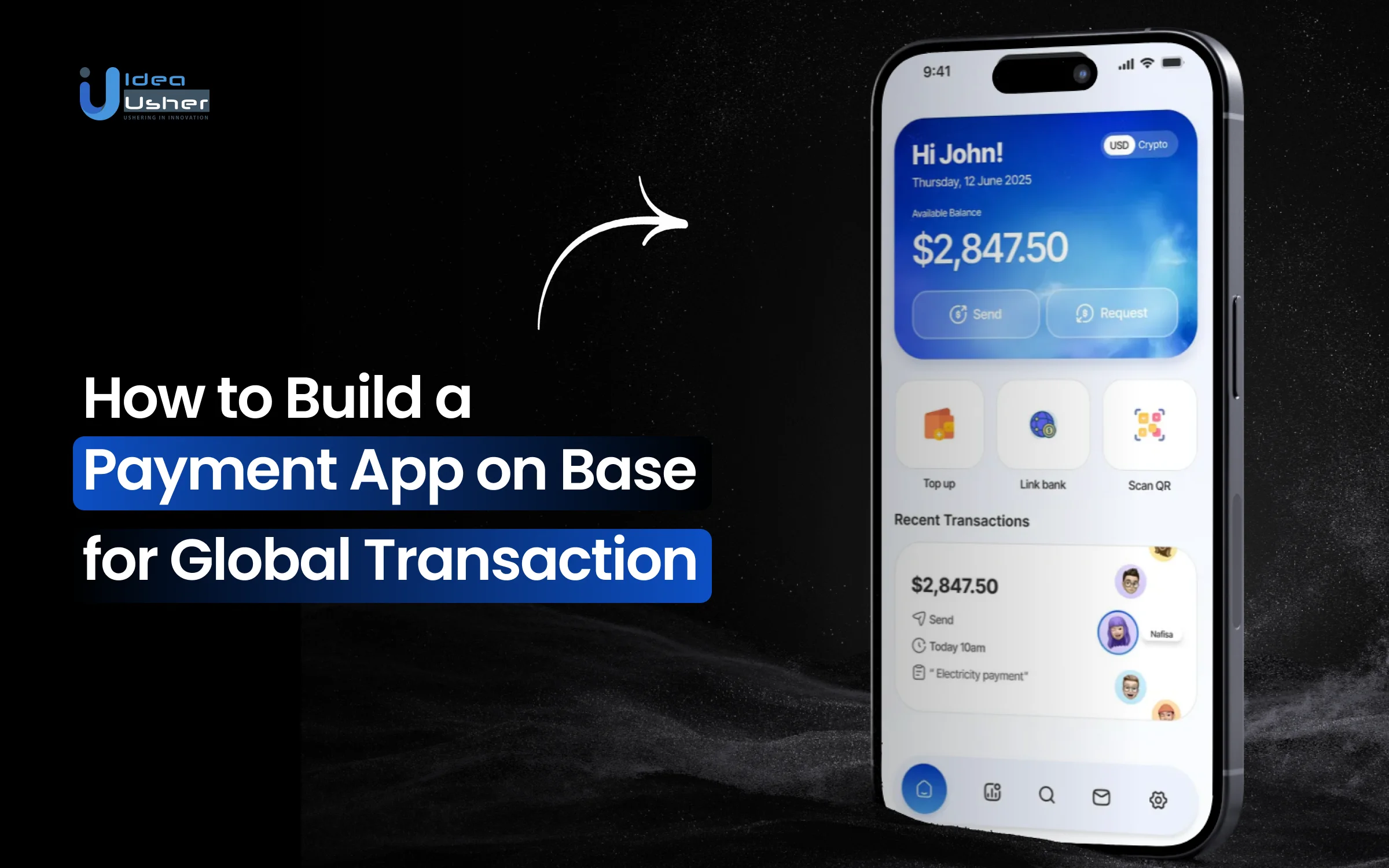
Global payment systems tend to break down not because features are missing, but because latency, high fees, settlement delays, and currency friction compound at scale. For businesses handling cross-border transactions, these issues make traditional payment infrastructure costly and difficult to extend across regions. This is where the global payment app on Base becomes relevant, offering a foundation to design faster, more predictable, and cost-efficient global payment experiences.
Once real users and transaction volume enter the system, payment behavior quickly reveals how reliable the platform truly is. Transactions must clear consistently, fees need to remain transparent, and complexity around networks or conversions should stay hidden from the user. Payment apps can benefit from faster settlement and lower costs using Base, but long-term success depends on how well on-chain logic, off-chain services, compliance layers, and user flows are integrated.
In this blog, we explain how to build a payments app on Base for global transactions by breaking down core system components, architectural decisions, and the design considerations involved in delivering scalable and user-friendly cross-border payment experiences.

What is a Payment App for Global Transactions?
A payment app on Base refers to a Web3-enabled financial application built on the Base Layer 2 blockchain that lets users send, receive, and manage value globally using cryptocurrency and stablecoins. It leverages decentralized smart contracts and Base’s scalable infrastructure to enable secure, transparent, peer-to-peer transactions without traditional intermediaries.
By running on Base, such a payment app can offer faster settlement and significantly lower transaction costs than Layer 1 networks, making global crypto payments more affordable and efficient. Base’s broad compatibility with Ethereum standards and its expanding ecosystem also help the app reach users worldwide while maintaining strong blockchain security and decentralization.
Why Businesses Should Build the Global Payment App on Base?
Businesses choose Base to build global payment apps due to its low-cost transactions, fast settlement, and Ethereum-backed security. This foundation supports scalable, compliant payment solutions for cross-border use cases.
1. Ethereum-Backed Security
Base is a Layer-2 chain that inherits Ethereum’s robust security guarantees while avoiding the high costs and congestion of Ethereum L1. Because it operates on the Optimism OP Stack, Base secures transactions through Ethereum’s decentralized consensus, giving enterprises confidence in settlement finality and fraud resistance.
2. Low and Predictable Transaction Fees
One of Base’s standout features is its dramatically reduced gas fees compared to Ethereum’s mainnet. By batching transactions off-chain and submitting them as rollups, Base can cut costs by up to 6–7× or more, making micropayments, remittances, and frequent transfers economically viable.
3. High Throughput for Global Payments
Base significantly increases throughput by processing many more transactions per second than Ethereum L1, due to Optimistic Rollup technology. As a result, it can support real-time global payments and wallet activity without bottlenecks.
4. Full EVM Compatibility
Base is fully compatible with the Ethereum Virtual Machine (EVM). Developers can reuse existing smart contracts, tools, and workflows such as Truffle, Hardhat, or Remix without rewriting code. This compatibility shortens development timelines and reduces bugs.
5. Seamless Coinbase & Circle Integration
A key advantage of Base is its integration with Coinbase and Circle, enabling fast blockchain payments with strong regulatory confidence. With USDC, it supports practical use cases like cross-border transfers, merchant payouts, and enterprise settlements more effectively than traditional banking systems or many other chains.
| Requirement | Traditional Banking | Other Chains | Base + USDC |
| 24/7 Availability | Banking hours only | Yes | Yes |
| Cross-Border Settlement | 2–5 days | Minutes | ~2 seconds |
| Regulatory Acceptance | High | Questionable | Circle + Coinbase-backed |
| Institutional Access | Via correspondent banks | Fragmented | Direct Circle API |
Types of Payment Apps Businesses Can Build on Base
Businesses can build diverse, scalable payment applications on Base that combine blockchain efficiency with enterprise-grade reliability. These solutions support modern financial use cases across global markets and industries.

1. Cross-Border Remittance Apps
Businesses can build instant remittance apps using USDC on Base, enabling low-cost international transfers without correspondent banks. Early Base ecosystem usage of USDC for cross-border value transfer demonstrates how near-instant global settlement can replace multi-day banking workflows.
2. Merchant Payment and Checkout Apps
Payment apps on Base can support stablecoin-based merchant checkouts with fast confirmation times. Wallets such as Coinbase Wallet already support Base, showing how merchants can accept payments directly from consumer wallets with predictable fees.
3. B2B and Enterprise Payment Platforms
Enterprises can build payment platforms for vendor payouts, cross-border invoicing, and treasury settlements. USDC settlement on Base, issued by Circle, is increasingly used for institutional payment flows requiring speed, transparency, and compliance alignment.
4. Marketplace Payout and Escrow Apps
Marketplaces can automate escrow and creator payouts using Base. Social and creator platforms like Farcaster operate on Base, demonstrating how on-chain transactions can support creator monetization and payout flows.
5. Wallet-to-Wallet Consumer Payment Apps
Consumer payment apps on Base enable peer-to-peer transfers, tipping, and everyday payments using USDC. With Base already supported by major wallets, users can transact globally with confirmation times measured in seconds rather than minutes or days.
Key Market Takeaways of Blockchain Payment Apps
The global cryptocurrency payment apps market size was estimated at USD 556.9 million in 2024 and is projected to reach USD 2,404.1 million by 2033, growing at a CAGR of 17.8% from 2025 to 2033. This growth is fueled by rising stablecoin adoption, cross-border payment demand, and merchant acceptance of blockchain-based settlements.

Low Gas Fees on Base Make Global Payments Scalable
As cryptocurrency payment apps scale globally, transaction costs and settlement efficiency become critical. Layer-2 networks like Base are increasingly used to overcome the cost and throughput limitations of Ethereum mainnet.
- Lower transaction fees for high-volume payments: Base significantly reduces gas costs, making microtransactions, remittances, and frequent cross-border payments economically viable for global users.
- Faster settlement without sacrificing security: By leveraging Ethereum’s security model while processing transactions off-chain, Base enables near-instant payment confirmations required for real-time payment apps.
- Predictable cost structure for payment platforms: Stable and lower fees allow payment app builders to design transparent pricing models, which is essential for user trust and global adoption.
Architecture of a Global Payment App on Base
A global payment app built on Base follows a layered architecture where each component directly contributes to faster settlement, lower costs, and regulatory-ready cross-border transactions.
| Architecture Layer | Core Components | Benefits of Base |
| User Interface Layer | Web app, mobile app, admin dashboard | Enables users and merchants worldwide to initiate and track payments in real time without dependency on local banking hours |
| Wallet & Identity Layer | Wallet connection, signature authentication, account abstraction | Removes reliance on region-specific credentials and enables borderless user authentication through wallets |
| Smart Contract Layer | Payment contracts, escrow logic, fee routing, payout rules | Automates trustless global settlements, reducing manual intervention and eliminating cross-border reconciliation delays |
| Base Blockchain Layer | Transaction execution, rollups, Ethereum settlement | Processes payments within seconds at low cost while inheriting Ethereum-level security for international trust |
| Stablecoin Layer | USDC contracts, treasury wallets | Enables stable-value global payments without FX volatility or currency conversion friction |
| Backend & API Layer | Payment orchestration, monitoring, retries | Ensures reliable execution of high-volume global transactions with real-time status and failover handling |
| Compliance & Risk Layer | KYC, AML, transaction monitoring | Supports regulatory alignment across jurisdictions while maintaining transparent payment trails |
| On/Off-Ramp Layer | Fiat ramps, bank integrations | Allows users to move funds between local currencies and stablecoins, enabling real-world adoption |
How a Global Payment App on Base Works?
A payment app on Base enables fast, low-cost global transactions by combining on-chain settlement with compliant fiat on- and off-ramps. This model supports scalable cross-border payments for modern financial use cases.

Phase 1: User Onboarding & Funding
Base removes the usual delays of traditional finance and enables near-instant access to payments and deposits.
A. For End Users: The onboarding experience is designed to feel familiar and frictionless, closely resembling modern fintech applications rather than traditional crypto workflows.
- Simplified Signup: Users can connect via email or social login using embedded wallet solutions such as Privy or Dynamic. This process does not require crypto jargon or seed phrases.
- Instant Verification: Base’s integration with Coinbase’s verified user base enables immediate KYC verification for millions of users.
- Fiat On-Ramp: Users can fund their wallet directly from the following sources:
- Bank account via ACH (Coinbase integration)
- Debit/credit card (MoonPay, Stripe integration)
- Existing crypto holdings
B. For Business Users: Business onboarding prioritizes control, compliance, and operational efficiency for managing payments at scale.
- Treasury Setup: Create a multi-signature smart account for corporate funds with role-based permissions.
- Liquidity Management: Use Circle’s APIs to mint USDC directly from corporate bank accounts at 1:1 parity.
- Compliance Integration: Automated sanctions screening via Chainalysis or TRM before any transaction leaves the wallet.
Phase 2: The Core Payment Engine
This is where Base’s architecture powers the core payment engine, enabling fast, reliable transactions and seamless user experiences at scale.
Key Components Working Together:
A. Smart Accounts (ERC-4337): Every user gets a programmable wallet that can:
- Sponsor gas fees so users never see “network fees.”
- Execute batch payments (pay 100 vendors with one click)
- Set spending limits and automated rules
B. Transaction Batching: Instead of each payment going individually to Ethereum:
- Thousands of payments aggregate into a single batch
- This batch is submitted as one Ethereum transaction
- Each user still gets individual proof of their specific payment
C. Gas Optimization: Through Base’s fee market and priority system:
- Transactions are ordered for maximum efficiency
- Fees remain predictable even during network congestion
- Emergency payments can be prioritized if needed
Phase 3: Cross-Border & Currency Handling (Built-In)
Base streamlines conversion and settlement to make global transactions simple and efficient.
A. Using USDC as the Settlement Layer: USDC acts as a neutral, dollar-denominated bridge asset that simplifies global payments while enabling fast, low-cost on-chain settlement.
- Sender: Initiates a payment by funding a wallet with local currency such as USD or EUR through a supported on-ramp.
- Conversion: The on-ramp provider converts the local currency into USDC at prevailing market rates, or USDC is minted directly by Circle.
- Transfer: USDC is transferred over Base with near-instant settlement and minimal transaction fees.
- Recipient: Receives USDC immediately and can choose to hold it as digital dollars or convert it back to local currency via an off-ramp.
B. No FX Complexity During Transfer: Foreign exchange risk is removed from the payment flow by standardizing value in USDC during transit.
- USDC maintains a 1:1 value with USD throughout the journey
- No spread losses during the transfer itself
- Conversion happens only at entry/exit points
Phase 4: Recipient Experience & Cash-Out
This phase focuses on how recipients receive funds instantly and seamlessly convert or use their balance, completing the end-to-end payment experience on Base.
A. For Crypto-Native Recipients:
- Instant Wallet Credit: Funds appear in the recipient’s wallet within seconds.
- Immediate Usability: Assets can be used right away across supported Web3 applications and services.
- Seamless Transfers: Funds can be sent onward without requiring additional conversions.
B. For Fiat-Focused Recipients:
- Off-Ramp Options: Recipients can easily convert USDC into fiat using multiple cash-out methods based on their location and preference.
- Direct to bank account via Coinbase (2-24 hours)
- To debit card via integrated partners
- To mobile money in emerging markets
- Local Currency Delivery: The payout experience is localized and handled end-to-end by trusted providers.
- Recipient selects preferred currency
- Provider handles final conversion at competitive rates
- Funds land in the local bank account
Phase 5: Compliance & Settlement
This phase ensures every transaction meets regulatory requirements while achieving true on-chain finality, delivering compliance, transparency, and reliable settlement at scale.
A. Real-Time Compliance: Compliance checks are embedded directly into the payment flow, enabling continuous monitoring without slowing transactions.
- Every transaction is screened against sanctions lists via compliance oracles
- Large or high-risk transactions are automatically flagged for additional review
- A full audit trail is immutably recorded on-chain
- Automated compliance and regulatory reports can be generated as needed
B. Final Settlement: Settlement on Base provides true finality rather than delayed assurances common in traditional systems.
- Base transactions are cryptographically final, unlike traditional systems, where “settled” means “promised to settle,”
- No chargebacks or reversals possible (supplemental insurance available)
- Reconciliation happens automatically through indexed blockchain data
Real-World Example: Paying International Contractors
Traditional Process (3-5 Days):
Day 1: Initiate wire → Day 2: Correspondent bank fees deducted → Day 3: FX conversion at poor rates → Day 4-5: Funds arrive, minus multiple fees
Base Process (Under 5 Minutes):
- Initiation: Accounting team approves batch of 50 contractor payments
- Funding: Corporate treasury converts $100,000 to USDC via Circle API
- Execution: Single batch transaction sends all 50 payments
- Confirmation: All contractors receive notifications within seconds
- Cash-Out: Contractors off-ramp to local currency on their schedule
Cost Comparison:
- Traditional: ~$2,500 in fees + FX spread + operational overhead
- Base: <$10 in network fees + minimal operational effort
Core Features of a Global Payment App on Base
A global payment app built on Base combines blockchain efficiency, stablecoin settlement, and regulatory-ready infrastructure. These core features enable secure, scalable, and compliant payment experiences across international markets.

1. Borderless Stablecoin Settlement
A global payment app must settle transactions without currency volatility or regional friction. Using stablecoin-based settlement, businesses can move value across borders instantly while Base ensures fast execution and low transaction overhead in the background.
2. Low-Cost High-Volume Processing
Payment platforms handling remittances, subscriptions, or marketplace payouts require predictable processing costs. Base complements this need by keeping transaction fees consistently low, enabling high-frequency global payments without eroding margins at scale.
3. Frictionless User Authentication
Modern payment apps avoid complex onboarding flows. Wallet-based authentication enables users to authorize payments securely from anywhere, while Base’s EVM compatibility ensures these interactions remain fast, reliable, and globally accessible.
4. Real-Time Currency Conversion
A global payment app can convert currencies in real time while settling in USDC. Native USDC integration with Circle’s CCTP provides canonical dollar liquidity, eliminates fragmented USDC versions, and enables 1:1 mint and burn settlement across supported chains.
5. Programmable Smart Wallets
A modern payment app can offer smart account wallets that let users define spending limits, approval rules, recurring payments, and automated payouts. These rules execute seamlessly at transaction time, while Base ensures gas-sponsored user operations as a first-class feature.
6. Instant Cross-Border Finality
Delayed settlement creates cash-flow issues for global businesses. Payment apps deliver near-instant confirmation to users, while Base’s rollup-based execution ensures transactions finalize in seconds instead of days.
7. Transparent, Audit-Ready Records
Payment platforms must maintain clear transaction histories for compliance and reconciliation. On-chain records provide immutable audit trails, and Base supports this transparency without introducing the cost and congestion associated with Layer-1 blockchains.
8. Seamless Fiat Entry and Exit
For real-world adoption, users need easy ways to move between fiat and digital payments. Payment apps integrate on-ramps and off-ramps, with Base supporting smooth settlement once funds enter the on-chain payment flow.
How to Build a Global Payment App on Base?
Building a global payment app on Base requires more than smart contracts. Our development process is designed to balance user experience, regulatory readiness, security, and scalability from day one.

1. Consultation & Compliance Mapping
We start by understanding your payment flows, target regions, currencies, and regulatory exposure. This helps define settlement logic, compliance boundaries, and user journeys before architecture or smart contracts are finalized.
2. Payment Architecture & Stack Design
Our architects design a layered payment architecture covering wallets, smart contracts, USDC settlement, backend orchestration, and compliance systems. This ensures your payment app scales globally while remaining secure, modular, and upgrade-ready.
3. Smart Contract Development
We develop and test smart contracts for payment execution, escrow, fee routing, refunds, and automated payouts. Contracts are optimized for low gas usage on Base and structured to support future upgrades without disrupting live payment flows.
4. Wallet Integration and Payment UX
We integrate user wallets and design payment experiences that feel familiar to non-crypto users. Gas abstraction, transaction status visibility, and error handling are built in to ensure smooth global payment interactions.
5. Integration of “On-Ramps” and “Off-Ramps”
For a global app, users need to get their local currency (like USD, EUR, or NGN) into the app and back out to their bank accounts. We integrate providers like Coinbase Pay or Stripe so users can fund their accounts using a simple debit card or bank transfer.
5. USDC, CCTP, and Payment Rail Integration
We integrate USDC as the settlement layer and configure Circle’s CCTP for canonical liquidity flows. This enables clean, 1:1 settlement across chains and removes fragmentation risks common in cross-chain payment systems.
6. Backend and Risk Controls
Our backend systems handle payment orchestration, retries, transaction monitoring, and alerts. This layer ensures reliability at scale and provides visibility into payment performance, failures, and operational risk.
7. Testing and Pre-Launch Validation
Before launch, we audit smart contracts, test payment scenarios under peak load, and validate edge cases such as failed transactions, partial settlements, and refunds to ensure production-grade stability.
8. Deployment and Ongoing Optimization
We deploy your payment app on Base, monitor transactions 24/7, and optimize performance as usage scales. As volume grows, we add features like “Request Money” links, merchant tools, and automated currency conversion.
How Payment Apps on Base Handle Global Transactions as a Layer-2 Network?
Payment apps on Base handle global transactions by executing payments off-chain for speed, anchoring security to Ethereum, and using stablecoins with regulated on-ramps and off-ramps to enable efficient, compliant cross-border value movement.
Phase 1: Fiat to Digital Conversion (The On-Ramp)
This phase converts a user’s local currency into USDC on Base through regulated on-ramps, enabling traditional money to enter the digital payment flow for global transactions.
The Process: Funds are converted into digital dollars and seamlessly prepared for fast, global on-chain settlement.
- Users deposit funds through familiar methods (bank transfer, credit/debit card, mobile money)
- Licensed partners convert these funds to USDC at competitive exchange rates
- USDC is minted directly on Base or transferred from other chains via Circle’s CCTP
- Digital dollars land in the user’s smart account on Base, ready for global transfer
Technology Involved: A modular, regulated technology stack powers secure fiat-to-crypto conversion and seamless user onboarding.
- Integration with regulated on-ramp providers (Coinbase, MoonPay, Ramp)
- Circle API for institutional USDC minting
- Smart account creation with gas sponsorship capabilities
- Real-time rate calculation and fee transparency
Example: US to Philippines Transaction
An American user wants to send $500 to family in Manila.
- User connects US bank account via Plaid or enters card details
- App shows exact conversion: $500 USD → $499.50 USDC (0.1% fee)
- Behind the scenes: Bank transfers $500 → Partner converts to USDC → USDC lands on Base
- User’s smart account now holds $499.50 USDC, ready for transfer
Phase 2: Base Network Settlement (The Core Transfer)
This phase executes the payment on Base, allowing digital value to move globally with near-instant settlement and minimal transaction costs.
The Process: Payments are executed through a secure, batched on-chain flow that delivers speed without compromising settlement integrity.
- Smart contracts validate the transaction against compliance rules
- The payment executes on Base’s L2 network
- The transaction is batched with thousands of others for efficiency
- Cryptographic proof is submitted to the Ethereum mainnet for security
- Funds settle instantly in the recipient’s smart account
Technology Involved: A scalable Layer-2 execution stack ensures fast, compliant, and cost-efficient payment processing.
- Optimistic rollup technology for batch processing
- Smart contract execution with automatic compliance checks
- Gas sponsorship via paymaster contracts
- Real-time status updates via WebSocket connections
Example: US to Philippines Transaction
The $500 transfer executes on Base.
- Smart contract checks sanctions lists and transaction limits
- Payment executes: Sender’s account (-499.50 USDC) → Recipient’s account (+499.50 USDC)
- Transaction cost: $0.07 (instead of traditional $10-20 wire fee)
- Settlement time: 2 seconds (instead of 2-5 business days)
- Recipient in Manila now has 499.50 USDC in their smart account
Phase 3: Digital to Local Currency (The Off-Ramp)
In this phase, USDC is converted back into the recipient’s local currency through licensed off-ramp partners, allowing digital funds to be withdrawn into bank accounts, mobile wallets, or local payment networks.
The Process: On-chain funds are converted and delivered through local payment rails to match the recipient’s preferred payout experience.
- The recipient selects a payout method such as bank deposit, cash pickup, or mobile wallet
- A service provider converts USDC into local currency at competitive exchange rates
- Funds are routed through regional payment networks like ACH, SEPA, Pix, or UPI
- The recipient receives funds in their chosen format with full pricing and status transparency
Technology Involved: A payout infrastructure stack ensures efficient local delivery, transparency, and operational accuracy at scale.
- Integration with global payout networks
- Dynamic routing for best FX rates and delivery speed
- Real-time tracking and notifications
- Automated reconciliation and receipt generation
Example: US to Philippines Transaction
Recipient converts USDC to Philippine pesos.
- Recipient chooses “Bank Deposit” to BDO or BPI account
- Service provider converts 499.50 USDC → ~27,800 PHP (better rate than Western Union)
- Funds route via the Philippines’ InstaPay system for instant bank transfer
- Total time: 5 minutes from USDC receipt to PHP in the bank account
- Recipient gets SMS confirmation with transaction details
Phase 4: Compliance & Liquidity Management (The Infrastructure)
This phase ensures every transaction remains compliant and liquid. Behind the scenes, monitoring, screening, and liquidity systems operate continuously to support secure, regulated, and scalable global payment flows.
The Process: Compliance and risk controls are enforced continuously throughout the payment lifecycle to meet regulatory standards at scale.
- Every transaction is screened against global sanctions and watchlists
- Large or high-risk transactions trigger additional compliance checks
- Liquidity pools automatically rebalance across payment corridors
- Immutable audit trails are generated for regulatory reporting
- Real-time monitoring detects suspicious activity patterns
Technology Involved: A compliance-first technology stack enables continuous risk monitoring, regulatory alignment, and operational visibility.
- Chainalysis or TRM oracle integrations for sanctions and risk
- Automated transaction monitoring
- Multi-chain liquidity management using CCTP
- Real-time compliance and reporting dashboards
- Geographic restriction enforcement based on regulatory requirements
Example: US to Philippines Transaction
The complete compliance and liquidity flow.
- Pre-Transfer: Sender’s wallet address is screened against the OFAC SDN list before initiation
- During Transfer: The transaction is monitored in real time for unusual or high-risk
- Post-Transfer: A complete audit trail is immutably recorded on the blockchain
- Liquidity Management: The provider’s PHP reserves are replenished through a local banking partner
- Reporting: Both sender and recipient receive detailed transaction receipts for tax and record-keeping purposes
Global Payment App on Base Vs. Traditional Cross-Border Payment Rails
This comparison highlights how a global payment app built on Base differs from traditional cross-border payment rails in terms of speed, cost, transparency, and settlement efficiency.
| Aspect | Traditional (SWIFT) | Base-Powered App |
| Time | 2–5 business days | 2 seconds (Base) + minutes to hours (off-ramp) |
| Cost | $25–$50 + 2–4% FX spread | $0.01–$0.10 + 0.5–1% FX |
| Traceability | Opaque, multiple intermediaries | Transparent, immutable blockchain record |
| Operating Hours | Banking hours only | 24/7/365 |
| Settlement Finality | Reversible (chargebacks possible) | Irreversible (cryptographic guarantee) |
How We Optimize Payment Apps on Base for High-Volume Transactions?
High-volume payment apps on Base need optimized architecture, efficient smart contracts, and scalable infrastructure to ensure fast, reliable processing at peak loads. Here’s how we improve performance, reduce latency, and maintain smooth transaction flow.
1. Advanced Transaction “Batching”
Instead of sending 100 individual payments to the blockchain, we use Batching to group multiple requests into a single digital “package.” This processes hundreds of payments in one go, significantly reducing “gas” fees per user and increasing speed.
2. Implementation of “Paymaster” Services
High-volume apps often fail when users run out of “gas” (ETH) for transactions. We use Account Abstraction and Paymasters to let your business sponsor fees or let users pay with the stablecoin (USDC) they’re sending, removing friction that slows down high-volume apps.
3. Off-Chain Transaction Indexing
The blockchain is great at moving money but slow at “searching” for it. We build a high-speed Indexing Layer using tools like The Graph or custom databases. This creates a “fast-track” mirror of blockchain data, so transaction history loads instantly without waiting for the network to respond.
4. Smart Contract “Gas” Optimization
Every line of code on Base has a “weight.” Our developers use advanced Solidity techniques like Bitmasking and Minimal Proxy Contracts to make our smart contracts as lightweight as possible.
- The Result: Your app uses less computational power, making it cheaper to run than a standard out-of-the-box payment solution.
5. Load Balancing & Infrastructure Scaling
Even though the money is on the blockchain, your app’s “brain” lives on servers. We use Auto-scaling Infrastructure like AWS or Google Cloud that detects traffic spikes. If 100,000 people send money simultaneously, our servers automatically add more “brainpower” to prevent lagging.
6. Edge Computing for Global Latency
To ensure users in London and Singapore have the same fast experience, we deploy Edge Nodes that place app data closer geographically. By reducing the physical distance data travels, hitting “Send” feels instantaneous regardless of location.
Top Global Payment Apps Built on Base
Global payment apps built on Base showcase how blockchain enables faster, lower-cost cross-border transactions using stablecoin settlement. These platforms demonstrate practical, scalable payment use cases across global markets.
1. Coinbase Commerce

Coinbase Commerce is an on-chain payment platform enabling merchants to accept cryptocurrency payments globally with instant settlement and low fees. Built on the open-source Onchain Payment Protocol and Base, it leverages ultra-fast, low-cost settlement, enabling global payments with fewer intermediaries and fees than traditional rails.
2. Bulla Network

Bulla provides on-chain trade finance and business payment tools for seamless payments, instant invoicing, and real-time accounting. Paired with Base’s fast execution and secure settlement, Bulla delivers efficient cross-border payments and transparent accounting with lower costs and faster settlement than traditional finance systems.
3. CoindPay

CoindPay is a cross-border payment infrastructure combining fiat payments, stablecoin settlement, and real-time global transactions for merchants and platforms. With Base, it settles USDC transactions with near-instant finality and low costs, removing delays and fees of traditional cross-border transfers while maintaining compliance.
4. Droplinked

Droplinked is an on-chain commerce platform that helps businesses sell products, subscriptions, and digital goods with tokenized records and transparent transactions. Built on Base, it leverages fast processing and secure smart contracts to power global sales with minimal friction and without traditional payment fees.
5. Superfluid

Superfluid is a real-time money streaming protocol for continuous on-chain transfers like subscriptions, salaries, or payouts. Built on a fast Layer-2 Base, it supports instant settlements with minimal gas, enabling next-gen payments such as real-time salaries or metered billing, which are difficult on traditional systems.
Conclusion
Building a global payment app on Base gives you a reliable path to move value across borders with speed, cost efficiency, and on-chain transparency. Base supports Ethereum-grade security, low transaction fees, and seamless compatibility with existing wallets and smart contract tooling. When paired with stablecoins, thoughtful UX, and clear compliance workflows, it can power payments that feel simple for users while staying robust behind the scenes. Focus on settlement reliability, fraud prevention, and scalable infrastructure, and your app can support real-world commerce without sacrificing performance.
Launch a Scalable Global Payments App on Base with IdeaUsher!
IdeaUsher designs and develops global payment applications on Base with secure smart contracts, stablecoin-based settlements, and optimized transaction flows.
We focus on low-latency transfers, fraud monitoring, and seamless onramp and offramp integrations to support cross-border payments at scale.
Backed by 500,000+ engineering hours and ex-MAANG/FAANG talent, we build payment systems that are reliable, compliant, and ready for real-world usage.
Explore our portfolio highlighting deep experience in building modern applications supported by robust architectures and emerging technologies.


FAQs
Start with stablecoin transfers, a simple wallet flow, and a backend that manages user accounts, transaction monitoring, and fee logic. Use Base smart contracts for settlement and integrate onramps, offrams, and notifications for a complete payment experience.
USDC is widely used for payments due to price stability, liquidity, and exchange support. It reduces volatility risk for merchants and users, and it simplifies settlements across regions while keeping transaction fees low on Base.
Fees can be managed through smart contract calculations or backend pricing rules, depending on your model. For exchange rates, use reliable price feeds and lock rates during checkout to reduce slippage and avoid settlement disputes.
Use audited contracts, rate limits, and fraud monitoring to protect transactions. Add multi-factor authentication, address screening, and wallet risk checks. A good setup includes clear error handling, dispute workflows, and strong controls for admin permissions.


