


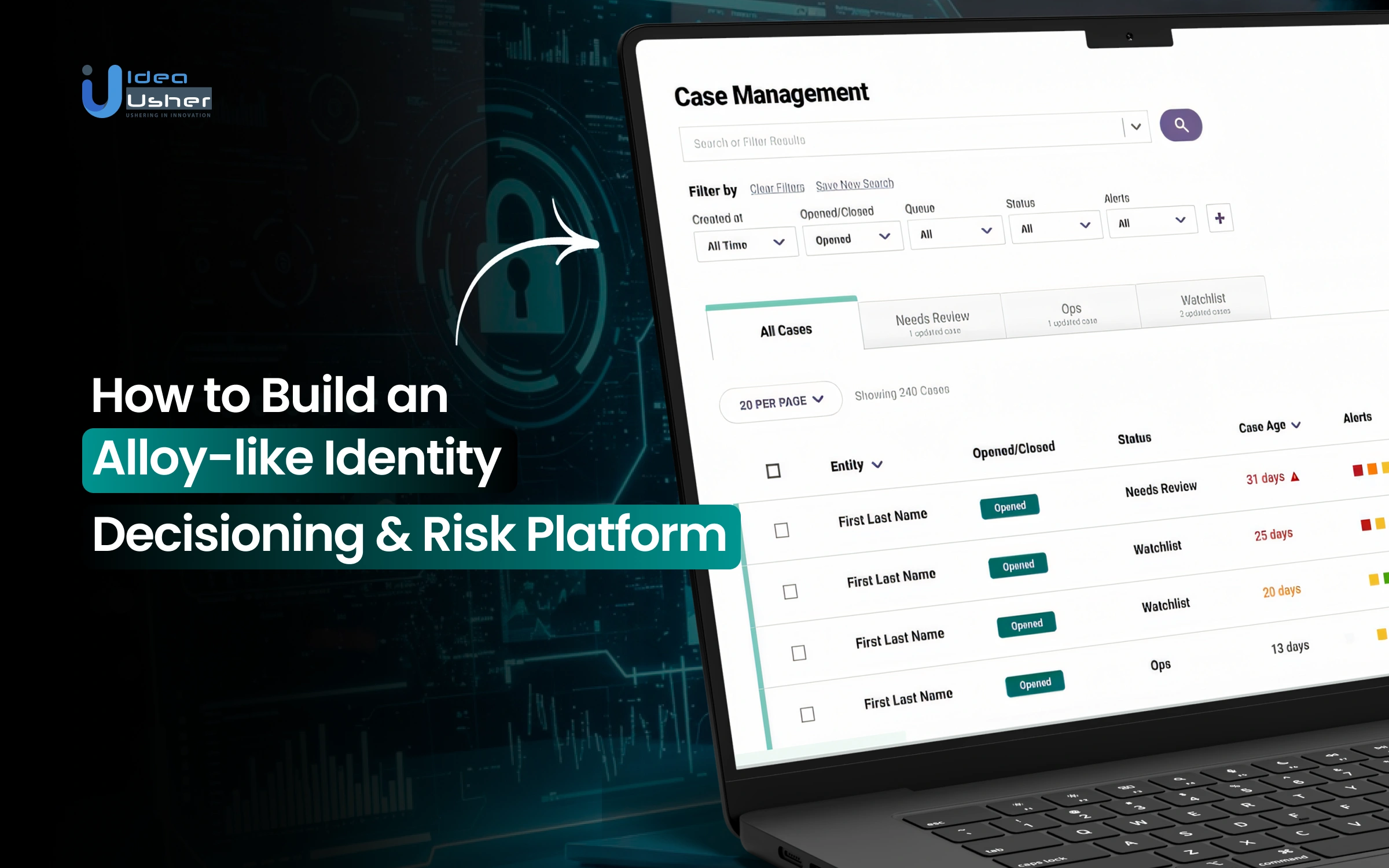
Verifying users and assessing risk is getting harder as digital businesses grow and many still depend on disconnected tools, manual reviews, and basic fraud checks that no longer keep up with modern threats. These gaps slow onboarding, lead to more false declines, and increase exposure to fraud and compliance issues. This makes it clear that businesses need a more Alloy-like intelligent identity decisioning & risk platform that evaluates users accurately in real time.
A unified decisioning system brings this intelligence together by combining verification, risk scoring, and data orchestration into one workflow. Using multi-source signals, automated rules, and machine learning for anomaly detection helps businesses approve more good users while stopping fraud earlier. This cohesive approach lowers operational effort and delivers a smoother, more trustworthy onboarding experience.
In this guide, we’ll explore how to build an Alloy-like decisioning and risk platform, the core features required, and the technology stack that supports reliable identity evaluation at scale. This blog will give you a clear roadmap to designing an intelligent identity and risk system that grows with your business.

What is an Identity Decisioning & Risk Platform, Alloy?
Alloy is an identity decisioning and risk automation platform that unifies identity, credit, fraud, and compliance data into a real-time decision engine. With multi-source data orchestration and configurable policies, it enables instant risk assessment and automated KYC, KYB, AML, and sanctions screening. This helps companies scale onboarding, improve compliance, and reduce manual reviews with greater accuracy.
The platform strengthens fraud defense with AI-assisted tools like Fraud Attack Radar, which identifies coordinated attacks and emerging threats. Alloy also supports continuous monitoring, adaptive risk scoring, and lifecycle identity evaluation to help institutions maintain trust and prevent fraud at every stage.
- Strong data orchestration ecosystem with access to hundreds of identity, credit, and fraud data sources.
- AI-supported intelligence layer for anomaly detection and real-time fraud pattern recognition.
- Advanced business verification and underwriting support for regulated industries.
- Enterprise-grade performance designed for high-volume onboarding and continuous risk evaluation.
Business Model
Alloy is a risk automation platform for onboarding, fraud prevention, and compliance, offering centralized risk intelligence, multi-source data orchestration, and configurable workflows for regulated industries.
- Alloy delivers SaaS-based identity and risk decisioning, giving financial institutions and fintechs a centralized platform for identity, fraud, compliance, and credit automation without building in-house systems.
- It offers broad data orchestration with a unified decision engine, combining hundreds of identity, credit, fraud, and sanctions data sources for faster, more accurate risk assessment.
- Businesses use Alloy for automated KYC/KYB, AML checks, fraud prevention, credit underwriting, and ongoing risk monitoring, consolidating multiple tools into one platform.
- Its low-code/no-code policy engine, API integrations, and unified dashboard let teams configure workflows and verification rules with minimal engineering effort.
- Alloy provides enterprise-grade performance for regulated industries, supporting strict compliance needs and high-volume onboarding with reliability and scale.
How an Alloy-like Identity Decisioning and Risk Platform Works?
An Alloy-like identity decisioning and risk platform works by aggregating identity, credit, and fraud data into a real-time decision engine. It automates KYC/KYB, AML, and risk scoring to streamline onboarding and compliance.

1. User Submission & Data Collection
The process begins when a user or business provides identity details, documents, or application data. The platform instantly gathers contextual signals such as device metadata, behavioral patterns, and geolocation, enabling real-time identity preprocessing before evaluation.
2. Multi-Source Data Orchestration & Enrichment
The platform connects to credit bureaus, sanctions lists, business registries, and fraud intelligence sources. These signals are unified through data orchestration pipelines, creating a complete identity profile enriched with external verification and risk indicators.
3. Identity Verification & Fraud Intelligence Checks
Documents, biometrics, and structured data are validated using AI-assisted parsing, pattern matching, and anomaly detection. The system identifies inconsistencies, synthetic identity traits, velocity spikes, and risk patterns that traditional manual review often misses.
4. Decision Engine Evaluation and Risk Scoring
The decision engine applies configurable rules, policy logic, and adaptive scoring models to determine trustworthiness. Dynamic risk scoring analyzes all signals to classify the user as low, medium, or high risk, guiding approvals, denials, or step-up verification.
5. Automated Workflow Routing & Compliance Screening
Based on the evaluated risk level, the platform routes the user through appropriate verification paths. Automated workflows trigger KYC, KYB, AML, and sanctions checks, ensuring regulatory alignment while maintaining a seamless onboarding experience.
6. Case Decisioning, Actions & System Synchronization
Once risk scoring is complete, the platform finalizes outcomes such as approval, denial, or step up verification. Automated actions sync results across internal systems, while flagged profiles move into case review for deeper analysis and compliance documentation.
How Identity Decisioning Platforms Achieve 4X Better Fraud Detection Than Manual Review?
The global fraud detection and prevention market was valued at USD 33.13 billion in 2024 and is projected to reach USD 90.07 billion by 2030, growing at a CAGR of 18.7% from 2025 to 2030. This rapid expansion reflects accelerating enterprise demand for automated, AI-driven identity risk platforms that can scale faster than emerging fraud threats.

AI models achieve 92–98% detection accuracy in identifying deepfakes and synthetic identities, compared with human reviewers who identify high-quality deepfakes correctly only 24.5% of the time, demonstrating a 4X advantage that makes automated identity risk decisioning essential for modern fraud prevention.
A. AI-Powered Pattern Recognition Surpasses Human Capabilities
Human analysts face cognitive limits, fatigue, and inconsistency. Identity decisioning platforms use ML models trained on millions of fraud patterns for real-time risk assessment across hundreds of variables that humans cannot process.
- 87% of global financial institutions now use AI-driven fraud detection, up from 72%, showing rapid replacement of manual review with automated decisioning.
- 50% of all IAM platforms are expected to include AI-driven risk analytics by 2025, confirming that automated anomaly detection and identity provisioning are becoming standard infrastructure.
- 76% of organizations are prioritizing AI and machine learning for automated risk decisions, reflecting broad recognition that manual review cannot keep pace with modern fraud threats.
- Average fraud duration has dropped from 18 months to 12 months, a 33% improvement fueled by real-time monitoring and automated identity risk detection.
B. Real-Time Decisioning at Scale Eliminates Manual Bottlenecks
Identity decisioning platforms evaluate thousands of transactions per second with consistent logic, while manual teams process dozens daily with variable quality. This enables real-time assessment of every transaction, dramatically reducing false negatives.
- 62% of organizations are moving to real-time fraud decisioning, replacing batch monitoring with instant automated detection that stops losses before they occur.
- 43% of fraud is still detected through human tips, underscoring the huge gap automated identity risk platforms can fill by identifying threats proactively instead of waiting for whistleblowers.
- Adaptive risk-based authentication reduced login abandonment by 30%, proving that automated decisioning improves both security and user experience by lowering friction for low-risk users.
- U.S. cybercrime losses hit $16.6B, with $2.77B from identity-based attacks, highlighting the urgent need for automated identity decisioning that can detect credential compromise far faster than manual review.
C. Why Now Is the Best Time to Build an Alloy-like Platform
The identity decisioning market is growing quickly as fraud increases and banks focus on automated risk systems. This creates opportunities for a new platform combining identity verification, fraud data, and real-time decisions.
- Alloy raised $100 million at a $1.3B valuation, followed by an additional $52 million, showing strong investor appetite for identity and risk infrastructure.
- The launch of Fraud Attack Radar, Alloy’s AI-powered fraud pattern detection tool, reflects rapid innovation and market readiness for advanced risk intelligence.
- Partnerships like Alloy + Mastercard signal deep industry adoption and expanding use cases beyond fintech.
- Global fraud rates continue to climb, increasing demand for AI-supported risk engines capable of detecting complex, coordinated attacks.
- Financial institutions and fintechs are actively replacing legacy systems with automated decisioning and compliance orchestration platforms.
- Businesses increasingly prefer configurable, low-code decisioning systems, reducing reliance on large engineering teams and shortening deployment cycles.
Benefits of an Alloy-like Identity Decisioning and Risk Platform
An Alloy-like platform offers real-time identity verification, automated risk scoring, and compliance, aiding fraud prevention and speeding onboarding. It unifies data and workflows to boost accuracy, cut manual reviews, and reduce costs.

A. Benefits for Users
Users experience faster, smoother onboarding and secure authentication with minimal friction.
- Faster and smoother onboarding through real-time identity checks and automated approvals.
- Reduced verification friction due to adaptive workflows that only add extra steps when risk is detected.
- Higher security and trust as the platform monitors for identity misuse, account takeovers, and suspicious activity.
- More accurate identity validation powered by enriched data sources and subtle AI-assisted verification signals.
- Consistent user experience across different services, products, or platforms connected to the same decisioning engine.
B. Benefits for Businesses
Businesses gain higher approval rates, stronger fraud prevention, and scalable compliance automation across all customer touchpoints.
- Stronger fraud prevention using real time risk scoring, anomaly detection, and continuous monitoring.
- Improved compliance through automated KYC, KYB, AML, and sanctions screening across jurisdictions.
- Lower operational costs by reducing manual reviews and minimizing human decision errors.
- Scalable onboarding infrastructure capable of handling high volumes with low latency.
- Better decision accuracy using multi source data orchestration and configurable policy logic.
- Higher conversion rates as low risk users move through streamlined verification flows.
- Centralized risk intelligence that unifies identity, fraud, and compliance data into a single decisioning ecosystem.
- Stronger audit readiness thanks to structured evidence, traceable decisions, and case management tools.
Key Features for an Alloy-like Identity Decisioning & Risk Platform Development
Building an Alloy-like identity decisioning and risk platform requires features that enable real-time verification, automated risk scoring, and intelligent fraud prevention. Below are the essential features your platform must include for accuracy, scalability, and compliance.

1. Identity Orchestration Engine
A powerful identity orchestration engine merges documents, biometrics, device insights, and behavioral signals into one profile. This unified identity layer enables precise decision-making and supports AI-assisted identity reconciliation across onboarding, monitoring, and fraud workflows.
2. Multi-Source Data Provider Integrations
The platform must connect with credit bureaus, sanctions databases, business registries, and alternative risk data sources. Aggregated signals form a richer identity picture, enabling AI-influenced evaluations and stronger insights during verification and ongoing monitoring.
3. Configurable Policy & Decision Engine
A flexible policy engine allows teams to build rules, manage compliance logic, and adjust risk thresholds without engineering help. Real-time evaluation uses conditional logic supported by ML-driven signals, ensuring faster decision rollout as risks or regulations evolve.
4. Dynamic Risk Scoring Framework
Risk scoring analyzes device history, behavior, external signals, and identity inconsistencies. Adaptive ML scoring highlights anomalies and categorizes users by risk, enabling more accurate approvals, denials, or step-up verification based on evolving fraud patterns.
5. KYC, KYB, AML & Sanctions Screening Module
The platform must automate regulatory checks with screening for individuals and businesses. Compliance-aligned workflows ensure regulatory consistency, while intelligent screening surfaces risk matches and complex relationship patterns that manual systems may miss.
6. Real-Time Fraud Detection & Step-Up Verification
Fraud detection relies on behavioral anomalies, velocity checks, device fingerprints and identity patterns. When risk increases, step up verification initiates additional proofing, such as biometrics or document reviews, making security adaptive without harming user experience.
7. Ongoing Monitoring & Lifecycle Risk Management
Risk continues after onboarding, so continuous monitoring of transactions, behavioral trends, and identity updates is crucial. AI-assisted monitoring detects unusual shifts, helping institutions maintain trust and meet AML expectations for ongoing oversight.
8. Case Management & Manual Review Workspace
A structured workspace helps analysts review flagged profiles, investigate anomalies, and collaborate on decisions. AI-supported triage prioritizes risky cases, accelerating resolution and ensuring that human review focuses on the most meaningful identity concerns.
9. High Performance Decisioning Infrastructure
The platform must support low-latency decisions at scale. Distributed processing and optimized pipelines allow real-time evaluation under heavy workloads, ensuring performance remains stable during peak onboarding or high transaction volume.
10. Unified API & Administrative Dashboard
A single API centralizes integration for onboarding, risk checks, and compliance tasks. The dashboard provides visibility into workflows and analytics. Unified control simplifies operations, enabling teams to adjust policies instantly and monitor system performance effectively.
How to Build an Alloy-like Identity Decisioning and Risk Platform?
Building an Alloy-like identity decisioning and risk platform requires a structured development approach focused on real-time data orchestration, automated verification, and intelligent risk analysis. Below is the streamlined framework our developers can follow to build a scalable, compliance-ready platform.

1. Consultation
We begin by understanding client onboarding flows, compliance expectations, fraud exposure, and risk appetite. This early collaboration defines decision criteria, identity checkpoints, and the foundational risk logic that shapes the platform’s decisioning architecture.
2. Requirements Analysis
Our developers analyze functional and regulatory requirements to outline identity rules, screening needs, and data mapping expectations. We determine how AI-supported insights, behavioral signals, and policy logic interact to ensure accurate and compliant decision outcomes.
3. Identity Orchestration Architecture Design
We design the identity orchestration layer that unifies documents, biometrics, device intelligence, and third-party signals into a single profile. This architecture supports real-time enrichment and identity consistency checks, enabling high-quality decisioning at every stage.
4. Decision Engine and Policy Logic Planning
We define the decision engine that evaluates identity attributes, external data, risk indicators, and behavioral trends. Configurable policy logic allows non-engineering teams to update rules, thresholds, and compliance checks as risk factors or regulations evolve.
5. Risk Scoring & Fraud Intelligence Framework
Our team builds a scoring framework combining rule-based logic with machine learning assisted anomaly evaluation. This reveals velocity spikes, identity inconsistencies, synthetic profiles, and other fraud signals that support automated approvals or step up verifications.
6. Data Source Integration & Signal Mapping
We integrate essential data sources such as credit bureaus, sanctions databases, business registries, and fraud networks. Mapped signals feed into the unified identity graph, helping generate richer evaluations for onboarding and ongoing monitoring.
7. Workflow Automation Layer Development
We create automation flows that route users or businesses based on risk scores and policy outcomes. Conditional routing and real-time triggers ensure the right verification path is applied, improving both fraud prevention and operational efficiency.
8. Ongoing Monitoring & Lifecycle Controls
We develop continuous monitoring features to track identity changes, behavior patterns, and suspicious activity. AI-assisted monitoring detects anomalies early and supports AML obligations for periodic reviews and lifecycle risk management.
9. Case Management & Analyst Workspace
We build an intuitive workspace for analysts to investigate flagged profiles, review identity evidence, and resolve exceptions. AI-supported triage prioritizes high-risk cases, improving investigative accuracy while reducing manual workload.
10. Testing & Launch the Platform
We validate workflows, policies, scoring outputs, and decision logic through simulations and edge case testing. Iterative refinement strengthens detection quality, ensuring the platform remains accurate and resilient against evolving threats and regulatory changes.
Cost to Build an Alloy-like Identity Decisioning & Risk Platform
Estimating the cost to build an Alloy-like identity decisioning and risk platform depends on features, data integrations, automation depth, and compliance requirements. Here is a concise overview of what influences the total development investment.
| Development Phase | Description | Estimated Cost |
| Consultation | Defining scope, compliance needs, and core risk logic for accurate decision planning. | $5,000 – $9,000 |
| Identity Orchestration Architecture | Designing unified identity layers that merge documents, device data, and signals. | $10,000 – $15,000 |
| Decision Engine & Policy Logic | Creating configurable rules and adaptive policy flows for real time decisions. | $12,000 – $20,000 |
| Risk Scoring & Fraud Intelligence Framework | Building scoring models and AI assisted anomaly checks to identify fraud risks. | $15,000 – $28,000 |
| Data Source Integration & Signal Mapping | Integrating bureaus, sanctions databases, and mapping external risk signals. | $12,000 – $17,000 |
| Workflow Automation Layer | Developing routing logic and conditional verification steps based on risk. | $10,000 – $12,000 |
| Ongoing Monitoring & Lifecycle Controls | Implementing continuous risk monitoring for identity updates and AML needs. | $11,000 – $15,000 |
| Case Management Workspace | Creating tools with triage assistance for flagged profiles and manual reviews. | $6,000 – $11,000 |
| Testing & Validation | Ensuring workflow accuracy, regulatory alignment, and stable decision outputs. | $5,000 – $9,000 |
| Deployment & Optimization | Launching the platform and refining risk and policy performance post-deployment. | $5,000 – $14,000 |
Total Estimated Cost: $67,000 – $128,000
Note: Actual development costs depend on workflow complexity, number of data integrations, compliance depth, and the sophistication of AI-powered risk intelligence included in the platform.
Consult with IdeaUsher to receive a personalized cost estimate and a complete roadmap for building a scalable identity decisioning and risk platform tailored to your fraud prevention and compliance goals.
Cost-Affecting Factors During the Development
Creating an Alloy-like Identity Decisioning and Risk Platform involves various technical, regulatory, and architectural factors that significantly impact the budget. Here are the main elements that affect the complexity and cost of development.
1. AI & Fraud Intelligence Complexity
Costs increase when incorporating AI-assisted anomaly detection, adaptive scoring, and behavioral risk models. Training, tuning, and validating these components require additional development effort and deeper data preparation.
2. Data Provider Integrations
Connecting with credit bureaus, sanctions databases, business registries, and fraud intelligence networks raises development cost. Each integration requires mapping, normalization, testing, and ensuring consistent signal quality across providers.
3. Workflow Automation and Policy Flexibility
Building customizable workflows with conditional routing, approval logic, and step-up verification requires significant engineering. The ability for clients to modify rules without developers also adds complexity to the platform’s internal logic.
4. Case Management & Analyst Tools
Developing a full investigation workspace with evidence grouping, triage capabilities, and role-based access controls increases cost. These tools must support efficient manual review and compliance reporting, which requires detailed UI and backend logic.
5. Security & Data Protection Standards
Identity and risk systems must follow strict data handling practices, encryption standards, audit controls, and privacy safeguards. Implementing these security layers raises development effort, especially for regulated markets.
Challenges & How Our Developers Will Tackle?
Developing an Alloy-like identity decisioning and risk platform faces challenges in data accuracy, real-time orchestration, compliance, and fraud detection. Here’s a brief overview of key hurdles and solutions for a secure, scalable platform.
1. Fragmented Identity and Risk Data
Challenge: Identity, behavioral, compliance, and device signals often come from disconnected sources, making unified risk evaluation difficult and inconsistent.
Solution: We build a consolidated identity orchestration layer that merges documents, device metadata, compliance data, and AI-enriched signals into a single profile. This unified identity structure improves decision accuracy and provides a reliable context for fraud and compliance checks.
2. Complex Fraud Patterns and Evolving Threats
Challenge: Fraud tactics shift quickly, introducing synthetic identities, velocity spikes, and behavior anomalies that static rules cannot reliably detect.
Solution: We combine rule logic with machine learning assisted anomaly detection to identify emerging patterns. Continuous signal analysis strengthens fraud prevention while enabling automated step-up verification for high-risk profiles.
3. Creating Efficient Case Management for Analysts
Challenge: Manual review becomes slow when risk alerts generate large queues without proper prioritization.
Solution: We build an investigation workspace with AI-guided triage and evidence grouping. Analysts see prioritized cases, complete risk context, and structured insights, improving review speed and accuracy.
4. Balancing Automation With Human Oversight
Challenge: Over-automation risks false positives, while over-reliance on manual review slows onboarding.
Solution: We design blended workflows that use automation for clear outcomes and human supervision for ambiguous risk profiles, maintaining both security and operational efficiency.
Revenue Models of an Alloy-like Identity Decisioning & Risk Platform
An Alloy-like platform can generate strong, recurring revenue because it becomes core infrastructure for onboarding, fraud prevention, and compliance decisioning. Below are the most effective and realistic revenue models used in this domain.

1. Subscription or License-Based Pricing
Platforms typically charge a recurring fee for access to the decision engine, policy builder, dashboard, and core orchestration features. This licensing model reflects how risk infrastructure becomes embedded into a company’s onboarding and compliance workflow, making recurring access essential rather than optional.
2. Usage or Volume-Based Billing
Most identity decisioning platforms earn revenue per decision, identity check, or monitored account. Financial institutions favor this model as it aligns costs with user growth and reflects actual operational load, since each verification involves data lookups, policy execution, and signal computation.
3. Tiered Plans and Premium Add-On Modules
Advanced features like AML monitoring, sanctions updates, risk scoring, fraud intelligence, or underwriting are often premium add-ons. Clients typically start with KYC or onboarding and then upgrade to deeper fraud and compliance as they grow.
4. Enterprise Licensing and Long-Term Contracts
Large banks, fintechs, and embedded finance platforms need custom workflows, data integrations, support, and strict uptime SLAs, justifying enterprise licenses with multi-year commitments. As identity and risk tools are mission-critical and churn is low, this ensures stable revenue.
Conclusion
Building an Identity Decisioning & Risk Platform gives businesses a structured way to assess users, analyze risk signals, and automate approvals with greater confidence. A platform designed with unified data sources, scoring models, and continuous monitoring can significantly strengthen fraud prevention and compliance. By focusing on accuracy, transparency, and flexible rule engines, companies can support safer onboarding and more reliable identity assessments. With the right technical foundation, this approach helps teams reduce manual reviews, respond to threats faster, and maintain a secure trust framework for customers and partners.
Why Choose IdeaUsher for Your Identity Decisioning & Risk Platform Development?
At IdeaUsher, we build advanced decisioning engines that help businesses evaluate identity risk, streamline onboarding, and reduce fraud through unified data intelligence. Our platforms integrate multiple data sources to deliver real-time approvals that are accurate and compliant.
Why Work With Us?
- Risk Engine Expertise: We design custom scoring models, rule engines, and automated checks that help businesses assess user trustworthiness instantly.
- Multi-Provider Data Integration: Our solutions sync with KYC vendors, fraud databases, AML tools, and behavioral analytics systems to provide a holistic risk view.
- Strong Fintech Development Experience: With projects like JabaPay, where secure onboarding and risk checks were essential, we understand what a modern fintech requires in its identity and compliance stack.
- Enterprise-Grade Security: We build platforms equipped with encryption, audit trails, and compliant data handling to support regulated industries.
Explore our portfolio to see how we help companies launch secure, compliant, and scalable AI solutions in the market.
Reach out today, and let us help you build an Identity Decisioning & Risk Platform that delivers accuracy, speed, and intelligent automation across your onboarding lifecycle.


FAQs
Identity decisioning evaluates user risk by combining identity data, behavioral patterns, and verification checks. It helps platforms determine whether to approve, reject, or review users while maintaining security, compliance, and a smooth onboarding flow.
A risk engine analyzes multiple data signals to detect fraud, inconsistencies, or suspicious activities. By scoring users based on risk levels, it supports faster and more accurate onboarding decisions while reducing false positives and manual reviews.
A comprehensive platform integrates KYC providers, AML databases, credit bureaus, device fingerprinting tools, and behavioral analytics. These combined sources strengthen identity checks and allow businesses to evaluate users with greater precision and confidence.
Automated decisioning systems identify unusual patterns in real time, preventing high-risk users from passing onboarding. With predefined rules and machine learning insights, they block fraud attempts early and strengthen overall platform security.


