

Key Takeaways
- An event prediction marketplace can cost anywhere from $20,000 to $100,000 or more.
- The final price depends on how complex the platform is and whether it runs on a blockchain, and compliance rules in your target market can push it higher.
- Users sign up and fund a crypto or fiat wallet, then trade through an AMM or an order book. Live oracle data drives the odds, and winners are paid out automatically.
- The technical side needs secure smart contracts or a backend engine, plus KYC and AML tools to meet compliance rules, and a clear interface makes it all usable for traders.
- Learn how Idea Usher can help businesses develop an event prediction marketplace, from planning and design to launch and ongoing support.
Building an event prediction marketplace usually costs anywhere from $25,000 to $150,000 or more. A basic MVP sits at the low end, and a blockchain-based platform with custom smart contracts and an automated market maker or AMM sits at the high end. On the feature side, users need to sign up, pass KYC and AML checks, browse events sorted by category, watch live odds, and fund their accounts with a crypto wallet or several currencies.
Behind the scenes, funds are held in escrow and paid out automatically once a decentralized oracle confirms the result. Admins also need a dashboard for handling disputes and monitoring risk. This blog breaks down what drives the cost and which features your platform needs. It also covers the development process step by step, from the first requirements call to launch, so you know what to expect at each stage.
Is an Event Prediction Marketplace Profitable in 2026?
Yes, an event prediction marketplace can make good money. It only works if you get steady trading volume and enough liquidity, and if the rules in your market stay clear. According to Mordor Intelligence, the online gambling market is projected to grow from USD 120.4 billion this year to USD 134.8 billion in 2027 and USD 231.4 billion by 2032, which is a CAGR of 11.42% between 2027 and 2032. More people betting online means more people who might try event contracts. Your profit will mostly come from fees on what they trade.
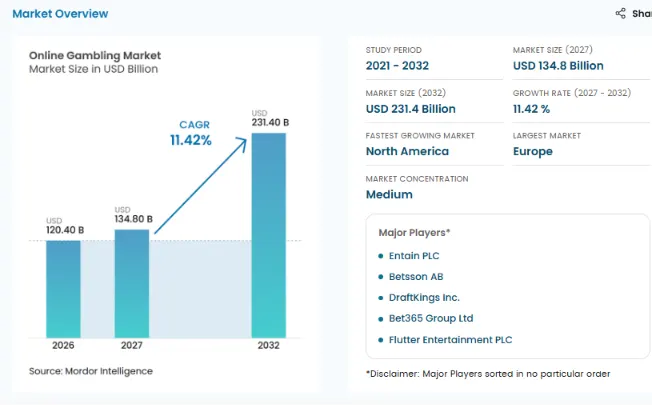
Source: Mordor Intelligence
Revenue and Monetization Models
Most prediction markets earn money from trading fees. Kalshi says it charges a blended fee of roughly 1% of trading volume. One estimate puts its fee revenue at $263.5 million last year. Polymarket took a slower path. It charged no fees on most markets last year and only started taking fees from takers this year. The model works, but you need a lot of volume first. Some platforms also earn from market creation fees, paid data access, and sponsored markets.
| Platform | How it earns | Number to know |
| Kalshi | Trading fees on most markets | About 1% of volume |
| Polymarket | Taker fees only | $330.79 million in all-time fees |
The gap between them shows how much the product mix matters. In May alone Kalshi collected $137.86 million in trading fees while Polymarket collected $28.07 million. A big reason is sports. About 87% of Kalshi’s yearly volume came from sports contracts. If you want similar income, pick a category that people trade all the time and not only during big events.
Operating Costs and Liquidity
Running the platform costs real money. You pay for developers and security audits and for KYC and AML tools. You also pay for the oracles that confirm results. The bigger cost is liquidity. Order books on prediction markets are usually thin compared with traditional markets, which leads to sharp price swings and small position sizes. Firms like Susquehanna, Jump Trading, and DRW are now building desks just for these markets. Without them a new marketplace can feel empty.
What thin liquidity looks like
A study of Polymarket order books found a median full spread of about 400 basis points for markets priced near 50 cents. For markets priced below 10 cents it jumped to 1,300 to 1,800 basis points. Wide spreads push traders away. Risk.net also found that liquidity on Kalshi and Polymarket is too thin for institutional use on financial and economic events. So you may have to pay market makers or reward them early.
How Opinion handled it
Opinion built its exchange on the BNB Chain around a central limit order book. After its mainnet launch it started OPN Season 1, a points system that rewards traders and market makers. It also partnered with Brevis to settle markets using zero-knowledge technology. The volume came fast. It logged $1.5 billion in weekly volume just weeks after launch. But its trading fees in May were only about $159,330. Volume alone does not pay the bills.
What Decides Profitability
A few things matter more than the rest:
- Steady volume from a category people trade all year
- Enough liquidity that spreads stay narrow
- Clear legal ground in the places you operate
- A way to reach users without paying too much for them
- A fee level that covers costs and keeps traders around
The legal point is a big one. More than 20 lawsuits are moving through US courts over sports event contracts. Any platform that leans on sports should plan for that risk.
Robinhood and its Rothera move
Robinhood shows why reach matters. Its event contract revenue hit $173 million in the latest quarter, more than six times the same quarter last year and ahead of its crypto revenue of $120 million. At first it sent customer orders to other exchanges. Then it bought MIAXdx with Susquehanna and renamed it Rothera, with Susquehanna as the day-one liquidity provider. Routing more trades through Rothera lets Robinhood keep more of the fees instead of sharing them.
Rothera passed $100 million in annualized revenue in its first full quarter. It kept adding products, too. In December, it launched preset and custom combos and player performance markets in its Prediction Markets Hub. In September, it added earnings contracts.

Key Features of Event Prediction Marketplaces
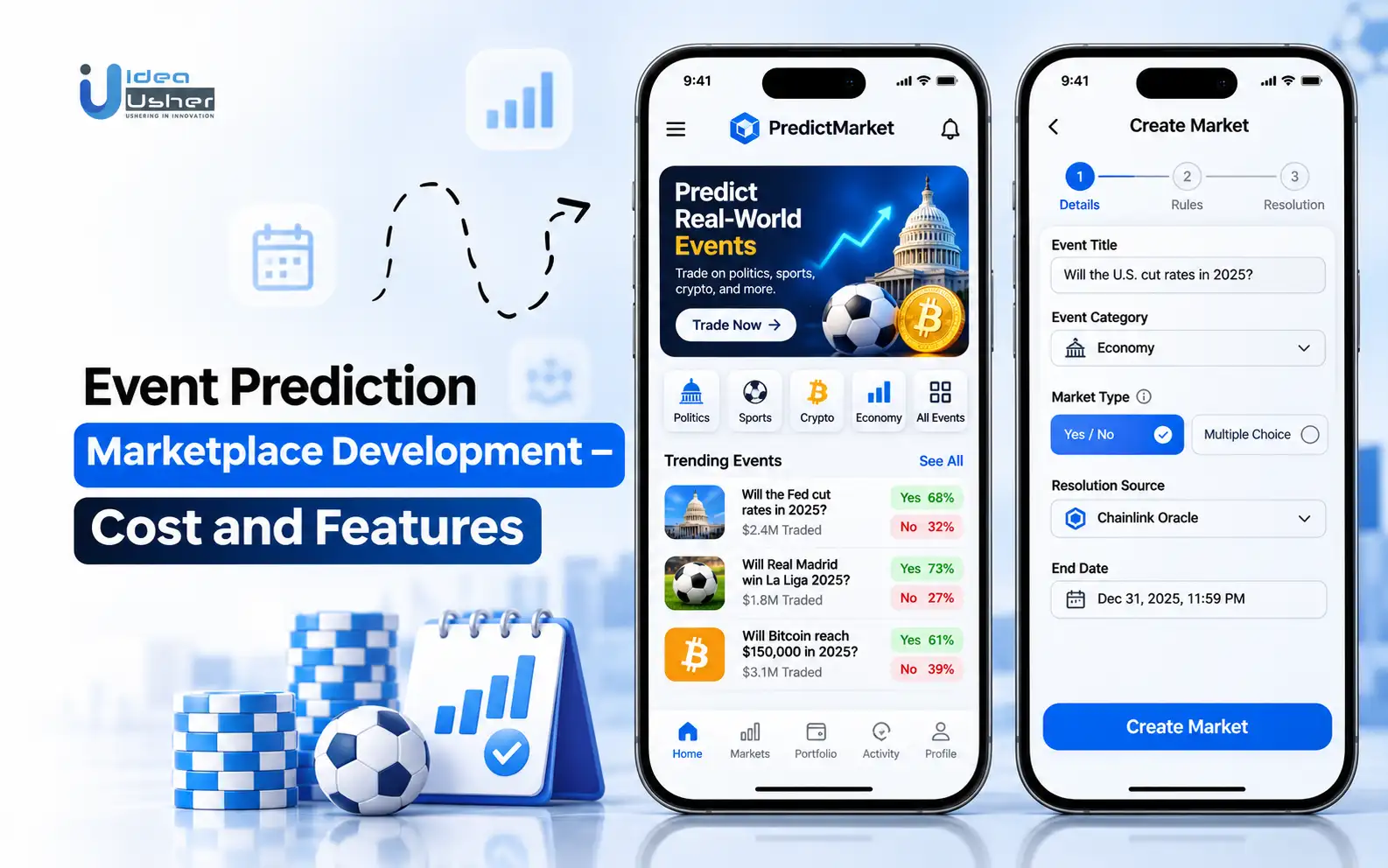
An event prediction marketplace needs eight key features to work well. These are event discovery, order matching, conditional trading, outcome verification, liquidity tools, risk controls, dispute handling and analytics. Each one has a simple job. Some help people find a market and trade it. Others keep prices fair and make sure winners get paid on time. A platform that misses even one of them will feel weak to traders and to regulators.
1. Event Discovery and Market Creation
Event discovery and market creation turn a real event into a yes or no question that people can trade. Every market needs a clear question and a named source for the final answer. Kalshi lists each market with a precise question and a clear settlement source. Polymarket also sets its rules up front, like the resolution source, the end date and how odd cases are handled. This stops people from fighting later about what the question really meant.
A good listing needs:
- A clear yes or no question
- One trusted source for the answer
- An exact end date
- Rules for odd cases
Every new question also gets its own fresh order book that starts empty.
2. Order Matching and Dynamic Price Calculation
Order matching is the engine that pairs a buyer with a seller. The price then shows how likely the crowd thinks the event is. YES and NO prices always add up to $1. So a YES price of 65 cents means the crowd sees about a 65% chance. Kalshi and Polymarket both use a central limit order book, while some platforms use a formula-based automated market maker.
| Order Book | AMM | |
| How trades match | Buyers are matched directly with sellers | Trades run against a pool |
| Who sets the price | Resting bids and asks | The pool curve |
| What it needs | Active market makers | Liquidity providers |
3. Conditional Trading and Portfolio Management
Conditional trading means an order only runs when your rules are met. A limit order is the easiest example. A limit order at 62 cents only fills if the market moves to that price. Kalshi supports limit, market, stop-limit, IOC and FOK orders. Portfolio tools then show what you hold. You can see the total cost and the most you can win or lose before you confirm, and you can sell any time during market hours.
- Limit order: you pick the price and wait
- Market order: you take the best price right now
- Stop-limit: it starts only after a trigger price
- IOC: it fills what it can and cancels the rest
4. Automated Outcome Verification and Payouts
Outcome verification checks the final result against a named source and then pays winners without anyone doing it by hand. Winning shares pay $1 and losing shares pay nothing. Polymarket uses the UMA Optimistic Oracle for event markets. Someone proposes the answer and puts up a bond. If nobody disputes it, the market settles about 2 hours later. This keeps payouts quick and cheap for the usual easy case.
- Event markets: a proposal comes with a bond of typically $750
- Price markets: Polymarket uses Chainlink TWAP, so the same inputs always give the same result
- Regulated exchanges: the answer comes from the named settlement source
5. Liquidity Pools and Market Maker Tools
Liquidity tools make sure there is always someone to trade with. Deep books mean tight spreads and low slippage, which is why platforms chase professional market makers. Without them traders leave fast. Platforms fix this with pools or with paid market makers.
How Kalshi Does It
Kalshi went the market maker way. Its Market Maker Program asks chosen firms to quote both sides in return for lower fees and adjusted position limits. Susquehanna was named its first dedicated institutional market maker in 2024. Cantor Fitzgerald now brokers large Kalshi block trades for about 3,000 institutional clients, with Susquehanna giving the liquidity. Trades of at least 50,000 contracts can get rebates on all exchange fees. Incentives need care though. Kalshi moved to end its Volume Incentive Program after trading scrutiny.
How Limitless Does It
Limitless Exchange runs on Base and uses an order book instead of a pool. It runs a liquidity provider incentive program that rewards users who place competitive limit orders. Its Points Program counted trading volume, liquidity, engagement and referrals, and those points fed an airdrop of its LMTS token. It also runs hourly and daily crypto price markets that resolve quickly.
6. Risk Monitoring and Position Limit Controls
Risk controls stop one trader or one bad actor from hurting the market. Two tools matter most. Position limits cap how much one person can hold. Surveillance watches for odd trades. Kalshi’s surveillance flagged near-perfect wins on low-odds markets and the team froze the accounts. Its surveillance system, called Poirot, has run over 200 investigations. The CFTC also reminded exchanges that they must keep strong surveillance.
How PredictIt Does It
PredictIt shows how limits can change over time. A new agreement with the CFTC removed its 5,000 trader limit. It also raised the cap per contract from $850 to $3,500. That number matches the federal campaign contribution limit. The site later launched a redesign with new features. Underdog also bought the Aristotle Exchange entities, but PredictIt was not part of that deal.
7. Dispute Resolution and Settlement Tracking
Dispute resolution gives traders a fair way to challenge a result they think is wrong. Settlement tracking shows where each market stands at any time. Polymarket gives a clear example of how this can work.
A fully disputed market takes about 4 to 6 days. Polymarket can also post an “Additional context” update when a rule needs clarity. Your own platform should show each market’s status like proposed, challenged or resolved. This helps traders trust the process while they wait.
8. Analytics Dashboard and Trading Insights
An analytics dashboard turns raw trades into something people can read. Traders use it to see price moves and how deep the book is. If the best buy is 0.50 and the best sell is 0.51, the top of the book reads 0.50 at 0.51. Admins use it to spot odd behavior early. Data also helps the community. Kalshi trading data is public, so users sent tips about odd trades. Polymarket gives developers REST and WebSocket access for live data.
- Price and chance history for every market
- Volume and order book depth
- Open positions and profit for each trader
- Inventory, profit and loss, and position limit alerts for admins
Why Is the Event Prediction Marketplace A Strong Business Investment?
An event prediction marketplace offers a unique and powerful business investment opportunity due to its ability to combine data-driven insights, real-time public sentiment, and financial engagement in one platform. These marketplaces allow users to place bets or make predictions on future events ranging from sports outcomes and election results to market trends, providing a clear monetization pathway. With the global prediction market industry projected to grow significantly, reaching an estimated $12 billion by 2026, businesses investing in these platforms can tap into a growing user base that values predictive analytics. Companies like Polymarket and PredictIt have already demonstrated success, attracting thousands of users and millions of dollars in trading volume.
For instance, Polymarket reported over $1 million in trade volume in a single month in 2023, driven largely by increased interest in political events. As public demand for accurate forecasts and risk assessment grows, a prediction marketplace offers a valuable tool for users and a profitable avenue for investors looking to leverage collective intelligence and market forecasting capabilities.
Revenue Metrics from Leading Platforms
PredictIt has successfully implemented a strategy that involves charging a 10% fee on winnings and a 5% withdrawal fee. This approach has paved the way for impressive revenue growth, particularly during election cycles.
Polymarket generates revenue through transaction fees, usually ranging from 1% to 5% per transaction. It also profits from selling valuable market data to analytics firms and researchers keen on studying predictive patterns.
Kalshi charges a 1% fee on each trade and allows large wagers, with limits reaching up to $7 million on some contracts. Kalshi’s CFTC approval has positioned it uniquely to monetize prediction markets without regulatory limitations. Revenue data suggests that Kalshi has managed to capture a sizable share of the market due to its regulatory edge and diversified user base.
Most Successful Business Models For Event Prediction Marketplace
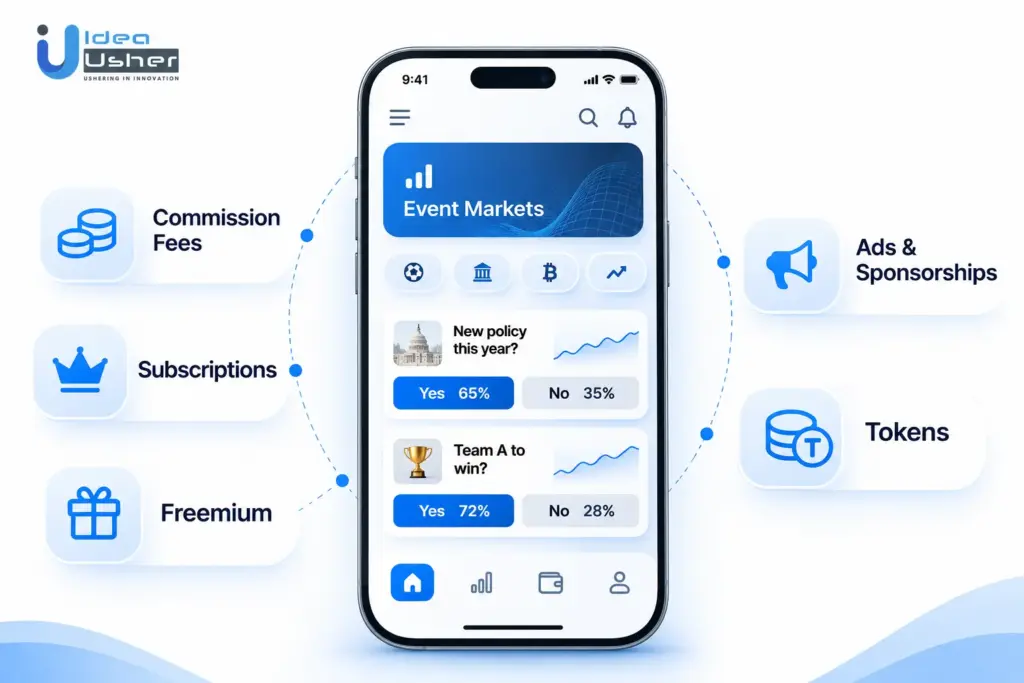
The most successful business models for an event prediction marketplace are commission fees, subscriptions, freemium, ads and sponsorships, and tokens. Commission is the strongest one because the platform earns on every trade and does not care who wins. The other four work best as add-ons that bring in more users or extra money. Most platforms mix two or three of them. A new platform should pick one main model first and then add the rest slowly.
1. Commission-Based Revenue Model
A commission model means the platform takes a small fee each time a trade happens. Kalshi makes more money when trading is high, but it does not gain or lose from the outcome of any event. Its fee is 0.07 × contracts × price × (1 − price), rounded up to the next cent. This means the fee is biggest when the price is 50 cents and smaller near the ends. Polymarket works in a similar way, but only on some markets.
Polymarket did not always charge fees. It added taker fees to 15-minute crypto markets first, along with a maker rebate program funded by those fees. Then on March 30 it spread the fees to nearly all categories. Early data showed the effect on trading volume was modest. Geopolitical and world event markets stayed free. So a platform can start free to grow and add fees later.
2. Subscription-Based Revenue Model
A subscription model means users pay every month for extra tools. It is not the main income for most exchanges. Kalshi, for example, has no membership fees. But traders do pay for better tools. Oddpool, a tool for Kalshi and Polymarket traders, offers 40+ event dashboards and basic data free, then charges $30 a month for Pro. Its pitch is that one arbitrage trade can pay for the month. That shows what people will pay for.
Good things to put behind a paywall:
- Cross-market price scanners
- Advanced charts and history
- Alerts for price moves
- Higher API limits for active traders
3. Freemium Model With In-App Purchases
Freemium means everyone starts for free and some users pay for extras. Manifold Markets is the best example. You can start free with play money called Mana and there is no KYC. Users can also buy Mana by card if they want more. Creating a market costs M$50, which goes into the pool so people can trade. Mana cannot be cashed out, but 100 mana can be given to charity as $1. This keeps the platform away from many gambling rules.
Manifold’s Product Changes
Manifold also tried a real-money step. It launched a feature called Sweepcash in September 2024 and shut it down on March 28, 2025. Sweepcash could be redeemed for real money with a 5% fee. Manifold is now Mana-only and has no plan to go back. It also has a loan system so your Mana is not stuck in long markets and its own automated market maker called Maniswap. The lesson is simple. Freemium brings in lots of users, but real cash income is harder.
4. Advertising and Sponsorship Model
In this model the platform earns from media deals, league deals and brand exposure. These deals bring in new users without paid ads. Kalshi and Polymarket both use them.
Money terms were not shared in these deals. A joint investigation by Popular Information and Public Notice said Kalshi inked a financial partnership with both CNN and CNBC. The CNN deal is exclusive, so CNN cannot mention Polymarket odds. That kind of exclusivity is something your platform can also ask for.
How Myriad Does It
Myriad took a different path and put the markets right inside content. It was launched by Dastan, the parent company of Decrypt and Rug Radio. Its markets show up next to Decrypt and Rug Radio stories through a Chrome extension. Myriad earns by taking a percentage of market volume, which Decrypt calls a new revenue model for media and creators. It reached $18.5 million in USDC trading volume with over five million trades.
5. Token-Based Revenue Model
A token model means the platform has its own coin that gives rewards or a share of fees. Polymarket is the big one to watch. Its chief marketing officer confirmed that a POLY token and airdrop are coming. The team wants to wait until the product has real utility first. A token only has value when real fees sit behind it. Polymarket’s crypto markets can charge up to $1.75 per 100 contracts at a 50 cent price and that is the kind of income a token can be tied to.
Augur showed the first version of this idea.
- Its REP token is needed by market creators and by reporters who stake it on the outcome.
- Each staked REP earns an equal share of the market fees.
- Reporters who vote against the consensus lose their staked REP.
- Traders never need to own REP to trade.
Developing an Event Prediction Marketplace Platform: Step by Step
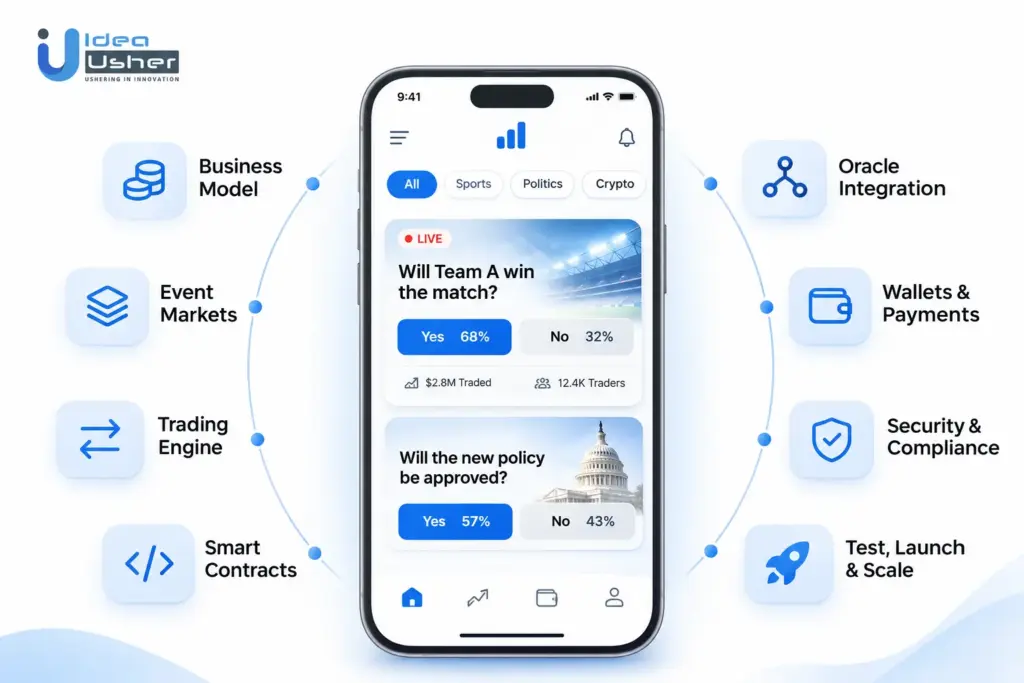
You build an event prediction marketplace in eight steps. First, you pick how you will earn money. Then you choose your markets and the trading engine that runs them. After that, you write the smart contracts and connect an oracle that confirms results. You also add wallets and payments, and then lock down security and compliance. The last step is to test the product and launch it and grow liquidity over time. Skipping any one of them usually costs more later.
1. Define the Marketplace Business Model
Start with how your platform will earn. Most platforms take a small fee on each trade. Kalshi says it charges a blended fee of roughly 1% of trading volume. Polymarket charged no fees on most markets last year and only started taking fees from takers this year. Pick your fee model before you write any code. It changes how you build the trading engine and who pays when a trade happens.
- Who pays the fee: takers, makers or both
- Whether market creators get a share
- Whether you hold user money or only match trades
- Whether you need a license to do any of this
2. Select Event Categories and Markets
Next you pick what people can trade on. Sports bring volume fast. About 87% of Kalshi’s yearly volume came from sports contracts. Other platforms lean in other directions. Start with two or three categories that you can fill with good markets every day. A site with only a few live markets looks empty to a new user.
| Platform | Where its markets lean |
| Kalshi | Sports |
| Polymarket | Politics, crypto, and geopolitics |
| Opinion | Macroeconomic events |
Myriad’s media angle
Myriad Markets took a different route. It comes from Dastan, the company behind the news site Decrypt. Its markets show up next to articles and social posts so readers can trade without leaving the content. It also launched Automated Markets built for short timeframes and auto-resolution, and it grew onto BNB Chain after Abstract and Linea. One guide noted that it used points instead of cash stakes. The lesson is simple. Where you place your markets matters as much as which ones you list.
3. Choose the Trading Engine
The trading engine decides how a trade gets filled. You have two main choices. An automated market maker, or AMM, trades against a pool of funds. An order book matches real buyers with real sellers. Each one has good and bad sides. The right pick depends on how many traders you expect and how deep you want your prices to be at launch.
| AMM | Order book | |
| How it fills | Against a liquidity pool using a formula | Matches buyers and sellers like a centralized exchange |
| Thin markets | Always quotes a price | Can stall when nobody takes the other side |
Limitless Exchange’s order book
Limitless Exchange picked the order book. Each market has separate Yes and No books with bids and asks and it supports both market and limit orders. It runs on Base and focuses on hourly and daily markets for crypto and stock prices. It uses Pyth oracles for resolution. It has handled over $500 million in total trading volume with more than 50,000 active traders. Its LMTS token and Points Program reward people who add volume or liquidity. A points program like this is one way to pull in early liquidity.
4. Design Smart Contracts and Settlement
Smart contracts hold the rules of every market. On Polymarket each market is a conditional token contract that points to an oracle request and states the question and the allowed sources and the event time and the rules for edge cases. When a market resolves the winning shares settle at full value and the losing shares settle at zero.
Keep the logic small. Less code means fewer places for a bug to hide. Polymarket also published a security audit report for its UMA oracle adapter. Plan your audit before launch and not after.
5. Integrate Oracles for Event Verification
An oracle tells your contract what really happened. A bad result can wreck trust fast. Polymarket uses UMA for prediction markets and Chainlink for up-down price markets. Chainlink Data Streams give timestamped price reports and Chainlink Automation triggers the onchain settlement. UMA works differently because token holders vote on disputes.
A Wall Street Journal analysis found that at least 60% of active UMA voters were linked to Polymarket accounts. UMA later limited who can propose results with an allowlist that started with 37 proposers. Choose your oracle with disputes in mind.
6. Build Wallets and Payments
Users need an easy way to put money in and take it out. The right choice depends on your market. Polymarket uses pUSD internationally and US dollars on Polymarket US while Kalshi uses US dollars. Crypto wallets give fast global access. Bank and card payments feel normal to new users but they need more checks. Interest on balances is also worth planning for because it keeps money on the platform.
- Kalshi pays a variable 3.50% on cash and open positions for eligible US accounts with at least $250.
- Polymarket pays 3.25% on positions in 18 selected long-term markets.
7. Implement Security and Compliance Controls
Prediction markets attract people who want to cheat. The Financial Times warned that they are vulnerable to insider information and manipulation until oversight and liquidity improve. Protect user funds with audited contracts and safe key storage. Add alerts for odd trading patterns and large bets placed right before news breaks. Fix these problems early because trust is hard to win back.
8. Compliance
The legal side takes the longest. Building a CFTC approved exchange takes years of KYC and AML work plus reporting and surveillance and rulebooks and regulator review. That is why Polymarket bought QCEX for $112 million instead of starting from zero. The CFTC had ordered it to pay $1.4 million and stop operating in the US in 2022. At a minimum plan for these controls:
- KYC and AML checks before users trade
- Blocking users in banned regions
- Market surveillance and audit logs
- Legal review for each country you enter
9. Test, Launch, and Scale
Opinion followed this path. It ran a closed beta Tradathon to gather trader feedback onchain and it came from a first product that drew over 1 million registered users. Its mainnet then launched on October 23. Scaling is where many platforms struggle. Order books are usually thin compared with traditional markets, which causes sharp price swings. Talk to market makers before launch day and not after.
- Run a closed beta with a small group of traders.
- Stress test the trading engine and the oracle flow.
- Launch with a few strong markets and not hundreds.
- Reward early market makers and active traders.
- Add new categories once volume is steady.
Event Prediction Marketplace Cost in 2026: MVP to $600K+ Custom Build
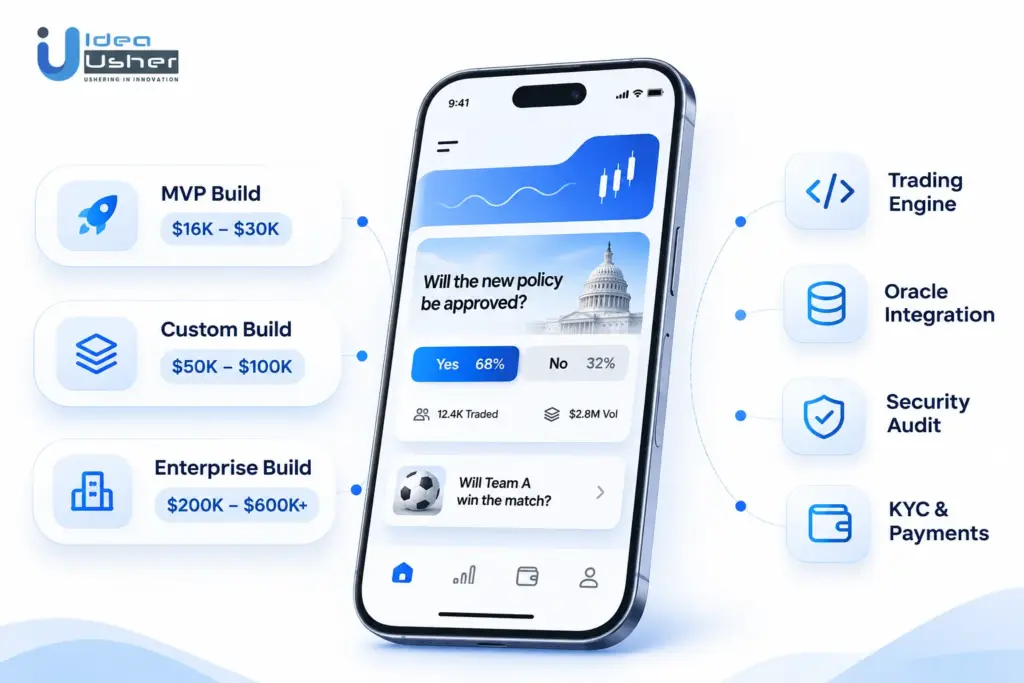
An event prediction marketplace costs about $16,000 to $30,000 for an MVP and $50,000 to $100,000 for a custom build. A full enterprise platform runs from $200,000 to $600,000 or more. These are planning ranges and not quotes. The price climbs with each extra piece such as an order book or KYC checks or an audit or a second oracle. Licenses cost extra. Polymarket paid $112 million for a licensed US exchange and clearinghouse instead of building one from scratch.
What does a 16K-30K MVP include?
A 16K–30K MVP proves that people will trade on your idea. It usually has one category and one simple engine. It has a few contracts and a basic admin screen and wallet login. It skips deep compliance and big liquidity deals. Labor drives most of this price. The US median pay for software developers is $134,040 a year or $64.44 an hour. One developer for a 160-hour month would cost about $10,300 at that rate. So an MVP at this price means a small team and a short build.
- One event category with a few live markets
- An AMM that always quotes a price even when nobody is on the other side
- Wallet login and simple deposits
- One oracle or a manual admin check of results
- An admin panel to create and close markets
PredictIt’s small start
PredictIt shows how a small start can work. It began under a 2014 CFTC no-action letter with limits of $850 per person in a contract and 5,000 traders per contract. Users pay a 10% fee on profit and a 5% fee on withdrawals. Its limit later rose to $3,500 and the trader cap was removed. It also launched a redesigned platform. The lesson for you is simple. Start small and keep limits tight. Then raise them as your tools and rules get stronger.
How does a 50K-100K build differ?
A 50k-100K build adds the parts that real traders expect. You add an order book or a stronger engine and KYC and a full admin dashboard. You also add a proper audit and a second data source. The team is bigger and the build runs longer. Three developers working for three months at the US median wage would cost about $93,000 in pay alone. That is why this range ends near $100,000.
What needs A 200K-600K+ budget?
An enterprise build is a different kind of product. It needs a fast matching engine and surveillance tools and several oracles and strong security. It also needs deals with market makers so the books are not empty. Order books on prediction markets are usually thin so prices swing a lot. Rothera started with Susquehanna as its day-one liquidity provider. The license is the part that can break a budget.
Building a CFTC approved exchange takes years of KYC and AML work plus reporting and surveillance and rulebooks and regulator review. So the $600K+ range covers the platform and not the license.
Underdog’s buy instead of build move
Underdog chose to buy. It first offered sports event contracts in its Underdog app through a partnership with Crypto.com Derivatives North America. Then it bought Aristotle Exchange DCM and Aristotle Exchange DCO so it could list and clear contracts itself. DraftKings did something similar when it acquired Railbird Exchange. Buying approvals can save years of waiting. Ask yourself if you can partner first and own the exchange later.
What Do Oracles, Engines, and Audits Cost?
Audits are the cost that most people underestimate. One audit platform puts the full range at $8,000 to over $300,000. A prediction market has settlement logic and oracle links and user funds. So plan toward the middle or top of the range and not the bottom. Also leave money for a second review whenever you change the contracts. A small fix after launch can add a new bug.
Oracles and Engines
Oracles are cheaper than audits but they need careful choice. UMA verifies data only when needed which can save money on event outcomes while Chainlink streams data at regular intervals. Price markets need that steady feed. The trading engine is the bigger decision. An AMM can almost always fill a trade while an order book can stall when nobody takes the other side. An order book needs more engineering and market makers. Budget more for it if you want sharp pricing.
What are Monthly Running Costs?
Servers are usually the smallest line on the bill. People and liquidity cost more. Thin books cause sharp price swings so many platforms pay market makers to keep quotes tight. Set aside a monthly budget for that before launch. Also expect to pay for a fresh audit when you change your contracts. Your monthly bill will grow with your users so review it every few months.
What Does $79.46B Combo Trading Volume Reveal About Marketplace Development?
Combo trades across five exchanges reached at least $79.46 billion in October. That was up 93.2% from $41.13 billion in September. This tells us that traders want more than simple yes-or-no bets. They want to join many outcomes into one trade and chase a bigger payout. So a new event prediction marketplace needs a multi-leg engine, smart pricing and strong market makers from day one.
One thing to keep in mind is that this number is notional volume. It counts the full payout of each contract and not the cash people really spent. So it shows strong interest and fast growth but it does not mean that much money moved.
What Is Combo Trading?
A combo joins two or more event outcomes into one contract. It pays $1 if every leg hits and $0 if any leg fails. So one wrong pick kills the whole trade. Polymarket US lets a user bundle two to 10 sports positions into a single combo. A simple example is “Team A wins” plus “over 2.5 goals” plus “Player X scores” in one tap. For a platform owner this means one more product that keeps users trading longer in the same game.
How Multi-Event Contracts Drive Volume
Combos make volume look big because of how it is counted. A contract that pays $1 adds $1 to volume even if the buyer paid only a few cents. Combos were 58% of Kalshi’s trading volume in September but less than 13% of its transactions. On Kalshi one dollar of cash made about $11.70 of combo volume but only about $2.30 on the rest of the exchange. So combos pull volume up fast even when most traders still place simple trades.
Kalshi
Kalshi started Combos as a beta in September 2025. After the full launch the feature did over $100 million in its first week. It also added a “Popular Combos” section that shows trending bundles so new users do not start from a blank page. Prices come from a request for a quote system.
Polymarket
Polymarket US filed with the CFTC in May for what it calls Combinatoric Athletic Outcome Contracts. Its offshore platform added parlays in June during the FIFA World Cup. Combos then launched publicly on Polymarket US on August 21 and reached 21.6% of its daily exchange volume within two days.
Key Technical Components Behind Combos
A combo looks simple to the user but a lot happens behind the screen. The platform must let people pick legs from different markets and then ask for a price. Then it must check how the legs affect each other and settle the trade only after every leg ends. If any of these parts is weak the whole product feels slow or unfair.
| Component | What it does |
| Leg builder | Lets users join legs from many markets |
| Quote engine | Sends the combo to market makers who compete and the best quote wins |
| Correlation check | Stops legs that depend on each other from being priced as separate |
| Settlement logic | Pays $1 only when all legs resolve correctly |
| Risk limits | Caps legs and exposure per event |
Novig
Novig is a good example of this stack in real use. Its Ludlow Exchange got CFTC approval on June 16 and Novig relaunched as a sports-only prediction market on August 4. It prices the requested parlay legs in real time and returns the best price it can find. It charges fees only on parlays and in-game trades. It also signed a multi-year deal with the New York Mets as their official prediction market partner. Parlays were about a third of its first-week volume of over $125 million.
Liquidity and Risk for Combos
Every combo is a tiny market of its own. Few people trade the exact same bundle so liquidity gets thin fast. The risk also piles up on market makers because the exchange does not hold it. One estimate said Kalshi alone would carry around $8 billion in maker risk in the opening week of the NFL season. So a platform that wants combos must plan for how market makers stay safe or they will leave.
Here is what helps:
- Cap the number of legs in one combo
- Set exposure limits for each game
- Check legs that move together before quoting
- Pool liquidity across related markets
- Watch spreads on thin combos all day
Research is also moving here. A recent paper called ParlayMarket shrinks the outcome space from 2^M to O(M²) so one liquidity pool can support many combos. It was tested on synthetic markets and on historical Kalshi combo data. This kind of design can lower the cost of running a combo engine for a new platform.
When to Introduce Combo Trading?
Do not launch combos first. Start with single markets that already have steady trading and a few market makers. Combos work best where there are many short events like sports and crypto. Sports, crypto and combos together made 94% of the nominal volume behind the record September across four platforms. Also plan for rules. Several states have filed lawsuits saying these event contracts are a loophole for illegal gambling. So get your compliance setup ready before the combo button goes live.
Underdog
Underdog shows the timing well. It bought the Aristotle Exchange in March and launched its own exchange in July. Before that it used a partnership with Crypto.com Derivatives North America to bring prediction contracts into its app. That deal started in 16 states. By August combos were 48% of its sports contract volume compared with 35% at Novig. It already had users and a sports audience so combos grew quickly once the exchange was ready.
How Do Kalshi and Polymarket Capture 90%+ of Prediction Market Volume?
Kalshi and Polymarket capture most of the volume because they win on three things. They have a clear legal or crypto-native path that fits their users. They have deep liquidity in the categories they know best. And they have deals that put them in front of millions of people. In the 30 days to October 7 Kalshi handled 75.6% of tracked volume while Polymarket US had 11.6% and its international site had 5.3%. That adds up to about 92%. Shares move over time so no lead is permanent.
Kalshi and Polymarket’s Market Position
Kalshi is the clear leader today. It was the first federally regulated event contract exchange in the US. It won CFTC approval in November 2020 and launched publicly in July 2021. That early start gave it a direct path to American sports fans. Polymarket took a different route. It built a crypto-native base around politics and global events. The order has also flipped before. Polymarket held over 90% of monthly volume in late 2024.
| Platform | Share of tracked volume | Best known for |
| Kalshi | 75.6% | Sports, which make up about 87% of its yearly volume |
| Polymarket US | 11.6% | Political markets |
| Polymarket International | 5.3% | Political markets |
Volume and Liquidity Advantages
Volume brings liquidity and liquidity brings more volume. Sports gave Kalshi a steady flow of traders every week. Polymarket kept its edge in politics. Big firms noticed too. Susquehanna and Jump Trading and DRW are building desks just for prediction markets. Those desks post prices all day and that helps keep spreads tighter on the biggest markets. A new platform has to compete with that depth from the first day.
The depth is not even everywhere though. Here is where the gaps show up:
- On Polymarket, the median full spread is about 400 basis points near 50 cents but it jumps to 1,300 to 1,800 basis points for markets under 10 cents.
- Risk.net found that liquidity on both platforms is too thin for institutional use on financial and economic events.
- On a 100-contract trade at 50 cents, Kalshi charges a $1.75 taker fee while Polymarket’s international site charges $0 to $1.75.
Those thin spots are where a new player can find room.
User Acquisition and Network Effects
Both leaders grew by plugging into places where people already spend time. Brokers brought in traders and media deals brought in trust. This builds a loop. More users bring more orders and more orders bring tighter prices. Tighter prices then bring more users.
Polymarket also opened its doors to outside builders. Its Builders Programme has produced interfaces that routed over $150 million in volume. It also added X integration and MetaMask in-wallet trading. Relying on one channel can be risky though. One analysis calls Kalshi’s dependence on Robinhood a structural weakness.
Opportunities for Niche Entrants
You do not need to beat them at everything. Focused platforms are finding room by serving one group better.
Novig’s no-vig exchange
Novig built an exchange only for sports traders. It runs a commission-free peer-to-peer exchange with an order book. It earns by charging institutional market makers and not retail users. It moved from a sweepstakes model to a federally regulated platform through Ludlow Exchange and the whole path from application to launch took 195 days. It had passed $6 billion in cumulative trading volume under its old model and the New York Mets named it their exclusive official prediction market partner. A clear niche and a sports team partner gave it a story that the big names could not copy easily.
ProphetX’s partner model
ProphetX also picked sports only. It gives up politics and crypto markets in return for deeper sports coverage. It trades only peer to peer so customers never trade against company-backed market makers. It built a Request for Quote system for custom odds and parlays. It went live five days after its final exchange approvals. It also partnered with EPICK Fantasy to give fantasy players direct access to its exchange. It is building a B2B business that sells exchange infrastructure to other companies.
The pattern is simple. Do not fight the leaders on breadth. Pick one category and serve it better. Then add partners who already have fans.
What the Polymarket UMA Dispute Reveals About Oracle Design?
The Polymarket UMA dispute shows that the oracle is not a side feature. It decides who gets paid. When a few big token holders can swing a vote on a market with real money in it, users stop trusting the platform. So a new event prediction marketplace should start with clear rules, a short dispute window and a human review step. Decentralized voting can come later and only when it is hard to game. In March 2025 one holder cast about 25% of the votes and decided on a $7 million market. That is the kind of risk to design around.
How UMA Holders Shape Outcomes
Polymarket uses UMA’s optimistic oracle. Someone proposes an answer and puts down a bond that is typically around $750. Then a 2-hour challenge period starts where anyone can dispute it. If the second proposal is also disputed the question goes to a vote by UMA token holders. Their power is weighted by tokens so bigger holders get more say and most of them are anonymous. Most markets never get here since Polymarket says only about 0.2% of bets reach arbitration.
| Phase | Time |
| Challenge period | 2 hours |
| Debate (if disputed) | 24-48 hours |
| UMA vote (if disputed) | About 48 hours |
| Full disputed resolution | 4-6 days |
What Contested Outcomes Reveal About Risk
The risk is not the oracle idea. The risk is who votes and what they own. In the Strategy bitcoin sale dispute 98.6% of 607 voters chose “No” even though the company later said it sold coins in that window. The biggest voter held 3.11 million UMA tokens. Two big wallets netted over $299,000 and $370,000 from voting on disputes. A Wall Street Journal report also found that at least 60% of active UMA voters were linked to Polymarket accounts.
What this means for a builder:
- Voters should not be allowed to profit from the market they judge
- One wallet should not hold enough weight to flip a result
- Resolution rules must be written clearly before trading starts
- Users need a visible way to appeal
Why Centralized Oracles Help MVPs
A centralized oracle means your own team decides the result using a named source. It is faster to build and easy to explain to users. It also needs no token or voter community. For an MVP this is often the smarter first step because you can fix wrong calls quickly and learn how users argue about outcomes.
Kalshi
Kalshi lists named source agencies in each contract and works under CFTC oversight rules. A disputed call goes to an internal team called the Outcome Review Committee. The weak point is that there is no independent appeal. In a Super Bowl halftime market with $47.3 million in volume Kalshi settled at the last traded price of $0.26 for YES and $0.74 for NO because the outcome was unclear. Polymarket US also moved to centralized settlement through Polymarket Clearing.
When to Add Decentralized Oracles
Add them after your markets have steady volume and clear rules. Even Polymarket has been changing its setup. UMA’s update to MOOV2 limited proposals to 37 trusted addresses. Polymarket also added Chainlink for price markets. Its V2 upgrade brings an OracleAggregator that can plug into UMA, Chainlink and other sources. So the lesson is to mix sources and not depend on one voter group.
Myriad
Myriad adopted Chainlink to automate market creation, resolution and settlement starting with BTC, ETH, BNB and SOL markets. It also made Chainlink the exclusive oracle for its FIFA World Cup markets. This works well for fast markets with clear data feeds.
Opinion Labs
Opinion built Opinion AI which is a multi-agent system that helps resolve markets and it uses Chainlink Functions for macro data. It also partnered with Brevis to use zero-knowledge proofs for trustless settlement. It is not perfect. Opinion once reported that its AI oracle had context contamination in the MetaMask market which caused a wrong settlement. New oracle ideas need human backup.
How to Build Dispute Controls
A dispute window should be short enough to pay users fast and long enough for people to object. Pair it with a bond so spam disputes cost money. Then add a human review step for unclear cases and a rule for what happens when the source fails. Polymarket overruled UMA only once in the Barron Trump market and refunded Yes holders. That shows why a manual override must exist and be used rarely.
| Control | What it does |
| Proposal bond | Makes false answers costly ($750 on Polymarket) |
| Challenge window | Lets users object (2 hours on Polymarket) |
| Review committee | Handles unclear cases like Kalshi’s team |
| Void and refund rule | Returns money if the source is gone |
| Public clarifications | Tells voters how to read the rules |
| Voter conflict check | Blocks voters who hold positions |
Which Trading Engine Is Best: Order Book, LMSR AMM, or Parimutuel?
The best trading engine depends on how busy your markets are. An order book is best for busy markets because it gives sharp prices and the platform takes no trading risk. LMSR is best for new or thin markets because it always gives a price. Parimutuel is best for one-time big events because it needs no matching at all. Most platforms start with one and add another for special cases.
1. Central Limit Order Book or CLOB Architecture
A CLOB matches buyers and sellers by price and time. Kalshi and Polymarket both run order books. The order book pushes risk onto traders and the platform earns fees. If the best buy is 0.50 and the best sell is 0.51 the top of the book reads 0.50 at 0.51. The catch is that a book needs people posting orders before it feels alive.
- Pros: deep books mean tight spreads and low slippage
- Cons: cold-start liquidity is weak and needs seeding
- Fix: hire a market maker to post two-sided quotes until real flow takes over
2. LMSR Automated Market Maker or AMM Model
LMSR is a formula that acts like a market maker. Robin Hanson invented it in 2002. It is always willing to trade and its prices always add up to 100%. The operator picks a number called b. The most the market maker can lose is b times the natural log of the number of outcomes. With b at 100 on a yes or no market that max loss is $69.31. So the cost of giving liquidity is known before launch.
LMSR has limits too. The b number is set when the market is created and usually stays fixed. Polymarket moved from an LMSR-based AMM to a central limit order book at the end of 2022.
How Delphi Does It
Delphi runs a fully on-chain AMM for prediction markets using LMSR. It also has an LMSR Vault where the community supplies the market making money. That lets the team size b so the worst-case loss fits inside the vault.
3. Parimutuel Betting Pool Mechanism
Parimutuel puts all bets into one shared pool. The operator takes a fixed cut and winners split the rest by how much they staked. It is the model behind horse racing tote boards. Final payouts are not known until the pool closes. That makes it easy to run because there is no order book to fill. It also means users cannot lock in a price.
How PolyMind Does It
PolyMind from the Luffa ecosystem skips order books completely. It uses a no-takebacks setup where funds stay locked until final settlement. Winners split the opposing pool in proportion to their stake. The team says this removes the speed tricks that high-frequency bots use on order books.
Trading Engine Performance and Liquidity Comparison
| What You Compare | Order Book | LMSR AMM | Parimutuel |
| Pricing | Continuous and two-sided | Continuous and formula-driven | Set only at pool close |
| Cold-start liquidity | Weak and needs seeding | Strong with instant quotes | Strong with no matching needed |
| Who takes the risk | Traders | The operator’s capital | Nobody since it pays only what the pool collected |
| Price discovery | Best for continuous precision | Smooth but fixed by b | Weak until close to settlement |
4. Choosing the Right Model for Your Platform
There is no single winner. The goal is to match the model to the business you are building. Polymarket runs a CLOB because its flagship markets attract professional market makers. Manifold runs an AMM because users create thousands of thin long-tail questions that no pro will quote. Pick the engine first because each one needs a different seeding plan.
- Order book: give a market maker the big headline markets
- LMSR: tune b to balance tight spreads against the capped cost
- Parimutuel: skip seeding but tell users the final odds are unknown until close
- Mix them: many operators use parimutuel for some event types and an order book or AMM for the rest
What CFTC Rules and Regulations Apply to Event Prediction Marketplaces?
In the US an event prediction marketplace mostly follows the Commodity Exchange Act and the rules of the CFTC. The platform has to register as a designated contract market and follow the core principles. It must list contracts by self-certification or approval and stay away from banned contract types. It also needs KYC and AML checks and a way to catch insider trading. State gambling laws still add a fight on top of this and that fight is not over yet.
1. CFTC Registration Requirements
An operator needs to be a designated contract market to serve everyday US customers. The CFTC classifies prediction markets as designated contract markets. Kalshi was approved as one in November 2020. Polymarket learned this the hard way. It settled with the CFTC in early 2022 for offering event contracts off-exchange without getting designated. That came with a $1.4 million fine. There is more than one way to get licensed.
Buying saves time. QCEX had been chasing approval for over four years.
How Robinhood Did It
Robinhood did not apply from scratch either. It formed a joint venture with Susquehanna International Group that bought a 90% stake in MIAX Derivatives Exchange. Miami International Holdings kept the other 10%. The plan is to use its exchange and clearing licenses to grow Robinhood’s prediction markets. Susquehanna is the same firm that Kalshi named its first dedicated institutional market maker.
2. Designated Contract Market Compliance
After getting licensed a DCM must follow the core principles in the Commodity Exchange Act every day. These cover things like market access, stopping manipulation, market surveillance and position limits. The rules do not end after launch. Kalshi says its reporting means the CFTC constantly reviews its trading data and new contracts. The CFTC is also still asking how these old rules should fit prediction markets.
- Market access: who can trade and how
- Manipulation checks: stopping fake price moves
- Surveillance: the CFTC asked if existing methods for spotting suspicious activity work for prediction markets
- Blockchain markets: it also asked what should be considered for blockchain-based prediction markets
Polymarket’s US path shows how customers can get in. A November 24 amended order came with rule changes that let registered FCMs become participants and send customers into the market.
3. Event Contract Approval and Listing Rules
A DCM can list a new event contract in two ways. It can self-certify under Rule 40.2 or ask for prior approval under Rule 40.3. Self-certification means it lists without pre-approval by filing a written certification. That is why new markets can show up within days of a news event. The CFTC is now tightening this. A staff advisory warned about broad template certifications that skip the contract terms. The number of contracts also exploded. Listed contract types grew from more than 220 in 2021 to over 8,000.
The CFTC also proposed a new review path in June for Rule 40.11. It is still only a proposal. The review clock after listing would run like this.
Contracts on final scores and tournament advancement are likely fine under the proposal. Contracts on player injuries, officiating and pre-collegiate sports are likely not. Contracts on terrorism, assassination and war are very likely not allowed.
4. State-Level Gambling Laws and Restrictions
States say sports event contracts are unlicensed gambling. Platforms say federal law wins. The courts do not agree yet. The Third Circuit ruled 2-1 on April 6 that New Jersey cannot enforce its gambling laws against Kalshi’s sports contracts. Then on August 28 the Ninth Circuit ruled 3-0 against Kalshi in a Nevada case. That created a circuit split. The Supreme Court also gave Kalshi until December 7 to respond in the case from the Third Circuit.
| Court | State | Result |
| Third Circuit | New Jersey | For Kalshi |
| Ninth Circuit | Nevada | Against Kalshi |
| Fourth Circuit | Maryland | Argued May 7 |
The states are pushing hard. Washington, Massachusetts, Michigan and Nevada filed civil suits while Arizona pursued criminal charges. A group of 38 states backed Maryland with a court brief. The CFTC answered back. On October 19 its interim final rule took effect and excludes casino-style gambling products from the swap definition.
How Crypto.com Handled It
Crypto.com shows the cost of losing in court. It said it is no longer serving Nevada after a court loss. Its exchange CDNA is a DCM that lists self-certified sports event contracts. It also runs a standalone platform called OG.com with a flat fee instead of a price formula. A new platform should plan for state-by-state limits.
5. KYC, AML, and Customer Verification
A regulated platform has to know who is trading. FCMs and introducing brokers are covered by the Bank Secrecy Act which includes Customer Identification Programs and Suspicious Activity Reporting. Kalshi says it verifies all users so it can spot fraud, money laundering, manipulation, underage access and insider trading. The platforms handle this in different ways.
A good compliance setup also needs:
- Sanctions screening and risk-scored monitoring
- Customer funds kept separate and daily reconciliations
- Enough capital to cover the business
6. Market Surveillance and Insider Trading Controls
Surveillance is one of the core principles and regulators are watching it closely. In February the CFTC’s enforcement division issued a Prediction Markets Advisory after a DCM closed two cases about trading on non-public information. Kalshi gave a clear picture of how it works. Its systems flagged near-perfect wins on low-odds markets that looked statistically odd. Its surveillance system called Poirot has run over 200 investigations.
| Case | Penalty |
| MrBeast editor | A $15,000 fine and $5,397.58 in profits returned plus a two-year suspension |
| Three congressional candidates | Fines and a five-year suspension |
Your platform should be able to catch more than one kind of trick. That includes wash trading, cornering, spoofing, timing oddities and coordinated social media manipulation. Congress is also looking at a bill to stop federal officials from trading on these markets.
Top 5 Event Prediction Marketplaces in the USA
Event prediction marketplaces range from specialized platforms focused on political or financial predictions to more comprehensive hubs for a wide range of topics. Here, we’ll take a look at the top five event prediction marketplaces:
1. Polymarket
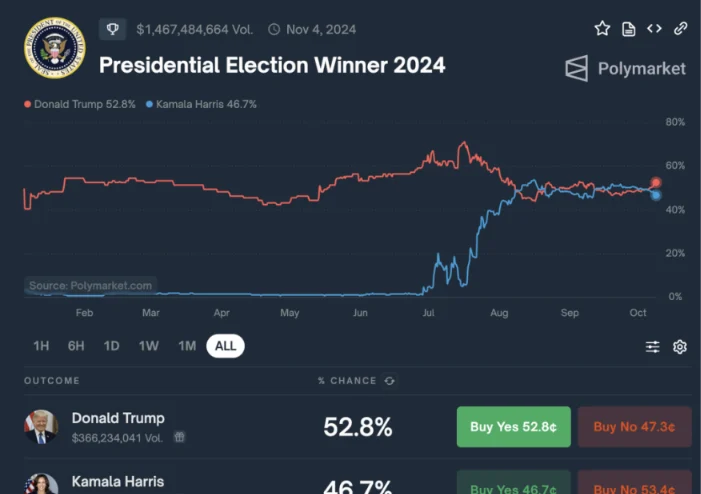
Polymarket is a decentralized prediction market that allows users to trade on a variety of topics, from global events and politics to cultural trends and economic indicators. Built on the Ethereum blockchain, Polymarket leverages DeFi principles, offering a transparent and secure environment for users to participate in event prediction without relying on centralized authorities. Known for its quick updates and wide range of forecasting topics, Polymarket appeals to users who value a decentralized, trustless marketplace.
| Pros | Cons |
| – Decentralized, ensuring a trustless environment | – Requires cryptocurrency to participate (USDC) |
| – Broad range of prediction topics | – Gas fees can be high on the Ethereum network |
| – Fast topic updates |
2. Metaculus
Metaculus is a collaborative forecasting platform that attracts a large community of forecasters focused on scientific, geopolitical, and technological questions. Metaculus is recognized for its commitment to precision and forecasts cultivated by the community. It utilizes collective insights to generate dependable predictions. Its community structure and focus on data-driven outcomes have made it a favored platform among researchers and professionals.
| Pros | Cons |
| – High accuracy due to community-driven forecasts | – Limited financial incentives |
| – Strong focus on scientific and geopolitical events | – Primarily focuses on specific niche topics |
| – Collaborative, educational |
3. PredictIt
PredictIt is a political prediction market based in the United States, offering a space for users to forecast political outcomes, such as elections, policy decisions, and legislative changes. As one of the most popular political prediction platforms, PredictIt allows users to purchase shares in specific outcomes, making it especially appealing for those with an interest in U.S. politics. The marketplace is regulated to ensure transparency and fairness.
| Pros | Cons |
| – Popular among U.S. political enthusiasts | – Limited to political events |
| – Regulated for transparency | – Restricted participation for users outside the U.S. |
| – Offers share-based betting structure |
4. Kalshi
Kalshi is a legally regulated prediction marketplace in the U.S., where users can trade predictions on a broad range of real-world events, from economic indicators to social issues. Kalshi is notable for its regulatory compliance and government approval, which lend it credibility among users seeking a reliable and legally secure platform. It also provides a straightforward interface designed for ease of use and accessibility.
| Pros | Cons |
| – U.S.-regulated, adding credibility | – Requires identity verification |
| – Broad range of prediction topics | – Limited international availability |
| – User-friendly interface |
5. Augur
Augur is a decentralized, blockchain-based prediction market that enables users to forecast the outcomes of various events, including sports, finance, and world events. Powered by smart contracts on the Ethereum blockchain, Augur operates without a central authority, giving users a transparent and trustless environment. Its decentralized structure appeals to users interested in blockchain technology and DeFi.
| Pros | Cons |
| – Decentralized, blockchain-powered for transparency | – Complex setup for new users |
| – Broad topic range, including sports and finance | – Potentially high transaction fees due to blockchain gas costs |
| – Operates on Ethereum |
Contact Idea Usher for Event Prediction Marketplace Development
IdeaUsher has 500,000 hours of coding experience and ex-MAANG and FAANG developers in the team. We have launched over 1,000 products and hold a 4.9/5 client rating on Clutch with 95% client retention. We use this experience to build event prediction marketplaces that stay fast when more users join. We plan the trading engine, wallet, admin panel and market creation tools so they grow with your traffic. You do not have to rebuild everything later when volume goes up.
Customized Trading and Resolution Features
Every platform has its own users and its own rules. So we shape the trading model, fee setup and market types around your plan. You can pick an order book or an AMM and add combo trading when you are ready. We also set up resolution the way you need it. That can be a simple team-based oracle for an MVP or a mix with Chainlink and dispute windows later. Our developers also add KYC and AML checks so your platform is ready for compliance work. As one client put it, the team was great to work with and exceeded their expectations.
Launch With Expert Development Support
We stay with you from the first idea to the launch day and after. Our team helps with design, smart contract work, testing and security checks before you go live. If something breaks or users ask for a new feature, our developers are there to fix it fast. A Clutch review from the CEO of Choice Your World says they were flexible with schedules, communicated well and delivered what they promised. If you are comparing a prediction market platform development company to build your product, talk to IdeaUsher today and get a free cost estimate for your event prediction marketplace.
Conclusion
Building an event prediction marketplace takes more than a trading screen. The cost depends on the features you pick and how safe you want your pricing and resolution to be. Start small with core markets and a simple oracle. Then add combo trading and decentralized oracles once your users and liquidity grow. This keeps your spend under control and your platform trusted.
FAQs
A1: The cost depends on what you build. A basic version with simple markets and a wallet costs much less than one with combo trading, an admin panel and a custom oracle. Other things that change the price are the blockchain you pick, smart contract audits and legal work. The best way to get a real number is to list your must-have features first and then ask a development team for an estimate.
A2: An MVP with core markets and trading usually takes less time than a full platform with advanced features. Time grows when you add combo trading, a decentralized oracle or heavy compliance work. Licensing can also add a wait. For example Novig applied to the CFTC in January and got approval in June. So plan your build time and your approval time together.
A3: Yes it can. Kalshi is a good example because it runs as a regulated exchange with its own team resolving outcomes and no on-chain oracle. Blockchain helps if you want open access, self-custody and on-chain payouts like Polymarket and Limitless offer. If your users want a simple app with bank payments then a non-blockchain build can be faster and easier to license.
A4: Most of them earn from trading fees. Kalshi’s fees change with the price of the contract and Polymarket started taker fees after a free period. Some platforms also sell data and API access or charge for market creation. Myriad charges fees on buys and sells and Opinion lists data and AI oracle services as extra income. Pick one or two simple streams to start.
A5: An order book is a strong pick if you can get market makers because it gives better price discovery. Polymarket and Limitless both use one. An automated market maker is easier when liquidity is thin since it always offers a price. Many new platforms start with an AMM and move to an order book as volume grows.
A6: They use a named source and a resolution process. Kalshi lists source agencies in each contract and its team makes the final call. Polymarket uses UMA, where someone posts a bond to propose an answer and anyone can dispute it within 2 hours. Price markets often use Chainlink data feeds. A good setup mixes clear rules with a human review step for unclear cases.
A7: It depends on where you operate. In the US sports and event contracts fall under the CFTC and platforms like Kalshi work as a designated contract market. Several states have also sued over event contracts saying they are illegal gambling. Outside the US rules vary by country. Talk to a legal expert before launch and build KYC and AML checks into the platform from day one.