AI Clinical
Assistant

We developed an AI Clinical Assistant for a growing healthcare organization looking to improve clinical efficiency, reduce documentation burden, and support healthcare professionals with intelligent, real-time assistance. The goal was to build a centralized clinical platform that assists physicians and care teams with medical documentation, patient information retrieval, clinical insights, care coordination, and administrative workflows.

By replacing time-consuming manual documentation and fragmented clinical workflows with an intelligent AI-powered platform, the client reduced administrative workload, improved access to patient information, streamlined clinical operations, and enabled healthcare professionals to spend more time focused on patient care.

Idea Inception

Healthcare professionals spend significant time reviewing patient records, documenting consultations, preparing clinical notes, coordinating care, and managing administrative tasks. Fragmented information across EHRs, laboratory systems, medical documents, and other healthcare applications can further slow clinical workflows and make it difficult for providers to access relevant information at the point of care.

The idea behind building ClinAssist AI was to create one intelligent clinical assistant that brings patient information, clinical documentation, AI-powered insights, and workflow automation into a unified experience. Using artificial intelligence, natural language processing, clinical data analysis, and secure healthcare integrations, the platform enables healthcare professionals to access relevant information faster, automate routine documentation, and make more informed clinical decisions.

Strategic Objective

  • Reduce clinical documentation and administrative workload using AI.
  • Provide healthcare professionals with faster access to relevant patient information.
  • Automate clinical notes, summaries, and routine documentation workflows.
  • Support clinical decision-making with AI-powered insights.
  • Improve care coordination and collaboration across healthcare teams.
  • Strengthen healthcare data security, privacy, and compliance.

Our Approach

Secure healthcare architecture

Enterprise-grade security controls were implemented with encrypted patient records, role-based access control, secure document storage, audit logging, automated backups, and compliance-ready infrastructure to protect sensitive patient and clinical information.

Intelligent clinical automation

AI and natural language processing capabilities were integrated to assist with clinical documentation, patient record summarization, information extraction, clinical workflow automation, and contextual insights, significantly reducing repetitive administrative tasks.

Clinician-centric user experience

Dedicated workflows were designed for physicians, nurses, specialists, and care teams to provide quick access to patient information, simplify documentation, surface relevant clinical context, and improve collaboration across healthcare workflows.

Unified healthcare integration layer

Secure APIs were developed to integrate with EHR and EMR systems, laboratory information systems, medical imaging platforms, pharmacy systems, telehealth solutions, and other healthcare applications for seamless patient data synchronization.

Key Differentiator

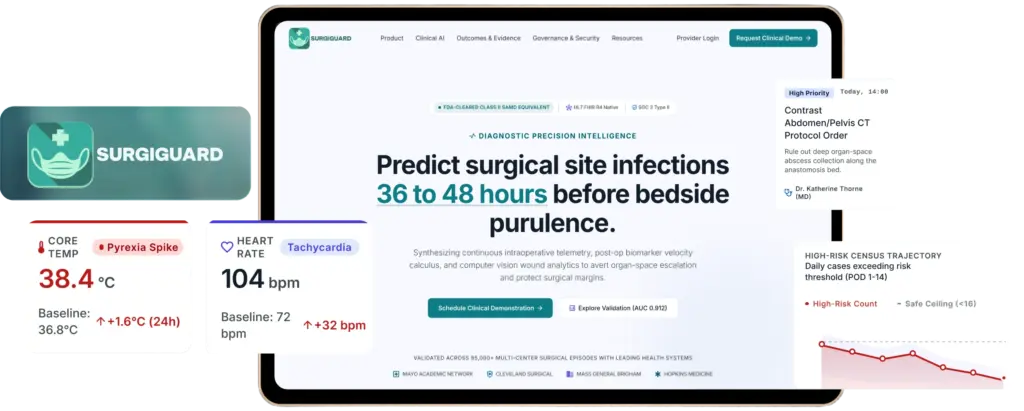
Unified surgical infection risk management across surgeons, nurses, infection prevention teams, and care coordinators.
AI-powered predictive risk assessment based on relevant clinical and post-operative indicators.
Real-time dashboards with patient risk scores, monitoring status, clinical observations, and follow-up information.
Automated alerts, monitoring workflows, follow-up tasks, and escalation processes.
Scalable cloud infrastructure with secure EHR, laboratory, surgical, monitoring, and telehealth integrations.
The platform is a comprehensive AI-powered predictive surgical infection management solution rather than a standalone infection tracking application.
OBSERVED SSI INCIDENCE RATE
2.1% ↓25.0%
MEAN TIME TO INTERVENTION
4.2 Hours ↓-77.4%
INTERVENTION SUCCESS RATE
88.4% N = 142
ESTIMATED COST AVOIDANCE
$486,000 ~18 Cases

ClinAssist AI goes beyond traditional clinical documentation software. It functions as an intelligent clinical support ecosystem that unifies patient information, AI-assisted documentation, clinical insights, care coordination, and workflow automation within a single platform. Most clinical software primarily stores patient information or supports individual documentation tasks. This platform extends beyond that by enabling:

  • Unified access to patient information across clinical systems and healthcare workflows.
  • AI-powered clinical summarization, documentation assistance, information extraction, and contextual insights.
  • Real-time clinical dashboards with relevant patient history, medications, laboratory results, and care information.
  • Automated clinical notes, consultation summaries, follow-ups, and routine administrative workflows.
  • Scalable cloud infrastructure with secure EHR, EMR, laboratory, pharmacy, imaging, and telehealth integrations.

The platform is a comprehensive AI-powered clinical assistance and healthcare workflow solution rather than a standalone medical documentation application.

Key Features

AI Clinical Documentation:

Converts clinical conversations and structured information into organized clinical notes, summaries, and documentation, reducing the time providers spend on manual record keeping.

Patient Record Summarization:

Analyzes patient records to surface relevant medical history, medications, allergies, laboratory results, diagnoses, and previous encounters in a concise clinical view.

AI Clinical Insights:

Analyzes available patient information to identify relevant patterns, potential risks, and clinical considerations while keeping healthcare professionals in control of final clinical decisions.

Centralized Clinical Dashboard:

Provides healthcare professionals with a unified view of patient information, appointments, clinical notes, medications, laboratory results, care plans, and recent activities.

Intelligent Information Retrieval:

Enables clinicians to quickly find relevant information from large volumes of medical records and clinical documentation using natural language-based search.

Care Coordination and Follow-Ups:

Streamlines referrals, follow-up tasks, care coordination, patient communications, and clinical workflows across multidisciplinary healthcare teams.

Compliance and Audit Management:

Maintains documentation histories, user activities, access records, approvals, and audit trails to support healthcare privacy, governance, and regulatory requirements.

Secure Cloud Infrastructure:

Protects sensitive healthcare data through encrypted storage, role-based access controls, secure API integrations, automated backups, and enterprise-grade cloud security.

Challenges and Solutions

Healthcare information scattered across multiple systems

The platform integrated patient information from connected healthcare systems into a unified clinical workspace, enabling providers to access relevant medical information without navigating multiple applications.

Time-consuming clinical documentation

AI-powered documentation workflows assisted with clinical notes, consultation summaries, and record preparation, reducing repetitive documentation tasks and allowing clinicians to focus more on patient interactions.

Difficulty reviewing extensive patient records

AI-powered summarization analyzed available medical records and highlighted relevant clinical information, helping providers quickly understand a patient's history and recent healthcare activity.

Limited access to contextual clinical information

Intelligent information retrieval and AI-driven clinical insights surfaced relevant patient data and clinical context within the provider workflow, supporting faster and more informed decision-making.

Healthcare data security and compliance complexity

Encryption, role-based access controls, secure integrations, centralized audit trails, access monitoring, and automated record management helped protect sensitive patient information while supporting healthcare privacy and regulatory requirements.

Build smarter AI Clinical Assistants and healthcare
workflow solutions with our healthcare technology
experts at Idea Usher!

Build smarter AI Clinical Assistants and healthcare
workflow solutions with our healthcare technology
experts at Idea Usher!