



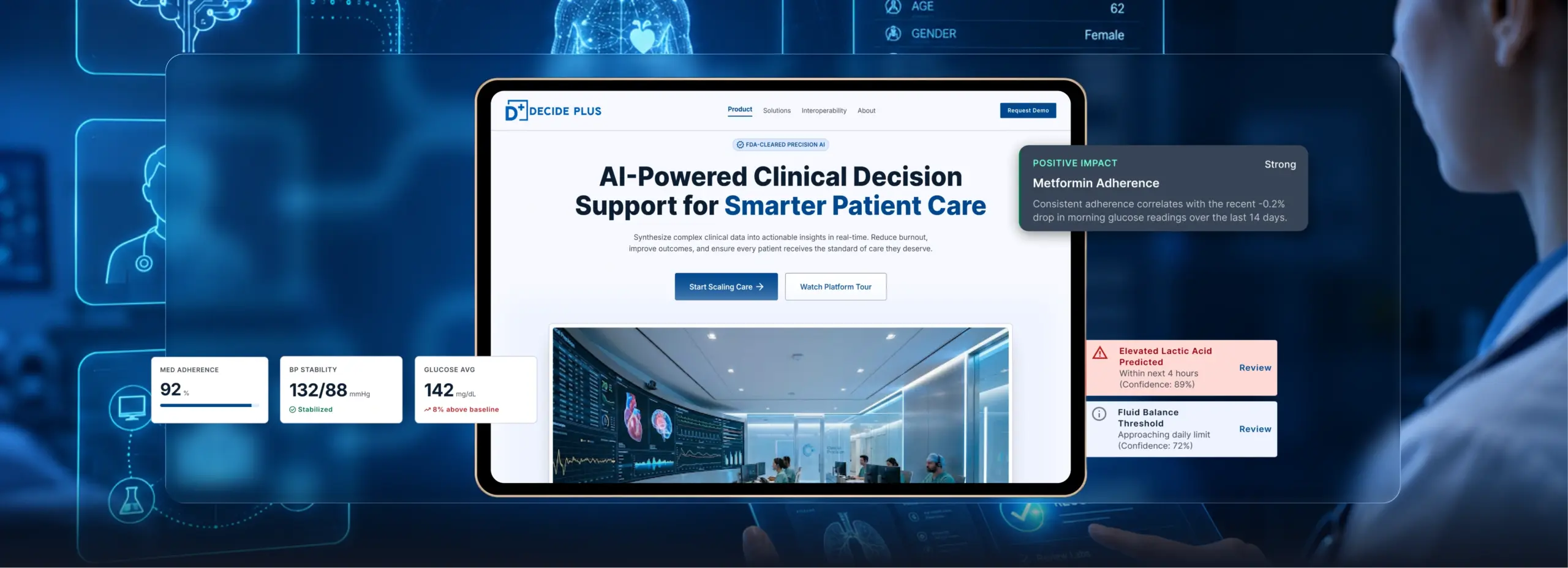


We developed DECIDE PLUS for a healthcare organization in the US. The platform demonstrates how artificial intelligence, clinical intelligence, and healthcare interoperability can improve decision-making at the point of care. The goal was to create a Clinical Decision Support System that helps clinicians access relevant patient information, identify potential risks, improve treatment planning, and support better patient outcomes through real-time insights.
Healthcare professionals work with large volumes of patient data spread across multiple systems. Medical histories, medications, laboratory results, diagnostic reports, and treatment records often exist in separate environments, making it difficult to access the right information at the right time.

DECIDE PLUS (DECIDE+) was conceived as an intelligent clinical decision support system that brings together patient information, predictive analytics, and evidence-based recommendations into a unified platform. The system assists clinicians with diagnosis support, medication safety checks, treatment recommendations, and patient risk assessment while fitting naturally into existing clinical workflows.
The concept focused on helping healthcare teams make informed decisions faster while improving efficiency, patient safety, and care coordinate.

1. Provide real-time clinical insights during patient care.
2. Support evidence-based diagnosis and treatment planning.
3. Identify medication risks and potential contraindications.
4. Enable predictive analytics for proactive patient management.
5. Integrate with EHR and EMR systems for unified data access.
6. Improve workflow efficiency for healthcare professionals.
7. Maintain healthcare compliance and data security standards.

Analyzes patient history, medications, diagnoses, and laboratory data to identify potential risks and support informed clinical decisions.
Provides evidence-based recommendations and intelligent insights to support clinical evaluation and diagnosis.
Identifies potential medication conflicts, contraindications, and safety concerns to improve patient care.

Provides timely recommendations and notifications that help clinicians respond to changing patient conditions.
Connects with existing healthcare systems to provide access to complete patient information from a single interface.
Extends clinical intelligence capabilities to virtual care environments and remote consultations.
Supports secure data exchange across healthcare providers, systems, and digital health platforms.


Machine learning models evaluate patient data to identify health risks and support proactive care planning.
AI analyzes clinical data patterns to assist healthcare providers with treatment recommendations aligned with patient-specific conditions.
The platform organizes information from multiple healthcare sources into clear and actionable patient summaries.
Advanced analytics help healthcare organizations identify trends, monitor patient populations, and improve care outcomes.

Automation supports routine clinical and administrative processes, helping care teams focus more time on patient care.


Solution: A centralized clinical intelligence layer was developed to aggregate and organize patient information from multiple healthcare systems into a unified view.

Solution: AI-powered analytics and evidence-based recommendation engines were implemented to provide clinicians with relevant insights during care delivery.


Solution: The platform was developed using HL7, FHIR, and SMART standards to support secure communication across healthcare systems.

Solution: The system incorporated encrypted data transmission, role-based access controls, audit capabilities, and HIPAA-aligned security practices.

Solution: Solution: Workflow automation and intelligent data processing simplified information access and improved operational efficiency.
DECIDE PLUS was built using enterprise-grade healthcare engineering practices designed for scalability, security, and interoperability. Key engineering capabilities included:

The platform also incorporated reusable healthcare accelerators, AI frameworks, and prebuilt integration components to support faster implementation timelines while maintaining quality and compliance standards.
DECIDE PLUS = Idea Usher’s expertise in building intelligent healthcare platforms that combine advanced clinical intelligence and interoperability. This project is set to help healthcare organizations improve decision-making, patient safety, and deliver better outcomes through data-driven care.


 | Transform Your Idea into Something Extraordinary Contact us for a free consultation call |

Congratulations on taking the first step towards taking your business to new heights!
We are ready to take you there.
We will soon contact you for more details.
Hi 👋 Can I help you?