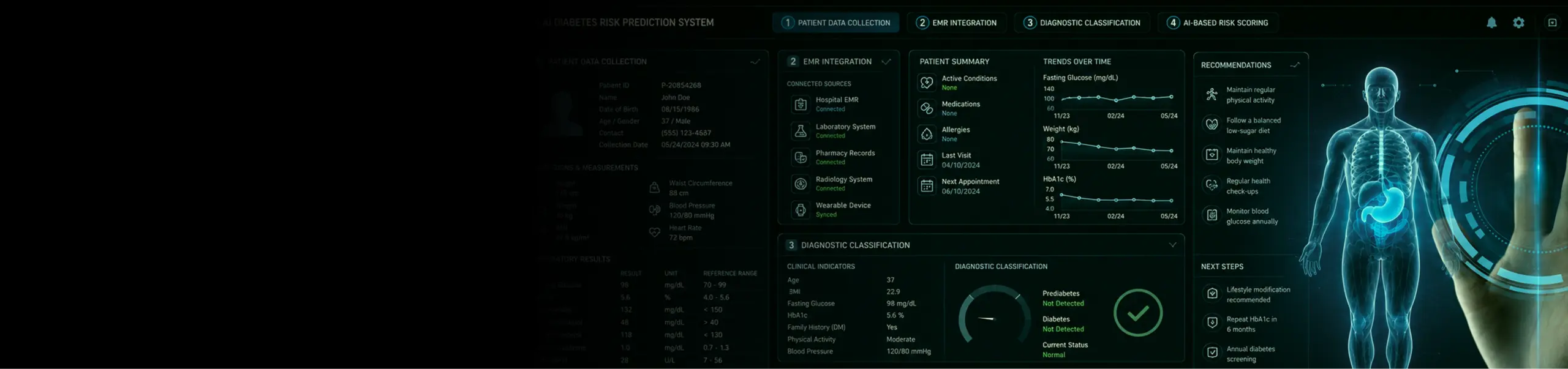
We have developed anAI-based predictive analytics platform for our clients to identify patients at risk of Type 2 diabetes at an early stage using electronic medical record data, clinical parameters, and historical patient records. The system supports healthcare providers in improving early intervention, reducing diagnostic delays, and strengthening long-term patient outcomes through data-driven risk prediction.
Idea Inception —
The problem that demanded an AI solution
Over 25 million people, or around 8.3% of the entire US population, suffer from diabetes.
Diabetes is also linked with a broad range of complications, including heart disease, stroke, kidney disease, and vision loss, which significantly increases long-term healthcare burden and treatment complexity.
A large number of patients are diagnosed at later stages when Type 2 Diabetes has already developed, reducing the effectiveness of early intervention.
Smaller gaps in early detection make it difficult for healthcare providers to identify high-risk patients in time.
The requirement was to build a system that can analyze patient medical data and identify individuals likely to develop Type 2 Diabetes at an early stage.
The core challenge was to design an AI-based solution that could process structured healthcare data to detect hidden risk patterns linked to diabetes progression.
Strategic Objective —
What we set out to build
The main objective was to build a predictive healthcare system that processes electronic medical records and clinical parameters to generate Type 2 Diabetes risk scores using machine learning, enabling early identification of high-risk patients and supporting data-driven clinical prioritization.
Strategic Objective —
What we set out to build
Our Approach —
A phased system, built for clinical precision
We developed a predictive healthcare system that includes patient data collection, EMR integration, diagnostic classification, and AI-based risk scoring for Type 2 Diabetes prediction.
Our team designed the system architecture, built machine learning pipelines, created structured clinical dashboards, and implemented predictive models trained on large-scale diabetes datasets for accurate risk detection.
Key Differentiator —
What sets AegisMetrix apart
Risk stratification system for identifying early-stage and high-risk diabetes patients.
Automated ICD-9 diagnostic coding for standardized clinical classification.
Built structured electronic medical record integration for continuous patient data evaluation.
Uses Random Forest-based predictive modeling with 2000 decision trees for clinical risk assessment.
Uses probabilistic scoring for transparent and measurable risk evaluation.
Enables healthcare providers to prioritize high-risk patients for early intervention.
Supports longitudinal patient tracking through historical medical records.
Key Features —
Platform capabilities
1. Patient Data Consolidation System
Combines personal, clinical, and historical medical data into a unified patient profile for analysis.
2. Clinical Measurement Processing
Processes vital signs and laboratory values, including BMI, blood pressure, temperature, and heart rate, for predictive modeling.
3. Diagnostic Intelligence Layer
Applies automated ICD 9 coding to standardize diagnostic records across healthcare systems.
4. Medication History Integration
Includes prescribed medication records to strengthen predictive accuracy across patient histories.
5. Random Forest Predictive Engine
Uses ensemble learning with 2000 decision trees to generate diabetes risk probability scores.
6. Risk Stratification Output
Classifies patients into defined risk probability ranges to support early intervention planning.
7. Healthcare Provider Dashboard
Provides a structured view of patient risk levels, records, and predictive outputs in one interface.
8. Electronic Medical Record Compatibility
Designed to operate on identified EMR datasets for scalable healthcare adoption.
Technologies Used —
The stack behind AegisMetrix
Challenges and Solutions —
Problems encountered, solved
3. Integrating multiple clinical data sources into a single system
Solutions: Designed a unified data architecture combining personal, lab, diagnostic, and medication records.
2. Ensuring high accuracy in predictive outcomes
Solutions: Implemented Random Forest model with 2000 decision trees and log loss evaluation for stable predictions.
1.Handling fragmented and unstructured medical data
Solutions: Standardized all patient records into a structured EMR format for consistent AI processing.
5. Maintaining consistency in repeated clinical measurements
Solutions: Used median-based normalization across lab values to reduce variability in medical readings.
4. Automating diagnostic classification for large patient datasets
Solutions: Implemented an ICD-9-based automated coding system within the clinical workflow dashboard.
The Strategic Need For AI-based Diabetes Prediction Platforms —
Why this platform had to exist
Diabetes affects approximately 40.1 million peoplein the United States, with nearly 1 in 4 cases remaining undiagnosed, creating a major hidden risk population.
Type 2 Diabetes accounts for nearly 90% to 95% of all diabetes cases, making it the dominant clinical focus for early detection systems.
Medical spending for diabetes exceeds hundreds of billions of dollars annually, making late detection a major cost driver for healthcare systems.
A significant portion of patients are diagnosed only after complications such as heart disease, kidney failure, and stroke have already developed.
Clinical data such as lab reports, vitals, and patient history exist in fragmented systems and are not consistently used for predictive risk scoring at scale.
Traditional screening methods depend on periodic evaluation, which limits continuous risk tracking across large patient populations.
This creates a requirement for an AI system that can process electronic medical records and identify Type 2 Diabetes risk before clinical escalation. AegisMetrix was built to convert structured medical data into predictive risk scores for early detection and clinical prioritization.
Business Impact —
Before vs. After AegisMetrix
Launch your next-Gen Healthcare solution with our expert developers.