


Key Takeaways
- Celebrity look-alike apps combine AI and computer vision to analyze facial landmarks, generate embeddings, and match selfies against celebrity databases.
- The market is moving beyond basic matching, with generative AI transformations, face morphing, beauty filters, AI avatars, and personalized photo experiences.
- Viral acquisition drives growth, as match cards, morphing videos, quizzes and social challenges encourage sharing across platforms.
- Multiple monetization models include subscriptions, AI-generation credits, advertising, VIP access, and affiliate commerce across beauty, fashion, and lifestyle.
- Celebrity matching can evolve into a broader AI consumer platform, spanning dating, virtual beauty, fashion, social entertainment, fitness, and lifestyle experiences.
- Future differentiation depends on personalization, combining facial analysis, generative AI, virtual try-ons, social features and contextual commerce.
Celebrity culture is becoming increasingly participatory, with users wanting to see how closely their identity, appearance and style resemble public figures. This shift is fueling demand for the best celebrity look alike apps, as AI-powered facial analysis turns a simple selfie into personalized celebrity matches, similarity scores and shareable social experiences.
Modern celebrity look-alike platforms combine facial recognition, landmark detection, face embeddings, celebrity databases, similarity scoring, side-by-side comparisons and AI photo transformations to make matching more engaging than basic image comparison. Accuracy, diverse celebrity datasets, privacy, viral sharing and personalized results increasingly determine whether an app becomes a one-time novelty or a repeat-use entertainment product.
In this blog, we will talk about the best celebrity look alike apps, their features, matching technology, accuracy, user experience, monetization models and what businesses can learn when building a scalable AI-powered celebrity look-alike platform.
The Global Celebrity Look-Alike App Market Is Growing Fast
The AI avatar market is valued at $12.90B in 2026 and projected to reach $142.62B by 2035 (30.73% CAGR). Meanwhile, the facial recognition market is expected to hit $30.52B by 2034 (14.8% CAGR). Celebrity look-alike apps merge computer vision, generative AI, and facial analysis for entertainment, beauty, fashion, and dating.

Consumer engagement with visual AI and identity tools continues to rise, with nearly 80% of Gen Z captivated by visual content and 78% regularly using immersive visuals such as lenses. AI photo tools are also gaining traction among younger consumers, creating strong opportunities for celebrity look-alike and facial-transformation apps.
A. Why Businesses Are Investing in Celebrity Look-Alike Apps
Businesses increasingly view celebrity matching as a low-friction acquisition engine driving high-margin monetization. Meanwhile, global AI-app in-app purchase revenue is projected to top $4 billion in H1 2026, a 36% rise from H2 2025.

The commercial opportunity extends beyond the initial match. Successful products can use that first interaction to increase retention, diversify revenue, encourage sharing, and introduce adjacent AI-powered experiences.
- Low-Friction User Acquisition: “Which celebrity do I look like?” provides an intuitive, curiosity-driven entry point. Gradient, for example, has surpassed 10 million Google Play downloads and ~291,000 reviews, demonstrating demand for celebrity matching and AI photo experiences.
- Built-In Organic Virality: Match cards, morphing videos, and compatibility scores encourage sharing across TikTok, Instagram, and Snapchat. AI apps mentioning AI terms are projected to reach ~10 billion downloads in H1 2026, up 25% YoY.
- Multiple Monetization Layers: Platforms can combine:
- Subscriptions: Unlimited HD scans, ad-free processing, and advanced match insights.
- Micro-Credit Bundles: Pay-per-generation credits for high-compute images and face-swapped videos. 35% of subscription apps now combine subscriptions with consumables or lifetime purchases.
- Programmatic Ads: Rewarded videos can unlock premium matches for free users.
- Affiliate Commerce: Celebrity-inspired beauty, fashion, and styling recommendations can generate affiliate revenue.
- High Engagement & Replayability: Testing various photos, lighting, expressions, and hairstyles across categories drives repeat use. Generative-AI app usage is projected to hit 36 billion hours in H1 2026, over double H1 2025
From Viral Feature to Scalable Platform: The bigger opportunity is not simply building another celebrity look-alike tool. It is using celebrity matching as a viral entry point into a broader AI consumer platform, where additional experiences drive repeat engagement, multiple monetization channels, and higher customer lifetime value.
B. How Celebrity Look-Alike Apps Can Capture Market Growth
The strongest growth opportunities come from turning a one-time celebrity match into repeatable experiences, social interactions, personalized recommendations, and commerce-driven features that create recurring engagement and revenue.

To capture long-term enterprise value and avoid the post-viral drop-off typical of simple filter apps, developers are expanding their feature suites into broader lifestyle and AI-entertainment hubs:
| Expansion Vertical | Feature Implementation | Key Industry & Performance Stat |
| Expanded Celebrity Categories | Hollywood, K-pop, athletes, anime archetypes, and regional creators. | 40%+ of global mobile AI avatar demand comes from APAC and LATAM pop-culture trends. |
| Generative AI Transformations | Selfies become editorial portraits, cinematic posters, and face-swapped videos. | 1.50 – 4.99 average spend per generation pack with 70%+ gross margins. |
| Dating & Social Optimization | Celebrity-match queues, profile scoring, and AI lighting enhancements. | Optimized AI dating photos can increase initial matches and swipe engagement by 25%–40%. |
| Virtual Fashion & Beauty | Celebrity hairstyles, color palettes, contouring, and wardrobe recommendations. | AR/AI virtual try-ons can increase retail conversion by 20%–30% while reducing returns. |
| Gamified Social Experiences | Friend comparisons, celebrity polls, and viral leaderboard badges. | Gamification can boost engagement 100%–150% and D30 retention by up to 22%. |
| Interactive AI Characters | Celebrity-twin AI personas with personalized voice notes and conversations. | AI companions can drive 20–35 minutes of average daily session time per active user. |
| Direct Contextual Commerce | “Shop the Look” carousels linking exact or affordable celebrity outfit alternatives. | Visual commerce can deliver 3× higher CTR and 5%–12% affiliate commissions. |
The Next Growth Opportunity: The next wave of celebrity look-alike apps will not compete on matching accuracy alone. They will compete by turning a single celebrity comparison into a broader AI-powered entertainment, social, dating, beauty or commerce experience.

What Is a Celebrity Look Alike App?
A celebrity look-alike app uses AI to analyze a selfie and compare facial characteristics against a celebrity database to find potential matches between public figures, actors, musicians or athletes. Modern platforms use facial recognition, landmark detection, machine learning, and face embeddings to evaluate features such as facial proportions, eye placement, nose shape, and jaw structure.
The basic “upload, analyze, and match” process begins when a selfie is submitted. The system extracts facial features, compares them to celebrities, and delivers matches with similarity scores, comparisons, or shareable cards. While StarByFace concentrates on matching, Gradient adds AI editing and quizzes.
How AI Matches Your Face to Celebrities
AI-powered celebrity matching combines computer vision, facial landmarks, deep-learning embeddings, and vector search to transform a selfie into a ranked list of visually similar celebrity profiles.

The end-to-end facial matching pipeline operates as a real-time retrieval workflow:
- Face Detection & Normalization: Models like RetinaFace or MTCNN detect facial bounding boxes and normalize for head tilt, yaw, pitch, scale, and lighting.
- Facial Landmark Extraction: The system identifies spatial anchors including pupillary distance, nose bridge, eye-socket width, lip curvature, and jawline boundaries.
- High-Dimensional Embedding Generation: The normalized face passes through models such as InsightFace, ArcFace, or FaceNet to generate a dense 128-, 512-, or 768-dimensional vector representing facial structure.
- Approximate Nearest Neighbor (ANN) Vector Search: The embedding is queried against databases such as Pinecone, Milvus, Qdrant, or Redis Vector Search containing precomputed celebrity embeddings.
- Distance & Similarity Scoring: Cosine Similarity or Euclidean Distance (L2) compares embeddings to calculate match confidence and return top-ranked celebrity results.
How Do Celebrity Look Alike Apps Work?
Celebrity look-alike platforms operate on a multi-stage Computer Vision (CV) and Deep Metric Learning pipeline. Rather than executing crude pixel-by-pixel comparisons, the system translates raw facial images into mathematical vector embeddings and searches for nearest neighbors in a high-dimensional feature space.

Step 1: Upload or Capture a Selfie
The user interaction begins by ingesting a portrait via the device’s native camera stream or file system:
- Format Validation & EXIF Parsing: The client or backend API validates file types (JPEG, PNG, HEIC) and parses EXIF metadata to correct image orientation (rotation/yaw flags).
- Quality & Resolution Normalization: Large raw photos (e.g., 12MP–48MP) are downscaled to an optimal inference resolution (typically 112 x 112px to 640 x 640px) to reduce bandwidth and inference latency without losing structural fidelity.
- Contrast & Illumination Pre-processing: Automated histograms or adaptive gamma correction balance overexposed highlights and harsh shadows, ensuring facial contours remain clear.
Step 2: Detect the User’s Face
Once the image is prepared, the app needs to identify where the user’s face is located. A facial detection model scans the image and determines which area contains a face. This allows the system to focus on the relevant facial information instead of analyzing the entire photograph. At this stage, the app can:
- Identify the location of the face
- Create a digital boundary around the face
- Determine whether the face is large and clear enough to analyze
- Detect multiple faces in a group photo
- Ask the user to select the correct face when necessary
- Flag images where sunglasses, masks or other objects significantly block the face
For example, if a user uploads a group photo, the app should not accidentally compare the wrong person with a celebrity. A well-designed platform can automatically identify the most prominent face or let the user choose which face to analyze.
Step 3: Extract Facial Landmarks
Once the face is bounded, the system maps structural anchor points across the facial topography:
- Landmark Topology Mapping: Models like MediaPipe Face Mesh (468 3D vertices) or Dlib (68 standard 2D landmarks) map key biometric anchors:
- Pupil centers and outer/inner eye corners (canthi).
- Nose bridge, tip, and nostril contours.
- Upper and lower lip vermilion borders.
- Full jawline perimeter from ear-to-chin.
- Spatial Normalization via Affine Transformations: Using the eye centers and nose tip as reference anchors, the algorithm applies rotational and scale affine transformations. This rotates the face to a standardized, upright frontal plane (0 roll and tilt), ensuring head tilts do not distort downstream mathematical comparisons.
Step 4: Generate a Face Embedding
The aligned face crop passes through a deep convolutional neural network (CNN) or Vision Transformer (ViT) to extract a compact biometric fingerprint:
- Deep Metric Learning Backbones: State-of-the-art architectures like InsightFace (ArcFace), CosFace, or FaceNet process the facial crop.
- Dense Vector Output: The neural network reduces facial features to a normalized floating-point array, usually 512 or 768 dimensions in ViT pipelines.
The important point for the user is simple: the app turns the visible characteristics of a face into information that its AI can compare consistently.
This allows the system to recognize similarities even when two photos have different lighting, backgrounds or image quality.
This ensures that future distance calculations reflect angular structural similarity rather than variations in lighting intensity.
Step 5: Compare Against Celebrity Profiles
With the query vector generated, the app queries an enterprise vector database holding thousands of pre-indexed celebrity profiles:
- Pre-Indexed Embeddings: The database stores vectors for thousands of public figures, with high-accuracy platforms storing multiple vector variants per celebrity (accounting for different ages, hairstyles, and facial expressions).
- Approximate Nearest Neighbor (ANN) Indexing: Instead of performing a brute-force linear search (O(N)), vector search engines (such as Pinecone, Milvus, Qdrant, or Redis Vector Sets) use indexing structures like Hierarchical Navigable Small World (HNSW) or Inverted File with Product Quantization (IVF-PQ).
- Sub-Millisecond Vector Retrieval: ANN algorithms retrieve the top K nearest celebrity candidate matches in under 15–30 milliseconds across databases containing tens of thousands of records.
Step 6: Calculate the Similarity Score
After identifying potential matches, the AI determines how closely the user’s facial characteristics resemble each candidate.
Rather than showing users complicated technical measurements, the application converts the analysis into an easy-to-understand result such as: “You look 91% like Ryan Gosling.”
The exact percentage is determined by the app’s matching model and scoring system. It represents the system’s calculated similarity between the user’s facial characteristics and the selected celebrity profile. The app can also rank multiple potential matches, such as:
- Ryan Gosling – 91% match
- Jake Gyllenhaal – 87% match
- Chris Evans – 83% match
Additional filters can be applied depending on the product design. Users might be able to search for matches within a particular category, country, profession or celebrity group.
This makes the result more personalized while giving users a reason to continue exploring different categories.
Step 7: Generate and Share the Result
The application’s presentation layer transforms the computational output into an engaging, shareable asset:
- Dynamic Side-by-Side Card Rendering: The app compositor combines the user’s original cropped selfie with the matched celebrity’s high-resolution reference photo on a branded canvas.
- Visual Overlay Badges: Displays verified match metrics (e.g., “91.4% Match — Ryan Gosling”), category tags, and watermark branding.
- Multi-Format Export Optimization: Renders assets into vertical aspect ratios (9:16 for TikTok, Instagram Stories, Snapchat) and square formats (1:1 for feed posts).
- Social SDK & Deep-Link Integration: Integrates native share sheets with pre-populated hashtags and dynamic attribution links, turning every shared result into an organic customer acquisition channel.
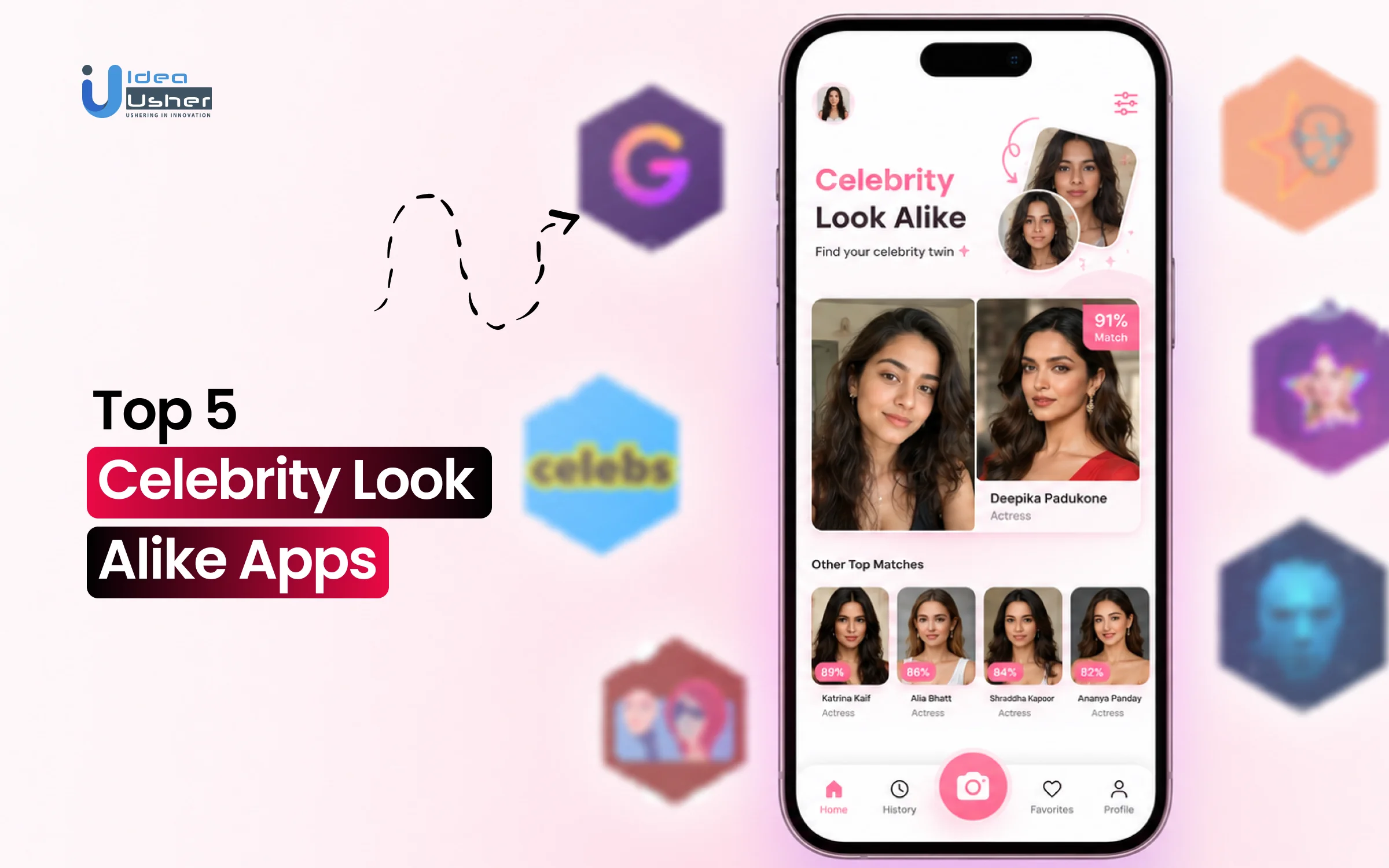
Top 5 Celebrity Look Alike Apps in 2026
Celebrity look-alike apps have evolved from simple face-matching tools into AI-powered entertainment platforms combining facial analysis, generative effects, social sharing, and personalized experiences. The following five apps demonstrate how different products approach matching accuracy, features, engagement, and monetization in 2026.
| App | Platform | Key Feature | AI Capability | Monetization |
| StarByFace | Web, iOS, Android | Free, direct portrait-to-celebrity matching | Neural-network facial point detection & pattern generation | Ad-supported (100% Free) |
| Gradient | iOS, Android | Multi-feature creative suite & viral face morphing | Deep learning facial embeddings & generative AI filters | Freemium (Weekly/Annual Pro Subscription) |
| Celebs | iOS, Android | Fast twin discovery with multi-category sorting | Facial landmark comparison & precision index scoring | Freemium (Ad-supported + VIP passes) |
| Y-Star | iOS, Android | Lightweight, instant camera-to-twin matching | Key facial point mapping (eyes, nose, mouth) | Free with in-app purchases & interstitial ads |
| CelebAI | iOS, Web | 25+ structured celebrity & public figure categories | AWS Rekognition mapping across 128 facial landmarks | Freemium (Tiered scan limits & Pro unlocking) |
These five apps illustrate different approaches to celebrity matching, AI-powered facial analysis, user engagement, and monetization. Comparing their features and technologies reveals where successful products differentiate themselves and which capabilities businesses should prioritize when developing their own scalable celebrity look-alike platform.
1. StarByFace

StarByFace is an accessible, web-first and mobile facial comparison tool focused purely on direct look-alike matching without extra editing layers.
- Face Detection & Point Mapping: Once a user uploads a clear portrait, the system executes facial point detection to locate structural anchors including eyebrows, eye centers, nose bridge, and mouth contours to generate a normalized facial pattern.
- Neural Network Comparison: The proprietary neural network compares the processed pattern against a global database of actors, musicians, and public figures, returning top matches with similarity percentages.
- Cross-Platform Accessibility: Operates as both a lightweight, responsive browser application and dedicated mobile apps for iOS and Android.
- Sharing Functionality: Generates downloadable, side-by-side comparison cards formatted for direct sharing to messaging apps and social channels.
- Strengths & Limitations:
- Strengths: Completely free, requires no account creation, and enforces a strict privacy policy where uploaded source photos are automatically deleted post-recognition.
- Limitations: Highly sensitive to photo angle and lighting; lacks generative filters, video morphs, or advanced category filters.
2. Gradient

Gradient is a full-scale AI portrait and photo-editing suite that gained viral recognition through its multi-frame celebrity look-alike morphing tool.
- Multi-Step Celebrity Transformation: Rather than just outputting a static result card, Gradient creates a dynamic 4-step morph sequence showing the gradual transition from the user’s face into their celebrity counterpart.
- AI Quizzes & Transformations: Includes interactive modules like “Which Historical Figure Are You?”, AI cartoon avatars, ethnic origin estimations, and artistic style transfers.
- Generative Beauty & Style Filters: Includes professional-grade portrait retouching, hair recoloring, digital makeup transfer, and generative art filters (e.g., turning selfies into Classical Renaissance or Anime portraits).
- Viral Social Integrations: Built natively for social sharing, featuring exportable video reels and animated GIFs optimized for TikTok, Instagram Stories, and Snapchat.
- Monetization Engine: Uses recurring Gradient Unlimited subscription tiers ($9.99/month to $49.99/year) to gate HD exports, remove watermarks, and unlock premium AI filters.
3. Celebs

Celebs is an entertainment-first mobile application optimized for discovering look-alikes across varied industries and creator verticals.
- Facial Landmark Recognition: Employs computer vision algorithms to evaluate facial symmetry, eye shape, and jawline geometry to calculate a precise “Twin Index” match rate.
- Granular Celebrity Categorization: Allows users to filter comparison pools by specific niches including Hollywood actors, K-pop idols, chart-topping musicians, professional athletes, and top social media influencers.
- Comparative Match Sliders: Provides interactive split-screen views with adjustable overlay sliders, allowing users to physically compare the alignment of their facial landmarks against the matched celebrity.
- Social Sharing Engine: Exports branded badge graphics complete with percentage match badges, compatibility tags, and integrated sharing to Instagram Stories and WhatsApp.
- Freemium Monetization: Offers basic matches for free supported by interstitial video ads, with paid weekly “VIP” access removing watermarks, eliminating ad interruptions, and unlocking deeper match pools.
4. Y-Star
Y-Star is designed around a streamlined, friction-free workflow that prioritizes speed and basic facial geometry matching over complex editing features.
- Instant Frontal Scanning: Built around a streamlined “Photo Analysis Twin Share” loop. Users snap a real-time selfie or upload a gallery image for immediate processing.
- Key Facial-Point Mapping: Focuses strictly on essential facial anchors, specifically the spatial geometry between the eyes, nose width, and mouth position to ensure fast, lightweight server-side matching.
- Optimized for Frontal Accuracy: Achieves its highest accuracy on clear, unoccluded frontal shots, minimizing false matches caused by heavy head tilts or facial obstructions.
- Privacy-Conscious Architecture: The platform processes facial scans in temporary memory buffers and explicitly states that raw user photos are not stored permanently on central servers.
- User Experience & Sharing: Generates quick side-by-side match cards ready for one-tap export to Instagram, X (Twitter), and Facebook.
5. CelebAI

CelebAI leverages enterprise-grade cloud computer vision infrastructure to deliver high-precision facial similarity scoring and granular catalog searches.
- AWS Rekognition Backend: Powered by Amazon Rekognition’s facial analysis pipeline, extracting and mapping 128 distinct facial landmarks (including eye gaze vectors, nose contour vertices, lip corners, and facial boundary limits).
- Curated 1,400+ Celebrity Database: Compares embeddings against a verified database of 1,400+ public figure profiles spanning entertainment, international politics, sports legends, and historical figures.
- Ranked Multi-Match Results: Rather than returning a single arbitrary match, CelebAI outputs a top-5 ranked leaderboard with individual similarity confidence percentages (e.g., 94.2% Match).
- 25+ Structured Match Categories: Users can isolate searches to specific clusters, such as Classic Hollywood, Reality TV, World Leaders, Tech Billionaires, or Bollywood.
- Monetization & Limits: Free tier users receive basic top-match previews, while full database queries, ranked leaderboards, and category unlocks require a premium pass.
Future Business Opportunities for Celebrity Look-Alike Apps
Celebrity face-matching applications are transitioning from novelty viral photo filters into sustainable, multi-revenue commercial platforms. By combining high-precision biometric embeddings with generative AI, virtual try-ons, and intent-driven matching algorithms, developers can tap into high-retention verticals across dating, retail commerce, entertainment, and personalized wellness.
1. Dating & Social Compatibility Experiences
Dating research shows visual attractiveness filters strongly drive initial swipe engagement. Platforms report increased activation using facial recognition search, with over 60% of look-alike queries targeting top celebrities like Kim Kardashian and Robert Pattinson to speed up onboarding.
Facial geometry and aesthetic preferences play a major role in dating dynamics. Integrating look-alike biometric matching into social platforms transforms subjective swiping into algorithmic matchmaking:
- Celebrity Crush Matchmaking: Users specify a public figure or aesthetic archetype they find attractive; the platform’s vector search matches them with real-world users who share similar facial landmark structures.
- Facial Compatibility Scoring: Algorithms calculate biometric symmetry indices between potential partners, offering visual icebreakers and unique matchmaking filters.
- Look-Alike Social Circles: Niche community hubs connect users with their “twin network” or surface people with shared facial structures across different global regions.
Real-World Example: Badoo launched its native “Badoo Lookalikes” feature, allowing its global user base of hundreds of millions to upload a picture of any celebrity or crush to find look-alike singles registered on the platform.
2. Fashion, Beauty & Virtual Styling
The global virtual makeup try-on market will reach $12.7+ billion by 2033. AR and AI feature mapping boost e-commerce conversion rates by 35% to 40% and increase purchase confidence for 73% of consumers.
Transitioning from identity matching to commercial affiliate commerce enables apps to monetize beauty, skincare, and apparel recommendations:
- Celebrity-Inspired Hair & Makeup Try-Ons: Users who match a specific celebrity can virtually overlay that public figure’s signature hairstyles, makeup palettes, and eyewear styles tailored directly to their facial geometry.
- Facial Topology-Based Product Recommendations: By analyzing face shape (e.g., oval, square, heart), skin undertones, and jawline structure, the app suggests tailored beauty products, contouring techniques, and cosmetic purchases.
- Affiliate Fashion & Wardrobe Styling: Linking celebrity look-alikes to red-carpet or streetwear outfit breakdowns, enabling users to shop the exact wardrobe pieces worn by their celebrity counterparts via direct e-commerce affiliate links.
Real-World Example: Perfect Corp (YouCam Makeup) partners with brands like Sephora and Estée Lauder to map facial landmarks in real time, matching users with celebrity-inspired shades and driving instant in-app checkout.
3. Social Media & Viral Entertainment
Short-form video metrics show user content with AI face swapping and neural filters achieves ~38% higher social engagement than static posts, creating a viral user acquisition loop.
Generative AI, diffusion models, and real-time neural rendering unlock immersive content creation pipelines:
- Generative Movie Scene & Music Video Inset: Users dynamically swap their faces into famous movie scenes, trailers, or music videos featuring their celebrity twins using real-time generative neural rendering.
- AI-Generated Avatars & Digital Doppelgangers: Transforming look-alike facial geometry into 3D gaming avatars, stylized anime characters, or virtual-world assets for platforms like Roblox, Unreal Engine, and spatial metaverse environments.
- Voice Synthesis & AI Duets: Combining facial matching with generative voice cloning to let users create satirical or entertaining AI video duets with their matched celebrity counterparts.
Real-World Example: Reface (formerly Doublicat) turned AI-powered face swapping into a viral sensation, generating over 100 million downloads by letting users insert their faces into licensed clips from Hollywood blockbusters and trending music videos.
4. Fitness, Lifestyle & Personalization
Mobile health analytics show that apps with personalized body-composition and archetype plans reach 2.5x higher 30-day retention than generic trackers, as users stick better to role-model plans.
Biometric mapping can be paired with body type classification and somatic profiling to deliver tailored lifestyle routines:
- Physique & Frame Archetype Matching: Expanding computer vision models to evaluate full-body proportions and muscle-insertion geometry, pairing users with athletes or fitness figures who share their bone frame and somatotype.
- Targeted Workout & Nutrition Blueprints: Recommending training splits, posture corrections, and conditioning routines modeled after the fitness regimens of matched athletes.
- Personal Branding & Aesthetic Coaching: Helping creators, models, and public professionals identify their optimal camera angles, lighting setups, and visual aesthetics based on how their celebrity counterparts are professionally photographed.
Real-World Example: Centr (by Chris Hemsworth) and customized aesthetic fitness platforms utilize personalized body-type assessments and celebrity workout modeling to deliver tailored exercise programming and dietary targets.
Build Your Celebrity Look Alike App With Idea Usher
IdeaUsher is an enterprise AI product engineering partner with 11+ years of mastery across 50+ countries. Backed by 250+ experts, 1,000+ completed projects and a 4.9/5 Clutch rating, we build custom, high-capacity celebrity look-alike apps from scratch.
Instead of generic templates, we build scalable entertainment platforms featuring precision facial landmark recognition, deep metric learning, real-time celebrity matching engines, and viral social sharing loops to help you dominate the mobile entertainment market.
Why Enterprises Partner With Us
Entertainment brands, social media networks, and consumer tech startups choose us to construct celebrity look-alike platforms because we convert advanced computer vision models into highly engaging, viral, and monetizable mobile experiences.
- High-Precision Facial Landmark & Embedding Pipelines: We engineer FaceNet and ArcFace pipelines that extract 128D/512D facial embeddings, enabling sub-second celebrity matching across angles and lighting conditions.
- Real-Time Morphing & AI Face-Swapping Engines: Our developers build computer vision pipelines for animated face morphing, real-time video swaps, and high-fidelity stylized portraits.
- Viral Social Sharing & Multi-Platform Integration: We build frictionless sharing SDKs for watermarked clips, comparison cards, and stories across TikTok, Instagram, and Snapchat to drive organic acquisition.
- Scalable Vector Search & Low-Latency Infrastructure: We deploy Milvus and Pinecone vector databases within auto-scaling cloud microservices to process millions of photo uploads with minimal latency.
- On-Device Neural Processing & Biometric Privacy: We implement CoreML and TensorFlow Lite for edge processing alongside automated image purging to protect facial data and support global biometric privacy compliance.
- Zero Vendor Lock-In Asset Delivery: We deliver clean, documented, auditable source code, giving your enterprise complete ownership of the platform and AI algorithms from day one.
Ready to launch a viral, high-performance celebrity look-alike platform? Partner with IdeaUsher’s principal AI and mobile software architects to map out your custom product build today.
Conclusion
Celebrity look-alike apps combine AI, facial recognition and social engagement to turn a simple selfie into a personalized entertainment experience. Their potential extends beyond celebrity matching, with opportunities for advanced transformations, niche celebrity categories, subscriptions and viral sharing. For businesses, the category offers a compelling way to combine consumer AI with highly shareable experiences. The right technology, accurate facial analysis, strong privacy practices and thoughtful monetization can help turn a simple celebrity-matching concept into a scalable digital product.
FAQs
A.1. Celebrity look-alike app development costs typically range from $50,000 to $100,000 for an MVP and $150,000 to $320,000+ for an enterprise platform, depending on AI complexity, platform selection, facial recognition features, database size, integrations, security and maintenance.
A.2. Core features include selfie upload, facial analysis, celebrity matching, similarity scores, multiple celebrity categories, side-by-side comparisons, result cards, social sharing, match history and AI-powered photo transformations.
A.3. Celebrity look-alike apps commonly use computer vision, facial detection, facial landmarks, machine learning models and face embeddings to analyze facial characteristics and identify visually similar celebrity profiles.
A.4. Celebrity look-alike apps can generate revenue through subscriptions, advertisements, premium celebrity categories, advanced AI transformations, additional match results, in-app purchases and paid access to exclusive features.


