

Key Takeaways
- Pet care is shifting to app-driven ecosystems with real-time tracking, AI insights, and on-demand services.
- Successful pet care apps combine health monitoring, service booking, IoT integration, and user-friendly UX into one platform.
- Pet care app market growth is driven by pet humanization, AI adoption, and subscription-based convenience models.
- The biggest pet care app opportunities lie in AI diagnostics, IoT ecosystems, super apps, and niche-focused solutions.
- How Idea Usher help you build a pet care app with market validation, scalable architecture, AI/IoT integration, and continuous growth support.
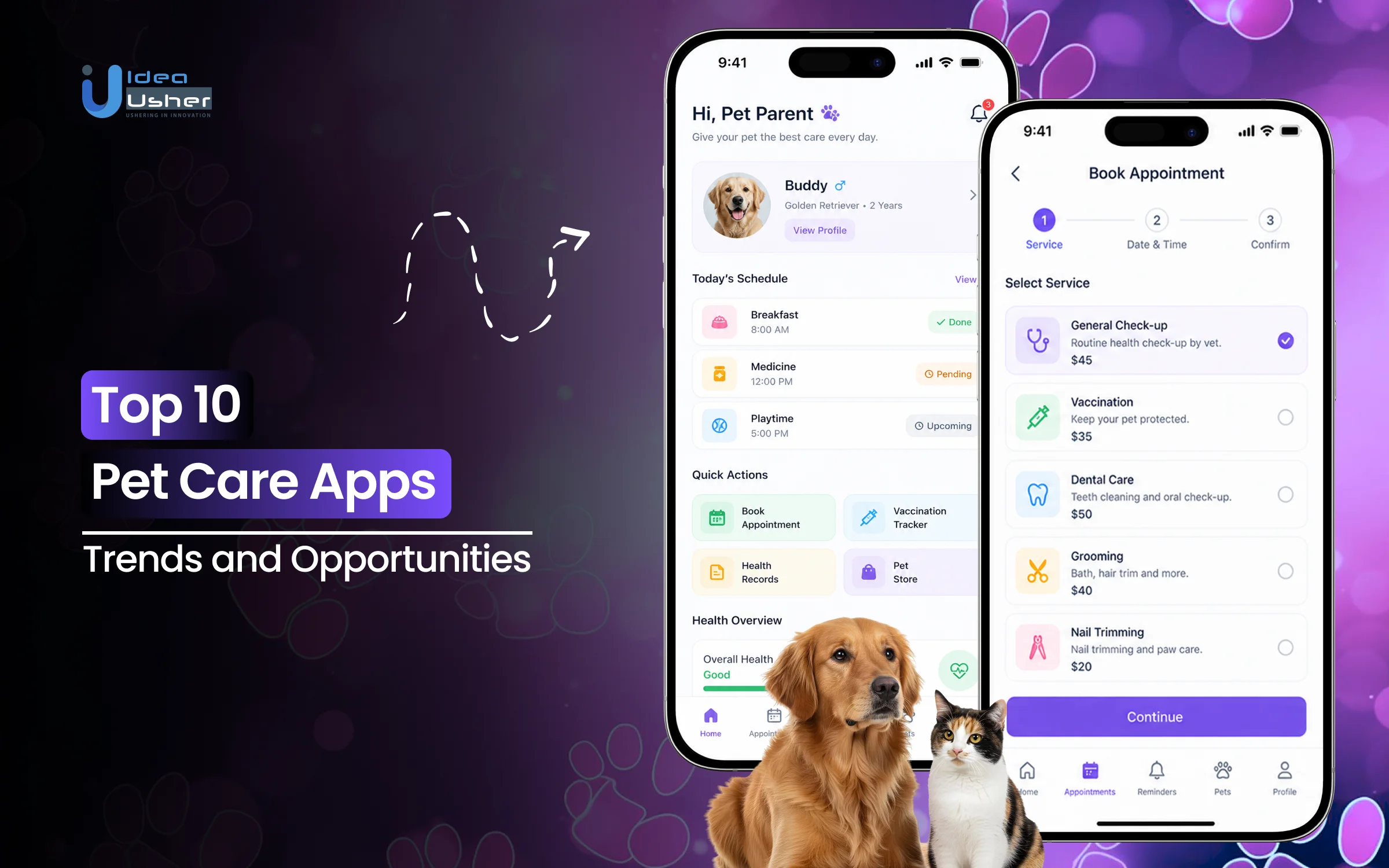
Pet care is no longer managed through occasional vet visits or manual routines. It is shifting toward continuous, app-driven engagement, making pet care apps central to how owners track health, schedule services, and stay connected with their pets, with users now expecting real-time updates, personalized care insights, and on-demand services all in one place.
Traditional pet care relied on fragmented services like clinics, trainers and boarding centers, which struggle with modern expectations. New platforms combine health tracking, tele-vet access, grooming bookings, community features and smart integrations, creating products where engagement extends into daily routines and businesses build long-term relationships instead of one-time service interactions.
In this blog, we will explore the top pet care apps, emerging trends and opportunities to build scalable solutions in this growing market where IdeaUsher can help you design, develop and launch a high-impact pet care platform tailored to your business goals.
What Are Pet Care Apps & Why They Are Booming?
Pet care apps are comprehensive mobile ecosystems designed to centralize the management of an animal’s life, ranging from health monitoring and service marketplaces to IoT-connected security. By merging data from veterinary records, wearable devices, and service providers into a single interface, these platforms transform traditional pet ownership into a tech-enabled “pet parenthood” experience.
A. Key Problems These Apps Solve
Pet care apps address daily hurdles by consolidating medical data, enhancing communication, and streamlining management. By merging smart tech with convenience, they improve safety and care efficiency within a single platform.
- Fragmented Health Data: Most pet owners struggle with physical records; these apps consolidate medical history, vaccination schedules, and prescriptions into a single, shareable vault.
- The Communication Gap: Since pets cannot communicate discomfort, AI-powered apps use biometric data to identify early symptoms of illness, such as changes in sleep or activity patterns.
- GPS & Monitoring: Integrated with wearable collars, these apps provide real-time location tracking and geofencing alerts while monitoring physical activity levels.
- Trust and Reliability in Service: Finding vetted providers is a high-stakes task. Apps solve this through rigorous background checks and real-time GPS tracking of service sessions.
- Logistical Overload: Managing multiple pets is taxing; automated reminders and subscription-based e-commerce alleviate this burden.
B. Market Size & Growth
The global pet care market was valued at USD 274.47 billion in 2025 and is anticipated to reach USD 289.29 billion in 2026 from USD 440.62 billion by 2034, growing at a CAGR of 5.4% during the forecast period from 2026 to 2034. This steady growth reflects rising pet ownership and increasing spending on premium pet services and products.

The current surge is fueled by post-pandemic shift & digital adoption and that is why pet-parents are more keen to use pet care apps, because:
- Global pet adoption rose 25% during the pandemic. As these pets age, they require more specialized health and behavioral management.
- Owners now view pets as family, increasing demand for premium services like DNA testing and tele-vet consultations.
- Roughly 75% of pet owners now take additional digital security precautions, such as using geofencing apps, to ensure their pets stay within safe boundaries.
- 74% of pet owners report that having a pet contributes significantly to their mental health. Apps reduce the “management stress” of ownership, allowing more time for bonding.
Types of Pet Care Apps Available in The Market
The pet tech industry is no longer just about digital diaries. The market has branched into specialized niches in 2026 that leverage AI, IoT, and high-frequency data to provide proactive care.

1. Pet Health & Monitoring Apps
These apps act as a centralized hub for a pet’s medical life, often bridging the gap between home care and professional veterinary records.
- Example Apps: PerkyPet AI, PetDesk, 11Pets.
- Core Features: Automated medical record syncing, AI-driven symptom checkers, and vaccination reminders.
- Integration Insight: These apps now act as the data hub, pulling in biometric data from IoT collars to provide vets with a 24/7 view of the pet’s health rather than just a snapshot during a visit.
- Monetization Model: Freemium with a Pro Tier for advanced health analytics; B2B revenue from veterinary clinics that pay for a streamlined patient portal.
2. Pet Service Marketplace Apps (Walkers, Sitters)
Operating on a gig economy model, these platforms connect pet owners with local, vetted professionals for on-demand care.
- Example Apps: Rover, Wag!, PetBacker.
- Core Features: GPS-tracked walks, in-app messaging, and secure payment processing.
- Integration Insight: In a connected ecosystem, when a walker logs a “bathroom break” or a “low energy” walk, that data is instantly pushed to the Health & Monitoring app, alerting the owner to potential digestive or lethargy issues.
- Monetization Model: Transaction fees (taking a 15–25% commission from each booking) and optional “Plus” memberships for owners that provide enhanced insurance and support.
3. Training & Behavior Apps
These pet care apps provide structured education, moving away from generic YouTube clips toward personalized, breed-specific training plans.
- Example Apps: Zigzag (specifically for puppies), Puppr, Dogo.
- Core Features: Video-guided training modules, digital clickers, and 1-on-1 virtual trainer consultations.
- Integration Insight: Smart cameras (IoT) can now detect excessive barking while the owner is away and automatically trigger a notification from the training app suggesting a specific “Separation Anxiety” module.
- Monetization Model: Subscription-based access to premium lesson libraries and pay-per-session for 1-on-1 virtual training.
4. Pet Insurance & Finance Apps
As veterinary costs rise, these apps simplify the complex world of insurance claims and financial planning for pet-related emergencies.
- Example Apps: Trupanion, Pets Best, Embrace.
- Core Features: Instant photo-claim filing, direct-to-vet payments, and coverage calculators.
- Integration Insight: The biggest trend for 2026 is “Proof of Care” discounts. Insurers are beginning to offer lower premiums to owners who can prove via Smart Device data that their pet is getting consistent exercise and preventative check-ups.
- Monetization Model: Monthly premiums and potential lead-generation fees from financial partners (e.g., offering pet-specific credit cards like CareCredit).
5. Smart Device & IoT Pet Apps
These apps serve as the control center for physical hardware, turning basic collars or bowls into data-gathering tools.
- Example Apps: Whistle, Furbo, Fi Smart Dog Collar.
- Core Features: Real-time GPS location, geofencing (escape alerts), and biometric monitoring (sleep, heart rate, scratching).
- Integration Insight: These devices are the primary sensors for the ecosystem. They provide the raw data that feeds into Health apps (for medical diagnosis) and Insurance apps (for risk assessment).
- Monetization Model: Hardware + Subscription (the “Razor and Blade” model). Users buy the physical device once and pay a recurring monthly fee for the cellular data/cloud storage.
6. Lost & Emergency Assistance Apps
Designed for high-stress situations, these tools focus on rapid recovery and immediate life-saving information.
- Example Apps: Pet First Aid (American Red Cross), WAUDOG Smart ID, Finding Rover.
- Core Features: AI facial recognition for lost pets, digital “Amber Alert” broadcasts, and offline-ready emergency first aid guides.
- Integration Insight: If a Smart Device detects a “Boundary Break”, it can automatically trigger a “Lost Pet” draft in these assistance apps, including the pet’s most recent GPS coordinates.
- Monetization Model: Often Free/Public Service (sponsored by non-profits) or hardware-linked (buying a Smart QR-coded ID tag).

Top 10 Pet Care Apps in the Market
The pet technology sector has reached a maturity point in 2026 where apps are no longer just “utilities”, they are lifestyle companions. Below is a comprehensive analysis of the market leaders currently shaping the “human-animal bond” through digital innovation.
| App Name | Category | Core Features | Monetization Model | Best For |
|---|---|---|---|---|
| Rover | Pet Services Marketplace | Pet sitting, dog walking, boarding | Commission per booking | Pet owners needing on-demand services |
| Wag! | On-Demand Pet Services | Dog walking, training, vet chat | Commission + subscriptions | Busy pet owners |
| Whistle | Health & GPS Tracking | GPS tracking, health monitoring | Device + subscription | Pet safety and health tracking |
| Petcube | Smart Pet Device | Live video, treat dispensing, alerts | Hardware + subscription | Remote pet monitoring |
| Fi Smart Dog Collar | IoT Pet Tracking | Real-time GPS, activity & sleep tracking | Hardware + subscription | Data-driven pet owners |
| Dogo | Training App | Training programs, clicker tools | Subscription | Dog training at home |
| Traini | AI Training & Behavior | Emotion detection, AI training assistant | Freemium + subscription | Behavior insights & smart training |
| Chewy | eCommerce | Pet supplies, auto-ship, pharmacy | Product sales + subscription | Pet product buyers |
| TTcare | AI Pet Healthcare | AI diagnostics, health analysis, telehealth | Freemium + subscription | Preventive pet health monitoring |
| Woofz | Training & Behavior | Personalized training plans | Subscription | First-time dog owners |
As the table shows, successful pet care apps stand out through business models, specialization and user experience, not just features. Next, we break down each app to explore their adoption drivers and revenue strategies.
1. Rover
Rover is the world’s largest marketplace for pet services, operating as the gold standard for the gig economy in the pet sector. It connects millions of pet owners with local providers for everything from overnight boarding to quick midday check-ins.
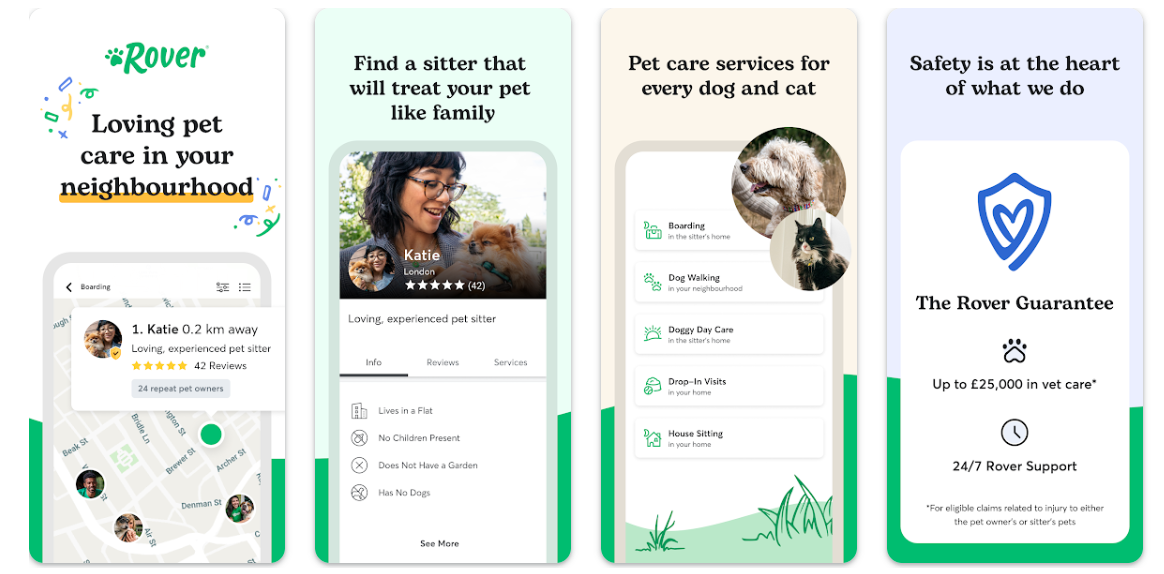
- Key Features: Trusted sitter profiles with verified reviews, “Rover Cards” (detailed reports including GPS maps of walks, photos, and bathroom updates), and 24/7 support including the Rover Guarantee for safety.
- Revenue Model: Commission-based. Rover takes a percentage (typically 20-25%) from every booking made through the platform.
- Target Audience: Busy professionals, frequent travelers, and urban pet owners who lack a local support network for their animals.
- Why it’s Successful (USP) & Cons:
- USP: Unrivaled market liquidity; it has the highest density of sitters globally, making it the most reliable choice for travelers.
- Cons: High platform fees for both owners and sitters; varying levels of professional experience among independent contractors.
2. Wag!
Wag! focuses on the on-demand aspect of pet care often described as the “Uber for dog walking,”. It is built for the “right now” culture, prioritizing speed and instant availability for walks and drop-in visits.

- Key Features: Instant booking functionality, real-time GPS tracking of the walker, lockbox integration for secure home entry, and a comprehensive “pup profile” that includes behavior notes for the walker.
- Revenue Model: Transaction-based. Like Rover, it takes a commission on services. It also offers a Wag! Premium subscription for reduced service fees and 24/7 vet access.
- Target Audience: Spontaneous pet owners or workers with unpredictable schedules who need immediate, short-term care.
- Why it’s Successful (USP) & Cons:
- USP: Speed of service; it is the most efficient app for last-minute, on-demand walking needs.
- Cons: Historically faced more scrutiny regarding safety protocols compared to Rover; premium features are locked behind a paywall.
3. Whistle
Whistle is a pioneer in the Pet IoT space. It combines a physical wearable device with a sophisticated data-tracking app to monitor a pet’s location and internal health metrics.

- Key Features: Precision GPS tracking (AT&T 4G LTE), “Health Portraits” that track licking, scratching, and sleeping, and activity goal-setting based on breed, age, and weight.
- Revenue Model: Hardware + SaaS. Revenue is generated through the sale of the physical tracker and a mandatory monthly subscription for cellular data and advanced health analytics.
- Target Audience: Data-driven owners and “helicopter pet parents” who want 24/7 peace of mind regarding their pet’s safety and wellness.
- Why it’s Successful (USP) & Cons:
- USP: Predictive health alerts; the app can often detect signs of illness (like skin infections or heart issues) through behavioral changes before an owner notices them.
- Cons: Initial hardware cost is high; battery life can be inconsistent depending on the strength of the GPS signal.
4. Petcube
Petcube is a leader in the interactive home monitoring segment. It uses high-definition cameras to allow owners to see, talk to, and play with their pets from anywhere in the world.

- Key Features: 1080p HD video with night vision, two-way audio, built-in laser toys or treat dispensers, and “Petcube Care” AI which detects and alerts owners to barks, meows, or human movement.
- Revenue Model: Hardware Sales & Subscription. It sells the physical cameras and offers a subscription service (Petcube Care) for cloud video history and smart alerts.
- Target Audience: Pet owners who experience “separation guilt” or those with pets prone to separation anxiety.
- Why it’s Successful (USP) & Cons:
- USP: High-level interactivity; it is one of the few apps that allows for physical play (laser) and reward (treats) remotely.
- Cons: Requires a strong, consistent Wi-Fi connection; the treat-dispensing hardware requires specific treat sizes to avoid jamming.
5. Fi Pet Tracking
Fi is a smart pet tracking platform that combines a GPS-enabled collar with a mobile app to provide real-time location tracking and activity monitoring. It focuses on safety, fitness, and behavioral insights, making it a core part of the connected pet ecosystem.

- Key Features: Real-time GPS tracking, escape alerts, activity tracking, sleep monitoring, and long battery life with LTE connectivity.
- Revenue Model: Hardware + subscription model, where users purchase the collar and pay a monthly fee for connectivity and advanced insights.
- Target Audience: Pet owners focused on safety, real-time tracking, and data-driven pet health monitoring.
- Why it’s Successful (USP) & Cons:
- USP: Combines hardware and software into a seamless ecosystem with highly accurate tracking and long battery performance.
- Cons: Requires device purchase and subscription, making it less accessible for budget users.
6. Dogo
Dogo is a mobile training academy that uses positive reinforcement techniques to help owners train their dogs at home without the expense of a private trainer.

- Key Features: 100+ training programs and tricks, a built-in digital clicker, and “Video Exams” where a certified dog trainer reviews your pet’s progress and provides personalized feedback.
- Revenue Model: Subscription-based. Users pay for full access to the training library and professional feedback services.
- Target Audience: New puppy owners and those looking for affordable, structured obedience training.
- Why it’s Successful (USP) & Cons:
- USP: Human-in-the-loop training; the ability to get a real human trainer to critique your video is a significant value-add over generic YouTube videos.
- Cons: Effectiveness depends entirely on the owner’s consistency; lacks the “hands-on” correction of an in-person class.
7. Traini
Traini is an AI-powered dog training and behavior analysis app that focuses on improving communication between pets and owners. By using advanced AI models, it interprets dog emotions, vocalizations, and body language, helping users better understand and train their pets in a more personalized way.

- Key Features: AI-based emotion detection, dog behavior analysis, personalized training programs, video-based lessons, and a built-in AI assistant (PetGPT) for guidance and recommendations.
- Revenue Model: Freemium / subscription-based model with premium training programs, AI insights, and expert consultations.
- Target Audience: New and experienced dog owners looking for structured training, behavior insights, and AI-assisted pet care solutions.
- Why it’s Successful (USP) & Cons:
- USP: Combines generative AI with training to decode pet behavior and emotions, creating a more interactive and personalized training experience.
- Cons: AI interpretations may vary in accuracy and still require real-world validation and consistent training effort from owners.
8. Chewy
The Chewy app has evolved into a comprehensive care platform while primarily an e-commerce giant, integrating shopping with telehealth and pharmacy services.

- Key Features: “Autoship” for recurring food/medication, “Connect with a Vet” (telehealth), a dedicated pharmacy for prescription management, and 24/7 world-class customer support.
- Revenue Model: Retail Markup. Revenue comes from the sale of pet goods, supplemented by a massive subscription base via their Autoship program.
- Target Audience: Virtually all pet owners, specifically those looking for convenience and cost-savings on bulk essentials.
- Why it’s Successful (USP) & Cons:
- USP: Customer experience; their legendary service and integrated pharmacy make them the one-stop-shop for all physical pet needs.
- Cons: Highly competitive market; prices fluctuate based on broader retail trends (Amazon, Walmart).
9. TTcare
TTcare is an AI-powered pet healthcare app that focuses on early detection and preventive care. Instead of relying only on clinic visits, it allows pet owners to analyze potential health issues using simple smartphone images, making everyday health monitoring more accessible and proactive.
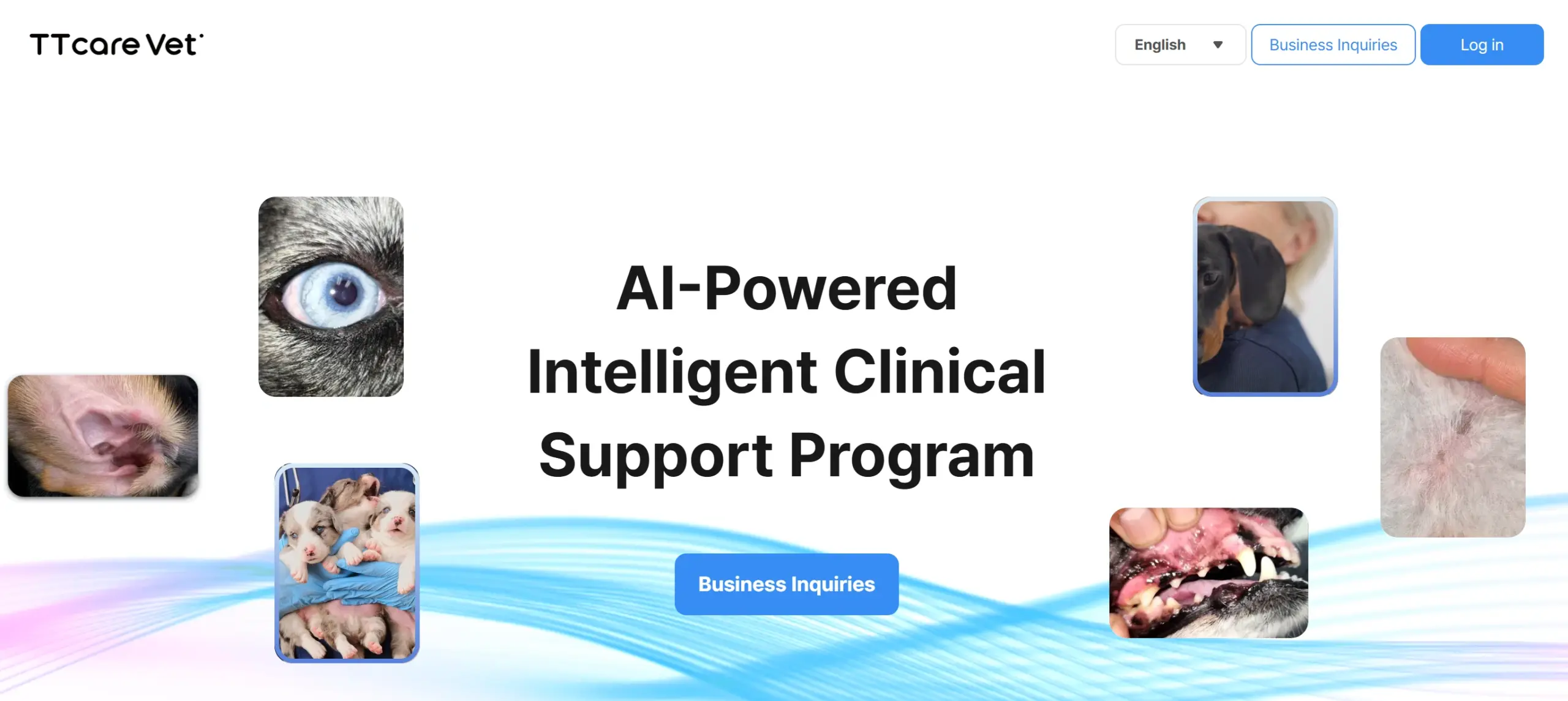
- Key Features: AI-based image analysis for eyes, skin, and joints, early symptom detection, health tracking, and telehealth support for further consultation.
- Revenue Model: Freemium model with advanced diagnostics, detailed reports, and consultations available through subscription.
- Target Audience: Pet owners looking for proactive health monitoring and early diagnosis, along with professionals seeking AI-assisted support.
- Why it’s Successful (USP) & Cons:
- USP: Focus on preventive care through AI-driven diagnostics, enabling early detection without immediate vet visits.
- Cons: Requires professional validation, as AI insights are assistive and not a replacement for veterinary diagnosis.
10. Woofz
Woofz is a modern, gamified dog training and puppy development app that focuses on the “parenting” aspect of pet ownership.

- Key Features: Puppy-specific developmental milestones, a “Problem Solver” library for common issues (biting, jumping), activity logs, and a sleek, user-friendly interface.
- Revenue Model: Subscription-based. Offers a free trial followed by monthly or annual billing for premium content.
- Target Audience: Gen Z and Millennial first-time puppy owners who value aesthetics and ease of use.
- Why it’s Successful (USP) & Cons:
- USP: Superior UI/UX; the app feels modern, fun, and less like a “manual,” making it highly engaging for younger pet owners.
- Cons: Less “clinical” or science-heavy than Dogo; some content can feel repetitive for experienced dog owners.
Market Trends Driving the Growth of Pet Care Apps
The explosive growth of the pet tech sector in 2026 isn’t a coincidence; it is the result of a fundamental shift in how humans interact with their animals. As the global pet care apps market climbs toward its $3.48 billion valuation this year, five key trends are acting as the primary catalysts for development.

1. Rise of Pet Humanization
The transition from “pet owner” to “pet parent” is the single most influential driver of industry growth. In 2026, research shows that record numbers of households across North America and APAC view their pets as literal family members rather than companions.
- Premium Spending: This emotional bond has led to “premiumization,” where users demand the same quality of digital experience for their pets as they do for themselves (e.g., high-end UI/UX and 24/7 support).
- Wellness Focus: There is a massive shift away from “reactive” care toward “proactive” wellness, fueling the demand for apps that track longevity, mental health, and quality of life.
2. Integration of IoT & Smart Devices
The “Connected Pet” ecosystem is no longer a futuristic concept; it is the 2026 standard. The pet tech market, now approaching $25 billion, relies on the seamless integration of hardware and software.
- Ubiquitous Sensors: Smart collars (GPS/biometrics), automated feeders, and AI-enabled cameras are the “eyes and ears” for the owner.
- The Hub Model: Apps have evolved to become the central dashboard for these devices. A successful app in 2026 must be “hardware-agnostic,” meaning it can pull data from a Whistle collar just as easily as a Furbo camera.
- Integration Insight: An IoT-connected smart bowl can detect a decrease in water intake and instantly trigger a notification in a Health & Monitoring app to schedule a vet consult before dehydration occurs.
3. AI & Data-Driven Pet Care
Artificial Intelligence has moved from a buzzword to a functional necessity in the pet care stack. AI is now used to decode the “silent” health signals that pets cannot express.
- Predictive Analytics: AI models analyze millions of data points from sleep patterns to scratching frequency to predict potential health issues like dermatitis or joint pain weeks before physical symptoms appear.
- Personalized Nutrition: Apps like The Farmer’s Dog use AI to calculate hyper-specific meal plans based on real-time activity data, breed-specific metabolic rates, and even local weather conditions.
4. Subscription-Based Models
The set-and-forget economy has taken over pet care, providing predictable revenue for developers and convenience for owners.
- The “Care Bundle”: We are seeing a rise in tiered subscriptions that bundle software access with physical goods (e.g., a monthly fee that covers an app’s premium features, a fresh food delivery, and basic pet insurance).
- Loyalty & Retention: Subscription models like BarkBox or Chewy’s Autoship have proven that pet owners value the convenience premium, leading to significantly higher customer lifetime value (CLV) compared to one-off purchases.
5. On-Demand Pet Services
As the global workforce settled into a permanent hybrid/office-return rhythm in 2025-2026, the demand for on-demand gig services reached an all-time high.
- The Convenience Economy: Demand for door-to-door services including mobile grooming, on-demand dog walking, and vet-teletriage climbed 30% over the last year.
- Real-Time Accountability: Users now expect “Live-Streamed Care.” Whether it’s a GPS-tracked walk or a video snippet of a pet-sitting session, transparency is the primary currency of trust in on-demand service apps.
Opportunities in the Pet Care App Market for Startups & Businesses
While established giants like Rover and Chewy dominate their respective niches, the 2026 market remains fragmented for specialized needs. For startups, the key to success lies in moving beyond “generalist” features and solving specific, high-friction problems with precision.

1. AI-Driven Diagnostics & Triage
The Gap: A global veterinary staffing shortage has caused high costs and long wait times for check-ups. Consequently, anxious owners often overpay for emergency care or delay treatment until minor symptoms become critical.
The Opportunity: Create a first-response AI app using computer vision to evaluate photos of skin, teeth, or gait. It acts as a digital triage hub, directing users to monitor at home, book a routine visit, or seek urgent care.
Monetization: A freemium model where basic scans are free, but detailed AI reports or instant connection to a 24/7 telehealth vet requires a per-use fee or premium subscription.
Business Potential: This model offers excellent scalability with low overhead. AI-driven scans provide cost-effective triage while generating high-value leads for telehealth providers. As a market entry point, it enables lucrative referral partnerships with clinics and pharmacies.
2. The “Senior Pet” Care Ecosystem
The Gap: Most digital tools focus on puppies or active adults, overlooking the record population of geriatric pets. These senior animals require specialized care, including medication management, cognitive monitoring, and mobility support, that general apps typically fail to provide.
The Opportunity: A specialized “Geriatric Care Manager” for pets. This app would focus on chronic condition management (diabetes, arthritis, kidney disease) and utilize IoT data to track changes in mobility or sleep patterns, often the first signs of cognitive dysfunction.
Monetization: Subscription-based care bundles that include medication reminders, specialized physical therapy video modules, and integrated e-commerce for prescription diets and mobility aids.
Business Potential: This sector provides maximum Customer Lifetime Value (LTV). Senior pet owners are high spenders with strong brand loyalty for services that enhance their pets’ final years. Simplifying complex medical and logistical needs creates a sticky product with minimal churn.
3. Hyper-Local Community & Social Marketplaces
The Gap: Marketplace apps find sitters but often lack community. Owners increasingly seek local pet-loving neighbors for social playdates or favor-swapping needs that high-commission professional platforms fail to address.
The Opportunity: A dedicated pet-owner social network, similar to Nextdoor, enables neighbors to share local hazard alerts, organize breed-specific playgroups, and coordinate trusted walking swaps within their local community.
Monetization: Revenue through hyper-local advertising for boutique pet shops and small transaction fees for verified neighborhood sitter bookings or community-vetted local products.
Business Potential: The value is driven by the Network Effect. Utility grows as local membership increases, making high engagement and DAUs ideal for B2B advertising and regional trend data collection.
4. Pet Insurance & Fintech Integration
The Gap: The reimbursement model of pet insurance is fundamentally broken for many owners. Paying a $2,000 vet bill out-of-pocket and waiting weeks for a check creates a massive financial barrier to care.
The Opportunity: A fintech-first digital wallet for pets streamlines direct-pay insurance claims by integrating with clinic systems. Owners pay only the deductible, while the app settles the remaining vet balance instantly.
Monetization: Commissions on insurance premiums, interest from “Pet Emergency Fund” savings accounts, and small transaction fees for the convenience of the digital wallet.
Business Potential: This offers a major disruption opportunity by eliminating claim-filing hurdles, allowing startups to reach uninsured owners. Managing pet-related funds creates high enterprise value and integrates deeply into users’ financial lives.
5. Connected “Smart Home” Hubs
The Gap: Currently, the smart pet market is fragmented. An owner might have a Petcube camera, a Whistle collar, and a SurePet feeder, each requiring a separate app. There is no unified dashboard that looks at all this data holistically.
The Opportunity: A brand-agnostic IoT hub consolidating data from all home pet devices into a “Universal Health Score.” It identifies medical concerns by cross-referencing inputs such as flagging pacing caught on camera alongside skipped meals from a smart feeder.
Monetization: Premium data insight subscriptions and B2B partnerships with hardware companies that pay to be integrated partners within the hub.
Business Potential: This strategic “data moat” play establishes the app as the pet home’s OS, securing data flow and platform loyalty. By syncing all hardware, the app becomes indispensable, offering a lucrative software-licensing opportunity for manufacturers.
6. Subscription-Based Pet Care Super Apps
The Gap: Pet owners are suffering from “Subscription Fatigue.” Managing separate payments for food, insurance, flea/tick meds, and vet visits is disorganized and expensive. There is a massive underserved demand for an all-in-one simplified monthly price.
The Opportunity: The “Amazon Prime for Pets” model offers a Super App bundling core needs into one monthly subscription. For a fixed price, owners get recurring food delivery, 24/7 telehealth, insurance, and annual preventative wellness kits.
Monetization: High-ticket monthly subscription tiers ($99–$199/month) offering premium features, advanced analytics, exclusive tools, and priority support for users.
Business Potential: The “Winner-Take-All” model captures the total share of wallet by eliminating niche competition. Its predictable recurring revenue attracts investment, while high convenience ensures retention, turning the app into an essential life-support system for pets.
Build and Launch a Pet Care App with Idea Usher
Building a pet care app in 2026 requires more than just a clean interface; it requires a deep understanding of the Connected Pet Ecosystem. Backed by a powerhouse team of 250+ elite developers and over 500,000+ hours of development experience, IdeaUsher provides the end-to-end technical expertise needed to turn a concept into a market-leading platform.
A. Validate Your Idea & Identify Market Opportunity
Successful apps solve specific pain points rather than imitating competitors. Drawing on our 1,000+ successful projects, we refine your concept by targeting market gaps and high-growth potential.
- Competitive Benchmarking: We analyze leaders like Rover and Chewy to identify features that users love and areas where they are still frustrated.
- USP Definition: We help you carve out a Unique Selling Proposition that ensures your app stands out in a crowded digital store.
B. Design a Feature-Rich & User-Centric App
Pet sector design requires empathy for owners and animals. Our ex-FAANG/MAANG developers apply world-class UX/UI standards to create intuitive, emotionally resonant interfaces for your project.
- Dual-User Interfaces: We build distinct, high-performance journeys for both pet owners and service providers (sitters, walkers, vets).
- Frictionless UX: Our design philosophy focuses on reducing the number of taps it takes to book a service, file a claim, or check a GPS location.
C. Build Scalable & High-Performance Applications
A pet care app must be as reliable as the owners who use it. With 500,000+ hours of development expertise, our approach ensures your platform can handle real-time tracking, high-frequency data from IoT devices, and secure payment processing without lag.
- Robust Backend: We build scalable cloud architectures that grow as your user base expands from hundreds to millions.
- Secure Payment Integration: We implement top-tier encryption for all financial transactions, including support for digital wallets and BNPL (Buy Now, Pay Later) options.
D. Integrate AI, IoT, and Smart Pet Technologies
Your app needs to be smart to lead the market in 2026. We implement AI and IoT integrations that mirror the functionality of high-end platforms like Petcube and Whistle.
- IoT Connectivity: We specialize in syncing software with smart collars, feeders, and cameras to provide users with a unified health score.
- AI Implementation: From predictive health alerts to automated image analysis for at-home triage, we help you future-proof your app with cutting-edge machine learning.
E. Launch Faster & Scale with Continuous Support
The journey doesn’t end at the App Store launch. We utilize Agile Development methodologies to get your MVP (Minimum Viable Product) to market quickly, allowing you to gather real-world data and iterate faster.
- Post-Launch Optimization: We provide ongoing maintenance and feature updates to ensure your app evolves alongside 2026 market trends and user feedback.
- Strategic Growth: From A/B testing user features to optimizing your monetization model, we provide the support needed to turn a launch into long-term market dominance.
Conclusion
Pet care apps are reshaping how owners manage health, services, and daily routines, while opening strong opportunities for businesses. From on-demand services to AI-driven insights, the market continues to evolve with clear demand and innovation potential. By understanding what makes the best pet care apps successful and identifying the right niche, startups can build scalable solutions. With the right strategy, features, and execution, launching a pet care app can be both impactful and highly profitable.
FAQs
A.1. High-performing platforms must integrate digital medical records, real-time GPS location services, and automated booking systems. Providing secure payment gateways and instant notifications for medication or appointments ensures the application remains an essential daily tool for pet parents.
A.2. Most applications generate sustainable revenue through tiered subscription plans, transaction fees on service bookings, or hardware sales. Many also leverage freemium models where advanced AI health analytics or direct telehealth consultations are locked behind a premium paywall.
A.3. Startups find significant success using the “Super App” model, which bundles insurance, nutrition delivery, and vet consultations. This approach maximizes customer lifetime value by solving multiple logistical pain points within a single, convenient monthly subscription package.
A.4. Artificial intelligence allows apps to offer predictive health alerts and automated triage through computer vision. By analyzing behavioral data and physical symptoms early, AI-driven platforms provide a level of proactive care that traditional, manual tracking apps cannot match.