 (+971) 8007 4267
 (+91) 946 340 7140
 (+1) 628 432 4305

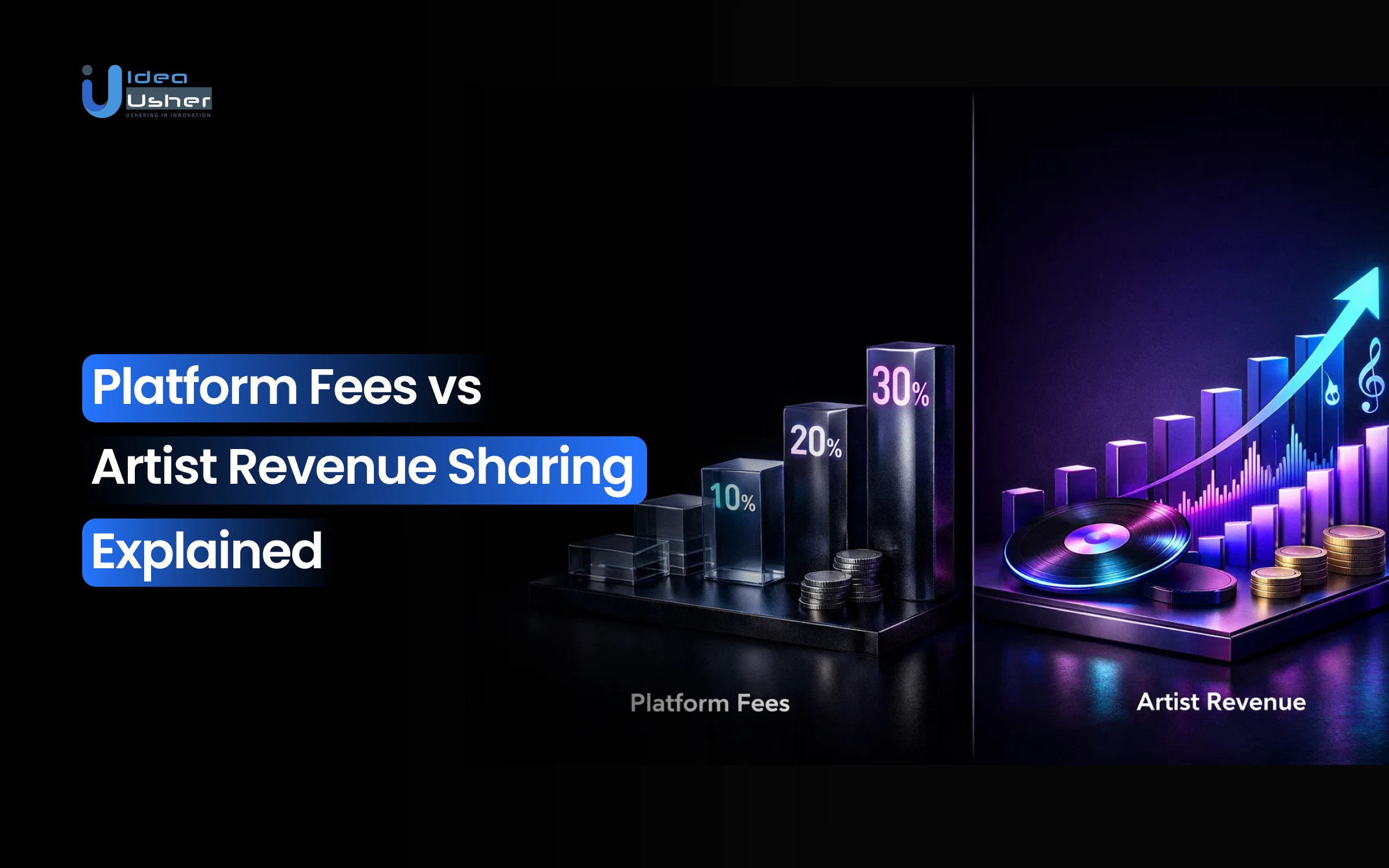
For many artists and investors entering digital music ownership, the confusion rarely comes from earning money. It comes from understanding where that money goes once it starts moving. Earnings appear, deductions follow, and the line between platform fees and revenue sharing often blurs. While they may sound similar, each model reshapes financial outcomes in very different ways, especially as income scales over time.
Modern music royalties platforms are built on layered technical and business foundations. They combine rights databases, usage data pipelines, licensing logic, and automated payout systems into a single operating model. How this architecture is designed directly determines whether a platform charges fixed fees, takes a percentage of artist revenue, or adopts a hybrid approach to remain sustainable while supporting long-term growth.
We’ve developed numerous music-royalty management solutions that leverage advanced technologies such as royalty ledger architectures and rights intelligence systems. As IdeaUsher has these years of expertise, we’re sharing this blog to explain how platform fees and artist revenue sharing models actually work in modern music royalties platforms.
Key Market Takeaways for Music Royalties Platforms
According to VerifiedMarketReports, the music royalties management market is entering a clear growth phase, driven by scale and complexity rather than hype. Valued at about USD 2.4 billion in 2024, the market is projected to nearly double by 2033 as platforms respond to a streaming economy where digital now contributes more than three-quarters of industry revenue. With plays fragmented across services such as Spotify and Apple Music, manual tracking no longer works, prompting rights holders to adopt automated, system-driven royalty infrastructure.

Source: VerifiedMarketReports
Modern royalty platforms are solving a structural problem, not just an operational one. They centralize collection, automate splits, and produce auditable reports for artists, labels, and publishers operating across dozens of revenue streams.
Adoption is accelerating as AI improves reconciliation accuracy, analytics expose long-tail income, and blockchain-style ledgers increase trust in payout calculations and ownership records.
Leading players show how this shift is playing out in practice. Kobalt uses its KOSIGN platform to offer real-time tracking and creator-friendly economics aimed at recovering billions in missed publishing income, while Songtrust has scaled global royalty collection to hundreds of thousands of writers through a simple commission model.

What Is a Music Royalties Platform?
A music royalties platform is a digital system that tracks how music is used, calculates who is owed money, and distributes royalties automatically across artists, writers, producers, and rights holders. It connects usage data from streaming, downloads, sync, and performances with contract rules and ownership splits to turn scattered revenue into clear, auditable payouts.
Instead of relying on manual reports and delayed statements, the platform creates a single source of truth where earnings can be monitored, adjusted, and paid with accuracy and transparency over time.
Platform Fees Model Explained
Artists or rights holders pay a fixed monthly or annual fee, typically $10 to $50 per year, to use the platform. In return:

- The platform takes zero percentage of your earnings
- You keep 100 percent of royalties collected
- All core features are included, such as tracking, splits, and reporting
Take TuneCore as an example. They charge an annual fee per single or album, usually between $9.99 and $49.99 per year, while letting artists keep 100 percent of royalties earned. If an artist earns $10,000 annually, a $49.99 fee represents roughly 0.5 percent of total revenue, making it highly efficient at scale.
Who It’s For
- Professional independent artists with consistent royalty income
- Catalogs with predictable revenue, including established back catalogs
- Labels and publishers managing multiple artists
- Creators who prefer fixed costs for financial planning
Artist Revenue Sharing Model Explained
There are no upfront fees. Instead, the platform takes a percentage of royalties collected, typically between 15 and 30 percent.

Consider CD Baby Pro. It charges no annual fee but takes 15 percent of streaming royalties and about 9 percent on downloads. For a new artist earning $500 in their first year, this means paying $75 instead of a fixed annual fee. The initial risk is lower, but the cost increases as earnings grow.
Who It’s For
- New artists testing the waters without upfront investment
- Creators with inconsistent or seasonal income
- Early-stage catalogs where predictability is difficult
- Artists prioritizing cash flow over long-term percentage retention
This model offers low upfront risk, but it can become expensive at scale. It works well early on, but artists should watch closely for the crossover point where a flat fee becomes more economical.
The Hidden Factor Most Platforms Don’t Discuss
Here is what separates basic services from sophisticated platforms. Missing money recovery.
Even with accurate distribution, studies suggest that 10 to 25 percent of royalties never reach artists due to metadata mismatches and international collection gaps. This is where specialized platforms like Songtrust stand out. They are built specifically to identify and recover black box royalties from global collection societies that standard distributors often miss.
For example, if a track is used in a Brazilian TV show, a typical distributor may only collect from DSPs. A platform like Songtrust actively tracks and collects from Brazil’s local collection society, ECAD, recovering sync and performance royalties that would otherwise remain unclaimed.
Do Revenue Sharing Models Hurt Credibility with High Earning Artists?
Revenue sharing models have lowered the barrier for artists to distribute music without upfront costs. That same model can quietly turn into a credibility problem as artists scale. What feels like a fair partnership early on may later signal that the platform benefits more from artist success than from delivering proportional value.

The Psychology of the “Success Tax”
When an artist transitions from earning hundreds to earning hundreds of thousands, their perspective on platform fees undergoes a fundamental shift. That reasonable 15% commission that felt like a fair partnership at $5,000 annually becomes a $75,000 “tax” at $500,000 earnings.
The credibility erosion happens in three phases:
- The “Am I Being Taken Advantage Of?” Moment: When artists realize their platform earns more from their music than their own band members do
- The Value Questioning: “What exactly am I getting for these six-figure commissions?”
- The Trust Breakdown: Artists begin questioning every recommendation, wondering if it serves their interests or the platform’s bottom line
The Math That Breaks Trust
| Artist annual earnings | 15 percent platform commission | Equivalent flat fee | Psychological impact |
| $5,000 | $750 | $50 per year | Reasonable partnership |
| $50,000 | $7,500 | $50 per year | Starting to feel expensive |
| $250,000 | $37,500 | $50 per year | This feels unjust |
| $1,000,000 | $150,000 | $50 per year | Active resentment |
The critical insight: When commissions exceed what artists pay their managers, lawyers, or even band members, the platform transitions from “service provider” to “silent partner taking too large a cut.”
Why High-Earners Feel Exploited
- Perceived Value Mismatch: The platform’s work doesn’t scale linearly with artist earnings. Processing $1M in royalties doesn’t cost 200x more than processing $5,000, yet the fee suggests it does.
- The “Success Penalty” Paradox: Artists who succeed most pay the highest effective rates, creating a perverse incentive structure.
- Transparency Issues: Many platforms struggle to demonstrate $150,000/year worth of value-add services for top earners.
Comparison to Industry Standards
Managers may take fifteen to twenty percent because they actively shape careers and make daily strategic decisions. Lawyers justify around five percent by handling high risk negotiations that protect long term income.
The Credibility Recovery Playbook
For platforms using revenue-share models, maintaining trust with high-earners requires:
- Transparent Value Justification: Quarterly reports detailing exactly what artists received for their commissions
- Performance-Based Scaling: Automatic rate reductions at revenue milestones
- À La carte Options: Let artists opt out of bundled services they don’t use
- Success Celebrations, Not Penalties: Public recognition programs, not just higher fees
- Easy Off-Ramps: No-penalty transitions to enterprise flat-fee tiers
How Do Platform Fees Model Affect Long Term Artist Retention?
Artist retention rarely depends on how cheap or expensive a music royalties platform is. It depends on whether the value delivered feels proportional to the cost paid. A $50 annual fee can feel insignificant or unacceptable based entirely on outcomes.

- Take DistroKid and TuneCore as an example. Both rely on flat fees, but retention psychology differs sharply. DistroKid’s $19.99 per year unlimited uploads create a set it and forget it mindset.
- Artists rarely reassess the expense. TuneCore’s per release pricing forces artists into frequent re evaluation moments, especially during renewals. That difference alone changes long term retention behavior.
Critical insight: platform fees create an implicit ROI check at every renewal. Artists consciously or subconsciously ask did this platform earn its fee this year. That question determines loyalty or churn.
1. The No Brainer Retention
High value and low cost
- Scenario: artist pays $49 per year and earns $15,000
- Psychological state: this feels like essential infrastructure
- Retention probability: 95 percent or higher
Why they stay:
- The fee feels psychologically invisible
- The platform blends into the artist’s workflow like electricity
- Switching feels unnecessary even if alternatives exist
A real example is an indie artist earning $20,000 annually through DistroKid’s low cost unlimited plan. There is almost no incentive to switch.
Similarly, LANDR reinforces retention by bundling services. When artists already use mastering, adding distribution feels like a logical extension rather than a new expense.
2. The Value Questioning Retention
Moderate value with perceived high cost
- Scenario: artist pays $150 per year and earns $2,000
- Psychological state: am I getting my money’s worth
- Retention probability: 60 to 70 percent
This is the most dangerous retention zone. Artists scrutinize every flaw. Bugs feel bigger. Delays feel personal. The effective fee feels heavy relative to income.
A TuneCore artist with multiple releases might pay $240 annually. If earnings plateau, comparison shopping begins almost immediately. At this stage, the platform must prove value continuously, not just once.
3. The Locked In Retention
High switching costs masking dissatisfaction
- Scenario: large catalog artist paying $500 or more annually
- Psychological state: I would leave if it were easier
- Retention probability: around 80 percent
These artists stay due to friction, not loyalty. Re uploading hundreds of tracks is painful enough to delay switching, but resentment builds quietly.
Critical mistake: assuming retention equals satisfaction. In many cases, retention simply reflects inconvenience.
4. The Enterprise Retention
Custom value alignment and active partnership
- Scenario: label paying $5,000 or more annually
- Psychological state: this is a strategic relationship
- Retention probability: about 90 percent when managed correctly
Enterprise clients buy outcomes and relationships, not just software. CD Baby demonstrates this with its Pro Publishing option. The combination of software plus active royalty collection creates ongoing engagement, which dramatically improves retention.
Psychological Triggers That Break Retention
The Sticker Shock Anniversary Effect
Renewal dates force reflection. Fee increases without clear new value trigger questions like what exactly am I paying more for. This leads to alternative research and delayed renewals.
Observed pattern: platforms that raise fees without visible upgrades see 25 to 40 percent higher churn in that renewal cycle.
The Vanishing Value Effect
When platforms stop innovating, fees feel increasingly unjustified over time. Consider:
- Year 1: “Wow, this analytics dashboard is amazing!”
- Year 3: “This dashboard looks dated compared to new platforms”
- Year 5: “I’m paying the same for increasingly outdated tools”
The Comparison Shopping Trigger
Artists do not churn in isolation. They churn socially. When peers migrate to newer or cheaper platforms, social proof flips direction. Network effects that once reinforced retention can quickly accelerate exits.
Top 5 Examples of Music Royalty Platforms
We have done some digging and quietly explored how music is being treated as an investable asset. What stood out is how these platforms may combine rights management data, royalty logic, and investor tooling in a structured way.
1. ANote Music

ANote Music operates a regulated marketplace where investors can buy and trade music royalties backed by verified catalogs. The platform emphasizes transparency, compliance, and predictable long-term income generation.
2. JKBX

JKBX offers a marketplace where individual investors can buy shares in music royalties from well-known songs by top artists like Beyoncé and Taylor Swift, with payouts tied to streaming, licensing, and sales income. This model tokenizes royalty income into tradable securities.
3. Round Hill Music

Round Hill Music acquires and manages premium music catalogs as long-term financial assets. Its investment strategy focuses on stable returns driven by established songs with consistent global usage.
4. Tangy Market

Tangy Market provides a marketplace for buying and selling music royalty assets across different rights types. Investors can diversify portfolios by accessing multiple genres and revenue streams in one platform.
5. BaseNote

BaseNote targets retail investors by offering early access to music investment opportunities tied to emerging artists. The platform blends fan participation with structured royalty-based returns.
Conclusion
Platform fees versus artist revenue sharing is not just a pricing choice but a core system design decision. In 2025 strong music royalties platforms should behave like financial intelligence engines rather than simple upload tools. If you invest in the right architecture now you can steadily build trust and may lead a market that is clearly maturing. At IdeaUsher we help enterprises design and scale royalties platforms that can balance monetization transparency and long term growth.
Looking to Develop a Music Royalties Platform?
IdeaUsher can help you design a music royalties platform that can accurately track rights streams and payouts from day one. Our team will build secure royalty ledgers and data ingestion pipelines that may scale as catalogs and users grow.
Why Build With Us?
- Deep Expertise: 500,000+ hours of coding experience by ex-MAANG/FAANG engineers
- Niche Specialization: We build secure, compliant platforms with real-time royalty tracking, smart contracts, and seamless payment splits
- Proven Delivery: From fintech to Web3, we turn complex ideas into scalable, user-friendly products


FAQs
A1: Platform fees can create steady and predictable income that helps the system scale with confidence. Over time the platform should invest this revenue into infrastructure and data pipelines so performance remains stable as usage grows. If pricing is aligned with value delivery scalability will likely remain sustainable.
A2: Revenue sharing can feel more attractive at the start because creators face lower upfront cost. However the platform must handle complex calculations and compliance from day one to avoid errors later. With the right accounting logic this model can work smoothly in early growth phases.
A3: Yes a hybrid approach can be designed at the architectural level without major friction. The system can route users into different monetization flows based on role and activity. This flexibility should allow the platform to evolve as the market matures.
A4: In most cases development can take around four to eight months depending on integrations and regulatory depth. A well defined scope should help teams move faster without cutting critical corners. With experienced execution the timeline can remain controlled and realistic.


