 (+971) 8007 4267
 (+91) 946 340 7140
 (+1) 628 432 4305

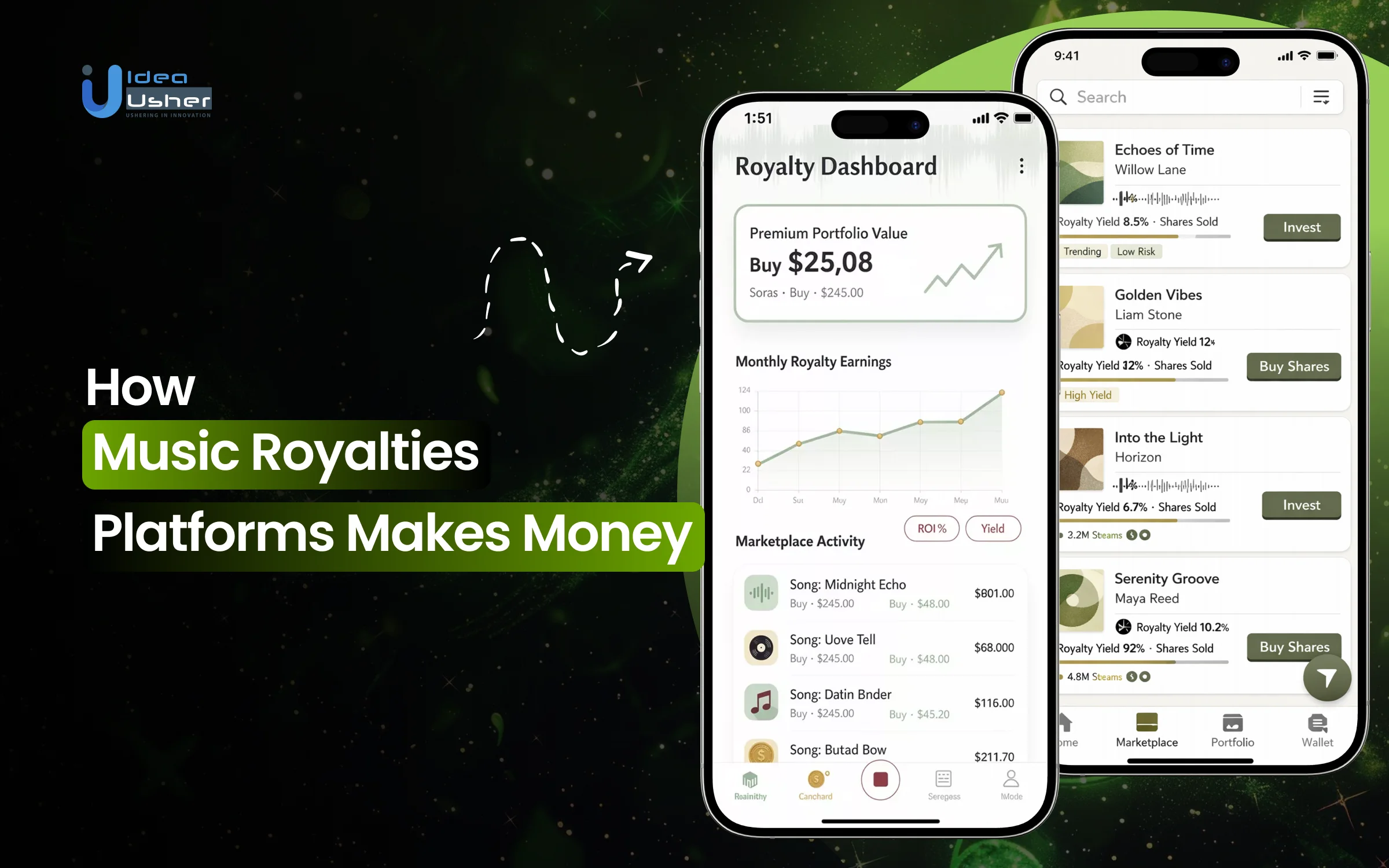
Music royalties rarely feel tangible to listeners or even to the people creating the music, with streams, plays, and licensing income moving quietly through layers of intermediaries. Behind this activity, artists and rights holders depend on fragmented systems that are slow to report and difficult to monetize predictably. This gap between how music earns revenue and how that revenue is structured is what defines the music royalties business model behind modern royalty platforms.
Royalty platforms operate at the intersection of rights management and financial infrastructure. They consolidate usage data from multiple sources, track earnings across channels, and package future royalties into structured financial products. Revenue is generated through platform fees, transaction commissions, data services, and in some cases direct participation in royalty streams, all of which depend on accurate tracking and compliant payouts.
In this blog, we explain how music royalties platforms make money by breaking down their core revenue streams, platform mechanics, and the operational factors that influence long term sustainability in this space.

The Economics Behind Music Royalties Platforms
Music royalties platforms handle royalty income for rights holders, not music creation or distribution. They manage money flow in a fragmented system as streaming, digital licensing, and global distribution grew, royalty management shifted from manual, relationship-based processes to centralized systems, driving platform growth.
A. Fragmentation in Music Rights and Revenue
Music rights are rarely owned by a single entity, especially in digital distribution. As music moves across platforms, regions, and uses, revenue is split among multiple owners. This fragmentation presents a challenge that music royalties platforms seek to address.
Fragmentation typically occurs across several dimensions:
- Multiple rights holders: Songwriters, publishers, performers, and recording owners may all hold claims on the same track.
- Different royalty types: Performance, mechanical, neighboring, and synchronization royalties follow separate rules and payment paths.
- Geographic territories: Rights and payout structures vary across countries, adding regulatory and administrative complexity.
- Diverse revenue sources: Streaming platforms, radio, live venues, and licensing deals generate royalties in different formats and timelines.
This layered structure makes manual royalty tracking inefficient at scale, creating the economic need for centralized systems that can aggregate, process, and distribute revenue accurately.
B. Platforms as Financial Intermediaries
In economic terms, music royalties platforms act as intermediaries, not owners or creators. They facilitate financial interactions between royalty generators and recipients, minimizing friction. This puts platforms at key points in the royalty chain.
In practice, this intermediary role involves:
- Standardizing royalty data: Converting inconsistent usage and payment reports into structured, comparable formats.
- Reducing transaction complexity: Managing calculations, validations, and distributions that would otherwise require manual coordination.
- Centralizing financial flows: Acting as a single point through which royalty payments are tracked and processed.
- Improving transparency: Providing clearer reporting and visibility into earnings across sources and territories.
By lowering operational costs and reducing inefficiencies, platforms create economic value without needing to control the underlying music assets.
C. Scale, Data & Efficiency as Economic Value
As music royalties platforms grow, scale becomes a core economic advantage. Managing a larger volume of works, users, and transactions allows platforms to spread fixed operational costs across broader revenue bases. This improves efficiency while increasing the usefulness of the platform to participants.
Meanwhile, data becomes more valuable as aggregated usage, payment, and rights data improve tracking, reporting, and financial transparency. These efficiencies generate economic value, supporting music royalties platforms’ business models.
Who Participates in the Music Royalties Platform Ecosystem?
The music royalties platform ecosystem brings together multiple stakeholders who enable rights monetization and investment flow. Each participant plays a defined role in ensuring transparency, revenue distribution, and long-term sustainability across the platform.
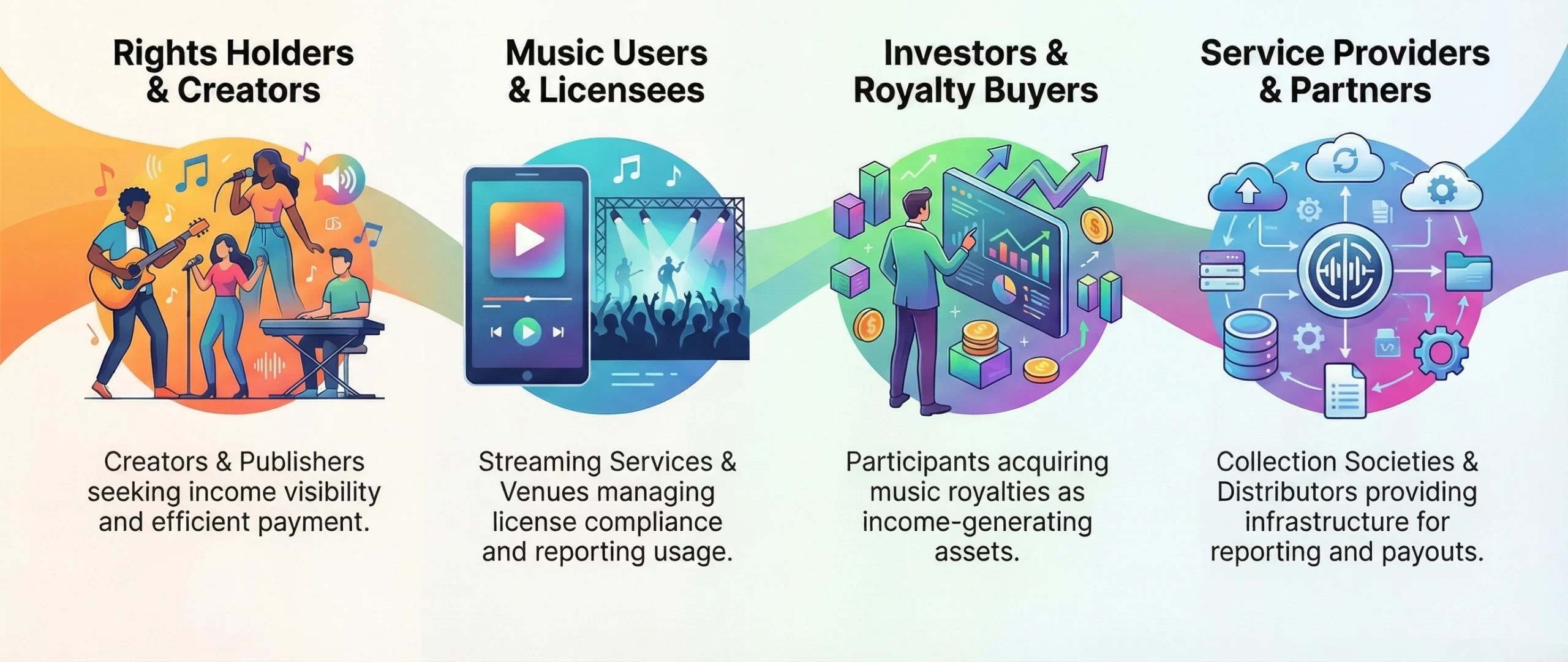
1. Rights Holders and Creators
This group includes songwriters, composers, publishers, performers, and recording owners who are entitled to royalty income. For these participants, platforms provide tools to register rights, track usage, and receive payments that would otherwise be difficult to manage independently. Their primary motivation is administrative efficiency and income visibility.
2. Music Users and Licensees
Streaming services, broadcasters, digital platforms, venues, and brands generate royalty obligations by using music commercially. These entities rely on royalty platforms to report usage accurately, calculate payments, and comply with licensing requirements. Platforms reduce the operational burden of managing large catalogs and frequent transactions.
3. Investors and Royalty Buyers
Some platforms attract participants interested in acquiring or financing music royalties as income-generating assets. These users engage with platforms for access to structured data, transparent reporting, and facilitated transactions. Their presence introduces additional financial activity beyond traditional royalty collection.
4. Service Providers and Partners
Collection societies, distributors, payment processors, and data providers often integrate with royalties platforms to support reporting, compliance, and payout infrastructure. These partnerships enable platforms to function at scale while expanding their service offerings.
How Money Flows Through Music Royalties Platforms?
Music royalties platforms control how revenue moves from music usage to rights holders and investors. This flow shows how platforms track, distribute, and report earnings within a structured and transparent ecosystem.
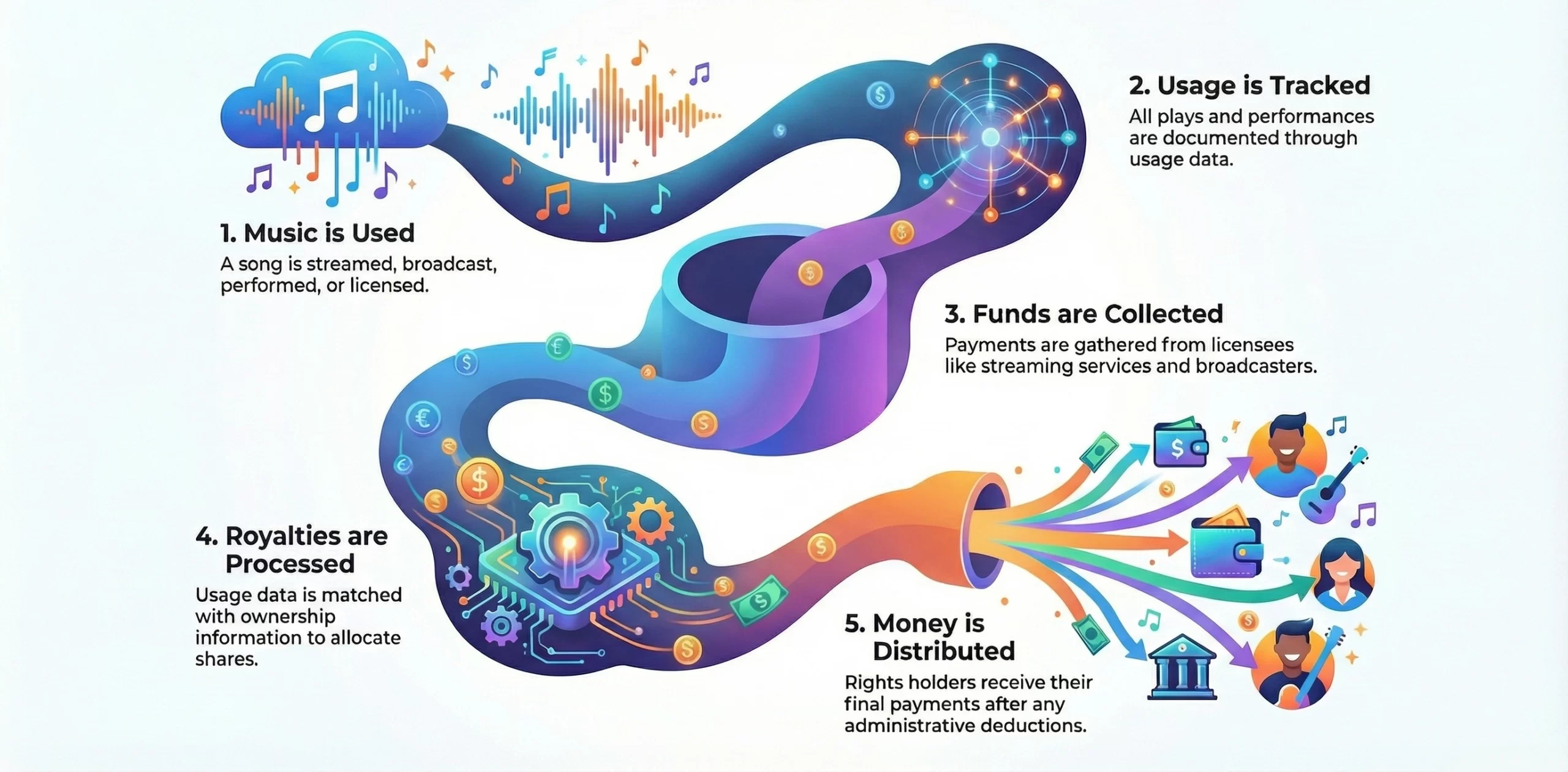
1. Music Usage Triggers Royalty Generation
Every royalty payment starts when audiences use music. Streaming platforms, broadcasters, venues, brands, and media outlets trigger royalty obligations when they stream, broadcast, perform, or license a song for commercial use.
2. Data Tracking and Reporting
After audiences use music, platforms generate and record data, usage reports, identifiers, and metadata track plays, performances, and licenses. Accurate data matters because platforms can calculate royalties only when they document music usage correctly.
3. Platforms Collect Royalties From Licensees and Distributors
Once platforms report usage, they collect royalty payments. Digital service providers, advertisers, broadcasters, and licensees supply the funds. Platforms often pool these payments before allocating them to individual songs or rights holders.
4. Processing and Allocating Royalties
During the processing stage, platforms match usage data with ownership information. They calculate payouts, apply royalty rates, and allocate shares among songwriters, performers, publishers, and rights investors. This step often involves resolving splits and handling complex rights structures.
5. Funds Are Distributed to Rights Holders
Finally, royalties are distributed to rights holders. Payments may be subject to thresholds, schedules, currency conversions, or administrative deductions. What creators receive reflects both the original royalty value and the costs incurred throughout the process.
Revenue Models Used by Music Royalty Platforms
Music royalties platforms rely on structured revenue models to support operations and scale efficiently. The platforms below include dedicated music royalties platforms as well as distribution, licensing, and analytics services that participate in the broader royalty ecosystem.
| Revenue Model | How It Works | Who Pays | Platform Examples |
| Commission-Based Fees | The platform takes a percentage of royalties it collects or distributes on behalf of rights holders. | Artists, songwriters, publishers | Songtrust, TuneCore |
| Subscription Fees | Users pay a recurring fee for access to royalty tracking, reporting, and management tools. | Creators, labels, publishers | DistroKid, Amuse |
| Administration Fees | Fees charged for rights management, metadata maintenance, and royalty processing services. | Rights holders, catalog owners | Kobalt, Sentric |
| Transaction Fees | Charges applied to withdrawals, currency conversions, or payment transfers. | Rights holders receiving payouts | CD Baby |
| Licensing & Deal Facilitation Fees | Platforms earn fees by helping secure sync licenses or commercial music deals. | Brands, licensees, rights holders | Songtradr |
| Data & Analytics Monetization | Advanced analytics, forecasting, or performance insights are offered as paid features. | Labels, publishers, professional creators | Chartmetric |
| Rights Investment Spreads | Platforms earn via management fees or price spreads on royalty-backed investments. | Investors and catalog sellers | Royalty Exchange |
How Music Royalties Platforms Make Money?
Music royalties platforms generate revenue by integrating into the flow of music income. These music royalties business models focus on scaling, reducing friction, and monetizing access to systems that turn music usage into predictable payouts.
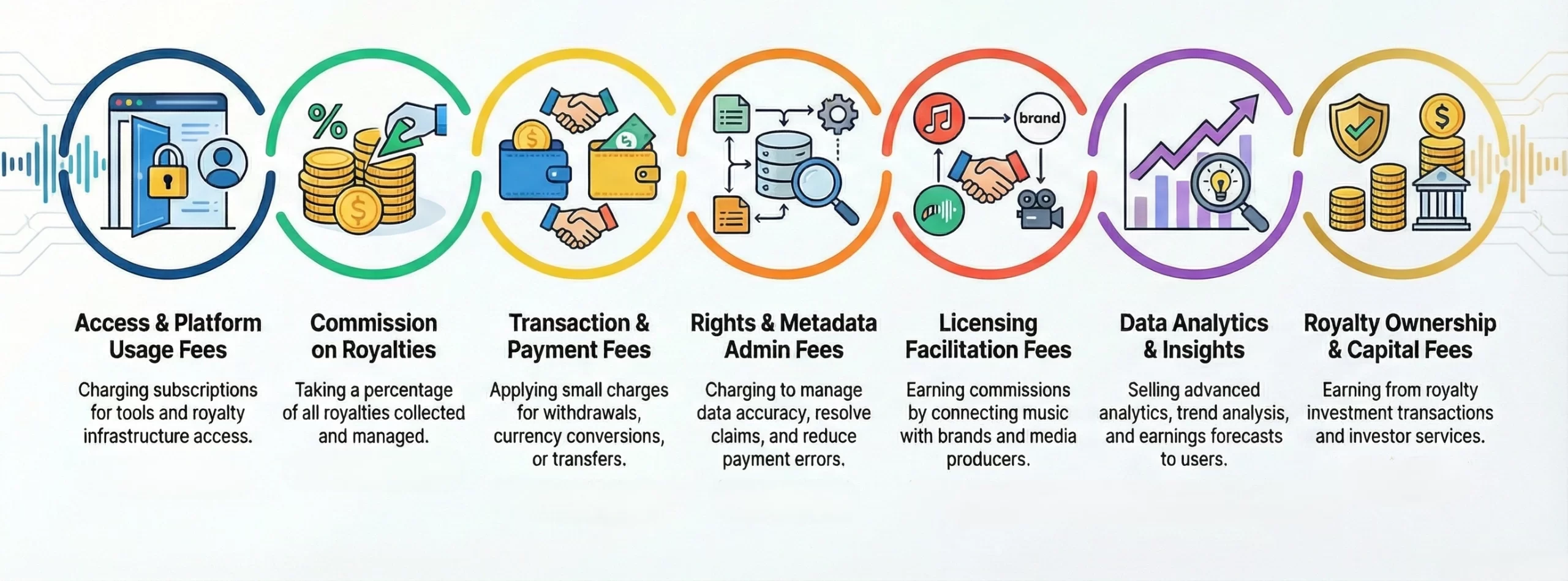
1. Access and Platform Usage Fees
Platforms monetize access to royalty infrastructure by charging subscriptions or service fees. These fees cover tools for usage tracking, rights management, payout calculations, and reporting, allowing creators and rights holders to participate efficiently in global royalty collection systems without building technical infrastructure.
Example: This model is commonly used by platforms such as DistroKid and Amuse, which monetize access to distribution, reporting, and account-level royalty infrastructure.
2. Commission on Royalties Collected and Distributed
Many platforms earn revenue by retaining a percentage of managed royalties. This commission-based model aligns platform income with music performance, enabling scalable growth while compensating platforms for handling compliance, calculations, and cross-territory royalty administration on behalf of rights holders.
Example: Commission-based royalty retention is central to publishing administration platforms like Songtrust and Sentric, where revenue scales with managed royalty volume.
3. Transaction and Payment Processing Charges
Transactional revenue is generated at payout moments, such as withdrawals, currency conversions, or expedited transfers. Although individually small, these fees accumulate across large user bases and high payout frequency, creating a consistent secondary revenue stream independent of royalty performance levels.
Example: Transaction-level fees are commonly applied by platforms such as CD Baby, particularly around withdrawals, payment methods, and currency conversions.
4. Rights Administration and Metadata Management Fees
Platforms charge for administering rights data and ownership accuracy. This includes managing splits, resolving claims, correcting metadata, and maintaining catalog integrity across collection systems. Revenue is earned by reducing royalty leakage and ensuring payments reach the correct rights holders.
Example: This revenue model is typical of rights-focused platforms like Kobalt, which monetize accuracy, ownership management, and reduced royalty leakage across complex catalogs.
5. Licensing Facilitation and Usage-Based Deal Revenue
Some platforms generate income by facilitating music licensing and commercial usage. By connecting rights holders with brands, media producers, or advertisers, platforms earn commissions or service fees tied directly to newly created royalty or licensing income opportunities.
Example: Licensing-driven revenue is characteristic of platforms such as Songtradr, which earn fees by facilitating commercial usage and sync opportunities.
6. Data Analytics and Earnings Intelligence
Aggregated royalty and usage data becomes a monetizable asset. Platforms charge for advanced analytics, territory insights, trend analysis, and earnings forecasting. These tools help users evaluate performance, plan releases, and assess long-term income potential beyond raw royalty statements.
Example: Analytics monetization is central to platforms like Chartmetric, where revenue comes from performance insights rather than royalty collection itself.
7. Royalty Ownership and Capital-Based Fees
Advanced platforms earn revenue through royalty ownership transactions and investment facilitation. Fees may include catalog management charges, transaction spreads, or investor services, positioning royalties as structured financial assets rather than solely creative income streams.
Example: Marketplaces such as Royalty Exchange use investment oriented revenue models and earn fees from royalty asset transactions and investor participation.
How the $104.61B Artist Market Drives Music Royalties Platform Growth?
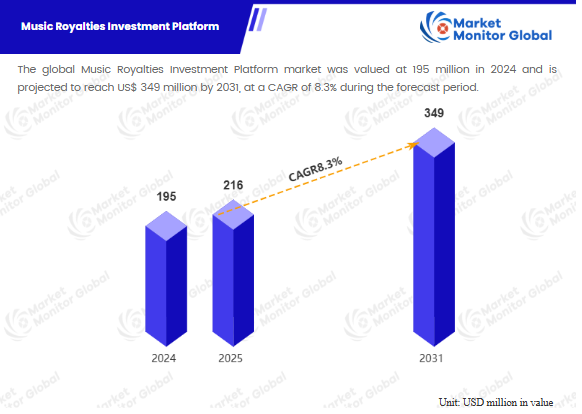
The global music royalties investment platform market is expected to reach around US$349 million by 2031, growing at an estimated 8.3% CAGR. This growth reflects rising demand for structured access to music-based income and alternative asset exposure.
At the same time, the independent artist market stands at $104.61 billion in 2024 and is projected to grow to $149.91 billion by 2029. This expansion significantly increases the volume of royalty-generating assets entering digital ecosystems.
A. How Independent Artists Expand Royalties Platform Demand?
The rapid growth of independent artists reshapes the economics of music royalties platforms by increasing both participation volume and operational complexity. This shift creates sustained demand for platforms that can manage rights, income, and reporting at scale.
- Self-Managed Catalog Growth: Independent artists retain ownership of masters and publishing rights, increasing demand for direct royalty collection, administration, and payout services.
- Platform Dependence for Royalty Operations: Without label infrastructure, creators rely on platforms for reporting, compliance, collection, and cross-territory royalty management.
- Fragmented Multi-Source Income Streams: Royalties flow from streaming, social, sync, and performance channels, requiring aggregation and consolidated financial visibility.
- Global First Distribution Behavior: Independent artists release music globally by default, creating complex regional royalty flows that platforms actively manage.
B. Why This Growth Supports Sustainable Platform Revenue?
As independent artist participation expands, music royalties platforms benefit from revenue models that scale with activity, administration, and long-term asset management rather than short-term creative performance.
- Recurring Revenue From Active Accounts: Platform revenue scales with active artists and catalogs through subscriptions, administration fees, or managed royalty percentages.
- Transaction-Based Monetization at Payout Stages: Payout processing, withdrawals, and currency conversions generate consistent transaction-level revenue as royalty activity increases.
- Growing Demand for Financial Visibility Tools: Analytics, performance reporting, and earnings forecasting create additional monetization as artists manage music as a business asset.
- Long Term Platform Retention as Catalogs Mature: Ongoing royalty generation encourages sustained platform use, compounding revenue as catalogs continue to perform over time.
The continued expansion of the independent artist market strengthens the economic foundation of the music royalties business model used by royalty platforms. As more creators manage rights independently and generate income across multiple channels, these platforms become essential infrastructure for organizing, processing, and monetizing royalty flows at scale.
What These Revenue Models Mean for Artists and Rights Holders?
Music royalties business models do not affect all participants equally. Their impact varies based on scale, ownership structure, and dependency on platform services, shaping how income is received, reduced, or optimized across different roles in the music ecosystem.
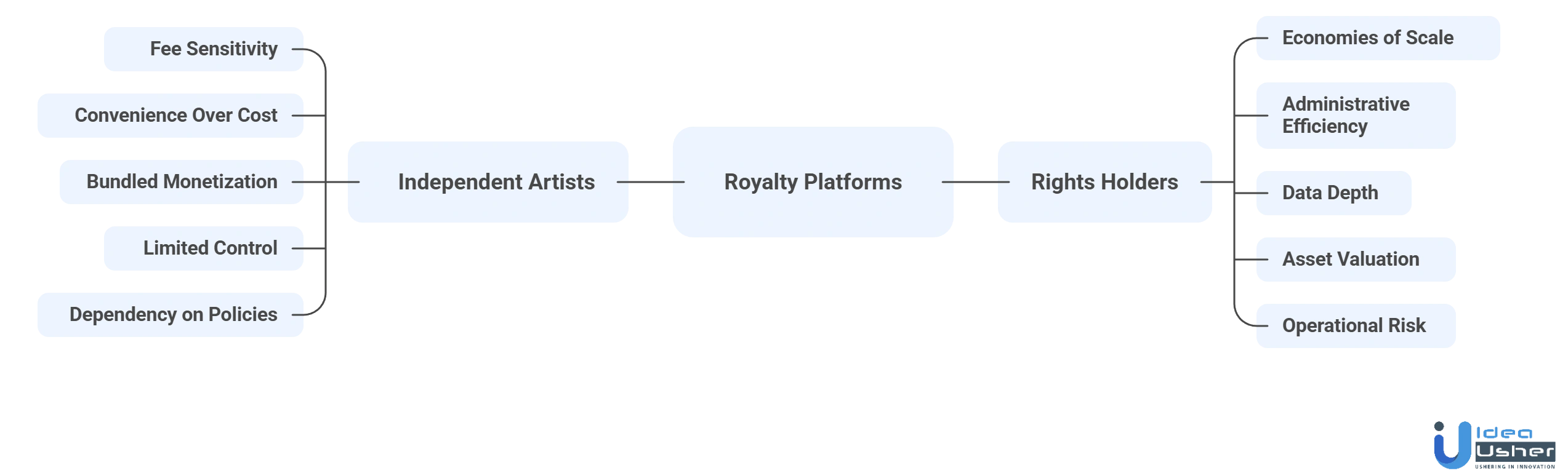
A. For Independent Artists and Creators
For most independent artists, royalties platforms function as essential intermediaries. Their revenue models influence not only earnings, but also access, transparency, and long-term sustainability within the digital music economy.
- Fee Sensitivity at Low Volumes: Percentage fees and transaction charges can meaningfully reduce net payouts when royalty income is small or inconsistent.
- Convenience Over Cost Efficiency: Artists often trade higher fees for simplified onboarding, automated reporting, and reduced administrative responsibility.
- Bundled Monetization Exposure: Distribution, publishing administration, and analytics fees are frequently layered together, making total costs less visible.
- Limited Control Over Payment Timing: Artists typically have little influence over payout schedules, thresholds, or processing delays imposed by platforms.
- Dependency on Platform Policies: Changes in fee structures, payout rules, or product features can directly affect artist income with limited ability to opt out or negotiate alternatives.
B. For Rights Holders and Catalog Owners
Rights holders and catalog owners interact with royalty platforms at scale. Their primary concern is not access, but efficiency, accuracy, and the long-term financial performance of managed assets.
- Economies of Scale in Fee Structures: Larger catalogs can absorb commissions more effectively and may benefit from negotiated or volume-based pricing.
- Administrative Efficiency as a Value Driver: Accurate rights management and reduced leakage often justify platform fees for complex, multi-territory catalogs.
- Data Depth and Financial Visibility: Advanced reporting and usage insights support valuation, forecasting, and strategic catalog management decisions.
- Impact on Asset Valuation: Platform deductions, data quality, and payout reliability directly influence how royalty income is valued over time.
- Operational Risk and Platform Reliance: Heavy dependence on a small number of platforms concentrates operational risk, making platform stability, compliance, and continuity critical to long-term revenue planning.
The Role of Music Royalties Platforms in the Modern Music Economy
Music royalties platforms support how music value is tracked, monetized, and distributed across the industry. Their role connects creators, rights holders, and investors through structured systems that enable sustainable participation.
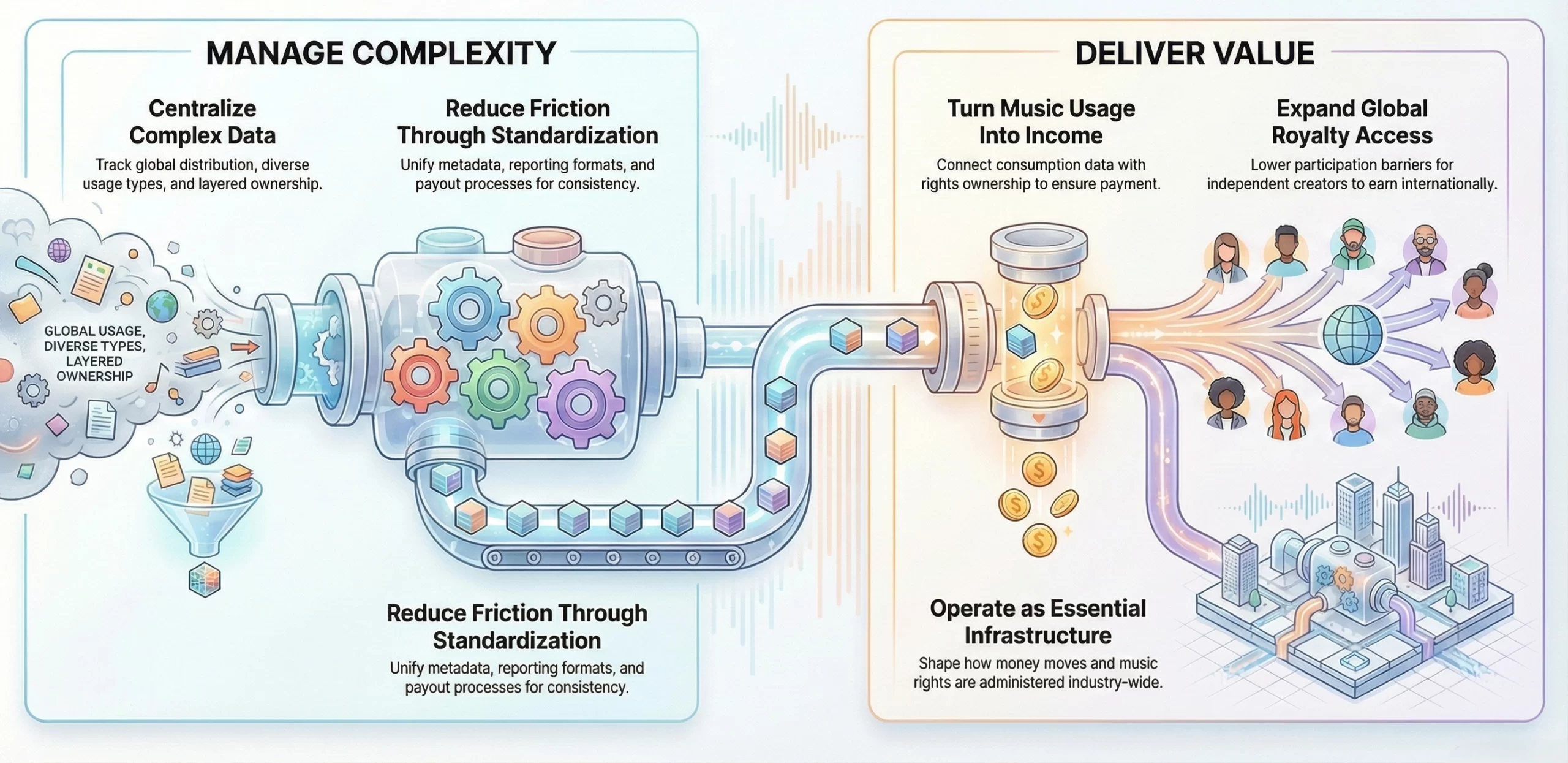
1. Managing Music Market Complexity
Music royalties platforms exist to manage the increasing complexity of music monetization. Global distribution, multiple usage types, and layered ownership structures require centralized systems that can track, normalize, and process royalty data across diverse markets and formats.
2. Turning Music Usage Into Income
At a fundamental level, royalties platforms translate music usage into financial outcomes. They connect consumption data with rights ownership, apply royalty rules, and ensure payments move from usage sources to rights holders in an organized and repeatable manner.
3. Reducing Friction Through Standardization
By centralizing metadata, reporting formats, and payout processes, platforms reduce operational friction. Standardization enables consistency across territories and services, allowing royalties to flow more predictably despite differences in regulations, collection systems, and market practices.
4. Expanding Global Royalty Access
Royalties platforms lower participation barriers for independent creators and smaller rights holders. Access to established royalty networks allows participants to earn from international usage without requiring direct relationships with every collection entity or licensing body.
5. Improving Value Transparency
While platforms facilitate access, they also influence outcomes. Fee structures, data accuracy, and reporting depth affect how much income reaches rights holders and how clearly earnings can be understood and evaluated over time.
6. Operating as Economic Infrastructure
In the modern music economy, royalties platforms function as infrastructure. They shape how money moves, how rights are administered, and how music income is measured, positioning themselves as integral components of the industry’s financial system.
The Business Logic Behind Music Royalties Platforms
Music royalties platforms operate on a defined music royalties business model that aligns rights management with revenue generation. This structure enables efficient royalty collection, accurate distribution, and scalable operations within the digital music economy.
1. Monetizing Industry Coordination
Music royalties platforms exist to coordinate complex systems involving usage tracking, rights ownership, and payments. Their business logic centers on monetizing this coordination, turning fragmented royalty pathways into repeatable and scalable operational processes.
2. Focusing on Scale and Automation
Platforms are designed to operate efficiently at volume. Standardized workflows, automated reporting, and rule-based payout systems allow royalties to be processed consistently across large catalogs, even when individual transactions vary in size or complexity.
3. Building Predictable Revenue Models
Rather than relying on uncertain performance outcomes, platforms structure revenue around predictable activities such as administration, processing, and access. This predictability supports sustainable operations despite fluctuating royalty volumes and uneven creator earnings.
4. Mitigating Risk Through Aggregation
By aggregating many users, catalogs, and transactions, platforms reduce reliance on any single revenue source. Operational costs and financial risk are distributed across scale, allowing platforms to remain stable while serving diverse participants in the royalty ecosystem.
5. Turning Irregular Income Into Infrastructure
At a foundational level, music royalties platforms convert inconsistent, usage-driven income into structured financial flows. Their long-term value lies in systematizing money movement, not in influencing creative output or controlling music itself.
Conclusion
Understanding how royalty platforms generate revenue helps clarify their role in the wider music ecosystem. Fees, licensing margins, data services, and marketplace access all contribute to sustainability when structured responsibly. A transparent music royalties business model aligns platform incentives with the interests of artists, rights holders, and investors. When revenue mechanics are clear, trust grows and participation becomes more informed. This clarity allows stakeholders to evaluate risk, predict returns, and support platforms that prioritize long term value rather than short term extraction across the evolving digital music economy globally today.
Why Choose IdeaUsher for Developing a Music Royalties Platform?
IdeaUsher helps businesses design and build music royalties platforms that support accurate royalty tracking, fair distribution, and sustainable revenue models. We work closely with founders to translate complex royalty mechanics into reliable, user-focused platforms.
Why Work With Our Team?
- Royalty Management Expertise: We build systems that handle multi-source revenue, licensing structures, and detailed reporting.
- Custom Platform Design: Each solution is tailored to your monetization strategy, audience, and operational needs.
- Data Transparency and Trust: Our platforms prioritize clear insights for artists, rights holders, and investors.
- Future Ready Architecture: We develop scalable platforms that adapt to evolving music consumption and monetization trends.
Explore our case studies to see how we design and deliver scalable AI & blockchain solutions across diverse digital platforms and industries.
Connect with our team to discuss how we can help you build and launch a music royalties platform focused on long-term sustainability.


FAQs
A.1. Platforms earn through transaction fees, royalty administration charges, licensing spreads, and premium analytics services. These revenue streams support operational costs while enabling platforms to scale without directly owning the underlying music rights.
A.2. Pricing is typically based on percentage-based fees or subscription models. Artists pay for administration and distribution, while investors are charged for access, transactions, and portfolio management tools that simplify royalty participation.
A.3. Royalty platforms monetize data by offering insights on performance, forecasting, and audience trends. These analytics help rights holders and investors make informed decisions, creating an additional revenue layer without impacting royalty payouts.
A.4. Sustainability depends on transparent fees, accurate reporting, and scalable operations. A balanced music royalties business model aligns platform profitability with artist earnings and investor returns, reducing churn and strengthening trust over time.