 (+971) 8007 4267
 (+91) 946 340 7140
 (+1) 628 432 4305

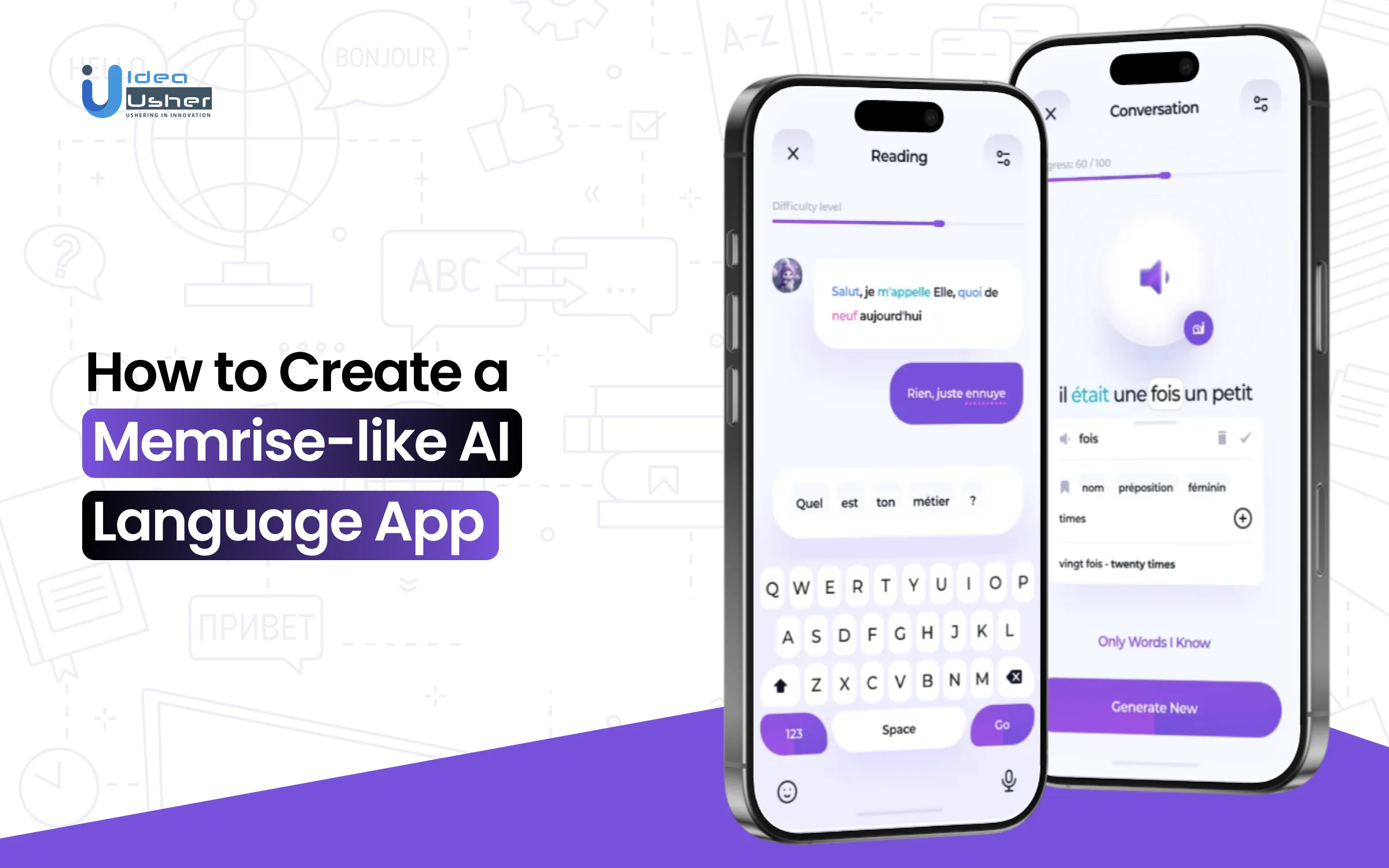
Learning a new language can feel exciting at first, but staying consistent is where most learners struggle. Busy schedules, slow progress, and traditional rote memorization often make it difficult to stay motivated. These challenges are pushing more people toward interactive, AI-powered tools and increasing demand for a Memrise-like AI Language App that makes learning fun, personalized, and easier to stick with.
Modern AI language platforms enhance learning by combining spaced repetition, real-world content, and adaptive models. They personalize lessons to each learner’s pace, use speech recognition to improve pronunciation, and create engaging practice sessions. This immersive, personalized approach helps learners build confidence while mastering language effectively.
In this guide, we’ll show how to create an AI language learning app like Memrise, highlighting essential features and the technology behind adaptive, personalized learning. With experience helping enterprises build AI-powered solutions, IdeaUsher can help develop your app to deliver engaging, scalable, and market-ready language learning experiences.

What is an AI Language App, Memrise?
Memrise is an AI-powered language-learning app blending memory science, immersive native-speaker content, and adaptive learning. Leveraging spaced repetition and multimedia lessons with real videos and audio helps users efficiently internalize vocabulary and conversational phrases. By applying memory neuroscience and a “learning-by-immersion” approach, it creates retention-optimized courses that outperform rote memorization and textbook methods.
The platform uses AI-driven personalization and conversational AI through “MemBot” to provide unlimited speaking practice, instant pronunciation and grammar feedback, and context-aware lessons. This adaptive path adjusts to individual strengths and weaknesses, maximizing efficiency and fluency. Memrise is a scalable language education product with strong potential for recurring subscription revenue worldwide.
- Accent modeling & mimicry training that helps users match native-speaker pronunciation patterns.
- Context-aware phrase recommendations that adjust based on user conversations with MemBot.
- Real-world video sourcing pipeline that continually refreshes content with hyper-local expressions and modern slang.
- Learner-behavior feedback loop that refines future content based on aggregated conversation data (no proportional increase in human content creation).
- Data-driven difficulty tuning that automatically calibrates challenge levels for each learner.
A. Business Model: How Memrise Operates
Memrise operates on a scalable, user-first model that blends freemium access, premium AI features, and global digital reach to drive sustainable growth.
- Freemium base with premium upsell: Memrise lets users start for free with access to spaced-repetition flashcards, native-speaker videos, and gamified learning tools. Premium plans unlock more advanced features.
- Content plus AI-driven personalization: The app offers official courses with native-speaker videos and real-world phrases, while premium users get AI tools like “MemBot” for speaking practice, pronunciation feedback, and adaptive learning.
- Scalable global reach: With tens of millions of registered users and fully digital delivery, Memrise can expand across languages and regions without increasing costs per user.
B. Revenue Model & Pricing Model:
Memrise generates revenue through a freemium structure supported by tiered subscription plans that unlock advanced AI-powered learning features.
- Memrise uses a freemium plus subscription model, allowing users to start for free and upgrade to access advanced features.
- Subscription plans include:
- Monthly plan at US $24.99
- Annual plan at US $61.99 (≈ US $5.17/month)
- Lifetime plan at US $329.99 one-time
- The Pro subscription unlocks the full feature set, including all official courses, unlimited native-speaker videos, complete lesson libraries, offline access, and an ad-free experience.
- The model’s value proposition: the free tier introduces the learning journey, while Pro provides “unlimited learning flexibility” that appeals to committed, long-term learners.
How an AI Language App Works?
AI language apps use advanced algorithms to understand, generate, and interact in natural language. By combining machine learning and linguistic data, they deliver personalized learning experiences for users.

1. Onboarding & Smart Level Detection
The user signs up, selects a language and completes a short assessment. Behind the scenes, baseline scoring algorithms analyze responses to determine an accurate starting level, ensuring early lessons feel natural rather than overwhelming.
2. Personalized Learning Path Setup
The system generates a tailored learning plan using adaptive pathing rules that evaluate goals, pace and skill indicators. It organizes lesson themes and difficulty sequences, creating a dynamically evolving pathway that adjusts as the user learns.
3. Immersive Lessons & Context Modeling
Users learn through videos, audio and contextual examples driven by content mapping frameworks. Lessons combine vocabulary, grammar and real scenarios to teach how native speakers use the language in everyday moments.
4. Adaptive Practice & Performance Analytics
While users complete exercises, the app tracks errors, hesitation, speed and accuracy using micro performance analytics. The system adjusts difficulty, selects practice items and provides AI-guided recommendations that match each learner’s current ability.
5. Speaking Practice with AI Tutor
The user chats naturally with an AI tutor that uses intent interpretation and dialogue shaping logic to maintain conversation flow. Pronunciation scoring runs on acoustic pattern analysis, giving clear and practical feedback for more confident speaking.
6. Progress Tracking & Learning Loops
Skill graphs, dashboards and spaced repetition cycles update in real time through behavior tracking models. The app reshapes lesson order and review patterns to ensure continuous, personalized learning that grows with the user’s performance.
Why a 40% Global Language Education Gap Creates Big AI Language App Opportunities?
The language learning app market was valued at USD 20.35 billion in 2024 and is expected to reach USD 89.53 billion by 2032, growing at a CAGR of 17.9% from 2026 to 2032. Driven by learners seeking AI-powered personalized instruction that reduces errors and speeds proficiency, this growth shows effective learning, not just convenience, fuels expansion.

UNESCO reports that 40% of the global population lacks access to education in their native language, a figure that rises to 90% in low and middle-income countries. Billions still need affordable language learning solutions.
A. The Signals Behind Growing Adoption in AI Language Apps
The language learning app category has demonstrated exceptional user retention and revenue generation capabilities, proving that both free and paid business models can thrive. These metrics validate that new entrants can build sustainable, profitable businesses in this space.
- 37.2M daily active users engage with leading language platforms, about 33% of monthly users returning daily, showing strong habit-forming engagement and high retention.
- Mobile platforms now capture about 80% of the language-learning market, showing that AI language apps thrive in an on-the-go, mobile-first environment with huge addressable growth potential.
- Leading platforms convert 8.6M users into paid subscribers, generating $748M annually, proving the freemium model drives scalable subscription revenue.
- Top apps earn $33M monthly from in-app purchases, totaling $396M annually, demonstrating that multiple monetization strategies can coexist profitably.
- Immersive AI-driven personalization cut learner mistakes by 70% in six months, highlighting growing demand for adaptive AI language apps and their market advantage.
- Advances in AI and NLP now deliver around 50% better pronunciation feedback, enabling faster improvement through immediate, consistent correction of subtle speech errors.
B. The Forces Behind Growing Enterprise Demand for AI Language Apps
Beyond individual consumers, corporate buyers and investors are actively seeking advanced language learning solutions, creating immediate B2B opportunities and strong funding potential for AI-powered platforms that deliver measurable results.
- 86% of executives value language skills, driving corporate training budgets and creating strong B2B opportunities for scalable AI language apps.
- The corporate e-learning market reached $104.32B in 2024, growing at 21.7% CAGR, with language training as a key growth segment.
- Individual learners represent 48.8% of the online language market, enabling dual B2C and B2B revenue streams for new platforms.
- AI-first language platforms hit $1B valuations, with Speak raising $78M in Series C funding, showing investor confidence in AI-driven solutions.
- Research shows that 15 minutes of daily practice delivers results comparable to 3 hours of weekly classroom learning, highlighting the 12x time efficiency that makes AI language apps especially attractive for busy learners.
- Speak’s 10M users generated 1B practice sentences in 2024, highlighting strong adoption of interactive, AI-powered learning.
- UNESCO research shows 14% better reading comprehension with language-appropriate instruction, validating personalized AI learning approaches.
The language learning app market presents massive opportunities for both consumer and enterprise adoption, driven by growing demand for AI-powered personalization, mobile accessibility, and measurable learning outcomes. With strong user engagement, scalable monetization, and proven efficiency, AI language apps are well-positioned to address the global language education gap while capturing significant B2C and B2B market potential.

Key Competitive Gaps in Current AI Language Apps You Can Capitalize On
AI language apps are powerful, but several competitive gaps still limit their effectiveness for everyday users and businesses. Understanding these weaknesses helps you identify clear opportunities to innovate and stand out in a crowded market.

1. Lack of Cultural Context in Lessons
Most apps, such as Duolingo and Babbel, teach vocabulary without showing how phrases shift in real cultural situations. For example, users never learn why Japanese greetings change based on hierarchy. You can introduce context-enriched learning with cultural cues, body language hints and tone explanations.
2. Limited Real-Time Personalization Beyond Difficulty
Apps like Memrise and Rosetta Stone adjust difficulty but ignore emotional tone, hesitation or learner confidence. For instance, when users repeatedly pause in speaking tasks, the system does not adjust pacing. You can add behavior-aware personalization that reacts to hesitation, frustration signals or fast progress.
3. Weak Pronunciation Training & Accent Coaching
Platforms such as Busuu and Babbel offer simple “correct” or “incorrect” scores without showing what part of the pronunciation was wrong. For example, they rarely highlight unstressed syllables or missing intonation. You can build prosody-aware coaching and accent transfer feedback for deeper correction.
4. Static Lesson Content That Doesn’t Evolve
Most apps use fixed lesson sets. Rosetta Stone and Duolingo do not create lessons based on real user goals like learning French for a job interview. You can use generative scenario building that produces custom lessons for travel, business or specific life events.
5. Limited Long-Form Conversation Capability
Apps like Memrise’s MemBot or Duolingo’s AI chat often lose context quickly. For example, if a learner says “I studied Spanish for two years”, the bot soon forgets. You can introduce strong dialogue memory and multi turn conversation arcs that feel truly human.
Key Features of a Memrise-like AI Language App
A Memrise-like AI language app combines adaptive learning, immersive native-speaker content, and AI-driven personalization to accelerate learning and boost retention. These features make the app engaging, efficient, and suitable for learners at every level.

1. Native Speaker Video & Audio Library
This feature provides short video and audio clips recorded by real speakers using creator-style micro content. The media pipeline applies lightweight streaming and adaptive compression which delivers natural pronunciation exposure, cultural nuance and scalable immersion across varied devices and network conditions.
2. AI-Powered Conversational Tutor
An AI tutor similar to MemBot offers real-time conversation practice through intent detection, semantic scoring and turn-taking logic. Users receive contextual feedback that improves fluency, accuracy and confidence while interacting with scenario-aware models trained on diverse conversational datasets.
3. Spaced Repetition Learning Engine
A spaced repetition engine uses memory decay modeling and pattern recognition to schedule optimized vocabulary reviews. It detects weak recall signals, adjusts intervals intelligently and supports long-term retention while maintaining cognitive efficiency through incremental learning cycles.
4. Adaptive Learning Pathways
Adaptive pathways personalize lesson difficulty using micro proficiency mapping, behavioral analytics and error pattern detection. This creates tailored learning trajectories that respond dynamically to each user’s strengths and weaknesses and support diverse proficiency levels without manual configuration.
5. AI-Generated Lesson Content
An AI generator produces vocabulary sets, example sentences and micro lessons using template-based generation and contextual language modeling. It reduces content production time, expands course coverage quickly and provides dynamically updated learning material aligned with user preferences and evolving usage patterns.
6. AI-Driven Accent Transfer
This module applies voice cloning, prosody modeling and acoustic style mapping through neural vocoders to transform the learner’s speech into a target accent. Users hear a hybrid version of their own voice with native like intonation which accelerates phonetic mastery and speaking confidence.
7. Cross-Platform Availability
Users can learn across mobile and web with synchronized progress supported by on device caching and lightweight data persistence. Offline mode enables access to downloaded lessons which ensures uninterrupted learning in low connectivity or travel environments.
8. Generative Scenario Builder for Real Life Situations
This feature uses a generative simulation engine with dialogue models and contextual intent parsing to create custom real-world scenarios. Users generate any environment and receive branching dialogues, targeted vocabulary and immersive experiences powered by scene rendering and adaptive scenario logic.
9. Dynamic Proficiency Graph
A proficiency graph uses linguistic embeddings, predictive modeling and continuous analytics to forecast future learning outcomes. It identifies micro trends, interprets user behavior signals and recommends precise interventions which create a proactive and data-driven learning progression.
10. Gamified Progress & Motivation Tools
Gamification uses streak counters, micro goals, reward loops and engagement scoring to build consistent learning habits. These systems rely on motivational heuristics and performance tracking to increase learner retention and sustain long-term practice behavior.
Language Pedagogy Models for Your AI Language App
Integrating proven language pedagogy models can make your AI language app more effective and engaging. These frameworks guide learning paths, improve retention, and enhance user outcomes.
| Pedagogy Model | Core Concept | How It Benefits an AI Language App |
| Communicative Language Teaching (CLT) | Prioritizes real communication and functional language use | Learners improve by completing real-world tasks |
| Task Based Language Teaching (TBLT) | Learners improve by completing real world tasks | Supports interactive tasks like travel, workplace or daily life situations. |
| Immersive Input / Comprehensible Input | Learners improve when exposed to content slightly above their level | Provides graded content and controlled difficulty for smoother learning. |
| Spaced Repetition Learning | Knowledge is reinforced when reviewed at optimized intervals | Strengthens retention through a timed review cycle. |
| Lexical Approach | Focuses on mastering chunks, phrases and collocations | Enables practical conversations and natural scenario-based speaking practice. |
| Multimodal Learning Theory | Combining audio, visual and text input enhances understanding | Boosts comprehension through rich visual and audio cues. |
| Adaptive Learning Framework | Content evolves based on performance and behavior | Offers personalized learning paths and dynamic difficulty. |

How to Create a Memrise-like AI Language App?
Creating a Memrise-like AI language app combines adaptive learning, immersive content, and AI-powered personalization to deliver efficient, engaging instruction. Our strategic development approach ensures the app meets user needs while scaling effectively in the competitive EdTech market.

1. Consultation
We begin with a detailed consultation to define goals, target learners and competitive advantages. Our team maps user flows, identifies core learning mechanics and clarifies expectations which ensures strategic alignment before moving into design, modeling and platform-level planning.
2. Product Discovery & Requirement Analysis
We conduct product discovery to translate ideas into structured requirements. This stage includes feature prioritization, experience mapping and behavior analysis which helps us define a focused MVP with clear learning objectives and measurable success criteria.
3. User Experience Design & Learning Flow
Our designers craft intuitive learning flows that support natural progression, spaced retention and conversational engagement. We combine interaction patterns with cognitive learning principles which creates frictionless onboarding, smooth navigation and a motivating learning environment across all primary user journeys.
4. AI Model Integration Planning
We outline how conversational AI, adaptive pathways and content generation will integrate with the app’s logic. Our team structures modular systems, intent flows and evaluation layers which allow scalable AI behavior and reliable performance across varying learner contexts.
5. Content Blueprint & Curriculum Structuring
We prepare a curriculum blueprint that defines vocabulary groups, micro-lessons and multimedia assets. This step ensures balanced difficulty progression, cultural relevance and coherent learning arcs supported by structured content modeling that keeps lessons consistent and scalable.
6. App Development & Core Features
Our developers build the core modules including interactive lessons, spaced repetition, conversational practice and progress tracking. We follow clean architecture patterns and maintain modular feature blocks which allow smooth iteration as the platform grows.
7. AI Features & Personalization Logic
We create personalization logic that adapts difficulty, reviews and recommendations to each learner’s behavior. This involves constructing feedback loops, learner profiles and micro assessments which produce individualized learning pathways grounded in real performance data.
8. Content Integration & Multimedia Sync
We integrate videos, audio clips, prompts and generated lessons into the platform. Our team synchronizes media assets with lesson logic which supports immersive learning while maintaining consistent pacing and smooth playback across devices.
9. Quality Assurance & Learning Validation
We run extensive QA to verify usability, accuracy and learning progression. This includes test scenarios for conversations, spaced repetition cycles and pronunciation features which ensure stable performance and effective knowledge retention before launch.
10. Launch & Ongoing Improvement
Once the platform is stable, we launch publicly and begin continuous improvement. Our team monitors engagement metrics, user progression patterns and AI performance to guide future updates and maintain a sustainably evolving learning ecosystem.
Cost to Build an AI Language App like Memrise
The cost to build a Memrise-like AI language app depends on features, AI capabilities, platform choice, and overall development complexity. Understanding these factors helps you budget accurately and plan a scalable, high-performing product.
| Development Phase | Description | Estimated Cost |
| Consultation | Defines goals, scope and learning vision through strategic discovery and requirement mapping. | $3,000 – $6,000 |
| UI/UX Design | Creates intuitive learning flows with cognitive experience design for smooth navigation and engagement. | $6,000 – $12,000 |
| AI Integration & System Architecture | Structures adaptive modules, intent flows and personalization using scalable system logic. | $13,000 – $20,000 |
| App Development (Frontend + Backend) | Builds lessons, spaced repetition engine and core platform using modular development patterns. | $26,000 – $38,000 |
| AI Feature Development | Implements conversational practice, personalization and content generation through adaptive AI mechanisms. | $17,000 – $30,000 |
| Content Integration & Multimedia Management | Syncs videos, audio and micro lessons using structured content pipelines. | $9,000 – $15,000 |
| QA Testing | Tests usability, retention cycles and AI outputs through behavior-driven validation. | $6,000 – $12,000 |
| Deployment & Post-launch Improvements | Deploys publicly and enhances early performance with continuous optimization cycles. | $4,000 – $6,000 |
Total Estimated Cost: $68,000 – $130,000
Note: Development costs depend on feature complexity, AI capabilities, custom content, scalability, localization, and advanced learning models.
Consult with IdeaUsher for a personalized cost estimate and a tailored roadmap aligned with your vision, feature goals, and long-term scalability plans.
Cost-Affecting Factors to Consider During Development
Several key factors influence the cost of developing an AI language app like Memrise, from feature complexity to AI integration and platform requirements.
1. Scope and Feature Complexity
Building advanced features increases effort and cost. Bold feature sets require deeper planning, longer development cycles and more sophisticated logic, especially when integrating AI-driven personalization or dynamic learning modules.
2. AI Model Sophistication
The depth of conversational AI, scenario generation and personalization directly impacts budget. Higher accuracy models require more training, refinement and evaluation, increasing both development time and resource allocation.
3. Content Volume & Multimedia Requirements
Large sets of videos, audio clips and lessons influence production and integration cost. Higher content volume demands more synchronization, structuring and quality control, affecting overall project expenditure.
4. User Experience & Design Quality
Polished learning flows, micro interactions and intuitive navigation add design hours. Premium UX increases engagement but also raises design workload, especially for apps targeting high retention rates.
5. Localization & Multi-language Support
Supporting multiple languages adds layers of complexity. More languages require expanded content, validation and UI adjustments, raising translation and testing costs.

Recommended Tech Stack for AI Language App
Choosing the right tech stack is essential for building a scalable, high-performance Memrise-like AI language app. The stack you select will directly impact development speed, app stability, AI capabilities, and long-term maintainability.
| Category | Recommended Options | Description |
| Frontend Development | React Native, Flutter | Builds cross-platform interfaces with a smooth user experience and efficient rendering. |
| Backend Development | Node.js, Django | Handles APIs, authentication and learning logic with scalable performance. |
| Database & Storage | PostgreSQL, MongoDB, AWS S3 | Stores learner data and multimedia with secure, reliable persistence. |
| AI & Machine Learning | Transformer models, pretrained embeddings | Powers conversational AI and adaptive learning through intelligent language modeling. |
| Speech Processing | ASR tools, phoneme analyzers, neural vocoders | Provides pronunciation scoring and accent feedback using advanced speech analysis. |
| Media Delivery | CDN systems, compression workflows | Delivers videos and audio through fast, optimized media pipelines. |
| Real Time Communication | WebSockets, event channels | Enables AI chat and interactive sessions with instant response handling. |
| Cloud Infrastructure | AWS, Google Cloud, Azure | Supports hosting, AI workloads and autoscaling for traffic spikes. |
Challenges During Development & How Our Developers Solve Those?
Building a Memrise-like AI language app comes with challenges around AI accuracy, personalization, scalability, and user engagement. Our developers address these issues with proven frameworks, robust architectures, and data-driven optimization to ensure a reliable, high-performing product.

1. AI Behavior & Personalization Accuracy
Challenge: Ensuring AI responds naturally, adapts to each learner and understands varied intent becomes difficult as personalization depth and behavioral consistency increase.
Solution: We solve this by building layered intent logic, refining learner profiles, running continuous evaluation cycles and adjusting response patterns using real usage signals. This ensures accurate personalization without compromising the natural flow of the learning experience.
2. Scaling Content Volume Without Quality Loss
Challenge: Large volumes of lessons, videos and prompts can reduce quality if they lack consistency, proper structuring or cultural relevance.
Solution: Our developers use structured content pipelines, quality checkpoints and balanced lesson modeling. This workflow allows us to expand content libraries quickly while preserving tone, clarity, usability and real world learning value.
3. Reliable Speech Recognition & Pronunciation Feedback
Challenge: Accents, background noise and inconsistent articulation make pronunciation scoring and speech recognition difficult to consistently evaluate.
Solution: We apply multi-stage audio analysis, tune phoneme comparisons and set intelligent thresholds. This approach boosts accuracy, improves feedback reliability and creates more meaningful pronunciation coaching for learners.
4. Real-Time Conversational AI Interactions
Challenge: Processing real time conversational requests while keeping responses contextually relevant can strain system responsiveness.
Solution: Our developers streamline communication using optimized request routing and responsive session management. This ensures conversational AI reacts instantly, maintains context and provides consistent learning support during continuous dialogue.
Conclusion
A Memrise-like AI Language App brings together adaptive learning, smart content generation, and real engagement features that support users as they build real language skills. Creating such a platform requires thoughtful planning, strong technical execution, and a clear focus on user experience. When each element works together, the result becomes a learning tool that feels meaningful and reliable for learners at every level. As you refine your idea and shape the final product, the right development approach will help your platform stand out in an evolving language learning market.
Why Choose IdeaUsher for AI Language Learning App Development?
At IdeaUsher, we specialize in building intelligent language learning platforms powered by advanced AI and adaptive learning systems. Our team creates apps that deliver personalized lessons, track progress with precision, and support immersive learning experiences across multiple languages.
Why Work with Us?
- AI and NLP Expertise: We design and train AI models that enhance vocabulary retention, improve pronunciation feedback, and personalize lessons based on user behavior.
- End-to-End Development: From concept design to deployment, our solutions are fully customized to match your product vision and growth plan.
- Proven Results: Our experience includes building scalable mobile apps, AI-based education tools, and multilingual learning systems for global clients.
- Future-Ready Architecture: We build platforms that handle high user traffic, integrate easily with third-party tools, and evolve as your learning ecosystem expands.
Explore our portfolio to see how we have helped companies launch AI products that reach global audiences.
Reach out today for a free consultation and start building your Memrise-like AI language app that delivers measurable learning outcomes.


FAQs
A Memrise-like AI Language App should include adaptive learning paths, gamified exercises, speech recognition for pronunciation, real-time performance analytics, flashcards, and multilingual support to provide a personalized and engaging learning experience for users of all levels.
Developing a Memrise-like AI Language App involves AI and NLP for understanding language patterns, speech recognition for pronunciation, machine learning for adaptive learning, cloud infrastructure for scalability, and mobile frameworks for seamless cross-platform experiences.
AI in a Memrise-like AI Language App analyzes user progress, identifies weaknesses, customizes exercises, and provides instant feedback. This ensures personalized learning, better retention, and increased engagement, adapting the experience to each learner’s pace and goals.
User data in a Memrise-like AI Language App, such as learning patterns, test scores, and engagement metrics, allows AI algorithms to adapt content dynamically, tailor exercises to individual needs, and enhance learning outcomes through personalized recommendations.


