


Key Takeaways
- Healthcare providers are increasingly adopting medical scribe and Voice AI platforms to reduce documentation burdens and improve clinical efficiency.
- While medical scribes provide human-assisted documentation, Voice AI uses ambient speech recognition, medical NLP, and EHR integration to generate clinical notes automatically.
- Voice AI platforms offer greater scalability, lower long-term operating costs, faster documentation, and higher SaaS margins, making them ideal for long-term growth.
- A hybrid model that combines AI-generated documentation with clinician or human review delivers the best balance of speed, accuracy, and compliance for complex healthcare workflows.
- How Idea Usher can helps businesses build secure clinical documentation platforms with ambient AI, EHR integrations, and scalable Voice AI solutions.
Clinical documentation has become one of the biggest challenges for healthcare providers as doctors spend more time on paperwork than ever before. This has created strong demand for solutions that can reduce administrative work without affecting the quality of patient care. As a result, both medical scribes and Voice AI platforms are seeing rapid adoption. While they solve the same problem, they follow very different paths. Choosing the right one depends on whether you’re building for operational efficiency today or a scalable healthcare platform for the future.
We’ve built numerous clinical documentation solutions that combine ambient speech recognition, clinical NLP, and EHR integration to automate clinical documentation. Drawing on this experience, we’ve put together this blog to help you understand the differences between medical scribes and Voice AI platforms, so you can choose the right solution to build based on your business goals.
Market Potential of Clinical Documentation Platforms
According to 360 IResearch, the clinical documentation software market is expected to grow from USD 4.26 billion in 2025 to USD 8.91 billion by 2032, showing how quickly healthcare providers are adopting smarter documentation tools. As physician burnout and administrative work continue to rise, hospitals and clinics are turning to ambient AI to automatically generate clinical notes, reduce time spent on paperwork, and give doctors more time to focus on patient care.

Source: 360 IResearch
One prominent player leading this space is Nuance, particularly through its DAX platform. Nuance has deeply penetrated the enterprise health sector by integrating directly into major hospital ecosystems. The company generates over $1 billion in annual revenue, proving that healthcare systems are willing to invest heavily in robust software that reduces the charting burden on their staff.
Market Growth and Trends
Clinical documentation software has become one of the fastest-growing segments in healthcare AI. The market is expanding at a CAGR of over 25%, driven by the growing need to reduce administrative work and improve clinical efficiency. Healthcare providers are investing in these platforms because they deliver measurable benefits, from faster documentation to lower operating costs.
This strong demand has also attracted significant interest from investors. Unlike AI tools used for diagnosis or treatment, documentation platforms focus on workflow automation, which often involves fewer regulatory challenges. That makes them easier to commercialize and a compelling opportunity for startups and healthcare technology companies.
Why Founders Are Building Platforms
For entrepreneurs, this market offers an exceptional business model rooted in high-margin, recurring B2B SaaS revenue. Once a healthcare provider integrates a documentation tool into their daily routine, the software becomes sticky. The switching costs are high, ensuring strong customer retention and a predictable long-term cash flow.
A great example of this scalability is DeepScribe. By utilizing ambient voice technology to replace traditional, expensive human medical scribes, they have scaled rapidly across various medical specialties. DeepScribe captures millions in recurring revenue while demonstrating how software can deliver the same accuracy as a human scribe at a fraction of the operational cost.
The true upside for founders lies in expanding beyond simple note generation. A modern platform can easily scale into adjacent high-value features:
- Automated Medical Coding: Translating clinical narratives directly into accurate ICD-10 and CPT codes for faster billing.
- Clinical Documentation Improvement (CDI): Prompting physicians for missing details before they sign off on a chart.
- Workflow Automation: Pre-populating referral letters and pharmacy order forms directly from the conversational data.

Medical Scribes vs Voice AI: Understanding the Core Differences
Founders and healthcare investors must choose between two distinct approaches to solve clinical documentation inefficiencies: scaling human labor or deploying ambient software. This comparison breaks down the operational mechanics, cost structures, and growth trajectories of both paths to help you determine where to deploy your capital for the highest returns.
How Scribes Handle Workflows
A medical scribe platform depends on trained professionals to document patient visits as they happen. The scribe listens to the conversation, prepares the clinical notes, and updates the patient’s medical record for the physician to review. This helps doctors stay focused on the patient instead of spending the appointment typing into an EHR.
The biggest challenge comes when the business needs to grow. Every new customer requires more trained scribes, which increases hiring, training, and operational costs. High staff turnover also makes it difficult to maintain consistent documentation quality, making it harder to scale compared to AI-driven solutions.
How Voice AI Automates Notes
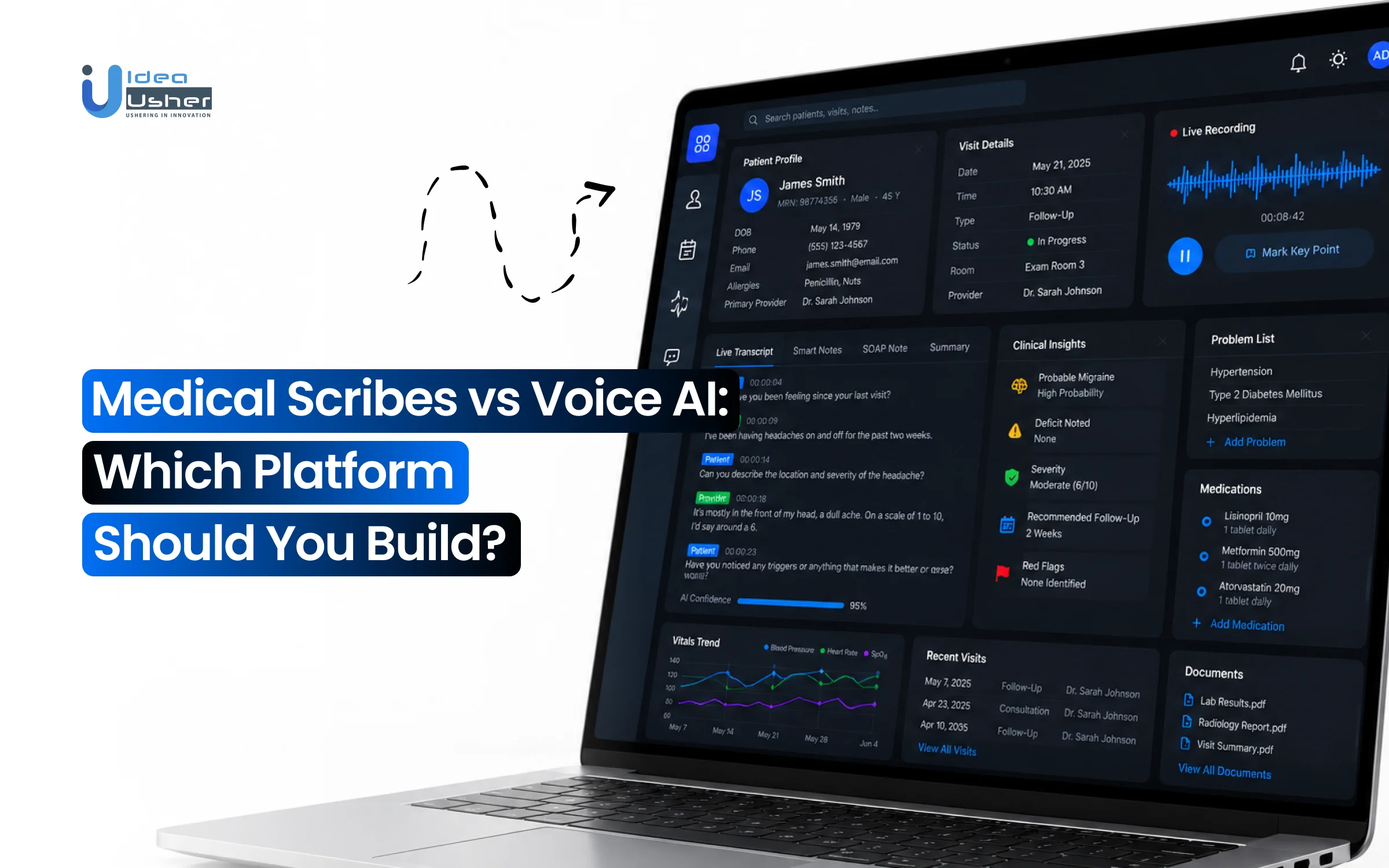
Voice AI platforms remove the human middleman to create a software-based solution. These systems use speech recognition and natural language processing to listen to the natural conversation between the clinician and the patient. The AI then generates a structured note and inserts it directly into the Electronic Health Record system.
Suki AI serves as a prime example of this model. They offer an AI-powered voice assistant that helps doctors with clinical tasks and chart updates. By focusing on software scalability, they have successfully expanded their presence and are generating estimated annual revenues near $30 million.
The technical advantages of this approach include:
- Real-time synchronization: Documentation happens as the visit progresses.
- Reduced latency: Notes are ready for review immediately after the visit ends.
- Infinite scalability: Software overhead does not increase with every new patient visit like human labor does.
- Data consistency: AI models apply uniform formatting to every note.
Which Platform Fits Your Business Goals?
For founders, the choice between human scribes and Voice AI comes down to unit economics and deployment speed. Human scribes offer a high-touch service that requires very little technical adoption from the doctor. However, the operational cost is a massive anchor on long-term profitability. Voice AI requires an initial investment in product development and clinical integration but offers much higher margins as you reach scale.
Abridge is another industry leader that demonstrates the power of this shift. They specialize in ambient listening and have seen rapid adoption across healthcare networks. Their platform captures complex clinical conversations and converts them into structured notes. Their current estimated annual revenue sits at approximately $50 million, proving that healthcare providers are eager to move toward automated solutions.
When choosing your path, consider these strategic factors:
- Capital requirements: Scribe companies require massive operational funding for labor. AI companies require capital for engineering talent and GPU compute.
- Customer stickiness: Voice AI tools become deeply embedded in the daily EHR workflow which makes them harder to replace.
- Margin expansion: AI platforms allow you to keep a significantly higher percentage of your revenue as profit once the product reaches maturity.
If you are building for the long term, software-based automation provides a cleaner path to profitability. While human scribes solve an immediate pain point, they often become an operational bottleneck. Investing in Voice AI positions your company to scale alongside the broader digital health transition.
Medical Scribes vs Voice AI: Feature-by-Feature Comparison
As healthcare providers handle more patients and growing administrative workloads, traditional documentation methods are becoming harder to sustain. This is creating a strong opportunity for startups and investors to build AI-powered documentation platforms that improve efficiency, reduce operating costs, and help healthcare organizations deliver better patient care at scale.

1. Documentation Accuracy and Clinical Quality
Medical scribes can quickly adapt to a physician’s preferred documentation style and understand the context of patient conversations. However, because the process depends on manual work, note quality can vary, and physicians still need to review the documentation before signing it. Voice AI offers a more consistent approach by automatically converting conversations into structured clinical notes.
Trained on extensive medical terminology, these systems can handle large volumes of documentation efficiently while helping reduce manual effort, though physician review remains an essential final step.
One notable player in the market is Augmedix. They combine ambient AI with remote human quality reviewers to deliver highly accurate medical notes. This hybrid approach helps ensure clinical quality while building trust with large hospital networks. Augmedix generates roughly $45 million in annual revenue, which shows strong commercial validation for their technical approach.
2. Speed, Productivity, and Workflow Efficiency
Medical scribes often need extra time after each appointment to complete and organize clinical notes. This can delay chart completion, slow down billing, and leave physicians reviewing documentation after clinic hours to make final corrections. Voice AI speeds up the entire process by generating structured clinical notes almost immediately after a patient visit.
Doctors can review and approve the documentation within minutes, reducing after-hours paperwork and allowing clinics to move patients through their schedules more efficiently.
| Metric | Human Scribe | Voice AI Platform |
| Turnaround Time | 1 to 2 hours | Immediate (seconds) |
| After-Hours Charting | Low reduction | High reduction |
| Physician Input | Moderate training | Minimal setup |
3. Scalability and Operational Costs
Expanding a medical scribe platform means hiring and training more people as new customers come on board. This makes growth slower and increases operational costs, especially for businesses serving multiple hospitals or large healthcare networks. Voice AI platforms are much easier to scale because the software can support new clinics without adding more documentation staff.
Once the system is in place, organizations can onboard more users with minimal overhead, making it a more efficient and cost-effective model for long-term growth.
| Operational Metric | Human Scribe Model | Voice AI Software Model |
| Gross Margins | 15% to 25% | 70% to 85% |
| Resource Demand | Highly labor-intensive | Highly scalable framework |
| Expansion Cost | Linear scale scaling with headcount | High initial tech build, low marginal cost |
4. Compliance and Security Standards
Medical scribe platforms require strong privacy controls because human scribes have direct access to sensitive patient information. Healthcare organizations must invest in regular HIPAA training, monitor compliance, and ensure proper patient consent whenever a third party is involved in the documentation process.
Voice AI platforms rely on built-in security features such as encryption, access controls, and detailed audit logs to protect patient data. These technical safeguards simplify compliance management and make it easier for healthcare organizations to meet enterprise security and regulatory requirements.
5. Complexity and ROI
Building a medical scribe platform is largely an operational business that depends on managing people rather than developing advanced technology. While the software requirements are relatively simple, scaling the business means continuously recruiting, training, and managing a growing workforce, which can limit long-term profitability.
Voice AI platforms require a more advanced technology stack, including speech recognition, medical AI models, and EHR integrations, but they offer much greater scalability. Companies like Mutuo Health Solutions, which generates an estimated $5 million in annual revenue, demonstrate how AI-powered documentation platforms can operate with lower overhead and grow as high-margin SaaS businesses.
Development Cost Comparison of Medical Scribes vs Voice AI Platforms
Choosing between a service-based platform and a Voice AI solution comes down to your long-term business strategy. A medical scribe platform is generally quicker to launch, while a Voice AI platform requires more upfront investment but offers better scalability, lower operating costs, and stronger long-term growth potential.
Costs for a Scribe Platform
Building a traditional medical scribe platform focuses more on creating tools to manage workflows, communication, and staff than on developing advanced AI. While the technology is relatively straightforward, long-term success depends on hiring, training, and managing a growing workforce, making it a service-driven business with higher operational costs as it scales.
| Development Phase & Operational Element | Estimated Initial Cost | Cost Type |
| Workflow Hub & Scheduling Web Apps | $40,000 to $70,000 | Fixed Upfront |
| Basic EHR Text Integration & Security APIs | $25,000 to $45,000 | Fixed Upfront |
| Scribe Recruitment & Quality Training | $30,000 to $50,000 | Ongoing Rolling |
| Management & Operational Support Software | $15,000 to $30,000 | Fixed Upfront |
| Total Initial Launch Budget | $110,000 to $195,000 | Mixed Allocation |
Costs for a Voice AI Platform
A fully automated Voice AI platform requires more investment during development because of the advanced AI technologies and secure healthcare infrastructure it relies on. The advantage is that once the platform is built, it can grow efficiently without adding large operational teams, making it easier to scale while keeping long-term costs under control.
| Core AI Engineering Component | Estimated Initial Cost | Cost Type |
| Ambient Listening & Speech Recognition Architecture | $80,000 to $120,000 | Fixed Upfront |
| Medical NLP Context Engines & Specialized LLM Tuning | $70,000 to $110,000 | Fixed Upfront |
| Advanced FHIR / HL7 EHR Integration Layer | $40,000 to $65,000 | Fixed Upfront |
| HIPAA Cloud Infrastructure & Encryption Setup | $30,000 to $50,000 | Fixed Upfront |
| Total Technical Architecture Budget | $220,000 to $345,000 | Capital Asset |
Which Platform Delivers Better Long-Term ROI?
Choosing where to invest depends on your ultimate exit strategy. Scribe operations generate rapid cash flow from day one because health clinics understand how to use human assistants immediately. However, the business model scales poorly because your expenses rise linearly with every single new contract you secure.
Voice AI shifts the financial advantage entirely in your favor over the long run. By trading initial engineering expenses for high gross margins, you build a highly scalable subscription software business. The platform can support thousands of active medical providers simultaneously without requiring a massive internal hiring drive. For founders looking to build an enterprise asset with defensive market value, software automation offers the superior path to profitability.
Can Voice AI Replace Human Medical Scribes?
The debate surrounding full automation versus human oversight is shaping the next generation of digital health investments. Analyzing whether software can completely phase out manual clinical support or if a blended framework yields the highest return is critical. Understanding where technology draws the line against human judgment is key to building a highly valuable, sticky enterprise application that healthcare networks will readily adopt.
Where Voice AI Outperforms Human Scribes
Voice AI platforms automatically convert doctor-patient conversations into structured clinical notes in real time, helping physicians complete documentation much faster. This reduces administrative work, shortens chart completion times, and allows clinicians to spend more time with patients instead of handling paperwork.
The business model is also highly scalable because software can support more users without adding large operational teams. Companies like Freed AI, which has surpassed $18 million in annual recurring revenue, show how AI-powered documentation platforms can grow quickly while keeping operating costs relatively low.
Why Human Medical Scribes Still Matter
Human medical scribes remain highly valuable in complex clinical settings where conversations are disorganized or unpredictable. A human can interpret non-verbal cues, follow chaotic storytelling from a patient, and filter out irrelevant small talk. In multi-specialty clinics or emergency rooms, the physical presence of a scribe allows them to adjust to changing workflows on the fly.
Furthermore, human scribes bring an extra layer of clinical judgment to the documentation process. They understand specific physician preferences and can ask clarifying questions when medical instructions seem incomplete. This level of adaptive support helps maintain documentation accuracy during highly nuanced patient encounters that might confuse a standard AI model.
The Future Is Human-AI Collaboration
Many healthcare organizations are adopting a hybrid approach where Voice AI creates the initial clinical notes and healthcare professionals review them before they become part of the patient’s record. This combines the speed of automation with the accuracy and oversight needed for high-quality clinical documentation.
For founders, this model offers the best of both worlds by reducing manual workload while meeting compliance requirements. Heidi Health, which has raised over $96 million in funding, is a strong example of this approach, using ambient AI to generate documentation while giving clinicians full control over reviewing and editing the final notes.
When Should You Build a Medical Scribe Platform Instead of Voice AI?
The best clinical documentation platform depends on the healthcare market you want to serve. While Voice AI is ideal for routine clinical documentation, supporting human review for complex workflows can make your solution more appealing to enterprise healthcare organizations that need greater flexibility and accuracy. This hybrid approach also gives your platform room to scale across different specialties without compromising documentation quality.
Practices That Still Depend on Human Scribes
Academic medical centers and teaching hospitals present operational realities that disrupt standard ambient listening tools. In these environments, an encounter is rarely a simple two-party conversation. It involves residents, fellows, medical students, and attending physicians discussing a single case, which creates a chaotic audio environment that software struggles to parse.
Human scribes excel here because they act as workflow coordinators. They filter out the teaching discussions from the actual patient data while populating complex, multi-layered charts. This operational agility keeps specialized, high-revenue clinics running on schedule.
| Practice Setting | Primary Operational Need | Why AI Alone Struggles | Best Product Fit |
| Teaching Hospitals | Multi-speaker filtering | Overlapping medical training dialogues | Human Scribe / Hybrid |
| Complex Oncology | Longitudinal context | Multi-year, multi-drug history synthesis | Human Scribe / Hybrid |
| Emergency Medicine | Physical task coordination | Extreme ambient noise and rapid pacing | Human Scribe |
| Geriatric Care | Patient story untangling | Slow, non-linear, disjointed patient input | Voice AI with Human Edit |
The Value of Human Judgment
Some clinical situations still benefit from human oversight, especially during sensitive consultations or complex cases where context and judgment are critical. In these scenarios, physicians often prefer to review AI-generated notes carefully or involve a trained professional to ensure the documentation accurately reflects the conversation.
Platforms like Nabla Copilot demonstrate how Voice AI works well for routine patient visits by generating clinical notes in real time while allowing physicians to edit and approve the final documentation. This combination of automation and clinician review helps improve efficiency without compromising accuracy.
Building a Hybrid Scribe Platform
A hybrid platform combines the speed of Voice AI with human oversight when it’s needed. AI can handle routine documentation automatically, while more complex cases are sent to trained reviewers. This helps healthcare organizations maintain high documentation quality without relying on a large team of full-time scribes.
Platforms like DeepCura show how this approach can be taken further with specialty-specific AI templates that produce more accurate clinical notes. By reducing the need for manual corrections, founders can build scalable documentation software that adapts to different medical specialties while keeping operational costs under control.
Build a Clinical Documentation Platform with IdeaUsher
Building a clinical documentation platform requires specialized expertise in healthcare AI, security, and interoperability rather than traditional software development. We combine deep healthcare engineering experience with modern AI technologies to help you launch a scalable, compliant product faster while reducing development risks.
Healthcare AI Expertise Beyond Development
We provide specialized engineering for complex medical software needs. The team focuses heavily on advanced speech recognition and medical natural language processing to capture complex clinical vocabulary accurately. This ensures that the system handles messy conversations and technical medical jargon perfectly from day one.
The development team builds systems tailored to the strict compliance and architectural demands of modern healthcare infrastructure. This specialized experience protects your startup from the costly security design mistakes that generic software agencies frequently make.
End-to-End Development Process
We help businesses build secure and scalable clinical documentation platforms from strategy and design to deployment. We create intuitive user experiences, integrate with leading EHR systems using standards like FHIR and HL7, and develop fully automated or hybrid AI solutions tailored to your product vision and long-term growth goals.
Build a Scalable Voice AI Platform
IdeaUsher operates as a dedicated technical partner to help you build highly valuable software assets. With over 500,000 development hours focused on advanced technology products, the team understands how to scale systems efficiently. The engineering department features seasoned ex-FAANG talent who build applications capable of supporting massive growth.
The team designs the underlying architecture to support enterprise growth from the start, allowing you to pitch major hospital networks with complete confidence. Partnering with IdeaUsher gives you the technical depth needed to turn your product vision into a highly profitable, scalable market leader.
Conclusion
Medical scribes and Voice AI both help reduce the burden of clinical documentation, but they serve different business goals. If you’re looking for a service-driven model with human oversight, a medical scribe platform can be a good fit. However, if your goal is to build a scalable healthcare SaaS product with lower long-term costs and broader market potential, Voice AI offers a stronger opportunity. The right choice depends on your target users, budget, and long-term vision, and building the platform with the right technology partner can make all the difference.
Things to Know About Clinical Documentation Platforms
A1: A clinical documentation platform helps healthcare providers create patient notes faster and with much less manual work. Instead of spending hours typing after appointments, clinicians can use AI to capture conversations, generate structured notes, and organize information directly inside their EHR. Modern platforms are designed to fit naturally into existing workflows, allowing providers to focus more on patient care while still maintaining complete and accurate medical records.
A2: The biggest difference is who creates the documentation. A medical scribe platform depends on trained professionals who listen to patient visits and prepare notes for the physician. A Voice AI platform does the same job using speech recognition, medical NLP, and generative AI. The doctor simply reviews the AI-generated note before signing it. For organizations looking to scale across multiple clinics or providers, Voice AI often becomes the more practical long-term solution because it reduces staffing needs and speeds up documentation.
A3: Yes, today’s AI documentation platforms are much more accurate than earlier generations, especially when they are trained on medical conversations. They can recognize clinical terminology, generate structured SOAP notes, and organize information in a way that’s easy for physicians to review. That said, AI is designed to assist clinicians, not replace them. The final note should always be reviewed by the healthcare provider before it becomes part of the patient’s medical record, ensuring both accuracy and compliance.
A4: Absolutely. Most enterprise-grade platforms are built to connect with leading EHR systems through standards like FHIR and HL7 or through vendor APIs. This means clinicians don’t have to copy and paste notes between systems. Instead, documentation flows directly into the patient’s chart, making the entire workflow faster, more accurate, and easier for healthcare teams to manage.


