 (+971) 8007 4267
 (+91) 946 340 7140
 (+1) 628 432 4305

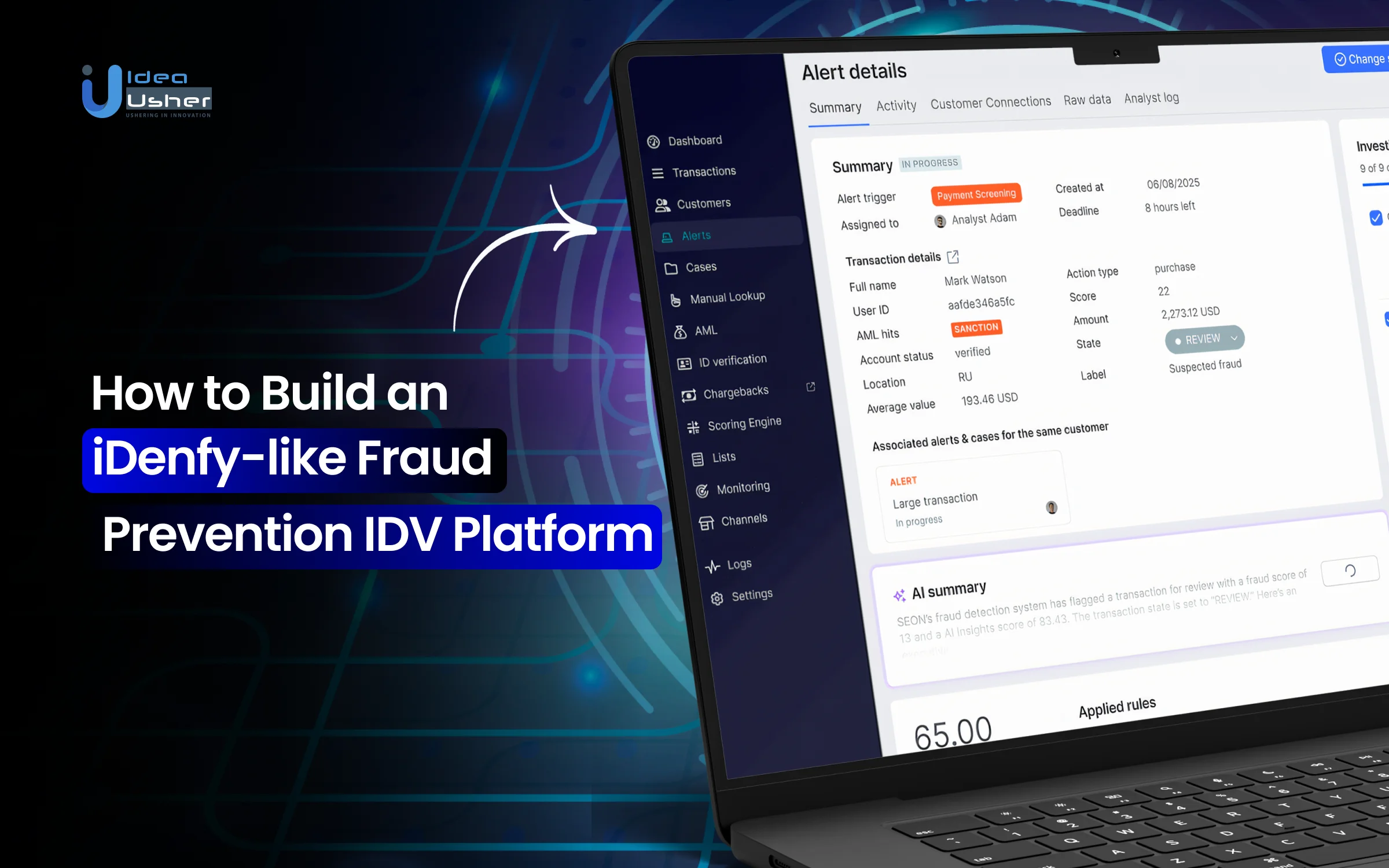
Businesses today operate in an environment where identity fraud is growing faster than ever, and the cost of a single breach can be enormous. With attacks becoming more sophisticated and verification demands rising, relying on old processes is no longer enough. A modern fraud prevention IDV platform like iDenfy helps companies stay ahead by combining speed, accuracy, and intelligent risk detection.
These platforms show how AI, biometrics, document forensics, and behavioral analytics combine to deliver secure, seamless verification. They automate ID checks, detect forgeries and deepfakes, and score risk in real time, enabling industries like fintech, gaming, ecommerce, and mobility to reduce fraud while preserving user trust.
In this guide, we explain how to build an iDenfy-like fraud prevention and identity verification platform, covering essential features, technology considerations, and integration strategies. As IdeaUsher has worked with several enterprises to build their AI solutions, we have the expertise to build and launch a secure, scalable, and compliant IDV platform.

What is a Fraud Prevention IDV Platform, iDenfy?
iDenfy is a fraud prevention and identity verification (IDV) platform that helps businesses confirm user identities, detect fraudulent activity, and stay compliant with global KYC and AML regulations. The platform combines automated document verification, biometric checks, liveness detection, and real-time fraud scoring to ensure that only legitimate users can access a service.
This platform differentiates itself through its all-in-one verification suite, which includes identity checks, fraud monitoring, sanctions screening, and transaction risk assessment. It enables companies from high-risk sectors to onboard users securely, reduce fraud losses, and maintain regulatory compliance with minimal friction.
- Full end-to-end fraud prevention, combining ID verification, transaction monitoring, and behavioral risk scoring in one unified platform.
- Hybrid verification pipeline where automated checks are backed by human oversight, improving accuracy for edge cases and reducing false declines.
- Real-time fraud intelligence, leveraging device fingerprinting, geolocation signals, and usage pattern analysis to detect bots, synthetic identities, and repeat offenders.
- Deep compliance coverage, offering built-in workflows for KYC, AML, sanctions, and age verification across different regulatory jurisdictions.
A. Business Model
iDenfy operates as a B2B identity-verification and fraud-prevention infrastructure provider that businesses integrate directly into their onboarding, compliance, and risk-management workflows.
- iDenfy provides identity verification services including document checks, biometric matching, liveness detection, fraud detection, KYB/UBO verification, and KYC/AML screening via APIs, SDKs, and simple web integrations.
- The platform is globally oriented, supporting thousands of government-issued IDs from 200+ countries and territories, enabling clients to verify users and businesses worldwide.
- It offers flexible verification flows: fully automated AI-based checks for standard or lower-risk scenarios, and hybrid flows combining AI with human review for high-risk or regulated industries.
- Its goal is to deliver fast, low-friction verification while helping clients remain compliant with identity, AML, and fraud-prevention requirements.
B. Revenue Model
iDenfy uses a usage-based and subscription-supported pricing model designed to serve startups, growing companies, and large enterprises with different verification volumes and compliance needs.
- iDenfy provides flexible plans based on verification volume and feature needs.
- Self-serve: From $1.35/verification, for small businesses with minimal monthly commitment.
- Premium: Around $1.30/verification, includes hybrid verification & extra fraud/compliance tools.
- Enterprise: < $1.00/verification for high-volume or regulated clients, with custom workflows.
- Custom enterprise contracts are available for businesses requiring tailored workflows, SLAs, dedicated support, white-labeling, or deeper AML/KYB capabilities.
- iDenfy also generates revenue through add-on compliance services, such as AML screening, sanctions/PEP monitoring, ongoing risk checks, and KYB/UBO verification, which are billed separately or embedded into custom plans.
- A partner and reseller program contributes additional recurring revenue via commission-based customer referrals and long-term collaboration agreements.
How an iDenfy-like Fraud Prevention IDV Platform Works?
An iDenfy-like fraud prevention IDV platform works by combining document verification, biometric authentication, and AI-powered fraud detection. It ensures secure user onboarding while validating identities in real time and maintaining regulatory compliance.

1. User Session Initialization
The user begins verification through a secure link as the platform creates a session token and gathers device metadata, and configures a controlled environment for document capture, biometric checks, and early fraud-signal detection.
2. Document Capture & Authenticity Screening
The user uploads their ID, which undergoes image normalization, document-edge detection, and template recognition. The system analyzes security features, MRZ zones, and barcodes using document-forensics techniques to validate authenticity before extracting structured identity data.
3. Biometric Capture & Liveness Assessment
The user takes a selfie evaluated through facial landmark mapping, quality scoring, and liveness detection. Micro-movement cues, depth signals, and texture variations help confirm real-user presence while blocking spoofing attempts, masks, or deepfake submissions.
4. Biometric Match & Identity Confirmation
The platform generates facial embeddings from the selfie and ID photo, comparing them through similarity scoring. It validates geometric alignment and texture integrity to confirm both images belong to the same person with strong confidence.
5. AML Screening & Fraud Risk Analysis
The system screens identities across sanctions, AML, and PEP databases using entity resolution logic. A real-time risk engine evaluates device fingerprints, behavioral patterns, and metadata anomalies to generate a contextual fraud-risk score.
6. Decision Output & Dashboard Review
Results from document checks, biometrics, liveness validation, and fraud analysis combine into a final verification decision. Admin teams review flagged cases, analyze risk indicators, and audit verification history through a dedicated dashboard.

Why $40 Billion in U.S. Fraud Losses by 2027 Makes a Fraud Prevention IDV Platform Essential?
The global fraud detection and prevention market, valued at $33.13 billion in 2024, is projected to reach $90.07 billion by 2030. This rapid growth highlights how enterprises worldwide are accelerating investments in advanced fraud prevention technologies driven by escalating threats and rising AI-powered fraud complexity.

Deloitte forecasts U.S. fraud losses rise from $12.3 billion in 2023 to $40 billion by 2027, a 225% surge, highlighting urgent need for modern identity verification. As digital transactions surge, organizations face escalating pressure to adopt AI-driven fraud prevention strategies to stay ahead of increasingly sophisticated attackers.
A. What Rising Fraud Losses Mean for Businesses?
As fraud accelerates, businesses face higher financial exposure, compliance pressure, and operational disruption. Modern IDV platforms help organizations stay ahead with measurable, revenue-protecting impact.
- AI-generated document fraud is up 244%, exceeding half of all document fraud and requiring automated detection to catch deepfakes and synthetic identities.
- Over 52% of enterprises save $1M+ annually, proving modern identity verification consistently delivers meaningful fraud-related cost reductions.
- A 180% rise in sophisticated fraud attacks highlights the growing need for adaptive, AI-driven IDV capable of countering complex threats.
- With a 44% global cybercrime exposure rate, identity verification has become a core operational requirement rather than optional security tooling.
B. Why a Fraud Prevention IDV Platform Is Now Essential?
AI-generated attacks like deepfakes and synthetic identities are growing faster than traditional systems can detect, making advanced IDV platforms critical for risk reduction and digital trust.
- According to The Wall Street Journal, financial institutions are facing a 700% surge in deepfake fraud, as AI-generated impersonation accelerates and demands stronger liveness detection and deepfake forensics.
- Europe has seen a 2,137% spike in deepfake attempts, signaling that AI-altered identities are escalating globally, especially in highly regulated sectors.
- 58% of fraud attempts now involve AI-powered deepfakes, revealing that traditional verification methods alone can no longer keep attackers out.
- Synthetic identity schemes continue to rise, with a 31% increase in AI-driven fake identities that require multi-layered verification using behavior, biometrics, and identity intelligence.
- AI-enabled defenses have already stopped $20 billion in fraud, according to Mastercard, demonstrating the measurable value of upgrading to advanced identity verification technologies.
Use Cases of Fraud Prevention IDV Platform Across Industries
Identity verification platforms have become essential infrastructure in a digital landscape where fraud, synthetic identities, and account takeovers are rising. Here’s how different industries use IDV technology to prevent fraud while maintaining a seamless user experience.

1. Fintech
Fintech platforms use real-time document and biometric verification to stop synthetic identity fraud, automate KYC and AML compliance, reduce manual reviews by 70 percent, support age verification for investment products, and maintain seamless onboarding experiences.
Real-world example: Revolut uses automated IDV to onboard millions of users globally, verifying government IDs and selfies in under 60 seconds while maintaining regulatory compliance across 35+ countries and reducing fraud losses significantly.
2. Banking & Lending
Banks rely on multi-layered IDV for digital account opening, loan verification, and secure wire transfers. It prevents account takeovers and synthetic identities, combats social engineering attacks, meets regulations, and completes verification checks in under sixty seconds.
Real-world example: Chime implements biometric IDV during account opening and high-value transactions, achieving 40-60% reduction in new account fraud while onboarding customers instantly without branch visits or lengthy paperwork processes.
3. Crypto Exchanges & Web3 Platforms
Crypto platforms perform IDV for onboarding, KYC compliance, and fiat on-ramp checks. Biometric re-authentication protects large withdrawals, stops account takeovers, ensures sanctions-screening compliance, and maintains the fast verification speed required for irreversible blockchain transactions.
Real-world example: Coinbase implements comprehensive IDV with document verification and liveness detection for all users, processing millions of verifications monthly while meeting Travel Rule requirements and preventing over $280 million in potential fraud annually.
4. Healthcare
Healthcare organizations use identity verification to stop medical identity theft, authenticate telemedicine patients, reduce insurance fraud, and secure prescription pickups. Biometric confirmation aligns treatments with correct patient records while maintaining HIPAA compliance and safeguarding sensitive health data.
Real-world example: Teladoc implements identity verification before virtual consultations and controlled substance prescriptions, verifying patient identities through document checks and biometrics while preventing prescription fraud and ensuring DEA compliance across telehealth services.
5. Real Estate
Real estate platforms verify buyers and owners to prevent wire fraud, enable remote notarization with verified digital signatures, and authenticate property transfers. IDV protects high-value deals from $100,000 to $500,000 and eliminates common title fraud attempts.
Real-world example: Notarize.com combines IDV with remote online notarization, verifying signer identities through knowledge-based authentication and biometrics, processing millions of legally-binding real estate documents while preventing wire fraud in property transactions.
Key Features Required in an iDenfy-like Fraud Prevention IDV Platform Development
Developing an iDenfy-like fraud prevention IDV platform requires a comprehensive set of features that guarantee accuracy, security, and regulatory compliance. Below are the key capabilities your platform must include to launch a competitive identity verification solution.

1. Global ID Document Verification Engine
The platform must validate passports, national IDs, licenses, and residence permits using template-matching models, spectral pattern checks, and document-forensics techniques. It analyzes microprint, MRZ integrity, and security elements to ensure high-confidence global ID authentication.
2. OCR + Automated Data Extraction
AI-driven OCR pipelines perform structured extraction from MRZ zones, barcodes, and hologram text using sequence-recognition models and field-level validation. The system applies semantic parsing and cross-checking logic to detect inconsistencies and auto-populate identity fields with precision.
3. Biometric Face Match + Liveness Detection
Selfie verification uses deep-learning facial embeddings, geometric alignment, and similarity scoring. Integrated liveness detection runs texture analysis, depth cues, and micro-movement tracking to block spoofing, replay attacks, and advanced manipulation attempts.
4. Hybrid Verification (AI + Human Review)
Automated decision engines process high-volume checks while human analysts validate anomalies and borderline cases. This dual-layer verification pipeline reduces error rates by combining algorithmic confidence scores with expert interpretation for ambiguous identity scenarios.
5. Proof-of-Address Verification
The system authenticates utility bills and bank statements using layout reconstruction, document-structure analysis, and metadata correlation. It cross-references extracted fields with user-submitted data to meet enhanced KYC and regulatory proof-of-residency requirements.
6. AML/PEP/Sanctions Screening
AML workflows screen individuals in real time through entity-resolution algorithms, fuzzy matching, and multilingual data normalization. The engine checks global sanctions lists, PEP datasets, and adverse media to help organizations maintain consistent regulatory compliance.
7. Business KYB & UBO Verification
KYB modules perform registry lookups, corporate identity extraction, and UBO graph mapping to reveal ownership structures. The system correlates filings, directors, and beneficial owners using structured data matching to detect high-risk or opaque corporate entities.
8. AI-Powered Fraud Detection
Fraud models analyze behavioral telemetry, device fingerprints, and anomaly-detection signals to spot synthetic identities or suspicious activity. A real-time risk engine scores users based on contextual attributes, transaction context, and cross-session inconsistencies.
9. AI Deepfake & Synthetic Media Detection
The platform identifies tampered content using GAN-pattern analysis, face-render inconsistency detection, and image artifact modeling. It flags deepfake videos, synthetic faces, and manipulated ID documents by analyzing generative footprints and unnatural pixel patterns.
10. Customizable Verification Flows
Verification intensifies or relaxes based on context-aware decision logic, behavioral inputs, and geo-risk indicators. Dynamic workflows adjust in real time, ensuring strong fraud defense while preserving a low-friction user experience during identity onboarding.

How to Build an iDenfy-like Fraud Prevention IDV Platform
Building an iDenfy-like fraud prevention IDV platform involves integrating AI-driven identity verification, biometric authentication, and real-time fraud detection. A well-designed system ensures secure onboarding while meeting global compliance standards efficiently.

1. Consultation
We begin by consulting with your team to understand business goals, verification objectives, fraud challenges, and compliance needs. Our experts analyze onboarding flows, user risk segments, and operational constraints to craft a tailored identity strategy that supports scalability, accuracy, and long-term platform resilience.
2. User Journey & Verification Flow Design
We design intuitive verification journeys that reduce friction while reinforcing security. This involves mapping document capture moments, biometric checkpoints, and risk-aware decision paths so every step supports smooth onboarding without compromising fraud prevention or regulatory compliance standards.
3. Architecture & System Blueprinting
We define a modular system blueprint that separates identity processing, fraud analytics, and compliance logic. This ensures scalable verification operations, efficient request handling, and adaptive behavior as fraud tactics shift, user volumes increase, or new regulatory requirements emerge.
4. Document Verification Engine Development
Our developers create structured pipelines for document capture, authenticity checks, and data extraction. The engine applies document-forensics rules, security-element inspection, and intelligent consistency checks to accurately verify global IDs across varying lighting, format complexity, and capture conditions.
5. Biometric Matching & Liveness Engine Development
We build facial matching and liveness modules using calibrated comparison logic, motion analysis, and anti-spoofing techniques. These systems detect depth inconsistencies, micro-movements, and synthetic visual artifacts to ensure accurate identity confirmation while blocking manipulated or fraudulent submissions.
6. Fraud Detection & Behavioral Risk Scoring Development
We implement a dedicated AI-powered risk engine that evaluates device fingerprints, metadata relationships, and behavioral signals. The engine generates a dynamic risk score using anomaly detection and contextual profiling to highlight suspicious sessions or synthetic identity attempts in real time.
7. Compliance, AML, PEP & Sanctions Integration
We integrate automated screening workflows aligned with relevant AML and KYC obligations. Our developers apply entity-matching logic, risk-flag detection, and audit-ready reporting so your platform stays compliant with regional sanctions lists, PEP records, and evolving regulatory frameworks.
8. Admin Dashboard & Case Management Setup
We build a centralized dashboard that enables teams to review cases, assess risk signals, and track performance metrics. The dashboard includes case prioritization tools, verification insights, and operational controls that streamline fraud-handling workflows across different user risk levels.
9. Testing & Fraud Scenario Validation
We perform extensive QA cycles that simulate fraud attempts, edge-case submissions, and document irregularities. Our validation process ensures high verification accuracy, consistent fraud detection, and stable system behavior before the platform moves into production environments.
10. Launch & Ongoing Support
We deliver continuous updates as fraud patterns evolve, refining rules, enhancing detection logic, and adjusting compliance workflows. Our team keeps the platform future-ready by improving accuracy, reducing false positives, and strengthening fraud resilience across all verification scenarios.
Cost to Build a Fraud Prevention IDV Platform
The cost to build an iDenfy-like fraud prevention IDV platform depends on features, technology, and compliance requirements. Investing in AI-powered verification, biometric authentication, and fraud detection ensures a secure and scalable solution.
| Development Phase | Description | Estimated Cost |
| Consultation | Defines goals and compliance needs through focused discovery and fraud-risk analysis. | $4,000 – $7,000 |
| User Journey & Verification Flow Design | Creates smooth verification steps with risk-aware flows and secure user pathways. | $5,000 – $8,000 |
| Architecture & System Blueprinting | Builds a modular architecture for scalable identity and fraud operations. | $6,000 – $10,000 |
| Document Verification Engine Development | Develops ID-validation pipelines using document forensics and structured extraction. | $10,000 – $20,000 |
| Liveness Engine Development | Implements facial matching and liveness with anti-spoofing logic. | $14,000 – $25,000 |
| AI Fraud Detection Development | Creates a real-time engine using anomaly signals and behavioral insights. | $17,000 – $32,000 |
| Compliance, AML, PEP & Sanctions Integration | Adds screening workflows with regulatory alignment and automated checks. | $10,000 – $14,000 |
| Admin Dashboard & Case Management Setup | Builds dashboards for case review, risk insights, and monitoring. | $7,000 – $13,000 |
| Testing & Fraud Scenario Validation | Runs document tests, fraud simulations, and biometric accuracy validation. | $5,000 – $9,000 |
| Launch & Ongoing Support | Updates fraud rules, compliance workflows, and performance tuning over time. | $7,000 – $17,000 |
Total Estimated Cost: $66,000 – $128,000
Note: Actual development costs vary with fraud-detection complexity, verification depth, regulatory requirements, and long-term optimization needs.
Consult with IdeaUsher to get a tailored cost estimate and a strategic roadmap for building a secure, compliant, and scalable fraud prevention IDV platform aligned with your business goals.

Factors Affecting The Cost of The Development
Several key factors influence the cost of developing an iDenfy-like fraud prevention IDV platform, from features to technology and compliance requirements.
1. Feature Depth and Verification Complexity
More advanced capabilities such as biometrics, liveness, and fraud-pattern analysis require additional engineering and model calibration, which increases overall development time and cost.
2. Global Document Coverage Requirements
Supporting many document types requires template mapping, localized rules, and extended QA, making broader document coverage more resource intensive and costlier.
3. Sophistication of Fraud Detection Models
Real-time risk scoring, device intelligence, and anomaly-detection models demand deeper algorithm design and continuous tuning, raising development and maintenance costs.
4. Compliance and Regulatory Obligations
Integrating AML, PEP, sanctions, and audit workflows requires regulatory alignment, robust verification logic, and extra reporting layers, which increases project complexity and budget.
5. Scalability and Performance Expectations
High-volume onboarding environments require low-latency pipelines, optimized architecture, and performance safeguards, contributing to higher development and infrastructure costs.
Challenges & How to Overcome?
Developing an iDenfy-like fraud prevention IDV platform comes with technical, regulatory, and security challenges. Implementing scalable architecture, AI-driven verification, and robust compliance measures helps overcome these hurdles effectively.
1. Accurate Global Document Recognition
Challenge: Handling global IDs with varying structures, damaged visuals, and inconsistent capture quality makes document authenticity detection difficult across diverse environments.
Solution: We enhance recognition using adaptive OCR, template classification, and document-forensics analysis. Our team expands datasets, tunes extraction logic, and validates security elements to deliver consistently accurate recognition across worldwide ID formats.
2. Achieving Reliable Biometric Matching
Challenge: Inconsistent lighting, angles, and device quality reduce biometric comparison accuracy and risk false approvals or rejections during face-matching flows.
Solution: We apply face-quality scoring, geometric alignment, and optimized embedding models. Controlled capture guidance and calibrated thresholds ensure strong biometric precision and consistent performance across unpredictable real-world conditions.
3. Blocking Deepfakes & Synthetic Media
Challenge: Fraudsters increasingly use deepfakes, masks, and manipulated visuals, making liveness checks harder and increasing the risk of synthetic identity attacks.
Solution: We deploy multi-layered anti-spoofing classifiers, temporal consistency checks, and texture analysis. Our models identify synthetic artifacts, detect replay attempts, and strengthen real-user verification against advanced generative manipulation techniques.
4. Maintaining Real-Time Risk Scoring
Challenge: High-volume verification sessions create latency issues when computing risk scores using device, behavioral, and metadata signals in real time.
Solution: We optimize scoring workflows through lightweight rule engines, signature caching, and anomaly-detection logic. The system correlates behavioral and device patterns within milliseconds, maintaining smooth verification performance during peak loads.
5. Secure Handling of Sensitive Identity Data
Challenge: Managing biometric data, ID visuals, and fraud signals introduces significant data protection challenges and increases exposure risks.
Solution: We enforce encrypted transport, controlled access policies, and tamper-resistant storage. Continuous security testing, monitoring, and vulnerability assessments keep sensitive identity information protected across all verification stages.
Conclusion
Building a Fraud Prevention IDV Platform equips businesses with the tools to detect and prevent identity fraud efficiently. By integrating advanced verification methods, real-time monitoring, and AI-driven risk analysis, organizations can secure their operations while maintaining seamless user experiences. Such platforms not only reduce financial losses but also build customer trust by safeguarding sensitive information. Implementing a robust Fraud Prevention IDV Platform ensures regulatory compliance, enhances operational efficiency, and prepares businesses to handle evolving digital threats with confidence and accuracy.
Why Choose IdeaUsher for Your Fraud Prevention IDV Platform Development?
IdeaUsher delivers comprehensive IDV solutions that protect businesses from identity fraud using real-time verification, AI-based risk scoring, and multi-layer authentication to safeguard user data and transactions.
Why Work with Us?
- Fraud Detection Expertise: Our platforms integrate biometric checks, dynamic liveness detection, and risk scoring to detect fraud attempts accurately.
- Tailored Risk Workflows: We design verification and monitoring flows specific to your business model, compliance needs, and threat profile.
- Security-First Infrastructure: We build secure IDV systems with encrypted data handling, audit logs, and compliance-ready architecture
- Scalable & Maintainable Systems: Our solutions adapt to growth and evolving security standards without sacrificing performance or reliability.
See our portfolio to explore completed projects where we delivered secure, real-time identity verification and fraud prevention platforms.
Get in touch to start building your own Fraud Prevention IDV platform with confidence.


FAQs
A Fraud Prevention IDV Platform is a system designed to detect and prevent identity fraud in real-time. It combines biometric verification, AI-driven risk scoring, and document authentication to safeguard businesses and users from fraudulent activity.
Essential features include AI-powered identity verification, liveness checks, multi-layer authentication, document verification, and real-time risk assessment. These elements ensure accurate detection of fraudulent attempts while maintaining a smooth user experience.
By continuously verifying user identities and monitoring suspicious activity, the platform minimizes financial loss, prevents account takeovers, and ensures regulatory compliance. It also builds trust by safeguarding sensitive personal and transactional data.
Technologies like artificial intelligence, machine learning, biometric recognition, optical character recognition, and secure cloud storage are used to detect fraud patterns, verify identities, and maintain reliable, real-time monitoring of all user interactions.


