

Key Takeaways
- Slips is a peer-to-peer betting app where users wager against each other instead of a house, which is what makes a zero-fee model structurally possible in the first place.
- The platform runs four contest formats: Heads Up, Pools, Tourlays, and AI-Generated Predictions, plus a Create Bet feature for custom wagers on anything.
- Zero-fee does not mean zero revenue. Slips monetizes through subscription tiers, in-app purchases, and payment spreads rather than a built-in margin on every bet.
- Slips reports more than 150,000 users and over $6 million in cumulative winnings, built on a $3.5 million seed round.
- A comparable zero-fee social betting app typically costs $60,000 to $350,000 to build, depending on whether it launches as a social MVP or a full AI-powered prediction platform.
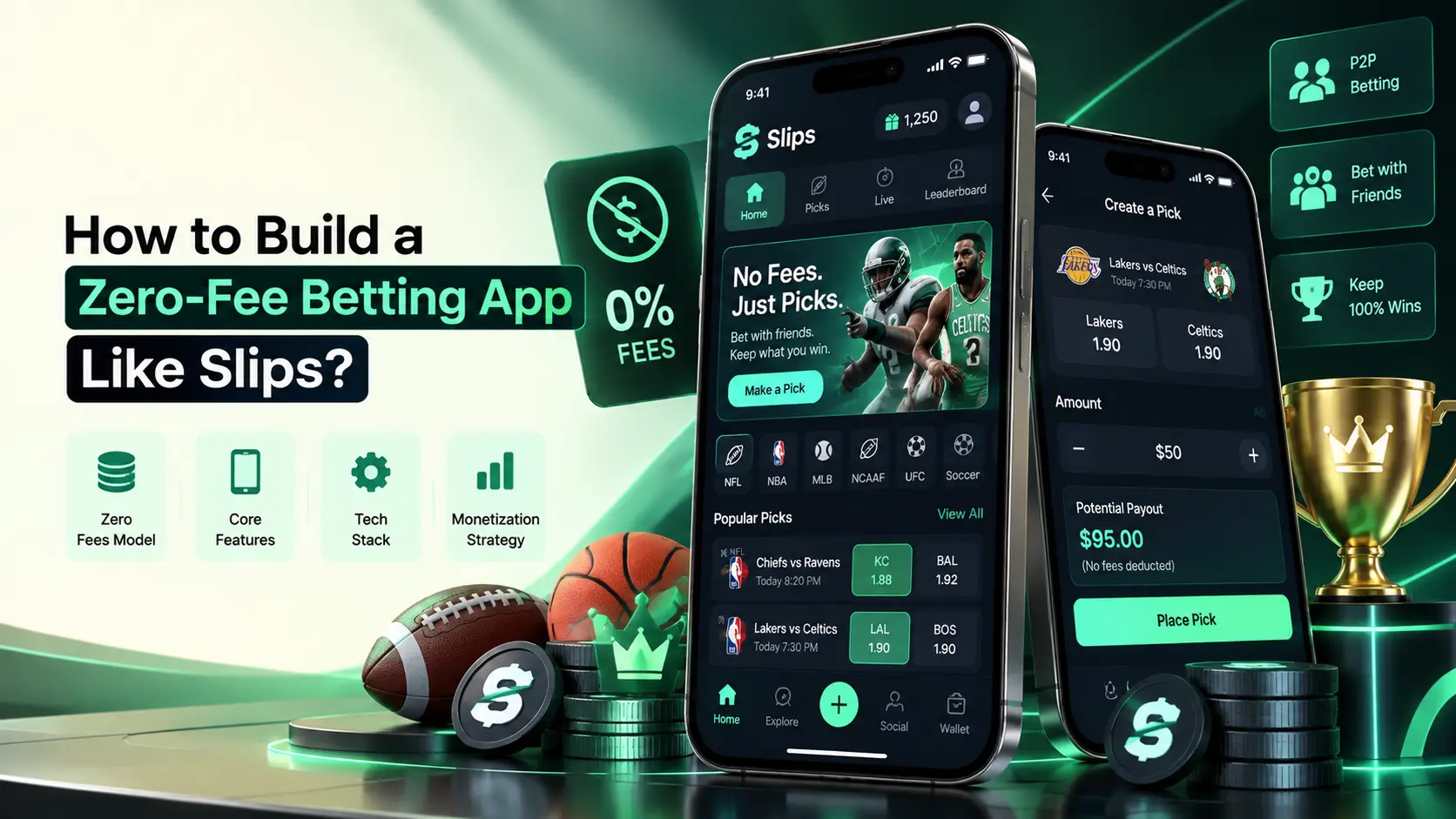
Every sportsbook makes money the same way: it prices a margin into the odds and collects it whether you win or lose. Slips built its entire product around removing that margin, letting users create bets, challenge friends in a group chat, and settle peer-to-peer with no fee taken out of the middle. Founder and CEO Jess Richman put the pitch bluntly at the platform’s September 2026 launch, saying that every other operator “is doing the same thing with different logos, you against the house.” The result is a genuinely different product shape, and a genuinely different revenue model behind it. This guide breaks down how Slips works, how a zero-fee platform actually earns money, and what it takes to build a comparable app with Idea Usher.
What Is Slips and What Does Zero-Fee Actually Mean?
Slips is a peer-to-peer betting platform operated by Slips Technologies, Inc. out of Los Angeles. The core positioning is that players bet against each other, not the house. The platform matches counterparties, holds the stakes, and processes settlement without ever taking a position on either side of a wager.
That structural choice is what makes zero-fee possible. A traditional sportsbook is the counterparty to every bet it accepts, so it has to price a margin into the odds to stay solvent. A platform that never takes a position does not carry that risk, so it does not need that margin. At launch, Slips introduced zero fees on peer-to-peer bets between friends alongside zero-fee ACH deposits, with membership tiers determining how many free transactions a user gets.
The distinction matters for anyone planning a build. Zero-fee is not a promotion or a discount. It is a consequence of the architecture, and it only works if the revenue model is designed around something other than the wager itself.
How Slips Works: Four Contest Formats
Slips runs four distinct wagering formats, each of which changes how the matching engine has to behave under the hood.
| Format | How It Works | What It Demands From the Build |
|---|---|---|
| Heads Up | One-on-one, winner-takes-all challenge between two users | Simple two-sided matching and escrow |
| Pools | Group betting where the pot is split among winners | Multi-party stake pooling and proportional payout logic |
| Tourlays | Tournament-style parlays where streaks build and one wrong call ends the run | Sequential leg tracking and elimination logic |
| AI-Generated Predictions | Markets the platform’s AI layer creates, prices, and settles automatically | Automated market generation, pricing, and resolution |
Create Bet and the Social Layer
The feature that anchors the whole product is Create Bet, which lets users wager on anything at all, not just listed sports markets. Sports outcomes, life events, and inside jokes are all fair game, and the bet gets created, sent, and settled inside a group chat with images, reactions, and one-tap bet sending.
This is the part most teams underestimate when they scope a build like this. The social layer is not a nice-to-have wrapped around a betting engine. On a platform where users supply both sides of every wager, the chat is the liquidity mechanism. No social graph means no counterparties, and no counterparties means no product, a dynamic covered in Idea Usher’s breakdown of peer-to-peer sports betting app development.
The AI Prediction Layer
Slips later added an AI layer that automatically generates, prices, and settles markets across sports, politics, entertainment, finance, and trending culture topics, with stated plans to expand into futures, commodities, and political outcomes. Richman framed it as the natural next step, saying prediction markets are “the natural evolution of peer-to-peer gaming, and AI is the engine that makes it limitless.”
Functionally, this solves the cold-start problem that every peer-to-peer platform hits. When users are not creating enough markets themselves, the AI creates them, prices them, and resolves them in real time, so there is always something to bet on. Idea Usher covers this same architecture pattern in its guide to AI in gambling apps.
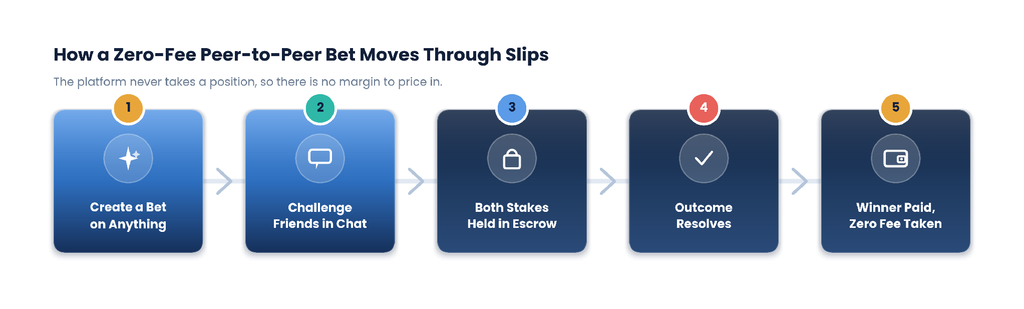
How a zero-fee peer-to-peer bet moves through Slips: create a bet on anything, challenge friends in chat, both stakes held in escrow, outcome resolves, winner paid with zero fee taken
How a Zero-Fee Platform Actually Makes Money
This is the question every founder asks about this model, and it has a clear answer: the revenue moves from the wager to the account.
- Subscription tiers: Slips runs Player, Premium, and Whale membership levels, with premium tiers advertising up to 75 percent off fees and 5x rewards
- In-app purchases: Slipper at $4.99 and Slipper Plus at $14.99, with annual options running from $49.99 to $149.99
- Contest fees on non-free activity: Free transactions are capped by membership tier, so heavy users convert
- Payment processing spreads: Margin captured on the deposit and withdrawal rails themselves
The strategic logic is worth sitting with. A sportsbook earns more when a user loses. A subscription platform earns more when a user stays. Those two incentive structures produce completely different products, and the second one is far easier to defend when regulators, app stores, and users all start scrutinizing how operators treat winning accounts. Idea Usher’s analysis of how a platform like Novig makes money walks through the same shift in a no-vig context.
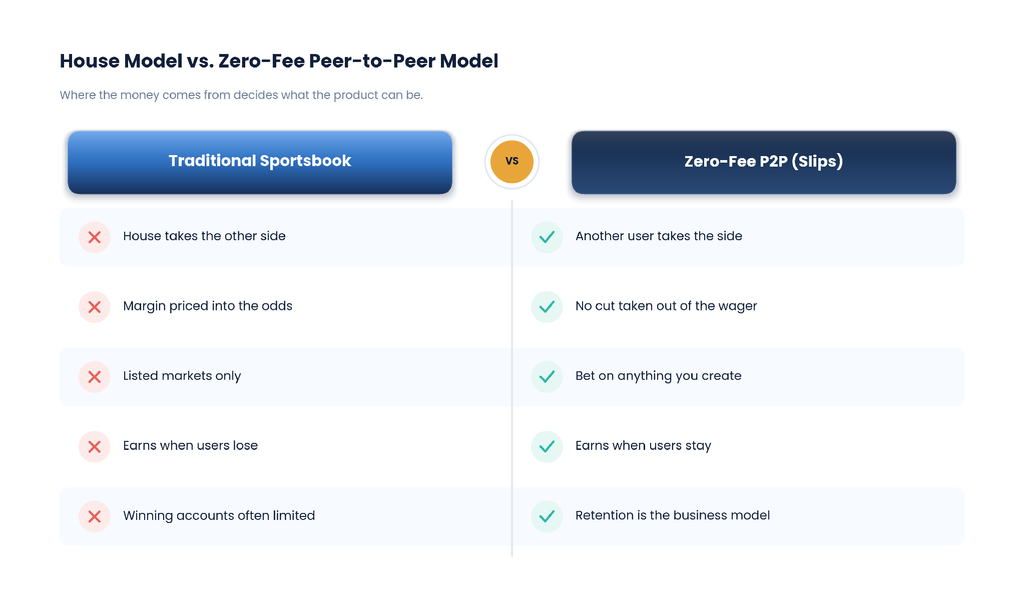
A traditional sportsbook takes the other side of every bet and prices a margin into the odds, while a zero-fee peer-to-peer platform like Slips matches users against each other and earns through retention instead
Slips by the Numbers
Slips reports more than 150,000 users and over $6 million in cumulative winnings since launch, built on a $3.5 million seed round backed by Sunset Bay Capital, Trousdale Ventures, Watertower Ventures, and WSOP champion Jason Mercier, alongside professional sports team owners. These are company-reported figures rather than audited numbers, but they establish that the zero-fee model has cleared real traction rather than staying theoretical.
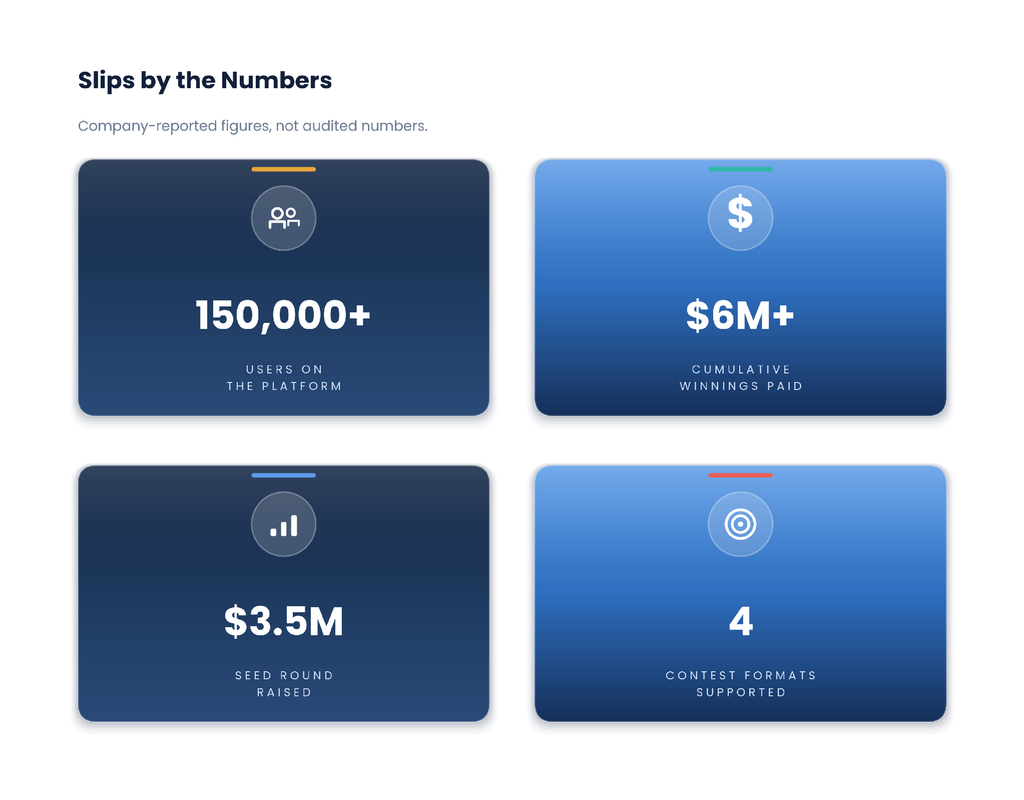
Slips by the numbers: 150,000+ users on the platform, $6M+ in cumulative winnings paid, a $3.5M seed round raised, and 4 contest formats supported
How Slips Compares to Sportsbooks and Other P2P Platforms
| Factor | Traditional Sportsbook | Slips Zero-Fee P2P |
|---|---|---|
| Counterparty | The house takes the other side | Another user takes the other side |
| Revenue source | Margin priced into every bet | Subscriptions, in-app purchases, payment spreads |
| What you can bet on | Listed markets only | Any custom bet a user creates |
| Social mechanics | Isolated bet slip | Group chat, challenges, one-tap sending |
| Incentive on winners | Often limited or restricted | Retention is the business model |
| Market creation | Oddsmakers and pricing models | Users plus an AI market generator |
Slips sits in the same broad category as platforms like Rebet and BettorEdge, but the emphasis is different. Where BettorEdge focuses on no-vig odds and exchange mechanics and Rebet leans on its peer-to-peer betting feature, Slips is built around social betting between people who already know each other, closer in spirit to a social sports prediction platform like ParlayPlay than to a conventional exchange.
How to Build a Zero-Fee Betting App Like Slips
Building a zero-fee betting app means building three systems that have to work together perfectly: a matching and escrow engine that never takes a position, a social layer that generates liquidity, and a subscription system that carries the revenue the wagers no longer do.
Core Features Checklist
- Custom bet creation that accepts any user-defined outcome, not just listed markets
- Matching and escrow engine that holds both stakes until resolution
- Multiple contest formats covering one-on-one, pooled, and parlay-style play
- Group chat with images, reactions, and one-tap bet sending
- Wallet supporting card, Apple Pay, PayPal, and ACH, with fast payouts
- KYC and identity verification at onboarding
- Geo-fencing mapped to each state’s specific rules, with 18-plus and 21-plus handling
- Subscription and rewards engine with tiered fee benefits
- Dispute resolution workflow for contested custom bets
- Optional AI market generation, pricing, and auto-settlement layer
The Matching and Escrow Engine
This is the heart of the build. The platform has to accept a stake from each side, hold both in escrow, resolve the outcome, and release funds automatically, all without the operator ever holding a position. That last constraint is what keeps the model legally distinct from a sportsbook, and it has to be enforced in the architecture rather than in policy.
Custom bets add a wrinkle a conventional sportsbook never faces. When two friends bet on something no data feed tracks, the system needs a resolution path: mutual confirmation, an appointed judge, an AI audit, or an escalation workflow. Getting this wrong is the fastest way to generate support tickets and chargebacks.
Tech Stack for a Zero-Fee Betting App
- Frontend: React Native or Flutter for mobile-first delivery, React or Next.js for web
- Backend: Node.js, Python, or Go for matching, escrow, and settlement services
- Database: PostgreSQL for transactional records, Redis for live contest state
- Real-time infrastructure: WebSockets for chat, live contests, and instant notifications
- Payments: A processor supporting card, Apple Pay, PayPal, and same-day ACH
- AI layer: LLM-driven market generation with automated outcome auditing and resolution
- Compliance: KYC provider, geo-fencing service, and responsible gaming controls
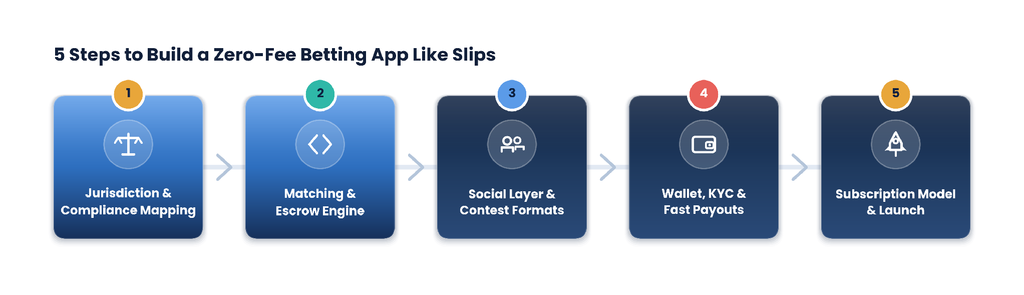
5 steps to build a zero-fee betting app like Slips: jurisdiction and compliance mapping, matching and escrow engine, social layer and contest formats, wallet, KYC and fast payouts, subscription model and launch
Development Cost and Timeline
| Tier | Core Features Included | Cost Range | Timeline | Best For |
|---|---|---|---|---|
| Social MVP | Heads Up bets, group chat, wallet, manual settlement review | $60,000 to $100,000 | 10 to 14 weeks | Testing whether the social graph actually drives wagering |
| Full P2P Platform | All contest formats, escrow engine, KYC, geo-fencing, subscriptions, fast payouts | $100,000 to $200,000 | 4 to 7 months | Most founders launching a compliant, market-ready zero-fee app |
| AI Prediction Platform | Automated market generation, pricing and settlement, multi-category markets, advanced rewards | $200,000 to $350,000 or more | 7 to 12 months | Platforms scaling beyond sports into broader prediction markets |
Feature-level costs break down further, since each system is scoped and built separately:
| Component | Estimated Cost |
|---|---|
| Matching and escrow engine | $20,000 to $55,000 |
| Wallet, ACH, and instant payouts | $18,000 to $45,000 |
| Social layer with group chat and challenges | $15,000 to $40,000 |
| KYC, geo-fencing, and responsible gaming | $10,000 to $28,000 |
| Subscription and rewards system | $8,000 to $22,000 |
| AI market generation and auto-settlement | $30,000 to $80,000 |
| Web and mobile apps | $20,000 to $60,000 |
Legal review, state-by-state licensing analysis, and payment processor onboarding are typically scoped as separate line items outside these ranges. Idea Usher’s breakdown of sports betting app development costs covers how these variables move on a conventional build for comparison.
Common Mistakes to Avoid
- Underbuilding the payout rails. Slips advertises same-day ACH payouts, yet a meaningful share of its App Store reviews complain about verification delays and slow withdrawals. On a zero-fee platform, payout speed is the product promise, and failing it damages trust faster than any missing feature.
- Treating the social layer as cosmetic. Chat and challenges are the liquidity engine on a P2P platform, not decoration around a betting screen.
- Launching without a dispute workflow. Custom bets on anything means outcomes no data feed can resolve, and that needs a real process before launch rather than a support inbox after it.
- Assuming the subscription revenue appears on its own. The tier structure has to be designed alongside the fee model from day one, because there is no vig backstop if conversion underperforms.
- Treating geo-fencing as a single national toggle. Availability is state-specific, with 18-plus in some jurisdictions and 21-plus in others, and the rules have to be enforced per user and per contest type.
Why Partner With Idea Usher to Build Your Zero-Fee Betting App
A zero-fee betting app lives or dies on three things: escrow that never breaks, payouts that clear fast, and a compliance layer that keeps up with a moving regulatory picture. Idea Usher has spent over a decade building exactly this category of money-moving software.
Over 10 Years Building Money-Moving Software
Idea Usher has operated for more than 10 years with a team of 250-plus specialists across AI, blockchain, and fintech development, with direct experience building wallets, escrow systems, and settlement infrastructure rather than standard consumer apps.
Peer-to-Peer Betting and Social Wagering Architecture
Idea Usher’s peer-to-peer sports betting app development practice is built around matching engines, escrow-backed contests, and the real-time social infrastructure that peer-to-peer liquidity depends on.
Compliance Mapped Before the Build Begins
Builds run through a staged process: requirements and jurisdiction mapping, architecture and UX design, core engine development, payment and KYC integration, testing, and deployment, with legal and regulatory work happening before the majority of the engineering budget is spent.
A Track Record Backed by Real Numbers
Idea Usher has delivered more than 1,000 projects across 50-plus countries, holds a 95 percent client retention rate, and carries Clutch recognition as a top app development and top blockchain company for 2026.
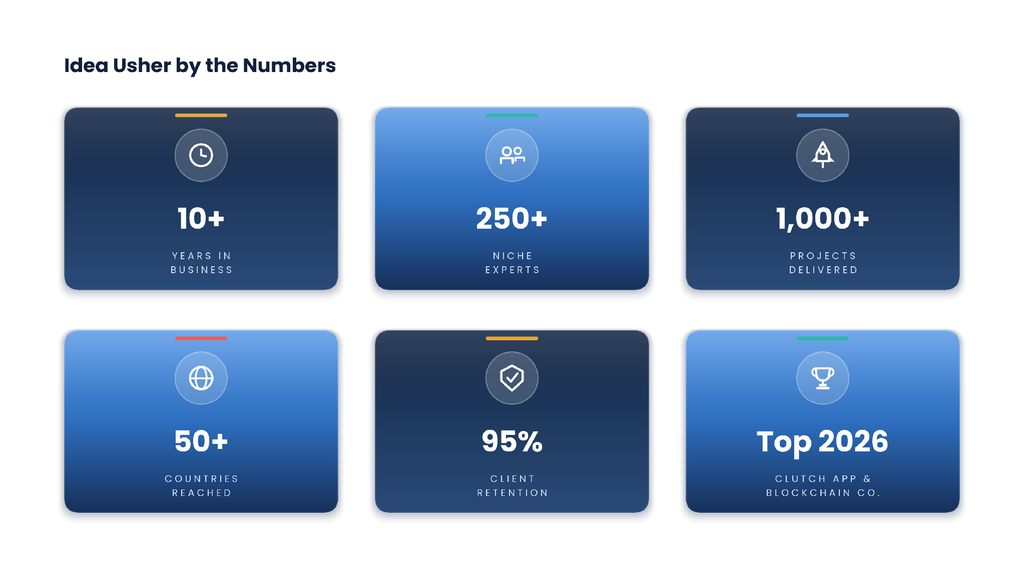
Idea Usher by the numbers: 10+ years in business, 250+ niche experts, 1,000+ projects delivered, 50+ countries reached, 95% client retention, Top 2026 Clutch App and Blockchain Company
If you are scoping a zero-fee or peer-to-peer betting app, talk to Idea Usher’s team about your peer-to-peer sports betting app development options, or book time directly with Nitish Garg to walk through your escrow architecture, payout rails, and compliance requirements.
Conclusion
Slips works because it moved the revenue off the wager and onto the account, and that single decision reshapes everything downstream. The platform never takes a position, so it never needs a margin. It earns through subscriptions instead, which means it makes more money when users stay rather than when users lose. For founders building in this space, the takeaway is that zero-fee is not a pricing gimmick to bolt onto a sportsbook. It is an architecture decision that has to be made before the first line of code, and it only holds up if the escrow engine, the social layer, and the subscription model are designed as one system.
FAQs
What does zero-fee betting actually mean?
It means the platform takes no cut out of the wager itself. Users stake against each other and the winner collects the full pot, with the operator earning revenue through subscriptions, in-app purchases, and payment rails instead of a built-in margin.
How does Slips make money if it charges no fees on bets?
Through membership tiers (Player, Premium, and Whale), in-app purchases ranging from $4.99 to $149.99 annually, capped free transactions that push heavy users to upgrade, and margin on payment processing.
Is Slips available everywhere in the United States?
No. Slips operates only in specified legal states, with users required to be 18 or older and 21 or older in some jurisdictions.
How much does it cost to build an app like Slips?
A comparable zero-fee social betting app typically costs $60,000 to $350,000 depending on scope, with a market-ready full P2P platform achievable for $100,000 to $200,000 in 4 to 7 months.
What is the hardest part of building a zero-fee betting app?
The escrow and settlement engine, since it has to hold both stakes and release funds automatically without the operator ever taking a position, alongside a dispute resolution path for custom bets that no data feed can settle.
Do I need a sportsbook license to launch a peer-to-peer betting app?
It depends on the jurisdiction and the exact mechanics. Peer-to-peer platforms are regulated differently from sportsbooks in many states, which is why jurisdiction mapping has to happen before the build rather than after it.
Can AI generate betting markets automatically?
Yes. Slips uses an AI layer that creates, prices, and settles markets across sports, politics, entertainment, finance, and culture, which solves the cold-start problem when users are not creating enough markets themselves.