


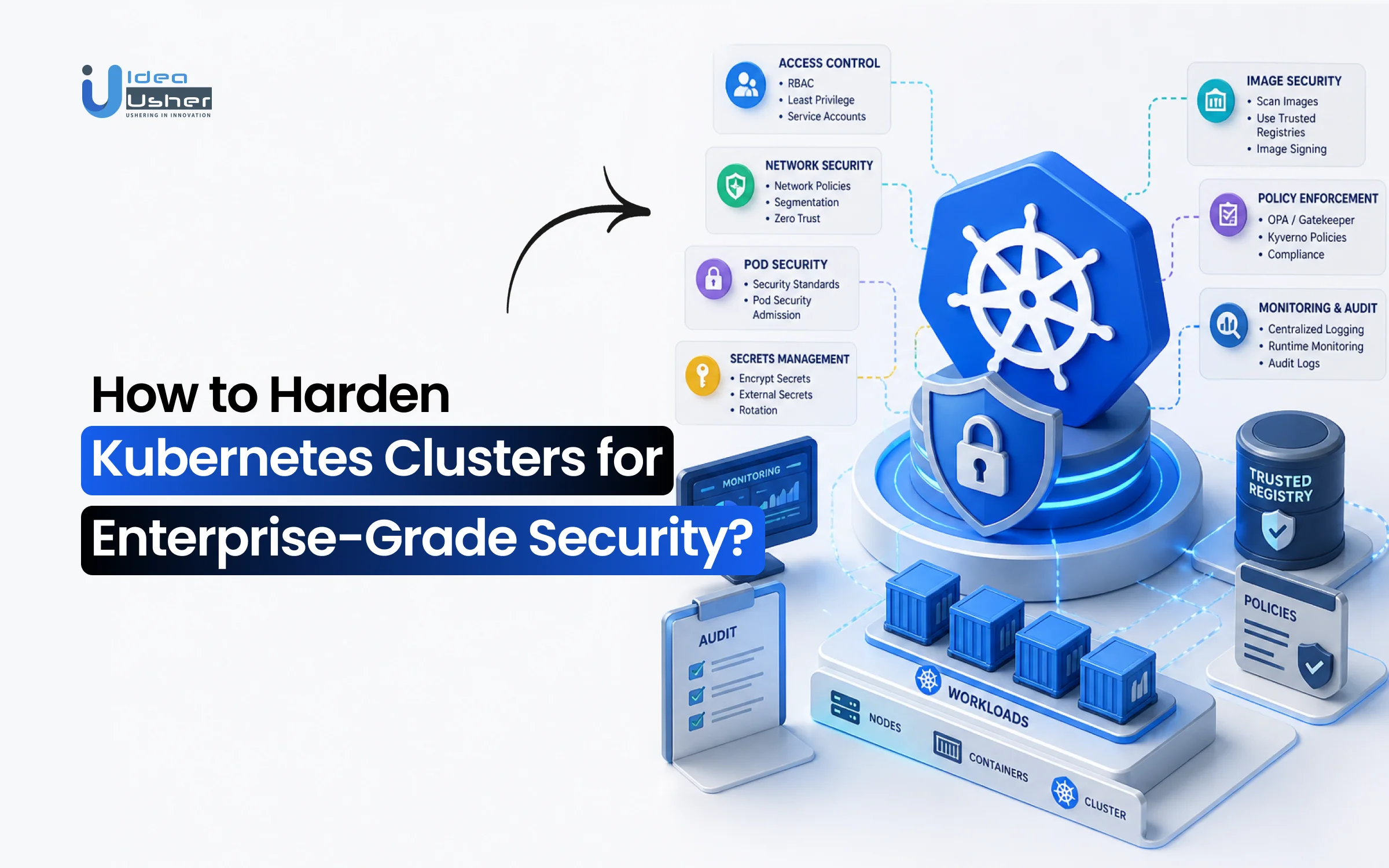
Key Takeaways
- Clusters remain vulnerable because security is treated as an afterthought, causing misconfigurations and weak settings.
- Hardening requires a continuous approach that secures systems while enforcing Zero Trust and access control.
- Unhardened clusters pose risks including data breaches, unauthorized access, compliance failures, and downtime.
- Enterprise security depends on DevSecOps, monitoring, and expert execution to balance protection with speed.
- How Idea Usher helps harden Kubernetes clusters for enterprise-grade security with its pre-vetted developers.
What if your Kubernetes cluster becomes less secure every time you deploy? Most enterprises still treat security as a checkpoint, something applied after workloads are built and shipped. That approach fails in environments defined by constant change, ephemeral workloads, and decentralized ownership. Clusters are no longer static assets. They are continuously evolving systems where risk compounds silently.
Faster releases, microservices sprawl, and GitOps pipelines mean security decisions are distributed, not centralized. In this model, misconfigurations and excessive permissions are the default state, not edge cases. Hardening Kubernetes now requires more than layered defenses. It demands security embedded across the entire lifecycle, from build to runtime.
We’ve hardened and scaled Kubernetes clusters across complex, multi-environment setups, addressing real-world misconfigurations, access risks, and runtime blind spots. In this blog, we break down how to secure clusters through practical controls and system-level decisions that strengthen protection without slowing down delivery.
Why Most Kubernetes Clusters Remain Exposed?
According to Virtue Market Research, in 2025, the Kubernetes Security Market was valued at approximately USD 1.95 billion and is projected to reach around USD 6.77 billion by 2030, growing at a CAG of 28.2% over the forecast period from 2026 to 2030. This aggressive capital allocation underscores a critical reality for modern enterprises: while Kubernetes has won the war for container orchestration, the complexity of securing these environments has created a massive, lucrative, and dangerous gap in the market.

Source: Virtue Market Research
For an investor or entrepreneur, this data signals a pivotal shift from adoption to fortification. Most clusters remain exposed not because of a lack of available tools, but because of systemic failures in how these environments are architected and managed. When scaling a platform, the focus is almost always on velocity, which means getting features to market and ensuring the infrastructure can handle the load.
Security is frequently treated as a secondary layer to be bolted on later, which, in a distributed system like Kubernetes, is a recipe for catastrophic failure.
Security as a Deployment Afterthought
In the race to achieve Product-Market Fit, speed is the primary currency. Engineering teams are often incentivized to push code quickly, leading to a deploy now, secure later culture. In the context of Kubernetes, this manifests as clusters being spun up with minimal security scaffolding. Hardening a cluster by implementing Network Policies, Pod Security Standards, and Secrets Management requires time and deep expertise that often conflicts with aggressive development timelines.
From a strategic perspective, treating security as an afterthought creates significant security debt. Much like technical debt, this carries an interest rate that eventually becomes unpayable. Retrofitting security into a live production environment is exponentially more expensive and disruptive than building it into the initial CI/CD pipeline. For decision-makers, this means that the initial cost savings of a quick and dirty deployment are illusory. They are simply deferred costs that will resurface during a security audit or, worse, a breach.
Vulnerabilities in Default Configurations
Kubernetes was originally designed for extensibility and ease of use within trusted internal networks, not for the hardened requirements of the modern public cloud. Consequently, many out-of-the-box settings favor functionality over restriction. By default, pods within a cluster can often communicate with any other pod across namespaces, and service accounts may have overly permissive access to the API server.
Professional-grade deployments require a Zero Trust approach from day one. This involves several critical technical shifts:
- Restricting Inter-pod Communication: Implementing a default-deny network policy to ensure only authorized traffic flows between services.
- Limiting API Access: Hardening the control plane and ensuring that the Kubernetes API is not exposed to the public internet without rigorous authentication and IP whitelisting.
- Resource Constraints: Setting limits on CPU and memory to prevent a single compromised or runaway container from crashing the entire node, which is a common vector for Denial of Service attacks.
DevOps and Security Ownership Gaps
There is a frequent organizational no-man’s land that exists between the DevOps teams who build the infrastructure and the Security teams who are tasked with protecting the enterprise. DevOps teams prioritize uptime and deployment frequency, while Security teams prioritize risk mitigation. When these two functions operate in silos, Kubernetes security becomes a casualty of fragmented responsibility.
To bridge this gap, successful platforms adopt a DevSecOps philosophy where security is integrated into the automated delivery pipeline. This is not just a cultural shift. It is a business requirement. Ownership must be clearly defined to cover specific operational needs:
- Patching Management: Determining who is responsible for updating the underlying nodes and container runtimes.
- Image Integrity: Establishing who manages the container image scanning and vulnerability triaging.
- Identity and Access: Assigning the duty of rotating certificates and managing RBAC (Role-Based Access Control) permissions.
Without a clear RACI matrix, critical vulnerabilities inevitably slip through the cracks.
Overreliance on Cloud Provider Defaults
A common misconception among entrepreneurs is the belief that utilizing a managed service like Amazon EKS, Google GKE, or Azure AKS absolves them of security responsibilities. While cloud providers do an excellent job of securing the infrastructure of the cloud, including physical servers and the control plane, the security in the cloud remains the sole responsibility of the customer.
Managed services often come with sane defaults intended to help a developer get started in minutes. However, these defaults are rarely sufficient for a production-grade enterprise application handling sensitive financial or personal data. For instance, a cloud provider might manage the control plane, but if the user deploys a container with root privileges or leaves a dashboard exposed without a password, the cloud provider cannot prevent the resulting exploit. Strategic investment in Kubernetes requires a team that understands exactly where the provider’s responsibility ends and yours begins.

What Does Kubernetes Hardening Actually Mean?
Hardening a Kubernetes environment is a rigorous process of securing the entire ecosystem by eliminating unnecessary functionality and reinforcing defensive barriers. For an entrepreneur, this represents the transition from a proof-of-concept to a bankable, enterprise-ready platform. It is the architectural equivalent of moving from a glass house to a reinforced vault.
In the current landscape, hardening is not a one-time configuration but a continuous state of operational excellence. It requires a vertical approach to security, ensuring that every layer, from the physical or virtual hardware to the code running in the container, is scrutinized and restricted. When you invest in hardening, you are essentially investing in the long-term viability and reputation of your digital asset.
1. Securing the Three Pillars
A comprehensive hardening strategy must address the three primary pillars of the Kubernetes architecture. Failure in any one of these areas compromises the integrity of the entire system, creating a vulnerability that can be exploited to gain unauthorized access. Understanding these pillars is essential for evaluating the technical maturity and risk profile of a platform.
- The Control Plane: This is the brain of your operation. Hardening here means securing the API server, etcd (the cluster database), and the scheduler. If an attacker gains access to etcd, they effectively own your entire platform. Business logic dictates that these components must be isolated from the public internet and encrypted at rest.
- The Worker Nodes: These are the muscle. Hardening the underlying operating system (like using a container-optimized OS) and ensuring that the Kubelet is configured to reject unauthorized requests is vital.
- The Workloads: This is where your actual application lives. You must ensure that containers are not running as root and that they have restricted access to the host filesystem.
Strategic Insight: Treat your infrastructure as immutable. Instead of patching a running node, replace it with a fresh, pre-hardened image. This eliminates configuration drift and ensures a consistent security posture across the fleet.
2. Minimizing Attack Surfaces
Reducing the attack surface is the art of giving an attacker as little to work with as possible. In a standard Kubernetes deployment, there are far too many open doors. Hardening involves systematically closing them, ensuring that your infrastructure is no longer a soft target for automated exploits.
Consider the following technical checklist for surface reduction:
| Component | Hardening Action | Business Impact |
| Network | Implement CNI-level encryption | Prevents data sniffing between services |
| Images | Use Distroless base images | Reduces the number of exploitable binaries |
| Metadata | Disable cloud metadata APIs | Prevents lateral movement to cloud providers |
| Binaries | Remove shells from production | Stops attackers from executing manual commands |
By stripping away everything that is not strictly necessary for the application to function, you create an environment where there is simply no room for an intruder to hide or pivot.
3. Implementing Zero Trust
The principle of Least Privilege is the cornerstone of a secure investment. In many failed ventures, developers are given cluster-admin rights for the sake of speed. This is a massive liability. Hardening means implementing granular Role-Based Access Control, where every user and every service has only the exact permissions they need to perform their job.
Zero Trust takes this a step further by assuming that the network is already compromised. In a Zero Trust Kubernetes environment, identity is the new perimeter. Every request, whether it comes from a developer in your office or a microservice within the cluster, must be authenticated, authorized, and encrypted. This is often achieved through a Service Mesh, which provides mTLS (mutual TLS) by default, ensuring that even if a pod is breached, the attacker cannot communicate with other parts of the system without valid cryptographic credentials.
4. Achieving Strategic Alignment
Hardening should not be performed in a vacuum; it must serve the broader business objectives. For an entrepreneur, this means ensuring that your technical security posture meets the compliance requirements of your target market, such as SOC2, HIPAA, or PCI-DSS.
True alignment means:
- Visibility and Auditability: You cannot secure what you cannot see. Hardening includes setting up comprehensive logging and monitoring so that every action within the cluster is recorded and can be audited.
- Scalable Governance: As your platform grows from one cluster to many, your hardening rules must scale automatically. Using Policy-as-Code allows you to set guardrails that prevent non-compliant workloads from ever being deployed.
- Cost-Effective Risk Mitigation: By identifying the most critical data paths and hardening them first, you optimize your security spend, focusing resources where they provide the highest protection for your most valuable assets.
Business Risks of Unhardened Kubernetes Clusters
When a Kubernetes environment is left in its default state, the risks extend far beyond technical glitches; they become existential threats to the enterprise. For entrepreneurs and stakeholders, an unhardened cluster represents a high-stakes gamble with company valuation and market trust. In the world of large-scale digital platforms, security is not a luxury; it is a prerequisite for stability and investor confidence.

1. Unauthorized Workload Access
The greatest danger in a containerized environment is lateral movement. If an attacker gains access to a single, non-critical pod, an unhardened cluster provides them with a roadmap to the rest of your infrastructure. Without proper isolation, a vulnerability in a public-facing web server can be leveraged to gain administrative control over the entire orchestration layer.
Risk Profile: The Domino Effect
An attacker exploits a known vulnerability in a third-party library. Due to a lack of RBAC restrictions, the compromised pod uses its default service account to query the Kubernetes API, discovers sensitive internal services, and begins exfiltrating proprietary algorithms or intellectual property.
This type of unauthorized access often goes undetected for months. By the time the intrusion is identified, the attacker may have established multiple backdoors, making the recovery process both long and expensive.
2. Data Breaches from Misconfiguration
Data is the most valuable asset of any modern platform, and in Kubernetes, it is often exposed through simple configuration oversights. Misconfigured secrets management or publicly accessible etcd instances can lead to the immediate exposure of database credentials, API keys, and customer PII (Personally Identifiable Information).
- Secret Sprawl: Hard-coding credentials in container images or storing them in unencrypted ConfigMaps.
- Insecure Volume Mounts: Allowing containers to access sensitive host paths, potentially exposing the underlying node data.
- Exposed Dashboards: Leaving administrative interfaces open to the internet without multi-factor authentication.
The financial impact of a data breach is not limited to the immediate loss of data. It includes the cost of forensic investigations, legal fees, and the long-term erosion of brand equity. For a growing company, a single significant breach can be a company-killer event.
3. Compliance and Regulatory Failures
For platforms targeting enterprise clients or regulated industries, compliance is a non-negotiable barrier to entry. An unhardened cluster will fail to meet the rigorous requirements of frameworks such as SOC2, HIPAA, or GDPR. These standards require proof of encryption, strict access controls, and comprehensive audit trails, which are features not enabled by default in Kubernetes.
| Standard | Requirement | Unhardened Risk |
| SOC2 | Principle of Least Privilege | Overly permissive RBAC leading to audit failure |
| HIPAA | Encryption of Data in Transit | mTLS not enforced, exposing patient data to sniffing |
| PCI-DSS | Network Segmentation | Flat network allows traffic between payment and non payment pods |
Failure to maintain compliance does more than invite regulatory fines; it disqualifies your platform from the lucrative enterprise market. Decision makers in large corporations will not risk their own compliance status by partnering with a vendor whose infrastructure is a known liability.
4. Downtime from Exploited Flaws
A breach is not always about stealing data; sometimes, the goal is disruption. Attackers can leverage unhardened clusters for cryptojacking, which involves using your compute resources to mine cryptocurrency. This spikes your cloud costs and starves your applications of CPU and memory. Even more devastating is a Ransomware as a Service attack that encrypts your cluster’s persistent volumes, bringing your entire business to a standstill.
The cost of downtime is calculated not just in lost revenue per hour, but in the permanent loss of users who move to more reliable competitors. A platform that cannot guarantee uptime due to security instability is a platform that cannot scale. Hardening is the insurance policy that protects your operational continuity against an increasingly hostile digital landscape.
Where Kubernetes Clusters Are Most Vulnerable?
Identifying specific failure points is the difference between a high-performing asset and a liability. While Kubernetes is modular and powerful, its distributed nature means the blast radius of a single vulnerability can be immense. For those overseeing technical investments, hardening Kubernetes is the only way to ensure engineering teams focus defensive efforts where they matter most, as vulnerability is rarely about a bug in the code and almost always about the architectural choices made during setup.

1. API Server Exposure
The API server is the gateway to everything in Kubernetes. It is the central management hub that receives every command to create, modify, or delete resources. If this gateway is inadequately protected, the entire cluster is essentially public property, leaving your core business logic and sensitive data exposed to anyone with a basic internet connection.
- The Threat: Many clusters are deployed with the API server exposed to the public internet, relying solely on basic authentication or weak tokens.
- The Solution: Use OpenID Connect or cloud-native IAM integration to ensure that only authenticated, multi-factor-verified users can reach the endpoint.
- Professional Insight: Private Link or VPN-only access to the API server should be a standard requirement for any platform handling sensitive data.
2. Over-permissive RBAC Roles
Role-Based Access Control is often the most misconfigured component in the stack. In the push for agility, developers are frequently granted cluster-admin privileges, or service accounts are given broad permissions across all namespaces just to avoid permission denied errors during testing.
Technical Debt Warning: Excessive RBAC permissions are a form of silent risk. Unlike a service outage, you won’t know you have an RBAC problem until an attacker uses a compromised pod to list all the secrets in your cluster.
Effective hardening requires a transition to namespace-scoped roles. By confining service accounts to the specific namespace they operate in and granting only the verbs they strictly require, you prevent a compromised microservice from becoming a launchpad for a cluster-wide takeover.
3. Insecure Runtime Configurations
The container is the final unit of execution, and its configuration determines how much of the underlying host it can see or manipulate. Most default configurations allow containers to run with far more system capabilities than necessary, effectively granting an attacker a direct path to the underlying server hardware if the application layer is breached.
- Privileged Containers: Running a container as privileged gives it nearly the same access as the host machine itself. This should be strictly forbidden in production.
- Root Execution: Most containers do not need to run as the root user. Hardening involves enforcing non-root policies at the pod level.
- Writable Filesystems: Allowing a container to write to its own root filesystem makes it easier for an attacker to download and execute malicious scripts. Using a read-only root filesystem forces the application to use designated, secure volumes.
4. Lack of Network Policies
By default, Kubernetes uses a flat network model. This means that every pod can talk to every other pod, regardless of whether they belong to the same application or have any business reason to communicate. This lack of segmentation is a gift to attackers seeking to move laterally, as it allows a single compromised low-level service to probe and exploit high-value backend systems without resistance.
| Network State | Security Posture | Risk Level |
| Default (Flat) | Open communication across all namespaces | Critical: Lateral movement is effortless |
| Namespace Isolation | Restricted traffic between logical groups | Moderate: Prevents cross-app contamination |
| Zero Trust (mTLS) | All traffic is encrypted and verified by identity | Low: Maximum defense against sniffing |
Implementing Network Policies acts as an internal firewall. By defining a default-deny posture and only whitelisting specific traffic paths, such as the Frontend talking only to the API, you effectively neutralize the threat of lateral movement even if one component is compromised.
Key Layers of Kubernetes Cluster Hardening
Building a defensible cluster requires a layered approach, often referred to as Defense in Depth. For any organization, hardening Kubernetes means ensuring that even if one layer of the stack is compromised, the subsequent layers prevent the attacker from causing meaningful damage. By focusing on these distinct tiers, you transform a fragile deployment into a resilient enterprise platform.
1. Control Plane Security
The control plane is the nervous system of your cluster. If it is compromised, the entire environment is lost. Security here focuses on shielding the API and the data store (etcd) from unauthorized eyes, ensuring that the central intelligence of your infrastructure remains inaccessible to malicious actors.
- Audit Logging: Enable detailed logging to track who did what and when. Without this, you are flying blind during a security incident.
- Encryption at Rest: Ensure that all secrets stored in etcd are encrypted using a provider-managed key.
- API Shielding: Restrict API access to authorized IP ranges and use a bastion host or VPN for administrative tasks.
2. Node and Kubelet Security
Nodes are the actual servers where your applications run. Hardening the node means reducing the footprint of the host operating system and tightening the Kubelet, which is the agent that runs on every node, to prevent unauthorized command execution at the hardware level. This systematic stripping of unnecessary services minimizes potential entry points, ensuring each server remains a single-purpose, highly secure execution environment.
Operational Standard: Use Container Optimized operating systems. These versions strip away non-essential packages like SSH or package managers, leaving no tools for an attacker to use even if they gain host access.
Additionally, the Kubelet should be configured to disable anonymous access and require X.509 client certificates for authentication. This ensures that only the control plane can tell a node what to do.
3. Workload and Container Controls
This layer is where your actual application code resides. Since this is the most likely entry point for an attacker, the controls here must be the most stringent to prevent code-level exploits from expanding into cluster-wide threats. By enforcing strict security boundaries at the workload level, you ensure that even a successful application breach is contained within a restricted sandbox, preventing the theft of sensitive keys or lateral movement across the infrastructure.
- Security Contexts: Define exactly what a container can do. Use settings to disallow privilege escalation and enforce a read-only root filesystem.
- Image Scanning: Integrate automated scanning into your CI/CD pipeline to block images with known vulnerabilities from ever reaching the cluster.
- Admission Controllers: Use tools like Gatekeeper or Kyverno to enforce policies. For example, you can create a rule that says no container can run as root, and the cluster will automatically reject any deployment that violates this.
4. Network Policies and Isolation
In a hardened environment, the network is no longer a free-for-all. Traffic isolation ensures that a breach in a frontend service does not lead to a breach in the backend database, effectively trapping an intruder in a single, isolated segment. By implementing granular network policies that only allow verified traffic paths, you eliminate the inherent trust of a flat network and ensure that your most sensitive data stores remain invisible to unauthorized components.
- Default Deny: Start with a policy that blocks all traffic.
- Micro-segmentation: Explicitly allow only the specific ports and protocols required for services to communicate.
- Egress Control: Limit which external websites or APIs your pods can talk to. This prevents a compromised pod from calling home to an attacker’s command and control server.
| Policy Type | Purpose | Security Benefit |
| Ingress | Controls incoming traffic | Blocks unauthorized external probes |
| Egress | Controls outgoing traffic | Prevents data exfiltration to the internet |
| Intra-Namespace | Limits traffic within a group | Prevents lateral movement between pods |
5. Identity and Access Management
Identity is the new perimeter. Rather than relying on simple passwords, enterprise hardening utilizes centralized Identity Providers. By integrating Kubernetes with your corporate Single Sign On, you can ensure that when an employee leaves the company, their cluster access is revoked instantly across all environments. This Identity First approach eliminates the risk of ghost accounts and orphaned credentials that are often the target of sophisticated attacks.
Step-by-Step: How to Harden Kubernetes Clusters
In our experience partnering with numerous organizations to secure their production environments, we have found that executing a security strategy requires a methodical approach that moves from the outside in. For any team we advise, hardening Kubernetes is not a one-time configuration but a series of deliberate steps designed to eliminate default trust.

1. Secure API Access
We always start with the API server, as it is the brain of the cluster. To protect it, we ensure it is not reachable by the general public and that every request is strictly authenticated, ensuring the central intelligence of your infrastructure remains inaccessible to malicious actors. By implementing strict mutual TLS and isolating these components within a private network, we create a foundational layer of trust that protects every other resource in the system.
- Disable Anonymous Auth: We ensure the anonymous auth flag is set to false to prevent unprivileged requests.
- Use Firewalls: We limit access to the API server to a specific set of management IP addresses or private endpoints.
- Enable TLS: We always deploy high-quality certificates for all encrypted communication.
2. Implement Strict RBAC
Role-based access control is the primary tool we use for enforcing the principle of least privilege. We move organizations away from shared administrative accounts toward granular, identity-based permissions, ensuring that every user and service has the minimum level of access required to perform its function.
Our Hardening Rule: We never use the default service account for applications. We create a unique service account for every workload and assign it only the specific permissions it needs to function.
Effective RBAC management involves regular audits where we identify and prune inactive roles or overprivileged bindings that may have accumulated during the development cycle.
3. Enforce Network Isolation
Without network policies, we find that most clusters are far too open. We implement a strategy that treats every pod as a potential threat. By implementing granular network policies that only allow verified traffic paths, we eliminate the inherent trust of a flat network and ensure that your most sensitive data stores remain invisible to unauthorized components.
- Default Deny: We apply a policy to every namespace that drops all incoming and outgoing traffic by default.
- Explicit Whitelisting: We create specific rules that allow the web tier to talk to the API tier and the API tier to talk to the database.
- Cross Namespace Block: We ensure that pods in a production namespace cannot communicate with those in a development environment.
4. Harden Runtime and Images
The security of a cluster is only as good as the code running inside it. By enforcing strict security boundaries at the workload level, we ensure that even a successful application breach is contained within a restricted sandbox, preventing the theft of sensitive keys or lateral movement across the infrastructure.
- Immutable Images: We use minimal base images to remove shells and package managers that attackers love.
- Rootless Execution: We configure the security context to ensure containers run as a non-privileged user by default.
- Read-Only Filesystems: We prevent attackers from installing malware by making the container root filesystem non-writable.
5. Enable Audit and Monitoring
Security is a game of visibility. If we are not logging API requests, we will not know when an attacker is probing your defenses. Audit logs provide the forensic trail we need to understand the scope of a breach and meet compliance requirements, giving us the ability to reconstruct events and close security gaps before they are exploited again.
| Component | What we Monitor | Why it Matters |
| API Server | What we monitor | Identifies unauthorized changes |
| Kubelet | Container restarts and host access | Detects potential host escapes |
| Network | Denied connection attempts | Flags lateral movement patterns |
6. Continuous Security Scanning
We treat hardening as an ongoing cycle, not a one-time task. As new vulnerabilities emerge and configurations drift with continuous deployments, risks can quietly build up. By regularly validating and remediating issues, we ensure your security posture evolves alongside the threat landscape and stays consistently strong throughout the application lifecycle.
- Automated Scanning: We use tools to scan images in your registry and run containers for newly discovered vulnerabilities.
- Configuration Validation: We run periodic checks against benchmarks to ensure your settings have not reverted to insecure defaults.
- Drift Detection: We implement admission controllers that block any deployment that does not meet our defined security standards.
Common Mistakes in Kubernetes Hardening
Even with the best intentions, we often see teams fall into predictable traps that leave their infrastructure exposed. Hardening Kubernetes is an intricate process, and a single oversight can render several other security layers ineffective. Drawing from our experience helping various organizations, we have identified the most frequent missteps that undermine cluster integrity.
1. Over-permissive Access Roles
The most frequent error we encounter is the privilege creep associated with RBAC. In the rush to meet deployment deadlines, it is tempting to grant broad permissions to resolve immediate blockers. However, this creates a significant security debt that is difficult to repay later.
The Admin Trap: We often see service accounts or user roles granted cluster admin privileges because it is the path of least resistance. This is the equivalent of giving every employee a master key to the entire building.
By failing to define specific roles for specific tasks, organizations lose the ability to contain a breach. If a developer’s credentials are stolen and they have unnecessarily high privileges, the attacker instantly gains the keys to the kingdom.
2. Ignoring Network Segmentation
Many teams operate under the false assumption that being inside a private cloud network is enough protection. We have seen how this crunchy shell, soft center approach fails during an active incident, as it relies entirely on a perimeter that can be bypassed by a single phished credential or a flawed application.
- Lateral Movement: Without network policies, an attacker who compromises a single, low risk pod can move freely to your most sensitive database pods.
- Unrestricted Egress: Allowing pods to talk to any external IP makes it trivial for malicious code to exfiltrate your proprietary data or download further attack payloads.
- Flat Architecture: A lack of segmentation means you are relying on every single application to be perfectly secure. This is a statistical impossibility.
3. Skipping Audit Logs and Monitoring
If a tree falls in a forest and no one is there to hear it, does it make a sound? In Kubernetes, if an attacker deletes a namespace and you are not logging, you will never know who did it or how. We find that many organizations treat logging as an afterthought or a cost to be minimized rather than a core security pillar.
| Mistake | Resulting Blind Spot |
| No API Audit Logs | You cannot track who modified cluster resources. |
| Silent Denials | You miss the warning signs of an attacker probing your network. |
| No Host Monitoring | You will not notice when a container escapes to the underlying node. |
Without a robust monitoring strategy, you are essentially flying a plane without a black box. When something goes wrong, you have no data to help you prevent the next crash.
4. Using Outdated Container Images
The velocity of modern software is a double-edged sword. We often find production environments running images that are months or even years out of date. These zombie images contain known vulnerabilities that scanners would have flagged if a continuous process were in place.
- Hidden Vulnerabilities: Old base images often contain outdated libraries with critical security flaws.
- Bloated Attack Surface: Using generic, heavy images instead of minimal distroless images gives an attacker more tools to use against you.
5. Treating Hardening as a One-time Task
The most dangerous mistake is the check-the-box mentality. We have seen organizations perform a massive hardening effort at launch, only to let the posture degrade as new features are added and configurations drift. Hardening is a living process. As we work with teams, we emphasize that the threat landscape changes every single day.
A configuration that was secure last month might be vulnerable today due to a new exploit. By failing to integrate security into the daily operational rhythm, organizations create a false sense of security that eventually leads to a critical failure.
Why Execution Is the Biggest Challenge?
In our work with diverse engineering teams, we have observed that the gap between security theory and operational reality is where most projects fail. Hardening Kubernetes sounds straightforward on paper, but the actual execution requires balancing ironclad protection with the need for developer speed. Most organizations do not lack the desire to be secure; they lack the specialized expertise to implement these changes without bringing their entire production environment to a standstill.
1. Complex Multi-layered Architecture
Kubernetes is not a single piece of software but an orchestration of dozens of moving parts. We have seen how this complexity creates a massive cognitive load for teams. Securing the stack requires expertise in networking, Linux internals, cloud provider identity systems, and the Kubernetes API itself.
- The Interdependency Problem: Changing a setting in the Kubelet can break the Container Runtime, while a strict Network Policy can suddenly disconnect a vital logging service.
- Version Drift: Because the ecosystem moves so fast, a hardening guide that worked six months ago might be incompatible with the latest version of your ingress controller.
2. Maintaining Uptime
The biggest fear we hear from CTOs is that a security team will roll out a policy that causes a massive outage. This tension often leads to a standstill where security is sacrificed for the sake of uptime, leaving known vulnerabilities unpatched to avoid the risk of a service disruption.
The Reality of Refusal: We frequently encounter environments where security settings remain at their weak defaults simply because the team is afraid that changing a security context or blocking a port will cause a cascading failure in a legacy microservice.
To solve this, we advocate for a dry run approach where policies are logged but not enforced, allowing us to see what would have broken before we commit to the change.
3. Lack of Real-time Visibility
You cannot secure what you cannot see. Many teams are operating with a fragmented view of their infrastructure, where logs are scattered across different platforms and there is no single source of truth for the cluster security posture. This lack of visibility makes it impossible to distinguish between a developer making a mistake and an attacker performing a reconnaissance scan.
| Visibility Gap | Operational Impact |
| No egress tracking | You won’t know if a pod is sending data to a foreign country. |
| Missing audit trail | You cannot verify if a privilege escalation was authorized. |
| No policy metrics | You have no way to prove your security posture to auditors. |
4. Tool Overload Without Integration
We often walk into organizations that have purchased several different security tools but have not successfully integrated any of them into their daily workflow. This creates a state of alert fatigue where important warnings are buried under a mountain of low priority notifications, leaving the security team overwhelmed and unable to distinguish between a minor misconfiguration and a sophisticated breach.
- Fragmented Context: A vulnerability scanner might tell you an image is risky, but it won’t tell you if that image is protected by a network policy or a read-only filesystem.
- Manual Toil: If your security tools require manual intervention to block a threat, you are already too late.
- The Strategy Void: Buying a tool is not a strategy. Without a clear plan for how these tools talk to each other and how your team responds to their findings, you are just adding noise to an already complex system.
Why Companies Struggle to Harden Clusters Internally?
We have worked with countless engineering departments, and the reality is that the desire to secure a cluster is rarely the issue. The struggle usually lies in the friction between legacy organizational structures and the high-speed requirements of modern orchestration. Hardening Kubernetes is as much a cultural challenge as it is a technical one, and internal teams often find themselves caught between competing priorities that make true security difficult to achieve.
1. Limited Security Expertise
Kubernetes is a specialized ecosystem, and general security knowledge does not always translate directly to its complex API. We find that while most internal teams have talented developers, they often lack the deep, niche experience required to understand the nuances of container escapes or obscure Kubelet configurations.
- The Learning Curve: Staying current with the latest attack vectors in the cloud-native space is a full-time job that internal staff often cannot prioritize.
- Specialized Tooling: Many teams struggle to configure advanced security tools correctly, leading to false positives that waste valuable engineering hours.
2. Delivery Speed vs. Security
In most organizations, the DevOps team is measured by how quickly they can ship features. We have seen how this pressure creates a natural bias against security measures that add friction to the deployment pipeline. When a project is behind schedule, hardening tasks are often the first to be moved to the back of the backlog.
The Velocity Conflict: We often observe a trend where security is viewed as a “blocker” rather than an enabler. By treating security as a final gate rather than an integrated part of the build process, teams end up with a fragile environment that is rushed into production.
By the time a cluster is live, the momentum of the project makes it psychologically and technically harder to go back and implement the strict controls that should have been there from day one.
3. Lack of Infrastructure Access
We frequently encounter a disconnect where the security team is responsible for the cluster’s safety but lacks the administrative access needed to inspect or change configurations. This siloed approach creates a bottleneck where every security request must be “translated” and passed to a busy infrastructure team.
| Internal Barrier | Impact on Hardening |
| Siloed Permissions | Security teams cannot verify if their policies are actually active. |
| Credential Gaps | Teams cannot perform deep scans of the underlying host nodes. |
| Delayed Response | Incident response slows down as teams wait for access approvals. |
4. Poor Team Coordination
Hardening a cluster requires a synchronized effort between developers, operations, and security. We often find that these three groups are working with different sets of goals and even different sets of data. Without a unified strategy, the hardening effort becomes a series of disjointed patches rather than a cohesive shield.
- Communication Gaps: Developers may not understand why a certain container setting is being restricted, leading them to find “workarounds” that compromise security.
- Shared Responsibility Confusion: When everyone is responsible for security, often no one is. We see many projects where teams assume the “other guy” handled the network policies or the image scanning.
- Fragmented Workflows: Without a single source of truth for security standards, different teams may implement conflicting rules, creating a chaotic environment that is easy for an attacker to exploit.
Why Hiring Kubernetes Security Talent Is Difficult?
We have worked with countless engineering departments, and the reality is that the desire to secure a cluster is rarely the issue. The struggle usually lies in the friction between legacy organizational structures and the high-speed requirements of modern orchestration. Hardening Kubernetes is as much a cultural challenge as it is a technical one, and internal teams often find themselves caught between competing priorities.
This is exactly why organizations partner with us; we provide the dedicated security engineering horsepower needed to bridge these gaps without slowing down your roadmap.
1. Limited Security Expertise
Kubernetes is a specialized ecosystem, and general security knowledge does not always translate directly to its complex API. We find that while most internal teams have talented developers, they often lack the deep, niche experience required to understand the nuances of container escapes or obscure Kubelet configurations.
- The Learning Curve: Staying current with the latest attack vectors in the cloud-native space is a full-time job that internal staff often cannot prioritize.
- Specialized Tooling: Many teams struggle to configure advanced security tools correctly, leading to false positives that waste valuable engineering hours.
- Our Solution: When you hire our developers, you gain immediate access to experts who live and breathe Kubernetes security, saving your team months of trial and error.
2. Delivery Speed vs. Security
In most organizations, the DevOps team is measured by how quickly they can ship features. We have seen how this pressure creates a natural bias against security measures that add friction to the deployment pipeline. By embedding our security-focused developers into your workflow, we ensure that hardening happens in parallel with feature development, removing the need to choose between speed and safety.
The Velocity Conflict: We often observe a trend where security is viewed as a blocker. We solve this by automating the hardening process within your CI/CD pipeline, turning security into a seamless, invisible part of your delivery engine.
By the time a cluster is live, the momentum of the project makes it harder to implement strict controls. We help you bake these in from day one, ensuring your production launch is both fast and fortified.
3. Lack of Infrastructure Access
We frequently encounter a disconnect where the security team is responsible for the cluster’s safety but lacks the administrative access needed to inspect or change configurations. Our engineers act as the missing link, working directly within your infrastructure to implement changes while providing your security team with the visibility they need.
| Internal Barrier | How We Solve It |
| Siloed Permissions | We work across teams to implement transparent, auditable security policies. |
| Credential Gaps | Our experts perform deep-dive host audits that internal teams may not have time for. |
| Delayed Response | We provide hands-on execution, turning security requests into immediate deployments. |
4. Poor Team Coordination
Hardening a cluster requires a synchronized effort between developers, operations, and security. We often find that these three groups are working with different sets of goals and even different sets of data. We step in to provide a unified strategy, acting as a cohesive force that aligns your technical departments under a single, hardened standard.
- Closing Communication Gaps: We explain the “why” behind security restrictions to your developers, ensuring they adopt secure coding practices rather than looking for workarounds.
- Defining Responsibility: We take ownership of the hardening checklist, ensuring that network policies, image scanning, and RBAC are never left to chance.
- Unified Workflows: We integrate fragmented security tools into a single source of truth, creating a transparent environment that is easy for your team to manage and impossible for an attacker to exploit.
Why External Kubernetes Experts Are a Better Choice?
When the stakes involve your production data and brand reputation, the cost of a learn-as-you-go approach is simply too high. Hardening Kubernetes requires a level of precision that usually takes years of trial and error to perfect. By bringing in external specialists, you bypass the experimentation phase and move straight to a battle-tested security posture. We do not just point out where the holes are. We provide the engineering talent to plug them permanently.

1. Faster Implementation
Recruiting a full-time Kubernetes security engineer can take months, and the onboarding process adds even more delay to your security roadmap. We eliminate this friction by providing immediate access to senior-level talent that is ready to execute on day one, allowing you to bypass the overhead of traditional hiring while gaining specialized skills that are typically hard to find.
- No Recruitment Lag: Skip the grueling interview cycles and background checks for niche roles.
- Rapid Deployment: Because we have secured countless environments, we can implement in weeks what might take an internal team an entire quarter to research and test.
- Focused Execution: Your internal team stays focused on building your product while we focus exclusively on fortifying the foundation.
2. Proven Hardening Frameworks
We do not believe in reinventing the wheel. Over the course of working with various enterprises, we have developed a library of proprietary frameworks and automation scripts that allow us to harden clusters with surgical accuracy, ensuring that every security control we implement is both repeatable and reliable.
The Blueprint Advantage: We bring a pre-validated set of configurations based on CIS Benchmarks and NIST standards. This ensures that your cluster meets global compliance requirements without the guesswork.
By applying these standardized templates to your specific infrastructure, we ensure that no obscure configuration flag is left at its vulnerable default setting.
3. Reduced Risk of Misconfigurations
In the world of Kubernetes, a single typo in a YAML file can inadvertently expose a database to the internet. Internal teams, often spread thin across multiple projects, are more prone to these high-risk errors. Our developers specialize in infrastructure as code with a security-first mindset, using automated linting and validation to catch mistakes before they ever reach production.
| Factor | Internal Generalist | Our Kubernetes Experts |
| Configuration Style | Manual or Ad-hoc | Automated and Version Controlled |
| Security Contexts | Often default or over privileged | Restricted and Rootless by default |
| Validation | Periodic or Manual | Continuous and Automated |
4. Immediate Posture Improvement
The most significant benefit of hiring us is the near-instant reduction in your attack surface. We perform an initial hardening phase that addresses the most critical vulnerabilities, such as open API ports and privileged containers, within the first few days of engagement, providing your team with immediate peace of mind while we work on deeper integrations.
- Baseline Audit: We immediately identify your top five most critical risks.
- Rapid Remediation: We deploy the necessary network policies and RBAC corrections to close those gaps.
- Sustainable Security: We leave behind the automation and monitoring tools your team needs to maintain that high security bar long after our initial work is done.
How Idea Usher Secures Kubernetes Clusters?
We take a hands-on approach to infrastructure security by acting as an extension of your own engineering team. Hardening Kubernetes is a high-stakes task that requires both precision and deep architectural knowledge. At Idea Usher, we do not just provide advice; we provide the technical experts who physically build, configure, and monitor your defenses, ensuring that your migration to the cloud is as safe as it is scalable.
1. Pre-vetted Security Engineers
Finding specialized talent is the biggest bottleneck in cloud security. We solve this by giving you immediate access to our elite roster of engineers who have already mastered the complexities of container orchestration, ensuring that your projects never stall due to a lack of technical expertise.
- Proven Expertise: Every engineer we assign to your project has been rigorously tested on their ability to secure multi-tenant environments.
- On-Demand Scaling: Whether you need a single specialist to audit a cluster or a full team to rebuild your security architecture, we scale our resources to match your project’s velocity.
- Knowledge Transfer: Our developers do not work in a vacuum. We document every change and train your internal staff on how to manage the new security controls we implement.
2. Enterprise-grade Hardening
We apply the same level of security used by global financial institutions and healthcare providers to your clusters. By moving beyond basic settings, we implement a multi-layered defense strategy that protects your data at the node, pod, and network levels, creating a resilient architecture that can withstand sophisticated targeted attacks.
The Zero Trust Standard: We treat every component within your cluster as untrusted. By enforcing strict mTLS, encrypted secrets management, and kernel-level security modules like AppArmor or SELinux, we ensure that even if one layer is breached, the rest of your system remains locked down.
3. Integrated DevOps Security
Security should never be an afterthought or a manual checklist. We specialize in DevSecOps, meaning we bake security directly into your existing CI/CD pipelines so that every line of code is automatically checked before it ever reaches a cluster, creating a frictionless environment where safety is guaranteed by default.
| Phase | Our Action | Outcome |
| Build | Automated Image Scanning | Blocks vulnerabilities at the source |
| Deploy | Admission Controllers | Prevents non-compliant pods from starting |
| Run | Runtime Threat Detection | Alerts us to suspicious behavior in real-time |
By automating these guardrails, we allow your developers to move fast without the risk of accidentally introducing a critical security flaw.
4. Accelerated Time-to-Secure
Speed is often the enemy of security, but our experience allows us to provide both. Because we come equipped with ready-to-use automation scripts and established workflows, we can take a cluster from wide-open to enterprise-hardened in a fraction of the time it would take an internal team to research the same solutions.
- Immediate Risk Mitigation: Within the first week, we close the most obvious gaps in your RBAC and network configuration.
- Infrastructure as Code: We transition your manual configurations into version-controlled scripts, making your security posture audit-ready and easy to replicate.
- Continuous Improvement: We establish a recurring cycle of audits and updates, ensuring your defenses stay ahead of new exploits and emerging threats.
What do Idea Usher Developers Do?
Our engineers are hands-on practitioners who dive into your YAML files, configuration maps, and cluster settings to build a fortress from the inside out. When you bring an Idea Usher developer onto your project, you are getting a dedicated expert who takes full ownership of the technical implementation required for hardening Kubernetes. We do not just run scans. We physically build the defenses that protect your production workloads.
1. Secure API Server
The API server is the brain of your cluster, and if it is exposed, your entire infrastructure is at risk. Our developers lock down this gateway to ensure only authorized traffic can interact with your orchestration layer, effectively sealing the most critical entry point of your environment.
- Disabling Anonymous Access: We ensure every request to the cluster is authenticated.
- Encrypted Communication: We enforce TLS for all API traffic, ensuring data in transit is unreadable to sniffers.
- IP Whitelisting: We restrict access to the API server to specific, trusted network ranges, adding an essential layer of physical security.
2. RBAC and Identity
We replace broad permissions with a granular system based on the principle of least privilege. Our developers carefully audit every user and service account to ensure they have the minimum access required to perform their specific job functions, preventing a single compromised account from endangering the whole system.
The Zero Overprivilege Rule: We eliminate the use of default service accounts and cluster admin roles for routine tasks. By creating custom roles for specific namespaces, we ensure that a breach in one department does not lead to a total cluster takeover.
3. Network Segmentation
By default, Kubernetes allows every pod to talk to every other pod. We change that. Our team implements strict network policies that act as internal firewalls, ensuring that your web frontend cannot directly communicate with your core database unless explicitly allowed, which fundamentally stops lateral movement by attackers.
| Network Layer | Security Action | Benefit |
| Ingress Control | Restrict incoming traffic to specific ports | Limits the entry points for potential hackers |
| Egress Filtering | Block unauthorized outbound connections | Prevents malware from communicating with its home server |
| Namespace Isolation | Logical barriers between different teams | Ensures cross project data leakage is impossible |
4. Hardened Runtimes
A secure cluster is only as strong as the containers running inside it. We work at the image level to ensure that your applications are not bringing hidden vulnerabilities into your environment, stripping away any unnecessary components that could be weaponized by an intruder.
- Distroless Base Images: We remove shells and tools from your containers, leaving an attacker with nothing to use, even if they get inside.
- Read-Only Filesystems: We configure containers to run with a read-only root, making it impossible for malicious code to install itself or modify your application.
- Rootless Execution: We ensure that your processes never run with administrative privileges inside the container, significantly reducing the risk of a container escape.
5. Monitoring and Alerts
We provide the eyes and ears for your infrastructure. Our developers set up comprehensive observability stacks that capture every action taken within the cluster, providing you with a clear audit trail for compliance and incident response while ensuring you are notified of threats the moment they appear.
We integrate tools like Prometheus, Grafana, and specialized security audit logs to create a real-time dashboard of your security health. This setup ensures that if a suspicious login occurs or an unauthorized pod is launched, your team is alerted instantly rather than discovering the breach weeks later. By turning raw logs into actionable intelligence, we give you the power to stay ahead of threats and maintain a continuously hardened environment.
In-House vs Staff Augmentation vs Experts
Deciding how to resource your security project is often the difference between a successful launch and a stalled initiative. Hardening Kubernetes requires a specific intersection of skills that many organizations struggle to maintain long-term. While every model has its place, the complexity of modern cloud infrastructure usually demands a level of focus that goes beyond generalist capabilities.
In-house: Control but Slower
Building an internal team gives you total control over your culture and long-term institutional knowledge. However, the current talent market makes this the most difficult path to execute quickly. We often see companies spend six months just trying to find a qualified candidate, leaving their clusters vulnerable in the meantime.
- Long-term Stability: Internal staff understands your business logic better than anyone else.
- The Training Burden: You must constantly invest in their education to keep up with evolving Kubernetes threats.
- The Bandwidth Trap: Internal engineers are often pulled away from security tasks to handle urgent feature requests.
Freelancers: Flexible but Risky
Freelance staff augmentation can be a tempting way to save on costs and fill immediate gaps. While there are many talented independent contractors, this model often suffers from a lack of accountability and high turnover, which is dangerous when dealing with sensitive security configurations.
The Documentation Gap: We frequently encounter clusters where a freelancer implemented a complex security tool and then left the project, leaving the remaining team with no idea how to manage or troubleshoot the system.
Without a centralized company backing the work, you risk having fragmented security policies that lack a cohesive long-term vision.
Idea Usher: Fast and Reliable
We provide the best of both worlds by acting as an embedded part of your team while bringing the institutional knowledge of a specialized security firm. When you partner with us, you are not just getting a person. You are getting a proven methodology and a collective pool of expertise.
- Immediate Availability: We can deploy a team of experts in days, not months, allowing you to start hardening your infrastructure today.
- Shared Responsibility: We take ownership of the security outcomes, ensuring that every configuration is documented and tested.
- Cross-Industry Insight: Because we work with many different clients, we have already seen and solved the security challenges you are currently facing.
Cost and Risk Comparison
Choosing the right partner is about balancing your budget against the potential cost of a breach. We provide a high velocity, low risk alternative to traditional hiring that ensures your security posture is robust from day one, allowing you to focus on innovation while we secure the foundation.
| Factor | In-House Team | Freelancers | Idea Usher Experts |
| Speed to Start | Low (Months of hiring) | Medium (Weeks of searching) | High (Immediate start) |
| Security Risk | Medium (Skill gaps) | High (Inconsistency) | Low (Proven frameworks) |
| Management Effort | High | High | Low (Managed execution) |
| Total Cost | High (Salary + Benefits) | Variable | Scalable (Pay for results) |
By choosing our specialized developers at IdeaUsher, you remove the guesswork from your infrastructure. We bridge the gap between your development goals and your security requirements, providing a clear path to a hardened, compliant, and resilient Kubernetes environment.
When Should You Harden Kubernetes Clusters?
Security is often treated as a destination, but in the world of container orchestration, it is actually a prerequisite for growth. Hardening Kubernetes should not be a reaction to a crisis. It should be a strategic move made when your infrastructure reaches key milestones. If you wait for a breach to occur before securing your environment, the cost of remediation will far outweigh the investment in prevention.
At Idea Usher, we help you identify these critical windows so you can bring in the right experts before your vulnerabilities become liabilities.
1. Before Scaling Workloads
Scaling a cluster also scales its vulnerabilities. If you have a single misconfiguration in a development environment, it is a minor issue. If you replicate that configuration across hundreds of nodes to support a global rollout, it becomes a catastrophic risk, effectively turning a small oversight into a widespread security crisis.
- Linear Risk Growth: As you add more pods and services, the potential entry points for an attacker multiply.
- The Blueprint Phase: Hardening your cluster before the big push ensures that every new node is born secure, saving you from having to fix a massive, sprawling environment later.
- Our Role: We help you establish secure base configurations and automated scaling policies that maintain a high security bar no matter how large your infrastructure grows.
2. Preparing for Compliance Audits
Whether it is SOC2, HIPAA, or PCI-DSS, compliance is no longer just about checking boxes. It is about proving that you have technical controls in place to protect sensitive data. Many organizations realize too late that their default Kubernetes setup falls far short of these rigorous standards.
The Audit Deadline: We often see teams panic as an audit date approaches. By bringing in our developers early, you can transition from a state of non-compliance to a fully hardened, audit-ready environment with documented proof of every security control implemented.
3. After Identifying Security Gaps
Sometimes the realization comes from a close call or a routine penetration test. If a scan has revealed that your secrets are unencrypted or your network is flat, the clock is ticking. This is the most urgent time to seek expert intervention, as every moment spent without remediation is an open invitation for a real-world exploit.
| Identification Source | Common Gap Found | Immediate Hardening Action |
| Penetration Test | Over-privileged Service Accounts | Implement Granular RBAC |
| Vulnerability Scan | Outdated Image Runtimes | Patch and Rebuild Images |
| Internal Audit | Publicly Exposed API Server | IP Whitelisting and TLS Enforcements |
4. Moving Toward DevSecOps
If your organization is transitioning from manual deployments to a fully automated DevSecOps model, hardening is the essential first step. You cannot automate a broken process, and you certainly should not automate an insecure one. We work with you to integrate security into the heart of your pipeline, ensuring that every deployment is automatically validated against your hardening standards.
- Shift-Left Implementation: We help your team move security checks to the earliest possible stage of development.
- Policy as Code: We convert your security requirements into executable scripts, ensuring that no manual intervention is needed to keep the cluster safe.
- Continuous Fortification: By making hardening a part of the daily workflow, we ensure that your security posture evolves as quickly as your application code.
Waiting for the “right time” often means waiting too long. Whether you are about to scale, facing an audit, or simply want to do things the right way from the start, our developers provide the expertise needed to turn your Kubernetes cluster into a secure, enterprise-grade asset.
Harden Kubernetes Clusters with Idea Usher
Security is a fundamental architectural requirement. At Idea Usher, we transform standard Kubernetes environments into hardened, production-ready fortresses. With over 500,000 hours of coding experience, our team of ex-MAANG developers brings technical depth that ensures your infrastructure is secure against modern threats.
Security-First Architecture
We secure your environment by addressing every stage of the container lifecycle. By treating security as a continuous thread, we ensure vulnerabilities are neutralized before they reach your production traffic, creating a seamless transition from development to a protected live environment.
- Secure Build: We implement automated scanning for container images to catch vulnerabilities early.
- Safe Deployment: Admission controllers ensure only containers meeting strict standards are allowed to run.
- Protected Runtime: Advanced threat detection monitors for suspicious behavior like unauthorized process execution.
Accelerating Compliance Readiness
Navigating SOC2, HIPAA, or PCI-DSS can paralyze an engineering team. We eliminate this friction by deploying pre-configured frameworks that align your clusters with global standards immediately. Most compliance failures happen due to inconsistent configurations. Our engineers utilize battle-tested blueprints that eliminate guesswork, allowing you to pass audits with documented and repeatable security controls.
Continuous Automation
Static security is insufficient. We move your organization toward a model of continuous fortification by leveraging policy-as-code and deep observability. This ensures that as your applications evolve, your security posture scales without manual intervention, keeping your defenses synchronized with your development velocity.
- Policy-as-Code: We translate requirements into code that prevents configuration drift.
- Automated Monitoring: Real-time dashboards provide a granular view of cluster health and events.
- Proactive Alerting: Our systems ensure your team is notified of potential risks the moment they arise.
Conclusion
Hardening Kubernetes for the enterprise is not a one-time configuration but a continuous commitment to structural integrity. By combining expert talent with automated frameworks and a shift-left security mindset, you transform a complex orchestration layer into a resilient, compliant, and highly defensible asset. Partnering with Idea Usher ensures that this transformation happens at the speed of your business, replacing the friction of traditional recruitment with immediate, surgical-grade security execution that protects your data and your reputation from day one.
FAQs
A1: The most vital first step is securing the API Server, as it is the central management point for the entire cluster. By disabling anonymous access, enforcing strong authentication, and using IP whitelisting, you ensure that only verified users and services can issue commands. Without a secured API gateway, all other internal security measures can be bypassed by an attacker with administrative access.
A2: RBAC limits the potential for internal damage by adhering to the Principle of Least Privilege, ensuring that users and service accounts have only the specific permissions they need for their tasks. By moving away from broad cluster-admin roles and implementing namespace-specific permissions, you prevent a single compromised account from escalating its privileges or accessing sensitive data elsewhere in the infrastructure.
A3: Standard Kubernetes setups allow unrestricted any-to-any communication between pods, which allows hackers to move laterally across your network once they gain an initial foothold. Implementing Network Policies acts as a distributed firewall, restricting traffic flow to only what is strictly necessary for the application to function. This containment strategy ensures that a breach in a frontend web server does not automatically lead to a breach of your backend database.
A4: Image scanning acts as a proactive gatekeeper by identifying known vulnerabilities and malware within container images before they are ever deployed to production. By integrating this into your CI/CD pipeline, you shift security to the left, allowing developers to fix issues during the build phase. This prevents the deployment of poisoned or outdated images that could serve as easy entry points for automated exploits.


