

Key Takeaways
- Financial institutions are adopting DORA-ready GRC platforms to strengthen operational resilience through continuous risk monitoring and automated compliance.
- Modern platforms combine ICT risk management, incident reporting, third-party oversight, resilience testing, and AI-powered analytics.
- Building a successful solution requires secure architecture, regulatory automation, real-time monitoring, scalable integrations, and compliance workflows.
- These platforms improve risk visibility, operational resilience, audit readiness, and regulatory compliance, creating strong enterprise opportunities.
Financial regulators are changing the way they assess operational resilience. A decade ago, proving that policies and controls existed was often enough. Today, they expect organizations to demonstrate that those controls continue to work during cyberattacks, infrastructure failures, and third-party outages. This shift is pushing companies to rethink the role of GRC technology. The growing demand for DORA-ready GRC platforms comes from the need to monitor resilience continuously instead of treating compliance as a periodic exercise. Rather than acting as simple governance tools, modern platforms provide a real-time view of operational risk.
As financial institutions adapt to the requirements of DORA, the need for modern GRC platforms has grown significantly. These platforms help organizations manage ICT risks, automate compliance processes, and improve operational resilience. In this guide, we’ll explore the key elements that make a DORA-ready GRC platform successful and the capabilities businesses should look for when building one.
Market Demand for the GRC Software Industry
According to Mordor Intelligence, the Governance, Risk, and Compliance software market was valued at USD 21.04 billion in 2025 and is projected to reach USD 39.01 billion by 2031, growing at a CAGR of 10.84%. This steady growth shows that businesses are treating compliance as an ongoing business function instead of a one-time requirement. With regulations like DORA raising the bar for operational resilience, companies are adopting GRC platforms to simplify compliance, manage risk, and stay prepared for changing regulatory demands.
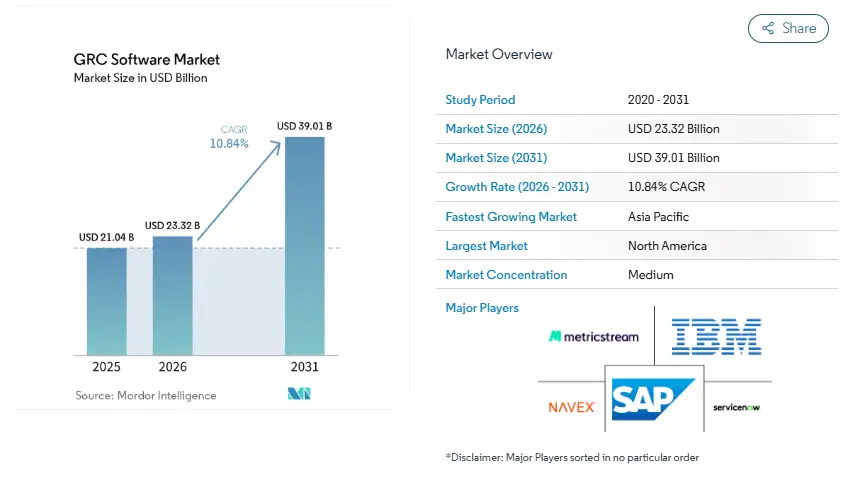
Source: Mordor Intelligence
Frameworks like DORA and NIS2 leave zero room for manual spreadsheet tracking. At the same time, privacy mandates and AI governance policies carry massive fines that directly threaten corporate revenues.
- Mandatory Resilience: Modern frameworks force companies to prove operational uptime, supply chain transparency, and immediate incident reporting.
- Cost of Non-Compliance: A single systemic breakdown can result in multi-million dollar penalties and lasting enterprise value erosion.
Consider platforms like OneTrust, which expanded its compliance modules to help enterprises navigate DORA and international privacy laws. By automating complex compliance frameworks for large organizations, OneTrust scaled its business to over $500 million in annual recurring revenue.
Finance Leads GRC Adoption
Banks, insurance providers, and fintech firms represent the single largest buyer segment in this sector. Their core business models operate on strict regulatory tolerances, making automated governance a mandatory capital expense rather than an optional upgrade. These institutions face intense oversight around operational resilience, third-party vendor risks, and automated regulatory reporting. Standard legacy software struggles to handle the volume and complexity of cross-border asset management and real-time transaction auditing.
- Third-Party Risk Mitigation: Financial institutions must continually assess and monitor thousands of cloud vendors and software suppliers.
- Continuous Audit Readiness: Automated platforms let risk teams generate compliance audit trails in minutes instead of spending months compiling manual reports.
Agile platforms like LogicGate have capitalized on this exact demand. By giving risk leaders customizable workflows to monitor enterprise controls, LogicGate reached approximately $49 million in annual revenue. Their growth trajectory shows how focused risk architecture attracts high-value financial clients.
Enterprise Spend Signals Growth
Enterprise IT budgets are undergoing a permanent structural shift. Risk management spending is moving out of generic administrative buckets and into dedicated, scalable software allocations. This sustained market demand creates an ideal environment for software founders and venture investors. Enterprise buyers actively want to replace fragmented point solutions with cloud-native platforms that automate risk scoring and continuous monitoring through artificial intelligence.
Key market catalysts pushing enterprise spend higher:
- High Retention Rates: Enterprise GRC products enjoy remarkably low customer churn because switching core compliance systems creates high operational friction.
- AI-Driven Margin Expansion: Buyers willingly pay premium prices for intelligent features that flag policy violations automatically.
- Direct C-Suite Visibility: Risk management dashboards now go straight to board committees, elevating buying decisions to top executive leaders.
Building a modern GRC platform grants entry into an industry defined by strong recurring revenues, long contract lifecycles, and sticky enterprise relationships.

Why Traditional GRC Platforms Fall Short for DORA Compliance?
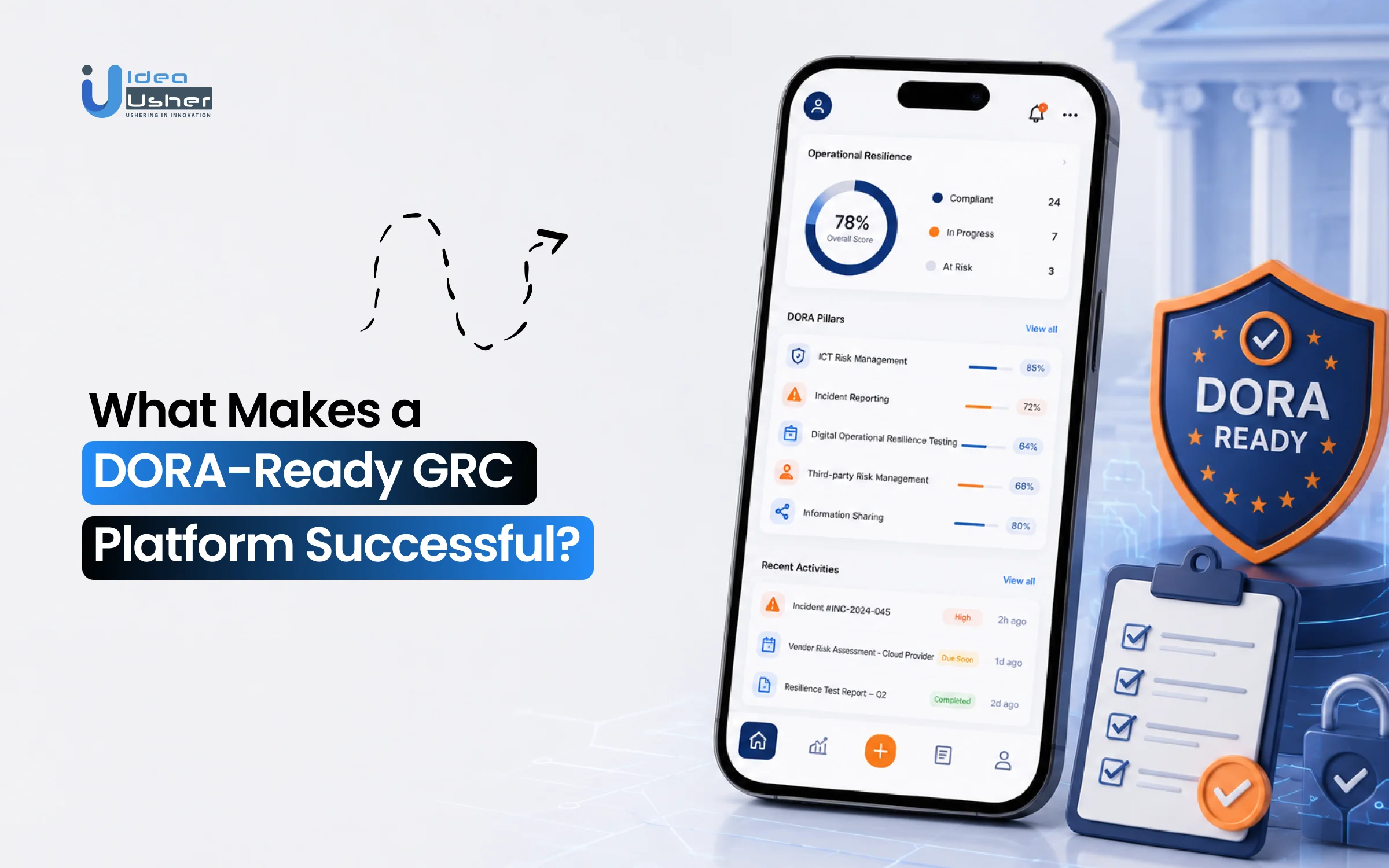
A DORA-ready GRC platform helps organizations stay resilient while keeping up with evolving regulatory requirements. It gives teams a clear view of ICT risks, automates vendor oversight, and simplifies compliance across the business. Unlike traditional GRC solutions, these platforms are designed for continuous monitoring and faster response, making it easier to manage risk before it becomes a problem.
Static Models Fall Short
Traditional platforms treat risk management like an annual check-the-box routine. They rely on point-in-time assessments built around frameworks like ISO 27001 or NIST. DORA shifts the rules completely. It requires continuous digital operational resilience and active risk governance every single day.
Why old models break down under new rules:
- Outdated Snapshots: Annual audits miss real-time system vulnerabilities and emerging threats.
- Passive Tracking: Legacy tools record static risks but fail to measure actual operational uptime.
- Paper-Trail Friction: Manual framework updates fall behind fast-changing regulatory demands.
Blind Spots in ICT Vendor Risk
Most compliance breaches happen through secondary or tertiary software suppliers, yet traditional platforms only look at direct vendors. Financial institutions rely on vast chains of cloud services and third-party software. DORA mandates a strict Register of Information to map every critical ICT vendor alongside deeper fourth-party dependencies.
Old platforms simply lack the data structures to handle this web of dependencies. They offer basic vendor questionnaires rather than deep, automated oversight across your entire supply chain.
Manual Speed Creates Compliance Gaps
Speed is where legacy architecture suffers the most. Traditional tools run on spreadsheets, manual evidence gathering, and slow email threads across departments. Relying on manual labor to hit strict reporting windows puts financial firms at serious risk of heavy fines. Building a modern platform that solves this speed bottleneck presents a high-value opportunity for software founders and enterprise investors.
| Legacy GRC Capabilities | Modern DORA Requirements |
| Quarterly manual reporting | Immediate ICT incident notification |
| Static document uploads | Automated evidence collection |
| Disconnected department silos | Real-time resilience testing |
The Five DORA Pillars Every GRC Platform Must Support
A modern GRC platform must go beyond static audits and address the five core pillars set by the European Union’s Digital Operational Resilience Act. For investors and developers, understanding these technical requirements is essential for building a high-value software solution that meets the non-negotiable operational standards of modern financial institutions.
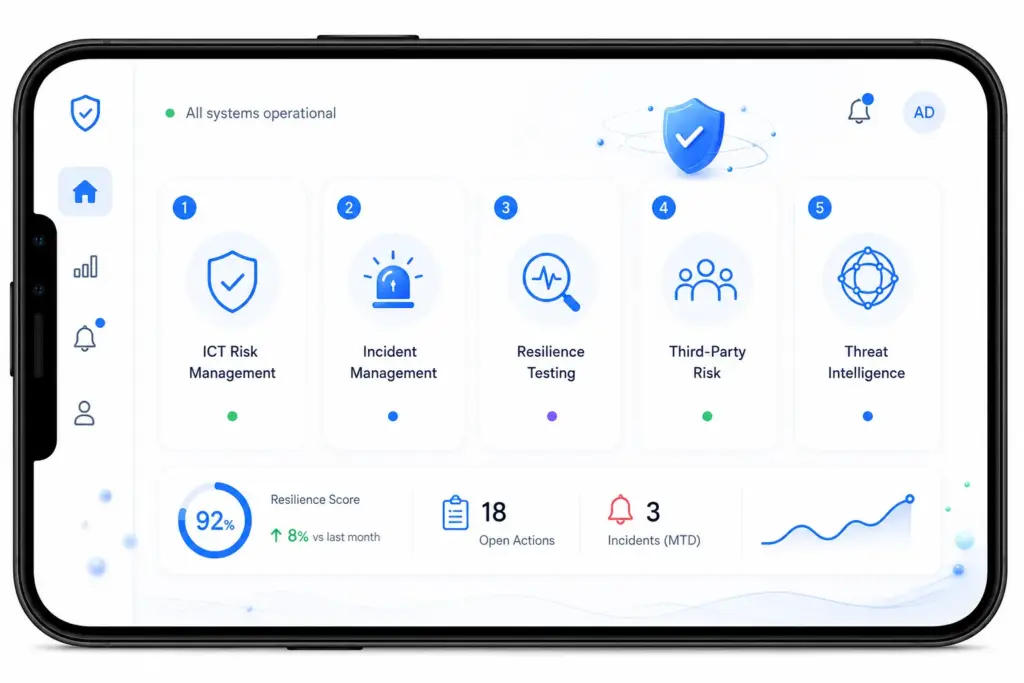
1. ICT Risk Management and Governance
Building a DORA-ready platform requires a centralized risk structure that aligns everyday IT management with executive accountability. Under Article 6(1), financial entities must define a sound, comprehensive, and well-documented ICT risk management framework as part of their overall risk management system.
The software needs to convert complex infrastructure data into clear board-level metrics. It should feature automated workflow engines for strategy reviews, policies, and continuous vulnerability scoring.
- Board Accountabilities: Article 5(2) states that the management body shall bear ultimate responsibility for managing the financial entity’s ICT risk.
- Continuous Updates: Frameworks must be reviewed at least annually, or upon major operational changes, to maintain active resilience standards.
Enterprises like MetricStream have built extensive market share around these structured risk capabilities. MetricStream generates roughly $240 million in annual revenue by serving global banks with complex regulatory mapping tools.
2. ICT Incident Management and Reporting
A DORA-compliant platform needs real-time detection, classification, and reporting engines built into its core architecture. Article 17(1) requires financial entities to define, establish, and implement an ICT-related incident management process to detect, manage, and notify ICT-related incidents.
Your software must track incident severity levels automatically against strict regulatory thresholds. It needs to generate submission-ready reports for competent authorities without human delay.
Classification and reporting triggers:
- Threshold Analysis: The system automatically flags incidents based on impacted users, critical services affected, data loss, and geographic spread.
- Mandatory Notifications: Article 19(1) dictates that entities shall report major ICT-related incidents to the relevant competent authority within tight, standardized timeframes.
- Audit Trails: Complete, tamper-proof logs must be maintained to review root causes and operational recovery steps.
3. Digital Operational Resilience Testing
Testing cannot be an afterthought handled by third-party spreadsheets. Article 24(1) establishes that entities shall establish, maintain, and review a sound and comprehensive digital operational resilience testing programme to assess preparedness and identify weaknesses. The software should track gap remediation, schedule routine vulnerability scans, and manage complex disaster recovery tests.
Under Article 26(1), designated significant entities must perform advanced Threat-Led Penetration Testing (TLPT) at least every three years. Your software should orchestrate these exercises, giving security officers a clear path from vulnerability discovery to verified engineering fix.
4. ICT Third-Party Risk Management
Supply chain exposure represents a huge risk area for modern financial institutions. Article 28(1) mandates that entities shall manage ICT third-party risk as an integral component of ICT risk within their overall framework. The centerpiece of this capability is the Register of Information.
Under Article 28(3), institutions must maintain and update at the entity, sub-consolidated, and consolidated levels a register of information in relation to all contractual arrangements on the use of ICT services provided by ICT third-party service providers.
- Subcontractor Mapping: Tracking direct vendors is no longer enough; the system must map critical fourth-party dependencies.
- Concentration Risk: Algorithms should analyze whether too many core services rely on a single cloud provider or software vendor.
Platforms like ServiceNow have captured significant enterprise market share by automating vendor oversight. ServiceNow operates as a massive enterprise player pulling in over $8 billion in revenue, proving how valuable automated IT service and risk management workflows are to enterprise buyers.
5. Cyber Threat Intelligence
DORA actively encourages institutions to collaborate against systematic threats. Under Article 45(1), financial entities may exchange cyber threat information and intelligence, including indicators of compromise, tactics, techniques, and procedures, within trusted communities. A modern platform should include secure channels to digest and share operational intelligence safely.
- Privacy Protections: Exchanged intelligence must safeguard sensitive customer data and proprietary trade secrets.
- Community Feeds: Direct integration with threat feeds allows risk teams to patch vulnerabilities before attackers exploit them.
Core Features of a Successful DORA-Ready GRC Platform
Building a DORA-ready GRC platform capable of handling modern financial resilience requires moving beyond static compliance lists and passive audit tracking. To capture enterprise market share, a modern GRC platform must integrate real-time IT operational data with automated compliance workflows across seven core architectural capabilities.
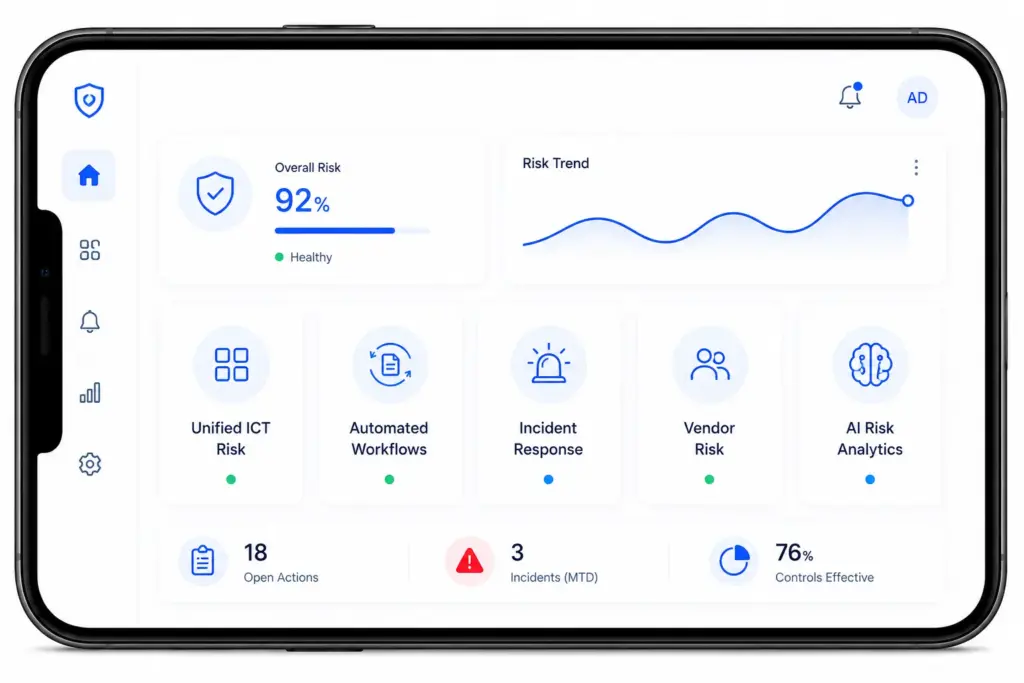
1. Unified ICT Risk Dashboard
A modern platform needs to bring scattered IT assets, active risks, and controls into one command center. Security and risk teams require complete visibility across their digital perimeter to manage resilience without switching between separate tools. Platforms like IBM OpenPages set an industry benchmark for risk visualization.
By centralizing enterprise data models, IBM helps global organizations monitor risk postures from a single interface, demonstrating the strong appetite among major institutions for unified governance systems.
- Asset Dependencies: Maps critical IT components directly to business processes.
- Live Heatmaps: Highlights active vulnerabilities needing immediate attention.
2. Automated Compliance Workflows
Manual tracking across shifting compliance guidelines drains resources. A successful platform automates control mapping, evidence gathering, policy updates, and compliance reviews in background workflows. OneTrust leads this category with automated regulatory mapping. By streamlining frameworks across privacy, security, and governance, OneTrust demonstrates how effectively automated compliance solutions scale within large enterprise environments.
How automated workflows optimize operations:
- Cross-Framework Mapping: Applies single control tests to satisfy multiple regulations at once.
- Continuous Testing: Runs background checks to catch missing compliance evidence automatically.
3. Incident Response and Reporting
DORA mandates rapid identification, escalation, and official notification for operational incidents. Software must feature built-in incident tracking tied into existing IT monitoring tools to minimize human delay. ServiceNow IRM leads this space by pairing risk processes directly with IT service data and infrastructure records. This unified operational approach shows the massive value in linking IT incident response with formal compliance tracking.
Key response automation triggers:
- Auto-Classification: Scores incident severity instantly using preset operational impact metrics.
- Regulatory Timelines: Tracks mandatory escalation hours automatically.
- Audit Readiness: Records full incident handling histories for post-event regulatory reviews.
4. Intelligent Vendor Risk Management
Financial institutions manage thousands of third-party vendors and critical software suppliers. Software needs full lifecycle tracking covering vendor onboarding, continuous risk monitoring, contract terms, and the required Register of Information. Archer (formerly RSA Archer) remains a dominant player in vendor risk management across complex financial institutions. Archer gives risk leaders deep supply-chain monitoring capabilities across highly regulated markets.
Key Advantage: Modern architectures track beyond direct vendor contracts, mapping secondary and tertiary supply chain risks to prevent hidden systemic dependencies.
5. AI Risk Scoring and Analytics
Managing thousands of controls manually leads to severe operational fatigue. Modern platforms deploy artificial intelligence to score risks dynamically, detect emerging threats, and highlight priority action items. MetricStream continues to invest in predictive risk intelligence and AI analytics for enterprise clients. This focus highlights how enterprise buyers favor intelligent software that turns passive risk logs into actionable security insights.
- Predictive Threat Analytics: Flags control weaknesses before operational failures occur.
- Automated Risk Scoring: Adjusts impact scores in real time as threat environments shift.
6. Audit-Ready Evidence Control
Gathering evidence for regulatory audits often devolves into frantic email threads and manual document hunting. A DORA-ready platform continuously pulls evidence, maps controls to rules, and maintains an audit-ready central vault. AuditBoard has scaled rapidly in this space by streamlining internal controls, audit trails, and evidence management. Their widespread adoption proves how much enterprise organizations value smooth, automated audit workflows.
7. No-Code Workflow Customization
No two financial institutions run identical approval chains or risk assessments. Building rigid code forces costly custom development, whereas a flexible no-code architecture lets non-technical teams tailor forms, notification flows, and dashboards effortlessly. LogicGate Risk Cloud stands out with its adaptable no-code environment. By letting risk teams design and update custom workflows as new regulations drop, LogicGate demonstrates how adaptable risk architecture attracts high-value financial clients.
Flexible software advantages:
- Fast Deployment: Modifies approval chains and forms without software engineering help.
- Future-Proof Scale: Adapts to new compliance mandates without replacing underlying systems.
Why Third-Party ICT Risk Management Is Becoming an Advantage?
Managing third-party software vendors and cloud providers has shifted from a routine administrative task into a core competitive differentiator. Platforms that automate supply-chain oversight enable financial institutions to move fast, pass strict regulatory audits, and prevent costly operational downtime.
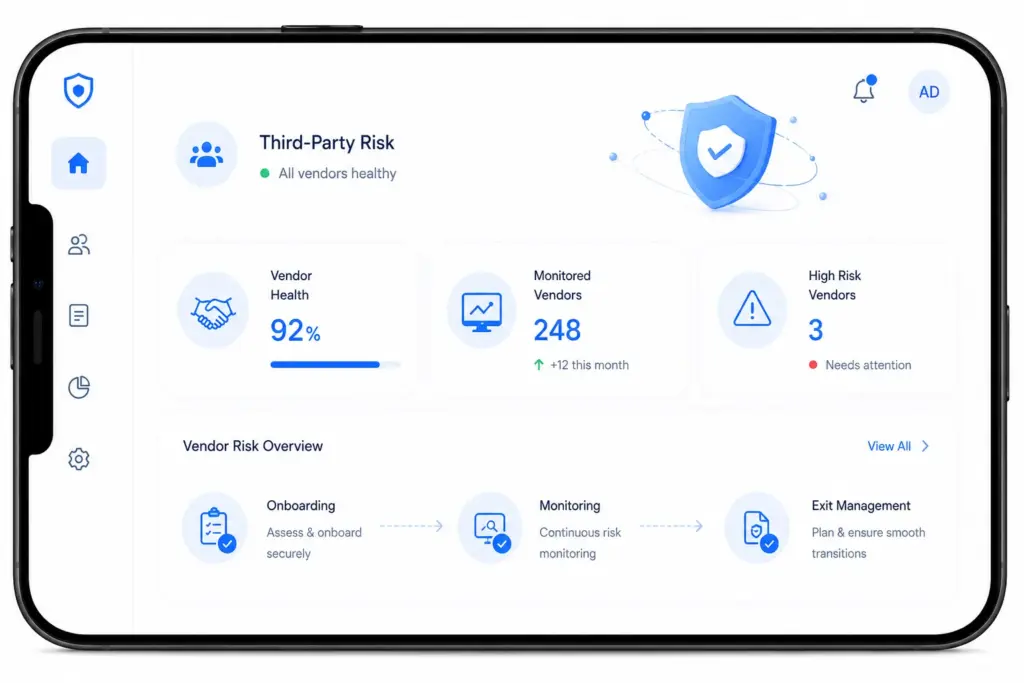
1. Vendor Governance Builds Trust
Modern financial firms rely heavily on external cloud infrastructure, payment gateways, and core software providers. Weak oversight of these relationships creates direct exposure to cyber attacks and regulatory penalties. A DORA-ready platform converts vendor risk oversight into a trust-building asset.
By continuously mapping third-party health, managing contracts, and keeping evidence ready for regulators, financial institutions demonstrate high operational resilience to markets and partners.
- Audit Confidence: Provides regulators with instant proof of third-party control compliance.
- Client Retention: Enterprise buyers favor financial institutions that can guarantee supply-chain stability.
Consider platforms like Prevalent, which specializes in dedicated vendor risk management and compliance automation. By helping organizations continuously track supplier risks and manage complex vendor networks, Prevalent reached approximately $23 million in annual revenue.
2. Continuous Monitoring Prevents Disruptions
Legacy assessments rely on static annual questionnaires that go out-of-date immediately. Modern GRC platforms replace periodic reviews with real-time tracking of vendor performance, security posture, and service availability. Real-time visibility allows risk teams to detect supplier weaknesses long before they escalate into systemic outages.
What continuous monitoring tracks:
- SLA Performance: Evaluates supplier commitments against actual operational uptime.
- Fourth-Party Risks: Identifies subcontractor dependencies hidden beneath primary vendor contracts.
- Concentration Risk: Alerts leadership when too many critical services rely on a single vendor.
Platforms like BitSight have scaled rapidly by pioneering continuous security ratings and external vendor risk assessments. BitSight crossed $100 million in annual recurring revenue, proving that enterprise buyers view continuous vendor intelligence as a non-negotiable strategic capability.
3. Automated Oversight Scales Growth
Manual spreadsheet tracking breaks down as soon as an institution manages hundreds of vendor relationships. DORA-ready software automates vendor onboarding, maintains the mandatory Register of Information, and structures contractual termination strategies.
Automation lifecycle steps:
- Seamless Onboarding: Standardizes risk questionnaires and automated due-diligence checks.
- RoI Maintenance: Updates central vendor registers automatically whenever contract terms change.
- Exit Management: Tracks mandatory termination plans to ensure smooth service transitions during vendor failures.
How Resilience Testing Should Be Built Into Modern GRC Platforms?
DORA expects financial institutions to do more than document their compliance efforts. They need to regularly test their systems, identify weaknesses, and demonstrate that they can recover from disruptions. A modern GRC platform makes this possible by automating security assessments, supporting resilience testing, and helping teams respond to risks before they affect business operations.
1. Vulnerability Testing and Risk Validation
A DORA-ready platform converts static compliance checklists into an active security system. The software automates ongoing vulnerability scans, system configuration audits, and patch tracking across all critical IT assets. Instead of outputting raw, unorganized vulnerability lists, the platform prioritizes security findings by mapping them directly to critical business functions. This gives risk engineering teams a clear blueprint for immediate remediation based on actual operational threat.
- Continuous Scanning: Replaces periodic risk assessments with live system configuration monitoring.
- Risk Prioritization: Ranks technical vulnerabilities by evaluating their potential impact on core business processes.
Specialized platforms like CyberSaint Security have pioneered this automated risk validation approach. By providing dynamic risk scoring aligned with regulatory standards, CyberSaint grew its enterprise footprint, reaching roughly $5 million in annual revenue.
2. TLPT Exercise Management
For financial entities subject to mandatory Threat-Led Penetration Testing (TLPT), the software should manage the entire exercise lifecycle. The platform structures scope definition, threat intelligence inputs, red team coordination, and regulatory evidence gathering within a unified workflow.
Seamless integration with frameworks like TIBER-EU gives risk leaders a standardized framework to execute complex resilience testing across multi-cloud environments. Centralizing these advanced testing exercises ensures financial institutions satisfy DORA obligations while generating audit-ready documentation for national regulators.
3. Scenario Testing and Recovery
Beyond technical penetration testing, modern platforms orchestrate broad operational resilience exercises. The platform schedules and evaluates disaster recovery drills, automated failover tests, and business continuity scenarios to verify that core services can survive severe disruptions.
Key operational capabilities:
- Automated Scorecards: Generates real-time recovery metrics after each simulated outage or failover test.
- Corrective Action Tracking: Assigns system gap remediations directly to IT owners with automated follow-ups.
- Audit-Ready Proof: Maintains verifiable records showing that critical business services meet maximum tolerable downtime targets.
Enterprise platforms like NAVEX Global have built robust operational continuity and risk tracking workflows to address these exact requirements. Harnessing widespread adoption across regulated sectors, NAVEX Global generates over $300 million in annual revenue by giving compliance leaders a comprehensive, audit-proof risk management ecosystem.
Top 5 DORA-Ready GRC Platforms in the USA
We reviewed several leading DORA-ready GRC platforms used across the financial services industry to understand what sets them apart. While each platform takes a different approach to governance, risk, and compliance, they all offer capabilities that help organizations strengthen operational resilience, automate regulatory workflows, and manage ICT risks more effectively.
1. IBM OpenPages
IBM OpenPages is one of the most comprehensive enterprise GRC platforms for financial institutions. It combines ICT risk management, policy management, internal controls, regulatory compliance, and AI-powered analytics in a single platform. Its modular architecture and real-time risk dashboards make it a strong choice for organizations building DORA-ready governance and operational resilience programs.
2. ServiceNow IRM
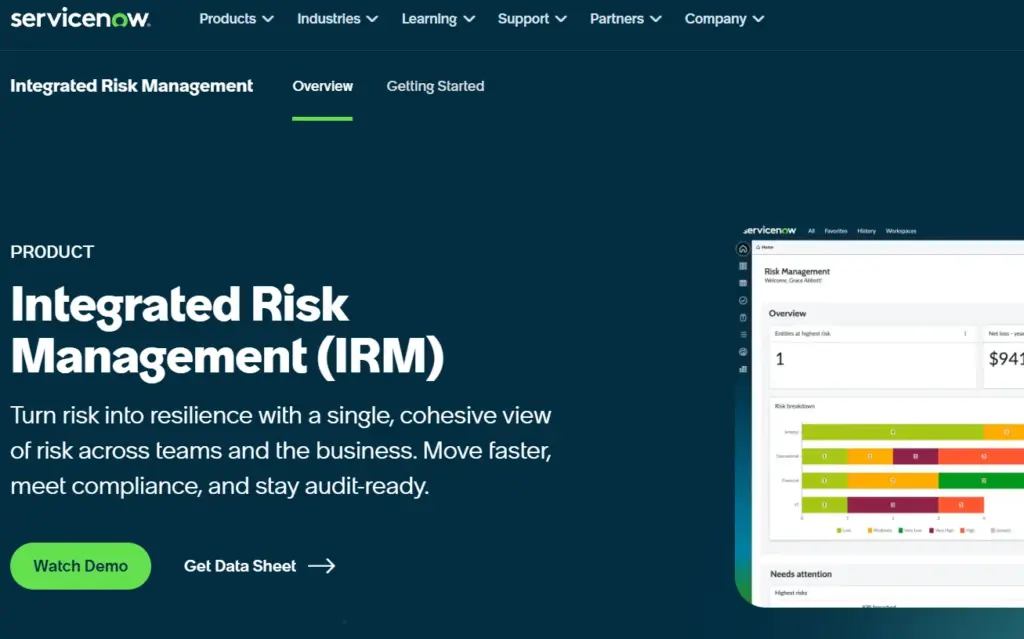
ServiceNow IRM extends traditional GRC by integrating risk management with IT operations, security workflows, and incident response. Financial institutions use it to automate ICT incident reporting, monitor operational resilience, manage third-party risks, and maintain continuous compliance through deep integrations with enterprise systems.
3. Archer
Archer is a highly configurable enterprise GRC platform widely adopted by large banks and insurance companies. It offers robust capabilities for enterprise risk management, third-party risk oversight, policy management, audit management, and regulatory compliance, making it well suited for organizations implementing DORA’s operational resilience requirements.
4. MetricStream
MetricStream provides an AI-enabled GRC platform focused on enterprise risk, cyber risk, operational resilience, and regulatory compliance. Its unified risk intelligence capabilities help financial institutions automate compliance workflows, prioritize risks, manage vendors, and strengthen resilience across complex global operations.
5. OneTrust
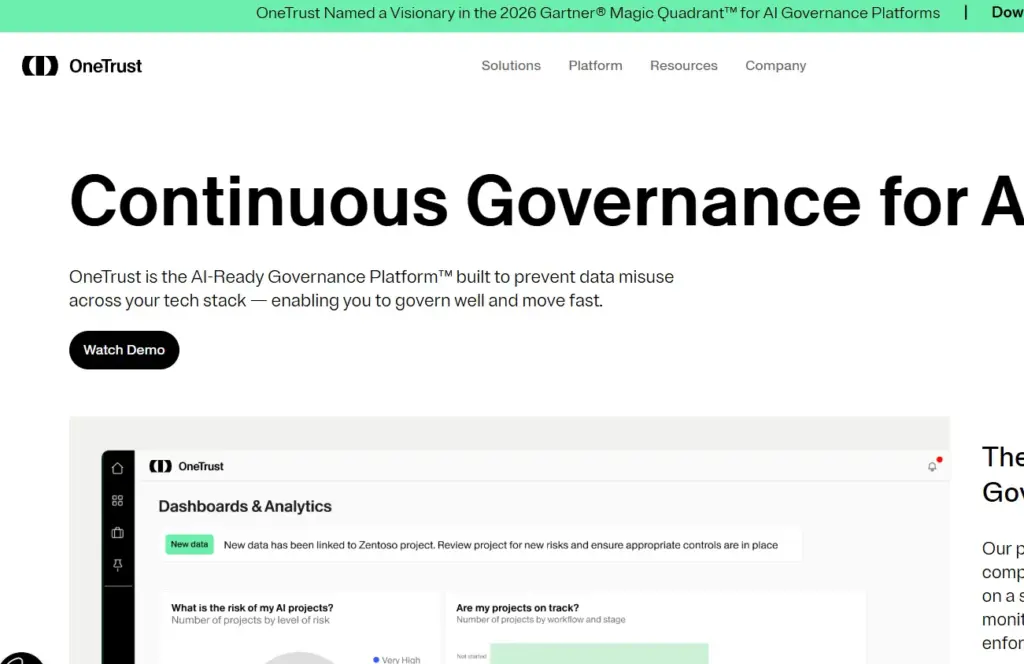
OneTrust has expanded beyond privacy management into enterprise GRC with features for compliance automation, policy governance, third-party risk management, and regulatory monitoring. It is particularly popular among fintechs and financial services organizations looking to manage DORA alongside GDPR and other global regulatory frameworks from a unified platform.
Build a DORA-Ready GRC Platform with IdeaUsher
Building a DORA-ready GRC platform requires more than strong development skills. It demands a clear understanding of regulatory requirements, enterprise security, and scalable system design. Working with an experienced development partner helps you build a platform that supports long-term compliance, adapts to future regulations, and grows with your business.
Tailored Compliance Solutions
Off-the-shelf software often forces companies into rigid, generic workflows. IdeaUsher designs custom GRC solutions built directly around your specific risk models, operational structures, and reporting needs.
- Tailored Workflows: Custom approval chains, risk scoring models, and reporting structures.
- Seamless Automation: Eliminates manual data entry and speeds up regulatory audit cycles.
- Scalable Architecture: Designed to adapt instantly as new regulations and compliance rules emerge.
Building custom software gives you complete control over your feature roadmap, IP ownership, and user experience, turning your GRC solution into a valuable proprietary asset.
Secure, Scalable Integrations
A DORA-ready GRC platform delivers the most value when it works seamlessly with your existing technology stack. At IdeaUsher, we build API-first platforms that integrate with security tools, IT infrastructure, and enterprise systems to keep compliance data synchronized in real time. This gives teams a unified view of operational risk without disrupting their existing workflows.
Enterprise Development Experts
Bringing a complex GRC platform to market demands top-tier technical execution. With over 500,000 hours of coding experience, our team of ex-MAANG/FAANG developers and 250+ technology specialists builds reliable, enterprise-grade software engineered for high performance.
IdeaUsher has delivered 1,000+ successful projects, helping organizations across regulated industries deploy secure, scalable platforms built for long-term growth. Whether you are an entrepreneur launching a commercial GRC SaaS or an enterprise looking to build a custom internal resilience platform, our engineering team provides the technical execution needed to build a market-leading product.
Conclusion
A successful DORA-ready GRC platform does more than help organizations meet regulatory requirements. It gives teams better visibility into operational risk, simplifies compliance, and supports faster decision-making. As regulations continue to evolve, businesses that invest in flexible and scalable GRC platforms will be better prepared for future challenges.
Things to Know About DORA-Ready GRC Platforms
A1: A DORA-ready GRC platform is designed to help financial institutions meet the requirements of the Digital Operational Resilience Act. It brings ICT risk management, incident reporting, third-party oversight, and resilience testing into one place, so teams don’t have to switch between multiple tools. Instead of simply helping with audits, it supports continuous compliance and gives organizations a clearer view of their operational risks.
A2: Any organization covered by DORA can benefit from a dedicated platform, including banks, insurance companies, investment firms, payment providers, and fintech businesses. It is especially useful for companies that rely on cloud services or work with many ICT vendors, as it simplifies compliance while improving visibility across the entire technology ecosystem.
A3: Most traditional GRC platforms are built around broad compliance standards like ISO 27001 or NIST. A DORA-ready platform goes a step further by supporting DORA-specific requirements such as ICT incident reporting, resilience testing, Register of Information (RoI) management, and third-party ICT risk monitoring. This makes it much easier for financial institutions to stay compliant as regulations evolve.
A4: Yes. Modern DORA platforms are built to connect with the tools organizations already use, including SIEM platforms, identity management systems, IT service management software, cloud infrastructure, ERP solutions, and vulnerability scanners. These integrations keep data synchronized, reduce manual work, and give compliance teams a more complete picture of ICT risks.