


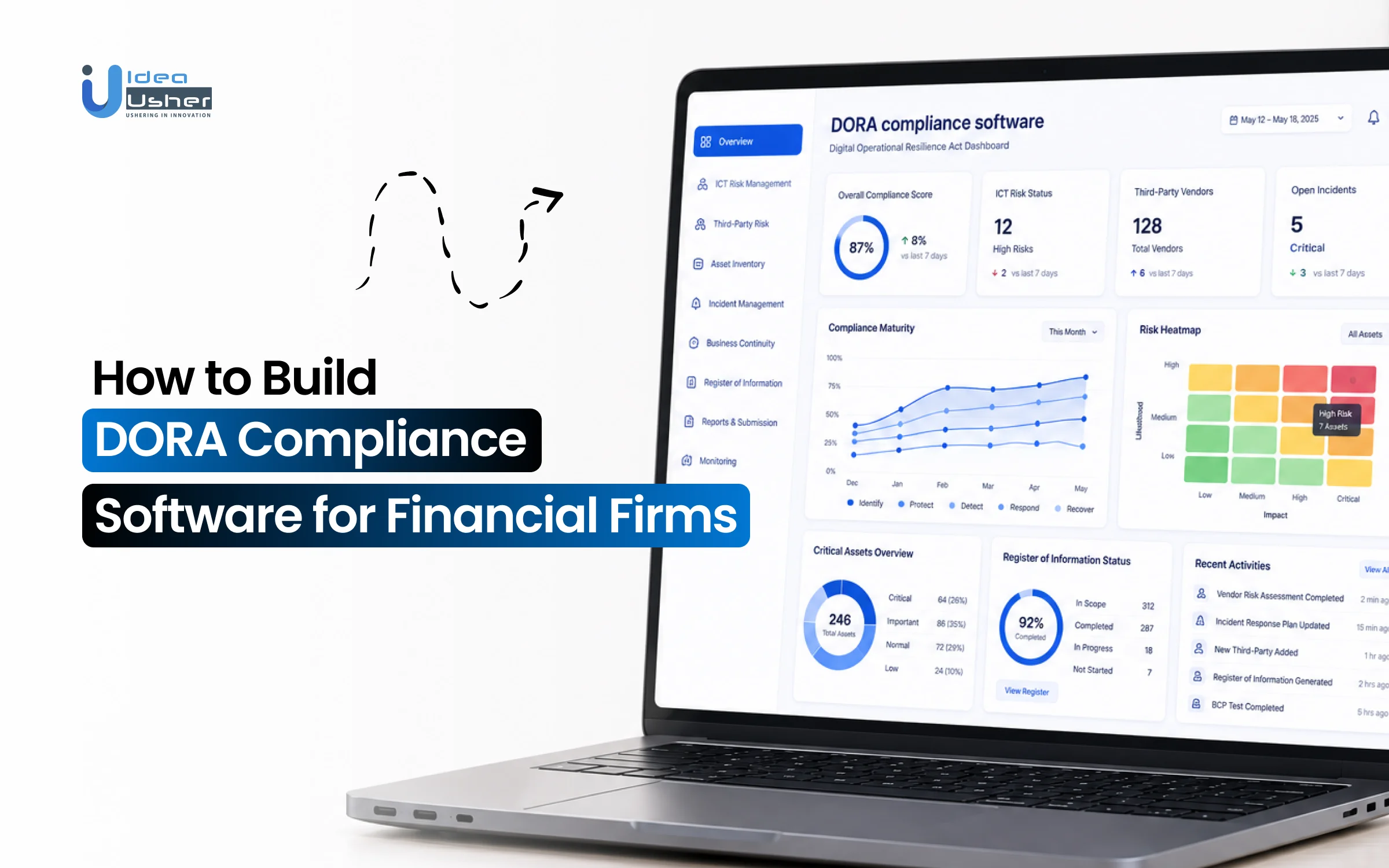
Key Takeaways
- DORA compliance platforms replace manual GRC processes with continuous ICT risk monitoring, automation and operational resilience.
- Core capabilities include incident reporting, Register of Information management, third-party risk oversight and automated compliance workflows.
- Real-time monitoring, enterprise integrations and audit-ready reporting help financial institutions meet evolving DORA requirements efficiently.
- Scalable architecture, strong security and regulatory automation are essential for building enterprise-grade DORA compliance software.
- How Idea Usher can help you build a DORA compliance platform for financial firms with automated compliance workflows and secure RegTech architecture.
Regulatory compliance is no longer measured by how well financial institutions document risk. It is measured by how quickly they detect, withstand and recover from operational disruption. This shift is accelerating DORA compliance software development as financial firms replace static governance tools with continuous resilience platforms built for real-time oversight and regulatory accountability.
Traditional GRC systems relied on periodic assessments, manual evidence collection, and disconnected risk workflows. Today, financial institutions expect ICT risk management, automated compliance workflows, third-party risk oversight, cyber risk monitoring, incident reporting, operational resilience testing, audit-ready evidence, governance dashboards, policy management, and real-time compliance to strengthen resilience, reduce manual effort, and improve audit readiness.
In this blog, we’ll explore how to build DORA compliance software for financial firms, covering its core features, architecture, technology stack, compliance workflows and how IdeaUsher can help develop enterprise-grade DORA compliance fintech platform that enable continuous operational resilience instead of periodic compliance.
Why Financial Firms Are Building DORA Platforms
The European financial sector is rapidly adopting DORA platforms as the Digital Operational Resilience Act (DORA) reshapes how institutions manage ICT risk and operational resilience. The regulation extends accountability across the entire ICT supply chain, with non-compliance carrying penalties of up to 2% of global annual turnover and personal fines of up to €1 million for senior executives.
The Governance, Risk Management And Compliance (GRC) Market size was valued at $50.5 Billion in 2024 and is projected to reach $104.5 Billion by 2031, growing at a CAGR of 15.41% during the forecast period 2024-2031.

Meeting DORA requirements demands significant investment, with implementation costs often ranging from €2–€5 million for large institutions and £350,000–£700,000 annually for mid-sized firms. As a result, financial organizations are replacing fragmented compliance tools with unified DORA platforms that automate resilience testing, third-party risk management, and regulatory reporting while reducing long-term operational costs.
A. Why Legacy GRC Solutions Fall Short Under DORA
Traditional Governance, Risk, and Compliance (GRC) tools were engineered for a static corporate landscape. They operate on the assumption that risks can be effectively managed in independent department silos and validated through periodic, point-in-time reviews. DORA’s rigid continuous-visibility mandates completely break these legacy architectures:
- The Spreadsheet Challenge: Around 46% of financial institutions cite the Register of Information as their biggest DORA hurdle. Managing ICT third-party dependencies in spreadsheets leads to version-control issues and fragmented data.
- The Manual Audit Burden: Compliance teams spend up to 40% of their time collecting evidence, updating documents, and retrieving access logs, slowing audits and increasing security risk.
- Periodic vs. Continuous Monitoring: Legacy GRC tools rely on periodic assessments, while DORA requires real-time ICT incident reporting within strict timelines, making continuous monitoring essential for compliance.
B. Operational Resilience Has Become a Strategic Priority
DORA forces a major cultural and technical shift, pushing financial firms away from defensive, checklist-based compliance and toward a model of active, proactive operational resilience. The regulation operates on the baseline assumption that complex digital disruptions will happen. Therefore, organizations must build the capabilities required to minimize the impact of those events.

This active resilience model directly impacts how companies approach technology funding:
- Threat-Led Penetration Testing (TLPT): DORA requires advanced financial institutions to invest heavily in threat-led penetration testing, with up to 30.6% of compliance budgets allocated to continuous security simulations that identify and remediate vulnerabilities before exploitation.
- Third-Party Supply Chain Security: Organizations dedicate approximately 28.1% of deployment budgets to managing Critical Third-Party Providers (CTPPs), strengthening oversight of ICT vendors and supply chain risks.
- Proactive Cyber Resilience: Continuous vulnerability monitoring and automated risk detection help organizations anticipate and withstand cyber threats, preventing an estimated 30 major operational incidents annually and reducing exposure to data breaches averaging $5.56 million in the financial sector.
C. Why Financial Institutions Are Investing in DORA Software
Consolidating ICT risk detection, incident logging, vendor mapping, and audit trails into a single digital platform completely changes the unit economics of regulatory compliance. Rather than operating as an expensive administrative cost center, a unified platform functions as a streamlined software utility that delivers predictable operational savings.
The explicit performance and financial advantages of moving from siloed GRC applications to a unified DORA infrastructure layer are clear:
| Operational Scaling Metric | Disconnected Legacy GRC Systems | Unified Resilience Platforms | Direct Institutional Capital Impact |
| Data Visibility | Static visibility covering only 54% of the environment. | Continuous monitoring across 100% of critical systems. | Improves early threat detection by 86%. |
| Evidence Collection | Manual data gathering consumes 40% of compliance effort. | Automated evidence collection from connected systems. | Delivers €1.22M in annual operational savings. |
| Third-Party Oversight | Annual vendor assessments with outdated records. | Continuous mapping of 22,000+ ICT dependencies. | Maintains an accurate, DORA-ready Register of Information. |
| Investment Payback | Implementation costs of €2M–€5M with ongoing overhead. | Rapid deployment with a 12-month payback period. | Delivers up to 2.5× ROI on resilience investments. |
The Enterprise Reality: Legacy, manual GRC frameworks can no longer support continuous compliance requirements. DORA platforms transform operational risk management into an automated, unified resilience framework that strengthens compliance, reduces operational overhead, protects critical data assets, and helps financial institutions minimize regulatory risk.

What Is DORA Compliance Software?
DORA Compliance Software is a specialized category of Governance, Risk, and Compliance (GRC) software designed to help financial institutions automate, manage, and prove their adherence to the European Union’s Digital Operational Resilience Act (DORA).
Unlike older financial regulations that focused primarily on capital reserves to absorb losses, DORA mandates that firms structurally ensure their information and communication technology (ICT) systems can withstand, respond to, and recover from severe cyber disruptions. The software provides a centralized dashboard to move financial firms away from manual spreadsheets and into automated, audit-ready compliance.
A. Understanding the EU Digital Operational Resilience Act (DORA)
The Digital Operational Resilience Act (DORA) is a European Union regulation that establishes a unified framework for strengthening the cybersecurity and operational resilience of the financial services sector. Fully applicable across all EU member states since January 17, 2025, DORA replaces fragmented national IT rules with a single regulatory standard requiring financial institutions to withstand, respond to, and recover from cyber disruptions.
The regulatory footprint of DORA is incredibly wide, directly governing 20 distinct classes of financial entities along with their critical technology partners. The compliance mandate explicitly applies to:
- Banking Infrastructure: Traditional credit institutions, central counterparties, and global clearing houses.
- Payment & Settlement Networks: Modern electronic money institutions, payment service providers, and account information aggregators.
- Investment & Trading Entities: Registered investment firms, alternative investment fund managers (AIFMs), management companies, and trading venues.
- Insurance & Protection Sectors: Large insurance and reinsurance undertakings, along with specialized insurance intermediaries.
- Emerging Digital Ecosystems: Crowdfunding platforms and newly regulated Crypto-Asset Service Providers (CASPs) falling under MiCA parameters.
- Critical Technology Suppliers: Third-party ICT service providers including major cloud infrastructure hyperscalers, core banking software providers, and data analytics firms.
B. Why DORA Requires More Than Traditional GRC Tools
Many organizations assume existing Governance, Risk, and Compliance (GRC) tools can support DORA through simple control mapping. In reality, traditional GRC platforms rely on periodic assessments, manual evidence collection, and annual reviews designed for static compliance. DORA shifts the focus to continuous operational resilience, requiring real-time monitoring, automated controls, and ongoing compliance rather than point-in-time assessments.

The data gaps that cause traditional tools to fail under the new rules include:
- The Register of Information Challenge: DORA Article 28 requires a dynamic Register of Information covering ICT providers, dependencies, and connections. In ESA validation exercises, only 6.5% of submitted registers passed basic data-quality checks, exposing the limits of spreadsheet-based tracking.
- The Asset Visibility Gap: Legacy tools separate asset inventories, contracts, and business functions, forcing compliance teams to manually connect ICT providers, critical assets, and concentration risks during audits.
- The Real-Time Reporting Gap: DORA requires major ICT incidents to be identified and reported within hours. Traditional GRC platforms lack real-time event ingestion and automated reporting, creating compliance delays.
C. The Five Pillars Every DORA Platform Must Support
To protect an enterprise from severe regulatory penalties which can reach 2% of global annual turnover for companies and €1 million for executives, a production-grade DORA compliance platform must convert the five regulatory pillars into clear, automated software capabilities.

1. ICT Risk Management & Governance (Articles 5-16)
DORA compliance software establishes continuous visibility across ICT assets, business processes, and governance controls, enabling financial institutions to proactively identify, assess, and mitigate operational technology risks.
- The Regulatory Expectation: The platform must systematically identify, classify, and document all ICT-supported business functions, information assets, and configuration dependencies.
- The Software Capability: The application operates an automated, real-time discovery engine that maps the entire IT architecture. It links hardware, code packages, and APIs directly to core business processes, giving management comprehensive visibility over the firm’s attack surface.
2. ICT-Related Incident Management & Reporting (Articles 17-23)
The platform streamlines the complete incident lifecycle by detecting, classifying, tracking, and reporting ICT-related events while ensuring regulatory reporting deadlines are consistently met.
- The Regulatory Expectation: Financial entities must identify, track, log, and classify operational incidents using the strict threshold criteria set by the ESAs, ensuring rapid regulatory reporting.
- The Software Capability: The system features direct API integrations with Security Information and Event Management (SIEM) tools. The moment an operational incident occurs, the software auto-populates the official ESA reporting templates and tracks strict submission timelines.
3. Digital Operational Resilience Testing (Articles 24-27)
This module enables organizations to centrally manage resilience testing programs, monitor remediation efforts, and maintain verifiable evidence demonstrating continuous operational resilience and regulatory readiness.
- The Regulatory Expectation: Lenders and insurers must run a risk-based testing program, executing annual vulnerability scans across all critical systems and completing advanced Threat-Led Penetration Testing (TLPT) every three years.
- The Software Capability: The application acts as the control center for resilience orchestration. It automates testing tracking, logs remediation actions, and archives evidence gathered from external security teams, creating an unalterable history of continuous testing.
4. ICT Third-Party Risk Management (Articles 28-44)
The software provides centralized oversight of ICT vendors, service providers, and supply chain dependencies, helping organizations manage third-party risks and maintain DORA-compliant vendor governance.
- The Regulatory Expectation: Organizations must track vendor concentration limits, monitor service level agreements (SLAs), map fourth-party dependencies, and maintain the Register of Information.
- The Software Capability: The platform includes an automated vendor assessment dashboard. It converts vendor contracts into machine-readable data structures, checks for cloud concentration risks, and runs automated validations to ensure compliance with EBA schemas.
5. Information Sharing Arrangements (Article 45)
The platform enables secure cyber threat intelligence sharing through trusted communication channels, allowing financial institutions to strengthen collective resilience while safeguarding sensitive operational and customer data.
- The Regulatory Expectation: Financial institutions are encouraged to exchange cyber threat intelligence and indicators of compromise safely with trusted external peers.
- The Software Capability: The software deploys encrypted, identity-verified communications pipelines, enabling teams to share threat intelligence while ensuring customer data protection and compliance with GDPR mandates.
D. Who Needs DORA Compliance Software?
Operating manually under DORA parameters creates severe legal and financial vulnerabilities. Any enterprise that matches the following classifications requires a native DORA compliance platform to protect its operating license:
| Institutional Segment | Key Target Software System Focus Areas | Estimated Implementation Cost Range |
| Banks & Credit Unions | Core deposit ledger isolation, systemic cloud resilience tracking, and multi-region failover validation. | €80,000 to €150,000+ per deployment loop. |
| Payment & E-Money Firms | Transaction gateway API mapping, high-speed incident logging, and merchant risk tracking. | €15,000 to €45,000 for mid-tier platforms. |
| Investment & Trading Hubs | High-frequency trading execution monitoring, live market feed integrity, and broker portal auditing. | €40,000 to €90,000 based on data complexity. |
| Insurance Underwriters | Actuarial database backups, third-party claim system mapping, and broker network compliance. | €30,000 to €100,000 on cross-border nodes. |
| Fintech & CASP Startups | Multi-chain protocol connection points, non-custodial wallet code scans, and cloud provider monitoring. | €10,000 to €30,000 utilizing cloud platforms. |
The Compliance Takeaway: DORA-native compliance platforms replace manual compliance processes with continuous, automated resilience management. By streamlining ICT risk monitoring, incident reporting, and third-party risk oversight, they help financial institutions strengthen compliance, improve operational resilience, and turn regulatory requirements into a long-term competitive advantage.
Key Features of a High-Impact DORA Compliance Platform
Beyond meeting DORA’s regulatory requirements, leading compliance platforms include advanced capabilities that improve operational efficiency, strengthen cyber resilience, automate governance, and reduce compliance costs. These features enable financial institutions to manage risks proactively while maintaining continuous audit readiness.

1. Real-Time ICT Risk Monitoring
Real-time ICT risk monitoring continuously discovers and tracks ICT assets, business services, cloud infrastructure, and system dependencies. By providing live risk visibility, asset inventories, configuration monitoring, and proactive threat detection, it enables organizations to identify vulnerabilities early and respond before operational disruptions occur.
2. AI-Driven Compliance Intelligence
AI-driven compliance intelligence analyzes operational data to identify compliance gaps, prioritize risks, recommend remediation actions, and map regulatory controls. Intelligent automation reduces manual reviews, improves decision-making, and helps compliance teams maintain continuous alignment with evolving DORA requirements.
3. Register of Information (RoI) Management
Register of Information (RoI) management automates the creation, maintenance, and validation of the DORA-required Register of Information. It centralizes ICT service providers, vendor relationships, fourth-party dependencies, and regulatory data, ensuring accurate, EBA-compliant submissions with minimal manual effort.
4. Policy & Control Automation
Policy and control automation centralizes governance by managing policies, internal controls, approval workflows, and compliance rules within a single platform. Automated validation, version control, and continuous control monitoring ensure policies remain consistent, enforceable, and aligned with regulatory obligations.
5. Automated Evidence Collection
Automated evidence collection gathers compliance records, security logs, testing results, incident reports, policy acknowledgments, and vendor assessments directly from connected enterprise systems. A centralized, tamper-proof evidence repository simplifies audits while eliminating time-consuming manual documentation activities.
6. Regulatory Workflow Automation
Regulatory workflow automation streamlines compliance operations through automated task assignments, approval processes, remediation tracking, deadline monitoring, and notification workflows. This improves cross-functional collaboration, accelerates issue resolution, and ensures critical compliance activities are completed on schedule.
7. Audit-Ready Regulatory Reporting
Audit-ready regulatory reporting automatically generates standardized compliance reports, incident documentation, executive dashboards, and regulatory submission packages. Built-in reporting templates, evidence linking, and submission tracking help financial institutions respond quickly to audits and regulatory reviews.
8. Enterprise System Integrations
Enterprise system integrations connect the platform with SIEM, CMDB, IAM, ITSM, ERP, GRC, cloud environments, vulnerability scanners, and third-party APIs. Continuous data synchronization creates a unified compliance ecosystem, improving operational visibility, automation, and enterprise-wide risk management.
How to Build DORA Compliance Software for Financial Firms
Building DORA compliance software requires more than developing a standard GRC platform. Our DORA compliance software development approach combines regulatory expertise, enterprise architecture, cybersecurity, and automation to create a scalable solution that helps financial institutions achieve continuous operational resilience and long-term regulatory compliance.

1. Define Business Requirements & Compliance Objectives
We begin by understanding your business model, regulatory obligations, and operational goals. Our team identifies applicable DORA requirements, financial entity classifications, ICT assets, stakeholder roles, compliance priorities, and business workflows to establish a strong project foundation.
- Regulatory Scope Identification: Defines applicable DORA requirements, entity classifications, and compliance obligations based on business operations and jurisdictional exposure.
- Stakeholder Alignment Strategy: Identifies key stakeholders, roles, and responsibilities to ensure clear ownership and accountability across compliance processes.
- ICT Asset Mapping: Catalogs critical ICT systems, infrastructure, and dependencies to establish visibility into operational risk exposure and compliance scope.
- Business Workflow Analysis: Evaluates existing operational processes to align compliance requirements with real-world business activities and system interactions.
2. Design a DORA-Native System Architecture
Our architects design a scalable, cloud-ready architecture tailored for DORA compliance. We define system components, data flows, governance layers, security frameworks, and integration points to support ICT risk management, operational resilience, and enterprise scalability.
- Scalable Architecture Planning: Designs flexible system architecture capable of supporting growing compliance requirements, data volumes, and enterprise expansion needs.
- Data Flow Structuring: Establishes secure and efficient data movement across systems to ensure real-time compliance monitoring and reporting accuracy.
- Governance Framework Design: Defines governance layers to manage policies, controls, and compliance oversight across organizational and technical environments.
- Integration Readiness Planning: Prepares architecture for seamless integration with enterprise systems, ensuring interoperability and continuous data synchronization.
3. Develop DORA Core Compliance Modules
Our developers build the platform’s essential compliance modules and centralized dashboards tailored to your operational requirements. These include ICT risk management, incident reporting, third-party risk management, resilience testing, Register of Information management, and policy governance.
- Modular Compliance Development: Builds flexible modules that support ICT risk management, incident reporting, and third-party risk monitoring capabilities.
- Centralized Dashboard Creation: Develops unified dashboards providing real-time visibility into compliance status, risks, incidents, and operational performance metrics.
- Policy Management Integration: Enables structured policy creation, approval workflows, and version control aligned with regulatory compliance requirements.
- Register of Information Management: Implements structured data repositories to maintain accurate records of ICT assets, vendors, and compliance documentation.
4. Integrate Enterprise Systems
Our developers connect your compliance platform with existing enterprise tools, cloud systems, and third-party APIs to ensure real-time data flow, eliminate silos, and provide unified operational visibility across your entire business ecosystem.
- System Integration Strategy: Connects compliance platform with enterprise tools to enable seamless data exchange and unified operational visibility across systems.
- API Connectivity Framework: Establishes secure API integrations to facilitate real-time communication between internal systems and external compliance services.
- Data Synchronization Mechanism: Ensures continuous and accurate data updates across integrated systems to maintain consistency and compliance reporting accuracy.
- Cross-System Visibility Enhancement: Provides centralized insights by aggregating data from multiple enterprise systems into a unified compliance monitoring interface.
5. Automate Compliance Workflows
Our team builds smart automation workflows that reduce manual compliance effort and streamline approvals while ensuring faster decision-making, audit readiness, and improved operational efficiency across your organization.
- Workflow Automation Design: Automates repetitive compliance tasks such as risk assessments, approvals, and reporting to improve efficiency and reduce manual errors.
- Incident Escalation Automation: Implements automated escalation processes to ensure timely response and resolution of compliance incidents and operational risks.
- Evidence Collection Automation: Streamlines documentation gathering and validation processes to support audit readiness and regulatory reporting requirements.
- Compliance Notification System: Enables automated alerts and notifications to keep stakeholders informed about compliance status, risks, and required actions.
6. Implement Enterprise Security & Access Controls
Our developers embed strong security layers, controlled access mechanisms, and data protection frameworks during DORA compliance software development, ensuring regulatory compliance while safeguarding sensitive financial and operational information from unauthorized access and cyber threats.
- Access Control Framework: Implements role-based access controls to ensure users have appropriate permissions aligned with their responsibilities and compliance roles.
- Data Protection Strategy: Applies encryption and secure storage practices to protect sensitive compliance data from unauthorized access and breaches.
- Audit Logging Mechanism: Tracks user activities and system changes to maintain transparency, accountability, and audit readiness across compliance operations.
- Identity Verification Controls: Integrates multi-factor authentication to strengthen user authentication and prevent unauthorized system access.
7. Validate Through Resilience Testing
Before launch, our team conducts rigorous testing using real-world scenarios, cyberattack simulations, and performance validations to ensure system stability, resilience, and readiness for regulatory audits and operational disruptions.
- Vulnerability Assessment Execution: Identifies system weaknesses and security gaps to strengthen platform resilience against potential cyber threats and operational disruptions.
- Penetration Testing Strategy: Simulates real-world attack scenarios to evaluate system defenses and improve overall cybersecurity posture and resilience capabilities.
- Disaster Recovery Simulation: Tests system recovery processes to ensure business continuity and minimal disruption during unexpected operational failures or incidents.
- Performance Testing Validation: Evaluates system performance under varying loads to ensure stability, scalability, and consistent compliance operations.
8. Deploy, Monitor & Maintain Compliance
After deployment, our team ensures continuous monitoring, regulatory tracking, and proactive risk management to keep your platform compliant, optimized, and aligned with evolving DORA requirements.
- Continuous Monitoring Strategy: Tracks system performance, risks, and compliance status in real-time to ensure proactive issue detection and resolution.
- Regulatory Update Management: Keeps platform aligned with evolving DORA regulations through timely updates and compliance enhancements.
- Performance Optimization Approach: Continuously improves system efficiency, scalability, and responsiveness to support growing operational and compliance demands.
- Long-Term Maintenance Planning: Provides ongoing support, updates, and system improvements to ensure sustained compliance and operational resilience.
Cost to Build a DORA Compliance Software for Financial Firms
The cost of building DORA compliance software depends on regulatory complexity, platform scope, enterprise integrations, security requirements, automation capabilities, and deployment scale. Understanding where your budget is allocated helps prioritize investments and plan development with greater confidence.
Building a DORA compliance platform involves multiple development phases, each contributing to the platform’s functionality, security, scalability, and long-term regulatory readiness. Below is an estimated DORA compliance software development cost breakdown based on the major development stages.
| Development Phase | Estimated Cost (MVP → Enterprise) | What the Phase Covers |
| Business & Compliance Discovery | $6,000 – $25,000 | Defines DORA scope, business objectives, ICT assets, user roles, compliance workflows, and functional requirements. |
| UI/UX Design & System Architecture | $10,000 – $50,000 | Designs user journeys, dashboards, workflows, scalable architecture, security models, and technical infrastructure. |
| Core Module Development | $25,000 – $200,000 | Develops ICT risk, incident management, RoI, vendor risk, governance, and resilience management modules. |
| Enterprise Integrations | $10,000 – $120,000 | Connects SIEM, IAM, CMDB, ITSM, ERP, cloud platforms, APIs, and cybersecurity solutions securely. |
| Workflow & Compliance Automation | $12,000 – $100,000 | Builds policy automation, approvals, evidence collection, remediation workflows, notifications, and regulatory reporting processes. |
| Security & Compliance Implementation | $10,000 – $80,000 | Implements RBAC, MFA, encryption, audit logs, GDPR controls, API security, and secure data governance. |
| Testing & Quality Assurance | $7,000 – $60,000 | Performs functional, security, performance, penetration, resilience, and user acceptance testing before deployment. |
| Deployment & Post-Launch Support | $5,000 – $65,000 | Deploys production environment, monitors performance, fixes issues, optimizes infrastructure, and provides ongoing maintenance. |
| Total Estimated Cost | $80,000 – $700,000+ | Sum of DORA compliance software development phases across MVP to enterprise platform implementations |
Note: These DORA compliance software development cost estimates align with platform maturity levels, where the lower range reflects MVP development and the higher range represents enterprise-grade platforms with advanced integrations, automation, and security.
Development Cost by Platform Level
The overall budget also varies depending on the platform’s maturity, feature set, scalability requirements, and regulatory automation level. However, it is important to understand that these ranges are indicative and can vary significantly based on enterprise needs, DORA compliance software development costs, and customization levels.
| Platform Level | Estimated Cost | What Features Include in that Platform Level |
| MVP | $80,000 – $150,000 | ICT risk management, incident reporting, basic vendor management, RoI management, compliance dashboards, user management, and essential reporting. |
| Mid-Level Platform | $150,000 – $300,000 | Advanced workflow automation, enterprise integrations, audit evidence management, policy automation, analytics dashboards, and enhanced security controls. |
| Enterprise Platform | $300,000 – $700,000+ | AI-powered compliance intelligence, advanced resilience testing, multi-entity management, predictive analytics, complex integrations, executive reporting, and highly scalable cloud infrastructure. |
Note: Enterprise financial institutions often invest beyond the initial DORA compliance software development budget to support regulatory updates, cloud infrastructure, cybersecurity operations, continuous monitoring, and ongoing feature enhancements as DORA requirements evolve.
Factors That Influence Development Budget
Several technical and business factors influence the overall cost of DORA compliance software development. Evaluating these requirements early helps define an accurate budget, development timeline, and implementation strategy.
- Regulatory Coverage: Supporting multiple EU entities, cross-border operations, and regulators such as the ECB and national authorities adds $10,000–$40,000.
- Legacy System Integration: Connecting core banking, trading platforms, and legacy ITSM systems increases integration and migration costs by $8,000–$35,000.
- Data Quality & Availability: Cleansing and normalizing ICT risk, incident, and vendor data adds $5,000–$20,000.
- Third-Party Vendor Ecosystem: Supporting large numbers of ICT providers and outsourcing partners increases vendor risk management costs by $7,000–$25,000.
- Operational Scale: High transaction volumes and real-time incident reporting require scalable infrastructure, adding $10,000–$30,000.
- Process Maturity: Designing compliance workflows, governance, and policies for organizations with manual processes adds $6,000–$22,000.
How DORA Compliance Software Make Money
DORA (Digital Operational Resilience Act) compliance software platforms do not operate like casual B2C applications. Because the regulation enforces strict, legally binding requirements on financial firms, backed by non-compliance penalties up to 2% of a firm’s annual worldwide turnover, these business-to-business (B2B) software companies command premium software-as-a-service (SaaS) and enterprise pricing.
DORA software platforms generate revenue primarily by aligning their pricing architecture directly with the regulatory scale and complexity of the financial firm using them.
DORA Software Revenue Stream Summary
A DORA compliance software platform can generate recurring revenue through multiple monetization models. Combining subscription licensing, modular offerings, and professional services creates predictable revenue while supporting organizations with varying compliance and operational requirements.
| Revenue Stream | Target Audience | Pricing Structure | Underlying Revenue Driver |
| Vendor & Tier-Based SaaS | DORA-regulated financial institutions | €20,000–€250,000+ / year based on company size and asset count | Pricing scales with ICT vendors, entities, and asset volume. |
| Modular Add-Ons | Mid-market and Tier 1 institutions | €10,000–€50,000+ per module | Revenue from specialized modules such as Register of Information and Incident Reporting. |
| Per-Seat Licensing | Risk and compliance teams | $100–$500 / user / month | Charges for power users while offering lower-cost tiers for general staff. |
| Professional Services | Banks, crypto firms, asset managers | 20%–40% of annual license value | Revenue from implementation, API integrations, and ongoing compliance advisory. |
These commercial models form the foundation of platform monetization after DORA compliance software development, bridging compliance capabilities with scalable revenue opportunities across institutions of different sizes and needs alike today.
1. Volume-Based Pricing Tied to Third-Party ICT Vendors
DORA places an aggressive operational emphasis on managing supply chain risk (Articles 28–44). Financial firms must maintain an exhaustive and continuously updated “Register of Information” mapping every single external tech vendor they use.
- The Scale Metric: Software platforms leverage this requirement by charging based on the number of active ICT third-party relationships managed in the tool.
- Pricing Multipliers: A small fintech company managing 20 core cloud APIs will sit on a low pricing tier. A regional bank managing 500+ vendor contracts and cross-border sub-outsourcing chains will be pushed into an enterprise tier, driving software contract sizes up rapidly.
2. Modular Capability Upselling
DORA is explicitly built on five distinct pillars (Risk Framework, Incident Management, Resilience Testing, Third-Party Risk, and Information Sharing). Rather than offering an all-in-one flat rate, software platforms frequently segment their product into standalone modules.
- Land-and-Expand Strategy: A platform might hook a client with an affordable “Third-Party Risk Management (TPRM)” or “Register of Information” engine.
- Regulatory Premium: When the firm realizes it also needs automated workflows to comply with DORA’s strict 4-hour major ICT incident reporting window, the platform charges an additional premium licensing fee to unlock the automated Incident Response module.
3. Hybrid and Tiered User Seats
To cultivate long-term revenue stability without discouraging wide company adoption, modern compliance platforms often deploy a hybrid per-seat licensing model:
- Power User Licenses: Risk managers, CISOs, internal auditors, and compliance officers require full system access to build frameworks and sign off on reports. Platforms charge premium seat costs, frequently $200 to $500+ per user monthly for these second-line operational roles.
- Uncapped or Low-Cost First Line: Platforms often provide free or highly discounted “read-only” or “reporter” access to regular employees who only log in occasionally to report an IT glitch or complete a vendor questionnaire, ensuring organizational buy-in while keeping core profit metrics tied to power users.
4. Professional Implementation Services & Integration Rakes
Because financial firms operate on highly regulated, often fragmented legacy architectures, off-the-shelf software rarely functions seamlessly immediately out of the box.
- Implementation Fees: Software providers routinely charge custom professional services fees, amounting to 20% to 40% of the first-year contract value to oversee data ingestion, configure cloud security postures, and build automated compliance workflows.
- API & Data Storage Overage Charges: Advanced platforms monetize the ongoing operation of the system by charging extra for custom API calls to legacy banking systems or enforcing premium storage fees once an institution’s archive of immutable compliance trails and audit logs exceeds standard limits.
Challenges in Building a DORA Compliance Software for Financial Firms
Building DORA compliance software requires balancing regulatory requirements, enterprise technology, cybersecurity, and operational resilience. Addressing these technical challenges during DORA compliance software development early helps deliver a scalable, secure, and audit-ready platform that remains compliant as business and regulatory needs evolve.
1. Integration of Diverse Enterprise Systems
Challenge: Connecting legacy banking systems, cloud platforms, cybersecurity tools, and third-party applications without disrupting existing operations or compromising data consistency.
Solution: Our developers build secure API-first integration layers, standardized data models, and real-time synchronization mechanisms to ensure seamless interoperability between enterprise systems while preserving data integrity, performance, and regulatory visibility.
2. Continuous Regulatory Compliance Management
Challenge: Keeping the platform aligned with evolving DORA requirements, regulatory technical standards, compliance workflows, and documentation without frequent manual platform modifications.
Solution: We develop configurable compliance engines, modular policy frameworks, automated workflow orchestration, and centralized rule management to enable efficient implementation of regulatory updates without requiring major application redesigns.
3. Protection of Sensitive Financial and ICT Data
Challenge: Protecting confidential operational data, vendor information, incident records, and compliance evidence against cyber threats while supporting enterprise-wide user access.
Solution: Our team implements enterprise-grade security using RBAC, MFA, end-to-end encryption, secure APIs, audit logging, continuous monitoring, and GDPR-aligned data governance to safeguard critical information throughout the platform.
Leading DORA Compliance Platforms for Financial Institutions
As financial institutions strengthen operational resilience, these platforms help automate DORA compliance, manage third-party risk, improve audit readiness, and support secure governance across complex ICT environments more efficiently at scale.
1. Fusion Risk Management

Fusion Risk Management is an operational resilience platform for financial institutions. It helps organizations comply with DORA by managing critical business services, ICT dependencies, resilience testing, incident management, third-party risk, critical services mapping, scenario testing, ICT risk, and business continuity.
2. RegPillar

RegPillar is a DORA-native SaaS platform for investment funds, AIFMs, and regulated financial institutions. It focuses on ICT third-party risk management, due diligence, provider governance, audit-ready reporting, and DORA ICT registers, supporting the register of information for EU-regulated firms today.
3. Cypago

Cypago is an AI-powered Cyber GRC platform automating continuous compliance monitoring, evidence collection, control testing, and audit preparation. The automation-first approach helps institutions streamline DORA compliance while improving continuous controls monitoring, audit automation, cybersecurity governance, cyber risk, and compliance automation.
4. ProcessUnity

ProcessUnity specializes in third-party risk management (TPRM), enabling firms to automate vendor onboarding, ICT supplier assessments, continuous monitoring, and regulatory reporting. Its vendor governance capabilities align with DORA’s ICT third-party provider requirements while strengthening vendor risk oversight and structured workflows.
5. Prevalent

Prevalent is an emerging third-party risk and cyber risk management platform that helps institutions automate vendor assessments, cyber questionnaires, continuous monitoring, and risk scoring. It strengthens ICT supplier oversight, operational resilience, vendor risk management, compliance automation, and ICT risk monitoring.
Why Choose IdeaUsher for DORA Software Development
IdeaUsher leverages 11+ years of industry mastery to build premium enterprise solutions from scratch. Powered by 250+ niche developers, a portfolio of 1,000+ deployed assets across 50+ countries, and a top-tier 4.9/5 Clutch credential, we deliver high-performing digital ecosystems.
We skip generic templates to handcraft premium RegTech applications optimized with real-time risk auditing layers, automated incident classification logic, and continuous vendor threat vectors to ensure your operational frameworks pass rigorous audits and secure total market dominance.
Why Enterprises Partner With Us
Financial leaders choose us to develop institutional-grade RegTech architectures because we turn complex regulatory mandates into automated, highly evidenceable, and audit-ready digital safeguards.
- Automated Register of Information: We build intelligent data pipelines that continuously generate and update the DORA Register of Information, replacing spreadsheets with a live, regulator-ready repository.
- AI-Driven ICT Incident Classification: We automate ICT incident detection, classification, and regulatory reporting workflows to meet DORA’s mandatory reporting timelines.
- Continuous Third-Party Risk Monitoring: We develop vendor risk frameworks that continuously assess critical ICT providers, monitor concentration risk, and enforce contractual compliance.
- Multi-Tenant Security Architecture: We deploy isolated, containerized cloud environments during DORA compliance software development to protect sensitive compliance records and prevent cross-tenant data exposure.
- Operational Resilience Dashboards: We create unified dashboards that track controls, testing, and compliance across the five DORA pillars, providing real-time, board-level visibility.
Ready to future-proof your financial institution with automated, enterprise-grade RegTech? Partner with Idea Usher’s principal fintech and security software architects to map your compliance product build today.
Conclusion
Organizations need a platform that supports continuous operational resilience to keep pace with DORA rather than focusing solely on regulatory reporting. An effective solution should integrate ICT risk management, automation, third-party oversight, resilience testing, and enterprise integrations into a unified compliance ecosystem capable of adapting to evolving regulations. At IdeaUsher, we assist financial institutions in designing and delivering scalable DORA compliance software development tailored to their business, security, and governance needs, ensuring long-term compliance, resilience, and operational efficiency.
FAQs
A.1. DORA compliance software centralizes ICT risk management, incident reporting, third-party oversight, resilience testing, and regulatory documentation, helping financial institutions maintain continuous operational resilience while meeting Digital Operational Resilience Act requirements.
A.2. Essential features of DORA compliance software development include ICT risk monitoring, Register of Information management, automated compliance workflows, incident reporting, resilience testing, audit evidence collection, regulatory reporting, enterprise integrations, and role-based security controls.
A.3. The DORA compliance software development cost typically ranges from moderate to high investment levels, typically between $80,000 to $700,000 or more, depending on platform complexity, regulatory scope, enterprise integrations, security requirements, workflow automation, and customization needed for financial institutions.
A.4. Yes, modern DORA compliance software development integrates with SIEM, IAM, CMDB, ITSM, ERP, cloud platforms, and cybersecurity tools to centralize operational data and automate compliance monitoring across enterprise environments.


