

Key Takeaways
- Vendor management platforms eliminate procurement chaos by centralizing contracts, supplier onboarding, compliance, and spend management.
- AI-powered automation improves visibility by monitoring vendor risks, analyzing contracts, and streamlining approval workflows.
- Deep integrations with SAP and Oracle synchronize financial, legal, and procurement operations efficiently.
- Scalable architecture, enterprise-grade security, and workflow orchestration are essential for modern vendor lifecycle platforms.
- How Idea Usher can help businesses build vendor management platforms like Gatekeeper using pre-vetted developers experienced in AI and SaaS architecture.
The most expensive contract a company owns is the one it forgot it signed. In decentralized corporate environments, vendor lifecycles are routinely managed through passive storage solutions, creating a systemic blind spot around critical milestone events. When opt-out deadlines, price-escalation clauses, and SLA review windows are trapped inside static documents, financial oversight becomes entirely reactive.
A modern vendor management platform like Gatekeeper shifts the corporate posture from reactive damage control to proactive optimization. By converting flat legal text into dynamic, time-sensitive data streams, these platforms protect corporate capital from the silent compounding costs of auto-renewal oversight.
Over the years, we’ve built enterprise vendor management and procurement automation solutions powered by supplier onboarding workflows and contract management systems. In this blog, we’ll break down how to build a vendor management platform like Gatekeeper.
Why Vendor Chaos Is Costing Enterprises Millions?
According to Research And Markets, the vendor management software market is experiencing robust expansion, growing from USD 10.03 billion in 2025 to USD 11.40 billion in 2026. Projected to increase at a CAGR of 14.01%, the sector is expected to reach USD 25.13 billion by 2032. This rapid capital allocation underscores a critical macroeconomic reality: modern enterprise supplier networks have grown too complex for legacy systems, and the financial bleeding caused by operational inefficiency has reached a breaking point.
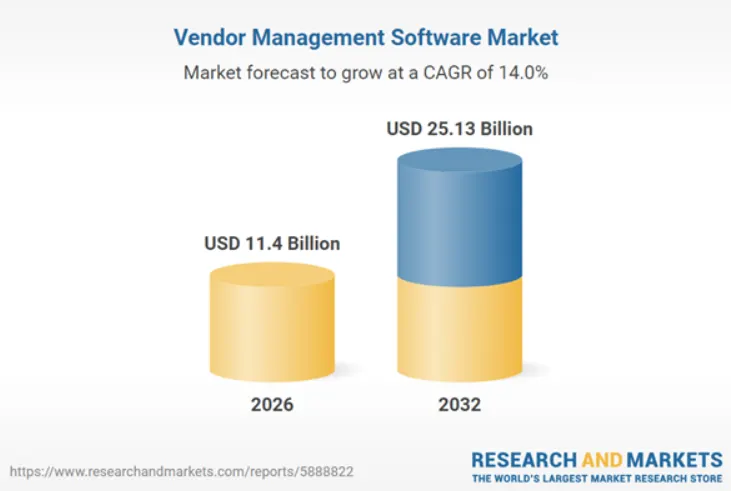
Source: Research And Markets
When organizations scale without a centralized governing framework, they enter a state of vendor chaos. This operational friction manifests as redundant software subscriptions, unnegotiated contract renewals, and severe compliance gaps. For multi-billion-dollar enterprises, the cost is not merely transactional. It degrades EBITDA, introduces catastrophic third-party risks, and stalls corporate agility.
Investors targeting this space are positioning themselves to solve a multi-billion-dollar pain point by replacing fragmented, ad-hoc workflows with a unified, high-visibility operational layer.
The Cost of Missed Renewals
Unmanaged contract renewals represent a silent drain on enterprise capital, primarily driven by the proliferation of evergreen clauses and decentralized ownership. In a typical corporate structure, software-as-a-service (SaaS) agreements and service-level contracts routinely feature auto-renewal windows requiring written notice 30, 60, or 90 days prior to expiration. Without a centralized, proactive alert architecture, these deadlines pass unnoticed, legally binding the enterprise to another fiscal cycle of underutilized or entirely redundant services.
The fiscal impact compounded across a global enterprise is staggering:
- Redundant Tooling: Separate business units frequently procure overlapping software suites, resulting in duplicate seat licensing costs.
- Lost Negotiating Leverage: Procurement teams lose the critical 60-day window required to benchmark market rates, audit vendor performance, and leverage competitive bidding.
- Inaccurate Financial Forecasting: CFOs are forced to accommodate unexpected operational expenditures, throwing off quarterly budget allocations due to zombie contracts that should have been rationalized or decommissioned.
The Failure of Spreadsheets
For decades, desktop spreadsheets served as the default repository for corporate vendor data. However, manual data entry introduces severe systemic risks and version control failures, leaving legal, procurement, and IT security teams without a single source of truth. Consequently, a contract amendment negotiated by legal rarely updates the financial tracking systems in real time.
Furthermore, spreadsheets lack the dynamic data ingestion capabilities required for modern corporate governance. They cannot integrate with threat intelligence feeds, track a supplier’s financial health, or automate critical compliance workflows. This operational opacity ultimately exposes enterprises to severe regulatory fines and unexpected disruptions.
Decentralized Buying Blind Spots
Decentralized procurement, driven by corporate shadow IT, allows department heads to bypass formal protocols and purchase services independently using corporate credit cards. While this grants localized teams short-term agility, it strips executive leadership of visibility and creates severe institutional blind spots over total corporate expenditures.
From a security and financial perspective, this fragmentation breaks the enterprise perimeter by exposing proprietary data to unvetted third-party vulnerabilities. It also dilutes corporate spending power, forcing organizations to pay premium, retail-tier pricing across small-scale accounts instead of leveraging bulk enterprise discounts.
Overview of the Gatekeeper Platform
Gatekeeper is a comprehensive Vendor Lifecycle Management and Contract Lifecycle Management platform engineered to provide mid-market and enterprise organizations with absolute operational control. By uniting vendor onboarding, contract execution, third-party risk management, and spend governance into a single database, the software eliminates fragmented corporate data silos.
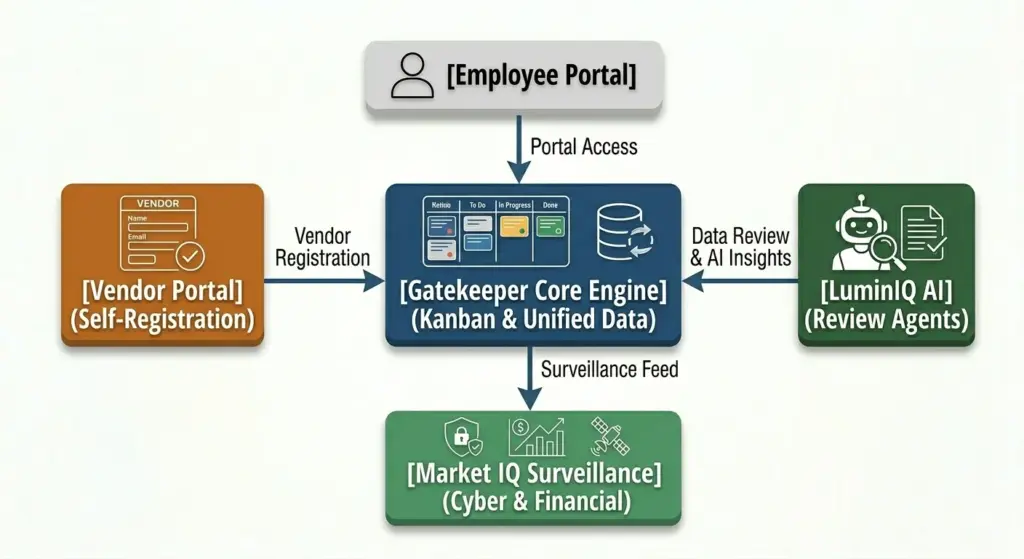
The platform transitions businesses away from manual tracking methods, spreadsheet chaos, and disconnected email approval threads toward a highly automated, secure ecosystem.
The Branded Vendor Portal
Administrative data-entry burdens shift away from internal procurement teams and directly onto the suppliers. Third parties utilize self-service public forms for registration, securely uploading required tax documents, banking details, and security certifications. Automated notification triggers prompt these suppliers to maintain and update their documentation periodically to ensure uninterrupted compliance.
The Employee Intake Portal
Internal teams submit requests for new contracts, supplier onboarding, or agreement renewals through a structured internal gateway. This centralized hub enforces strict submission rules, dramatically reducing data errors and ensuring corporate procurement policies are respected before any external financial commitments occur.
Visual Kanban Workflow Engines
Rather than hiding complex operations behind rigid database tables, processes materialize as highly visual, customizable Kanban boards. Teams easily configure multi-stage, condition-based approval pathways for contract redlining, vendor vetting, and budget clearances.
Key Operational Modules
The platform’s operational strength comes from its modular architecture, where each component is designed to manage a critical part of the vendor lifecycle. These interconnected modules work together to streamline procurement workflows, improve compliance visibility, strengthen vendor governance, and deliver better financial oversight across the enterprise.
| Module Name | Strategic Function | Operational Capabilities |
| Contract Lifecycle Management | Drives speed to signature while eliminating administrative burdens. | Offers native eSignature licensing compliant with eIDAS and UETA standards, clause libraries, and automated renewal monitoring to recover leaked revenue. |
| Spend Management | Optimizes cross-departmental budgets and uncovers financial waste. | Imports transactional accounting data to compare forecast milestones against actual expenditures, identifying immediate opportunities for software and vendor consolidation. |
| Risk & Compliance Register | Mitigates severe third-party liabilities and non-compliance fines. | Tracks supplier performance using automated Balanced Scorecards while maintaining calculated risk scores based on probability and business impact variables. |
| Market IQ Surveillance | Delivers 24/7 continuous supply chain threat intelligence. | Feeds real-time financial health updates, corporate credit adjustments, and cybersecurity rating changes directly into active vendor profiles to flag threats instantly. |
LuminIQ Digital Agents
The platform replaces passive logging with proactive intelligence by incorporating the specialized LuminIQ Suite. This array of purpose-built AI agents acts as digital workers, reading, parsing, and extracting critical text patterns from complex corporate files. Manual oversight scales poorly. Automated AI verification ensures structural compliance across thousands of legal agreements simultaneously.
- Contract Review Agent: Automatically scans incoming agreements against a defined corporate playbook, instantly flagging hidden liabilities, unusual indemnification clauses, or missing legal terms.
- SOC 2 & Security Compliance Agents: Extracts exceptions and security gaps from lengthy third-party infrastructure reports, protecting the corporate network from supply-chain data breaches.
- Regulatory & Framework Agents: Reviews specific ICT supplier submissions against complex industry-specific legal frameworks, such as DORA requirements, to ensure complete regulatory alignment prior to execution.
Enterprise Security & Global Connectivity
Data sovereignty and information security serve as the foundation of the architecture. The ecosystem holds strict global certifications, including ISO 27001 and ISO 9001, enforcing granular role-based access control layers alongside robust SAML SSO integrations for providers like Okta, Google, and Microsoft.
To handle complex corporate tech stacks, the infrastructure connects natively with over 1,700 external software applications. Deep bidirectional programmatic syncs link directly into primary financial platforms and ERP systems like NetSuite, keeping master vendor profiles, active purchase orders, and legal compliance structures permanently balanced across the entire enterprise.
Features of a Vendor Management Platform Like Gatekeeper
Building a competitive vendor management platform requires far more than basic CRUD dashboards. The system must function as a dynamic workflow orchestration engine connecting vendors, contracts, approvals, financial systems, and compliance operations. To deliver true enterprise value, the product architecture must center on six core feature pillars designed to handle high-volume corporate transactions seamlessly.
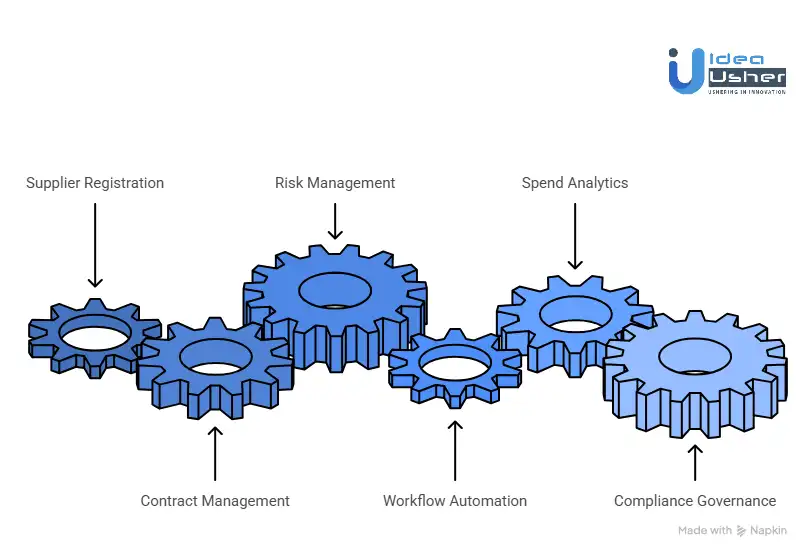
1. Supplier Registration
The initial point of entry must eliminate manual administration by shifting data entry tasks from internal procurement teams directly onto the vendors themselves. Platforms like Precoro leverage this self-service model to accelerate early pipeline creation. This significantly reduces procurement bottlenecks while improving onboarding accuracy across large supplier ecosystems.
[Vendor Registration Sign-up] ➔ [Self-Service Profile Portal] ➔ [Automated Tax/Bank Validation]
Development teams design self-service vendor portals where suppliers securely upload their own tax documents, banking details, and security certifications. The system must run real-time background validation scripts to ensure bank routing numbers are accurate and tax IDs are verified against global databases before allowing a vendor into the main ecosystem.
2. Contract Management
A contract is not a passive digital document; it is a live financial agreement filled with data points that dictate operational revenue and liabilities. Specialized software like Ironclad demonstrates the power of structuring this text into dynamic, searchable milestones. When contract intelligence remains buried inside static PDFs, enterprises lose visibility into critical financial and compliance obligations.
- Dynamic Document Parsing: High-performance platforms utilize optical character recognition to read legal PDFs, auto-extracting critical execution dates, termination clauses, and financial values.
- Clause Libraries: Legal departments require structured repositories of pre-approved contractual language, allowing sales and procurement teams to assemble compliant agreements without manual legal oversight.
- E-Signature Routing: Secure, native integrations with signature platforms ensure agreements transition instantly from redlining to final corporate authorization.
3. Risk Management
Enterprises face immense liabilities if their third-party suppliers suffer security breaches or structural insolvency. Your platform must mitigate this by acting as a continuous, automated risk scanner, similar to how dedicated tools like Bitsight handle ongoing threat monitoring. In high-scale enterprises, even a single compromised vendor relationship can trigger widespread financial, operational, and reputational damage.
The Security Rule: Risk evaluation cannot end after onboarding. A supplier who was safe six months ago might expose your data to vulnerabilities today.
The engineering approach incorporates continuous API webhooks linked to external cybersecurity feeds and global financial databases. If an onboarded vendor’s corporate credit rating drops or an active data vulnerability is flagged on their network, the platform automatically drops their internal health score and locks pending payouts until a formal re-audit occurs.
4. Workflow Automation
Enterprise procurement depends heavily on complex, conditional approval chains that cross multi-department boundaries. Market leaders like SAP Fieldglass highlight the necessity of deep workflow customizability when orchestrating global teams. Even minor approval bottlenecks can create cascading delays across procurement, finance, legal, and vendor onboarding operations.
| Trigger Condition | Required Approval Path | System Action |
| Contract Value > $100,000 | Direct CFO Sign-off | Auto-routes invoice to executive queue. |
| Handles PII / Customer Data | InfoSec Team Review | Triggers mandatory security survey. |
| International Supplier | International Legal Team | Flags contract for regional compliance review. |
Building flexible, backend routing logic capable of running these evaluations simultaneously ensures documents reach the precise stakeholders required without stalling overall operational velocity.
5. Spend Analytics
Executive leadership teams need precise data to optimize budgets and eliminate financial waste across their entire operational footprint. Solutions like Coupa pave the way in this sector by giving companies absolute spend controls over out-of-policy purchases. Without centralized spend intelligence, enterprises often lose visibility into millions of dollars hidden across fragmented departmental purchasing activity.
Total Spend Analytics = (Active ERP Invoice Data) – (Contracted Rate Card Value)
The platform must ingest active transaction data from corporate ERP systems and compare it directly against signed contract rate cards. This highlights immediate financial leaks, flags duplicate billing anomalies, or exposes shadow IT instances where departments are buying software outside of negotiated enterprise accounts.
6. Compliance Governance
When external regulatory audits occur, companies must be able to instantly prove their operational compliance history without scrambling through fragmented files. Specialized trust tools like Vanta emphasize the value of maintaining continuous, clear evidence chains to satisfy rigorous oversight.
The platform must maintain comprehensive, immutable audit trails. Every user action, from changing a contract term to approving an invoice or renewing a vendor license, must be timestamped, logged, and securely stored.
The Enterprise Architecture Behind Platforms Like Gatekeeper
The biggest misconception about vendor management software is that it is primarily a front-end application. In reality, the hardest engineering challenge is designing the relational data infrastructure. Building a resilient backend requires moving past traditional siloed structures to construct a deeply integrated data network capable of handling massive corporate transaction volumes.
The Vendor Relationship Graph Framework
One of the biggest architectural gaps in most procurement systems is that they treat vendors, contracts, approvals, compliance records, and payments as isolated entities. A better approach is the Vendor Relationship Graph Framework. This architecture models enterprise vendor operations as connected relational objects rather than separate, decoupled spreadsheet rows.
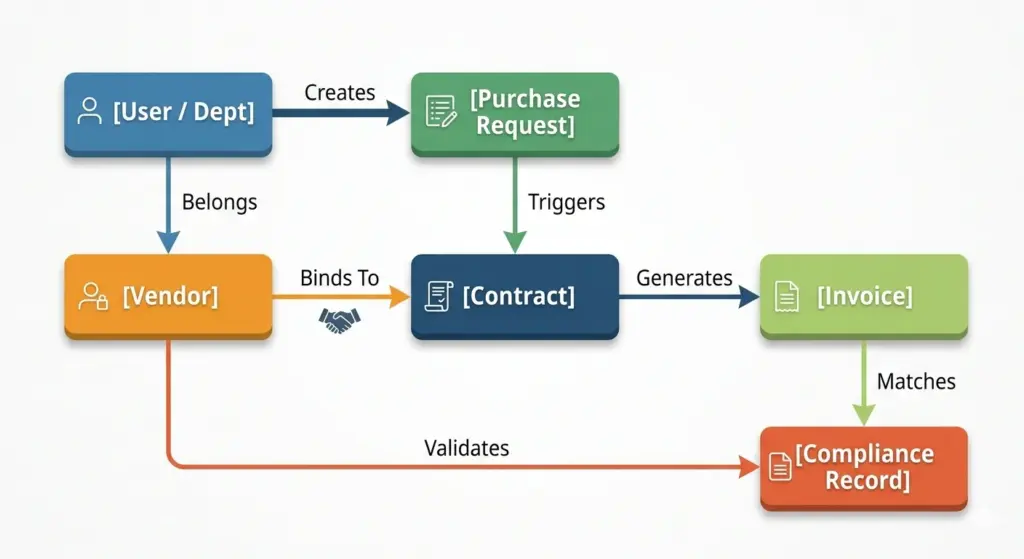
By linking every data point back to a central node, the software mirrors actual corporate ecosystems. When an event happens to one element, the entire relational web updates dynamically.
Core Data Relationships
To map this complex graph, the system relies on structured dependencies across six primary architectural entities. Each entity acts as an operational checkpoint responsible for validating workflows, permissions, financial logic, and compliance states across the platform. Maintaining these interconnected relationships is essential for ensuring real-time synchronization between procurement, legal, finance, and vendor governance operations.
| Entity | Connected Systems | Operational Interdependency |
| Vendor | Contracts, invoices, approvals, compliance records | Acts as the root node for all downstream operational data. |
| Contract | Legal terms, spend, obligations, renewals | Dictates financial boundaries and milestones for invoices. |
| User | Roles, departments, approvals | Governs permission levels and approval routing parameters. |
| Purchase Request | Budgets, ERP entries, workflows | Validates available capital against corporate departmental budgets. |
| Compliance Record | Risk reviews, certifications | Sets the active operational health status of the supplier node. |
| Invoice | Procurement, accounting, vendor | Maps transaction history directly back to initial contract rate cards. |
This relational graph architecture enables a series of highly automated capabilities:
- Unified Vendor Intelligence: Accessing a single screen pulls a real-time ledger of every active contract, pending payment, and security risk associated with that supplier.
- Automated Workflow Dependencies: If a compliance certification expires, the system references the graph and instantly pauses all pending purchase requests related to that specific vendor.
- Risk Correlation: Cross-referencing legal terms with active security feeds flags contracts that lack mandatory liability protections during a vendor breach.
- Real-Time Reporting: Eliminates database lag by serving up instant visibility into cross-departmental spend patterns and compliance histories.
- Predictive Procurement Analytics: Monitors historical invoice data alongside milestone timelines to anticipate contract cost spikes before they hit the ledger.
Without this solid data structure beneath the hood, platforms become fragmented quickly under heavy enterprise workloads.
Recommended Technology Stack
Executing this advanced architecture demands a robust, production-grade tech stack capable of scaling gracefully while maintaining strict enterprise compliance. The infrastructure must support massive transactional throughput without introducing workflow latency or data inconsistency across interconnected systems.
The Architectural Priority: The stack must balance rapid user-interface performance with heavy backend analytical processing power and ironclad data security.
- Frontend Layers: React.js paired with Next.js, written natively in TypeScript and styled via Tailwind CSS, delivers a highly responsive, type-safe single-page application framework.
- Backend Engines: Node.js utilizing NestJS provides an enterprise-ready, modular framework for core business logic, while Python microservices handle asynchronous, resource-heavy AI parsing workflows.
- Database Layer: PostgreSQL serves as the relational bedrock for transaction safety, complemented by Elasticsearch for complex document query indexing, Redis for high-speed session caching, and Neo4j for intensive relationship graph mapping.
- Infrastructure Pipeline: Containerized via Docker and orchestrated through Kubernetes across AWS or Azure, with the entire environment provisioned securely using Terraform for infrastructure-as-code deployment.
- Security & Identity: OAuth 2.0 and SAML SSO protocols integrate directly with tools such as Okta, enforcing granular role- and attribute-based access controls (RBAC/ABAC) to isolate corporate assets.
- AI Infrastructure: External LLM APIs connect directly to dedicated vector databases, enabling sophisticated Retrieval-Augmented Generation (RAG) pipelines to automatically parse and search legal text.
AI Features That Modern Vendor Management Platforms Need
Artificial intelligence is rapidly transforming procurement and vendor governance. The next generation of vendor management platforms will compete less on dashboard design and more on operational intelligence. Rather than serving as passive filing cabinets, systems must actively read, analyze, and automate complex workflows to deliver tangible enterprise value.
1. AI-Powered Contract Intelligence
Reviewing thousands of multi-page legal documents manually creates massive operational bottlenecks. AI-powered document intelligence transforms static contracts into dynamic, structured datasets instantly. This allows procurement and legal teams to access critical contract insights without spending countless hours on manual review processes.
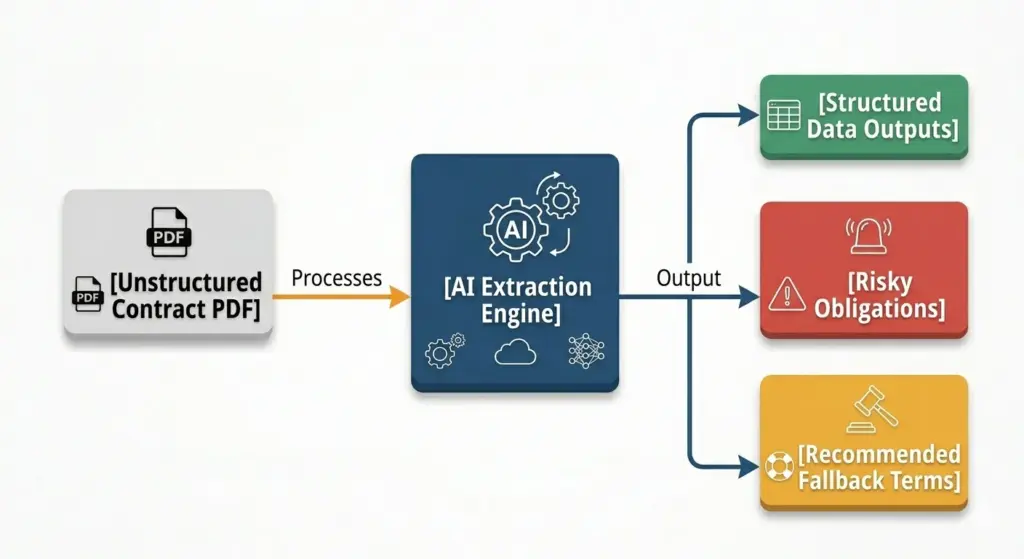
By embedding advanced machine learning models directly into the ingestion pipeline, the software can automatically:
- Extract Critical Clauses: Isolate liability limits, indemnification terms, and termination notice periods.
- Identify Unusual Language: Highlight deviations from the standard corporate legal playbook.
- Flag Missing Terms: Warn legal teams if mandatory data privacy addenda or standard payment terms are omitted.
- Detect Risky Obligations: Surface auto-renewal traps or hidden price escalation clauses.
- Generate Summaries: Produce instant executive briefings for complex, cross-border agreements.
- Recommend Fallback Clauses: Suggest pre-approved alternative legal language when a vendor rejects standard terms.
This predictive automation reduces manual contract review workloads significantly, allowing internal legal teams to focus on high-risk negotiations rather than administrative data entry.
2. AI Vendor Risk Scoring
Traditional threat assessment relies on static, annual compliance questionnaires that become obsolete the moment they are completed. Modern risk management requires a continuous, predictive approach. Organizations now need real-time visibility into supplier stability, cybersecurity posture, and operational reliability to reduce potential disruptions proactively.
The Predictive Edge: AI shifts risk tracking from a reactive, point-in-time check to a continuous, real-time posture analysis.
Instead of waiting for a manual audit, specialized algorithms work in the background to monitor external risk signals across global networks. The system actively analyzes a supplier’s live cybersecurity posture, parses news feeds for early signs of vendor financial instability, and identifies unusual corporate spending behavior. By combining these diverse data streams, the AI can accurately predict renewal risks and flag vulnerable suppliers long before an actual operational breach or insolvency occurs.
3. AI Workflow Orchestration
Modern procurement systems increasingly replace rigid, hard-coded routing rules with intelligent, autonomous AI agents to manage complex corporate approvals. These systems continuously learn from historical procurement behavior and organizational patterns to improve decision-making accuracy over time. As procurement environments become more complex, AI-driven orchestration helps enterprises maintain speed, compliance, and operational consistency at scale.
| Operation | Agent Action | System Benefit |
| Approval Routing | Evaluates organizational context and historical patterns. | Eliminates manual ticket assignment errors. |
| Request Prioritization | Scores requests based on urgency, budget, and business impact. | Accelerates critical infrastructure purchases. |
| Supplier Recommendation | Analyzes performance, compliance history, and cost metrics. | Optimizes supplier selection for incoming projects. |
| Duplicate Detection | Flags overlapping software licenses or redundant hardware requests. | Prevents waste and shadow IT spending. |
These intelligent agents process incoming procurement tickets, generate concise intake summaries for busy managers, and keep multi-million dollar supply chains moving at peak velocity without human bottlenecks.
4. AI Search & Knowledge Retrieval
Enterprise search has evolved into a major competitive differentiator for modern software ecosystems. Corporate users increasingly expect intuitive, conversational interfaces where they can interrogate their data directly using natural language. Modern AI systems are now expected to deliver answers with the same speed and simplicity as consumer search experiences.
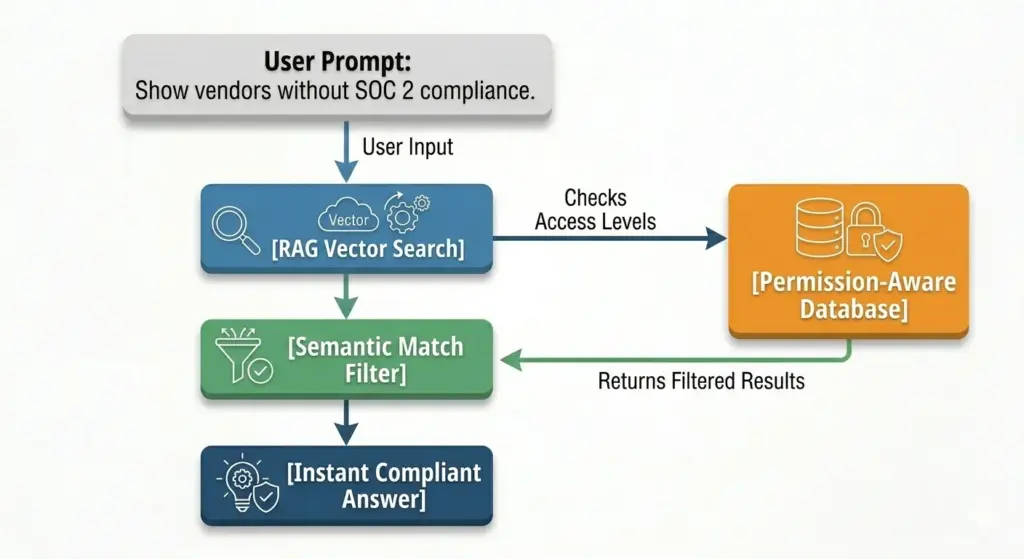
Implementing this capability requires combining vector search engines with Retrieval-Augmented Generation architectures. By anchoring large language models to your structured procurement data, users can ask complex questions and receive immediate, precise answers:
- “Which vendor contracts are scheduled to renew next quarter?”
- “Show all active software suppliers who currently lack SOC 2 compliance.”
- “Which secondary SaaS tools overlap with our core Salesforce functionality?”
To deploy this successfully in an enterprise environment, the underlying retrieval engine must be entirely permission-aware. The system must verify role-based access controls in real time, ensuring that a general manager cannot query sensitive executive payroll contracts or restricted financial agreements.
Why ERP Integrations Determine Platform Success?
Many procurement startups fail because they underestimate integration complexity. A vendor management platform cannot operate as an isolated application; it must synchronize seamlessly with the enterprise financial infrastructure. If a platform operates in a silo, it forces accounting and procurement teams to manually copy data across screens, introducing severe operational risk and destroying the software’s core value proposition.
Critical ERP Integrations
To secure a foothold in the enterprise market, high-performing platforms design native data bridges to major corporate systems of record. Systems like Gatekeeper maintain their market-leading status by establishing deep programmatic connections with industry-standard ecosystems.
- Financial & Core ERP Infrastructure: SAP, Oracle, NetSuite, and Microsoft Dynamics.
- Human Capital & Specialized Procurement Ecosystems: Workday, Coupa, and ServiceNow.
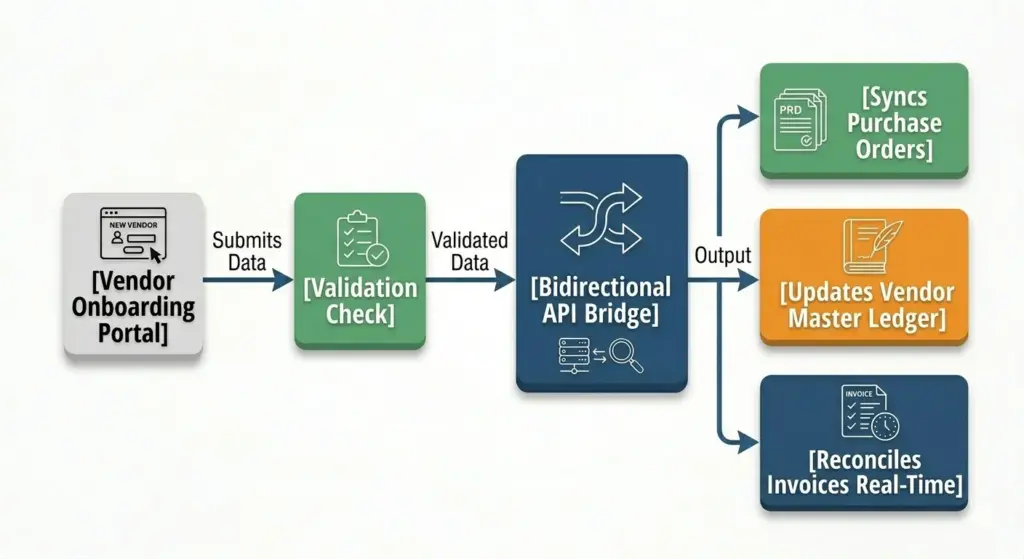
Establishing these real-time data loops enables an array of automated financial capabilities:
- Purchase Order Synchronization: Automatically generating matching POs in the financial system the moment a procurement request clears internal approval workflows.
- Vendor Master Updates: Pushing newly validated supplier bank routing details, tax classifications, and compliance statuses directly to the main accounting ledger without human intervention.
- Invoice Reconciliation: Executing automated three-way matching by cross-referencing incoming bills against the original signed contract rate cards and approved purchase orders.
- Budget Validation: Checking real-time departmental balance sheets within the ERP before allowing a user to submit a high-value purchase request.
- Procurement Approvals: Translating complex financial limits set in the core accounting software into actionable, dynamic user notification queues.
- Spend Analytics: Aggregating raw transactional data from the ledger to map real-time cash outflows against contractual obligations.
The Unified Spend Layer Framework
Overhauling or replacing an enterprise’s foundational financial infrastructure is an operational nightmare that corporate IT departments fiercely resist. One effective architectural approach to bypass this friction is the Unified Spend Layer Framework. This model allows organizations to modernize procurement operations without disrupting deeply embedded legacy financial systems.
The Integration Rule: Do not fight the existing financial infrastructure. Build an intelligent operational canopy above it.
| System Layer | Primary Operational Role | Core Functional Assets |
| Your Vendor Platform | The Orchestration Canopy | Workflow engines, vendor intelligence hubs, contract lifecycles, compliance tracking, and intuitive user intake interfaces. |
| The Corporate ERP | The Financial Bedrock | General ledger, transaction logging, tax reporting, and ultimate financial source of truth. |
By positioning your platform as the agile workflow layer that feeds data down into the rigid ERP ledger, you eliminate manual data entry while respecting the enterprise’s existing financial controls. This architectural approach dramatically reduces implementation resistance from corporate CIOs, slashes software onboarding timelines from months to days, and positions your platform as an indispensable asset in the corporate tech stack.
How to Build a Vendor Management Platform Like Gatekeeper?
Building an enterprise-grade vendor management platform requires shifting perspective from a passive database to an active orchestration engine. Software like Gatekeeper succeeds because it sits directly at the intersection of process automation and data centralization. The primary goal is to construct a scalable architecture that handles complex corporate operations while maintaining an intuitive user experience.
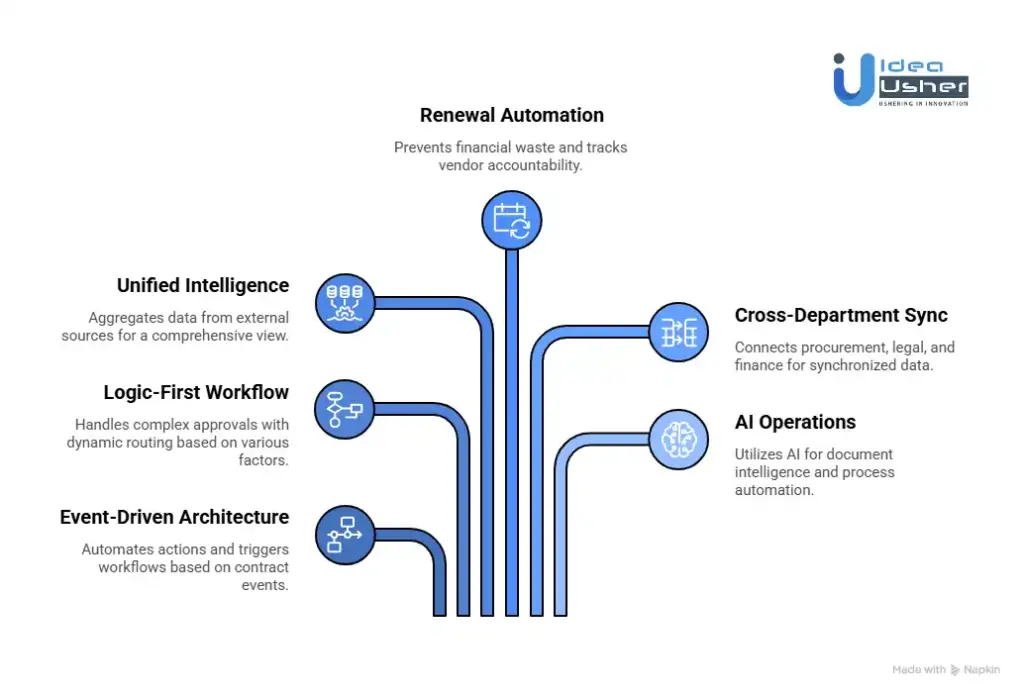
When we build platforms in this high-value vertical, our engineering focus centers on six core architectural strategies designed to ensure maximum enterprise adoption and return on investment.
1. Event-Driven Contract Architecture
Traditional software treats contracts as static PDF attachments. To build a truly disruptive platform, our development teams design the architecture to treat every contract as a dynamic timeline of structured data events. This allows the system to automate actions, trigger workflows, and surface operational risks long before they become financial problems.
When a contract is uploaded, our systems immediately parse key metadata fields into actionable operational triggers:
- The Lifecycle Loop: Extracting termination notice periods, opt-out windows, and milestone delivery dates automatically.
- The Automated Pipeline: Instead of relying on a human to check an expiration date, the contract object itself pushes notifications to specific user groups as these dates approach.
- The Downstream Effect: If a vendor contract requires a security re-audit every twelve months, our backend engineers program the system to auto-create that IT ticket based entirely on the execution date event.
2. Logic-First Workflow Design
A beautiful user interface is worthless if the underlying business logic cannot handle the messy reality of enterprise approvals. Before coding a single front-end component, our product architects map out the conditional routing matrices that govern corporate procurement.
The Enterprise Rule: Approvals are never strictly linear. They shift dynamically based on contract value, department, data risk profile, and geographic location.
We engineer backend engines to support complex Boolean logic. For example, if a software purchase exceeds $50,000, our workflow logic automatically routes the ticket to the CFO. If that same software handles protected health information, it simultaneously triggers a parallel review track for the data privacy officer. We specialize in building highly flexible, code-free workflow builders that let corporate admins modify these rules on the fly without needing constant engineering support.
3. Unified Intelligence Layer
Enterprise buyers do not need another siloed dashboard. They need a single, master intelligence layer that aggregates data from external ecosystems to provide a comprehensive view of supplier health. This unified visibility allows procurement, legal, and finance teams to make coordinated decisions from the same operational source of truth.
| Intelligence Stream | Target Data Points | Operational Benefit |
| Cybersecurity Feeds | Active malware threats, unpatched vulnerabilities, data leaks. | Prevents third-party breaches before onboarding. |
| Financial Health Tracking | Credit scores, bankruptcy filings, ownership changes. | Protects the supply chain from sudden vendor insolvency. |
| Regulatory Databases | Politically Exposed Persons (PEP) lists, sanction watchlists, GDPR compliance. | Ensures absolute legal and geopolitical compliance. |
By natively integrating these live data streams via secure APIs, we transform your platform from a simple administrative tool into an indispensable, risk-mitigating enterprise asset.
4. Renewal and SLA Automation
The primary ROI metric for any enterprise procurement platform is its ability to stop financial waste and track vendor accountability. We build these products with automated renewal scoring and continuous service-level agreement tracking frameworks. This enables enterprises to proactively identify underperforming vendors before contracts silently renew or compliance issues escalate.
Renewal Risk Score = (Vendor Input Score) + (SLA Compliance Rate) + (Utilization Data)
Instead of simple date-based alerts, we develop predictive scoring models. If a vendor has a history of missed milestones, low software seat utilization, and declining performance metrics, our platform flags that contract as a high-risk renewal ninety days out. This gives procurement executives the exact data and leverage they need to either negotiate aggressive discounts or confidently transition to a competitor.
5. Cross-Department Data Sync
A significant flaw in legacy software is the isolation of departmental data. To build a truly competitive platform, we position your product as the connective tissue between three distinct enterprise pillars. This unified architecture ensures procurement, finance, and legal teams operate from synchronized vendor intelligence instead of fragmented systems.
- Procurement: Manages vendor onboarding, requests for proposals (RFPs), and initial supplier qualification workflows.
- Legal: Owns the contract lifecycle management (CLM), redlining, clause libraries, and ultimate contract execution.
- Finance: Controls purchase orders, ERP synchronization, invoice matching, and actual spend analysis.
Our development approach focuses heavily on bridging these islands. When procurement approves a vendor, the legal workflow launches automatically using pre-approved clause templates. Once legal signs the contract, we ensure the platform instantly pushes the financial data to systems like NetSuite or SAP to open a purchase order, completely eliminating manual double-entry.
6. Native AI Operations Engine
Artificial intelligence is no longer a luxury feature; it is the baseline expectation for modern enterprise procurement software. However, building an AI engine in this space requires moving past basic chatbot integrations to focus entirely on document intelligence and process automation.
- Optical Character Recognition (OCR): We build robust, custom OCR pipelines capable of scanning legacy, unstructured contract PDFs and instantly converting them into structured, searchable data tables.
- Automated Risk Redlining: We train machine learning models to review incoming vendor-provided agreements against an enterprise’s standard legal playbook, automatically flagging non-standard liability caps or unfavorable indemnification clauses.
- Anomalous Spend Detection: Our data engineers utilize specialized algorithms to audit transactional records and find hidden cost spikes, duplicate billing anomalies, or instances where a department is being overcharged based on the agreed-upon contract rate cards.
Security, Compliance & Governance Requirements
Vendor management platforms handle highly sensitive operational data. The system databases hold business-critical assets, including legal contracts, corporate financial records, supplier bank credentials, internal procurement budgets, and executive approval trails. Because a single breach can compromise an entire corporate ecosystem, enterprise buyers expect ironclad governance controls before trusting a new platform with their data.
1. Required Security Features
Securing a high-value corporate procurement application requires a defense-in-depth engineering strategy. The system infrastructure must be built around strict data protection protocols and granular user management tools. This ensures that sensitive procurement operations remain protected against both external cyber threats and internal misuse.
Identity & Access Control
Managing who can view, edit, or delete sensitive legal and financial data is the first line of defense against internal and external threats. Strong identity and access controls help organizations minimize unauthorized activity across procurement workflows. They also ensure that confidential supplier and contract information remains accessible only to approved personnel.
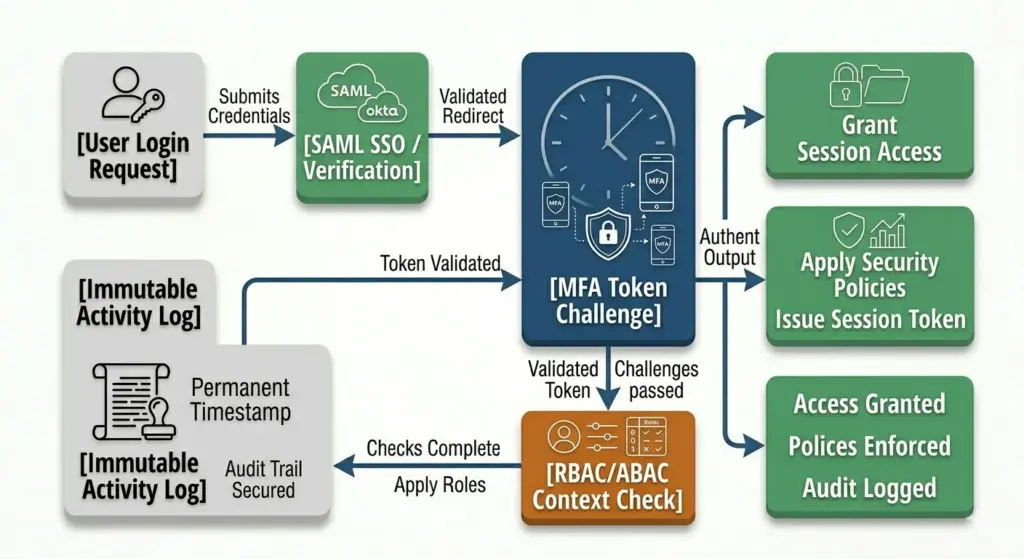
- SSO & MFA: Native integration with corporate identity providers via SAML SSO or Okta, backed by mandatory Multi-Factor Authentication.
- RBAC & ABAC Permissions: Implementing role-based and attribute-based access controls to ensure employees only view contracts relevant to their department or authorization tier.
- Granular Audit Logging: Creating immutable, timestamped ledger entries tracking every user action, from document views to approval overrides.
- Active Session Controls: Enforcing automated session timeouts, device pinning, and location-aware access boundaries.
2. Data Security
Data must remain entirely unreadable to unauthorized entities, whether it is sitting statically in a database or moving across the network. Strong encryption and secure infrastructure practices help prevent unauthorized interception or data exposure. This level of protection is essential for maintaining enterprise trust and regulatory compliance across procurement operations.
The Security Standard: High-performance enterprise platforms apply strict cryptographic boundaries to every layer of the data lifecycle.
All data moving across public or private networks must be protected using TLS 1.3 encryption protocols. Static assets, such as uploaded contract PDFs and database rows, require field-level AES-256 encryption. Key Management Systems (KMS) should handle automated cryptographic key rotation, while the underlying storage engines must run secure, multi-region automated backups to ensure rapid disaster recovery without data loss.
3. Compliance Standards
Depending on your target industries and geographic markets, clearing corporate procurement vetting requires holding recognized security certifications. These compliance standards demonstrate that the platform follows established security, privacy, and operational governance practices. They also help enterprise buyers reduce vendor onboarding friction during security and legal evaluations.
| Certification Standard | Primary Focus Area | Target Industry Vertical |
| SOC 2 Type II | Continuous operational security, availability, and data privacy. | All Enterprise SaaS Markets |
| ISO 27001 | Global information security management systems framework. | International Enterprise & Tech |
| HIPAA | Protected health information (PHI) data safeguards. | Healthcare, Biotech, & Pharma |
| GDPR / CCPA | Strict user data privacy rights and residency enforcement. | European Union & California Markets |
| FedRAMP | High-level cloud security parameters for public sectors. | Government Agencies & Contractors |
Achieving these standards requires designing the software architecture correctly from day one, ensuring that data partitioning, encryption keys, and system logs conform to rigorous external audit parameters.
4. Zero-Trust Vendor Governance Model
One emerging best practice is implementing a Zero-Trust Vendor Governance Model. This approach assumes that every vendor relationship introduces dynamic, ongoing operational risk rather than a static compliance status. Instead of relying on outdated, static annual reviews, the platform continuously and automatically validates the supplier’s network footprint:
- Dynamic Access Verification: Revoking vendor portal access automatically the moment an onboarding contract expires or enters a dispute state.
- Live Compliance Status: Ping regulatory watchlists and database registries daily to verify corporate business standings.
- Continuous Risk Posture Monitoring: Aggregating external threat intelligence to detect unpatched vulnerabilities in a supplier’s software supply chain.
- Automated Certification Expiration Tracking: Launching automated reminder sequences ninety days before a vendor’s SOC 2 or insurance certificate lapses.
This model aligns perfectly with broader enterprise cybersecurity trends, transforming the vendor platform from a passive directory into an active, defensive security asset.
Cost to Build a Vendor Management Platform Like Gatekeeper
Development costs vary dramatically depending on feature depth and enterprise requirements. Navigating this capital expenditure requires a clear understanding of your platform’s scope and the technical milestones that dictate total investment. Building high-performing vendor management platforms involves a calculated alignment of software engineering, security architecture, and user experience design.
Estimated Development Costs
To help you map out your budget allocations, we break down financial requirements into distinct tiers based on product maturity and complexity. Each pricing tier reflects differences in infrastructure depth, workflow automation capabilities, AI integration, and enterprise security requirements. Understanding these distinctions helps businesses align product vision with realistic development investment planning.
| Platform Scope | Estimated Cost |
| MVP Vendor Portal | $40,000 – $80,000 |
| Mid-Level SaaS Platform | $120,000 – $250,000 |
| Enterprise VCLM Platform | $300,000 – $600,000+ |
| AI-Powered Enterprise Suite | $750,000+ |
Investing in a basic minimum viable product allows for fast market entry, while moving up to an enterprise Vendor Contract Lifecycle Management or AI-powered suite requires deeper financial runway to accommodate advanced architecture.
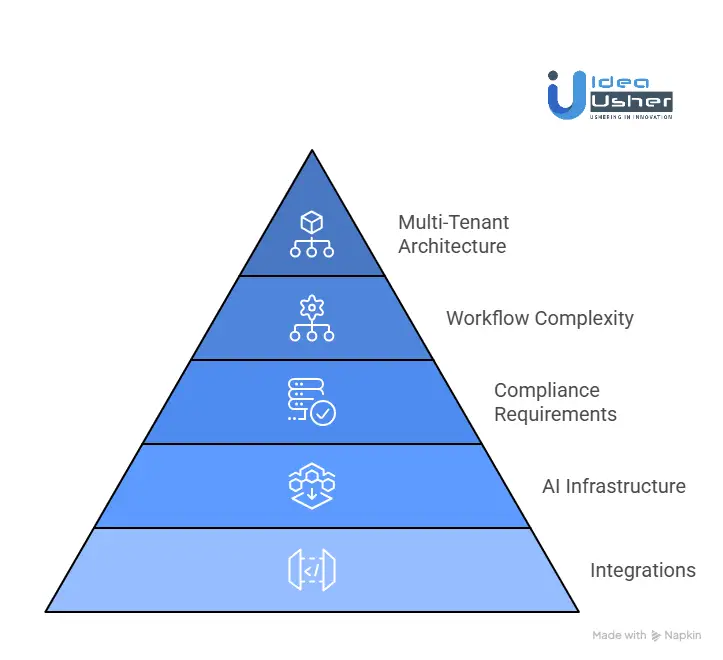
Major Cost Drivers
When building high-end procurement platforms, capital allocation is heavily skewed toward five major engineering pillars. Understanding these drivers ensures accurate forecasting and prevents development bottlenecks. It also helps founders prioritize infrastructure investments that directly impact enterprise scalability and long-term platform reliability.
1. Integrations
ERP and enterprise integrations are often the largest engineering expense. Connecting your platform seamlessly to existing client tech stacks demands robust API development. To close enterprise deals, your software must read and write data in real time across legacy ERP systems, accounting software, and specialized single sign-on tools. Building, testing, and maintaining these secure corporate hooks requires senior database and backend talent.
2. AI Infrastructure
Document intelligence, AI workflows, and vector search add infrastructure and model costs. Building a system that doesn’t just store documents but actually understands them requires specialized machine learning operations. This includes designing pipelines capable of extracting, classifying, and contextualizing legal and procurement data at enterprise scale.
The AI Reality: Budgeting for AI means factoring in both the initial model training/fine-tuning costs and the ongoing token consumption expenses required to process thousands of multi-page legal PDFs simultaneously.
3. Compliance Requirements
SOC 2, GDPR, HIPAA, and enterprise security certifications increase development timelines. Because your platform will handle sensitive corporate data, banking details, and legal agreements, security cannot be an afterthought. Enterprise clients often evaluate security posture before product functionality during procurement assessments.
- Encryption-in-Transit and at Rest: Implementing AES-256 encryption standards.
- Audit Trails: Developing automated, immutable logs that track every user action for regulatory compliance checks.
- Penetration Testing: Factoring in the costs of third-party security audits required to pass enterprise procurement vetting.
4. Workflow Complexity
No-code automation engines require sophisticated backend logic. Creating a user-friendly drag-and-drop builder where a non-technical manager can define approval matrices looks simple on the surface but demands heavy backend engineering. The system must process complex condition trees without breaking performance speeds or locking database tables.
5. Multi-Tenant Architecture
Enterprise SaaS scaling introduces strict operational requirements that scale engineering complexity. As enterprise adoption grows, the platform must maintain high availability, low-latency performance, and strict data isolation across thousands of concurrent workflows. This demands infrastructure that can scale horizontally without compromising security, uptime, or compliance readiness.
- Tenant Isolation: Guaranteeing that one customer’s data can never bleed into or be accessed by another tenant under any circumstance.
- Permission Segmentation: Building granular role-based access control (RBAC) to manage varying clearance levels within a single enterprise client.
- Data Partitioning: Structuring databases to handle massive, isolated datasets efficiently.
- Regional Hosting Requirements: Providing infrastructure that allows data to reside entirely within specific geographic boundaries to satisfy local compliance laws.
The VENDOR Framework for Building Enterprise Vendor Platforms
One major problem with procurement software development is that teams focus too heavily on front-end user interface workflows while ignoring foundational operational infrastructure. When engineering teams build purely for visual aesthetics, the application rapidly degrades under the weight of thousands of active enterprise vendor contracts, complex approval routing trees, and high-velocity database queries.
To prevent this architectural decay, our product teams deploy a highly scalable, infrastructure-first blueprint: the VENDOR Framework.
V — Visibility Layer
We establish an absolute, single source of truth across your organization. Our developers build a centralized vendor intelligence repository that aggregates disjointed supplier communication threads, historical onboarding documents, and active milestones into a unified profile matrix. By consolidating fragmented data silos, we ensure executive leadership can audit entire corporate supplier networks at a single glance.
E — Enterprise Integrations
A standalone platform cannot survive within a modern corporate tech stack. We specialize in setting up stable, bidirectional programmatic data pipelines that connect your platform directly into existing core business layers:
- ERP & Accounting Ledgers: We sync transactional data streams with platforms like NetSuite, SAP, and Oracle.
- HRMS Infrastructure: Our team connects your system to platforms like Workday to dynamically track internal procurement request owners and department heads.
- Identity Management: We deploy SAML SSO and Okta hooks to handle corporate authentication securely.
N — Normalized Data Architecture
Our pre-vetted engineers prioritize clean, highly structured relational database schemas over unindexed JSON storage models. We design the architecture to separate and index distinct entity nodes, such as vendors, legal clauses, variable line-item spends, and compliance expiration logs, while maintaining rigid, high-performance relational foreign key mappings.
The Architectural Bedrock: This rigorous normalization ensures that a change in a vendor’s base status instantly updates every downstream contract, invoice, and risk assessment across the entire platform without causing database lockups or stale caches.
D — Dynamic Workflow Automation
Enterprise procurement requires flexible, multi-stage approval routing engines that move beyond rigid, linear code structures. We implement custom policy-based workflow orchestration capable of processing real-time conditional logic:
| Trigger Value | Evaluation Node | System Action |
| The invoice exceeds the allocated budget | Department Cost Center | Flags request and routes to VP of Finance queue. |
| Vendor handles corporate PII | InfoSec Clearance Engine | Halts onboarding until automated security scan passes. |
| The invoice exceeds allocated budget | International Legal Team | Dispatches alert to specialized regional counsel. |
O — Operational Intelligence
We leverage machine learning pipelines to handle heavy analytical lifting for your users. By implementing native optical character recognition (OCR) and advanced retrieval architectures, we empower your platform to move past passive logging and actively surface operational intelligence. The systems we build automatically extract hidden contract obligations, flag unusual duplicate spending spikes across separate departments, and calculate dynamic vendor risk ratings based on real-time external data feeds.
R — Risk & Regulatory Governance
Security cannot operate as a reactive, point-in-time checklist. Our development teams implement a continuous, automated threat mitigation layer. We design this sub-system to actively track vendor compliance parameters, monitor third-party cybersecurity data feeds, maintain an immutable ledger of every user action, and enforce regional data residency requirements to ensure a permanent, audit-ready status for your enterprise clients.
The Deterministic Fallback Rule: Preventing RAG Hallucinations
When an LLM hallucinates a creative word in a marketing blog, nobody loses money. However, when a Retrieval-Augmented Generation system hallucinates a decimal point on a vendor’s early-payment discount clause, your enterprise client pays a massive premium on a multi-million dollar invoice.
In procurement, a single miscalculated token can break compliance structures, drain corporate budgets, and lead to devastating legal liabilities.
The Systemic Risk
Standard generative AI models are inherently probabilistic; they are built to predict the next most likely token in a sequence. This fluid, creative nature is fundamentally incompatible with the absolute mathematical precision required by corporate finance, legal, and risk teams.
Allowing an AI model to guess, approximate, or deduce critical data boundaries introduces unacceptable vulnerability into an organization’s tech stack.
- The Renewal Trap: An LLM reads a termination clause and states a contract renews on “October 4th” because it misread a poorly formatted table, causing the business to miss a mandatory 60-day cancellation window.
- The Liability Leap: The system shifts a decimal place on a limitation of liability clause, turning a $5,000,000 corporate protection cap into an unprotected $500,000 exposure liability during a vendor data breach.
- The Rate Card Creep: The engine summarizes an hourly vendor development fee incorrectly, leading to automated invoice approval pipelines validating overcharges without alerting accounting.
The Architectural Strategy
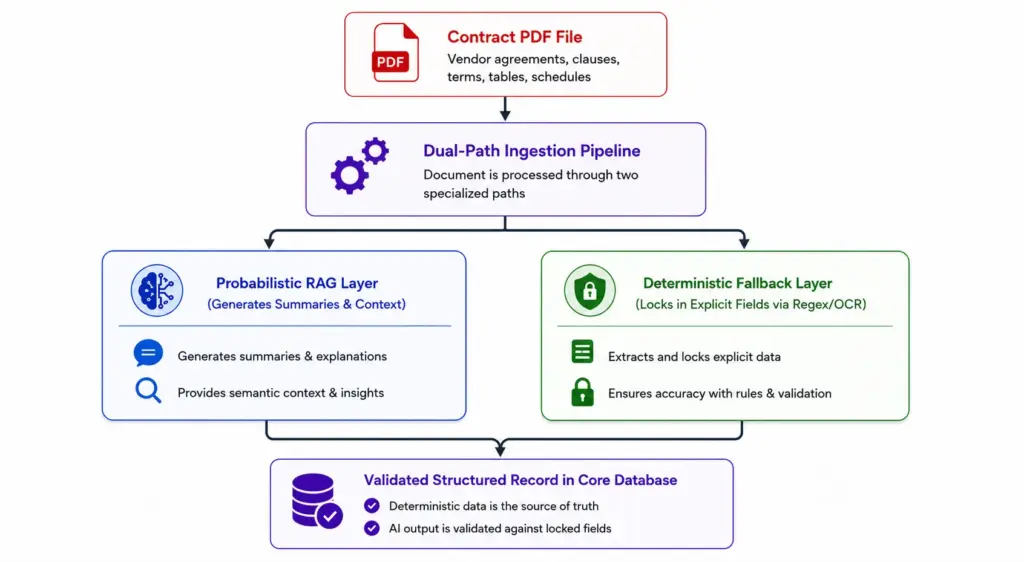
To eliminate this data risk completely, software engineering teams must implement a strict Deterministic Fallback Rule directly inside the ingestion infrastructure. This architecture splits document processing into two distinct, specialized computation paths. By separating semantic interpretation from factual extraction, enterprises gain both AI efficiency and financial reliability.
The Hybrid Rule: Use deterministic rules to lock down hard corporate numbers, and reserve probabilistic AI models exclusively for abstract semantic interpretation.
| Processing Path | Technical Mechanism | Tactical Responsibility |
| Deterministic Layer | Layout-aware OCR, strict Regex heuristics, and structural entity recognition. | Extracts and freezes unchangeable data fields: exact contract execution dates, precise tax IDs, bank routing figures, and definitive currency values. |
| Probabilistic Layer | Vector embedding search, LLM context windows, and RAG prompt tuning. | Synthesizes high-level contract summaries, drafts context explanations, and flags anomalous language variations against standard playbooks. |
By saving extracted values as rigid, structured fields in a database like PostgreSQL before the text ever hits an LLM prompt, you prevent the generative layer from modifying reality. If the AI model’s conversational summary contradicts the frozen database fields, the system triggers an immediate validation flag.
Implementation with Idea Usher
Building a dual-path engineering architecture that balances generative speed with deterministic validation requires highly specialized backend knowledge. At Idea Usher, our pre-vetted senior developers design custom, production-grade ingestion pipelines engineered to eliminate RAG hallucinations entirely.
By hiring from our elite technical talent pool, you onboard developers who specialize in layout-aware document extraction, complex vector database caching, and multi-layered validation logic. We build the advanced hybrid infrastructure your platform needs to safely process enterprise agreements, giving your clients the automated speed of AI backed by the unyielding accuracy of deterministic code.
Do Enterprises Really Need Unified Vendor Platforms?
Some organizations argue that vendor management can be handled using existing, disparate tools. They rely on ERP procurement modules for purchasing, shared cloud drives for storage, isolated contract lifecycle management (CLM) software for legal documents, spreadsheet workflows for tracking, and email threads for executive approvals.
While this decentralized approach may work for smaller teams with limited supplier networks, the model completely breaks down at scale. Fragmented workarounds cannot support complex corporate operations.
[Isolated ERP] + [Shared Drives] + [Spreadsheets] + [Emails] = Operational Chaos
The Breaking Point of Scale
Large enterprise environments create data demands that quickly overwhelm manual tracking methods. Organizations operating at scale must constantly navigate massive operational layers. As vendor ecosystems expand, maintaining visibility across contracts, approvals, compliance, and procurement activity becomes increasingly difficult.
- Thousands of Active Vendors: Managing a sprawling supplier base across multiple departments, tiers, and geographical locations.
- Multi-Region Compliance Requirements: Navigating differing global data regulations, tax structures, and industry-specific mandates.
- Complex Renewal Cycles: Tracking variable termination notice windows and auto-renewal traps across thousands of separate legal agreements. Platforms like Giva emphasize the necessity of unifying these workflows to keep legal timelines clear and searchable.
- Rigorous Regulatory Audits: Providing immediate, documented evidence of vendor security vetting and internal corporate approval histories.
- SaaS and Software Sprawl: Combatting duplicate software subscriptions purchased independently by decentralized business units.
The True Cost of Disconnected Systems
When these operational elements are managed across separate, disconnected systems, major structural vulnerabilities emerge across the organization. Teams often struggle with inconsistent data visibility, delayed approvals, and fragmented reporting across departments. Over time, these inefficiencies increase compliance risks and reduce overall operational agility.
The Visibility Gap: Fragmented tools create data duplication, severe compliance blind spots, manual operational bottlenecks, weak spending visibility, and dangerously high vendor risk exposure.
| Disconnected Symptom | Real-World Enterprise Impact |
| Spreadsheet Tracking | Outdated data leads to missed termination windows and forced auto-renewals. |
| Email Approvals | Compliance auditors cannot easily verify who authorized a high-value transaction. |
| Isolated Shared Drives | Legal teams lose visibility into active liabilities and indemnification limits. |
| Siloed ERP Modules | Accounting reconciles invoices without seeing real-time compliance breaches. |
Operational Control as a Necessity
The strongest argument for deploying a unified vendor management platform is not convenience; it is absolute operational control. A centralized platform acts as an intelligent canopy, orchestrating data seamlessly between your vendors, legal agreements, compliance states, and core accounting ledgers. Comprehensive software suites like ProcurePort show how pulling these disparate systems into a single hub eliminates systemic data fragmentation.
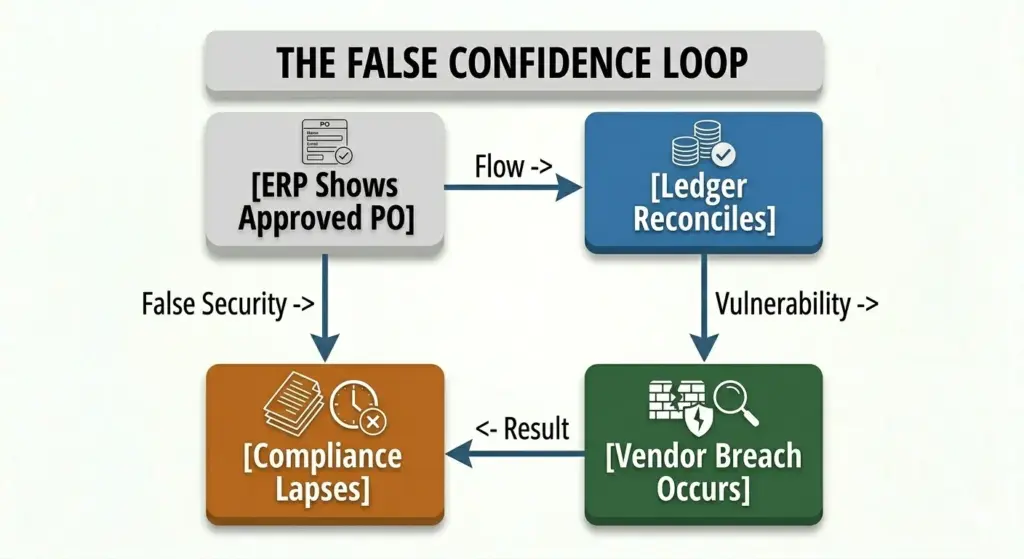
Is Your ERP Giving Visibility or Just Creating False Confidence?
Many executive teams look at their expensive Enterprise Resource Planning dashboards and feel a deep sense of security. The ledger balances, purchase orders map cleanly to general ledger codes, and the financial reports reconcile perfectly at the end of every month. However, for a vast majority of enterprises, this feeling of control is completely artificial, which is why organizations are increasingly migrating toward dedicated vendor management platforms. A perfectly balanced financial ledger does not mean an organization has operational visibility; it simply means the company is keeping highly accurate records of its blind spots.
The Operational Blind Spots of a Standard ERP
An ERP is fundamentally designed to act as a financial system of record. It excels at tracking money that has already been allocated or spent. However, it is fundamentally blind to the unstructured, chaotic operational events that happen before and after a financial transaction occurs.
1. The Legal Disconnect
An ERP knows an invoice is for $50,000. It does not know if the vendor who sent that invoice has breached their contractual limitation of liability, failed to meet their Service Level Agreements, or skipped a mandatory auto-renewal termination notice window.
2. The Compliance Void
The financial ledger will happily clear a payout to an active supplier node. It has no native mechanism to verify if that supplier’s SOC 2 certification expired last week, if their professional liability insurance has lapsed, or if they have suddenly been added to an international regulatory watch list.
3. The Intake Friction
Because core ERP interfaces are notoriously rigid and complex, general employees bypass them entirely during early procurement phases. Instead, they rely on a disjointed mix of offline spreadsheets, localized emails, and Slack messages to vet suppliers, leaving the enterprise entirely blind to early-stage corporate pipeline risk.
Ledger Accuracy vs. True Operational Control
The distinction between a standard financial system and a dedicated orchestration layer comes down to the difference between historical tracking and active governance. Traditional ERP systems primarily record completed financial activity, while modern vendor platforms continuously monitor operational risk and supplier performance.
| ERP Capability (False Confidence) | Dedicated VLM Capability (True Control) |
| Tracks historical financial spend | Analyzes contract terms to prevent value leakage. |
| Stores basic supplier bank details | Continuously monitors live vendor risk signals. |
| Requires manual data input | Automates intake via vendor self-service portals. |
| Maintains rigid, linear data silos | Creates an interconnected relationship graph. |
The Architectural Reality: Relying solely on an ERP for vendor governance is like navigating a ship by looking exclusively at the wake behind it. You possess highly accurate data on where you have been, but you remain entirely blind to the iceberg directly ahead.
How We Bridge the Gap at Idea Usher?
We help organizations transform this false confidence into ironclad operational control. Our pre-vetted product teams design agile vendor lifecycle layers that sit directly above rigid legacy systems like SAP, Oracle, or NetSuite. By hiring from our pool of expert engineers, you gain direct access to developers who know exactly how to build bidirectional API bridges.
We ensure your core financial ledger remains the ultimate source of truth, while equipping your business with the dynamic workflow engines, continuous compliance tracking, and AI-driven contract intelligence needed to secure your entire supply chain.
Contact Idea Usher for a Vendor Management Platform
Transforming complex corporate procurement into a seamless digital asset requires an engineering partner with a proven track record. Building advanced vendor management platforms demands deep technical expertise, stringent security protocols, and scalable architecture.
With over 500,000 hours of coding experience, our team of ex-MAANG/FAANG developers specializes in bringing enterprise-grade platforms to market. We bridge the gap between high-level operational strategy and sophisticated, secure backend development, ensuring your product is optimized for competitive market penetration.
Discuss Your Requirements
Every corporate entity operates on unique operational logic, complex approval matrices, and specific compliance guardrails. Navigating these requirements effectively means mapping out your system’s exact business dependencies before writing the first line of code. When you connect with our product strategists, we dive deep into the essential requirements of your target market:
- Procurement Workflows: Mapping out multi-department approval structures that dynamically adjust based on budget caps and departmental risks.
- Legacy Integrations: Evaluating the technical protocols needed to read and write data in real time across systems like NetSuite, SAP, and custom internal architectures.
- Data Privacy Guardrails: Specifying regional compliance standards to build data isolation models that clear strict enterprise InfoSec assessments.
Validate Your Architecture
Building software for high-net-worth investors and major enterprise buyers leaves no room for architectural flaws. An unstable system foundation leads to costly code refactoring, data leaks, and lost market trust. Enterprise-grade platforms must be engineered for resilience, scalability, and long-term operational reliability from the very beginning.
The Architectural Priority: Before committing substantial capital to full-scale development, our elite engineering team reviews, refines, and validates your proposed system infrastructure.
Our ex-MAANG/FAANG developers run rigorous stress tests on your product blueprints. We analyze your planned data partitioning models, audit database scalability designs, and verify that your AI data-ingestion pipeline runs at peak efficiency. This comprehensive technical validation ensures your software launches on a stable, secure framework designed to handle millions of data transactions without performance lag.
Launch Your Platform
The modern market requires moving past static databases toward automated, predictive intelligence engines. By partnering with us, you gain access to pre-vetted, top-tier technical talent dedicated to turning your conceptual product into a market-ready reality. Our senior development teams take complete ownership of your product execution pipeline:
- Custom OCR & Document Processing: Engineering tailored document intelligence systems that instantly parse unstructured legal agreements into actionable metadata events.
- Dynamic No-Code Automation Engines: Constructing user-friendly, drag-and-drop workflow builders capable of processing complex conditional routing matrices on the backend.
- Enterprise-Grade Infrastructure Setup: Deploying fully isolated, multi-tenant cloud environments with role-based access controls and robust encryption mechanisms.
Conclusion
Building a platform like Gatekeeper requires shifting from static storage to event-driven orchestration across procurement, legal, and finance. Success hinges on combining logic-first workflow automation, third-party intelligence, and native AI processing. By deploying this on a secure, multi-tenant architecture, you deliver a scalable asset that eliminates enterprise chaos and captures high-value market share.
FAQs
Q1: What is a vendor management platform?
A1: A vendor management platform acts as a centralized digital control center that allows organizations to track and govern their entire supplier lifecycle. Instead of relying on fragmented emails and manual trackers, this software automates onboarding, stores compliance credentials, monitors ongoing security risks, and tracks total corporate spending. It essentially provides executive leadership with complete visibility into who they are paying, how much they are spending, and what operational risks those third parties introduce.
Q2: What makes Gatekeeper different from traditional procurement software?
A2: Traditional procurement systems operate as passive databases, primarily focused on basic supplier logging and historical purchasing records. Gatekeeper differentiates itself by functioning as an active, event-driven orchestration layer that merges vendor onboarding with advanced contract lifecycle management (CLM). By embedding automated workflow logic, real-time threat intelligence feeds, and automated renewal monitoring directly into the user pipeline, it transforms static contracts into dynamic, actionable corporate data.
Q3: How long does it take to build a vendor management platform?
A3: Deploying a functional minimum viable product (MVP) focused on core supplier onboarding typically takes four to six months of targeted engineering. However, scaling that foundation into an enterprise-grade ecosystem requires a timeline of 12 to 24 months. This extended window accommodates the complex development of multi-tenant security architecture, custom AI-driven document extraction pipelines, and deep, real-time API integrations with legacy corporate ERP systems like SAP or NetSuite.
Q4: Which industries use vendor management platforms the most?
A4: Highly regulated sectors with complex supply chains and strict compliance mandates, such as finance, healthcare, and enterprise technology, drive the highest adoption. Manufacturing, logistics, and government agencies also rely heavily on these platforms to mitigate operational bottlenecks. For these data-sensitive industries, automated vendor governance is an absolute operational necessity to prevent catastrophic third-party data breaches, avoid regulatory non-compliance fines, and stop contract financial leakage.