 (+971) 8007 4267
 (+91) 946 340 7140
 (+1) 628 432 4305

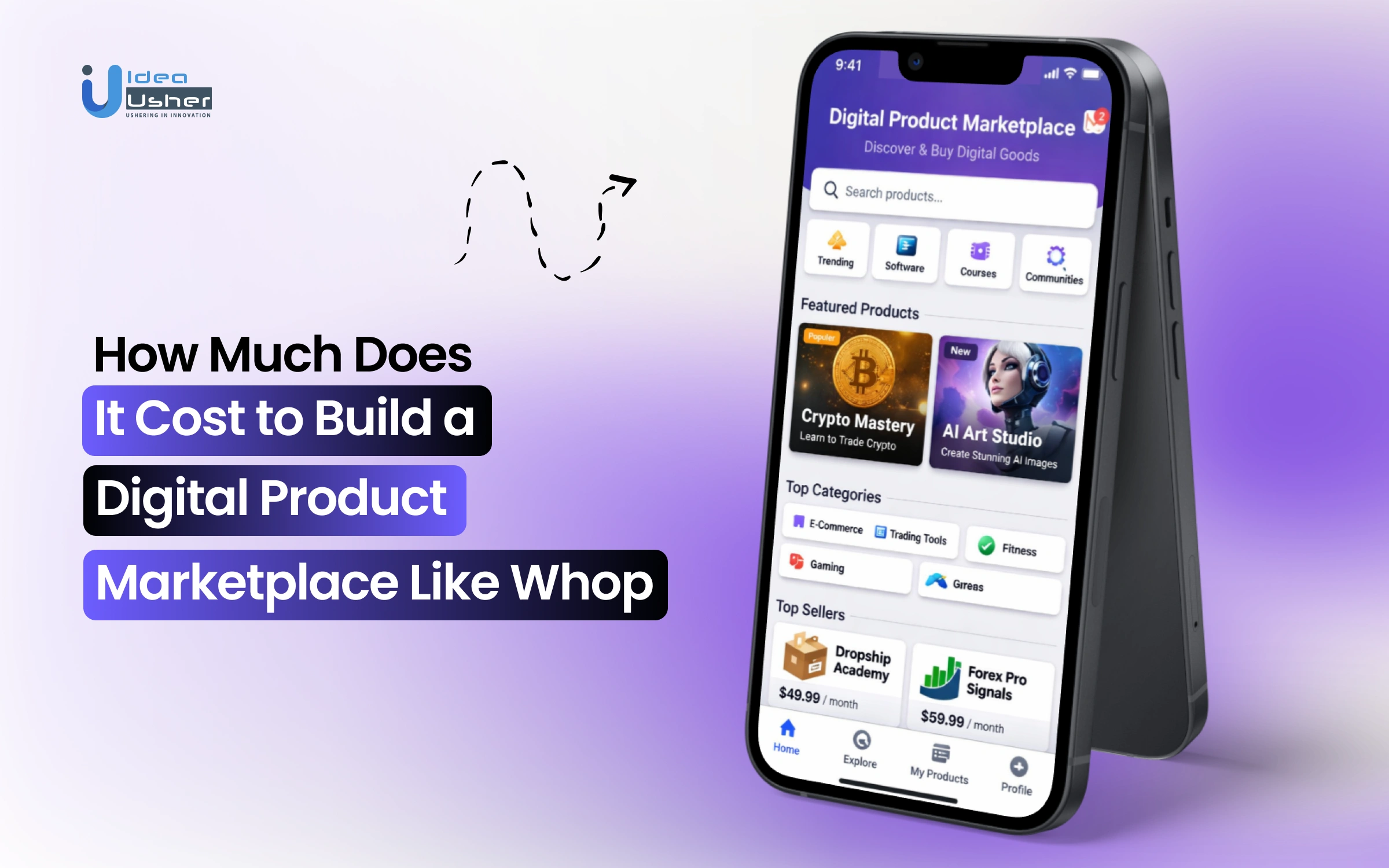
Digital product marketplaces unify storefronts, creator tools, payments, and community features into a single platform. While the experience may appear simple, supporting large creator ecosystems and real-time transactions requires a complex backend. These demands directly drive digital product marketplace development cost, with technical scope and operational needs shaping the total investment.
Once core marketplace functions are mapped out, the scope expands quickly as creator onboarding, product hosting, payment processing, subscription management, analytics, and community engagement features add layers to the platform. Infrastructure choices, scalability planning, and security requirements further affect how development costs evolve as the marketplace grows.
In this blog, we break down the cost to develop a digital product marketplace like Whop by examining feature requirements, system components, and practical factors that determine the total platform development investment.

Overview of Digital Product Marketplace, Whop
Whop is a social commerce marketplace andall-in-one platform for creators and entrepreneurs to sell digital products, manage memberships, and host online communities. Founded in 2021, it has evolved into a major player in the creator economy, reaching a valuation of $1.6 billion following a $200 million investment from Tether in February 2026.
Core Capabilities of Whop
Whop offers key capabilities that help creators launch and manage digital businesses. These features simplify selling, community management, and global payments within one centralized platform.
- Centralised Hub: Sellers can create a “whop,” a customisable online space to host forums, chat channels, and files.
- No Upfront Costs: Joining is free with no monthly subscription fees; Whop only takes a commission on sales.
- Modular App System: Features like course builders, giveaways, and video conferencing are added via 150+ native apps.
- Merchant of Record: Whop handles payment processing, tax compliance, and disputes on behalf of sellers.
- Global Payments: Supports 170+ countries with methods including credit cards, crypto (including BTC), and Venmo.
Types of Digital Products Sold on Creator Marketplace Whop
Whop is a specialized social commerce platform designed for the creator economy to sell various digital goods and access-based services. Below is a breakdown of the primary types of digital products sold on the platform.
| Product Category | Common Examples | Monetization Model |
| Community Access | Paid Discord servers, Telegram groups, native Whop chat rooms | Recurring Subscription |
| Education & Learning | Online courses, video tutorials, masterclasses, study guides | One-time or Subscription |
| Trading & Finance | Trading signals, trading bots, financial planners, market algorithms | Recurring Subscription |
| Software & SaaS | Browser extensions, Notion templates, specialized apps, automation scripts | Subscription or One-time |
| Creative Assets | Digital art, fonts, stock photos, Canva templates, presets | One-time Download |
| Professional Services | 1:1 coaching sessions, resume writing, consulting, personalized fitness plans | Per Session or Package |
| Content & Media | Paid newsletters, eBooks, audiobooks, private podcasts | Subscription or One-time |
| Gaming & Niche | Fortnite maps, gaming mods, reselling group access (sneakers, tickets) | Subscription or One-time |
Marketplace Highlights:
- Whop Payments: Creators can accept payments in both fiat and cryptocurrency.
- Zero Fixed Costs: There are no monthly platform fees; Whop only takes a 3% commission on sales.
- High-Value Niches: The platform is a leader for high-ticket items like masterminds and specialized trading communities, which can range from $50 to over $20,000 per user.
Revenue Models of Whop
Whop utilizes a pay-as-you-go revenue model where creators pay no monthly subscription fees and only incur costs when making a sale.
1. Primary Revenue Streams for Whop
Transaction Commission: Whop typically charges a 3% fee on sales that utilize native automations like Discord, Telegram, or TradingView.
Payment Processing: For transactions handled via Whop Payments, the platform charges 2.7% + $0.30 per successful domestic card transaction.
- International Fees: Transactions with international cards incur an additional 1.5% fee.
- Currency Conversion: An extra 1% charge is applied if currency conversion is required.
Marketplace Discover Fee: Historically, Whop charged a 30% fee for sales generated through its “Discover” marketplace.
Note: As of May 2025, Whop shifted its strategy by eliminating this 30% fee (reducing it to 0%) to prioritize growth and creator acquisition.
2. Payout & Infrastructure Services
Whop generates additional value by acting as a Merchant of Record (MoR), handling global tax compliance (VAT, GST) and dispute management for creators.
- Standard Payouts: ACH transfers to banks typically cost around $2.50 per transfer.
- Instant/Alternative Payouts:
- Instant USD deposits: 4% + $1 fee.
- Crypto, Venmo, or CashApp payouts: 5% + $1 fee.
- External Infrastructure: Whop has begun offering its payment stack as a service to external platforms (e.g., micro1), capturing processing fees from outside their core marketplace.
3. Affiliate & Referral Program
Whop maintains a circular growth model through its affiliate system:
- Affiliate Commissions: Affiliates earn a default 30% recurring commission on referred purchases.
- Partner Program: Referrers who bring new sellers to the platform earn 25% of the gross profit generated by those sellers’ transactions
Why Digital Product Marketplaces Are Growing Fast?
The Digital Products market is growing rapidly, with a CAGR of 9.60%, currently valued at $9.8 billion, and projected to reach $18.3 billion by 2033, growing at 7.40% annually. This steady growth is encouraging startups and businesses to invest in digital product marketplaces like Whop, where creators can easily sell courses, memberships, software, and other digital assets to a global audience.

The rapid rise of Whop further highlights the growing demand for digital product marketplaces. As of early 2026, the platform hosts 14.2 million users and more than 183,000 sellers, showing strong adoption among both creators and buyers.
Its growth is also reflected in its $1.6 billion valuation in February 2026, following a $200 million investment from Tether to expand stablecoin payments. The platform has also processed $2.67 billion in lifetime GMV, highlighting the strong earning potential of creator-focused digital marketplaces.
Whop’s marketplace infrastructure also helps creators reach audiences quickly. Its “Discover” marketplace attracts over 4 million monthly visitors, giving digital products strong visibility from the start.
At the same time, the platform’s streamlined setup allows about 73% of creators to launch their store and publish their first product within 24 hours, making it easier for new sellers to start monetizing their content quickly.
Benefits of a Digital Product Marketplace Like Whop
A digital marketplace like Whop functions as a dual-sided ecosystem designed to eliminate the friction between creators and consumers. By centralizing commerce, community, and content delivery, it provides a specialized infrastructure that offers distinct advantages for both buyers and sellers.

A. Benefits for Buyers
For customers, these marketplaces offer a streamlined, “one-stop-shop” experience where finding and managing high-value digital assets is simplified through a single, secure account.
- Centralized Access: Buyers can manage all their subscriptions, software keys, and course materials in one unified dashboard rather than juggling dozens of different websites.
- Instant Delivery: The moment a transaction is completed, the digital asset is immediately accessible, providing 24/7 instant fulfillment without any manual wait times.
- Secure Transactions: Marketplaces provide a layer of protection, ensuring that payments are handled through verified gateways and that digital assets are delivered as described.
- Diverse Payment Options: Users benefit from the flexibility to pay via credit cards, digital wallets, or even crypto, depending on what the marketplace supports.
- Community Integration: Beyond just a file download, buyers often gain immediate entry into exclusive Discord or Telegram communities, adding social value to their purchase.
B. Benefits for Sellers
Creators can focus entirely on their craft because the marketplace handles the heavy lifting of business operations, allowing them to scale their digital brand with minimal overhead.
- Lower Entry Barriers: Sellers don’t need to build a website from scratch, which significantly reduces the initial digital product marketplace development cost and technical headache.
- Automated Business Operations: The platform handles recurring billing, subscription renewals, and license key generation automatically, allowing for true passive income.
- Global Tax Compliance: Most marketplaces act as the “merchant of record,” meaning they handle the complex task of calculating and remitting global sales tax (VAT) on behalf of the seller.
- Built-in Marketing Reach: By listing in a high-traffic discovery feed, sellers gain organic exposure to a massive audience of “warm” buyers who are already looking for digital products.
- Powerful Affiliate Tools: Sellers can easily launch affiliate programs, allowing other users to promote their products in exchange for a commission, effectively outsourcing their marketing.
Key Features That Impact Digital Marketplace Development Cost
The digital product marketplace development cost depends on the features and systems built into the platform. Core features such as product management, subscriptions, payments, and secure delivery require complex backend infrastructure and integrations.

1. Creator Product Management System
A digital product marketplace like Whop must provide creators with a dedicated dashboard where they can upload, organize, and manage their digital products. This allows sellers to list courses, memberships, software tools, or downloadable resources while controlling pricing, access permissions, and product updates.
Technical systems required to build this feature include:
- Creator dashboard and product management interface
- Product database and metadata storage
- Secure digital file storage and delivery system
- Product pricing and configuration engine
- Automated buyer access provisioning after purchase
Estimated development cost: $8,000 – $15,000
This module needs backend architecture, creator dashboards, and secure storage. Supporting thousands of creators uploading multiple digital products raises development and infrastructure costs.
2. Subscription and Membership Infrastructure
Subscription-based products are one of the most common monetization models in creator marketplaces. Creators often sell recurring access to premium communities, mentorship programs, exclusive content libraries, or learning platforms.
Technical systems required to support subscriptions include:
- Recurring payment processing system
- Subscription lifecycle management
- Membership tier management
- Automated billing and payment retries
- Access control based on subscription status
Estimated development cost: $10,000 – $18,000
Subscription systems raise digital product marketplace development costs due to recurring billing infrastructure, payment gateway integration, and managing subscription lifecycles. Supporting tiers, free trials, and renewals increases engineering effort.
3. Secure Digital Content Delivery
Digital product marketplaces must ensure that purchased content is delivered securely to buyers while minimizing the risk of piracy or unauthorized sharing.
Key systems required for secure content delivery include:
- Encrypted file storage and access control
- Secure content delivery network integration
- Protected download links and token-based access
- Streaming infrastructure for video content
- Authentication and authorization systems
Estimated development cost: $7,000 – $14,000
Security infrastructure raises development costs due to encrypted storage, authentication, and scalable content delivery systems. As the marketplace expands, these must handle large digital volumes without sacrificing security or performance.
4. Creator Revenue Distribution System
A creator marketplace must automatically manage financial transactions between buyers, creators, and the platform. This includes calculating commissions, processing payments, and distributing earnings to creators.
Systems required to enable this functionality include:
- Payment gateway integration
- Automated revenue split calculation
- Creator payout management system
- Financial reporting dashboards
- Refund and chargeback management
Estimated development cost: $9,000 – $16,000
Financial systems add complexity due to secure payments, automated revenue sharing, and regulations. Platforms supporting international creators or multiple currencies need extra financial infrastructure.
5. Community and Access Control Features
Many creator marketplaces combine digital product sales with private communities where buyers can interact with creators or other members. These communities often require restricted access based on product purchases or active subscriptions.
Key systems needed to implement community access include:
- Role-based access control systems
- Community or messaging platform integration
- User authentication and identity management
- Purchase-based permission management
- API integrations with community tools
Estimated development cost: $6,000 – $12,000
The digital product marketplace development cost rises as the platform manages user permissions across multiple products and communities. As creators and users increase, maintaining secure, scalable access controls becomes more complex.
Cost to Build a Digital Product Marketplace Like Whop
The digital product marketplace development cost requires balancing lean MVP development with the high-performance security and scalability needed for global digital commerce and community management.

1. UI/UX Design for Creator and Buyer Interfaces
Design is the backbone of trust in a marketplace. A high-converting interface ensures that creators can easily manage their storefronts while buyers enjoy a frictionless “one-click” checkout experience across all devices.
| Component | MVP – Mid-Scale Cost | Enterprise Cost | What to Build |
| User Research & Journey Mapping | $3,000 – $6,000 | $8,000 – $15,000 | Defines journeys for creators (product listing) and buyers (discovery, checkout, and access). |
| Wireframes & UX Architecture | $3,500 – $7,500 | $10,000 – $20,000 | Structural layouts for the marketplace home, creator storefronts, and subscriber dashboards. |
| Visual UI Design System | $4,000 – $9,000 | $15,000 – $30,000 | Design components, typography, and dark-mode compatible UI guidelines for a modern brand. |
| Creator & Buyer Dashboard Interfaces | $4,000 – $9,000 | $12,000 – $25,000 | Interfaces for creators to manage products and revenue, and for buyers to manage purchases and access. |
| TOTAL (Approx.) | $10,500 – $22,500 | $33,000 – $65,000 | Complete design system supporting the creator-to-buyer transaction lifecycle. |
2. Backend Architecture for Marketplace Operations
The backend handles the heavy lifting, including database management, real-time webhooks for community access, and secure digital file delivery. It must be built for high concurrency to manage traffic spikes during “digital drops.”
| Component | MVP – Mid-Scale Cost | Enterprise Cost | What to Build |
| API & Database Design | $5,000 – $10,000 | $15,000 – $35,000 | Scalable PostgreSQL/Redis architecture to handle user data, product metadata, and high-speed search. |
| Subscription & Membership Logic | $4,000 – $8,000 | $12,000 – $25,000 | Systems handling subscription plans, recurring billing logic, and membership tiers. |
| Revenue Split & Transaction Systems | $4,000 – $9,000 | $12,000 – $28,000 | Commission calculation, transaction tracking, and creator earnings distribution. |
| Integration Webhooks | $3,000 – $7,000 | $10,000 – $20,000 | Real-time connectors for Discord roles, Telegram access, and software licensing keys. |
| TOTAL (Approx.) | $12,000 – $25,000 | $37,000 – $80,000 | The “logical engine” ensuring secure transactions and automated product fulfillment. |
3. Frontend Development for Marketplace Experience
This layer translates the design into a lightning-fast, SEO-optimized web application. It includes the buyer-facing storefront and the complex, data-rich dashboards that creators use to track their business growth.
| Component | MVP – Mid-Scale Cost | Enterprise Cost | What to Build |
| Buyer Storefront & Discovery | $6,000 – $12,000 | $20,000 – $45,000 | SEO-friendly landing pages, product category filters, and high-speed checkout interfaces. |
| Creator Management Portal | $7,000 – $15,000 | $25,000 – $55,000 | Complex dashboards for product management, sales tracking, and member communication. |
| Buyer Account & Purchase Management | $3,000 – $8,000 | $10,000 – $25,000 | User dashboards for purchases, subscriptions, and digital content access. |
| Responsive Web Optimization | $3,000 – $6,000 | $10,000 – $20,000 | Ensuring the marketplace is fully functional across desktop, tablet, and mobile browsers. |
| TOTAL (Approx.) | $16,000 – $33,000 | $46,000 – $110,000 | A high-performance web interface optimized for conversion and creator utility. |
4. Payment and Subscription Infrastructure
A marketplace requires multi-party payout logic, unlike a standard e-commerce platform. This section covers the integration of complex billing systems that handle global taxes and split payments automatically.
| Component | MVP – Mid-Scale Cost | Enterprise Cost | What to Build |
| Payment Gateway Integration | $4,000 – $8,000 | $10,000 – $18,000 | Setup for split-payments, automatic creator payouts, and multi-currency handling. |
| Subscription Logic & VAT | $3,500 – $7,000 | $10,000 – $25,000 | Automated recurring billing, trial periods, and global tax compliance (VAT/Sales Tax). |
| Fraud & Dispute Tools | $2,500 – $5,000 | $8,000 – $15,000 | Integration of chargeback protection and real-time fraud monitoring (Stripe Radar). |
| TOTAL (Approx.) | $10,000 – $20,000 | $30,000 – $70,000 | A robust financial layer ensuring secure, automated global money movement. |
5. Cloud and Storage Setup Cost
Digital products require specialized storage that balances security with speed. This digital product marketplace development cost covers the setup of cloud environments that host everything from video courses to complex software assets.
| Component | MVP – Mid-Scale Cost | Enterprise Cost | What to Build |
| Secure Cloud Storage (S3) | $2,000 – $5,000 | $8,000 – $18,000 | Encrypted storage buckets for digital files with private, time-limited download links. |
| Global CDN (CloudFront) | $2,500 – $4,500 | $7,000 – $15,000 | Content Delivery Network to ensure instant asset access for buyers worldwide. |
| DevOps & Server Scaling | $3,500 – $7,000 | $12,000 – $25,000 | CI/CD pipelines and auto-scaling server environments to handle traffic spikes. |
| TOTAL (Approx.) | $8,000 – $16,500 | $27,000 – $58,000 | Scalable cloud architecture designed for 99.9% uptime and global accessibility. |
6. Testing and Platform Quality Assurance
A marketplace is a high-value target for hackers. Quality assurance ensures the platform is bug-free, while security testing protects creator revenue and buyer data from breaches.
| Component | MVP – Mid-Scale Cost | Enterprise Cost | What to Build |
| Functional & UX Testing | $3,000 – $6,000 | $10,000 – $22,000 | Rigorous manual and automated testing to ensure all core marketplace features work perfectly. |
| Penetration & Security Audit | $4,000 – $8,000 | $15,000 – $35,000 | Specialized security testing to identify vulnerabilities in the payment and access layers. |
| Performance Stress Testing | $2,000 – $4,000 | $7,000 – $15,000 | Simulating high traffic to ensure the platform doesn’t crash during major product launches. |
| Platform Launch & Deployment | $2,000 – $5,000 | $6,000 – $14,000 | Final production deployment, cloud configuration, domain setup, and launch preparation. |
| TOTAL (Approx.) | $9,000 – $18,000 | $32,000 – $72,000 | A rigorous QA cycle ensuring a secure, bug-free, and high-performing platform. |
Estimated Total Cost to Develop a Whop-Like Digital Marketplace
The total digital product marketplace development cost like Whop varies based on platform scale, feature complexity, and security infrastructure. Below is an estimated cost range for different development stages.
| Platform Stage | Estimated Cost | What Includes In This Stage |
| MVP Platform | $65,000 – $135,000 | Core marketplace with automated digital delivery, Stripe integration, Discord access bots, and a basic dashboard to validate the business model. |
| Mid-Scale Platform | $180,000 – $380,000 | Scalable ecosystem with AI recommendations, affiliate management, tiered subscriptions, anti-piracy layers, and advanced creator analytics for data-driven growth. |
| Enterprise Platform | $400,000 – $650,000+ | Global platform featuring high-concurrency architecture, multi-party payouts, Web3 payments, AI fraud detection, and enterprise-grade security audits. |
Consult with IdeaUsher to get a tailored digital product marketplace development cost estimate based on your specific requirements, feature roadmap, security needs, and long-term vision for building a digital commerce platform like Whop.
Key Cost-Affecting Factors of Digital Product Marketplace Development
Building a marketplace like Whop involves more than just listing products; it requires a complex ecosystem of automated access, high-speed delivery, and global financial compliance. The following factors are the primary drivers of the final digital product marketplace development cost.

1. Architectural Complexity and Automation
The most significant cost driver is the Community Integration Layer. Unlike standard e-commerce, a creator marketplace must trigger real-time actions across third-party apps.
Estimated Cost: $15,000 – $35,000
- Discord/Telegram Bots: Automating role assignments and revoking access upon cancellation requires sophisticated webhook logic.
- Software Licensing: Generating unique API keys or hardware-locked licenses for digital tools adds to backend complexity.
2. Payment Logic and Global Tax Compliance
Handling money for thousands of individual “sub-merchants” (creators) is a massive technical and legal undertaking.
Estimated Cost: $12,000 – $30,000
- Split Payments: Integrating Stripe Connect or Paddle to automatically split revenue between the platform and the creator in real-time.
- Merchant of Record (MoR) Features: Automating global VAT and sales tax collection is a high-cost feature but essential for shielding creators from tax liability.
3. Security and Anti-Piracy Infrastructure
Since digital assets are easy to copy, protecting a creator’s intellectual property is vital for platform retention.
Estimated Cost: $10,000 – $25,000
- Dynamic Watermarking: Adding user-specific identifiers to PDF or video files on-the-fly to track leaks.
- Device Locking: Restricting access to a specific number of devices per user to prevent account sharing.
- DDoS and Scraping Protection: Implementing advanced firewalls to stop AI bots from scraping protected creator content.
4. Scalability and Traffic Concurrency
Creator marketplaces are prone to “viral spikes.” If a creator with a million followers drops a new product, the platform must handle thousands of simultaneous checkouts.
Estimated Cost: $8,000 – $20,000
- Serverless Architecture: Using AWS Lambda or Google Cloud Functions to scale resources instantly during traffic surges.
- Edge Computing: Utilizing CDNs (Content Delivery Networks) to ensure that large digital files download instantly regardless of the buyer’s location.
5. Advanced Data and Discovery Features
To keep users engaged, modern platforms must move beyond simple search bars to intelligent discovery.
Estimated Cost: $10,000 – $22,000
- AI Recommendation Engines: Using machine learning to suggest creators to buyers based on their previous purchase behavior.
- Creator Analytics: Building deep-dive dashboards that track Churn Rate, LTV (Lifetime Value), and conversion funnels.
What are the Legal Requirements for a Digital Product Marketplace?
Launching a compliant digital product marketplace requires a strategic legal framework that addresses data privacy, tax obligations, and consumer rights. Navigating these global regulations ensures long-term business viability and protects both the platform and its users.
1. Data Privacy and Protection Compliance
Platforms must adhere to strict regulations like GDPR, CCPA, and the DPDP Act (2026), ensuring informed user consent, data minimization, and robust encryption protocols to safeguard sensitive personal and financial information.
2. Business Registration and Licensing
Operators must select a formal legal entity, such as a Private Limited Company, and secure mandatory tax registrations like GST or VAT, alongside specific e-commerce licenses required for international trade and digital operations.
3. Intellectual Property and Licensing Rights
To prevent piracy, marketplaces must implement clear digital rights management (DRM) and licensing agreements, explicitly defining how buyers can use, share, or modify digital assets while protecting the original creator’s ownership.
4. Consumer Protection and Transparency
Regulatory standards demand clear disclosure of product details, pricing, and refund policies. The “Digital Fairness Act” (2026) specifically targets deceptive practices, ensuring users have visible, one-click options to manage or cancel subscriptions.
5. Tax Collection and Global Remittance
Marketplaces act as “deemed suppliers” under modern tax laws, making the platform responsible for calculating, collecting, and remitting global sales taxes (VAT/GST) based on the customer’s specific location and local tax thresholds.
Conclusion
Building a high-performance digital product marketplace like Whop requires a strategic investment in secure payment rails, automated fulfillment, and robust creator tools. While the initial digital product marketplace development cost varies based on feature complexity and scalability needs, prioritizing a modular architecture ensures long-term viability. Success in this space hinges on balancing a seamless user experience with ironclad security for digital assets. Partnering with an experienced development team allows you to navigate these technical intricacies efficiently, transforming a complex vision into a scalable, revenue-generating ecosystem.
Why Choose IdeaUsher for Digital Marketplace Development?
Understanding the cost to build a digital product marketplace like Whop requires more than estimating feature lists; it demands insight into architectural decisions, scalability investments, and long-term maintenance strategies.
We build AI-driven products across industries, specializing in performance systems, model integration, and scalable infrastructure. Our expertise helps us develop digital marketplaces that balance development investment, operational efficiency, and revenue potential.
Our ex-FAANG and MAANG engineers bring over 500,000+ hours of hands-on AI development experience, allowing us to architect cost-efficient platforms aligned with growth trajectories, feature prioritization, and sustainable monetization models.
Why Hire Us:
- Cost-Optimized Architecture: We engineer high-traffic marketplace ecosystems with smart infrastructure that minimizes upfront costs and ensures scalability, deploying robust payment rails and digital delivery systems without over-engineering.
- Custom Feature Planning: We help you prioritize development by ROI, building proprietary vendor tools and buyer experiences that maximize market impact per development dollar.
- Full-Cycle Ownership: We manage infrastructure selection, digital tax compliance, and scalable architectures that grow with your transaction volume, ensuring your marketplace is advanced, cost-efficient, and ready for launch.


FAQs
A.1. The digital product marketplace development cost typically ranges from $65,000 to $135,000 depending on complexity. This budget covers UI/UX design, backend architecture, and the development of core features like automated licensing, recurring billing, and cross-platform integrations for creator communities.
A.2. Post-launch expenses generally total 15% to 20% of the initial development cost annually. These funds cover server hosting, security patches, API updates for payment processors, and continuous feature enhancements to keep the platform competitive in the evolving creator economy.
A.3. Beyond development, hidden costs include third-party API fees, email automation services, and premium security certificates. Additionally, you must budget for customer support tools and potential chargeback fees from payment processors, which can fluctuate based on the volume and risk level of your transactions.
A.4. A high-end, custom-branded interface designed for maximum conversion can cost between $10,000 and $25,000. Professional designers focus on creating intuitive creator dashboards and frictionless checkout flows, which directly influence the platform’s long-term retention rates and overall perceived value in the market.


