 (+971) 8007 4267
 (+91) 946 340 7140
 (+1) 628 432 4305

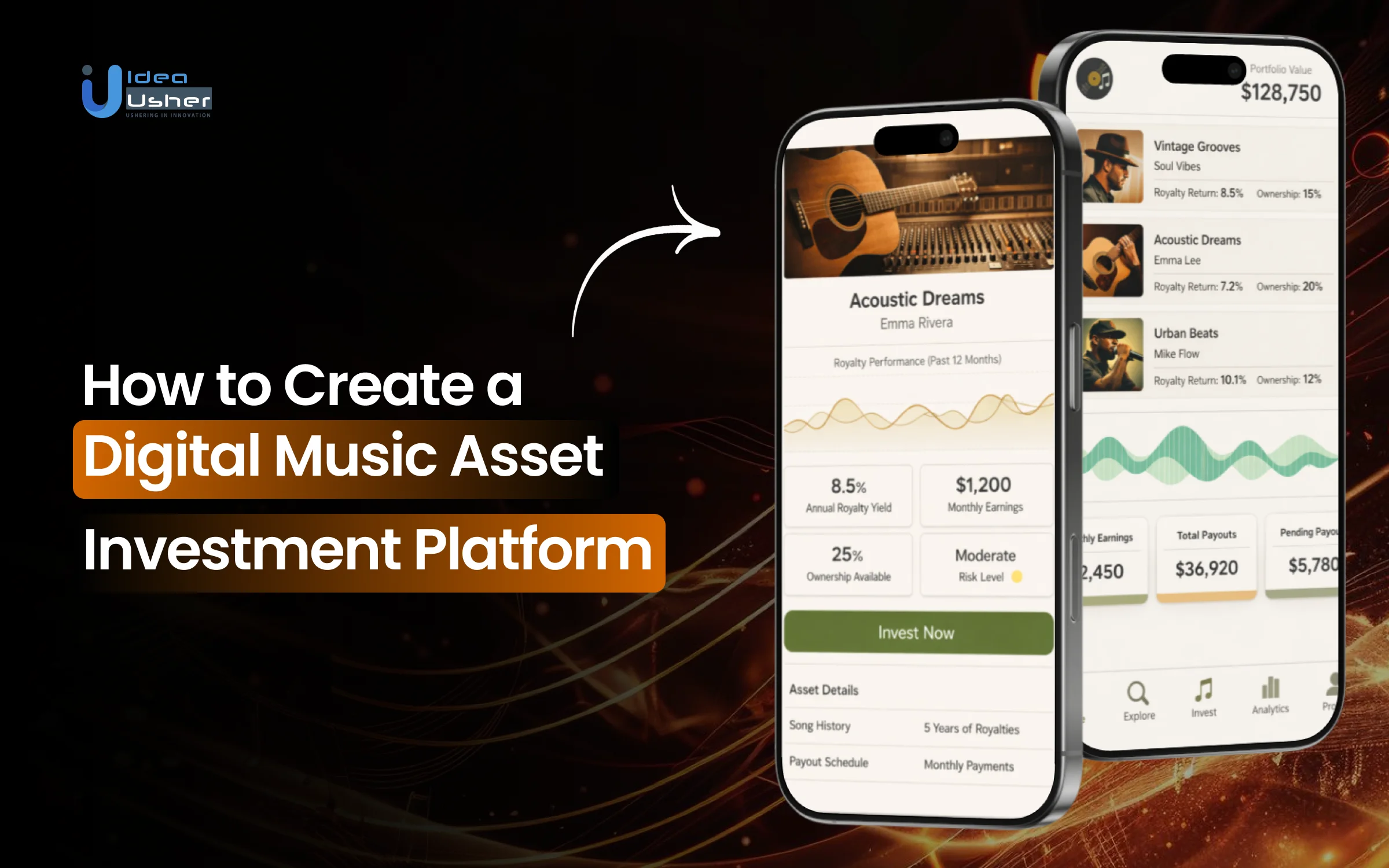
Music has become increasingly digital, but investing in music assets is still far from straightforward. Revenue flows through multiple channels, ownership is often fragmented, and tracking long-term returns remains complex for anyone outside traditional industry structures. These constraints explain the growing relevance of a digital music asset investment platform as a structured and accessible way to package rights, revenue, and participation.
This type of platform treats music assets as investable units rather than passive income sources. It brings together rights management, royalty tracking, valuation logic, and secure transactions into a single system. Making this work requires more than a compelling concept. It depends on accurate data aggregation, transparent asset structures, compliant payouts, and infrastructure that can scale as usage and investment activity grow.
In this blog, we explain how to create a digital music asset investment platform by breaking down the key product components, technical considerations, and operational challenges involved in building a solution that functions reliably in real market conditions.

What is a Digital Music Asset Investment Platform?
A digital music asset investment platform is an infrastructure that enables music rights or royalty-bearing assets to be structured, listed, and accessed as investable financial instruments. These platforms translate future royalty income into defined economic exposure, allowing investors to participate without directly managing music rights.
Unlike traditional music royalty services, these platforms operate within an investment context. They combine rights administration, financial structuring, investor controls, and ongoing reporting, ensuring that asset ownership, income distribution, and regulatory obligations are handled within a controlled, auditable framework.
- A risk translation layer, converting uncertain, usage-driven royalty income into structured investment exposure with defined assumptions and disclosures.
- A governance wrapper, enforcing rules around asset eligibility, investor participation, and decision accountability that individual rights owners cannot easily maintain alone.
- A normalization engine, aligning inconsistent royalty data, reporting timelines, and payout behaviors into a unified financial experience for investors.
- A long-term stewardship system, designed to manage assets across multi-year horizons rather than optimizing for short-term transactional activity.
- An interface between creative value and financial markets, enabling music to be treated as an income-generating asset without abstracting away its underlying dependencies.
Digital Music Asset Investment Platforms Vs. Traditional Music Businesses
Digital music asset investment platforms differ from traditional music businesses by structuring music rights as investable assets, supported by technology-driven transparency, standardized governance, and data-based revenue distribution models.
| Aspect | Digital Music Asset Investment Platform | Traditional Music Business |
| Primary Objective | Managing investor exposure and income predictability | Monetizing music through creation, promotion, and distribution |
| Core Responsibility | Financial governance, compliance, and reporting accuracy | Artist development, catalog growth, and commercial exploitation |
| Revenue Dependency | Future royalty cash flows modeled as financial assets | Active release cycles, marketing performance, and audience growth |
| Risk Ownership | Explicitly transferred to investors through structured disclosures | Implicitly absorbed by labels, publishers, or rights owners |
| Decision Framework | Regulation-driven and audit-oriented | Market-driven and creative-strategy oriented |
| Time Horizon | Multi-year asset stewardship and income durability | Project or release-based performance cycles |
| Success Measurement | Consistency, transparency, and compliance adherence | Chart performance, streaming volume, and market reach |
How a Digital Music Asset Investment Platform Works?
A digital music asset investment platform explains how music rights are listed, valued, and managed for investors. The workflow connects rights holders, data systems, and payout mechanisms within a structured environment.

1. Asset Onboarding and Rights Verification
Music assets enter the platform through a structured onboarding flow where ownership documentation, rights scope, and revenue eligibility are reviewed. Only assets with clear legal entitlement and verifiable income rights proceed further.
2. Investment Structuring and Asset Listing
After validation, each music asset is converted into defined investment units. Economic exposure, participation terms, and duration assumptions are documented, allowing assets to be presented in a standardized format suitable for investor evaluation.
3. Investor Participation and Capital Allocation
Investors gain exposure by allocating capital to listed assets. Allocation rules determine proportional participation, ensuring investment amounts map accurately to defined economic interests without altering underlying rights ownership.
4. Royalty Collection and Income Processing
As music generates revenue, royalties are collected from relevant channels and processed centrally. Incoming income is reconciled, adjusted when required, and attributed to the appropriate asset before investor-level calculations occur.
5. Reporting, Distribution, and Performance Tracking
Investors track performance through periodic reporting cycles. Distributions are based on actual received income, providing clarity around earnings, timing, and asset-level performance over the investment period.
How does a Music Asset Investment Platform attract 25,000+ Investors?
The global NFT music market is projected to reach USD 1,039.6 million by 2033, up from USD 72.02 million in 2023, growing at a 30.6% CAGR between 2024 and 2033. This growth reflects rising acceptance of music as a digital, investable asset class.

Alongside this expansion, music asset investment platforms have demonstrated the ability to attract 25,000+ investors across more than 60 countries, highlighting a strong global appetite for structured, borderless access to music-based investments.
A. Global Investor Base Signals to Platform Builders
A widely distributed investor base is not incidental. It signals deliberate platform design decisions that prioritize accessibility, trust, and regulatory awareness across regions from the outset.
- Demand for Borderless Alternative Assets: Investors view music assets as location-independent investments when platforms remove direct rights management complexity.
- Trust Anchored in Structure and Disclosure: Global adoption favors platforms with clear asset structuring, transparent income logic, and consistent reporting.
- Early Cross-Border Compliance Readiness: International platforms embed jurisdiction-aware onboarding, eligibility checks, and disclosure frameworks early.
- Liquidity Supported by Geographic Diversity: A distributed investor base reduces reliance on concentrated capital and supports long-term resilience.
B. How Platform Design Enables Global Participation?
Scaling participation across countries depends on operational discipline and clarity rather than aggressive growth strategies. Platforms that succeed globally focus on systems that scale trust as effectively as access.
- Standardized Investment Experiences: Consistent asset presentation, investment flows, and reporting build investor confidence across regions.
- Clear Communication of Risk: Transparent explanations of income timing and performance variability manage global investor expectations.
- Ongoing Transparency Beyond Transactions: Regular reporting and payout visibility maintain engagement across jurisdictions.
- Governance Models Built for Scale: Scalable governance ensures consistent oversight, accountability, and audit readiness as participation grows.
The convergence of rapid digital music market growth and demonstrated global investor participation shows that music asset investment platforms can scale internationally when built with structure, transparency, and compliance awareness. For platform builders, this reinforces the need to design for global participation from the very beginning rather than treating it as a later-stage objective.
Key Features of a Digital Music Asset Investment Platform
A digital music asset investment platform requires carefully designed features to support ownership, transparency, and investor confidence. These capabilities enable secure asset management, accurate reporting, and scalable participation across the platform.

1. Music Asset Structuring & Tokenization
This feature defines how music rights are converted into investable digital assets. Clear asset structuring, cash-flow mapping, and token logic ensure each investment unit accurately represents underlying royalty entitlements and enforceable economic rights.
2. Rights Verification & Due Diligence
A platform must validate ownership before listing any asset. Chain-of-title verification, contract review, and rights scope analysis are essential to prevent disputed claims, revenue leakage, and downstream legal exposure for both the platform and investors.
3. Asset Valuation & Revenue Modeling
Reliable investment decisions depend on defensible valuation logic. This engine combines historical royalty data, usage volatility, territory weighting, and decay assumptions to model expected cash flows and present realistic yield scenarios to investors.
4. Catalog and Asset Lifecycle Management
Music assets evolve over time. Lifecycle management systems track changes such as ownership updates, catalog expansions, term expirations, and revenue shifts, ensuring asset representations remain accurate throughout their investment and monetization lifespan.
5. Investor Onboarding & Accreditation
Investment access must align with regulatory requirements. Identity verification, accreditation logic, and jurisdictional eligibility checks ensure only qualified investors participate, reducing compliance risk and protecting the platform during audits and regulatory reviews.
6. Fractional Ownership & Capital Allocation
This system governs how capital is split across assets. Fractional ownership logic, allocation rules, and unit issuance controls ensure proportional entitlement to income while maintaining clarity over investor exposure and dilution mechanics.
7. Royalty Collection & Distribution
The platform must reliably move money from the source to the investor. Automated collection, reconciliation workflows, and distribution schedules ensure royalty income is accurately pooled, allocated, and paid out with minimal operational friction.
8. Transparent Yield & Performance Tracking
Investors require ongoing visibility into outcomes. Yield reporting frameworks present realized returns, projected income, and variance analysis, helping users evaluate performance without relying on speculative or marketing-driven metrics.
9. Investor Education & Disclosure
Clear disclosure supports informed participation and explains asset structure, revenue assumptions, dependency risks, and usage sensitivity, enabling investors to understand what drives returns before committing capital.
10. Portfolio Management Dashboard
A centralized dashboard provides long-term engagement. Portfolio-level visibility, asset exposure tracking, and cash-flow history allow investors to monitor performance, manage allocations, and assess risk across multiple music assets.
How to Create a Digital Music Asset Investment Platform?
Creating a digital music asset investment platform requires a structured balance of technology, compliance, and trust. Our developers follow proven frameworks to build secure, transparent, and scalable investment systems.

1. Consultation
We begin by aligning on the platform’s investment thesis, target users, regulatory exposure, and asset scope. Early consultation defines feasibility, clarifies jurisdictional constraints, and ensures the platform is designed around real market and compliance requirements, not assumptions.
2. Platform Scoping and Requirements
Our team translates business intent into structured requirements. This includes asset types, investment flows, user roles, compliance boundaries, and reporting expectations, ensuring every feature supports both regulatory obligations and long-term operational scalability.
3. Asset and Rights Framework Design
We design how music assets are represented within the platform. Rights mapping, revenue entitlement logic, and ownership boundaries are clearly defined to ensure each listed asset has enforceable economic meaning and can be administered without ambiguity.
4. Investment Flow and Capital Logic Planning
We define how capital enters, moves through, and exits the platform. Subscription logic, allocation rules, payout sequencing, and investor entitlements are mapped carefully to avoid inconsistencies between financial operations and asset-level economics.
5. Compliance and Risk Architecture Planning
Our developers work alongside legal and compliance inputs to design investor eligibility rules, disclosure requirements, audit readiness, and risk controls, embedding regulatory considerations directly into platform workflows rather than treating them as add-ons.
6. UI/UX and Trust Layer Design
We focus on clarity and transparency in user interactions. Investor dashboards, asset disclosures, and reporting views are structured to reduce confusion, set accurate expectations, and support informed decision-making throughout the investment lifecycle.
7. Reporting and Financial Visibility Design
We architect how data flows across the platform. Royalty data handling, performance reporting logic, and historical tracking are planned to support accurate yield reporting and long-term credibility with investors and external reviewers.
8. Long-Term Asset Integrity Planning
We plan how asset data remains accurate over long investment horizons. Versioned records, controlled correction workflows, and historical snapshot preservation ensure royalty adjustments, ownership updates, and reporting changes do not erode investor trust or financial clarity over time.
9. Pre-Launch Validation and Testing
Before launch, we validate assumptions through operational simulations, edge-case testing, and compliance checks, ensuring the platform behaves predictably under real-world conditions such as delayed royalties, ownership updates, or uneven cash flows.
10. Launch and Ongoing Iteration Planning
We prepare the platform for market entry with controlled rollout planning, monitoring frameworks, and post-launch iteration strategies, recognizing that asset performance, user behavior, and regulatory interpretation evolve after launch.
Cost to Build a Digital Music Asset Investment Platform
The cost to build a digital music asset investment platform depends on features, compliance needs, and technology choices. Development scope, security requirements, and scalability considerations shape overall investment planning.
| Development Phase | Description | Estimated Cost |
| Consultation & Feasibility Analysis | Investment thesis alignment, regulatory feasibility, and early platform scope validation | $5,000 – $8,000 |
| Requirements & Platform Architecture | Functional specifications, investment workflows, and scalable platform architecture planning | $10,000 – $15,000 |
| Asset Structuring & Rights Framework | Music asset modeling, ownership logic, and revenue entitlement structuring | $16,000 – $25,000 |
| Compliance & Investor Controls | Investor eligibility rules, disclosure workflows, and audit readiness implementation | $18,000 – $26,000 |
| Investment & Capital Flow Development | Fractional ownership logic, capital allocation, and payout sequencing systems | $20,000 – $32,000 |
| Royalty Processing & Financial Logic | Royalty collection, reconciliation workflows, and structured distribution mechanisms | $16,000 – $28,000 |
| Reporting & Investor Dashboards | Yield reporting, portfolio visibility, and investor performance tracking | $12,000 – $16,000 |
| Testing | Platform security, scenario testing, and pre-launch risk validation | $10,000 – $12,000 |
| Launch Support & Optimization | Controlled rollout, performance monitoring, and early-stage platform optimization | $8,000 – $10,000 |
Total Estimated Cost: $65,000 – $120,000+
Note: Development costs vary by asset complexity, data access, and investor needs. Ongoing compliance, platform optimization, and asset growth influence long-term investments.
Consult with IdeaUsher for a tailored cost estimate and development plan aligned with your platform goals and compliance requirements.
Challenges & How Our Developers Will Solve Those?
Building a digital music asset investment platform comes with technical, regulatory, and operational challenges. Our developers address these issues with secure, scalable, and compliant solutions that ensure smooth platform performance and reliability.

1. Fragmented Music Rights Data
Challenge: Music rights data is scattered across sources, often incomplete or conflicting, making accurate asset onboarding difficult for a digital music asset investment platform.
Solution: We design structured ingestion workflows that normalize incoming data, flag inconsistencies early, and require manual verification checkpoints before assets move into the investment pipeline.
2. Disputed Ownership Structures
Challenge: Unverified ownership and a broken chain of title can expose investors and platforms to legal disputes and invalid royalty claims.
Solution: Our developers embed ownership validation into asset onboarding, ensuring contract-backed rights confirmation is completed before assets are tokenized or made available for investment.
3. Aligning Finance with Legal Rights
Challenge: Royalty income structures rarely match simple ownership percentages, leading to payout mismatches if legal and financial logic are improperly aligned.
Solution: We separate legal entitlement definitions from payout calculations, allowing royalty distributions to follow enforceable agreements rather than oversimplified ownership assumptions.
4. Compliant Investor Flows Across Regions
Challenge: Investor eligibility rules vary across jurisdictions, complicating onboarding and access control within a global digital music asset investment platform.
Solution: We implement jurisdiction-aware onboarding logic that dynamically applies region-specific compliance rules without duplicating investment workflows or fragmenting the core platform.
5. Managing Irregular Royalty Cash Flows
Challenge: Royalty payments often arrive late, adjusted, or restated, creating reporting inconsistencies and investor confusion if not handled correctly.
Solution: Our developers build asynchronous payout logic that accounts for timing gaps, reconciles adjustments, and preserves accurate historical reporting across all investor dashboards.
Regulatory, Legal, and Structural Considerations Before Going Live
Before launching a digital music asset investment platform, careful attention to regulatory, legal, and structural requirements is essential. Addressing these factors ensures compliance, protects stakeholders, and supports a sustainable platform ecosystem.
1. Music Assets as Securities
Classification becomes a foundational concern when fractional music assets are offered to investors. We evaluate how assets are structured, marketed, and monetized to determine whether they may be considered securities, as this directly affects disclosures, investor eligibility, and platform obligations.
2. Defining Asset & Investor Liabilities
Before launch, we clearly define how responsibility is distributed across the platform, asset issuers, and investors. This clarity helps users understand performance risk, revenue variability, and decision accountability while reducing legal exposure and reinforcing trust in the investment framework.
3. Aligning Platform With Regulations
We plan platform structure around specific launch jurisdictions because regulatory expectations differ across regions. Our developers align entity setup, asset availability, and investor access rules with local regulatory interpretations to avoid enforcement risks and operational disruptions.
4. Disclosure-First Investment Design
We design investment flows around transparency rather than conversion. Asset listings, investment actions, and reporting views consistently surface risk factors, revenue assumptions, and dependency variables so investors can make informed decisions within clearly defined informational boundaries.
5. Audit & Record-Keeping Readiness
From the outset, we design systems that preserve transaction histories, ownership records, payout calculations, and reporting snapshots. This approach ensures the platform remains audit-ready and capable of responding to regulatory reviews or investor inquiries without retroactive reconstruction.
6. Preparing for Regulatory Changes
Regulatory guidance evolves as digital asset and investment models mature. Our developers build flexibility into eligibility logic, disclosure structures, and asset presentation layers so the platform can adapt without disrupting existing investments or historical reporting integrity.
Post-Launch Operations and Long-Term Platform Responsibility
Post-launch operations define how a digital music asset investment platform maintains trust and performance over time. Ongoing governance, compliance oversight, and system optimization support stability and responsible long-term platform growth.

1. Ongoing Compliance & Alignment
After launch, we continuously monitor regulatory updates, enforcement trends, and interpretative guidance. Our developers adjust onboarding rules, disclosures, and access controls to ensure the platform remains compliant as legal expectations evolve over time.
2. Royalty Accuracy & Payment Integrity
We actively oversee royalty inflows, adjustments, and restatements to maintain financial accuracy. Post-launch operations focus on reconciliation discipline, ensuring investor payouts reflect actual received income rather than estimated or delayed figures.
3. Investor Communication & Transparency
Maintaining trust requires consistent communication beyond reporting dashboards. We ensure clear explanations around performance changes, delays, and asset updates, helping investors understand outcomes without relying on assumptions or incomplete data.
4. Platform Governance & Oversight
Our team operates with defined governance processes covering asset approvals, exception handling, and reporting changes. Clear internal accountability ensures operational decisions remain consistent, traceable, and defensible as the platform scales.
5. Responsible Scaling & Data Integrity
As user and asset volumes grow, we prioritize data accuracy, reporting consistency, and operational resilience. Scaling decisions are measured against their impact on investor clarity, compliance posture, and long-term platform credibility.
Real World Examples of Digital Music Asset Investment Platforms
Several established platforms show how companies structure music rights as investable digital assets. These examples highlight different approaches to royalty monetization, investor participation, and platform governance across the music investment ecosystem.
1. ANote Music

ANote Music operates as a regulated marketplace where investors purchase music royalty streams tied to real songs. The platform emphasizes transparent cash flow reporting, secondary market liquidity, and a structured trading environment for professionally curated music catalogs.
2. Royalty Exchange

Royalty Exchange enables rights holders to auction future music royalty income to investors. Buyers receive monthly payouts from streaming, radio, and licensing revenues, making it one of the most established platforms for direct royalty acquisition and income-focused investing.
3. Music Bull

Music Bull allows users to invest in music royalties through fractional ownership units. The platform focuses on portfolio diversification, automated royalty tracking, and tradable assets, positioning itself as a structured investment marketplace for music-backed financial products.
4. Sonomo

Sonomo provides access to diversified music royalty portfolios designed for long-term income generation. The platform simplifies investing through curated offerings, performance analytics, and risk spread across multiple catalogs, appealing to investors seeking passive music-based returns.
5. Artyfile

Artyfile offers fractional ownership in master recording rights using blockchain-backed verification. The platform highlights transparency, secure ownership records, and direct participation in streaming revenues, combining music rights investment with digital asset infrastructure.
Conclusion
Building a successful music investment product requires more than technical execution. It calls for respect for creators, clarity for investors, and governance that supports long-term value. When strategy, compliance, data integrity, and user experience align, trust follows naturally. A well-designed digital music asset investment platform can translate rights ownership into accessible opportunities while preserving artistic intent. If you focus on transparency, scalable infrastructure, and responsible monetization, the platform becomes a shared ecosystem where innovation and sustainability can coexist. This balance shapes credibility, participation, and durable outcomes for stakeholders.
Building a Digital Music Asset Investment Platform with IdeaUsher!
At IdeaUsher, we specialize in developing secure and compliant digital music asset investment platforms that connect artists, rights holders, and investors within a structured ecosystem. Our team understands the technical, legal, and financial complexity involved in music asset monetization and fractional ownership.
Why Partner With Us?
- Music Rights and Investment Expertise: We design platforms that accurately manage ownership, royalty flows, and investor participation.
- End-to-End Platform Development: From architecture planning to deployment, we deliver tailored solutions aligned with your business goals.
- Compliance Driven Approach: We build our solutions with regulatory readiness to support long-term platform credibility.
- Scalable Infrastructure: We create systems that grow with your marketplace while maintaining transparency and performance.
Explore our portfolio to see how we help companies build and launch scalable AI/blockchain solutions across evolving technology landscapes.
Connect with us for a consultation and take the next step toward building your music asset investment platform.


FAQs
A.1. A scalable platform requires secure cloud infrastructure, rights management systems, payment processing, analytics dashboards, and compliance automation. Strong data security and transparent reporting tools are essential to protect assets and maintain investor confidence.
A.2. Returns come from streaming royalties, licensing income, and usage rights tied to the music assets. Investors earn a share based on ownership structure, making accurate data reporting and transparent payout mechanisms critical for long-term participation.
A.3. Platforms must follow copyright law, financial regulations, and investor protection rules. This includes licensing verification, securities compliance where applicable, and KYC or AML processes to operate legally across target markets.
A.4. Trust is built through clear asset documentation, real-time royalty reporting, and audited payout systems. Providing visibility into performance data and ownership terms reassures users and increases platform credibility during early growth stages.


