


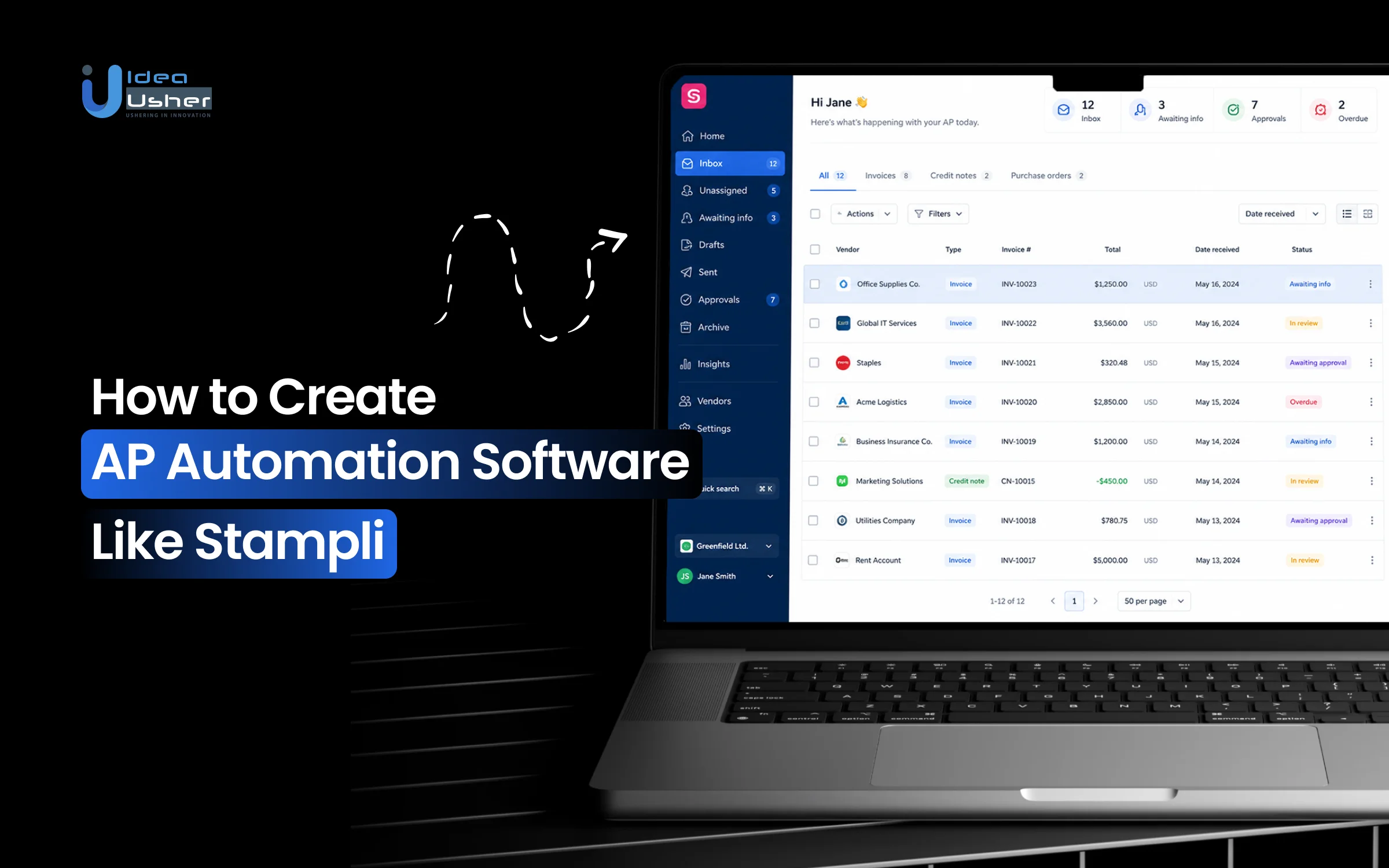
Key Takeaways
- AP automation software streamlines invoice approvals and payment tracking with AI-driven financial workflows.
- Platforms like Stampli use AI OCR and ERP integrations to reduce invoice delays and AP bottlenecks.
- Core capabilities include invoice capture, three-way matching and fraud detection automation.
- Enterprises adopt AP automation systems for faster approvals, lower processing costs and stronger compliance.
- How IdeaUsher help you build scalable AP automation platforms with AI workflows and enterprise-grade ERP integrations.
Accounts payable is no longer just a finance function focused on processing invoices. It has become a critical operational layer that directly impacts cash flow visibility, vendor relationships and financial efficiency. That shift is increasing demand for intelligent AP automation software capable of streamlining invoice management, approvals and payment workflows within a unified system.
Traditional AP processes relied heavily on emails, spreadsheets and manual approvals that created delays, duplicate payments and limited visibility across financial operations. As businesses handle larger transaction volumes and more complex vendor ecosystems, enterprises now expect AI-powered invoice capture, automated approval routing, ERP integrations, real-time payment tracking and fraud detection built directly into accounts payable workflows.
In this blog, we will talk about core features, architecture, development costs and how IdeaUsher can help build AP automation software like Stampli by transforming AP operations from fragmented back-office tasks into collaborative financial workflows.
Why Traditional Accounts Payable Workflows Fail at Scale
The global accounts payable automation market is valued at $5.42 billion and is projected to grow to $6.57 billion at a 21.6% CAGR, eventually reaching $14.38 billion. Growth is driven by cloud-based finance systems, global e-invoicing mandates and rising demand for touchless financial operations across enterprise organizations.

Manual invoice processing costs organizations between $9.84 and $12.88 per invoice while extending processing cycles to an average of 9.2 days due to repetitive data entry and approval delays.
AI-powered AP automation platforms reduce invoice processing costs to $2.78 per invoice, cutting operational overhead by 78%. They also shorten cycle times to 3.1 days and reduce invoice errors by 85%, enabling finance teams to focus on strategic financial operations.
At scale, the invisible inefficiencies of a low-volume AP department become glaring financial liabilities, leading to:
- The Data-Entry Trap: Staff spend hours manually copying line items from PDFs into internal software, a process prone to human error that stalls downstream workflows.
- Lack of Visibility: Leadership cannot accurately project cash flow because hundreds of invoices sit floating in email inboxes or physical desks, completely invisible to the finance team until they are formally keyed in.
- Compliance Hazards: Without standardized, automated checks, fraud detection and duplicate invoice prevention become nearly impossible to enforce consistently across thousands of monthly transactions.
A. Why Manual Invoice Processing Causes Payment Delays
The journey of an invoice from receipt to payment is rarely a straight line. In a traditional setup, this journey is plagued by constant, manual interventions that turn simple approvals into logistical nightmares.

- The Email Chasing Cycle: Invoices are routinely routed via internal emails for departmental sign-off. If an approver is traveling, out of the office or simply overwhelmed, the invoice sits stagnant.
- Three-Way Matching Chaos: Manually cross-referencing an invoice against its corresponding purchase order (PO) and goods receipt note (GRN) requires meticulous attention. When thousands of line items are involved, mismatch discrepancies take days of back-and-forth communication to resolve.
- The Cost of Friction:
- Missed Early-Bird Discounts: Many vendors offer vendor discounts (e.g., 2/10 Net 30) for swift payments, which enterprises consistently miss due to internal processing friction.
- Late Payment Penalties: Stalled approvals inevitably push payments past their due dates, straining vendor relationships and incurring unnecessary fees.
B. Why ERP Systems Cannot Fully Automate Accounts Payable
A common misconception among scaling enterprises is that their Enterprise Resource Planning (ERP) software can handle the heavy lifting of AP automation. While ERPs are excellent systems of record, they are fundamentally not built to be agile systems of engagement.
| Feature / Capability | Enterprise ERP Systems | Dedicated AP Automation Platforms |
| Primary Function | Centralized database for organizational data. | Workflow optimization and document ingestion. |
| Data Ingestion | Relies heavily on rigid, template-based OCR that breaks if a vendor alters their invoice layout. | Uses AI and NLP to read and extract data contextually, regardless of format. |
| Exception Handling | Flags errors but requires human intervention to manually investigate and fix them. | Uses machine learning to suggest fixes or automatically route exceptions to the right person. |
| User Experience | Often dense, complex and requires specialized training for non-finance staff. | Intuitive, streamlined portals built for quick internal approvals and vendor collaboration. |
Relying solely on an ERP to automate accounts payable is like using a massive cargo ship to navigate a narrow, winding canal; it lacks the specialized flexibility required to handle the messy, unstructured realities of incoming billing data.
C. Why Businesses Use AI for Accounts Payable Automation
To prevent operational gridlock, forward-thinking enterprises are decoupling their AP workflows from manual labor and rigid ERP constraints, migrating instead toward dedicated, AI-driven automation layers.
What is AI-Driven AP Automation? It is the integration of machine learning, cognitive document processing and intelligent routing to transform unstructured financial documents into structured, touchless data streams.
By implementing AI-driven platforms, enterprises unlock critical competitive advantages:
- Touchless Processing: AI extracts data, matches records and prepares payments instantly, requiring human intervention only for flagged exceptions.
- Smart Exception Routing: The system automatically sends anomalies, like price mismatches, to relevant managers with contextual notes to accelerate resolution.
- Financial Agility: Real-time data gives CFOs visibility into liabilities, turning AP into a strategic hub for cash flow forecasting and capital optimization.

What Is AP Automation Software and How Platforms Like Stampli Work
Accounts Payable (AP) automation replaces manual invoice tasks like data entry, routing and reconciliation with intelligent, digital systems. By centralizing the procure-to-pay lifecycle in the cloud, these platforms eliminate the need for manual record-keying and approval chasing, transforming AP into a streamlined system of engagement, reducing processing costs, preventing fraud and giving finance teams real-time visibility into company spending.
Advanced platforms like Stampli go further by avoiding rigid workflows. Instead, they centralize all documentation, logic and communication directly on the digital invoice, allowing finance teams to maintain strict control without compromising operational speed.
A. AI-Powered Invoice and OCR Processing Engines
Traditional Optical Character Recognition (OCR) systems are notoriously brittle. They rely on fixed templates, for example, if a vendor moves their “Total Due” text box two inches to the left, the template breaks, causing data errors or forcing a manual reset.

Modern AP automation platforms leverage advanced AI engines to process documents contextually, mimicking how a human reads a bill. Stampli utilizes a specialized, built-in AI copilot known as “Billy” to automate ingestion and coding.
- Contextual Data Extraction: AI uses NLP to understand field meanings, extracting line items, tax breakdowns and payment terms regardless of document’s layout.
- Predictive GL Coding: Using historical data, AI automatically suggests accurate GL codes and departments at the line level.
- Upstream Fraud Detection: AI validates invoices against past patterns to immediately flag duplicate invoices, inflated bills or suspicious vendor emails.
B. AI-Powered AP Approval Workflows for Finance Teams
One of the biggest bottlenecks in corporate finance is the disconnect between the AP department and the rest of the business. Invoices routinely get trapped in siloed internal email threads or casual chat channels, destroying visibility. Platforms like Stampli solve this by turning the digital invoice into a centralized Collaboration Hub.

Modern AP platforms centralize approvals, conversations and audit trails within a single invoice workspace, creating a far more transparent and collaborative workflow for both finance teams and vendors.
- On-the-Document Communication: Approvers tag teammates and ask questions directly on the digital invoice, keeping all context permanently attached to the transaction without external emails.
- Intelligent, Dynamic Routing: The system automatically maps internal approval chains using company rules and historical data such as dollar thresholds or specific cost centers.
- Self-Service Vendor Portals: Rather than inundating the finance team with emails asking, “What is the status of my payment?”, suppliers can access a secure vendor portal to track invoice status, update compliance documents and manage payment details independently.
- Audit-Ready History: Centralizing all communication and three-way matches (matching Invoice to Purchase Order to Goods Receipt) in one workspace enables instant audit preparation.
C. ERP Synchronization Across Leading Financial Systems
An AP automation platform is only as strong as its connection to your core financial system. If data has to be manually exported via CSV files and re-imported into an accounting system, errors are inevitable and real-time visibility is lost.
Advanced platforms use pre-built, native integrations that seamlessly mirror the architecture of your specific Enterprise Resource Planning (ERP) platform.
| ERP System | Integration Nature | How it Synchronizes |
| Oracle NetSuite & Oracle Fusion | Deep API Link | Syncs subsidiary structures, custom segments, tracking dimensions and PO data automatically. |
| SAP (ECC & S/4HANA) | Enterprise Connectors | Bridges complex, multi-entity corporate purchasing structures with line-level matching logic. |
| Microsoft Dynamics 365 (BC / GP / F&O) | Native Table Mapping | Integrates directly into native tables and dimensions to automate the full invoice-to-pay lifecycle. |
| QuickBooks (Online / Desktop) | Real-Time Sync | Ideal for growing mid-market companies looking to quickly sync vendor records and general ledger charts without heavy IT intervention. |
Because these tools plug into your existing ecosystem without requiring a complete overhaul of your current processes, they achieve a “single source of truth” effect.
The AP platform mirrors your ERP’s chart of accounts, approval hierarchies and posting rules exactly. Once an invoice is fully approved inside the automation layer, it is automatically posted to the ERP in real time with zero manual data entry required.
Core Technologies Powering Modern AP Automation Platforms
Modern AP automation platforms derive their efficiency from an advanced tech stack that moves beyond basic data storage. By embedding machine learning, natural language processing and event-driven architectures directly into financial workflows, these platforms transform passive accounting records into autonomous, intelligent data pipelines.

1. AI and Machine Learning for Invoice Intelligence
This technology acts like a digital brain, analyzing past financial behavior to automatically predict accounting codes, recommend the right managers for approvals and spot unusual vendor fraud or duplicate payments.
- Predictive Anomaly Detection: Flags irregular billing patterns or sudden price hikes before invoices reach processing teams.
- Duplicate Payment Prevention: Catches identical or overlapping transaction records across different business units to stop double spending.
- Intelligent Invoice Classification: Automatically categorizes bills by expenditure type, project scope or operational urgency.
- AI Approval Recommendations: Mentions the ideal internal manager for sign-off based on historical organizational routing habits.
- Vendor Fraud Monitoring: Triggers security alerts when a supplier’s banking details or email domains suddenly shift.
- Intelligent GL Coding Suggestions: Predicts and populates accurate accounting dimensions down to the line-item level.
2. OCR, NLP and Intelligent Document Processing
This technology combines visual scanning with language-reading algorithms, allowing the system to look at any layout, read handwritten notes and understand the actual meaning of text fields like a human.
- OCR Invoice Digitization: Transforms scanned physical paperwork and flat PDF files into searchable, interactive digital text.
- NLP Document Understanding: Interprets the underlying meaning of words within bills rather than relying on location rules.
- Context-Aware Extraction: Pulls correct totals, tax lines and shipping terms, even when mixed with marketing text.
- Multi-Format Recognition: Ingests and standardizes billing files delivered via EDI, Word documents, emails or smartphone photos.
- Handwritten Invoice Processing: Deciphers scribbled warehouse notes, pen-written receipts and manual signatures with high accuracy.
- Semantic Invoice Parsing: Maps relational data structures to ensure line items stay bound to their specific unit prices.
3. Workflow Automation Engines and Business Rules
This technology functions as a digital traffic controller, running pre-set logic gates that instantly check compliance rules, reroute delayed invoices, handle price exceptions and optimize internal corporate tracking paths.
- Rule-Based Workflow Automation: Executes complex corporate spend policies instantly the moment a document enters the platform.
- Dynamic Approval Routing: Shifts authorization paths in real time based on changing line-item amounts or department codes.
- SLA and Escalation Engines: Sends automated reminders to slow approvers and shifts responsibilities to backup managers.
- Exception Handling Automation: Isolates mismatched purchase orders and routes discrepancies directly to procurement for quick fix.
- Conditional Workflow Triggers: Launches unique, multi-layered compliance review tracks for high-risk accounts or specialized international vendors.
- Intelligent Workflow Optimization: Evaluates processing histories to suggest faster internal routing paths for specific billing types.
4. ERP Integration and API Orchestration
This technology operates as a live digital pipeline, using cloud bridges and automated communication triggers to pass data instantly back and forth between the AP platform and enterprise accounting records.
- SAP Integration Frameworks: Links directly into enterprise ledger architectures without disturbing existing corporate configuration environments.
- Oracle NetSuite APIs: Updates subsidiary ledger records, custom fields and tracking segments through secure, real-time connections.
- Middleware Orchestration: Manages complex multi-cloud corporate systems, ensuring steady data flow across fragmented accounting platforms.
- Two-Way ERP Synchronization: Ensures that actions taken in either system reflect instantly in the other without manual exports.
- Event-Driven Architecture: Triggers automated system updates the second an invoice status changes, eliminating processing lags.
- Real-Time Data Exchange: Maintains unified tracking metrics for open purchase orders, active vendors and operational budgets.
5. Real-Time and Financial Intelligence Dashboards
This technology serves as an interactive data translator, instantly turning processing histories into live visual charts that help leadership track bottlenecks, look over vendor spend and forecast upcoming cash demands.
- Cash Flow Forecasting: Aggregates pending and approved invoices to map out precise short-term financial cash demands.
- Approval Bottleneck Analytics: Isolates the exact departments or individuals holding up bills and delaying closing cycles.
- Spend Analysis Reporting: Groups corporate expenditures by category, supplier or business unit to reveal cost-saving openings.
- Vendor Payment Insights: Tracks historical supplier turnaround times to optimize payment schedules and secure early discounts.
- Financial KPI Monitoring: Evaluates department metrics like cost-per-invoice and processing cycle times on a live screen.
- Real-Time AP Visibility: Gives financial leadership instant access to the exact status of every dollar currently in pipeline.
Core Features of AP Automation Software Like Stampli
Modern AP automation platforms like Stampli replace fragmented accounting tasks with an intelligent, centralized system of engagement. By unifying artificial intelligence, dynamic workflows and deep system integrations, these solutions maximize operational visibility and eliminate manual friction at scale.

1. AI-Powered Invoice Capture and OCR Processing
Accounting teams use cognitive OCR and machine learning to automate multi-format ingestion, line-item extraction and predictive GL coding, while seamlessly supporting handwritten notes and multi-language international invoices.
- Multi-Format Ingestion: Automatically captures invoices via dedicated emails, vendor portals, EDI or direct scans.
- Cognitive OCR Scanning: Reads layouts contextually without relying on rigid, breakable templates.
- AI Data Extraction: Uses machine learning to instantly interpret fields, totals and tax categories.
- Handwritten Recognition: Extracts text from physical signatures, notes and hand-filled billing slips.
- Multi-Language Support: Automatically parses and translates international invoices for global vendors.
- Line-Item Precision: Captures complex, multi-page tabular data with exact matching accuracy.
2. Intelligent Workflow Automation and Approval Routing
Unmanaged invoices create operational bottlenecks but rule-based conditional approval chains, department-specific mapping, multi-level sign-offs, automated SLA notifications and dynamic escalation management keep payments moving forward without friction.
- Conditional Approval Chains: Triggers unique workflows based on specific thresholds, vendors or GL codes.
- Department-Wise Routing: Automatically sends invoices to the correct business unit managers.
- Multi-Level Approvals: Handles complex corporate sign-offs requiring multiple executive inputs sequentially.
- Rule-Based Automation: Executes custom compliance policies instantly upon document ingestion.
- Escalation Management: Reroutes stagnant invoices to alternative managers to prevent operational delays.
- SLA Tracking & Notifications: Issues automated alerts to approvers to maintain processing speed.
3. ERP and Accounting System Integrations
Maintaining a single financial source of truth requires seamless two-way data synchronization, utilizing native APIs and specialized connectors to link existing procurement platforms with SAP, NetSuite, QuickBooks and Microsoft Dynamics.
- SAP Architecture: Connects to complex enterprise environments via secure API interfaces.
- NetSuite Native APIs: Synchronizes custom segments, tracking dimensions and subsidiary data instantly.
- QuickBooks Sync: Provides real-time ledger updates for fast-growing mid-market companies.
- Microsoft Dynamics Connectors: Links ledger structures seamlessly across BC, GP and Finance modules.
- Procurement Integrations: Unifies purchasing data from specialized tools directly into the AP workspace.
- Two-Way Synchronization: Converts the platforms into a single ecosystem, eliminating double data entry.
4. Three-Way Matching and Purchase Order Automation
Protecting capital means validating every transaction by cross-referencing incoming bills against purchase orders and goods receipts, utilizing configurable tolerance rules to instantly detect layout discrepancies or billing exceptions.
- PO-to-Invoice Matching: Connects line items from invoices directly to corresponding purchase orders.
- Goods Receipt Verification: Confirms that products or services were officially delivered before issuing payment.
- Automated Discrepancy Detection: Flags unit prices, quantities or line items that do not align.
- Tolerance Configurations: Approves minor, pre-defined cost variances automatically without flagging exceptions.
- Exception Workflows: Isolates disputed invoices and alerts procurement managers for quick resolution.
- Reconciliation Automation: Closes out open purchase orders in the ERP once fully balanced.
5. Vendor Management and Supplier Collaboration
Strengthening supply chains requires unified communication networks built on secure self-service portals, automated digital onboarding, compliance tracking, direct finance collaboration threads and real-time payment status visibility for external business partners.
- Onboarding Automation: Simplifies vendor setup through digital registration and secure banking collection.
- Supplier Self-Service Portals: Allows vendors to check payment statuses and submit invoices independently.
- Compliance Verification: Automates the tracking and expiration management of W-9 forms and insurance certificates.
- Internal Finance Collaboration: Tags specific team members directly on the digital invoice for quick alignment.
- Communication Threads: Archives all buyer-supplier correspondence directly alongside the financial record.
- Real-Time Status Visibility: Gives vendors instant clarity on where their bill stands in the pipeline.
6. Fraud Detection and Audit Management
Safeguarding company funds demands rigorous, continuous oversight via duplicate payment detection, AI-driven fraud monitoring and GST/VAT validation, backed by complete historical audit trails and strict role-based access controls.
- Duplicate Detection: Flags identical or highly similar invoices to prevent accidental double payments.
- AI Fraud Monitoring: Identifies anomalies in vendor behavior, routing changes or billing frequencies.
- GST/VAT Validation: Verifies corporate tax identification numbers against global regulatory databases.
- Audit Trail Generation: Logs every single user action, edit and approval stamp permanently.
- Compliance Reporting: Generates comprehensive regulatory documentation with a single click.
- Role-Based Permissions: Restricts payment creation and modification rights to authorized personnel only.
7. Analytics and Financial Intelligence Dashboards
Modern CFOs rely on clear operational visibility, using specialized data dashboards to monitor AP cycle times, track vendor spend, forecast cash flow liabilities, pinpoint bottlenecks and export custom financial reports.
- Cycle Time Analytics: Measures the exact speed of invoices from ingestion to final payment.
- Spend Visibility Dashboards: Breaks down company expenditures by vendor, department or project code.
- Cash Flow Forecasting: Projects upcoming financial liabilities to better manage corporate liquidity.
- Bottleneck Insights: Pinpoints specific departments or individuals causing processing delays.
- Vendor Performance Tracking: Evaluates suppliers based on billing accuracy and fulfillment timelines.
- Custom Reporting: Generates tailored financial exports for internal stakeholders and board reviews.
8. Enterprise Security and Scalable SaaS Infrastructure
Enterprise software requires modern defense architecture, combining secure multi-tenant cloud networks with banking-grade encryption, single sign-on, multi-factor authentication, high-volume processing capabilities and geographically redundant system backups.
- Access Management: Enforces zero-trust frameworks through precise, functional user permissions.
- SSO & MFA: Secures logins via corporate single sign-on and multi-factor authentication.
- Data Encryption Systems: Protects financial records both in transit and at rest using banking-grade protocols.
- Multi-Tenant SaaS Architecture: Delivers continuous software updates and performance improvements without downtime.
- High-Volume Processing: Scales infinitely to handle thousands of concurrent invoices effortlessly.
- Disaster Recovery Infrastructure: Guarantees business continuity through geographically redundant, automated system backups.
How to Create AP Automation Software Like Stampli
Building a proprietary AP automation platform like Stampli requires translating complex financial workflows into a highly secure, integrated and intelligent software ecosystem. This development guide outlines the end-to-end technical roadmap required to engineer an enterprise-grade accounts payable solution.

1. Finance Workflow Discovery and Operations Analysis
This step serves as the foundation phase, mapping out paper-heavy process lifecycles, gathering specific compliance rules and identifying existing corporate operational friction points before any software code is written.
- AP Workflow Audits: Evaluates how financial teams currently receive, log, track and pay incoming corporate bills.
- Stakeholder Interviews: Gathers explicit daily operational requirements and pain points directly from controllers, procurement heads and CFOs.
- Invoice Lifecycle Mapping: Traces the exact path a bill takes from initial inbox arrival to final ledger posting.
- Approval Bottleneck Analysis: Pinpoints the structural delays where invoices typically stall within manual corporate communication chains.
- ERP Dependency Evaluation: Analyzes how deeply the company’s existing general ledger system dictates their accounting fields.
- Compliance Requirement Gathering: Collects regional tax, structural reporting and financial security mandates needed to guide development.
2. Product Architecture and SaaS Infrastructure
This architecture phase focuses on engineering a multi-tenant cloud framework that isolates client databases, scales computational resources dynamically and utilizes an API-first approach to support high-volume transaction processing.
- Multi-Tenant SaaS Architecture: Designs isolated, secure storage layers to protect individual corporate tenant data on shared hardware.
- Cloud Infrastructure Planning: Maps out cloud computing, container hosting and load-balancing services for uninterrupted system availability.
- Microservices Frameworks: Decouples core systems like ingestion, processing and reporting into modular services to simplify scaling.
- Scalability Capacity Planning: Blueprints auto-scaling server configurations to smoothly handle sudden, seasonal spikes in document volume.
- Database Architecture Decisions: Selects relational and non-relational database structures optimized for complex, fast transactional queries.
- API-First Platform Design: Builds the entire software layout around exposed internal APIs, simplifying future enterprise system expansions.
3. Invoice Processing and OCR Automation Systems
This core technology combines specialized scanning engines with natural language processing models to read document text contextually, extract line-item metrics accurately and ingest multiple file variations autonomously.
- OCR Engine Selection: Evaluates and embeds high-performance optical character recognition engines to digitize flat invoice files.
- NLP Document Understanding: Integrates language models that interpret the actual meaning of text blocks regardless of placement.
- AI Model Training Workflows: Builds continuous machine learning loops that refine ledger coding suggestions based on user corrections.
- Invoice Parsing Pipelines: Establishes data clean-up sequences that format raw OCR text into verified accounting dimensions.
- Multi-Format Ingestion: Constructs pipelines to capture billing files coming from emails, API uploads and portal entry points.
- Extraction Accuracy Optimization: Tunes document confidence scoring thresholds to maximize line-item extraction precision over time.
4. Workflow Automation and Approval Engines
This core logic layer acts as a digital routing mechanism, processing custom corporate spend rules, managing multi-tier authorization loops, tracking processing timelines and isolating billing discrepancies instantly.
- Rule-Based Workflow Systems: Builds code structures that execute custom accounting policies the second an invoice is logged.
- Multi-Level Approval Logic: Supports sequential, multi-manager signature requirements based on specific corporate hierarchies and dollar sizes.
- SLA and Escalation Systems: Programs automated alert timers that shift stalled approvals to designated backup managers.
- Conditional Routing Engines: Develops code that sends invoices to unique review tracks based on project, department or cost center.
- Exception Handling Workflows: Builds holding areas that freeze mismatched purchase orders and notify procurement managers automatically.
- Real-Time Workflow Orchestration: Manages state transitions across thousands of active document paths concurrently without system lag.
5. ERP and Accounting System Integrations
This integration network functions as a two-way data pipeline, utilizing native cloud bridges to sync active ledger accounts, purchase orders and transaction updates between the platform and core enterprise software.
- SAP Integration Frameworks: Builds secure connectors that interact directly with enterprise ledger environments without disrupting internal setups.
- Oracle NetSuite APIs: Orchestrates direct data transfers to map custom segments, tracking fields and subsidiary data in real time.
- QuickBooks Synchronization: Creates lightweight, reliable syncing loops tailored for mid-market general ledger updates.
- Microsoft Dynamics Connectivity: Connects platform databases to Business Central and Finance modules via native cloud links.
- Middleware Orchestration: Leverages Idea Usher’s specialized integration expertise to seamlessly unify fragmented legacy corporate infrastructure channels.
- Two-Way Financial Data Sync: Ensures every single payment update and ledger entry reflects across both systems simultaneously.
6. Security, Compliance and Audit Infrastructure
This security infrastructure deploys zero-trust authorization frameworks, rigorous access logging, data encryption protocols and global compliance settings to guarantee that enterprise financial networks remain fully protected.
- Role-Based Access Control: Restricts interface permissions tightly, ensuring employees only access data required for their specific role.
- MFA and SSO Implementation: Integrates corporate single sign-on systems and multi-factor authentication tools to protect login portals.
- SOC 2 Readiness: Designs the environment to comply completely with strict independent data security and operational integrity audits.
- GDPR Compliance Systems: Implements strict data anonymization, localized storage policies and right-to-be-forgotten deletion workflows.
- Audit Logging Architecture: Engineers unalterable ledger logs that record every user action, edit and approval timestamp permanently.
- Data Encryption Systems: Deploys banking-grade cryptographic protocols to secure financial records both during transit and at rest.
7. Analytics, Reporting and Financial Dashboards
This intelligence layer aggregates processing histories to generate live financial visualizations, helping corporate leadership monitor vendor spend patterns, track process speeds and accurately forecast upcoming cash needs.
- Spend Analysis Systems: Groups operational expenses automatically to show leadership clear patterns in corporate purchasing behaviors.
- Cash Flow Forecasting Dashboards: Looks at upcoming approved bills to calculate precise near-term cash requirements for management.
- Vendor Analytics Engine: Evaluates supplier records to reveal fulfillment speed, billing accuracy and contract pricing trends.
- Approval Bottleneck Insights: Surfaces precise operational turnaround speeds to pinpoint specific departments slowing down processing lines.
- Real-Time AP Reporting: Generates instant operational overview summaries without requiring manual data compilation or CSV exports.
- Executive KPI Dashboards: Tracks higher-level financial performance metrics like cost-per-invoice and average processing cycle times.
8. Testing AI Accuracy and Platform Scalability
This quality assurance framework uses extensive system stress testing, penetration evaluations and integration validation loops to verify software stability and precision under heavy enterprise workloads.
- OCR Accuracy Testing: Validates data extraction quality across thousands of pixelated, skewed or poorly formatted invoices.
- Workflow Stress Testing: Simulates millions of simultaneous routing conditions to ensure conditional logic trees never misroute bills.
- ERP Integration Testing: Verifies data transfer boundaries to ensure synchronization remains uninterrupted during network interruptions.
- Security Penetration Testing: Runs controlled hacking simulations to identify and patch potential software security vulnerabilities.
- Load and Performance Testing: Floods the infrastructure with massive invoice volumes to confirm server processing speeds stay consistent.
- AI Model Optimization: Evaluates confidence scores continuously to reduce false positives in general ledger coding suggestions.
9. Enterprise Deployment and Post-Launch Optimization
This final deployment phase combines structured cloud rollouts with live infrastructure monitoring to guarantee smooth platform adoptions and long-term scaling capacity.
- Cloud Deployment Strategy: Orchestrates controlled rolling updates to update live application services without causing system downtime.
- Enterprise Onboarding Workflows: Builds clear data migration steps to move historical general ledger records onto the new platform.
- Employee Training Systems: Provides intuitive guided software tours that help corporate finance staff adapt to automated interfaces quickly.
- Monitoring Infrastructure: Sets up live diagnostics to track application response times, error rates and API connectivity metrics.
- Continuous AI Improvement: Utilizes daily user correction inputs to train and refine extraction models after launch.
- Scalable Modernization Support: Leverages Idea Usher’s 500K+ development hours and post-launch optimization experience to guide long-term platform growth.
Cost to Build AP Automation Software like Stampli
Building a modern accounts payable solution requires balancing upfront software engineering hours with long-term AI infrastructure maintenance. While a mid-market solution can be launched as a functional pilot, scaling to compete with platforms like Stampli involves significant enterprise security and middleware investments.
A. MVP AP Automation Platform Cost Breakdown
This budget segment represents the financial resources needed to build a working prototype, combining standard document scanning engines, foundational multi-tier approval rules, core interface screens and a single ledger integration.
| Development Phase | Technical Scope & Phase Cover | Estimated Cost Range |
| Discovery & Operations Analysis | Auditing AP workflows and mapping invoice lifecycles to identify bottlenecks and ERP dependencies. | $5,000 – $10,000 |
| Product Architecture & Design | Designing multi-tenant SaaS infrastructure, microservices and interactive UI/UX wireframes. | $8,000 – $15,000 |
| Core Engine & OCR Development | Developing NLP models and vision APIs for multi-format ingestion pipelines. | $15,000 – $25,000 |
| Logic & Workflow Engineering | Engineering rule-based automation, conditional routing and multi-level approval hierarchies. | $20,000 – $35,000 |
| Ecosystem & ERP Integration | Connecting two-way API pipelines to ledgers like QuickBooks, SAP and NetSuite. | $25,000 – $40,000 |
| BI Portals & Analytics Dashboards | Creating reporting layers and dashboards for spend analysis and cash flow forecasting. | $12,000 – $20,000 |
| Quality Assurance & Penetration Testing | Performing OCR validation, stress-testing and SOC 2/GDPR security audits. | $10,000 – $18,000 |
| Deployment & Post-Launch Scaling | Setting up CI/CD paths, monitoring metrics and continuous AI learning loops. | $5,000 – $12,000 |
| Total Estimated Cost | Delivering complete discovery through production-ready environment stabilization. | $72,000 – $125,000 |
B. Enterprise-Scale AP Automation Development Costs
This budget phase outlines the capital needed to transition a basic platform into a robust enterprise-level AP automation software, introducing deep contextual AI, isolated multi-tenant cloud networks, global security certificates and external collaboration portals.
| Advanced Module | Core Technical Scope | Estimated Cost Range |
| AI Infrastructure Scaling | NLP training, contextual machine learning and predictive GL coding engines. | $45,000 – $75,000 |
| Multi-Tenant Architecture | Secure, containerized cloud storage to isolate client databases on shared servers. | $35,000 – $60,000 |
| Compliance & Security | Role-based security and SSO deployment for SOC 2 and GDPR compliance. | $30,000 – $50,000 |
| Vendor Portals & Analytics | Self-service supplier portals and advanced CFO financial forecasting systems. | $25,000 – $45,000 |
| Total Enterprise Add-on Budget | Scalable, secure layer required to support high-volume corporate clients. | $135,000 – $230,000 |
Technical Implementation & Resource Allocation
To justify these investments to stakeholders, engineering teams must allocate these budgets toward specific technical milestones:
- AI Data Pipeline Engineering: The $45k–$75k budget funds MLOps, LLM hosting and real-time feedback loops for AI learning.
- Architecture Scaling: Senior architects implement logical data isolation and unique encryption keys to keep enterprise financial records segregated on shared cloud infrastructure.
- Compliance Auditing: Budget is allocated for SOC 2 and GDPR readiness, including unalterable audit trails, automated data purging and banking-grade encryption (AES-256 and TLS 1.3).
- Secure External Gateways: Isolated access points are built outside corporate firewalls to allow supplier uploads and status checks without risking the core ERP integration layer.
C. Key Factors Affecting AP Automation Development Cost and Timeline
This operational analysis of AP automation software highlights the architectural design decisions, system connectivity demands, data complexities and regional compliance structures that actively expand software development timelines and total pricing.
- ERP Integrations: Standard REST API connections (e.g., QuickBooks) take 40–60 hours. Complex legacy syncs for SAP or NetSuite require 150+ additional hours due to custom mapping and SOAP protocols.
- AI Sophistication: Basic OCR offers 60–70% accuracy but is brittle. High-accuracy NLP (95%+) requires a 30–50% budget increase, costing $20,000–$45,000.
- Workflow Complexity: Advanced multi-conditional routing (e.g., threshold-based approvals) adds 3–6 weeks and 120–180 engineering hours.
- Compliance Requirements: Multi-entity tax and global regulatory support adds 15–25% overhead, extending timelines by 40–80 hours.
- Multi-Region Needs: International architecture handling localized currencies and GDPR adds 3–5 weeks and $15,000–$30,000 to the budget.
Challenges in Building AP Automation Platforms
Developing an enterprise-grade financial platform involves balancing adaptive data extraction with rigid corporate compliance guidelines. Minor development perspectives can lead to systemic data corruption, exposed financial pipelines or broken ledger syncs.

1. ERP Integration and Legacy System Challenges
Challenge: Legacy ERP systems lack modern, well-documented REST APIs, making bidirectional data synchronization, real-time transaction locking and complex multi-entity mapping incredibly difficult to engineer.
Solution: Our developers deploy dedicated middleware layers and custom data connectors that translate complex SOAP protocols, execute secure message queuing and guarantee transactional integrity across legacy enterprise infrastructures.
2. Invoice Data Accuracy and AI Training Issues
Challenge: Low-resolution document uploads, varying vendor layouts and handwritten notes cause standard OCR engines to fail, resulting in flawed line-item data extraction.
Solution: We build advanced NLP document pipelines and continuous MLOps training feedback loops, allowing our models to process documents contextually and learn dynamically from real-time human corrections.
3. Enterprise Security, Compliance and Audit Challenges
Challenge: Financial applications are prime targets for fraud, demanding unalterable data logging, strict regulatory compliance and bulletproof defense frameworks to prevent unauthorized capital access.
Solution: Our engineers implement zero-trust role-based access control, enforce multi-factor authentication, build immutable database audit trails and architect the platform to comply completely with SOC 2 and GDPR protocols.
4. Standardizing Invoice Data Across Vendors and Regions
Challenge: Global cross-border transactions involve multi-currency line items, varying international tax frameworks (like VAT/GST), localized data residency mandates and fragmented financial reporting layouts.
Solution: We construct adaptive database schemas and location-aware microservices that dynamically parse regional tax laws, standardize multi-currency metrics and route data through geography-specific cloud storage containers.
Why Choose Idea Usher for Enterprise AP Automation Development
Building critical AP automation demands a partner combining machine learning with financial precision. Idea Usher delivers this through 250+ experts across the USA, UK, Canada etc. Using specialized frameworks, they transform complex finance requirements into touchless, high-efficiency software.
A. 500K+ Hours of Enterprise SaaS Experience
Leveraging over half a million hours of practical engineering experience and a legacy of delivering 1,000+ projects globally, Idea Usher eliminates infrastructure guesswork, building highly available cloud systems that effortlessly process high-volume, enterprise-grade document workloads from day one.
- Robust Multi-Tenant Architectures: Designs completely isolated cloud database layers backed by specialized database sharding to secure individual corporate client records on shared server hardware.
- Optimized Processing Pipelines: Engineers fluid, high-throughput document frameworks that maintain a 95% client retention rate by preventing data latency during peak financial closing cycles.
- Rigid Infrastructure Mastery: Translates deep structural knowledge into enterprise deployments across 50+ countries, handling millions of concurrent financial data requests without system downtime.
B. Expertise in AI, ERP and Financial Automation
Idea Usher excels at bridging the gap between advanced cognitive technologies and complex systems of record, maintaining high-fidelity data flow across fragmented software networks without corrupting core financial ledgers.
- 95%+ Extraction Accuracy: Builds advanced, custom NLP document understanding pipelines and Agentic AI workflows that effortlessly parse unstructured invoice layouts, varying regional tax lines and handwritten text.
- Bidirectional ERP Syncs: Engineers deep API integrations and secure middleware orchestration for platforms like SAP, Oracle NetSuite, Microsoft Dynamics and QuickBooks.
- Advanced Ledger Isolation: Programs meticulous transaction locking mechanisms and custom data-masking layers to respect complex accounting dimensions and protect multi-entity corporate structures.
C. End-to-End Support From Strategy to Scalable Deployment
Idea Usher provides continuous technical guidance across the entire AP automation software development life cycle, serving as a long-term engineering partner committed to your platform’s ongoing modernization, compliance and multi-region growth.
- Strategic Workflow Discovery: Maps out complex financial business logic and approval bottleneck constraints through comprehensive user-experience mapping before executing a single line of software code.
- Compliance Readiness Auditing: Establishes immutable, unalterable audit trails and data encryption setups fully aligned with SOC 2 Type II, HIPAA and GDPR protocols.
- Dedicated Post-Launch Scaling: Provides active continuous AI model optimization and 24/7 system health checks to smoothly accommodate evolving transaction volumes as your enterprise grows.
Book an AP Automation Strategy Consultation with IdeaUsher
Ready to transform your accounts payable operations into a strategic financial asset? Schedule a dedicated, technical discovery session with our senior product architects to map out your platform’s development path.
During your strategic consultation, our software engineers will guide you through a comprehensive architecture evaluation, covering:
- AP Workflow Feasibility Analysis: We break down your manual billing cycles to build an efficient, touchless digital routing framework.
- ERP Integration Consultation: Our team maps out the custom data synchronization layers and middleware protocols required to securely link your core systems.
- AI Invoice Automation Roadmap: We outline the exact natural language processing (NLP) models and training structures needed to hit your extraction targets.
- Enterprise SaaS Architecture Planning: Our engineers blueprint a secure, multi-tenant cloud framework optimized for high-volume invoice processing.
- Security and Compliance Assessment: We design structural audit trails, strict role-based access frameworks and data protection environments to prepare for SOC 2 and GDPR audits.
- Development Timeline and Cost Estimation: Get a clear, transparent development schedule and module-by-module cost projection tailored to your product scope.
Talk with Idea Usher’s enterprise software architects to validate your AP automation software idea, design scalable finance workflows and build a secure AI-powered accounts payable ecosystem tailored for enterprise operations.
Conclusion
As enterprises move away from manual invoice processing, AI-powered AP automation softwares are becoming essential for improving financial visibility, operational efficiency and compliance management. Platforms like Stampli demonstrate how intelligent workflows, ERP integrations and real-time analytics can transform finance operations at scale. Building such a platform requires strong expertise in AI, workflow automation, cloud infrastructure and enterprise integrations. With 500K+ development hours and deep enterprise SaaS experience, Idea Usher help businesses build scalable AP automation solutions tailored for modern financial ecosystems.
Things to Know About AP Automation Softwares
Q.1. How Much Does AP Automation Software Development Cost?
A.1. Building an AP automation software MVP typically costs between $72,000 and $120,000. Adding advanced AI, multi-tenant architecture and enterprise-grade compliance can increase development costs by another $135,000 to $230,000.
Q.2. Why AP Automation Platforms Need Zero-Trust Security?
A.2. AP automation softwares require zero-trust security frameworks to prevent internal fraud and unauthorized financial access. Features like single sign-on and role-based permissions ensure users only access data relevant to their responsibilities.
Q.3. How to Improve Invoice OCR Accuracy With AI in AP automation software?
A.3. Achieving 95%+ invoice extraction accuracy requires combining OCR with AI-powered natural language processing. Continuous machine learning models improve accuracy over time by learning from human corrections and varying invoice layouts.
Q.4. Which Security Standards Are Required for AP Automation Software?
A.4. Enterprise AP software must support SOC 2 Type II and GDPR compliance through role-based access controls, multi-factor authentication, encrypted data storage and immutable audit trails.


