 (+971) 8007 4267
 (+91) 946 340 7140
 (+1) 628 432 4305

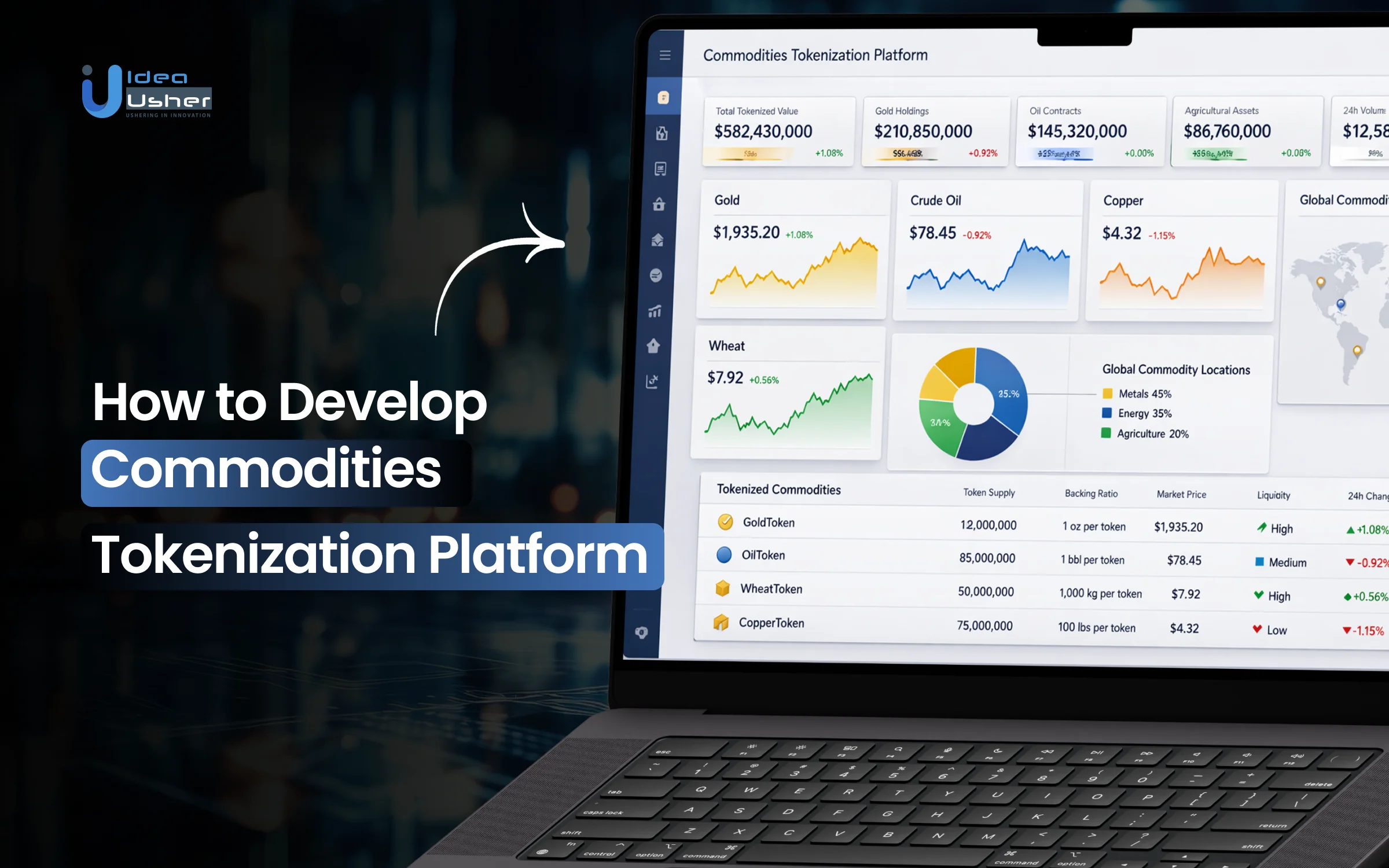
Commodity markets have long struggled with visibility into where assets are stored, who controls them, and whether reported quantities actually exist. As supply chains became more fragile, this gap gradually became a material risk for traders, lenders, and regulators.
Commodities tokenization platforms have gained attention for reducing reliance on fragmented records and delayed reconciliation. Businesses can verify inventory status more reliably and settle cross-border trades faster. Tokenization also makes it easier to enforce compliance rules at the transaction level. By linking physical commodities to digital records, ownership and transfers can be tracked in near-real-time.
We’ve developed numerous commodity tokenization solutions, powered by blockchain-based asset tokenization frameworks and oracle-driven proof-of-reserve systems. As IdeaUsher has this expertise, we’re writing this blog to outline the steps for developing a commodity tokenization platform.
Key Market Takeaways for Commodity Tokenization Platforms
According to Dimension Market Research, the global tokenization market is projected to reach USD 3.9 billion in 2025 and is expected to grow at a 19.0% CAGR through 2034, reaching nearly USD 18.8 billion. This growth reflects a growing shift toward digitizing real-world assets, with commodities such as gold, oil, and agricultural products emerging as prime candidates. Commodities tokenization platforms are enabling fractional ownership, continuous trading, and improved liquidity by removing the limitations of physical settlement.

Source: Dimension Market Research
Adoption is accelerating as large financial institutions like BlackRock and JPMorgan actively explore tokenized asset infrastructure, while regulatory clarity in regions such as the UAE and Singapore reduces compliance friction. These platforms allow both retail and institutional investors to gain exposure to traditionally illiquid commodities without handling storage, logistics, or large capital commitments.
Investor interest is also translating into capital inflows, with venture funding reaching USD 1.8 billion last year to support innovation in commodity-backed tokens. Gold-linked assets such as PAXG and XAUT are increasingly integrated into DeFi ecosystems, enabling lending and yield use cases.

What Is a Commodities Tokenization Platform?
A commodities tokenization platform is a digital system that converts real-world assets such as gold, oil, and agricultural goods into blockchain-based tokens. These tokens represent verified ownership or exposure to the underlying commodity and can be issued, traded, and settled with built-in compliance and transparency. The platform connects physical asset verification smart contracts and investor access into a single programmable infrastructure.
Types of Commodities Commonly Tokenized
Commonly tokenized commodities include metals, energy assets, agricultural goods, and ESG-linked instruments. These assets can be verified against real-world reserves or production data. Tokenization may quietly improve liquidity and transparency in these markets.
1. Precious Metals
Precious metals like gold and silver are commonly tokenized because they are standardized, easily verifiable, and simple to custody in audited vaults. Tokenization enables fractional ownership and near-instant trading while keeping the asset fully backed by physical reserves.
Example platform: Paxos Gold, where each token represents ownership of a specific amount of vaulted gold.
2. Energy Commodities
Energy commodities such as crude oil and natural gas are tokenized through reserve-backed or production-linked models rather than physical delivery. These structures allow investors to gain exposure to energy output or revenue streams in a more liquid and transparent format.
Example platform: Tether Hadron, which provides infrastructure to tokenize energy assets and production-based commodities.
3. Agricultural Commodities
Agricultural commodities such as wheat, coffee, and sugar are tokenized to improve supply chain transparency and expedite trade settlement. Tokens can link harvest data, storage verification, and ownership transfer into a single digital asset.
Example platform: AgriDigital, which tokenizes agricultural commodities to support secure trading and settlement for farmers and buyers.
3. Industrial and Base Metals
Industrial metals such as copper and aluminum are tokenized to support inventory financing and long-term supply agreements. These tokens often represent warehouse-backed stock or contractual delivery rights, helping manufacturers and traders manage supply risk.
Example platform: LME Digital, which explores tokenized representations of base metals linked to exchange-approved storage.
4. Rare Earth and Strategic Minerals
Rare earth and strategic minerals such as lithium and cobalt are tokenized at the reserve- or extraction-rights level due to their limited supply and strategic importance. Strong verification and compliance layers are typically built into these tokens.
Example platform: MineHub, which supports digital asset structures for mining outputs and strategic mineral supply chains.
5. Environmental and ESG Commodities
Environmental commodities such as carbon credits and renewable energy certificates are tokenized to prevent double-counting and enable real-time ownership tracking. This makes ESG assets programmable and easier to integrate into financial and compliance systems.
Example platform: Toucan Protocol, which converts verified carbon credits into blockchain-based tokens for transparent trading and retirement.
How Does a Commodities Tokenization Platform Work?
A commodities tokenization platform links a real asset to a compliant on-chain token. Oracles verify the asset state, enabling the token to be traded or used as collateral. Holders may later redeem the token while legal and inventory records stay aligned.

1. The Physical Asset and Legal Vault
Before anything goes digital, the real-world commodity must be secured and legally ring-fenced.
Step: The physical asset, such as 1,000 kg of copper, is placed in a regulated, insured custodial facility, such as a vault, warehouse, or silo.
Legal Wrapper: A legal entity, often an SPV or Special Purpose Vehicle, takes formal ownership. This establishes a legally binding link between the physical lot and its future digital representation.
2. The Verification and Data Oracle Layer
This is the trust layer where the physical world speaks to the blockchain.
IoT Integration: Sensors for weight, temperature, humidity, and GPS are installed to monitor the commodity status and location.
Proof of Reserve and Audit Oracles: Services like Chainlink Proof of Reserve or specialized supply chain oracles pull verified data from sensors and custodian systems. They cryptographically attest that the 1,000 kg of copper is still present, in the expected condition, and at the recorded location.
3. The Tokenization Engine
Here, the digital twin is created with embedded intelligence.
Smart Contract Minting: A smart contract, often built on ERC 3643 or ERC 1400 for compliance, is deployed. It is programmed with asset-specific details, including quantity, quality grade, custodian details, and legal terms.
Compliance by Design: The token is not a simple ERC-20. It includes embedded rules that allow only KYC-verified wallets, restrict trading by jurisdiction, and ensure total supply remains pegged to oracle-verified physical stock.
4. The Liquidity and Market Layer
The token now behaves like a financial instrument.
Primary Issuance: Tokens are issued to investors through a security token offering or a private placement.
Secondary Trading: Tokens can be traded on permissioned DEXs or regulated ATS platforms that respect built-in compliance rules.
DeFi Integration: Tokens can be deposited as collateral in RWA-focused DeFi pools such as Aave Arc to borrow stablecoins. This creates instant liquidity against physical inventory.
5. The Redemption and Lifecycle Management Layer
This completes the loop from digital back to physical.
Burn for Delivery: A holder initiates redemption by burning tokens through a smart contract.
Automated Workflow Trigger: This activates an off-chain legal and logistics process.
- The custodian is notified.
- The commodity is segregated and prepared for shipment.
- A logistics oracle, such as a digitally signed bill of lading, confirms dispatch.
Only after these confirmations does the smart contract finalize the burn and update ownership records.
Asset Consumption and End of Life: For consumable commodities, the platform manages token retirement once the underlying asset is sold or used in production.
How to Develop a Commodities Tokenization Platform?
To develop a commodity tokenization platform, the process should begin with linking digital tokens to verified physical assets and clear legal ownership. Compliance-aware smart contracts can then be implemented to control issuance, transfers, and redemption securely.
We have delivered multiple commodity tokenization platforms, and this is the process we typically follow.

1. Asset and Infrastructure Mapping
We start by identifying which commodities can be tokenized and how they are stored and verified. This includes mapping warehouses, custodians, insurance coverage, and audit standards so each token is anchored to a clear physical and operational setup.
2. Legal Asset Structuring
In this step, we design the legal framework that links physical ownership to on-chain tokens. We structure SPVs or similar claim models and align them with smart contracts to ensure token holders have enforceable rights tied to the underlying commodities.
3. Compliance-First Token Design
We then build tokens with compliance embedded directly into their logic. By using standards such as ERC-3643, we apply KYC rules, jurisdiction checks, and transfer controls so regulatory requirements are enforced automatically at the protocol level.
4. Physical Data Integration
At this stage, we connect real-world data to the blockchain. Inputs from warehouses, IoT devices, and pricing feeds are delivered through oracles, keeping inventory status and valuation in sync with the on-chain state.
5. Automated Redemption and Settlement
We design smart contract flows that manage redemption end-to-end. Token burns, payments, custody release, and logistics confirmations are automated to reduce delays and operational risk for all parties.
6. Liquidity and Market Access
Finally, we enable controlled liquidity by integrating trading and financing mechanisms. Secondary markets, lending, and collateral use cases have been added to ensure tokenized commodities remain active assets while remaining compliant and securely backed.
Designing Token Economics for Traders and Commodity Holders
Token economics should stay tied to real commodity value while allowing liquid trading layers. The design can separate ownership from liquidity, keeping producers stable and traders active. When done carefully, it can balance physical trust with financial efficiency.

Core Economic Design Principles
1. The Token Must Represent Real, Uncorrupted Value
Hard Peg to Physical: Each token must be backed one-to-one by a verified and audited unit of the underlying commodity. This is non-negotiable for physical holders who rely on trust and legal certainty.
Dynamic Backing Adjustment: Oracles should be used to adjust the backing ratio when real-world conditions change. This could include grain moisture loss, metal degradation, or wine appreciation over time. These adjustments preserve economic accuracy and long-term confidence for both traders and asset owners.
2. Dual Utility for Financial and Operational Users
The token must support two parallel utility paths.
For Traders and Investors: Liquidity access, yield generation, portfolio diversification, and exposure to real assets without operational overhead.
For Physical Holders such as Producers and Merchants: Working capital access, price hedging, inventory monetization, and supply chain financing without relinquishing ownership.
The Token Mechanics That Bridge the Two Worlds
1. The Base Token as a Digital Twin
A compliance-aware token, such as ERC-3643, that represents direct ownership of a specific commodity lot or grade.
Value for Physical Holders
It functions as a digitally native warehouse receipt. Ownership proof becomes instant and programmable, enabling trade finance, collateralization, and rapid settlement.
Value for Traders
It provides pure commodity exposure without storage, logistics, or counterparty friction. Trading can occur around the clock on permissioned markets.
A useful real-world example is the Moss Carbon Credit Token MCO2, which represents one tonne of verified carbon removal. Each token is fully backed by audited carbon credits sourced from the Amazon.
Environmental projects gain transparent funding, while traders receive a standardized ESG asset whose price reflects real supply and demand for offsets.
2. The Liquidity & Yield Layer Using vTokens
This layer cleanly separates speculative activity from real asset operations. Physical holders deposit their commodity tokens into a verified, insured smart-contract vault and receive vTokens in return. This allows liquidity to circulate without disturbing physical ownership or operational use.
For the Physical Holder
Ownership and price exposure remain intact, but liquidity is unlocked. vTokens can be used as collateral, sold partially, or leveraged for working capital without disrupting physical operations.
For the Trader
vTokens are freely tradable and fully fungible because they represent a claim on a pooled vault rather than a specific commodity lot. This makes them suitable for trading strategies and yield participation.
Yield Generation Sources
- Lending fees from vToken-backed borrowing
- Transaction fees from secondary market trading
- Physical lease income when commodities are temporarily allocated to industrial use
Yield Distribution: Vault revenue is distributed to vToken holders, while original depositors receive a liquidity premium for supplying the underlying assets.
A strong illustration is Plastiks, which tokenizes plastic recovery credits. Recycling facilities deposit tokens representing recovered plastic and receive liquidity in the form of vTokens.
Brands purchase those credits to meet sustainability targets, while traders supply liquidity and earn yield from market activity. Capital flows directly into real-world environmental impact.
3. Stabilization & Hedging Through Hedge Pools
The Problem: Producers dislike volatility. Traders actively seek it.
The Solution: Dedicated Hedge Pools allow producers to lock in future prices for their tokens. Traders underwrite these positions in exchange for premiums.
The Outcome: Producers gain predictable revenue and cost stability. Traders gain access to structured products with measurable risk and return profiles.
Incentive Alignment and the Flywheel Effect
A well-designed system becomes self-reinforcing.
Phase 1. Onboarding Physical Supply
Producers can be incentivized through discounted inventory financing or reduced platform fees during the first six months. This approach allows stored commodities to quickly transform into productive working capital without forcing early asset sales.
Result: High-quality physical assets are added to the platform, providing a trusted backing for the token economy.
Phase 2. Attracting Liquidity and Traders
Traders can be attracted by offering a boosted yield to early vToken liquidity providers. Structured products such as options or futures built on the commodity token may further increase participation and trading depth.
Result: Deep liquidity pools form, improving price discovery and market efficiency.
Phase 3. Creating Network Effects
Cross-market utility allows commodity tokens to act as collateral across connected DeFi and financial platforms. At the same time, real-world utility comes from partnering with distributors and buyers, enabling tokens to be used directly in physical purchase agreements. Together, this can keep demand active both on-chain and in real trade flows.
Result: The token becomes a preferred medium of exchange and a collateral layer across both on-chain markets and real-world trade networks.
How Do Platforms Handle Fractional Ownership of Indivisible Assets?
Commodity tokenization platforms usually pool identical commodities under a legal entity and issue tokens that track proportional value. The asset stays whole in custody while investors may hold fractional exposure. Physical delivery only happens when enough tokens are combined to form a full unit.

The Core Model
Platforms do not tokenize individual items for retail investors. Instead, they use a Legal Pool or SPV Special Purpose Vehicle model.
Asset Pooling
Instead of tokenizing a single identifiable unit such as Gold Bar A123, the platform bundles 1,000 identical gold bars into a legally segregated and insured pool within a custodial vault. This pool is held by a legally distinct entity such as an SPV.
Tokenizing the Pool
The platform issues digital tokens that represent a fractional and proportional claim on the entire pool, not on any specific bar. If 1,000,000 tokens are issued for a 1,000-bar pool, then one token equals a 0.0001 percent ownership stake in the total pool.
The Legal Foundation: Each token is a digital representation of a share in the SPV that legally owns the physical pool. This structure is what makes fractional ownership legally valid and enforceable.
How This Works in Practice
For example, a vault may hold a pooled inventory of 1,000 gold bars, each weighing 12.5 kilograms, and the bars remain physically indivisible while ownership is represented digitally.
Digital Reality: An investor purchases 10 tokens.
What They Own: The investor does not own a fractional interest in a specific bar. They own a 0.1 percent proportional claim on the total gold held in the legal pool, which is equivalent to the value of one kilogram of gold. Their rights attach to the value and proceeds of the pooled asset.
How Leading Platforms Navigate This
Take Pax Gold as a prime example. It does not tokenize individual bars and instead holds a pooled reserve of London Good Delivery gold bars in Brink’s vaults. Each PAXG token represents one fine troy ounce of gold within that pooled reserve.
Holders own a fractional and undivided interest in the overall reserve while the physical asset remains in institutional-grade custody.
For a more specialized commodity, consider AgriDigital. When tokenizing a grain harvest, the platform does not assign tokens to individual bushels; instead, it issues a digital title token for a defined lot within a certified silo, such as 10,000 bushels of Grade 2 wheat. Farmers or investors can trade fractions of that digital title.
Ownership represents a contractual right to the output of that lot while the commodity is stored as a commercial-scale batch.
The Redemption Challenge
This is the most critical engineering problem because a fractional holder may still need physical delivery. Platforms address this with a tiered redemption engine, where smart contracts manage accumulation, verification, and final asset release once the full units are reached.
Accumulation Phase:
Investors freely buy, sell, and trade fractional tokens on secondary markets.
Redemption Request:
An investor or a group of investors who have accumulated enough tokens to meet a Minimum Delivery Unit, such as tokens representing one full 12.5-kilogram gold bar, can initiate a redemption request.
Smart Contract Orchestration:
The required number of tokens is locked within a smart contract.
The contract verifies the custodian’s proof of reserve for the specific physical unit to be delivered. It triggers the legal and logistical workflow. The custodian segregates the asset, prepares it for shipment, and the SPV updates its ownership records.
Atomic Settlement:
Once a cryptographically signed proof, such as a digital warehouse receipt or bill of lading, confirms dispatch, the smart contract permanently burns the corresponding tokens. The token supply decreases, and the remaining tokens now represent claims on a slightly smaller pool, for example, 999 bars instead of 1,000.
What Happens If an Investor Never Redeems?
For most participants, physical delivery is optional. Investors retain pure financial exposure. Tokens can be traded on markets, used as collateral in DeFi systems, or held as a long-term digital store of value, all without ever interacting with the underlying physical commodity.
This separation between physical custody and digital liquidity enables large-scale fractional commodity ownership.
Top 5 Commodities Tokenization Platforms
We studied how commodity tokenization is being implemented across regulated markets and production environments. Through this research, we identified a few U.S. platforms that approach commodities with strong compliance logic and production-ready architectures.
1. Securitize

Securitize is one of the most established U.S.-based platforms for compliant real-world asset tokenization. It supports commodities such as gold and other physical assets through regulated token issuance, built-in KYC and AML, and access to secondary trading via licensed ATS partners.
2. Polymesh

Polymesh is a purpose-built blockchain designed specifically for regulated assets, including commodities. It embeds identity, compliance, and governance directly into the protocol, which reduces reliance on external compliance layers.
3. Paxos

Paxos is best known in the U.S. for launching regulated, commodity-backed tokens such as gold. Its infrastructure focuses on trust, custody, and regulatory approval, which is critical when tokenizing physical commodities stored in real-world vaults.
4. Sygnum

Sygnum operates as a regulated digital asset bank with strong capabilities in asset tokenization, including commodities. While global in scope, it serves U.S.-linked institutional clients seeking compliant issuance, custody, and lifecycle management of tokenized assets.
5. tZERO

tZERO focuses on regulated digital-asset markets and secondary trading in tokenized securities and real-world assets. For commodities, it plays a key role in the liquidity and trading side rather than raw issuance.
Conclusion
Commodities tokenization platforms are quietly changing how physical assets can be owned, traded, and financed in real markets. For platform builders and operators, this shift should feel practical rather than theoretical, as tokenized rails may gradually replace slow, paper-based processes. With a robust system architecture, a clear compliance layer, and reliable settlement logic, tokenized commodities can transition securely from pilot use to core market infrastructure.
Looking to Develop a Commodities Tokenization Platform?
IdeaUsher can help by designing the asset model and smart contract logic around real commodity behavior. Our team may carefully integrate pricing oracles, custody systems, and compliance layers. This approach can gradually turn physical inventory into secure on-chain assets that scale reliably.
Why partner with us
- Deep Tech Expertise: Over 500,000 hours of coding experience powered by ex-MAANG and FAANG developers.
- Beyond Basic Tokenization: We integrate IoT for real-time proof of reserves and embedded compliance using ERC 3643, along with DeFi composability, so your assets do not just trade, they actively work.
- Full Stack Delivery: From smart contract architecture to redemption logistics, we handle the complex layers so launches happen with confidence.
Check out our latest projects to see how we engineer trust, liquidity, and innovation into code.


FAQs
A1: Development usually starts with defining the asset model and compliance logic. The platform should then integrate smart contracts with pricing oracles and custody systems. Over time, the system can be tested with controlled assets before scaling.
A2: The cost may vary based on scope and regulatory depth. A basic platform could start in the lower five-figure range, while enterprise systems may go higher. Most teams should plan phased investments to manage risk effectively.
A3: Core features include asset onboarding, price feeds, and investor dashboards. The platform should support custody tracking and redemption workflows. Advanced systems may also add lending and reporting modules gradually.
A4:The platform converts a real commodity into a digital token backed by custody proof. Smart contracts manage ownership and pricing logic in near-real-time. Redemption and settlement can then reliably link tokens to physical delivery.


